



Abstract
Individuals higher in grandiose narcissism strive to create and maintain their inflated self-views through self-aggrandizing and other-derogating behaviors. Drawing from the dual-process model of narcissistic admiration and rivalry, we proposed that individuals higher in narcissism may contribute to more competitive and less cooperative conflict processes. We tracked over 100 project design teams from inception to dissolution, gathering data at three time points. We evaluated how team levels of narcissism (i.e., maximum team score, team mean, and team variance) related to latent team means of cooperative and competitive conflict processes. Team mean scores of narcissistic rivalry corresponded to less cooperative and more competitive team conflict processes as teams approached their final project deadline. Our results show how narcissistic rivalry (but not admiration) alters the types of team conflict processes that arise within groups, and is particularly consequential as teams approach major project deadlines.
Team-based models are becoming an increasingly popular way of organizing employees and production as contemporary work becomes more complex and streamlined. In the past 2 decades, time spent on group efforts (e.g., meetings, group work, assisting others) by employees in the workplace has increased dramatically, with some estimates suggesting an increase of 50% (Cross et al., 2016). Despite the popularity of teams, they are not always effective (Allen & Hecht, 2004). Meta-analytic evidence indicates that both the personalities of group members and how teams navigate conflict are important to group functioning (Bell, 2007; DeChurch et al., 2013).
One personality trait that may influence group functioning is grandiose narcissism (Sedikides & Campbell, 2017). Given that narcissists 1 strongly desire social status and engage in a suite of self-aggrandizing and other-derogating tendencies (Grapsas et al., 2020), we argue that team levels of narcissism may shape how teams navigate and work through disagreements. Despite widespread recognition of the social consequences of narcissism, such as ethically questionable decision making (e.g., Campbell & Campbell, 2009; Sedikides & Campbell, 2017), the implications of narcissism for team functioning are not well understood. In the current study, we apply the narcissistic admiration and rivalry concept (NARC; Back et al., 2013), a dual-process model of narcissism, to investigate how teams with higher levels of narcissism might suffer from conflict processes characterized by competition rather than cooperation.
Team Conflict Processes and Narcissism
Group members regularly disagree about their ideas and perspectives on instrumental tasks and objectives, the ways in which tasks should be completed, and interpersonal issues (De Wit et al., 2012). Given that conflict is recurrent and consequential within teams, scholars have called for greater attention to the ways in which teams navigate and work through such disagreements (DeChurch et al., 2013; O’Neill & Allen, 2014; O’Neill & McLarnon, 2018). As such, we focus on team conflict processes, which DeChurch et al. (2013) defined as “members’ interactions aimed at working through task and interpersonal disagreements” (p. 560). Two specific forms of team conflict processes are competitive and cooperative, which are differentiated according to the individualistic versus collectivistic nature of each approach (DeChurch et al., 2013). Competitive conflict processes preserve individuality and focus on individual task completion by members striving to advance their own interests and prove others wrong. In contrast, cooperative conflict processes focus on resolving disagreements in a communal manner and prioritize collective interests. Meta-analytic findings demonstrate that competitive conflict processes are often harmful to team functioning, whereas cooperative conflict processes are positively associated with team member satisfaction and team performance outcomes (DeChurch et al., 2013).
Team members higher in narcissism may alter the conflict processes that arise over a team’s life cycle. Narcissists believe they are superior (Brummelman et al., 2016), dismiss advice from others (Kausel et al., 2015), prioritize self-interests over collective interests (Campbell et al., 2005), and are less likely to support the goals suggested by other team members (Giambatista & Hoover, 2018). Given that narcissists intensely pursue status and are vigilant to status-relevant cues (Grapsas et al., 2020), narcissistic team members may be less likely to accede to others’ viewpoints and perspectives in team conflict situations to avoid diminishing their social standing. Together, these findings suggest that narcissistic tendencies might put teams at risk of experiencing more competitive and less cooperative team conflict processes. Despite the potential costs teams may incur from narcissistic teammates, there are some positive elements to narcissism.
Narcissists can be charismatic, decisive, and confident in their vision for groups and organizations (Galvin et al., 2010). As evidence of the potential upside of narcissism, one study found that team levels of narcissism amplified the positive association between task conflict and business planning performance (Kollmann et al., 2019). Furthermore, narcissists believe they are effective leaders and are perceived to be effective in such roles, at least during the early stages of social interaction (Brunell et al., 2008; Nevicka et al., 2011). As described within the energy clash model (Sedikides & Campbell, 2017), although narcissists can be a source of irritation and conflict due to their self-interested and exploitative tendencies, narcissistic individuals also have the ability to create excitement and change due to their bold and risky strategies (Sedikides & Campbell, 2017). Overall, the social consequences of narcissism are complex, varying based on the length of acquaintance and familiarity as well as on the context. As narcissism is a multifaceted construct, our hypotheses pertaining to how narcissism relates to competitive and cooperative team conflict processes were informed by the narcissistic admiration and rivalry framework (Back et al., 2013).
How Narcissistic Admiration and Rivalry Relate to Team Conflict Processes
The NARC model (Back et al., 2013) highlights two dimensions of grandiose narcissism that differentially influence social behavior and thus are highly relevant to understanding team conflict processes. Narcissistic admiration and rivalry represent two distinct motivational pathways that emanate from the primary goal of maintaining a grandiose self-view (Back et al., 2013). Crucially, the dimensions of narcissistic admiration and rivalry distinguish between the assertive (i.e., social potency) and antagonistic (i.e., social conflict) interpersonal processes associated with narcissism. Despite mounting evidence showing how narcissistic admiration and narcissistic rivalry are linked to distinct intra- and interpersonal processes (e.g., Back et al., 2013; Leckelt et al., 2015), existing work has yet to consider how these dimensions of narcissism map onto team conflict processes.
The narcissistic rivalry pathway is characterized by antagonistic self-protection, which involves aggression, devaluation of others, and supremacy striving (Back et al., 2013). Narcissistic rivalry is associated with more fragile self-views (Geukes et al., 2017), negative views of others (Back et al., 2013), and a desire to disrupt group membership in response to group failure (Benson et al., 2019). Notably, individuals higher in narcissistic rivalry tend to experience more negative social outcomes (e.g., rejection, criticism, distrust) due to their arrogant and aggressive interpersonal behaviors (Back et al., 2013; Leckelt et al., 2015). Individuals higher in narcissistic rivalry may also be more likely to aggressively advance their own ideas and derogate others in group discussions marred by disagreement. As such, we expect that teams with members higher in narcissistic rivalry will experience more competitive conflict processes and less cooperative conflict processes.
Narcissistic admiration is characterized by assertive self-enhancement, which includes grandiose fantasies, striving to be unique, and charm. Unlike the rivalry dimension of narcissism, individuals higher in narcissistic admiration tend to be liked and afforded high status due to their self-assured and dominant behavior (Leckelt et al., 2015). Narcissistic admiration is associated with more positive and stable self-views (Geukes et al., 2017) and a tendency to view ingroup members more positively (Benson et al., 2019). Despite the contrast in the social strategies linked to narcissistic admiration and rivalry, both forms of narcissism are rooted in a desire to maintain a grandiose image and place more importance on status attainment than on affiliation (Grapsas et al., 2020). One possibility is that teammates higher in narcissistic admiration will positively assert themselves and bring clarity to group discussions, which might facilitate more beneficial team conflict processes. Another possibility, however, is that the highly agentic and self-interested orientation of such individuals might hinder collaborative and open discussions among group members (Nevicka et al., 2011). One idea for reconciling these conflicting perspectives is considering that there might be an optimal dose of grandiose narcissism in social interaction contexts. Indeed, moderate levels of grandiose narcissism have been linked to effective leadership (Grijalva et al., 2015) and more creative teams (Goncalo et al., 2010). This suggests that team levels of narcissistic admiration may only incite conflict or preclude cooperation at extremely high levels. As such, narcissistic admiration may exhibit a curvilinear relation with both competitive and cooperative team conflict processes.
Overview of the Current Research and Hypotheses
We studied project design teams over the course of their life cycle (three time points), where group members worked interdependently to generate solutions to complex issues. In this context, conflict is ubiquitous and a necessary function of group performance. We assessed team personality at Time 1 (i.e., team formation), and team conflict processes at both Time 2 (i.e., 4 months into each team’s life cycle) and Time 3 (i.e., approximately 7 months into the team’s life cycle, 2 weeks prior to the project design deadline). Team personality composition has been operationalized by evaluating the aggregated mean level of a personality trait possessed by group members, the maximum (or minimum) score on a trait possessed by a single individual, as well as the diversity of traits within a group (Bell, 2007). Our hypotheses took a maximum-score approach to narcissistic admiration and rivalry due to existing theory focusing on the social consequences of narcissists in team contexts (Back et al., 2013; Sedikides & Campbell, 2017). This approach is recommended for disjunctive tasks (i.e., when a team’s task is to generate and agree upon a solution for a complex problem), according to Steiner’s typology (1972).
Hypothesis 1: The maximum score of narcissistic rivalry in a team will be positively related to competitive conflict processes at Time 2 and Time 3.
Hypothesis 2: The maximum score of narcissistic rivalry in a team will be negatively related to cooperative conflict processes at Time 2 and Time 3.
Hypothesis 3: We expect a curvilinear relation between the maximum score of narcissistic admiration in a team and competitive conflict processes at Time 2 and Time 3. The maximum score of narcissistic admiration will initially be negatively related to competitive conflict processes then it will become positive as narcissistic admiration scores continue to increase.
Hypothesis 4: We expect a curvilinear relation between the maximum score of narcissistic admiration in a team and cooperative conflict processes at Time 2 and Time 3. The maximum score of narcissistic admiration will initially be positively related to cooperative conflict processes then it will become negative as narcissistic admiration scores continue to increase.
Notwithstanding the previous predictions, a meta-analysis found that studies following Steiner’s recommendations (i.e., how decisions to operationalize team personality compositions in a specific way should be informed by the type of team task) did not find stronger estimates for how member attributes related to team outcomes (Bell, 2007). As such, we tested alternative models using mean levels of narcissistic admiration and rivalry as predictors. All hypotheses and analyses, including the a priori plan to evaluate alternative models, were preregistered on the Open Science Framework (https://osf.io/mz6pd?view_only=476208a9a46947dfbb556975faf907ce).
Method
Sample
Members of project design teams were recruited from an 8-month first-year engineering design course at a large Canadian university. Participants completed measures at the beginning of the fall academic term in September (T1; N = 524), 2 weeks into the second semester in January (T2; N = 500), and at the end of the term in March (T3; N = 451). Across all three time points, 407 individuals from 104 teams completed the measures (45.7% White, 24.6% Asian, 29.7% other; 76.2% men; Mage = 18.14, SD = 1.48). Teams had an average of 3.91 members, with no formal leadership positions. Team membership fluctuated as students dropped the course or were reassigned to teams (five students changed teams from T2 to T3). For the analyses assessing the relation between T1 and T2, 472 individuals from 111 teams (M = 4.25 members) completed both personality and team conflict process measures. For the analyses assessing relations between T1 and T3, 424 individuals from 104 teams (M = 4.08 members) completed both personality and team conflict process measures.
Procedure and Measures
The researchers assigned the participants to teams at T1. The only requirement was that the course instructor (who was not involved in the research project) requested that any teams with women must have at least two women in the team (i.e., teams were either mixed-gender or comprised solely of men). As part of a larger study, participants completed a battery of self- and peer-report questionnaires at each time point. In the current paper, we report on the relevant variables and analyses we preregistered. Participants completed measures of narcissism, self-esteem, and an abbreviated version of the Big Five personality traits when the teams were formed (T1). Participants completed the conflict process measures at the midpoint of the team’s life cycle (T2) and near the end of the team’s life cycle (i.e., 2 weeks before the year-end project was due; T3). Throughout the year, the project design teams met regularly to complete team-based assignments for their course grade. In exchange for access to the data, the authors provided two teamwork training workshops to the participants as part of their course curriculum.
Narcissism
Participants completed the Narcissistic Admiration and Rivalry Questionnaire (NARQ; Back et al., 2013), which assesses narcissistic admiration (nine items; α = .77; e.g., “Being a very special person gives me a lot of strength”) and narcissistic rivalry (nine items; α = .76; e.g., “I react annoyed if another person steals the show from me”). Participants indicated the degree to which they agreed with the 18 statements, using a 6-point Likert-type scale (1 = not at all agree, 6 = agree completely).
Self-esteem
Participants completed the Rosenberg Self-Esteem Scale (Rosenberg, 1965), which assesses self-esteem (10 items; α = .87). A sample item is “I feel that I am a person of worth, at least on an equal basis with others.” Participants used a 9-point Likert-type scale (1 = strongly disagree, 9 = strongly agree) to indicate how strongly they agreed or disagreed with each of the statements.
Five Factor model of personality
Participants completed the shortened International Personality Item Pool (mini-IPIP; Donnellan et al., 2006). The mini-IPIP assesses personality using five subscales of extraversion (four items; α = .83; e.g., “I am the life of the party”), agreeableness (three items; α = .54; e.g., “I feel others people’s emotions”), conscientiousness (four items; α = .56; e.g., “I get chores done right away”), neuroticism (four items; α = .52; e.g., “I have frequent mood swings”), and intellect/imagination (four items; α = .66; e.g., “I have a vivid imagination”). Participants were asked to indicate how much they agreed each statement accurately represented themselves. Participants used a 6-point Likert scale (1 = strongly disagree, 6 = strongly agree) to rate each statement.
Team conflict processes
Participants completed the Conflict Management Processes Questionnaire (Barker et al., 1988), which assesses perceptions of conflict processes (i.e., conflict management style) within groups. The 14-item version including the subscales for competitive conflict processes (T2: α = .87; T3: α = .94; “Individual team members demand that I agree to their position”) and cooperative conflict processes (T2: α = .88; T3: α = .92; “Individual team members seek a solution that will be good for all of us”) was modified using a group referent shift approach (Chan, 1998). For each item, participants indicated how much they agreed that the statement applied to their group, using a 7-point Likert scale (1 = strongly disagree, 7 = strongly agree) with seven items for each type of conflict management process. Given the modified version of the questionnaire, we carried out multilevel confirmatory factor analysis at the within-person and between-person levels at Time 2, χ2 (152) = 396.83, p < .001, RMSEA = 0.06, CFI = 0.93, TLI = 0.92, SRMRwithin/SRMRbetween = .07/.15, and then a between-person level-specific model by saturating the within-person level, χ2 (76) = 128.91, p < .001, RMSEA = 0.04, CFI = 0.99, TLI = 0.96, SRMRwithin/SRMRbetween = .01/.16, both of which demonstrated good fit.
Team Member Satisfaction
We also assessed team member satisfaction at the final time point using a single-item measure (“Please indicate your degree of satisfaction with your group members”) on a scale ranging from −3 (very dissatisfied) to 3 (very satisfied). Although this variable was not included in our preregistered analyses, meta-analytic findings demonstrate a robust link between team conflict processes and team affective outcomes (DeChurch et al., 2013). As such, we conducted exploratory analyses to evaluate the degree to which team levels of narcissism were indirectly associated with team member satisfaction via team conflict processes.
Analysis
All analyses were conducted in Mplus 8.4 (Muthén & Muthén, 2017). Regarding missing data, several groups did not have complete participation; not all team members completed every questionnaire. Participants who completed questionnaires at T2 and T3 did not significantly differ in their narcissism scores from those who only completed T1 (T2admiration: t = −0.48, p = .628; T2rivalry: t = 0.54, p = .592; T3admiration: t = 0.30, p = .764; T3rivalry: t = 0.20, p = .840). Specific to the team conflict scores, O’Neill et al. (2018) argued that lower response rates might reflect group dysfunction and thus omitting teams with missing members might systematically bias the results. Following this reasoning, rather than only including teams that provided full response sets from all members, we retained teams that had at least two members that completed the surveys.
To evaluate the hypothesized relations between team levels of narcissism and team conflict processes, all variables were aggregated to the team level. In the initial models, we operationalized narcissism using the team maximum score, which assigns a team score of narcissism based on the highest scoring individual team member. In subsequent models, we tested alternative ways of operationalizing narcissism. The team mean score involves averaging the individual scores to the team level. 2 As a small number of members were assigned to new teams throughout the duration of the course, we computed team personality scores for each follow-up data collection period to ensure team personality scores represented the current members on the team. Consistent with the assumption that conflict processes and team member satisfaction are shared constructs in teams, the ICC revealed substantial between-team variance in cooperative conflict processes (T2 = 12.9%; T3 = 10.1%), competitive conflict processes (T2 = 23.2%; T3 = 18.9%), and team member satisfaction (T3 = 24.2%). We used latent team mean scores for cooperative and competitive conflict processes as well as team member satisfaction, because doing so provides more reliable and accurate parameter estimates (Lüdtke et al., 2008).
As we only assessed conflict at two time points, we focused on time-point-specific estimates of the association between narcissism and team conflict processes—rather than how narcissism predicted changes in team conflict processes across time points. In each regression model, latent team scores of either competitive or cooperative conflict processes were regressed onto the observed mean score of narcissistic rivalry and narcissistic admiration. The first series of regression models included either maximum team scores for narcissistic rivalry (H1 and H2) or narcissistic admiration (H3 and H4) as the predictor of each conflict dimension at T2 and T3. Specific to H3 and H4, we tested curvilinear associations between narcissistic admiration and team conflict processes at both time points. All predictors were grand-mean centered. The next set of regressions used team mean scores of narcissism. As the team maximum score was highly correlated with the team mean score for both dimensions of narcissism (e.g., T2: admiration, r = .58; rivalry, r = .72), and team mean scores accounted for more variance than team maximum scores across all of the tested models, we evaluated the robustness of the parameter estimates for team mean scores of narcissism by including a range of covariates.
Results
Narcissism as a Predictor of Conflict Processes
Descriptive statistics, including correlations among study variables, means, and standard deviations, are reported in Table 1. Regression models were conducted to determine how narcissistic admiration and rivalry related to competitive and cooperative conflict processes. The results for the most complex models are depicted in Table 2.
Descriptive statistics and correlations at the individual level.
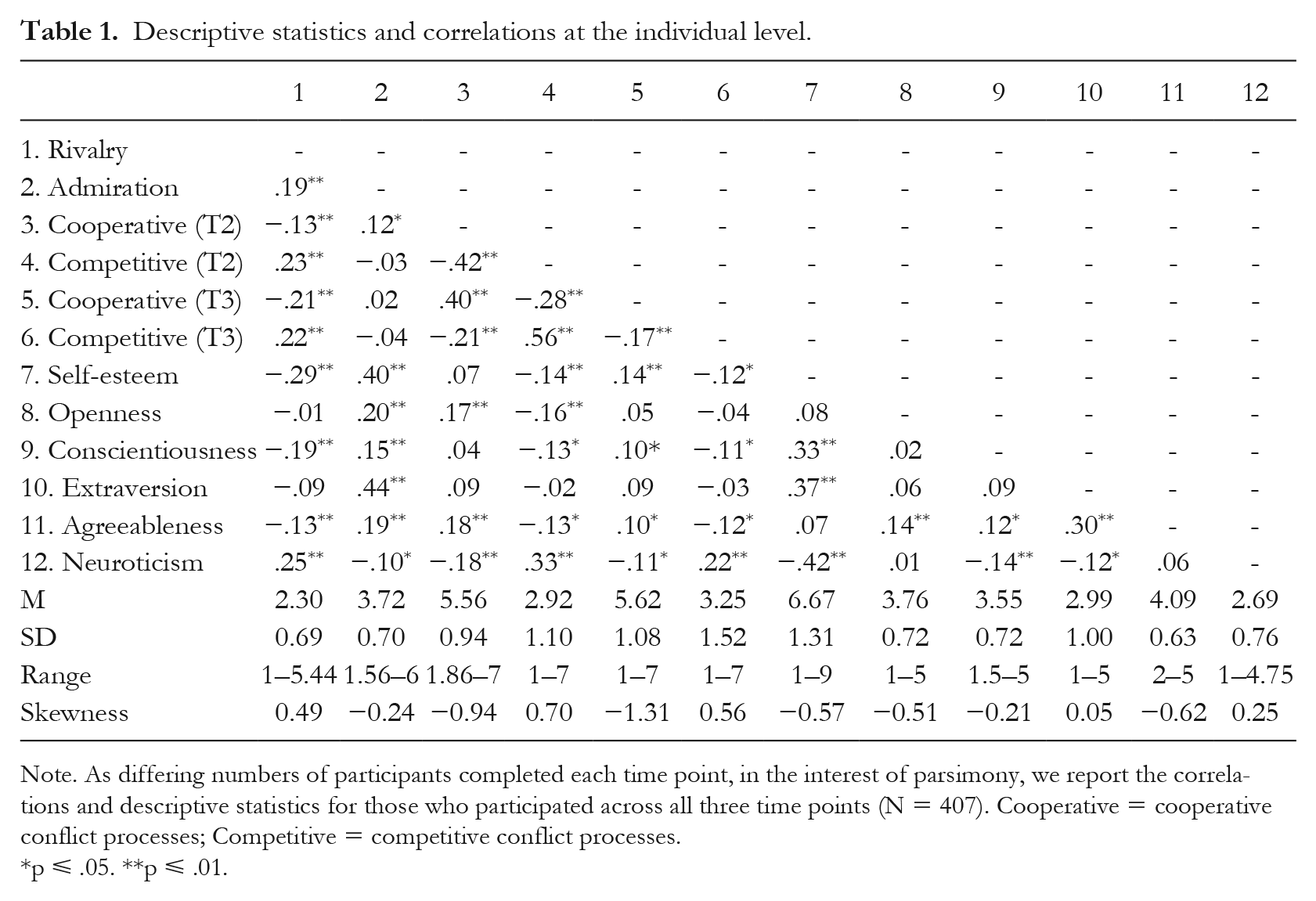
Note. As differing numbers of participants completed each time point, in the interest of parsimony, we report the correlations and descriptive statistics for those who participated across all three time points (N = 407). Cooperative = cooperative conflict processes; Competitive = competitive conflict processes.
p ⩽ .05. **p ⩽ .01.
Team levels of narcissism predicting competitive and cooperative conflict processes.
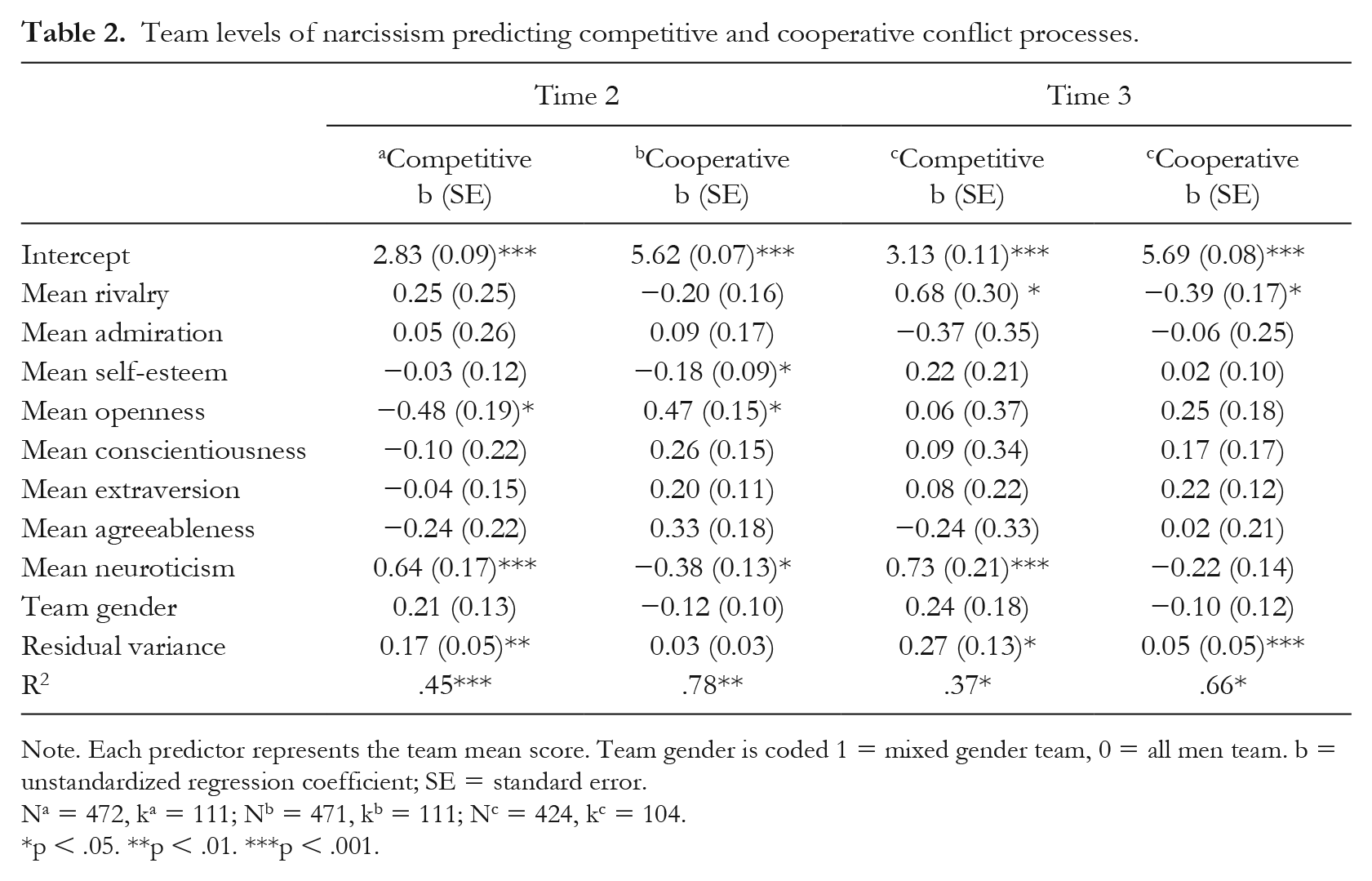
Note. Each predictor represents the team mean score. Team gender is coded 1 = mixed gender team, 0 = all men team. b = unstandardized regression coefficient; SE = standard error.
Na = 472, ka = 111; Nb = 471, kb = 111; Nc = 424, kc = 104.
p < .05. **p < .01. ***p < .001.
Zero-Order Relations Between Narcissism and Team Conflict Processes
We first examined whether team levels of narcissistic rivalry positively predicted competitive conflict processes (H1) but negatively predicted cooperative conflict processes (H2). Maximum team scores of narcissistic rivalry were not significantly related to team competitive conflict processes (T2: b = 0.14, SE = 0.12, p = .277; T3: b = 0.23, SE = 0.19, p = .221) or team cooperative conflict processes (T2: b = −0.04, SE = 0.08, p = .617; T3: b = −0.16, SE = 0.10, p = .085). Operationalizing narcissism using team mean scores, however, revealed a different pattern. Team mean scores of narcissistic rivalry were significantly related to team competitive conflict processes (T2: b = 0.45, SE = 0.20, p = .025; T3: b = 0.60, SE = 0.25, p = .017) and team cooperative conflict processes, but only at the final time point (T2: b = −0.27, SE = 0.16, p = .088; T3: b = −0.52, SE = 0.14, p < .001).
We then examined whether team levels of narcissistic admiration exhibited a curvilinear association with competitive conflict processes (H3) and cooperative conflict processes (H4). Contrary to our hypotheses, none of the quadratic terms for narcissistic admiration were significant predictors of team conflict processes. Thus, we report the linear associations between narcissistic admiration and team conflict processes. Maximum team scores of narcissistic admiration were not significantly correlated with competitive conflict processes (T2: b = −0.09, SE = 0.17, p = .575; T3: b = 0.31, SE = 0.23, p = .178) or cooperative conflict processes (T2: b = 0.09, SE = 0.12, p = .436; T3: b = −0.10, SE = 0.13, p = .430). Likewise, team mean scores of narcissistic admiration were not significantly related to team competitive conflict processes (T2: b = −0.13, SE = 0.20, p = .511; T3: b = 0.14, SE = 0.29, p = .637) or team cooperative conflict processes (T2: b = 0.35, SE = 0.16, p = .125; T3: b = −0.17, SE = 0.20, p = .934). Team variance scores of narcissistic rivalry and admiration were not related to either form of team conflict processes and are not discussed further.
Multiple Regression Models With Narcissism as a Predictor of Team Conflict Processes
We then specified team mean scores of both narcissistic rivalry and narcissistic admiration as simultaneous predictors of team conflict processes. Team competitive conflict processes were positively predicted by team mean scores of narcissistic rivalry (T2: b = 0.58, SE = 0.23, p = .010; T3: b = 0.65, SE = 0.29, p = .024), but were not significantly predicted by team mean scores of narcissistic admiration (T2: b = −0.38, SE = 0.22, p = .089; T3: b = −0.18, SE = 0.33, p = .593). Team cooperative conflict processes were negatively predicted by team mean scores of narcissistic rivalry (T2: b = −0.42, SE = 0.16, p = .009; T3: b = −0.60, SE = 0.14, p < .001) and positively predicted by team mean scores of narcissistic admiration, although there was no significant association at the final time point (T2: b = 0.44, SE = 0.18, p = .014; T3: b = 0.27, SE = 0.21, p = .198).
As shown in Table 2, we then conducted a series of more complex models including controlling for covariates to determine if these associations were unique to narcissism. As teams approached their final project deadline, team mean scores of narcissistic rivalry positively continued to predict competitive conflict processes (T2: b = 0.25, SE = 0.25, p = .317; T3: b = 0.68, SE = 0.30, p = .024) and cooperative conflict processes (T2: b = −0.21, SE = 0.16, p = .194; T3: b = −0.39, SE = 0.17, p = .022). In contrast, team mean scores of narcissistic admiration were unrelated to competitive and cooperative conflict processes at both time points. Out of the covariates, neuroticism was positively related to competitive conflict processes at both time points, but negatively related to cooperative conflict processes at Time 1. At Time 2 only, openness was negatively related to competitive conflict processes, but positively related to cooperative conflict processes.
In addition to our preregistered analysis plan, we examined whether the interaction effect between narcissistic admiration and rivalry predicted team conflict processes. However, the two dimensions of narcissism did not significantly interact in predicting competitive conflict processes (T2: b = −0.41, SE = 0.58, p = .480; T3: b = −0.33, SE = 0.69, p = .631) or cooperative conflict processes (T2: b = 0.38, SE = 0.48, p = .422; T3: b = 0.51, SE = 0.46, p = .262) at either time point. 3
Exploratory Analyses: Team Member Satisfaction
We constructed two mediation models to examine the degree to which team mean scores of narcissistic admiration and rivalry predicted team levels of satisfaction through their association with competitive and cooperative conflict processes. Model 1 specified cooperative conflict processes as a mediator between both forms of narcissism and team member satisfaction. Although neither dimension of narcissism exhibited a significant direct effect on team satisfaction (admiration: b = 0.06, SE = 0.28, p = .840; rivalry: b = 0.48, SE = 0.29, p = .095), cooperative conflict processes were strongly positively associated with team satisfaction (b = 1.88, SE = 0.22, p < .001). Narcissistic rivalry exhibited a negative indirect effect on team satisfaction via cooperative conflict processes (b = −1.14, SE = 0.27, p < .001), but there was no significant indirect effect of narcissistic admiration (b = 0.49, SE = 0.40, p = .221). Overall, the total effect (i.e., the sum of the direct and indirect effects of both forms of narcissism) was nonsignificant (b = −0.11, SE = 0.35, p = .745).
Model 2 specified competitive conflict processes as a mediator between narcissistic admiration and rivalry and team member satisfaction. Neither dimension of narcissism exhibited a significant direct effect on team satisfaction (admiration: b = −0.19, SE = 0.33, p = .559; rivalry: b = 0.16, SE = 0.47, p = .736), however, competitive conflict processes were negatively associated with team satisfaction (b = −1.10, SE = 0.36, p = .002). Neither form of narcissism exhibited a significant indirect effect on team satisfaction via competitive conflict processes (admiration: b = 0.21, SE = 0.38, p = .582; rivalry: b = −0.75, SE = 0.45, p = .097). The total effect was also nonsignificant (b = −0.11, SE = 0.34, p = .759).
Discussion
Drawing from the NARC (Back et al., 2013) and energy clash model (Sedikides & Campbell, 2017), we expected that narcissistic individuals would disproportionately influence the ways that teams navigate and work through conflicts. Using a prospective design that tracked project design teams from formation to dissolution, we found that narcissistic admiration and rivalry differentially related to competitive and cooperative conflict processes. Notably, team mean scores of narcissistic rivalry (but not admiration) were systematically related to collective perceptions of cooperative and competitive team conflict processes. As these team conflict processes have distinct consequences for team performance and affect (DeChurch et al., 2013), our results provide support for disentangling the differential relationships of antagonistic (narcissistic rivalry) and agentic (narcissistic admiration) narcissism.
Our findings suggest that narcissistic rivalry is a key variable for understanding how teams navigate and work through disagreements. Specifically, teams with higher mean scores of narcissistic rivalry experienced lower levels of cooperative conflict and higher levels of competitive conflict as they approached their end-of-term design project deadline. These results only partially support H1 and H2 because we initially predicted that team maximum scores of narcissism would account for variance in both types of team conflict processes, and we only observed support for these associations at the final time point. Nonetheless, the positive linkages between team mean scores of narcissistic rivalry and both forms of team conflict processes remained significant at the final time point when controlling for narcissistic admiration, the Big Five personality factors, and team gender composition. Furthermore, our exploratory analyses revealed that narcissistic rivalry may undermine team satisfaction levels through its negative relation with cooperative conflict processes. Given the demonstrated link between team conflict processes and team affective outcomes (DeChurch et al., 2013), the significant indirect effect observed in the current study supports studying team personality through the lens of an input–process–outcome framework (i.e., narcissism–team conflict processes–team affective outcomes).
As to why narcissistic rivalry was only consequential for teams at the final time point, existing work highlights two potential reasons. First, the negative social consequences of narcissism are more apparent as the length of acquaintanceship increases (Campbell & Campbell, 2009). Indeed, researchers have found that, over time, narcissistic rivalry accounts for increasing displays of arrogant-aggressive interpersonal behaviors and more negative peer evaluations (Leckelt et al., 2015). Second, the final measurement period was shortly before the deadline for the project—a time frame in which teams tend to upregulate their engagement in group processes (Larson et al., 2020). As such, the antagonistic interpersonal style that is characteristic of narcissistic rivalry may have become more apparent as teammate interactions increased in both frequency and intensity with the approaching project deadline. Taken together, our results suggest that team levels of narcissistic rivalry may be problematic for groups due to how rivalrous interpersonal tendencies eventually alter team conflict processes.
In contrast, narcissistic admiration did not predict team conflict processes—either at the midpoint of the project or as teams neared completion. We theorized that the strong desire for status coupled with low regard for communion that are germane to narcissistic admiration would lead to less productive team conflict processes (i.e., more competitive, less cooperative). Failing to support H3 and H4, we did not find support for the maximum score approach (or the mean score approach) to narcissistic admiration operationalization within teams. One exception was a positive association between narcissistic admiration and cooperative team conflict processes at the second time point. However, this linkage was only significant when controlling for narcissistic rivalry, which may reflect statistical suppression. Caution is also merited regarding this specific finding because controlling for shared variance between constructs can introduce difficulties in interpretation (Vize et al., 2018). Overall, this suggests that narcissistic admiration—which predominantly captures the agentic dimension of grandiose narcissism—is less relevant to team conflict processes than its antagonistic counterpart (i.e., narcissistic rivalry; Back et al., 2013). Exploratory analysis similarly revealed that narcissistic admiration was not associated with team satisfaction through either competitive or cooperative conflict processes. Despite running counter to our original expectations, the results align with the notion that narcissistic admiration can be conceptualized as a stable pattern of behaviors that contributes to social potency rather than social conflict. As individuals higher in narcissistic admiration tend to be successful in achieving their social goals (Grapsas et al., 2020), they might be equally savvy in how they approach and navigate moments of conflict within teams and organizations.
The current results support a growing literature adopting a multidimensional approach to studying the social consequences of narcissism. An advantage offered by the NARC framework is that it parses the distinct self-regulatory processes that contribute to the social consequences of narcissism (Back et al., 2013; Campbell & Campbell, 2009). Treating grandiose narcissism as a unitary construct runs the risk of blending the agentic (admiration) and antagonistic (rivalry) elements of narcissism, which may obscure important associations. Indeed, the multidimensional approach taken in the current research may explain why our results diverge from prior work that observed minimal support for the role of narcissism in relation to task conflict resolution (O’Neill & Allen, 2014).
Despite clear theory and strong empirical evidence underscoring the interpersonal consequences of narcissism, it is difficult to determine the ideal way to operationalize team personality. In our study, operationalizing narcissism using the maximum approach yielded insignificant results, suggesting that a highly narcissistic team member may not have the social clout to significantly disrupt group functions. Alternatively, it may also suggest that the effects on conflict processes may only be present when there are multiple narcissists on a team. Future research may investigate conflict processes at the dyadic level, particularly between narcissistic members, and their potential spillover into the team level. Studying the consequences of narcissism within teams is inherently complex because it requires researchers to not only consider how the expression of narcissism impacts other group members, but also the timing of such interpersonal processes, how others’ personality characteristics and the context might attenuate (or amplify) the expression of a trait, and how to integrate information about individual differences among team members in a way that aligns with theory and maximizes explanatory power. A shortcoming of the maximum score approach to operationalizing narcissism is that it only accounts for the personality score of a single team member, which may explain its weak explanatory power.
Nonetheless, as encapsulated by the energy clash model (Sedikides & Campbell, 2017), there may be cases where understanding the narcissism of a single team or organizational member is informative. The energy clash model focuses on how narcissists that emerge as leaders (or enter organizations in leadership positions) are a disruptive social force that can ignite conflict throughout an organization. This model, along with recent work (Grijalva et al., 2019), highlights that narcissists may exert a more substantial influence when they occupy prominent or core roles within a group. That said, narcissists who are forced to occupy a subordinate role may also be problematic due to their strong desire for status and unwillingness to embrace such roles (Benson et al., 2016). As the present study involved leaderless groups with no formal hierarchy, we could not discern the roles occupied by participants, which may be a crucial moderating variable if the goal is to evaluate how a single narcissistic team member alters team dynamics. As such, the nature of the teams in the current investigation may partly explain why average team scores of narcissism emerged as a better predictor of team conflict processes than team maximum narcissism scores.
Limitations and Future Directions
Despite studying ecologically valid teams (i.e., teams working together over a period of months, with high levels of task and outcome interdependence and tangible consequences for poor performance), the sample consisted of students with relatively limited work experience and the teams had no formal hierarchy. As such, future research should consider a variety of occupations and group settings to better understand how narcissism may affect group conflict processes across different contexts. Recognizing existing theory and empirical work on narcissism in organizational contexts (Grijalva et al., 2019; Sedikides & Campbell, 2017), the consequences of a highly narcissistic member may depend on whether they occupy a core role or high social rank within the group.
Another potential limitation is the reliance on self-report measures, which may expose the data to various biases (e.g., Balsis et al., 2015; Kowalski et al., 2018). Using multimethod approaches to evaluate the interpersonal and group consequences of narcissism would be particularly insightful. Notably, behavioral observations of team conflict processes as they unfold in real time would provide insight into how different interpersonal exchanges contribute to the emergence of higher level team processes and states. Although such an approach would necessitate trade-offs (e.g., type of team task studied, acute period of observation), studying behavioral processes would lend insight into the mechanisms that explain why teams higher in antagonistic narcissism tend to engage in less beneficial conflict processes (i.e., less cooperative and more competitive).
Future work should consider the value of an interactionist approach to conceptualizing and measuring how personality characteristics of specific team members interact to affect team processes (e.g., Hardy et al., 2020; Schmidt et al., 2012). Interactionist approaches, such as trait activation theory (Tett & Burnett, 2003), argue that the relation between personality and behavior is affected by the situational context, including group membership (Schmidt et al., 2012). For example, the degree to which a highly narcissistic team member experiences or initiates conflict may vary as a function of their teammates’ levels of narcissism (e.g., Burton et al., 2017).
Although we modeled team-level narcissistic admiration and rivalry composition through three different approaches to aggregation (i.e., mean, variance, and maximum), future researchers may consider other methods of aggregation to model the interaction between individual and team personality composition (Hardy et al., 2020). For example, Peeters et al. (2006) used a dissimilarity index to examine how dissimilarity between each team member’s Big Five personality scores as well as their own personality score interacted to affect individual team satisfaction. Unlike the team variance score approach, this dissimilarity index operationalizes dissimilarity at the individual level as the distance between an individual team member and their teammates on a particular personality dimension. As team dynamics result from the cumulative expression of how multiple team members interact with one another, a related point would be to focus on dyadic conflict processes that occur within teams (e.g., round-robin reports of conflict). This would aid in the understanding of who is experiencing conflict with whom, and if this differs across the group. This would open up a range of analytical opportunities, such as examining whether narcissistic individuals are the source of conflicts, or if their presence catalyzes conflict between other dyads within the group.
Lastly, although we used a prospective design, tracking team conflict processes across three or more time points (and shorter intervals) would provide insight into the temporal dynamics of how narcissism relates to team processes. A final point to consider would be evaluating the intrateam consequences of collective narcissism. Collective narcissism is the concept of ingroup identification and ingroup bias (Golec de Zavala et al., 2009). Specifically, the belief that one’s group cannot be matched by any other group in greatness. Groups high in collective narcissism (i.e., believing their group is better than others) may deal with conflict in a different manner than the groups presented in this research.
Conclusion
Drawing from the dual-process model of narcissistic admiration and rivalry, the present study offers insight into how team mean scores of narcissistic rivalry predict teams’ use of competitive and cooperative conflict processes over time. Narcissistic team members may be prone to using conflict processes to match their grandiose self-view maintenance strategy (e.g., advancing their own self-interests, maximizing ingroup status, and/or undermining others’ status). Given meta-analytic findings suggesting that team conflict processes are connected to both team performance and affective outcomes (DeChurch et al., 2013), it is notable that teams with higher levels of narcissistic rivalry suffered from conflict processes characterized by competition rather than cooperation.
