




Abstract
In many countries, COVID-19 has amplified the health, economic and social inequities that motivate group-based collective action. We draw upon the SIRDE/IDEAS model of social change to explore how the pandemic might have affected complex reactions to social injustices. We argue that the virus elicits widespread negative emotions which are spread contagiously through social media due to increased social isolation caused by shelter-in-place directives. When an incident occurs which highlights systemic injustices, the prevailing negative emotional climate intensifies anger at these injustices as well as other emotions, which motivates participation in protest actions despite the obvious risk. We discuss how the pandemic might shape both normative and non-normative protests, including radical violent and destructive collective actions. We also discuss how separatism is being encouraged in some countries due to a lack of effective national leadership and speculate that this is partially the result of different patterns of social identification.
Keywords
Despite widespread “shelter-in-place” orders, collective protests in the United States ranged from mostly (unmasked) White participants gathering outside state legislatures to demand an end to these orders, to more ethnically diverse participants marching in city streets to demand an end to racial violence and police brutality (Andone, 2020; Burch et al., 2020). These protests illustrate the extent to which COVID-19 has revealed and amplified shared grievances and sharpened group boundaries (see Marshburn et al., 2021, for a discussion of racial bias during COVID-19). However, in other countries such as Canada and Italy, COVID-19 has inspired national unity and shared sacrifice (Beauchamp, 2020; Horowitz, 2020). In this article, we draw upon the SIRDE/IDEAS model of social change to suggest how the pandemic might affect people’s reactions to group-based disadvantages and their willingness to engage in different types of collective action.
The SIRDE/IDEAS Model of Social Change
At the heart of the Social Identity, Relative Deprivation, Efficacy (SIRDE) model of social change is disadvantaged group members’ identification with their group, which often is an important part of their collective self-concept (Grant et al., 2015). The model emphasizes two sets of pathways through which such identification motivates participation in protest actions (Figure 1). These pathways emphasize how a concern for justice for the disadvantaged group is the central motivator of social change and stands in contrast to the perspective that collective action is a group coping response (see van Zomeren et al., 2012). First, emotions of anger and resentment are sustained by a strong group identification if group members believe that their group is treated unfairly by society (perceived discrimination). These emotions fuel the desire to rectify this injustice (the identity -> emotions -> protest actions pathway and the perceived injustice -> emotions -> protest action pathway). Second, disadvantaged group members who have a strong group identity are most likely to notice and act upon a perceived injustice suffered by their group and believe in their group’s willingness and capacity to advocate for social change (the identity -> perceived injustice -> protest actions and the identity -> perceived injustice -> perceived efficacy -> protest actions pathways). It is how the pandemic affects the first set of pathways involving intergroup emotions that we emphasize in this article.
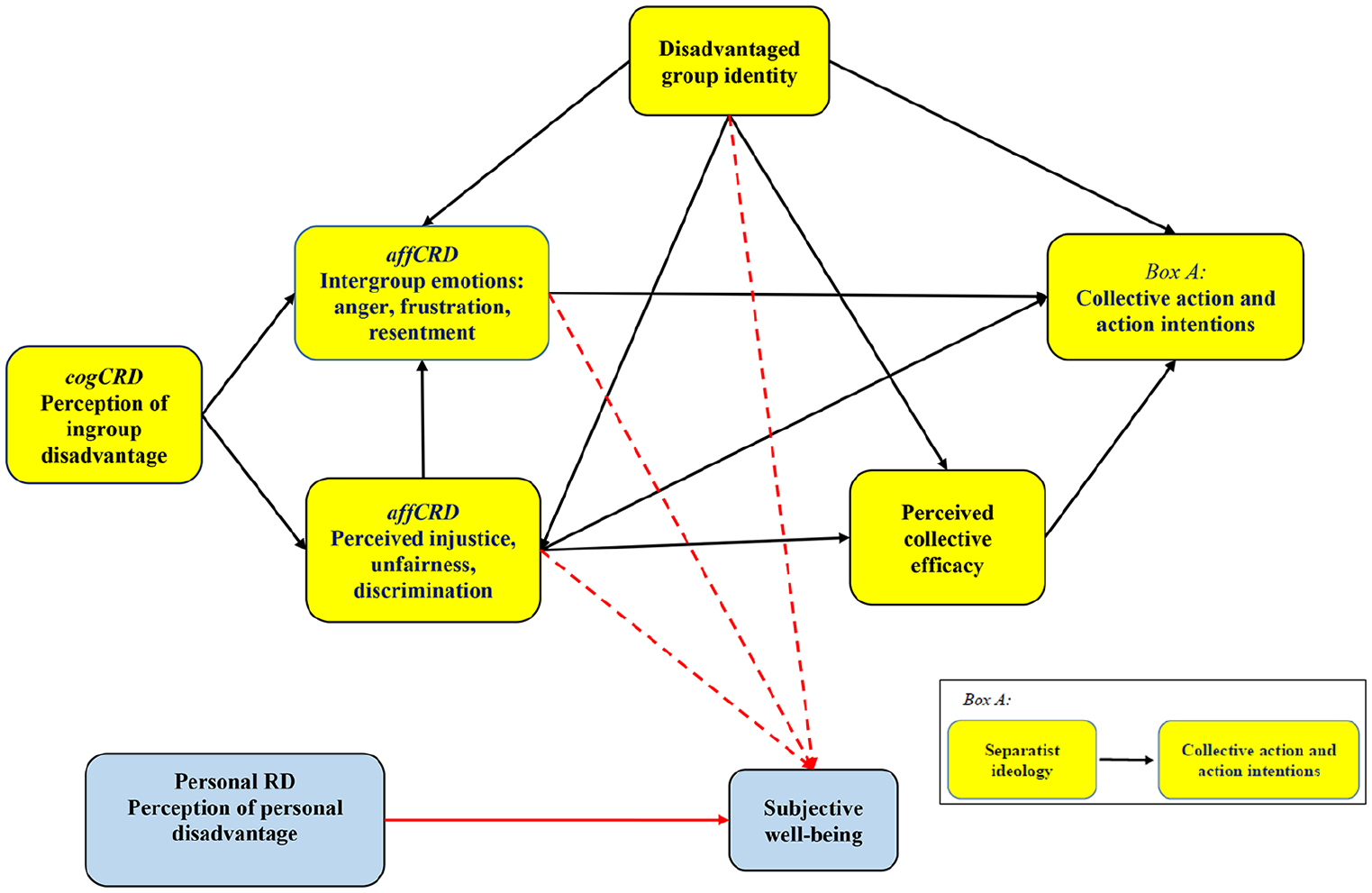
SIRDE is depicted with yellow boxes connected by black arrows. The dotted red arrows depict how subjective well-being is influenced by social identity and affective relative deprivation (IDEAS). The solid red arrow depicts the influence of personal RD on subjective well-being. When activism is motivated by separatism, Box A is replaced by separatist ideology which then is the only proximate motivator of collective actions and action intentions as shown in the boxed insert.
Early relative deprivation research separated personal relative deprivation as the product of undeserved interpersonal comparisons from collective relative deprivation. However, the Identity-Deprivation-Efficacy-Action-Subjective well-being (IDEAS) model, as an extension to the SIRDE model, proposes that a strong group identity can directly and positively affect well-being while also indirectly affecting well-being negatively because of heightened perceptions of injustice and more intense negative intergroup emotions (Abrams et al., 2020). This extension is important because the pandemic illustrates the extent to which people’s individual experiences are intertwined with their group memberships. The disease is more prevalent and its consequences are more severe within segments of society with more limited access to adequate care and treatment (e.g., Indigenous people, African Americans, older people). Further, the pandemic highlights the occupational health risks that are associated with being an “essential worker” as well as the sudden economic problems faced by many in the service industry. These occupational categories have become new sources of shared social identities that are the targets of unfair treatment (similar to the emergence of opinion-based groups; Thomas et al., 2009). The pandemic also may have recalibrated the personal risks and benefits associated with protest. Although protest participation could increase health and other risks, the pandemic has focused attention on serious inequities faced by disadvantaged groups which demand redress.
Intergroup Emotions During the Pandemic
To experience collective relative deprivation is to believe that the ingroup is treated unfairly and feel the intergroup emotions of anger and resentment at this treatment; two separate measures of affective collective relative deprivation. Results from a comprehensive quantitative review show that both types of measures predict collective protest intentions and actions, although the studies included in this meta-analysis used either one or the other (Smith et al., 2012). The contribution of the SIRDE model was to postulate that both should be included because they are separate, but related, components of affective relative deprivation (Grant, 2008).
This choice also reminds us that group members can react to injustice with, for example, fear, sadness, or contempt, and not just anger and resentment (Becker & Tausch, 2015; Osborne et al., 2012). Even though people may agree that their group is deprived, different emotional reactions and their regulation in service of group goals should motivate different types of individual and collective behavior (Goldenberg et al., 2016). The implication for the SIRDE/IDEAS model is clear. Any negative intergroup emotions evoked by social injustices may fuel protest actions, and these injustices may be particularly salient during the pandemic. For example, contempt, not anger, can motivate group members to pursue non-normative violent protests if they believe that their group’s ability to effect social change is low (perceived collective inefficacy; Becker & Tausch, 2015). Mackie and Smith (2018) echo this view although they suggest that it is hatred – a potent mix of anger, contempt, and disgust – which provides the emotional driver for political violence. The pandemic and associated shelter-in-place orders are likely to have intensified this reaction by persuading more members of certain disadvantaged groups that, collectively, they have little real power to protect their communities from the illness and economic hardship. For members of small extreme groups, then, hatred of those who perpetuate inequalities against their group in society may be inflamed by the feeling of powerlessness evoked by the pandemic, leading them to plan and participate in destructive acts of violence more frequently. This might be one of the reasons small groups of protesters chose to loot stores and burn police cars in the aftermath of yet another act of police brutality, while the majority of protestors choose to advocate for real social change in peaceful ways (Gafni et al., 2020). The former are expressing their hatred of an unjust system and their inability to effect change, while the latter are expressing their anger at an unjust system and the belief that their actions can make a difference.
Although rarely considered in models of collective action, collective grief also can motivate protest actions if it is strongly associated with a salient injustice. This is particularly likely during the pandemic because so many have suffered through the illness and loss of loved ones; a circumstance in which personal grief mingles with and amplifies collective grief. For example, the Milwaukee Bucks, a US national basketball team, responded to the shooting of Jacob Blake, a black man, by police in Kenosha, Wisconsin by refusing to play – not because they had a specific demand, but to express their grief and distress (Goldman, 2020). Their action (echoed by the choice of many other professional sports teams to boycott their respective games) reminds us that collective protests have both instrumental and expressive functions, and that, during the pandemic, people may respond to grief both by seeking out others for support while also joining them in civil unrest, especially given the extent to which COVID-19 prevents more usual ways to grieve.
Emotional Contagion
It has long been known that emotions are contagious. At the interpersonal level, research has indicated that a person interacting with an individual who is experiencing an emotion tends to mimic that individual’s facial expressions, bodily movements and posture, which then engender that same emotion. This is not simply an automatic response to muscle movements, but rather is an attempt to act appropriately within a particular social context. The person who is experiencing the emotion sends a social cue to others in that social setting regarding what feelings are normative (Hatfield et al., 2014). At the intergroup level, “evidence suggests that intergroup emotions share the same physiological, embodied, and motivational properties as individually experienced emotions” (Mackie & Smith, 2018, p. 3). Further, intergroup emotions are experienced most intensely by group members who strongly identify with their group, especially those specific emotions which are normative within a particular intergroup context.
During a pandemic, everyone experiences more negative emotions. Simply knowing more people who have fallen ill is likely to create anxiety and stress, and to experience grief at the loss of a loved one to COVID-19 evokes a much more intense and long-lasting mixture of negative emotions. However, negative emotions among members of disadvantaged groups are likely to be more frequent and severe. Proportionately more disadvantaged group members have low-paying jobs such as grocery store workers, nurse’s aides, and janitors, which place them at risk of contracting the virus and, at the same time, provide less access to adequate health care and paid leave. Such people face a dilemma: either continue to work and receive a wage, or quit and receive some form of social assistance. In countries that do not provide an adequate social safety net, many choose to continue working and, consequently, contract COVID-19 more frequently. Hence, we argue that the negativity created by the pandemic may amplify the anger and resentment of activists who claim that social disparities are disproportionately affecting the health and economic well-being of their disadvantaged group. Further, their anger and resentment are more likely to be heard and to become a normative emotional reaction within the group if the pandemic highlights and amplifies these injustices, strengthening and intensifying the perceived injustice -> emotions -> protest action pathway in SIRDE. Further, the IDEAS model suggests that the intensification of feelings of anger and resentment will negatively affect the well-being of individual group members and deepen their negative feelings further.
Social Media and Activism During the Pandemic
Because shelter-in-place orders limit social opportunities, the pandemic emphasizes how important social media is for people to find others who share similar views and emotional reactions. In their analysis of 44,620,175 tweets associated with the Black Lives Matter hashtag, Freelon et al. (2018) show that single events of police brutality did not always lead to increased social media attention. Instead, it required different “influencers” and activists to post and signal the event’s significance. When this happened, posts and memes enabled group members to highlight their group identity and share their emotional reactions to their group’s unjust treatment much more easily than in the past (the identity -> intergroup emotions -> protest and the perceived injustice -> intergroup emotions -> protest pathways in SIRDE/IDEAS). Social media allowed them to rapidly converge on a normative emotional reaction to that incident and then respond with agreed upon protest actions. This process has been documented for people who took part in the Arab Spring protests even when they faced violent repression (Steinert-Threlkeld et al., 2015). The widespread and sustained collective response to the killing of George Floyd, a black man, in Minneapolis, Minnesota by police on May 25, 2020 illustrates this process at work during the pandemic (Burch et al., 2020).
The shelter-in-place orders led many more people to find themselves isolated and dependent on internet-based connections. Given that computer-mediated communication can make social categories more and interpersonal differences less salient (Postmes et al., 2002), the emotional content of the memes and posts that people tend to share is likely to intensify group-based emotions. Hence any negative, group-based emotional reaction to an injustice, such as an incidence of police brutality, is more likely to be amplified by the prevailing emotional climate and sweep through the affected community. Tellingly, disadvantaged groups tend to use alternative news outlets and social media which highlight the issues that their community faces (Chan, 2017). In these outlets, the injustices and plans for subsequent protest actions are juxtaposed against the grim background of the illnesses and deaths caused by COVID-19, contributing to the negativity and outrage at these injustices. The result is that activists should be more likely to be able to use social media effectively to generate broad support for protest actions during the pandemic motivated by these intense shared emotions. Theoretically, the implication is that emotional contagion during the pandemic is likely to strengthen and intensify the perceived injustice -> emotions -> protest action pathway in SIRDE/IDEAS.
Radicalism During the Pandemic
The role of ideology is an important facet of SIRDE/IDEAS. The model distinguishes between political protests by groups advocating for greater social inclusion from protests by those groups advocating for more independence. The protest actions of the former are mostly peaceful and normative, and such actions have been the subject of most research on social protests in the past (see Smith et al., 2012; van Zomeren et al., 2008). The latter, more radical option, is most likely to arise after many years of perceived mistreatment as well as a history which can be interpreted as showing that the group has the capability and resources to flourish independently (voluntary social exclusion). Critically though, such radical action depends upon the development of a separatist ideology. In the SIRDE/IDEAS model, therefore, collective actions in which protestors advocate for equal treatment within society are motivated directly by group identification, intergroup emotions, perceived injustice, and perceived efficacy (Figure 1). In contrast, these same motivators only result in protestors advocating for independence to the extent that they fuel the development of a separatist ideology (Replace Box A with the insert embedded in Figure 1: Abrams & Grant, 2012; Grant et al., 2017). If the pandemic highlights how much a group is disadvantaged in society, then the development of a separatist ideology is more likely, particularly when there is already some support for separatism within the group.
For example, some of the indigenous First Nations in Canada wish for more separation and autonomy so that they can provide more culturally appropriate health care, criminal justice, and education systems for their people. This political reality has become more pressing during the pandemic and, in response, the Canadian government has earmarked special funds for First Nations and Métis communities so that they can each implement their own safeguards to protect their people from the virus (Indigenous Services Canada, 2020). This policy affirms the importance of the cultural identity, while at the same time evoking national identity in a time of crisis. At the same time, US supporters of Aamon and Cliven Bundy (responsible for several armed stand offs with the federal government over land access) entered the Idaho State House to protest mask mandates as part of their long-term efforts to be free from government regulation and intervention (Dawson, 2020); a radical action which emphasizes their strong cultural identity and their struggle for greater autonomy. As Thomas and colleagues (2020) show in their recent analysis of New Zealanders’ opinions, the same model can explain collective mobilization for groups on both the political left and right (see also Kashima et al., 2021, for discussion of cultural differences during COVID-19).
Participation in collective protests also can change and radicalize group members’ social identity if they experience resistance from the authorities to their “legitimate” protest actions (Drury & Reicher, 2009). Participants can feel empowered if they believe that they have at least challenged the authorities and expressed their opposition to an injustice. The accompanying intergroup emotions include anger and resentment at salient injustices which have still not been addressed adequately, but also hope, joy, exhilaration, and euphoria at participating in a collective action which they feel has made a difference. Some recent studies suggest that hopefulness about the achievement of social equality stimulates collective efficacy beliefs which, in turn, increase support for protest actions (e.g., Hasan-Aslih et al., 2019). Perhaps identity change due to the spontaneous alignment of group norms, emotions, shared beliefs, and actions during a protest creates this sense of empowerment as the work by Thomas and colleagues would imply (Thomas et al., 2009). During the pandemic, feeling such joyous emotions in unity during a protest may stand out all the more. Such emotions, along with anger and resentment at continuing injustices, may motivate disadvantaged group members to make particularly strong and enduring commitments to sustained actions, particularly if the norms of the group change to support such actions (normative alignment). Anecdotally, this certainly seems to be the case as exemplified by the sustained protests around the world for the “Black Lives Matter” movement.
National Leadership During the Pandemic
The hypothesis that a strong disadvantaged group identity will motivate participation in protest actions is as central for the SIRDE/IDEAS model as it is for other models of collective action (Sturmer & Simon, 2004; Thomas et al., 2009; van Zomeren et al., 2018; van Zomeren et al., 2008). To this point, we have assumed that the pandemic increases identification with such a group. However, what if group members identify more with their nation than their deprived group during the pandemic? Interestingly, the media has spotlighted examples of the differential effectiveness of leaders from different countries and has paid close attention to those who are doing particularly well versus those who are doing particularly badly.
One interesting observation that is relevant to SIRDE/IDEAS is that those leaders who are effective have consistently emphasized the importance of national unity. For example, from the beginning of the pandemic, Prime Minsters Justin Trudeau of Canada and Jacinda Ardern of New Zealand have emphasized through clear messaging that everyone in their countries must work together and follow public health guidelines to combat the virus (Beauchamp, 2020; Penaloza, 2020). As well as bolstering their countries’ health care systems, they have also spent a considerable amount of money on programs to help people who are negatively impacted by the pandemic, including special programs for the most vulnerable in their societies. The result is that the virus has remained relatively under control. We argue that, in response, citizens identify with their country even when they are members of a disadvantaged group, and they act in accordance with national norms during the pandemic. The importance that skilled immigrants placed on their new national identity as they protested to gain full access to the Canadian marketplace illustrates this process (Grant, 2008; Grant et al., 2015).
In contrast, leaders who have done particularly badly, such as Presidents Trump of the United States of America (Beauchamp, 2020) and Jair Bolsonaro of Brazil (Rapoza, 2020), downplayed the severity of the pandemic, disagreed with health experts on safe practices, encouraged people to go to work, and blamed others for the high incidence of the disease. It is in these circumstances that people who are particularly affected by the pandemic feel alienated from their national government and turn to their ethnic/racial/religious community for support. That is, their primary allegiance (identity) is to their cultural group. Then, if health care disparities highlight injustices that adversely affect this group and these injustices are discussed on social media, new, more radical norms supporting protest actions are likely to emerge, and identifying with a disadvantaged group will be most strongly linked to support for protest actions. In addition, the prototypical group members who exemplify these new, more radical norms will be different. The obvious implication is that there is likely to be a leadership change as established leaders will no longer be seen as representing the interests of the disadvantaged group. The subtler implication is that the national leadership will not be seen as representing the interests of the disadvantaged group at all, and schisms will deepen between groups in society (see Antonakis, 2021, for further discussion on leadership during COVID-19). The result is that health disparities among groups are highlighted, and protests by those most negatively affected will mount.
Conclusions
We cannot possibly do justice (pun intended) to the variety of important collective action research and theories in this essay. And of course, our suggestions as to how COVID-19 might shape collective action are speculative, and require appropriate empirical verification. We imagine that the full effects of the pandemic on collective behavior will not be known for some time. However, we are struck by the extent to which the SIRDE/IDEAS model is applicable to the nature and intensity of activism and protest actions around the world during the pandemic. It is encouraging that that the field of intergroup relations is so clearly relevant during the pandemic, even though it is equally clear that we need to understand so much more about this complex social phenomenon.
