




Abstract
Herder–farmer conflicts in West Africa have caused thousands of deaths in recent years. Many conflicts are triggered by localized events that rapidly spiral out of control. What leads specific interpersonal conflicts to scale up into intergroup violence? We propose that such conflicts are rooted in identity and ritual dynamics. We present evidence that participants in Mambila traditions of masquerade initiation in Cameroon report especially strong identity fusion, a visceral sense of oneness with the ingroup. Results showed that men strongly fused to their ethnic ingroup were especially willing to fight and die for it. Overall, our findings provide evidence that when ordinary conflicts develop between groups that differ sharply on ethnic and religious lines, there is grave risk that fused persons will escalate violence. Understanding these processes may inform future development of new strategies to prevent or ameliorate intergroup conflicts of this kind.
Many humanitarian crises, from terrorist campaigns to ethnic cleansing, begin as relatively localized conflicts that spin out of control. For instance, in the southern Adamaoua region of northwest Cameroon, as well as across the border on the highlands of the Mambila Plateau in Taraba State, Nigeria, farmers of Mambila ethnic origin claim that animal herders of Fulbe ethnic origin have made unsubstantiated land ownership claims (Pelican, 2008). The Fulbe herders claim that their grazing routes are long established, and the Mambila farmers are disrupting their livelihoods. Such tensions and disputes have on two occasions in recent years led to large-scale violence in which armed Mambila activists have driven out Fulbe residents, killing people and cattle (for a description of 2001–2002 events, see Gausset, 2005; see Kindzeka, 2017, for 2017 events). With estimates of the 2017 killings ranging from the hundreds to the thousands, and many thousands more displaced as refugees, including kidnapped children (Akpeji & Olaniyi, 2017; Kindzeka, 2017), there is great need to understand the psychological forces responsible for discrete, interpersonal conflicts scaling up into indiscriminate intergroup violence.
To examine these issues, we utilize a recently developed identity-based framework for understanding extreme violence (Swann et al., 2009; Swann et al., 2012). This framework was originally developed to understand why some individuals in groups are willing to make tremendous personal sacrifices, including giving up their own lives as well as harming others, in the name of their group and its members (Swann et al., 2009). The framework has also sought to explain how people develop irrevocably strong ingroup bonds, focusing specifically on the role of group rituals (Whitehouse, 2018; Whitehouse & Lanman, 2014). Given that the parties involved in the Cameroon conflict have strong ethnic ties and rich traditional ritual histories, we began to examine the conflict through this framework.
A growing body of research suggests that a willingness to fight and die for one’s group when it is under attack stems from a psychological process rooted in shared, personally defining experiences (Whitehouse, 2018). In military groups, such experiences are often created through participation in emotionally intense rituals such as hazing and initiation, or even the ordeals of boot camp or frontline combat (Whitehouse et al., 2017). In West African cultures, including Mambila, such rituals traditionally take the form of a masquerade, a frightening but also life-shaping rite of passage that many undergo in childhood (Zeitlyn, 1994). Here, we present evidence that participation in these rituals is associated with a powerful form of group alignment known as “identity fusion” in which the boundary between personal and group identity is rendered porous. For those who have become fused in this way with a group, any attack on their fellows is taken both personally and as an attack on their fused group as a whole, and thus motivates willingness to fight and die to defend the group. We argue that these identity-driven psychological processes help to explain the continual escalation of violence between herders and farmers, but these processes may also be targeted for the development of interventions that could increase the prospects of peace in regions like rural Cameroon. We begin by reviewing the construct of identity fusion, then turn to the question of what produces fusion in the first place.
Identity Fusion
Identity fusion is defined as a visceral sense of oneness with a group (Swann et al., 2009). Each of us has a cognitive representation of our personal identity (i.e., the aspects of self that make me, me) and our many social identities (e.g., religious, ethnic, national identities). Identity fusion theory posits that some people’s representations of their personal identity and a social identity are so intertwined that they experience a sense of oneness between the two (Swann et al., 2012). The fusion construct is related to, but distinct from, other forms of group bonding such as group identification, relational and collective group ties, organizational commitment, and attachment (Swann et al., 2012). Fusion’s closest conceptual cousin is group identification (Tajfel & Turner, 1979; Turner et al., 1987). Unlike the group identification construct, which assumes a hydraulic relationship between the salience of personal and collective identities, identity fusion theory assumes that some people experience a synergy between their personal and collective identity, resulting in feeling that group membership is deeply personal and self-defining (Swann et al., 2012).
The fusion construct also builds on models from the interpersonal relationships literature. For example, the pictorial measure of identity fusion is a modification of Aron’s inclusion-of-other-in-self measure (Aron et al., 1991), similarly portraying one’s personal self as varying in degrees of overlap with another person/group. And as with Fiske’s notion of communal sharing, identity fusion also emphasizes the importance of mutual interdependence and reciprocal strength between individuals, as is common in small, tight-knit groups such as families (Fiske & Haslam, 2005). Indeed, most people experience fusion with their own families (Swann et al., 2014), and fusion with larger groups such as one’s religion engenders a sense of psychological kinship with fellow group members (Buhrmester et al., 2015; Whitehouse & Lanman, 2014). In social interactions, identity fusion may often be communicated via the use of familial language in nonkin groups (e.g., “brothers-in-arms”; Whitehouse et al., 2014), with recent research showing that the use of “fictive kinship” language can increase altruistic behavior toward ingroup members (Abou-Abdallah et al., 2016).
Identity fusion is important because it motivates extreme progroup action (Swann et al., 2009). Past work shows that Libyan revolutionaries in 2011 who were especially strongly fused to their combat unit were most engaged in frontline fighting (Whitehouse et al., 2014). Strongly fused Americans provided the most aid to victims of the 2013 Boston Marathon bombing terrorist attack (Buhrmester et al., 2015). And across 11 countries, persons strongly fused to their home countries reported they were especially willing to sacrifice their lives for their country (Swann et al., 2014).
What Underlies Fusion? The Mambila Masquerade Initiation Ritual
Previous research suggests that identity fusion is rooted in the sharing of essentialized qualities associated with personal and group identities (Buhrmester, Burnham, et al., 2018; Swann et al., 2012). One proposed pathway involves the sharing of self-defining experiences within the group (Whitehouse, 2018). Research on this pathway to fusion has been largely inspired by anthropological studies of so-called “imagistic” traditions, in which rare but emotionally intense rituals, and the imagery they evoke, prompt processes of meaning-making that come to form part of the essential autobiographical self while also being perceived as group-defining events (Richert et al., 2005; Whitehouse, 1995, 2000, 2004). A growing body of experimental research has since linked these imagistic processes to measures of identity fusion and strong forms of progroup action (Buhrmester, Newson, et al., 2018; Jong et al., 2015; Kapitany et al., 2019; Kavanagh et al., 2018; Newson et al., 2018).
Given the importance of identity fusion in motivating progroup action, especially the willingness to fight and die for other members of the group when they come under attack, we sought to explore the role of the imagistic pathway to fusion in driving fusion and intergroup conflict in rural Cameroon. According to past work in this region of Africa, the Mambila male masquerade initiation seems to fit the mold of an imagistic ritual experience. Ethnographic work by Zeitlyn (from 1985 to 2019) suggests that the masquerade involved emotionally intense events that participants typically remembered for the rest of their lives, contributing to both personal and group identities in ways consistent with the shared experiences pathway to identity fusion.
The Mambila Masquerade Initiation Ritual
The Mambila male masquerade (suàgà bɔ̀ sep) occurs annually. 1 During the period of the masquerade, the village in Somie, Cameroon, a cultural and economic hub for the Mambila, is ritually protected from malign forces by a symbolic burial which is also said to ensure fertility. 2 In the weeks preceding the main ritual, the masquerade emerges and goes through the village causing mischief, scattering firewood, and banging on roofs (Zeitlyn, 1994). Women and girls must hide since the sight of the mask is said to cause madness and infertility, as does the sight of the women’s masquerade for men. Each year, some Mambila youths are initiated into the masquerade. It is not only youths: anthropologists and at least one curious Catholic priest have also been initiated, as witnessed by the second author. Some men who were away from the village at a distant school may join much later. Young boys from the age of about 5 or 6 are taken annually into the enclosure near the chief’s palace where the suàgà rites take place out of the sight of women. As they enter the enclosure, they are surprised in a mock “attack” by the masquerade whereupon they flee screaming (see Figure 1). In literal terms, the attacks are not violent: the masquerade figure stands by the fence hidden in the darkness next to the entrance; when the boy enters, the masquerade figure steps out behind them and sometimes puts a hand on their shoulder. The surprise and the sight of the sacred figure is enough: it is rare for a young boy to spend more than a minute in the enclosure before they flee screaming, sometimes even forcing their way through the fence if their route to the entrance is blocked by others (Zeitlyn, 1994). As they get older, they clearly know what is in store for them: some hide and when found are dragged by their fathers or elder brothers to the enclosure where the ritual scaring is repeated, and although they clearly know what they can expect, this does not diminish the terror they experience. What initiation into the masquerade marks is the shift from being frightened to being one of the frighteners, no longer being attacked by the mask but now a party to its secret and one of those who conspire to scare the children (Zeitlyn, 1994). Once initiated, they are no longer terrorized. They now participate in the rituals inside the enclosure to protect the village. They now also participate in the night-long singing and dancing round the fire in the center of the enclosure that follows the symbolic burial of the village (Zeitlyn, 1994).
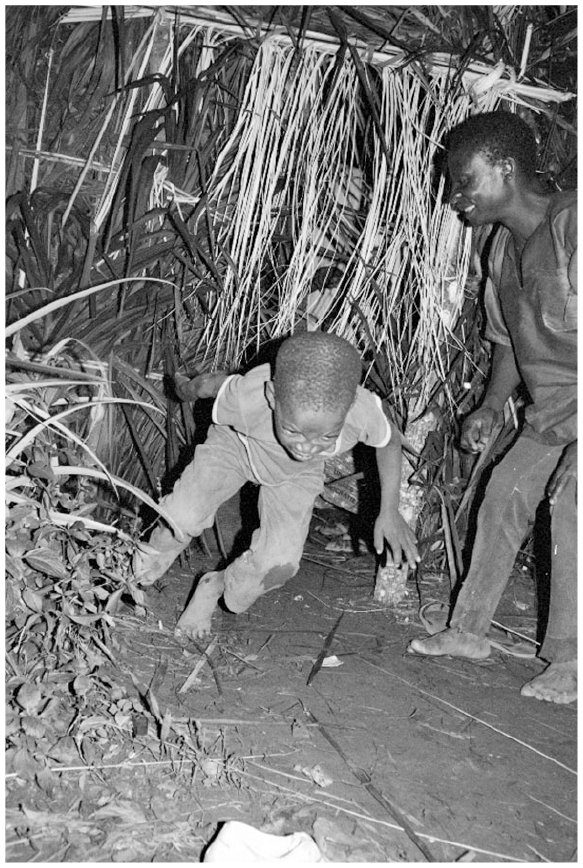
Mambila boy fleeing in fear during suàgà as an elder watches.
Overall, the Mambila masquerade, according to past ethnographic accounts, appears to contain core elements of an imagistic ritual. Imagistic rituals are emotionally intense and infrequent. The ritual’s rarity and emotional intensity (e.g., evincing fear, pain, etc.) promote the formation of flashbulb-like episodic memories (Whitehouse, 2004). Such autobiographical memories are vividly recalled and serve as the foundation upon which a process of meaning-making occurs (Newson et al., 2018; Richert et al., 2005; Whitehouse, 2000). Over time, this meaning-making process results in a sense that the memory is personally self-defining and defining for other group members as well (Buhrmester, Burnham, et al., 2018). And since the emotional experience has been shared with fellow initiates, people tend to assume the event was similarly defining for others, resulting in a feeling of local fusion with coinitiates, which over time can extend to all members of the group (Páez et al., 2015; Swann et al., 2012; Whitehouse, 2018).
Compulsory participation is also a key aspect of an imagistic ritual (Whitehouse, 1996, 2004). Typically, family members, group leaders, or group traditions more generally mandate participation. Compulsory participation is important, as it diminishes the potential for cognitive dissonance—a potential alternative psychological account of the effects of dysphoric rituals (see Newson et al., 2018, for a discussion). Amongst the Mambila, fathers or other elder male kin take the boys to the suàgà enclosure, and sometimes this is done by force. However, participation is not made compulsory by the larger community in a formal sense—family members are left to decide whether to have their children initiated. Such decisions are likely made for a number of reasons, such as whether the father himself had been initiated, practical abilities to attend the initiation, and varying views on the utility of the initiation.
In precolonial times, imagistic initiation rituals of this kind would likely have given the group an edge on intergroup competition over groups that lacked imagistic rituals (Sosis et al., 2007; Whitehouse et al., 2017). One possible explanation for this is that groups aligned through imagistic practices would be more likely to stand united on the battlefield, despite strong incentives to run away or free-ride on the efforts of fellow fighters. In human evolutionary history, military cohesion would have conferred survival benefits under conditions of intergroup competition (Whitehouse et al., 2017).
The Mambila masquerade initiation also conforms to a model described elsewhere as imagistic “rites of terror” (Whitehouse, 1996, 2000), exemplified by the Orokaiva tradition of northern Papua. Orokaiva children undergo a lengthy initiation process, including a ceremony in which they are chased and attacked while blindfolded by their elders as part of a stepwise process in which the novices are transformed from a state of victimhood into fully initiated warriors. Like men’s suàgà, the Orokaiva’s initiation encompasses multiple stages, not all of which are necessarily traumatic. But all those who go through the process must, by definition, have experienced the terrifying experience of being chased and tormented.
Initiation rites of terror are found in many kinds of groups globally, not just in relatively isolated traditional cultures. For instance, many neighborhood and prison gangs engage in ritual, severe beatings of initiates that serve as rites of passage into full ingroup membership (Vigil, 1996). Such gang initiations serve to solidify bonds primarily with fellow gang members, usually most or all of which have been similarly initiated, and are thought to more broadly increase identification with ethnic ingroups, as many gangs are ethnically homogenous and value ethnic heritage (Bloch & Niederhoffer, 1958). Extreme initiation practices are also common in military groups, university fraternities and sororities, sports teams, and beyond (Allan & Madden, 2012; Hoover & Pollard, 2000; Winslow, 1999). Many of these practices, however, deviate drastically from the imagistic mode, resulting not in greater cohesion but instead in personal trauma and even death (Nuwer, 1990).
The Importance of Imagistic Rituals and Fusion in Intergroup Conflict
High levels of fusion, as created by imagistic rituals, lead to a variety of personally costly progroup outcomes. Empirical studies have focused on two classes of such outcomes concerning intergroup violence and intragroup support. Under the violence class, studies have focused on groups as varied as armed militia members to football hooligans. For example, research on Libyan revolutionary militia members during the 2011 revolution to overthrow Gaddafi suggested that those who had experienced the horrors of frontline combat became more fused to their fellow brothers-in-arms than even to their own family (Whitehouse et al., 2014). In another context where men often subjectively see themselves as brothers-in-arms—UK football fan groups—research has shown that supporters of teams who have experienced highly dysphoric losing campaigns have been more willing to fight and die for their club than supporters of perennially winning teams, an effect mediated by identity fusion (Whitehouse et al., 2017). In the US, university fraternity members who had undergone dysphoric initiation rituals reported especially high fusion with their group as well as high willingness to fight and die for it (Whitehouse et al., 2017). This pattern of effects also extends to yet another group—Brazilian Jiu Jitsu practitioners—and their belt-whipping initiation (Kavanagh et al., 2018).
Imagistic events and fusion can also produce nonviolent progroup outcomes. For instance, after the gruesome killing of a beloved wild lion named Cecil in Zimbabwe, an event experienced as imagistic by many wildlife conservationists, fusion with a wildlife conservation group soared, and in turn, so too did proconservationist philanthropic giving and political engagement (Buhrmester, Burnham, et al., 2018). After another tragic imagistic event, the 2013 Boston Marathon bombings, people fused to the US were especially likely to have engaged in philanthropic and other victim support actions (Buhrmester et al., 2015). Overall, these studies suggest that fused persons are not necessarily motivated to hurt the outgroup. Instead, they seek to maximally protect and enhance the ingroup, and whether that involves interaction with an outgroup at all depends on the context (Buhrmester, Newson, et al., 2018).
Current Study
Based on the foregoing analysis, we sought to empirically test four central hypotheses related to the dynamics of the Mambila masquerade ritual, identity fusion, and intergroup conflict.
Based on past ethnographic accounts and the descriptive overlap between the elements of the initiation ritual and the core elements of the imagistic mode, we predict that participants experience the Mambila masquerade initiation as imagistic. Specifically, we predict that when prompted to reflect on their past initiation experience, Mambila males will recall it as having been dysphoric, vividly remembered, personally self-defining, and producing strong, kin-like bonds with coinitiates.
Also based on ethnographic accounts and past work on groups who have experienced intense conflicts (e.g., Whitehouse et al., 2014), we predict that overall rates of identity fusion with family and the ethnic ingroup will be very high.
Furthermore, in line with recent work showing that participation in imagistic rituals produces strong identity fusion (Whitehouse, 2018), we predict that the Mambila initiation will be associated with especially strong fusion with family and the ethnic group.
Finally, given past evidence showing that imagistic rituals and identity fusion produce extreme willingness to self-sacrifice for one’s ingroup, we predict that initiation participation and fusion with the Mambila people will be associated with reports of willingness to fight and die for them.
Method
Participants
Research assistants surveyed 398 Mambila males in and around Somie, Cameroon. According to an a priori power calculation, this total sample size exceeded the minimum number of participants required (N > 385) to detect a small-sized effect (f2 = .02) with power at 0.80, p = .05, in a simple regression model. The survey was administered during two separate fieldwork trips to the area, and ethical approval for the study was granted prior to them. Only males were surveyed as part of the study because, historically, females have not perpetrated violence. Interviews were conducted in simple French, and participant responses were recorded in notebooks.
Procedure and measures
Local research assistants from the community invited participants to complete a survey that was generally concerned with their way of life and thoughts about those inside and outside of their community. Participation was voluntary (i.e., unpaid). The only incentive was to aid the researchers in learning about the community’s way of life, and all participants verbally gave informed consent to participate. The survey instrument had several sections described in what follows.
Demographics
Participants indicated their age, place of birth and residence, highest level of education, occupation, nationality, and religious affiliation.
Initiation ritual
Participants were instructed to recall the male masquerade initiation called suàgà or sometimes juju. They were first asked whether or not they had been initiated at a masquerade when they were younger. Participants who had been initiated were then asked the following follow-up questions. To assess the extent to which the ritual was self-defining, participants were asked two yes/no questions: “Did the initiation make you the man you are today?” and “Has your initiation remained important to you?” To assess whether the ritual was recalled as a vivid episodic memory, participants were asked, “Are you able to recall every detail of your initiation?” To assess whether the ritual was intensely dysphoric, participants were asked, “Was the initiation extremely frightening?” And finally, to assess whether the ritual produced strong bonds amongst coinitiates, participants were asked, “For fellow initiates, do you consider them as brothers?”
Identity fusion
Participants completed the pictorial identity fusion measure developed by Swann et al. (2009) twice—once in reference to their family and again in reference to their ethnic group (i.e., all Mambila people). 3 For each group reference, participants were instructed to look at a set of five pictures. Each picture contained a small circle representing oneself and a larger circle representing the reference group. The pictures varied in how much the circles overlapped, from the leftmost picture depicting no overlap, to the rightmost picture depicting complete overlap. Higher values on this measure (1–5 scale) indicate higher fusion with the reference group.
Self-sacrifice
Participants responded yes or no to five questions concerning their willingness to fight and die for the Mambila people. Items were based on a self-sacrifice scale validated by Swann et al. (2009). The items were, “Would you sacrifice your life if it saved the life of a fellow Mambila?”; “Would you fight someone if they threatened a Mambila person?”; “Would you fight someone if they insulted the Mambila people?”; “Would you hurt someone if it helped a Mambila person?”; and “Would you sacrifice your life if it gave the Mambila people great status or reward?”
Results
Demographics
Participants were broadly representative of the region: Mage = 43.49, SD = 13.44, range: 17–95 years; 73% were born in the village of Somie, 93% currently resided in Somie; 68% completed less than secondary school education, 32% completed secondary school or beyond. Nearly all participants’ primary occupation was farming (97%), with 48% listing a second job (modal response: taxi driver); 88% reported their nationality as Cameroonian, 12% as Nigerian; 74% reported their religious affiliation as Christian, 26% as Muslim.
In exploratory analyses, we examined relationships between these demographic variables and other key measures: initiation experiences, fusion, and willingness to sacrifice. In a series of binary regressions with demographic variables as predictors and each key measure as the outcome, we found two statistically significant relationships (p < .05), both for the model with initiation participation as the outcome. In the model, there was an effect of age, B = 0.07, SD = 0.01, Wald χ2(1) = 42.28, p = .0001, OR = 1.05, indicating that older men were especially likely to have been initiated. There was also an effect of religion, B = 0.71, SD = 0.28, Wald χ2(1) = 6.28, p = .01, OR = 2.03, indicating that Christians were especially likely to have been initiated. Both of these findings may suggest that younger generations of parents and children have been exposed to a wider array of outside cultural influences, including global monotheistic religions, that affect decisions to participate in the initiation. This is only speculation on our part, however, as the interplay of ethnicity, traditional local religion, and global religion is a potentially complex dynamic in the region. It will take further qualitative and quantitative research to gain traction on these issues.
Initiation ritual and identity fusion
See Table 1 for descriptive statistics of the survey items concerning initiation experiences and identity fusion. Nearly half of respondents (49%) said they had been initiated. To our knowledge, our survey is the first to estimate this percentage (see the Discussion section for implications). In support of our first hypothesis, a majority of respondents affirmed that the ritual was experienced as imagistic according to the four surveyed facets (i.e., self-definingness, vivid episodic memory, intense dysphoria, and fusion with coinitiates). In addition, mean responses to both fusion scales were near the ceiling of the scale. Thus, in line with past studies of fusion with similarly skewed distributions (Swann et al., 2009), we dichotomized these variables to contrast those totally fused (response: 5) with those not totally fused (response: 1–4).
Initiation and fusion descriptive statistics.
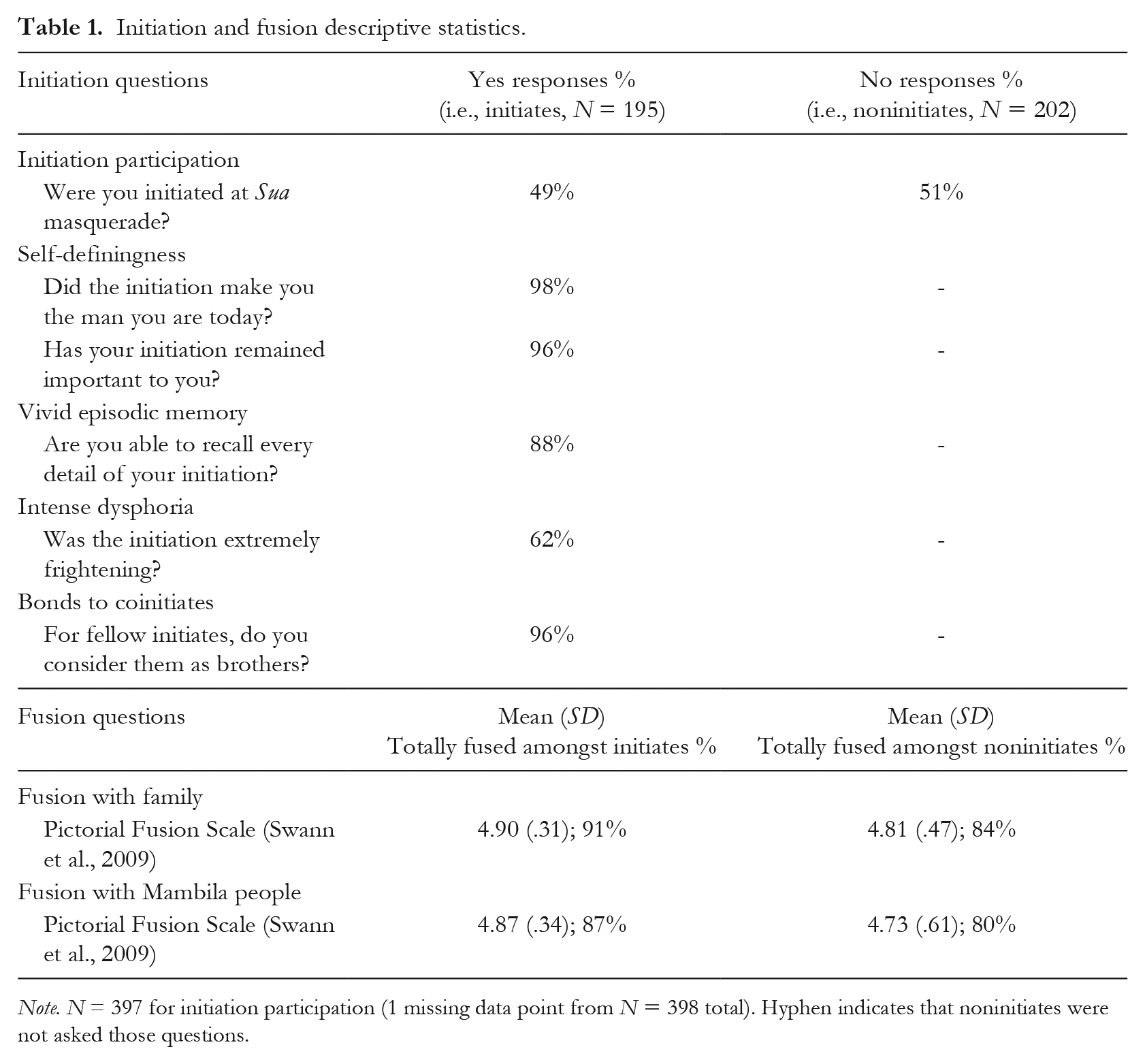
Note. N = 397 for initiation participation (1 missing data point from N = 398 total). Hyphen indicates that noninitiates were not asked those questions.
Ritual effects on fusion
To test the third hypothesis that initiation participation would be associated with stronger fusion with family and the ethnic group, we conducted two chi-square analyses. In line with predictions, more initiates reported complete fusion with family (91%) than noninitiates (84%), χ2(1, 397) = 4.48, p = .034. More initiates also reported complete fusion with the ethnic group (87%) than noninitiates (80%), χ2(1, 397) = 4.00, p = .045 (see also Table 2 for phi correlation coefficients for all main variables of interest). We also explored whether including participant religion and age as control variables changed the observed pattern of effects in multiple regression models; however, these variables did not approach statistical significance in either model (fusion with family as dependent variable [DV] model: age Wald χ2 = 0.86, p = .36, religion Wald χ2 = 0.02, p = .90; fusion with Mambila DV model: age Wald χ2 = 0.21, p = .65, religion Wald χ2 = 0.09, p = .76).
Phi coefficient matrix for main variables of interest.
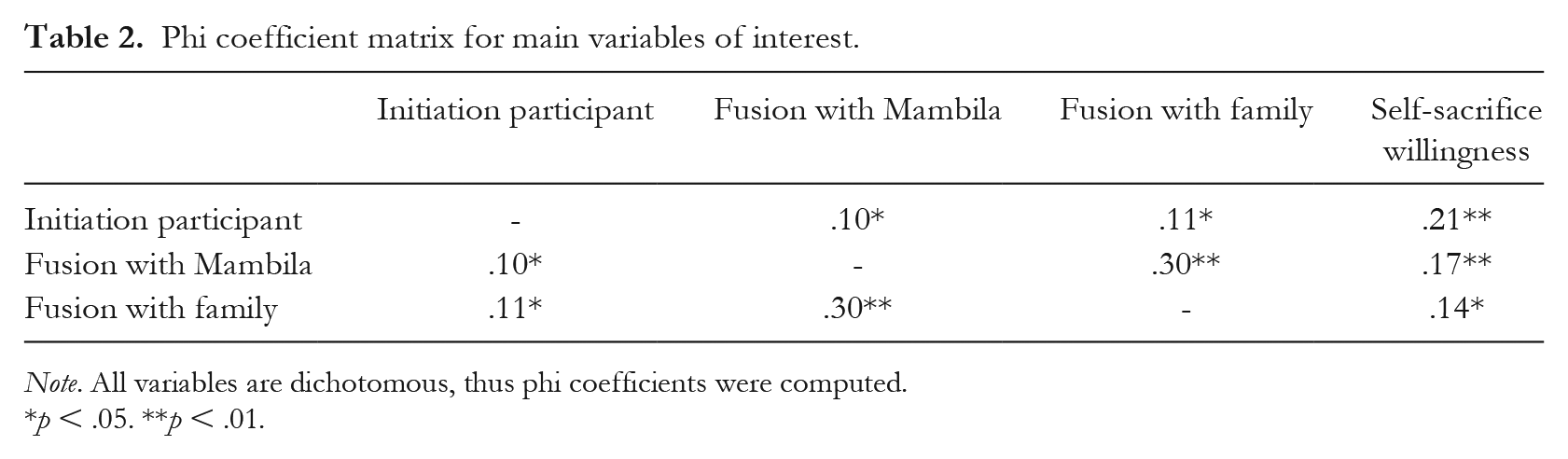
Note. All variables are dichotomous, thus phi coefficients were computed.
p < .05. **p < .01.
Initiation and fusion effects on progroup outcomes
To examine the effects of initiation and fusion on the willingness to fight and die items, we first computed scale means. However, upon inspection, there was a clear ceiling effect in responses. For four of the items, more than 90% of participants responded “yes,” and 84% responded “yes” to the fifth item. Given this, we chose to dichotomize the scale, with participants who answered “yes” to all questions coded 1, and participants who answered “no” to one or more questions coded 0. This resulted in 53% “all yes” responses, and we thus used this computed dichotomous score in our analyses to contrast those expressing absolute willingness to sacrifice (1) with those expressing less than absolute willingness to do so (0). In line with our fourth hypothesis, a chi-square analysis revealed that more initiates reported an absolute willingness to sacrifice (64%) compared to noninitiates (36%), χ2(1, 398) = 17.59, p = .0001. In addition, more men fused to the Mambila people reported an absolute willingness to sacrifice (55%) compared to men nonfused to the Mambila people (45%), χ2(1, 398) = 4.66, p = .03 (see also phi coefficients in Table 2). Finally, we explored whether including participant religion and age as control variables changed the observed pattern of effects in multiple regression models. However, these variables did not approach statistical significance in either model (initiation model: age Wald χ2 = 0.39, p = .53, religion Wald χ2 = 0.01, p = .93; fusion with Mambila model: age Wald χ2 = 0.65, p = .42, religion Wald χ2 = 0.53, p = .47).
Discussion
The results of our survey of Mambila males in Cameroon supported the four main hypotheses. Consistent with Zeitlyn’s (1994) ethnographic accounts of the initiation masquerade ritual, a majority of respondents affirmed that their initiation was experienced as imagistic in nature. Identity fusion levels with family and ethnic community were near the ceiling of the scale, similar to other samples experiencing intense intergroup conflict, such as Libyan revolutionaries (Whitehouse et al., 2014). Importantly, identity fusion and initiation participation were positively correlated, in line with previous research suggesting that imagistic rituals foster especially high levels of fusion (see Whitehouse, 2018, for a review). And finally, consistent with past research linking imagistic rituals and identity fusion to extreme progroup behavior, we found positive associations between a measure of willingness to fight and die for the Mambila people and initiation participation and fusion with the Mambila people. Together, these results extend previous findings to a novel, non-Western (Henrich et al., 2010), ongoing violent intergroup context that, to our knowledge, has not received any prior quantitative research attention. Our results also (a) add to growing literatures linking ritual practices to intergroup conflict, (b) speak to troubling realities in which leaders escalate conflict by making fused identities salient, and (c) provide a jumping off point for exploring possible first steps toward peacebuilding interventions. We turn to each of these points next.
Anthropologists and historians have long argued that imagistic practices generate group cohesion via long-term processes of reflection on the meanings of emotionally intense, life-changing experiences (Martin & Pachis, 2009; Whitehouse & Laidlaw, 2004; Whitehouse & Martin, 2004). Nevertheless, this is the first study to our knowledge to show that participation in an imagistic ritual in childhood is associated with levels of fusion in adulthood (in this case, both with family and with other Mambila). Indeed, on average, a gap of more than three decades separated the experience of initiation from the point at which our survey data were gathered. It is possible that the effects of the masquerade on group cohesion and willingness to defend fellow group members would be even higher during adolescence and early adulthood, especially in all-male groups where testosterone levels run high and competing allegiances to family based on marriage and childrearing have not yet become established. Nevertheless, the effects of initiation are still clearly detectable in later life as well, consistent with the hypothesis that episodic recall and reflection on shared life-changing experiences fuels the fusion process throughout the life course.
In the current context, our results suggest that some involved in the conflict, namely those fused to their ethnic group, could be especially receptive to calls for violence by ingroup members and leaders in the name of protecting one’s ethnic “blood,” as evidence suggests has unfortunately been the case (“Mambila Crisis,” 2017; Olaniyi & Abdulsalami, 2017). The tragic risk is that when those involved in disputes over resources begin to believe that each other’s motives are rooted in beliefs of ethnic superiority, the public discourse around such disputes can quickly become focused not on the actual disputes over resources, but instead on concerns about ethnic cleansing and ethnically-biased responses by policing and justice authorities. Escalation of this type can be found beyond the Mambila Plateau as well. For instance, resource disputes between Fulbe and Gbaya people in east Cameroon in 1991 turned into broader violent outbreaks (Burnham, 1996). Other cases have also been documented in the area where our research took place (on the Tikar Plain, see Gausset, 2005, 2007; for disputes on the Mambila Plateau, see Hurault, 1998; see also Hussain, 2005; Pam, 2018). Thus, as a first step toward achieving stable peace in the region, our analysis suggests that when leaders address these disputes as they arise, they should refrain from discussing them in terms of us-versus-them injustices through the lens of ethnic identities.
Beyond changes to the public discourse surrounding the conflict, our work may speak to future development of targeted interventions aimed at reducing violence. If fusion resulting from imagistic rituals is helping to fuel the escalation of farmer–herder conflicts, then it may be appropriate to explore the feasibility of interventions that could “de-fuse” initiates (see Gómez et al., 2019, for a discussion of de-fusion). For example, since the pathway to fusion in this case involves shared experiences of the masquerade, focus groups for initiated men could be used as a way of bringing to light a diversity of memories and experiences in ways that could reduce perceptions of sharedness and thus erode feelings of fusion that contribute to outgroup hostility. Alternatively, efforts could be made to foster fusion with more peaceful values and shared identities that reflect experiences of both farmers and herders. Regarding the latter, it should be noted that among some Fulbe pastoralist groups there is a tradition of imagistic initiation. These rites (in the Fulfulde language called Soro/Sharo) demonstrate in public a young man’s imperviousness to pain (see review in Aniago, 2012). This suggests that there may be common imagistic experiences between members of groups in antagonistic relationships. Approaches to use such shared experiences could build on interventions currently being developed to reduce violence and recidivism among ex-prisoners (Newson & Whitehouse, 2020). However, any such interventions would likely require the building of consensus and support within both farming and herding communities in rural Cameroon. In principle, this could also give rise to a more widely generalizable toolkit for tackling intergroup violence in a range of social settings around the world. Although such interventions remain some way off, the best hope for developing effective ways of addressing patterns of escalation in intergroup conflict is to look for explanatory variables, in the middle distance between immediate triggers and the grand narratives of history.
As this work represents our first collaborative efforts at gaining insight into the ritual, identity, and conflict dynamics amongst the Mambila, it is not without some limitations. First, although our local research assistants aimed to sample the community broadly and without systematic sampling bias, as with any convenience sample, there is potential for selection bias to be reflected in our results. For instance, it is plausible that, since there was no previously known estimate of the percentage of men initiated in the masquerade, our sample over- or underrepresented initiates versus noninitiates. In addition, since we aimed to collect a large sample, we needed to keep the survey brief. Thus, we were unable to cast a wide net for potential third variables that could account for some of our findings. It will take future empirical work to examine the extent of these issues. In addition, our theoretical model linking ritual experience to fusion and this to extreme progroup action is causal in nature, yet our survey design limits making causal claims. Future experimental research could examine causality more directly by randomly assigning individuals to recall their ritual experiences (vs. recalling neutral experiences) and then capture fusion and other outcomes. Future work could also look prospectively at the conflict, examining how fusion and ritual experiences predict later reports of actual engagement in violence, as it is unclear the extent to which measures of willingness to sacrifice reflect actual violent behaviors. Last, future work will need to more sensitively measure participants’ memories of initiation experiences. In our context, this means crafting questions about initiation experiences that are not potentially leading or socially desirable, thus leading to overestimations. In addition, usage of Likert scales, as opposed to binary yes-or-no responses used in our context in an attempt to simplify response collection and increase clarity, could be beneficial as well.
Future research is also necessary to more fully understand the causal relationships between group bonding and violent actions. The primary perspective we have worked from here considers violent action as a consequence of perpetrators motivated by tight-knit group bonds in response to perceived threats or injustices (see also Swann et al., 2012; Whitehouse, 2018; Whitehouse & Lanman, 2014). However, other perspectives have suggested that engagement in violence can also trigger increased group bonding, leading to a reciprocal cycle (Littman, 2018). We believe that such a cycle is likeliest to occur when the violent action is experienced in line with the imagistic mode. For instance, in Littman’s (2018) work with Liberian civil war combatants, stronger ingroup bonds were found for those men who said they were forced to commit violence. And given that the average combatant was still in his teens, a formative time for personal and group identity development, it seems likely that for many, their acts of violence were transformative in ways consistent with the imagistic mode.
Overall, we hope our investigation here encourages more researchers to seek out collaborations that take them to understudied, non-Western populations and contexts in which empirical theory testing synergizes with real-world problem-solving. As globalization, climate change, technology, and a host of other forces shrink the distances between peoples, there is growing need for researchers to similarly shrink the distances between disciplines to understand our changing world.
