




Abstract
Research has shown that vicarious contact can help to reduce prejudice. We tested the effect of a controlled, video-based vicarious-contact intervention on straight men’s (implicit and explicit) attitudes toward gay men. Findings of Experiment 1 (n = 99 German participants) failed to show direct effects but were in line with the idea that negative (situation-specific) emotions mediate the intervention effect. Experiment 2 (n = 108 U.S. participants) expanded findings: straight men with antigay preattitudes reported less negative intergroup emotions toward gay men after watching the vicarious-contact video (compared to the control condition); and less negative intergroup emotions were related to more positive attitudes toward gay men. For straight men with positive preattitudes, findings were in line with the hypothesis that positive intergroup emotions toward gay men were the relevant mediator. We discuss the moderating role of preattitudes to explain processes underlying vicarious-contact effects.
Keywords
Hate crimes and tensions between groups are prevalent in mass media. We read about them online and in newspapers, hear about them on the radio, and see them on TV. These tensions can be reduced by direct and indirect contact between groups: research has shown that intergroup contact can improve intergroup relations by diminishing prejudice, improving attitudes, and eventually reducing violence and hate crimes (Dovidio, Love, Schellhaas, & Hewstone, 2017). Prejudice, hate crimes, and discriminatory behavior toward minority members do not only impact people directly involved, but influence the whole minority group. Often “people share strong empathic ties with fellow ingroup members” (Paterson, Brown, & Walters, 2019, p. 2) leading to “feelings of vulnerability, fear, anger, and sadness” (Paterson et al., 2019, p. 1). These feelings can lead to avoidance and withdrawal of contact by minority members. Moreover, majority members with negative outgroup attitudes “can experience negative affect, form a negative impression of the [minority] target, and become motivated to avoid interacting with the [minority] target in the future” (Stone, Whitehead, Schmader, & Focella, 2011, p. 596). Under these conditions, prejudice-reducing intergroup contact between minority and majority members is not possible. In times of growing mass media consumption, it is however likely to experience indirect contact (i.e., interaction with an outgroup member without face-to-face contact). When using the media, people are mostly passive recipients (i.e., observers), thus encountering vicarious contact—one type of indirect contact that appears promising for prejudice-reducing interventions. There are various theories explaining vicarious contact; for instance, observing an ingroup member interacting positively with an outgroup member may lead to copying the ingroup member’s behavior and thus, improves the observer’s attitude. That way, the “empathic ties” hindering direct intergroup contact can be used for prejudice-reducing vicarious contact. Whereas affective variables have been identified as mediators of direct contact, little attention has been paid to positive and negative emotions as possible mediators of vicarious contact. Furthermore, individual differences such as existing attitudes toward the outgroup have not been investigated as potential moderators of vicarious-contact effects. The goal of the present research was (a) to provide controlled evidence for vicarious-contact effects, (b) to identify the role of positive and negative emotions, and (c) to narrow down for whom it works.
Intergroup Contact: Direct and Indirect Forms
The contact hypothesis, formulated more than 60 years ago (Allport, 1954), is arguably the most researched basis for prejudice reduction and attitude change (for meta-analyses, see Davies, Tropp, Aron, Pettigrew, & Wright, 2011; Lemmer & Wagner, 2015; Pettigrew & Tropp, 2006; Zhou, Page-Gould, Aron, & Hewstone, 2019). Homogeneous effect sizes indicate that, indeed, positive intergroup contact improves intergroup relations. Although the initial focus was on racial and ethnic groups and explicit intergroup attitudes, intergroup-contact effects were extended to other minority groups (e.g., Herek & Capitanio, 1996; Pettigrew & Tropp, 2006) and different outcome variables such as implicit attitudes (Dasgupta & Rivera, 2008; Turner, Hewstone, & Voci, 2007), future contact intention (Crisp & Husnu, 2011; Mazziotta, Mummendey, & Wright, 2011), and discriminatory behavior (Paluck, 2009). Although there is consensus among researchers that intergroup contact is the most successful intervention to improve intergroup attitudes, it has its limits: direct contact is often simply not possible. To overcome this limit, during the past decades, research has shown a growing interest in indirect contact that does not require face-to-face interaction. The most investigated indirect contact approaches are imagined (Crisp & Turner, 2009), extended (Wright, Aron, McLaughlin-Volpe, & Ropp, 1997), and vicarious contact (Mazziotta et al., 2011).
Imagined contact, defined as the imagination of an interaction with a member of an outgroup (see Crisp, Stathi, Turner, & Husnu, 2009), is the easiest to implement but also the most criticized approach (e.g., Dermody, Jones, & Cumming, 2013). A meta-analysis has shown significant but small effects (Brown & Paterson, 2016; Miles & Crisp, 2014), for instance, toward gay men in high-prejudice contexts (West, Husnu, & Lipps, 2015). Extended contact is knowing that an ingroup member has a close relationship with someone from the outgroup (i.e., my friend’s friend; Brown & Paterson, 2016), yielding larger effects than direct contact (see meta-analyses by Pettigrew & Tropp, 2006; Zhou et al., 2019; but see Paolini, Hewstone, & Cairns, 2007). However, interventions using extended contact are not easily developed (Brown & Paterson, 2016); thus, research is mostly correlational (Vezzali, Hewstone, Capozza, Giovannini, & Wölfer, 2014).
Vicarious Contact
Vicarious contact (also known as parasocial, indirect mediated, media, and sometimes virtual contact) is closely linked to extended contact but is defined as observing (not only knowing) an ingroup member interacting with an outgroup member, leading to improved intergroup relations (Vezzali et al., 2014), for instance, toward lesbians and gay men (Li, 2019). Vicarious-contact interventions were developed using the mass media; for instance, when interpreting “observing” in a broader way, through books (Cameron & Rutland, 2006; Husnu, Mertan, & Cicek, 2018, Study 2; Vezzali, Stathi, & Giovannini, 2012; Vezzali, Stathi, Giovannini, Capozza, & Trifiletti, 2015) and radio soap operas (Paluck, 2009)—or, when interpreting “observing” in a narrower way, through existing TV shows (e.g., Schiappa, Gregg, & Hewes, 2006) and movies (Li, 2019; Ortiz & Harwood, 2007; for a review, see di Bernardo, Vezzali, Stathi, Cadamuro, & Cortesi, 2017).
Allport (1954) acknowledged vicarious contact through books, stories, and movies to be an “effective first step” (p. 453). For the following reasons, vicarious contact can be more successful than direct contact (e.g., Gómez & Huici, 2008) or can build a basis for future direct contact (Mazziotta et al., 2011): (a) vicarious contact can be applied even in segregated areas or conflict situations (such as war); (b) it is less anxiety-inducing, if at all, for minority and majority members (i.e., minority members do not fear violence and majority members do not feel threatened); (c) vicarious-contact interventions can ensure that contact is depicted as positive; and (d) vicarious contact can reach a large audience by utilizing mass media.
The most common media form used for vicarious-contact interventions are videos. However, since developing these media interventions in a controlled, experimental manner is time- and cost-intensive, most research has used existing videos (but see Mazziotta et al., 2011). Although research on vicarious contact is mostly experimental, using existing uncontrolled videos often encompasses the problem that a comparable video for the control condition is lacking. Thus, the control group often does not watch any video (e.g., Vezzali, di Bernardo, Stathi, Visintin, & Hewstone, 2019) or watches one that is not comparable (e.g., Murrar & Brauer, 2018), precluding unambiguous interpretation of findings. However, Mazziotta et al. (2011) presented German students a video depicting positive interactions between a Chinese and a German student (compared to a control group who watched a comparable video depicting two German students). They found improved explicit attitudes toward Chinese people and higher willingness for future contact of German students due to the video. Similar to direct contact and to most other vicarious-contact research, this prominent example used intergroup attitudes and behavioral tendencies as outcome variables.
To explain vicarious-contact effects, Mazziotta et al. (2011) relied on social-cognitive learning theory (Bandura, 1986), which postulates that by observing others, individuals learn social norms and how to behave in specific situations with certain individuals. In addition, theories trying to explain vicarious-contact effects also include balance theory (Heider, 1958), vicarious dissonance theory (Festinger, 1957; Monin, Norton, Cooper, & Hogg, 2004; Norton, Monin, Cooper, & Hogg, 2003), and vicarious self-perception theory (Bem, 1972; Goldstein & Cialdini, 2007), which do not postulate a need to simulate the observed behavior. A common element in these theories is that attitude change is motivated by emotions (e.g., avoiding discomfort in vicarious dissonance theory). Thus, we focus on the affective route between vicarious contact and improved attitudes (proposed in a model by Vezzali et al., 2014). Only little evidence suggests that vicarious contact can also impact implicit intergroup attitudes (Castelli, Carraro, Pavan, Murelli, & Carraro, 2012; Weisbuch, Pauker, & Ambady, 2009). Notably, these studies focused solely (a) on observing nonverbal behavior and (b) on negative effects of vicarious contact. Research demonstrating positive effects of vicarious contact on implicit intergroup attitudes is lacking.
The Targeted Minority Group: Antigay Attitudes
Our intervention focuses on the minority group of gay men (for a meta-analysis of direct contact effects on sexual prejudice, see Smith, Axelton, & Saucier, 2009). Although the legal situation in many countries has improved (e.g., legalization of same-sex marriage in Austria in January 2019), antigay behavior and discrimination occur on a regular basis, and hate crimes against sexual minorities are even increasing in some Western countries (Walters, 2019). It is a well-established finding that attitudes toward gay men are more negative than attitudes toward lesbians (e.g., Herek, 2002; Steffens, 2005; Whitley, 2001). This is especially the case for straight men’s attitudes (compared to straight women’s attitudes). Since negative attitudes are often precursors of discriminatory behavior, straight men are more likely to show discriminatory behavior toward gay men than women or than toward lesbians. Further, attitude-change research has asked for specific interventions focusing on groups that are most likely to show discriminatory behavior toward sexual minorities (Bartoş, Berger, & Hegarty, 2014; Tucker & Potocky-Tripodi, 2006). Considering the described gender differences, interventions specifically developed to change straight men’s attitudes toward gay men are required. In a meta-analysis regarding antigay-attitude interventions, (both direct and indirect) intergroup contact was one of the most successful interventions showing medium-size effects on antigay attitudes (Bartoş et al., 2014). Only few studies suggest positive effects of vicarious contact on antigay attitudes (e.g., Li, 2019; Ortiz & Harwood, 2007).
Moderators: Narrowing Down for Whom Vicarious Contact Works
There is much evidence on moderators of direct intergroup contact, but less for indirect contact. In their indirect-contact model, Vezzali et al. (2014) described individual differences as possible moderators (among others). Although there is evidence from research on direct (and extended) contact that (right-wing) authoritarianism (RWA; Hodson, 2011; Hodson, Harry, & Mitchell, 2009) and social dominance orientation (SDO; Hodson, 2008; Kauff, Schmid, Lolliot, Al Ramiah, & Hewstone, 2016; Miller, Smith, & Mackie, 2004) are important moderators, so far none of these have been tested in vicarious-contact interventions. Thus, it remains an open question whether vicarious contact also works for people with negative attitudes who tend to avoid direct contact but need it the most. Interestingly, antigay attitudes are related to RWA (Stones, 2006; Whitley & Lee, 2000) and SDO (Pratto, Sidanius, Stallworth, & Malle, 1994; Sibley & Duckitt, 2008), leading to the assumption that participants’ initial attitudes toward the outgroup (here: preattitudes toward gay men) could moderate vicarious-contact effects (see also Hodson, Hewstone, & Swart, 2013; Vezzali et al., 2014). The only study examining preattitudes as moderator (Munniksma, Stark, Verkuyten, Flache, & Veenstra, 2013) found respective evidence, but assessed extended instead of vicarious contact. Moreover, Munniksma and colleagues reported a (nonsignificant) decrease of positive attitudes for participants with initially positive outgroup attitudes (i.e., backlash effect).
Mediators of Vicarious Contact: Identifying Underlying Affective Processes
Only few mediating variables of vicarious contact have been examined (Vezzali et al., 2019), but mediators could resemble those of direct contact. Affective mediators are more important than cognitive variables in direct-contact interventions (e.g., Esses & Dovidio, 2002; Pettigrew & Tropp, 2008). Much evidence showed that intergroup emotions (i.e., emotions between an ingroup and an outgroup; Iyer & Leach, 2008; see also intergroup emotion theory, e.g., Mackie & Smith, 2018; Miller et al., 2004) mediate the relation between direct contact and prejudice reduction; namely, decreasing negative emotions such as intergroup anxiety (Voci & Hewstone, 2003; Voci & Pagotto, 2010; Vonofakou, Hewstone, & Voci, 2007; West, 2020), threat (Tausch, Hewstone, Kenworthy, Cairns, & Christ, 2007), anger (Kauff et al., 2017), and disgust (Seger, Banerji, Park, Smith, & Mackie, 2016); as well as increasing positive emotions such as empathy (e.g., Tam, Hewstone, Harwood, Voci, & Kenworthy, 2006) and admiration (e.g., Seger et al., 2016). Furthermore, this pattern remained for imagined contact (e.g., mediated by reduced anxiety: Turner, Crisp, & Lambert, 2007; and improved trust: Pagotto, Visintin, de Iorio, & Voci, 2012) and extended contact (e.g., mediated by reduced threat, improved trust: Dhont & van Hiel, 2011; and increased empathy: Vezzali, Hewstone, Capozza, Trifiletti, & di Bernardo, 2017).
Regarding vicarious contact, most research identified cognitive mediators (e.g., Brown & Paterson, 2016; Cameron, Rutland, Brown, & Douch, 2006; Murrar & Brauer, 2018; Paluck, 2009; Vezzali et al., 2019; Vezzali et al., 2014; Vezzali et al., 2012). Only a few studies focused on affective mediators such as reduced anxiety, increased empathy, and trust (Pagotto & Voci, 2013; Visintin, Voci, Pagotto, & Hewstone, 2017)—the latter mediators mirroring the results for direct contact. Consequently, there is no common ground amongst researchers whether affective or cognitive mediators are more important for vicarious-contact effects (see also Vezzali et al., 2014). The present research focuses on affective mediators because, for the minority group of gay men, considering intergroup emotions in (vicarious) contact effects seems relevant (Paterson et al., 2019): previous research showed that just thinking about admired gay men can improve antigay attitudes (Dasgupta & Rivera, 2008). Similarly, negative emotions such as disgust (Cottrell & Neuberg, 2005; Inbar, Pizarro, Knobe, & Bloom, 2009) and anger (Ernulf & Innala, 1987) were associated with antigay attitudes.
To conclude, decreasing negative and increasing positive emotions seem to be promising mediators for vicarious-contact effects on (antigay) attitudes (e.g., Cernat, 2011). Previous research has focused mostly on specific emotions. Seger et al. (2016) did not find differences when using situation-specific or general intergroup emotions as mediators; however, they did not test vicarious-contact effects. Similarly, in an exploratory analysis, Cernat (2011) provided first evidence that general intergroup emotions rather than a specific emotion (i.e., intergroup anxiety) mediated vicarious-contact effects. Thus, it remains to be tested (a) whether general intergroup emotions mediate vicarious-contact effects, and (b) under which conditions positive versus negative emotions are relevant mediators. Differences in mediators could depend on moderating variables (e.g., for people high in prejudice, threat was a significant mediator: Dhont & van Hiel, 2011; Hodson et al., 2009; whereas for people with positive preattitudes, affective reactions were possible mediators: see Riggle, Ellis, & Crawford, 1996, for discussion).
The Present Research
The present experiments contribute to the intergroup-contact literature by testing processes underlying a vicarious-contact intervention. Although there is research on vicarious contact regarding antigay attitudes (e.g., Ortiz & Harwood, 2007; Schiappa, Gregg, & Hewes, 2005, 2006), none of these studies has used controlled, video-based interventions with a comparable video for the control group to test vicarious-contact effects in a methodologically sound manner. Moreover, the role of intergroup emotions in vicarious-contact interventions is understudied: only a few studies implemented intergroup emotions as mediators of vicarious contact (Cernat, 2011; Pagotto & Voci, 2013), focusing mostly on specific single emotions. Furthermore, no research has yet examined the moderating impact of initial preattitudes toward the outgroup on vicarious-contact effects. Preattitudes seem to be a promising moderator; however, possible backlash effects should be considered: the intervention might improve outgroup attitudes of people with negative preattitudes, but it could lead to a decrease of positive outgroup attitudes for people with positive preattitudes (i.e., backlash effect; Munniksma et al., 2013). Thus, it is important to ensure that already positive preattitudes stay unchanged or improve further.
We developed a controlled, video-based vicarious-contact intervention to improve straight men’s implicit (Experiment 1) and explicit (Experiments 1–2) antigay attitudes. We examined the role of positive and negative emotions as mediators and the role of preattitudes toward gay men as moderator. We selected and modified a video that showed a gay couple (outgroup member) moving to a new U.S. neighborhood and interacting with their neighbor, a man with rather conservative attitudes (ingroup member) whose attitude toward gay men improved during the video. Importantly, the control group watched the same video with the same content, but cut in a way that no gay couple was depicted.
Experiment 1
The goal of Experiment 1 was to test if the intervention video can improve attitudes toward gay men and to explore underlying processes. Based on the outlined theory, established findings in intergroup- and vicarious-contact research, and antigay-attitude interventions, we derived the following hypotheses (preregistered at https://aspredicted.org/5dw6z.pdf):
H1: Straight men who experienced the vicarious-contact intervention show more positive attitudes toward gay men than straight men in the control condition.
H2: The intervention shows greater effects on straight men with negative preattitudes than on straight men with positive preattitudes toward gay men.
In addition to these preregistered hypotheses, we tested whether positive and/or negative emotions mediate the intervention effects on antigay attitudes.
Method
Participants
As preregistered, we collected data of 120 men in the city center of a small to medium-sized city in South-West Germany, aiming to recruit a broad sample including people with (very negative) antigay attitudes (e.g., higher in age, conservative, and less educated) following recommendations (Bartoş et al., 2014). We excluded 21 participants based on preregistered exclusion criteria: under 18 years (n = 2), female (n = 1), nonstraight sexual orientation (n = 6), incorrect manipulation check (ntotal = 12; nexp. cond. = 8, ncontrol cond. = 4). The remaining N = 99 perfectly met the sample size estimated by an a priori power analysis (Faul, Erdfelder, Buchner, & Lang, 2009); 99 participants for linear multiple regression, R2 deviation from zero, effect size f2 = .15 (based on a review that found medium-sized effects for intergroup contact to reduce sexual prejudice; Bartoş et al., 2014), α = .05, power 1 − β = .90, number of predictors = 3.
Age of the exclusively straight, male, German sample ranged from 18 to 79 years (M = 45.51, SD = 18.07), 46% were employed, 22% were students, 20% were retired, 6% were unemployed, 6% other or nonresponse. Regarding political orientation, the sample was slightly more left than right wing (M = 3.06, SD = 1.27; 1 = left, 7 = right).
Materials
Cover story
We called the study “How well can you remember a video?” Participants entering the lab were informed that the study contained three parts: a video, a speed test (actually an Implicit Association Test [IAT]), and a memory test (actually the manipulation check including additional items to maintain the cover story). We informed them that after watching the video, they would answer another survey’s questions about a minority group which would be randomly selected (actually everyone answered questions about gay men) to let some time pass before completing the alleged memory test assessing how well they remembered the video. A monetary price of €50 was raffled among all participants.
Measures and procedure
For all reported scales, we used 7-point Likert scales and computed mean scores so that high scores demonstrate higher levels on the variable (e.g., more positive attitudes). As preregistered, we included further measures not relevant for the purpose of the present research and thus not described in the following. Described measures (of both experiments) are available on the Open Science Framework (https://osf.io/rjbsu/?view_only=89059997d2e64d8ba0c524d9450f7213). The videos are available from the first author upon request.
Preattitudes toward gay men
After informed consent, participants completed a single-item feeling thermometer (0 = very cold and negative, 100 = very warm and positive) measuring their preattitudes toward gay men (among other groups; Kauff et al., 2016).
Intervention and control video
Then, participants were randomly assigned to one of two conditions: participants in the experimental condition (EC; n = 45) watched the vicarious-contact intervention video (English with German subtitles, duration: about 5 minutes). In the video, a man, the main character, interacted with his new neighbors, a gay couple and their daughter. At the beginning, the main character reacts in a prejudiced way regarding the gay couple; however, during the video his attitude changes: at the end, the man and the gay couple are friends. Participants in the control condition (CC; n = 55) watched a video with the same content and actors, but the new neighbor could not be identified as gay (i.e., scenes that showed him with his partner were cut).
Implicit attitudes toward gay men
After the video, we implemented an IAT (the alleged speed test) to measure participants’ implicit attitudes toward gay men. We used images of couples to present the categories gay and heterosexual, and words for the categories negative and positive, following the IAT procedure and materials described by Preuß, Ottenstein, Kachel, and Steffens (2020).
Explicit attitudes toward gay men
Next, we measured participants’ explicit attitudes toward gay men by: (a) again using the feeling thermometer and (b) a scale using scenarios to measure the affective and behavioral components of attitudes toward gay men (SABA-G; Preuß et al., 2020). The SABA-G consists of five scenarios (e.g., “You have a son who goes to kindergarten, and you learn that your son’s teacher has recently come out as gay”) followed by two items each, asking how participants felt in this situation (“How comfortable do you feel in this situation?”) and how likely it is that they show a specific behavior in this situation (“How likely is it that you will try to change your son’s class placement?”). We computed a mean score of all SABA-G items (Cronbach’s α = .87).
Negative situation-specific emotions
Afterwards, participants were told to start the alleged memory test by completing five items asking how they felt after watching the video (uncomfortable, uneasy, bothered, relaxed, worriless; α = .78). The first three items were used to measure aversive tension (Elliot & Devine, 1994). We added the latter two to implement also positively worded items.
Manipulation check
Then, participants answered several items related to the alleged memory test comprising the manipulation check (“In the video you have watched, who moved in?” [a man and his daughter/a gay couple with their daughter/a straight couple with their daughter/I do not know]). Afterwards, they completed demographics, were fully debriefed, and thanked.
Results
Descriptive statistics. Although aiming to recruit a sample with rather negative attitudes toward gay men, the sample’s preattitudes were positive (see Table 1). An independent samples Welch test (due to a significant Levene’s test) revealed no significant difference between the preattitudes of the experimental and the control conditions, t(93.72) = 1.63, p = .107, 95% CI [−1.58, 15.81]. Correlations and descriptive statistics of main variables are displayed in Table 1.
Experiment 1: Means and standard deviations by condition, as well as ranges and correlations of relevant measures.
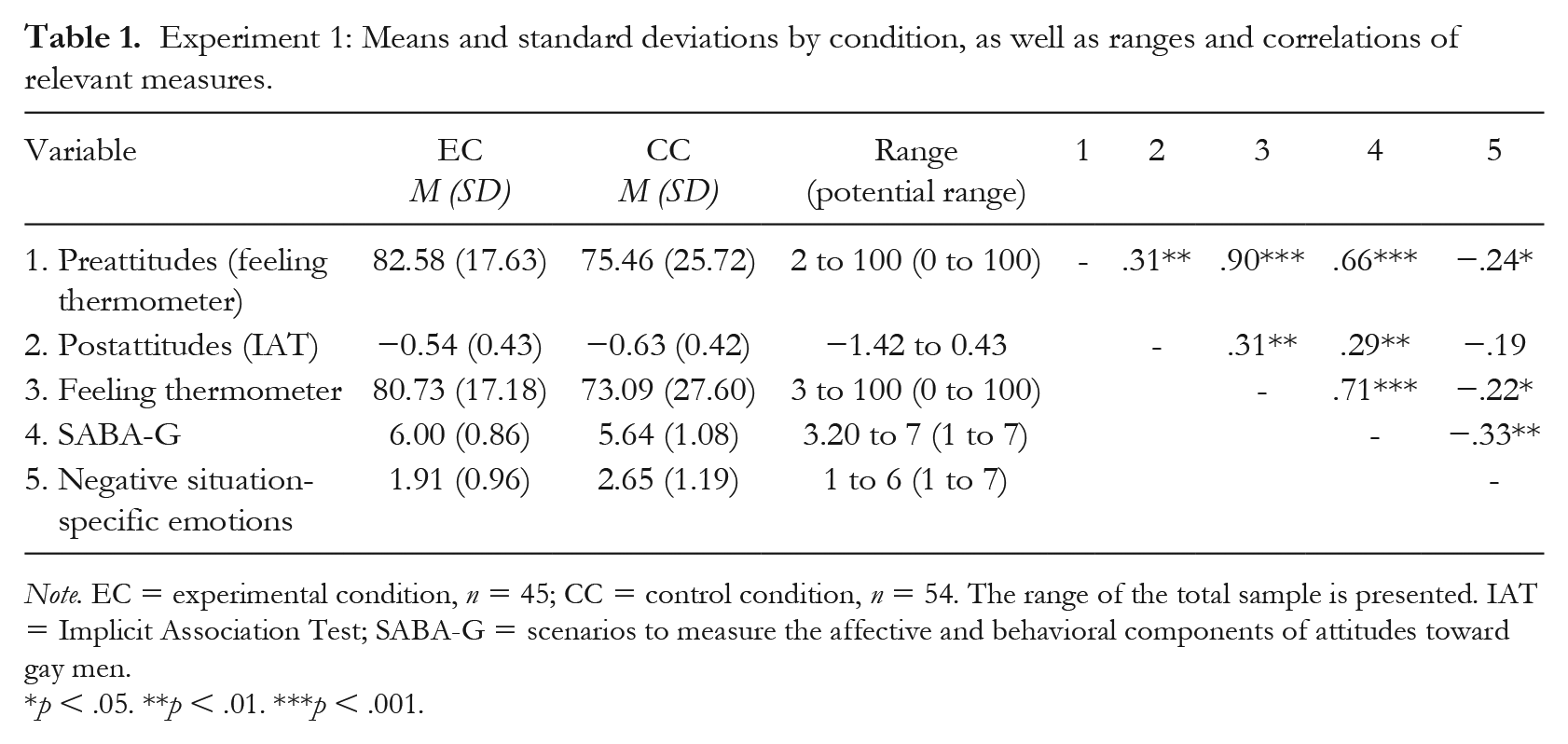
Note. EC = experimental condition, n = 45; CC = control condition, n = 54. The range of the total sample is presented. IAT = Implicit Association Test; SABA-G = scenarios to measure the affective and behavioral components of attitudes toward gay men.
p < .05. **p < .01. ***p < .001.
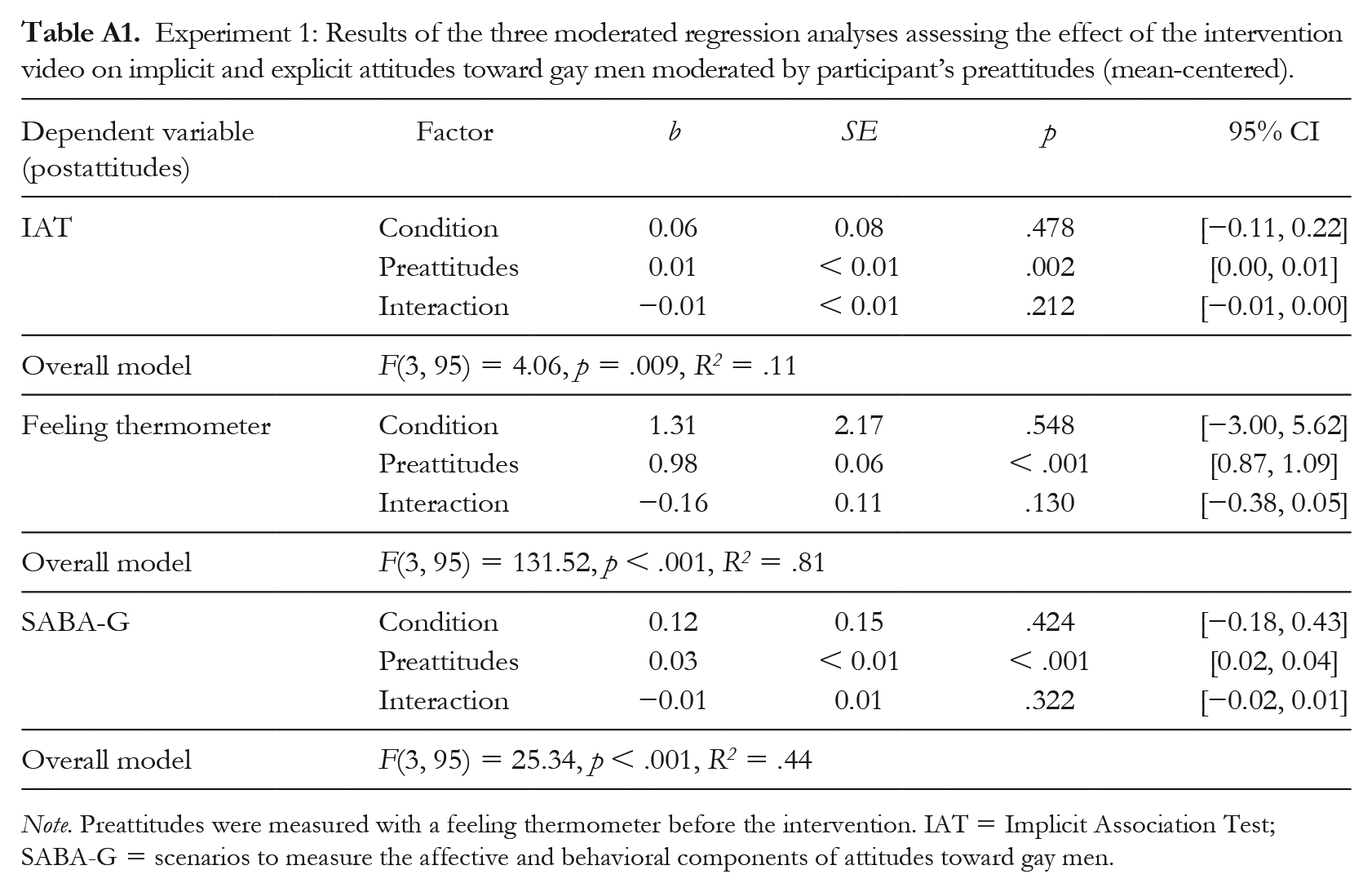
Hypothesis testing. To test the first hypothesis, as preregistered, we performed a MANOVA containing all three dependent variables. Although descriptive statistics indicated trends in the expected direction, results revealed no direct effect of the intervention video on any dependent measure compared to the control condition: multivariate F(3, 95) = 1.07, p = .366; IAT: F(1, 97) = 1.10, p = .297; postthermometer: F(1, 97) = 2.61, p = .110; SABA: F(1, 97) = 1.42, p = .236. Regarding Hypothesis 2, we performed three regression analyses with preattitudes (mean-centered) as moderator—one for each dependent variable. Results revealed the same pattern for all dependent variables (see Table A1 in the Appendix): the interaction condition × preattitudes was not significant (ps > .13), and the variable preattitudes was the only significant factor in the model (all effects of condition: ps > .42). Thus, Hypotheses 1 and 2 were not supported.
Exploratory analysis: Mediation
Since descriptive statistics indicated trends in the expected directions, we explored the five-item mediator negative situation-specific emotions. We performed three mediation analyses, one for each dependent variable, using PROCESS 3.0 for SPSS (Model 4). We report bias-corrected 95% CIs based on 10,000 bootstrap resamples, as recommended by Hayes (2013). Only for SABA-G, results revealed a significant indirect effect of the intervention video on antigay attitudes mediated by negative situation-specific emotions, c’ = 0.20, 95% CI [0.05, 0.40]. Specifically, data were in line with the theoretically postulated model that people who experienced the vicarious-contact intervention had less negative situation-specific emotions than the control condition, and less negative situation-specific emotions were related to more positive attitudes toward gay men (see Figure 1). Since the five-item measure of negative situation-specific emotions contained positive and negative emotion items, in two separate mediation analyses, we explored whether the three-item measure negative situation-specific emotions (Cronbach’s α = .86) and the two-item measure positive situation-specific emotions (Spearman–Brown coefficient = .85; Eisinga, Te Grotenhuis, & Pelzer, 2013) mediated the effect of the intervention on explicit attitudes toward gay men (SABA-G). Results of both analyses showed significant indirect effects (for details, see the Appendix, Figure A1).
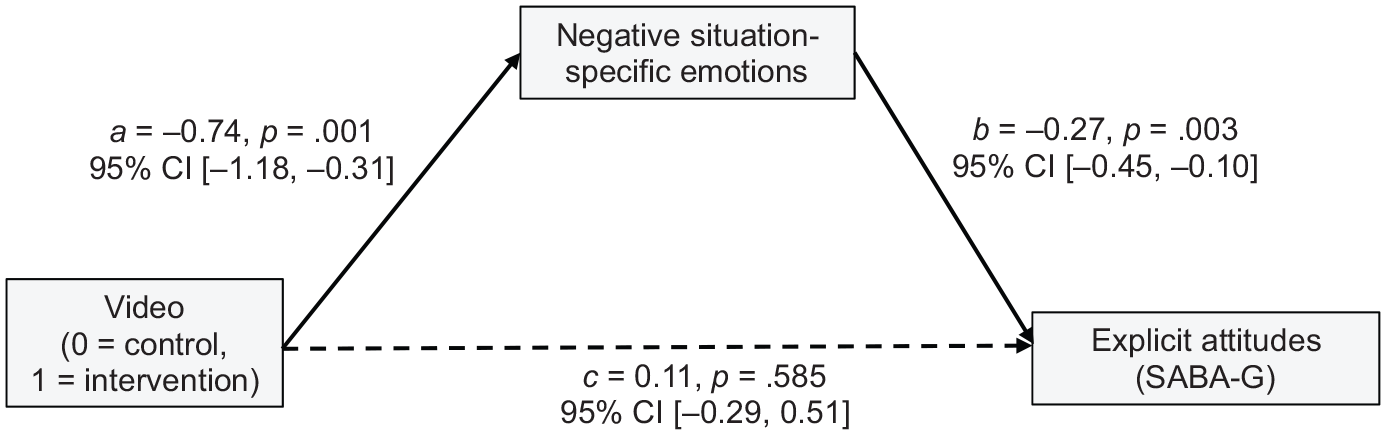
Experiment 1: Mediation analysis with negative situation-specific emotions (five-item measure) as mediator showing the indirect effect of the intervention video on explicit attitudes toward gay men measured with SABA-G.
In exploratory moderated mediation analyses with preattitudes (mean-centered) as moderator and positive and negative situation-specific emotions, respectively, as mediator on antigay attitudes measured with SABA-G, we found only one expected effect (for details, see the Appendix, Figure A2). Regarding positive situation-specific emotions, although the interaction condition × preattitudes on positive situation-specific emotions was not significant, the conditional indirect effect of experimental condition on antigay attitudes was significant for people with positive preattitudes (+1 SD), b = 0.14, 95% CI [0.01, 0.30], but not for people with negative preattitudes (−1 SD), b = 0.10, 95% CI [−0.04, 0.31]. This supports the idea that attitude change based on the intervention video occurs for people with positive preattitudes through an increase in positive emotions.
Discussion
Experiment 1 was a controlled experiment testing vicarious-contact effects on attitudes toward gay men. Findings failed to show direct effects but were in line with the assumption that negative situation-specific emotions mediated the intervention effect (small effects). Since these mediations were not preregistered, we aimed to replicate them in Experiment 2. Moreover, we did not find effects of the intervention video on implicit attitudes nor on explicit attitudes toward gay men measured with a feeling thermometer; thus, we dropped the time-consuming implicit measure in Experiment 2 (online) and omitted the feeling thermometer. Since different attitude measures may lead to slightly different results (Smith et al., 2009), we kept the SABA-G to replicate our results. We found only preliminary evidence for the moderating role of preattitudes; thus, this was again investigated in Experiment 2.
It seemed promising to further assess the found mediation effects of emotions: since Seger et al. (2016) did not find differences in the mediating role of situation-specific and general intergroup emotions, we implemented measures of general positive and negative intergroup emotions in Experiment 2, instead of asking participants how they felt after watching the video (i.e., situation-specific emotions). Because demand effects could influence self-reported intergroup emotions, we additionally measured the motivation to control prejudiced reactions (Dunton & Fazio, 1997). Moreover, research suggests that direct contact could influence vicarious-contact effects (Fuochi et al., 2020); therefore, we controlled for direct contact with gay men. Since studies indicated a stronger relation between contact and negative attitudes in the U.S. than outside the U.S. (Smith et al., 2009), and in order to increase identification with the American ingroup protagonist in the video, we recruited a sample of Americans.
Experiment 2
Experiment 2 focused on measuring intergroup emotions toward gay men as mediators between a vicarious-contact video intervention (vs. control) and antigay attitudes. We derived and preregistered the following hypotheses (https://aspredicted.org/ur4sp.pdf).
H1: Straight men who experienced the vicarious-contact intervention show more positive attitudes toward gay men than straight men in the control condition.
H2: The intervention shows greater effects on straight men with negative preattitudes than on straight men with positive preattitudes toward gay men.
H3: Experiencing the vicarious-contact intervention reduces negative intergroup emotions (compared to the control condition). This leads to more positive attitudes toward gay men.
H4: Experiencing the vicarious-contact intervention increases positive intergroup emotions (compared to the control condition). This leads to more positive attitudes toward gay men.
Method
Participants
We recruited 130 psychology students from a large university in California in exchange of extra course credit. Based on the preregistered exclusion criteria, we excluded 22 participants: female (n = 2), nonstraight sexual orientation (n = 9), non-American (n = 3), incorrect attention check response (n = 8). Whereas the remaining sample (N = 108) was smaller than preregistered (i.e., 162 participants; based on the results of Experiment 1, we used a small effect size in the preregistered a priori power analysis, but we were unable to obtain that many participants), given 108 participants, effects of f2 = .15 could be detected in a linear multiple regression (R2 deviation from zero, α = .05, power 1 − β = .93, number of predictors = 3). The analyzed sample comprised 108 straight men with an average age of 22 years (SD = 4.54; range: 18–49); 71% were students, 24% were (self)employed, 5% other or nonresponse. Unsurprisingly, the sample’s political orientation was slightly liberal (M = 3.07, SD = 1.46; 1 = liberal, 7 = conservative).
Materials
We used the same cover story and measures as in Experiment 1. However, we implemented a more detailed measure of intergroup emotions and added control variables. Again, we used 7-point Likert scales, we calculated mean scores and, after the relevant variables, we included further variables (partly focusing on gay men) that are irrelevant for the present purpose.
Measures and procedure
After participants completed the feeling thermometer measuring preattitudes toward gay men (among other groups), they were randomly assigned to watch one of the videos (intervention video: n = 56; control video: n = 52) without subtitles. Then, they completed the SABA-G (α = .89) and reported their intergroup emotions toward gay men.
Positive and negative emotions toward gay men
We measured participants’ positive and negative intergroup emotions using items from Elliot and Devine (1994), Kauff et al. (2017), Miller et al. (2004), and Seger et al. (2016) in a randomized order (“Please indicate how often you feel the following emotions regarding gay men. Gay men sometimes make me feel. . .”). Six items measured positive intergroup emotions (respectful, happy, hopeful, admiration, proud, grateful; α = .92) and nine items measured negative intergroup emotions (angry, resentful, anxious, fearful, disgusted, sickened, bothered, uneasy, uncomfortable; α = .88). 1
Further measures
After intergroup emotions, two items measured quantity of contact (Tausch et al., 2007) to control for previous direct contact with gay men. Then, we measured authoritarianism with four items concerning child-rearing values (Feldman & Stenner, 1997; e.g., “What is more important for a child to have?”; 1 = independence, 7 = respect for elders; α = .67) as control variable. Additionally, participants answered six items measuring the motivation to control prejudiced reactions (Dunton & Fazio, 1997; e.g., “It’s important to me that other people do not think I’m prejudiced”; α = .66; an initially seventh item decreased the internal consistency and thus, was excluded). Afterwards, participants completed the manipulation check and demographics, were fully debriefed and thanked.
Results
Manipulation check and descriptive statistics
Every participant in the experiment condition remembered the sexual orientation of the couple correctly. In the control condition, 33% (n = 17, 16% of the complete sample) responded erroneously that a gay couple had been shown in the video. This relatively high number (compared to n = 4 in Experiment 1) probably occurred because, between watching the video and responding to the manipulation check, additional measures focused on gay men (these were implemented after relevant measures were completed; thus, the main variables were not influenced by these additional measures focusing on gay men). The pattern of findings remains when excluding participants who answered the manipulation check incorrectly. Descriptive statistics of the main variables can be found in Table 2. The sample’s preattitudes were less positive than in Experiment 1 but still positive.
Experiment 2: Means and standard deviations by condition, as well as ranges and correlations of main measures.
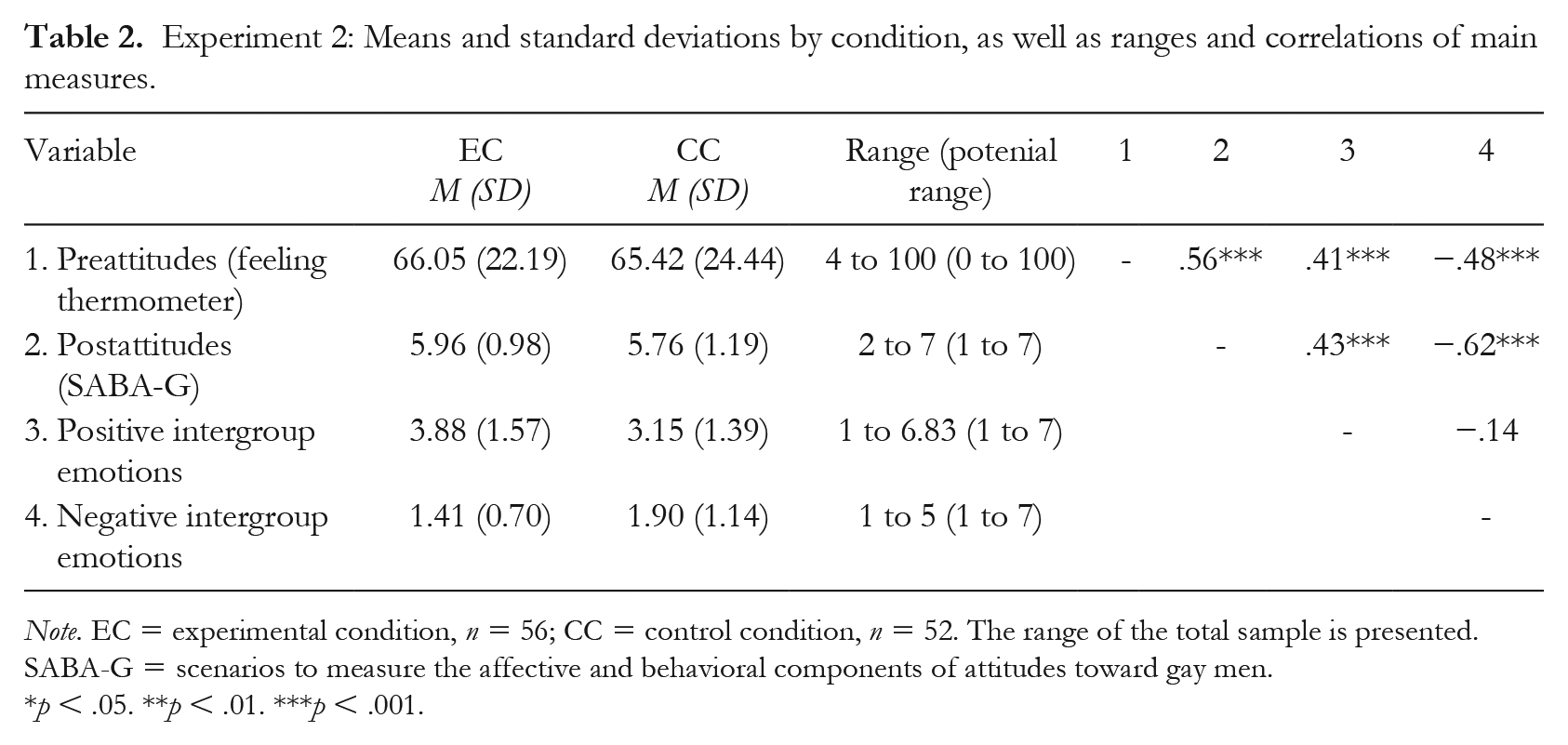
Note. EC = experimental condition, n = 56; CC = control condition, n = 52. The range of the total sample is presented. SABA-G = scenarios to measure the affective and behavioral components of attitudes toward gay men.
p < .05. **p < .01. ***p < .001.
Hypothesis testing
Unless mentioned otherwise, we performed the same analyses as in Experiment 1. Findings confirmed the results of Experiment 1. An independent samples t-test did not show a direct effect of the intervention video on attitudes toward gay men (compared to the control condition), t(99.03) = 0.94, p = .352, 95% CI [−0.22, 0.62], nor did we find the moderating effect of preattitudes (mean-centered), condition × preattitudes: b < 0.01, p = .672, 95% CI [−0.01, 0.02]. There was only an unsurprising main effect of preattitudes, b = 0.02, p < .001, 95% CI [0.01, 0.04]; overall model: F(3, 104) = 16.03, p < .001, R2 = .32. Thus, Hypotheses 1 and 2 were not supported by the data. However, we found the preregistered indirect effects of the intervention on antigay attitudes mediated by positive intergroup emotions, b = 0.22, 95% CI [0.05, 0.43], and (in a separate model) mediated by negative intergroup emotions, b = 0.36, 95% CI [0.10, 0.63], confirming Hypotheses 3 and 4. These effects remained when including both mediators simultaneously, supporting the assumption that vicarious contact improved attitudes toward gay men through positive and negative intergroup emotions. This pattern remained when controlling for (a) previous direct contact with gay men, (b) authoritarianism, and (c) the motivation to control prejudiced reactions (which could influence the effects).
Exploratory analyses: Moderated mediation
Findings were examined in more detail considering preattitudes: we added preattitudes (mean-centered) as moderator in the two mediation analyses. The resulting moderated mediation analysis with positive intergroup emotions as mediator was significant. Specifically, findings were in line with the theoretical idea that people with positive preattitudes who experienced the vicarious-contact intervention reported more positive intergroup emotions toward gay men (than the control condition), b = 1.43, p < .001, 95% CI [0.72, 2.15], and more positive intergroup emotions led to more positive attitudes toward gay men (see Figure 2, upper panel). Positive intergroup emotions of people with negative preattitudes toward gay men did not depend on condition, b = −0.01, p = .972, 95% CI [−0.73, 0.70] (see Figure 3, upper panel). However, the moderated mediation analysis with negative intergroup emotions as mediator was in line with the theoretical idea that people with negative preattitudes who experienced the vicarious-contact intervention reported less negative intergroup emotions toward gay men (than the control condition), and less negative intergroup emotions led to more positive attitudes toward gay men (see Figure 2, lower panel). Although the interaction condition × preattitudes on negative intergroup emotions was not significant, the conditional effect was for people with negative preattitudes, b = 0.79, p < .001, 95% CI [−1.23, −0.35], but not for people with positive preattitudes, b = −0.18, p = .434, 95% CI [−0.61, 0.03] (see Figure 3, lower panel). These indirect effects remained when controlling for (a) previous direct contact with gay men, (b) authoritarianism, and (c) the motivation to control prejudiced reactions, respectively. We controlled for these variables because preattitudes could have been formed based on prior direct contact (r = .28, p = .004), authoritarianism is often related to antigay (pre)attitudes (which was not the case here: r = −.16, p = .098), and the motivation to control prejudiced reactions is known to impact self-report measures of preattitudes (which was not the case here).
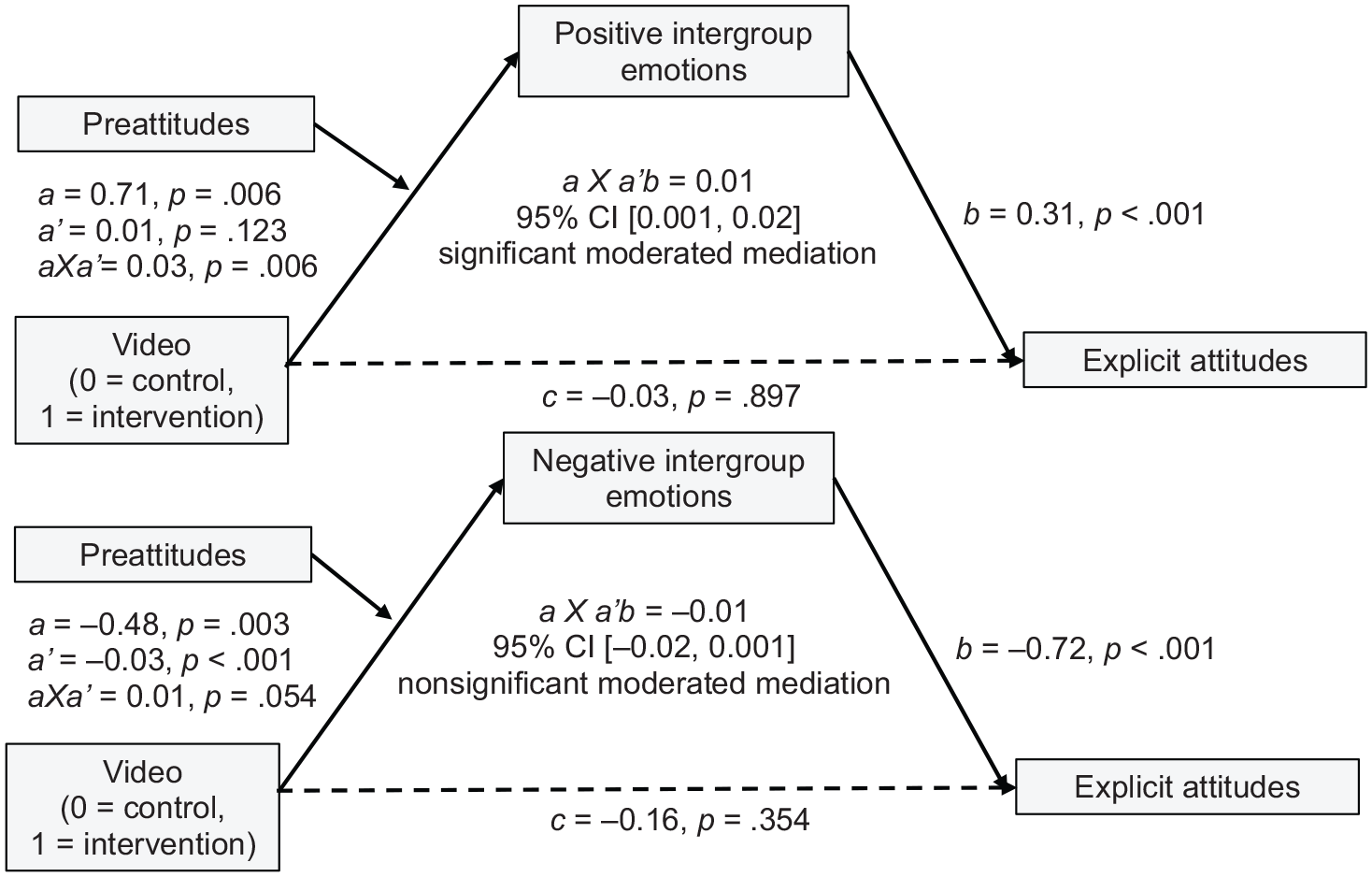
Experiment 2: Indirect effects of vicarious-contact intervention on attitudes toward gay men through positive intergroup emotions moderated by preattitudes (upper panel), and through negative intergroup emotions moderated by preattitudes (lower panel).
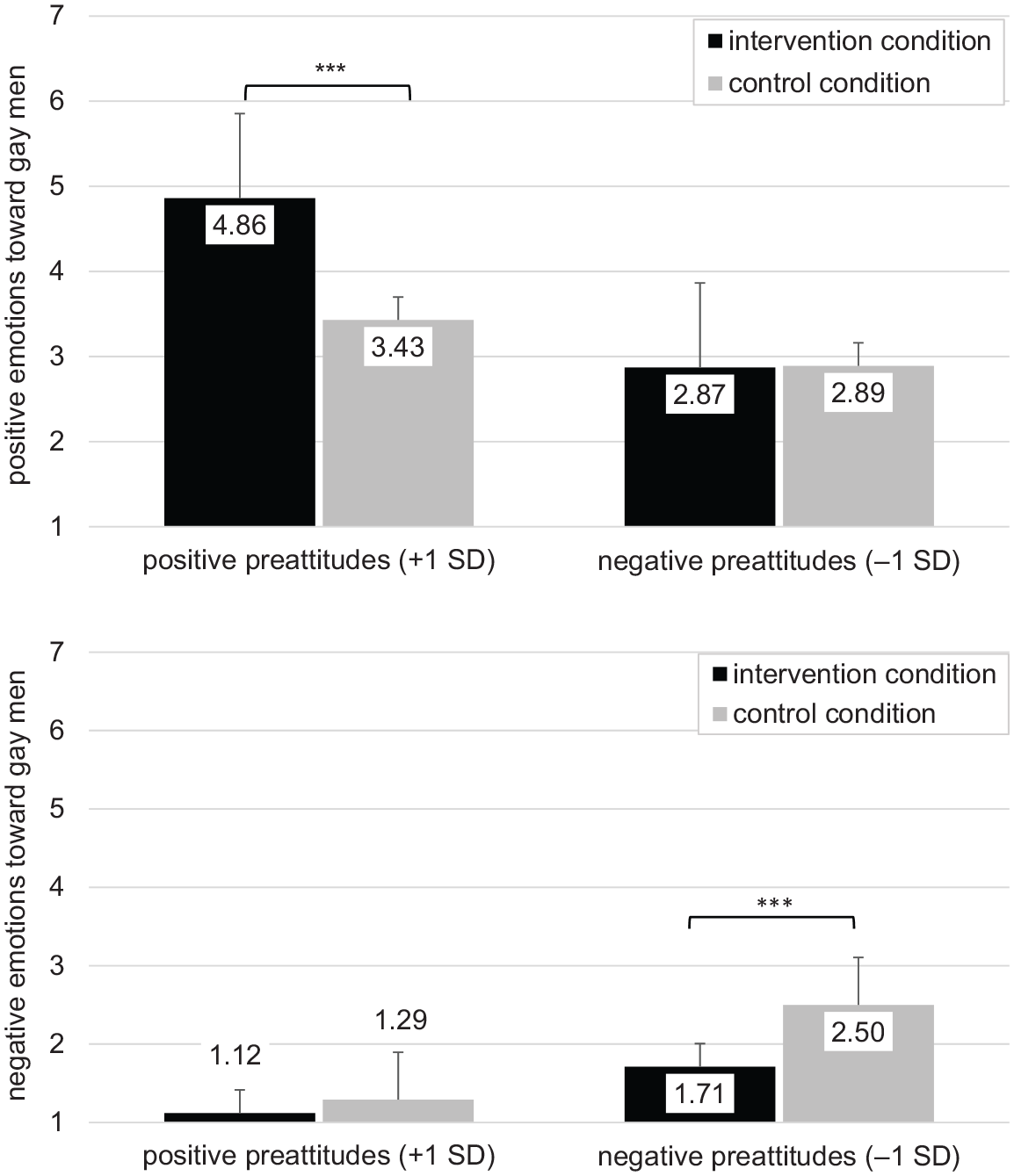
Experiment 2: Moderation of preattitudes on positive intergroup emotions toward gay men (upper panel) and on negative intergroup emotions toward gay men (lower panel). Conditions (intervention vs. control) were manipulated. Positive preattitudes are defined as 1 SD above the mean, negative preattitudes as 1 SD below the mean.
Discussion
Experiment 2 expanded the results of Experiment 1: data supported the preregistered hypotheses that general positive and negative intergroup emotions functioned as mediators of the vicarious-contact intervention, leading to improved attitudes toward gay men (compared to control; small effects). Although we, again, found neither direct effects of the intervention nor the moderation by preattitudes, exploratory analyses closely related to Hypothesis 2 indicated that preattitudes moderate the hypothesized mediation effects: straight men with negative preattitudes toward gay men reported less negative intergroup emotions toward gay men after watching the vicarious-contact video (compared to the control condition); and less negative intergroup emotions were related to more positive attitudes toward gay men. For straight men with positive preattitudes, data supported the idea that positive intergroup emotions were the relevant mediator.
General Discussion
The present research focused on positive vicarious-contact effects on straight men’s implicit and explicit attitudes toward gay men (a) moderated by an individual difference related to RWA and SDO, namely initial preattitudes toward the outgroup, and (b) mediated by affective variables, namely positive and negative intergroup emotions. Specifically, we created a video as vicarious-contact intervention that can be used in mass media to improve straight men’s attitudes toward gay men. Although we did not find direct effects, we found that decreasing negative emotions and increasing positive emotions (situation-specific: Experiment 1; and intergroup: Experiment 2) play essential roles for the intervention effect on antigay attitudes. Moreover, we identified underlying mechanisms for men with positive and negative preattitudes toward gay men: straight men with initially positive attitudes toward gay men who watched the vicarious-contact video reported more positive intergroup emotions toward gay men (than the control condition); and more positive intergroup emotions were related to more positive attitudes toward gay men. For straight men with initially negative attitudes toward gay men, reducing negative intergroup emotions was important: after watching the vicarious-contact video, they reported less negative intergroup emotions toward gay men (than the control condition); and less negative intergroup emotions were related to more positive attitudes toward gay men. In short, the intervention was successful in changing straight men’s explicit antigay attitudes mediated by general intergroup emotions. More importantly, in contrast to other attitude-change interventions, the vicarious-contact video did not show a backlash effect for people with initially positive attitudes—instead, it further improved their already positive attitudes toward gay men through positive emotions. Although these effects were small, the resulting win-win situation is promising for future research. Whereas we did not additionally examine effects of negative vicarious contact (e.g., as demanded by Kauff et al., 2017; Pettigrew & Tropp, 2006), we followed the call of attitude-change and antigay intervention research asking for interventions specifically focusing on prejudiced groups such as straight men.
One strength of our research is the controlled video intervention: both groups watched a video with identical actors and actresses, music, mood, etc. Thus, the intervention and control videos were comparable and only differed in (not) indicating the sexual orientation of the (gay) men; specifically, the only difference rested in whether vicarious contact was displayed or not. Based on the contact hypothesis (Allport, 1954), the effects of contact interventions are best when the following conditions are met: (a) equal status, (b) shared goals, (c) cooperation, and (d) sanction by authority (Christ & Kauff, 2019; Paluck & Green, 2009). Although a meta-analysis (Pettigrew & Tropp, 2006) found that these optimal conditions do not need to be met for intergroup-contact benefits, Paluck, Green, and Green (2018) stated that examining these conditions in contact interventions is essential to influence policies, supporting that optimal conditions should be met. The present video met some of these: equal status was given since the depicted ingroup and outgroup members were neighbors. Due to their neighborhood, they implicitly also shared the goal of living together without conflicts. Cooperation was depicted by helping each other and invitations to BBQs and dinner parties.
Since the video presented an interaction that improved during the course of the video, our intervention started with a protagonist holding negative attitudes toward gay men. Thus, there was a risk that the intervention backlashed on people with positive attitudes toward gay men by decreasing their initially positive attitudes, as found in previous research (Munniksma et al., 2013). However, this was not the case here.
Although we did not find the expected direct effect of the vicarious-contact intervention, and thus only some of our preregistered hypotheses were supported, the exploratory analyses of the present research provide additive value regarding (vicarious) contact effects: it is an established finding that intergroup anxiety (along with other intergroup emotions) mediates contact effects; however, other research did not find reduced intergroup anxiety to mediate vicarious-contact effects (e.g., Vezzali et al., 2019). We argue that our results contribute to an understanding of why sometimes negative intergroup emotions (i.e., intergroup anxiety) mediate vicarious-contact effects and why sometimes positive intergroup emotions are the essential mediator(s): the present research indicates that the mediating intergroup emotions depend on people’s preattitudes (i.e., initial outgroup attitudes). Therefore, considering preattitudes and intergroup emotions could contribute to explaining the results of previous research. Our results add to the growing body of literature indicating that intergroup emotions play a key role not only in direct intergroup contact but also in vicarious contact, more specifically, serving as mediators of the vicarious-contact intervention on improved outgroup attitudes. Thus, the present research bridged the literatures on contact effects and on intergroup emotions which have been linked in a surprisingly small extent (Seger et al., 2016).
Limitations
Since we followed antigay intervention researchers’ call to develop and test an intervention targeted at a specific group (here: improving straight men’s negative attitudes toward gay men), the results cannot be generalized—neither to women or nonstraight people nor regarding attitudes toward lesbians or other groups. Future research could replicate the results within a broader context. Moreover, as Experiment 1 yielded no effects on feeling thermometers, the results should be replicated with additional attitude measures (other than the SABA-G), even though the SABA has demonstrated sound psychometric properties (Preuß et al., 2020), and contact research has demonstrated only weak differences depending on antigay attitude measures (Smith et al., 2009). On a methodological note, although the reported results are consistent with past research, we acknowledge that the data underlying our (moderated) mediation analyses are only correlational and measured concurrently, thus conclusions about causal direction are purely based on theory (see Kline, 2015). Future research could (a) assess intergroup emotions at one time point and outgroup attitudes after a delay, or (b) manipulate intergroup emotions, or (c) instruct participants to (not) focus on their emotions (Esses & Dovidio, 2002) to provide stronger evidence of mediation (see also Fiedler, Schott, & Meiser, 2011). Moreover, we are aware that we only assessed short-term effects of a one-time exposure vicarious-contact intervention. Future studies could examine repeated exposure effects and whether the intervention has an enduring (long-term) and direct effect.
Although we tried to recruit a sample with negative attitudes toward gay men by implementing a cover story, and a nonstudent sample (Experiment 1), we did not meet our goal: participants’ political orientation (related to antigay attitudes; Seltzer, 1992) was only slightly below the scale’s midpoint (indicating a slightly more left- than right-wing sample, with presumably slightly positive attitudes toward gay men). Preattitudes in both samples were substantially above the scale’s midpoint. In general, this finding is promising, indicating less antigay attitudes in society; however, we cannot generalize the found effects to a sample with very negative attitudes toward gay men. The quite positive preattitudes possibly explain the small effect sizes: the ceiling effect left little space for attitude improvement. Moreover, the sample size in Experiment 2 was smaller than an a priori power analysis had indicated. Although our samples were large enough to find medium-sized effects (see Bartoş et al., 2014), a larger sample holding more negative attitudes would be desirable in a replication.
Regarding the videos’ content, it could be relevant that the gay couple was depicted as two fathers of a little girl. Fathers (compared to men in general) are perceived as more positive (warm, patient, and supportive vs. unemotional, aggressive, and messy; Park & Banchefsky, 2018). Thus, it might be the case that attitudes toward gay men improved because they were depicted as parents. However, gay men are often perceived as crossing traditional gender roles and stereotypes: independent of their (non)parenthood, gay men are often perceived as warmer and higher on traditionally feminine traits than straight men (e.g., Steffens, Niedlich, Beschorner, & Köhler, 2019). Furthermore, the video in the control condition also displayed a father with the same little girl. Thus, the influence of a positive perception of parenthood should be equal across conditions. Also, research has indicated that attitudes toward same-sex families differ from those toward gay men (Li, 2019). However, to assess this influence in more detail, future studies could include additional measures of attitudes toward gay couples, rainbow families, and same-sex parents (see also Costa, Pereira, & Leal, 2014). Moreover, in the control video, the new neighbor is depicted as a father of a little girl. He is not explicitly presented as being part of a straight couple; thus, he could have been perceived as being a (gay) single father, which might explain why some participants in the control condition did not complete the manipulation check correctly but falsely recalled to have seen a gay man in the control video. Whereas a single father can be perceived as a gay man, there is evidence that single fathers are rather perceived as being separated or widowed instead of gay (Steffens, Preuß, & Scheifele, 2019). Thus, we believe the result of the manipulation check was due to the questions focusing on gay men that followed the video. As we did not find direct effects of experimental condition on antigay attitudes, we think it is unlikely that demand effects can explain our significant findings. In contrast, demand effects could have been at work in both conditions, thus mitigating the difference between experimental and control condition (in which 33% falsely claimed to have seen a gay man in the video). However, excluding those participants did not change the results, which speaks against this idea.
Previous research highlighted the importance of ingroup identification with the protagonist of the vicarious-contact intervention (e.g., Vezzali et al., 2015). In the present research, identification may not be high for various reasons (e.g., participants’ average age in Experiment 2 differed from the protagonist’s age; the protagonist may have not been perceived as the typical American man because he is an artist who seems to live alone without family). However, Cernat (2011) showed that intergroup contact also works when observing outgroup–outgroup interaction, with smaller effects than when observing ingroup–outgroup interactions. Thus, a sample who highly identifies with the protagonist should yield larger effects.
Future Research and Conclusion
We did not find the expected effects of the vicarious-contact intervention on implicit attitudes toward gay men. However, the evidence for vicarious-contact effects on implicit attitudes is rather weak: for instance, Li (2019) also found vicarious-contact effects only on explicit attitudes toward lesbians, gay men, and bisexual women and men. He assumed that implicit attitudes may not be changed with a single exposure to vicarious-contact interventions but require repeated exposure (for discussion, see Devine, 1989). Thus, we would like to encourage contact researchers to examine both implicit attitudes and repeated exposure.
Although we only tested the moderating effect of initial outgroup attitudes (i.e., preattitudes) specifically on straight men’s attitudes toward gay men (and thus results cannot be generalized easily), we believe preattitudes to be a valuable, though understudied, moderator given its relation to other well-established moderators of contact effects. For instance, preattitudes could have been formed based on prior direct or extended contact. Thus, the moderating role of preattitudes could combine the impact of several established moderators (e.g., individual differences such as RWA, contextual conditions such as direct contact). Consequently, further investigating the moderating role of preattitudes seems promising.
Since there is growing interest in vicarious contact, future research could test whether controlled, video-based vicarious-contact interventions toward gay men improve attitudes toward other outgroups at the same time (i.e., secondary transfer effects; Christ & Kauff, 2019). Moreover, vicarious-contact interventions that resemble our video should be applied in real-world settings in mass media to improve attitudes toward gay men and other social minorities reaching a large audience. For instance, the presented vicarious-contact video could be used in diversity training to improve attitudes and diminish discrimination at the workplace (for a review, see Steffens, Niedlich, & Ehrke, 2016). Moreover, our research indicates that including sexual minorities (specifically gay men) in TV shows and movies may improve attitudes of people with positive and negative preattitudes toward gay men. As has been already assumed by Allport (1954), they can have a direct (short-term) effect and an indirect (long-term) effect: since vicarious contact seems promising to reduce negative intergroup attitudes and intergroup emotions (direct short-term effect), it could build the basis for direct, face-to-face contact (indirect long-term effect), which in turn can result in cross-group friendship, a more diverse environment, and consequently extended contact. Thus, promoting videos in mass media that depict intergroup contact as vicarious-contact interventions seems important, successful, and encouraging—particularly in times of populistic and negative attitudes, segregation, intergroup tensions, and conflicts.
Footnotes
Appendix
Experiment 1: Results of the three moderated regression analyses assessing the effect of the intervention video on implicit and explicit attitudes toward gay men moderated by participant’s preattitudes (mean-centered).
| Dependent variable (postattitudes) | Factor | b | SE | p | 95% CI |
|---|---|---|---|---|---|
| IAT | Condition | 0.06 | 0.08 | .478 | [−0.11, 0.22] |
| Preattitudes | 0.01 | < 0.01 | .002 | [0.00, 0.01] | |
| Interaction | −0.01 | < 0.01 | .212 | [−0.01, 0.00] | |
| Overall model | F(3, 95) = 4.06, p = .009, R2 = .11 | ||||
| Feeling thermometer | Condition | 1.31 | 2.17 | .548 | [−3.00, 5.62] |
| Preattitudes | 0.98 | 0.06 | < .001 | [0.87, 1.09] | |
| Interaction | −0.16 | 0.11 | .130 | [−0.38, 0.05] | |
| Overall model | F(3, 95) = 131.52, p < .001, R2 = .81 | ||||
| SABA-G | Condition | 0.12 | 0.15 | .424 | [−0.18, 0.43] |
| Preattitudes | 0.03 | < 0.01 | < .001 | [0.02, 0.04] | |
| Interaction | −0.01 | 0.01 | .322 | [−0.02, 0.01] | |
| Overall model | F(3, 95) = 25.34, p < .001, R2 = .44 | ||||
Note. Preattitudes were measured with a feeling thermometer before the intervention. IAT = Implicit Association Test; SABA-G = scenarios to measure the affective and behavioral components of attitudes toward gay men.
Acknowledgements
We are grateful for the contributions by Laura Kilian, Sarah Wünsche, and Amy Rae Fox regarding planning and realizing the studies, as well as for their help in data collection. We also thank Hugh Halter for writing the story of the present vicarious-contact video intervention and Wade Yamaguchi for creating the video, his willingness to share, and his permission to use and modify the video for our research purposes.
Author Note
Parts of this research have been presented as posters at the 5th Research Day “Gender & Diversity” in Landau, Germany (February 2018) and at the EASP International Workshop “Building an LGBT European Social Psychology” in Lisbon, Portugal (June 2019).
Funding
The author(s) disclosed receipt of the following financial support for the research, authorship, and/or publication of this article: This work was supported by a PhD grant from the German Academic Scholarship Foundation to the first author and by the German Research Foundation (DFG), Ste938/11-3.
