




Abstract
When people witness conflicts in their group, they can react in one of the following ways: (a) support one of the involved parties, (b) reconcile the conflict, (c) escalate the conflict, or (d) remain neutral and passive. These reactions can be conceptualized as social roles. Building on the assumption that role-taking in conflicts is intricately intertwined with the moral self-concept, the present research aims at testing three empirical hypotheses. First, taking a moral role is predicted by individual differences in the general relevance of a moral self-concept. Second, taking a moral role increases the situational moral self-concept. Third, the more relevant the general moral self-concept for an actor, the higher the situational moral self-concept increase after moral role-taking. Results from three studies using both experimental and correlational designs (N = 961) support these hypotheses.
“One does what one is; one becomes what one does.”
Imagine Bob and Rob, two members of a working group. They created a new web page together. However, when Bob presents the new design, he does not mention Rob’s contribution and takes all the credit. When Rob becomes aware of Bob’s behavior, he is furious, accuses Bob of falsely taking all the credit, and demands an apology. Bob, however, does not show any kind of remorse and is not willing to make amends. A conflict emerges and gradually other members of the team become involved, including Tim. How does Tim react? How does Tim’s reaction shape his self-concept during the conflict? And can a focus on the self-concept help to explain why Tim reacts the way he does? In this article, three empirical studies shed light on these questions, elucidating how third parties react in interpersonal conflicts following perceived norm violations. Combined, they test the idea that the moral self is a crucial concept when explaining third-party reactions in conflicts, as it both shapes these reactions and is shaped by them.
Interpersonal Conflicts Succeeding Norm Violations
Perceived norm violations, like the unfair credit-taking in the scenario described before, often lie at the heart of interpersonal conflicts (Montada, 2013). Such conflicts take place in a variety of groups (e.g., organizational teams, families, or even groups of complete strangers), and they often share a common structure: in a typical course of events, the victim accuses the perpetrator of having violated a norm, and demands some kind of restitution or, at least, an acknowledgment. This demand creates a pressure to react, not only for the accused perpetrator but also for third parties, who might consider this demand more or less legitimate. Thus, third parties become inadvertently involved in the conflict, and it is important to understand the psychological processes underlying their initial reactions, as they can have decisive consequences for the further course of events (Skarlicki & Kulik, 2005). For instance, depending on third parties’ reactions, Bob might get away with his bad behavior or might be forced to apologize and make up for it. If third parties do not take action against Bob’s behavior or even defend Bob, Rob’s feelings of being mistreated may have downstream consequences, such as—in the context of the example—counterproductive work behaviors or resignation intentions (Colquitt & Zipay, 2015). So, which processes underlie third parties’ initial reactions to conflicts?
Social psychological research on behavior in conflicts following norm violations—such as the one presented here—has mainly focused on the central protagonists’ behaviors (i.e., victim and transgressor; see Gray & Wegner, 2009; Shnabel & Nadler, 2008). Studies on third-party responses are comparably sparse and have mainly focused on specific behaviors, such as third-party punishment (e.g., Lotz, Baumert, Schlösser, Gresser, & Fetchenhauer, 2011), retribution (e.g., Skarlicki & Rupp, 2010), forgiveness (e.g., Green, Burnette, & Davis, 2008), or compensation (e.g., Lotz, Okimoto, Schlösser, & Fetchenhauer, 2011). What is missing, however, is an integrative framework linking third-party behavior in social conflicts with the actors’ self-concept. The present research aims to fill this gap.
Social Roles
We propose that reacting to a conflict situation from a third-party perspective means taking a role. Notably, each individual who is neither victim nor perpetrator, such as Tim in our opening example, can take one (and only one) of five roles (see Figure 1): “victim supporter,” “perpetrator supporter,” “arbitrator,” “escalator,” and “bystander.” In the example of Rob and Bob, Tim could support Rob’s claims for an apology (“victim supporter”), argue in favor of Bob’s behavior (“perpetrator supporter”), mediate between Rob and Bob (e.g., by trying to find a solution that is acceptable for both; “arbitrator”), escalate the conflict (“escalator”), or stay out of the conflict (“bystander”). What would Tim do? Which role is he likely to take, and why? And how does this role-taking reflect on Tim’s self-concept?
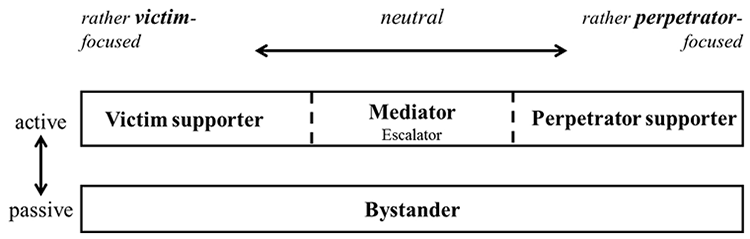
Schema of third-party conflict roles resulting out of activity and sidedness as classification dimensions.
Role-Taking and the Self
According to Gecas (1982), a role “typically refers to the behavioral expectations associated with a position or status (either formal or informal) in a social system” (p. 14). Behavioral expectations are necessarily aligned with other role-specific associations, for example, the specific goal that a role proponent is expected to pursue. A role-specific goal can be positively and/or negatively interdependent with the goals pursued by other actors (in their respective roles). These interdependencies form social systems such as societies (macro level) or interactions (micro level). For instance, a sale situation consists of at least a buyer and a seller; a knowledge transmission situation (such as in the classroom) consists of (at least) a student and a teacher; and a conflict situation consists of (at least) a victim and a perpetrator, as described before.
Moreover, and central to the present research, roles are intertwined with the self, a fact that has been especially highlighted by symbolic interactionism (e.g., Stryker & Burke, 2000). Thus, third-party reactions can at least partly be accounted for by a self-regulatory process. Firstly, taking a particular role should make associations between role-specific features and the situational self-concept (or “working self-concept”; see Markus & Kunda, 1986) stronger. And secondly, because people differ in the degree to which they experience certain self-associations as rewarding (e.g., moral associations; Aquino & Reed, 2002), stable personality dispositions capturing such individual differences should predict role choice.
How Role-Taking Shapes the Situational Self-Concept
The situational self-concept consists of all self-referent cognitions and emotions in a particular situation referring to, for instance, self-evaluations in the domains of (a) morality (i.e., the extent to which one perceives her/himself to be a moral person), (b) self-esteem (i.e., a general evaluation of oneself), (c) identity expression (i.e., the extent to which one’s actions express “who I am”), (d) meaning (i.e., the extent to which one’s actions are experienced as meaningful), and (e) power (i.e., the extent to which one’s actions provide one with a sense of power). Looking at the identity expression and meaning facets allows investigating the degree to which third parties experience a role as meaningful and relate it to the self. The self-esteem facet allows investigating which of the self-domains often associated with social roles (i.e., power and morality) is more important for general self-valence in conflict situations. Power and morality are important domains when it comes to role-taking, because social roles entail rights and duties (Karelaia & Keck, 2013), allowing powerful (i.e., when wielding rights) and moral experiences (i.e., when fulfilling duties). For instance, as a referee in a soccer match, the rights and duties assigned to the role allow referees to experience themselves as powerful and moral persons: the right to decide over what others are allowed or not allowed to do can provide referees with a sense of power, and fulfilling the duty to be fair and impartial can provide them with moral self-regard.
Indeed, a particularly relevant facet of the situational self-concept—especially in conflict situations—is morality: the extent to which one is able to perceive oneself as a moral (or immoral) person (Brambilla & Leach, 2014). Everything an actor does in a conflict following a norm violation has moral value, that is, can be evaluated on a moral dimension of “right” and “wrong.” Thus, taking a moral role in a conflict allows the actor both to express and to experience him/herself as a moral person, at least temporarily. Thus, taking a moral role in a conflict should be correlated with a more positive moral situational self-concept than taking a neutral or immoral role. However, a morality-boosting effect of moral role-taking does not explain why a given actor takes a given role. Why do some actors take moral roles more often than others? Do some actors profit from moral role-taking more than others?
Individual Differences in Moral Role-Taking
If the idea that social conflicts are charged with notions of morality and injustice—especially after perceived norm violations—were true, personality traits that reflect an individual concern for justice should be systematically linked to role-taking. More specifically, when third parties become involved in a normative conflict between two other actors, they take the neutral observer’s perspective. Consequently, a trait that should shape whether or not third parties take a moral (vs. a nonmoral) role is people’s dispositional sensitivity to injustice from an observer’s perspective (which is also referred to as “observer sensitivity” in the literature; see Schmitt, Baumert, Gollwitzer, & Maes, 2010; Schmitt, Gollwitzer, Maes, & Arbach, 2005). People scoring high on observer sensitivity are more sensitive to cues of observed injustice than people scoring low on this trait (Baumert, Gollwitzer, Staubach, & Schmitt, 2011). Furthermore, they experience strong negative emotions in the face of observed injustice, and they tend to ruminate longer about observed or alleged injustice. In line with these findings, observer sensitivity is related to moral behavioral dispositions such as modesty, agreeableness, or perspective-taking (Schmitt et al., 2005), cooperative choices in social dilemmas (e.g., Fetchenhauer & Huang, 2004; Gollwitzer, Rothmund, Pfeiffer, & Ensenbach, 2009; Thomas, Baumert, & Schmitt, 2011), solidarity with the disadvantaged (Gollwitzer, Schmitt, Schalke, Maes, & Baer, 2005), and a willingness to engage in costly sanctioning of rule-breakers (“altruistic punishment”; see Lotz, Baumert, et al., 2011). Thus, observer sensitivity is expected to positively predict the likelihood of taking a moral role in social conflicts, that is, the arbitrator or the victim supporter role.
A second personality disposition that should uniquely predict moral role-taking in social conflicts is moral identity—the centrality of morality for one’s self-concept (Aquino & Reed, 2002). Importantly, moral identity consists of two dimensions: moral internalization is the degree to which moral traits (e.g., caring, honest, and fair) are central to one’s general self-concept. Moral symbolization is the degree to which the traits are reflected in one’s actions—stated differently, the degree to which a person wants to communicate the possession of moral traits to others.
Regarding role choices in conflicts, people with a high moral identity thus should be more likely to prefer a moral over a nonmoral role; this applies both to “high internalizers” as well as to “high symbolizers” (O’Reilly & Aquino, 2011). However, regarding the effects of role-taking on the situational self-concept, only “high internalizers” should actually feel more moral after taking a moral role because doing so provides actors with cues for their moral situational self-concept, and “high internalizers” react more readily towards such cues (Aquino & Freeman, 2009). “High symbolizers,” however, are more concerned about appearing moral to others instead of nourishing their moral self. Thus, if taking a moral role in interpersonal conflicts fosters one’s moral situational self-concept, it follows that moral internalization, but not moral symbolization, should amplify (i.e., positively moderate) this effect.
The Present Research
The present paper describes three studies in which the following hypotheses are empirically tested:
H1: Observer sensitivity uniquely predicts taking a moral role (i.e., above and beyond moral identity and more general morality-related personality traits). That is, the higher an actor scores on observer sensitivity, the higher the likelihood of taking a moral, compared to a neutral or immoral, role.
H2: Moral internalization and symbolization both uniquely predict taking a moral role (i.e., over and above observer sensitivity and more general morality-related personality traits). The higher an actor scores on moral internalization and moral symbolization, the higher the likelihood of taking a moral, compared to a neutral or immoral, role.
H3a: Taking a moral role in a conflict elicits a higher moral situational self-concept during the conflict than taking a neutral or immoral role.
H3b: This effect is amplified by moral internalization but not by moral symbolization.
In Study 1, personality traits and (self-reported) role choice in a conflict scenario were measured online. After taking a role in this conflict, participants rated five facets of their situational self-concept during the conflict (i.e., morality, self-esteem, identity, meaning, and power), with morality as the central dependent variable (DV). In Study 2, we replicated Study 1 with an experimental design: instead of measuring participants’ role choice via self-reports, participants were randomly assigned to one particular role in a conflict. Again, the moral situational self-concept during the conflict was the central DV in this study. Study 3 directly builds upon the findings of Study 2 and scrutinizes the generalizability of the effect in a different conflict situation.
Study 1
Method
Sample
Participants were recruited via a university-wide mailing list including students and university staff members. All participants completed the study online using the survey platform SoSci Survey (https://www.soscisurvey.de). As a reward, a tablet PC was raffled among all participants. The final sample consisted of n = 659 participants (65% women) between 18 and 70 years of age (M = 29, SD = 10.4). This large sample size was the result of our efforts to ensure statistical power for each of the logistic regressions in the multinomial regression model of role choice (see the following lines): we aimed for at least 100 participants per role, and stopped data collection 1 week after this threshold was reached. No analyses were conducted before the end of data collection. A post hoc power analysis for the logistic regression with the two roles chosen by the fewest participants as outcome variables (bystander and victim supporter; n = 110 each) and a given odds ratio of 2 for a continuous predictor (corresponding to a small to medium effect size; Chen, Cohen, & Chen, 2010) revealed a power of 86%. While the majority of the sample consisted of students (66%, n = 432), we also recruited a substantial amount of participants in their working life (30%, n = 197).
Independent variables
Moral identity (MI)
Participants indicated their age and sex and then responded to the 10 items of the Moral Identity Scale (Aquino & Reed, 2002). The MI scale measures the centrality of a set of moral traits (e.g., caring, fair, helpful) to a person’s self-concept with two subscales. The Moral Internalization subscale measures the degree to which persons internalize the set of moral traits into their personal self-concept (e.g., “Being someone who has these characteristics is an important part of who I am”; five items; α = .74). The Moral Symbolization subscale measures the effort persons spend on communicating to others that they have these moral traits (e.g., “I often wear clothes that identify me as having these characteristics”; five items; α = .77). Response scales ranged between 1 (completely disagree) and 6 (completely agree), with higher values indicating a higher centrality of morality to a person’s self-concept.
Observer sensitivity (OS)
Next, participants completed the 10 items of the Observer Sensitivity Scale (e.g., “I am upset when someone is undeservingly worse off than others”; α = .87; Schmitt et al., 2010; Schmitt et al., 2005). Again, response scales ranged between 1 and 6.
Honesty-humility and agreeableness
To enable us to scrutinize the hypothesized unique effects of moral identity and observer sensitivity on role choice over and above broader personality traits (i.e., H1 and H2), we included two traits from the HEXACO model of personality (Ashton et al., 2004): honesty-humility (e.g., “I would never accept a bribe, even if it were very large”; 10 items; α = .67), and agreeableness (e.g., “I rarely hold a grudge, even against people who have badly wronged me”; 10 items; α = .76). Response scales ranged between 1 and 5.
Dependent variables
Role-taking
Participants were told to imagine being a member of an organizational working group. They then read a short description of a norm conflict evolving in this team (see Appendix A in the supplemental material for all vignettes). Each participant read one vignette, which was chosen randomly out of a set of three vignettes, each containing a different kind of norm violation (e.g., violation of fairness norms, personal harm) to extend external validity. To ensure that the described situations were plausible, immersive, and free of undesired biases (e.g., strongly favoring a certain role), a set of five vignettes was pretested. In a between-subjects design, 88 participants read one of the five vignettes and rated it with regard to immersion ( “I can picture myself in that situation very well”), general plausibility (“What happened in the described situation appears plausible to me”), plausibility of the conflict (“It appears plausible to me that a conflict developed out of that situation”), plausibility of third-party reactions (“How plausible would it be for third parties in this situation to [support the perpetrator/support the victim/do nothing/try to reconcile]?”), responsibility for causing the conflict (“Which of the two actors caused the conflict?”), and severity of the norm violation (“How much damage did [name] cause with his behavior?”). Two vignettes were discarded because of the pretest results. One was discarded because the norm violation was rated as very mild in the pretest (M = 1.81, SD = 1.11; on a scale from 0 = no damage was caused by the behavior to 5 = a very big damage was caused by the behavior), and the evolving conflict did not appear very plausible to participants (M = 2.94, SD = 1.35; on a scale from 0 = not at all plausible to 5 = very plausible). Another vignette was discarded because the supposed perpetrator of the norm violation was not clearly identifiable as the perpetrator (44% of all participants in the pretest sample wrongly identified the victim as being responsible for the conflict).
The situation described at the end of all three vignettes portrayed a team meeting in which a conflict between two team members is debated (see Appendix A in the supplemental material). While the perpetrator is neglecting his wrongdoing, the victim wants everybody in the work group to recognize the wrongdoing and to support the claim for consequences for the perpetrator. Next, the emotional, cognitive, and behavioral reactions from participants during that meeting were assessed in open format. Thus, participants were asked how they would feel, think, and behave during this conflict meeting. Participants were then asked to subsume their respective reaction under a particular role (i.e., victim supporter, perpetrator supporter, bystander, or arbitrator 1 ) that fitted their reaction best. The supporter roles were labeled as “supporter of [name]” to avoid biases through the labels of victim and perpetrator. By assessing the reaction in an open format first, and anchoring participants’ role choice this way, we prevented participants from choosing their role based on the label. That said, some participants confused the names of victim and perpetrator, or chose a role label which was completely incongruent with their reaction described beforehand (e.g., indicating “arbitrator” as a role, but describing their behavior as clearly sided). To correct for this kind of mislabeling, two independent raters, who were blind to the hypotheses, checked the congruence between reaction and label for all cases. Only obvious cases of mislabeling, indicated by both raters, were corrected (3.6% of all cases, n = 24). 2
Situational self-concept
After role-taking, participants were asked to imagine acting as described before (i.e., during the meeting). In other words, they were told to imagine themselves in their specific role in the actual conflict situation. The five facets of the situational self-concept as described in the introduction were assessed by asking participants how acting out their role in the conflict would make them think and feel about themselves (17 items; see Appendix B in the supplemental material). Items were developed in accordance with the definition of a situational self-concept, as described before. The facet “moral situational self-concept” was most relevant for the present purposes. Since we were unable to find a suitable self-report measure of the moral situational self-concept in the literature, we developed three items based on the definition given before (“What I said and did in the situation shows that I am a moral person,” “What I said and did in the situation shows that I am a good person,” “What I said and did in the situation is an expression of my fundamental convictions and values”). Item- and scale-level analyses (including all 17 items) showed that these three items loaded on a common factor (with loadings ⩾ .3), which explained 5.2% of the observed variance (see Appendix B in the supplemental material). Given a sufficient internal consistency (Cronbach’s α = .78), we aggregated the three items into a Situational Moral Self-Concept Scale.
The other facets of the situational self-concept were self-esteem (three items; α = .74; e.g., “Because of the things I said and did in the situation, I am satisfied with myself”; adapted from the Rosenberg Self-Esteem Scale; Rosenberg, 1979), identity (four items; α = .85; e.g., “What I said and did in the situation is an expression of my personality”; self-developed), meaning (two items; r = .74, p < .01; e.g., “What I said and did in the situation was meaningful”; self-developed), and power (five items; α = .83; e.g., “I think I had some power in the situation”; adapted from Anderson & Galinsky, 2006). Response scales ranged between 1 and 6. A list of all items can also be found in Appendix B in the supplemental material.
Results
Correlations and descriptive statistics for all measured variables are reported in Table 1. To test Hypotheses 1 and 2 regarding predictors of role-taking, a multinomial regression model was specified. The outcome was the (self-selected) role choice with the roles of (a) victim supporter (n = 110), (b) arbitrator (n = 439), and (c) bystander (n = 110), with the bystander role as the reference category (coded with 0). The fourth role, perpetrator supporter, was not chosen by any participant. Obviously, this role was not sufficiently plausible or attractive enough in the presently described situation. The results of the multinomial regressions are reported in Table 2. The five predictors—observer sensitivity, moral internalization, moral symbolization, honesty-humility, and agreeableness—were simultaneously entered into the regression model. As predicted, observer sensitivity (B = 0.34, p < .01) and moral internalization (B = 0.29, p = .02) had significant positive effects on the arbitrator versus bystander contrast. In other words, the higher a person scores on observer sensitivity or moral internalization, the higher the likelihood that he/she will choose the arbitrator over the bystander role—above and beyond more general personality traits (honesty-humility and agreeableness) and moral symbolization. Moral symbolization, in contrast to our hypothesis, did not show the same predictive effect.
Correlations among and descriptive statistics for all measured variables in Study 1.
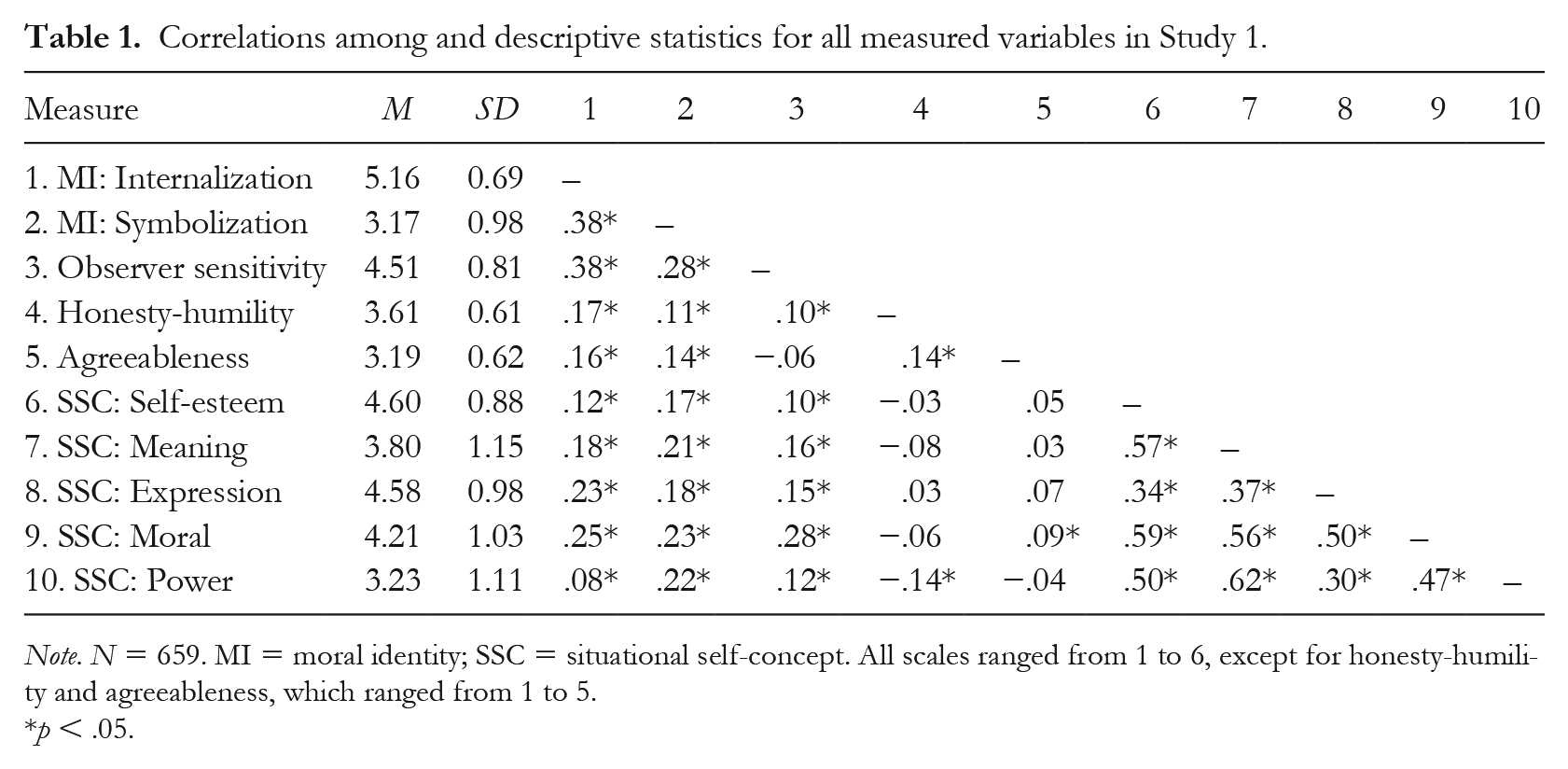
Note. N = 659. MI = moral identity; SSC = situational self-concept. All scales ranged from 1 to 6, except for honesty-humility and agreeableness, which ranged from 1 to 5.
p < .05.
Multinomial logistic regression predicting choice of role with bystander as reference category in Study 1.
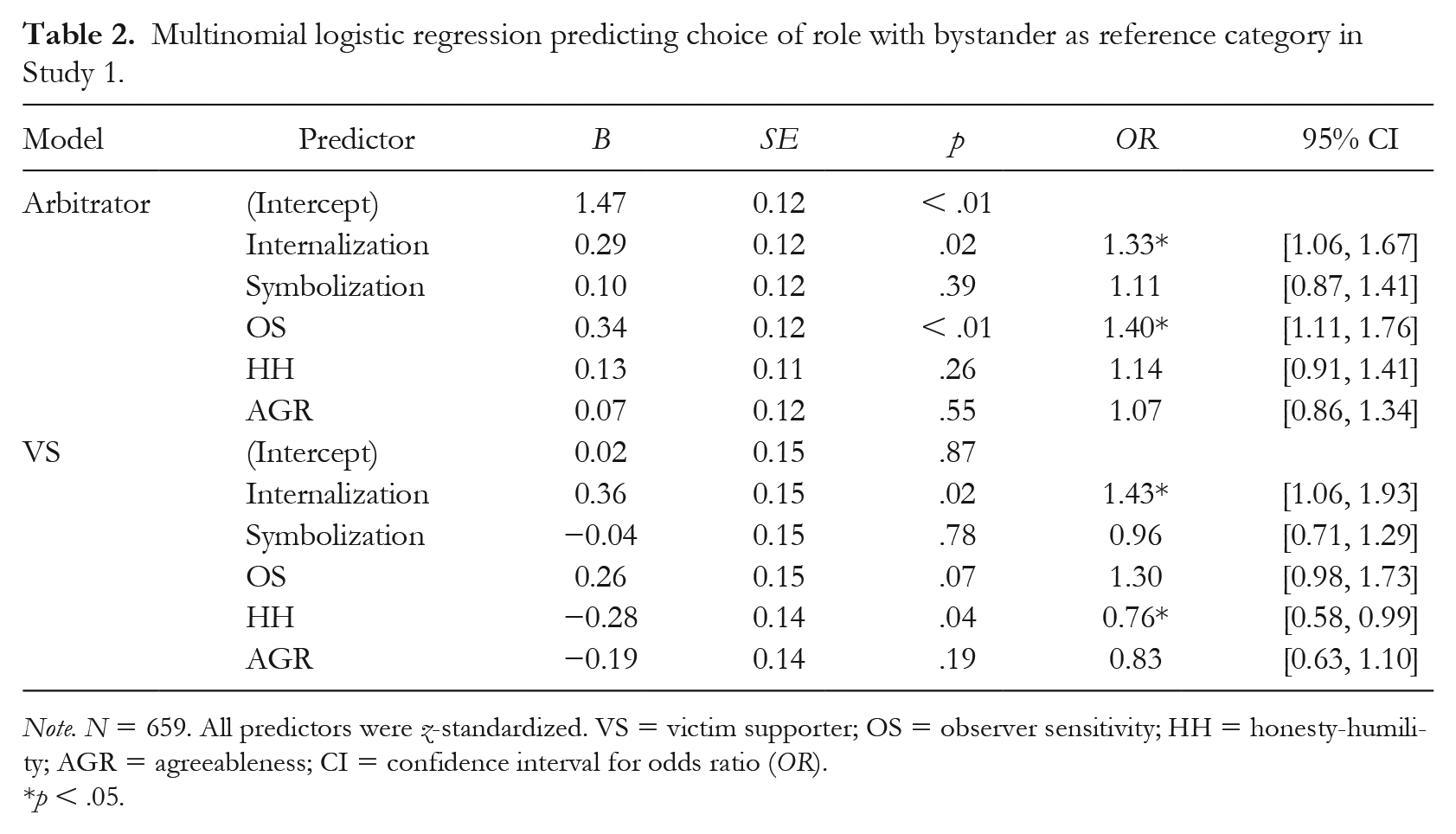
Note. N = 659. All predictors were z-standardized. VS = victim supporter; OS = observer sensitivity; HH = honesty-humility; AGR = agreeableness; CI = confidence interval for odds ratio (OR).
p < .05.
Regarding the victim supporter role, moral internalization (B = 0.36, p = .02) had a significant positive effect on the victim supporter versus bystander contrast. Although observer sensitivity had a similar effect in size on the victim supporter versus bystander contrast (B = 0.26) in comparison to its effect on the arbitrator versus bystander contrast (B = 0.34), this effect was not significant on a 5% level (p = .07). Honesty-humility had a significant negative effect on the victim supporter versus bystander contrast (B = −0.28, p = .04). This unexpected effect led us to test whether the pattern of results would be robust if honesty-humility and agreeableness were excluded from the analysis (see Appendix B, Table 10, in the supplemental material). While this produced no changes in the pattern of results regarding the arbitrator versus bystander contrast, the significance pattern regarding the victim supporter versus bystander contrast switched with regard to moral internalization and observer sensitivity. Whereas the positive effect of moral internalization was not significant anymore (B = 0.28, p = .05), the positive effect of observer sensitivity now reached significance (B = 0.28, p = .04). Across both moral roles, the results show that the likelihood of choosing a moral role in contrast to a bystander role increases with higher scores on observer sensitivity and moral internalization, while the likelihood of choosing a victim supporter role decreases with higher scores on honesty-humility.
The mean scores and standard deviations for the moral situational self-concept as a function of role choice and the corresponding ANOVA results are reported in Table 3. In line with Hypothesis 3a, participants who took moral roles as an arbitrator or victim supporter profited more from their roles in regard to their moral situational self-concept in comparison to participants who took the bystander role, F(2, 656) = 69.76, p < .01, ηp2 = .18. That is, moral roles—in comparison to the bystander role—provided them with a stronger sense of their moral character.
Mean scores, standard deviations, and univariate analyses of variance for facets of the situational self-concept as a function of role in Study 1.
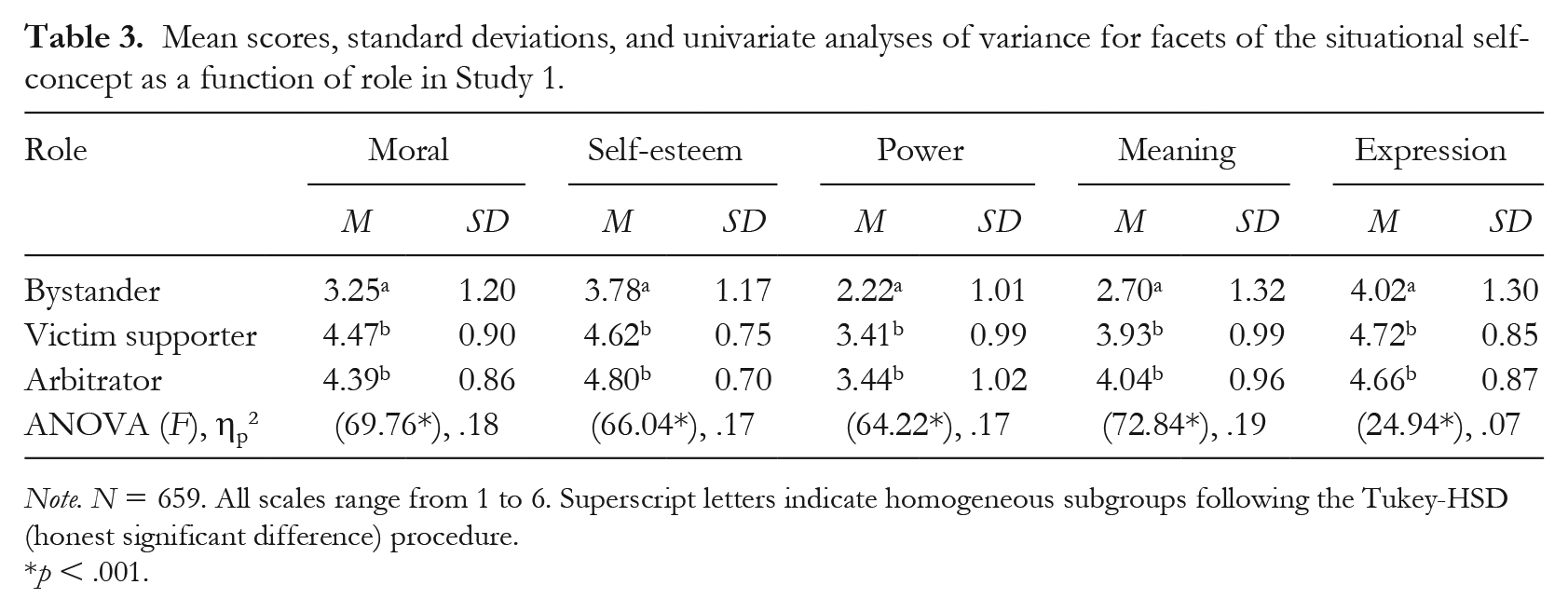
Note. N = 659. All scales range from 1 to 6. Superscript letters indicate homogeneous subgroups following the Tukey-HSD (honest significant difference) procedure.
p < .001.
To test Hypothesis 3b regarding the amplifying role of moral internalization (but not symbolization), we specified multivariate linear regression models with the moral situational self-concept as dependent variable. The results for the internalization model are displayed in Table 4. In the first step, two dummy-coded variables were included to contrast the effects of taking the arbitrator or the victim supporter role (both coded 1) versus the bystander role (coded 0). Additionally, moral internalization (z-standardized to facilitate the interpretation of regression weights) was included as predictor. In the second step, the interaction terms of Internalization × Arbitrator (vs. bystander; Dummy 1), and Internalization × Victim Supporter (vs. bystander; Dummy 2) were added to the model. Doing so did not decrease the unexplained variance significantly (∆R² < .01, p = .43). That is, in a quasi-experimental design with a self-selection to the experimental groups (i.e., to the roles), moral internalization (which was used in the same study to predict role-taking and is therefore confounded with the role choice) did not amplify the effects of moral role-taking on the moral situational self-concept. We specified an analogous two-step model with moral symbolization replacing internalization, yielding the same pattern of results (∆R² < .01, p = .87). 3
Hierarchical regression analysis summary for role-taking and moral internalization predicting participants’ moral situational self-concept in Study 1.
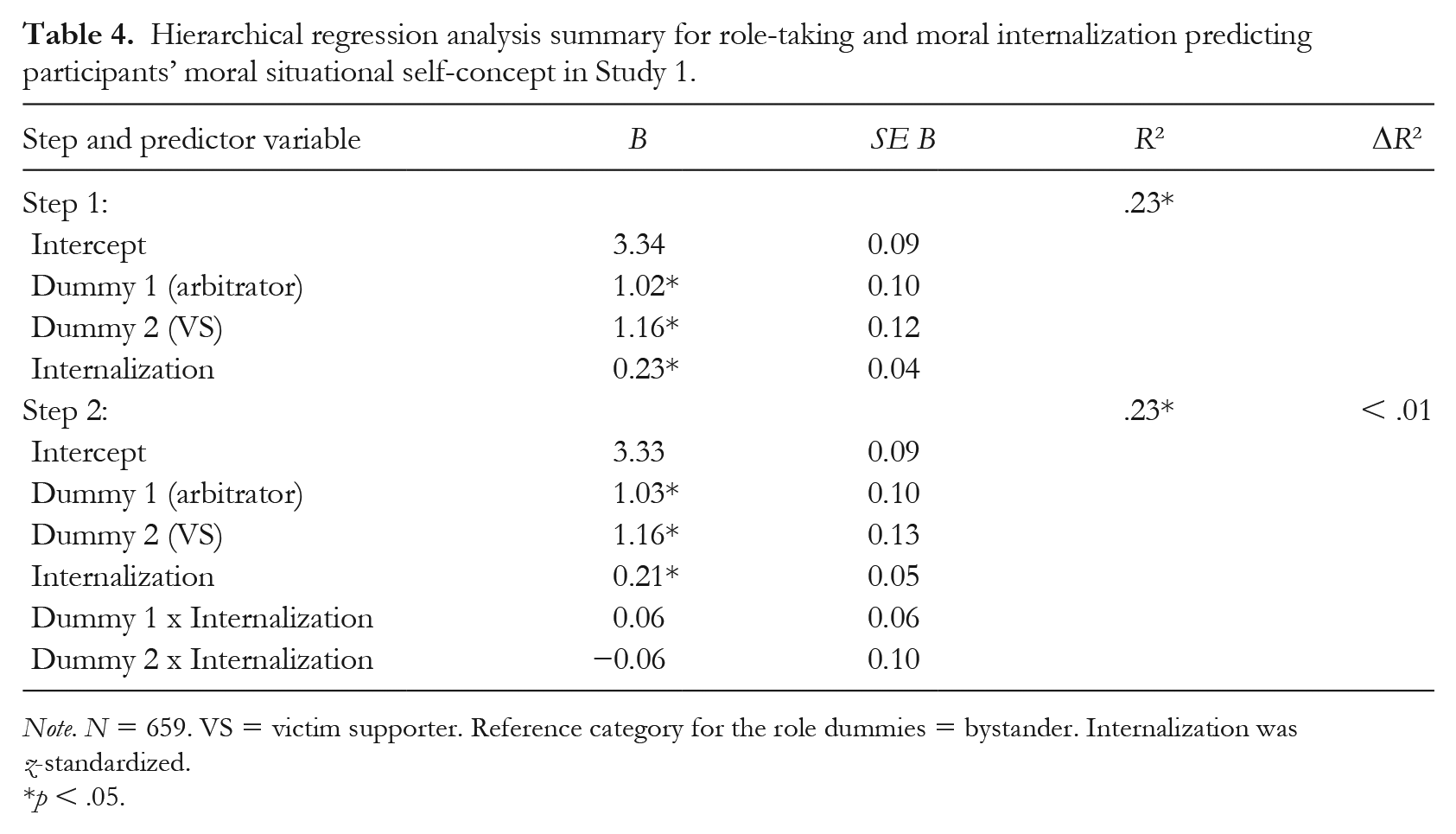
Note. N = 659. VS = victim supporter. Reference category for the role dummies = bystander. Internalization was z-standardized.
p < .05.
Discussion
The results of Study 1 support the hypotheses that moral internalization and observer sensitivity predict moral role-taking choices in interpersonal conflicts succeeding norm violations, but do not support the hypothesis that symbolization also predicts moral role-taking. People with a strong moral internalization disposition were more likely to take a moral role as an arbitrator or as a victim supporter in comparison to the bystander role—over and above more general personality traits, that is, agreeableness and honesty-humility. People scoring high on observer sensitivity were more likely to take a moral role as an arbitrator in comparison to the bystander role in the same analysis. Interestingly, moral symbolization did not predict moral role-taking. This might be a result of the fact that this was an online study: moral symbolization might show a predictive effect in settings where the presence of others—to whom one can communicate one’s moral traits through role-taking—is more salient than in an online imagination task.
The results also support Hypothesis 3a that moral role-taking elicits a moral situational self-concept. Participants taking a moral role (i.e., arbitrator or victim supporter) perceived a significantly higher moral situational self-concept during the conflict. These effects are in line with our reasoning that taking moral roles in conflicts boosts actors’ moral situational self-concept more than taking neutral roles. Regarding Hypothesis 3b, the data from Study 1 do not support the notion that actors scoring high on moral internalization profit even more strongly in their moral situational self-concept from moral role-taking in comparison to taking a bystander role. However, in the present study, the free choice of roles—which was necessary to test the predictive effects of the traits on role-taking—only offered a quasi-experimental design to investigate the role-taking effects on the situational self-concept. This design is not optimal to test Hypothesis 3 (a and b) due to the nonindependence between moral internalization and role choice. To test Hypotheses 3a and 3b more rigidly, we conducted a second experimental study with a random assignment of roles.
Study 2
In Study 2, we tested Hypotheses 3a and 3b in an experimental design. In addition, we also wanted to avoid a priming of moral idealism through the assessment of moral identity directly prior to role-taking. Therefore, we assessed moral identity independently at a measurement occasion 4 months prior to the actual study.
Sample
Participants were first-year psychology students. In the first week of the semester, they completed a battery of paper-and-pencil questionnaires that, among other trait scales, also included the same observer sensitivity and moral identity scales that had been used in Study 1 (five items for moral internalization, α = .78; five items for moral symbolization, α = .78). Four months later, students were invited to take part in an online study on “behavior in conflict situations.” Seventy-two students completed the online study, and 55 (i.e., 76%) of them could be unambiguously matched with their data from the questionnaire battery on the basis of a personalized code. This was a convenience sample, as we tried to recruit as many participants from that year as possible. Data collection was stopped at the end of the semester. No analyses were conducted before the end of data collection. A post hoc power analysis in regard to an increase in coefficient of determination corresponding to a medium-sized effect of the proposed interaction in Hypothesis 3b (f² = .15) yielded a power of 70%.
Materials and Procedure
The materials and procedure were the same as in Study 1, except that (a) no traits were assessed directly prior to reading the vignettes, and (b) roles in the conflict situation (victim supporter, arbitrator, bystander) were randomly assigned instead of chosen. Furthermore, to avoid biases created by the role labels, a schematic depiction was used to assign the roles (see Figure 2). As a manipulation check, participants were asked how they would behave when taking their respective role in the conflict, and answers were probed with regard to their role consistency by two independent raters (e.g., no active behavior as a bystander, no side-taking by arbitrators, active support of the victim as a victim supporter). Participants would have been excluded if both raters indicated role-inconsistent behavior. However, no data had to be excluded on the basis of this rule. Afterwards, like in Study 1, the same self-referent cognitions and emotions during the conflict session were assessed (all Cronbach’s α > .75).
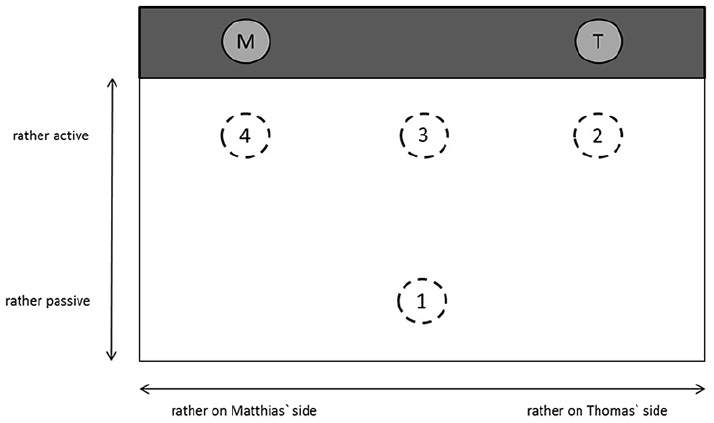
Schema used for the role assignment of bystander (1), victim supporter (4), and arbitrator (3) in Study 2.
Results
Correlations and descriptive statistics can be found in Appendix C in the supplemental material. The results for Hypothesis 3a stating that moral role-taking is associated with a higher moral situational self-concept than taking a bystander role are displayed in Table 5. The results replicate the effect from Study 1: participants who were assigned to a moral role (arbitrator or victim supporter) reported a significantly higher moral situational self-concept during the conflict meeting than proponents of the bystander role, F(2, 52) = 4.50, p = .02, ηp2 = .15.
Mean scores, standard deviations, and univariate analyses of variance for facets of the situational self-concept as a function of role in Study 2.
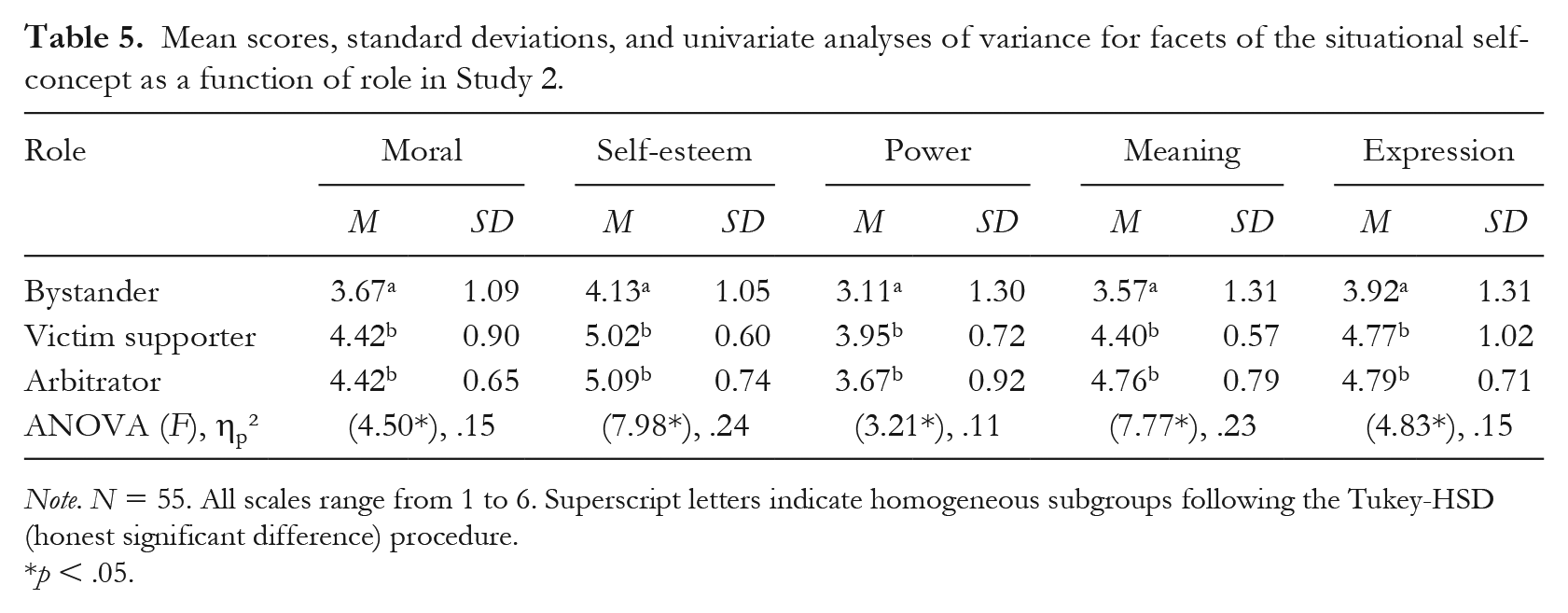
Note. N = 55. All scales range from 1 to 6. Superscript letters indicate homogeneous subgroups following the Tukey-HSD (honest significant difference) procedure.
p < .05.
To test Hypothesis 3b stating that this effect is amplified by moral internalization, but not by moral symbolization, we specified multivariate linear regression models with the moral situational self-concept as dependent variable. The results for the model with internalization as moderator are displayed in Table 6. In the first step, two dummy-coded variables were included to contrast the effects of taking the arbitrator or the victim supporter role (both coded 1) versus the bystander role (coded 0). Additionally, moral internalization (z-standardized) was included as predictor. In the second model, the two interaction terms were added to the model. Doing so decreased the unexplained variance significantly (∆R² = .13, p = .02), supporting the hypothesis that moral internalization amplifies the effects of moral role-taking on the moral situational self-concept. For people scoring high on internalization (+1 SD), moral role-taking as an arbitrator in comparison to taking a bystander role had a significant positive effect on the predicted moral situational self-concept (B = 0.88, p < .01), as well as moral role-taking as victim supporter (B = 1.22, p < .01). In contrast, for people low on internalization (−1 SD), taking the arbitrator role (B = 0.67, p = .02) still led to a significant increase in the predicted moral situational self-concept, while taking the victim supporter role (B = 0.34, p = .12) did not. The interaction is graphically displayed in Figure 3. Note that the Internalization × Arbitrator interaction coefficient in Table 6 is not significant according to conventional levels (p = .11). However, the pattern of the interaction and the simple effects support the notion that internalization moderates role-taking effects on the moral situational self-concept. We ran an analogous model for moral symbolization (see Appendix C, Table 12, in the supplemental material). Although a similar pattern resulted, using symbolization as a moderator of role-taking effects did not decrease the unexplained variance significantly (∆R² = .05, p = .21). This lends support to our hypothesis that moral internalization, but not moral symbolization, amplifies the positive effect of moral role-taking on the moral situational self-concept. 4
Hierarchical regression analysis summary for role-taking and moral internalization predicting participants’ moral situational self-concept in Study 2.
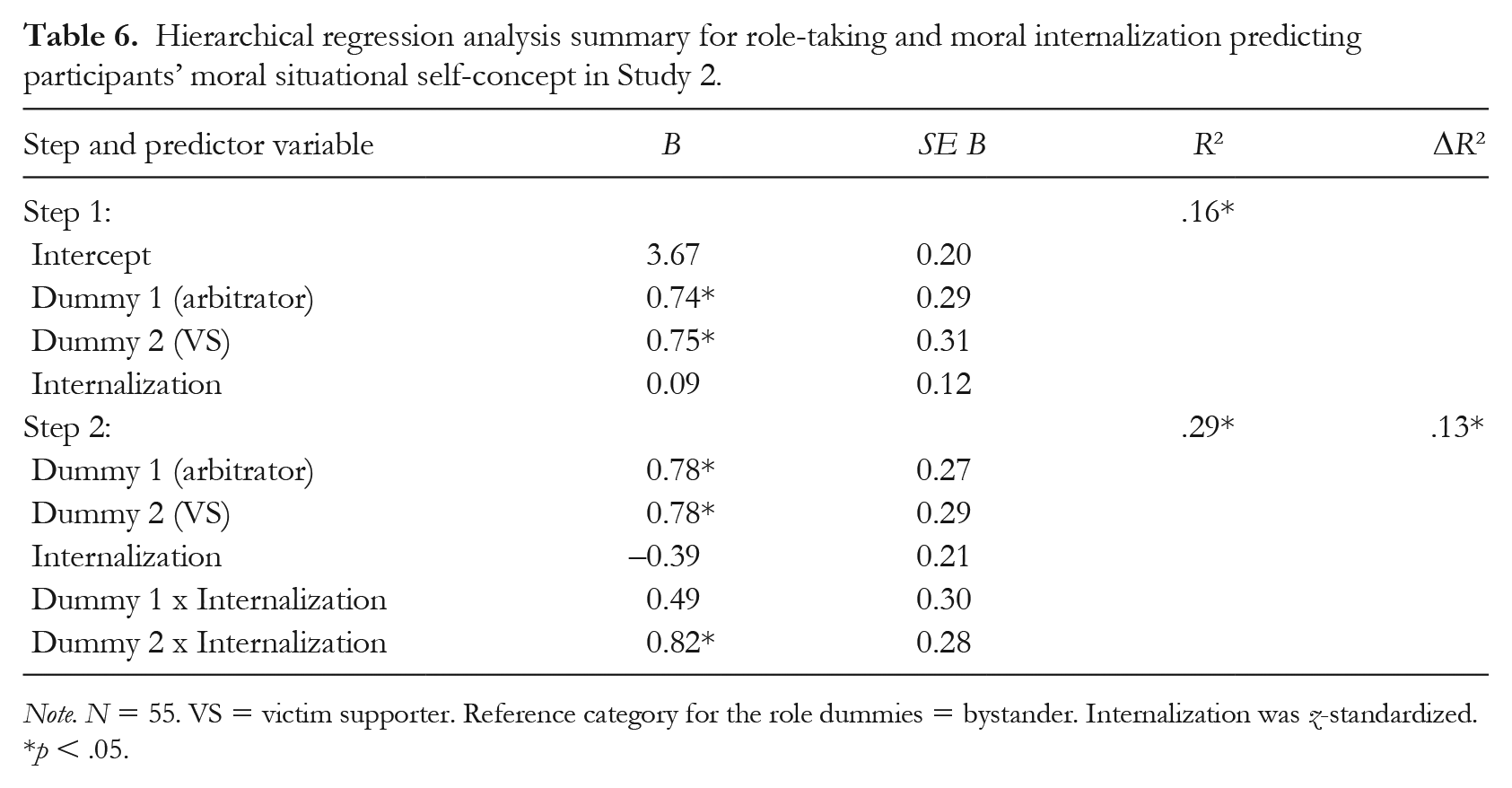
Note. N = 55. VS = victim supporter. Reference category for the role dummies = bystander. Internalization was z-standardized.
p < .05.
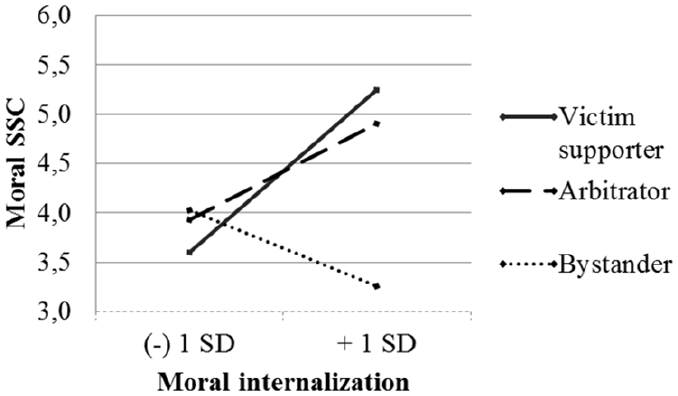
Relationships between moral internalization and the moral situational self-concept in Study 2 for each role.
Discussion
The results of Study 2 further support the hypothesis that moral role-taking in norm conflicts reflects positively on the moral situational self-concept, and that people with a high moral internalization profit even more from the beneficial effect of moral role-taking. The latter effect supports the proposed motivational mechanism: people who have strongly internalized moral aspects into their personal self-concept are drawn towards roles that elicit a moral situational self-concept because they feel even more moral in moral roles than people who do not value the moral aspect of their self as highly. In this sense, Study 2 sheds light on how stable features of one’s self-concept (e.g., a high centrality of moral aspects for the general self) interact with situational factors (e.g., moral role-taking in conflicts) on the moral situational self-concept. However, the design of Study 2—a clear-cut norm violation as the starting point of the conflict, a work group context with high interdependence among members, and the investigation of only three of the five roles—leaves open some questions regarding generalizability.
Study 3
In Study 3, we replicated Study 2 with a number of changes designed to scrutinize the generalizability of the effects found here to different conflict contexts. Specifically, we (a) replaced the work group setting with a group of tenants living in the same house (in order to reduce the degree of mutual interdependence between group members), (b) investigated all five third-party roles in a larger sample, and (c) investigated very mild and very ambiguous norm violations instead of a more severe one as in Study 2. More specifically, the two tenants were in conflict either about (a) noise disturbance, (b) how to use the shared garden area, or (c) parking spots in front of the house. Participants then took their assigned role when the conflict came up in a meeting of the housing community.
Sample
Participants were recruited via weekly invitations using a university-wide mailing list, incentivized by a raffle of five €25 online-shopping vouchers, and took part using an online survey platform (SoSci Survey; https://www.soscisurvey.de). The sample consisted of N = 230 participants (83% students, 70% women) between 18 and 61 years of age (M = 26, SD = 8.19). Acknowledging that the context changes might reduce the effect size of Hypothesis 3b, we aimed for a .80 power for an effect size half as big as in Study 2 (f² = .15 / 2 = .07). Thus, we set the threshold for data collection at 176 participants. As planned, we stopped data collection 1 week after this threshold was reached to include all participants that reacted to the last of the weekly invitation emails.
Materials and Procedure
The materials and procedure were similar to those of Study 2, except that we assessed the traits at the beginning of the study (i.e., moral identity, observer sensitivity), randomly assigned all five roles using their goals, and used different conflict situations in our vignettes (see Appendix D in the supplemental material). Again, no participants had to be excluded. The self-referent cognitions and emotions during the conflict session were assessed in the same way as in the previous studies (all Cronbach’s α > .75).
Results and Discussion
Correlations and descriptive statistics can be found in Appendix E in the supplemental material. The results conceptually replicate Study 2. In regard to Hypothesis 3a, taking a moral role (i.e., victim supporter or arbitrator) significantly increased the moral situational self-concept in comparison to taking an immoral role (i.e., perpetrator supporter or escalator), with the neutral bystanders scoring in between, F(4, 225) = 51.25, p < .01, ηp2 = .48. The results are displayed in Table 7. In regard to Hypothesis 3b, we again found that moral internalization amplifies the effects of moral role-taking on the moral situational self-concept: adding the Internalization × Role-Dummy interaction terms to the model predicting the moral situational self-concept lead to a significant increase in explained variance (R² = .04, p < .01). The results are displayed in Table 8. In contrast to Study 2, where this interaction was driven by the bystander role, it is driven by the escalator role in Study 3: in contrast to all other roles, the more escalators internalized moral notions, the less moral they felt in their role (Β = −0.41, p < .01). The fact that internalization seems to affect bystanders differently in Study 3 in comparison to Study 2 reflects the change in context, as mentioned before. For people scoring high on internalization (+1 SD), taking any role other than the escalator role had significant positive effects on the predicted moral situational self-concept in a range from B = 2.79 for perpetrator supporters (p < .01) to B = 3.44 for arbitrators (p < .01). For people scoring low on internalization (−1 SD), the positive effects of taking any role other than the escalator role persisted; however, the effects were reduced to a range from B = 1.41 for perpetrator supporters (p < .01) to B = 2.34 for victim supporters (p < .01).
Mean scores, standard deviations, and univariate analyses of variance for facets of the situational self-concept as a function of role in Study 3.
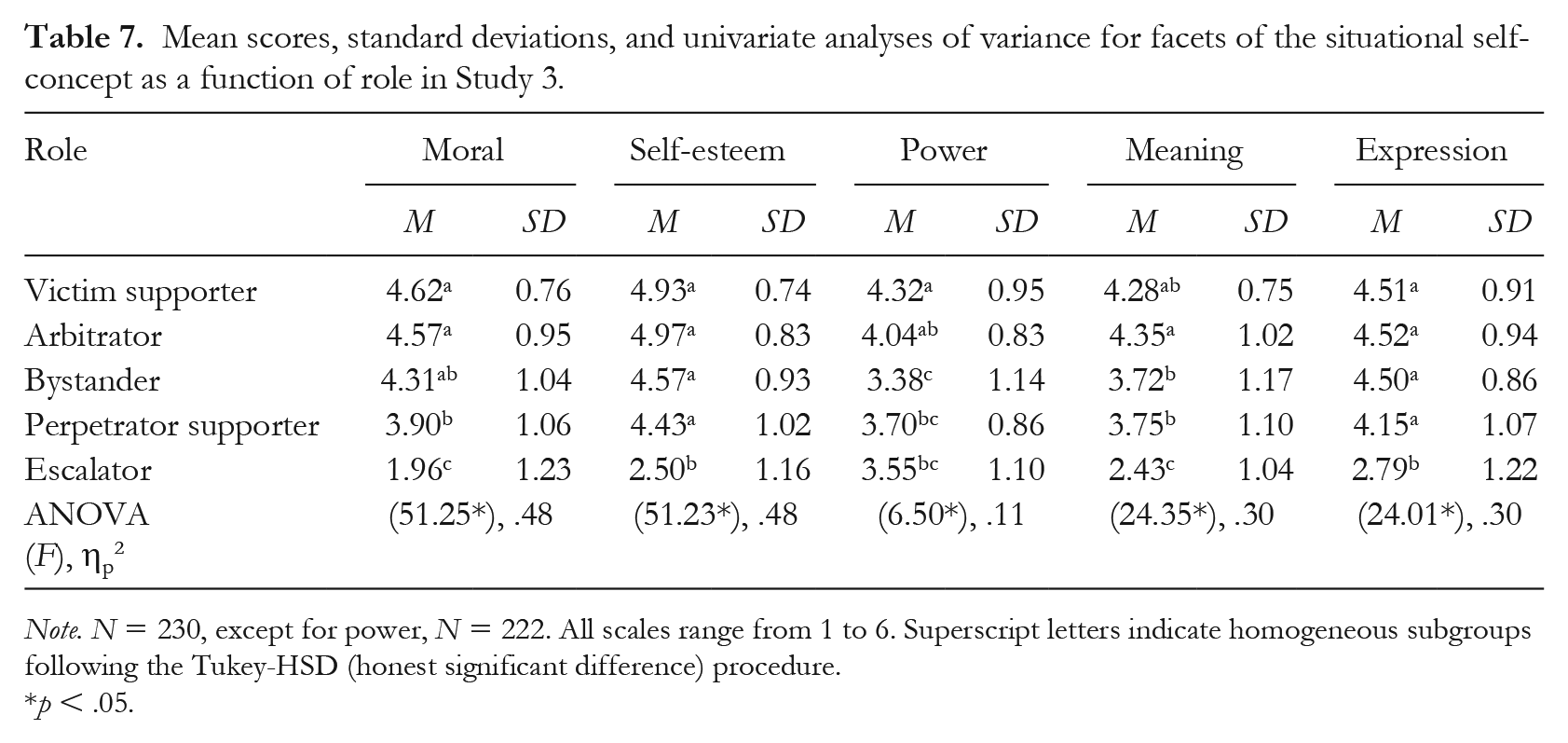
Note. N = 230, except for power, N = 222. All scales range from 1 to 6. Superscript letters indicate homogeneous subgroups following the Tukey-HSD (honest significant difference) procedure.
p < .05.
Hierarchical regression analysis summary for role-taking and moral internalization predicting participants’ moral situational self-concept in Study 3.
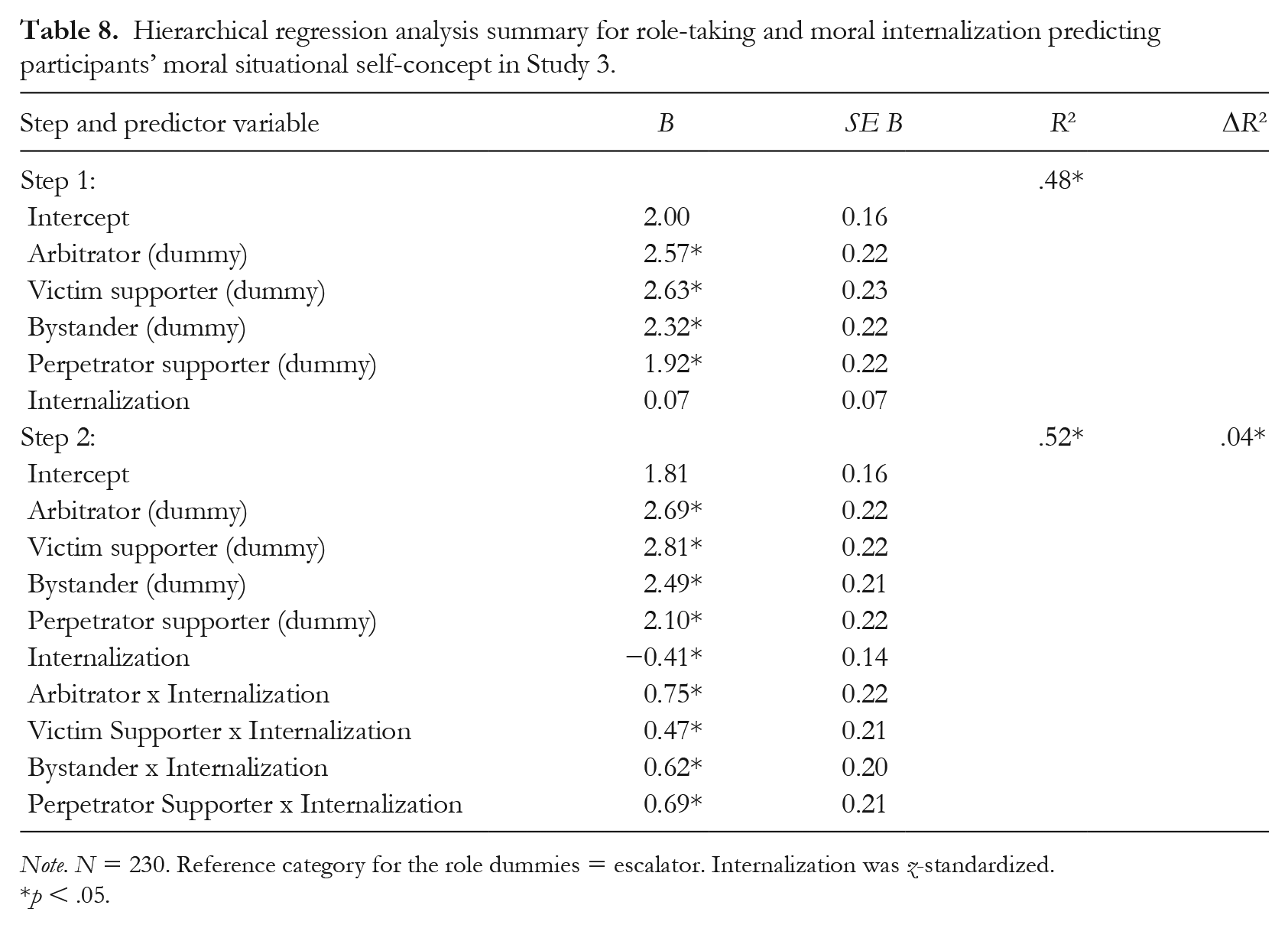
Note. N = 230. Reference category for the role dummies = escalator. Internalization was z-standardized.
p < .05.
This interaction pattern remained robust in additional analyses, including both a full model with moral symbolization as an additional moderator (see Appendix E, Table 15, in the supplemental material) as well as models additionally controlling for observer sensitivity and its interaction terms. However, in contrast to Study 2, symbolization also amplified the positive effect of moral role-taking on the moral situational self-concept in Study 3 (∆R² = .02, p = .03), but only when ignoring internalization as a moderator. That is, the explanatory increment of symbolization as an additional moderator over and above internalization was not significant in stepwise regression analyses (∆R² = .01, p = .20), whereas, the other way around, internalization as an additional moderator still explained incremental variance over and above symbolization and its interaction terms (∆R² = .03, p = .02). That is, Study 3 suggests that although moral symbolization may also amplify benefits in the moral situational self-concept due to moral role-taking, this effect is negligible once the much larger amplifying effect of moral internalization is taken into account. This underscores that moral internalization, rather than moral symbolization, is the central moderator of the positive effect of moral role-taking on the moral situational self-concept.
General Discussion
In this article, we aimed at (a) individual-level mechanisms explaining interindividual differences in third-party reactions in interpersonal conflicts, and (b) the effects of role-taking on the situational moral self-concept. Building on a definition of social roles as the associations actors tie to social positions, we tested whether the choice of roles can be uniquely predicted by personality traits reflecting the centrality of a moral self-concept and sensitivity for injustice (i.e., moral identity, observer sensitivity). In line with Hypotheses 1 and 2, moral internalization and observer sensitivity predicted the choice of moral roles over and above other morality-related traits (i.e., honesty-humility and agreeableness). However, moral symbolization did not show the hypothesized predictive effect.
Second, we tested whether taking a moral role leads to a more positive moral situational self-concept than taking a neutral or immoral role—this follows from the argument that role-taking is intertwined with the situational self-concept. Results were consistent with this hypothesis in two studies using both correlational and experimental designs: participants who selected (Study 1) or were assigned to (Studies 2 and 3) a moral role experienced themselves as more moral persons during the conflict in comparison to participants in neutral or immoral roles.
In addition, we investigated a potential motivational mechanism underlying the predictive effect of moral internalization for taking moral roles. We argued that taking a moral role fosters the moral situational self-concept. What follows from this argument is that the effect of taking a moral role on self-referent moral cognitions and emotions should be particularly pronounced among “high internalizers” (i.e., people with high values on moral internalization), but not among “high symbolizers” (i.e., people with high values on moral symbolization), because only moral internalization reflects the centrality of being moral for one’s self-concept. This hypothesis (3b) was tested in all three studies. While the effect did not occur in Study 1 (in which role-taking was self-selected and, thus, quasi-experimental), the results of the more rigid tests in Studies 2 and 3 (in which role-taking was randomly assigned) were in line with this hypothesis: people with relatively high values on moral internalization (but not those with relatively high values on moral symbolization) felt even more moral after taking moral roles in conflicts.
The difference in results in Study 1 needs to be discussed. The quasi-experimental design of Study 1 made it more difficult to rigidly test the hypothesized moderation effect, because internalization and role-taking were confounded. One potential alternative explanation of the null effect regarding Hypothesis 3b in Study 1 caused by the quasi-experimental design lies in a post hoc legitimization of a bystander role choice in Study 1: actors scoring high on moral internalization were arguably more prone to justify their inactive role choice post hoc by reporting a more moral situational self-concept. That could be the reason why one obtains similar positive regression coefficients of internalization on the moral situational self-concept in all roles (see Step 2, Table 4). In Studies 2 and 3, post hoc justifications are not necessary because roles were assigned, not selected. This might have been the decisive factor to reveal an amplifying effect of internalization on the moral situational self-concept boost after moral role-taking (see Step 2, Table 6).
In conclusion, the results lend support to our theoretical argument that moral role-taking in interpersonal conflicts is related to a process of moral self-regulation, rather than, for example, impression management concerns. In sum, when explaining third-party reactions, the results highlight the importance of how these reactions feedback on the actors’ moral self-concept during the conflict, and how interindividual differences moderate this feedback, reinforcing the reaction in this way.
Limitations
The present research faced four methodological challenges. First, demand effects are relevant because participants might have taken moral roles more often or reported more positive self-referent cognitions and emotions after moral role-taking because they might have inferred that this were the effects we were looking for (e.g., from the role labels). We tried to minimize such artifacts by capturing the reactions in Study 1 in open format first, avoiding the labels “victim” and “perpetrator” in general, and by avoiding any role labels in Study 2 or 3 (e.g., we used a schematic description of the various roles in Study 2; see Figure 2). Of course, we cannot rule out that participants guessed our hypotheses despite these demand-reducing strategies.
Second, the samples in all three studies were dominated by students, while the second sample consisted of first-year psychology students only. This raises the question of generalizability. Especially in regard to interpersonal conflict behavior, effects might differ between psychology students and the general population. For example, compared to the general population, psychology students might have a stronger preference for moral roles. However, role choice was only self-selected in Study 1, and the sample of Study 1 also comprised a substantial amount of students of other departments, as well as nonstudents (30%). In Studies 2 and 3, roles were randomly assigned.
Third, the sample size of Study 2 was relatively small. This raises issues of statistical power and the question of reliability. However, a false positive in regard to the central result (i.e., the interaction of moral role-taking and moral internalization on the moral situational self-concept) seems to be quite implausible, taking the consistency of the overall data pattern into account (see Table 6). Furthermore, the results were conceptually replicated in Study 3.
Fourth, we investigated only two (i.e., work groups and house communities) out of all possible conflict contexts, and results might differ in other contexts (e.g., families, circles of friends, or groups of complete strangers). For example, in close and durable groups like families, the history of the group and personal relations might be so crucially decisive for third-party reactions that they could overshadow the mechanisms presented here. On the other hand, the structural positions of conflicts and the roles tied to them do not differ between contexts, and in so far, the line of thought presented here should be generalizable. However, replications in other contexts are desirable.
Outlook
In the present studies, we investigated how the moral value of roles in conflicts affects the situational self-concept. It is important to note that contextual factors can influence the moral value of a role in a specific conflict. However, a role-theoretical framework is also useful when outlining contextual factors. For example, personal relations can additionally influence the moral value of roles in a specific situation. In role-theoretical terms, the existence of personal relations creates intraindividual interrole conflicts: if the perpetrator in a conflict is also my friend, I am torn between the loyalty principle tied to my friend role and my moral evaluation of the perpetrator supporter role. The same logic applies to categorical relations such as group memberships. However, to investigate our hypotheses with a basic design first, we looked at third-party role-taking in a common ingroup setting (i.e., third party and others are members of the same group), with no further information about personal relations. Future research could fill this gap by systematically varying personal and categorical relations of the third party and the focal conflict actors, or the whole group.
Furthermore, conflicts take place in a variety of groups (e.g., in working teams, house communities, or families), and group characteristics moderate the moral value of roles. First and foremost, the degree of interdependence among members (Kelley & Thibaut, 1978) is noteworthy: in groups with high interdependence, destructive conflicts create more fallout for everyone, and thus, the more moral it becomes to solve them instead of staying passive or even escalating them. In role-theoretical terms, the degree of interdependence is a system-level factor that amplifies the importance of all roles in that system. The design of Study 3 was based on this idea, and the results underscore this reasoning. However, future research should investigate the degree of interdependence among members and other group characteristics more comprehensively. Summing up, contextual factors additionally influence the moral value of a role in a specific situation, and their effects can be integrated in a role-theoretical framework in future work.
Conclusion
The present studies demonstrate how a role-theoretical approach can help to analyze the social structure of conflicts, and to understand the intraindividual processes deciding how third parties engage with and are affected by role-taking in conflicts. In sum, the results illustrate that stable features of third-party actors’ self-concepts, such as moral internalization, affect role-taking in conflicts, and that role-taking reflects back on more malleable manifestations of the self, that is, the moral situational self-concept. In conclusion, the studies suggest that third-party reactions to conflicts are at least partly driven by moral self-regulation, that is, that third parties react in certain ways in order to experience themselves as moral persons. In contrast, we did not find any support for moral impression management in our studies.
Looking forward, research following these and similar directions will create stepping stones on the road to a comprehensive role-theoretical understanding of third-party behavior in interpersonal conflicts. Besides paving the way for role-theoretical research in other domains (e.g., negotiations, solutions to social dilemmas, etc.), this understanding will help developing effective and efficient interventions (i.e., coaching sessions, training programs) aimed at preventing situations like the one described at the beginning of this article (i.e., Bob and Rob’s conflict over taking credit for ideas), or at least at helping third parties to deal with them efficiently.
Supplemental Material
Supplementary_Online_Material – Supplemental material for Explaining third-party reactions in interpersonal conflicts: A role-taking approach
Supplemental material, Supplementary_Online_Material for Explaining third-party reactions in interpersonal conflicts: A role-taking approach by Johannes Schwabe and Mario Gollwitzer in Group Processes & Intergroup Relations
Footnotes

References
Supplementary Material
Please find the following supplemental material available below.
For Open Access articles published under a Creative Commons License, all supplemental material carries the same license as the article it is associated with.
For non-Open Access articles published, all supplemental material carries a non-exclusive license, and permission requests for re-use of supplemental material or any part of supplemental material shall be sent directly to the copyright owner as specified in the copyright notice associated with the article.
