




Abstract
The experience of “burnout” is characterized by emotional fatigue and detachment associated with intensive stress. Burnout is prevalent across personal and professional spheres, with increasing cultural salience. Multiple factors can contribute to burnout. Here, we focus on one: exposure to others’ trauma. This circumstance spans domains from social service professions to social media newsfeeds, with potentially deleterious effects on the self. To understand the conditions under which trauma exposure results in burnout, we propose and test a role–taking model. We do so by presenting study participants (N = 723) with a first–person account of intimate partner violence, stimulating an acute instance of trauma exposure. Findings show that higher levels of role–taking increase burnout, with antecedents and outcomes tied to role-taking’s cognitive and affective components. This study clarifies how burnout occurs within the scope of trauma exposure while expanding role–taking research beyond the interpersonal benefits that have monopolized scholarly attention to date.
The problem of “burnout” is now common and diffuse, with some scholars and journalists raising this affliction as a defining condition of contemporary social life (Han 2020; Petersen 2021). Characterized by emotional fatigue and detachment, burnout was traditionally applied to volunteer and workplace settings (Demerouti et al. 2001; Freudenberger 1974), with particular hold on the social and humanitarian services (Bride et al. 2004; Cummings et al. 2021; Maslach and Jackson 1984; Maslach, Schaufeli, and Leiter 2001; Michalopoulos and Aparicio 2012; Sprang, Craig, and Clark 2011). Today, burnout has expansive reach with ties to 24/7 news cycles (Boukes and Vliegenthart 2017; Mannell and Meese 2022), social media “doom-scrolling” (Han 2018; Sharma, Lee, and Johnson 2022), and activist participation (Cox 2011), among myriad other sites. 1
The causes of burnout are complex and many, but one factor that spans multiple domains—from humanitarian services to social media newsfeeds—is the exposure of the self to other people’s trauma (Boukes and Vliegenthart 2017; Cox 2011; Koutsimani, Montgomery, and Georganta 2019; Mannell and Meese 2022; Maslach and Leiter 2017; Mikolajczak, Gross, and Roskam 2019). We investigate this factor in the present work, enrolling the tools of structural social psychology for a question toward which these tools are especially well-equipped: under what conditions does trauma exposure result in burnout for the self, and to what effect? To address this question, we draw on the construct of role–taking.
Role-taking is a fundamental element of selfhood and interaction whereby people place themselves in the proverbial shoes of another or others (Mead 1934). With role–taking, we propose predictors and outcomes of burnout, modeling a pathway by which others’ trauma vicariously affects the self. 2 We test this model with a nationally recruited U.S. sample (N = 723) who read and respond to a real court document detailing a case of intimate partner violence, preceded by questions about participants’ background and attitudes, and followed by cognitive, affective, and anticipated behavioral measures. Intimate partner violence refers to physical, sexual, and/or psychological abuse between people in the context of an intimate relationship (Breiding et al. 2015; Stark 2007). We present participants with a single account of such violence, serving as an acute instance of trauma exposure that can surface and foreground variables of theoretical interest.
Results show that higher levels of role–taking increase indicators of burnout and reduce participants’ willingness for continued engagement, whereas less active role–taking seems to buffer such effects. Role-taking is partially predicted by participants’ experiences of abuse and their attitudes about victimization, with nuanced distinctions between role-taking’s cognitive and affective elements. Theorizing burnout in this way gives a sociological read to that which has been predominately filtered through a psychological prism and has explanatory value for the process by which trauma exposure impacts the self. Simultaneously, attention to burnout adds depth to role–taking theory. Here, we illuminate role-taking’s psychosocial vulnerabilities, whereas existing research has focused exclusively on interpersonal benefits (Bailenson 2018; Hooper et al. 2015; Penn, Ivory, and Judge 2010; Rosenberg, Baughman, and Bailenson 2013; Shott 1979; Stryker 1957).
Literature
Burnout
“Burnout” was first introduced in the 1970s to describe the disaffection of social aid volunteers in New York (Freudenberger 1974) and has since extended to a broad range of occupational contexts (Demerouti et al. 2001; Koopman and Hakemulder 2015; Maslach and Leiter 2017). Burnout has also expanded beyond professional sectors and been applied to family care (Mikolajczak et al. 2019), news consumption (Boukes and Vliegenthart 2017; Mannell and Meese 2022), social media participation (Han 2018; Sharma et al. 2022), social justice activism (Cox 2011), and many other settings. Burnout is defined by feelings of cynicism, detachment, and emotional exhaustion, with effects such as depression, anxiety, and withdrawal from burnout–inducing situations (e.g., paring back family duties, quitting a job, limiting news consumption, breaking from social media, reducing involvement in activist organizations; Boukes and Vliegenthart 2017; Cox 2011; Koutsimani et al. 2019; Mannell and Meese 2022; Maslach and Leiter 2017; Mikolajczak et al. 2019).
There are many interrelated causes of burnout, including overwork, undersupport, lack of resources, repetitiveness, and prolonged exposure to distressing circumstances (Bakker and de Vries 2021; Demerouti et al. 2001; Han 2020). It is this last factor, exposure to distressing circumstances, that we directly attend to in the present study. We do so because this factor weaves throughout multiple domains in which burnout occurs, with broad relevance across professional and personal life. For example, burnout is disproportionately high among those who work in social and humanitarian services, where practitioners are likely to interact with traumatized clients and encounter textual, verbal, and graphic depictions of traumatic events (Beck 2011; Bemiller and Williams 2011; Kim and Stoner 2008; Kolb 2014; Pearlman and Saakvitne 1995; Schaufeli, Leiter, and Maslach 2009; Singer et al. 2020; Wasco and Campbell 2002). More recently, research shows similar patterns in nonwork settings. For example, studies find news–related burnout connected to COVID-19 coverage (Gottfried 2020; Mannell and Meese 2022), a range of burnout indicators associated with doom–scrolling through negative content on social media (Han 2018; Sharma et al. 2022), and activist burnout during the Black Lives Matter and #MeToo movements, which concentrate attention on racial and gender violence (Gorski 2019; Richardson 2020; Strauss Swanson and Szymanski 2020). In each of these cases, trauma is present and prominent, with the potential for burnout to arise (Cohen and Collens 2013; Silver, Portnoy, and Peters 2015).
Although trauma exposure opens the door to burnout, this outcome is neither inevitable nor uniform across subjects and circumstances. The literature points to a range of variables that can mitigate or amplify the likelihood that burnout will ensue, such as strength of social support networks, institutional cultures and policies, and individual personality traits (Galek et al. 2011; Rupert, Miller and Dorociak 2015; Strauss Swanson and Szymanski 2020; Swider and Zimmerman 2010). What remains understudied is how interactional, social–psychological factors figure in. This leaves open a key piece of the puzzle, given that social–psychological processes link the micro to the macro, the self to the other, and the structural to the personal. We thus build on existing work by investigating a fundamental social–psychological construct—role-taking—in the burnout pathway, gaining insight into how burnout eventuates.
Role-Taking
Mead (1934) theorized role–taking as a hallmark of human development and community social life. Role-taking is the process and practice of putting the self in the proverbial shoes of another—understanding the world from the other’s perspective and behaviorally responding in turn. Role-taking serves as a fundamental building block of the social–psychology paradigm, underpinning structurally situated social interactions in which individuals present, interpret, and respond to meaningful social cues (Cast 2004; Davis and Love 2017; Love and Davis 2014, 2021; Mead 1934; Turner 1962).
As a distinctly structural concept, role–taking models social interaction between occupants of interrelated social roles. These roles inform who each person is in an interaction situation, accompanied by normative expectations about the thoughts, feelings, and behaviors of each role occupant (Love and Davis 2014, 2021; Mead 1934; Schwalbe 1988; Shott 1979; Turner 1962). From this structural base, role–taking holds two psychological dimensions—perspective-taking and empathy—accounting for cognition and affect, respectively. Perspective-taking is the cognitive process of discerning what others think and feel, and empathy refers to shared feeling and being moved by others’ emotions (Davis and Love 2017:167). Variation in role–taking is shaped by a number of factors, including social status hierarchies (Love and Davis 2014, 2021), similarity (or difference) between interactants (Cast 2004; Love and Davis 2014), and adherence to stereotypic beliefs (Avenanti, Sirigu, and Aglioti 2010; Johnson et al. 2009; Parlan 2015).
Active role–taking is often linked to prosocial outcomes such as social cohesion, helping behavior, and favorable attitudes toward outgroups (Bailenson 2018; Hooper et al. 2015; Penn et al. 2010; Rosenberg et al. 2013; Shott 1979; Stryker 1957). Yet, role–taking with traumatized persons may hold mental and emotional burdens, revealing a vulnerability in role–taking practice. Such potentials remain unexplored in the existing theoretical program, which has trained focus on role-taking’s interpersonal advantages. Burnout thus represents a productive entry point for building a holistic theory of role–taking, one that accounts for its multidimensional properties.
Current Study
The current study proposes and tests a role–taking theory of burnout in the scope of trauma exposure, based on a design in which participants encounter and respond to a first–person narrative describing a victim’s experience of abuse. With these data, we identify stimulus–relevant antecedents of role–taking, effects of role–taking on burnout, and effects of burnout on continued engagement with trauma–related material. We also test for role-taking’s direct and indirect effects on continued engagement, probing further the outcomes affected by role–taking variation. This model anchors burnout to a social–psychological foundation while advancing role–taking theory.
To model a role–taking theory of burnout, we set forth six hypotheses. These divide into predictors of role–taking, effects of role–taking on burnout, effects of burnout on continued engagement, and the (direct and indirect) effects of role–taking on continued engagement (see Figure 1).
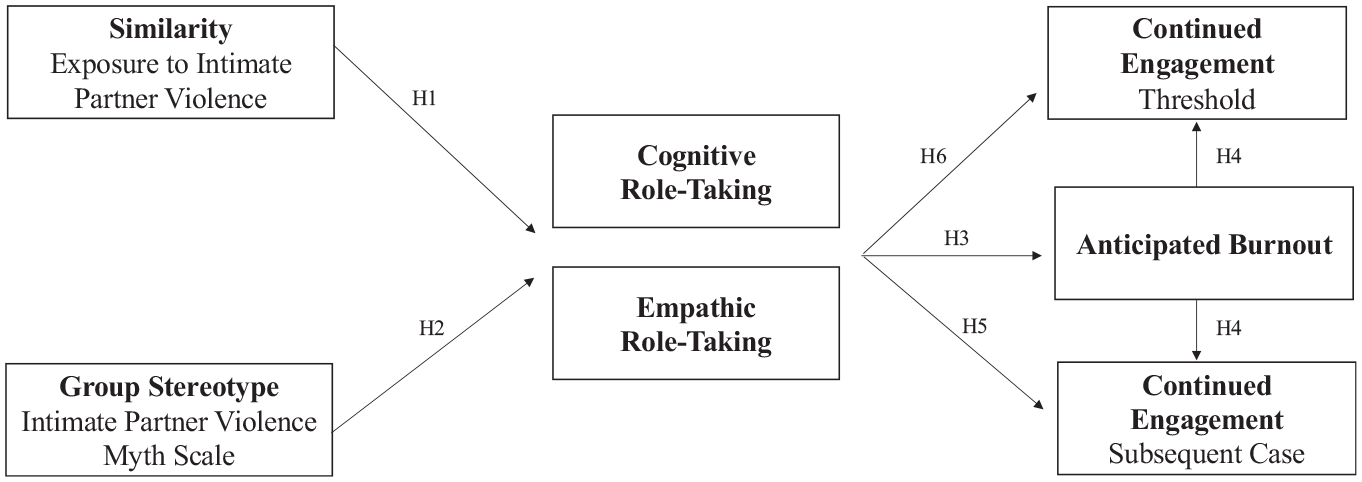
Model of Cognitive and Empathic Role-Taking Affecting Burnout and Continued Engagement
Hypotheses
Predictors of role-taking
We hypothesize that participants’ experiences with and attitudes about intimate partner violence will significantly predict both cognitive and empathic role–taking. Specifically, we hypothesize that participants who share the experience of an abusive relationship, either personally or through close friends and family, will role–take more actively with the victim whose story is conveyed in the stimulus. We make this prediction based on existing research showing prior victimization experiences increase feelings of compassion toward victims (Batson et al. 1991) and the general finding that people role–take more readily with others who are similar to themselves (Cast 2004; Love and Davis 2014).
Hypothesis 1a: Participants with experiences of abusive relationships will show higher levels of cognitive role–taking than participants without abuse experiences.
Hypothesis 1b: Participants with experiences of abusive relationships will show higher levels of empathic role–taking than participants without abuse experiences.
Our second hypothesis addresses the effects of stereotypes on role–taking. Stereotypes are a broad set of negative meanings attributed to an entire group. As applied to intimate partner violence, research shows that holding strong negative stereotypes about victims reduces empathic concern (Parlan 2015). More generally, stereotypes can have distancing and dehumanizing effects that dull sensitivity to the experiences of stereotyped group members (Avenanti et al. 2010; Johnson et al. 2009). In the context of our study, we thus predict that holding negative stereotypes about victims and victimization will diminish participants’ role–taking responses.
Hypothesis 2a: Participants who hold negative stereotypical beliefs about victims will show lower levels of cognitive role–taking than those with less adherence to negative stereotypes.
Hypothesis 2b: Participants who hold negative stereotypical beliefs about victims will show lower levels of empathic role–taking than those with less adherence to negative stereotypes.
Effects of role–taking on burnout
People vary in the extent to which they role–take with others (Love and Davis 2014, 2021), and we test these variations as a pathway to burnout following exposure to trauma–related content. As we discuss in the “Methods” section, ethical and practical considerations prevent us from inducing a full burnout experience. We thus measure anticipated burnout if participants were to regularly encounter similar materials to the stimulus. We hypothesize that higher levels of cognitive and empathic role–taking will predict higher levels of anticipated burnout.
Hypothesis 3a: Higher levels of cognitive role–taking will increase anticipated burnout.
Hypothesis 3b: Higher levels of empathic role–taking will increase anticipated burnout.
Effects of burnout on continued engagement
The literature shows that people often withdraw from burnout–inducing circumstances (Boukes and Vliegenthart 2017; Mannell and Meese 2022; Maslach and Leiter 2017). In the context of our study, this is relevant to participants’ (un)willingness to remain engaged with trauma–related content based on their perceived proximity to burnout after reading the initial case report depicting abuse. We thus hypothesize that higher levels of anticipated burnout will reduce participants’ willingness to continue engaging with trauma–related material. We measure participants’ willingness for continued engagement in two ways, asking how willing they are to read a subsequent case report as part of the present study and to estimate how many cases they could read before becoming emotionally fatigued. We hypothesize that increased anticipated burnout will decrease willingness for continued engagement across both indicators.
Hypothesis 4a: Higher levels of anticipated burnout will reduce participants’ willingness to read a subsequent case report.
Hypothesis 4b: Higher levels of anticipated burnout will reduce the number of cases participants estimate they could read before reaching a threshold of emotional fatigue.
Effects of role–taking on continued engagement
Finally, we test how cognitive and empathic role–taking relate to continued engagement. This contributes to a holistic theory of role–taking, given that the psychosocial connection between self and a traumatized other may be at once a lynchpin of compassion and, at the same time, the mechanism by which disengagement occurs (Han, Lee, and Lee 2012). Thus, we hypothesize that higher levels of cognitive and empathic role–taking will reduce willingness to continue engaging with trauma–related material. We test for direct effects of role–taking on continued engagement measures, indirect pathways via burnout, and total effects in the model.
Hypothesis 5a: Higher levels of cognitive role–taking will reduce participants’ willingness to read a subsequent case report.
Hypothesis 5b: Higher levels of empathic role–taking will reduce participants’ willingness to read a subsequent case report.
Hypothesis 6a: Higher levels of cognitive role–taking will reduce the number of cases participants estimate they could read before reaching a threshold of emotional fatigue.
Hypothesis 6b: Higher levels of empathic role–taking will reduce the number of cases participants estimate they could read before reaching a threshold of emotional fatigue.
Methods
To investigate our hypothesized relationships, we administered a survey to a U.S. national sample stratified across demographic dimensions of age, race, and gender. Each participant in the study was presented with an anonymized court filing from a real civil protection order case in which a woman who experienced intimate partner violence details her abuse. Intimate partner violence involves physical violence, sexual violence, and/or stalking, including the use of controlling and/or coercive tactics by a current or former intimate partner (Breiding et al. 2015; Stark 2007). This type of abuse is widespread (Avon 2013), culturally salient via contemporary social movements (Strauss Swanson and Szymanski 2020), and exposure to it has been shown to produce negative socioemotional effects on professionals who encounter abuse–related materials on a regular basis (Beck 2011; Kim and Stoner 2008; Kolb 2014; Schaufeli et al. 2009; Singer et al. 2020). These factors—familiarity, likelihood of encounter, and empirical indicators of socioemotional effects—guided our selection of intimate partner violence as a domain for this first test of the role–taking burnout relationship.
Stimulus
The stimulus for this study is a narrative from a court order in a real civil protection order case. These court orders can restrain an abuser from contacting, threatening, or harassing a victim (Groggel 2021; Lynch et al. 2022; McFarlane et al. 2004). Victims typically apply for a protection order by filing a court petition that includes a written first–person account of abuse. We selected one of these accounts from an online justice database to which the authors have access and research permissions.
The case involves a woman filing against her ex–boyfriend. It details incidents of physical, sexual, and psychological abuse, including tactics of isolation and humiliation. The account is 297 words long and presented in handwritten text. To protect anonymity, a researcher rewrote the text verbatim in her own handwriting (rather than retaining the narrator’s original handwriting), and we assigned pseudonyms to the victim and perpetrator in the case. 3 We obtained approval from the Institutional Review Board and provided participants with warnings about the nature and content of the case they would encounter. Participants could withdraw from the study at any time and still receive full payment.
The victim narrative served as a theoretically relevant stimulus from which participant responses were derived. This approach circumvents the abstract self–reports that are common in survey research while allowing for targeted theory testing. However, it is limited in its recreation of our phenomenon of interest—burnout—which develops over time through prolonged trauma exposure. This is a necessary limitation due to ethical and practical concerns that preclude ongoing trauma exposure and related effects for purposes of research. To balance the dual priorities of theory testing and ethical–pragmatic constraints, we thus used a single, acute case of trauma exposure (the first–person victim narrative) to surface and observe relevant theoretical indicators. For this reason, our design represents a conservative test, with effects that would likely amplify in real–world settings where trauma exposure endures.
Sample
We recruited participants from Prolific Academic (http://www.prolific.co), an online crowdsource research platform. Crowdsource platforms are suitable for theory testing (Manago, Mize, and Doan 2021), as we do in the present work. Although these platforms often produce younger and more educated samples than U.S. workers in general (Hitlin 2016), they provide satisfactory data quality, with greater diversity than traditional university student samples (Hays, Liu, and Kapteyn 2015; Pe’er et al. 2021). Prolific also compares favorably against other crowdsource platforms, showing low levels of dishonesty among participants and high levels of naivety to common experimental tasks (Pe’er et al. 2017).
We collected an initial sample of 750 responses and dropped cases from the data set if a participant missed attention check questions or did not answer questions on focal independent or dependent variables or the response raised other quality concerns such as nonsensical or irrelevant textual inputs (3.6 percent). 4 We removed these observations through listwise deletion, creating a final sample of 723 participants (Allison 2001). Table 1 describes our sample: 51 percent are women, 73 percent of the sample is White, and 39 percent of the sample is married. We also asked about experiences of intimate partner violence due to its relevance for our stimulus. About 25 percent of the sample reports having been in an abusive relationship themselves, while 47 percent report having a close friend or family member that is or has been in an abusive relationship. This aligns with reports that more than half of Americans know a victim of either domestic violence or sexual assault (Avon 2013). Approximately 37 percent of the sample has a bachelor’s degree, which aligns with national trends, but our sample does have a higher number of advanced degrees compared to the general population. 5
Survey Respondent Demographics
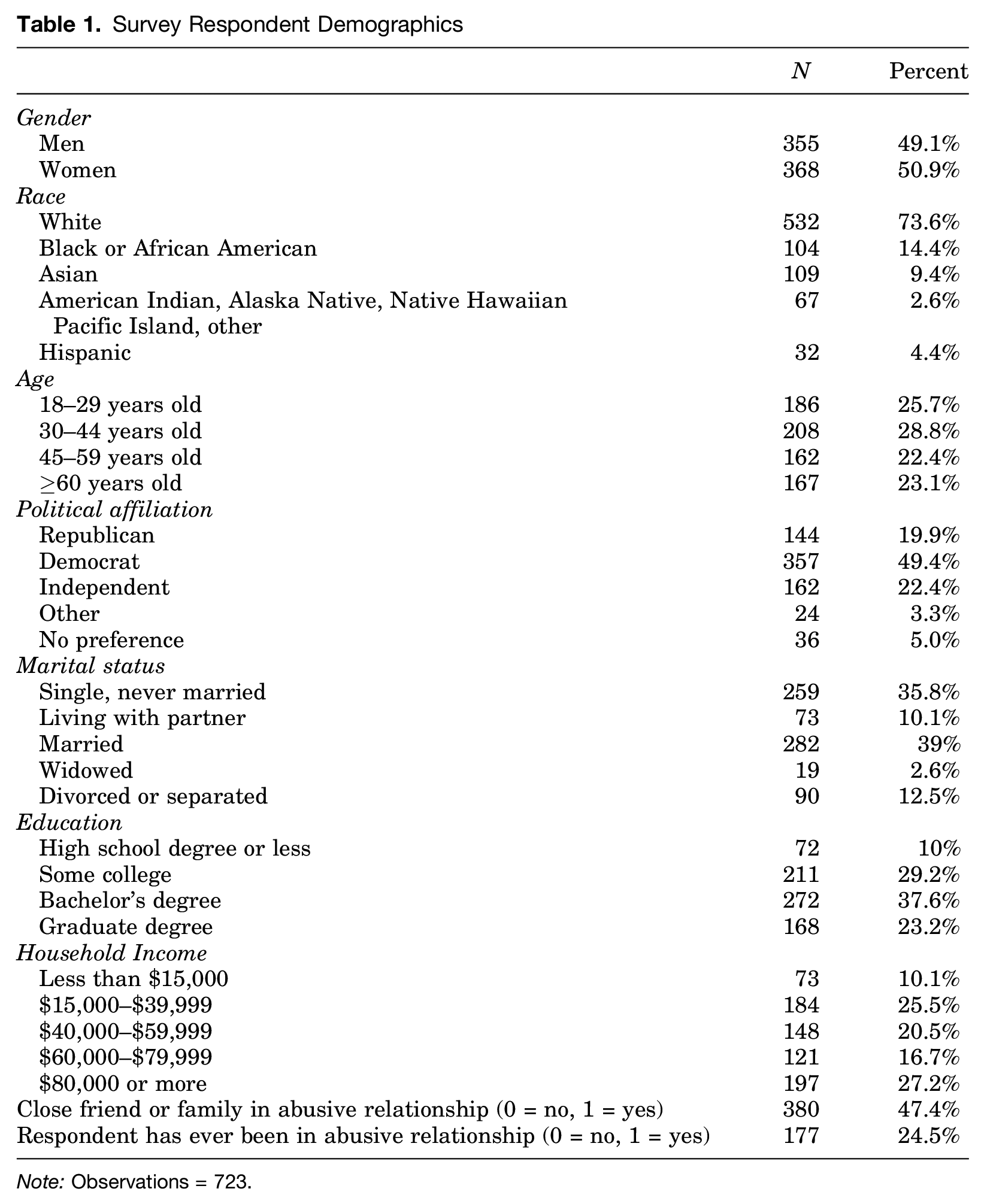
Note: Observations = 723.
Analysis
To test our hypothesized relationships, we used a linear multivariate path analysis in Stata 15.1 with standard errors estimated using Satorra-Bentler adjustment. The model also includes the covariance between the errors for cognitive and empathic role–taking and covariance between our two measures of continued engagement. 6 In Stata, we used the command “estat teffects” to report the direct, indirect, and total effects for each path of the hypothesized model (Sobel 1987). We note that the path between two of our key variables—role-taking and anticipated burnout—represent a seeming effect of the former upon the latter. However, it is possible that there is a bidirectional relationship such that participants who know they are sensitive to burnout may limit how actively they engage with the victim narrative. This is particularly the case with cognitive role–taking whereby participants may choose to read the narrative less closely as a self–protective measure. Results should be considered with this caveat in mind.
Variables
Anticipated burnout and continued engagement are our main dependent variables. We examine how they relate to each other and how they are predicted by cognitive role–taking and empathic role–taking, for which we test theoretically relevant antecedents.
Burnout and engagement
Anticipated burnout
We conceptualize anticipated burnout as a sense of emotional fatigue, operationalized through an adapted version of Maslach and Jackson’s (1981) measure for experienced burnout. Our adapted version of the scale contains three items in which participants indicate how emotionally fatigued they are from reading the case report, how frustrated they would be if they had to read cases like this every day, and how they anticipate they would feel if their job entailed reading similar cases, such that exposure to trauma was ongoing. The scale items are shown in Table 2 (Cronbach’s α = .84). Responses are scored on a 7–point Likert scale, ranging from 1 = strongly disagree to 7 = strongly agree. The theoretical range of this scale is 3 to 21, where higher scores reflect greater anticipated burnout.
Anticipated Burnout Scale

Continued engagement
We conceptualize continued engagement as one’s willingness (or unwillingness) to continue engaging with trauma–related material. We operationalize this through two separate measures. One measure asks participants how willing they are to read through another case report as part of the present study. This variable is measured on a 7–point Likert scale ranging from 1 = extremely unwilling to 7 = extremely willing. It is modeled as a continuous linear outcome with high scores indicating highly willing and low scores indicating unwillingness to read through a subsequent case. 7 A second measure asks participants to predict their threshold for encountering trauma–related material, indicated by the number of cases they estimate they could read before becoming emotionally fatigued. 8 We label these variables continued engagement (subsequent case) and continued engagement (threshold), respectively.
Role-Taking
Recent developments in role–taking theory convey the process as an interrelation of cognitive and affective elements (Davis and Love 2017). This is operationalized in our study through cognitive and empathic role–taking measures.
Cognitive role-taking
Cognitive role–taking is conceptualized as thinking with the other—entering the other’s perspective (Davis and Love 2017). We operationalize this with an adapted version of Green and Brock’s (2000) Narrative Transportation Scale applied to the victim narrative, measuring the extent to which the case occupied the mind of the reader. The specific scale items are shown in Table 3. We use a total of 10 items measured on a 7–point scale, anchored by 1 = not at all and 7 = very much. Our adapted scale has a Cronbach’s α of .71. The theoretical range of the Narrative Transportation Scale is 10 to 70, with higher scores indicating higher levels of cognitive role–taking.
Narrative Transportation Scale
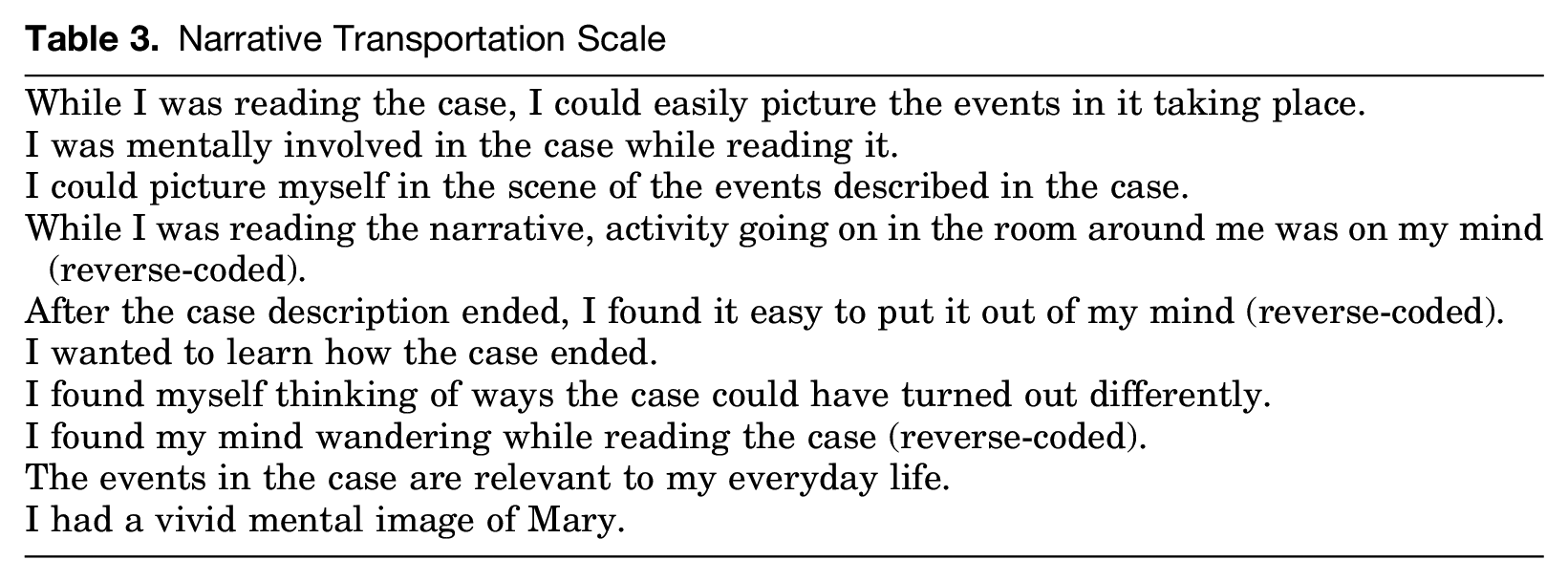
Empathic role-taking
Empathic role–taking is the affective dimension of role–taking conceptualized as feeling with the other—being moved by another’s emotions (Davis and Love 2017). We operationalize this by comparing participants’ self–report emotional states prior to and then immediately after, reading the case report. Participants selected from a 7–point Likert scale ranging from 1 = I am not experiencing this emotion to 7 = I am overwhelmed by this emotion for fear, anger, sadness, disgust, and discomfort. The emotional state scale prior to reading the case report had a Cronbach’s α of .89, and the emotional state scale after reading the report had a Cronbach’s α of .90. We then took the standardized means for each assessment and constructed an emotional response variable that reflects the change in participants’ emotions before and after encountering the story of abuse. We treat high change scores as indicators of greater empathic role–taking and low change scores as indicators of lower empathic role–taking.
Role-Taking Antecedents
To understand variation in initial role–taking responses, we predict cognitive and empathic role–taking with two theoretically and empirically relevant antecedents: similar experiences to the victim and stereotype beliefs about intimate partner violence.
Similarity
Role-taking and related research shows an intragroup advantage by which role–taking is higher with others similar to the self (Cikara, Bruneau, and Saxe 2011; Love and Davis 2014; Zaki and Cikara 2015). We therefore measure similarity based on participants’ shared experience of intimate partner violence, operationalized through two binary variables indicating whether the participant has ever had an abusive partner (0 = no, 1 = yes) and if the participant has any close friends or family who have been in abusive relationships (0 = no, 1 = yes). Responses reflect social similarity with the person presented in the court filing.
Stereotype beliefs
To capture participants’ attitudes toward intimate partner violence, we use the Domestic Violence Myth Acceptance Scale, an 18–item scale that asks a series of questions across four dimensions: character blame of victims, behavior blame of victims, minimization of the seriousness and extent of abuse, and exoneration of the perpetrator (Peters 2003, 2008). Participants selected from a 7–point Likert scale ranging from 1 = strongly disagree to 7 = strongly agree. Higher scores indicate greater endorsement of intimate partner violence myths that denigrate victims and reflect supportive attitudes toward perpetrators of abuse (Cronbach’s α = .92). To optimize relevance for this particular study, we added four additional scale items pertaining to stereotypes about intimate partner violence victims in the justice system (e.g., “Women file restraining orders to punish their husbands or boyfriends”) and on the belief that court filings are used by women as a tool of manipulation (e.g., “Women lie to judges about abuse as a manipulation tool in divorce or custody cases”). The Domestic Violence Myth Acceptance Scale and our added measures were highly correlated, and hence combined, based on the mean of standardized scores. Possible scores on the prestandardized, combined summative scale range from 22 to 134. Higher scores represent stronger adherence to myths about intimate partner violence. Table 4 displays the full set of 22 items (Cronbach’s α = .94).
Myth Acceptance Scale
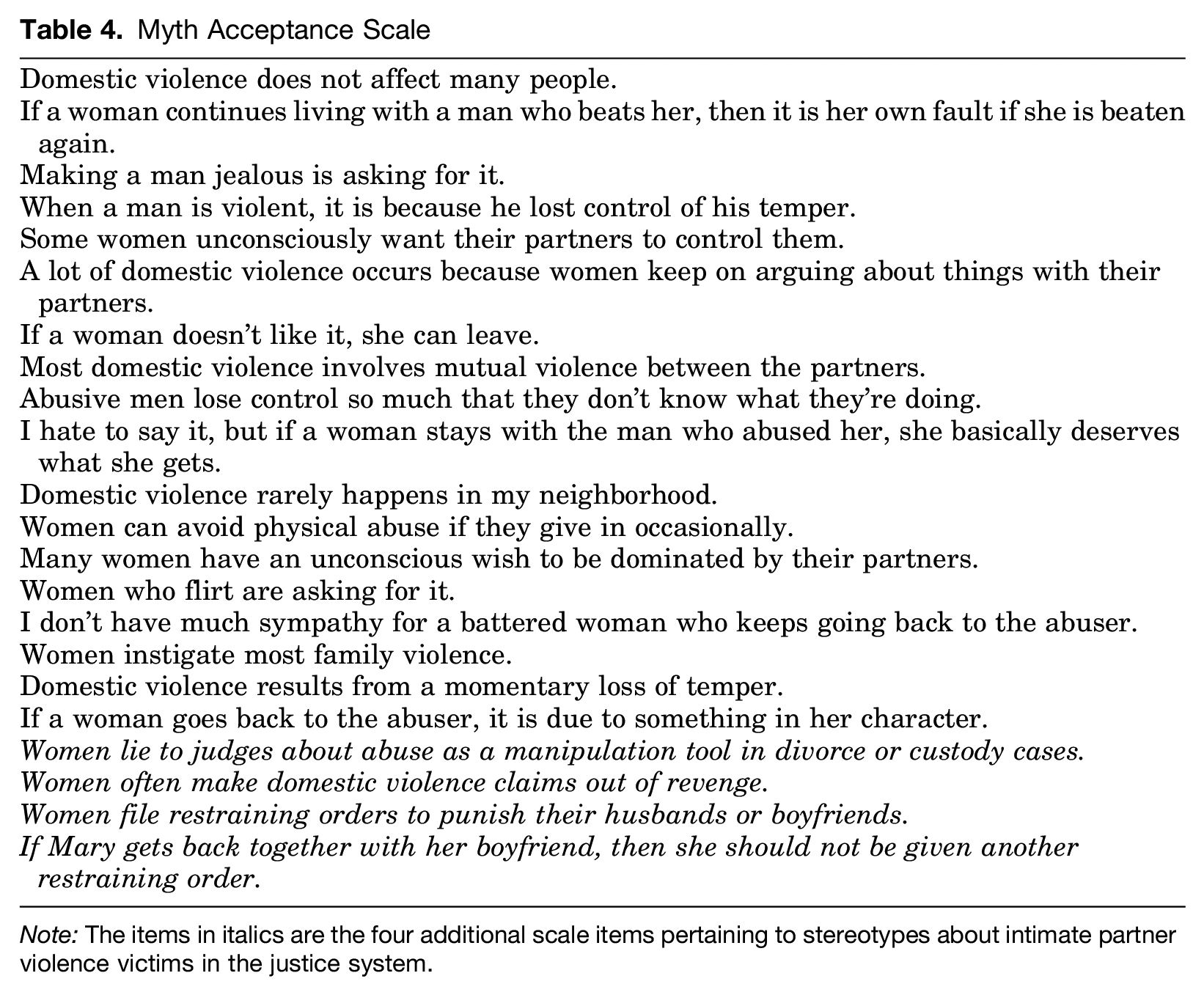
Note: The items in italics are the four additional scale items pertaining to stereotypes about intimate partner violence victims in the justice system.
Control Variables
We account for a number of social demographic characteristics that have been associated with burnout and/or role–taking. These include age, gender, race, and level of education. 9 Age and gender have been identified as significant indicators of burnout (Cheng et al. 2013; Iglesias, de Bengoa Vallejo, and Fuentes 2010; Lim et al. 2010; Marchand et al. 2015; Rosenberg and Pace 2006), while gender and race have been shown to affect role–taking via status processes (Love and Davis 2014, 2021). Dummy variables were created for each racial category: Black or African American, Asian, Hispanic, and an aggregate category that consists of Native American or American Indian, Pacific Islander, or another racial category. For each race dummy variable, the reference category is White. Level of education often has diffuse effects and is thus included as a binary variable indicating less than a college degree (0) or bachelor’s degree or higher (1).
Results
We use a path analysis to examine antecedents and outcomes of cognitive and empathic role–taking as they affect anticipated burnout and continued engagement for participants exposed to trauma–related content. In the following sections, we report on these theoretically relevant relationships and their alignment with our hypotheses. Figure 2 displays the unstandardized coefficients of the direct effects of our measures. 10 Our hypothesized pathways demonstrate a strong fit according to multiple fit statistics: root mean square error of approximation was less than .05, and comparative fit index was greater than .95 (Acock 2013; Browne 1993; Hu and Bentler 1999). Control variables are included in this model, but for the sake of presentation, their effects are not reported in Figure 2.
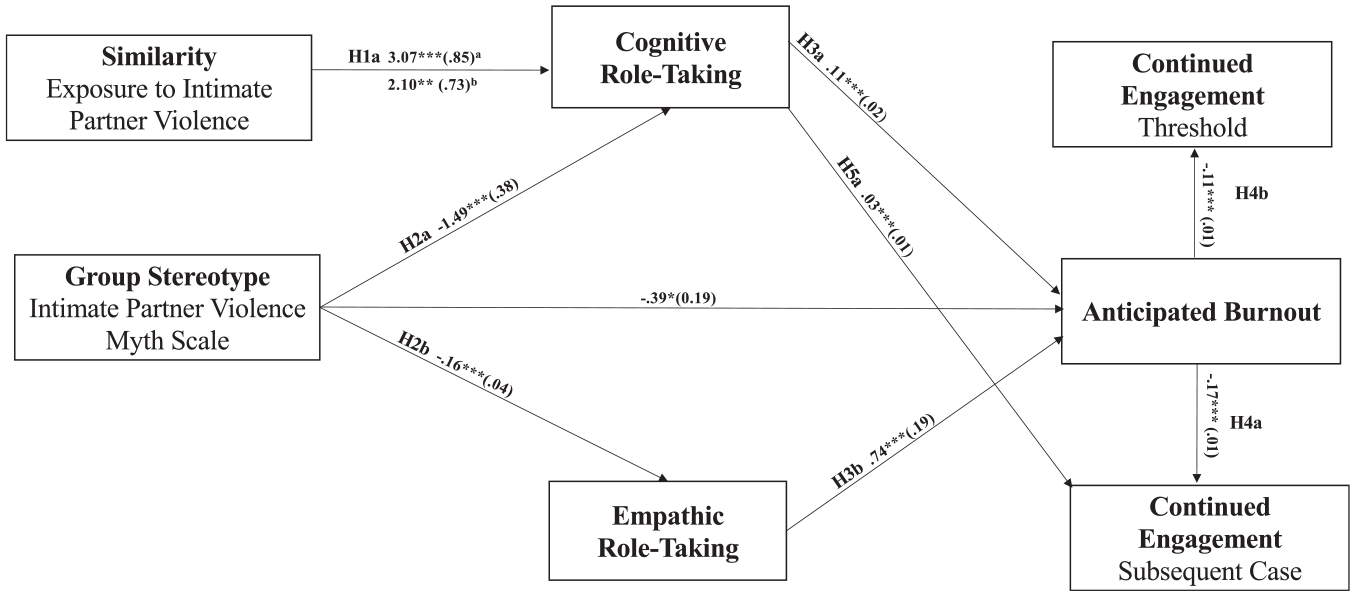
Direct Effects of Cognitive and Empathic Role-Taking on Burnout and Continued Engagement
Role-Taking Antecedents
Hypotheses 1 and 2 predict antecedents to role–taking, suggesting that shared experiences of abuse will increase cognitive and empathic role–taking scores (Hypotheses 1a and 1b) and that stereotypic beliefs about intimate partner violence will decrease cognitive and empathic role–taking scores (Hypotheses 2a and 2b).
Prior abuse experiences
We first examine whether having prior experiences with intimate partner violence affects cognitive and empathic role–taking. We find that participants who have been in abusive relationships and those with family or friends who have been in abusive relationships show increased cognitive role–taking, as indicated by higher scores on the Narrative Transportation Scale. Those who have had an abusive partner scored higher on the Narrative Transportation Scale compared to those who have not (b = 3.07, SE = .84, p < .001). Likewise, participants with family members or close friends who had experienced abusive relationships scored higher on the Narrative Transportation Scale than those without (b = 2.10, SE = .73, p < .01). Results support Hypothesis 1a that prior experience with abusive relationships will increase cognitive role–taking scores. In contrast, prior abuse experience does not significantly predict empathic role–taking in our sample. The data therefore do not support Hypothesis 1b. We explore this null finding further in the “Discussion” and “Conclusion” sections.
Stereotype beliefs
We find that holding stereotypic beliefs about intimate partner violence has a significant negative direct effect on cognitive role–taking, as indicated by responses to the Myth Acceptance Scale and scores on the Narrative Transportation Scale. This aligns with Hypothesis 2a (b = −1.49, SE = .38, p < .001). Similarly, participants’ stereotypic beliefs negatively affect empathic role–taking with the victim, as indicated by participants’ prenarrative and postnarrative self–assessments of their emotional state. Figure 2 shows that higher scores on the Myth Acceptance Scale significantly decrease empathic role–taking scores (b = −.16, SE = .04, p < .001). Findings support Hypothesis 2b that participants who hold negative stereotypic beliefs about victims will show lower levels of empathic role–taking than those with less adherence to negative stereotypes.
Role-Taking and Anticipated Burnout
Hypotheses 3a and 3b predict that role–taking increases burnout such that higher scores on both cognitive and empathic role–taking measures will predict higher scores on the Anticipated Burnout Scale.
Cognitive role-taking
Cognitive role–taking has a significant positive relationship with anticipated burnout. As shown in Figure 2, a one–unit increase on the Narrative Transportation Scale associates with a .11 increase on the Anticipated Burnout Scale (SE = .02, p < .001). Thus, our results offer support for Hypothesis 3a that cognitive role–taking predicts higher levels anticipated burnout.
Empathic role-taking
Empathic role–taking also has a significant positive relationship with anticipated burnout. A one–unit increase in empathic role–taking leads to a .74 increase on participants’ Anticipated Burnout Scale scores (SE = .19, p < .001). Thus, we find support for Hypothesis 3b that empathic role–taking predicts higher levels of anticipated burnout.
Anticipated Burnout and Continued Engagement
Hypotheses 4a and 4b predict a negative relationship between Anticipated Burnout Scale scores and indicators of willingness to continue engaging with trauma–related material. As outlined earlier, we have two measures of continued engagement. One measure indicates participants’ willingness to read through another case report of abuse as part of the present study. The second measure represents the number of cases participants believe they could read before becoming emotionally fatigued.
Continued engagement (subsequent case)
Anticipated burnout has a significant negative relationship with continued engagement (subsequent case). An increase of 1 on the Anticipated Burnout Scale reduces willingness to read another case report by .17 (SE = .01, p < .001). This finding supports Hypothesis 4a.
Continued engagement (threshold)
In line with Hypothesis 4b, we find an increase of 1 on the Anticipated Burnout Scale leads to a 10.7 percent decrease in the number of cases a participant believes they could read before becoming emotionally fatigued (SE = .01, p < .001). 11 Thus, we find evidence that higher levels of anticipated burnout significantly reduce participants’ scores on the continued engagement (threshold) measure.
Role-Taking and Continued Engagement
Thus far, we have examined predictors of cognitive and empathic role–taking, the relationships between both measures of role–taking and anticipated burnout, and effects of anticipated burnout on participants’ willingness to continue engaging with trauma–related material. Results indicate that in general, increased cognitive and empathic role–taking correspond with higher levels of anticipated burnout, which in turn reduces willingness for continued engagement across short–term (subsequent case) and long–term (threshold) measures. Here we examine more closely how role–taking operates on this pathway, testing direct, indirect, and total effects of cognitive and empathic role–taking on the outcome measures for continued engagement (Hypotheses 5a, 5b, 6a, and 6b).
Continued engagement (subsequent case)
Cognitive role–taking has a significant direct effect on participants’ willingness to read another case report, but in the opposite direction to that which we predicted. We find that an increase of 1 on the Narrative Transportation Scale increases participants’ willingness to read another case by .03 (SE = .01, p < .001). However, the indirect effect operates in the negative (and expected) direction based on how cognitive role–taking relates to anticipated burnout. A one–unit increase in cognitive role–taking leads to an expected .02 decrease on the continued engagement (subsequent case) measure due to the indirect pathway through anticipated burnout (SE = .00, p < .001, not reported in Figure 2 12 ). This produced an insignificant total effect of cognitive role–taking. However, this indirect pathway through anticipated burnout offers partial support for Hypothesis 5a, indicating that cognitive role–taking decreases participants’ willingness to read a subsequent case report, via anticipated burnout.
As shown in Figure 2, empathic role–taking does not have a significant direct effect on participants’ willingness to read an additional case report. However, empathic role–taking increases anticipated burnout, which in turn affects the continued engagement (subsequent case) outcome. Through the indirect pathway of anticipated burnout, empathic role–taking significantly diminishes participants’ willingness to read a subsequent account of intimate partner violence such that a one–unit increase in emotional response leads to a .12 decrease in participants’ willingness to read another case (b = −.12, SE = .03, p < .001, not reported in Figure 2). Because the total effect of empathic role–taking was insignificant, we find only partial support for Hypothesis 5b that empathic role–taking will lead to lower levels of continued engagement, occurring again through the pathway of anticipated burnout.
Continued engagement (threshold)
Cognitive role–taking did not have a significant direct effect on participants’ estimated threshold for continued engagement. However, the pathway from cognitive role–taking through anticipated burnout is significant and in the expected direction. A one–unit increase in cognitive role–taking leads to an approximately 1 percent decrease in the number of cases a participant believes they could read due to this indirect path (p < .001, not reported in Figure 2). Although the total effect of cognitive role–taking on participants’ estimated threshold for continued engagement is not significant, the indirect pathway from cognitive role–taking through anticipated burnout offers partial support for Hypothesis 6a.
We also find that the direct effect of empathic role–taking on continued engagement (threshold) is insignificant, but the indirect effect through anticipated burnout is significant in the expected direction. A one–unit increase in empathic role–taking leads to an 8.2 percent decrease in participants’ emotional fatigue threshold via anticipated burnout (b = −.08, SE = .02, p < .001, not reported in Figure 2). These results partially support Hypothesis 6b.
Discussion
Drawing on data from a U.S. national quota sample, we tested six hypotheses that together model a role–taking theory of burnout in the scope of trauma exposure. These hypotheses address antecedents to role–taking (Hypotheses 1 and 2), the effects of role–taking on anticipated burnout (Hypothesis 3), and the effects of anticipated burnout and role–taking on participants’ willingness to continue engaging with trauma–related material (Hypotheses 4–6).
In line with Hypothesis 1a, we find that participants who have personal or relational experiences with intimate partner violence show significantly higher scores for cognitive role–taking than those without these experiences. This corresponds with extant findings in role–taking theory that show higher levels of role–taking with others similar to the self (Cikara et al. 2011; Love and Davis 2014; Zaki and Cikara 2015).
The relationship between shared experience and empathic role–taking is less clear. We do not find support for Hypothesis 1b that those with experiences of abusive relationships will show higher levels of empathic role–taking than participants without abuse experiences. One possible explanation for the unexpected finding is that individuals who have a history of similar trauma may be dulled to these accounts and/or maintain emotional distance as a coping strategy. Supporting this notion, previous research highlights that while abuse victims may initially experience symptoms of hyperarousal, this can morph into desensitization and emotional numbing (Krause et al. 2006; Messman-Moore and Long 2003). 13 It is also possible that our measure of empathic engagement misses some of empathy’s relational complexity and interpretive nature (see Batson et al. 1991; Clark 1987, 1990, 2007; Zaki 2019; Zaki and Cikara 2015), a consideration we return to in the “Conclusion” section.
Hypothesis 2 addresses the effects of negative stereotypic beliefs about victims on cognitive and empathic role–taking. In line with expectations, strong stereotyping is associated with lower scores for both cognitive and empathic role–taking measures, reflecting a propensity to dismiss the victim and/or rely on general assumptions rather than engaging with the individualized human experience of the victim–narrator.
Hypothesis 3 tests the effects of cognitive and empathic role–taking on anticipated burnout, showing that higher levels of cognitive and empathic role–taking are associated with higher levels of anticipated burnout among participants. Anticipated burnout in turn seems to negatively affect participants’ willingness to continue engaging with trauma–related content, as indicated by decreased willingness to read a subsequent case report as part of the study (Hypothesis 4a) and lower thresholds for the number of cases participants estimate they could read before experiencing emotional fatigue (Hypothesis 4b). Here we see a pathway forming from role–taking to burnout, with resultant disengagement (holding in mind the possibility of a bidirectional relationship between the cognitive role–taking and anticipated burnout variables).
We further investigate the earlier mentioned pathway in Hypotheses 5 and 6, addressing the relationship between role–taking and continued engagement measures. Results show no direct pathways but instead highlight the indirect pathways from role–taking, through anticipated burnout, to continued engagement. These pathways indicate that active role–taking can result in disengagement via burnout and its characteristic emotional fatigue—an indication that is theoretically strengthened by the relationship between role–taking and anticipated burnout variables demonstrated in tests of Hypothesis 3 and between anticipated burnout and continued engagement measures in tests of Hypothesis 4.
Conclusion
The experience of burnout is widespread in contemporary society, expanding beyond its origins as a workplace problem and diffusing through home life, activist mobilization, and multifaceted media landscapes (Han 2018, 2020; Mannell and Meese 2022; Petersen 2021; Richardson 2020; Singer et al. 2020). Burnout also continues to be an issue in professional spheres, disproportionately affecting workers in the social and humanitarian services (Beck 2011; Kim and Stoner 2008; Kolb 2014; Schaufeli et al. 2009; Singer et al. 2020). Understanding the continuation and spread of burnout means interrogating how burnout occurs, probing and illuminating its constituitive elemements. In the present work, we focus on trauma exposure as a key factor in the burnout pathway, modeling this factor through the construct of role–taking.
To model and test a role–taking theory of burnout in the scope of trauma exposure, we presented 723 participants with a real court document detailing a first–person account of intimate partner violence. This document represents an acute instance of trauma exposure, from which we investigated the conditions under which burnout is more or less likely and to what effect. Results indicate that increased cognitive and empathic role–taking amplify the likelihood of burnout, which in turn reduces willingness to remain engaged.
Taken as a whole, these findings suggest that cognitively and affectively connecting with a traumatized other can have deleterious effects on the self. A tension thus emerges in which the means of compassion can also be the mechanisms of mental distress. Although resolving this tension is beyond the scope of the present work, a role–taking theory of burnout delineates how burnout eventuates from trauma exposure and sets a foundation from which more detailed analyses and perhaps mitigations can develop. Connecting role–taking to burnout is also theoretically generative for the role–taking research program. Until now, role–taking studies have focused on interpersonal benefits such as helping behavior and positive outgroup evaluations. Here, we address vulnerabilities role–taking may entail and thus build out a holistic understanding of this multifaceted process.
Limitations and Future Directions
As with all studies, the present work has several limitations. We address these here to contextualize the findings and establish new lines of inquiry. These limitations and future directions span burnout studies, role–taking studies, and the interrelation of the two.
One limitation is our use of a cross–sectional study design. We did this for reasons of ethics and practicality—it would be ethically and logistically untenable to instantiate persistent trauma exposure for purposes of research. However, in practice, burnout generally forms over prolonged periods with effects that build and accrue (Demerouti et al. 2001; Han 2020; Maslach et al. 2001; Maslach and Leiter 2017; Petersen 2021). Future work will benefit from longitudinal studies that capture actual thresholds after which burnout occurs, most likely conducted through multimethod fieldwork in settings with endemic trauma exposure. This may include expanded and behavioral measures of continued engagement, building on the two self–report indicators we use in the present work.
A second limitation is that our stimulus exposes participants to trauma of a particular sort (intimate partner violence), and our predictors of role–taking align directly with this kind of trauma, addressing prior experiences of abuse and stereotype beliefs. However, trauma takes a diversity of forms, each of which has its own unique character. The dynamics at play in the present work may not perfectly translate to other examples of trauma exposure, forecasting the need for theoretical and methodological adjustments. An important direction for future work will be to trace the role–taking to burnout pathway through multiple domains, understanding how different kinds of trauma exposure operate across subjects and circumstances. This includes studies of specific samples for whom the trauma exposure under study is directly relevant (e.g., burnout among social workers, social media content moderators, heavy news consumers, or activist leaders). These domain–specific studies will also be instrumental for creating effective interventions that alleviate burnout because any intervention must be fitted to context.
A third limitation is that we could not rule out all possible pathways between our variables. Most notably, survey participants who know they are sensitive to burnout may seek to prevent this outcome by disengaging from the narrative, thus reducing cognitive role–taking. Results should thus be read with this caveat in mind, while future work may investigate issues of bidirectionality.
Finally, our treatment of role–taking, as a construct, was limited by several interrelated factors. These include our use of a simple emotional change measure for empathic role–taking when in fact, empathy is relational, interpretive, and multifaceted (Batson et al. 1991; Clark 1987, 1990, 2007; Ruiz-Junco 2017; Zaki 2019; Zaki and Cikara 2015); leaving the relationship between cognitive and empathic role–taking unaddressed; and focusing on participants’ general sense of connection with the victim rather than the accuracy with which participants’ understood the victim’s experiences. There are elements of our results that suggest these limitations should be further explored. For example, shared experience of intimate partner violence increased cognitive role–taking scores, as predicted, but did not significantly predict empathic role–taking. However, in analyses not reported, we did see a significant pathway from cognitive role–taking to empathic role–taking for participants with personal and relational experiences of abuse. Exploring the nature of these relationships—between cognitive role–taking, empathic role–taking, and personally relevant trauma—will have explanatory value for the conditions under which trauma exposure results in burnout. On a basic theoretical level, it will also shed light on the interrelation of role-taking’s component parts. These efforts will be further enhanced by including multidimensional measures of empathic role–taking beyond a simple indicator of emotional movement, such as that which we employ in the present work.
Results should be interpreted within the scope of limitations detailed herein. Taking account of these limitations and moving forward from them, this work sets the stage for novel developments in both theory and method while holding practical implications for the study and treatment of burnout in contemporary societies.
Supplemental Material
sj-doc-1-soq-10.1177_01902725221128392 – Supplemental material for Facing Others’ Trauma: A Role-Taking Theory of Burnout
Supplemental material, sj-doc-1-soq-10.1177_01902725221128392 for Facing Others’ Trauma: A Role-Taking Theory of Burnout by Anne Groggel, Jenny L. Davis and Tony P. Love in Social Psychology Quarterly
Footnotes
Acknowledgements
Special acknowledgement is owed to the Social Psychology Quarterly staff and reviewers, whose thoughtful commentary greatly improved the quality and clarity of the article.
1
“Doom-scrolling” is the colloquial term for consuming negative content on social media platforms.
2
In the literature, burnout is imbricated with “vicarious trauma” and related constructs such as “secondary trauma,” “emotional contagion,” and “compassion fatigue.” These constructs are variously presented interchangeably or as predictors of one another. Fully engaging these literatures is beyond the scope of the present work, but see  for a review.
3
Due to the sensitive nature of the details in the case, we do not present its content as part of the article. This is available on request from the authors.
4
Analyses were rerun with the inclusion of participants who missed quality checks, and the results remain the same.
5
Because our sample has more participants with advanced degrees than the general public, we also ran all analyses excluding those with advanced degrees, and our findings remained consistent.
6
Analyses available from the authors on request.
7
Regardless of response, participants were not presented with additional cases. This measure was solely to capture their willingness to continue engaging with trauma–related material.
8
This outcome variable was top–coded at 1,000 to avoid outliers having outsized impact on estimates. We addressed the issue of the variable being right–skewed by transforming the outcome, taking the log of the variable plus 1, which allowed us to take the log of zero values, so that the interpretation of each coefficient is in terms of percentage change based on the exponentiated value.
9
Our model includes only theoretically relevant demographic variables rather than the full range of demographic variables listed in . Including additional demographic variables leads to overspecification of our model. Future work can address how additional demographics not included in our model may affect role–taking, burnout, or both.
10
Standardized and unstandardized coefficients of direct, indirect, and total effects are provided in Tables A, B, and C of an online appendix.
11
As previously outlined, the emotional fatigue threshold measure of continued engagement is logged so that interpretation of each coefficient is in terms of percentage change based on the exponentiated value (e.g. [100 × (exp(.11) – 1]).
12
All results in this section that are not reported in Figure 2 can be found in supplemental tables in the online appendix (Tables A, B, and C).
13
The possibility of a numbing effect is bolstered by the significant direct relationship between personal experience of abuse and anticipated burnout in our model (see ). Although we did not devise any hypotheses about this relationship, the data show that participants who have had an abusive partner scored lower on the Anticipated Burnout Scale than those without a personal history of abuse (b = −.99, SE = .42, p < .05).
Funding
The author(s) disclosed receipt of the following financial support for the research, authorship, and/or publication of this article: This project received funding from Australian National University Role-taking Fellowship and North Central College s Faculty Development and Recognition Grant.
Supplemental Material
Supplemental material for this article is available online.
Bios
References
Supplementary Material
Please find the following supplemental material available below.
For Open Access articles published under a Creative Commons License, all supplemental material carries the same license as the article it is associated with.
For non-Open Access articles published, all supplemental material carries a non-exclusive license, and permission requests for re-use of supplemental material or any part of supplemental material shall be sent directly to the copyright owner as specified in the copyright notice associated with the article.
