



Abstract
According to the extended contact hypothesis, direct intergroup contact is not necessary for prejudice reduction; it suffices to know that ingroup friends have outgroup friends. However, extended contact is typically measured in a way that does not clarify whether people know the outgroup friend of their ingroup friend or whether they are even direct friends. A social network approach is used to compare extended contact when ingroup friends’ outgroup friends are not direct friends (open triads) to when there is a direct friendship with some (mixed triads) or all of the ingroup friends’ outgroup friends (closed triads). Results from a nonprobability sample in the US predicting feelings toward Black people (N = 313) and from a representative sample in the Netherlands predicting attitudes toward immigrants (N = 818) show that extended contact reduces prejudice only when some of the outgroup friends of one’s ingroup friends are known. This suggests that the extended contact effect should not be interpreted as providing a solution for situations where direct contact with outgroup members is not possible.
About twenty years ago, Wright, Aron, McLaughlin-Volpe, and Ropp (1997) introduced the extended contact hypothesis, which argues that simply knowing that an ingroup member has a close relationship with an outgroup member is sufficient to reduce prejudice toward the outgroup. This considerably advanced Allport’s (1954) contact hypothesis, which required people to have direct contact with outgroup members for prejudice reduction (Pettigrew & Tropp, 2006; Pettigrew, Tropp, Wagner, & Christ, 2011). By now, more than 115 studies have produced robust evidence for the association between extended contact and less prejudice, and a meta-analysis even revealed that this association is as strong as the one between direct contact and less prejudice (Zhou, Page-Gould, Aron, Moyer, & Hewstone, 2019).
Extended contact is inherently a social network phenomenon as it builds on the logic of “a friend of a friend is a friend.” Yet, few studies have actually considered the social network when studying extended contact (Munniksma, Stark, Verkuyten, Flache, & Veenstra, 2013; Wölfer et al., 2017; Wölfer, Schmid, Hewstone, & van Zalk, 2016). Typically, researchers have measured extended contact with questions such as, “How many of your White friends have Asian friends?” (Turner, Hewstone, & Voci, 2007) or, “How many Norwegian friends do you have who have friends from another ethnicity?” (De Tezanos-Pinto, Bratt, & Brown, 2010). Even though these questions measure the number of ingroup friends with outgroup friends, they ignore the structure of the social network in which extended contact takes place. Several authors have pointed out that such questions do not preclude the possibility that people have extended as well as direct contact with the same outgroup member (Munniksma et al., 2013; Pettigrew, Christ, Wagner, & Stellmacher, 2007; Tausch, Hewstone, Schmid, Hughes, & Cairns, 2011).
Although this seems to be a methodological problem at first, it has important theoretical consequences. The effect of extended contact is often interpreted as indicating that it is not necessary to have direct contact in the form of a direct friendship or in the form of knowing the outgroup member at all (Vezzali, Hewstone, Capozza, Giovannini, & Wölfer, 2014). This interpretation is supported by research that found a stronger effect of extended contact among people who reported to have less direct outgroup contact (Christ et al., 2010; Dhont & van Hiel, 2011; Vezzali, Hewstone, Capozza, Trifiletti, & Di Bernardo, 2017). Hence, it is often argued that extended contact could reduce prejudice in contexts where direct contact is unlikely, such as in ethnically segregated neighborhoods or schools (Dovidio, Eller, & Hewstone, 2011). Extended contact could also pave the way for future direct contact by first reducing fears and inhibitions among highly prejudiced people who currently do not want to engage with the group they are prejudiced against (Pettigrew et al., 2011; Turner, Hewstone, Voci, Paolini, & Christ, 2007). However, these interpretations are only appropriate if extended contact does not require people to have direct contact experiences.
Simply controlling for the amount of direct contact people have when assessing effects of extended contact (Eller, Abrams, & Gomez, 2012; Vezzali et al., 2014) does not allow drawing this conclusion. Many of the known mediators of extended contact work through the ingroup friends who have outgroup friends and are independent of who these outgroup contacts are. For instance, extended contact reduces prejudice because people gain additional information about the outgroup from their ingroup friends (Eller, Abrams, & Zimmerman, 2011), they infer positive ingroup norms toward the outgroup (De Tezanos-Pinto et al., 2010; Turner, Hewstone, Voci, & Vonofakou, 2008), and develop positive intergroup expectations from knowing an outgroup member has friendly relationships with other ingroup members (Mazziotta, Mummendey, & Wright, 2011). Because the positive experiences of ingroup friends are the cause of such mediation processes, they might reduce prejudice even if the outgroup friends of the ingroup friends are also personal friends. A statistical model that takes direct contact into account might thus detect a net effect of extended contact on top of having direct contact. However, it would be incorrect to conclude from this result that extended contact reduces prejudice among people who do not (want to) have direct contact.
The present research uses social network methods to advance our theoretical understanding of the extended contact hypothesis. The social network approach allows disentangling people who have extended contact with unknown outgroup members from (a) those who are direct friends with the outgroup friends of their ingroup friends, and from (b) those who are not direct friends but do personally know the outgroup friends of their ingroup friends. If indirect relationships with unknown outgroup members reduce prejudice, the interpretation of extended contact as a solution for situations in which people cannot or do not want to have direct contact would be warranted. However, if it is necessary for people to personally know the outgroup friends of their ingroup friends or perhaps even have a direct friendship with them, extended contact would have different theoretical implications. These concerns do not challenge the basic premise of the extended contact hypothesis that indirect contact can reduce prejudice. Instead, taking the network structure into consideration will illuminate whether two of the most common interpretations of the extended contact hypothesis are justified.
Approaches to Distinguish Between Direct and Extended Contact
Few studies have tried to measure extended contact in a way that makes sure that people do not have contact with the outgroup friends of their ingroup friends. For instance, Pettigrew et al. (2007) found in a robustness check a significant effect of extended contact among the group of people who reported to not have direct contact at all. Another approach was used by Tausch et al. (2011), who asked how many ingroup contacts in certain settings (e.g., at work) had outgroup contacts from other settings (i.e., not from work). While this latter approach may minimize the potential overlap, it does not preclude the possibility that there is a direct relationship with the outgroup contacts from the other setting.
Wölfer et al. (2016) proposed a two-step approach to measuring extended contact through social networks. First, ingroup friends are identified in a whole social network by having every person within a certain context (e.g., a school class) complete a questionnaire. In the second step, ingroup friends’ self-reports about their number of outgroup friends can be used to determine the amount of extended contact a person has (Wölfer et al., 2017). This approach reduces the likelihood of direct contact with the indirect outgroup friends, but some outgroup friends may still be shared with the ingroup friends.
Munniksma et al. (2013) proposed another social network approach to distinguish between two distinct network configurations. Figure 1 shows two situations in which a White Person A could report to have extended contact. In Panel 1, Person A has a White Friend B who has a Black Friend C. Since A and C are not friends with each other, this configuration is called an open triad. Such open triads are probably what most previous authors had in mind when they suggested extended contact could reduce prejudice in situations where direct contact is not feasible.
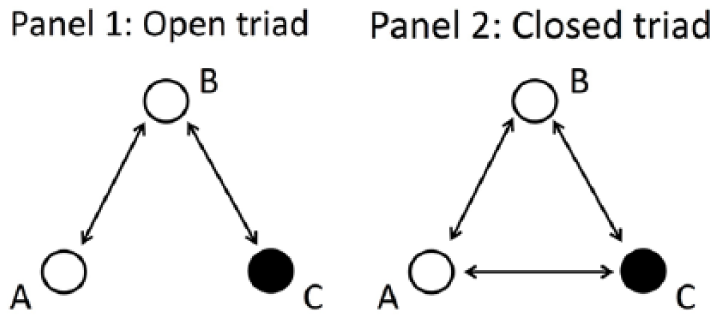
Two possible relationship structures underlying extended contact. Circles represent White and Black persons, arrows indicate friendship relationships.
However, the question “how many of your ingroup friends have outgroup friends?” also counts network configurations depicted in Panel 2 of Figure 1. The White Person A still has an ingroup Friend B who has a friend from the outgroup. Moreover, A is a direct friend of the outgroup member C, which means the triad is closed. Munniksma et al. (2013) suggested excluding these network configurations from the measure of extended contact. Hence, these authors studied only open and not closed triads and found two opposing effects of their novel measure of extended contact with longitudinal network data from Dutch school children. Having extended contact through open triads reduced interethnic prejudice among those who held negative attitudes in a previous wave. However, extended contact through open triads marginally increased prejudice among students who had initially positive interethnic attitudes.
Open, Mixed, and Closed Triads
The approach proposed by Munniksma et al. (2013) allows comparing the effects of having extended contact through open triads, closed triads, and a mix of the two. Open triads can further be divided into those where the extended contact is with an unknown outgroup member and those where the outgroup contacts of the ingroup friends are known but there is no direct friendship with them. Mixed triads, in contrast, would mean that a given ingroup friend has multiple outgroup friends of which some are, and others are not, also direct friends.
How open, closed, and mixed triads are counted depends on the definition of extended contact. In the “traditional definition,” extended contact is determined by the number of ingroup friends who have outgroup friends (Zhou et al., 2019). The “alternative definition” of extended contact counts the number of outgroup members to which a person is indirectly connected. Based on the second definition, one ingroup friend could be counted in multiple triads if he/she has more than one outgroup friend. Just like 83% of the published studies on extended contact (Zhou et al., 2019), the present research focuses on the traditional definition and counts the number of ingroup friends who have outgroup contact through open, closed, or mixed triads.
Each of these types of triads has unique theoretical implications for the extended contact effect. First, open triads in which the indirect outgroup contacts are not personally known come closest to the idea of extended contact being the number of ingroup friends who have outgroup friends while there is no direct contact with these indirect outgroup friends. This type of extended contact may be the most common because friendship networks tend to be racially and ethnically segregated, meaning that there are few intergroup friendships (e.g., S. Smith, Maas, & van Tubergen, 2014). These triads are also in line with the interpretation that prejudice can be reduced if direct contact is not possible (e.g., Pettigrew et al., 2011; Turner et al., 2008; Vezzali et al., 2014).
Second, open triads in which the outgroup contacts are personally known but there is no direct friendship might actually be a consequence of prejudice instead of a means to reduce prejudice. Structural balance theory (Cartwright & Harary, 1956; Newcomb, 1956) predicts that people close an open triad if they have the opportunity to do so (“a friend of a friend is a friend”). Thus, if someone knows the outgroup friend of their ingroup friend, he or she should form a friendship with that person as well. Keeping a triad open implies cognitive unbalance that can lead to tensions (Heider, 1946). That people are willing to accept cognitive unbalance by not becoming friends with their friends’ outgroup friends may imply strong negative feelings toward the outgroup or the particular outgroup member. Thus, this form of extended contact may not reduce prejudice (Munniksma et al., 2013).
Third, mixed triads refer to the combination of open and closed triads. An effect of this combination would suggest that knowing about additional intergroup friendships of ingroup friends with whom people already share outgroup friends would be particularly relevant for prejudice reduction. People may perceive additional information about the outgroup that they receive from their ingroup friends as more credible if they know from first-hand experience that these ingroup friends have positive relationships with outgroup members.
Fourth, closed triads represent a form of direct contact because there is a direct friendship with the outgroup friend of one’s ingroup friend (Munniksma et al., 2013). Yet, if closed triads have an effect on top of that of direct contact, these types of relationships might represent a particularly effective way to reduce prejudice. Alternatively, closed triads could be weakly related to prejudice reduction because the fact that the outgroup friend is shared with an ingroup friend may reduce the salience of the outgroup member’s ethnic group membership, or because the outgroup friend is subtyped and not considered a typical representative of the outgroup (Stark, 2016). Salience of group membership, just as typicality, has been identified as a facilitator of the direct contact effect (Brown & Hewstone, 2005; Hewstone, 1994).
The Present Research
In two studies, it was tested to what extent having extended contact through open triads, closed triads, or a mix of the two was related to intergroup attitudes. An ego-centered network approach was used to gauge whether there was a direct friendship between participants and their ingroup friends’ outgroup friends. In ego-centered network studies, participants (egos) are asked to list their social contacts in so-called name generator questions (Marsden, 2011; Stark, 2018). Such questions ask, for instance, who one’s friends are or with whom one discusses important issues. Follow-up questions about these contacts allowed identifying whether network contacts belonged to the outgroup, whether ingroup contacts had outgroup friends (extended contact), whether the participants were also friends of their ingroup contacts’ outgroup friends (open, mixed, and closed triads), and whether the outgroup members in open triads were personally known. This is different from whole-network studies where all members of one social setting, such as a school class, report who their friends are and indirect relationships are inferred from friends’ answers (e.g., Munniksma et al., 2013; Wölfer et al., 2017). Compared to the proposed two-step approach (Wölfer et al., 2016), the ego-centered network method has the advantages that ingroup friendships of ego are not restricted to one social setting and that ego-centered networks can be assessed in regular surveys and not only in whole-network studies.
Both studies were conducted online but in very different contexts. Study 1 used a nonprobability sample from the United States, and Study 2 used a national representative sample from the Netherlands. In Study 1, half of the sample answered a traditional ego-centered network questionnaire, and the other half answered the same questions in the Graphical Ego-Centered Network Survey Interface (GENSI; Stark & Krosnick, 2017). All participants answered the survey using GENSI in Study 2. This graphical interface allows answering follow-up questions about network contacts by dragging and dropping graphical representations of the network contacts in answer buckets on the screen instead of answering the same question for each contact. Answers and relationships between variables in Study 1 were not associated with the method of assessment (i.e., whether participant completed a traditional ego-centered network questionnaire or the GENSI measure).
Study 1
Method
Data were collected from a nonprobability online sample of U.S. residents recruited through Amazon Mechanical Turk (MTurk). An invitation to participate in a survey about social relationships was published on MTurk on July 20, 2014, and 468 participants followed this invitation within 3 hours. 1 Completing the survey took on average 6.1 minutes and participants were paid $1.00 for their participation. The present research focused only on the 342 participants who identified as White (Caucasian). Twenty-six respondents failed an attention check at the end of the survey and were removed from the sample. 2 Three additional participants were later excluded from the analyses due to missing values on the dependent variable. The remaining 313 participants in the final sample were predominantly highly educated (48% had a 4-year college degree) and male (56%). The average age was 34.9 years.
Measures
Standard direct and standard extended contact
At the beginning of the survey, all participants were asked, “About how many of your friends are Black?” and “About how many of your White friends do you think have friends who are Black?” (Response options for both questions were coded 0 = none, 1 = a few, 2 = about half, 3 = most, 4 = all; Turner, Hewstone, & Voci, 2007).
Direct network contact
In a first step, participants’ ego-centered social network was assessed. The network generator question asked “Who are the people outside of your home that you feel closest to? These may be friends, co-workers, neighbors, relatives, or anyone else who does not live with you” (Emerson, Sikkink, & James, 2010). Participants could enter the names of up to five contacts. In a second step, it was asked for each network contact, “To which racial/ethnic group does [name contact] belong?” Half of the sample saw a graphical representation of their network in GENSI. For these participants, the question read, “To which racial/ethnic group do these people belong? Drag the circles with the name of each person into the box below that indicates their racial/ethnic group.” Answer categories were “White (Caucasian),” “Black,” “American Indian, Alaska Native, or Native Hawaiian,” “Asian,” “Hispanic,” and “other.” For each participant, the indicator of direct network contact represents the number of Black people in the network. This measure could range from 0 to 5; however, it was highly skewed (skewness = 3.05). Two hundred forty-three respondents named no Black network contact, 59 respondents named one Black person in their network, 10 named two, and only one person named five. To avoid wrong interpretations due to this skewed distribution, the contact variable was dummy coded indicating whether a respondent had zero or at least one (coded 1) Black network member.
Extended network contact
For each network contact, all White participants were asked, “Does [name contact] have one or more close friends who are Black?” Response options were “Yes” and “No.” Extended network contact was measured as the number of White network contacts who had Black friends. This indicator could range from 0 to 5 and was not critically skewed (skewness = 0.41).
Open, mixed, and closed triads
For each network contact that had one or more close friends who were Black, participants were subsequently asked, “Are you also close friends with [name contact]’s Black friends?” Answer options were “Yes, with all of them,” “Yes, with some of them,” and “No.” Open triads were the count of White friends who had one or more close Black friends that were not close friends of the participants’ (answer “No”). Closed triads, in contrast, were the count of White friends who had close Black friends that were all also close friends of the participants’ (answer “Yes, with all of them”). Mixed triads were the count of White friends who had close Black friends of which some were also friends of the participants’ (answer “Yes, with some of them”). All three indicators could range from 0 to 5 and their sum was equal to the number of extended contacts for each participant.
Knowing the extended contacts
After participants had indicated that they were not a close friend of all of their White contacts’ Black friends (open and mixed triads), they were asked, “Do you know [name contact]’s Black friends who are not your friends?” Response options were “Yes, some of them,” “Yes, all of them,” and “No.” This allowed differentiating between the number of open triads in which the participants did not know their friends’ Black friends (answer “No”) and the number of open triads in which the participants knew some or all of the Black friends of their friends. Likewise, the number of mixed triads in which participants did not know the additional Black friends of their White friends with whom they shared some Black friends were separated from the number of mixed triads in which the participants knew some or all of the additional Black friends of their friends.
Feeling thermometer
The dependent variable, attitudes toward Black people, was measured at the end of the survey with the question, “Do you feel warm, cold, or neither warm nor cold toward most Black people?” Answers were given on a 7-point scale (1 = extremely cold, 7 = extremely warm).
Control variables
Contact effects were analyzed while controlling for relevant sociodemographic characteristics (gender, age, and education). Age ranged from 19 to 74 years and was mean centered in the analysis. Education was dummy coded to differentiate between participants who had a BA degree or more (coded 1) and those who had less education than a BA degree (coded 0).
Results
A majority (n = 235, 75.1%) of the 313 participants answered that they had “a few” or more friends who were Black to the standard direct contact question. However, only 70 (22.4%) named at least one Black person among the five people they felt close to in the direct network contact measure. Almost all participants (n = 305, 97.4%) reported that “a few” or more of their White friends had friends who are Black in the standard extended contact measure. According to the network contact measure, 250 (79.9%) participants had extended contact. That is, they said that at least one of the White friends they named in the network question had a close Black friend. In total, there were 571 of such indirect relationships. Of these, 62.2% were open triads, 35.2% were mixed triads in which respondents were friends with some but not all of their White friends’ Black friends, and only 2.6% were closed triads.
Table 1 shows that in most of the open triads (68.5%), the participants did not know their White friends’ Black friends. These people thus had extended contact with unknown outgroup members. Participants indicated to know their White friends’ Black friends with whom they were not direct friends in about one third of the open triads. The distribution was almost reversed for mixed triads; participants knew their White friends’ additional Black friends with whom they were not direct friends in about two thirds of the mixed triads (69.7%).
Distribution of open triads, mixed triads, and closed triads underlying all extended contact relationships in Study 1 and Study 2.
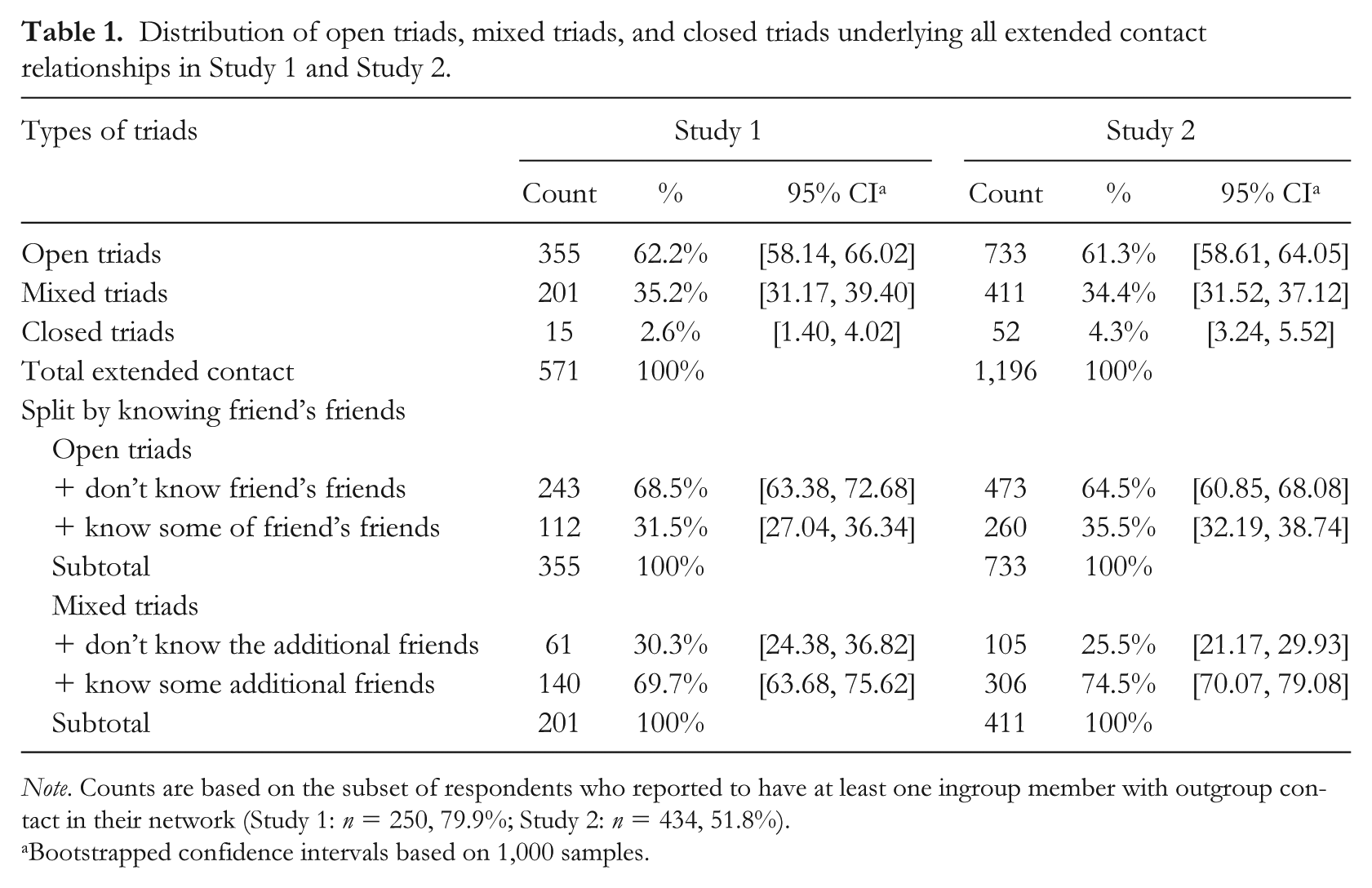
Note. Counts are based on the subset of respondents who reported to have at least one ingroup member with outgroup contact in their network (Study 1: n = 250, 79.9%; Study 2: n = 434, 51.8%).
Bootstrapped confidence intervals based on 1,000 samples.
Table 2 shows the percentage of participants that had extended contact with Black people through certain types of triads. Of the 250 participants who reported to have extended contact through their network, about half (49.6%) had only open triads. That is, they were not direct friends with any of their White friends’ Black friends. About a fifth reported only mixed triads and about a quarter of the sample had a combination of open and mixed triads. The remaining 5.6% of respondents reported having only closed triads or a combination of closed and other triads.
Percentage of people who reported certain combinations of triads to underlie their extended contacts in Study 1 and Study 2.
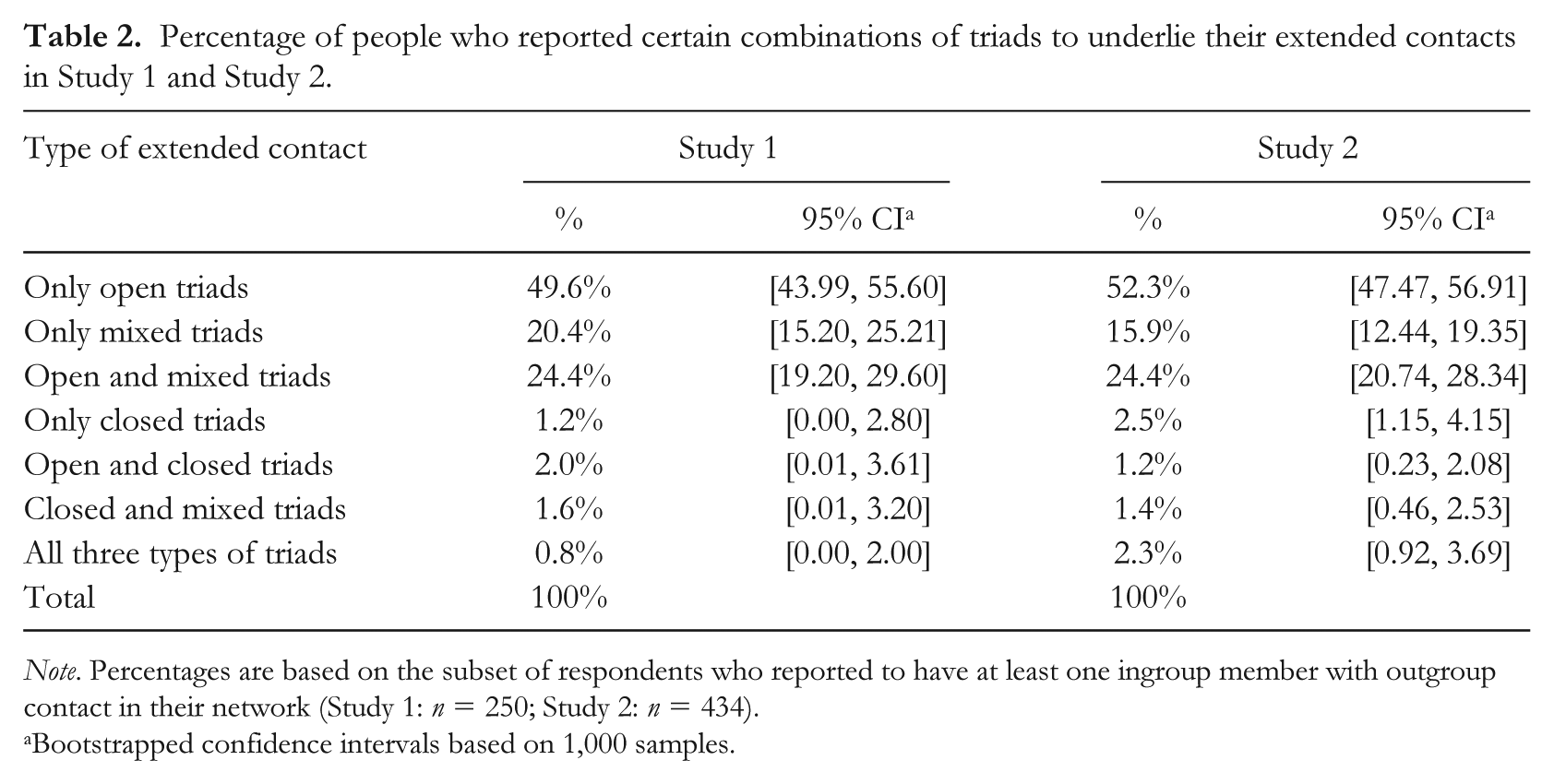
Note. Percentages are based on the subset of respondents who reported to have at least one ingroup member with outgroup contact in their network (Study 1: n = 250; Study 2: n = 434).
Bootstrapped confidence intervals based on 1,000 samples.
In the entire sample, participants reported rather positive attitudes toward Black people. The mean value (M = 4.83; see Table 3) of the feeling thermometer was significantly higher than the neutral midpoint of the scale t(312) = 12.64, p < .001. On average, each person had 1.82 extended network contacts, of which significantly more triads were open, M = 1.13, than mixed M = 0.64, t(312) = 5.07, p < .001, or closed, M = 0.05, t(312) = 15.68, p < .001.
Descriptive statistics of the central variables of Study 1 (N = 313).
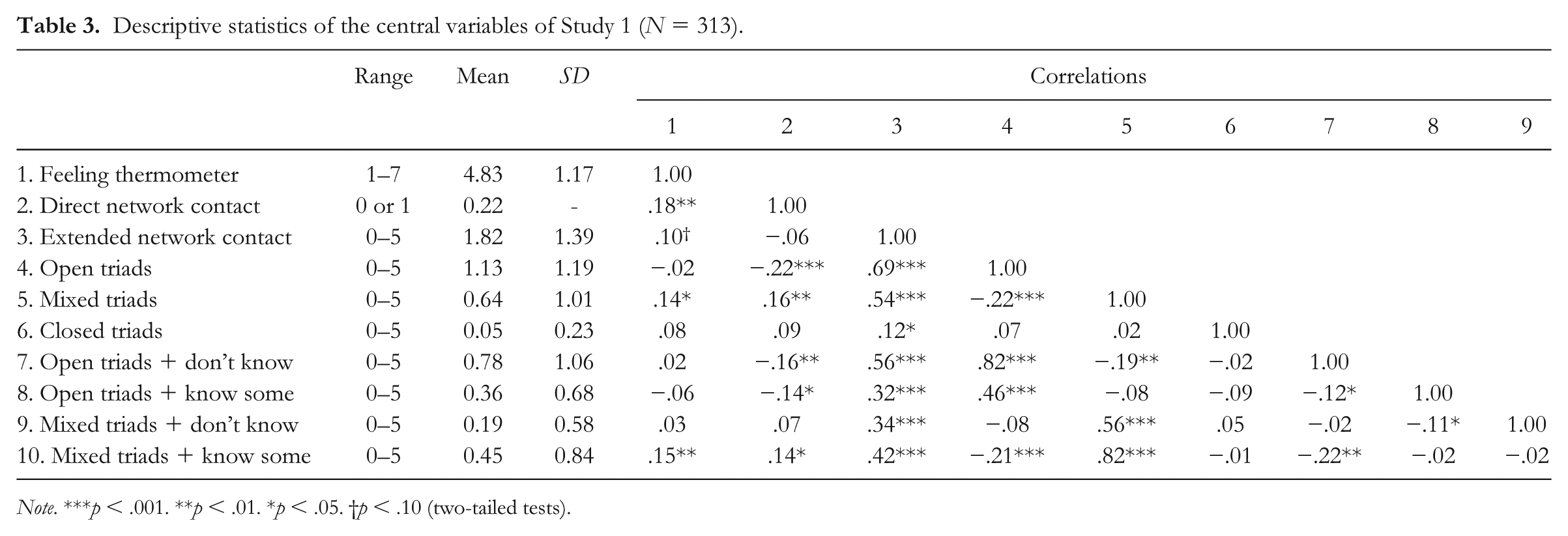
Note. ***p < .001. **p < .01. *p < .05. †p < .10 (two-tailed tests).
Table 3 further shows that the direct network contact measure correlated most strongly with the feeling thermometer (r = .18, p = .001). The association of extended network contact with the feeling thermometer was somewhat smaller (r = .10, p = .071). Only the number of mixed triads (r = .14, p = .012) but not the number of open triads (r = −.02, p = .775) or the number of closed triads (r = .08, p = .169) correlated with the feeling thermometer. The unexpected insignificant associated between closed triads and attitudes toward Black people was likely due to the very low number of closed triads in the sample.
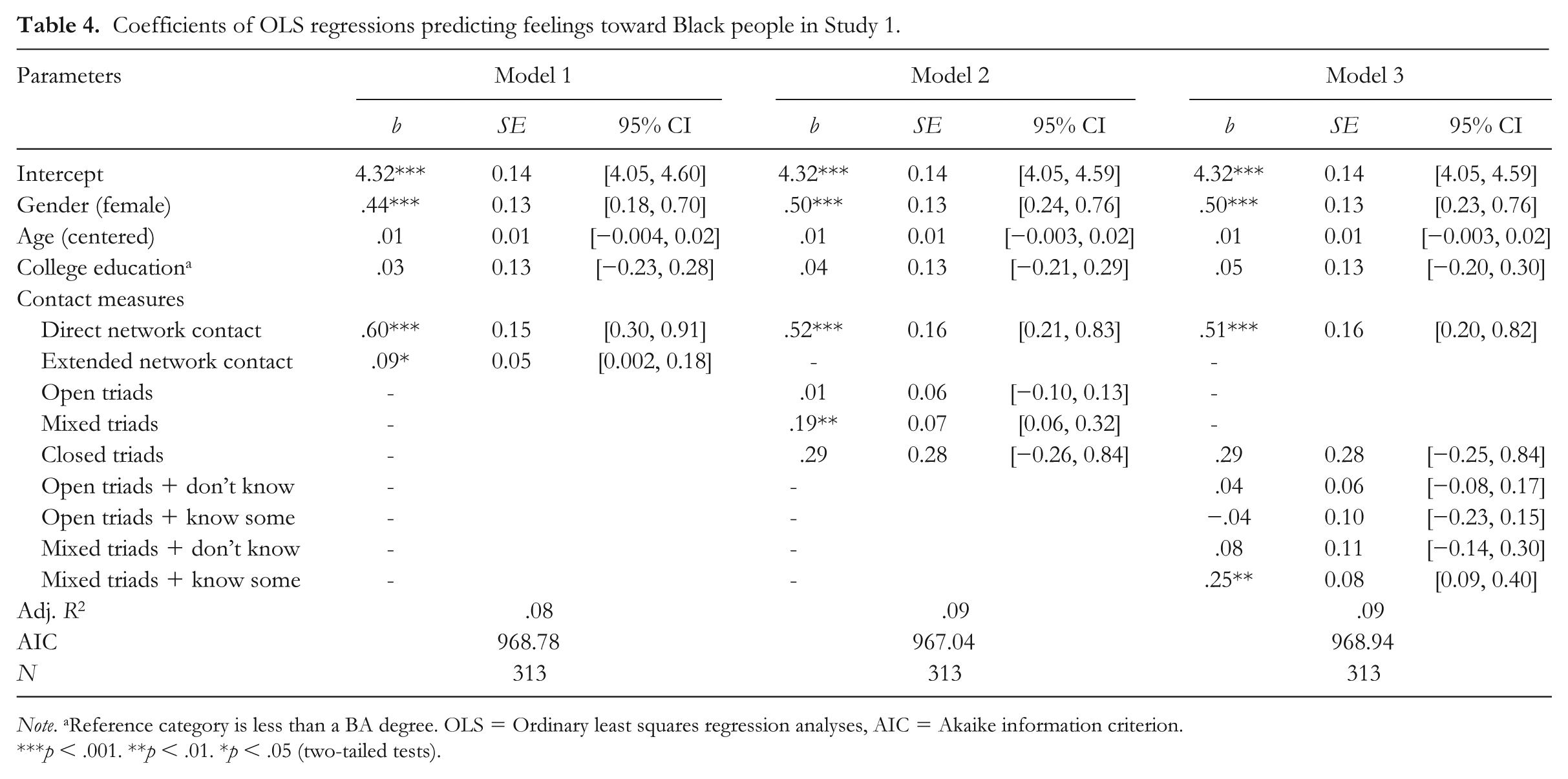
Linear regression analyses (OLS) showed that both direct network contact and extended network contact were independent predictors of the dependent variable feelings toward Black people (Model 1 in Table 4). Of the control variables, only participants’ gender was associated with their feelings toward Black people (women had more positive attitudes).
Coefficients of OLS regressions predicting feelings toward Black people in Study 1.
Note. aReference category is less than a BA degree. OLS = Ordinary least squares regression analyses, AIC = Akaike information criterion.
p < .001. **p < .01. *p < .05 (two-tailed tests).
When the effect of extended contact was separated in the underlying triads, the number of open triads turned out to be not a significant predictor of attitudes toward Black people (b = .01, p = .791, Model 2). 3 In contrast, the number of mixed triads was significantly associated with more positive attitudes toward Black people (b = .19, p = .004). This effect was significantly stronger than the effect of the number of open triads, F(1, 305) = 6.22, p = .03. The number of closed triads showed the strongest coefficient (b = .29, p = .300); however, this effect was not statistically different from zero, possibly due to the small number of closed triads in the sample. In sum, these results suggest that the effect of extended contact found in Model 1 was mainly due to the number of mixed triads.
Taking into account whether the participants knew their White contacts’ Black friends in open and mixed triads shed further light on these results. Neither the number of open triads in which people did not know the Black friends of their White contacts (b = .04, p = .526, Model 3) nor the number of open triads in which participants personally knew the Black contacts was a significant predictor of attitudes toward Black people (b = −.04, p = .660). Likewise, the number of mixed triads in which participants did not know the Black friends of their White contacts was not significantly associated with attitudes toward Black people (b = .08, p = .472). However, the number of mixed triads in which participants knew some of their White contacts’ additional Black friends was a significant predictor of feelings toward Black people (b = .25, p = .002). This effect was also significantly stronger than the effect of open triads in which respondents did, F(1, 303) = 5.66, p = .018, or did not know the Black friends of their White friends, F(1, 303) = 5.09, p = .025.
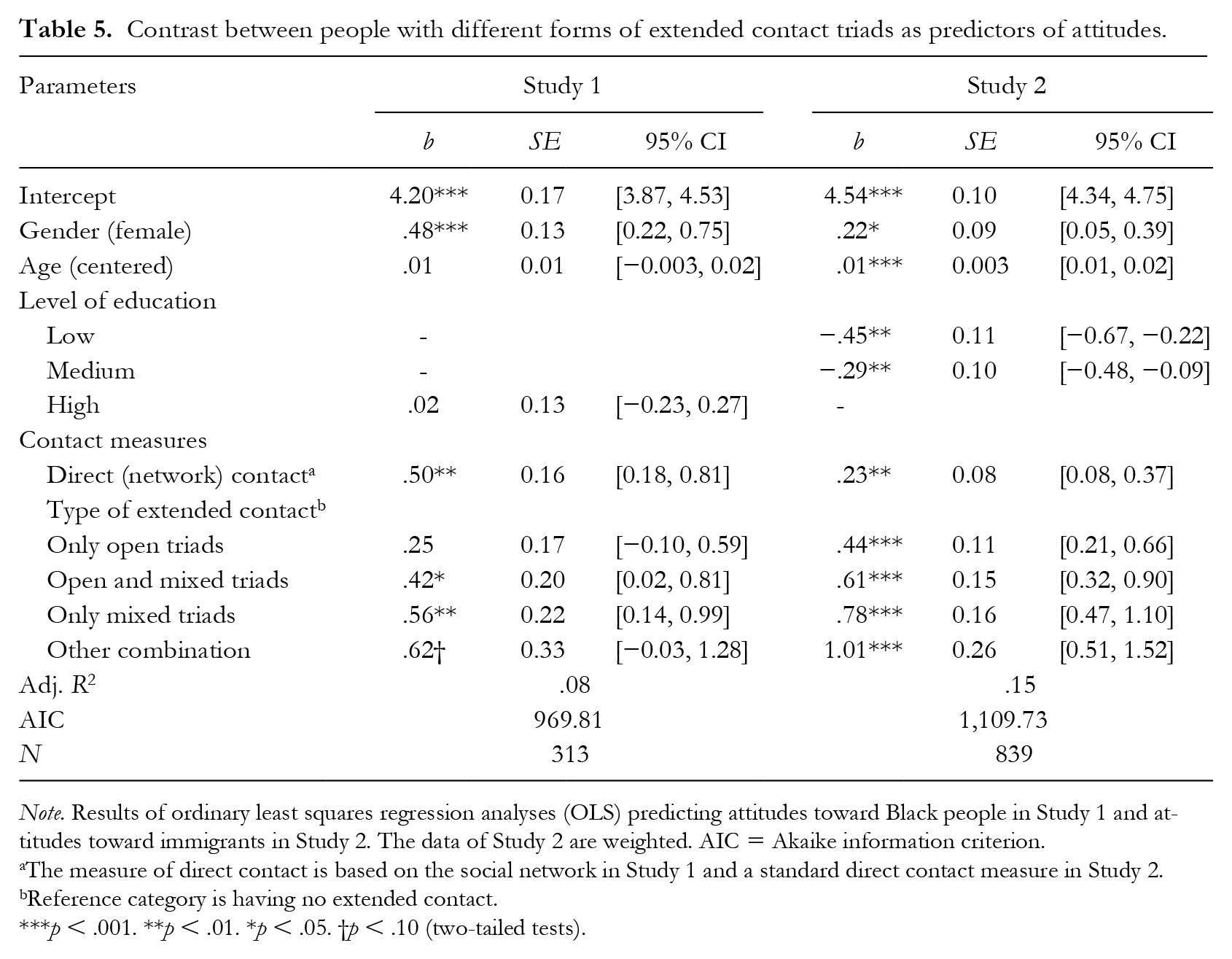
Comparing respondents with certain types of extended contact relationships provided yet another perspective on the effect of open, mixed, and closed triads. Model 1 in Table 5 presents dummy contrasts between people who had extended contact only through open triads, only through mixed triads, through a combination of both, or through another combination that includes closed triads. Having no extended contact served again as the reference category.
Contrast between people with different forms of extended contact triads as predictors of attitudes.
Note. Results of ordinary least squares regression analyses (OLS) predicting attitudes toward Black people in Study 1 and attitudes toward immigrants in Study 2. The data of Study 2 are weighted. AIC = Akaike information criterion.
The measure of direct contact is based on the social network in Study 1 and a standard direct contact measure in Study 2. bReference category is having no extended contact.
p < .001. **p < .01. *p < .05. †p < .10 (two-tailed tests).
This analysis showed that extended contact only through open triads was not significantly related to attitudes toward Black people. In contrast, having extended contact only through mixed triads (p = .039), a combination of mixed and open triads (p = .01), or another combination (p = .061) was related to the dependent variable. However, none of these effects were significantly different from the nonsignificant effect of open triads.
Discussion
Study 1 presented evidence in line with the direct (Allport, 1954) and the extended contact hypotheses (Wright et al., 1997). Direct and extended contact with Black people measured through the network were both significant predictors of participants’ feelings toward Black people. Moreover, the network structure underlying the extended contact relationships revealed that open triads in which participants were not direct friends of their White friends’ Black friends were not significantly related to intergroup attitudes. Instead, the more participants were involved in mixed triads in which they knew some of the additional Black friends of their White friends, the more positive their attitudes toward Black people were. This pattern of findings suggests that it is not sufficient to merely know that ingroup friends have outgroup friends; having a direct friendship with some of these outgroup friends seems necessary for extended contact to reduce prejudice.
The design of Study 1 limits the confidence in the results. First, the sample consisted of MTurk participants who are not representative of any population. Thus, it remains unclear whether these results would generalize to other populations. Second, the way in which direct network contact and extended network contact were measured prevented the possibility to have high scores on both measures. People with many Black friends among their five network contacts could not also have many White friends who have Black friends. Third, the procedure used to measure extended contact in the network was not fully in line with the original theory of extended contact. The standard extended contact measure asks about ingroup friends who are not only friends but also have Black friends, whereas the method employed here asked participants to simply recover close friends from memory without indication of their race or outgroup friends.
To overcome these limitations, I decided to replicate the study using a national representative sample and different indicators for intergroup contact. Participants were not asked to name five friends but rather were first asked how many of their ingroup friends had outgroup friends (standard extended contact). Subsequently, they were asked for the names of five of these ingroup friends with outgroup friends. Thus, the network question assessed only extended network contact but not direct network contact. To increase the comparability of the findings with earlier studies, the General Evaluation Scale that was presented in the original publication of the extended contact hypothesis (Wright et al., 1997) was used as dependent variable.
Study 2
Method
Data for Study 2 were collected in a nationally representative random-probability online sample of native Dutch members of the LISS (Longitudinal Internet Studies for the Social Sciences) panel administered by CentERdata (Tilburg University, the Netherlands). 4 A total of 1,081 panel members were invited to participate in the study and 851 completed the survey (response rate 78.7%). Twelve cases with missing values on the dependent variable were later removed, leaving a sample of 839.
To account for nonresponse and sampling bias, the data were weighted to adjust the sample to represent the native Dutch population in terms of education, gender, and marital status. The average age of participants was 51.4 (48.2 after weighting), 28.2% (26.0% after weighting) had a low level of education (primary school or low secondary school), 36.3% (37.1% after weighting) had a medium level of education (secondary vocational or occupational training), and 35.6% (36.9% after weighting) had a college degree. About half of the sample was female (53.7%, 50.4% after weighting).
Measures
Standard direct contact
Participants were asked, “How many of your friends or acquaintances are immigrants?” 5 (Answer categories were 0 = none [n = 432], 1 = some [n = 347], 2 = less than half [n = 47], 3 = about half [n = 10], 4 = more than half [n = 0], 5 = most [n = 2], and 6 = all [n = 1]). To avoid wrong conclusions due to the few cases with a lot of immigrant friends, the four highest categories were collapsed so that the final scale ranged from 0 to 3.
Standard extended contact and extended network contact
To determine standard extended contact, participants were asked, “How many of your native Dutch friends or acquaintances have immigrant friends?” Answers were given on the same scale as that used for direct contact, ranging from 0 to 6. To assess extended network contact, all participants who answered “some” or more to the standard extended contact measure were asked for the names or initials of up to five of these native friends who had immigrant friends. The number of names or initials provided in this ego-centered network name generator question represents the indicator of extended contact. Values could range from 0 to 5.
Open, mixed, and closed triads
For each network contact, participants were asked, “You said that [name contact] has immigrant friends. Are you also friends with the immigrant friends of [name contact]?” Answer categories were “Yes, with all of his or her immigrant friends,” “Yes, with most of his or her immigrant friends,” “Yes, with about half of his or her immigrant friends,” “Yes, with some of his or her immigrant friends,” and “No.” Open triads were the count of “No” answers to this question. Closed triads were the count of “Yes, with all of his or her immigrant friends” answers. Mixed triads were the count of all remaining answers, indicating that at least some, but not all, of the native Dutch friends’ immigrant friends were also friends of the participants. All three indicators could range from 0 to 5 and their sum was equal to the number of extended contacts for each participant.
Knowing the extended contacts
After participants had indicated that they are not friends with all of their Dutch contacts’ immigrant friends, they were asked, “Do you know the immigrant friends of [name contact] who are not your own friends?” Response options were “Yes, I know all of them,” “Yes, I know most of them,” “Yes, I know about half of them,” “Yes, I know some of them,” and “No, I do not know any of them.” Open and mixed triads were further split into those in which participants did not know any of their friends’ (additional) immigrant friends (answer “No, I do not know any of them”) and those in which participants knew at least some of them (all other answers).
Attitudes toward immigrants
Based on Wright et al.’s (1997) General Evaluation Scale, participants were asked, “How would you describe your feelings toward immigrants? The closer you choose an answer to a word, the better the word describes your feelings.” Answers were given on 7-point scales that separated the following bipolar adjective pairs: negative–positive, friendly–hostile (reverse-coded), suspicious–trusting (Cronbach’s α = .80). A mean score was generated ranging from 1 to 7, with higher values indicating more positive attitudes toward immigrants.
Control variables
Gender, age (range: 16–92 years, mean centered), and education were controlled for in the analyses. Education differentiated between participants who had a BA degree or more (reference category) and those with a low (primary school or low secondary school) and medium level of education (secondary vocational or occupational training).
Results
When asked the standard direct contact question, about half of the 838 participants said that at least some of their friends or acquaintances were immigrants (n = 407, 48.6%). More people said that at least some of their native Dutch friends had immigrant friends or acquaintances (n = 593, 70.8%). However, when these participants were asked for the first name or initial of these Dutch friends, only 51.8% (n = 434) of the sample reported at least one name (73.2% of people who said to have extended contact).
In total, participants reported 1,196 indirect relationships with immigrants. A little less than two thirds were open triads, about a third were mixed triads, and only 4.3% were closed triads (see Table 1). In most of the open triads (64.5%), participants did not know their Dutch friends’ immigrant friends. In most mixed triads (74.5%), participants knew their Dutch friends’ additional immigrant friends who were not also their direct friends.
The distribution of participants that had extended contact with immigrants through certain types of triads was extremely similar to that of Study 1, even though the new data came from a representative sample of another country. About half of the respondents with extended contact (52.3%) only had open triads (see Table 2). About 16% reported only mixed triads and about a quarter of the sample (24.4%) had a combination of open and mixed triads. The remaining 7.4% of respondents reported having only closed triads or a combination of closed and other triads.
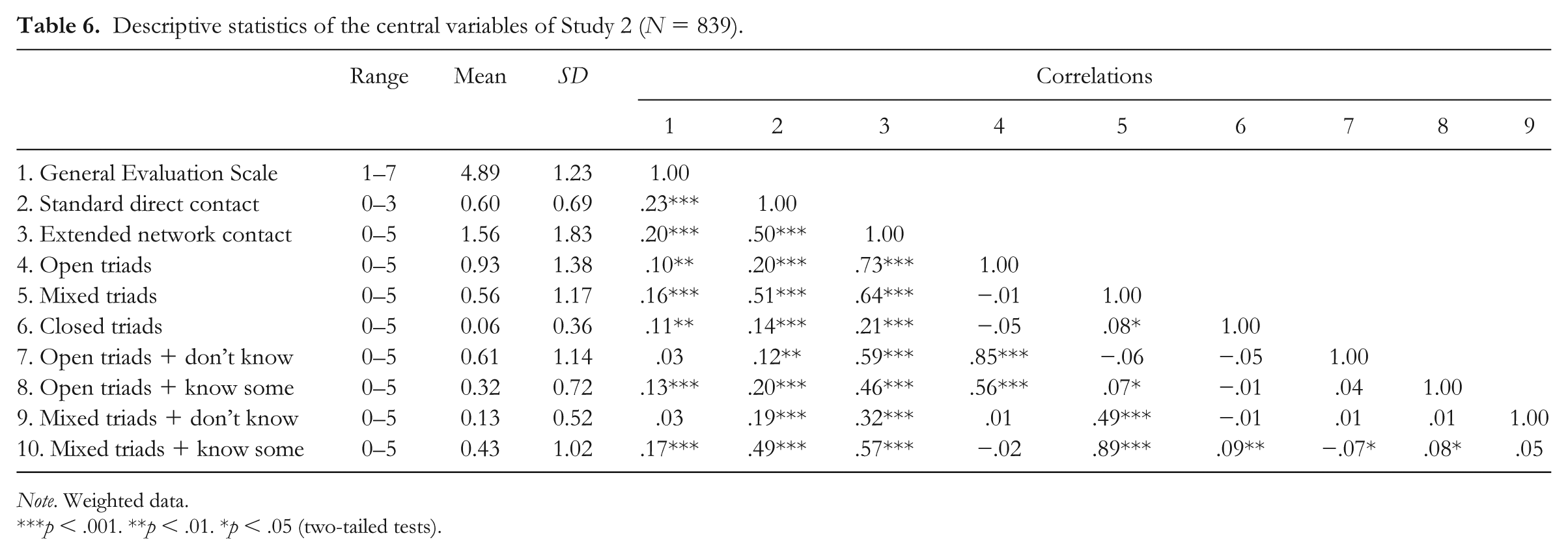
Attitudes toward immigrants were relatively positive. The mean value of 4.89 (see Table 6) was significantly higher than the neutral midpoint of the scale, t(838) = 20.79, p < .001. On average, participants named 1.56 native Dutch network contacts who had at least some immigrant friends. The average number of open triads (M = 0.93) was significantly higher than the number of mixed triads, M = 0.56, t(837) = 5.97, p < .001, or closed triads, M = 0.06, t(837) = 17.73, p < .001. Standard direct contact, extended network contact, and all forms of triads were significantly related to attitudes toward the outgroup (see Table 6).
Descriptive statistics of the central variables of Study 2 (N = 839).
Note. Weighted data.
p < .001. **p < .01. *p < .05 (two-tailed tests).
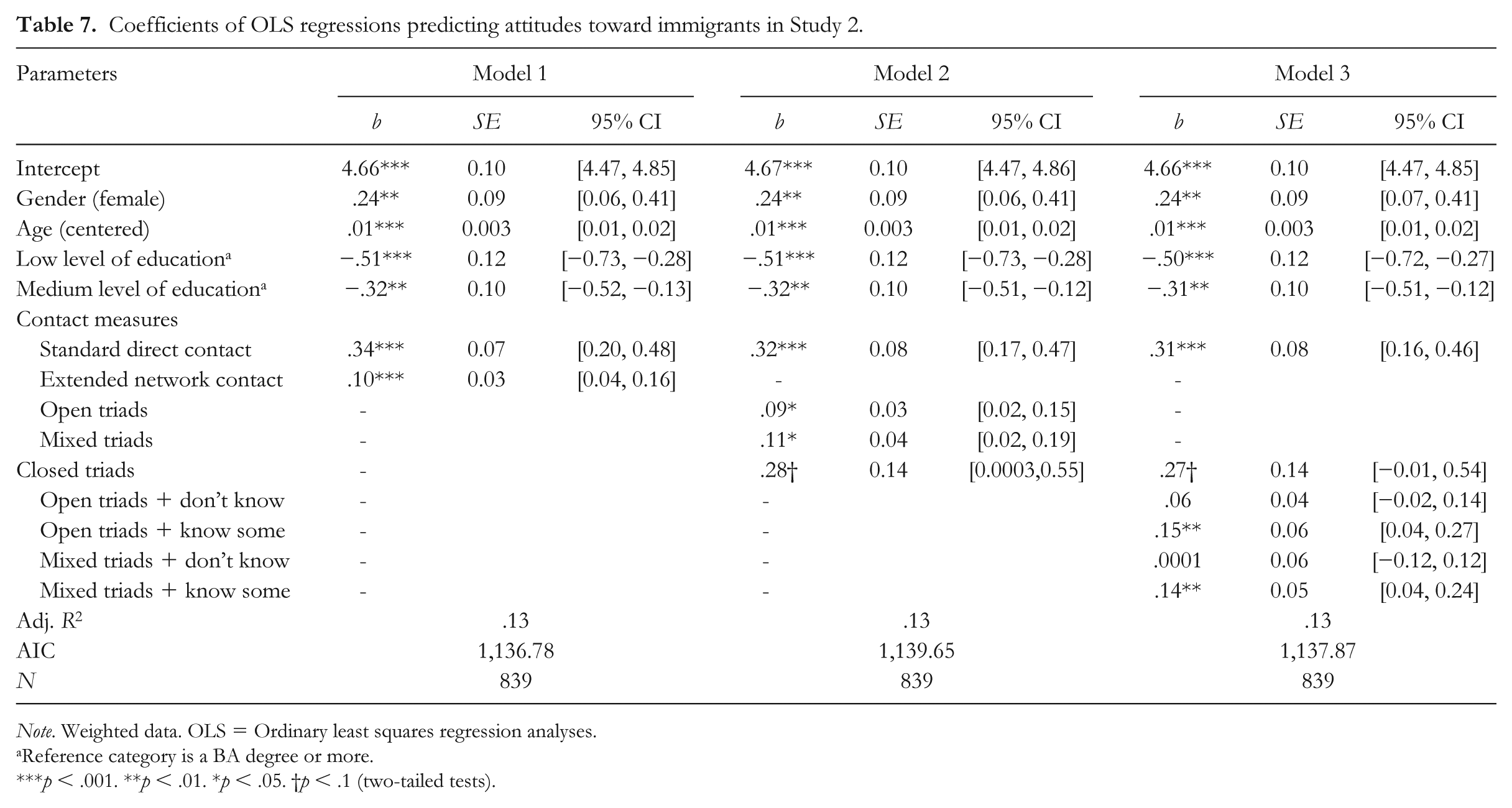
Linear OLS regression analyses showed that standard direct contact (b = .34, p < .001) and extended network contact (b = .10, p < .001) were independent predictors of attitudes toward immigrants (Model 1 in Table 7). Women and older participants had significantly more positive intergroup attitudes. People with medium education and low education had significantly worse attitudes than those with a college degree.
Coefficients of OLS regressions predicting attitudes toward immigrants in Study 2.
Note. Weighted data. OLS = Ordinary least squares regression analyses.
Reference category is a BA degree or more.
p < .001. **p < .01. *p < .05. †p < .1 (two-tailed tests).
Both, the number of open and the number of mixed triads were significantly related to participants’ attitudes towards immigrants and the coefficients were of similar size (Model 2 in Table 7). The effect of the number of closed triads was about 3 times as strong but just not statistically significant (b = .28, p = .050). The three coefficients were not significantly different from each other.
Only participants who reported to know the (additional) immigrant friends of their Dutch friends reported more positive attitudes toward immigrants. This was true for open (b = .15, p = .009; see Model 3 in Table 7) and for mixed triads (b = .14, p = .004). The number of open triads or mixed triads in which the additional immigrant friends were not known by the participants were not significantly related to participants’ attitudes. The effect of mixed triads with unknown additional friends was weaker than that of mixed triads with known additional friends, χ2(1) = 3.84, p = .049, and that of open triads with known additional friends, χ2(1) = 3.56, p = .059. The effect of open triads with unknown additional friends was not significantly weaker than the other effects.
The dummy contrasts between people who had extended contact only through open triads, only through mixed triads, through a combination of both, or through another combination that includes closed triads are shown in Model 2 of Table 5. All types of extended contact relationships were significantly related to participants’ attitudes toward immigrants. However, having only open triads had the weakest effect (b = .44, p < .001); this effect was significantly weaker than the effect of having only mixed triads, χ2(1) = 4.68, p = .031, or another combination that includes closed triads, χ2(1) = 5.07, p = .024.
Discussion
Results of Study 2 were again in line with the direct (Allport, 1954) and the extended contact hypotheses (Wright et al., 1997). Mixed triads in which additional outgroup friends of one’s ingroup friends were known appeared as a consistent predictor of intergroup attitudes. In contrast to Study 1, having extended contact through open triads was also a significant predictor of intergroup attitudes in this representative sample. But this was mainly so for open triads in which participants knew some of the immigrant friends of their ingroup friends. This suggests that merely knowing that ingroup friends have unknown outgroup friends might not be enough to reduce prejudice.
General Discussion
This research explored what people have in mind when they are asked how many of their ingroup friends have outgroup friends, to measure extended contact. Results from two studies suggest that this might differ from what scholars commonly believe. In line with the common belief, most people reported having extended contact through open triads in which they did not know the outgroup friends of their ingroup friends. However, this form of extended contact was not related to outgroup attitudes. Personally knowing the outgroup contact seems to be crucial for effective prejudice reduction. This finding does not challenge the original extended contact hypothesis, which does not require that extended contact takes place with unknown outgroup members (Wright et al., 1997). However, the finding challenges common interpretations of the extended contact effect. Extended contact seems not to be a solution for prejudice reduction in situations where people cannot have outgroup contact (Dovidio et al., 2011; Turner et al., 2008; Vezzali et al., 2014) or do not want to engage with the outgroup (Pettigrew et al., 2011; Turner, Hewstone, Voci, et al., 2007). Importantly, these results replicated in two studies despite using different measures of extended network contact, different outgroups, different measures of intergroup attitudes, and different national contexts, suggesting robustness of the findings.
Open Triads
Open triads were less strongly related to ingroup attitudes compared to the other types of triads. The number of open triads in which respondents were involved did not predict intergroup attitudes in Study 1. The number of open triads was significantly related to attitudes toward immigrants in the representative sample of Study 2. However, this was only true for open triads in which the outgroup friends of one’s ingroup friends were known. Open triads with unknown outgroup members were not significantly related to intergroup attitudes.
These findings of an effect of open triads are in line with previous research that found an effect of extended contact among survey respondents who reported to have no direct outgroup contact (Pettigrew et al., 2007). It is also in line with a number of studies that found a stronger effect of extended contact among people who reported to have less direct outgroup contact (Christ et al., 2010; Dhont & van Hiel, 2011; Vezzali et al., 2017), and with the few studies that experimentally manipulated extended contact to ensure that triads were open (for an overview, see Vezzali et al., 2014). Yet, the effect of having only open triads was significantly weaker than that of other forms of extended contact in Study 2. This suggests that knowing the outgroup friends of one’s ingroup friends is particularly beneficial.
Vicarious Contact and Mediators
Extended contact through mixed triads in which people are personal friends of some but not all of their ingroup friends’ outgroup friends was the most consistent predictor of intergroup attitudes in both studies. I suggested that the additional information one might receive through extended contact in mixed triads may be particularly credible because it is known from first-hand experience that the ingroup friend does, in fact, have outgroup contact. However, the consistent finding that only mixed triads, in which some of the additional outgroup friends of one’s ingroup friends were known, predicted intergroup attitudes is at odds with this explanation. Mixed triads in which the additional outgroup friends were unknown did not predict attitudes in either study.
The vicarious contact hypothesis offers a potential explanation for this. Vicarious contact is another form of indirect contact that refers to observing the friendly interaction between ingroup members and outgroup members (Dovidio et al., 2011). Thus, whereas extended contact is about knowing that a friendly relationship exists, vicarious contact is about actually observing the interaction (Mazziotta et al., 2011). There is a lot of experimental evidence for prejudice reduction when someone observes ingroup and outgroup members interact (Cameron, Rutland, Hossain, & Petley, 2011; Lemmer & Wagner, 2015; Mazziotta et al., 2011). Also, some of the experimental studies on extended contact actually studied vicarious contact (see Vezzali et al., 2014) by having study participants observe the interaction between ingroup and outgroup members either by reading about it (Vezzali, Stathi, Giovannini, Capozza, & Trifiletti, 2015) or watching a video of the interaction (West & Turner, 2014).
Observing the interaction between ingroup friend and outgroup contact may be a particularly effective form of indirect contact because it likely enhances the effect of many of the mediators underlying the extended contact hypothesis. For instance, positive outgroup norms toward the ingroup (Turner et al., 2008) can only be observed if the indirect outgroup member is personally known, and inclusion of the other in the self (Vezzali et al., 2014) is particularly likely if a cross-group friendship can be observed. Likewise, perspective taking (Stasiuk & Bilewicz, 2013) and self-disclosure (Turner, Hewstone, & Voci, 2007) may be more effective if an outgroup member is personally known, since this would allow to take their perspective or to disclose personal information to them. Observing the positive interaction between an ingroup friend and an outgroup member may also be particularly effective in reducing intergroup anxiety or perceptions of outgroup threat (Turner et al., 2008), and in increasing intergroup empathy (Vezzali et al., 2017) and trust (Dhont & van Hiel, 2011). Thus, indirect contact through open and mixed triads in which people know the indirect outgroup friends is in line with the processes known to underlie the extended contact hypothesis.
Social Network Measures of Contact
It might be argued that mixed triads and particularly closed triads are not a form of extended contact but rather represent direct contact (Munniksma et al., 2013). Yet, it should be noted that the traditional survey questions asking for the number of ingroup friends who have outgroup friends count these triads as well. The network approach enables researchers to assess the effect of these different forms of extended contact separately (Wölfer et al., 2017).
However, the use of network methods reduces the amount of information that can be gathered because time-consuming follow-up questions about each network contact force network researchers to restrict the network size (Marsden, 2011). In Study 1, for instance, participants could only name up to five network contacts although their actual number of direct or extended contacts may have been higher. Study 2 overcame this limitation to some extent by directly asking for ingroup contacts who had outgroup friends. However, 12.5% of the sample gave the maximum of five names even with this approach. Some of these respondents may have been able to name more than five ingroup friends with outgroup friends. Accordingly, the present study may have underestimated the effects of direct and extended contact that were measured through the network.
It could just as well be that standard extended contact measure overestimates it. T. W. Smith (2002) showed experimentally that questions about the amount of interracial friendships lead to much higher reports of such friendships compared to social network methods that ask for actual names of such friends. Similarly, 70.8% of participants in Study 2 said that they have ingroup friends who have outgroup friends when answering the standard extended contact question, but only 73.2% of these participants subsequently named at least one of these ingroup friends. T. W. Smith (2002) suspected that questions about the amount of contact lead to an overreporting of interracial friendships and concluded that network methods should be preferred. However, he also noted that context effects are known to affect levels of reported cross-group friendships. The direct questions about outgroup friends and ingroup friends who have outgroup friends that preceded the social network questions in the present studies may thus have created demand effects that may have encouraged people to overreport outgroup friends or ingroup friends with outgroup friends. More research is needed to help us understand the added value of the network approach for intergroup research.
Limitations
Just like 83% of previous studies on extended contact (Zhou et al., 2019), the present research focused on the “traditional definition” of extended contact and counted the number of ingroup friends who had outgroup friends. This approach ignored how many outgroup friends the ingroup friends had or if the same outgroup friend was shared by multiple ingroup friends. The various proposed network methods to study extended contact thus provide exciting opportunities for future research to explore such alternative perspective on extended contact. Such research could, for instance, test whether the number of the unique indirect outgroup friends is more important than the number of ingroup friends who have outgroup friends.
Collecting data on whole networks may solve the aforementioned size restriction of ego-centered network studies, as no follow-up questions need to be asked about network contacts who participate in the research. However, whole networks are limited to one social setting (e.g., a school class) and cannot be assessed as part of a general population survey. Moreover, approaches to studying extended contact through whole networks count the actual number of outgroup contacts (Munniksma et al., 2013; Wölfer et al., 2016), which a recent meta-analysis found to be less relevant than the perceived number of such contacts (Zhou et al., 2019). Future research could use a combination of whole network and ego-centered network data on the same population to directly test whether it is more important to actually have ingroup friends who have outgroup friends or to just believe that ingroup friends have outgroup friends.
Both studies relied on cross-sectional data that do not allow conclusions about the causal mechanisms. This is particularly relevant since prejudice also leads to having less outgroup contact (Pettigrew et al., 2011; Stark, 2015). Longitudinal data could address this issue and such data would also allow following the development of triads over time. In line with structural balance theory (Cartwright & Harary, 1956; Newcomb, 1956), open triads should become closed—at least when the outgroup member is personally known. Some researchers have suggested that triads remain open if people are prejudiced toward the outgroup (Munniksma et al., 2013), but there was no evidence in line with this expectation in the present cross-sectional studies. Longitudinal research could test whether this is different over time; prejudiced people may keep triads open, whereas those without prejudice may become friends with the outgroup friends of their ingroup friends.
Conclusion
This research demonstrates how a social network perspective can advance our understanding of intergroup processes. Although extended contact is a well-established concept (Vezzali et al., 2014; Zhou et al., 2019), observing the underlying network structure led to new insights. The findings suggest that simply knowing that an ingroup friend has outgroup friends may not be enough to reduce prejudice. Instead, it seems to be necessary for people to personally know some of the outgroup contacts of their ingroup friends for the extended contact effect to occur. Even though this challenges two of the most common theoretical interpretations of the extended contact hypothesis, the hypothesis itself remains unchallenged and important for prejudice reduction. It is still true that one intergroup friendship can affect many people who do not have direct outgroup contact themselves (Vezzali et al., 2014; Wright et al., 1997). For effective prejudice reduction, it may, however, be necessary for these people to observe the ingroup friends interact with their outgroup contacts.
Supplemental Material
Supplemental_Material – Supplemental material for Indirect contact in social networks: Challenging common interpretations of the extended contact hypothesis
Supplemental material, Supplemental_Material for Indirect contact in social networks: Challenging common interpretations of the extended contact hypothesis by Tobias H. Stark in Group Processes & Intergroup Relations
Footnotes
Acknowledgements
I would like to thank Maykel Verkuyten and Marcel Coenders for helpful feedback on earlier versions of this manuscript.
Funding
The author disclosed receipt of the following financial support for the research, authorship, and/or publication of this article: This work was supported by the European Commission (FP7-PEOPLE-2011-IOF, Grant Agreement No. 299939) and the Netherlands Organisation for Scientific Research (NWO – Veni Grant 451-14-003).

Supplemental Material
Supplemental material for this article is available online.
Notes
References
Supplementary Material
Please find the following supplemental material available below.
For Open Access articles published under a Creative Commons License, all supplemental material carries the same license as the article it is associated with.
For non-Open Access articles published, all supplemental material carries a non-exclusive license, and permission requests for re-use of supplemental material or any part of supplemental material shall be sent directly to the copyright owner as specified in the copyright notice associated with the article.
