



Abstract
In three studies we test whether three key predictors of collective action (i.e., group identification, anger, and efficacy) also predict whether and how members of third groups are willing to undertake collective action. Little is known about this, particularly about whether and how third-group members may engage in collective action to protect their own group and/or to protect an outgroup in need. In three studies that employed different three-group contexts, we found that the three predictors contributed to third-group members’ collective action intentions aimed at protecting the ingroup as well as those aimed at protecting the outgroup. Study 1 found this among Latvians (N = 89) in response to the Russian annexation of Ukrainian territory; Study 2 found this among residents of a Dutch village (N = 98) located nearby a gas-extraction-related earthquake region, in response to authorities’ inadequate protection of the residents of that region; and Study 3 found this among Latino Americans (N = 278) in response to police brutality against Black Americans. Moving beyond replication and application of previous work, our set of studies show first evidence for ingroup and outgroup protection as motives of third-group members’ collective action. We discuss the implications of our findings for the broader social psychology of collective action literature.
When Russia annexed Ukrainian territory in 2014, Ukrainians went to the streets to protest against this act of aggression. Social-psychological explanations of why people protest typically are restricted to such two-group contexts in which members of a disadvantaged group jointly act against the advantaged group in order to improve the living conditions of their group (i.e., the identity management strategy of collective action; Wright, Taylor, & Moghaddam, 1990). However, what may be less known is that not only Ukrainians protested in response to the Russian aggression, but there were also marches in nearby Latvia. This country was not directly affected by the Russian annexation of Ukrainian territory, yet it clearly is in the potential Russian sphere of influence. The occurrence of these marches raises the question of why these individuals engaged in such collective action—did they want to help protect the Ukrainians? Did they want to protect themselves against the potential threat of broader Russian actions? Or both?
The main aim of this article is to answer the question of what motivates members of third groups 1 to engage in collective action. This is important for at least two reasons. First, the social-psychological literature on collective action overwhelmingly focuses on explaining collective action among members of disadvantaged groups (e.g., those facing structural discrimination in society). We therefore know little about what motivates third groups to act collectively, despite the potential of allied minorities to improve each other’s situation through their solidarity and collective action (see Dixon et al., 2015). Second, studying third groups uniquely enables testing individuals’ (in the same sample and context) motivation to engage in collective action to protect their own group (e.g., as the Russian aggression against Ukraine may signal that other countries around Russia, such as Latvia, might be next) and/or to protect the disadvantaged outgroup (i.e., Ukrainians). These different aims of collective action are difficult to study in conjunction when focusing only on members of disadvantaged groups, given that their collective action is assumed to revolve around ingroup protection (Wright et al., 1990). Furthermore, studying advantaged group members’ motivation to engage in collective action typically goes against the interests of the ingroup and is thus assumed to revolve around outgroup protection (van Zomeren, Postmes, Spears, & Bettache, 2011). In fact, we are not aware of any study that has tested whether and how third-group members engage in collective action to protect “us,” “them,” or both.
We conducted and report three studies that specifically apply the three key predictors of the social identity model of collective action (SIMCA; van Zomeren, Postmes, & Spears, 2008) to third-group members’ collective action intentions. Although the SIMCA was originally developed to explain why members of disadvantaged groups engage in collective action, it has been successfully applied and extended to members of advantaged groups (Cakal, Hewstone, Schwär, & Heath, 2011; van Zomeren et al., 2011; see also Reimer et al., 2017), allied minority groups (Cakal, van Zomeren, Nadhmi, Chauhan, & Dixon, 2018; see also Dixon et al., 2015), and voters in national elections (van Zomeren, Saguy, Mazzoni, & Cicognani, 2018). This broad scope suggests that the three key predictors that this model identifies (i.e., ingroup identification, ingroup efficacy beliefs, and anger at the advantaged outgroup) provide a good point of departure for understanding why third-group members engage in collective action. More specifically, we expect that these three predictors apply to third-group members, but that their motivation for collective action to protect “us” and/or “them” will depend on which group they identify with (and, by extension, believe in their efficacy, and feel anger on its behalf).
In what follows, we introduce the SIMCA, outline how we extend this model by focusing on third-group members’ motivation for collective action to protect “us” and/or “them,” and report three empirical studies that used different third groups and contexts to test the SIMCA predictors’ applicability.
Extending the SIMCA to Third Groups
In a meta-analysis, van Zomeren et al. (2008) found across a diverse set of groups, contexts, and collective disadvantages that individuals’ ingroup identification (i.e., individuals’ sense of membership and/or belonging to a social group), their experience of group-based injustice (i.e., perceptions of group-based discrimination and/or feelings of group-based anger), and their ingroup efficacy beliefs (i.e., beliefs that the group can achieve its goals through joint action) each uniquely predicted their support for, intentions for, and engagement in collective action (e.g., Klandermans, 1997; Mummendey, Kessler, Klink, & Mielke, 1999; van Zomeren, Spears, Fischer, & Leach, 2004). On this basis, they developed the SIMCA, which revolves around the notion that individuals’ group identification predicts their engagement in collective action directly, but also indirectly through their group-based anger (which should be stronger for highly identified individuals) and efficacy beliefs (which should also be stronger for high identifiers with the group). SIMCA, thus, holds that collective action is, in essence, motivated by individuals’ identification with a contextually relevant group (for a review, see van Zomeren, 2013).
It is important to note that the SIMCA is based on social identity and self-categorization theories (Tajfel & Turner, 1979; Turner, Hogg, Oakes, Reicher, & Wetherell, 1987), which implies that, under conditions conducive to collective action (Ellemers, 1993), disadvantaged group members will get involved in this identity management strategy when they self-categorize as, and identify with, this group, thus turning a group into a psychological ingroup. The SIMCA extends and moves beyond this analysis by suggesting that disadvantaged group members who self-categorize and identify as part of their group will also experience stronger group-based anger and efficacy beliefs, each of which will also increase individuals’ engagement in collective action (e.g., Cakal et al., 2011; Cakal et al., 2018; Tabri & Conway, 2011; van Zomeren, Postmes, & Spears, 2012).
Other research suggests that the SIMCA also applies to advantaged group members’ willingness to engage in collective action. Van Zomeren et al. (2011), for example, found that the three SIMCA predictors also applied to the collective action intentions of members of the advantaged group (e.g., Dutch citizens), such that their identification with the disadvantaged group (e.g., Dutch Muslims) predicted their collective action intentions directly, but also indirectly through their group-based anger and efficacy beliefs. Importantly, they found that advantaged group members’ identification with the disadvantaged outgroup (rather than with their ingroup) was crucial in understanding and explaining their collective action intentions (see also Reimer et al., 2017), with anger and efficacy beliefs again predicting unique variance in these intentions. Thus, research suggests that the SIMCA holds for advantaged group members’ willingness to engage in collective action to protect the disadvantaged outgroup as long as the contextually relevant social identity reflects that outgroup.
How does this line of thought apply to third-group members? In line with the SIMCA’s focus on group-based injustice, Dixon et al. (2015) found that the perception of outgroup discrimination was important for members of one minority group to act in solidarity with another minority group. However, in our definition and view (see Endnote 1), third groups are not necessarily already allies of a disadvantaged group (as in Dixon et al., 2015), but in the context of a broader threat or actions of an advantaged group (e.g., the threat of Russian invasion, such as in the opening example) this may certainly be or become possible. As a consequence, third-group members may want to engage in collective action to protect their ingroup when they identify with it, but they may also want to do so to protect the disadvantaged outgroup when they identify with this outgroup as well. As such, a focus on third-group members’ willingness to engage in collective action enables us to study the different goals that members of third groups may have (i.e., to protect “us,” “them,” or both) and how these relate to the group they identify with, believe in their efficacy, and feel anger on its behalf.
The Current Research
In the three present studies, we tested an “ingroup-oriented” SIMCA that is similar to the original SIMCA for disadvantaged group members (revolving around ingroup identification; van Zomeren et al., 2008), and an “outgroup-oriented” SIMCA that is similar to the model’s extension to advantaged group members (focusing on outgroup identification; van Zomeren et al., 2011), in order to explain third-group members’ collective action intentions to protect “us” and/or “them.” The former model thus predicts that ingroup identification and ingroup efficacy beliefs together with group-based anger against the advantaged outgroup, predict collective action aimed at protecting the ingroup (Hypothesis 1). The latter model predicts that outgroup identification (i.e., with the disadvantaged outgroup) and efficacy beliefs together with group-based anger against the advantaged outgroup, predict collective action aimed at protecting the outgroup (Hypothesis 2). This effectively means that we expect the very same SIMCA predictors and processes (group identification, anger, and efficacy) to be relevant for understanding third-group members’ willingness to engage in collective action, but that the key difference is which underlying social identity is contextually relevant for them.
Conceptually, however, the “outgroup-oriented” SIMCA requires an explanation of what individuals’ identification with a disadvantaged outgroup entails. This is because such identification is unlikely to include strong self-categorization as a member of that group—when Latinos identify with Blacks in the context of police brutality, for example, they cannot factually claim being Black. Because this should hinder “top-down” identity formation (based on conforming to social categories), we therefore wanted to explore why individuals identify with disadvantaged outgroups (“bottom-up” identification through interpersonal relations and interaction with ingroup members; Postmes, Spears, Lee, & Novak, 2005). Specifically, we took a relational approach that explains identification through relational, interaction-based processes (van Zomeren, 2016; van Zomeren, Susilani, & Berend, 2016), such as intergroup contact (Pettigrew & Tropp, 2006; see also Dixon et al., 2015). Indeed, one may identify with an outgroup because of positive and frequent contact with members of that group (Pettigrew & Tropp, 2006) and/or a relational model of solidarity (coined communal sharing by Fiske [1992]) or of allyship (coined equality matching; Fiske, 1992) with that group. More concretely, this would mean that positive and frequent intergroup contact (Islam & Hewstone, 1993) and/or the experience of communal and/or equality relational models between the groups (Wermser, van Zomeren, Pliskin, & Halperin, 2018) should positively predict identification with the disadvantaged outgroup. Although these ideas were explorative at first (i.e., before Study 1), our multistudy set-up allowed for later confirmatory tests of them in Studies 2 and 3.
Similarly, we initially explored the potential added value of the notion of shared efficacy beliefs, which reflects individuals’ beliefs in the joint efficacy of the ingroup and a disadvantaged outgroup. We included shared efficacy beliefs because the notion of minority allyship (Dixon et al., 2015) may suggest that shared efficacy beliefs are more predictive of collective action than ingroup efficacy beliefs alone, presumably because there is a stronger “power in numbers” to suggest a stronger belief in shared efficacy (Cakal et al., 2018). This would mean, for instance in the case of Latinos acting collectively to protect themselves from police brutality, that their shared efficacy beliefs (that Latinos and Blacks together can achieve their goals) would predict their intentions to engage in collective action more strongly than their ingroup efficacy beliefs would. Because this logic made sense particularly in the three-group contexts we wanted to study, we explored this possibility in Study 1 and ran confirmatory tests in Studies 2 and 3.
The three studies tested our hypotheses among third-group members in different real-life contexts (see Figure 1). In Study 1, we surveyed Latvians (Study 1, N = 89) about the Russian annexation of Ukrainian territory, testing whether and how they were motivated for collective action. In Study 2, we surveyed inhabitants of a village nearby a Dutch gas-extraction-related earthquake region (Study 2, N = 98), testing whether and how they were motivated for collective action in response to authorities’ lack of response to protect those in that region. In Study 3 (N = 278) our predictions were tested with a larger sample size in the context of police brutality against Blacks in the US, surveying Latinos about their willingness to protest to protect “us,” “them,” or both.
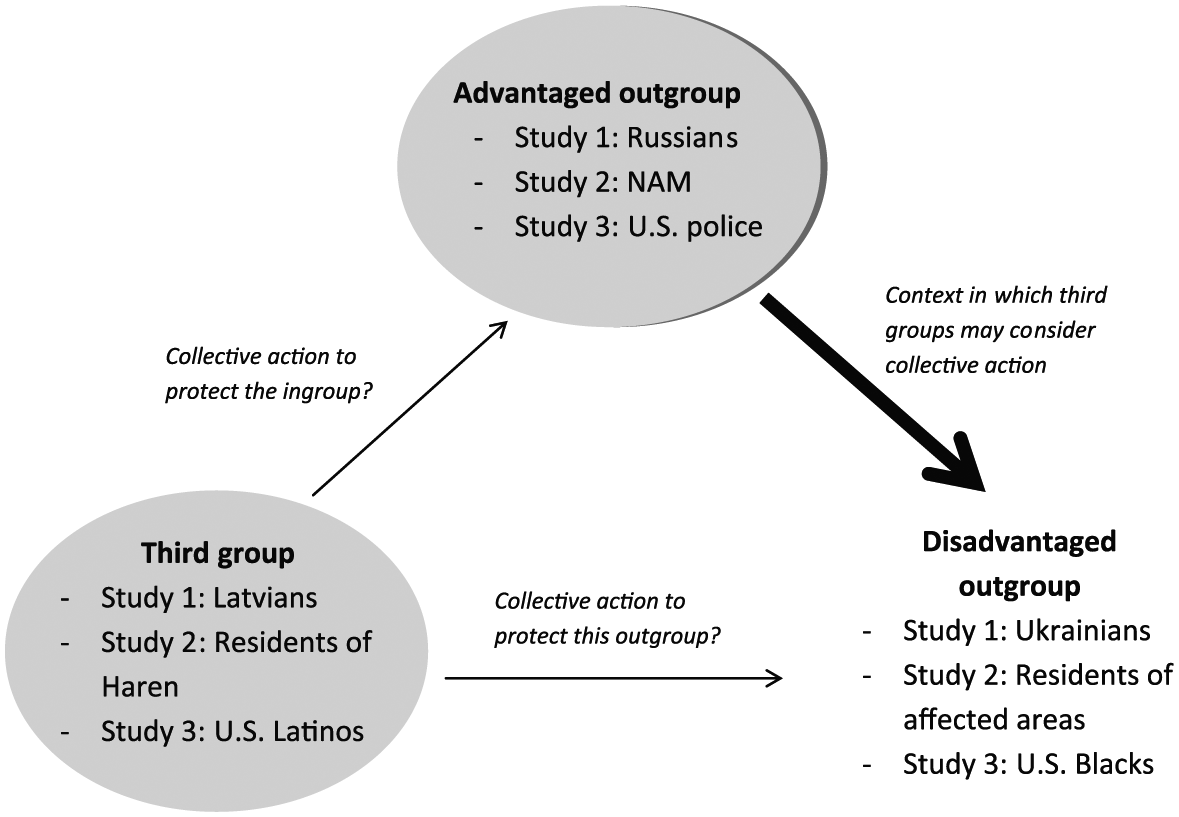
Third-group members’ intentions to engage in collective action to protect their ingroup or to protect the disadvantaged outgroup, with specific groups for each of the three studies.
Study 1
Method
Participants
Participants were 89 (19 men, 66 women, four not specified) residents of Latvia. Seventy-eight of the participants identified themselves as Latvian, 6 as Russian (note that Russians are an ethnic minority in Latvia), 1 as Jewish, and 4 did not specify their nationality. The average age of the participants was 26.90 years (SD = 7.40). Participants were approached in a university and asked if they wanted to volunteer in a study investigating students’ opinions about current events in Ukraine; 92% of the participants were psychology students, the rest were either not students or students from a different discipline.
Materials
The questionnaire contained an informed consent form (which all participants signed), the questionnaire items, and a debriefing form. In line with our research questions, the questionnaire included measures of ingroup and outgroup identification, group-based anger, (ingroup, outgroup, and shared) efficacy beliefs, collective action intentions to protect the ingroup, collective action intentions to protect the disadvantaged outgroup, intergroup contact, and communal relational models (see supplemental materials). 2
Specifically, five items were adapted from questions used to assess group identification (Kessler & Hollbach, 2005). Each item was adjusted to measure identification with the ingroup, the disadvantaged outgroup (Ukrainians), and the advantaged outgroup (the Russians; see supplemental materials). For example, one of the items measuring identification with the ingroup was “I feel a bond with Latvians.” The items were assessed on a 7-point Likert scale (1 = strongly disagree, 7 = strongly agree). Cronbach’s alpha was .92 for ingroup identification, .78 for identification with the disadvantaged outgroup, and .89 for identification with the advantaged outgroup.
Two items measuring anger towards the advantaged outgroup on behalf of the disadvantaged outgroup were adapted from Mackie, Devos, and Smith (2000). An example of the items is “I feel furious at the Russians for violating Ukraine’s sovereignty.” Participants indicated to what extent they agreed with the items on a 7-point Likert scale (1= strongly disagree, 7 = strongly agree). Both items correlated highly (r = .91, p < .001).
Two items adapted from van Zomeren et al. (2004) measured ingroup, outgroup, and shared efficacy beliefs. For example, an item measuring ingroup efficacy was “I think Latvians as a group can maintain and protect their nation’s sovereignty,” and an item measuring shared efficacy was “I think together Ukrainians and Latvians can successfully maintain and protect Ukraine’s sovereignty.” Participants indicated to what extent they agreed with the items on a 7-point Likert scale (1 = strongly disagree, 7 = strongly agree). The items correlated highly for efficacy of the ingroup (r = .82, p < .001), for efficacy of the disadvantaged outgroup (r = .73, p < .001), and for shared efficacy (r = .87, p < .001).
The main dependent variables were different collective action intentions. The items were adapted from Brunsting and Postmes (2002) and Shi, Hao, Saeri, and Cui (2014). Five items were included to assess ingroup-oriented collective action intentions (e.g., “I am willing to sign a petition in support of maintaining and protecting Latvian sovereignty”). The same five items were modified to assess outgroup-oriented collective action intentions (“I am willing to sign a petition in support of maintaining and protecting Ukrainian sovereignty”). Cronbach’s alphas were .85 for ingroup-oriented and .88 for outgroup-oriented collective action intentions.
Seven items assessed intergroup contact between the ingroup and the disadvantaged outgroup (adapted from Islam & Hewstone, 1993). For example, “I regularly interact with Ukrainians” (1 = strongly disagree, 7 = strongly agree) and “On average, how positive or negative have your interactions with Ukrainians been?” (1 = very negative, 7 = very positive). Cronbach’s alpha was .71 for contact with Ukrainians.
Three different relational models between Latvians and Ukrainians were assessed based on relational models theory (Fiske, 1992): Six items (Haslam, 1994; Wermser et al., 2018) reflected communal sharing, equality matching, and authority ranking (a relational model based on hierarchy; see supplemental materials). We report communal sharing and equality matching across the studies as the most relevant relational models, as these conceptually fit with solidarity and allyship relationships, respectively. For example, an item assessing communal sharing relationship was “If one group needs something, the other will give it without expecting anything in return”; an item assessing equality matching relationship was “Both groups have a right to equal treatment.” Participants indicated to what extent they agreed with the statements (1 = strongly disagree, 7 = strongly agree). Cronbach’s alphas were .83 for communal sharing and .60 for equality matching.
Results
Descriptive statistics
On average, individuals’ willingness to engage in ingroup-oriented collective action was higher (M = 5.23, SD = 1.50) than their willingness to engage in outgroup-oriented action (M = 4.26, SD = 1.42). Similarly, ingroup identification (M = 6.11, SD = 1.10) was higher than identification with the advantaged outgroup (M = 2.72, SD = 1.61) and disadvantaged outgroup (M = 2.94, SD = 1.20). These results suggest that, as expected, Latvians identify less with both outgroups than with their ingroup. On average, group efficacy with regard to the ingroup (M = 5.14, SD = 1.48) was higher than that of the disadvantaged outgroup (M = 4.78, SD = 1.57), and both were higher than shared group efficacy (M = 3.58, SD = 1.69). Anger towards the advantaged outgroup (Russians) was rather high (M = 5.25, SD = 1.93). Furthermore, participants reported to have a lot of contact with Russians (M = 4.40, SD = 1.17), which is in line with the distribution of ethnic minorities in Latvia. They also perceived their relationship with Ukrainians as characterized by communal sharing (M = 4.14, SD = 1.05), which fits a solidarity-based relationship. Equality matching was also perceived as descriptive of the relationship between Latvians and Ukrainians (M = 4.39, SD = 0.79), which fits with the idea of allied minorities that are in the same boat together.
Hypothesis testing
We tested Hypothesis 1 that posits that ingroup identification, anger towards Russians, and ingroup efficacy beliefs uniquely and positively predict intentions for ingroup-oriented collective action. The regression model explained 51% of the variance. Both ingroup identification and anger towards Russians were indeed statistically significant and positive predictors. Ingroup efficacy beliefs, however, was not a significant and unique predictor, despite its positive and significant bivariate correlation with the action measure (r = .28, p = .01; see Table 1). Shared efficacy beliefs, however, was a positive and significant predictor of ingroup action when entered into the model, increasing the explained variance to 55% (see Table 4). Thus, Hypothesis 1 received support for its ingroup identification and anger predictors, but mixed support for the relevant efficacy predictor. Indeed, participants’ shared efficacy beliefs predicted their intentions to engage in collective action more strongly than their ingroup efficacy beliefs.3,4
Correlations between the main variables, Study 1.
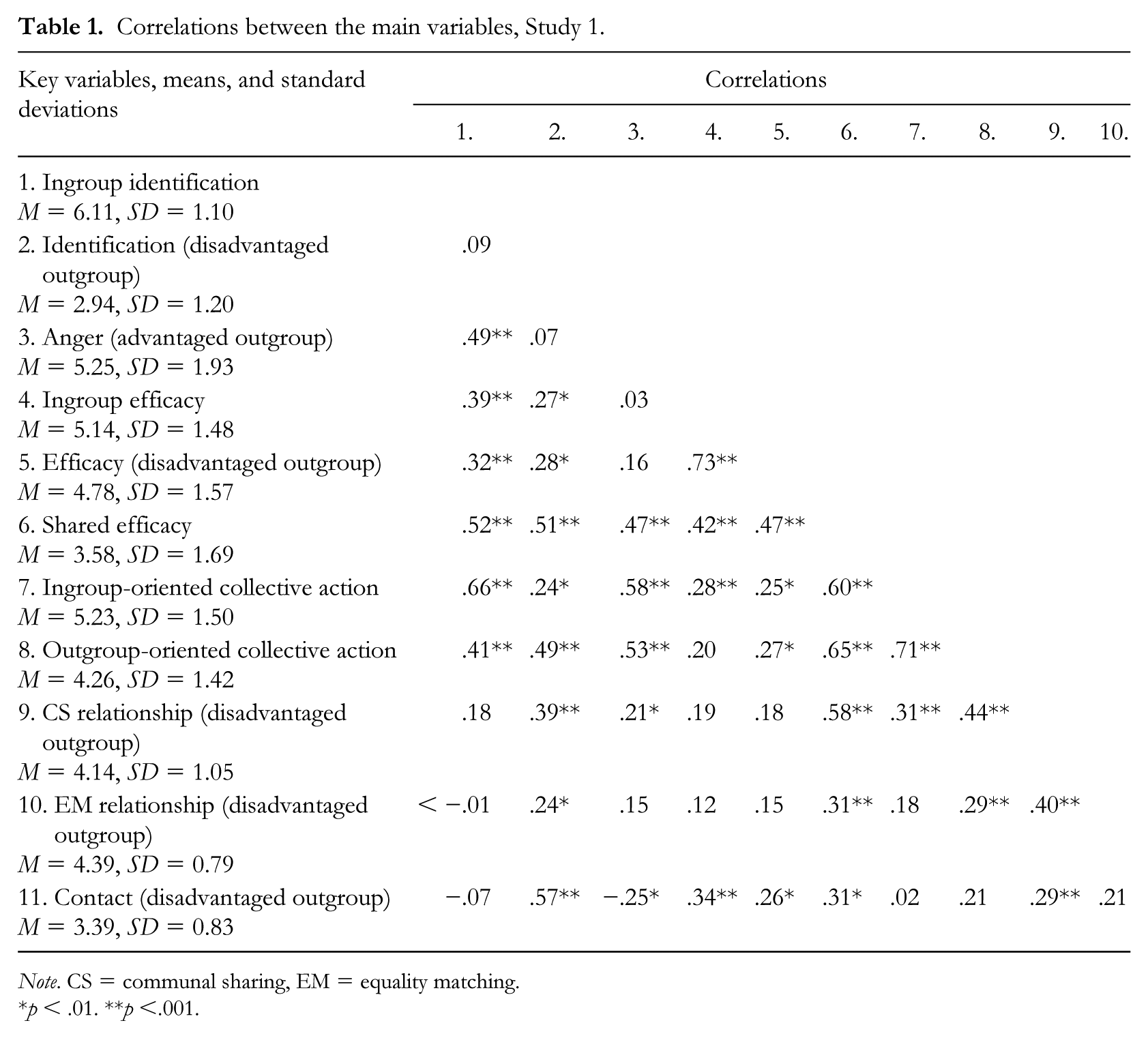
Note. CS = communal sharing, EM = equality matching.
p < .01. **p <.001.
Next, we tested Hypothesis 2 that posits that outgroup identification, anger, and efficacy beliefs predict outgroup-oriented collective action. The results showed that outgroup identification (i.e., with Ukrainians) and anger towards Russians were significant and positive predictors, explaining 47% of the variance. Outgroup efficacy (i.e., of Ukrainians) did not predict outgroup-oriented collective action, despite positive bivariate correlations between these measures. In fact, it was again shared efficacy beliefs that, when entered, uniquely and significantly predicted such collective action, with the model explaining 53% of the variance (see Table 5).
Exploring predictors of outgroup identification
What does outgroup identification entail for third-group members? We explored which relational variables predicted outgroup identification by testing whether such identification was predicted by contact with this outgroup (i.e., Ukrainians) and by communal and equality models regarding this outgroup (while controlling for ingroup identification), with the model explaining 37% of the variance. As can be seen in Table 6, the key predictor of outgroup identification was contact with that outgroup, with an additional trend for communal rather than equality relationships.
Discussion
Findings of Study 1 show first evidence of the applicability of the SIMCA predictors to ingroup-oriented and outgroup-oriented collective action intentions among third-group members in three-group contexts. Indeed, ingroup identification, anger towards Russians, and shared (rather than ingroup) efficacy beliefs predicted collective action to protect the ingroup, whereas outgroup identification, anger towards Russians, and shared (rather than outgroup) efficacy beliefs predicted collective action to protect the outgroup.
Intriguingly, ingroup efficacy beliefs did not predict ingroup-oriented collective action, but shared efficacy did; similarly, outgroup efficacy did not predict outgroup-oriented collective action, but shared efficacy again did. Given this preliminary pattern of findings, we first wanted to replicate it in Studies 2 and 3 before interpreting it further. Similarly, Study 1 also explored potential antecedents of outgroup identification, which was predicted by positive and frequent contact with the outgroup, and by perceiving the relationship as part of a communal (rather than equality) model, all of which are indicators or outcomes of relational, interaction-based processes. Nevertheless, we refrain from interpreting these findings until we can confirm these effects in Studies 2 and 3.
We conducted follow-up studies to avoid reliance on single studies. Indeed, critics may argue that the Study 1 context might be rather unique and even rare (as it involved a military invasion by a major power). As such, the findings may be valid only within the idiosyncrasies of this particular context and thus may not easily generalize to other contexts. We therefore conducted Study 2 in a different three-group context, reasoning that replicating support for Hypotheses 1 and 2 while seeking confirmatory tests of the importance of shared efficacy beliefs and relational predictors of outgroup identification would provide more generalizable support for our line of thought.
Study 2
Study 2 used a unique context in the northern region of Groningen, the Netherlands, in which light but damaging earthquakes have become more and more common due to the extraction of natural gas. Within this region, a clear differentiation has arisen between the affected areas (where earthquakes have damaged houses, which results in their lower value) and the nonaffected areas (such as the city of Groningen and the nearby town of Haren). Collective action is relevant in this context because there is a lot at stake for all parties involved. The Groningen gas field is the largest gas field in Europe and it is managed by the private petroleum company Nederlandse Aardolie Maatschappij (NAM). When the government decided to allow NAM to increase their drillings and gas production, the frequency of earthquakes increased. About 60,000 homes are within the earthquake zone and nearly 6,000 have had serious damages. This caused public protest in the affected areas, but initially without much effect. At the same time, there are towns and villages in the province of Groningen that are not directly affected by the earthquakes, but could be affected if the extraction area is expanded. This context, thus, includes an advantaged outgroup (the gas company), a disadvantaged outgroup (inhabitants of the affected areas), and a third, at present unaffected but potentially affected, ingroup, which makes it structurally comparable to the Study 1 context.
Method
Participants
Participants were 98 (47 men, 49 women, two not specified) residents of Haren, a town south of the city of Groningen, that is, third-group members. 90.8% of the participants were Dutch (M = 55.50 years, SD = 17.80); 77% had higher education (university or university of applied sciences); 33.8% had a household monthly income higher than €4,500, 22.1% between €4,500 and €3,500, 28.1% between €3,500 and €2,500, 16.2% between €1,000 and €2,500 (the rest preferred not to share this information); 84.5% were homeowners.
In order to select a random sample of residents, an aleatory sample of 20 streets was generated from a complete list of the streets in Haren. Every third house was surveyed. If there was no response or the resident declined to participate, the house next to it was selected. Five participants withdrew from the study upon agreeing to complete the questionnaire: One participant was unsatisfied with the formulation of the questionnaire; two participants did not manage to find the time and no longer wanted to participate; and two participants believed they did not know enough about the topic to provide useful answers and therefore left the questionnaire blank.
Materials
As in Study 1, the questionnaire contained an informed consent form (which all participants signed), the questionnaire items and a debriefing form. We measured the same constructs with similar items that were, where needed, adapted to the current context (see supplemental materials).
The same items as in Study 1 were used to measure ingroup identification, identification with the disadvantaged outgroup, and identification with the advantaged outgroup. For example, one of the items measuring identification with the ingroup was “I feel a bond with Haren residents” (see supplemental materials). The items were assessed on a 7-point Likert scale (1 = strongly disagree, 7 = strongly agree). Cronbach’s alpha was .95 for ingroup identification, .91 for identification with disadvantaged outgroup, and .95 for identification with the advantaged outgroup.
In Study 2, we developed separate sets of the items to measure anger on behalf of the ingroup and anger on behalf of the disadvantaged outgroup. For example, “I feel furious at NAM for causing earthquakes and their consequences for Haren residents” and “I feel furious at NAM for causing earthquakes and their consequences for the residents of the affected areas” (see supplemental materials). Participants indicated to what extent they agreed with the items on a 7-point Likert scale (1= strongly disagree, 7 = strongly agree). Both items correlated highly for anger on behalf of the ingroup (r = .89, p < .001) and for anger on behalf of outgroup (r = .85, p < .001).
As in Study 1, ingroup, outgroup, and shared efficacy beliefs were measured. For example, an item measuring shared efficacy was “I think the affected residents and Haren residents together can protect the interests of the affected areas.” Participants indicated to what extent they agreed with the items on a 7-point Likert scale (1= strongly disagree, 7 = strongly agree). Cronbach’s alpha was .84 for perceived shared efficacy, .87 for perceived efficacy of the outgroup, and .95 for perceived efficacy of the ingroup.
As in Study 1, there were separate sets of items for collective action intentions on behalf of the ingroup and for collective action intentions on behalf of the outgroup. Examples of ingroup- and outgroup-oriented collective action intentions are: “I am prepared to sign a petition to support and protect Hareners” and “I am prepared to sign a petition to support and protect people in the affected areas,” respectively. Cronbach’s alpha was .86 for action intentions on behalf of the ingroup and .85 for action intentions on behalf of the outgroup.
Intergroup contact was assessed the same way as in Study 1. Examples of these items are “I have many friends/acquaintances in the affected areas” (1 = strongly disagree, 7 = strongly agree) and “Generally, how positive or negative are your interactions with residents of the affected areas?” (1 = very negative, 7 = very positive). Cronbach’s alpha was .75 for contact between ingroup and outgroup.
Relational models were measured as in Study 1. Cronbach’s alpha was .86 for communal sharing and .77 for equality matching between ingroup and disadvantaged outgroup.
Procedure
Participants were reached at their homes and asked if they wanted to volunteer in a study about their opinions of effects of earthquakes from gas extraction. Participants were approached by students of University of Groningen who completed this task as a part of their research project. Participants were told that they could complete the questionnaire, which would take about 25 minutes, alone and in their own time and that it would be picked up at a later time of their choosing. Upon agreeing to take part, participants received an envelope containing the informed consent form (which all signed) and the questionnaire; they were assured of the anonymity of their responses. Finally, participants were debriefed via a university-approved debriefing form that included additional information about the study.
Results
Descriptive statistics
As in Study 1, individuals’ willingness to engage in collective action was rather high. This was the case for ingroup-oriented collective action intentions (M = 4.11, SD = 1.52) but also for outgroup-oriented collective action intentions (M = 4.76, SD = 1.20), which was even higher than the former. Participants also reported more anger towards the advantaged outgroup on behalf of the disadvantaged outgroup (M = 3.87, SD = 1.80) than on behalf of their ingroup (M = 2.84, SD = 1.64). Furthermore, individuals identified the least with NAM (M = 1.65, SD = 0.99) and less with people living in the affected areas (M = 4.37, SD = 1.49) than with their ingroup (M = 5.05, SD = 1.41). On average, ingroup efficacy (M = 4.37, SD = 1.53) and disadvantaged outgroup efficacy (M = 4.15, SD = 1.41) were lower than shared group efficacy (M = 4.68, SD = 1.35). Furthermore, contact with members of the disadvantaged outgroup was high (M = 4.40, SD = 1.11). Communal sharing and equality matching described their relationship with the disadvantaged outgroup best (M = 4.00, SD = 1.27; M = 4.29, SD = 1.90).
Hypothesis testing
First, we tested whether, in line with Hypothesis 1, ingroup identification, anger towards NAM, and ingroup efficacy beliefs uniquely and positively predicted ingroup-oriented collective action intentions. In line with Study 1, ingroup identification and anger on behalf of the ingroup were positive and significant predictors of ingroup-oriented collective action intentions. Also as in Study 1, ingroup efficacy did not correlate with and did not predict ingroup action but shared efficacy did (see Table 2), increasing the explained variance of the model from 36% to 41% (see Table 4). These findings effectively replicate those of Study 1 in a very different (yet structurally comparable) three-group context.
Correlations between the main variables, Study 2.
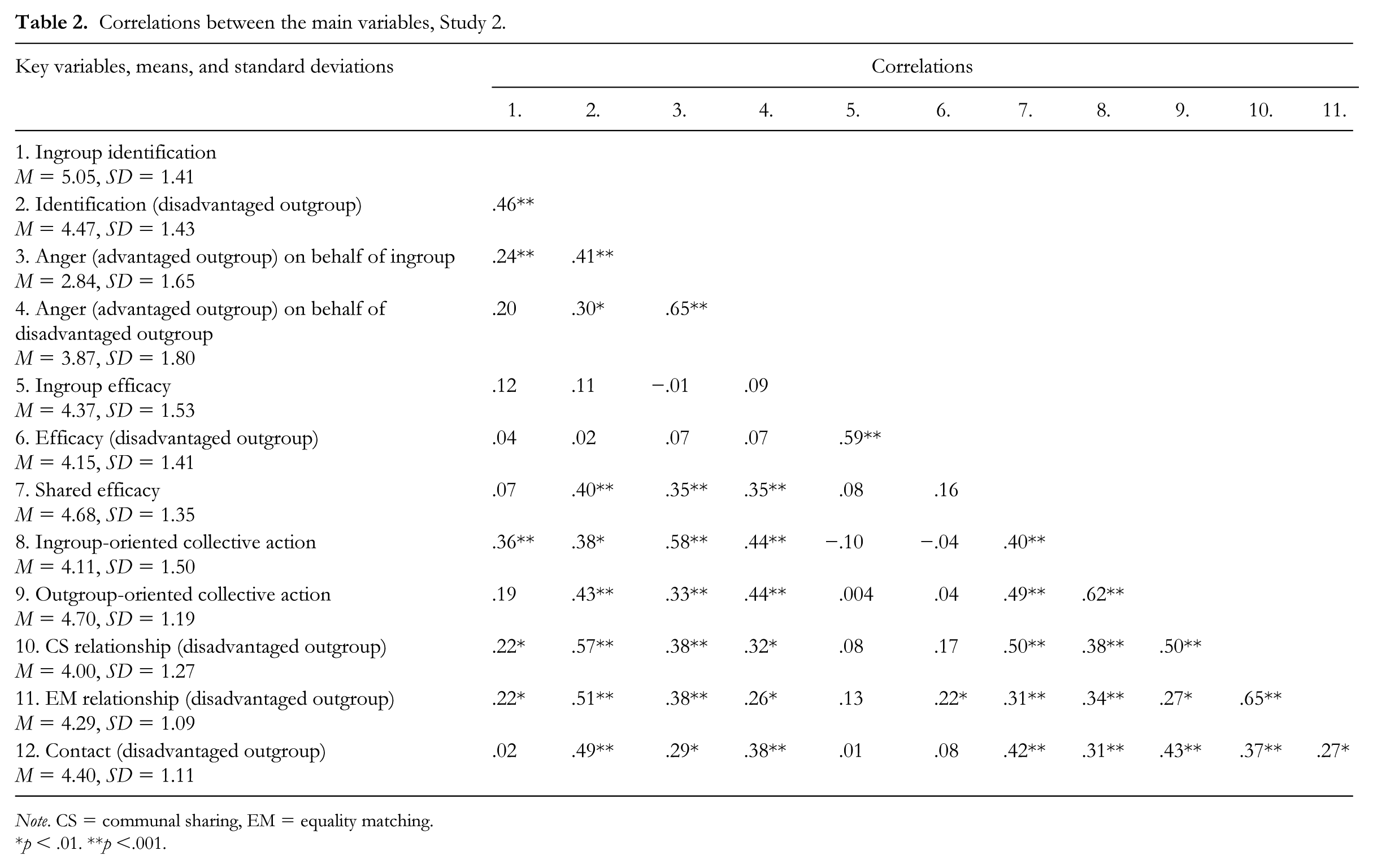
Note. CS = communal sharing, EM = equality matching.
p < .01. **p <.001.
Next, we tested whether, in line with Hypothesis 2, outgroup identification, anger, and efficacy beliefs predicted outgroup-oriented collective action intentions. In line with Study 1, the results showed that outgroup identification and anger on behalf of the outgroup were significant predictors of outgroup action. Also as in Study 1, outgroup efficacy did not significantly predict collective action, but shared efficacy did, with the model explaining 37% of the variance (see Table 5). Together, these findings replicate support for both hypotheses in a different context, now confirming what initially were preliminary findings regarding shared efficacy beliefs.
Predicting outgroup identification
As in Study 1, we tested whether contact with the outgroup as well as communal sharing and equality matching relationships, when controlling for ingroup identification, predicted outgroup identification (see Table 6), with the model explaining 59% of the variance. Replicating Study 1, intergroup contact with the outgroup was a significant and unique predictor of outgroup identification. Communal sharing was another significant and unique predictor of outgroup identification, but this was not the case for equality matching.
Discussion
Findings of Study 2 replicated those of Study 1, which corroborates support for the application of the SIMCA to third-group members’ ingroup- and outgroup-oriented collective action intentions. Not only did the Study 2 findings support Hypotheses 1 and 2, they also confirmed what were initially preliminary findings for shared efficacy beliefs, intergroup contact, and communal (rather than equality) relational models. Although Study 2 was conducted in a different context than Study 1, the pattern of findings across the studies was very similar, which increases their external validity. At the same time, it could be argued that a common weakness of both studies was that sample sizes were small, which was partly due to the difficulty of data collection (i.e., hard-to-reach samples). We therefore decided to conduct a third study with a larger sample size and a different context to boost the external validity of our findings.
Study 3
The police brutality context in the US is often associated with the Black Lives Matter meme and movement (see Leach & Allen, 2017). We chose the police as the advantaged outgroup in this particular U.S. context and Blacks as the disadvantaged outgroup while focusing on Latinos as the third group (i.e., the ingroup). The reason for this was that although incidents of police brutality may often involve Black victims, media reports suggest that this may become or already be a reality for U.S. Latinos as well (see e.g., Florido, 2016). As compared to Studies 1 and 2, we decided to use a larger sample to test the SIMCA predictors of collective action to protect the ingroup (Latinos) and/or the disadvantaged outgroup (Blacks).
Method
Participants and procedure
We used Amazon’s Mechanical Turk to specifically recruit Latinos. Participants were 278 Latinos (152 men, 125 women, one preferred not to say; Mage = 34.41, SD = 10.79). The sample also included 38 non-Latinos, the data of whom were not analyzed. We determined sample size based partly on a power analysis, after which we decided to oversample this study (but within the limits of the budget) to cope with potential dropouts and have more statistical power. In fact, Study 3 included more participants than Studies 1 and 2 combined.
Materials
As in Studies 1 and 2, the questionnaire contained an informed consent form (which all participants signed), the questionnaire items, and a debriefing form. We measured the same constructs with similar items that were, where needed, adapted to the current context (see supplemental materials). We thus measured identification with the ingroup (Cronbach’s alpha = .94), the disadvantaged outgroup (Cronbach’s alpha = .95), and the advantaged outgroup (Cronbach’s alpha = .96); we included separate sets of the items to measure anger on behalf of the ingroup (r = .91, p < .001) and anger on behalf of the disadvantaged outgroup (r = .93, p < .001); we measured ingroup efficacy (r = .83, p < .001), outgroup efficacy (r = .86, p < .001), and shared efficacy beliefs (Cronbach’s alpha = .97); we included measures of collective action intentions on behalf of the ingroup (Cronbach’s alpha = .93) and on behalf of the outgroup (Cronbach’s alpha = .93); we measured contact between ingroup and outgroup (Cronbach’s alpha = .88); finally, we measured communal sharing and equality matching relational models between these groups (Cronbach’s alphas = .87 and .68, respectively).
Results
Descriptive statistics
As in Studies 1 and 2, individuals’ willingness to engage in collective action was rather high. This was the case for ingroup-oriented collective action intentions (M = 4.80, SD = 1.64) and for outgroup-oriented collective action intentions (M = 4.62, SD = 1.61). Participants identified less with the police (M = 3.28, SD = 1.65) and with Blacks (M = 4.27, SD = 1.63) than with their Latino ingroup (M = 5.98, SD = 1.18). Participants also reported high anger towards the advantaged outgroup on behalf of the disadvantaged outgroup (M = 5.14, SD = 1.71) and on behalf of their ingroup (M = 5.14, SD = 1.73). On average, ingroup efficacy (M = 4.64, SD = 1.58) and disadvantaged outgroup efficacy (M = 4.42, SD = 1.57) were similar to shared group efficacy (M = 4.87, SD = 1.56). Furthermore, contact with members of the disadvantaged outgroup was high (M = 4.61, SD = 1.31). Indeed, communal sharing described the relationship with the disadvantaged outgroup best (M = 4.01, SD = 1.37) and better than equality matching (M = 2.90, SD = 0.82; see Table 3 for correlations between the variables).
Correlations between the main variables, Study 3.
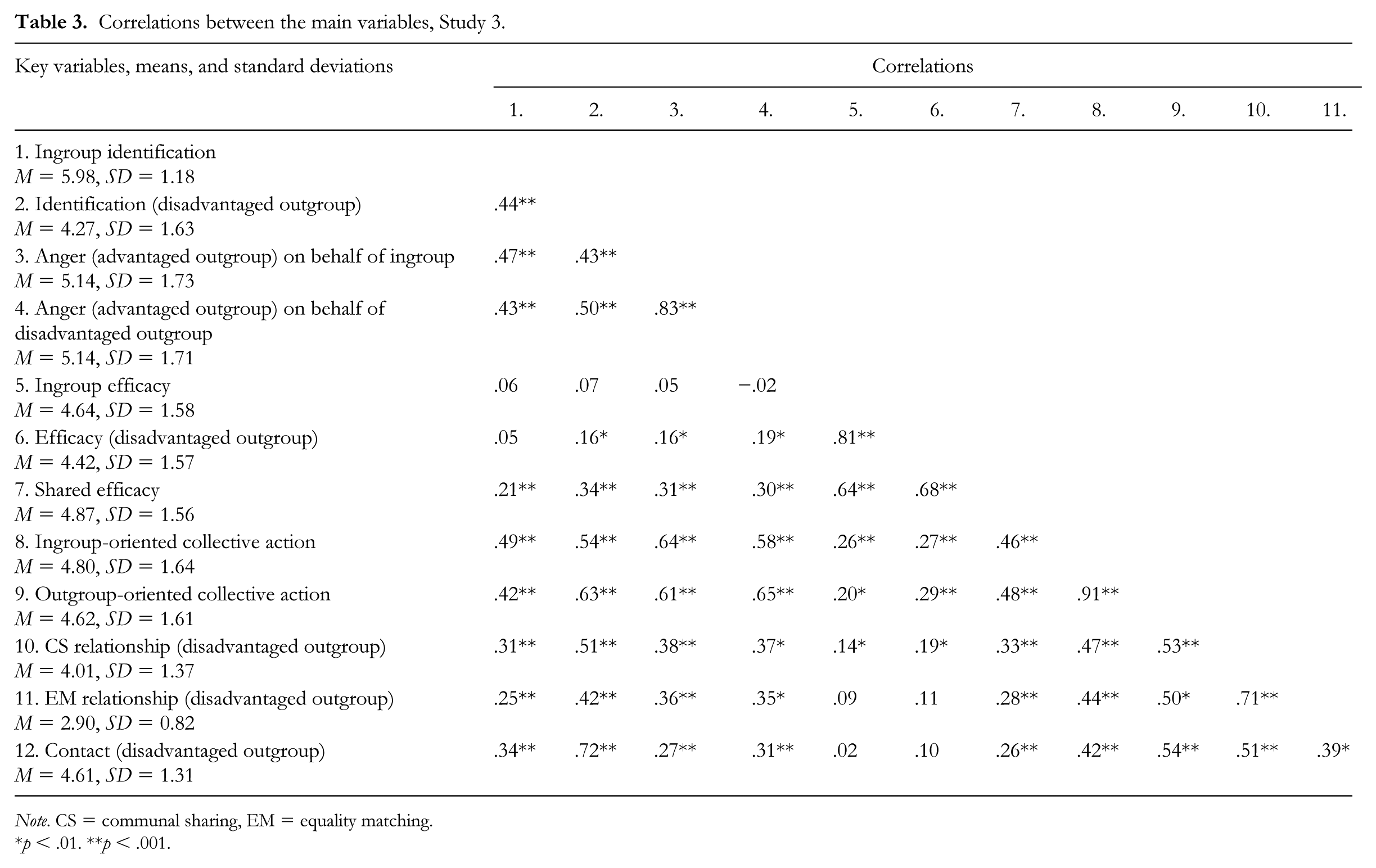
Note. CS = communal sharing, EM = equality matching.
p < .01. **p < .001.
Hypothesis testing
First, we tested whether, in line with Hypothesis 1, ingroup identification, anger towards the police, and ingroup efficacy beliefs uniquely and positively predicted ingroup-oriented collective action intentions. In line with Studies 1 and 2, ingroup identification and anger on behalf of the ingroup were positive and significant predictors of ingroup-oriented collective action intentions. Moreover, as in Studies 1 and 2, ingroup efficacy did not predict ingroup action but shared efficacy did, with the model explaining 52% of the variance (see Table 4). These findings replicate those from Studies 1 and 2 in yet another three-group context while using a larger sample size.
Predictors of ingroup-oriented collective action intentions, Studies 1, 2, and 3.
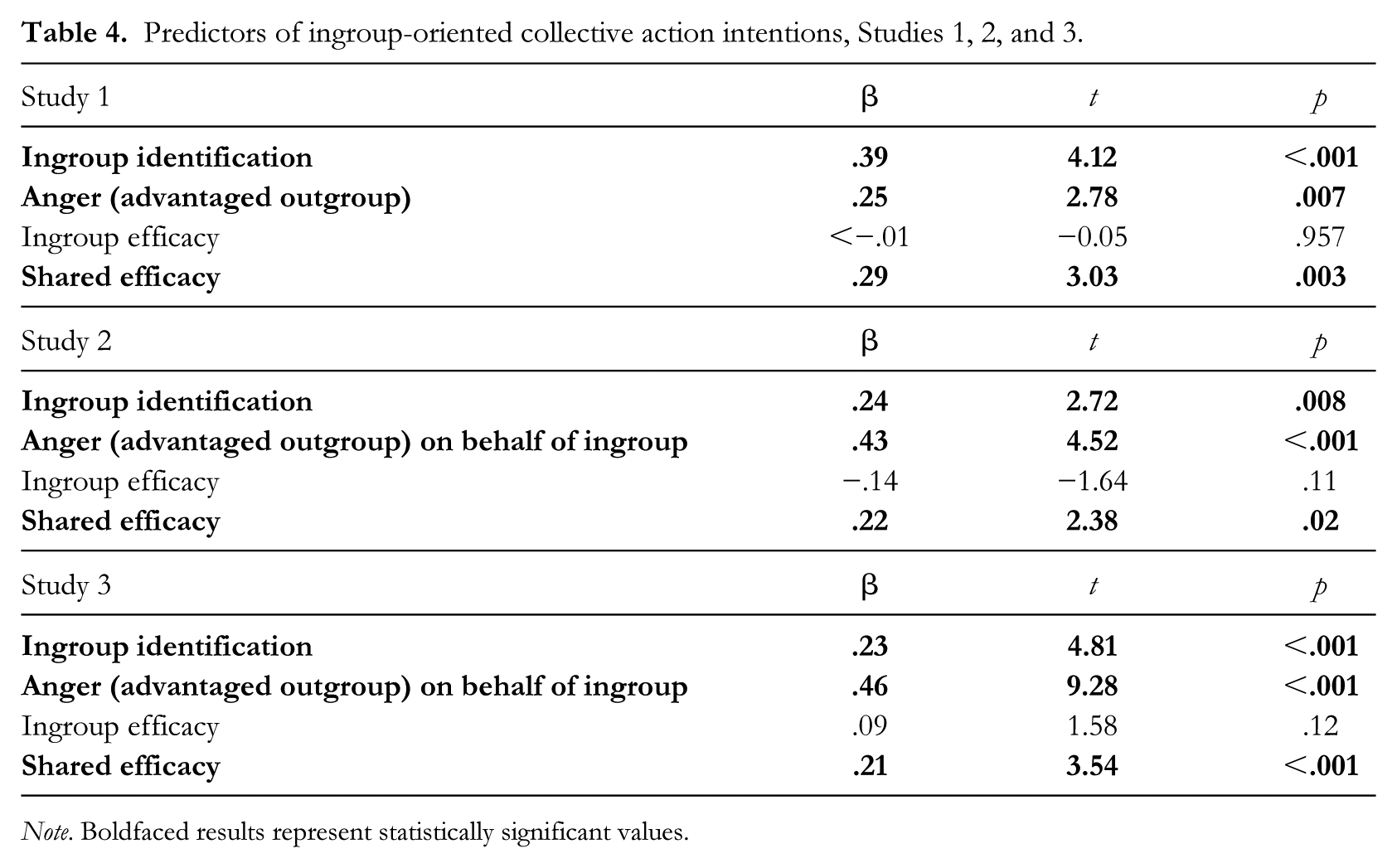
Note. Boldfaced results represent statistically significant values.
Next, we tested whether, in line with Hypothesis 2, outgroup identification, anger, and efficacy beliefs predicted outgroup-oriented collective action intentions. In line with Studies 1 and 2, the results showed that outgroup identification and anger on behalf of the outgroup were significant predictors of outgroup action intentions. Furthermore, as in Studies 1 and 2, outgroup efficacy did not significantly predict collective action, but shared efficacy did, with the model explaining 60% of the variance (see Table 5). These findings replicate those from Studies 1 and 2 in yet another three-group context while using a larger sample size.
Predictors of outgroup-oriented collective action intentions in Studies 1, 2, 3.
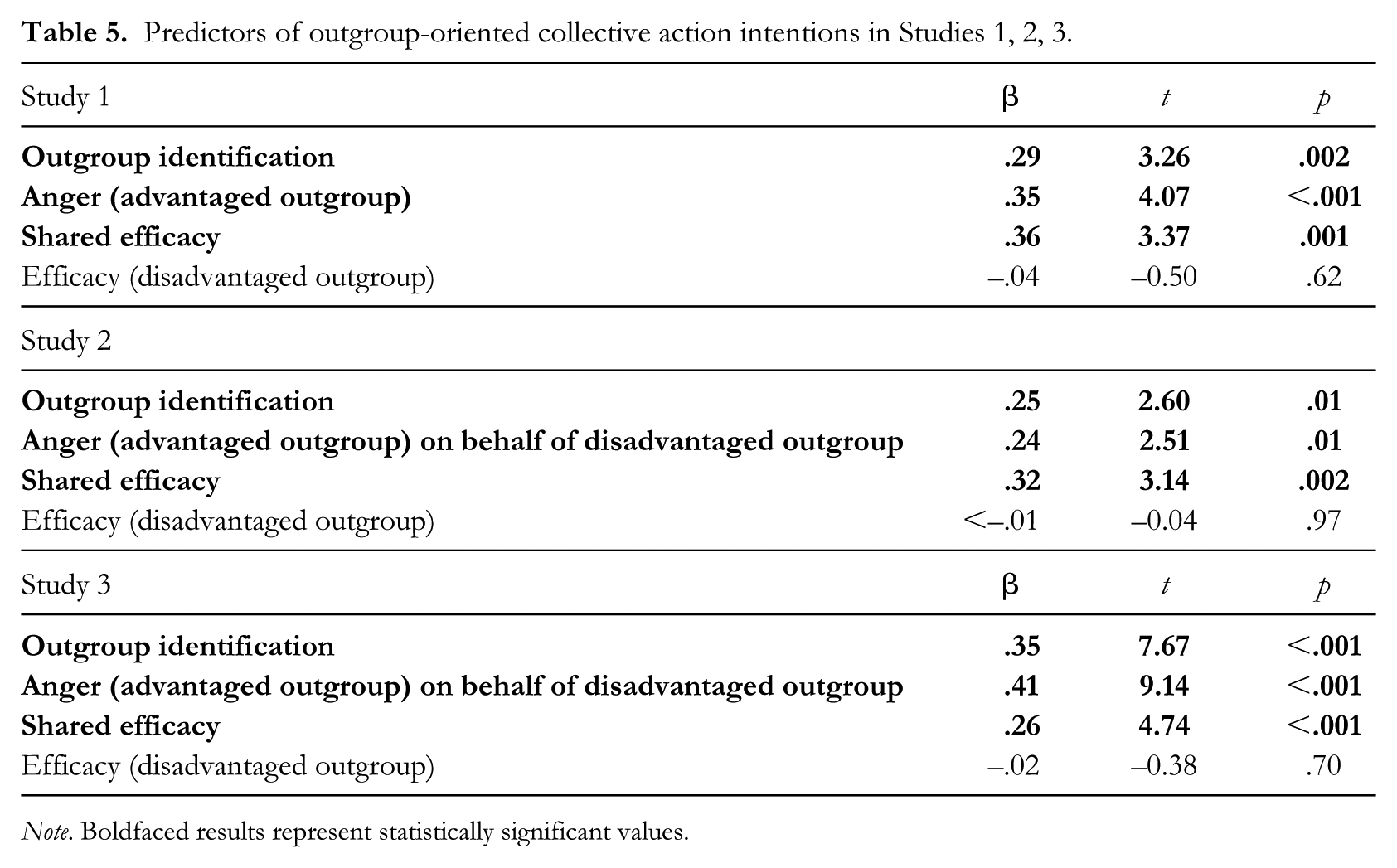
Note. Boldfaced results represent statistically significant values.
Predicting outgroup identification
We tested whether contact with the outgroup as well as communal sharing and equality matching models predicted outgroup identification (see Table 6) while controlling for ingroup identification, with the model explaining 58% of the variance. As in Studies 1 and 2, intergroup contact and communal sharing (rather than equality matching) with the outgroup predicted outgroup identification.
Predictors of outgroup identification in Study 1, Study 2 and Study 3.
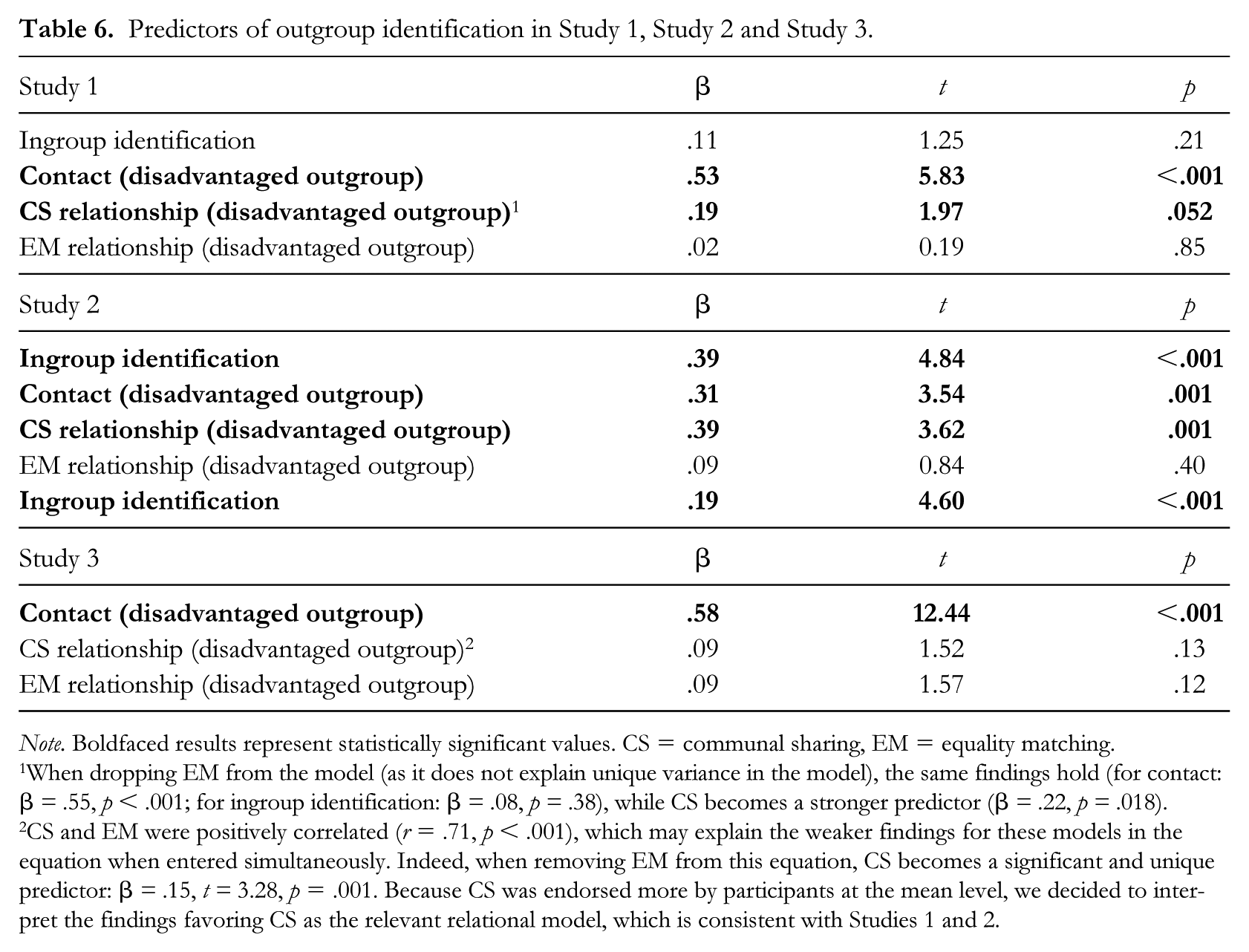
Note. Boldfaced results represent statistically significant values. CS = communal sharing, EM = equality matching.
When dropping EM from the model (as it does not explain unique variance in the model), the same findings hold (for contact: β = .55, p < .001; for ingroup identification: β = .08, p = .38), while CS becomes a stronger predictor (β = .22, p = .018).
CS and EM were positively correlated (r = .71, p < .001), which may explain the weaker findings for these models in the equation when entered simultaneously. Indeed, when removing EM from this equation, CS becomes a significant and unique predictor: β = .15, t = 3.28, p = .001. Because CS was endorsed more by participants at the mean level, we decided to interpret the findings favoring CS as the relevant relational model, which is consistent with Studies 1 and 2.
Discussion
The Study 3 findings replicated those of Studies 1 and 2. Study 3 further confirmed the importance of shared efficacy beliefs for both types of action and, moreover, confirmed the importance of intergroup contact and communal relational models in predicting outgroup identification. As Study 3 employed a larger sample size as compared to previous studies and in another highly relevant political context—different, yet, structurally comparable to the contexts used in Studies 1 and 2—this study’s results increased the external validity of our findings.
General Discussion
Across three empirical studies we found broad and consistent support for the three SIMCA predictors (group identification, efficacy, and anger) as applied to third-group members’ ingroup- and outgroup-oriented collective action intentions. In Study 1, Latvians’ ingroup identification, anger towards Russians, and shared efficacy beliefs predicted their collective action intentions to protect their ingroup; while their outgroup identification (with Ukraine), anger towards Russians, and shared efficacy beliefs predicted their collective action intentions to protect the Ukrainian outgroup. In Study 2, Hareners’ ingroup identification, anger towards the petroleum company NAM, and shared efficacy beliefs uniquely and positively predicted their intentions for collective action to protect their ingroup; while their outgroup identification (with those in the affected areas), anger toward NAM, and shared efficacy beliefs were significant predictors of their intentions for collective action to protect that outgroup. Finally, in Study 3, Latinos’ ingroup identification, anger towards the police, and shared efficacy beliefs predicted their intentions for collective action to protect their ingroup; while their outgroup identification (with Blacks), anger toward the police, and shared efficacy beliefs predicted their intentions for collective action to protect that outgroup.
This consistent pattern of findings across multiple studies with different contexts provides first yet solid evidence that the SIMCA predictors can be extended to third-group members’ willingness for collective action to protect their ingroup and/or a disadvantaged outgroup. In fact, this reflects the first contribution of our findings to the broader social-psychological literature on collective action. Indeed, whereas the SIMCA originated from studies among members of disadvantaged groups (e.g., Cakal et al., 2011; van Zomeren et al., 2012) and was later extended to members of advantaged groups (e.g., Cakal et al., 2011; Tabri & Conway, 2011; van Zomeren et al., 2011), the current set of studies suggests that the very same psychological variables and processes (revolving around group identity, anger, and efficacy beliefs) are relevant in predicting the collective action intentions of third-group members. More specifically, we found that these predictors were relevant for explaining individuals’ intentions to engage in collective action to protect their ingroup and/or the disadvantaged outgroup.
The second contribution of our findings lies in identifying the importance of shared efficacy beliefs in the three-group contexts we studied. In line with Cakal et al. (2018), we consistently found across the three studies that, for third-group members, their belief in the efficacy of both ingroup and disadvantaged outgroup was more predictive of their collective action intentions to protect either group. Although initially considered preliminary, the two later studies confirmed these findings. We interpret them in relation to the strategic calculation of “power in numbers”—when multiple groups fight for the same cause and against the same foe (Cakal et al., 2018; see also Tawa, 2017). For example, when Latinos realize that police brutality might also affect them, they may think not just about their own group’s efficacy, but about the efficacy of Latinos and Blacks together. This line of thought fits with Dixon et al.’s (2015) suggestion for future research to focus more on efficacy beliefs in the study of collective action among allied minorities, where such power in numbers may certainly be relevant.
The third contribution of our paper is that we successfully and consistently identified relational, interaction-based predictors of outgroup identification. This is important because, conceptually, the notion of outgroup identification does not exist from the perspective of social identity theory—this theory only explains identification with ingroups (van Zomeren et al., 2011). Moving beyond previous work, our relational approach was able to explain (and later predict) why third-group members identify with outgroups: Such identification was consistently and positively predicted across our three studies by more positive and frequent contact with members of that outgroup (Dixon et al., 2015; Pettigrew & Tropp, 2006) and by the experience of a communal rather than equality relational model with that outgroup (Fiske, 1992; Wermser et al., 2018). These findings are novel and intriguing, as they support the idea that outgroup identification among members of third groups, which seems difficult to explain from a “top-down” category basis, has an important “bottom-up” relational basis (van Zomeren, 2016; van Zomeren et al., 2016; see also Postmes et al., 2005). Perhaps the difference between identification with ingroup and outgroup is really a difference of how much can be inferred about the outgroup from the social category itself (which should be a stronger basis for ingroup identification) vis-à-vis what can be inferred from interpersonal interactions and relationships with outgroup members.
An important implication of the current set of findings is that third-group members’ willingness to engage in collective action requires knowing what is the contextually relevant group (van Zomeren, 2013), given that both ingroup protection and outgroup protection may be relevant aims for them. In this respect, this set of studies revealed that these motivations to protect the ingroup or the disadvantaged group definitely do not seem mutually exclusive: Across the studies, the different collective action measures were highly positively correlated. This may not be surprising given that the items for each were identical except for the specific target of protection (i.e., ingroup or disadvantaged outgroup). At the same time, we found clear evidence that participants differentiated between the different targets (see Endnote 4). On this basis, we interpret our findings as suggesting that third-group members’ motivations to protect their ingroup and outgroup through collective action are certainly not mutually exclusive. Future research can examine this relationship more closely.
Future research can also elaborate on what third-group members’ predictors of outgroup identification entail. Our studies provided useful pointers toward an intriguing answer, namely that such identification is likely based on individuals’ social relationships with members of that group. Across the studies, we found that outgroup identification was predicted by more positive and frequent contact with members of that outgroup and by the experience of a communal relationship with its members. This fits with the broader notion that knowing, interacting, and more generally relating with people from an outgroup provides meaning to outgroup identification, which in turn invites the interpretation of feeling anger, efficacy, and intentions to engage in collective action on their behalf as based on relationships with people rather than representations of that group as a social category.
The findings also have practical implications in terms of the development of strategies to mobilize third-group members for collective action. Our findings suggest that one way to mobilize them is by communicating the need for ingroup protection, which should increase ingroup identification and anger toward the advantaged outgroup. Another, not mutually exclusive, way to mobilize third-group members is to communicate the need for outgroup protection (i.e., the disadvantaged outgroup), which should increase their identification with the disadvantaged group and their anger toward the advantaged outgroup. Our findings also suggest that, perhaps particularly for third groups in three-group contexts, it is important to communicate shared efficacy beliefs that remind individuals that they may have allies that could increase their power. Finally, for third-group members it may not hurt to communicate both the need for ingroup protection as well as for outgroup protection.
Our set of studies of course also has limitations that warrant some caution in interpreting the results. First, all three studies are correlational and hence do not allow for causal conclusions about the relationships between the variables studied. Note that we did not design the studies to have a strong internal validity, as we relied on both van Zomeren et al.’s (2008) meta-analysis and primary studies that experimentally manipulated the SIMCA predictors to find effects on collective action intentions (for a review, see van Zomeren, 2013). Thus, our basis for interpreting the relationships between the SIMCA predictors and collective action intentions as flowing in that particular causal direction is in line with that conceptual model and the empirical support behind it. Against this backdrop, our studies were designed to be strong on external validity, a goal that we feel we achieved given that we managed to replicate our findings across very different real-life contexts. Furthermore, a second limitation of our studies is that we did not assess actual behavior of activists, but their intentions. Although intentions are good proxies for behavior in this context (van Zomeren et al., 2008), this means that our claims are restricted to third-group members’ motivation and willingness to engage in collective action to protect their ingroup, the relevant outgroup, or both. Therefore, assessing actual behavior would be a good next step for research on social psychology of third-group members’ collective action intentions.
Conclusion
The current set of studies is the first to test the applicability of the SIMCA predictors to the collective action intentions of third-group members in three-group contexts. Examining this in three very different real-world settings enabled us to answer the questions of whether and how third-group members are willing to undertake collective action to protect their ingroup and/or the disadvantaged outgroup. Whereas the former was predicted by ingroup identification, anger felt toward the advantaged group, and shared efficacy beliefs (i.e., belief in the efficacy of the ingroup and the outgroup in need), the latter was predicted by identification with the outgroup in need, felt anger toward the advantaged outgroup, and again shared efficacy. Outgroup identification was predicted in all three studies by relational, interaction-based variables (intergroup contact and communal relational models). As such, the current studies stretch the scope of the SIMCA further to include third-group members’ willingness to engage in collective action to protect “us,” “them,” or both.
Supplemental Material
Supplemental_material – Supplemental material for Protesting to protect “us” and/or “them”? Explaining why members of third groups are willing to engage in collective action
Supplemental material, Supplemental_material for Protesting to protect “us” and/or “them”? Explaining why members of third groups are willing to engage in collective action by Liga Klavina and Martijn van Zomeren in Group Processes & Intergroup Relations
Footnotes
Funding
The author(s) received no financial support for the research, authorship, and/or publication of this article.
Supplemental material
Supplemental material for this article is available online.
Notes
References
Supplementary Material
Please find the following supplemental material available below.
For Open Access articles published under a Creative Commons License, all supplemental material carries the same license as the article it is associated with.
For non-Open Access articles published, all supplemental material carries a non-exclusive license, and permission requests for re-use of supplemental material or any part of supplemental material shall be sent directly to the copyright owner as specified in the copyright notice associated with the article.
