



Abstract
Audience research is widely regarded as a crucial area of media scholarship and needed to understand the role of media in society. Significant changes in how and what we watch in recent decades have heightened the need for a reinvigorated and systematic investigation of watching across television and the many screens and sources now common. This conceptual article draws from separate studies of contemporary watching in the US, UK, and Australia to reframe screen audience studies with approaches that manage the now extensive, coexisting behaviours, modes, and motives of watching that transcend television, streaming, YouTube, TikTok, and video in social media. The article particularly focuses on the value of centring motive and illustrates how narrowing to deeply explore particular motives better captures the diverse experiences that are part of contemporary watching. Such a heuristic also reveals longstanding gaps in the types of watching that have been central to investigations.
Introduction
For nearly two decades, media studies scholarship has attempted to understand and explain the implications of industrial change initiated by the rise of digitisation, platforms, and streaming on screen media industries, and television specifically. Yet, while there is a rich literature on industrial and technological transformation (e.g., Evens and Donders, 2018; Johnson, 2019; Lotz, 2018, 2022; Lobato, 2019), comparable academic attention has not been paid to adjustments in how we watch because of these manifold changes. Industry surveys reveal that most people in industrialised countries use multiple technologies, services, and screens to watch daily (e.g., Ofcom, 2024). ‘Watching’ screen media has become more multifaceted, commonly encompassing various means of distribution (broadcast, cable, satellite, internet), services (TV channels, video-on-demand [VOD], social media sites), devices (TV sets, set-top boxes, smart phones, tablets, laptops), and social contexts (home, bus, work, alone, with others, etc). Yet we lack sufficient empirically grounded studies and theoretical concepts to understand how people's experiences of watching have been transformed and grown more heterogeneous as a result. By ‘watching’ we mean the deliberate consumption of screen media content. The watching may not be one's primary activity (so ‘background’ viewing counts), the content may not be deliberately chosen (as in the videos that appear in a TikTok or social media feed), but the individual elects some level of screen engagement (so we are less concerned with instances when individuals are effectively forced to view as in waiting rooms when screen images and noises draw attention).
Making sense of the more complicated and diverse field of viewing experiences requires approaches that reflect viewer perspectives rather than the ways media industries or most scholarship tend to organise them. Viewers seek entertainment, distraction, connection, and information throughout their day. In the past, movie theatres and television provided the only audiovisual media, but now viewers can use different forms of ‘television,’ social media, and internet-distributed video to achieve these ends. However, scholarly frames often isolate media into categories that do not reflect viewers’ experiences, as with, for instance, studies of VOD or social media that disregard how new practices coexist alongside other viewing (see, for example, Bengtsson and Johansson, 2022; Frey, 2021; Martinez and Kaun, 2019; Spilker and Colbjørnsen, 2020).
In response, this article begins to rethink watching by considering basic questions of how and why viewers turn to video as a starting point for revitalising frameworks and approaches that can manage the complexity and variation of the twenty-first century field of viewing experiences. In what follows, we propose a retheorisation of watching informed by three research projects based in the US, UK, and Australia, encompassing 177 interviews, three nationally representative surveys, and four focus groups about contemporary viewing practices conducted separately but in dialogue. In the UK, the Routes to Content project consisted of semi-structured interviews within the homes of 30 UK adults in summer 2019, with follow-up online video interviews with 28 of the same participants during the first Covid-19 lockdown in May 2020. This was followed by an online survey (n = 1495) of UK adults in May 2021. 1 In Australia, we conducted a recruited, nationally representative survey (n = 2060) in November 2022, four focus groups in November 2023 through January 2024, and 40 hour-long, recruited Zoom interviews in November 2024. 2 In the US, we conducted a nationally representative survey (n = 1000) in August 2023, while also interviewing 92 subjects for between 40 and 80 min each in the summers of 2023 and 2024. 3
The empirical findings of the UK and Australian studies are reported elsewhere (Johnson et al., 2024; Johnson and Dempsey, 2023; Johnson et al., 2025; Lotz and McCutcheon, 2003a, 2003b, 2003c, 2003d; Lotz and Lunardi, 2025); this article instead uses insights from all three studies as a starting point for retheorising watching in the twenty-first century. Each study was broadly inductive in approach and initiated in the spirit of investigating contemporary viewing practices, rather than seeking to test firm hypotheses. We designed them in conversation with one another, but with no cross-oversight. This paper grew inductively, then, from debriefings we gave each other, and from behaviours and practices that we identified as common across all studies. Our intention is not to focus these findings into a categorical model; nor do we seek to compare the studies, especially because the studies did not follow identical methodologies. Rather, this article reports on patterns of watching that emerged across the studies regardless of the contextual differences, privileging the qualitative data. It works to identify major common behaviours, modes, and motives for watching, in order to provoke a conversation about what a viewer-centred approach to understanding changing audience practices might encompass. 4
Our aim here is to identify alternatives to previous categories that scoped studies of viewing. Rather than genre, source, or title, our fieldwork indicates the value of using various modes and motives to build more comprehensive and dynamic understandings of why people continue to spend so many leisure hours viewing video of all sorts. Building from watching behaviours, modes, and motives supports more durable theories that respond to the sophisticated and varied reasons viewers engage with different types of video at different times. This frame centres a viewer-based explanation of watching (Hasebrink and Domeyer, 2012; Wagner et al., 2021) and more reliably categorises watching based on a viewer's expressed or imputed purpose rather than inferring from textual characteristics (as, for instance, when one assumes a viewer watching news must be seeking information). It also helps us understand complex relationships of complementarity and substitution that tie to what viewers seek from a video experience at different points throughout their days.
Such an approach responds to the expansion of the field of video experience that developed throughout the twentieth century. At first cinemagoing and public exhibition provided the only way to watch. Linear channels extended the experience of watching to include the home and led to new and different viewing behaviours as the range of content on offer increased. Later, recording, owning, and renting further broadened viewers’ abilities to decide what and when to watch within the home. Internet distribution builds on this century-long adjustment by adding the capability to access a wide range of formally financed and licensed video on demand as well as new a subfield of ‘hosted’ (Idiz and Poell, 2024) video (YouTube, TikTok, and other video on social media). Mapping such a multifaceted field of video experience that has grown to include a number of differentiated viewing subfields reveals how developments of the last two decades are part of a long arc of change: Predigital technology provided a range of video experiences, and internet-distributed video does not indicate a rupture from these so much as it extends viewer command over video experiences and introduces a significant expanse of content and services. Correspondingly, understanding twenty-first century viewing does not require a new and separate scholarship, but investigation of why viewers watch a mix of predigital and internet-distributed video daily and the cultural roles that viewing plays.
This article has been in part motivated by an interest in revisiting some of the broader questions that centred audience studies in its early years in cultural studies. Those years were characterised and driven by questions about who gets to make decisions about consumption – ‘the politics of the sitting room,’ as David Morley (1992) called them – and what work they were trying to perform with those decisions, by the roles that reception played in everyday life (Silverstone, 1994) and indeed in shaping home life especially (Brunsdon, 1997; Gray, 1992; Morley, 1986, 1992), and by capacities for resistance and play as audience (Fiske, 1989; Hebdige, 1979; Lewis, 1991; Radway, 1987). Moreover, the fascination was with all audiences: certainly, most researchers focused on particular groups, but directed their data towards theorising audiences writ large. Beginning in the 1990s, however, a great deal of audience research focused more specifically on fans (Booth, 2010; Click and Scott, 2018; Hellekson and Busse, 2006; Hills, 2002; Jenkins, 1992; Sandvoss, 2005), as fan studies grew from being a part of audience studies to dominating it. Over time, too, many in fan studies aimed more modestly to understand fandom as a particular realm or set of practices, not to build theory about audiences in general. Meanwhile, large technological-industrial shifts were occurring, with the growth first of satellite/cable then of internet-distributed content. A range of studies tracked some of these changes with great skill. But it is our contention that between fan studies’ focus on particularly deep engagement, and various studies’ laser focus on specific new technologies or practices (such as second-screening in Wilson, 2016, bingeing in Jenner, 2017, or online TV viewing in Lüders and Sundet, 2021), less work has focused on a broader audience that may at times be fannish but other times dissatisfied, merely amused, watching whatever grandma wanted, and so forth, that may engage with specific new features of contemporary viewing but amidst a wide range of other behaviours. And thus, although we offer some loose taxonomies by which we might organise our studies of watching, along with Ien Ang our interests lie not in ‘dissecting “audience activity” in ever more refined variables and categories so that we can ultimately have a complete and generalizable formal “map” of all dimensions of “audience activity”’ (Ang, 1995: 42).
We do believe our data support moving towards a framework of watching that highlights different dimensions, such as motive, than have guided previous research. 5 Instead of offering a totalising schema of viewing, then, we suggest ways of thinking about a broad range of audience behaviours, modes, and motives that are drawn from our expansive empirical research.
Differentiating watching behaviours and modes
The main intervention of the article is to identify motives that crosscut an array of technologies, services, or other common categories. However, before discussing motives, we argue for the need to separate out behaviours, modes, and motives as distinct, yet interconnected, facets of viewing. Space limits prevent detailed evidence of behaviours and modes but we briefly explain their relation to motives.
Behaviours categorise what viewers do when they access or use video. Modes of watching function as variations of those behaviours. Motives categorise what viewers aim to accomplish with watching. Together, behaviours, modes, and motives encompass how (behaviour and mode) and why (motive) viewers watch. 6 Table 1 offers an indicative, rather than exhaustive, list of the kinds of behaviours that encompass how one watches video. One behaviour might map onto multiple different viewing experiences, technologies, and/or services. Browsing for something to watch, for example, might be a common behaviour across multiple technologies/devices for watching video, from zapping through channels to scrolling through Netflix's interface. This illustrates how behaviours persist despite changes in distribution technologies and services.
Behaviours: How viewers watch video.
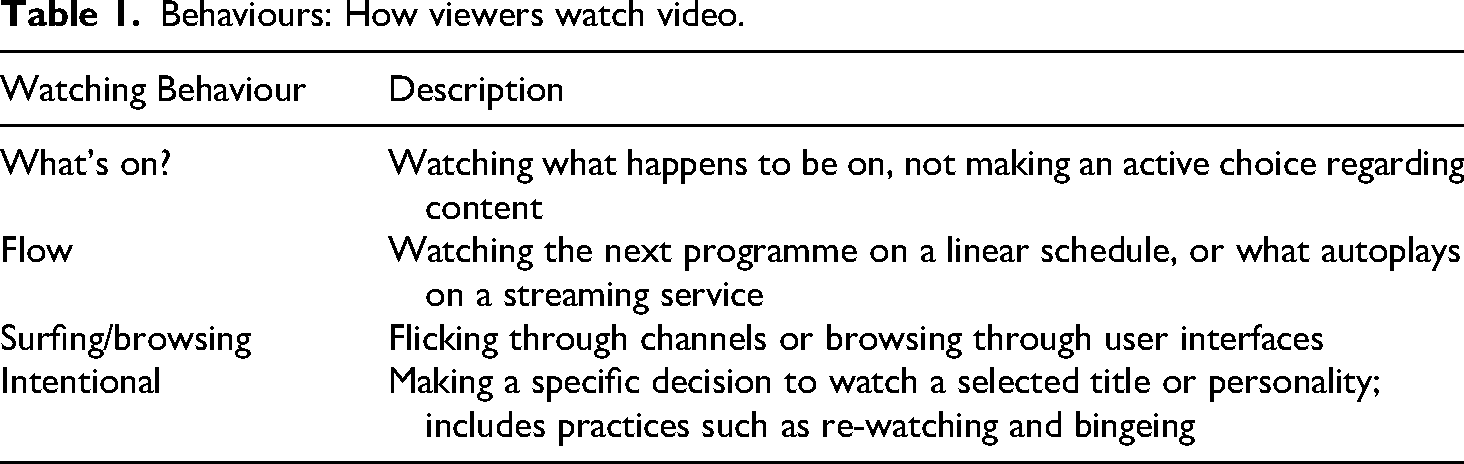
Watching behaviours have not been radically altered in the twenty-first century, although experiences of watching tied to internet distribution allow variation in how the behaviours can manifest. Many viewers now have much greater control, whether to select from thousands of on-demand titles or by cultivating algorithms to deliver video tied to particular interests (Lotz and Lunardi, 2025). Notably UK survey data suggested that over half the time, people are intentional in their viewing, knowing what they want to watch before switching on their device, while almost half of the respondents to the Australian (Lotz and McCutcheon, 2023b) and US surveys similarly reported knowing what they want to watch always or most of the time. However, while intentional viewing was once tied to linear schedules, today viewers might intentionally search for a specific video on YouTube, continue watching episodes of a beloved show on their favourite streaming platform, or select to watch videos friends have shared in direct messages rather than an algorithmic feed.
Modes of watching then help us sort the different ways viewers typically engage with watching. A continuum of modes can be identified ranging from ‘attentive’ through ‘distracted’ to ‘background’ watching, and whether one watches alone or with others suggests another modal dimension. Each of these modes change our experience and identify variations in how individuals operationalise behaviours. For the mathematically minded, we might think of mode (m) as modifying behaviour (b) such that m(b) is an equation that explains how viewers watch. For example, one might intentionally turn on a title one has watched many times – a deliberate viewing behaviour – whether planning to perform a routine chore while viewing or watching with close attention (different viewing modes). 7 Gemma, for example, described intentionally selecting Coronation Street to watch while ironing precisely because it can play in the background without requiring full attention while many others spoke of deliberately selecting a title to watch with rapt attention. The behaviour of intentional viewing is common, but its aims are quite different. Also, multiple modes are often in play: distracted viewing during family movie night, for instance, or the variation among intentionally watching with a housemate or familiar versus watching in public with strangers as different variations of attentive watching with others. The experience of watching changes in each mode and modifies the behaviour. Modes distinguish meaningfully different watching experiences that help organise the complicated and different reasons for viewing; they also create categories of viewing practice that possess enough commonality for in-depth study and conceptualisation.
The aim of this brief discussion of behaviours and modes is simply to acknowledge these modifiers of the ways in which people watch that change the role of the viewing and operate along with motive. Many of these behaviours, modes, and motives are not new and have long informed viewer practice. However, they can now be actioned by viewers and conceptualised by researchers in ways that were less feasible relative to twentieth-century distribution technologies. Much greater richness of understanding is available once we have deconstructed a category as broad as watching television/video into modes and behaviours that offer greater internal consistency. For example, our interviews suggest that video played in ‘the background’ is often deliberately selected and often with intentional aim that is as important a cultural role to understand as more attentive modes (Gray, 2025). But these variations can easily be lost without a framework that helps us capture differences in behaviours, how they are enacted, and their purpose for the viewer.
Unpacking watching motives
Watching motives, our focus in this article, then categorise why or what the viewer aims to accomplish with watching (Table 2). Motive captures subconscious and habitual processes, perhaps more similar to the ones that lead us to eat X instead of Y when we are hungry, as well as conscious decisions. In some ways, our attention to motives returns us to previous approaches such as ‘uses and gratifications’, but we would argue the changed and now multifaceted context of watching enables a reanimation of this approach with a more critical epistemology (also see endnote 6). Viewers may not necessarily know or deliberately decide to pursue a viewing experience based on awareness of motive; indeed, this poses a significant methodological challenge. The likelihood that viewers are often unaware of the motive driving their viewing behaviour makes this difficult to study, and to be clear, we are not using ‘motive’ here in the manner of behavioural psychology research. But still, separating motive from behaviour (what we do) and how viewing modes modify behaviour (how we do it) is useful for identifying the considerable consistency in why viewers watch across the many services and content choices now available to them. These are foundational concepts that enable us to understand the complex mix of difference in content and service and commonality in motive and behaviour that has become typical of everyday watching for many.
Motives: Why viewers watch.
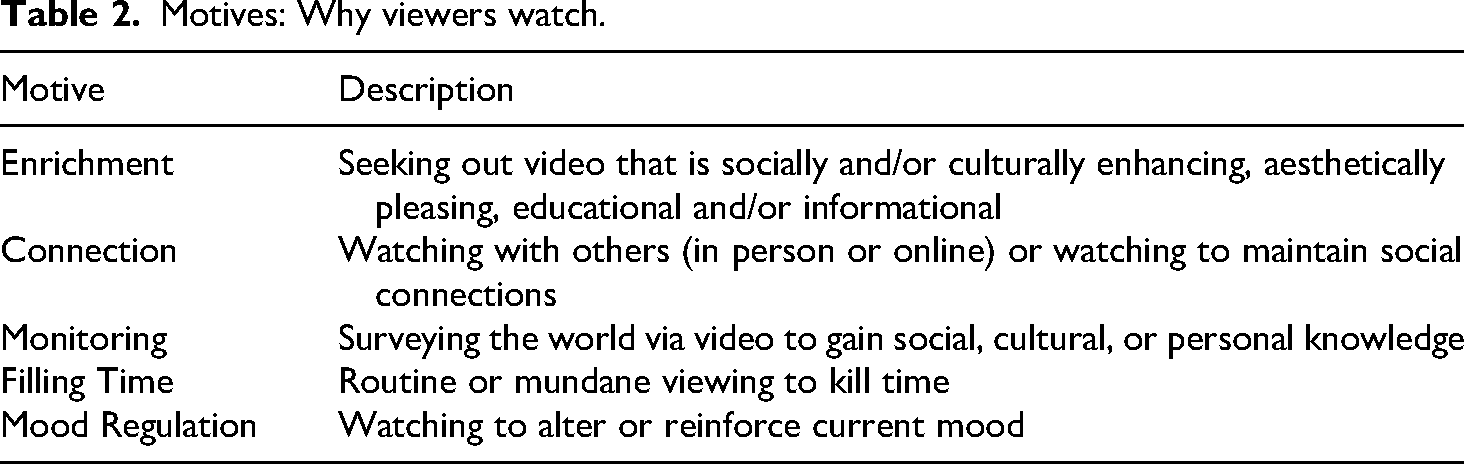
Our combined research has supported the generation of five motives – Enrichment, Connection, Monitoring, Filling Time, Mood Regulation – that are not specific to content or video subfields but are inductively derived from interview conversations in which participants discussed different facets of viewing. These motives are useful sites for further research to develop understanding of the personal, social, and cultural roles fulfilled through video in contemporary society given viewers’ expanded capability to access much more varied content across a wider range of technologies and services. As with behaviours, this list is not asserted to be exhaustive – rather it focuses on the most pervasive explanations of viewing reported in interviews. Crucially, the motives help diminish the tendency to regard practices of viewing hosted video accessed on YouTube, TikTok, and on social media as entirely distinct from those that compel linear or on-demand viewing.
We do not see these motives as necessarily mutually exclusive. Indeed our transcripts are full of instances of overlap. To even invoke ‘motives,’ after all, is to enter tricky territory where first we must trust our respondents’ self-reporting completely, and second, we must trust their ability to truly know at all times exactly why they are doing something. Nevertheless, across our interviews motivations for viewing emerge through the ways in which our respondents described, explained, and sometimes justified their viewing practices. In this way, motives emerge as discursively relevant categories that frame how people think about and ‘do’ viewing. Our interests here, therefore, lie in understanding how these motives coalesce across our interviews into social and cultural categories utilised by people to explain their reasons for watching.
Twenty-first century video offers an unfathomable array of enrichment, with distribution that supports narrowcast and micro tastes. The pursuit of enrichment might be explored along two dimensions. In some cases, viewers seek enrichment from specific titles or creators – as when the video is selected intentionally, for example, selecting to watch exercise videos, gaming, or woodworking videos on YouTube to improve their health/craft or watching The Mandalorian because they were enraptured in its story. At other times, viewers seek a general category, turning to video in pursuit of ‘a comedy’ or scrolling an Instagram or TikTok feed to see what new content comes up (knowing that however they have organised their account will lead it to deliver content curated accordingly). Aunt D, for example, was training to work in the healthcare field, and loved watching House:
because I like trying to figure out the differentials because that's something I have to do a lot of for school. I feel like it's kind of keeping that part of my brain practiced, even if it's not like common stuff.
Or Rick, as a therapist, talked about the considerable value of watching shows to see how characters dealt with issues similar to his clients’, and also noted that he would regularly recommend they watch these shows as a form of homework. But we also heard countless instances of respondents ‘simply’ loving a good story, loving ornate clothing and hence gravitating towards period dramas or documentaries about clothing, watching surfing movies as well as videos on YouTube to be inspired or improve, and so forth.
In many respects, this motive has received plentiful attention by academics. Researchers who care about poetics have laboured to make sense of the structures of story, character, shot, and more, while many cultural studies scholars have been motivated by an interest in cultural citizenship, and by what messages and lessons we are all collectively gleaning from our viewing. We are also, here, engaging with an emergent literature on engagement, which has been particularly concerned with why and how TV matters to audiences, often in dialogue with industry-audience dynamics (see, for example, Dahlgren and Hill, 2022; Evans, 2019; Hill, 2019). However, we want to move discussion beyond an association of engaged viewing with productivity and/or participation and to widen enrichment to include ‘enjoyment’. The inclusion of enrichment on our list should surprise few readers; we contend, however, that it is but one motivation among several, for much viewing – perhaps counter-intuitively to some – does not involve a search for enrichment. It is also helpful, therefore, to establish as a category that can be investigated in much greater detail and even subcategorised and understood as quite different from other motives for watching.
Twentieth-century studies of audiences understood well the central social functions of viewing because the technological conditions of the time often required families to negotiate viewing on a single set (Gray, 1992; Lull, 1990; Morley 1986, 1992). The conditions of the twenty-first century are different, but our attention to the pervasive personal screens on mobile phones, tablets, and laptops often overlooks the continued sociality common in daily viewing. Survey data from all three studies, for example, suggested that half or more of all viewing of television and movies took place with other people (Johnson et al., 2023; Lotz and McCutcheon, 2023c). And although the experience of watching videos on YouTube or social media may not be replicated as precisely as shared viewing of a movie or television in a lounge, we can still identify very similar motivations among those who watch and share short videos to connect with others (Lotz and Lunardi, 2025). Indeed, several of our participants described watching TikToks together with friends, and in our US survey, 54 percent of respondents reported watching social media with others. As such, these newer video forms are not immune from being watched collectively.
Fan studies have often shown how even with beloved texts, a key appeal to watching may be the people one meets through the fandom as much as engagement with the fan object itself (Hellekson and Busse, 2006). For some fans, that would mean co-present viewers – watching with friends, strengthening family bonds with a shared text, pouring over analysis in social media while watching a new episode – while for many it would mean the arsenal of scenes unpacked later with other fans. Studies of dislike have shown connection can be a key motivator, though, as when Andre Cavalcante (2018) notes the ‘resilient reception’ that trans viewers must adopt when watching yet another text that victimises trans bodies, or as when Jonathan Gray (2021) details parents’ or partners’ decisions to prioritise shared time with a loved one over watching content they actually like. And when neither love nor dislike is present, we might expect a great deal of casual, ‘meh’-viewing to occur because other appeals are central: an average, ‘okay’ show may become one well worth watching if it is one that brings with it social cohesion. Several participants described watching whatever their family members were watching, regardless of their own preferences, in order to spend time with others or maintain familial relationships. Meera, for example, described how she tolerated watching Bake Off because her mother and sister watch, even though she finds it boring (Johnson et al., 2025).
Viewers use video to
Historically, the video available allowed us to monitor the world well outside our own experience. Thus, a certain amount of news consumption might be considered monitoring – that level of learning ‘what's going on’ that is offered by headlines and news briefs. This was particularly apparent in one of our studies undertaken during Covid-19 lockdowns where many participants described specifically making an appointment to view the nightly news bulletins or going to YouTube to monitor the state and progression of the virus (Johnson and Dempsey, 2020). Video on social media now also enables viewers to monitor their personal communities of friends and family that post videos or ‘stories’ (in the vernacular of many services), or to ‘follow’ the lives or video offerings of a great many creators who they find interesting.
As with connection, monitoring reminds us that people might be watching things they do not enjoy simply to be able to keep up with or on top of contemporary culture. David, for example, described his decision to watch Tiger King:
everyone [at work] was going “Have you watched the Tiger King? Have you watched Tiger King?” So I thought, right, okay, we’re gonna watch it tonight. We’ll watch it tonight. We better watch it before everyone else does and starts telling us what happens.
Monitoring is also a position common to lapsed fans, who ‘check in on’ a once-beloved but now disliked show or franchise, fully suspecting they will be unimpressed, but feeling a duty to see what the show or franchise is now doing nonetheless. Certainly, this type of monitorial viewing is common amongst those caught between like and dislike, not knowing whether to watch or avoid.
Sometimes viewers just turn something on, a motive identified as
But video may be used to fill entire evenings or days too, and this is precisely why this often-disregarded form of viewing warrants bespoke investigation. Watching video, after all, is remarkably easy to do, requiring none of the set-up time or companions that a board game requires, for example, nor the physical exertion of going for a run or walk. Video watching may happen by attrition, as the easiest option when viewers are already lying on the sofa, or perhaps even to avoid other family activities and interactions.
Filling time can also refer to habitual viewing practices designed to slot viewing into wider household routines that work to simplify the choices and negotiations of what to watch. Viewing can be the easiest and/or least objectionable option of what to do in an environment that presents so many title choices as to be overwhelming. Many described turning to ‘explore’ functions of hosted video (those that are purely algorithmic) precisely out of a desire not to have to make decisions but instead to receive a stream of content (Lotz and Lunardi, 2025). Here the choice not to choose, by watching ‘what's on’ to fill time might be more desirable than starting what can be a long and tedious search for something to watch that is enriching or meets the needs of everyone in the household. Filling time might equally be valued and intentional. Fred, for example, referred to ‘fillers’ as much-enjoyed long-running series intentionally selected to fill the time between the viewing of scheduled content, such as a film or series.
Within this motive, ‘captive’ viewing is a particular mode of watching that occurs when viewers have little else to do. Waiting rooms and modes of transportation in particular set ‘traps’ wherein few other activities might present themselves as practically available, and changes in technology and distribution have made viewing far more accessible out of the home. But captive viewing might also occur socially, for example, when viewers are restricted from leaving or from doing much else by social expectations, and hence left with viewing as one of the few things to do. In his book Dislike-Minded, Jonathan Gray (2021) provides numerous examples, ranging from workers who cannot choose what is on at their workplace, to roommates whose passages through the living room may entail some time watching material they did not select, but that temporarily holds sway in that shared space.
Filling time as a motive was pervasive amongst our respondents, but it is worth noting how rare it is in media and cultural studies literature. The general turn to fannish audiences and behaviours that has dominated audience studies for the past four decades has generally resulted in a comparative lack of consideration of time-filling media, while the focus of much scholarship considers prime-time, high quality programmes designed to be watched closely, or reacts against that tradition by considering reality television shows known to engage vigorous fan discussion. As a consequence, there remains scant academic research on the practices that make up this ubiquitous mode of watching.
Although there are likely many more, our interviews inductively evidenced five forms of mood regulation that might guide further investigation:
Returning to consideration of all motives, we recognise they are a complicated classification for researchers to operationalise but warrant a greater role in efforts to make sense of the twenty-first century videosphere and its range of use. We repeat our earlier assertion that motives often overlap, such that we discourage seeing the above as a rigid model. Further complications arise as some motives are aspirations that in practice may be frustrated or surprised by content or shifting social factors that result in motivational changes. For instance, one may scan through Instagram reels or TikTok for an hour hoping to be enriched, and be unsuccessful, or one might watch a show to be able to talk about it the next day with friends who then reschedule their plans, thereby ending the chance of discussion, and the motive is still relevant. Meanwhile, other pleasures may arise while engaging in viewing: sometimes viewers watch somewhat begrudgingly, for instance, thinking of the viewing only as a way to connect with a co-viewer, but be surprised by the viewing in ways that regulate mood, say, or enrich. In no way, therefore, do we intend to isolate each of these from one another. We also welcome research that poses other motives, or that identifies important distinctions within and between these categories.
We also sidestep the question of whether someone ‘likes’ what they are watching. This may seem to be a confusing omission, since surely a key motivation to watching is because one likes something: this response was indeed often supplied by interview respondents. But ‘like’ entails so many facets as to be largely unhelpful for the purpose of analysis. Instead, then, we offer motivations that detail further how one likes, in the case that they do like, but also motivations that need not presume liking, and that leave room for a range of other affective positions. Affective positioning, as such, should be regarded as a separate dimension of viewing, and one that has arguably been the dominant dimension studied within media and cultural studies, such that the field's tools for examining it are already well-honed. Here, we aim to make sense of details beyond that positioning.
Conclusion
A reader may reasonably question the purpose of these classificatory schemes or be wondering about the value of analysis that distinguishes between motives X and Y. Our intervention responds to the limitations of approaches that focus on affective audience practices or specific forms of media, genres, or texts. In response, we argue for a viewer-centred approach to analysing watching that accounts for why audiences watch across the range of screen media available in the twenty-first century and the continuities and changes from twentieth-century practices. We offer this loose schema as a waypoint not an endpoint, seeking to unpack the act of ‘watching’ while also encouraging further work that explores the wide range of motives and practices that risk being flattened and blended together by that singular term in today's more multifaceted viewing environment.
We also offer it as a way of moving beyond other sub-classifications of viewing that strike us as unhelpful. Some such sub-classifications are premised on indefensible binaries, as with the ‘active-passive’ divide. Others are entirely defensible, but have allowed too much explanatory power to genre or demographic features, and have discouraged us collectively from considering patterns and practices that cut across genre or demographics. For instance, separating entertainment from information, as has been common, risks presuming that consumers watch each for entirely different reasons. Similarly, a great deal of work in our field's history has sought to better understand evaluative/affective positions. However, as we hope to have shown, a range of motives, modes, and viewing behaviours lie within each evaluative/affective position, and some viewers spend considerable and valued time watching things that they may not especially care for because it serves another purpose.
Here, therefore, we invite a different set of questions, and with them a different object for understanding. Indeed, we do so in part to call for an audience studies that considers a broader range of watching than is encompassed within the fan studies that largely substituted in for audience studies for several decades, or even than the recent surge of interest in dislike, anti-fandom, and non-fan audiences encompasses (see Click, 2019; Gray, 2021; Stanfill, 2024). Such work has enriched the field, but we must be willing to leave the engaged viewer aside, or to look beyond their love or hate, to ask a wider range of other questions about what viewers seek from the video they watch, and about how this impacts many other moments of their viewing lives.
On one hand, we regard the current moment as an exciting and important one to undertake this analysis. The common availability of a multiplicity of delivery and reception technologies and much broader range of content require that we ask whether the acts of viewing are changing, and whether the field's understandings of viewing need to be updated. On the other hand, though, we do not mean to fetishise, and in doing so discursively construct, ‘the new’ as unprecedented or exceptional. None of our proposed motives are entirely ‘new’ – one has always been able to use video to connect, to regulate mood, to enrich, to monitor, and to fill time – but some become more easily operable in our current media environment: regulating one's mood, for instance, is easier when one has so many more options and control over access to a range of on-demand content; enrichment to one's own specifications is easier when one can find content on seemingly any topic, and so forth. With that extra ‘operability,’ we pose that today's analyst has so much more to examine, and that finer-grained distinctions between types of viewing that may have been more difficult for audience researchers to access in earlier media eras are now considerably more accessible and important to assess and explore.
Specifically, then, an analysis of motives allows us to probe deeper into the very point of media, for viewers, and into considerably more questions about why, not just how, people watch. A key reason why media and cultural studies took up the project of analysing audiences in the first place was to better understand the personal, social, and cultural uses of media, and what media actually do for individuals and in the constitution of society in practice and not just in theory (Ang, 1995; Brunsdon, 1997; Gray, 1992; Lewis, 1991; Morley, 1986, 1992). We see considerable need for that project to be renewed, and indeed developed, and we offer this schema both as a way of inspiring some such projects of renewal, and as a way of bringing together and connecting work that has already been conducted.
