




Abstract
When choosing what to watch, television audiences habitually default to particular channels, shows and apps as part of their everyday routines. Additionally, streaming platforms and devices also default to particular content, services or ads as determined by their software settings. In other words, television viewing is commonly shaped by both behavioural and technological defaults. How can television audience research account for these two distinct, yet related, phenomena? What does defaulting mean for our understanding of media choice in the streaming age? Drawing on the authors’ recent empirical work, this article develops a conceptual framework for understanding the role of defaults in contemporary television viewing. Our analysis synthesises ideas from fields of knowledge that are rarely considered together – television audience studies, platform studies and the sociology of habit – to revise longstanding debates about defaults, and to update them for the present context of streaming television.
Keywords
Introduction
The aim of this article is to critically revisit a longstanding debate in television studies about choice – or how people decide what to watch. It is often said that contemporary television audiences have more choice than ever before, due to the abundance of video services and the variety of devices through which their content can be easily accessed. Expanded choice for television audiences is sometimes evaluated positively, as a sign of consumer empowerment and increased diversity in television’s ‘era of plenty’ (Ellis, 2000: 162). It can also be evaluated negatively, through the lens of choice fatigue or overload (Cohn, 2019). Regardless, commentary on choice often presents it as a form of active decision-making – a conscious selection between competing options. At the heart of this model is a particular kind of implied user: a selective user with distinct tastes, who knows what they want and what they like.
This way of thinking about choice makes sense for some kinds of audiences. Fan consumption, for example, is typically selective, intentional, engaged and passionate: fans care a lot about choice and their choices help to define their identities. The related trope of the binge-viewer also suggests a highly intentional and committed viewer. These implicit models of choice also aptly describe many television scholars who are strongly invested in their own television choices. But they do not adequately describe all television viewers, all of the time. Indeed, the voluntarist, active and selective notion of choice may in fact blind us to some of the more habitual ways in which audiences choose what to watch.
In this article we propose a different approach to choice by introducing a concept we call default viewing. Our argument in this article is informed by two audience research projects about streaming television choice which alerted us to the importance of this issue and from which we draw the empirical data cited throughout the article. The Routes to Content project, led by Johnson, consisted of three waves of qualitative research in the UK. In the summer of 2019, semi-structured interviews were conducted in the homes of 30 UK adults (referred to throughout as UK1). During the first COVID-19 lockdown in May 2020, we undertook video interviews with 28 of the same participants about changes in their media use (referred to throughout as UK2). In May 2021 we conducted a follow-up online survey (n = 1495) of UK adults. A parallel project on smart TV users in Australia, led by Lobato, used a national online survey (n = 1069) and 20 follow-up video interviews to understand how viewers discover content on smart TVs. The Australian survey was rolled out in December 2022 and follow-up interviews took place in Q1 2024. These two projects were conducted in different countries with different research teams but using a similar research design. In both cases, we used extended semi-structured interviews (in-person or online) incorporating a ‘walkthrough’ or ‘show and tell’ section. This involved the participant showing us how they turned on the device commonly used to watch TV – from a smart TV and/or set-top box (STB), to a games console or laptop/tablet – and talking us through their navigation of the interfaces that they encounter. During these interviews we paid close attention to the user’s movement through different apps and platforms, noting where they began their journey, how they moved through different screens and which parts of the interface they looked at and/or talked about (and also ignored). 1
Conversations among the authors during and after data collection revealed some striking commonalities in the findings that we felt required further investigation. Notably, both projects suggested the importance of default behaviours – habitual, repeated viewer actions – when selecting what to watch, such as defaulting to a single aggregator platform, defaulting to the electronic programme guide (EPG), defaulting to a specific linear channel number or defaulting to pre-recorded programmes on the STB or personal video recorder (PVR; Johnson, Hills and Dempsey, 2024). These choices did not seem to align with the voluntarist model of the ‘superrational and very selective’ (Windahl, 1981: 176) viewer which has been central to much recent television audience research. Instead, our research suggested a need for a different conceptualisation of choice and how the choice architecture of connected TV platforms might shape those choices. For these reasons, the authors felt that further work was needed to delineate a concept of default viewing and to specify its difference from other models of media choice.
This is the aim of the present article, which builds on our empirical work to present a novel conceptualisation that we hope will be useful for television researchers. Our argument proceeds in three stages. First, we review the existing literature on choice and habit in television audience studies. Second, we introduce our concept of default viewing, noting how it builds on and departs from these scholarly traditions. Third, we draw on our audience research to describe two different modalities of default viewing – defaulting to routinised pathfinding and defaulting to other people’s choices. We conclude by reflecting on the analytical value of the default viewing concept within television audience research.
Choice and habit in television audience research
Television audience research has tended to understand choice – which we define, following Hartman (2009: 2) as ‘all of the macro- and micro-level factors that determine a person’s actual [media] exposure’ – in one of two ways. Some research has focussed on who chooses (i.e. which members of the household make decisions about what to watch and the social structure of those decisions). Other studies have explored how audiences choose, focussing on the processes, procedures and practices of choice. Studies of media choice also distinguish between different kinds of media choices, including selective, habitual and avoidance choices (Hartman, 2009). In this literature review we read across these traditions of research to show how choice has been variously conceptualised and what gaps remain in our understanding.
We begin with research addressing the ‘who’ aspect of choice. An early example of this work is Lull’s observational studies of domestic family viewing, which explored ‘who was responsible for the selection of television programs at home, how program selection processes occur and how the roles of family position and family communication patterns influence these activities’ (Lull, 1982: 801). Lull (1988) found that television content was often consumed as a background ‘companion’ or ‘environmental resource’ (p. 250–251), rather than being something that people attentively watch. Indeed, he cited market research data suggesting that three quarters of television viewing was nonselective in nature, characterised by inheritance effects (that is, the ‘tendency of people who watch one program on a given network to stay tuned to the next’, [Webster, 2006: 323]) or enforced viewing – ‘watch[ing] programs that are selected by someone else in the family’ (Lull, 1990: 87).
Other scholars working in this ethnographic tradition focussed on the social contexts that shape everyday choice. Morley (1986), following Modleski (1982), emphasised the importance of gender. He observed that the men in his studies tended to prefer attentive viewing and deliberate selection, whereas women were more likely to be nonselective. As one female participant in Morley’s (1986) study noted, ‘[the TV] just goes on, and we all watch whatever comes on’ (p. 112). Gray’s (1992) research on VCR use powerfully advanced these debates by foregrounding the gendered construction of choice. Gray (1992) noted that her female participants often exhibited ‘guilt’ or ‘calculated ignorance’ (pp. 150, 151) about choice, and preferred instead to leave decisions to male members of the household. Scholars working in this ethnographic tradition were careful not to assume the kind of hyper-selective viewer idealised in uses and gratifications research; instead, they studied audiences in their actually-existing environments, juggling viewing with childcare, housework and other distractions. Accordingly, ethnographic research conceived choice as a spectrum of agency, ranging from active selection through to nonselection (watching whatever is on).
Of course, this research was conducted in a period of televisual scarcity (Ellis, 2000), where the actual choice of programmes to watch was limited to whatever was showing on one of a handful of channels. In this context, the question of what to watch was understood primarily in terms of who gets to choose, rather than how decisions of what to watch are made. In today’s television landscape, where choice is extensive, how people decide what to watch becomes a more complex question that demands an understanding of how social and household power dynamics intersect with the programmed architectures of TV technologies, as well as the broader patterns of everyday life.
Accordingly, recent research on choices made by users of streaming video services has emphasised the ‘how’ part of this problem. Frey (2021), in a major study of Netflix users in the UK and US, used surveys and interviews to explore how these users engage with personalised recommendations on the Netflix home screen. Frey’s study rejects the idea that users are ‘blindly following recommender systems to make their film and series choices’ (p. 125), finding that choice is typically an iterative, multi-stage process in which many different factors – including word of mouth, advertising and reviews – play a role alongside recommendations. Similarly, Lüders and Sundet (2022) interrogate the complex interplay between active choice and managed flow in their interviews with 20 Norwegian streamers. Arguing for the need to ‘place the [selective] viewer relative to what is materially enabled and constrained’ (p. 337), they find that audience use of streaming services is characterised by uneven ‘awareness of how the programming of services and interfaces’ guides viewers’ attention (p. 348). In other words, they find that choice is to some extent structured by interface design, but that audiences often know this and can reflect on the process thoughtfully.
These studies, among others, point to the need for television audience studies of choice to attend to changing conditions of distribution and reception. In contrast to earlier broadcast-era studies, these more recent studies suggest that audience choices cannot be studied in isolation; instead, they need to be considered in the context of the device- and platform-level interfaces that seek to organise those choices. As Lüders and Sundet (2022: 349) conclude, ‘A robust conceptualization of watching online TV hence needs to recognize the material level as well as [focusing on] acting human subjects’.
At the same time, research needs to explain why audiences may fall back to habitual choices. Here, the scholarly literature on habit in media consumption is of relevance. Habitual consumption can be defined as a category of media choice, characterised by ‘repeated behavior that gradually becomes automatic as control is passed from the cortex to the cerebrum’ (Larose, 2009: 18–19). Some behavioural scholars see habit as a passive and problematic behaviour associated with lack of self-regulation (Choi and Li, 2022; Larose, 2009). In line with a longstanding tendency for habit to be framed in opposition to logical and rational decision-making, in media psychology, habit is often theorised as a subconscious and passive response to stimulus (Kim and Choi, 2007). Habits, conceptualised as unthinking routines, are understood as both an inevitable and lamentable part of everyday life. As Neal et al. (2006) conclude, ‘Habits keep us doing what we have always done, despite our best intentions to act otherwise’ (pp. 201–202).
Yet recent critical work in the social science of habit has questioned this paradigm. Crossley (2013) draws on the work of Merleau-Ponty (1962, 1965) and Dewey (1988) to argue for a re-theorisation of habit as an agentic process through which people conserve past experiences in the form of ‘know-how and schemata’ (p. 146). Far from being passive responses that leave us vulnerable to manipulation, for Crossley, ‘Habit arises when we arrive at a new (relatively stable) way of handling or using the world. [. . .] Habit is knowledge and understanding’ (p. 149). This aligns with the key neuroscience article on habit, in which Graybiel (2008) argues that habits are learned and acquired through experiences that allow the human brain to develop helpful shortcuts to navigate everyday life so that attention can be focussed elsewhere (p. 370). The conceptualisation of habit as the development of shortcuts for handling the world also emerges in research examining everyday viewing practices. Eichner (2014) argues that habitual viewing is acquired or learnt behaviour that forms part of the ‘structuring and organizing of our everyday lives’ (p. 158), while Rosenstein and Grant (1997: 326) observe that, for television viewers, ‘the habit may be pleasurable in and of itself’. Here habitual viewing is neither passive nor active, ritual nor instrumental, but rather a cognitive process supporting media dependency relationships (329; see also Webster, 2009).
In summary, early research on media choice demonstrated the importance of being attentive to the social context of viewing but was conducted in a time of scarcity in which choice was primarily understood in terms of who gets to choose, rather than how viewing decisions are made. More recent studies suggest that audience choices need to be considered in the context of the complex array of device- and platform-level interfaces that seek to shape viewing behaviours. Within this context, research on habits as learned shortcuts that form part of the structuring processes through which audiences navigate everyday life, suggests a potential reassessment of the role of habit in media choice.
Conceptualising default viewing
The concept of default viewing, we believe, provides a way to reconcile these scholarly debates and move this discussion forward. The etymology of the word ‘default’ includes two distinct layers of meaning that are helpful for our purposes. The first of these is behavioural: to default means to ‘fall back on something, often unthinkingly’ (OED, 2023). This refers to the habitual aspect of choice – the reversion to learned patterns of behaviour (defaulting to particular channels or apps at particular times of the day and following repeated patterns of behaviour etched into our neural pathways). The second meaning of default is more technical and directly relevant to streaming television: ‘to adopt a particular option automatically whenever an alternative is not specified by the user or programmer’ (OED, 2023).
In connected TV devices, default settings ensure the viewer sees a particular set of services and apps whenever the device is turned on. The purpose of this design strategy is to nudge the viewer towards particular content options that generate revenue for the device manufacturer or TV operating system. The tendency of users to stick with the pre-programmed default has been frequently noted in the software and product design literature, as well as in market research. For example, only 5% of users were found to change default settings when using Microsoft Word (Spool, 2011) and only 14% changed default search engines on their mobile devices (Competition and Markets Authority, 2022; Roy Morgan, 2021: 13; 67).
The commercial and cultural implications of default settings in connected television are quite significant. TV devices such as set-top boxes and smart TVs come with certain apps preinstalled, some of which are also advertised on the remote control via branded shortcut buttons. These design practices encourage default behaviours to reduce the burden of decision-making (for example, simply hitting the Netflix button to avoid having to navigate to and around the home screen and app launcher row). However, the home screen ‘real estate’ of these devices is also typically sold to third-party services as part of commercial ‘prominence’ deals (Johnson, 2020; Ofcom/MTM, 2019). In this context, default settings – for example, settings that determine whether a TV ‘wakes’ to the home screen as opposed to the last-viewed TV channel or app – can have a meaningful impact on the effectiveness of these prominence deals. Hence the topic of defaults needs to be understood as integral to the political economy of connected television, as well as to the psychology of media choice.
Existing research on defaults within television viewing is limited in scope. Market research firms have used consumer surveys to identify the key services and devices to which viewers default and how this has changed over time; for example, Hub Research (2023) found that 60% of US viewers default to a streaming platform, 30% to a pay-TV set-top box and 5% to terrestrial broadcast, when turning on the TV. Johnson et al. (2024) identified four defaults that viewers adopted when watching TV: defaulting to the interface of a connected TV device or service (‘1-World Default’), defaulting to the EPG (‘EPG Default’); defaulting to a specific linear channel (‘3-Digital Default’); defaulting to ‘My Recordings’ on a set-top-box (‘3-Step Default’). However, qualitative analysis of these default choices, and what they mean for audiences’ experience of television, remains limited.
It is within this context that we propose our concept of ‘default viewing’, which we define as everyday, habitual behaviours learned and acquired through experience of socially-situated media technologies that provide shortcuts and facilitate the choice of what to watch. As shown in Table 1, default viewing practices can be divided into several different categories, including technical defaults (related to the settings of TV devices or services), behavioural defaults (related to habitual, learned behaviours of audiences) and social defaults (related to the choices of other people, either in the household, through other interpersonal relationships or online). Each of the practices described in Table 1 represents a way of managing the complexity of choice in connected television by reducing the choice burden and simplifying the range of options available. For this reason, we do not equate defaulting with a lack of agency; indeed, defaulting may in fact be an active choice – the choice not to choose or to limit choice in manageable ways.
Modalities of default viewing.
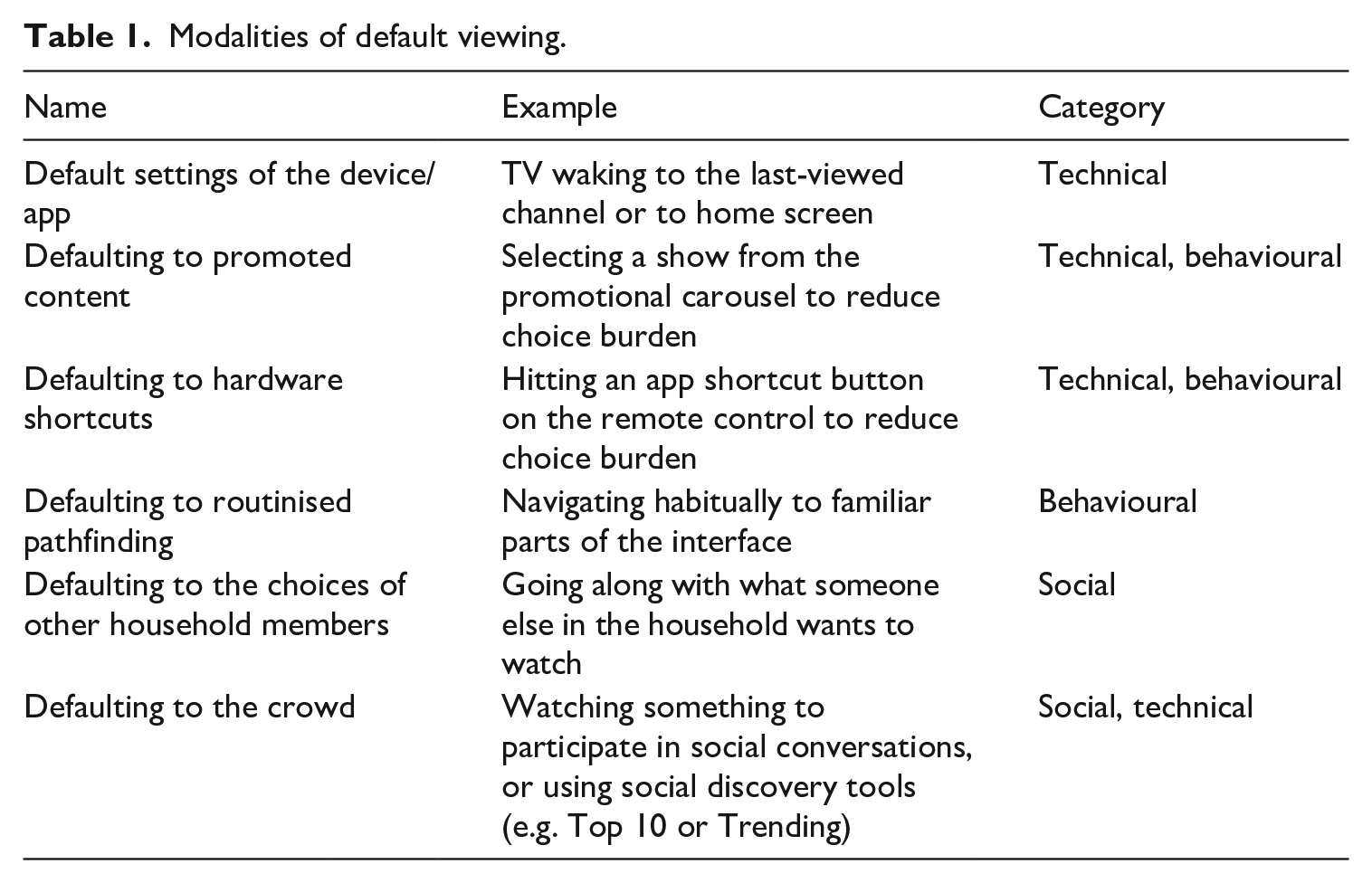
Each of these modalities of default viewing deserves its own analysis. In other work we explore the power of choice architecture (Lobato et al., 2024) and the imaginaries that shape people’s habitual viewing activities (Johnson et al., 2024). However, given space limitations in this article, we will focus on two modalities that surfaced repeatedly in our research and which we believe have important ramifications for debates about media choice: defaulting to routinised pathfinding and defaulting to the choices of other household members.
Defaulting to routinised pathfinding
Throughout our interviews and observations, we noticed a common tendency for television audiences to default to particular parts of the interface when making decisions about what to watch. We call this routinised pathfinding – routinised in the sense that it reflects habitual, repetitive navigation actions formed over a long period of television use. Our research suggested that many viewers seem to find a form of comfort in these habitual actions – a way to manage the burden of choice. We also observed that many routinised pathfinders are active in the choices they make, even when they make these choices in a habitual and often illogical way.
Consider the case of Musa (UK1), a 50-year-old Asian man, who showed us how he would typically turn on his TV set and Sky STB and then click straight through to the EPG: ‘I’m so used to doing it the same way. I have this routine. It’s not OCD or anything. It just makes it easy for me’. Musa’s routinised and learnt behaviour avoids the prominent pathways set out within the user interface (UI). It mirrors Crossley’s (2013: 149) understanding of habit as ‘know-how’ that provides new and stable ways of handling or using the world and demonstrates how habits support the use of television as a leisure activity. Where UI design might emphasise ease of use, Musa’s habitual behaviour equally functions to make choices around TV viewing easier, albeit by constructing his own route through the interface of the STB.
This phenomenon illustrates what Johnson et al. (2024) term the ‘negotiated-null affordance’, in an earlier article drawing on data from one of the studies we reference here (UK1). Drawing on Shaw’s (2017) model whereby people’s imagined affordances of technology either agree with the intentions of the design, lead to new unintended affordances (negotiated) or are used in unanticipated ways, here Johnson et al. (2024) argued for a fourth way in which people engage with the affordances of technologies: the ‘negotiated-null’ affordance. This refers to instances where default behaviours ‘can lead people to entirely miss or “tune out” prominent features in the UIs of devices and services’ (p. 1634). Here the choice architecture is neither followed, actively negotiated nor consciously rejected. Rather, people have established their own routine pathways through the UI. An interesting implication here is that viewers often ‘route around’ the promotional spaces of the UI.
Several of our participants had developed routinised pathfinding techniques to avoid the promotional carousel that sits at the top of the screen and contains new-release content on a video-on-demand service or ads on a smart TV. Consider the case of Sean (Australia), a 57-year-old white man who meticulously plans and curates his TV viewing. When asked if he had ever watched LG Channels, the free ad-supported TV streaming service that was being promoted on-screen during our interview, he did not know what this was: ‘I’ve never seen that come up on the screen. But I’m not looking up there [at the promotional carousel]. I’m looking down the bottom [at the app row]’. In other words, Sean’s cognitive shortcut of going straight to the app row meant that he circumnavigated at least some of the advertising being shown on his LG TV. Sean, like many of our other participants, did not seem to take in the whole of the UI; instead, he skipped to the particular parts of the UI that interested him. We observed a similar pattern of navigation with other participants in our studies. For example, Australians Joe (61, Greek/Australian, male), Linda (67, white, female) and Penny (61, white, female) all navigated straight to the TV Shows or Movies page of streaming apps, ignoring the home screen completely (Figure 1). Rahul (41, Asian, male) told us he does not trust the home-screen carousel, because it does not match his tastes and because it is awkward and time-consuming to scroll through.
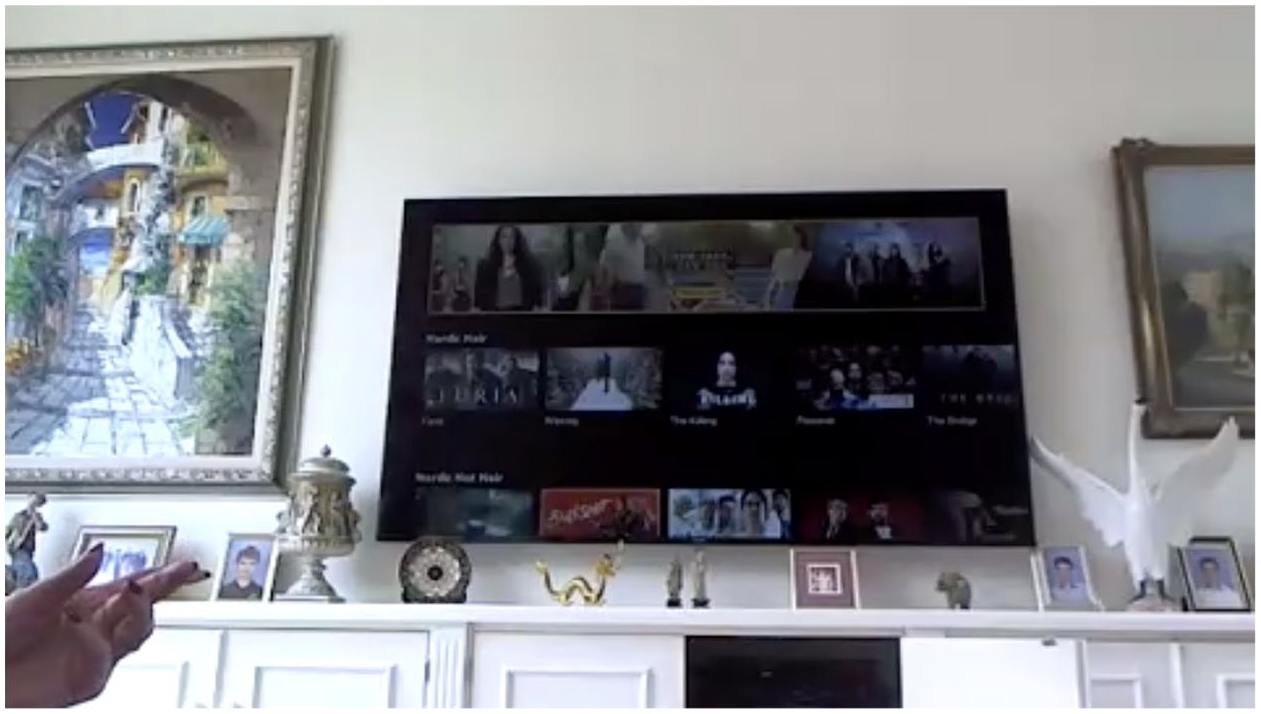
Linda (Australian, 67, white, female) navigates straight to the ‘Shows’ page of her VOD apps, ignoring the home screen with its recommendations and carousel; she prefers to browse through shows in a more traditional way.
Marlon (UK1), a 30-year-old white man, also tended to bypass the homepage of his PlayStation when watching television. In demonstrating this behaviour, he described: If I am on the screen you can see now [homepage], if one of the tiles, and it would probably have to be on the top row, if one of these four tiles here was something that I was interested in, or that I had heard about, then I might use the tile to click it, rather than going through the [Netflix] app. But, honestly, by the time I have got to this point, I have probably already decided that I am going to go into Netflix. I don’t ever come to this page and think ‘I don’t know which one of these apps I am going to use, so I will look at these to get ideas’. I have kind of made my mind up.
Marlon’s description of his navigation through the choice architecture suggests that habitual behaviour is not intrinsically unconscious or passive. Here, Marlon tunes out the recommendations, because he has already made his viewing choice. Our UK survey (2021) found that 54% of people always or most of the time knew what they wanted to watch before switching on their viewing device, with only 18% sometimes or never knowing what to watch before tuning in. This suggests that a significant proportion of decision-making takes place even before people engage with the choice architecture of the devices that they use to watch TV. However, Marlon’s emphasis on only paying attention to the ‘top row’ of tiles on the interface points to the ways in which default settings and default behaviour intersect. While describing how his typical behaviour negates the choice architecture, Marlon simultaneously validates the structuring hierarchy of the interface design by emphasising the value of the top four tiles.
People’s negation or adoption of the nudges offered by the choice architecture were also context dependent. During the first COVID-19 lockdown, a number of our participants in the UK described how their TV viewing behaviour had changed. For Carrie (UK2), a 35-year-old white mother of small children who had recently been made redundant, the recommendations at the top of the home page of her Virgin STB gained a new utility during lockdown. Describing how she started watching Joe Wicks’ exercise videos with her children, she claimed: I probably wouldn’t have taken notice of those sponsor things at the top [of the homepage] but because I was sort of desperate to find something different to keep the kids entertained, I supposed I was probably more, what’s the word, like susceptible to, you know, or more aware of these things. Rather than just, sort of, probably blanking them like I would normally do, and not paying any attention to them.
Here, Carrie describes how contextual factors shifted her from a negotiated-null affordance in which she blanked the most prominent parts of the homepage UI in favour of her habitual route through the device, to actively paying attention to the recommendations because she felt under pressure to find new things for her children to watch.
Use of remote control shortcut buttons was another behaviour that simultaneously negated and accorded with different facets of choice architecture. In many ways, use of remote shortcuts could be understood as a form of defaulting to the power of the choice architecture because, as noted above, remote shortcuts are sold to streaming services as part of global partnership deals with TV manufacturers. However, our participants also used them to actively avoid other aspects of choice architecture.
For example, Helga (UK1), a 54-year-old white woman, would turn on her television set and TiVo box and immediately press the ‘My Shows’ button on her remote control to take her directly to the programmes that she had recorded. For Helga, My Shows was a reliable place where she knew she would find programmes that she wanted to watch – either something she had recently recorded and was looking forward to, or regular shows on series link that her and her partner habitually watched together with their evening meal. We also observed this navigation pattern among older viewers in Australia. Sue – a 58-year-old white female fan of broadcast TV documentaries – used her PVR to record shows every day, and would default to her PVR recordings library where she proudly hosted these treasured programmes (‘You can see I’ve got 29 pages [of recordings] there’) (Figure 2). Uri (UK1), a 36-year-old Asian woman, also used a remote control shortcut – this time for Netflix – to avoid having to navigate through the UI of her Sky STB: ‘generally I just go, boom, straight away to Netflix. [. . .] I don’t like Sky. I find it long-winded, and it bugs me having to go back to HDMI and switch it all around. I just don’t end up watching’. These assemblages of hardware (remote), software (TV platform) and interfaces (home screen) reflect the complexity of contemporary ‘television device ecologies’ (Hesmondhalgh and Lobato, 2019) as well as the diverse pathways that users take to navigate through these ecologies.
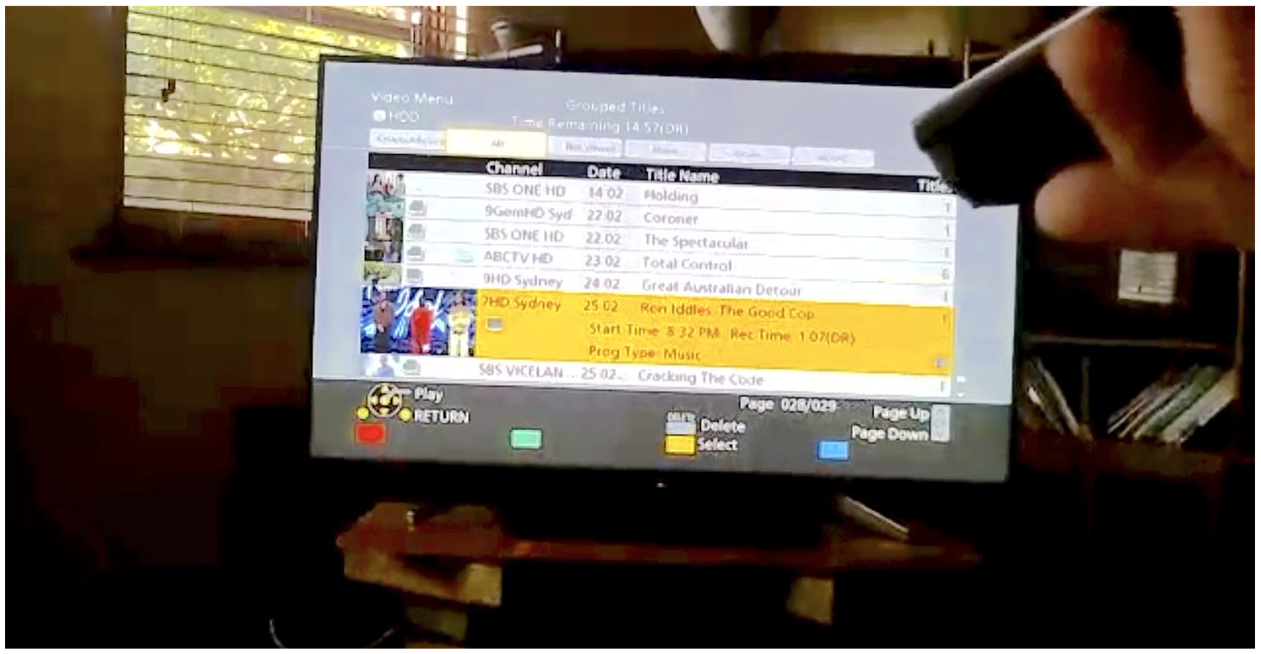
Sue (Australian, 58, white, female) defaults to her PVR recordings library: ‘I’ve got 29 pages [of recordings] there’.
The default behaviours described in this section cannot be simply dismissed as nonselective, passive or sub-rational. These are learned and routinised behaviours that people have adopted to facilitate their viewing. In some instances, these behaviours were instinctive and not necessarily the most logical way to access the content that our participants wanted to view. However, they remained easy to use because they had become habitual practices within their everyday lives. In other instances, the routine avoidance of the programmed design of the choice architecture stemmed from the fact that our participants already knew what they wanted to watch and had learned shortcuts to take them quickly to that content. There were also instances where habitual behaviour that circumvented one aspect of choice architecture (the STB home screen), depended on another aspect of choice architecture (remote control shortcuts). This serves as a reminder that our participants cannot entirely escape the default settings and programmed choice architecture of the devices that they utilise. This is particularly important given that our participants are typically negotiating simultaneously between multiple devices, each with their own affordances and UIs, when choosing and watching television.
Defaulting to the choices of family, friends and/or co-workers
In this final section we turn our attention to the role of social rituals and household dynamics in default behaviours. Crucial here is a recognition that on the whole, television viewing is a social activity. Our UK survey (2023) revealed that only 7% of participants reported never watching television with someone else, while 79% reported viewing TV with others at least sometimes, with similar figures reported in the Australian survey (69% most often watching with others vs 31% alone). The social dynamics of television viewing are therefore central to understanding how people choose what to watch.
Watching television selected by others and not of your own choosing was widespread in our studies and emerged in a number of different scenarios. Those participants with small children regularly described watching children’s programming with their kids. Martin (UK1), a 45-year-old white man, for example, went so far as to claim, ‘All I’ve watched for the last five years is kids TV’. Tolerating other people’s choices in order to spend time with family members also emerged in adult households. Meera (UK1), a 20-year-old Asian female who lived at home with her parents, explained how her parents reluctantly watched Love Island because she watches it: ‘I do get my parents into crap. Like, I do get them into Love Island. They do watch it. But, at the end of it, they’re just like, “oh, is it not finished yet?”’ On the other hand, Meera equally found herself watching programmes simply because others in her household were watching them.
I’d never watch Bake Off on my own. [. . .] I think I’d be bored of it. [. . .]
So Bake Off’s just if your Mum and sister are watching it?
Yeah.
We also observed many instances of participants defaulting to their partner’s choices to maintain family relationships. Joe (Australia) appeared to take joy from sitting next to his wife while she watched ‘her’ shows: ‘She’s so busy. . . [when she watches reality TV] she doesn’t have to think too much. . . I’m probably the only guy in the world that’s watched all The Kardashians. . . 100% every season, every season’. There is a give and take in these descriptions of how TV viewing is shaped by family dynamics. Martin, Meera and Joe default to the choices of others in the household not because those are programmes that they would want to watch, but as part of the negotiation of the shared domestic space within which TV viewing takes place.
Family hierarchies play a role in these default behaviours. Helen (UK1), a 30-year-old white female, for example, gave a vivid description of her lowly place in the TV-viewing pecking order: ‘They’re [family] normally hogging the TV [laughs]. So, yeah, sometimes I just sit down in the evening and if they’re already watching something I’ll sit down and join them. So, it’s like that really, yeah. So, I don’t really have a say normally’. Here Helen defaults to the viewing choices of her family because the domestic hierarchy determines that her choices are less valued. Carrie similarly described how, ‘If I’m with my partner, it’s generally led by what he will watch. Because, as I say, he’s just dead fussy and pedantic’. Such acquiescence to the preferences of others can also lead to missing out on programmes. For example, Melissa (UK1), a 55-year-old white woman, explained that, ‘I wanted to watch Downton Abbey. Never did, ‘cause he [husband] weren’t interested. He was “you can go and watch it”. And I thought, I don’t really want to watch it that much that I want to sit on my own somewhere and watch it’.
These examples need to be seen in the context of earlier research on household TV choice and remote control use. Morley (1992: 147), in his ethnographic studies of family television viewing in the UK, identified ‘masculine power. . . as the ultimate determinant’ of viewing choices in numerous households. It is notable, then, that many of our examples are of women defaulting to the choices of their male family members. While it is difficult to generalise from the small sample of our qualitative studies, our surveys provide some clues here. When we asked people in the UK survey who decides what to watch when viewing TV with other people, 70% said ‘me and others in equal measure’. However, for the 30% that deviated from this, men were more likely to say that it was mostly or always them that chose what to watch, while women were more likely to say that it was mostly or always others that made the decision about what to watch. Similarly, in the Australian smart TV user study we found that, when asked about the gender of the person most often in charge of the remote control within the participant’s household, 42% responded male, 32% responded female and 24% responded that the remote control was shared. Given that surveys of the division of household labour show that gender inequality tends to be under-reported, this suggests that there continues to be a gendered dimension to who gets to choose, with men being more likely than women to control choices of what to watch in the home.
A gender pattern was also visible in the use of TV devices and services, particularly for older women (Johnson et al., 2024). For example, when we asked Melissa (UK1) to turn on the TV set to show us how she found something to watch, she replied: This will be interesting. I rarely use the remote. Right. It is mostly my husband who does the remote. As most blokes do. He has the remote. This is why probably most of it [TV viewing] is done when he is here. He is the one who puts it on.
Carrie (UK2) also claimed that ‘nine times out of ten’ it was her husband who had hold of the remote. She also used her husband’s Netflix account, which meant that it was ‘set up with [her husband’s] preferences’. Meanwhile, when asked to show us how she typically watched TV, Uri (UK1) struggled to sign in to BBC iPlayer, claiming, ‘my husband probably knows the details to that one’. For Penny (Australia), it was routine to hand over control of the main television to her husband: ‘If he’s home, then we’re usually in the same room together and he’s got whatever he’s got on and [I’m] doing stuff on the computer. . . I just sort of partly watch what he’s watching’.
It is important not to assume that these women simply lacked the skill to use smart TVs, connected devices and VOD services. As Johnson et al. (2024: 1637) argue, what may be on display here is what Gray (1992:151) referred to as ‘calculated ignorance’, utilised as a deliberate strategy by women to ensure that operating this technology did not become another domestic task expected of them. Carrie (UK2), for example, justified using her partner’s Netflix account by stating, I’m not thick. I would figure it out in the end. But I just, I’m just not one of these, you know, I’m not one of these people that are turned on by tech and IT. I see it as a hassle. [. . .] I’m just like, oh God, you know, do I have to? And so it’s just a bit easier to just go into [husband’s account] because it’s already set up.
Penny (Australia), meanwhile, did not resent her husband’s control over the main TV set, but was comfortable with the arrangement as she had control of the TV when her husband was out of the house: ‘I have my set time where it’s just me so I can watch what I want to watch’. Melissa (UK1), meanwhile, insisted that even though she depended on her husband to use the TV, when they sat down to decide what to watch, ‘it is a decision that we make together’. Television viewing habits, therefore, are situated within the complex and negotiated gender dynamics within domestic power relationships.
These examples of defaulting reveal the importance of social rituals and household power dynamics in deciding what to watch. TV viewing is a leisure activity embedded within the economy of the household and wider social relationships. Here, default viewing can be a gift, a burden, a compromise and an obligation. As with routinised pathfinding, viewers often take comfort or pride in defaulting to choices of other people. These choices are shaped not only, or even principally, by choice architecture, but rather by the social ties that bind interpersonal relationships.
Conclusion
The default practices described in this article are thoroughly ordinary, yet they are also exceptional and important in the sense that they confront received notions of choice in television audience research. Challenging the idea of a hyper-selective individual who always knows what they want, our research suggests that many viewers actively find ways to deny, defer or limit choice by defaulting to routinised pathfinding or to the choices of others, alongside other modalities of default viewing.
The reasons behind this are complex. As we have shown, defaulting may reflect a strategy to reduce the burden of choice, thus making choice manageable and pleasurable. Or it may reflect social factors including restricted power within the household or a desire to connect with other people through television viewing. Our point here is that defaulting needs to be understood as integral to the everyday experience of television – and that theories of media choice must more fully account for this phenomenon.
We have been careful to stress that defaulting is not a sign of passivity, just as active selection is not evidence of empowerment. Future research in this area must move beyond a binary of active choice (good) vs default habit (bad). Instead, defaulting needs to be seen as the ordinary, pervasive behaviour it is. No viewer is hyper-selective all of the time – we all choose not to choose sometimes and are susceptible to nudging from devices and peers. Indeed, the available evidence from neuroscience, behavioural science and the social science of habit suggests that habitual choice is the norm from which deliberative, conscious and reflective choice departs (defaulting is the default, so to speak). This is not always easy to assimilate to the models of choice commonly used in media, communication and cultural studies, which are premised on an idea of the citizen-consumer as a reflective, selective individual. But it is certainly not a new idea. As we have shown in our literature review, there is a rich strand of audience research that has considered these issues and which holds the keys to a more nuanced analysis of choice.
The implications that flow from these findings are many and varied. For audience researchers, there is value in returning to the questions of ordinary, mundane and distracted viewing and decision-making that was the initial focus of ethnographic audience research, as opposed to the more exceptional, novel and spectacular consumption practices that have occupied the field of television studies in recent years. This may involve building frameworks that begin from the understanding that choice is a burden as well as a blessing and that audiences will seek to reduce and manage choice through the default behaviours we have described above. There is also a policy implication here, in the sense that the answer to many policy challenges such as media diversity, representation and access may not necessarily be solved by adding ‘yet more choice’, when it is clear that there are cognitive limits to the amount of choice that audiences can deal with. For these reasons, we would argue that the question of choice in connected television can no longer be divorced from the practical considerations of access and decision-making that, as we have shown, structure that choice in meaningful ways.
Footnotes
Acknowledgements
The authors would like to thank: Lauren Dempsey, Matt Hills, Cornel Sandvoss and Annaliese Grant (UK) for their contributions to the design, data collection and analysis of UK data upon which this article draws; and Ashleigh Dharmawardhana (AU) for her contribution to data collection and research assistance.
Consent to participate
All participants provided written consent to participate in the studies upon which this research is based, including informed consent for use of their data and images (where relevant) in publications.
Data availability statement
Participants did not provide informed consent for the primary data upon which this research is based to be made open access.
Funding
The author(s) disclosed receipt of the following financial support for the research, authorship, and/or publication of this article: Lobato and Scarlata disclose receipt of financial support from the Australian Research Council (FT190100144), and the Special Broadcasting Service (SBS). Johnson discloses receipt of financial support from the Screen Industries Growth Network, funded by Research England.
Ethical approval and informed consent statements
Qualitative interviews conducted in 2019 and 2020 and a survey conducted in 2021 in the UK were approved by the School of Music, Humanities and Media Ethics Committee at the University of Huddersfield in 2019, 2020 and 2021 respectively. Analysis of this data for this article took place at the University of Leeds. An online panel survey conducted in 2022 and qualitative interviews conducted in 2023 and 2024 in Australia were approved by the RMIT University Human Research Ethics Committee. This research was carried out according to Australia’s National Statement on Ethical Conduct in Human Research (2007).
