



Abstract
Skinamarink, the surprise micro-budget horror film sensation of 2023, gained unexpected international exposure by going viral on TikTok after the film was accidentally leaked online. The film's virality was propelled by an algorithmically driven cross-pollination between forces at seemingly oppositional ends of the taste-cultural spectrum – horror film and children's cultures. Extending theorisations of the digital and algorithmic uncanny, the article outlines how the TikTok algorithm and young platform users collaborated to position a film regarded as one of the most terrifying of the year as a participatory ‘challenge’ that adopts TikTok dynamics popular with children such as ‘intensified play’.
Introduction
Skinamarink, the surprise horror film sensation of 2023, revealed TikTok's capacity to drive reciprocal flows between childhood and the ostensibly adult domain of horror film cultures. The experimental debut feature of Canadian filmmaker Kyle Edward Ball, Skinamarink was made for only $15,000 CAD in a period of one week in the director's childhood home in Edmonton. The film went viral online post July 2022 after a leak associated with a film festival (Briscuso, 2023), after which it was accessed by global audiences through online piracy, a limited international theatrical release between December 2022 and February 2023, and its eventual international home-viewing release in February 2023 via subscription streaming service Shudder (Guy, 2023). The film went on to gross $2.1 million USD (Box Office Mojo, 2023). Along with Reddit, YouTube, and Twitter, TikTok was one of the key platforms to propel the film's global exposure throughout the final months of 2022.
This article examines how Skinamarink's virality on TikTok was characterised by an interplay between the film's aesthetics and themes of nightmarishly corrupted childhood nostalgia, and genres and communities on TikTok focused on both horror movies and children's cultures. This article builds on previous research establishing the popularity with children of TikTok's dynamic model of participatory, creative sociality (Sarwatay et al., 2023: 49–51), through a methodological approach that integrates social media methods with an attentiveness to genre and textual analysis drawn from screen studies. In so doing, I contribute new understandings to two burgeoning fields – 1. TikTok and children's culture, and 2. horror films and child audiences – by outlining how TikTok's child-friendly algorithmic dynamics become uncanny through Skinamarink's virality on TikTok. This uncanniness emerges from how the film's virality was underpinned by an algorithmically driven cross-pollination between forces at seemingly oppositional ends of the taste-cultural spectrum – horror film and children's cultures.
The virality of this experimental horror film expands in new directions an emerging phenomenon of reciprocity between horror film and children's cultures on TikTok. For instance, another of 2023's most successful horror movies, M3GAN (Johnstone), created a viral phenomenon amongst young people on TikTok prior to release, in which young people emulated an unsettling dance sequence featuring the film's malevolent animatronic doll (Rosenblatt, 2023). This surprise resonance with a younger demographic led to the film's redevelopment to align with a PG-13 rather than the originally planned R rating (Newby, 2023). Five Nights at Freddy's (Tammi), another hit PG-13 2023 horror film, also sparked viral activity amongst young people on TikTok, and both films ignited commentary around the future of horror being PG-13 (Laman, 2023). Skinamarink's TikTok virality can be understood as part of this trend, which connects more broadly with a phenomenon addressed in recent research in which screen texts in the on-demand, participatory video streaming era strategically cross transgenerational boundaries (Johnson, 2019; Lizardi, 2017) in ways that are sometimes intentionally provocative (Baker et al., 2023). However, the Skinamarink TikTok phenomenon is distinct given that this challenging film is decidedly adult in tone yet deeply engaged with themes and aesthetics of children's culture, rather than being designed to attract ‘the widest mainstream audience possible’ (Romanchik, 2023). ‘Skinamarink TikTok’ is thus particularly transgressive in its redrawing of the techno-social limits of childhood.
Focusing on the cultural dynamics of the viral discourse and community that emerged around Skinamarink on TikTok, this article illuminates three ‘intersections of the unexpected’ around this micro-budget experimental horror film's social media virality:
That a lo-fi experimental horror film garnered such significant international exposure. That TikTok was a key driver of the film's international visibility, given the seeming misalignment between this work of experimental ‘slow cinema’ and the fast-paced algorithmic dynamics of TikTok. That a film deemed the scariest of the year (Boo, 2023; Greenwood, 2023) – or even of all time (Gissen, 2023; Stolworthy, 2023) – resonated with children's cultures on TikTok.
In exploring these intersections, this article illuminates how TikTok's algorithmic logics drive distinctive collective engagements with film and other entertainment media. Primary among these is the platform's provocation of shifting boundaries between children's and adult's entertainment cultures, which generatively aligns with Skinamarink's own aesthetic, ideological, and cultural provocations.
Skinamarink TikTok and children's horror film cultures
I argue that ‘Skinamarink TikTok’ can be understood through my previous (2021) theorisation of the algorithmic uncanny. This aesthetic mode is built around a troubling of child and adult-oriented content boundaries, the uncanniness of which is driven in part by a ‘perception that algorithms have played a key role in not only distributing the content but in shaping its aesthetic and thematic agendas’ (Balanzategui, 2021: 3523). 1 I previously defined the algorithmic uncanny in relation to so-called ‘disturbing’ children's content on YouTube, which has periodically raised significant cultural anxieties ignited by the indifference to child-appropriateness of what Jean Burgess (2018) calls YouTube's ‘ambivalent’ platform logics: an ambivalence to the metrics around child appropriateness that govern the production and distribution of children's content in legacy media industries. Skinamarink TikTok is marked by a similar ambivalence towards established cultural norms around the boundaries between child-appropriate content and genres like horror films that are designed – and typically classified for – adult audiences.
Given its characteristic intent to elicit fear (Carroll, 1990), the horror genre does not sit comfortably with mediated regimes designed to be safe and appropriate for young audiences. Indeed, Lester describes the children's horror film as an ‘impossible genre’ (Lester, 2016: 22), and Antunes’ research elucidates how the introduction of the PG-13 rating – instigated initially by the horror film Poltergeist (Hooper) in 1982 – operated throughout the 80s ‘as the marker of new boundaries for childhood as well as the horror genre’ (Antunes, 2017: 28–29). Yet while mainstream narrative-driven PG-13 films like M3GAN and Five Nights at Freddy's exhibit ‘carefully calibrated processes of affectual engagement’ (Balanzategui, 2018: 202) in addressing young audiences – an example being M3GAN's re-shooting to fit the PG-13 rating to subdue the violence (Romanchik, 2023) – Skinamarink's horrors are not attenuated for child suitability. Instead, the film entered children's media cultures in unexpected ways through the algorithmic dynamics of TikTok, which are ambivalent to such socio-cultural considerations. In this way, Skinamarink's virality on TikTok became an example of the ‘algorithmic uncanny’. By uncovering how a participatory community emerged around Skinamarink on TikTok, I elucidate not just this algorithmically uncanny cross-pollination of child/adult cultures, but the other interrelated factors that drove the deep structures of socio-cultural reciprocity between TikTok and Skinamarink.
Skinamarink as child-centred adult horror film and the platform ambivalence of TikTok
This article analyses the three ‘intersections of the unexpected’ underlying Skinamarink TikTok using content analysis methods from social media studies integrated with analytical strategies from screen genre studies. However, before articulating these methods, it is important to clarify Skinamarink's constitutive demographic and thematic ambiguity, which positioned the film as fertile ground for TikTok virality. As Antunes’ work unveils, ratings developments and controversies represent radical transformations in the cultural scaffolding separating childhood from adulthood (Antunes, 2020: 12–13), and the internationally visible popularity of horror films amongst young users on TikTok throughout 2023 operates in a similarly transformative way. Skinamarink is the most provocative example due to its combination of ambiguous demographic positioning and algorithmically ambivalent resonance with young children's cultures. In Australia, where this author is based, the film is classified ‘M’ (for audiences over 15), and similarly in Britain it carries a UK15 rating for ‘strong horror and sustained threat.’ The film remains unrated in the US and is rated PG – suggested for audiences over 13 – in Canada. There are notable discrepancies between ratings rationales across countries, with the film being rated M in Australia on the basis of Mature themes but not Violence (Australian Classification, 2023) in contrast to the British ratings rationale around strong threats of implied violence (BBFC, 2023). This incongruity and the ambiguous US and Canadian ratings are indicative of the film's lack of a coherent narrative and its barely discernible on-screen action: the violence and threat throughout Skinamarink is usually heard rather than seen, or otherwise detected in brief, shadowy glimpses in the corners of frames. Through a grainy aesthetic in the style of a degraded VHS videotape, Skinamarink depicts the frightened and confused perspective of an insomniac young child, Kevin, as he wanders the family home in the middle of the night, soothing his fears with cartoons and toys. The film has a very bare plot, but throughout, these stereotypical signifiers of children's culture are gradually repositioned as threatening sources of dread: the child's family, house, cartoons, and toys all turn on him, seemingly infected by an enigmatic malevolent force which is almost entirely unseen throughout the film. This entity's presence is signified by its deep, crackling voice, which issues vague commands to the child.
While the threat throughout the film is vague, it is nevertheless relentless and pervasive – the nameless malignant entity seems to manipulate every frame, while isolating Kevin from the outside world by supernaturally manifesting the disappearance of the house's doors and windows. It eventually compels the child to commit acts of self-harm, such as telling him to get a butcher's knife from the kitchen and ‘put the knife in your eye’ (the child seemingly complies). Thus, while Skinamarink is a film immersed in and filtered through children's cultures and perspectives, it also depicts these realms as sites of relentless horror.
Skinamarink's IMDB ‘Parents Guide’ (2023) page further contextualises its ratings information and appropriateness for younger audiences, and in so doing captures the cultural uncertainty around categorising such an aesthetically and thematically disturbing horror film that depicts no on-screen violence. The user-generated score for the film's ‘Violence and Gore’, for instance, is ‘Mild’, but this category is marked by a wide spread of votes: only 48 of the 93 contributors selected this category as the one that best fits the film. By contrast, 82 of the 87 voters opted for the ‘safest’ ‘Nudity and Sexuality’ rating: ‘None’ (see IMDB, 2023). Yet when it comes to the category ‘Frightening and Intense Scenes’, Skinamarink is rated ‘Severe’ – the most extreme category – with 71 of the 120 voters selecting this category. Users provide more detail and justification for this in their comments (IMDB, 2023): ‘Extremely tense and unsettling film. The cinematography purposefully shies away from whatever action is happening which leaves it very off-putting.’ ‘This movie is extremely unsettling, and features many scenes involving children in peril.’ ‘A child is implied to have stabbed their eye out. Some blood is seen splattered on a window, but the injury is never seen.’
Skinamarink's provocative play with child/adult media cultures and subjectivities has proven to be well suited to TikTok's own controversial transgression of such mediated cultural boundaries. While TikTok requires users to be 13 or older to have an account (TikTok Community Guidelines, 2023), it is becoming one of the world's most popular social media platforms with children under 13. 2 TikTok is now the most popular social media platform with children aged 4–18 in the UK (Statista, 2023), and in Australia, behind YouTube, TikTok is the second most popular app amongst young people aged 6–13 (Roy Morgan, 2020). Yet TikTok has been deemed ‘an unacceptable risk to Australian children’ by the Federal Shadow Communication Minister (Collins, 2023), and internationally has been subject to government lawsuits due to child safety concerns in a number of countries (Beesley, 2023; FinTech Global, 2022; Shepardson, 2023).
The virality of Skinamarink on TikTok accentuated both the film's and platform's culturally troubling dismantling of child/adult media distinctions, and the clearest example of this is the crosspollination of Skinamarink and young children's nursery rhyme content on TikTok. The name of the film is taken from a popular nursery rhyme most famously performed by Canadian children's musical group Sharon, Lois and Bram across their children's television programming popular throughout the 1980s (The Elephant Show, CBC, 1984–1989) and 1990s (Skinnamarink TV, CBC, 1997–1999). As is typical of nursery rhymes, the term ‘Skinamarink’ has no logical meaning: the playful nonsense word is used in the song for rhythmic and repetitive effect. 3
This ‘gibberish’ nursery rhyme logic is reflected by the three popular hashtags that constitute what I call ‘Skinamarink TikTok’: #Skinamarink (73.8 million views at the time of writing), #Skinnamarink (30.4 million views), and #Skidamarink (6 million views). The film's director Ball has explained that he used the nursery rhyme as the title as ‘it's personal, sentimental … it's child-like and makes no sense’ (Briscuso, 2023). Notably, the song does not appear in the film at all, with the title instead being emblematic of the film's focus on distorted nostalgia for childhood. While Briscuso's article featuring the above-cited interview with Ball suggests that the title is a misspelling of the rhyme, the rhyme has long had the fluid spellings characteristic of the linguistic play of nursery rhyme culture. Thus, the film renders uncanny the playful gibberish of nursery rhyme culture, and this is co-opted and driven in new directions by the multiple colliding hashtags of Skinamarink TikTok, in which spellings and logical coherence are secondary to the rhythmic effect and community of behaviours that constellate around these terms and their corresponding hashtags. Skinamarink TikTok thus evidences the platform's distinctive cultivation of a form of creative sociality that invites intergenerational exchange (Zeng and Abidin, 2021).
The ambiguity of both Skinamarink's title and its demographic positioning have in turn played into the inherent ambivalence of TikTok's platform logics. This mutually generative uncanny ambivalence is best evidenced by the way children's nursery rhyme and Skinamarink videos sit side-by-side on the platform through the above-listed hashtags: they were often delivered to me in succession by the recommender algorithm in the course of my research (see Figure 1). As I address in the final section, while ‘Skinamarink’ nursery rhyme content on TikTok pre-dated Ball's film, exchange between content about the nursery rhyme and the horror film was collaboratively facilitated by TikTok's algorithm and users.
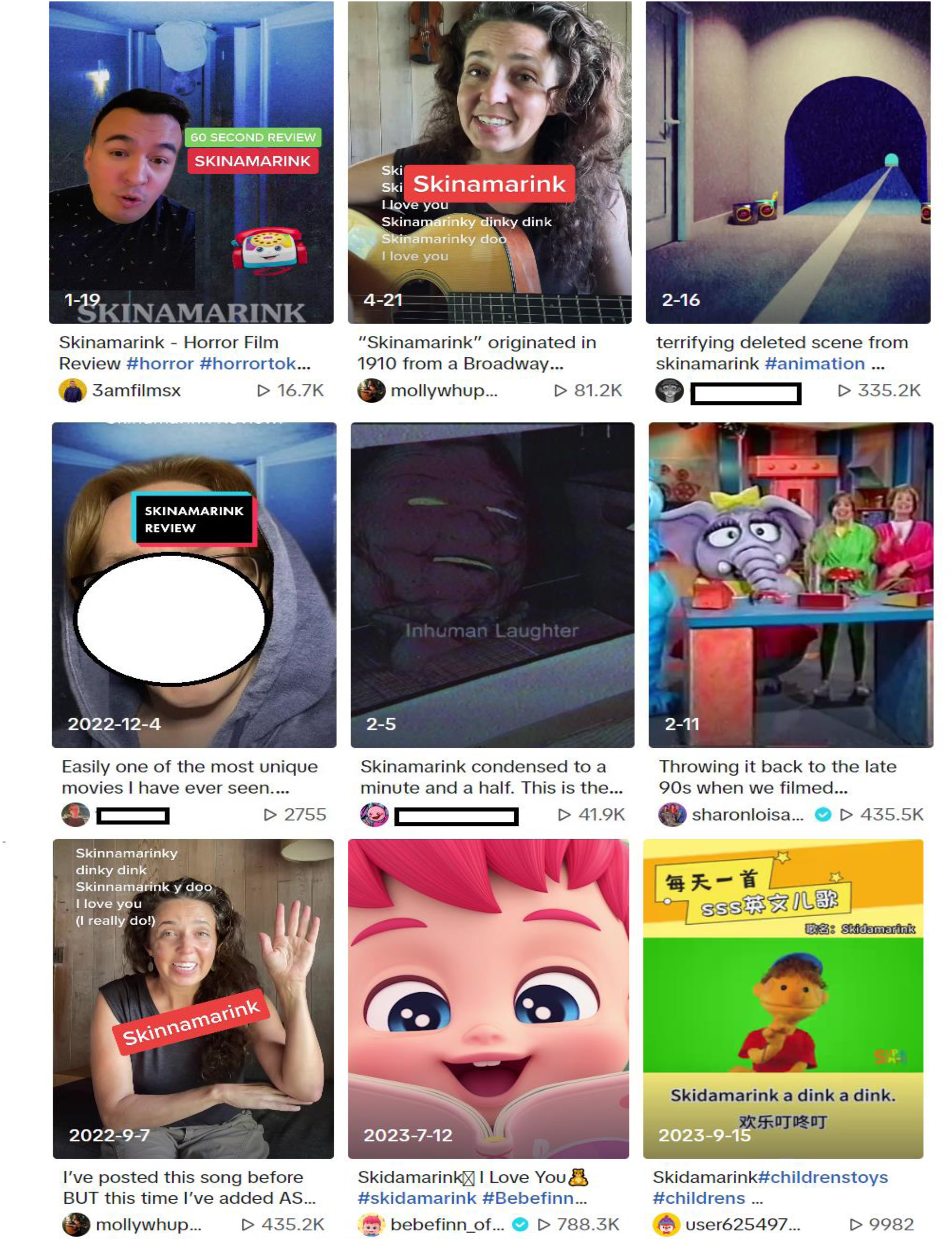
Nursery rhyme and horror movie ‘Skinamarink’ videos appearing side-by-side (screenshot by author, 15 December 2023). Please note, aside from official accounts and those created by adults clearly soliciting visibility, I have anonymised creators throughout (see Methods).
A key element of Skinamarink's TikTok virality which drove such algorithmic/user collaboration is the openness of this experimental, non-narrative film to interpretation and thus re-contextualisation. This aligns very well with the ambiguity of TikTok's shortform memetic video content: a semantic openness which ‘[leaves] the viewers to derive meaning from their own knowledge’ (Hautea et al., 2021: 2). The ambiguous nature of TikTok's content relates to the short duration of the videos – typically they are up to three minutes long, the maximum duration permitted when recording videos in-app – and also the brevity required in the accompanying video descriptions, which had a 300-character limit until October 2022 (it is now 2200). The majority of the videos I analysed were under three minutes, with many being between 10 and 45 s. Most had only very brief descriptions or were described mainly or only via hashtags.
As a result, both TikTok's algorithmic flows and its content types – like Skinamarink – are characterised by loose tethering to coherent intended meanings. TikTok content instead becomes meaningful through shared networks of content that promote comparative contextualisation and memetic meaning-making, in ways that have the potential to connect ‘different generations of people from different places and communities with similar interests’ (Vizcaíno-Verdú and Abidin, 2022: 885). The reciprocity between an experimental horror movie and children's nursery rhyme cultures is a node of such intergenerational processes of exchange, which became an engine for Skinamarink's virality: a variegated community constellated around Skinamarink TikTok propelled by the vague but rich cultural signification processes that constitute both Skinamarink as a text and TikTok's platform dynamics.
In this way, Skinamarink's provocatively unsettling depiction of children's culture and nostalgia intersects in illuminating ways with the much-publicised ambivalence of TikTok's platform cultures towards child users. Despite not being ‘for’ children, TikTok's algorithmic architecture appeals to them, which sets the platform apart from others like Instagram (Sarwatay et al., 2023: 54). Algorithmic curation of trending content relevant to each user's interests on the For You Page, along with interactive mechanics inviting users to participate in such trends via duets, challenges, or related creative formats, encourage playful engagement with children, leading to the building of communities (Sarwatay et al., 2023: 54), processes also key to Skinamarink TikTok.
Ultimately, the three ‘intersections of the unexpected’ between TikTok and Skinamarink operate as a cultural flashpoint in TikTok's contributions to transforming relationships between children's and adult's media cultures. These intersections of the unexpected are inherently algorithmically uncanny because they consist of algorithmic collaboration between media forms and cultures beyond the realm of human expectation and convention. Yet, these unexpected cultural intersections have gone on to influence human behaviours on a large scale through collective and participatory engagement in trends shaped by these ambivalent algorithmic idiosyncrasies. Thus, Skinamarink TikTok is marked by an algorithmically uncanny blurring of ‘distinctions between human and nonhuman actions’– to draw on Kriss Ravetto-Biagioli's (2019: 32) theorisation of the digital uncanny– which muddies some of the cultural categories that scaffold the coherence of a (seemingly) orderly human society. However, the algorithmically uncanny dynamics of Skinamarink TikTok go further than the ‘new type of uncanny experience’ Ravetto-Biagioli points to wherein ‘nonhuman devices (surveillance technologies, algorithms, feedback, and data flows) anticipate human actions, emotions, actions, and interactions’ (Ravetto-Biagioli, 2019: 5). While Skinamarink TikTok is an example of such a phenomenon, it also pushes such non/human interaction further through its algorithmic curation of human collectivities and behaviours that defy ‘safe’ demarcations between child/adult cultures. Yet in the process, Skinamarink TikTok unveils some of the most aesthetically and personally meaningful cultural logics that emerge from this dissolution.
Methodology
The analytical approach in this article integrates screen and social media platform qualitative analysis methods as the basis for discursive textual and genre analysis. The study's methods involve an iterative process of inductive-deductive coding of Skinamarink TikTok, an ‘exploratory and qualitative method’ informed by methods used by Vizcaíno-Verdú and Abidin to study TikTok's music video challenge memes, which ‘consisted of analyzing predesigned codes based on preliminary theory’ (Vizcaíno-Verdú and Abidin, 2022: 887). I finessed these categories of Skinamarink TikTok based on the videos analysed, a ‘constant comparative method’ of empirical analysis that identifies patterns and thus facilitates development of a ‘complex theory that corresponds closely to the data’ (Glaser and Strauss, 1999: 113–114). This analytical approach illuminated the comparative processes of memetic meaning-making on TikTok. Subsequently, I organised the videos I collected into these different categories of Skinamarink content, most of which were responses to the film. The categories included formats that have pre-existing formal conventions – ‘Review Style’, ‘Challenge’, ‘Nursery Rhyme’ and ‘Parody’ – and content that consisted primarily of emotional and/or bodily responses to the film – ‘Terrified’, ‘Bored’, ‘Ambivalent’ and ‘Performative Watching.’ These categories were not mutually exclusive, as some videos aligned with multiple categories. For instance, as will be discussed, many of the videos privileged bodily and/or emotional responses to the film yet were delivered in the format of a film review video. Some videos emphasised an emotional and/or bodily reaction to the film that spanned multiple categories, such as both ‘bored’ and ‘terrified’, a peculiar confluence of seemingly dichotomous emotional states often discussed in relation to Skinamarink. One hundred and seventy-five videos were collected, after which point data saturation was reached as content became repetitive, irrelevant, or did not shed further light on the research questions. I captured the video's metadata (description, hashtag, date) along with the video.
To locate videos, I manually scraped the TikTok hashtags #Skinamarink, #Skinnamarink, and #Skidamarink, scrolled through the For You Page, and searched on the homepage using these three search terms, given some of the videos did not use hashtags. In some cases, the absence of hashtags seemed related to young people not wanting their content to be tracked and collated under hashtags populated with horror movie content. I collected videos between 01 December 2022 and 01 May 2023, and between 01 September and 31 December 2023, enabling consideration of how this phenomenon developed over a 12-month period.
Hashtag exploration involved the walkthrough method (Light et al., 2018: 882), which ‘is a way of engaging directly with an app's interface to examine its technological mechanisms and embedded cultural references to understand how it guides users and shapes their experience’. I deployed elements of this method's ‘central data-gathering procedure’, the ‘technical walkthrough’, as I collected videos by methodically engaging with the interface when scrolling through TikTok's recommendations to analyse how the app ‘frame[s] users’ self-expression, relationships and interactions’ (Light et al., 2018: 897). The aim was to understand the overlapping children's/youth and horror movie TikTok cultures that constitute Skinamarink TikTok.
The analysis of the videos themselves seeks to understand their deep aesthetic and ideological structures, and is thus driven by a qualitative screen genre studies approach that uses textual analysis to understand the semantic and syntactic patterns of video content (Altman, 1984: 10–11). While such textual analysis requires close attention to individual examples, I have anonymised account and usernames throughout, except in rare instances where the account is an official, branded one run by adults, which removes ambiguity as to its purpose. Like Vizcaíno-Verdú and Abidin's music challenge memes study, this approach is guided by Markham's (2012: 335) insights around best ethical practice when analysing participatory online cultures, given social media contexts produce ‘ambiguous, contested and changing’ individual and cultural definitions of privacy: Markham's example is a young person's anger that her Facebook material was ‘publicised’ via an educational seminar (Markham, 2012: 336–37). I have thus generally kept account details anonymous given many of the videos feature young people and children – a vulnerable group (Tiidenberg, 2018: 4) – and users with small followings who may not be aiming for high or hyper-visibility (Abidin, 2021a: 1; 5; 7). These ethical considerations are particularly important in this article's case because some videos involved illegal viewing of Skinamarink via online piracy.
Intersection of the unexpected 1: Skinamarink's surprise global exposure
The foundational intersection of the unexpected driving Skinamarink TikTok's algorithmic uncanny dynamics is that the film gained international exposure at all, particularly to the extent that it became a viral phenomenon. The micro-budget film has a decidedly anti-commercial aesthetic: the viewer typically sees the key child characters from behind, or glimpses parts of their body at the edge of the frame. The whispered dialogue is often barely audible, with captions appearing only sporadically and at seemingly random intervals to assist the viewer's comprehension. The sequence of narrative events also does not follow a coherent temporal structure with any semblance of the linear cause-and-effect chains typical of narrative filmmaking: time seems to stretch and drift over one endless night. Thus, the film is avant-garde in its composition, and furthermore does not have recognisable actors or creators, major studio branding, or (initially) a marketing campaign, all of which are key to building the commercial potential required to attract an audience in mainstream film circuits. As AL Rees (1999: 1) explains, avant-garde cinema ‘has only surfaced to wider view at particular moments in history’ with this mode of filmmaking typically consumed by ‘alternative audiences on the margins of mainstream cinema’ (Rees, 1999: 1).
The videos I collated from the beginning of Skinamarink's virality in the final months of 2022 – the earliest video I collected was uploaded in September, but most were uploaded between October and December 2022 – created an aura of mystery and intrigue around a film that was at that time difficult (and illegal) to access. Online interest in the film snowballed in the final months of 2022, as is indicated by the below graph (Figure 2) which features analysis by an AI-based insights firm that analyses internet trends. The graph indicates a sharp increase in Google searches for the film in late 2022, peaking in December, the month the film began to be theatrically exhibited. The article goes on to point out that ‘Google didn’t build this movie's buzz – TikTok was the true force behind Skinamarink's sudden popularity’ (Quilt AI, 2023). As the AI analysis points out, three TikTok videos reviewing the film went viral within the same two-week period in November 2022, producing 4.2 million views in this timeframe. By January, the hashtag Skinamarink had 24 million views.
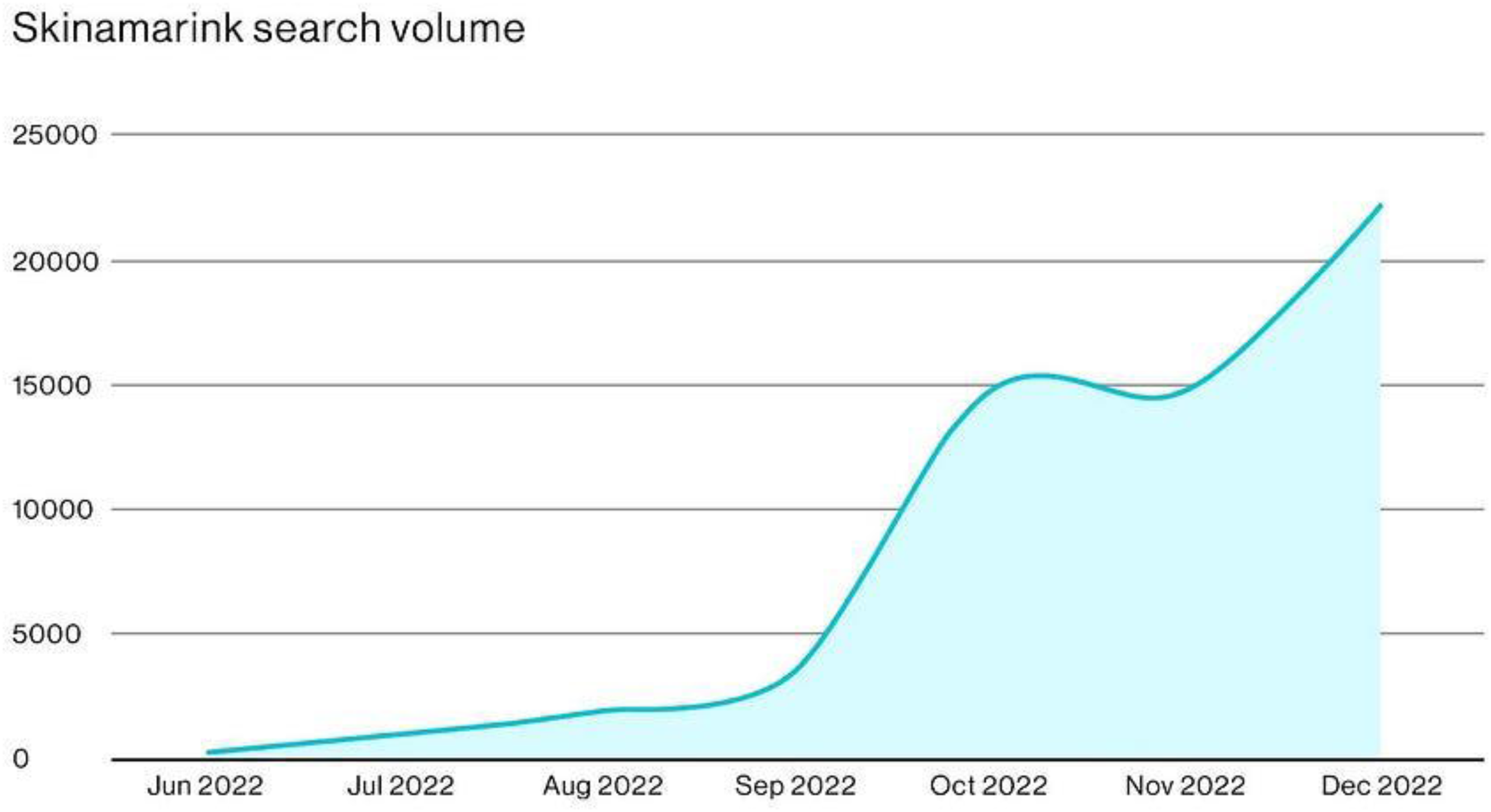
Graph indicating peak in Skinamarink Google search activity by Quilt AI (28/01/2023).
These early TikTok videos which drove the first phase of the film's virality tend to emphasise simply that the viewer has watched a film that ‘everyone’, ‘TikTok’, or ‘film/horror film TikTok’ is talking about. These videos typically align with the ‘Review style’ category – the most prevalent in my coding with 66 videos – in which the creator speaks direct to camera to summarise their perspective on the film, often with the label ‘review’ in the video description or via their dialogue. Notably however, most of these videos are scant on detail about the film, being focused instead on its enigmatic aura and affective intensity, the vigour of the TikTok discussion around it, and/or that the film was at that point hard to find. These videos thus modulate the film review video – a popular content type on YouTube – so that it better aligns with TikTok's affordances: the longest of these videos is five minutes and 13 s, and many are much shorter. They all consist of very simple production values, with the presenter appearing in close-up or mid-shot, usually with the film's poster as the video's ‘greenscreen’ background (an automated image insertion feature in TikTok). Very few of these videos contain editing, and none feature clips from the film, instead focusing on the presenter's emotional reactions to Skinamarink rather than its content. This simplicity makes such content quick and easy to produce, aligning with Sarwatay et al.'s research around how TikTok trends popular with young people enable the sharing of ‘creativity and interests’ through an ‘inexpensive, low-tech setup’ (2023: 54).
The format of these review style videos further emphasises the affective responses of the presenter, given they are aesthetically structured around the creators’ bodily and facial reactions. Skinamarink review videos thus evidence Zhiyuan Hu's point that the short-form, vertical format of TikTok (Hu, 2023: 4) is ‘uniquely suited to body performance content’ and the foregrounding of facial reactions (Hu, 2023: 31). This focus on emotional reactions delivered through bodily performance fits the affect-driven nature of the horror genre. Linda William's influentially deems horror as one of three ‘Body Genres’ (the other two are pornography and melodrama): film genres which centralise ‘the spectacle of a body caught in the grip of intense sensation and emotion’ and invite mirrored audience reactions, which in horror's case involves terror (William, 1991: 4). Skinamarink TikTok harnesses and ‘re-performs’ the on-screen emotion-driven bodily performativity of the horror genre through TikTok's affect-driven ‘vernacular of body performativity’ (Cervi and Divon, 2023: 4), in so doing inviting further participatory engagement.
As an example of how these early contributors to Skinamarink's virality emphasise emotional reactions to the film rather than its content, one early video (uploaded November 2022) with 102,000 likes begins: ‘I watched the horror movie that's traumatising everyone on TikTok’, and goes on to explain that it is not like a conventional movie but more like ‘watching someone's nightmare, or a bad childhood memory that you repressed.’ Another of these early videos posted by the same account opens with ‘Skinamarink is the scariest movie I’ve never finished, and I’m going to tell you why’. Another such early contributor to the film's virality (with 61,000 likes at the time of writing) – also uploaded in November – begins ‘so if you’re on horror movie TikTok in any way, I’m sure you’ve already seen people talking about Skinamarink’ before explaining that this new horror movie ‘is not even technically out yet, but you can find it online’. The creator then details his experience with the film, noting that he watched it on his phone and through his fingers at times out of frightened anticipation about what was going to happen: he also mentions holding his phone ‘as far away from my face as I could’ in an attempt to neutralise the threat the movie was exuding. While the movie was not legally available at the time this video was uploaded, like many of these early videos, the uploader invites others to ‘tell me what you thought’ if ‘you’ve seen it.’ Some other early contributors to Skinamarink TikTok focus on ‘How to Watch’ the film when it comes out formally via its impending limited theatrical and Shudder release, informing viewers that they will soon be able to join in on the Skinamarink discourse through straightforward (and legal) access to the film.
The videos that initially drove the snowballing virality of Skinamarink on TikTok thus construct an aura of anticipation and mystery around the film that invites curiosity and active participation. While in a review style format, many of these videos also fit categories such as ‘Challenge’, ‘Performative Watching’, or ‘Terrified’ reactions, because they emphasise the uploader's terrified reaction and challenge other users to watch the film and let others know how they handled the experience. Indeed, often, the intersection with challenge content was explicitly signalled by having the word ‘challenge’ in the video description, link, or hashtags. TikTok challenge videos generate ‘new ways to build relationships among users’ and involve the completion of a goal accompanied by an invitation for others to attempt it and share the results (Vizcaíno-Verdú and Abidin, 2022: 885–886). While they do not fit the more prescriptive format of music challenge videos, these early Skinamarink TikTok videos encourage users to embark on the challenge of locating the film and/or of enduring it, and thus construct a community around this shared goal. These challenge-type Skinamarink videos thus built an ‘imitation public’ through a ‘collection of people whose digital connectivity is constituted through the shared ritual of content imitation’ (Zulli and Zulli, 2020: 1882).
Skinamarink TikTok and performative watching
The videos that fit the ‘Performative Watching’ category further shaped such processes of shared participatory engagement by positioning watching Skinamarink as ‘experiencing’, ‘enduring’, or ‘surviving’ the film, in alignment with the intensive dynamics of cult film reception (Mathijs and Mendik, 2008: 4). Like the review videos, this genre of Skinamarink TikTok loosely harnesses the structure of challenge videos as watching the film becomes a communal lived experience rather than a passive endeavour. Indeed, a number of these videos are tagged with descriptions or hashtags categorising the video as a ‘live reaction’ to the film. These reaction videos often depict the ritual around setting up the film to watch it, building intense anticipation around the viewing experience. One such video uploaded prior to the film's formal release (November 2022) starts with the uploader explaining that they tried to watch the trailer at 3am with no lights on, but they became too fearful to finish it. They go on to express their tense anticipation for the full feature, but also their ‘worry’ about trying to watch it: a concern which they relate not just to the film's frightening nature but to likely difficulties around access. There is then a cut, and we return to the creator in the aftermath of their viewing: they appear very emotional, and explain that they are not easily scared but that this movie ‘really did it for me’ and they ended up being ‘too chicken’ to watch it with the lights off.
Other performative watching videos capture the creator's reaction in the style of a truncated ‘Let's Play’ video, a format popularised on YouTube in which users record themselves playing a videogame and reacting to the experience in ‘real time’. In one such video, the creator sits on the couch, commentating her viewing experience and reacting with terror across her whole body as she watches the film. She brings her hands to her face, screams, shakes her head, and hides her eyes with a blanket. Another video themed around ‘watching Skinamarink at 1am’ displays the creator's ritual of locating the film on his television, turning off the lights, and then consists of a series of shots of him reacting in fear to the experience. As in the above-described video, the screen displaying the film is not visible to viewers, we only see the lights and shadows being cast on the creator's face as it plays – like the review videos, most of these performative watching videos feature close-ups of the uploader's face or mid-shots of their body, but no sequences or images from the film itself. In this video, in lieu of content from the film, captions such as ‘Halfway Through’ accompany the close-ups of the creator's reactions. The captions in this video, as in many other examples, provide the viewer with a sense of how these reactions relate to the film's runtime and sparse sequence of events. This particular video ends with the uploader shaking his head with a wide-eyed, overwhelmed expression, accompanied by the caption ‘After the Movie.’ Another video similarly depicts the ritual of turning off the lights around the house to watch the film, but takes this performative watching trend in a parodic direction: the uploader explains he's turning off all the lights to watch Skinamarink ‘because my Momma didn’t raise no bitch.’ Once the film begins, however, he starts to rush around to turn the lights on again in a performance of over-the-top panic, because, as he exclaims hysterically, ‘my Momma did raise a bitch!’
Skinamarink's enigmatic and affect-driven textual structure is well suited to these bodily performative reactions on TikTok because the film's semantic and syntactic ambiguity invites emotional rather than logical and explanatory reactions. These responses to the film are examples of the type of viral challenge performance tied to ‘affect’ ‘in which users enlist their bodies to create meme-based challenge videos that will be credited with algorithmic attention’ (Cervi and Divon, 2023: 4). These strategies also guide the audience ‘to take action and get involved in intense interactions, which are crucial to the formation of the spectacle of body’ (Hu, 2023: 19) – an engagement which again accords with the intense bodily spectacle of horror and with the communal affective intensity of horror/cult cinema cultures. The combination of bodily performance and facial expressions key to this type of TikTok content invites an ‘uncontrollable mimicry’ that ‘creates a strong affection effect on the audience's body’ while cultivating intimate connections with the performer (Hu, 2023: 14). This TikTok driven affective communion with Skinamarink was a contributor to young people's investment and participation in the trend, a phenomenon made more surprising by the productive intersection between the film's slow, experimental structure and TikTok's rapid algorithmic dynamics.
Intersection of the unexpected 2: Skinamarink as slow cinema and TikTok's fast-paced algorithmic dynamics
The second intersection of the unexpected underpinning Skinamarink TikTok is that TikTok virality contributed so meaningfully to the film's international visibility despite the film's aesthetic misalignment with the platform's algorithmic dynamics. TikTok's short-form video content is delivered via rapid-fire algorithmic distributive logics to produce an ‘endless flow of images’ (Lin et al., 2023: 1552). Yet this experimental horror film is notorious for its languorously slow place and lack of legible imagery and narrative action, a mode seemingly ill-suited to TikTok's structure of short-form vertical video delivered through a swift, continuous algorithmic flow. This distinctive algorithmic attention economy involves multilayered ‘visibility labours’ from users to attract attention within short windows of time (Abidin, 2021b), aesthetic and cultural dynamics that seem antithetical to the sparse takes ‘grounded in stillness, silence, and duration’ (de Luca, 2016: 25) of slow cinema.
I found that Skinamarink's abnormally slow pace for a horror film attracted intense curiosity, and in tandem various different types of performative reactions well-suited to TikTok – and to children and young people. This applied even when the intense reaction was boredom: indeed, one of the categories in my coding process was ‘Bored’. In another instance of the complex affectual responses Skinamarink generated on TikTok, ‘bored’ responses to the film sometimes manifested in emotionally charged videos: in one such example, the creator passionately declares in a 44 s video that Skinamarink was ‘the worst movie I have ever seen in my life’, before pointing to an image of the poster superimposed in the clip and shaking his head in disbelief, while declaring ‘what was this? What was this? What the hell even was this?’ He invites anyone who liked the film to come and throw stones at his window so he can ‘square up with them’, finishing by stating ‘this literally has made me angry.’ While videos featuring this type of performative outrage were less common than more ambivalent or terrified reaction videos, such responses to the film's ‘boring’ pace further contributed to the lively and curious community around Skinamarink, given their diametric opposition to the visceral reactions of horror seen in many of the popular review and reaction videos.
Some videos detailing the film's intensely boring quality also fit into the ‘Performative Watching’ category: for instance, in one video, a young user emphasises their bored confusion in the style of a ‘Let's Play’ video. The video captures her side profile as she watches the film, and is constituted of close-ups of her facial reactions accompanied by captions. The video starts with the caption ‘Watching Skinamarink, heard it was pretty scary.’ She looks increasingly bemused throughout the video – as the video progresses, captions read ‘not quite sure what's going on so far’ and ‘still waiting for something scary to happen’ – as she looks variously at the television screen or direct-to-camera with befuddled expressions. Rather than the film soundtrack, the musical soundtrack is a bouncy supermarket aisle-style tune, underscoring the comic disjuncture between ‘the scariest film of 2023’ and this young person's impatient, perplexed reaction to its slow pace and minimal plot.
While these bored and confused reaction videos do not reflect positively on the film, they do further contribute to the challenge-style logic of Skinamarink TikTok, because the divisiveness of the emotional reactions canvassed across this community enticingly suggest that each individual user does not know how they will respond to the ‘challenge’ of watching the film until they give it a try themselves. As Cervi and Divon (2023: 3) point out, ‘challenges are play-based collaborative tasks governed by a set of performative rules’ – while the performative rules of Skinamarink TikTok are loose, they nevertheless solicit further participation in ways ‘that then circulate as viral performances’.
Notably, the film's slow pace and sparse action were a key contributing factor emphasised in some of the ‘Terrified’ reactions. One young person's video for instance depicts them drawing quietly while watching the film and suddenly stopping to cover their mouth in shock in reaction to the sound and images on screen. This video is in the style of a ‘duet’ with one of this creator's earlier videos - two reaction videos side-by-side. In a rare video that showcases a scene from the film, this creator's earlier video depicts one of the film's loudest and scariest moments playing on their laptop screen, in which Kevin's sister Kaylee, who mysteriously disappears after disobeying the malevolent entity mid-way through the film, suddenly reappears in front of her brother with no eyes or mouth. This monstrous image is accompanied by a sonic burst of dissonant sound – a typical horror movie jump-scare ‘stinger’. This young user's two videos about one of the film's scariest moments creates a ‘challenge’ out of enduring the film's slow pace interspersed with sudden moments of intense scariness. They have had to resort to drawing to fill in time while watching the film, but nevertheless are suddenly physically shocked by this scene. In one of these two videos, the user is seen giving the scary image on their laptop screen the ‘rude’ finger, emphasising the intensity of their reaction. The film's timestamp is prominently positioned in large type across the videos, implicitly inviting viewers to also experience this ‘scary’ part of the film. This video is an example of how even Skinamarink's slow and sparse narrative structure contributed to intensely affect-driven response videos that adopt TikTok's characteristic dynamic of ‘intensified play’ (Bresnick, 2019).
Intersection of the unexpected 3: Skinamarink and children's cultures
Finally, to re-centralise the key intersection of the unexpected that opened this article, one of the most algorithmically uncanny elements of Skinamarink's virality is how an experimental horror movie deemed to be one of the scariest of the year resonated with children's cultures via TikTok. Some of the above-mentioned reaction videos are examples of this, and as outlined earlier in this article, the most explicit driver of child/adult culture boundary-crossing is the intermingling of Skinamarink TikTok and young children's nursery rhyme content, given the name of the film is taken from the aforementioned Canadian children's nursery rhyme by Sharon, Lois and Bram, and their television show, Skinnamarink TV (CBC, 1997–1999). Sharon, Lois and Bram have an official TikTok account (@sharonloisbram) with nearly 150 thousand subscribers and 1.7 million likes. The account targets both child viewers and adult nostalgia, describing them as ‘award-winning, platinum selling children's entertainers’ followed by a single hashtag: #Skinnamarink. It thus taps into TikTok's capacity for intergenerational engagement (Zeng and Abidin, 2021). A video featuring the trio performing the nursery rhyme – uploaded in 2021 before the release of the horror movie – is pinned to their profile page and has 4.8 million likes. This upload features the hashtags #memoryunlocked, #doyouremember and #skinnamarinkchallenge. Such appeals to adult nostalgia are common across Sharon, Lois, and Bram's videos, which also includes the theme song for Skinnamarink TV with the hashtags #dooyourememberthisshow, #nostalgia, and #memoryunlocked. Thus, this account for a popular children's entertainment group of the 1990s resonates with Skinamarink's underpinning uncanny nostalgia for analogue children's media from the past. This account's hashtags invite participatory engagement through ‘unlocking’ long-lost childhood memories, thematically paralleling the descriptions of Skinamarink's affectual mechanics in the previously cited TikTok discourse, which posit that watching the film feels like the resurfacing of a long-repressed childhood memory or nightmare.
This type of algorithmically curated but aesthetically and conceptually provocative reciprocity between children's and horror movie TikTok was taken up and further facilitated by users. TikTok content featuring adult users singing the ‘Skinamarink’ nursery rhyme and emphasising that it represents a nostalgic childhood memory was a small component of this activity. Some such videos explicitly connect the horror movie's popularity with their nostalgia for the rhyme: one video features a screen-shotted clip of Sharon, Lois and Bram's performance of the song with the caption ‘nostalgic gem’ accompanied by the description ‘every time I see that new scary movie promo called #skinamarink I start singing this and can’t get it outta my head lol’ accompanied by nursery rhyme hashtags (#skinamarinkydoo; #skinamarinkydinkydink) and nostalgia hashtags (#nostalgia; #80sbaby; #90skids). This video explicitly brings together horror movie and nostalgic nursery rhyme communities, however others featuring the song are ambiguous about whether they respond to the trending horror movie or children's nursery rhyme content. Such ambiguous intentions align with the algorithmic uncanny, in which human behaviour seems compelled or structured by algorithmic curation that muddies distinctions between child/adult media cultures.
Much of the ‘Skinamarink’ nursery rhyme content is explicitly for young children. A wide range of live action and animated versions of the song were captured in my coding, including from channels dedicated to young children's content, such as bebefinn_official (4.5 million followers and 12.6 million likes) and kidsfuntvofficial, which features a puppet-animated version. Indeed, there is a content category for this nursery rhyme tagged ‘children and babies.’ During my walkthrough explorations of Skinamarink TikTok, this nursery rhyme content was incorporated into the algorithmic flow of the horror movie content via shared hashtags. For instance, the video analysed in the previous section featuring a young user reacting to Skinamarink while drawing was followed by a video featuring a performance of the rhyme by a mother and her five-year-old son in a ‘duet’-style video stitched with a clip of Sharon, Lois, and Bram's performance. Such nursery rhyme content propels the intergenerational play afforded by TikTok's ‘vernacular communicative style of short videos’ (Zeng and Abidin, 2021: 2476).
Ultimately, I found that the use of the nursery rhyme for the horror film's title without explicit reference to it in the soundtrack or plot encouraged ‘intensified play’ (Bresnick, 2019) for the way it gelled with TikTok's characteristic aesthetic openness and ambiguity, which thus invites creative participation. As Skinamarink TikTok matured in late 2022 and into 2023, it became common for young users to deploy the nursery rhyme title as a playful moniker for the unnamed malevolent entity in the film – or to use the phrase in a grammatically non-sensical way to describe how they ‘got Skinamarinked’ while recounting moments from the film. This type of play with the film's themes and narrative refracts the linguistic gibberish of nursery rhyme culture. For instance, one parody video from March 2023 addresses ‘how I would survive Skinamarink, or things that I would try if I got Skinamarinked’, which include ‘pretend I don’t notice anything is wrong’ and ordering a pizza. In another video from March 2023, a young person performs over a popular soundbite used for TikTok lip-sync videos – Will Ferrell performing the line ‘You shut up! I’m so fucking scared right now! You shut up!’ from the movie The Other Guys (McKay, 2010). As the creator emotively lip-syncs the line for comic effect in a tight close-up, the caption reads ‘When the skinamarink said ‘hey yo I’m the skinmarink or what have you’ and skinamarinked the kids.’ Another video features a young person speaking direct to camera and explaining that their favourite part of the film was ‘when the Skinamarink came out and was like hey I’m Mr Skinamarink, I spooked ya!’
All of these videos diminish the horror of Skinamarink through TikTok's dynamics of intensified play, rendering the film more palatable to children. The toys in the film were another factor that drove such light, playful interaction across Skinamarink TikTok. The image of the Fisher-Price chatter phone which torments little Kevin by staring and lunging at him in a darkened hallway was particularly prevalent. Some videos position the image of the phone into a lip-sync style composition, injecting the image with romantic connotations. For instance, one video accompanies this creepy image with a musical soundbite popular on TikTok in which Weird Al Yankovich lovingly sings ‘when he looks at me, I look at him.’ Another features a montage of images of the phone staring and ‘smiling’ accompanied by another popular TikTok soundbite of actor Shemar Moore saying ‘this one's for all my babygirls. I see your comments ladies and they make me smile. I’m lurking, and I’m stalking when you least expect it.’ Such play with the toy imagery from the film renders some of its most frightening sequences amusing, thus stripping away the threat these objects carry in a playful re-calibration of the film's unsettling themes. These Skinamarink images, through their aestheticisation of an uncanny and ambivalent collision of child/adult cultures, came to function like memetic emblems for the film, embroiled as they were in TikTok's content and post-based logics of visibility (Abidin, 2021b: 79–80), which invites creative playfulness with aesthetically compelling content trends.
Conclusion
The cultural, aesthetic, and conceptual reciprocities between Skinamarink and TikTok expose their shared deconstructive capacity to destabilise entertainment media's longstanding management of child/adult culture distinctions. Overall, Skinamarink TikTok unveils new dimensions of both cinema and TikTok cultures, including:
TikTok's suitedness to the types of intensely affective and performative engagement with cinema characteristic of horror and cult film cultures; TikTok's ability to cultivate collective engagement with slow, experimental films seemingly antithetical to the platform's fast-paced algorithmic flows; and TikTok's playful and controversial algorithmic boundary crossing between children's and adult's media cultures.
This type of uncanny play with media boundaries is significant because the continual renegotiation of mediated child/adult culture distinctions is key to the transformation of cultural imaginaries of childhood. The subject position of child is not ‘simply fixed or given’ and is ‘constantly redefined, reasserted and resisted’ in children's relationships with media content (Buckingham, 1995: 83). Furthermore, horror content is a key battleground for the negotiation of such child/adult subject positions, given the horror genre's status as an ‘adult’ content type (Antunes, 2020; Buckingham, 1995: 88–92; Lester, 2016). The three ‘intersections of the unexpected’ between TikTok and Skinamarink operate as a flashpoint in the current controversial renegotiation of the cultural apparatus scaffolding child/adult conceptual distinctions driven by video sharing social media platforms. While algorithmically uncanny, Skinamarink TikTok is also aesthetically and culturally generative, offering new ways to play with the inherent cross-hatching of children's media cultures, adult memories for childhood, and children's and young people's formative experiences with confronting media texts designed for adults.
Footnotes
Funding
The author received no financial support for the research, authorship, and/or publication of this article.
