




Abstract
Influenced by social media and COVID-19, human relations with ‘nature’ are increasingly shaped by media infrastructures and logics, leading to a global surge of interest in nature tourism and outdoor activities. This article examines the mediatization of relations with nature—or, the more-than-human world—in the Arabian Gulf country of Oman, where nature tourism has developed in the past decade. Through a mixed-methods approach involving fieldwork and interviews between 2022–2024, relations with nature in Oman are shown to be informed by global social media logics, as with the trend of ‘viral landscapes’ in which a nature destination is popularized due to its high value in social media attention economies. However, local practices are also platformed, as Instagram users in Oman exploit three affordances to address the environmental problem of litter. Mediatization may thus entail a circulation of global discourses and practices as well as the emergence of syncretic sociocultural formations.
Keywords
Introduction
During COVID-19, relations between people and ‘nature’ were put in the spotlight. Following initial lockdowns and news reports of wildlife making unexpected appearances in urban centers, with the resumption of human mobility came a remarkable surge in outdoor recreational activities. The phenomenon that has been described as ‘outdoorification’ responded to travel restrictions and the comparative safety of exercising outdoors (Hedenborg et al., 2024), with domestic nature tourism activities, such as hiking, gaining exceptional popularity (Obradović and Tešin, 2022). While sales in the sporting goods industry boomed, outdoor spaces and especially national parks saw a large increase in visitors (Bustad et al., 2023), which was followed by fears of crowds damaging the environment (McGivney, 2022).
Yet the pandemic seems to have merely accelerated a trend that began in the early 2010s, under the influence of social media. The widespread adoption of Instagram and its geotagging feature—in which posts are linked to a map location—led to the explosive popularity of relatively unknown nature destinations (Vox, 2018), with national parks welcoming unprecedented numbers of visitors (Simmonds et al., 2018) and studies indicating a social-media-induced uptick in local interest in nature in contexts ranging from Pakistan (Walter, 2022) to the Netherlands (Büscher, 2021). Even as popular articles consider ‘How Instagram Ruined the Great Outdoors’ (Ketcham, 2019), ‘#nature’ is today one of the platform's top 10 most-used hashtags, with 813 million posts as of May 2024.
The growth of social media and the mobilities wrought by COVID-19 have seen human relations with nature become increasingly mediatized, or transformed by (social) media infrastructures and logics (cf. Couldry and Hepp, 2013). This mediatization has led to the circulation of recreational practices and ways of thinking about ‘nature,’ the ostensibly non-human environments and lifeways that, in the effort to eschew dualism, may be described as the more-than-human world. This seemingly global shift comes at a time of rapid environmental change due to the growing impacts of climate change and plunging biodiversity, with efforts to counteract these effects by activists and civil society likewise molded by the strategic possibilities of social media. This article traces this process by examining a context where nature tourism as a domestic practice was only popularized in the last decade, and largely by social media: Oman, a country in the Arabian Gulf. Situating this study in a place where nature tourism is comparatively new delivers insights into questions that reverberate globally: How does mediatization impact relations with nature? And how do social media users address environmental issues within particular sociocultural and political-economic settings?
Following a discussion of recent perspectives on the mediatization of relations with nature, this study's conceptual framework is elaborated, describing how discourses about nature and about not littering circulate through users’ exploitation of three affordances: scalability, visibility, and cite-ability. After explaining the mixed-methods approach to this study involving digital and in-person ethnographic fieldwork as well as interviews, the rise of domestic nature tourism in Oman is described. Mediatized relations with nature are shown to have resulted in two broad trends in Oman: a global logic of ‘viral landscapes’, and a more localized anti-litter environmental activism. This article concludes with a consideration of the implications of mediatized relations with nature, suggesting that social media is a conduit not merely for the dissemination of global nature discourses and practices, but can be a space for the coalescence of localized and syncretic sociocultural formations.
Mediatization and the platforming of nature/society discourse
Whereas ‘mediation’ describes the way communication is shaped through systems, structures, and technologies (Livingstone, 2009), ‘mediatization’ refers to how media modes and infrastructures drive sociocultural change (Couldry and Hepp, 2013). As communication and practice across a broad array of social and political-economic fields increasingly evolve in syncopation with mediatory technologies (Livingstone and Lunt, 2014), social life is now integrated with digital media (Hepp, 2020) and platformed upon hegemonic digital infrastructures (Van Dijck et al., 2018). Mediatization, and its component processes such as platformization, is a ‘metaprocess’ that has unfolded over centuries (Krotz, 2007) and has transformed the material conditions of the environment (Wickberg, 2023), yet work conceptualizing the impacts of mediatization upon sociocultural relations with nature is underdeveloped (Christensen, 2023).
Mediatization has propagated the construct of ‘nature,’ that famously complex term that in English commonly concerns ‘the “countryside”, the “unspoiled places”, plants and creatures other than [hu]man’ (Williams, 2015: 169). This deeply ideologized view is a core construct of Western modernity and posits a dualistic separation of human society from the so-called ‘natural’ environment (Latour, 1993), comprising what Foucault (1992) terms a ‘discursive formation’: a framework for the dispersion of objects, categories, and practices. The consumption of the more-than-human environment through such recreational activities as hiking, sightseeing, and adventure sports—in other words, nature tourism—is historically embedded in dualistic nature/society discourse, with the practice originating in the 18th and 19th centuries among upper classes in Western Europe (Macfarlene, 2003). Nature/society dualism is likewise interwoven with political economy, as industrial capitalism rationalizes an ontological understanding of nature as an external resource from which humans can extract value (Moore, 2015).
Against this backdrop, some have cautioned that mediated connections with nature can problematically reinforce nature/society discourse, further enfranchising spectacular commodification of the more-than-human world (Altrudi, 2021; cf. Igoe, 2010). Imagery of ‘pristine’ nature circulating on social media platforms indeed remains rooted within Western aesthetics of the sublime (Smith, 2024), which persistently articulates nature/society dualism (Fälton, 2024). These images can be a source of symbolic capital within social media attention economies, such that an image of a mountain—or better yet, of oneself standing on a mountain—can be exchanged for likes and followers, or even be monetized (Smith, 2021; cf. Bourdieu, 1984). Users attuned to the value of nature images are thereby encouraged to take pictures and videos similar to those which they have previously encountered on social media, an effect that has been shown to be particularly platformed on Instagram: users are observed to perceive nature from the most ‘Instagrammable’ angle (Arts et al., 2021), with the effect of disrupting economic and infrastructural geographies (Oh, 2021) and de-prioritizing ecological health in favor of a high-value view (Šmelhausová et al., 2022).
As nature tourism becomes an increasingly global pastime, however, ‘nature’ is not unilaterally foisted upon new locales but may be translated according to local discourses and practices (Satsuka, 2015), availing syncretic formations that suggest new, even counter-hegemonic relationalities. This too is a mediatized process, which can be understood through an analysis of platform dynamics.
Affordances and the circulation of discourse
The global mediatization of relations with nature can be understood as a process of discursive circulation and uptake of practice, but also as a process of interpretation and syncretization with localized practices. While this mediatization can be imputed to numerous forms of media, this article focuses on that platformed on social media, and specifically Instagram, as a powerful locus of nature-related sociocultural change in Oman. Instagram users in Oman who engage in nature tourism are part of a loosely-defined yet coherent online community, or ‘networked public’ (boyd, 2010), that is shaped by the architecture of the digital environment in which the community is brought into active relation. From a discourse perspective, the platform infrastructure of Instagram supports an ecology in which communication in the form of digital texts, or posts, is dialogically produced in emergent genres, or discourse ‘types’ (Bakhtin, 1981), with prior utterances remaining intertextually embedded in new productions (Thurlow and Jaworski, 2014). The dialogical remediation of meaning is enacted through digital practices, or the ‘assemblages’ of actions using digital technologies through which individuals conduct social relationships, construct identities, and pursue goals (Jones et al., 2015).
Such discourse perspectives benefit from a ‘platform-sensitive’ approach to social media affordances (Bucher and Helmond, 2017), or the relational action potentials that are contained in the possibilities and limitations of a user's digital environment (Evans et al., 2016; cf. Gibson, 1979). On Instagram, three affordances in particular inform the mediatization of relations with nature: (1) scalability, in which communicative utterances can be seen by a vast number of users (boyd, 2010); (2) visibility, in which formerly marginalized or hidden communication is made known to a public (Treem and Leonardi, 2013); and (3) cite-ability, in which—building on replicability (boyd, 2010)—users reproduce, or ‘cite,’ a discourse event while reflexively animating it as their own (Nakassis, 2013). Such interdiscursive references to prior discourse events are crucial for the (scalable) circulation of meaning, but also for the transformation of meaning and adaptation to context. This meaning-making, however, is transacted within the affordances of (social) media platforms such as Instagram, as the mediatization of nature reflects the adaptation of long-running discourses of nature not just to new contexts, but to social media logics (Van Dijck and Poell, 2013).
Digital practices and environmental activism
Environmental activism, or practices undertaken to protect and increase awareness around environmental health (Fielding et al., 2008), dates at least as far back as the 19th century and can today be identified in myriad forms around the world. The advent of digital networking technologies has transformed activist campaigning, de-emphasizing the centrality of organizations and enabling more widespread participation in social movements (Bennett and Segerberg, 2012), although it can be difficult for digital movements to sustain momentum (Shahin and Ng, 2022). Environmental activism typically transpires within a nexus of actors that include not just activists but also journalists, political institutions, and industry, and—with each actor’s decision shaped by and set into motion through media—it is a highly mediatized field (Hutchins and Lester, 2015). Posting on social media, a connective action typically executed through self-organized networks (Bennett and Segerberg, 2012: 756), can thus be a form of activism with measurable effects: highly visible users posting about environmental issues can inspire change in their audiences’ practices (Knupfer et al., 2023), as followers of such ‘greenfluencers’ adopt pro-environmental behaviors over time (Dekoninck and Schmuck, 2022).
Digital environmental activism is beholden to both sociocultural and political-economic context. Activists leveraging the affordance of visibility must account for how, as a means of obtaining recognition, visibility is political: actors can acquire power, or actors can invite the attention of institutions that seek to limit their power (Brighenti, 2007). While social media platforms afford for the circulation of critical messaging through visual performances, for instance, in authoritarian nation-states this is a delicate and risk-laden negotiation (Khazraee and Novak, 2018). Social media visibility can at once empower and disempower, affording marginalized actors the ability to put pressure on institutions while, at the same time, enabling the surveillance of those who are mobilizing for change (Uldam, 2018). In Oman, where open criticism of the government is forbidden and both official and private media outlets do not stray from sanctioned coverage, social media has emerged as a crucial space for navigating the perils of visibility, as messaging which expresses dissent and advocates for policy change can be circulated without directly addressing the government (Al Zidjaly, 2017). The opportunity and risk of visibility is a pressing concern for people posting about environmental issues, as discussed in the case analysis below.
Methodology
The findings in this article emerge from a mixed-methods study of tourism, social media, and changing perceptions of nature in the Arabian Gulf. Data is comprised of social media posts, recorded interviews, field notes, and photographs collected over the course of digital and in-person fieldwork in Oman. The information shared with researchers during fieldwork is inflected by a researcher's positionality, as researchers gain or are barred from access to social settings depending on their linguistic abilities, their gender, race, or class status, their nationality, and many other factors. As a white man with an American passport working at a European university, I am privileged in some spaces while I do not access others. The national language in Oman is Arabic, which I speak conversationally and in which I conducted the more complex recorded interviews, that I later transcribed by hand and translated with the help of a dictionary. This leads to limitations that a more fluent speaker would be unlikely to face, at least in part, as many residents do not speak Arabic, and many Omanis speak English.
My approach to digital material is aligned with qualitative digital ethnography as it is conducted in the social sciences. The primary site of research was Instagram, where nature tourism in Oman is predominantly platformed. In December 2021 I created a new Instagram account declaring my position as a researcher and began identifying and following influential accounts in the local networked public, as well as interacting with people by liking posts, commenting, and engaging in direct message conversations. In maintaining regular activity on this Instagram account, I have noted key trends and events (such as the 2022 ‘soap spill,’ described below), collecting a sample of 300 posts 1 between March 2022 and December 2023 and following around 700 users based in Oman and the Arabian Peninsula. Additionally, I actively participated in this networked community, becoming ‘entangled’ with users’ socialities (Postill and Pink, 2012: 131) as I met with them in person, was tagged in their posts and tagged them in mine; my Instagram account is followed by some 600 users, mostly in Oman. This direct involvement has fostered emic as well as reflexive insights (Tavakoli and Wijesinghe, 2019), as I grappled with the affordances of communication in this networked public firsthand.
Next to snowball sampling, Instagram was a key networking tool in the 18 weeks I spent in person in Oman, over the course of five grant-funded trips from March 2022 to March 2024. During this multi-sited fieldwork I engaged in participant observation, a method in which a researcher joins in day-to-day life and records activity in field notes. This has often involved engaging in nature tourism practices such as hiking, camping, canyoning, and caving, but also drinking coffee in cafes and sharing meals as a guest in participants’ homes. What some anthropologists call ‘deep hanging out’ instructs researchers in the sociocultural practices, affects, and beliefs of a given community, facilitating an understanding of others’ perspectives. Additionally, 34 semi-structured interviews were recorded in 2022–2023 with 45 people: 40% women and 60% men, 24 Omanis, 12 residents, and nine tourists. For reasons of participant preference, many more conversations were not recorded but were later documented in field notes. These transcribed (and sometimes translated) interviews, field notes, and Instagram posts have all been thematically coded and recursively analyzed using an inductive approach (LeCompte and Schensul, 2013), in which prominent themes are identified by repetition across source and context. Research trajectories thus develop organically and often unexpectedly—as did the issue of litter.
#Nature in Oman: The development of a domestic trend
Contrary to widespread imaginaries of Arabia as little but sand dunes and windswept rocks, the Sultanate of Oman boasts a diverse environment, with 3000 km of coastline harboring mountain ranges filigreed by turquoise-watered canyons (or wadis; الأودية) and with peaks that exceed 3000 m. This geography has been instrumental in the country's rising reputation as an international tourism destination, with Lonely Planet naming it among the top 10 ‘Best in Travel’ in 2022 (Marcus, 2021). Until the last few years, however, Oman's environment was not popular for recreation among the country's citizens and residents. Approximately five million people live in Oman today, most of whom practice Islam, including the 40 percent of the population who live and work as non-permanent residents (locally termed ‘expats’ 2 ) and comprise nearly 80 percent of the workforce (Ennis, 2020). While most of the population dwells in urban centers along the coast, urbanization only began in the 1970s following the discovery and systematized extraction of oil and natural gas, which led the transition from a predominantly rural and agrarian economy into that of an industrialized middle-income country (Jones and Ridout, 2015). Prior to this transition, rural life in Oman was—and to some extent, still is—undergirded by what Alhinai and Milstein (2019: 1079) describe as a ‘mutualist’ relation with the more-than-human world, characterized by a recognition of human responsibility to and intertwinement with the environment and multispecies life.
While Omanis in urban centers often retain ties with extended family networks based in rural villages, contact with nature remained limited for many until the recent popularity of outdoor activities—a change that, as one Omani tour guide told me, was ‘all because of social media!’ This was both a result of globally-circulating images and entrepreneurial initiative within Oman's private sector, as newly-created outdoor companies leveraged social media to expand the market. Ali, owner of one of the largest and longest-running adventure tourism companies in Oman, explains: If you think about hiking, hiking has been what the rural guys have done all of their lives. This is what we’ve done, our ancestors, all they did was hike, to go from place to place, but, you know, how can we make that something attractive for the young population? If you think about it, at that time, Instagram was booming, this was 2013, 2014. Everyone wanted to take that great photo… So we allowed that.
While almost everyone in Oman uses WhatsApp and YouTube, and SnapChat and Twitter/X are also popular, interactions with nature have been predominantly platformed on Instagram (TikTok was banned as of March 2024). ‘When you talk about social media, specifically here in Oman, it's Instagram,’ says Rumaitha, an environmental strategist and consultant. She notes that the confluence of social media and interest in outdoor activities gained momentum in 2017, and suggests a direct link to new Instagram features: I think Instagram had the video function and the Stories pick up a few years ago, and that's when things became picked up even more… I’m assuming it's because of those features, where people were able to kind of post more of their adventures rather than just one photo, that we kind of get immersed into those experiences and said, ‘Wow, I had no idea that we had this stuff [in Oman].’
‘Something modern’: Hiking during COVID-19
As nature content circulated within local networked publics, the number of self-guided hikers and tour companies gradually increased until 2020, when COVID-19 sealed citizens and residents inside the country's borders and sparked an outdoor exodus. Nadhira, the first Omani mountaineer to summit K2 and the Matterhorn, recalls: I think Covid was bad, but it was very helpful to bring everybody—men and women—to the mountains. Because they are not allowed to travel, not allowed to go anywhere… So hiking, it becomes something modern, you know, moda. It's always been in the background that we have these amazing natural places… Then when Covid happened, you have people that were, ‘Okay, I can’t travel, I can’t go anywhere, this Instagram account is showing me this place, maybe now is the time to do it.’ It was insane. I needed to ask, ‘Did anyone go to this trail? Is it crowded?’ I never had to ask that question before.
Viral landscapes: A global trend in Oman
Mediatized relations with nature are evident in the banality of taking photographs and videos while engaged in nature tourism activities in local and national contexts the world over, which may be stylized according to prevailing aesthetic regimes in order to gain visibility within a networked public. This logic of visibility has resulted not just in the citation of globally-prominent motifs, but in the viral popularity of destinations that become recognized as especially ‘Instagrammable’, resulting in a rapid and often environmentally consequential increase in visitors seeking to create their own social-media-ready content. This nature tourism trend usually occurs when images of a unique landscape feature suddenly scale up beyond localized social networks to distant and even global networks in a viral event (cf. Nahone and Hemsley, 2013). ‘Viral landscapes’ that have seen meteoric increases in visitor numbers due to social media fame include Horseshoe Bend in Texas, Trolltunga in Norway, and Roy's Peak in New Zealand. Yet viral landscapes are also a feature of contemporary nature tourism in more localized contexts. While Oman may not (yet) host a globally-famed viral landscape, a host of locations have achieved national prominence, with some cases arising due to fleeting climate events.
At 3028 m, Jebel Shams (جبل شمس; ‘Sun Mountain’) is the highest peak in Oman and is a popular destination for both local and international tourists. Due to its elevation, snow falls once every few years despite the desert climate in Arabia, with the last occasion occurring before nature tourism became popular. Then, in January 2023, snowfall was captured in a few Instagram posts (e.g., Figure 1(a)) and there was a rush on the mountain. A traffic jam clogged the two-lane dirt road leading up Jebel Shams, posing a significant hazard as it was muddy from the rainfall at lower elevations (Figure 1(b)). The snow was in fact not visible from the road and could only be reached following a difficult hike of several kilometers from the parking area, making it even more challenging to witness. Content from the snowfall nonetheless filled local social media networks for days, with motifs developing that were repeated, or ‘cited,’ in numerous posts: shaking a tree branch of snow onto oneself, snowball fights, walking through the snow wearing traditional Omani dress, and building snowmen (Figure 1(c)).
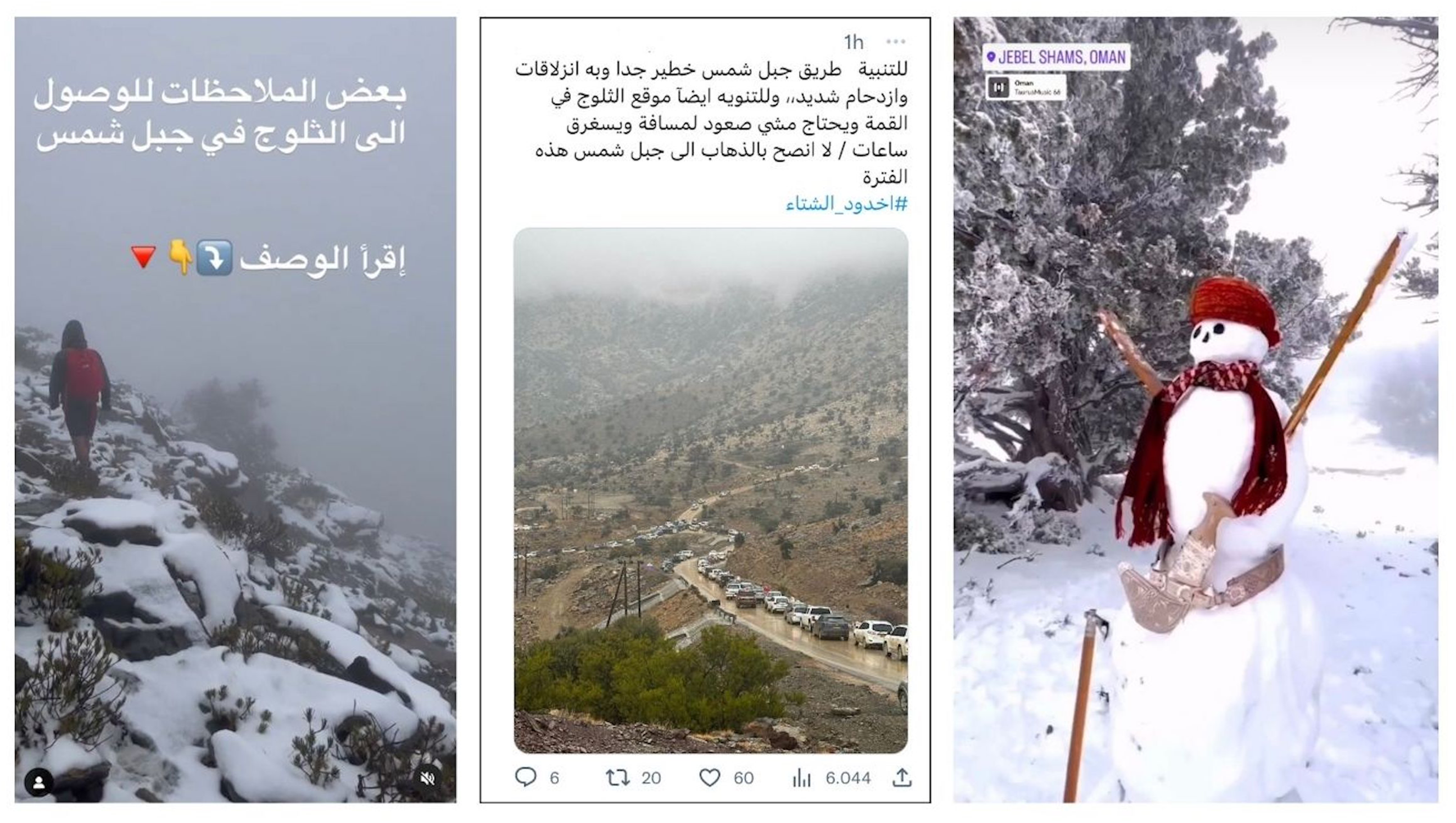
Right-to-left: (a) a post made in collaboration with an aggregator account of the snowfall on Jebel Shams, reading ‘Some notes on getting to the snow on Jebel Shams’; (b) a Twitter post, with the first line reading: ‘The Jebel Shams road is very dangerous, slippery, and there is severe crowding’; (c) an Instagram stories post of a snowman built on Jebel Shams, wearing a khanjar (Omani dagger).
Qasim, a landscape photographer with 50,000 Instagram followers, was on Jebel Shams working on a project when he saw the snow fall and the beginning of the rush. He suggests that the rush to see the snowfall was driven by the urge not just to witness a unique climate event, but to capture high-value Instagram content: Now, the people, their mind is in social media. What, where we will go to make as a trend… They want to do a trend-able video, like they went up the mountain with Omani fully dressed, khanjar [dagger] and all that, and built the snowman.
As this example illustrates, mediatization can produce interactions with nature that are wholly predicated on their potential for networked uptake. However, while in some cases nature becomes a source of attraction only for its exchange value in attention economies, in other ways mediatization has induced another effect: care for the environment.
‘This preserves nature’: Anti-litter activism in Oman
While this study was initially conceived as an investigation of mediatized relations with nature in Oman, during my first field visit an unexpected topic repeatedly surfaced: litter, or improperly discarded rubbish, was raised unprompted in 10 of 12 interviews in March 2022. For most participants living in Oman, nature tourism and litter are mutually implicated, as adventure tour company owner Sheda describes: I remember going on hikes before Corona [COVID-19], and it was great, there weren’t people there, there wasn’t any rubbish there! Corona comes, people start going wherever they want, and: rubbish. When they finished drinking, they would throw it [the bottle], in nature… The litter kills turtles, kills fish… it's very dangerous. I want the awareness [الوعي] that, when we go out on an adventure in nature, when we finish drinking water and eating food, we have to put it [our trash] in a bag and take it with us. This preserves nature, preserves the environment [البيئة].
Among participants, social media is largely regarded as an effective albeit imperfect tool for communicating environmental issues. Abdullah, a tour guide and photographer with 300,000 Instagram followers, argues that despite inherent limitations it is nonetheless essential to try and spread awareness: Try to post about it, you see, talk about it, take pictures, and raise the awareness… that's what we can do, because we have the social media. We don’t have the power, but that's the only thing we can do, you see. But if everybody talks about it, if everybody in his or her capacity can do something more, that will be helpful.
Scalability: Symbolic capital in a local attention economy
Scalability describes how communication on many social media platforms has the potential to be seen and interacted with by a vast number of users, extending potentially far beyond an individual's network. This environment has given rise to influencers, who maintain large followings and whose posts frequently reach beyond these followings due to the dialogical infrastructure of apps such as Instagram, where posts are easily reposted to Stories and are algorithmically promoted within adjacent networks. One of the most prominent genres to circulate in Oman is what can be called the ‘cleanup post’: an image or video featuring a user or others removing rubbish from the environment, typically modeling a behavior that the user wishes to see adopted by others. Riyadh, a guide and tour company owner with more than 50,000 Instagram followers, began posting videos several years ago of him picking up litter and explaining the importance of keeping the environment clean. He describes his aims: Because there is a message in it, some nice content, something positive, maybe it changes the cultural ideas of society [فكرة ثقافة المجتمعة]. So I made more videos of this kind, of gathering plastic and so forth… with positive content [المحتوى الإيجابي] or a message for society, the word becomes more widespread.
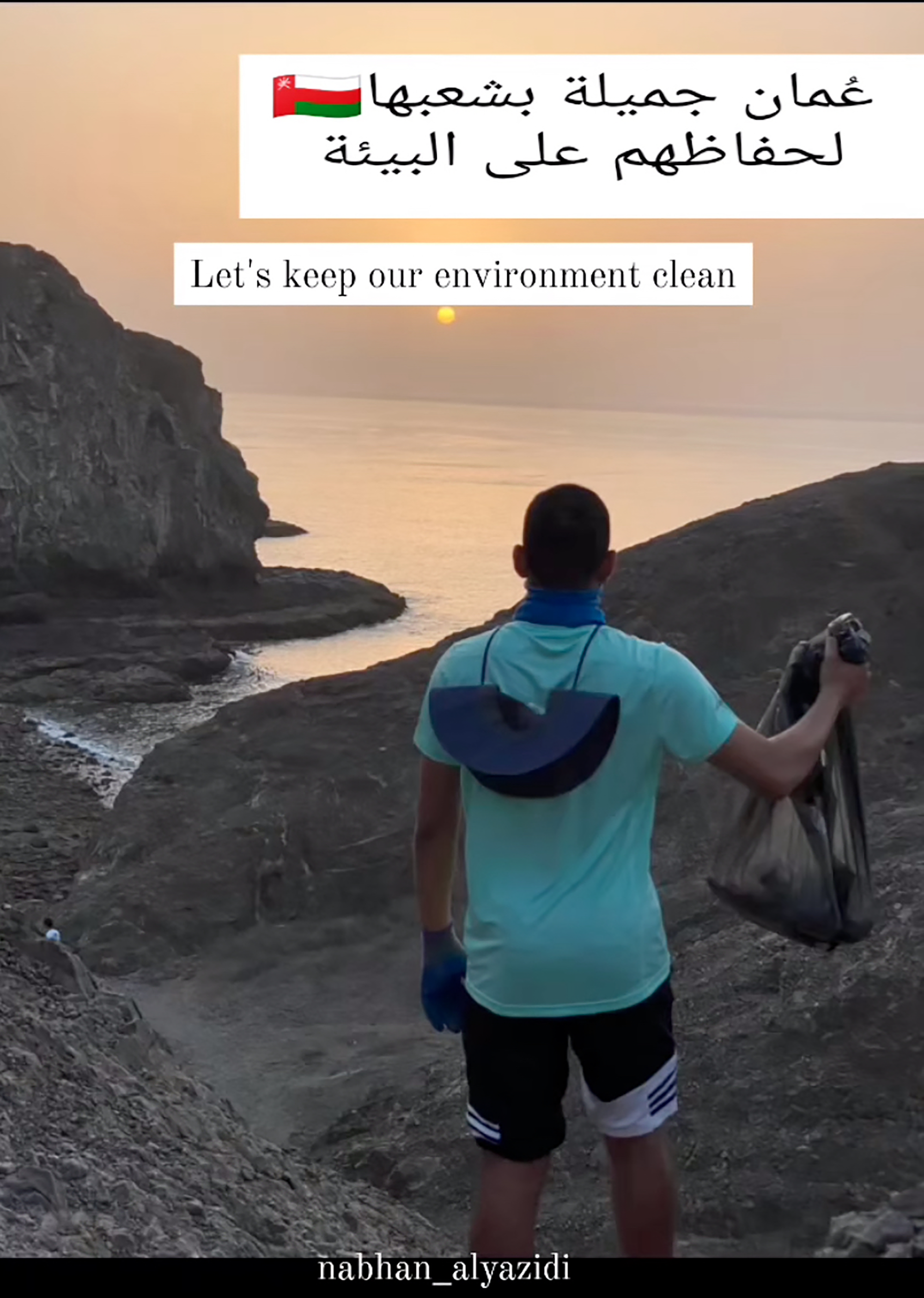
Still image of an Instagram Reels post by @nabhan_alyazidi showing a cleanup at a popular coastal hiking area near Muscat.
While the pursuit of symbolic capital on social media can support commodification, the case of cleanup posts raises the question of whether ‘like’-able Instagram content benefits environmental health. The dialogical architecture of Instagram entails that an individual user's exposure to other users’ posts informs their understanding of what succeeds within the attention economy of a given platform; when users witness the symbolic value of anti-litter content, they are encouraged to post their own. In the pursuit of likes, however, the value for not littering may be inculcated by those users and other members of the networked public. Thus, the ‘word becomes more widespread’ in two senses: through advocacy, and through the symbolic valuation of anti-litter practices within an attention economy.
Visibility: The politics of digital environmental activism
While social media can play a role in spreading environmental awareness, it is essential to contextualize the visibility of such platformed messaging within the dynamics of local media economies, which are shaped through vastly different sociocultural and political stakes. The promises and hazards of visibility are well illustrated by the environmental disaster that came to be known as the ‘soap spill’ (or in Arabic, أكياس الصابون, ‘the bags of soap’). On 26 June 2022, the residents of Muscat and surrounding cities awoke to find the coastline covered in small blue packets of soap. It was, in the words of one organizer, a ‘catastrophe’: tens of thousands of plastic bags filled with synthetic detergent littered the shoreline, shallows, and reefs, posing a health hazard to marine life and human communities. The response from civil society was immediate, with calls going out from individuals, action groups, and Oman's environmental NGO to join cleanup efforts. ‘It's a disaster,’ said one activist, ‘but the beautiful side of this, the response was positive. People started to get together.’ Paralleling the logic of ‘viral landscapes,’ Instagram and Twitter filled with videos and images of people collecting packets from local beaches (Figure 3), as hundreds of volunteers arrived for beach cleanups that began that afternoon. Indeed, without making the disaster visible on social media, the scale of the response would likely have been far more limited—not least because the government never issued an official statement regarding the spill.
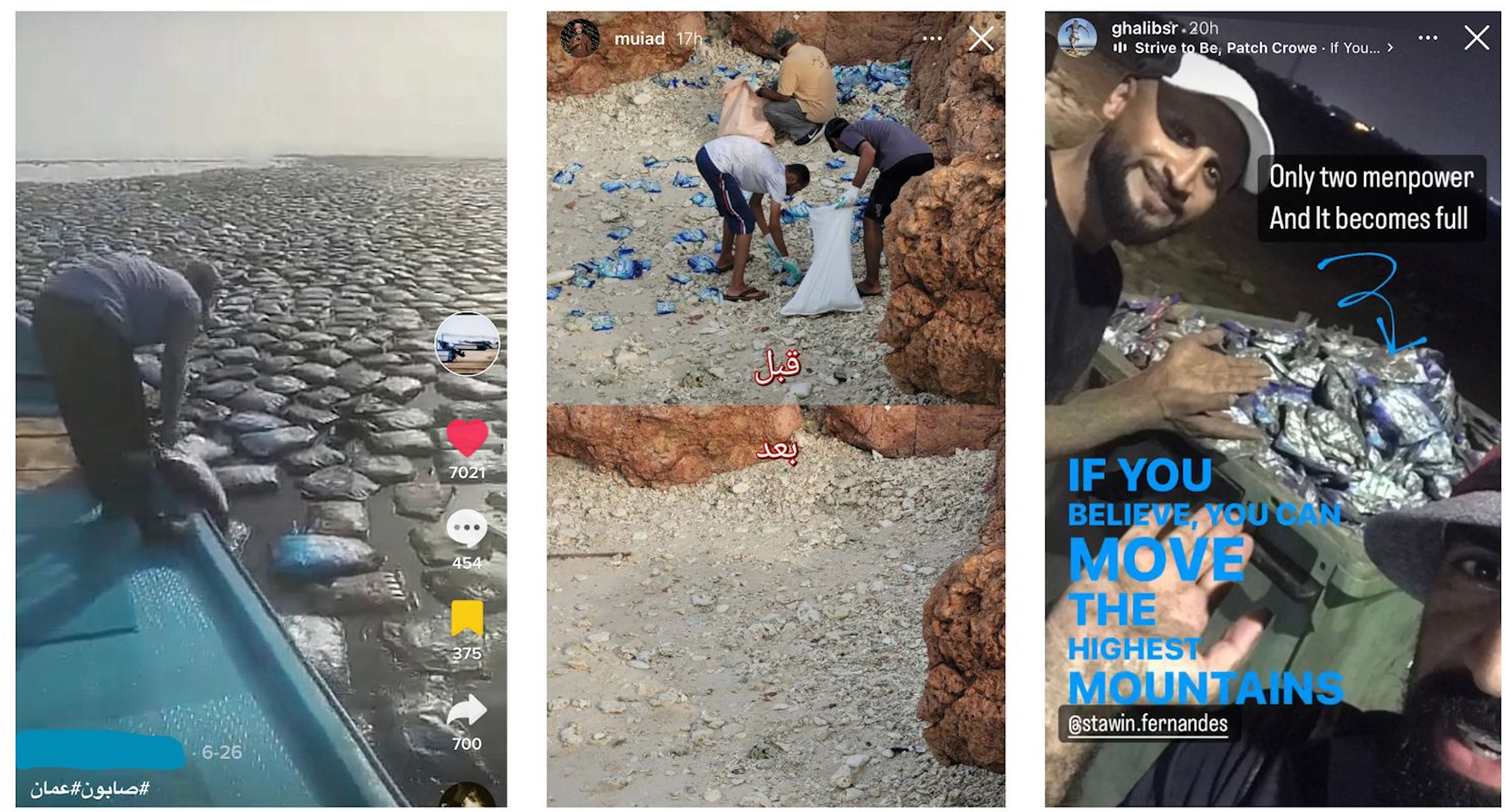
Right-to-left: (a) A TikTok post (likely made with a VPN) with 1m + views taken by fishers off the coast of Muscat; user anonymized; (b) Instagram stories post by @muiad, showing a soap spill cleanup ‘before’ (قبل, top) and ‘after’ (بعد, bottom); (c) Instagram stories post by @ghalibsr, showing the successful aftermath of a soap spill cleanup with @stawin.fernandes.
The lack of a government statement on the spill was a concern for many, especially as rumors began to circulate that the sinking of a container ship was known yet no preparations were made in the time it took for the soap packets to wash up on the coast. However, this concern could not be made visible on social media, as a Muscat-based professional who participated in cleanups explains: It was very heartwarming to see people band together for that one goal of keeping the ocean clean. We were not at liberty to talk about why it happened—like most things here, we kind of never find out the reason, or the answer… You can’t say anything negative, you just kind of have to be like, ‘Hi, look, please pay attention.’
Understanding how media operates in Oman, in fact, highlights the vital importance of social media users’ exploitation of visibility. According to a journalist who has spent more than five years working for a local news organization, the primary role of institutional media is to answer ‘the question of what the government is doing’, and since there are no beat reporters tasked with the critical investigation of civic issues, social media ‘brings quick attention to what the people think is a priority environmentally.’ The June 2022 soap spill is an exemplary case, as posts from (micro)influencers in Oman's networked public succeeded in getting the media's attention (e.g., Kothaneth, 2022) and accelerated cleanup efforts. The journalist continues: Social media has become very important in pushing for change… there are times that the government cannot be aware. So a lot of times, you would know what is happening from social media. And… that's when the issue is addressed.
Cite-ability: Mediating Arabic oral tradition
The replicability of digital texts enabled by most social media platforms provides an avenue for the circulation of discourse through the animation of a prior discourse event in one's own words. Cite-ability affords for the circulation of interdiscursive chains of meaning wherein, with each new post, a discourse event may be adapted to a new spatiotemporal context while remaining linked to a prior utterance. Each video of litter being removed from the environment, for example, cites prior cleanup posts in a continued mediation of the message, Don’t litter. A second genre of anti-litter discourse likewise operates through interdiscursive chains of meaning and has thrived in particular due to the sociocultural context of the Arabian Gulf.
As part of a grassroots initiative in Oman that promotes environmental awareness and sustainable practices through cleanups, advocacy, and youth engagement, environmental activist Fahad created a ‘jingle’ about not littering that has now been sung at beach cleanups, at elementary schools, and by hundreds of social media users. His aim was to create a discursive intervention that could be widely cited and used ‘positive reinforcement’ rather than reprimanding to encourage environmentally responsible behavior. According to Fahad, spoken communication is ‘underestimated’ on social media, but that ‘in Arabic, this is what we are known for, the power of wording.’ In order to ‘really influence [Arabic-speaking] society,’ he says, it is essential to leverage the power of words. Oral content ‘can actually build a stronger memory’ for influencing behavior, as it is rooted in the deep history of ‘stories, our grandfather's stories, our grand-grandfather's stories, the poetry.’ For non-Arabic speakers, it helps to read the English transliteration out loud so the rhyme can be heard:
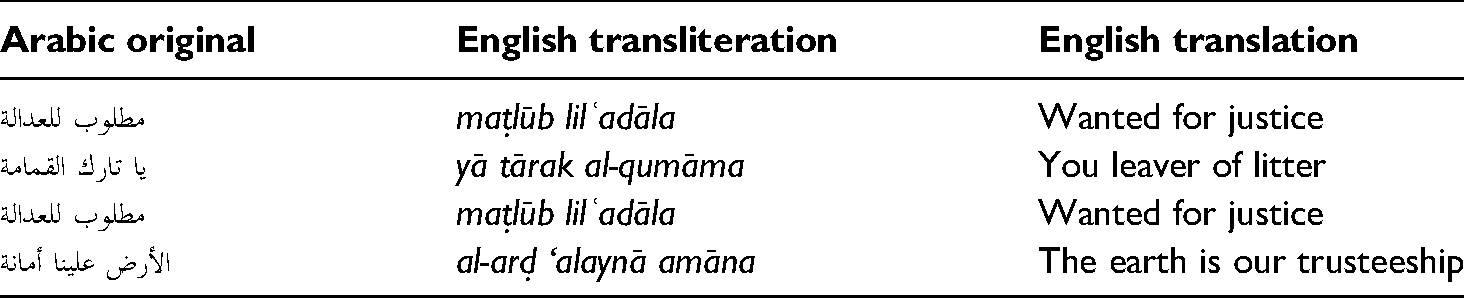
The jingle emerged through a collaboration with a state-funded municipal organization, which proposed the phrase, ‘wanted for justice’—to which Fahad added, ‘The earth is our trusteeship.’ Except ‘trusteeship’ is not a perfect translation of amāna (أمانة), the last word of the jingle. Fahad instead offers ‘honorship’: that is, ‘you are responsible for something you don’t own.’ The word amāna, found in the Qur’an, is a powerful framing for human relations with the more-than-human world, and can be further defined as ‘everything that the individual is obliged to take care of, uphold, and fulfil based on the rights of others… includ[ing] a moral responsibility toward more-than-humans’ (Alhinai and Milstein, 2019: 1086).
The jingle's discursive intervention and oral modality within dominantly visual networked spaces has re-invigorated a traditional relationality that fosters ontological commitments beyond nature/society dualism. The use of amāna in the jingle, however, is not religious—in fact, Fahad has faced challenges from conservative groups opposing music, and has responded in these cases by adapting the jingle as a nasheed (نشيد), or chant. The dexterity of the jingle's oral circulation has facilitated its widespread citation, with the Highlights section of Fahad's Instagram page remediating Stories posted by people across Oman, the Middle East, and as far away as India and Sudan singing the jingle at home, around a campfire, or alongside sacks of rubbish cleared from a beach (Figure 4). Drawing upon cite-ability to create posts in the mold of a traditional form of communication, users have circulated anti-litter discourse widely within networked publics in and far beyond Oman.
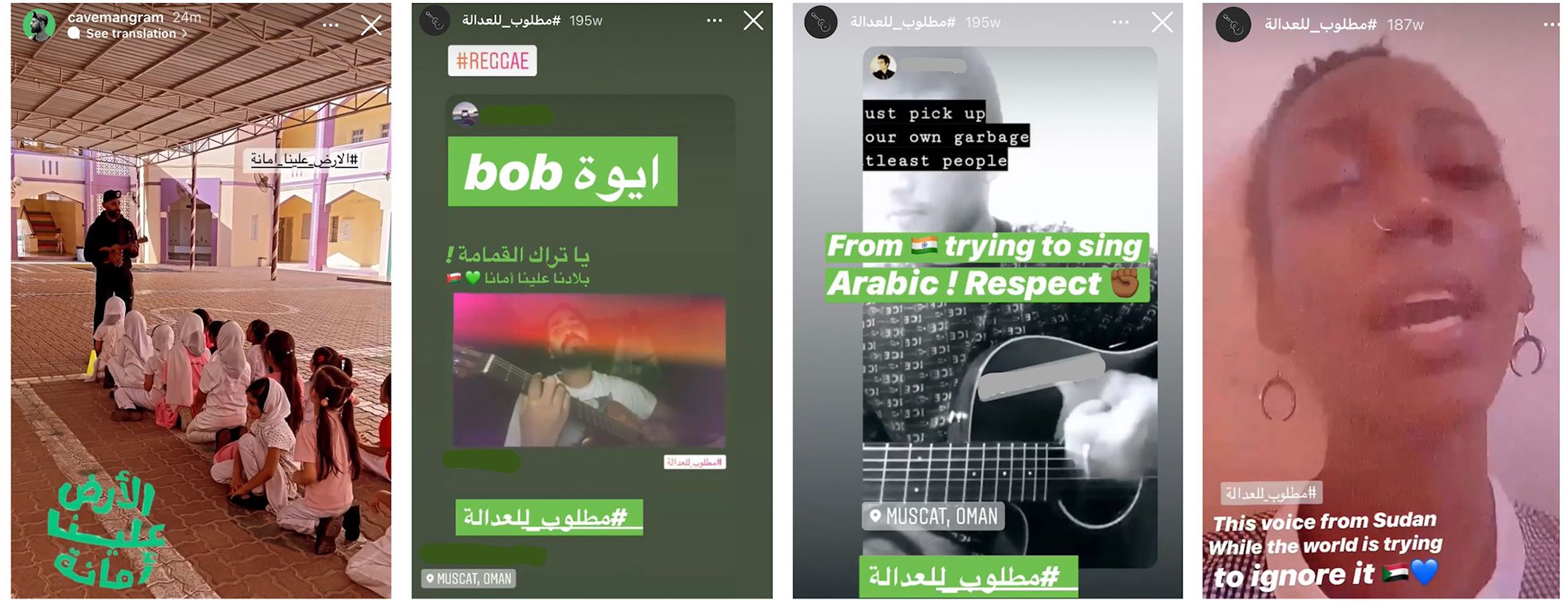
Right-to-left: (a) Fahad teaches the anti-litter jingle, maṭlūb lilʿadāla, to schoolchildren in Muscat; users from (b) Oman, (c) India, and (d) Sudan cite the jingle in their own Instagram stories posts.
Conclusion
The mediatization of relations with ‘nature,’ or the more-than-human world, is a global phenomenon that has accelerated under the influence of social media and the mobilities wrought by COVID-19. This article has sought to conceptualize how mediatization impacts relations with nature and how environmental problems are addressed by social media users within sociocultural context. In Oman, mediatization has resulted in the adoption of global social media logics of nature consumption, as in the trend of ‘viral landscapes’ in which a landscape feature or climate event attracts a sudden surge of visitors for the potential of said landscape to attract visibility on social media. However, users in Oman concerned about environmental health have devised strategies for exploiting social media affordances to address the problem of litter: scalability is leveraged to circulate anti-litter content among a wide public, enhanced by the symbolic capital associated with pro-environmental practices; visibility is carefully utilized to draw the attention of the public as well as institutional media and the government; and cite-ability is used to replicate anti-litter messaging across contexts, simultaneously mobilizing Arabic traditions of oral poetry and an ancient relationality with the more-than-human world.
What makes Oman an especially instructive example for understanding the impact of mediatization upon relations with nature is that, prior to the advent of social media, global forms of nature tourism such as hiking were rarely practiced by most citizens and residents. Amidst claims that Instagram and other platforms have ‘ruined’ nature in places where recreational outdoor practices have long been embedded, in Oman mediatization has led not only to increased numbers of hikers but to a widespread interest in caring for the environment. The exploitation of platform affordances by activists and everyday users to circulate anti-litter discourse takes place in a civic context where free speech is limited, demonstrating how social media can be a crucial tool for raising awareness and organizing actions. A far more ambivalent aspect of social media is the effect of attention economies; while in some cases environmental discourses may gain traction through being ‘likeable,’ it seems unlikely that any such benefit delivered by the pursuit of visibility is outweighed by the impact of viral landscapes and other popularity-based phenomena.
What is the clear is that ‘#nature’ may be a global trend, but it is not a unilateral flow of mediatized practices. In some cases, social media logics may broadly shape the way people interact with nature, but in many others digital tools and spaces are adapted to fit local sociocultural practices. This is perhaps best characterized as an uneven process, in which hegemonic discourses and practices are translated, contested, or even rejected—whether by recreationally consuming the environment, or by seeking to protect it. To further understand how mediatization is interacting with environmental change, future research might examine the impacts of attention economies on the environment yet also consider social media as a means of connecting to nature, with the potentiality for generating new relations with the more-than-human world.
Footnotes
Funding
The author disclosed receipt of the following financial support for the research, authorship, and/or publication of this article: This research was supported by the Fonds voor Wetenschappelijk Onderzoek – Vlaanderen (Research Foundation – Flanders/FWO), grant numbers 1298522N and V413423N.
