




Abstract
During the COVID-19 pandemic, many governments discouraged citizens from travelling both within and outside the nation in an effort to mitigate the spread of the virus. Still, some Scandinavian influencers, whose livelihood often depends on producing aesthetic travel content, chose to go abroad, which led to criticism from both followers and others. While ethical debates over air travel have taken place in social media for a long time, the specific conditions of the COVID-19 pandemic travel restrictions, combined with the centrality of travel within influencer culture, created new controversies and discussions on several influencers’ Instagram accounts in Norway and Sweden. In this article, we use digital ethnography and multimodal discourse analysis to examine discursive negotiations of different moral positions in regards to long-haul travel, the political role and responsibility of influencers, as well as how appeals to solidarity and individualised responsibility were performed and contested in socially mediated spaces during the COVID-19 pandemic.
Introduction
During the COVID-19 pandemic, local lockdowns and restrictions significantly curtailed global mobility. Scandinavian governments justified extended measures during the pandemic by appealing to solidarity, urging citizens to ‘do their part’, for the sake of their national community (Bjørkdahl et al., 2021). This approach relied on moral appeals to individual responsibility, with citizens expected to sacrifice individual comfort for the common good. Exactly what those sacrifices should look like and what kind of changes to everyday behaviour and social relations one should implement was, however, to a large extent left up to the individual. The appeals and restrictions also affected citizens in different ways, and national contexts contributed to diverse interpretations of ‘the common good’. Like other social and political issues, the pandemic and its impact on people’s lives was often discussed in social media, where people tried to make sense of the various restrictions and recommendations from their governments. This study focuses on such negotiations in a particular digital cultural context – social media influencers – to examine how travel restrictions were discussed through the lens of individual responsibility in Norway and Sweden.
Like in many other professions, social media influencers, whose livelihood often depends on sponsored travel deals and aesthetic travel content, were strongly affected by the pandemic response. For this purpose, we are interested in ways that influencer platforms became spaces for public debates regarding travel practices during the pandemic. Influencers are here defined as a specific form of micro-celebrities who use self-branding practices and relationship building interactions to gain a following in social media, and who also capitalise on their audience in some way (Abidin, 2015; Khamis et al., 2017). While the phenomenon is born out of a digital ‘demotic turn’ where ordinary people can rise to stardom, the success of aspirational influencers often depends on class position (Duffy, 2017) as well as being conventionally ‘good looking’, specifically on visually oriented platforms such as Instagram (Marwick, 2015).
Previous research on influencers’ luxury travel has shown that visualising long-haul travel plays a vital part in constructing one’s self-image within affluent Instagram communities, such as the self-proclaimed Rich Kids on Instagram (Cohen et al., 2022). Influencers especially monetize the luxurious aesthetics of tourism, as part of their collaborations with brands and travel services. It is therefore not surprising that some Norwegian and Swedish influencers, despite appeals to stay at home, chose to travel abroad during the pandemic. Because of that, they received criticism from followers, other influencers, and the mass media (e.g. Støre and Berge Christensen, 2021).
The morals behind long-haul tourism have been part of the societal discourse for a long time regarding its negative impact in several areas. Critique of leisure travel has, for example, been prominent in relation to environmental impacts of aviation, especially in digital environments (Becken et al., 2021). Furthermore, Instagram posts depicting long-haul tourism have been subjected to post-colonial critique, particularly concerning the unequal power relations between locals and tourists (Smith, 2018). The destinations of sponsored influencer travels can also become the subject of critique. Swedish influencers’ collaborations with the official tourism board of Dubai, for example, generated discussions on issues such as human rights and freedom of speech in the United Arab Emirates (Arnesson, 2024).
Previous research has examined the effects of the pandemic on influencer marketing (c.f. Archer et al., 2020; Le and Aydin, 2023). While marketisation is an important part of influencers’ livelihoods, we rather focus on how their platforms can serve as arenas for public debate during an ongoing crisis. The analysis focuses on two questions: (1) How did social media influencers talk about and present their travel practices during the COVID-19 pandemic? and (2) How did their audiences respond to their pandemic travels, particularly focusing on the debate about individual responsibility during situations of collective uncertainty?
Based on case studies of four Norwegian and Swedish influencers who travelled abroad during the pandemic – @biancaingrosso, (1.3m followers), @kenzas (1.7m followers), @sofiekarlstad (285 k followers), and @isabelsraad (333 k followers) – we rely on digital ethnography (Pink et al., 2016), combined with critical discourse analysis (Machin and Mayr, 2012) in order to analyse the textual and visual elements in the influencer posts and their related comments sections. The national contexts are chosen based on the cultural similarities of the two countries while pandemic travel responses differed slightly (see overview below). Here, we are not intending to compare the debates taking place on each of the influencers’ platforms based on their nationality – the study should instead be understood as a case study of the debate of influencer responsibility during a highly political point in time, shaped by a similar Nordic and geopolitical context.
The article starts with an overview of the pandemic restrictions in the two countries. This is followed by a discussion on the role of influencer platforms as sites for digital public debate about individual responsibilities, collective norms, and values. Then, we outline the study’s methodology, followed by analysis and conclusions which focus on three themes: pandemic contexts, affective intimacies, and ideological squaring of moral positions.
Pandemic restrictions in Norway and Sweden
Throughout the COVID-19 pandemic, people’s ability to move about freely has been impacted by various local lockdowns and restrictions. In Norway and Sweden, most restrictions, including travel bans, rested upon individualising political incentives to stop the spread of the virus and were generally supported by affected populations (Kallbekken and Sælen, 2021; Matti, 2010).
In Norway, drastic measures, effectively amounting to a national lockdown, were implemented on 12 March 2020. A few days later, on 15 March, Norway’s borders were closed, and all non-residents were banned from entering the country. Residents were still allowed to enter but were required to quarantine upon arrival. Travel restrictions were maintained until October 2021, while being softened and reinforced during different phases of the pandemic. The most radical restrictions were effective during the winter of 2020–2021, banning all foreign nationals not residing in the country from entering, requiring all residents undertaking ‘non-essential’ travels abroad to show a negative test, and staying at a quarantine hotel upon arrival (Regjeringen.no, n.d.).
Measures to contain and mitigate the spread of COVID-19 were also taken in Sweden, though no national lockdown was issued. Public gatherings and events for example, were restricted or even prohibited during specific time periods. General recommendations 1 from the Public Health Agency of Sweden stated that individuals should avoid socialising with people outside of their immediate family or a close group of friends, limit ‘unnecessary travel’, and stay at home and get tested at any sign of infection (Krisinformation.se, 2020). Urges to stay at home were specifically issued during holidays such as Easter and Christmas, when people tend to travel both within the country and abroad. Discouragement from non-essential travel within Sweden was lifted during the summer of 2021 (Swedish Ministry of Foreign Affairs, 2021); however, people were still urged to keep a distance from others and stay at home at the slightest symptoms.
Influencer platforms as digital arenas for public debate
Influencers have had a commercial and promotional function from the start, with self-branding and digital entrepreneurship at its core (Duffy, 2017). Self-branding on social media means creating and cultivating an ‘extra/ordinary’ persona (McRae, 2017) who interacts with ‘followers’ and builds a close relationship to them through affective labour and perceived interconnectedness (Abidin, 2015; Raun, 2018). These relations also become monetized, since a large and dedicated following is a form of audience commodity that can be sold to advertisers and collaboration partners (Hunter, 2016).
In addition to their commercial function, influencers have also gained attention as role models in social issues. The notion of ‘political influencers’ might encompass a number of actors and practices, for example a trend among lifestyle influencers towards integrating politics into commercialised content (Riedl et al., 2021). Previous research has focused on how influencers use their platforms to promote specific issues and ideologies (i.e. Abidin, 2019; Dekoninck and Schmuck, 2022; Maly, 2020), as well as how influencers may influence youth’s interest in politics (Schmuck et al., 2022). Influencers are also increasingly engaged to spread information using social media between those in positions of power and the public, primarily young people. During the war in Ukraine, for example, Russia has used social media celebrities as propaganda machines, where famous Russian influencers on TikTok were coerced to read aloud pro-Kremlin statements for their followers and viewers (Gilbert, 2022). In addition, though in a non-authoritarian context, the White House picked a number of TikTok influencers to debrief about the current state of the war (Lorenz, 2022). Similarly, several governments collaborated with influencers to reach young people with crisis information during the early stages of the COVID-19 pandemic (Abidin et al., 2021; Pöyry et al., 2022). This suggests influencers are seen as role models during times of uncertainty and risk.
It does not, however, mean that influencers’ audiences are uncritical consumers, or easily manipulated by actors with specific political interests. Success in the attention economy of social media often relies on influencers’ ability to create content that resonates with people’s interests, and to tap into ever-changing trends on different platforms (Duffy et al., 2021). The content and commercial collaborations of influencers are also disputed in comment sections and on ‘hate blogs’, where people debate issues of authenticity, power, and responsibilities related to this relatively new profession (e.g. Duffy et al., 2022; McRae, 2017). Such discussions are often centred around whether influencers should be considered private individuals or public actors, and individual factors (such as popularity and persona), as well as cultural and ideological contexts play into the politicisation of influencer content (Arnesson, 2024). From this point of view, influencer accounts might constitute a digital arena for everyday politics where norms and values can be both reproduced and contested (Arnesson, 2023; Sinanan et al., 2014; Suuronen et al., 2021).
Influencers’ characteristic mix of private and public content results in discussions where individuals try to navigate between agency and structure, between choice and regulations. In recent years, such dilemmas have, for example, been a core issue in discussions on the social and environmental impact of extensive tourism and air travel in both Norway and Sweden (Andersen, 2022). A recent example is the public debate surrounding ‘flygskam’ (‘flight shame’), which now occupies a central space in global environmental discussions (Becken et al., 2021). This debate was spurred by a Swedish anonymous Instagram account that reposted every instance of long-haul airplane travel from Swedish influencers as a spotlight for the unsustainable travel behaviours presented in the influencer feeds (Larsson, 2019). Thereby, the account facilitated a debate about influencers’ individual responsibility and personal morality in relation to sustainability. In addition, call-out culture has been prevalent in the influencer comments sections of influencers, as shown by Lee and Abidin (2021). In their study of Korean influencers, they find that followers, similar to consumers of a brand, will withdraw their support using methods of publicly naming influencers for not acting in accordance with their followers’ standards. However, these call-outs featured both misogynistic and abusive undertones.
Our analysis of the debates sparked by influencers travelling abroad despite pandemic travel restrictions reveals a similar emphasis on personal morality and accountability. The very act of travelling is imbued with notions of individual responsibility in curing the pandemic’s spread. The critique is mainly performed through accusations whereby individuals are blamed for violating not only formal travel advice but also informal norms and values. Here, accusations serve not merely as ‘persuasive attacks’ that damage the accused’s image and reputation (Benoit, 2014), but also to reinforce, examine, and negotiate collective norms and values. They do so, as the act of accusing invites the audience to share the evaluation of the action perceived as offensive, implying that the accusation gains its legitimacy in the norms and values that the collective is envisioned to share (Iversen and Nørremark, 2021). Thus, the critique directed at influencers for their travel behaviours has the potential to catalyse multi-faceted public debates. Beyond questioning the role and responsibility of influencers within the pandemic context, these debates may extend to pondering collective norms, values, and the interplay between personal actions and societal expectations.
Methodology
This study utilises data from influencer posts and the associated comments. Initially, we identified influencers with significant presence in the influencer sphere of the two Nordic countries, considering factors like follower count, and approached the Instagram feeds of these accounts as investigative fieldwork. While follower count should not be considered the sole factor in measuring the real-life ‘influence’ of influencers, where for example influencers’ perceived credibility (Reinikainen et al., 2020) and relatability (Coco and Eckert, 2020) are important factors for their marketisation, influencer follower counts have been used in this study as a criterion for data collection. The influencers chosen for this study has been featured in journalistic descriptions of the influencer field of the ‘top-most followed influencers’ in Sweden and Norway in the beginning stages of research (see for example Influens.se, 2021). We chose influencers from various niches, not exclusively travel-related. That said, they featured travel content occasionally on their pages, along with makeup brand deals, DIY content, or fashion tips. Instagram was chosen as the research platform due to its relevance to the influencers under investigation. We conducted fieldwork in April 2022 by systematically reviewing influencers’ feeds, focusing on images, post captions, and comments. This digital ethnographic approach involved note-taking, screenshotting, and quoting relevant content (Pink et al., 2016).
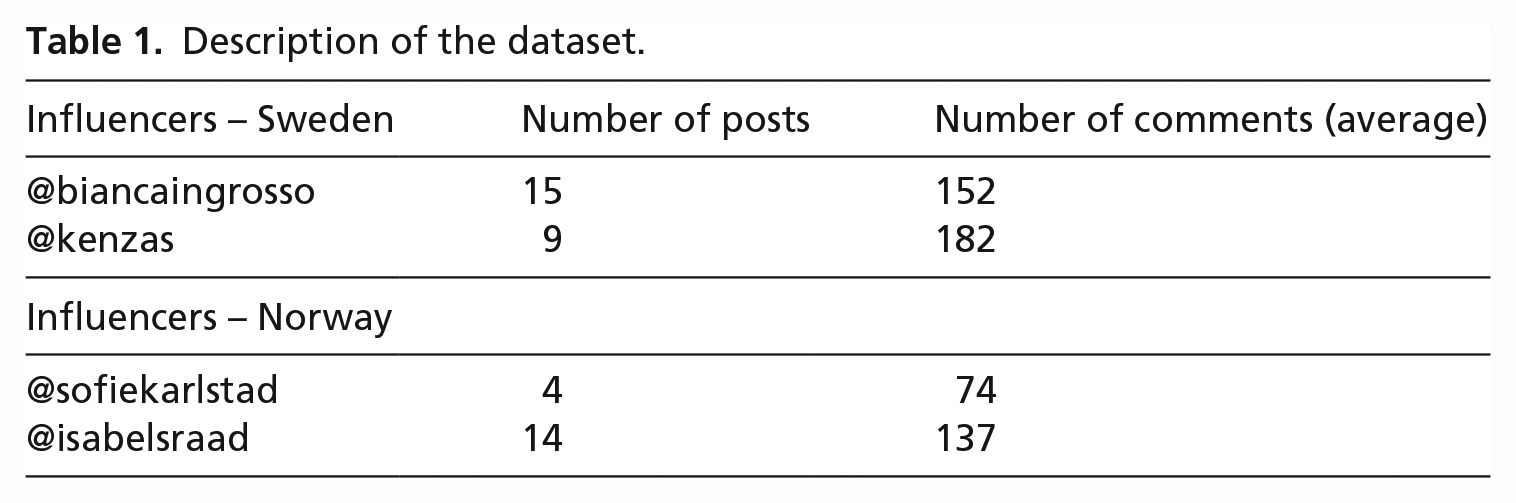
We identified the accounts of two influencers for each of the two countries that were critiqued for their pandemic travels. In Sweden, we picked the account @biancaingrosso (1.3m followers) of influencer Bianca Ingrosso, a reality star and the owner of a makeup brand, and the account @kenzas (1.7m followers) of influencer Kenza Zouiten Subosic, famous since the early days of blogging. In Norway, we picked the account @sofiekarlstad (285 k followers), of influencer Sofie Karlstad, and the account @isabelsraad (333 k followers) of influencer Isabel Raad, both fashion and beauty influencers, who made headlines in Norwegian news media for travelling abroad during the pandemic (e.g. Støre and Berge Christensen, 2021). These four influencers were chosen based on their overall popularity (specifically their follower counts), as well as their involvement in the debates concerning international travels during their pandemic. We viewed, saved, and shared the posts with each other, as well as read through the comments sections for reactions to these posts (see Table 1 for a description of the dataset). The posts were chosen based on their relationship to travelling, either because they featured trips abroad, or because the influencers talked about travelling in these specific posts.
Description of the dataset.
We centred our analytical timeframe from the point of analysis (April 2022) back to the beginning stages of the pandemic in Sweden and Norway (February 2020). Sweden and Norway were chosen based on their similarities in socio-economic and cultural contexts, but also their different approaches to handling the pandemic, as previously explained. Owing to these cultural affinities, as well as differences in their political implementations in this specific case, we chose to look solely at influencers from these two countries. In this process, we were able to identify instances where the influencers had been abroad during the pandemic, as well as instances where they had sparked a critical reaction from their followers in other ways (for example by asking their followers about their own previous travels). By focusing specifically on travelling, we could centre on specific cases that were interesting for this study.
In our analysis of the posts and their comments, we used multimodal critical discourse analysis (MCDA) as developed by Machin and Mayr (2012). The method takes on a ‘social semiotic view of language’, which emphasises the way ‘we should see all communication, whether through language, images, or sounds, as accomplished through a set of semiotic resources, options and choices’ (Machin and Mayr, 2012: 15). This method approaches both the lexical and visual semiotic choices in the material in relation to its discursive practices. Our interpretation of the multimodal content was of a qualitative, iterative nature, where categories ultimately emerged from recurring themes in the material. To categorise the content, we used an Excel sheet where each post was added. The initial stage consisted of labelling each post that we chose for our analysis, noting their popularity in numerical terms (likes and comments), the date they were posted, the hashtags they included, as well as whether they were a brand collaboration, and in such a case, with whom. Second, we summarised the visual contents of the posts in explanatory terms, for example, ‘a pool, palm trees, black and white’, and a summary of the types of comments this post would receive, for example, ‘you shouldn’t encourage travelling!!!’.
According to van Dijk (2001), critical discourse analysis should consider both the implicit and indirect meanings in the texts. This is especially true for this study. However, such implications may also be made in texts through the structuring of concepts, where opposing classes of concepts are built around what van Dijk (1998) has referred to as ‘ideological squaring’. In other instances, what is not being said is more important than what is being said, which is referred to as suppression or ‘lexical absence’ (Machin and Mayr, 2012: 38). These different lexical choices are analysed in the influencer posts as different discursive elements, mediated in either speech or text.
Ethical considerations
While online posts are publicly accessible, it is crucial for researchers to respect the intended use of these posts. Social media users may have varying perceptions of their anonymity, which may not align with their privacy settings, emphasising the need to consider individual privacy experiences (Zimmer, 2018). While influencers are highly visible within digitally mediated spaces, their visibility varies across different scales. For example, Swedish influencers have far fewer followers than those working in US or UK contexts. In this study, we, too, find this variation in scale in relation to Norwegian and Swedish influencer contexts, where Swedish influencers have a larger following than their Norwegian counterparts.
While discretion can be important for Internet studies, influencers are generally considered so well-known within the Internet culture that their content should rather be understood as material coming from ‘public figure accounts’ (Williams et al., 2017), meaning that rather than using content from individual Internet users, these accounts are understood as Internet celebrities within specific digital contexts. Our interpretation of these influencers’ Instagram feeds as public is also supported by the Norwegian National Research Ethics Committees’ recommendations, which introduce the concept of ‘reasonable expectation of publicity’ and suggest that online groups with thousands of members could be regarded as public, despite any technical settings indicating that they are private (NESH, 2019: 10-11). In line with Norwegian and Swedish copyright laws, however, we have not included the original posts themselves.
To protect the privacy of the influencers’ followers, who may not hold the same understanding and expectation that their actions are public, their comments are anonymized in the analysis both through the removal of any names and nicknames and by translating their comments from the original language. However, because of influencers’ visibility and social status within Internet communities, the analysis will include the influencers’ original textual captions rather than anonymized and altered quotes (see, for example, Markham, 2012).
Analysis
The analysis focuses on the influencers’ travel content, the critique they received in their comments sections, as well as their responses to this critique. Focusing on these four influencers’ travel content at specific points in the pandemic allowed us to explore the role of influencers in highly politicised issues. We identified three themes that framed this political discourse; the different pandemic contexts as a backdrop for the critique, the affective intimacy of influencers and their followers shaping the critique, and how moral positions become ideologically squared in the comments sections. We will expand upon these three themes further in the sections below.
Pandemic contexts for critique
When the COVID-19 pandemic hit Sweden and Norway, each of the two countries introduced restrictions that affected individuals’ possibilities for international travel. A few months into the pandemic, some influencers did however travel. In October 2020, Kenza went on vacation to the Maldives with her family. In one of the first posts from this trip, depicting her and her husband playing with their child outside a beach villa, she tagged the hotel in the image caption and described how happy she was to bring her entire family along on this trip. While this post received more than 80 thousand likes, the comments section was filled with disbelief at the idea of Kenza travelling at this stage of the pandemic, as followers commented, is this an old pic or something, there’s a pandemic going on!! everyone else is being careful and you’re travelling like nothing has happened?
This trip occurred shortly after one of the most intense periods in the pandemic (see timeline). As a result, Kenza’s decision to travel appeared to be ill-received by many of her followers, even though the excess mortality rate was relatively low at this specific point in time 2 .
As shown in the timeline above, the peak of the second wave of Corona outbreaks was ongoing in other national contexts, such as Norway, while receding in Sweden (see Figure 1). Yet, Kenza’s followers appeared to expect that the pandemic was not over. In the several pictures posted from this trip, Kenza received massive criticism for travelling abroad at this very stage of the pandemic, making this critique pandemically contextual. Thus, we suggest that the pandemic served as an ‘affective context’ (Hoff-Clausen, 2018) that shaped followers’ reception and interaction with the influencers’ travel content.
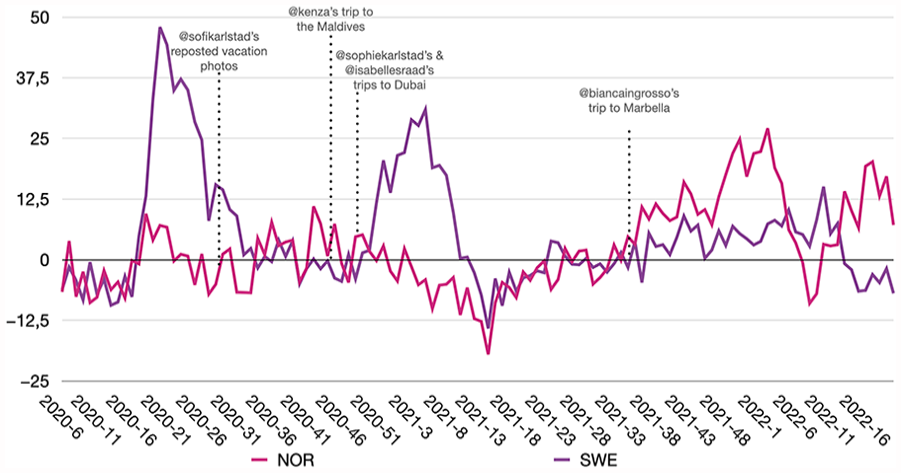
Timeline. The date of the study’s case studies shown over the excess mortality scores in Sweden and Norway during the COVID-19 pandemic[3]. The x-axis shows the timeline written in year and week (YEAR-WEEK) for the period from early 2020 until April 2022.
The pandemic was defined as a crisis, evident in both national and international authorities’ communication and the mass media’s reporting (e.g. Bjørkdahl et al., 2021; Ytre-Arne and Moe, 2021). A crisis, by its very nature, triggers affective responses, typically inducing fear and often inciting anger (Hoff-Clausen, 2018: 31–32). The pandemic was a type of crisis that could evoke particularly intense feelings and affects, as the virus directly threatened our bodies (Johnson, 2016). Along with this, the pandemic had a profound impact on people’s daily lives and mobility. We therefore suggest that the pandemic created an affective context that influenced followers’ reactions to the influencers’ international travels. Many followers reacted to the influencers’ travels with indignation and anger, often manifested in accusations of them acting irresponsibly and selfishly. Indignation and anger are common emotional reactions to feelings of uncertainty and threat, as well as to perceived violations of shared norms and values (Condit, 2018). Public expressions of these emotions, in particular in accusations, may function as a social regulation that, at once, conserves and reinforces, and invites reflection upon and negotiation of, the community’s norms and values (Condit, 2018: 75). The anger directed at the influencers’ travels during the ongoing pandemic can thus be interpreted as emotional reactions to actions seen as jeopardising others and contravening the solidarity emphasised by authorities, urging citizens to stay home. While these expressions of anger may prompt influencers to reconsider their actions and seek forgiveness, they also function to rally others in confirming the importance of solidarity and to join in condemning the influencers for failing to display solidarity.
Affective intimacy
The followers’ critique of the influencers’ travels was largely based on their expectation of influencers as role models who should lead by example. While this expectation was often implicit, it occasionally surfaced in comments such as, ‘You are failing to be a good role model’ and ‘It is sad that you are a role model to many’, both addressed to the Norwegian influencer, Isabel Raad. However, not all influencers faced equal levels of criticism for their travels. Instead, some appeared to largely escape such criticism. We propose that this divergence can be attributed to variations in the personal and intimate connections influencers establish with their followers.
In January 2021, 12 posts from Dubai in the United Arab Emirates appeared in Sofie Karlstad’s feed. Many of these were images of her in lingerie or swimwear, often gazing directly into the camera with a captivating allure. Although some followers voiced concern about her travelling during the pandemic, most comments expressed appreciation of Karlstad’s physical appearance. Karlstad has built her influencer career through participation in various reality shows such as Paradise Hotel and Ex on the Beach. Her Instagram content primarily comprises endorsements for various products and brands, and she projects a self-brand image associated with a luxurious lifestyle. While frequently appearing in little clothing and provocative poses, she rarely grants her followers a glimpse behind the scenes. Karlstad’s posts seldom contain intimate details about her day-to-day life, her relationships with friends and family, or her innermost thoughts and feelings. Her captions are typically brief, rarely addressing the audience directly. Moreover, she seldom interacts with her followers in the comment fields. Thus, Karlstad’s followers are mainly invited to get acquainted with her public persona. Most comments from followers were also not inviting interaction; instead, many of these simply expressed admiration for her looks. Sometimes, she also received criticism. However, the bulk of this critique manifests as body shaming or allegations of leveraging sexuality and endorsing cosmetic procedures.
Around the same time, on December 29, 2020, a post featuring an image of Isabel Raad on a luxurious aeroplane appeared on her Instagram feed. Two days later, on December 31, followers soon learned that the plane’s destination was Dubai. In January 2021, 12 posts from the Dubai trip appeared in Raad’s feed, containing images of her, for example, posing in front of sports cars with palm trees and skyscrapers in the background. In contrast to Karlstad, Raad’s posts were characterised by a personal tone. She often addressed her followers directly as her ‘Internet friends’, asked them questions, and openly shared her personal thoughts. In return, many followers expressed a personal investment in her life, often stating that they ‘live through her’ in her day-to-day life. Raad is notably responsive to many of these comments, nurturing a mutual bond between her and her followers.
Beyond Instagram, Raad also utilises platforms like YouTube, where she conducts Q&A sessions, talks about her experiences as a celebrity, and engages in candid conversations about personal struggles. Moreover, she has co-authored a book with her mother, delving into her upbringing as the child of an immigrant mother and her experiences in child protection services (Raad and Khalil, 2023). She also stars in her own documentary series, Isabel (TV2, 2020-), which offers viewers behind-the-scenes glimpses into her private life. By providing followers with intimate insights into her life on various platforms, Raad thus cultivates an affective intimacy that draws followers closer, creating a sense of connection and validation.
Previous research has emphasised the significance of intimacy in the success of female influencers, both as celebrities and brand promoters (Berryman and Kavka, 2017). However, this emphasis on intimacy has also raised concerns, as the pressure to cultivate intimacy can leave influencers feeling more accountable when their followers call their life choices into question. This vulnerability is particularly pronounced among marginalised influencers who may experience ‘weaponised intimacy’, involving the exposure of private information online (Glatt, 2024). Our analysis extends these notions, highlighting the critical role of affective intimacy in influencers’ capacity as role models, as well as the nature and intensity of the criticism they receive regarding their life choices. This is particularly evident when considering the degree to which they are held accountable for their conduct and expected to serve as role models in societal matters. Specifically, the two very different reactions to, on the one hand, Karlstad’s travel to Dubai during the pandemic, and Raad’s travel to the same location on the other, shows that critique was not solely based on the actions of individual influencers.
Both influencers were criticised in national news and guested on the television talk show God morgen, Norge, where they were criticised by other influencers (Støre and Berge Christensen, 2021). This criticism revolved around their positions of power on social media, specifically as role models. Unlike politically motivated criticism of influencers who travelled to and promoted Dubai as a tourist destination (Arnesson, 2024), the objections in this case focused on the influencers’ perceived lack of solidarity with the rest of the nation, which was making personal sacrifices to prevent the virus from spreading. This contrast was evident in how many comments to Raad’s posts drew a distinction between the influencers’ actions and the actions of ‘the rest of us’, frequently invoking the term ‘dugnad’, a Norwegian word for voluntary community work. An example, is the following comment to one of Isabel Raad’s posts, How stupid is it possible to be! Stay at home and join the dugnad!
Many Norwegians regard ‘dugnad’ as a typical Norwegian practice and an essential national value, as underscored by the government’s appeals to the nation during the COVID-19 pandemic (Bjørkdahl et al., 2021). ‘Dugnad’ came to represent not only what other people were doing but also what followers believed the influencers should be doing – sacrificing their comfort and desires for the common good. However, although both Norwegian influencers did receive criticism in the mass media for their travel practices, their followers reacted differently to their travels. Whereas Raad was held accountable by her followers, Karlstad’s followers mainly interacted with her travel content as online entertainment. Raad’s followers expressed disappointment in her, through comments like ‘I used to like you a lot, but I’m so disappointed in you now’, indicating that her behaviour did not align with their expectations, both in the context and in their perception of her as a role model. In contrast, most of Karlstad’s followers focused on celebrating her appearance. The ‘lexical absence’ (Machin and Mayr, 2012) of criticism of Karlstad, in contrast to the scrutiny Raad faced, suggests that affective intimacy plays a role in whether influencers receive moral critique. In a broader context, this suggests that followers with an intimate connection to the influencer have higher expectations of them as role models and react when these expectations are disappointed (Arnesson, 2024).
Ideological squaring of moral positions
In September 2021, Bianca Ingrosso travelled to Marbella, Spain with her friends. In one of the posts from this trip, she posed for the camera wearing a green dress on a patio in front of exotic greeneries and parasols, with the caption ‘Green is such an underrated colour (green heart emoji)’. This photo sparked criticism that spoke specifically to the aspect of ‘being green’ – that is, acting in environmentally friendly ways. The juxtaposition of her green outfit with the beautiful scenery of her destination in an exotic tourist location seemed to spark a reaction in and of itself. Especially, her use of the green heart emoji in the caption, frequently associated with environmental issues like recycling, sustainability, and veganism (Ho, 2022), drew attention. Relating to her reference to the colour ‘green’, both in text and emoji usage, one commenter wrote, The only thing green here is your outfit.
As previous studies have shown, the pandemic curtailed people’s travel behaviours not solely due to travel advice but also environmental concerns (O’Connor and Assaker, 2022). A noteworthy difference between the two national contexts studied, is the presence of comments invoking climate change as a context for critique in the Swedish material, whereas such responses to the influencers’ travels are strikingly absent in the Norwegian material. This disparity highlights the contextual nature of how influencers’ actions and behaviours are perceived and given meaning, reflecting differences in both the political response to the pandemic and the broader debate in the two countries concerning individual responsibility in reducing air travel. While pandemic restrictions were stricter in Norway than in Sweden, the concept of ‘flight shame’ first gained prominence in Sweden, sparking debates and affecting attitudes and travel behaviours (WWF, 2019). In contrast, the Norwegian debate on flight shame was relatively short-lived and had little observable effect on people’s attitudes and behaviours (Andersen, 2022).
While many commentators criticised Bianca for travelling during a pandemic, some followers directed their criticism at each other, highlighting the perceived biases and immorality in others’ comments, specifically for not recognising other reasons to avoid travel, as in the following comment, So funny that everyone is pointing fingers just because they cancelled their trips due to corona. I wonder if bianca has failed to read the news lately about the state of the world atm. BUT WHAT ABOUT ALL OF YOU WHO BOOKED TRAVEL DESPITE EVERYTHING THAT IS WRITTEN ABOUT THE CLIMATE RIGHT NOW. Take a hard look at yourselves instead.
This comment reveals a disagreement about who bears responsibility and for what. While it does not challenge the idea that long-haul travel is morally questionable, it disputes the moral basis on which other commenters base their critique. This form of ideological squaring (van Dijk, 1998), where one moral context is juxtaposed against another, constitutes a ‘whataboutism’, a discussion technique that involves responding to an accusation by accusing the opponent of hypocrisy (van Eemeren and Houtlosser, 2003). In doing so, the commenter discredits the criticism by alleging hypocrisy and shifts the focus away from the content of the critique by introducing a different issue (Stevenson, 2010).
Similarly, Sofie Karlstad responded to the criticism she received in the mass media when travelling to the Emirates during the pandemic. In a comment, she listed a set of moral criteria that her critics should fulfil to critique her travel content: everyone who has not done any of these things during the pandemic are allowed to be pissed:
Not partied at home.
Had no visits in the past week.
Not been abroad during the summer break.
Had no more than two close contacts.
Not held the 1 m distance during Christmas.
Not exceeded the 10 ppl rule more than two times this Christmas.
Not partied this christmas/new years.
Karlstad’s response is a form of self-defence, absolving herself of blame not by disputing the morality of her actions but by questioning the legitimacy of moral criticism. Essentially, she suggests that no one has the authority to criticise the actions of others and portrays moralising as an intrusive and unwarranted interference in personal matters. Furthermore, her defence is grounded in a rejection of the belief that she is a role model and should be held to higher standards than others. Likewise, some followers defend Karlstad and other influencers by accusing critics of ‘hypocrisy’ and ‘jealousy’ and suggesting that ‘everyone should mind their own business’. These interactions, whether between influencers and their followers or among followers, illustrate a contest for the moral high ground, with participants vying to have the morally superior rationale for condemning the influencers’ actions (see Andersen, 2020, p. 225).
Conclusion
Influencers, driven by economic incentives and the need to maintain their self-promoting image, often find themselves under the scrutiny of their followers. This study has focused on influencers’ pandemic travel content and the audience response to these posts, to demonstrate how their platforms can serve as arenas for public debate about norms and behaviours, particularly in times marked by uncertainty about appropriate conduct. Long-haul travels by influencers have previously faced various forms of moral critique related to environmental, post-colonial, and human rights concerns (Arnesson, 2024; Larsson, 2019; Smith, 2018). However, the pandemic introduced a distinct context for critique. It served as an affective context, evoking strong emotional responses, including anger and indignation, as followers grappled with questions of uncertainty, risk, individual responsibility, and solidarity. At the same time, our analysis suggests that for some followers, other issues, like the climate crisis, still constituted a more legitimate context for critique than the pandemic and that followers both criticised and defended the influencers and each other. Thus, we argue, followers are both an audience and a public; in their interactions with influencers and each other, they are both commodified and engaged in ongoing negotiations on values, norms, and politics.
Our study shows how influencers, as well as some of their followers, can strive to mitigate the role model function beyond a commercial context. Although a core idea for influencers is to create a need, or desire, for specific products and lifestyles, they tend to retreat to the personal sphere when criticised, asserting that their actions are not meant to influence others. Moreover, our study suggests that the expectation for influencers to act as role models is intricately linked to their relationship with followers. Maintaining a personal and intimate relationship with their followers may cause influencers to be held to higher standards and face greater accountability, while focusing on appearances and providing limited details about their personal lives may be a way to avoid such expectation. While earlier research has emphasised affective intimacy as both crucial to the success and vulnerability of influencers (Berryman and Kavka, 2017; Glatt, 2024), our study thus provides novel insights into the impact of affective intimacy in influencers’ capacity as role models and the intensity of the criticism they receive in societal matters. Thus, our study broadens our understanding of the intricate interplay between influencers, followers, and the societal context in which they operate. Specifically, it underscores the critical role of affective and relational factors in shaping the accountability of influencers and the moral standards they are expected to uphold.
This study has focused solely on influencers from a Northern European context, meaning that the results should be understood within the contextualised policies, restrictions, and overall cultural conditions of this region, especially during the pandemic. The pandemic timeframe has also entailed that the ongoing contexts of political discussion regarding long-haul travel, and the influencer industry at large, reside beyond the scope of this study. Future studies should include influencer critique in relation to other political issues and contexts.
Footnotes
Data availability statement
Data sharing not applicable to this article as no datasets were generated or analysed during the current study.
Declaration of conflicting interests
The author declared no potential conflicts of interest with respect to the research, authorship, and/or publication of this article.
Funding
The author received no financial support for the research, authorship, and/or publication of this article.
