




Abstract
This article analyzes how Marxist platform-dependent cultural producers in Brazil - one woman and two drag queens - navigate platform spaces in relation to their identities and everyday work. Struggling with platforms refers to the specific ways in which Marxist cultural producers seek to engage in class struggles, while also grappling with the constraints imposed by platforms. There are paradoxes, tensions and frictions in these efforts. In analytical terms, the article develops how this ‘struggling with platforms’ occurs in two main dimensions: (1) struggling with identities – including the implications of being a Marxist cultural producer on platforms and how one's identity is shaped and commodified in this space, and (2) struggling with everyday work – considering how the pursuit of social change is both constrained and enabled on platforms.
Introduction
‘A Brazilian drag queen or woman presents Marxist concepts to an audience.’ This scene could play out at a university, union, or political party. But it takes place on YouTube. Historically, left-wing activists have been present in various political institutions and also in media, such as newspapers and television, communicating their values and politics. But what happens when Marxist cultural producers go to commercial social media platforms, creating and distributing content? How do they navigate relationships with platforms? How do they build their identities, differentiating themselves from so-called ‘influencers’?
This article analyzes Marxist platform-dependent cultural producers in Brazil and how they navigate platform spaces, in relation to their everyday work and identities. It identifies these people as platform-dependent cultural producers by situating them within the platformization of cultural production (Poell et al., 2022). Marxist cultural producers already existed before platforms, with other nomenclatures and identities, as educators or communicators. Following Poell et al. (2022: 9), cultural producers are understood as ‘actors involved in the creation, distribution, marketing, and monetization of symbolic artifacts’. They are dependent on platforms (Schor, 2021), in the sense of infrastructural and economic dependencies.
The Marxist cultural producers at the center of this study do not identify with labels such as ‘creators’ or ‘influencers’ to describe the work they do. These labels are often given by the platforms themselves (e.g., YouTube creators) (Duffy et al., 2021), and Marxist cultural producers avoid aligning themselves with platform discourses, as a way of discursively demonstrating their political position.
The politics and values of cultural producers must be addressed more consistently in the scholarship on platforms and cultural production. This is important for those who are fighting against dominant meanings – following Stuart (Hall's 1991) proposition – contesting political and media power (Couldry and Curran, 2003) and provoking other circulations of meanings (Couldry, 2000; Dyer-Witheford, 1999). This is true for Marxist platform-dependent cultural producers, who work in tension and struggle with the platforms.
This article constitutes an effort to localize and contextualize platformized cultural production - considering Marxists producers in specific realities (Brazil, drag queen or woman). But this does not mean exoticizing Marxist cultural producers or understanding them from the perspective of uniqueness. These producers are confronted with forms of platform power that affect many cultural producers (e.g., Arriagada and Ibañez, 2020; Duffy and Meisner, 2023). Furthermore, this contextualization effort means understanding that these Marxist cultural producers emerge in reaction to the dominance of far-right politics on social media in the Brazilian context (Pinheiro-Machado, 2019).
At the center of the analysis is the concept of ‘struggling with platforms’, which refers to the ways in which Marxist platform-dependent cultural producers engage with platforms, re-shaping their identities, and everyday work. This leads to paradoxes, tensions, and frictions, especially in relation to their ideological and political values. These cultural producers join the platforms to spread the word of Marxism to more people, and, in doing so, find both new audiences - and new ways to communicate their ideas. Yet, they also experience constraints in relation to platforms. ‘Struggling’ does not necessarily mean resistance or antagonisms, but tensions and paradoxes, not necessarily negative or positive. The article develops how this ‘struggling with platforms’ occurs in relation to identities and everyday work of three Brazilian platform-dependent cultural producers focused on Marxism. Identities refer especially to the discursive dimension (Fairclough, 1992; Hall and du Gay, 1996), in relation to the construction of online identities (Dyer and Abidin, 2022). Everyday work – inspired by Thompson's (1966) culturalist perspective on the everyday dimension of class – refers to how they manage their work and their business in relation to platforms, including forms of platform governance.
In recent years, even with the strengthening of the far-right in Brazil (or because of it), a scene of Marxist platform-dependent cultural producers has emerged in the country. This article analyzes three of them, two drag queens, Rita von Hunty and Dimitra Vulcana, and one woman, Sabrina Fernandes. They synthesize, in Brazil, the struggles of Marxist cultural producers with the platforms, and they stood out in the ‘Marxist scene’ amid straight male dominance. We analyze how they mobilize their identities, develop everyday working routines, while struggling with platforms in their cultural production.
The results show that these Marxist cultural producers make the different layers of contradictions and paradoxes visible. As such, ‘struggling with platforms’ can be understood as a proper aspect of class struggles. In relation to identities, they reject notions of ‘creator’ and ‘influencer’, preferring to address issues of education, pedagogy and communication – trying to reach a wider audience. This means a strategic use of platforms for educational purposes. The most common strategy, then, is struggling with the platforms and not, necessarily or openly, against them. To deal with this ambivalence, Marxist cultural producers try to persuade/train their audiences to use platforms in a smarter fashion, engaging with progressive content online and understanding that education cannot be commodified – that is, it cannot be understood only in terms of platform logic. Thus, the article offers a contribution to platform and media industries studies by highlighting how, even amidst the struggle with platforms, Marxist cultural producers manage fissures (Ferrari and Graham, 2021) and develop political agency (Bonini and Trere, 2024) to dispute meanings (Hall and du Gay 1996) in relation to social life.
Marxist cultural production and platforms
Long before the emergence of platforms, communication and media played an important role in political disputes, as a place for recognition, collective voice and struggles for visibility (e.g., Champagne, 1990; Couldry, 2010). For Marxists, creating and circulating symbolic artifacts is essential work for engaged political action since the writings of Marx and Lenin. Historically, media are a means for mobilizing and organizing, as demonstrated by Bertolt Brecht. Later, in the 1970s, cultural studies scholars, especially Raymond Williams (1977, 2005), emphasized the role of media and culture in Marxist praxis. Thus, cultural production through media is understood as a tactical space to disseminate Marxist ideas, increasing and strengthening engagement with them. This can mean both direct political action and long-term training in class consciousness. Given this historical importance of cultural production for Marxists, they find ways to produce symbolic artifacts according to the means of communication available at their time. Therefore, Marxist cultural producers have begun to occupy social media platforms.
However, the materialities of platforms (Bollmer, 2019) are different from a newspaper or magazine produced and distributed by Marxists to reach out to a specific audience. In fact, as widely known in media studies, each medium presents specific challenges in terms of production, distribution and consumption. Thus, following Williams (2005), means of communication engender certain forms of means of production. In relation to social media platforms, this means that Marxist cultural producers occupy space that they do not own – unlike, for example, the working class press in the Marxist tradition. In fact, this process is part of the broader platformization of political communication, as a process of change and dependency on platform infrastructures and affordances (Poell et al., 2019). The scholarship on this issue has addressed how platforms impact political communication, including in Brazil (Santos Junior, 2021), involving forms of political engagement (Rodrigues, 2020), protests (Schradie, 2019), and the use of social media platforms by social movements and activists (Trere and Bonini, 2024).
Dependency on platforms is at the same time infrastructural, economic, and technological. Thus, platforms shape the ways in which Marxist cultural producers perform their identities (Dyer and Abidin, 2022) and practice everyday work. The fact that this happens within capitalist infrastructures is not a novelty for Marxists, but it is even clearer and complex in the context of commercial platforms. Marxist cultural producers have to simultaneously navigate being a Marxist under capitalism and trying to pursue a political agenda through platform logic. In terms of content production, this leads platform-dependent Marxist cultural producers to a framework of ambivalence and contradictory pressures (Glatt and Banet-Weiser, 2021).
The visibility game (Cotter, 2019), as something routinely played by platform-dependent cultural producers, is also an issue for Marxist cultural producers. For example, scholarship on platforms and cultural production has emphasized how platform-dependent cultural producers who are minoritized in terms of class, gender, race, sexuality, disability, etc. have long faced dilemmas around visibility and invisibility in relation to platforms (Bishop, 2019; Duffy and Hund, 2019; Duguay, 2019; Glatt and Banet-Weiser, 2021; Petre, Duffy and Hund, 2019). For Marxist cultural producers, this means competing for spaces for ‘bottom-up anticapitalist organization building, public pedagogy, and alternative media making’ (Mirrlees, 2021: 1).
There is an emerging scholarship (e.g., Cotter, 2022; Maddox and Creech, 2021; Mirrlees, 2021, 2023; Sylvia and Moody, 2022) that highlights how socialists are producing content for social media, with a dual activity of ‘communicating within and against digital capitalism’ (Mirrlees, 2021: 57). Mirrlees (2021) argues that, even with limits, this is an opportunity for socialist cultural producers to make themselves visible in a ‘many-to-many’ dynamic. We add that social media can even function as a stage to compete for visibility in the ‘mainstream’ media. In the past, Marxist cultural production was relegated to singular spaces, such as factory newspapers, for example. Mirrlees (2023) also considers that the production of socialists for social media can mean addressing public pedagogies, circulating the struggles (Dyer-Witheford, 1999) of socialism and Marxism.
If platform-dependent cultural producers, especially those belonging to minority groups, encounter similarities to varying degrees in their dependence on platform logic, what distinguishes Marxist cultural producers is their approach to utilizing it. They employ social media tactically to disseminate socialist and Marxist ideas, as a form of pedagogy.
Struggling with platforms: Tactics and contradictions in the Marxist cultural production
We argue that Marxist cultural producers are ‘struggling with platforms’. On the one hand, this builds on previous scholarship (e.g., Bishop, 2023; O’Meara, 2019) that emphasizes the role of agency of cultural producers - including creators and influencers - vis-à-vis platforms. On the other hand, Marxist cultural producers try to use platforms in a tactical way, as a tool for class struggle and ideology. This article highlights two dimensions of struggling with platforms: identities and everyday work, meaning disputes and conflicts between political values of cultural producers and the commercial meanings of platforms. The context for these struggles is the understanding that the materialities of political struggle – and therefore class struggle – currently involve the struggles over meanings on social media platforms, as a groundwork.
It means locating and historicizing tactics and antagonisms in the everyday fight against platform power (Bonini and Trere, 2024). As Heemsbergen and colleagues (2022) state, antagonisms not only develop in relation to technical systems, but also in relation to power. Antagonisms have always been part of the lives of the subjects of the majority world in relation to media and technologies (Pereira et al., 2022). Thus, the relations of subjects with platforms are constructed within specific social, political and local contexts. These tactics were theorized by the Latin-American media theorist Jesús Martín-Barbero (1993) as mediations – the way people engage with media considering identities and positionalities. These tactics and antagonisms can also have a more radical character, either in terms of refusing technologies and platforms, or in ways of proposing radical alternatives to dominant platforms (Mueller, 2021; Muldoon, 2022).
In the context of different genres of platform-dependent cultural production, Duffy and Meisner (2023), Arriagada and Siles (2023), and Are and Briggs (2023) highlight different ways in which cultural producers try to deal with platform institutions - such as governance and infrastructure, as nested precarities of social media creators (Duffy et al., 2021) and as platform governance ‘from below’ (Duffy and Meisner, 2023). This means considering the point of view of cultural producers and how they navigate their relationship with platforms, presenting a series of tactics, fissures and resistance.
The notion of ‘struggling with platforms’ relates strongly to the above-mentioned literature, as a perspective to understand the ways in which cultural producers relate to platforms. In this case of Marxist cultural producers, ‘struggling with platforms’ means, firstly, an ideological struggle and a struggle over meanings. Following Stuart Hall's (2003) perspective, this concerns how they engage with platforms as Marxist cultural producers and as specific ‘brand subjectivities’ (Arriagada and Ibañez, 2020), pursuing social change in a radical sense, while producing content for capitalist platforms. Second, ‘struggling’ also means struggling with their identities, as Marxists or cultural producers, and how they do their everyday work. This activity can be addressed as a tactic used by Marxists to employ hegemonic apparatuses for subversion. But this tactic also reveals limits and contradictions related to platform logic.
Thus, platforms are a site of struggle and, in Marxist terms, they are a component of class struggle. Signs, language and culture are at the core of ideological disputes (Williams, 2005). More specifically, ‘struggling with platforms’ can resemble what Nancy Fraser (2018) calls ‘boundary struggles’, ‘as nodes of contradiction and potential crisis, these boundaries are both sites and stakes of struggle: at once locations where conflict erupts and objects of contestation’ (Fraser, 2018: 213). This means focusing on the contradictions (Harvey, 2014) that emerge in struggles with platforms.
Methods and context
We analyze the social media content of three Brazilian Marxist cultural producers through a critical discourse analysis (Fairclough, 1992, 2003) to understand their struggles with platforms. This means understanding enunciation and discourse from a broader social context, also considering that discourses are inscribed in certain materialities (Bollmer, 2019). In this case, social media platforms constitute the socio-material context, which allow certain discourses to the detriment of others.
To do so, we collected videos, tweets, and posts from all the three creators: Sabrina Fernandes (803 Instagram posts and 215 YouTube videos), Dimitra Vulcana (1300 Instagram posts and 287 YouTube videos) and Rita von Hunty (1270 Instagram posts and 267 YouTube videos), since the beginning of their content production on Instagram, YouTube and X (formerly Twitter). Considering the enormous amount of content (3373 Instagram posts and 769 YouTube videos), the publications were first categorized according to two pre-established dimensions, statements about the cultural producers’: (1) everyday work, considering labor conditions, including contexts of production, work organization and monetization strategies; (2) identities as Marxist and/or cultural producers and their relationship with platforms. At the end of the analysis, a floating reading of the tweets of cultural producers was conducted based on these dimensions, to which 30 additional posts were also incorporated from X.
This corpus had 71 statements from Instagram posts, YouTube videos and tweets – 18 related to labor conditions; 24 about relationships with platforms and 26 identities. Every quote of Sabrina, Rita and Dimitra are part of this corpus 1 . The statements date from September 2017 to March 2023. After the data analysis, we re-categorized the corpus, considering the following dimensions: (1) struggling with identities; (2) struggling with everyday work.
The three examined cultural producers are among those with highest number of followers on Brazilian YouTube in 2022, having inspired the development of a ‘Marxist scene’ during the far-right Bolsonaro government (2019–2022). The notion of ‘Marxist scene’ refers to Marxists producing content for platforms with great visibility and circulation on social media in the country. The selected producers explain Marxist concepts and books and aim to ideologically dispute the meanings around internet content production in the country, including on the left itself. We focus on specific cultural producers because in addition to being drag queens and a woman, they are Brazilian, that is, they produce content in Portuguese and within the Latin American region. This does not mean, however, exoticizing their content, as they are inserted in a global scene of platform-dependent cultural producers (Cunningham and Craig, 2021).
Rita von Hunty is the drag queen performed by Guilherme Terreri, who is an actor and professor of English and Literature from Sao Paulo. In 2015, Rita von Hunty began her own journey on YouTube with the channel Tempero Drag, initially as a vegan cooking show with various guests. With the rise of the extreme right and Bolsonarism in Brazil, Rita von Hunty intensified the production of videos with political content, addressing topics such as feminism, queerphobia and Marxism. According to them, Some things happened in the field of politics and I saw a very strong need to start talking about them. […] I was concerned with understanding which direction we were heading as a society […] So Rita is a tool that I found to dialogue with a wider audience. Inside the classroom I have a range, with a wig and lipstick I have another. All I did was to find a way to use my tool as a vehicle for my ideas and speech.
Sabrina Fernandes holds a PhD in Sociology and a Masters in Political Economy from Carleton University in Canada, where she developed an award-winning thesis on the depoliticization and fragmentation of the left in Brazil. She defines herself as a militant of the radical and revolutionary left, in the fields of ecosocialism and feminism. Sabrina started recording videos for YouTube and Facebook in June 2017, as she felt that long and hermetic texts about Marxist theory were less read and had little impact on Brazilian society. On her own words: And then they ask me why I created this channel. The left is fragmented […] but if there's one thing I propose in my thesis, it's that we try to dialogue in the greatest possible ways. That means, then, to set an example and to face the slap.
In 2018, the channel was named Tese Onze, in reference to the Communist Manifesto, with 436,000 subscribers. The channel's content focuses on scientific dissemination and political education. During the pandemic, Sabrina used Twitter as a space for outbursts and personal issues. In July 2023, Sabrina Fernandes decided to conclude the activities of her channel. Among the reasons, Sabrina mentioned work overload due to the accumulation of tasks related to content production and her career as a researcher.
Dimitra Vulcana is a drag queen performed by Danilo Lima Carreiro, a gay man, and professor with a PhD in Health Sciences. In 2016, they created the Hora Queer podcast. Initially, their podcast only brought questions about the LGBTQIA + struggle, but gradually it started to bring Marxist content after being often called communist by haters. Inspired by Sabrina Fernandes’ Tese Onze, they created Doutora Drag YouTube channel in 2018 (currently with 40,000 subscribers), focusing on Marxism and anti-capitalism discussions. Among the three influencers, they comment most on her personal life and routines. These nuanced profiles inform the way in which these cultural producers struggle with platforms, in discursive and material dimensions.
Struggling with identities
The first dimension of ‘struggling with platforms’ is related to their identities, both as Marxist and cultural producers. In digital contexts or in other institutional spaces, ‘social identities are manifested in discourse’ (Fairclough, 1992: 138) and can be understood, in Bourdieu's terms (2010), as ‘struggles for classification’, in the sense that the way they prefer to enunciate themselves in Marxist or content producer terms is never neutral but reveals values and ideological positions.
Sabrina Fernandes, Dimitra Vulcana and Rita von Hunty describe themselves in diverse ways. One common choice is to make their Marxist affiliation not explicit, or to make it invisible. Rita von Hunty, who reaches the larger audience among the cultural producers, does not mention any association to Marxist ideas on their YouTube About Section. She says: ‘we have been dealing with social and political issues with humor and art since 2015. We believe in education as a tool for emancipation and we work together for more and better access’. Fairclough (1992) pointed out that texts are intertextually entangled and they cannot be clearly identified or attributed. When Rita presents their work as ‘education as a tool for emancipation’, they are in correspondence with the Marxist meaning for emancipation, as ‘emancipatory transformation requires popular mobilization and struggle’ (Wright, 2018: 495). Rita gives enough information for comrades but, at the same time, avoids potential stigmatized interpretations of what a Marxist may look like or may address on a YouTube channel. To lay audiences, Rita might appear as a teacher discussing current issues, if we consider the titles of her videos: ‘Is it a sin to be LGBT?’; ‘Beauty Standards’; and ‘Monogamy’. This is one of the many paradoxical, but also pedagogical strategies to gain wider online audiences. This is a synthesis in relation to struggling with platforms.
In addition to negotiating assumptions to reach more and new audiences, there is a base audience that is also crucial in the cultural producers’ communication strategies: the Brazilian left. However, following Cotter (2022: 8), Marxists in Brazil face a ‘[…] constant state of existential crisis, which is evident in discourses about the community's disunity’ since it ‘[…] hosts a spectrum of beliefs, ranging from Social Democratic to Maoist […]’. Sabrina Fernandes reports in a video, for instance, that there is a devaluation from Marxist institutions, parties and leaders of what Marxist YouTubers do on platforms: There are several studies out there about how the Brazilian population informs themselves and the impact of social networks is enormous. That alone should serve as a warning to people on the left who think that being called a youtuber is an insult and that they belittle the debates played on the internet.
No wonder Rita von Hunty justifies her presence on YouTube by referring to Lenin: ‘If we think of historical-dialectical materialism, if we think of Uncle Lenin from the height of his erudition, of his theoretical accumulation, he was printing newspapers and delivering them at factories’. Here, Rita evokes the concept of personification in politics to defend what is done by Marxist on social media platforms. Rita's statement invalidates the accusation of the Brazilian left that this is unimportant work. Furthermore, these cultural producers consider the importance of doing political groundwork in spaces other than social media platforms. Dimitra Vulcana points out: ‘Today there are left-wing content producers on the internet that were not so common before […]. We took a while to get to platforms and understand them as a tool and not as a means (of groundwork) in itself’.
This perspective may lead to the idea that a Marxist may be a ‘an agent preparing and hastening up conditions for change, rather than the site in which said change occurs’ (Kuznetsov and Ismangil, 2020: 205). The struggle of what is expected from a Marxist – groundwork – and the potentialities of digital communication – but still ‘just’ potentialities – is part of a constitutive struggle for platform-dependent cultural producers. This demands from them constant negotiation to be part of the political debate, including different ways of naming their activity as cultural producers.
The discourse of the Marxist cultural producers is shaped by a confluence of interdiscursivity and nondiscursive constraints (Fairclough, 1992). The analyzed corpus consistently engages in a discursive ‘response’ to discourses surrounding the practices of digital influencers, elucidating how their labor is entangled with these norms, filled with questions, tensions, and struggles. Throughout, there is a deliberate effort to reject being labeled as mere ‘influencers,’ in a sort of pushback against implicit yet widespread cues.
Sabrina Fernandes, who has an academic and research career, says it bothers her to be defined as an influencer: ‘I'm treated like “this influencer”, because it is kind of a job category. But the word itself bothers me […] So instead of being an influencer, I prefer to be a multiplier’. The idea of a ‘multiplier’ comes in dialogue with Paulo Freire's (2000) thoughts in which the author treats teaching not as the transfer of knowledge, but the creation of possibilities for its construction. Hence the idea of a multiplier as opposed to an influencer: ‘
You can't just deal with politics with influencers at the top and consumers at the bottom […] that's why we don't like the term influencer, I know that in fact we end up influencing people, but I always like it saying that I would like to be a multiplier […] because if not, there is this hierarchical notion that is very bad.
Dimitra Vulcana and Rita von Hunty call themselves ‘teachers’ – emphasizing their role ‘outside’ social media: ‘My place in the world […] is this hybrid between a teacher and an actor’; ‘I am a teacher and I will continue in this large room teaching what I always learn with humility’. The emphasis on the role of ‘teachers’ puts them away from the stereotype of influencers and shows a movement to leave the ivory tower – valued among left-wing cultural producers.
The fact that there are a woman and two drag queens producing Marxist content on social media platforms also adds a layer of complexity. In a Brazilian ‘Marxist scene’ dominated by straight cis men, including on platforms, the performances of Rita von Hunty, Dimitra Vulcana, and Sabrina Fernandes present tensions in relation to the historically constructed identity of what it means to be a Marxist. On the one hand, they caught the audience's attention and managed to reach a wider audience because they did not communicate exactly what an aesthetic stereotype of a Marxist would be. On the other hand, they define their identities based on Marxism and socialism, even when they present feminist or LGBTQIA + content. Thus, their identities are not positioned in the ‘drag scene’ on platforms, for example.
Besides that, for cultural producers dedicated to leftist issues who ‘aspire to be “transformational” – to change social norms, to challenge discrimination, to disrupt systems of power […] there is a limit to its progressive potential’ (Glatt and Banet-Weiser, 2021: 54). Even though there is activist and critical content on platforms, in the case of Marxist cultural producers the challenge may not lie in the content itself but instead in how platform infrastructures and governance are structured. Meaning platforms are an actor in this process of struggle. Platforms are based on the processes of commodification of users. This logic is prominent within creator cultures where it is mandatory to engage in micro-celebrification practices (Vizcaíno-Verdú and Abidin, 2023), constant personal branding, self-optimization for platforms, and the commodification of authenticity (Bishop, 2023). A decisive contradiction arises here: the labor of platform-dependent cultural producers is characterized by personality, authenticity, and relatability (Abidin, 2015). The self takes priority over the content, and the attainment of visibility is a byproduct thereof. However, these Marxist cultural producers aim to reach a substantial audience to effect radical societal and economic structural changes – objectives that have very little to do with their own image. It ends in a content creation that is always under ambivalence and contradictions related to how the content is not the main character, but the – not occasionally called – influencer.
Sabrina Fernandes reports discomfort with the commodification of her own image, pointing out that she never had any intention, at the beginning of the channel, to perform for audiences. Her original intention was simply to ‘play a bunch of content’ without needing to talk about herself. What she perceived, years later, as a certain naivety since the internet ‘is about the ad-hominen, everything is about the speaker’, but she insisted: ‘[…] I don't work with my image, it is part of the communication tool, but it is not central to me’. Sabrina also reports getting constant comments on her outfits, makeup, and hair on videos, denoting gender-based aggressions, intensifying the suffering of the Marxist woman who produces content for YouTube. Rita and Dimitra do not express the same discomfort with the commodification of their images while performing as drag queens.
Self-commodification of personal lives is also the basis of digital influencers’ business model. The branded self allows more appealing advertorial spaces that offer a possibility of financially maintaining (unpaid)work online – but also indicates an economic logic that is not totally integrated by Marxist cultural producers. Sabrina addresses it in another statement:
Most people who work with digital influence work with the digital market. They work with ads; I don't work with ads. They work a lot with their image, so a person who is a blogger is telling about their daily life and opens up their intimate space a lot, I have a lot of difficulty doing that.
This commodification happens both on a discursive level - in the sense of shaping struggles with their identities - and on a material level, in terms of how this relates to everyday work with platforms.
Struggling with everyday work
Marxist cultural producers struggle with their everyday work on platforms, a process that we understand as their relations with labor, work routines, business models – or ways to sustain their channels, and the relationships with platforms themselves. This is a key material dimension of their everyday life.
Here emerges a pivotal and material point of differentiation between creators, in a broader context, and Marxist cultural producers. In common, all are involved in platform-based dynamics, thus, they see impacts of platforms on the production of their content, distribution, and monetization – materialized in algorithms, governance, terms and conditions. In the broader creator community, particularly those affiliated with lifestyle, fashion, and beauty content, reliance on sponsored content agreements with brands is commonplace. This entails not only the commodification of the creators themselves but also the negotiation of audience trust as a prestigious and valuable commodity transacted with brands. In the words of Shtern and Hill (2021: 261), ‘value is being created through the commodification of individual creators’ audiences, in particular, the trust in the authenticity of the content and creator’.
In opposition, Marxist cultural producers do not allow themselves to be commodified through sponsored content deals. There are two main results of this contradiction:
a feeling of being penalized for not following the logic of self-commercialization, since ‘Instagram became increasingly commercial and post delivery to people dropped a lot’, as Sabrina points out. Here, aspects of governance and algorithmic content management are evident. Dimitra Vulcana stated that she feels ‘humiliated by the algorithms’ in relation to what it ‘delivers to people’ or not. Thus, they feel that the reach and engagement are undermined by the platforms. a feeling that there is a loss in terms of monetization by exempting from the activity of selling oneself as a commodity. This sentiment is reiterated by Sabrina's statement: ‘Tese Onze was never called “Sabrina Fernandes” because I was never the blogger or the influencer, the issue was always the research and the content. This will only be possible if we can maintain a good flow and if possible increase to pay someone to work on our social media networks’. The discomfort lies in the fact that the content should be the protagonist and not the one who produces it.
Sabrina's reflections also provide insights into contemplating monetization strategies within a market delineated by monetization originating from platforms and/or contracted brands. In the former scenario, adherence to the capitalist and neoliberal precepts of platforms is requisite; in the latter, an additional requirement involves the commercialization of followers’ trust and one's own image, often at the expense of political content. It is in this vein that Glatt and Banet-Weiser (2021) posit constraints on creators aiming for societal transformation within platforms.
The impossibility of accruing visibility and sustaining political communication projects financially on platforms constitutes yet another contradiction in the symbiotic relationship between influencers, platforms, and the creator market or platform-mediated cultural production. Dimitra, for example, regrets that she finds it difficult to produce regularly for the platforms, due to both work conditions and funding. She has a fixed income, and currently remunerates two people with her YouTube channel. Thus, she is on the way to professionalization, but it is not yet fully realized. The exhausting working hours as a platform-dependent cultural producer are ironically perceived: ‘I am here working overtime for the YouTube company’.
Dimitra Vulcana elucidates how her business model is expanded precisely to subsidize content production: ‘Support our project at apoia.se/doutoradrag. Picpay […] or PIX […]. It is with this money that we pay the costs to maintain our channel, our podcast, and our study group to debate the works of Marx and Engels’. Additionally, she elaborates on Sabrina's strategies: ‘It comprises podcasts, study groups, channels, and the dissemination of significant research and activism pertinent to our times’. Dimitra emphasizes the cooperation work with Sabrina Fernandes, as a necessity for the strengthening of Marxist cultural producers on social media platforms.
Furthermore, these Marxist cultural producers reveal the labor behind militancy and cultural production. Sabrina complains about double and triple working hours, alongside the realization that the labor invested in content production often remains uncompensated by the platforms. Ideologically, she advocates for fair labor conditions for everyone who works with her, however, the enduringly long and arduous work hours pose a significant obstacle to this aspiration. As she makes clear,
that will only be possible if we can keep up steady workflow, and ideally, increase it to pay someone to handle the social media accounts. I don't want Tese Onze to come to an end, but the issue of cash flow is essential.
Sabrina Fernandes echoes similar concerns to Dimitra Vulcana regarding both the funding of the channel and the working hours. It is not a surprise since they both host podcasts and both maintain a crowdfunding platform for their work with rewards for supporters, such as exclusive videos, closed debates, and reading sessions. In addition, Sabrina also maintained the Tese Onze project by launching a paid study group, in which books selected by the cultural producer were read and discussed over monthly meetings. Particularly during the period of isolation imposed by COVID-19, Dimitra and Sabrina also expanded their platform production by embracing Twitch, a live streaming platform. They transitioned to frequent content creation on Twitch, where followers could financially contribute during live streams.
This economic model is not exactly distinct from other platform-dependent cultural producers, as authors such as Partin (2019), Johnson and Woodcock (2019) and McLeod (2017) have previously demonstrated. Rather than taking this as something distinct to Marxist cultural producers, it demonstrates, once again, how these cultural producers’ tensions with platforms occur, to be strongly present on the main platforms, while trying to find ways to not be so dependent on them for the continuity of their political communication (Figure 1).
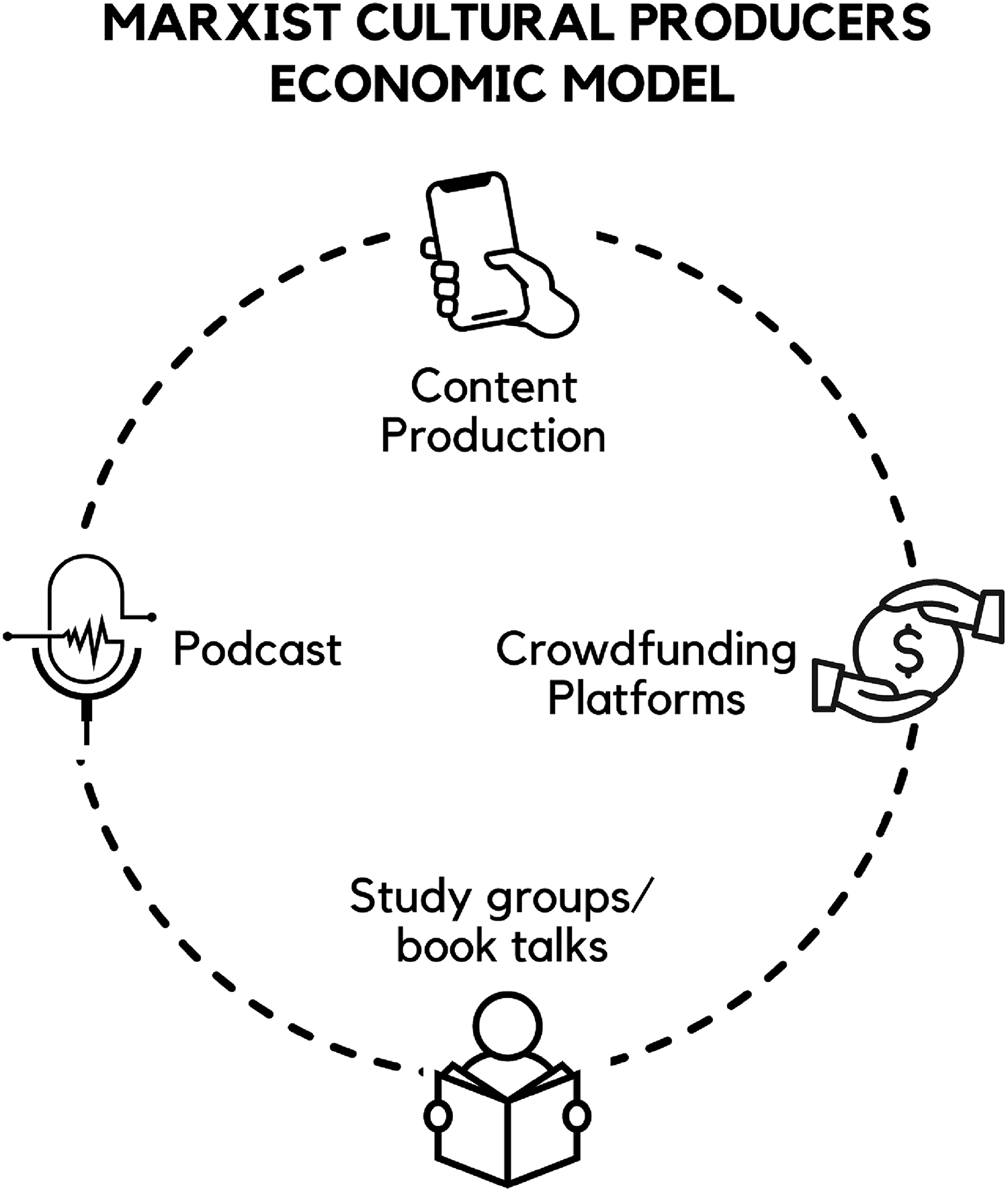
Marxist cultural producers economic model. Created by the authors.
Therefore, when talking about everyday work conditions, struggling means a reflexivity about their material conditions, especially regarding funding and working hours, and the teams. This reflexivity is a recognition of struggling with platforms, and the identification of their governance, bias and limits.
The relationship between cultural producers and platform governance is always a tough and controversial relationship, especially for minoritized platform-dependent cultural producers (Are and Briggs, 2023; Duffy and Meisner, 2023), who face unfair blocking and demonetization, risks of de-platforming, difficulties in dealing with content moderation, among others. In the case of Marxists, they report a ‘toxic relationship with the platforms’. This is nothing new in relation to platform-dependent cultural producers. However, these Brazilian Marxists have publicly criticized platforms from a Marxist political economy perspective. According to Sabrina Fernandes, The fact is that all these platforms have billionaire owners with billionaire interests. The rules are often obscure and nobody here has a guarantee that our serious work produced will be absolutely preserved in case of an attack. We don't even have a guarantee that our new video will be delivered to subscribers who have notifications turned on, or anything.
Rita von Hunty analyzes the issue from the same perspective as Sabrina highlighting the difficulties of producing Marxist content for platforms as their core business is based on entertainment and not education, and even less political Marxist education: ‘Today I am the biggest channel of the radical left, which goes to the root of problems. The audience consumes what interests them, and the most watched videos on the channel are about religion and love’. The biggest point of struggling with platforms is that, in her vision, the platforms were not designed for a deep and quality knowledge about the subjects, but for ‘fast food knowledge’. In a video dialog with Sabrina Fernandes, Rita von Hunty reflects about the demands that the public makes on Marxist cultural producers to comment on all ‘breaking news’. They affirm that it is impossible for a person to be able to produce quality knowledge about everything, but that this kind of demand from the audience reflects consumption demands in capitalism. Rita statement also reveals the recognition of speed and productivity as two important values of the platformization agenda. Therefore, in her view, there is a need for more dissemination among Marxist cultural producers to supply this consumption demand.
Thus, struggling with platforms here also means a tactic of, at the same time, trying to refuse the platform logic in terms of engagement and acceleration, trying to build a network of Marxist cultural producers. For both Rita von Hunty and Sabrina Fernandes, the discourse on platforms is more broadly related to the political economy of platforms. On the one hand, these Marxist cultural producers never express a desire to build alternative worker-owned platforms. But on the other hand, in addition to the struggle over meaning within platforms, there is the question of relational labor (Glatt, 2024). These producers engage with audiences beyond platforms, for example, in training courses, envisioning worlds that do not depend on platforms.
As we said previously in the literature review, forms of agency and resistance on the part of platform-dependent cultural producers occur regularly (Duffy and Meisner, 2023; O'Meara, 2019). However, here, these fissures seem to gain stronger contours in the critique, not only in discourses on platforms, but also in public discourses in other leftist spaces. This also means that these producers have access to social and cultural resources that do not make them precarious in the same way as cultural producers in North America.
Conclusions
This article offers an analysis of Brazilian Marxist cultural producers based on the notion of struggling with platforms. This notion considers contradiction and class struggle at the core of the relationships between cultural producers and platforms, in discursive and material dimensions. On the one hand, platform power acts to constrain identities and everyday work - including monetization and relationships with audiences and the platforms themselves. On the other hand, Marxist cultural producers find tactics to assert themselves as educators, and pedagogically circulate the word of Marxism, in addition to achieving other forms of monetization beyond platforms, struggling with platform dependence.
In discursive terms, there are ‘struggles for classification’ (Bourdieu, 2010) in the sense of rejecting commercial brands, such as influencers and creators, and asserting themselves as cultural producers who depend on platforms, in an educational and political sense. However, these Marxist cultural producers continue to be labeled as influencers or YouTubers, as audiences sometimes insist on framing them based on the logic of the platform. They see themselves more as teachers and educators and, therefore, try to stay away from a commodified logic of content production. Thus, they do not consider themselves as just another ‘brand’ to be consumed and sold through social media platforms. The fact that there are two drag queens and a woman producing Marxist content also complicates the very identity of what it means to be Marxist in Brazil. Their videos reach a wider audience while maintaining political coherence with Marxism as the central focus of the videos.
In the material dimension, following Mirrlees (2023), these Marxist cultural producers are ‘occupying’ and ‘disputing’ the platforms, in the sense of fighting for other meanings as counter-hegemonic communication, considering the platforms as a battleground (Bonini and Trere, 2024). They even compare the YouTube channel to the role of the workers’ newspaper for factories in the 20th century. However, part of this struggle with platforms is that – unlike the working-class newspaper – the whole logic of a YouTube channel is controlled by the platforms - with its owners and institutions – and not by the Marxist cultural producer. Even so, they find ways to navigate this, demonstrating that their forms of political communication are not limited to platform logic. This material dimension also means exhausting working hours, little funding and free labor. They even feel exhausted and humiliated ‘by the platforms’. Struggling here means communicating a Marxist content centered on the class struggle and, at the same time, having to take care of all the responsibilities of having a channel on these platforms, including forms of monetization. This struggle also means ways to try to circumvent platform dependence. This also means stating that these struggles are not in a vacuum, but in relation to the power of platforms.
The article contributes to research on platforms and cultural production, especially in creator studies. Although platform shape cultural production- in terms of platform logic and commodification - there are specificities in how Marxist cultural producers find agency amid platform dependence. This research is located in a Latin American context, namely Brazil, and aims to contribute to diversifying our understanding of ‘platform cultures’ (Steinberg et al., 2024).
Footnotes
Acknowledgment
We would like to thank all the guest editors, especially Arturo Arriagada and Thomas Poell, for the guidance and patience, the reviewers for the strong feedback, and all participants of the ‘Global Perspectives on Platforms and Cultural Production’ workshops for the valuable insights and conversation. We also thank Pedro Burity and Rafael de Toni for the research assistantship.
Funding
The authors received no financial support for the research, authorship, and/or publication of this article.

Notes
Author biographies
Issaaf Karhawi Assistant Professor of Communication at the Paulista University (UNIP), Brazil.
Rafael Grohmann Assistant Professor of Media Studies (Critical Platform Studies) at the University of Toronto (Department of Arts, Culture and Media & Faculty of Information).
References
