




Abstract
This article seeks to reposition freelance creative and cultural workers (CCWs) and conditions of creative work as the foundations of cultural policy making. Using a case study of Dundee, Scotland, in the immediate aftermath of the Covid-19 pandemic, the article draws on focus groups and interviews with creative freelancers, representatives of cultural organisations and members of a cultural strategy development group in Dundee. It presents how freelancers were not only missing from policy (national and local), their precarity was also exacerbated by cultural organisations in their response to pandemic-induced uncertainty. The potential for more caring modes of engagement with freelance CCWs are identified. Crucially, the article argues that this support work must also be resourced to be effective and sustainable. The article presents opportunities for rethinking the position of freelancers in cultural policy and sector leadership, and reflects on the capacity for academic research to support such work.
Introduction
This article reflects on challenges at the foundation of UK cultural policy making, that the people – specifically freelance creative and cultural workers (CCWs) 1 – and relationships that produce culture and drive the creative economy are often under-considered, under-valued and under-protected. It seeks to identify how freelancer CCWs, as the most precarious CCWs, can be better included in cultural policy (FitzGibbon and Tsioulakis, 2022), and how care (Alacovska and Bissonnette, 2021; Belfiore, 2021; Dent et al., 2023) can be better embedded in institutional practices, cultural leadership and employment relationships in a move towards more sustainable and just principles for creative work (Banks, 2017).
The onset of the Covid-19 pandemic in early 2020 added to the already precarious nature of employment in the creative and cultural industries (CCIs) and heightened the individualisation of risk when the industry was exposed to economic shocks (Comunian and England, 2020). In 2020, 9.3 million people in the United Kingdom entered the Covid-19 job retention scheme 2 – known as ‘furlough’ – while a further 2.7 million claimed a self-employment income support scheme grant (Office for National Statistics, 2020). However, while economic adversity was felt across the board, creative freelancers – who make up around 32% of the creative workforce in Scotland and 16% of the UK creative workforce (Connell et al., 2022) – were particularly vulnerable (Comunian and England, 2020; May et al., 2022; Scott et al., 2023). They were impacted by the wider fragility of the sector; a reliance on cultural production sites – closed by government mandate – for income generation, resulting in prolonged economic activity; and ineligibility for furlough or the self-employment support scheme due to flexible contractual arrangements, portfolio working or recent entrance to the sector (May et al., 2022). In Scotland, however, a ‘Newly Self-Employed Hardship Fund’ (Scottish Government, 2022) and specific funds for creative freelancers (Cancellation and Hardship funds) (Creative Scotland, 2022) were established to support those ineligible for other support via UK-wide schemes, demonstrating the potential for devolved government and sector body action. Freelancers in this study nevertheless still noted challenges and inequalities in accessing such support, or were unable to sustain themselves on such funds. Scott et al. (2023) also highlight that many freelancers juggle PAYE and freelance contracts and therefore found themselves ineligible for any structured government support throughout the crisis.
More attention, therefore, needs to be placed on understanding freelancers’ rights and how Fair Work principles for freelance workers can be embedded in organisations and adopted by employers (Scott et al., 2023). Drawing on a qualitative case study of Dundee, Scotland, the article highlights how freelance CCWs were not only missing from policy at the national or local government level but could also be ill-considered in local institutional and organisational responses to the pandemic, including in public funding distribution (Belfiore, 2021). This is presented as a manifestation of national (Scottish and UK) policy in organisational priorities and policies and therefore behaviours and practices, whereby uncertainty and risk are passed on to freelancers. Attention is first drawn to mechanisms of systematic exploitation of CCWs in employment arrangements and funding mechanisms (Belfiore, 2021). Second, the article highlights that cultural organisations, networks and their leaders do have significant capacity for cultivating systems and networks of care (Alacovska and Bissonnette, 2021), but that such work often lacks recognition and resourcing. Specifically, the article argues for better resourced organisational strategies in which mutuality and solidarity with CCWs are prioritised (Alacovska and Bissonnette, 2021) as central to sustainable development of creative and cultural economies. Therefore, while holding cultural institutions to account (Belfiore, 2021), the article also acknowledges the structural pressures facing cultural institutions – during the pandemic but also in relation to long-term austerity in the UK and the ongoing cost of living crisis – and the emotional burden experienced by organisational leaders (also CCWs) in reacting to conditions of uncertainty and organisational precarity. The article highlights the potential for collective action and networks to provide alternative, more caring (Alacovska and Bissonnette, 2021) modes of engagement with CCWs, providing they are adequately resourced (Dent et al., 2022a; Scott, 2022).
The article also speaks to the need for a critical renewal of cultural policy studies (Belfiore, 2021), reflects on the value of researchers collaborating more with the cultural and creative communities they study (FitzGibbon and Tsioulakis, 2022) and notes challenges to overcome in communicating with policy makers in order to develop meaningful, even caring, research practices and impacts.
While the article focuses on the UK context, and Scotland in particular, this exacerbation of precarity for freelance creative workers has been experienced internationally (England et al., 2022; Joffe, 2021; Tanghetti et al., 2022). Furthermore, while highlighting local conditions, the Dundee case has relevance in other international contexts in relation to its political and urban re-imagining as a ‘creative city’ and culture-led regeneration strategy (Dent et al., 2022b).
Creative work, cultural policy and Covid-19
Cultural labour studies have highlighted the precarious and exploitative nature of employment in CCIs (Banks, 2017) and documented how recruitment and working practices create inequalities in accessing and progressing in creative careers (Brook et al., 2020). This is particularly prominent for freelance workers, as informal labour practices (including within formal economic activity) exacerbate precarity (Joffe, 2021). Dent et al. (2022a: 25) state that a policy focus on the economic opportunities offered by creative placemaking has reduced attention to both the wider ecology – the interconnections and interdependent relationships needed to foster a sustainable creative and cultural economy – and ‘the needs of the creative and cultural workforce within that ecosystem’. Mangset (2020) has also critiqued public authorities in the UK for continuing to support potentially obsolete cultural institutions, and notes the failure to improve the economic circumstances of professional artists through policy interventions and support schemes so far.
In the UK, significant connections have been made between the pandemic context and pre-existing literature critiquing the precarious nature of creative work (Comunian and England, 2020) and inequalities (Brook et al., 2020) which preceded the pandemic. However, in CCI policies and cultural strategies (including Covid recovery plans), the voices and knowledge of CCWs often go unheard (Comunian and England, 2020; England et al., 2022; FitzGibbon and Tsioulakis, 2022). Sargent (2022: 9) notes that ‘the sector can no longer evade the professional and moral responsibility to embrace those essential workers in more supportive and engaged ways’. This includes cultural organisations reflecting on their institutional practice and contractual arrangements with CCWs, especially freelancers. The UK-wide ‘Culture in Crisis’ project also presented that the ‘UK's cultural sector is undoubtedly at an inflection point and facing imminent burnout alongside significant skills and workforce gaps’ (Walmsley et al., 2022: 68).
Belfiore asserts that, to address such issues, we need to ‘bring our public cultural institutions to task’ (2021: 63, emphasis in the original) and focus on systemic exploitation of practitioners within public funding mechanisms. This article seeks to contribute to this growing body of critical cultural policy research, but also acknowledges the constraints under which sector organisations are operating and structural conditions which enable and, in some cases, demand such exploitation. Studies have also documented caring organisation and labour practices in CCIs (Alacovska and Bissonnette, 2021), demonstrating capacity for alternative, fairer and more caring approaches to become embedded more widely across the sector.
In Scotland, specific attempts to approve working conditions (including for freelancers) are, however, starting to be reflected in policy such as the Fair Work Nation vision for 2025 and the latest Culture Strategy (Scottish Government, 2020). This has included a review of the workforce which highlighted ‘an urgency to resolve “low pay and precarious work”’ (Scott, 2022: 4) and advocated for a collective leadership model involving the Scottish government, Creative Scotland and/or unions to address systemic issues. The Fair Work guide principles for working with freelancers, recommends supporting secure employment by: addressing contractual arrangements (including working hours, holiday entitlement, sick pay and pension contributions); ensuring fair pay (industry standard rates and the Real Living Wage); minimising use of zero hours contracts, unpaid positions and volunteers to cover key roles and tasks; offering flexible working; and taking steps to become a Real Living Wage accredited employer (Scott et al., 2023: 86). Adoption of these principles by sector organisations is voluntary and will require further evaluation to assess adoption rates and impact. More widely, Universal Basic Income (UBI) has been experimented with (Basic Income Scotland, 2021) and the Scottish National Party are proposing a minimum income guarantee (MIG) (means tested), but the Scottish Parliament does not have sufficient powers as a devolved government to bring in a UBI (Brawn, 2023).
In achieving better working conditions for freelancers, networks and supporting organisations (alongside governments) are key to sector implementation (Scott, 2022). Academic literature has emphasised the role of networks as catalysts and facilitators of sustainability for local creative economies (Komorowski et al., 2021). Formal and informal freelancer networks (online and offline) have emerged in recent years to meet challenges of isolation of freelance workers and foster workforce solidarity and knowledge exchange they may miss from being outside an organisational context (Scott et al., 2023). Mutual aid networks, collective movements and activism also emerged directly in response to the pandemic and increased CCW precarity (FitzGibbon and Tsioulakis, 2022; Tanghetti et al., 2022).
There remains, however, limited understanding of how such networks are formed and sustained, and how/whether they actually influence policy or stimulate growth (FitzGibbon and Tsioulakis, 2022). Notably, the review of the Scottish cultural workforce highlighted the need for sector-supporting organisations and networks to be incentivised, through additional funding, to support the implementation of a Fair Work strategy and collaborations to maximise resources and impact (Scott, 2022: 10). This article provides further support for the need for adequate resourcing of collective action and strategic intervention, and provides more nuanced understanding of how inadequate resourcing exacerbates systemic practices of exploitation (Belfiore, 2021), particularly for freelancers.
The case of Dundee
The article presents a case study of Dundee, a small (60 square km) post-industrial city on the east coast of Scotland, with a population of 147,720 in 2021 (National Records of Scotland, 2022). Dundee has a history of industrial decline, which has caused significant socio-economic inequality and widespread unemployment among local populations (Dent et al., 2022b): 3 the city has one of the highest levels of multiple deprivation in Scotland (Dundee City Council, 2020) with key issues of unemployment, youth migration, high drug dependency and poverty levels.
A targeted, infrastructure-heavy, culture-led approach to urban regeneration has been adopted by the local authority, including designating a Cultural Quarter in the 1990s and a waterfront development, including the creation of a flagship V&A Dundee (opened 2018), and further flagship projects driving tourism and job creation – an E-sports arena is predicted to open in 2025 and Eden Project Dundee in 2026. Dundee also delivered a successful bid to become the UK's first UNESCO City of Design in 2014, gaining international recognition for its cultural offering.
The city also hosts a number of creative networks, including networks of creative practitioners (e.g. Creative Dundee's Amps network – Amps), creative and cultural organisations (e.g. Dundee Cultural Agencies Network – CAN) and a strategic lead group for culture (the Dundee Partnership Cultural Development Group – DPCDG – including a Strategy sub-group), which act as a platforms for arts and cultural advocacy in the city. The DPCDG – made up of representatives of cultural organisations of different sizes and with diverse mandates across the city – have produced four cultural strategies and led the bid for Dundee to become UNESCO City of Design.
There is a lack of city-level reporting on creative and cultural activity in the UK, including in Scotland. However, an economic impact assessment of Dundee City's CCIs in 2018 (Reid et al., 2018: 4) identified 2800 CCI employees (almost 4% of total employment in Dundee City and 3% of all CCI employment in Scotland) and 255 registered enterprises in CCIs (8% of all registered enterprises in the city). Key sub-sectors were writing and publishing and computer games, performing arts and design. A high proportion of businesses were micro businesses (<10 employees) (86%), and nearly half were sole traders (47%). This profile does not, however, reflect changes associated with the waterfront development from 2018 onwards (V&A Dundee opened September 2018). In the 2019/20 financial year, 19 creative and cultural organisations and institutions in Dundee reported nearly 700 jobs, including 293 employees and 402 freelance/contractual (England, 2021). The majority of freelancers were classified as ‘part-time artists/creatives’ and this included freelancers/contractors on regular and temporary project or event-based employment. This, in part, reflects the (pre-Covid) availability of temporary/project-based employment opportunities relating to cultural regeneration strategies and an emphasis on outreach and education work (see England, 2021 and further discussion below) aligned with the city's cultural regeneration agenda (Dent et al., 2022b). In the 2020/21 financial year, total jobs reported fell by 21% to around 550, but the reduction in employment included only a small reduction of employees (−4%) (part-time and full-time) while freelance/contract staff reduced at a much higher rate (−34%) (England, 2021).
Methodology: Dundee recovery project
At the start of the pandemic, the DPCDG were working on the city's next five-year strategy and subsequently shifted to focus on the recovery of the sector. As part of wider cultural recovery planning in Dundee coordinated by the DPCDG, the author collaborated with Leisure & Culture Dundee and Dundee City Council Events Team on the ‘Dundee Cultural Recovery Project’ (DCRP). The project aimed to generate insights into the impact of the pandemic on the organisations and individual cultural workers (specifically freelancers) who make up Dundee's cultural economy and the role of policy in supporting the city's cultural recovery. The research builds on the work of the DPCDG and was designed collaboratively. Findings published in a policy report (England, 2021) fed into the group's cultural strategy and recovery planning.
This research takes a case study approach to be able to explore the local dynamics of the cultural ecosystem of Dundee and its response to the pandemic. While elements of the discussion emphasise local specificity, it also aims to illustrate the potential for models of best practice to be developed in this small post-industrial city context that can be exemplars for other cities. The potential for such learning between cities (in Scotland but also further afield) was also articulated by participants.
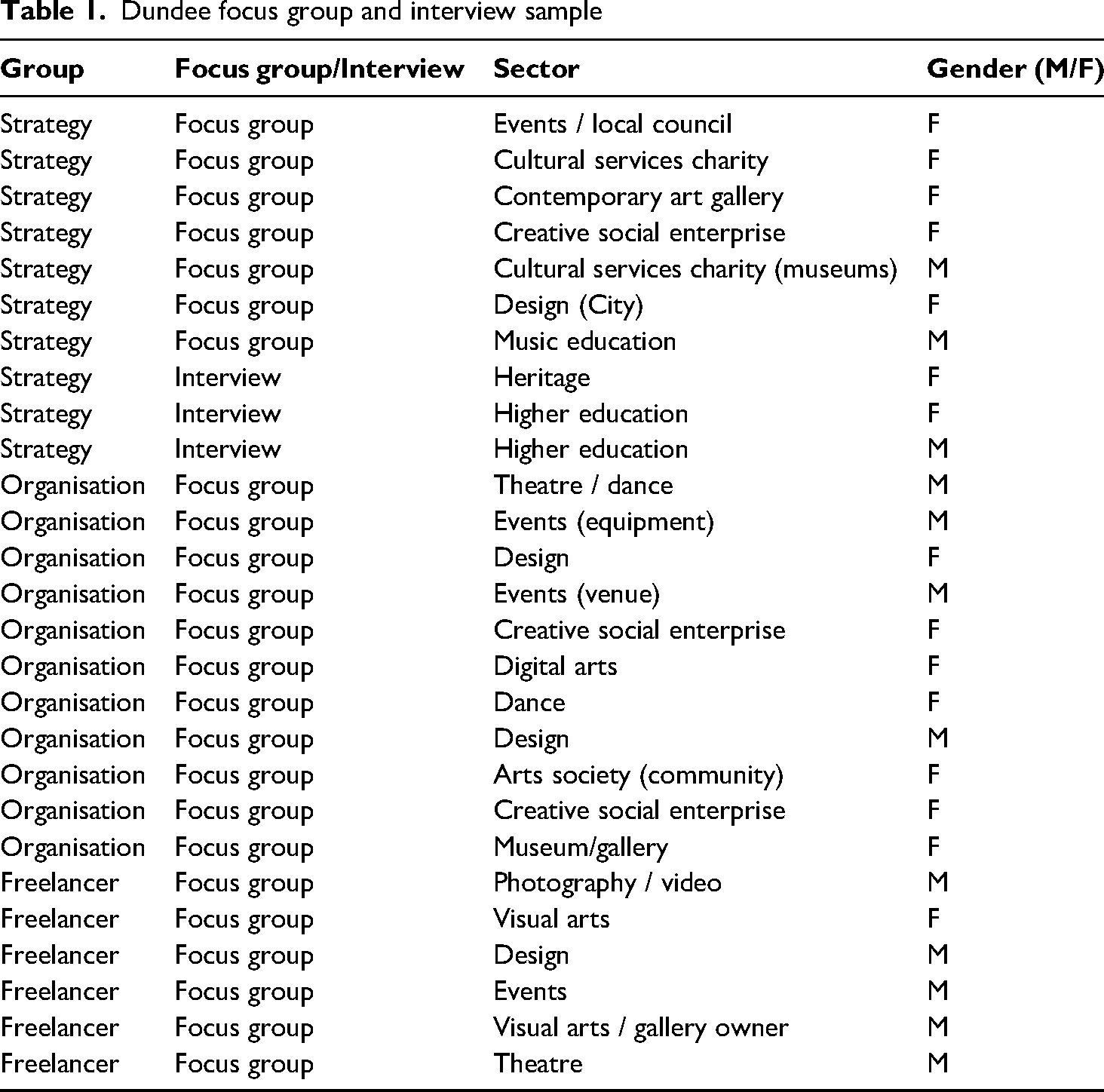
The article focuses on findings from three online focus groups with different cultural stakeholder groups in Dundee which took place at the end of June 2021 as part of the DCRP. The focus groups supported knowledge sharing around issues of Covid-19 impact and recovery to understand the economic, social and psychological impacts of the pandemic on different cultural stakeholders. Representatives of creative organisations (n = 12), members of a strategic lead group for culture in Dundee (n = 7) and creative freelancers (n = 6) took part. Each focus group lasted two hours and all activities took place online using MS Teams. Additional one-hour online interviews were held with key stakeholders (n = 3) who were not able to attend the focus groups. A total of 27 individuals took part, 4 see Table 1 for a breakdown of the sample. Freelancer participants were offered compensation for their time in the form of an e-voucher. All activities were audio recorded and transcribed verbatim for research purposes. Data was anonymised during the transcription process. Quotes used in this report are therefore labelled according to the participant group (freelancer, organisation, strategy) and the sector they work in (e.g. theatre, design, museum/gallery).
Dundee focus group and interview sample
Data analysis
Thematic analysis (Clarke et al., 2015) was applied, with iterative rounds of coding conducted by the lead researcher to consider the ways in which focus group and interview participants articulated the impact of the pandemic on Dundee's cultural ecology and reflected on the implications this had for the sector's future development, particularly with respect to the impact on CCWs. Themes were drawn from across the focus groups and interviews to highlight the interconnections and interdependencies between different stakeholder groups. Themes were discussed with other academics researching Covid-19 impacts on cities and creative work, and Dundee specifically, as a process of validating the findings.
Creative work and care in Dundee's cultural recovery
This section first reflects on the conditions of creative work experienced by freelancers in Dundee, connecting these with organisational responses to the pandemic which exacerbated mechanisms of systematic exploitation (Belfiore, 2021). It then addresses the potential for an alternative approach, where CCWs (including cultural leaders) have significant capacity for cultivating systems and networks of care (Alacovska and Bissonnette, 2021) and principles of Fair Work for freelancers (Scott et al., 2023). The subsequent discussion seeks to consider these two dynamics ecologically, considering how better resourcing of organisations and networks alongside supporting policy frameworks and improvement of freelancer workers’ rights could help to reduce mechanisms of systematic exploitation.
Conditions of creative work
The sudden, recurring, and persistent loss of employment (and consequently income) is one of the most severe impacts of the pandemic on CCIs, including in Dundee. The immediate impact of the closure of arts and cultural venues on creative workers and ongoing uncertainty within CCI organisations was the cancellation or postponement of contracts for projects and events that were no longer able to take place due to national restrictions. As noted earlier, Dundee's cultural organisations were heavily reliant on freelancers prior to the pandemic, and this group was worst hit by employment losses between 2019 and 2021 (England, 2021). This was particularly problematic (although not exclusively) for larger, venue-based organisations (often publicly funded), such as museums, galleries and visitor attractions, as their activities and opportunities to ‘pivot’ were more restricted by infrastructural and ongoing core cost demands (cleaning and security, increased Covid-security measures). Such organisations, however, were typically able to access a wider range of emergency/recovery funding and make use of furlough schemes for employees.
Freelancers described how this caused a significant or complete reduction in their income generated from creative work and, as a result, some had left, or were currently considering leaving the sector, and knew others who had already left. This is supported by quantitative UK labour force analysis, which indicates particularly high job losses among freelancers (Walmsley et al., 2022), and Scottish reports (Scott, 2022; Scott et al., 2023) on the creative freelancer workforce which highlight a critical skills loss and subsequent skills shortage resulting from freelancers leaving the sector.
Freelancers and organisations alike acknowledged that the pandemic had put unprecedented strain on cultural organisations and their leaders, and that uncertainty over funding and the inability to plan long term due to the unknown duration of, and potential further lockdowns created significant challenges in their ability to communicate with and effectively support their freelance staff. The lack of security and certainty at the organisational level resulting from the wider national response and volatile economic environment, subsequently filtered down to the freelancer community. although we’ve used […] furlough schemes […] we were put into a situation whereby we used to support lots of freelancers and artists and that's something that we really struggled with being able to do, although we have continued with certain contracts, it wasn’t as readily available. (Visual arts – Organisation)
I was in the middle of teaching a course […] that was cancelled straight out, within a day or two, I lost everything. So I had no work for quite some time. […] I found the larger organisations to be abysmal. The dropped us like hot potatoes, and then didn’t answer emails. And that's partly because their staff […] didn’t know what was going on, so they couldn’t tell us what was going on. But for freelancers, who are you know, weren’t on furlough, didn’t have you know, anything to turn to. (Photography/video – Freelancer)
Here cultural organisations are in some ways forced to be complicit (Belfiore, 2021) by conditions beyond their control, but their responses nevertheless exacerbate the precarity of freelancers. This reflects an institutional lack of accountability regarding freelance employment rights and conditions, and a wider tendency for the risks and uncertainty faced by cultural organisations to be passed on, manifesting in organisational priorities, policies and practices that create exploitative employment relationships with freelancers, as discussed further below.
While this has severe consequences for individual freelancers, it was also acknowledged that it has a damaging effect on organisations and the wider sector, which in turn impacts the speed and quality of recovery. This was felt particularly acutely in the events industry, as articulated below, and poses a particular challenge for Dundee as a large proportion of their cultural calendar was event-based. most of our staff are freelance. And the big concern now […] they’ve been forced to go off and do other things. […] there are customers all over the place that are scrambling now, for technicians, we can’t get them because they’ve decided to do other things. And that's going to be a pressure going forward as things start to open up. (Events – Organisation)
Beyond events, education and outreach work in Dundee was particularly hard hit by the pandemic (England, 2021). As noted earlier, a heavy emphasis on regeneration, but also social inclusion in Dundee – associated with the Creative City status but also wider social agendas in the City Plan and cultural strategy responding to the high levels of social deprivation across the city – had resulted in a large amount of outreach and education work at cultural organisations prior to the pandemic (England, 2021). Freelancers noted that there had been significant work in this area and that it formed a key part of their portfolio in Dundee.
It was indicated that education and outreach activity was not seen by organisations as ‘core business’ in the initial stages of the pandemic, and therefore not prioritised. For those that did continue with community outreach activities, such as designing activities for children and young people to try at home, this was often carried out by a remaining ‘skeleton’ in-house staff (those not on furlough), rather than using freelance contractors who would usually have been involved in live facilitation. Similarly, there were capacity and staff-skills constraints in trying to ‘pivot’ to digital when organisations were working with a heavily reduced staff and no additional resources.
A key issue for Dundee's freelancers was that education and outreach work was core business for them. Therefore, this work and income which was previously perceived to be ‘secure’ became insecure. For some, their experience of the short-notice cancellation of contracts and subsequent interactions with cultural organisations meant they were also giving up this form of project-based work (e.g. leading or facilitating creative workshops at museums and galleries). I’m a painter, and I sell my paintings. And then I also do freelance work, which is more kind of project based and stuff [at galleries and museums]. And I’ve actually given that up during the pandemic […] because I felt like I was treated so badly that I literally couldn’t live with myself if I went back to those places […] I always thought that is my safe and calm [job], and the painting was the thing that wasn’t secure. […] they literally just dropped us and, and then now, I’m still owed a couple of contracts. (Visual arts – Freelancer)
While arguably unintentional, this collateral damage again reflects a lack of institutional responsibility and the absence of a safety net for freelancers within the employment structures and cultures that sustain the broader creative economy. This lack of a social safety net for CCWs been reported in a variety of international contexts (Dent et al., 2023; Joffe, 2021; Tanghetti et al., 2022). While workers’ rights have been hard fought for (in the 19th and 20th century in the UK), these have typically been based on more traditional employment models and haven’t yet been transferred over to project-based labour (Dent et al., 2023). The adoption of Fair Work principles (Scott et al., 2023) indicates potential for improvement, although these do not (yet) constitute legal requirements.
Ultimately, the precarity of the freelancer workforce affects the resilience of the city's cultural ecosystem as a whole; the loss of a freelancer community (Walmsley et al., 2022) due to financial pressures will inhibit organisations’ ability to deliver programmes and events, and subsequently contribute to the local economy and community. This is particularly problematic for cities such as Dundee, where emphasis has been placed on culture-led regeneration and tourism as economic drivers and culture's key role in the city's social justice agenda.
In discussing largely negative contractual relations and exploitative practices in cultural work, both prior to and during the pandemic, it is important to note that freelancers in Dundee did highlight the good practice, particularly among smaller creative organisations, in their treatment of freelancers. These are discussed further in the next section. The main issues raised were with large, often publicly funded, organisations (museums, galleries and theatres). It was noted by organisational representatives that effort had been put into directing (national) recovery funding towards supporting freelancer creatives, either to retain/honour existing contracts or to generate new opportunities (particularly for community-based and/or digital work) and provide a source of income: ‘One of the amazing things about the funding was that the stipulation was that half of that had to go to create freelancers creating, like sustainable commissions for people’ (Digital arts – Organisation). However, when discussing their experiences of such opportunities, freelancers noted that funds were not always allocated in ways that were transparent, or sufficient to sustain their livelihood: a number of venues I was dealing with were saying […] we’re commissioning 45 writers, but, and that looks great on paper when you’re feeding back to Creative Scotland or the Scottish government […] but is a £250, 200 words piece that's going to be on a website for a year, actually a commission? Or are you kind of spinning, you know, spinning your kind of reach, your impact with the money you’re receiving to look good for future funding applications? […] as [for] the individual artist who's getting £200, £250 […] it's nothing. (Theatre – Freelancer)
Bad practices and contractual arrangements (including terms and conditions and remuneration) were exacerbated rather than generated by the pandemic: ‘what goes on in the industry, and what people try to get away with, has actually not changed’ (Theatre, freelancer). This included informal and off-the record agreements to reduce fees for projects, extensions to project timeframes and hours worked without additional remuneration and deducting money from subsequent commissions: You initially quote for, you know, four days work or three days work. And you’re doing way over and above. […] there's a lot of additional work that seems to be going on, there's a hell of a lot more admin, but the fees that are involved in the work aren’t changing. (Visual arts/photography – Freelancer) pieces that were originally commissioned digital pieces are going to be performed physically, but […] in the commissioning of the physical work, they’re going to deduct the money that the people were paid […] for the original digital commission. […] we had to really, really fight over such small amounts of money that were given to artists, and for big venues to be kind of seen clawing them back. (Theatre – Freelancer)
This again indicates that the uncertainty and risk experienced by organisations, the dynamics of the wider arts funding landscape and conditions-of-funding reporting (including fears of funding cuts or not being awarded funding in a subsequent year) trickles down and manifests in precarious, sometimes exploitative arrangements with freelance contractors. These findings speak to Belfiore's (2021: 61) critique of ‘mechanisms of systemic exploitation of artists within current funding practices’ and a lack of ‘provisions to ensure the fulfilment of duties of care’ within project-based public funding. Overall, it reflects the sharp end of instrumentalised culture which places so much emphasis on demonstrating ‘value for money’ and ‘impact’ from culture (Belfiore, 2021: 6) that it perpetuates the exploitation of those who deliver the work and, ultimately, facilitate the impact.
This scenario is by no means unique to Dundee, Scotland or the UK context. We also see such dynamics in Europe and beyond (Dent et al., 2023; Tanghetti et al., 2022), suggesting a wider sectoral and societal reframing of the value of creative and cultural work and workers is needed to address them (England et al., 2022; Scott, 2022; Walmsley et al., 2022). Arguably, this lack of care for freelancer CCWs stems from the hyper-competitive nature of CCW and CCIs in neoliberal society (Tanghetti et al., 2022) and the competitive arts funding landscape (Belfiore, 2021) which, perhaps unconsciously, encourages organisations to adopt exploitative practices. However, as Belfiore (2021) notes, responsibility for the relationship dynamics between cultural organisations and creative freelancers cannot be brushed aside as an unavoidable consequence of the institutional and economic environment. Scott et al. also note that while implementing Fair Work principles is undoubtedly challenging, ‘the burden of insecurity and risk should not rest on the shoulders of employees or other freelance workers’ (2023: 85).
The findings presented here indicate that cultural institutions – in relation to project funding but also overarching employment relationships with freelance CCWs – are complicit in adopting exploitative practices and reinforcing power imbalances. Here the freelancers who produce culture and its associated social, cultural and economic impacts, are consistently placed at the bottom of the hierarchy when they should be understood as central to the provision of culture and therefore cared for. Cultural leaders must, therefore, carefully consider the priorities and policies of their organisations – which often emphasise a social responsibility and a care for their community – and ensure that this care is also reflected in their employment practices (Scott et al., 2023). The next section emphasises practices of care that were already taking place in Dundee during the pandemic, highlighting the potential for such practices to be distributed across the city through coordinated, collective work.
Systems and networks of care for CCWs
A need for greater care for CCWs, both during the pandemic and as a general operating principle, was highlighted during this research. This was enacted through practices such as providing counselling for staff members following bereavement, but also in financial and management practices when considering the needs of their staff when on furlough (topping up pay to 100%) or facing redundancy. we lost three people, two older members, and a young person [died]. And that had a profound impact on our organisation as we were navigating everything. […] we thought we need to take care of ourselves as we take care of things. […] now we get counselling as an individual and as a group, and like professional counselling, because we do performing arts, we work with vulnerable groups. (Dance – Organisation)
We’ve got a new CEO, who is, one of our priorities is a socially just future. So anybody who is made redundant, she tried to find an alternative role for and […] she froze their salaries on their previous salary. (Visual arts – Organisation)
Dundee is a site of multiple creative networks. For freelancers, the Amps Network – moved online during the pandemic – became a key source of support and community building: ‘there was a stronger sense of creative community in Dundee during that time, even in spite of all that the kind of negative background radiation that was going on’ (Theatre – freelancer). Stakeholders across the three groups were also champions of the networked and collaborative nature of the city. This was partly attributed to its smaller scale, whereby connections across the city and beyond had capacity to enable more coordinated approaches to achieve fair working conditions. The Strategy group repeatedly referred to the city and its cultural organisations as ‘more than the sum of its parts’ (Visual Arts gallery – Strategy). As articulated by a member of the Strategy group, it was also highlighted that political leaders in the city were potentially willing to ‘do things differently’: we’re just like, the perfectly sized place for like, talking to people, generating ideas, coming up with new ways of doing things. […] the city ecosystem, and it works across like different community groups […] our local politicians kind of are up for trying things, well some of them, are quite up for doing things in a different way” (Design/ City – Strategy)
There were opportunities for the benefits of national support for cultural organisations (relief funding) to trickle down to creative freelancers although, as discussed earlier, this did not always result in effective financial aid or fair modes of working. Among Dundee's cultural organisations there was also potential to leverage collective capacity regarding fundraising and lobbying power. The frameworks for such collective action already exist in the city, demonstrated by the development of previous cultural strategies and the successful City of Design bids but also by the Dundee Cultural Recovery Fund; led by V&A Dundee, £1 million was raised from trusts, foundations and private donors to benefit five key cultural organisations in the city. While this fund focused on organisations, it nevertheless indicates significant potential for collective action and support to be distributed by existing networks at all levels of the city.
It was further highlighted how the development of Dundee's original cultural strategy, and the ongoing work of the DPCDG was very much a collective effort, requiring input and collaboration from across the sector, including the voices of freelancers, as represented by networks such as CAN. However, it was noted that the structure and work of the DPCDG had the potential to be venue-focused and exclude some aspects of the city's cultural ecology, including independent creatives and freelancers. This was acknowledged by the Strategy group, although, in developing the recovery strategy there was a conscious effort made to include freelancers in network consultations: We had really thought hard about how we involved all sorts of people in the writing process as well. And we paid independent artists and freelancers from Generator to be part of that, as well. And so we really did try to think about how we, I guess more formally involve people in that process […] I do think we need a structure […] which is then our reporting mechanism, to enable us to keep, keep pushing forward and make sure that all of those different shapes and sizes can be included. (Contemporary art gallery – Strategy)
However, there were and continue to be challenges in working collectively and inclusively. This was partly attributed to a lapse of DPCDG coordination and administration, but also in recognition of the many demands on the attention and energy of cultural leaders across the city dealing with serious pressures on budgets and staff in their own organisations.
While much attention has rightly focused on the particularly dramatic experiences of freelance CCWs during the pandemic (Tanghetti et al., 2022), it is important to note that feelings of exhaustion were also prominent among leaders of cultural organisations – who are also CCWs – who had continued working throughout the pandemic, with reduced resources and under conditions of great uncertainty: ‘I feel like we’ve got through it as well as we can, but everyone's just absolutely exhausted. And, you know, there's still all the kind of financial worries, all the kind of worries about what's going to happen next as well’ (Museum/gallery – Organisation). This was particularly acute in smaller organisations, where ‘the burden of responsibility of keeping it ongoing was on just a few people’ (Community arts organisation – Organisation).
It was also noted that the responsibility for directing the recovery strategy for the city and its cultural organisations was based on unsustainable labour, and that the individual cost of such labour impacted organisational capacity and the development of a city-wide cultural recovery strategy. it relies on unpaid labour. It relies on people being exhausted, it relies on people patching things together with friends and colleagues and then Dundee has this incredible ability to get together and make things happen. But it's done at a huge unsustainable cost to individuals, which then has an impact on the organisations within the city as well. (Visual arts – Strategy)
Strengthening support networks (Komorowski et al., 2021), or ‘local relational infrastructures of care’ (Alacovska and Bissonnette, 2021: 36), at different organisational levels is also important. The networks of greatest value to freelancers – namely Creative Dundee – are among the least resourced organisations in the city (England, 2021). Here, a lack of resourcing of actors at the smaller organisational level and community level creates an over-reliance on particular organisations and key individuals within them. It is argued that, alongside the cultural production and distribution work of CCWs, the work that goes into developing and maintaining ecosystem-sustaining networks and support systems also needs to be adequately resourced in order to be sustainable.
Discussion and conclusion
This article argues that the persistent precarity of freelance CCWs and their lack of representation as key foundational actors in CCIs not only represents a failing of cultural policy (Mangset, 2020), it also creates a point of fragility in the wider ecosystem and therefore limits the potential for sustainable creative and cultural economies development. However, rather than marking the ‘end of cultural policy’ (Mangset, 2020), it is argued that, following the Covid-19 pandemic, there is an even greater need for cultural policy and organisational practice to be revised following Fair Work principles (Scott, 2022).
The article emphasises two key points: first, that freelancers need to be central to the development of cultural policies, local cultural strategies and organisational approaches. This is because their contribution to cultural organisations (as leaders, workers, content producers and technicians) and local communities is what drives the economic and social contribution of culture. Second, that support for freelancers can be distributed through networks and collective action that constitute local relational infrastructures of care (Alacovska and Bissonnette, 2021), but that this work also needs coordination and resourcing (Dent et al., 2023; Scott, 2022).
To address the first point, beyond supporting the recommendations in the Fair Work guide (Scott et al., 2023) to reduce freelancer precarity, the article calls for a greater adoption of ecological approaches (FitzGibbon and Tsioulakis, 2022) that strengthen the interrelationships and interdependencies between different actors and cultural resources (Gross and Wilson, 2020). Such work could include ensuring freelancers’ voices are included in strategy discussions, and putting their needs and employment conditions at the heart of strategic planning. In evaluating the impact of creative economies, this article also calls for a move away from metrics emphasising the quantity of creative jobs towards an emphasis on quality, equity and inclusivity.
To address the second point, sector (support) networks and capacity for working collectively need to be capitalised on and made sustainable to support uptake of Fair Work principles (Scott et al., 2023). This is an area where Dundee has potential to become an exemplar for other (small) cities internationally by fostering its capacity for ideas generation and practices of care among its highly collaborative community. Strategy development work in Dundee – through the Cultural Partnership – has been and continues to be a collective effort, and valuable learning should continue to be drawn from across stakeholder groups and beyond the city, and shared with others. In line with the point above, further resourcing of freelancer contributions to strategy discussions, and continued integration with freelancer support networks in the city is also important. Such collectives, however, must be attentive to power dynamics, particularly when convening large institutions, small/micro-enterprises and individual representatives.
It is also important to recognise that strong, consistent cultural leadership is also creative work. This must be adequately resourced (Scott, 2022) in order to sustain collective capacity for action that can support the required radical rethinking and cultural strategy development without relying on goodwill and the work of already exhausted CCWs (Belfiore, 2021). Funding schemes that specifically incentivise (Scott, 2022) and support the development of connections across the cultural ecosystem – including freelancer representatives, support organisations/networks and policy makers – and make collective action sustainable would be a welcome intervention. An example of such funding is the Creative Dundee funding secured from Creative Scotland's Recovery Fund for a new Producer role to better centre the views of freelancers within the cultural strategy and action. Strategic collaboration could also be supported by the adoption of collective organisation models and budget management, such as SMART Coop (Europe), although this may be better suited to fostering collective working among smaller-scale enterprises and individuals rather than large institutional actors.
There is also potential for academic research to provide an evidence base for cultural organisations to draw on in funding applications 5 and impact policy and practice. Despite over a decade of published critique highlighting a inequalities in creative work (Brook et al., 2020) and fundamental flaws in cultural policy making (Belfiore, 2021; Mangset, 2020), the precarity of freelancers and other CCWs globally is perennial and ubiquitous; the same unsustainable and exploitative economic development policies continue to be implemented across the world, with policy makers seemingly disregarding evidence of their flaws. Recent reviews of cultural workforce conditions from around the world (Culture Action Europe and Dâmaso, 2021; Joffe, 2021; Scott, 2022) indicate potential for renewed engagement with scholarship and the development of new regulations and fair working practices. To sustain this, we must review existing mechanisms for policy engagement in academia and look at how meaningful collaborations and open-access knowledge sharing can be developed to generate real change in policy and practice. While universities increasingly focus on ‘pathways to impact’ in relation to research funding (Chubb and Watermeyer, 2017), pathways to local or national policy impact can remain unclear and difficult to navigate for many researchers. Enhanced sector or organisational policy impact could be fostered, however, by wider adoption of co-creative methodologies and researchers feeding more directly into strategy or activist campaigns (FitzGibbon and Tsioulakis, 2022). This could be supported through research funding and strengthening connections between universities and their local creative economy to enable capacity building. Other strategies could include making research accessible through open-access publication and alternative public publication/reporting strategies. Perhaps most importantly, better communication channels are needed with those in positions of power. This is perhaps the most challenging to achieve, although it could be supported through expansion of consultations with sector representative bodies (such as Creative Scotland) and all-party parliamentary groups, or research collaborations with local councils. By developing the DCRP collaboratively with the DPCDG, and sharing findings both directly with the Strategy group and in publicly accessible policy reports (England, 2021) that were subsequently used to leverage funding and support engagement with the local council, this research aimed to support more sustainable CCI development in Dundee.
Footnotes
Funding
The author disclosed receipt of the following financial support for the research, authorship, and/or publication of this article: This work was supported by the University of Dundee (grant number Impact and Innovation Grant 2021).

Notes
Author biography
Dr Lauren England is a Lecturer in Creative Economies at King's College London, UK. While conducting this research, she was a Baxter Fellow in Creative Economies at the University of Dundee (2020-21). Lauren is interested in creative enterprise and education with a focus on craft and design economies and sustainable development in both global North and global South contexts. She has published research on the craft economies, creative economy development in Africa and the impact of COVID-19 on creative workers.