



Abstract
What sparks collective acts of resistance to workplace inequality? This article considers the Covid-19 (C-19) pandemic as an interruption to established practices of creative work, one that creates the opportunity for politicised subjectivities to develop. It is based on a qualitative investigation of cultural and creative workers located in the Italian city Milan conducted in the aftermath of the first C-19 lockdown. Observations of an emerging sense of consciousness, a recognition of precarious working conditions associated with creative labour by those who operate within the sector, combined with the necessary resource of time created the conditions for collective action. Building on previous literature that considers the disruptive effects of interruptions, from either large-scale physical disaster or significant change to an individual's personal identity, the article explores the generative outcomes that can emerge from an interruption, one which creates opportunities for re-imagination and political re-futuring.
Keywords
Introduction
Work-based ‘interruptions’ have typically been understood from either a management/organisation perspective (Jett and George, 2003; Perlow, 1999) or through the impact of increased communication technology and/or globalisation on previously established norms of production (Wajcman and Rose, 2011). In this context, an interruption is generally considered to be disruptive to the overall productivity of the worker and their impact on outputs. Work in the cultural and creative industries (CCIs) has already been understood from a management perspective as sitting outside more traditional structures of work (Armstrong and Page, 2015; DeFillippi et al., 2007; Hesmondhalgh and Baker, 2011). Empirical research on creative labour has concentrated on the inequalities that emerge from atypical employment structures, with detailed investigations on how new productivity regimes associated with this form of knowledge work have created barriers of access and inclusion across gender, race, social class, disability and place (Dent, 2020; Gill and Pratt, 2008; de Peuter, 2011; Wreyford et al., 2021). The issue of work-based interruptions from an employment perspective, however, has not been widely considered in relation to cultural and creative workers (hereafter CCWs). This could be due to a persistent focus on the precariousness that is associated with individualised labour markets (Tanghetti et al., 2022), whereby project-based labour renders monitoring the management of productivity outputs at the individual and not organisational level. The global lockdown and social distancing policies implemented due to the Covid-19 (hereafter C-19) pandemic interrupted multiple forms of work, creating an opportunity to reflect on the relationship between labour and value. The abrupt interruption of the ability of some CCWs to conduct professional activity has dramatically exposed the precarity that these sectors have hitherto relied upon (Comunian and England, 2020). In the early days of the C-19 lockdown, many CCWs, whose livelihoods were within precarious labour markets, were suddenly left with no form of economic sustainability and no robust welfare system for immediate support. The time lag of various nation states in securing financial relief for CCWs pushed many into extreme economic hardship, as evidenced through concurrent studies (England, 2021; Walmsley et al., 2022), and exposed the fragility of this workforce.
In this article we consider how the initial C-19 lockdown, which took place within the period March–July 2020, can be understood as a political interruption. We apply a feminist theoretical framing that considers an interruption as a space for radical transformation (Baraitser, 2008), one that can create new forms of collective imaginings (Solnit, 2020). This framing was applied to data gathered from CCWs based in the city of Milan (Italy), an example of a ‘creative city’ (Montalto et al., 2019) linked to the fashion industry and associated creative clusters (Vanni, 2016). Milan has a history of grassroots collective action against precarious work and has been a focal point for Italian sociological scholarship on knowledge workers (Mattoni, 2012; Murgia, 2014; Murgia et al., 2017). This article is based on 16 interviews with Milanese CCWs conducted in the immediate aftermath of the first C-19 global lockdown, 1 providing a unique documentation of their experiences during this period. The C-19 lockdown illustrated the barriers created by project-based labour, with its particular dimensions of time and sustainability, to contestation, and the inability of workers within individualised precarious labour employment structures to access welfare support. The interruption created a space for reflection, an emergent consciousness of the unfair working conditions within which they had hitherto operated. While other outputs from this research have considered this consciousness (Tanghetti et al., 2022), this article focuses on the political possibilities that can emerge from a moment of interruption.
A wider global recognition of the value of certain types of care labour, combined with a public commitment around ‘rebuilding’ (Art Workers Italia, 2021) and ‘building back better’ (OECD, 2020a), creates an opportunity for rethinking aspects of accountability and developing more equitable structures for creative labour. There is a connection here to Horowitz's (2021) concept of ‘mutualism’ as a pre-existing model of social and workplace organisation that shifts the focus of growth and opportunity to traditions of care and support. However, as we argue, discourse must be accompanied with tangible actions, otherwise dominant narratives linked to ‘resilience’ re-emerge (Butler, 2004; Filion, 2013). As such, the article comes with the warning that emerging forms of consciousness and/or resistance should not be not mistaken for actual change. Following Glynos and Howarth (2007) on the logics of fantasy and dislocation that impede resistance, we acknowledge the reality that many of these workers continue to occupy precarious and economically unstable positions with the risk that C-19 will further exacerbate inequalities for the CCWs rather than help address them. That said, this article proposes that a political interruption can create the space for radical hope and an opportunity for re-imagination (Gross, 2022).
Interruptions and subjectivity
Butler's book Precarious Life (2004) presents a series of reflective essays written in response to the 2001 attacks on the US World Trade Center (WTC), in New York City on September 11. The essays consider the Bush administration's response to the 9/11 attacks and the use of ‘Terror’ as a rationalisation for increased domestic censorship and foreign military intervention. Butler reflects on a concept of a ‘precarious life’ to reinforce the notion that human beings are tied together through conditions of interdependence and vulnerability, and such moments of disaster could be opportunities for re-imagination (Butler, 2004). The political response to the September 11 attacks of 2001 did not result in a radical political transformation along the lines of re-imagining collective interdependence. Instead, narratives of retribution, terror, and the dehumanisation of foreign others rationalised military interventions. We start with this reflection on the power of discourse to drive policy interventions. Previous research in this area has demonstrated that following a disaster – either natural or human-made – there is a moment of reflection, a pause which creates a discursive space on the topic of radical transformation (Solnit, 2020). This is an occurrence that can be felt from a macro level, for instance the aforementioned WTC attacks, the 2008 global financial crisis and the 2020 C-19 outbreak to the micro, individual experiences of change, loss and grief. A sudden illness, the death of a close relative or friend, job loss, all create the space for personal reflection on the subject's condition prior to the event. This topic has been considered within disciplines such as psychology and behavioural science (Cueto and Agaton, 2021). It has also been addressed within feminist literature, where the impact of motherhood has been considered as constructive of a new subjectivity (Kristeva, 1981; Ruddick, 1980). In her book Maternal Encounters, Baraitser (2008) considers maternal subjectivity as the recognition of the ‘other’ within the self, and argues that this encounter illustrates the social structures that constrict women's participation in the wider social and public sphere. This subject has been addressed by feminist geographers in relation to newly formed encounters with public space that are experienced by the new mother/parent, the new restrictions on travel and movement when seen from the viewpoint of the ‘other’ in urban design that is not reflective of those with limited physical capabilities (Kern, 2020). It is this sudden encounter with structural limitations caused by an interruption that provides a space for reflection, and we apply this concept to our argument on the impact of C-19 on content creators in the CCIs. In this article, we argue that C-19 created an opportunity for CCWs to recognise their devalued position (Dent, 2020) within the economic model of creative production. By ‘other’ we refer to an awakening consciousness of inequality, of unfair exploitation that had hitherto not been understood or challenged. In this article, we consider the wider literature on precarious labour in the CCIs prior to C-19 and then consider the impact of C-19 as, potentially, helping to create a radical transformative conscious awareness across the labour market. From the initial impact of halted production chains and income opportunity, to the sudden scramble for data and evidence on the impact of C-19 on the CCIs, to new forms of collective communication and action, we can track the emergence of this subjectivity.
Precarious labour in the neoliberal cultural and creative workforce and the production of docile creative workers
There is a significant body of literature that reflects on the political and economic interest in the CCIs (Bakhshi et al., 2013; Dent et al., 2020; Gross, 2020; Hesmondhalgh and Baker, 2011; Nathan et al., 2015; UNDP and UNESCO, 2013). We know that the construction of the ‘creative industries’ label championed the economic value of this growing aspect of the neoliberal economy (Gong and Hassink, 2017; Gross, 2020; UNDP and UNESCO, 2013). The celebratory political discourse on the creative industries’ value was accompanied by an appreciation of new models of creative work. Applying concepts such as ‘flexibilisation’ and ‘autonomy’, the employment model associated with creative labour became that of the project-based, self-employed, individual, risk-taking worker, free from traditionally structured Fordist notions of work (McGuigan, 2010; Murgia, 2014). This focus on the workforce generated a body of empirical research that critically explored the working conditions within different pockets of creative/cultural sectors, including television (Ursell, 2000), fashion (McRobbie, 2002; Vanni, 2016) and new media including gaming (Dyer-Witheford and de Peuter, 2006). As knowledge of the various models of employment and governance exposed geographically dispersed examples of inequality and exploitation that had become normalised within these new cultures of work, precarity emerged as a unifying concept to understand the framework of employment across multiple creative, media and cultural sectors (Fast et al., 2016; de Peuter, 2011; Rabosto and Zukerfeld, 2017; Siebert and Wilson, 2013; Tirapani & Willmott, 2021). British scholars Gill and Pratt use Negri's concept of the ‘factory without walls’ to define the precarious labour conditions associated with CCW in the modern economy as, ‘all forms of insecure, contingent, flexible work – from illegalized, casualized and temporary employment, to homeworking, piecework, and freelancing’ (2008: 3). They go on to observe how precarious conditions create the possibility for ‘new forms of political struggle and solidarity’ (2008: 3) The emergence of collective consciousness and solidarity across precarious CCWs has, for some time, remained dormant, particularly following the 2008 global financial crash, when a discourse of ‘resilience’ and ‘entrepreneurial growth’ was used to rationalise and celebrate the economic growth of the creative sector during that period (Pratt, 2015). ‘Developing resilience’ in response to the austerity-driven cuts to public investment in the arts became a fundamental goal of the body set up to promote arts in the UK (Gupta and Gupta, 2022). The discourse of ‘resilience’ and an increase of exhortations to be more ‘entrepreneurial’ (Scharff, 2016) legitimised neoliberal policies that increased the ‘creative precariat’ (Filion, 2013; de Peuter, 2014). Pockets of resistance to such structural inequalities have been identified. For example, reflections on the impact of labour reforms implemented within Italy since the late 1990s illustrate the conditions by which precarious working conditions have expanded across all aspects of the Italian labour market, a trend amplified following the 2008 financial crisis (Arvidsson et al., 2010). Murgia (2014) points out that the conditions that create precarious labour are a combination of contractual reform in the workplace coupled with a reduced welfare state, both of which have been implemented in Italy during this timeframe. Resistance to these conditions has emerged from Italian labourers through mediated forms of political communication, situated outside of normative political actors such as trade unions and led by social movement groups that have used a variety of online and offline interventions to foster collective action (Mattoni, 2012). Despite evidence of resistance to precarious labour conditions, the structural persistence of atypical, project-based labour continued to limit the possibility for widespread resistance (Murgia et al., 2017). It appears that neither resistance movements nor academic research have had a dissuasive effect on either policy makers or large areas of the workforce. Despite the developing body of empirical evidence that documents multiple barriers to employment opportunities (Ursell, 2000; Wreyford et al., 2021), the rise in student numbers on cultural and creative-based higher education courses from the early 2000s has created an increasing supply chain of CCWs that have appeared unmotivated to collectively resist precarious working conditions (Comunian et al., 2011; McRobbie, 2016). This has led to an interest in the question of affect and the psychological rewards of creative labour (Banks, 2007; Conor et al., 2015; Gill and Kanai, 2018; Scharff, 2016; Taylor, 2011 ). Much of this literature has reflected on the susceptibility of CCWs to a neoliberal consciousness that was emerging in the new economy. Writers like Wendy Brown (2003) reconceptualised neoliberalism as more than a new economic model, seeing it as a political rationality that works inwardly on the subject, reducing all aspects of people’s lives to their individual market value. The actuality of being a CCW and the sense of self-worth associated with creative living obscured the ability to recognise or resist precarity (Arvidsson et al., 2010; Dent, 2020).
The political celebration of the entrepreneurial growth that drove the economic rise of the creative sector post-2008 was underpinned by external policies that further exacerbated inequalities, such as the rise of the global, creative city (Sassen, 2005). Concepts such as creative clusters and creative placemaking increased housing prices in urban areas, which exacerbated the socio-economic divides within cities and, ironically, pushed many CCWs out (Adkins et al., 2021; Comunian and Mould, 2014; Courage and McKeown, 2019; de Peuter and Cohen, 2015). This model, although widely discussed in the scholarly literature, has not been effectively challenged until the sudden interruption of cultural production in March 2020. The sometimes extreme disparities between those CCWs who had the ability to survive financially and those who were pushed into economic instability (England, 2021; Raising Films, 2021) exacerbated already acknowledged employment inequalities across social class, gender, ethnicity and other marginalised identities. It is important to recognise that not all employment areas of the creative economy were negatively interrupted as a result of the C-19 lockdown. Some consumer-led sectors, for example gaming and online streaming, experienced increased user engagement and profit (World Economic Forum, 2020). However, in this article, we focus on creative activity associated with the live arts sector, such as the performing arts and fashion events, characterised by a precarious, deregulated, unsustainable financial model, underwritten by hidden intergenerational assets that exacerbated the widening inequalities within the labour market. Thus we can consider C-19 as a disruptive event that interrupted the norms of production and created a moment that illustrated the limitations of this labour model.
Milan: from creative city to Covid-19 hotspot
Milan is the second most populated city in Italy after Rome (1.4 million inhabitants; see Istat, 2021) and is a major urban economic centre, producing 10% of the national GDP (Assolombarda, 2019). The city and its administrative region (Lombardy) are at the heart of the Italian creative and cultural economy. In 2021, CCIs in this area generated €23.7 billion of added value, employing approximately 344,000 workers, respectively, 27% and 23% of the nation's total (Symbola, 2022). The prominence of Milan as a creative city, and the consequent concentration of CCWs, has been internationally recognised (Montalto et al., 2019). Milan is known globally as an epicentre for fashion production (Vanni, 2016), for its international events, and as a key tourist destination (Assolombarda, 2019).
The concentration of CCWs in Milan has generated a scholarly interest on their livelihoods. There have been a number of studies that point to the recognition and consequences of precarious labour for Milan's CCWs (d’Ovidio and Cossu, 2017; Murgia, 2014; Vanni, 2016), showing a rising consciousness of inequality and new forms of activism and resistance (Arvidsson et al., 2010; Mattoni, 2012). In 2020, when our research interviews were conducted, the Italian region most affected by the C-19 virus was Lombardy, where around 800,000 C-19 infections and 33,000 deaths were recorded in the period February 2020–June 2021, with Milan identified as having the highest infection rate within Italy (Regione Lombardia, 2021). The fact that Milan was also one of the first European cities to experience the intensity and distress of C-19 adds to the value of reflecting on this location. Lombardy went into full lockdown on 8 March 2020, two days prior to the wider Italian territory. Lockdown measures were lifted in the region from May 2020, with various cultural and creative institutions able to offer some form of public engagement, albeit with strict social distancing measures. Following an increase in cases of C-19, a second lockdown was announced on 24 October, which remained in place until early February 2021. Both local and national periods of restrictions resulted in a sudden and severe impact on local cultural and creative work. As such, Milan is an interesting case study for reflecting on the political interruption caused by C-19.
Methodology
This article builds on data gathered as part of a self-initiated research project led by the authors, who were interested in understanding the impact of C-19 on CCWs based in Milan as the pandemic was unfolding (see Tanghetti et al., 2022). As stated, in 2020 Milan and the Lombardy region was the Italian area most affected by the C-19 virus. Sixteen semi-structured interviews with Milanese CCWs were conducted remotely, using internet-mediated communication, from April 2020 to June 2021. Interviewees were identified following a digital ethnography of online interactions between CCWs on social media platforms. All interviews were recorded remotely, conducted and transcribed in Italian then translated into English by the research team. The decision to limit the number of interviews to 16 was taken in response to saturation. In addition, the researchers noted how conducting this research during the unfolding events of the pandemic generated recognisable emotional responses from both participants and researchers, so a decision was taken to limit interview data collection at that time.
The interview respondents’ occupations spread across public art venues (1), PR and communications (1), visual art workers, including artists and curators (6), performing arts workers, including performers and technicians (8). In terms of employment contracts, two participants would be classified as employees, one was a company owner and the rest broadly identified as self-employed/freelance of whom six were non-VAT registered. Four of the interviewed participants had had active involvement in collective organisations/associations that addressed the question of unfair working conditions that had started as a direct result of the lockdown conditions imposed during the pandemic (Tanghetti et al., 2022).
Interviewees were offered complete anonymity, although some were keen for the group they represented to be mentioned. Each participant was asked to provide an overview of their working situation pre the lockdowns, during them, and as the lockdowns were lifted, focusing on their awareness of precarity, the structural problems of the sector, their connectivity with other CCWs and their relationship to the creative city of Milan. Interview transcripts were analysed thematically (Braun et al., 2019), enabling multiple reflections on the immediate impact of C-19 on precarious CCWs. It is important to acknowledge that, at the time of the interviews, neither participants nor researchers knew how or when the pandemic would end, nor what the long-term consequences would be. In another article (Tanghetti et al., 2022), we reflect on how the observation of increased online communication between CCWs in Milan discussing their situation during the lockdown led to the research interviews. As we analysed the qualitative interview transcripts, we reflected on the impact of the interruption on the subjective consciousness of the CCWs, relating it to the wider feminist literature and, because of our reflections, we propose a series of policy interventions that can rebuild the sector for radical inclusive sustainability.
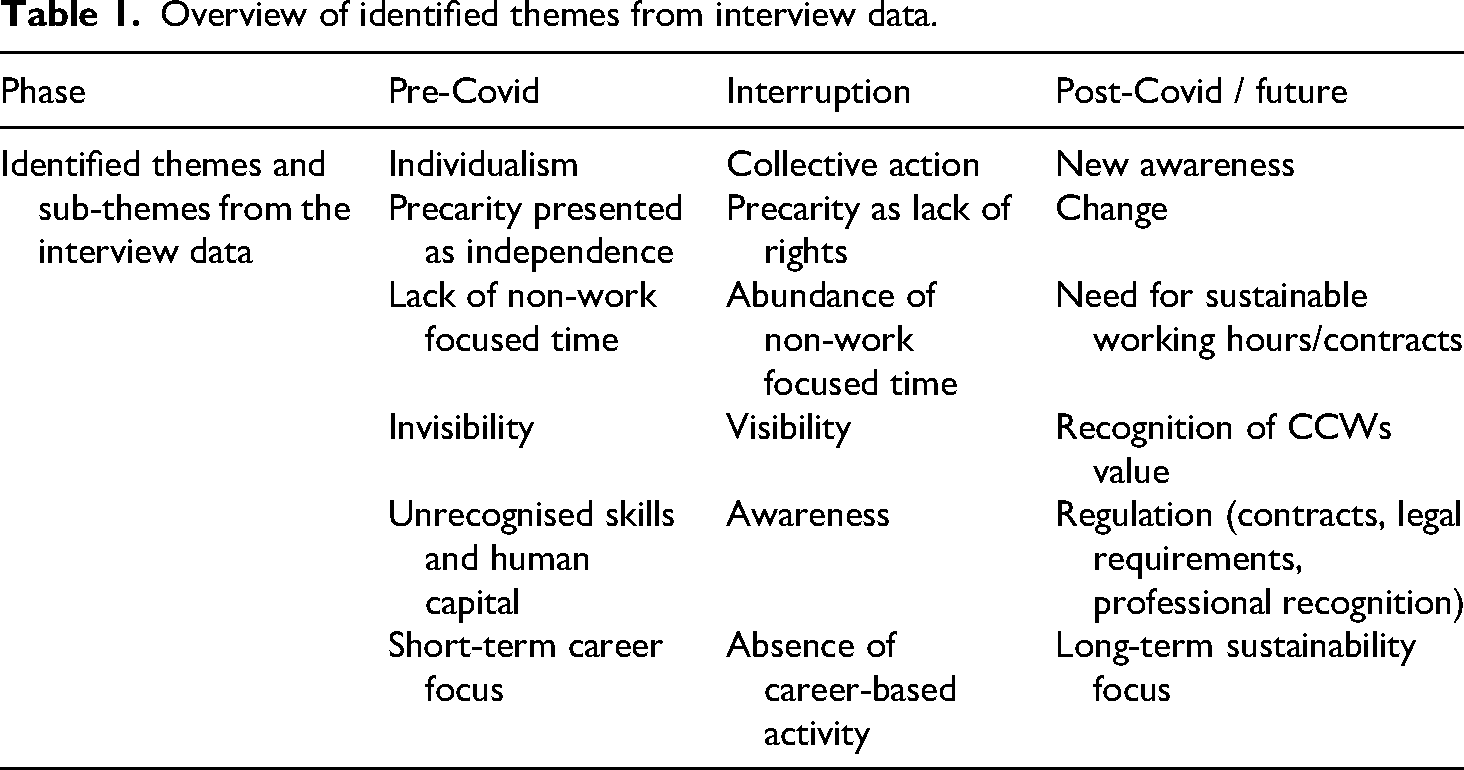
The thematic analysis identified three specific phases that CCWs experienced in connection with the pandemic and the moment of interruption functioning as a specific trigger to look at the past and the future. Table 1 offers an overview of the results:
Overview of identified themes from interview data.
Precarity, individualism and invisibility
As discussed, we have applied Baraitser's (2008) use of the term ‘interruption’ to represent a space of radical transformation, with participant recognition of structural inequality being one of the outcomes. We are applying this concept to the experience of Milanese CCWs during the C-19 lockdown, who experienced a sudden politically enforced interruption to their livelihoods, which exposed the pre-existing precarious labour market and absent welfare support framework that had characterised their working lives prior to C-19. The Milanese CCWs were able to articulate how their position shifted in the context of project-based labour from discourses of independence and flexibility to precarity and vulnerability as illustrated in the following comment by a performing arts technician: [You are independent and promote yourself] here precarity is often seen as positive in the sector. Now we see the negative side of precarity, especially in Italy, we find out that certain formats that allow for the protection and safeguarding of the worker, which are there in other countries, should have been … we should have asked and sought them with much more strength in the past. (Interview 11)
The recognition of being part of a precarious labour market emerged from across the data, and with it the barriers for forms of collectivism and contestation that emerge from more-structured labour markets. The competitive and individualised nature of creative labour was exposed through the C-19 interruption: There is a sort of individualism in each of us. It was never seen as a big problem because we have always lived in the twilight zone. This twilight zone has made this individualism almost undetectable, as if it did not exist because it was just a consideration inside our head, in which we would tell ourselves, ‘I am not damaging a colleague, I am just choosing to do this now because it is my choice.’ The crisis, the only positive side of the crisis, is that it has unveiled that this type of thinking is not productive, it does not lead anywhere and instead causes damage. (Interview 12)
Finally, for others, precarity was not seen only as a problem in contractual terms but also in relation to individuals’ work–life balance. This fits into the wider literature on precarity as a subjective operation (Brown, 2003; Murgia et al., 2017). The need to be constantly working or looking for work left CCWs without the space to consider long-term personal and professional development, making skilled individuals feeling like they are: invisible… it is a field that requires a very high level of specialisation… that takes years and investments from the individual… then when you start working, it is a system that recognises little or nothing of all your competencies. (Interview 7) we are responsible, I talk about my profession, of the situation we find ourselves in. In my work I see the playing with strength, seduction, buying and sell and power… resulting in being scared, blackmailing, feeling inadequate and a contractual fragility that we have always carried along with. (Interview 10)
Interruption, time and collectivism
As such, the impact of the C-19 lockdown gave Milanese CCWs a space to pause and reflect on the absence of structural systems of accountability or responsibility for workforce wellbeing. This visual art worker reflected on the desire to resist that existed prior to the lockdown but time was never a resource that enabled action: the same old issue, the same people, with a desire to do something… we never managed to get organised in practice, in this sector, being all freelance with six thousand things to do, and this kind of things require a lot of time and we never found it, we never had the push. Then the lockdown arrived, and some problems emerged in an ever so evident way, we could not avoid doing something now… in this misfortune, at least for some of us, there was not a new availability of space and time. (Interview 7) Attempts to organise, form a structure, a conscious category [of workers], have happened in previous years. However, until the problems were really serious, this shape to share, propose, organise has always been very weak. I mean, when you work 10–12 hours a day the last thing you want to do is spend another 4–6 hours to chase people to talk about how to improve the situation. So in many ways we have been lazy but, even more, detached, because outside our work we did not want to commit to start addressing work issues, although in the field we would sometimes tell each other about these issues. The real awareness of what is wrong and what needs to be changed and drastically reformed has come out unfortunately right with the start of the pandemic. (Interview 12) [This is] the first time in which we stopped running around like crazy with the aim of just being able to stand on our feet, and we realised that we have never cared about how fragile our working conditions were, [organisation name] was our collective answer to these shared feelings. (Interview 7)
These comments illustrate the labour that goes into collective action and forms of resistance. One of the barriers to activism and organisation across CCWs has been a combination of the continuous demand to find, secure and maintain work alongside the competitive pitting of workers against each other in a neoliberal market-driven rationality. The break from work, alongside digital platforms which enabled communication (see Tanghetti et al., 2022), allowed discourses of collectivism to emerge: I think it is a paradox, but Covid has created two antidotes…. One is the associationism. In Italy we did not have it culturally since the 1980s, because of the political choices we made, especially in the social sphere. We create a fracture between politics and citizens and the work politics opted for the entrepreneurial model [neoliberal]… the second has been the emergence of informal coordination, especially through digital technologies. (Interview 10)
Others describe this emerging collectivism as ‘the glass half full’ as, for the first time, CCWs have acquired a ‘class consciousness and started talking to each other’ (Interview 1). For many of them, this opportunity to discuss was facilitated and mediated by technology. However, the affordance was time: ‘it was a month that all arts workers, including myself, were left at home, we could not go out, there were no means of working’ (Interview 4). Left at home and accessing online groups via Facebook or other social media, CCWs saw the size of the problem and the number of people sharing their own situation ‘we were many, many, many […] the number of subscribers to the group grew to 1000 in just a few days, we asked questions, we thought solutions, what could we do?’ (Interview 4). The organiser of a different group reports ‘it was a big exchange, a very intense work, very strenuous, we spent so many hours of our lockdown in meetings, assemblies, all online obviously’ (Interview 5).
Interruption as opportunity for re-futuring
In her work on interruptions, Baraitser (2008) uses the recognition of the maternal subject as an important political moment that develops our understanding of the human condition. Ana Alacovska explores the possibility of developing ‘a hopeful sociology’ of creative work, one that requires, ‘an attentiveness to the moments when “islands of hope” are established amidst a sea of despair’ (Back, 2015 in Alacovska, 2019: 1120). We argue that the interruption to the norms of working life has provided a moment of consciousness from within CCWs that leads to a vision of future change. In the wider literature on collective action and resistance to precarious labour, one of the barriers to its sustainability is the fragmentation of the collective experience of labour into multiple individual experiences (Neilson and Rossiter 2008, in Murgia, 2014). The C-19 lockdown provided a global collective interruption, albeit individually experienced but responding to one singular cause. This provided a unifying opportunity for the Milanese CCWs interviewed who then developed formalised organisations that are actively campaigning for workforce reform: Bringing together all this working groups and proposals, initiatives and collective efforts, we have come to a point, where we are trying to purposely push forward one, two, three concrete proposals, real proposals from a law-making and decision-making perspective. (Interview 12) ...education, creating awareness of rights and duties of workers, imagining also a code of conduct or an ethics code to be subscribed to, a table of honorariums so that this can be implemented with a professional and professionalised system… give clear indications and instruments for those who are employed and those who employ, that there are fair ways to work. (Interview 7)
Two clear priorities in relation to re-futuring emerged from the data. One was the need to find a contractual and social security framework that reshaped the way CCWs are able to access basic social security and welfare support. This, however, needs to be linked to a wider reform of employment contracts that allow tax contributions to be made in transparent and coordinated ways. In fact, for the struggles of the pandemic to have a positive impact, the focus of many was to act on the nature of contracts in the sector: ‘we need to eliminate the myriad of types of contracts that are in use and identify one, that offers security, that allows [us] to contribute to national social security funds’ (Interview 12); this would also contribute to the elimination of unlawful/submerged work practices. Also, alongside contracts, for many it was important that CCWs were given more recognition as workers and as professionals. ...the fragmentation of things from a contractual and tax perspective and of the individual contribution [to social security] is one of the major obstacles to being able to obtain the right social protection in moment of crisis… we are discussing with [name of policy maker] social security and tax contributions in the contracts for the events which Milan city council sponsors. (Interview 11) If I could commit to something tomorrow it would be to making things transparent and public, getting rid of this rotten unhealthy logics [of contracted work]. (Interview 12)
For technicians in the audio-visual sector, this might mean shorter and safer working hours. However, as this participant articulates, formalised welfare support demonstrates, ‘putting at the centre of CCWs the centrality of being a human being, not part of the technology or hardware of a venue’ (Interview 12).
The second priority was a revaluing of CCWs and their wider economic and social contribution to both the sectors in which they operate and the creative city. This was articulated through a need for improved working conditions which value CCWs as professionals and a greater political and public recognition of the value of creative and cultural work. As one of the participants highlighted, responses to requests of more support were often based around the belief, ‘that this is not a true and proper job because it does not produce immediate economic value’ (Interview 1). During the pandemic this message translated into culture not being included in the essential goods or services citizens needed but something that could be stopped or paused, even post-lockdown. As one of the interviewees highlighted, ‘it makes me cry when I think about it, that it is so absurd that a country founded on culture, does not have a minimum care towards the people that look after culture […] how is it possible that this is not seen as essential?’ (Interview 4). Therefore, this re-futuring needs to address questions of value and, specifically, a better articulation of culture valued by society and the means by which this value is also extended from artifacts, buildings and institutions to people who make culture happen, making it evolve and produce new content and experiences for all.
Conclusions
The article has reflected on the affective impact of the interruption to the norms of creative working live experienced by Milan-based CCWs during the C-19 lockdown specifically focusing on the period up to July 2020. Building on previous literature that has considered the impact of a disruption from either a large-scale physical disaster (Solnit, 2020) or significant change to an individual's personal identity (Baraitser, 2008), we have explored the generative outcomes that can emerge from an interruption. In the case of the Milanese CCWs interviewed through this research, we noted how a recognition of the precarious working conditions associated with creative labour combined with the necessary resource of time enabled collective consciousness and solidarity. The labour market and economic model that has driven a perceived concept of ‘growth’ within Western creative economies has been discussed and, as we argue, challenged as an unsustainable model based on precarious working conditions. The research that informs this article was conducted at a particular moment in time, documenting the immediate impact of the C-19 pandemic on one dimension of the modern workforce and demonstrating, through their personal experiences, the impact that precarity has on the sustainability of our current economic system. There is a clear need for structural reform, but wider questions emerge around whose responsibility it is to implement change. The CCWs interviewed for this article do not reflect the individualised, docile creative workers that had been identified in previous research (Banks, 2007). At the time of interviews, they articulated a clear commitment to collective action for structural change, this was clearly identified as consequence of C-19 interruption.
Our wider research project uncovered the creation of a series of formalised associations / organisations for CCWs’ labour rights within Milan and its administrative region that emerged because of the pandemic (Tanghetti et al., 2022). As discussed, Milan has a history of fostering grassroots collective action in reaction to precarious labour conditions (Mattoni, 2012), with continued issues of sustainability due to the conditions being reacted against (Murgia, 2014). Whether these organisations continue to campaign and agitate for structural change as the impact of the pandemic becomes less visible over time and things go back to normal is yet to be seen. We know from previous research that activist and change-making organisations within the creative economy are themselves often precariously funded and subject to closure due to participant burnout and lack of core funding (Dent, 2022). Maintaining the impetus for change requires time and investment which may not be sustainable for those CCWs who need to continue their livelihoods post C-19.
The research has identified clear implications for policy to take forward in order to ‘rebuild better’ or at least remain engaged with the challenges faced by CCWs in more ordinary times as well. In particular, we highlight (1) the importance of reflecting on extraordinary measures versus structural changes. While C-19 has given these actors much more visibility through public protests (Tanghetti et al., 2022), but also via media coverage and extensive government reporting (Comunian and England, 2020), this visibility and collective consciousness have mostly resulted in extraordinary intervention measures and emergency funding (OECD, 2020b). Policy makers at urban, regional and national level should be reporting and engaging on what changes have been made to improve the long-term sustainability of the sector and its workforce. Furthermore (2) opportunities and dialogue should remain open between CCWs, employers and policy makers. The interruption has afforded new ways of communicating, exchanging ideas, and participating within a range of discussions. Those new opportunities for exchange need to find permanent platforms for dialogue and reflections. Finally, the interruption and the time available for CCWs to invest in their collectivism needs to be channelled into more permanent formats and associations. Research on structures of care support for CCWs highlights that there is an often-invisible network of support and care for them (Raising Films, 2021), which needs a funded, permanent and reliable structure – it cannot survive on free labour in the long term. Overall, whether the C-19 interruption has created new forms of collective action, increased unionisation, helped form a more robust welfare model for CCWs and new models of bargaining that evolve in the future, requires further monitoring and reflection.
Footnotes
Funding
The author(s) received no financial support for the research, authorship, and/or publication of this article

Notes
Author biographies
Tamsyn Dent is a Lecturer in cultural work in the Department for Culture, Media and Creative Industries at King's College London. Her research interests are on cultures and structures of work within creative economies with a particular interest in questions of accessibility, inclusivity and sustainability. She has recently worked on a European-wide research investigation on local creative economies.
Jessica Tanghetti is a post-doc Research Fellow in the Department of Management at Alma Mater Studiorum – University of Bologna. She is interested in cultural and creative work, craft clusters, art markets and museum management. She has participated in research projects in collaboration with international partners, such as King's College London, Arts Council England and Duncan of Jordanstone College of Art and Design, University of Dundee.
Roberta Comunian is Professor of Creative Economies at the Department for Culture, Media and Creative Industries at King's College London. She is interested in the relationship between public and private investments in the arts, art and cultural regeneration projects, cultural and creative work, careers, and creative social economies. She is internationally recognised for her expertise on the value of creative higher education and creative careers. In the last five years, she has explored the development of creative economies in Africa, establishing research networks and collaboration to support the engagement of the African higher education sector with local creative economies.