



Abstract
Women are under-represented in information technology (IT) professions, globally. It is widely discussed that there is an urgent need to tackle this issue by bringing more women into the IT industry. However, the spotlight is less often put on women currently working as developers in male-dominated environments. How do these women experience their work and deal with problems? International non-profit initiatives such as Women who Code (WwC) aim not only at supporting women in training for and entering IT professions: they also advise them in their daily lives and struggles as developers. Using this network and its blog as a case study, I show that the WwC bloggers are faced with contradictory work norms and experiences. They tend to resort to pragmatic advice, focused on DIY problem solving, and shouldered individual responsibility rather than highlighting systemic failures. This tendency shows similarities to neoliberal feminist rationales and speaks to the need for (re)emphasizing the need for structural changes within the broader discourse concerning women developers.
Introduction
Women are under-represented in information technology (IT) professions (Eurostats, 2019; Myers, 2018; Vitores and Gil-Juárez, 2016). Despite the number of women in Science, Technology, Arts and Mathematics (STEM) slowly but steadily going up, in many countries women are less likely to enter the IT sector than a few years ago (Eurostat, 2019; Miles, 2019). It is widely agreed that there is an urgent need to tackle IT’s diversity problem (Gorbacheva et al., 2019). However, the matter is usually addressed by focusing on the need to bring more women into IT. 1 Less frequently, the spotlight is put on those women currently working in male-dominated developer professions. How do these women experience their work environments and deal with problems? As members of an under-represented group, what insights and advice do they derive from their experiences?
The lack of attention for women in IT, as opposed to getting women into IT, is surprising: especially given that previous academic work on the subject has described certain developer cultures as hostile, challenging, and even harmful for under-represented groups (Richterich, 2018; Lemons and Parzinger, 2007; Shih, 2006). During recent years, this issue has also received increasing news coverage, partly due to staff in major tech corporations speaking up and filing law suits with regard to the gender pay gap, gendered discrimination, ageism and racism (Geuss, 2015; Levin, 2018; Wakabayashi, 2017). While some academic work is indeed dedicated to the challenges faced by women developers, this focus is comparatively rare (or at least, rarer than one would expect – considering the implications of IT’s diversity problem on the one hand, and the contributions made by women technologists on the other hand). The topic appears to have received more attention in the 2000s, also building on earlier work in cyberfeminism, technofeminism, and feminist technoscience (Wyatt 2008; McNeil 2008; Adam et al. 2006; see also Sørensen et al. 2011; Wajcman 2011; and Webster, 2014 for later publications). Further insightful work in this field of research has been contributed by authors such as: Scott-Dixon (2004) on the struggles of women and minorities working in IT; Toupin and Tanczer on women hackers and feminist hackspaces (Tanczer, 2016; Toupin, 2014); and Consalvo (2008) as well as Harvey and colleagues on women in (digital) game design (see, among others, Harvey and Fisher, 2015; Harvey and Shepherd, 2017). From historical perspectives, related issues have also been raised by Hicks (2017) and Light (1999).
My article adds to this body of work on under-represented groups contributing to IT professions and products. It provides an in-depth analysis of an initiative not merely encouraging women to train for and join the IT industry as developers, but supporting them in their professional role in a male-dominated industry. In this article, I use the international network Women who Code (WwC), a community built by women for women, as a case study.
Lived experiences
Drawing on posts from the Women who Code (WwC) blog as main sources, I explore how women developers share their lived experiences and advice with other women working in IT professions. The term ‘lived experiences’ has its origin in phenomenology and qualitative phenomenological research (see Adams and van Manen, 2012: 616). It refers to how individuals’ experiences and their choices are represented. This includes what kind of conclusions and beliefs someone would draw from these experiences. While I do not pursue a phenomenological approach, the concept is apt and useful for this article, because it not only responds:
to people’s experiences, but also to how people live through and respond to those experiences. The body of work on lived experience focuses on everyday life occurrences and self-awareness. [. . .] The lived experience method does not critique individual lives, but rather it presents them for comparison with others. (Boylorn, 2012: 490)
In this sense, also, the posts represent women’s lived experiences as developers. Moreover, the posts provide insights into how these are reflected upon and offered as basis for advice to others.
Approach and argument
Methodologically, my paper draws on 21 purposefully sampled posts and analyses them with the help of grounded theory (Glaser and Strauss, 2017; Morse et al., 2016). Based on this, I argue that the WwC bloggers are faced with contrastive, normative expectations and experiences: they are presented with meritocratic ideals, characteristic for developer cultures more broadly, yet experience contradictions related to being part of an under-represented group. On the one hand, they frequently encounter and support the idea that ‘[h]ard work and perseverance are the keys to break all barriers’ (see Table 1, article 3). On the other hand, they know from experience that working hard, and harder than others, is not sufficient for being respected and acknowledged in a project or job. Being painfully aware of the contradictions and biases they experience, they resort to pragmatic advice such as ‘get comfortable with feeling uncomfortable’ and reflect on how they arrange ‘the way we dress and the things we decide to do vs not do so that we can continue to succeed in this male-dominated industry’ (Table 1, article 1). Their reflections show that the women developers take individual responsibility for issues that are rooted in systemic failures (see also Rottenberg, 2018). They engage in strategic self-branding and adjust their habitus to fit into male-dominated developer cultures.
Selected articles from the Women who Code blog.
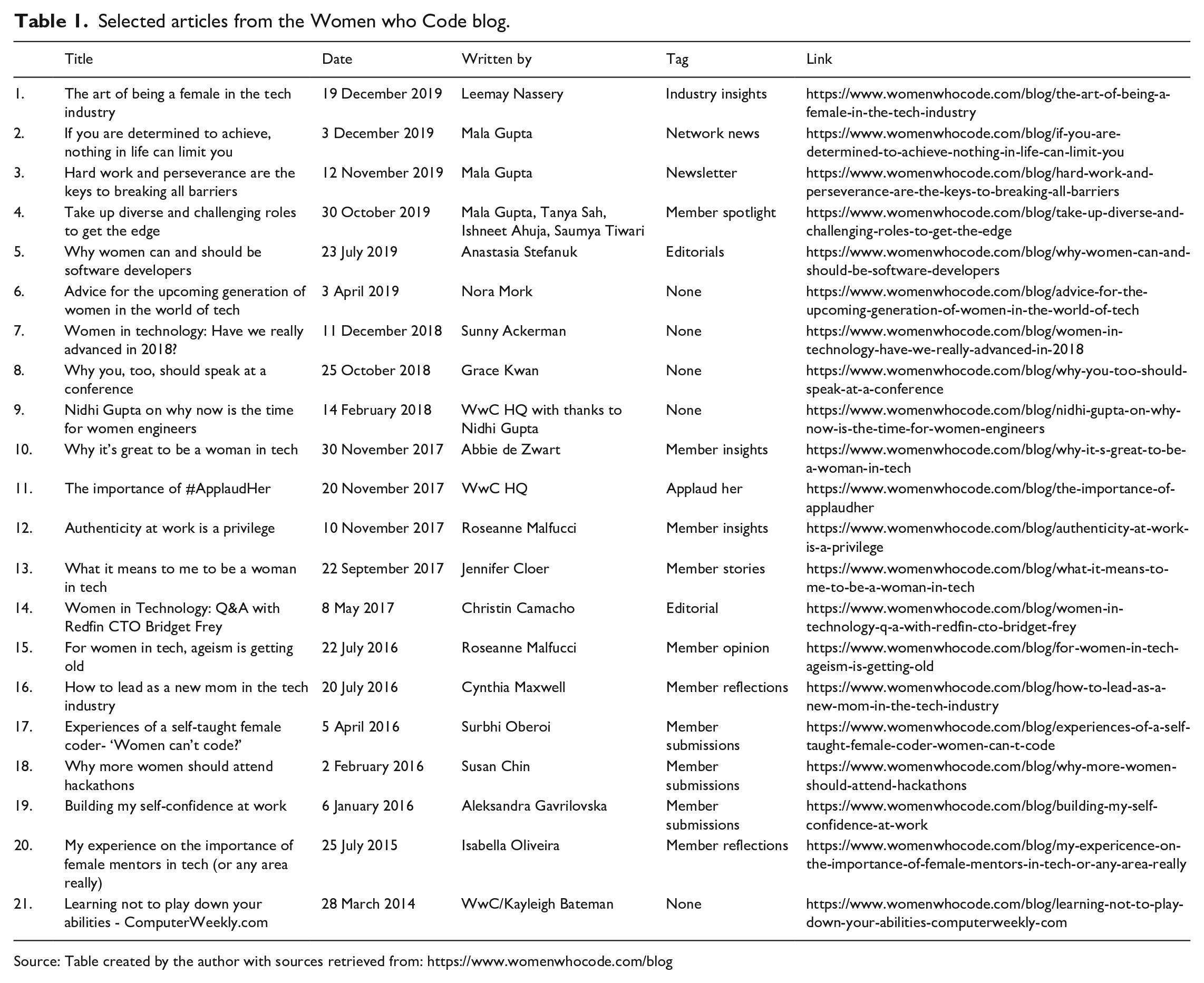
Source: Table created by the author with sources retrieved from: https://www.womenwhocode.com/blog
To develop and substantiate this argument, I first elaborate further on previous work on women in IT professions and provide an overview of some women-centred initiatives for developers, including WwC. Second, I will explain my methodology and the reasons for a case study approach focusing on one blog. It has been argued that qualitative analyses of single cases, such as the WwC blog, allow only for limited, notably not comparative or representative insights (Thomas, 2010). In turn however, as scholars like Brydges and Sjöholm (2019: 124) stress, individual, in-depth case studies like mine facilitate ‘a high level of explanatory richness’.
Diversity trouble in IT professions
The IT sector has a well-known diversity problem and it is dominated by a male workforce. This goes for European countries, India, countries in North America as well as in the Global South. As indicated by Eurostat (2019):
The vast majority of persons employed as ICT specialists in the EU-28 are men. The share of ICT employment that was accounted for by men stood at 83.5 % in 2018, which was 5.7 percentage points higher than it had been in 2008 [. . .]. In 2018, more than 9 out of 10 ICT specialists in Hungary (91.5 %) and Czechia (90.1 %) were men. While men accounted for at least 8 out of every 10 ICT specialists in the majority of the remaining EU Member States, there were six Member States where the share of men was lower than this.
2
Similarly, in 2015, women accounted for 25% of computing-related professions in the United States; numbers have been declining since 1991 – when they were at 36% (see Ashcraft et al., 2016: 6–7). Raghuram and colleagues showed in their 2017 report on the Indian IT industry that ‘[o]f the 150 IT sector companies surveyed, 46.2% have over 31% of their workforce made up of women’ (Raghuram et al/, 2012: 12). With regard to women’s participation in IT in the Global South, a study by Powell and Mei Chang highlights a mixture of ‘underperforming’ and ‘mixed-success countries’ (2016: 5), with the latter still facing challenges.
Seeing that there are significantly fewer women working in IT professions worldwide, researchers, policymakers and IT professionals alike have been pondering the implications of this imbalance. The lack of diversity in tech professions has been problematized from different, though interrelated perspectives. First, the lack of women in IT is seen as one reason for a lack of IT professionals overall. Women are described as ‘untapped potential’ for enhancing the IT workforce. Shortages of IT professionals impede the potential and competitiveness of various sectors (Hicks, 2017; Watanabe et al., 2017).
Second, from a perspective focused on (inclusive) innovation, it is stressed that there are not only overall fewer people working in IT professions than there could be, and than are in fact needed: in addition, there are fewer people with diverse backgrounds – which would facilitate different kinds of innovation and tech development (see Díaz-García et al., 2013; Harvey and Shepherd, 2017; Wajcman, 2007).
Third, from a diversity and inclusion perspective, the lack of women in IT needs to be considered as, among others, a symptom of problematic working cultures – rather than a lack of interest among women in joining IT professions. In this sense, the lack of women in IT is also an indicator of women’s lacking freedom of choice (given the likely challenges ahead) when considering training for and joining this sector (see Alsos et al., 2013; Botella et al., 2019; Pettersson and Lindberg, 2013).
In light of the above statistics and reasons for not only multiplying but also diversifying the IT workforce, it is not surprising that policy makers as well as corporations have taken an interest in developing and promoting initiatives for getting women into IT. It has also been revealed, though, that there is not only a lack of women in IT, but that working in the male-dominated IT sector is difficult for women (to say the least). In response, initiatives such as WwC were founded, aimed at supporting women in their tech professions, careers, and leadership ambitions.
Women-centred initiatives and WwC
Initiatives aimed at making life easier for women in tech often combine different strategies and approaches: they offer community support, networking, and mentoring as well as opportunities for knowledge exchange, learning, and sharing of experiences. They tend to combine digital means of (international) community building, (online) courses, larger (annual) events such as conferences, as well as regular local meet-ups.
For example, platforms such as Ladies of Code, Ada’s List and WwC 3 have established globally interacting communities, while likewise hosting local networking meetings and educational events. Some of these groups focus on particular programming languages, such as PyLadies4 or R-Ladies Global. Initiatives like Girls who Code 5 aim at involving and supporting women and girls early on in technological practices like programming and developing games. Again, similar projects exist for individual languages/frameworks, for example Django Girls6 for Python/Django. There are also some initiatives, such as Coders of Colour7 that centre on women of colour and BAME (black, Asian and minority ethnic) people.
I am focusing on WwC in this article, since it does not prioritize one programming language and, unlike Ladies of Code, has chapters and hosts meet-ups beyond the US and the UK. In addition, much of is content is publicly available, that is, accessible without registering as community member, thus making its access practically feasible and ethically appropriate.
WwC was founded in 2011 as an international non-profit and has since then grown into a network with over 200,000 members, spanning more than 70 cities and 20 countries. WwC does not explicitly position itself as feminist initiative and I will come back to this point in my analysis. According to WwC’s own statistics, 50% of all members are engineers, 26% in other tech roles, 7% executives, 7% management, 5% in data science and 4% in design. On its website, its mission is described with the aim ‘to inspire women to excel in technology careers’. It mainly targets women who are proficient developers already and offers them ways to enhance their existing skills. Also, WwC represents less the interests of those entering tech professions and instead focuses on those who are already active in the field.
Corpus and methodology
The corpus for my analysis consists of posts from the WwC blog. I analyse 21 posts which I purposefully sampled from 730 publicly available posts published between 14 December 2013 and 13 January 2020. The blog and the respective posts (see Table 1 for an overview) have been selected according to the criteria outlined in the next section.
Selection criteria and purposeful sampling of posts
My methodology combines purposeful sampling of blog posts for the data collection with grounded theory for the data analysis. Purposeful sampling, according to Patton (1990), follows a logic of ‘selecting information-rich cases for study in depth’. The author suggests several approaches to purposeful sampling 8 and I followed the approach of theory-based or operational construct sampling. With this approach, the researcher ‘samples incidents, slices of life, time periods, or people on the basis of their potential manifestation or representation of important theoretical constructs (Patton, 1990: 77). The main thematic construct that I used for selecting posts was that these represented and reflected upon lived experiences.
I started reading the WwC blog retrospectively in late 2019, after meeting a member at a conference. Apart from more straightforward, informative post categories such as event announcements and reports on members’ achievements, I noticed a type of post that was more difficult to place: these posts reported on what it meant to be a (successful) woman developer in a male-dominated industry and what advice others could take away from these experiences.
All posts are categorized according to tags such as Network events, Network news, Member or Industry insights. The genre I kept encountering was not limited to a specific category, but appeared across categories. Posts on the WwC blog are written by members, some in leading positions, of the international network. With very few exceptions, most posts are written by women and non-binary/queer persons. I have selected the 21 posts shown in Table 1, across all categories, as they form and support a red thread within the WwC communication: how to act, brand, and reflect on yourself as a women developer in male-dominated IT professions.
To arrive at this selection, I first skimmed through all posts and then sorted out those which did not focus on individual experiences (e.g. event announcements or technical advice/reviews). I then close-read the remaining selection of ca. 180 texts and selected a smaller sample of articles. Once I started the analysis, I decided that some of these were not as fitting as I expected them to be. For instance, they were more strictly technical than I had thought and or more focused on companies/ initiatives.
Concept-wise, I looked for titles and articles that signalled ‘lived experiences’ in that they reflected personal impressions and ways of making sense of lessons learnt. In some cases, this includes authors using the term ‘experiences’, but it is more frequently expressed in motivating and encouraging titles as well as posts on how women dealt with challenges and what others may learn from that.
Non-representability and non-generalizability are the most obvious limitations of such a purposeful selection. In addition, purposeful, theory-based sampling relies heavily on personal judgement (see Patton 1990: 177–8). Although ‘lived experiences’ as a concept was my frame of reference for selecting texts, this selection will likely be different when undertaken by another person – and the same goes for the interpretational, analytical approach of grounded theory.
Grounded theory
While grounded theory has been typically used to analyse qualitative data, such as interviews, it has been recently taken up for analysing new media content such as blogs (see Torabian and Arai, 2016; Rubin et al., 2011). Originally developed by Glaser and Strauss (1967), the approach is nowadays more diversified (Kenny and Fourie, 2015). Strauss and Corbin (1997) developed it further in a way that still privileges qualitative data such as interviews. Yet Glaser’s well-known dictum has always been that ‘All is data’ and thus may be analysed using grounded theory (Bryant, 2003).
After selecting the blog posts according to the above-mentioned sampling mechanism, I coded them. Two main units for coding using grounded theory analysis are concepts and categories. This means that upon and while reading the posts, I first created concepts describing certain statements, sentences and sections. When these concepts were also relevant to other parts of the material, I assigned these again and grouped the material together. Drawing on a constant approach of comparing/contrasting, I would pay attention to links between concepts and how these concepts could form broader categories.
This approach to coding necessarily starts with open coding, that is, assigning codes to parts of the text without being based on any previously established concepts or categories. Once some concepts or categories have been highlighted however, I also selectively coded my material: this means that I paid attention to whether some of the concepts (and later categories) could be found in other posts too. Main quotes that were selected during coding have been uploaded as supplementary material with this submission.
Analysis
After coding the 21 posts, I identified 4 categories. Out of these, three are sub-categories. The overarching, main category refers to experienced challenges 9 and, drawing on these, the bloggers brought up three sub-categories for how to deal with and work around such challenges:
- self-branding and authenticity
- hard/er work and passion
- support: networking, mentoring, and acknowledgement
The first overarching category reflects those instances in which the bloggers describe the problems they have experienced in their professions, specifically highlighting the link to male-dominated work cultures. The sub-categories listed depict those instances in which the women reflect on approaches for dealing with and working around these challenges. It is striking that most of the authors suggest pragmatic and individualistic DIY solutions. As highlighted with the first sub-category, this often requires them to adjust their behaviour and appearance and to engage in strategic self-branding.
The second sub-category, concerning hard work and passion, is again related to the main category as these are frequently described as pragmatic solutions to experienced challenges. The bloggers do, however, acknowledge inherent contradictions, arguing that they are required to work harder than others, while likewise conceding to the need for doing so to be successful. Similarly, the third sub-category is also linked to the overarching category: support in the form of networking, mentorship and public acknowledgement among women is described as key for countering the difficult position that most women in tech find themselves in. At the same time, it is seen as vital for increasing diversity, thereby making tech a more welcoming field for future women developers.
Experienced challenges
The challenges described by the women developers, in relation to work environments and career paths, can be clustered around four main concepts (see supplementary material):
- stereotypes
- biases
- self-confidence
- family
A major concern to the women is that they are confronted with stereotypes. In their experiences, developers tend to be assumed to be men. The women are thus faced with assumptions about ‘what [a] software developer was supposed to look like (a guy)’ (Table 1, article 20) and a ‘collective understanding of what an engineer is supposed to look like’ (Table 1, article 12). In turn, they are often approached in ways assuming and suggesting that they occupy non-technical positions; for instance, peers would ‘launch into detailed technical conversations with my male co-workers but avoid using technical terms with me, or they’d ask me if I was in marketing or sales’ (Table 1, article 11).
As indicated by this quote, stereotypes are closely connected to biases, that is, making assumptions about women developers that work in their disfavour. This has a bearing on inclusion and acknowledgement of skills, potentially resulting in discrimination. Interestingly, some women scrutinize their own self-confidence as reason for experienced biases: ‘Maybe it was only in my head, because of the lack of confidence’ (Table 1, article 19). They do however likewise assert that confidence needs to be, at least partly, built with the help of feeling acknowledged and respected – which is often scarce given previously mentioned issues.
While these three concepts, that is, stereotypes, biases, and self-confidence, are interrelated and overlapping, the matter of family is often brought up in isolation. It also comes up less frequently. The women mention making time for family as challenging and especially highlight their return from maternity leave as tough time. With regard to the latter, biases and stereotypes again appear relevant. For instance, it is advised that upon return from maternity leave, women should beware of appearing disorganized (Table 1, article 16). It is telling that the author focuses on being responsible for not seeming unorganized, rather than advising others to be aware of the possibility that women colleagues may go through changes and challenges related to parenthood.
This point already touches upon the three main sub-categories mentioned before – which are all reflections and advice on how to respond to experienced challenges. In response to stereotypes and biases, the women developers highlight three main strands of strategies:
- strategic self-branding
- harder work and passion for technology (and tech for good)
- women-centred networking and support
These correspond with the three sub-categories mentioned above and will be analysed in more detail in the following sections.
Self-branding and authenticity
Self-branding is described as deliberate effort to fit into predominant company cultures and to respond to stereotypes as well as gendered expectations (see also Lewis, 2013; Marwick, 2013). It relates to appearance and behaviour. In describing her brand and efforts in ‘shifting the focus from our gender to our skill sets’, the author of article 1 states for instance that she has ‘been wearing black t-shirts and jeans and my hair up in a ponytail for over 10 years’. Reagle (2017) scrutinizes the relevance of appearance in developer communities, notably hackers. He argues that developers tend to focus on matters of comfort and functionality, even suggesting that: ‘from the hacker’s perspective, conventional attire is a mark of inferiority’ (Reagle, 2017). The author moreover highlights the relevance of idiosyncratic elements, citing Marc Zuckerberg’s preference for hoodies as an example. Such a preference for an easily recognizable, habitual appearance is also reflected in the women developer’s comment on cultivating a visual brand based on casualness and consistency.
However, what might have been a matter of preference and comfort in the first place, appears to have turned into an expectation and signifier of competence as well as social belonging. Some of the women accept these and other approaches somewhat matter-of-factly as a ‘cosmetic’ requirement to succeed in their career. Others point out the implications of this, in particular with regard to the impossibility of feeling a sense of belonging and acting in a way they consider authentic. As argued in article 12 (in Table 1), by a queer/non-binary developer, this ultimately translates into being ‘asked – either implicitly or explicitly – to contain the things that are the most important to us; things that we want to share, because we want to relate to, and be known to, our peers’.
While popular culture icons considered relevant to developer cultures, such as Star Wars, are mentioned in this context too, language and jargon are described as main signifiers of in-/exclusion. In response to the tendency of assuming that women are not in technical professions, the authors propose making a habit out of extensively using jargon and stressing technical skills and previous tasks (Table 1, article 15). In addition, all articles agree with the sentiment that, in terms of behaviour, working hard and moreover harder than others is key for succeeding as women developers.
Hard/er work and passion
Hard work, powered by passion for technology and a belief in a tech-driven betterment of society, are described as vital for succeeding in developer careers as women. The authors consider hard work key to winning respect for themselves, their ideas, and their creations. This willingness to work not only hard but harder than others, they suggest, ultimately needs to be fuelled by a desire to work with technology, joy in doing so, and the belief that tech can change life for the better. This ideal of ‘tech for good’ echoes persistent hopes that digital technology may act as a ‘basis for a new form of society that is potentially liberating for women’ (Wajcman, 2007: 291).
To some extent, the argument that ‘hard word and perseverance will break all barriers’ (Table 1, article 3) falls back on meritocratic ideas which have been described as typical of developer cultures and are also characteristic of neoliberal feminism (Rottenberg, 2018) and postfeminist thought (Gill, 2016). Looking at open source communities, Coleman observes that ‘most developers prefer meritocracy to democracy’ (2012: 136) and that authority should be mainly tied to merit. Coleman herself is critical of this and feminist developers outside of WwC have raised the issue that in developer contexts and beyond ‘meritocracy benefits not only those with skill and ability, but with the self-confidence to demonstrate their skill publicly and demand recognition for it. And self-confidence is highly gendered’ (Skud, 2009). The latter point also relates back to previous reflections on matters of self-confidence. Similarly, because of their lived experiences as members of an under-represented group, the WwC authors and developers are aware that this alleged meritocracy in fact implies higher expectations when it comes to women developers – who need to overcome indicated biases and stereotypes first. They take a pragmatic approach of playing by the rules, despite knowing that these are rigged to their disadvantage.
As indicated, the WwC authors’ argumentation and advice show similarities to neoliberal feminism and strands of postfeminism. Rottenberg points out that neoliberalism ‘produces subjects who are individualized, entrepreneurial, and self-investing; they are also cast as entirely responsible for their own self-care and well-being’ (2018: 15). While postfeminism should not be conflated with neoliberal feminism, it has been argued that both are marked by such neoliberal ideology (see also Banet-Weiser et al., 2020). The WwC posts too are characterized by rhetorics and rationales highlighting self-responsibility and perseverance, despite acknowledging issues of agency.
Passion for technology and the belief in ‘tech for good’ take on a vital role here, because they are described as main reasons why it is worth enduring and dealing with the challenges described. In highlighting the relevance of passion (see also Consalvo, 2008; Vigdor, 2011), the women developers again echo broader discourses in tech professions. Passion is proposed as main driver for accepting and overcoming the difficulties and discrimination experienced as women developers. Proposing to ‘get comfortable with being uncomfortable’, the women developers thus resort to pragmatic solutions that focus on immediate, ‘DIY’ self-help rather than suggestions for structural changes.
The WwC bloggers frame their passion for a tech job as a matter of self-fulfilment and following one’s dreams. At the same time, they associate two main moral obligations with this: first, it is seen as a way for creating technology that can change the world for the better. Second, while pursuing a vision of technology that has a positive impact on society, the women also argue for a responsibility towards past and future women developers. This point is more extensively reflected in the third sub-category, that is, the need to network and acknowledge each other’s accomplishments.
Applaud her
The bloggers propose networking among women developers, mentoring, and support through public acknowledgement as key strategies for mitigating the problems experienced in male-dominated workplaces. Their positions rest on a moral notion of solidarity among women developers (see also Dean, 1998). In terms of women’s legacy in computing, they stress that they can only be in the positions they are in now, thanks to the work of women who entered the field before them. With an eye towards future generations of women developers, they articulate a moral obligation to pave the way and to act as role models.
In addition, the authors highlight the relevance of support and solidarity among women developers in the present. This aspect of the WwC posts is notable because, rather than focusing on habitual changes on the individual level, they aim at leveraging communal power and making structural changes. The previous categories all indicate a focus on self-reliance. In this, the bloggers mirror characteristics of neoliberal (feminist) subjects as they have been attributed to, for example, digital game developers too. Exploring subject-positions in digital game production, Harvey and Fisher (2015: 585) observe that: ‘[t]his subject is necessarily autonomous, self-regulating, active, and freely choosing, and it is female subjects in particular that are called upon to self-manage and self-discipline’. Here too, (self-)branding is relevant, as the women position themselves and others as hard-working, well-connected developers and effective neoliberal subjects.
Yet, in their pleas for solidarity, that is, asking women to be available as mentors and not afraid to ask for mentees, the bloggers move beyond solutions to be found merely on an individual level. Among the highlighted strategies for mutual support are more traditional forms of mentoring and networking, as well as digital, public acknowledgement. The WwC initiative ApplaudHer is picked out here, as a means for mentioning peers’ achievements on social media and supporting fellow women developers in gaining public visibility. Under the hashtag #ApplaudHer, WwC promotes women developers who have been submitted by members of its network as well as the public. Despite standing out in considering collectivist solutions, responsibility is still assigned to women developers helping each other – rather than demanding external ways of support.
Summary: women developers’ responses to workplace challenges
The blog posts reflect how women developers make sense of challenges experienced at their workplaces and what advice they derive from these experiences. My analysis illustrates that the women largely resort to pragmatic solutions, such as adjusting their appearance in accordance with predominant norms in their work environment. They argue, moreover, for the need to take on a work attitude that accepts the need to work hard and harder than others, fuelled by a passion for tech and its contribution to society.
What appears largely absent in their accounts (see Table 1, article 12 for an exception), are appeals for more structural changes – directed at companies or policy makers for example. While reflections on the importance of networking and support networks are crucial, the bloggers seem to have given up on the option to request support and solidarity from employers or colleagues.
This emphasis on self-help, assimilation, and perseverance echoes postfeminist and, more specifically, neoliberal feminist ideas, as they were articulated for example in Sheryl Sandberg’s work on ‘leaning in’ and women in tech (see Kim et al., 2018b; Rottenberg, 2018). Feminism is barely mentioned – only once among all posts published on the WwC blog. This seems to be as much symptomatic, given similarities to postfeminism as well as neoliberal feminism, as it was likely strategic. Most strands of critical feminism have highlighted structural issues faced by women, minorities, and vulnerable groups. Such an approach, however, would clash with (likewise neoliberal) ideals that are still upheld in many IT work cultures and need to be dealt with by the women developers.
This includes the tendency to prefer pragmatic, individualistic solutions (Hunt and Thomas, 1999) as well as meritocratic ideals (Coleman, 2012; Reagle, 2017). Moreover, the women’s focus on passion for tech and a belief in ‘tech for good’ echo broader discourses in technology professions and reasons for entering these (see also Consalvo, 2008; Harvey and Shepherd, 2017). However, in the case of these bloggers, passion also becomes a major motivational factor for enduring the difficulties associated with male-dominated work environments.
This appears to be a crucial point for needed, discursive changes and policy interventions: while passion may be considered crucial for entering IT professions, it is of course highly regrettable that women may get the idea that if they are just passionate enough, this would make up for experienced challenges. Instead, it is crucial to facilitate discourses and policies addressing the need for structural workplace changes countering experienced stereotypes and biases.
Conclusion
The WwC blog provides insights into the experiences and responses of women in tech. The bloggers relate how they are presented with meritocratic ideals, characteristic of developer cultures more broadly, yet frequently face contradictions due to being part of an under-represented group. Being aware of these contradictions, that is, realizing that hard work may not be enough to succeed in an alleged meritocracy, the women developers resort to pragmatic advice such as getting comfortable with feeling uncomfortable at work. They stress that stereotypes and biases require them to adjust their habitus to prove themselves in male-dominated work environments.
In terms of advice to others, the bloggers tend to favour pragmatic, individualistic solutions, rather than exploring or demanding strategies for bringing about structural change. They do highlight possibilities for ‘collectivist solutions’ (Harvey and Shepherd, 2017: 505) with regard to networking and solidarity between women. However, even in those cases, they accept that women must help themselves. They shoulder responsibility for addressing issues that are rooted in systemic failures. This preference for individualistic problem solving − which echoes postfeminist (Gill, 2016) and neoliberal feminist tendencies (Rottenberg, 2018) – does have problematic ramifications on a collective level.
The focus on variations of individualistic, DIY approaches for tackling experienced challenges, points at crucial issues that need to be addressed on a structural level. (And we might want to start by acknowledging that working as a woman developer can be tough.) Individualistic approaches may seem unavoidable as temporary workarounds, yet they should not be framed as actual solutions. The possibility of, and need for structural changes – beyond networking among women – need to be reinjected into the discourse. Previous research has shown that ‘by arguing that women can solve the problem themselves, advocates of the “DIY” approach may imply that women should be the ones to solve it – that it is their responsibility to do so’. Moreover, it risks ‘leading people to another, potentially dangerous conclusion: that women have caused their own under-representation’ (Kim et al., 2018a, see also Kim et al., 2018b). Thus, while perfectly understandable in this context, ‘DIY messages of women empowerment’ should be taken with a pinch of salt. For the WwC bloggers, focusing on individualistic solutions appears a pragmatic, necessary approach – as no other solutions are in sight. Yet, this tendency indicates an urgent need to (re)emphasize the necessity of structural changes as well as governmental and corporate responsibilities within the broader discourse concerning women developers.
Supplemental Material
Supplemental_material – Supplemental material for Work hard, fit in, and applaud her Women developers blogging about their lived experiences
Supplemental material for Work hard, fit in, and applaud her Women developers blogging about their lived experiences by Annika Richterich in International Journal of Cultural Studies
Footnotes
Funding
The author(s) disclosed receipt of the following financial support for the research, authorship, and/or publication of this article: The research for this article was carried out during a Marie Skłodowska-Curie Actions fellowship, funded by the European Union/European Commission Horizon 2020 Framework Programme (grant no. 790777).
Supplemental material
Supplemental material for this article is available online.
Notes
Author biography
References
Supplementary Material
Please find the following supplemental material available below.
For Open Access articles published under a Creative Commons License, all supplemental material carries the same license as the article it is associated with.
For non-Open Access articles published, all supplemental material carries a non-exclusive license, and permission requests for re-use of supplemental material or any part of supplemental material shall be sent directly to the copyright owner as specified in the copyright notice associated with the article.
