




Abstract
This article analyses a viral X post in which the author used Grok, an AI image generator, to produce a ‘makeunder’ of newly elected Green MP Hannah Spencer, modelled on the BBC Three reality series Snog Marry Avoid? (2008-2013). Drawing on Pickering’s (2014) analysis of makeover television and class, Kay’s (2020) concept of communicative injustice, and Parry and Johnson’s (2021) study of gendered parliamentary performance, it argues that the post is symptomatic of a broader cultural logic in which the disciplinary conventions of British makeover television have migrated into political life. Central to this argument is the role of AI: by passing an ideological verdict about a woman’s appearance through a generative model, the post reproduces the pseudo-objectivity of Snog, Marry, Avoid? and its surveillance mechanism (POD), recasting aesthetic judgement as neutral analysis. The article contends that Spencer’s style - confident, idiosyncratic, and resistant to Westminster’s professional-feminine norms - is best understood as non-assimilation, and that the hostility it provoked reveals class and gender as the unmarked axes around which both makeover culture and political legitimacy continue to turn.
Introduction
On 27 February 2026, Hannah Spencer won the Gorton and Denton by-election for the Green Party, defeating both Reform UK and Labour in a constituency Labour had held since 1931. Spencer is a Bolton-born plumber and plasterer who left school at 16, dropped out of sixth form, and trained through National Vocational Qualifications (NVQs) at Bolton College rather than university, before setting up her own plumbing business and entering elected politics via Trafford Council. She is the Green Party’s first MP in the north of England and the first Green to win a by-election in UK electoral history. Her campaign explicitly foregrounded class: she argued that Parliament is dominated by ‘a small club of posh boys that all went to the same schools or studied at Oxbridge’, and that people from working trades should have a seat at the table (Keate and Earl, 2026).
Her candidacy was met almost immediately with sustained and coordinated attacks. The online hostility was, as coverage at the time made clear, patterned and gendered. Spencer herself named it directly: ‘I’ve faced a lot of criticism for my appearance, for my hair, for my relationship status’, she told Byline Times, ‘all those things that I just haven’t seen about people like Matt Goodwin’, her Reform UK opponent (Bienkov, 2026). A presenter on a Times-affiliated channel, Talk, posted a photo of Spencer on the social media platform X with the caption ‘why does Hannah Spencer have the same hairstyle as a three year old?’ (Bienkov, 2026). After her election, the abuse continued. Following her maiden speech, Spencer was met with what was described as a ‘pathetic’ onslaught of online commentary focused on what she was wearing rather than what she had said (Jackson, 2026).
It is worth pausing on the question of Spencer’s class identity because it is itself contested terrain. Coordinated social media misinformation has repeatedly questioned her working-class credentials and fabricated details of her personal life. For instance, a false image claimed she lived in an expensive Hale property (Topping, 2026), and another post falsely stated that she was married to a multi-millionaire pharmaceutical executive (Peach, 2026). Spencer’s response was characteristically direct: ‘I’ve been a plumber for nearly 20 years. What do they want, to see a toilet I’ve fixed?’ (Chakelian, 2026). She is not alone in this experience. Labour MP Angela Rayner faced media scrutiny for her clothing and appearance as evidence of a ‘poor fit’ in Parliament, with research showing that working-class women in senior political roles are routinely evaluated negatively on exactly these grounds (Rickett, 2025). Indeed, female politicians’ appearances are frequently commented on across the political spectrum (e.g. Conservative Prime Minister Theresa May and her leopard-print kitten heels), but for working-class women, this criticism carries a different charge. Their style becomes not merely a matter of taste, but evidence of unsuitability, a sign that they do not quite belong in the institution they have entered.
Jilly Boyce Kay’s (2020) concept of ‘communicative injustice’ is useful here. Kay describes the ‘impossible situation that women encounter in public speech: participating in the public sphere is fundamental to any conceptualisation of citizenship and full personhood, and yet that same public sphere is profoundly shaped by its own history of gendered exclusions’ (Kay, 2020: 9, cited in Parry and Johnson, 2021). As Katy Parry and Johnson’s (2021) analysis of a critical parliamentary moment in 2019 demonstrates, this communicative injustice is not merely historical but is actively reproduced in contemporary political culture, including through media that frame female politicians’ parliamentary performance. Spencer’s experience – the sustained focus on her appearance, hair, and relationship status rather than her policies or mandate – is a textbook instance of the dynamic Kay identifies. Her presence in Parliament is legitimate, but the terms on which she occupies it are relentlessly contested.
Into this landscape came the X post that is the subject of this piece. It reads: ‘Have you ever watched reality television show “Snog Marry Avoid”? I asked @grok to do a POD style makeunder, and dress Hannah Spencer in a simple white blouse and black pencil skirt, and smarten up her hair. Anyone who thinks her presentation is irrelevant should take a look. She dresses like a child for a reason. That concerns me’. Accompanying the post was a side-by-side image: on the left, Spencer in her own clothes at the despatch box – bright pink blouse, green trousers, powder blue scalloped vest, voluminous wavy hair; on the right, an AI-generated version dressed in a white shirt and black pencil skirt, with sleek, shortened blonde hair (Figure 1).
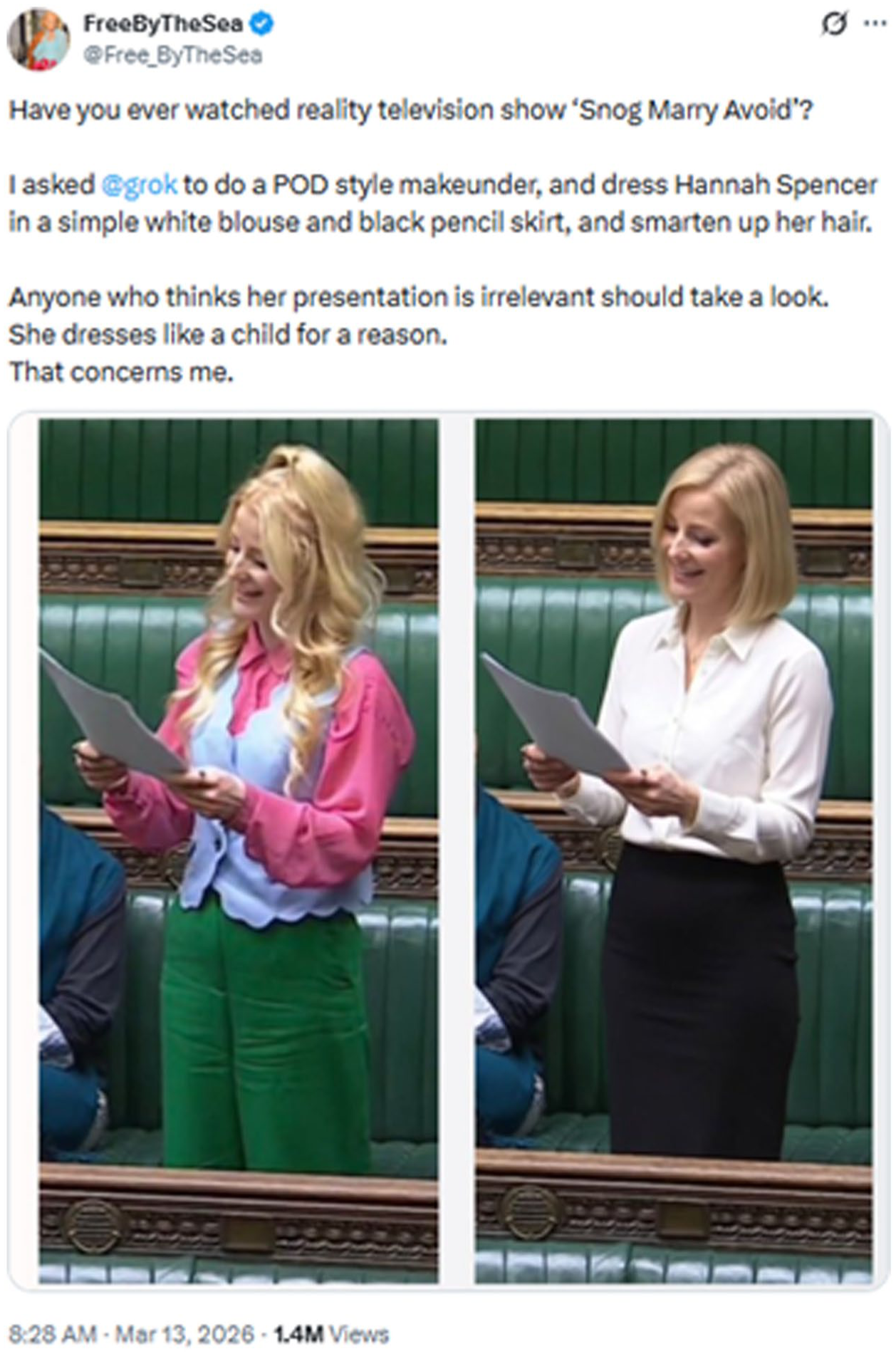
The original X post image: Hannah Spencer as she appeared at the despatch box (left) and the Grok-generated ‘makeunder’ version (right).
What I want to argue here is that this X post is not a peripheral outburst but a symptomatic one – a moment in which the disciplinary logic of British makeover television, the legitimising technology of AI image generation, and the long-standing class politics of the presentable female body converge to police the boundaries of who is entitled to political authority. As Jo Pickering (2014) has argued in relation to Snog Marry Avoid? (SMA?), such texts do not merely reflect existing class hierarchies but actively produce them, naturalising middle-class taste as universal good taste and casting non-conformity as a failure of individual judgement. The above X post performs this operation but extends it into political territory, and crucially, it does so through AI.
Snog Marry Avoid?, Class, and the politics of the makeunder
The post’s reference point, Snog Marry Avoid?, aired on BBC Three between 2008 and 2013. In the show, a computer system called the Personal Overhaul Device (POD) assessed female participants’ appearance and typically delivered a verdict that they wore too much makeup, dressed too loudly, or presented themselves in ways that were excessive, performative, or sexually inappropriate. The show’s promised corrective was the ‘makeunder’ or, in other words, stripping back to a supposedly ‘natural’ femininity.
What the show codes as ‘natural’ beauty is, of course, anything but. As Pickering (2014) observes, the made-under woman is still required to perform femininity; the difference is that the labour involved is now concealed rather than displayed. The programme presents its preferred femininity – understated, contained, apparently effortless – as the participant’s ‘true self’, while encoding the class values that underpin it as commonsense and universal. Drawing on Angela McRobbie (2009: 132), Pickering identifies this as the operation by which ‘properly middle-class women’ are seen to possess ‘effortless elegance’ while glamour becomes a ‘gendered marker of class’ to be disavowed. Working-class women’s investments in a glamorous self represent attempts to accrue ‘feminine capital’ where other forms of capital are structurally unavailable – but these attempts are consistently read as ‘a class drag act, an unconvincing and inadvertently parodic attempt to pass’ (Skeggs, in Tyler and Bennett, 2010: 381). The show does not merely observe this dynamic, Pickering argues; it performs it, with POD as the instrument of reclassification.
Crucially, POD’s authority derives from its apparent technological neutrality. As Pickering suggests, following Foucault’s account of the panopticon, POD operates as a surveillance mechanism that renders the programme’s disciplinary function impersonal and therefore unassailable. The disembodied, digitised voice of POD is ‘free to pass forthright and negative, yet comedic, judgments’ in a way that a human presenter could not (Pickering, 2014).
POD goes online: Grok and the illusion of objectivity
The post about Hannah Spencer’s appearance replaces BBC Three’s POD with Grok, the AI model developed by Elon Musk’s company xAI. This substitution is not merely technological: it is ideological. Grok is a Large Language Model (LLM) with a distinctive profile among conversational AI tools – it operates through real-time integration with the X platform and has been characterised by its developers and analysts alike as prioritising ‘freedom of expression’, a formulation that in practice describes a looser approach to content moderation than that adopted by comparable models (Calvet-Bademunt et al., 2025; Horton, 2026). Its creator is among the most prominent international supporters of right-wing populist political movements, including those with direct ties to Reform UK’s ideological networks (before feuding with the party’s leader, Nigel Farage: BBC News, 2024).
But the deeper function of this AI substitution is to replicate POD’s pseudo-objectivity at a higher register. If BBC Three’s POD was a television prop (clearly artificial, embedded in the conventions of entertainment), then Grok is a ‘real’ AI system, one associated in popular discourse with capability, data, and intelligence. Asking Grok to generate this image transforms what would otherwise be an ideological act into something that appears to be an analytical output. That the author of the X post is herself a woman is not incidental. As Pickering (2014: 198) argues, the surveillance logic of SMA? is designed to be internalised and reproduced by women themselves. After all, it is not AI that wants Spencer to dress differently – it has simply processed a prompt and returned a result.
This operation has a parallel in the parliamentary dynamics that Parry and Johnson (2021) analyse in their study of a charged moment in the House of Commons in September 2019. During the transitional period of Brexit, attempts to pass the necessary withdrawal legislation had stalled, and the government’s controversial strategy of proroguing Parliament for 5 weeks was declared unlawful by the Supreme Court on 24 September. The very next day, Parliament reconvened. Prime Minister Boris Johnson returned early from the United States to address the House, but rather than acknowledging the Court’s decision, he lambasted Parliament for its delay and dismissed concerns raised by female Labour MPs about the threatening consequences of his inflammatory language with a single word: ‘humbug’. He then provoked further outrage by declaring that the best way to honour the memory of murdered MP Jo Cox was to ‘get Brexit done’. Parry and Johnson’s analysis shows how Johnson’s performance of measured indifference in this exchange functioned to delegitimise the emotional speech of the female MPs. A performance of calm rationality (Johnson’s ‘open-armed grin’ and consistent tone against Paula ‘Sherriff’s emotional account’) works to position women’s political speech as ‘inauthentic, subjective and feminised’ while his masculine performance claims the register of reason (Parry and Johnson, 2021: 11). The above X post performs the same sleight of hand. By routing its aesthetic verdict through an AI system, it positions its judgement as data rather than desire, as analysis rather than aggression. Spencer’s colourful self-presentation is cast as the subjective, excessive, readable problem; the white blouse and pencil skirt are presented as the neutral, rational solution.
This is made possible by the broader cultural perception of AI as objective despite substantial evidence to the contrary. Research into AI image generation has consistently demonstrated that generative models reproduce and amplify gender stereotypes embedded in their training data. Collyer-Hoar et al.’s (2025) study of gender expression in AI-generated imagery found a pronounced masculine bias in outputs, demonstrating that clothing is among the most powerful determinants of perceived gender expression in what these models produce. When Grok is asked to produce a ‘smartened up’ version of a woman’s appearance, it does not access some neutral standard of professionalism; it reproduces the gender and class norms encoded in its training data, which is to say, the norms of our dominant culture.
Spencer’s style and the politics of non-assimilation
So, what does the AI image actually do? It takes Spencer’s colourful, exuberant appearance and replaces it with the visual grammar of Westminster professional femininity. The sleek, shortened hair replaces Spencer’s full waves with a style that signals control, containment, and the subordination of personal pleasure to professional performance, while the white blouse and black pencil skirt are the uniform of a specific class position (and, interestingly, resemble former Conservative Prime Minister Liz Truss’s look). There is nothing arbitrary about these choices; as research into AI image generation makes clear, ‘smartening up’ a woman through a generative model will reliably produce exactly this – the normative professional feminine – because that is what the training data has taught the model to associate with credibility (Collyer-Hoar et al., 2025). In this sense, the AI makeunder is simply the parliamentary version of POD.
The reception of Spencer’s maiden speech in the House of Commons on 12 March 2026 sheds further light on this dynamic. Writing in The Spectator, Melanie McDonagh declared herself ‘frankly distracted’ by Spencer’s clothes, offering a verdict that was gentler in tone than the X post but structurally identical in operation. Acknowledging that Spencer’s ‘trademark colourful blouse with waistcoat looked fabulous on election night’, McDonagh (2026) nevertheless pronounced that the green trousers worn for the maiden speech were a step too far: ‘with vivid green trousers? No, just no’. The piece is notable for its self-awareness. McDonagh asks whether she would write this about a man and concludes she would not – but this acknowledgement does not interrupt her policing. This is communicative injustice operating at a subtler register. It is not the crude misogyny we have seen, but the same underlying assumption that a woman’s body in political space requires external calibration (Kay, 2020).
Spencer’s style has never been the problem the X post presents it as – and it is worth being clear that this is not the hyperfeminine working-class aesthetic that SMA? typically targets. Recognised at 22 as among the best-dressed at Glastonbury 2013 in The Guardian (Iqbal, 2013), Spencer’s style choices are better understood as a confident, idiosyncratic refusal of the restrained, professional-feminine register that Westminster conventionally demands. As Bourdieu (1984) observes, dress functions as a social marker whose meaning derives from its position within a ‘system of distinctive signs’ (p.192, cited in Pickering, 2014), and what Spencer’s style signals, above all, is non-assimilation.
Conclusion
The X post’s invocation of Snog Marry Avoid? is more politically revealing than its author may have intended. Its emotional address is clear: it invites readers to feel discomfort at Spencer’s appearance, to see the AI-generated image as relief, and to share the author’s concern that a woman who dresses this way has been allowed into Parliament. It asks them, in short, to occupy the position of the SMA? viewer who accepts POD’s authority.
That this move is made in the context of a by-election in which a working-class Green candidate defeated Reform UK – a party whose politics rest substantially on fantasies of cultural restoration – is not coincidental. Both are arguments about who belongs; both are attempts to enforce a set of norms (sartorial, cultural, class-coded) against someone whose very presence challenges them. And crucially, as Spencer herself recognised throughout the campaign, these arguments were consistently directed at her body and her appearance in a way they were not directed at her male opponents. The communicative injustice Kay (2020) identifies as structural was, in Spencer’s case, relentlessly operational (Bienkov, 2026).
What the Spencer case makes visible, then, and what makes it worth sustained analysis is how the disciplinary logic of British makeover television has migrated into the political landscape, how AI has given that logic new tools and new false credibility, and how class remains the unmarked axis around which both turn. As Pickering concludes, in these representations, ‘class is presented merely as that which is “to be overcome”’ (citing Skeggs, 2005: 54), but it is to be overcome ‘by the individual agent, devoid of meaningful context, as a measure of their essential quality or lack thereof’ (Pickering, 2014).
It was Spencer’s victory that provoked the X post in the first place (and then this article), namely, the unsettling proof that someone who dresses like this could walk into Parliament and win. The green trousers and pink blouse did exactly that, with a majority of 4402. Within hours, the waistcoat had gone viral – variously described as chartreuse, ‘gross green’ and ‘phlegm’ – hailed as a deliberate political statement by a candidate who was ‘knowingly online’ and understood exactly what she was doing (Ferrier, 2026). POD’s verdict, as it turned out, was not the electorate’s.
Footnotes

Ethical considerations
This article is a piece of cultural media analysis. It does not involve human participants, human data, or human tissue. Ethical approval was not required.
Consent to participate
Not applicable.
Consent for publication
Not applicable.
Funding
The author received no financial support for the research, authorship, and/or publication of this article.
Declaration of conflicting interests
The author declared no potential conflicts of interest with respect to the research, authorship, and/or publication of this article.
Data availability statement
Data sharing is not applicable to this article as no datasets were generated or analysed during the current study.