




Abstract
Interventional reality programmes often give rise to speculations about how they treat their contributors. However, little is known about the actual production practices that lie behind these complex and often contradictory media texts. Based on in-depth interviews with crew members of a variety of popular formats, this article explores how ordinary people are turned into subjects of emancipation and spectacular transformations. By analysing the ideals, tactics and constraints characterising this process, I address how particular discursive and organisational mechanisms support or hinder morally viable compromises in situations where the imperative of ‘selling strong performances’ and personal standpoints come into conflict.
Keywords
Introduction
This show is about loving your stuff, right? Caring about something that no one else cares about. And not being able to let things go. Everyone can relate to this. And it is shocking… the people that we go into to help are in extreme crisis. But there are 18 million hoarders in this country, so everyone knows a person with that problem. We made people more aware of this condition, and those in need can also realise that they are not alone. (Juliet, executive producer Hoarders, 2009-)
Telling an extreme yet relatable story; exposing a societal problem while also helping the participants through their crisis – according to executive producer Juliet (psyeudonym), these are the key ingredients of the popularity of the longest running television programme she had been working on. This recipe, without a doubt, is not unique to this format about obsessive compulsive disorder: it is applicable to a broad spectrum of programmes that link particular emancipatory agendas to the transformative journey of their participants and combine the educational, ‘do-good’ conventions of public service broadcasting with surveillance entertainment. In this sense, life intervention may be considered as a logic that cuts across pre-established generic conventions, themes and subject matters: it is, as argued by Brenda Weber, contemporary television`s emerging mandate to demand that individual subjects desire, and hence submit to, a transformation with normative ends, framing this submission as a necessary path to social justice (Weber, 2014: 383-4). Candidates of televisual interventions typically belong to stigmatised and vulnerable social groups, and hence their transformative ‘journey’ has high existential stakes: the outcome of their endeavour both determines their future navigation of the social world and reflects this social world that they are trying to navigate.
This article surveys the production practices behind these complex and often contradictory media texts. Based on fifteen in-depth interviews with below-the-line and above-the-line crew members of a variety of popular interventional formats, I address how ordinary people are transformed into both ‘television participants' and ‘empowered citizens' by those working on these productions. How do industry workers see the benefits and the possible downsides of participation and how do they act upon these aspects? What kind of tactics do they employ to make ordinary people perform according to their vision? And more broadly: how do television producers position their ideas, ideals and practices in response to perceived industrial and socio-cultural changes?
Addressing these issues from a holistic perspective and through the voices of television makers serves multiple purposes in this work. First, critical studies of televisual transformations are predominantly focused on discrete media texts or contextual-historical factors that explain the popularity of shows building on the before/after trope of the makeover (Brunsdon, 2003; Moseley, 2000; Ouellette and Hay, 2008; Philips, 2005; Taylor, 2002). Such works make strong points about how these programmes work in a way that reaffirm the cultural capital and the superior expertise of the ‘tastemaker’ while erasing the agency and the history of the subjects of the transformation (Philips, 2005) and how interventional shows conflate personal responsibility and self-enterprise with the ethics of ‘good’ citizenship (Ouellette and Hay, 2008). At the same time, these phenomenological arguments do not provide empirical details of how television’s professed capacity to govern through entertainment is being realised in the actual process of media production.
Additionally, although the off-screen, behind-the-scenes world of media production has long been mythologised, fictionalised and branded for public consumption, studies focusing on the lived experiences of reality TV workers remain scarce (Mayer et al., 2009: 2). As a result, little is known even about the basic procedures for selecting, creating or rejecting content in this realm of symbolic cultural production (Mayer, 2014: 58; cf. also Peterson and Anand, 2004). Furthermore, apart from a few exceptions (see for example Teurlings, 2004; Shufeldt and Gale, 2007; Kjus, 2009; te Walvaart et al., 2018; Hill et al., 2019), scholarly insights into the world of television making deal not so much with the social dimensions of producer-participant interactions as with the power dynamics and hierarchies within the occupational communities of production workers (Caldwell, 2008; Mayer, 2014; Wei, 2016) and how these are affected by neoliberal industrial structures and ideologies (Ross, 2014). By looking into the role of participants in the production process, as experienced and conceptualised by the producers, I not only aim to nuance popular readings of reality television production as an exploitative and morally tainted work (Wei, 2016), but also to arrive at a more complex understanding of the mechanisms through which the participatory scope of these shows either reconfigure or reproduce the social hierarchies and inequalities that they claim to challenge.
Transforming citizens: Strategies, ideals and constrains
In order to explore the ways ordinary people are made into subjects of emancipation and spectacular transformations in contemporary televisual interventions, this article examines the common steps in the production process as they are described, valued and motivated by crew members of different ‘do-good’ reality TV productions. In doing so, I address the following overarching question: how do producers organise the participation of non-media professionals in interventional television production, and what kind of ideals, tactics and constraints characterise this process? While seemingly straightforward, the second part of this inquiry needs some elaboration, as it also helps to clarify the general theoretical outlook of this study.
With ideals, I refer to what Caldwell terms ‘industrial self-theorizing’ (2008), and more specifically, the producers’ personal and professional stances towards what it takes to make ‘good television’ with ordinary people; with tactics, I refer to the routinised professional practices that aim to contain and construct (Shufeldt and Gale, 2007) – and in this sense, ‘script’ – the reality represented in televisual interventions; and with constraints, I aim to capture the links and discrepancies between tactics and ideals. This latter aspect reminds us that production workers are not free social actors as descriptions of how they exercise logistical control over unscripted happenings often suggest (Grindstaff, 2009; Shufeldt and Gale, 2007; Teurlings, 2004); as such, it also provides a productive starting point to solicit moral reflections from the respondents. While this separation of ideals – tactics – constraints is provisional and somewhat artificial, it serves further analytical and theoretical purposes here.
First, discerning routinised, strategic actions from personal takes on these actions allows us to treat the interview material both as factual details coming from ‘experts’ and as biased interpretations of involved actors. The distinction between ideals, tactics and constraints thereby not only sensitises one to distinguish between the two types of data at relevant points of the analysis, but also to make connections between the ideological, practical and the experiential dimensions of the production process.
Second, these dimensions correspond to already theorised patterns of ritualisation which seem to be at the core of both representation and the experiences of the participants in interventional shows (Boross and Reijnders, 2019; Couldry, 2003, 2004). Ideals, in this respect, involve the motives, values and understandings of the social world and the role of the ‘television maker’ in it, and as such, they embody the set of dispositions that constitutes the symbolic-mythical dimension of mediated ritual actions and processes (Rothenbuhler, 1998). Tactics, considering the authorised and authoritative practices that conventionally govern the producer-participant interaction (to put it simply: the things to be done to make the participant act in a certain way), correspond with the sequential, formalised component of ritual conduct. Finally, the notion of ‘constraints’, as employed in this article, evokes the commonly acknowledged tensions between ritual structure and agency: this aspect addresses how and to what extent the structures and structuring mechanisms influencing the conduct of television making contribute to achieving the ‘transcendent’ promises of the programmes, and how much space the actors have to negotiate their own ideals in this process.
Finally, emphasising the above aspects aims to signify my attempt to occupy a middle ground position between approaches that, even unintentionally, risk victimising either the participants or the production members in systems and processes of television making. On the one end, crew members are often treated as mere strategic players on a field characterised by fundamentally asymmetrical power relations (Shufeldt and Gale, 2007; Teurlings, 2004). In this reading, the ultimate goal of every action is tactical and motivated by selling strong identity performances (Teurlings, 2004). On the other end, cultural studies of media industries tend to focus on the structural constraints and pressures faced by production workers in their daily work – see for instance Mayer’s illuminating study of casters (2014). Without denying the significance of identifying disempowering and exploitative aspects of production practices, my triangular focus on ideals, tactics and constraints might provide a more comprehensive vantage point to grasp the dynamics of participant-producer interactions in different stages of television production.
In line with the above considerations, my discussion will proceed as follows. First, I will present accounts of the routines and challenges associated with casting, highlighting how decisions in this phase of the production are negotiated against different notions of, and expectations from the ‘ideal participant’. Next, I will turn my attention to the actual shooting process and discuss how crew members conceptualise the transformative power of acting in front of the camera, and what measures they take in order to facilitate this transformative experience, on the one hand, and mitigate the participants’ self-performance towards particular scripts on the other. Although reality genres are commonly classified as ‘unscripted television’, notions of script and scripting refer in this context to how producers narrow down performance options throughout the production (Ytreberg, 2006). These terms also aim to signify that interventional formats are based on easily recognised cultural templates to enact without explicit fictionalisation (Grindstaff, 2009); in this sense, scripting can be conceptualised as a process intrinsic to ritualisation discussed above. Finally, I will be looking at considerations underlying the development of these scripts and how the stories finalised in the editing rooms are seen to be given justice to the participants' voices, self-conceptions and life narratives.
It is to be noted, however, that if studying television participation revolves, to a large part, around questions of access – the conditions under which the symbolic as well as the material boundaries between ‘ordinary’ and ‘media worlds’ are negotiated, transgressed and reconfirmed (Couldry, 2003) – so does the very possibilities for researching this subject at all: gaining direct insights about what is going on behind the scenes is commonly conceived to be notoriously difficult. Therefore, it is worthwhile spending some words on the methodological choices and lessons learned during this study.
Access and conversing from ‘behind the scenes’
Recruiting respondents started with an inventory of over 60 television programmes that centre around the lives, stories and life-turning moments of ‘ordinary’ people. For reasons of feasibility, the initial list mainly included English speaking titles and, hence, productions that were (originally) created in the United Kingdom and the United States. The corpus in other respects was deliberately broad: programmes with a broad spectrum of participant populations, thematic foci and genre conventions were included, ranging from more observational-style docu-soaps through makeover shows to competition-based blockbusters on the other end of reality programming. The decision to cut across sub-genres not only aimed to acknowledge the quintessential hybridity of what is labelled as ‘reality television’ today (Bignell, 2014), but also to identify patterns and dilemmas of working with non-professional cast beyond the peculiarities of particular formats.
Based on this inventory, crew members from the different programmes were identified and contacted (n=252) via databases like IMDB, networking sites for television freelancers like the UK’s Talent Manager or the US focused StaffMeUp, general social media platforms (LinkedIn, Facebook) and occasionally via information found on the websites of production companies, networks and channels. To cover different aspects of the production process, both below-the-line and above-the-line crew members were approached, including production assistants, casters, camera operators, directors, script developers and editors, series producers and executive producers. The combination of freelance-based work conditions of television professionals with the set hierarchy of production roles proved to be advantageous in this respect: it often occurred that the same person had been working on a variety of programmes in different positions, including other shows that were also part of the original corpus. This allowed the respondents to reflect on different experiences as well as to enrich the data by getting different perspectives on the very same shows.
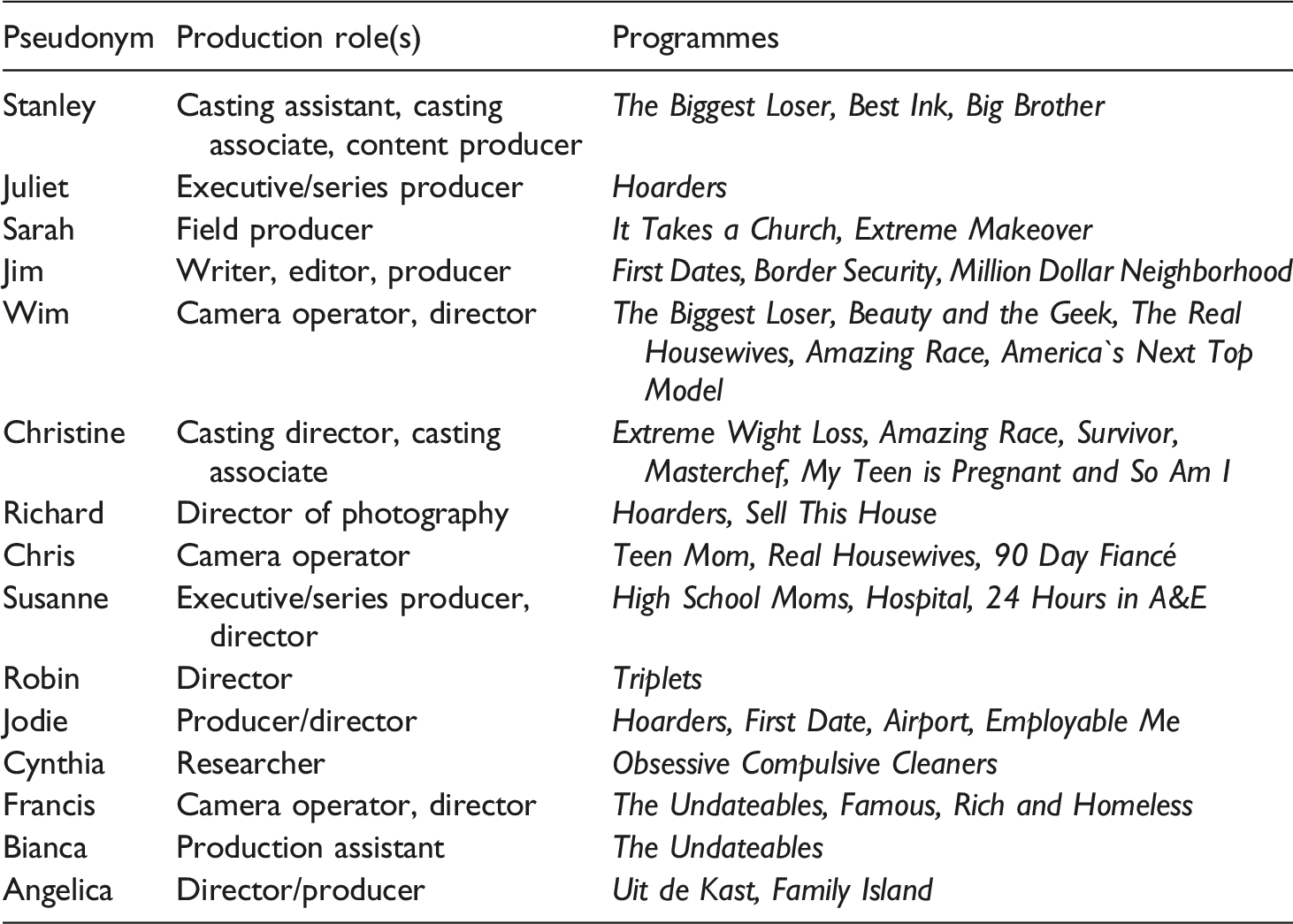
The initial contacts were handled by a research assistant and the solicitation letters in all cases were personalised. Respondents were furthermore offered anonymity and a gift certificate as a compensation for their time and effort. In the end, a total of 15 producers from the UK, US, The Netherlands and Canada were recruited with a more or less proportional distribution of respondents in terms of production role, age, gender, national background and programmes they had been predominantly working on. While reality television production is by and large a transnational field, national characteristics were registered and, where relevant, noted in the analysis. Such differences, however, seemed to be minimal as far as the producer-participant relations were concerned; this underlined my suggestion elsewhere that the identity work of the social actors involved bear more significant consequences to these relations than national production structures (Boross and Reijnders, 2019). At the same time, the fact that the respondents were less diverse in terms of class and race/ethnicity – all of them were middle class and white – potentially also shape the tactics and representational strategies discussed above; this issue would deserve further attention in future studies of cast–crew relations. Interviews lasted an hour and a half on average and were conducted either via Skype or in person.
The low response rate in spite of including multiple countries did not come as a surprise, and was later also thematised in the interviews, partly to discuss aspects of access and partly to get an idea about the motivations of those who finally agreed to take part. A common thread, especially in the case of below-the-line workers, in explaining why crew members are generally reluctant to disclose details of their work is the lack of clarity about what one is allowed to say at all without asking permission from superiors. This is generally related to the assertion that those at the top of the production ladder do not want to reveal how the sausage is made: ‘It would just kill a bit of that magic. There is so much magic that you don’t want people to question. And that’s important, not breaking that suspension of disbelief’ – casting assistant Stanley argued. Others were more down to earth in this respect: ‘They don’t really care about what we are talking about,’ cameraman Chris maintained, ‘they just care about the storylines, and they are worried about that kind of thing getting out. So my initial response when I saw your email was, yes, somebody does need to get to the bottom of this. Because it’s something so pervasive in our society right now, it’s huge. And people have been programmed since they’ve been kids now, with this type of television experience. Who knows what it does to people.’
One of the anticipated constraints of ‘getting to the bottom’ of what television participation ‘does to people’ was what Caldwell calls the ‘inverse credibility law’, referring to his experience that ‘the higher one travels up the industrial food chain for insights, the more suspect and spin-driven the personal disclosures tend to become’ (2008: 3). In order to move beyond habitually employed corporate scripts and to go beneath discursive constructions of the ‘ethical producer’ (Wei, 2016) in the interview situations, embedding the topics of my interest in broader and personal life histories and experiences of the respondents proved to be a good strategy. Accordingly, relatively large parts of the interviews were spent asking the producers about childhood memories about television, their path to the industry and future ambitions. Other topics that were helpful in establishing rapport were talking about the interviewees’ (lack of) interest in working on fiction and discussing utopian and dystopian scripts of the future of television and media practices – these mind games commonly triggered enthusiastic and philosophical conversations and, returning to my narrow topic from these side routes, often enriched the picture provided earlier.
That said, the interviews show a clear duality with respect to the subjects’ willingness to share the contradictions of their work – mainly, how the little scope for individual artistic self-expression create conflicts between what they ‘can do’ and what they ‘want to do’ (Zoellner, 2009) and the efforts they recurrently made to highlight their personal and professional integrity. There is not much to do about this – this is a notorious problem of virtually all interview studies – except for being aware of the bias and being attentive to the earlier described discursive-ideological, practical and experiential dimensions of the production process. With these words of caution, I will now proceed to my findings, starting with the first moment of interaction between productions and participants: the casting.
Casting the ‘ideal’ participant
In his study on dating shows, Teurlings (2004: 141) identifies two managerial problems when it comes to the selection of candidates: finding enough participants (termed as ‘selection-as-inclusion’) and eliminating unsuitable candidates (‘selection-as-exclusion’). As the interviewees often highlighted, these problems are quite inseparable in the actual process of casting. Even in cases of large volumes of applications, it is difficult to find and pick participants who indeed ‘play the ball’. At the same time, potential candidates commonly undergo several rounds of call backs, test shots, psychological screening and sometimes group interviews. As a result, those who finally appear on the screen are, as most interviewees insisted, not just ‘off the street’: These people have been vetted and scrutinised to determine how they come across on camera. If you were to just do a random sampling of the people off the street, you would end up with a terrible show, it just wouldn’t work. (Wim, director of photography)
‘Ordinary’ people, in other words, must meet a variety of criteria to ensure that their performance will be ‘broadcast friendly’. Most importantly, the ideal participant has to be authentic, and at the same time, conform to the personality traits and abilities preferred by the format and the programme’s politics of representation.
These judgments are most likely inseparable from both the caster`s and the participant`s intersectional identities, nevertheless, this has rarely been thematised by the interviewees. Respondents rather linked the notion of ‘authenticity’ to the idea that the candidates’ motivations have an impact on how they will come across and, consequently, how therogrammme will be received by the audience. ‘Those who are obsessed with getting on television will not seem very genuine at the end,’ Canadian producer Jim claims, suggesting that the pure desire to be on television cannot be the candidates’ main drive to participate, even if it is precisely this desire which is reinforced by the programmes: they ultimately showcase how the ‘higher reality of media’ (Couldry, 2004; Kilborn, 2008) provides an experience that enables people to transform their lives. ‘Authentic’ participants are not only lacking celebrity aspirations, but their participation is altruistic, ensured also by not providing them financial compensation: according to producer Jodie, ‘if you financially compensate the participant, it is not a true documentary anymore’ [author emphasis]. Note here how the lack of financial transaction between participant and production is linked to notions of ethical, quality programme making, and how this interpretation diverges from academic discussions where the ‘free labor’ practices of reality TV economy are often juxtaposed to questions of fairness and exploitation (Andrejevic, 2004). In this respect, Andrew Ross (2014) rightly proposes that what counts as ‘fair’ is highly contextual, especially in the deregulated sectors of the creative industry and in times when the generational norms and conceptualisations of ‘compensation’ are rapidly shifting.
Besides the ‘right’ motivations, authenticity is also commonly equated with natural self-presentation and performance. As maintained by several respondents, casting authentic characters has, in this respect, become increasingly difficult, due to the general ‘reality savviness’ of the audience. Wim`s following explanation underlines how reality TV became familiar cultural terrain in the past two decades (Grindstaff, 2009), prompting candidates to follow particular implicit scripts: Reality TV has been around for so long, we are now casting people who’ve grown up almost exclusively with this kind of programming experience. They know the rhythms and how the world of reality television plays out. So it’s getting tougher to get truly unique characters, that don’t automatically fall into those patterns that are so prominent in most reality shows. Like patterns of behaviour and talking… like I need to act even more outlandishly than I would normally to draw attention to myself.
Ideal candidates are thus free from ‘reality TV patterns’, but this does not mean that producers do not seek the potential of (interpersonal) drama when selecting participants: ‘We want people to get into conflicts, we want to see something instigated, we want to see it resolved in the ending,’ casting director Christine insists. The ‘drama’, however, should be based less on the candidates’ performance of an exaggerated self (which will become ‘outlandish’) but follow the cultural scripts and stereotypes on which specific programmes build and, therefore, controlled and facilitated by the crew: ‘If you put enough personalities in a room, there’s gonna be conflict,’ casting assistant Stanley admits how drama is often routinely ensured.
Searching for ‘rough diamonds’ does not mean that the personal qualities required from future participants are lacking patterns, either. While the key criterion, as unanimously emphasised, appears to be the candidates’ ability to narrate their experience, the respondents also agree that ideal participants are open, energetic and talkative, even in instances when the core business of the programme is to help and educate rather than entertain: Audiences respond more to bigger personalities, to people who are more energetic, just like in life. You not only see who’s got a need, but you also see who is not gonna just sit back and be super quiet. This is a TV show, and it has got to be interesting. We are not here just as a clinic. (Stanley, casting assistant)
Finally, the producers strive to present extraordinary transformations, both satisfying presumed audience needs and legitimising the televisual framework of the intervention this way. As Stanley exemplifies: ‘no one wants to see someone who is going from slightly overweight to be less than slightly overweight; the whole point of the show is that people really turn their lives around.’
There might be people out there meeting all the above criteria, but it is often challenging to turn them into actual ‘participants’, especially when producing new shows. As casting director Christine highlights, the lack of familiarity with the programme and finding cast members in real life who fit in the constructed reality of the programme are particularly persistent difficulties of first series: Nobody knows the format, who the host is, you don’t have any celebrity backing it, the network won’t even admit they are making the show, and you are the first person cold calling the contestants. And when there is a type of person or type of story that we want, we have to find them. Once I had to cast mothers and daughters who are pregnant at the same time… It’s a lot of work and the worst thing is when you come to work and your email inbox is empty.
While more established formats are self-sufficient in the sense that they attract candidates without having to search for them, the casting process is characterised by a great deal of uncertainty also in cases of popular programmes. Applicants often change their minds, even if they show up for open castings themselves. ‘If you are standing in the line for an hour or two, out there with 15,000 people, nothing seems real at that moment. But in call-backs, people start getting nervous, not calling us back, because all of a sudden it feels real, they realise they are about to be on TV.’ Stanley here describes how the abstract desire of getting on the screen is naturalised and facilitated when being part of a ‘likeminded’ crowd, and how it becomes questioned when the prospect of participating in the show starts feeling ‘real’.
Surprising as it may seem, the most common concern about television participation for candidates is social media and online interactivity. As explained by a caster,
They [candidates ultimately backing out] didn’t mind being on TV, as far as what that meant in 1992, but they didn’t wanna be on TV in 2017 where everyone on the internet can go and weigh in on everything you’ve done. They wanted the help, but they didn’t want to become a public person.
In the case of televisual interventions, where the desire to take part appears to be based less on celebrity aspirations than the desire of ritual transformation (Grindstaff, 2009: 83), the fact that the audience can talk back, appears as a threat to television participants. This threat is contrasted with easier times when the more restricted para-social relationship with the audience prevented the participant from being commented upon. Crew members for sure perceive online interactivity as a risk, underlined also by the common reasoning that the primary purpose of psychological screening of the cast is to see if they are able to handle this type of publicity – and not, shall we say, their preparedness for the emotional labour (Ross, 2014: 34) involved in the actual production process. In the next section, I turn to this process and how the labour of ‘being watched’ (Andrejevic, 2004) is streamlined by the programme makers.
Producing ‘extraordinary’ performances
If the whole point of participating in interventional shows, as emphasised by respondents in the previous section, is to turn lives around, the intriguing question that follows is how the ‘turning points’ – confessing deep secrets, breaking with vicious routines, taking on challenging situations – are triggered by the productions and why such turning points can be achieved at all. ‘The premise is that you’d force yourself into a position you are uncomfortable with, and help yourself through that,’ Cynthia, production assistant on the Obsessive Compulsive Cleaners (2013-) franchise asserts, highlighting the disciplinary force of the production environment. But how does this environment serve as a catalyst and what are the limits of its transformative power?
Responses to these questions commonly entail a combination of general assumptions regarding how ‘media power’ works (let us call these meta-explanations) and assertions regarding the importance of micromanagement, in which the tactics of forming the participant-crew relationship play the most significant role (let us call these interaction strategies).
As to the meta-explanations, interviewees generally subscribe to the idea that being part of television is an extraordinary enough experience to facilitate out-of-the-ordinary performances. According to executive producer Jim: It takes you outside of yourself. Because television is bigger, it's a bigger experience, and I think what happens is when people put themselves out there to do that, because it's such a unique experience and situation, their perception changes and they become more open-minded.
Others link the possibility of making participants perform in ways they would not in their everyday lives more specifically to the ‘epistemology’ of surveillance. ‘As soon as you observe something, you change it,’ director and cameraman Francis claims, suggesting that the camera is not there to ‘document’ (or neutrally register) reality but to construct and change reality; it is precisely this mechanism where the transformative power of television participation lies. That surveillance transforms its object, which in our case means that it induces behavioural changes in the participants; is often considered by the respondents a therapeutic effect of acting for television, corresponding with Andrejevic’s study where being watched all the time, as claimed by Big Brother participants intensifies one’s experiences and thereby facilitates self-growth and self-knowledge (Andrejevic, 2004: 145). When elaborating on such empowering effects of surveillance, monitoring is often equated by the respondents with listening, and linked prominently to the participants’ desire to be heard: Having cameras pointing at you boosts your confidence: you feel stronger when you are being listened to. We say to people ‘I see you’, and that’s what most people, participants in any programme, normally do not have. They are not used to being seen. (Angelica, director)
Remarkably, while the interviewees attribute such a metaphysical power to the presence of the cameras, they commonly argue that this power works only with the right interaction strategy, that is when the people behind the camera remain invisible and interact with the cast as little as possible. ‘We should be ghosts,’ cameraman Wim states, describing the conditioning of the participants to accept this principle as a Pavlovian process: First week they are uncomfortable and try to talk to us. Eventually somewhere in the second week, they start to get bored with that, especially if they are being ignored. If the crew isn’t engaging with them, then they are not getting any reward for trying to talk to them, they will then just put their attention to their task or on whoever else is in the room, hopefully the other cast members. We want them to relate to one another, not us.
Other roles within the production team, however, require different strategies: producers often emphasise the emotional investment and the importance of personal bonding with the participants to make them do what they want to see on the screen. Although not necessarily conceived as un-genuine, this investment is often described as manipulative. As producer-director Angelica maintains: I am even conscious about touching people at the right moment. But that’s the work we have, we try to convince people to say and do things. And to trust in us. But I also feel that they have to be able to trust us.
In Angelica’s argumentation, ‘manipulation’ serves a purpose, but it does not mean that it is exploitative, as long as the trust built up with the cast is not compromised in the end. Furthermore, as underlined by others, employing fine-tuned tactics is quintessential to create a sense of authorship, enhancing in that way the participants’ commitment to the project. ‘No one wants to be a fish in a fish bowl,’ Shawn argues why indirect guidance is more efficient than giving clear-cut instructions. Jim adds that crew members ‘are not dealing with actors who have been trained to take direction,’ highlighting the importance of making participants feel that they are the primary owners of their actions. ‘You’re telling them: we’re going to do this with you, while in fact we already planned the whole day,’ Angelica points out who makes the actual decisions in the process, even if participants often experience it otherwise.
Despite these strategies, production members commonly emphasise the fragility of the cast-crew relationships and the challenge of maintaining a fine balance between the end goal (that is creating a ‘good story’) and the participants’ personal needs and reasons for going through the process. In this respect, ‘out-of-balance’ situations are frequently imputed to the power relations of the production hierarchy: Those higher up in the team aren't talking to the contributors on a regular basis. They don't know them and care about them on the level that we do. That’s why always the bosses come up with the ridiculous dreams and scenarios that we have to try to fulfil. (Bianca, production assistant)
Although such narratives are common, complaining about unrealistic scenarios rarely involves moral reflections or questioning the chain of command. ‘I am well compensated for the work I do, and it’s a job, we are telling a story,’ cameraman Chris claims. ‘But you have to treat the talents well. If you are always just pushing them in the worst way, they will stop responding to you, they won’t open up anymore,’ he adds, framing responsible and ethical conduct as a pragmatic prerequisite to delivering a good job.
In general, ethical questions are seldom articulated in relation to the actual treatment of the participants in the production process. ‘We have such tight production protocols, also in terms of what we can offer or say or do, that it’s a fairly well-oiled machine,’ executive producer Juliet argues, while allowing that ethical conduct is not universally given: ‘Television is like everything else you consume. Every network has a different agenda, and the participants need to do their research and select carefully where they are going to put themselves.’ This reasoning, however, also captures a core paradox of the neoliberal logic of interventional television: the starting point of the formats is the contestation of the participants’ agency for self-care or improvement (after all, that is why the televisual transformation is needed), while insisting on the participants’ responsibility to be literate enough to select the right show (which will then train them in citizen self-responsibility).
Having said this, respondents commonly highlight the challenges of portraying the participants ‘fairly’. As illustrated by the quote below, the choices in this regard also requiring a great deal of pragmatism: I had a feeling that, okay we can't show this [compromising footage about a participant]. But then the channel insists, even if it was going to destroy that person. Then you use them, but try to make some balance. If they say something really stupid, people will love it. Then you know that the following day you'll have 100,000 extra viewers. But if you continuously make them look stupid, people won’t bond with them, won’t identify with them and they will stop watching eventually. (Robin, director)
At the same time, footage manipulation does not necessarily serve a negative or scandalous end, even if it aims at increasing viewing figures. According to BBC producer Jodie, the opposite – editing people ‘nice’ – is more common: People often think that we make participants out to look worse, while most of the time, we try to make them look better. Because if you are not a very nice person, people aren’t gonna want to watch you, and they are not gonna care about whether you succeeded in this journey you are taking in this programme.
While this quote is consistent with the findings of my earlier studies where participants are generally satisfied with the end product, it is important to highlight that positive evaluations largely depend on the extent to which participants are able or willing to ascribe their performances to established cultural stereotypes (Boross and Reijnders, 2019). Considering a journey ‘successful’ also largely depends on the vantage point from which the impact of the extraordinary performances are evaluated. In this respect, the transformational potential of television participation is often discussed, and problematised, by the interviewees with respect to different yet interfering realms. First of all, it is commonly emphasised that one cannot control what happens outside of the actual production, even if aftercare is involved. Once leaving behind the corporate scripts from which respondents often initially talk, many of them raise concerns regarding the long-term effects of participation, revealing certain ontological tensions at the core of their business. According to Jim, Underlying causes are more persistent than what production companies can do. Even with aftercare, you can't change people's lives. Intervention even can make things worse: you'd have this extra attention, then it is gone and you are alone again. I've always wondered if being on television is good for your soul or not, I don't know.
Concerns regarding the temporality of the attention given to participants are also raised by BBC producer Susanne: ‘We come into their lives, open them up, take what we want and leave, and suddenly they are on their own again.’ Cameraman Chris goes even further in questioning the help provided to the participants and the public service element of the programmes which is often highlighted by producers: It [Hoarders] is supposed to be a public service, but it’s a freak show. It’s about ‘how could a person be like this’. There’s the therapy, but there’s not really therapy, it’s just treating the symptoms: let’s just clean this up for the sake of television, so that we can get a beginning, a middle and an end. Now perhaps they are more damaged because we separated them from the only comfort they’ve had, which was their stuff. In a greater context, there is this pervasive use of people to get a story, but I mean the bigger question is: is the content worth it?
In spite of the attention given and strategies discussed before, it also occurs that participants fail to perform or overcome their issues within the process of production; paradoxically, such failures are often imputed to the participants’ ‘blind trust’ in television’s ritual power to transform people: Participants sometimes see television as a miracle maker; they are like: I'm in this programme so I will lose weight, but they seriously get disappointed when they realise that they also have to work for it themselves. They don’t see that those being in the show on previous episodes had been followed for a year. They only see the 40 minutes: you start like this, and you end up like that. (Angelica, director)
In this interpretation, the naivety of unsuccessful candidates is linked to the pervasiveness of the assumption that television will fix you no matter what; yet this assumption is precisely reinforced by the representational logic and the editing of the series. In this logic, striving for a ‘happy ending’ plays a pivotal role. As Angelica continues: It is often not at all a success story once the camera is gone. If we followed them up a year later, you would see that half of the families stopped working out. Maybe they’re not even together anymore. But on TV it has to be successful because otherwise why start season two with different families. So you censor to sort of keep the hope alive.
In the following section I will look deeper into the considerations and mechanisms behind the creation of such televisual representations, as well as how the final cuts, according to the producers, give voice to the participants, or reflect their stories.
Creating ritualised texts
Success stories, as underlined by Angelica at the end of the previous section, are important ingredients of institutional self-legitimisation and reproduction: they authorise the interventions and maintain what I have earlier called the ‘transformational credibility’ of the programmes (Boross and Reijnders, 2019). Delivering positive messages, however, while also fulfilling the audience’s presumed appetite for drama and extraordinariness (remember: ‘no one wants to see someone who is going from slightly overweight to be less than slightly overweight’) is only sustainable if the productions employ certain established strategies to textualise the otherwise messy realities of the participants’ ‘journey’.
In this respect, the development and the serialisation of interventional programmes are often described with ambivalence, interpreting the process as a gradual move from a ‘true’ documentarist endeavour, the very ideal when it comes to professional self-identification and thinking about storytelling, to the mechanical reproduction of scripted formats. Those working on early episodes often look back with nostalgia and perceive the ‘formatisation’ of subsequent seasons as a compromise of quality and value. In such recollections, the ‘early days’ are described as a state of bliss, where the effort of helping the participants goes hand in hand with collective creativity and professional excitement about the unpredictability of the outcome. In these readings, serialisation results in increased hierarchical control over the content in order to safeguard profitability: I was there at the very early stages. It was lots of experimentation; we really didn’t know if it was going to work. And there was a purity to it: we were really focused on these people’s condition and helping them improve and make changes. Then it became all about attracting an audience, and also obviously to sell ads. If you go through the seasons progressively, the amount of time allocated to selling product, what we call integrations, just has gone up and up and up. (Wim, director of photography, Biggest Loser)
Formatisation is, however, explained only partly by risk aversion. Repeating the ‘same story’ over again is also imputed to freelance labour conditions and the fact that individual crew members with creative control are often commissioned for a few episodes only. ‘If the same person were filming all the births, you wouldn’t see the same story twice,’ BBC producer Jodie exemplifies the problem of staff fluctuation with the series Teen Mom (2016-). ‘But without continuity, every director goes down to the basics: the girl comes in, she’s very young, she’s very vulnerable, and she has a baby.’ At the same time, Jodie allows that repetition does create a sense of continuity on the reception side: ‘The audience wants to know what they are gonna be watching. The whole point of a documentary is supposed to be surprising, taking on a different route. But there is the comfort when you are familiar with what you are getting into,’ she maintains, denoting a positive habitual function to consuming predictable storylines.
It is easy to realise how the quest for replicating previously successful moments also necessitates the active construction of situations and cast interactions even when the production shoots on the ‘observational’ end of the reality spectrum. Yet ‘scripting’ is also explained by the need to expedite the flow of events or by the frequent realisation that the everyday reality of the participants is more banal or tedious than originally expected. ‘We realised that triggers are needed, otherwise it is going to be bad TV. So it shifted within a week from “let it happen” to invent all the episodes ourselves,’ director Robin recalls how the shooting of a pilot made him depart from a ‘documentarist’ perspective. Cameraman Richard further illustrates the unsustainability of ‘pure’ observational techniques by his recent work on a docu-soap, focusing on the ‘everyday life’ of police officers: When we first started out on the show, we attempted to do it real, but it would take too long for something to happen. You may spend weeks following them giving people traffic tickets, well, that’s not exciting television, it’s only exciting when they pull their guns out, that’s where the drama lies.
Often, balancing between actual circumstances and delivering an improved, more exciting version of reality is further complicated by the commissioner’s requirements or expectations about the ideal show and, apparently, working for commercial channels or public service broadcasters does not make much difference in this respect. ‘The channel wants helicopters, at least three times per [season]. But you can’t guarantee who’s gonna come in from an accident that way,’ producer Jodie complains. ‘(…) Then [for the public broadcaster] you have to tick the diversity box even when you are shooting in an area which is 99% white.’
Considering that the motive for television participation is typically linked, by participants and producers alike, to the desire to be listened to, a question that logically follows from the above production pressures and strategies is the relation between the participants’ story and the producers’ story: how do the participants’ voice, personal life narratives or intersectional identities fit into the often pre-established formats? Remarkably, this dilemma is seldom raised by the respondents: many of them rather straightforwardly claim that the ‘participant’s story’ is not ‘out there’, not a preliminary given, but constructed through participating in the production process and ultimately authored by the crew. According to producer and scriptwriter Jim, it is precisely the construction of a meaningful story and attaching it to a participant’s life where the ritual and reciprocal function of participating in scripted television lies. As he elaborates: We all want our lives to be a novel, but our real life doesn't have a story, it doesn't have an arc. Mostly our lives are just a bunch of random circumstances that come together, right? We want someone to give meaning to that, and I think that's what television does. It takes an ordinary person and surrounds them with a team of authors who say what the story of this person's life is. And in television we are seeking greater themes and universal truth, so our version of those people’s lives frames them in a context that makes it feel like their lives have more meaning.
Jim’s theorisation also explains why participants most of the time are satisfied with the end result: their life got a storyline. As Jodie explains, the creation of this storyline first and foremost means selections in practice: script development is primarily about finding a pattern to tell a story out of random situations and utterances. According to Jim, the story will be recognised and appropriated by the participants as their own story, as long as the producers ‘pick pieces [from the participant’s life] that will fit the stories we are trying to make.’ Somewhat cynically he adds: ‘you know the old saying that facts are like apples on the tree, there are many apples, but you pick the ones you want. From an hour-long interview what 2 minutes are you going to use?’
The construction of a televised version of one’s everyday reality, in this reasoning, requires distance – contrarily to the often intimate interpersonal strategies employed in the actual process of the shooting. In Jim’s work routine, the rule of thumb is not letting the directors (or anyone working with the participants ‘on the ground’) into the edit suite: ‘They’re too close to them [the participants] to be editing in post-production. It’s all about maintaining that sense of distance. If you haven’t met that person, then you have a little more freedom to play with their words.’
Jim sees the power of television precisely in such procedures of ‘distant creation’; ‘reality’, in this view, is something observed from a perspective. To underline this argument, he contrasts television participation with online DIY productions, such as grassroots content creation on YouTube: For YouTube you can create tiny little formats, and people might come back because they just like your personality. But there is no story, there is no artist, there is no growth, and there is no perspective when you are doing it yourself. It's impossible to see the journey of your own life.
Similarly to Jim, many respondents emphasise the value of televisual storytelling vis-à-vis content that is produced and consumed within the new media ecology. ‘You can watch a thousand cat videos and it’s great, but it’s like eating cup noodle: it’ll fill you up for 5 minutes, but it won’t satisfy you,’ producer Susanne argues, implying that it is solid storytelling that ultimately gratifies the audience. Such articulations, however, demonstrate a far-reaching duality. On the one hand, ‘cat videos’ (to stick to Susanne’s synecdoche) are seen as the epitome of emergent forms of online media against which the continuing value of the shows the respondents create is positioned. On the other hand, such products are perceived as a general threat to established forms of storytelling, based on the assumption that the ubiquity of ‘cat videos’ inevitably changes audience habits and needs. In the next, concluding section of this article, I briefly expand on this duality, putting the previously discussed ideals, strategies and constraints of producing interventional television in a more general perspective.
Conclusion: Televisual interventions in a new broadcasting age
‘The world of television that I inhabit now is not the world I grew up with. Things have changed massively. The channels are in a desperate race for the viewers, and there is a huge amount of trash out there. And it is exploitative trash,’ BBC producer Susanne contemplates near the end of our conversation. Her slightly alienated, Adornoian outlook on the current state of affairs in the broadcast television industry is not atypical, quite the contrary: the interviewees of this study have generally painted a pessimistic picture when reflecting on the changing conditions and conduct of today’s television production.
Next to the earlier mentioned ‘formatisation’ and format copying (diminishing, according to many, the space for creativity), the most common trope prevailing in such discourses is acceleration. As Susanne points out, ‘once we filmed single episodes for several months. Now things like The Undateables (2012-) just take a week to film. It’s brilliant: it is cheap, quick, easily reproducible, so it fills a lot of airtime. And it gets viewers.’ Likewise, producer Jodie recounts how a format she had been working on for years was gradually modified to reach its current form: ‘We used to shoot more observationally, the scenes were opened up. Now it’s fast paced, everything is cut against music, and the scenes are so short because all they need is a look or a word.’
While this emphasis on speed is commonly perceived as a restraint on in-depth storytelling, it is also interpreted as a ‘natural’ reaction to the professed transformation of audience habits amidst the increasing mediatisation of everyday life. ‘Cell phones and social media lead us to need more stimulation faster and that translates into television. Like okay, we’ve got one thing going on, we need to get the next thing happening,’ Chris explains with some disillusion. ‘You have to make scenes shorter because people lose interest, and because on a different channel they can watch shorter, choppier sequences, and that keeps them more alert. People have got too many mobile phones, haven’t they?’ Jodie argues similarly. Others connect the logic of ‘narrative speeding’ with the constant need for producing interactive audiences. ‘Shows are built more around person-to-person conflicts now,’ Stanley highlights. ‘They are pushing more of that, wanting to see people argue with people, because it helps the show moving faster. And there has to be a moment in every couple of minutes that people are tweeting about.’ Such strategies of audience maximisation are, however, often seen as an obstacle in making an ‘impact’ in the end: ‘Today everything is catered to your interests. If something is felt [to be] too long, you just switch. You only get what you like, what your friends like, so you cannot expand your horizon. TV used to be about looking out, and now it’s about looking in,’ Angelica contrasts an ideal (ised) past with a present where effortless, on-demand programme consumption, instead of facilitating, ultimately hinders social learning.
What is noticeable in these arguments is how strongly they relate to changes of traditional broadcast business models that already occurred around the turn of the century (Kilborn, 2008; Zoellner, 2009), while they lack reflections on more current reconfigurations of the industry (such as platformisation, convergence and streaming services). Rather, new media and its ‘impact’ is discussed more in layman terms (the fictional series Black Mirror, 2011–2019, has been a frequent point of reference by the respondents at this point of our conversations)
With all its deterministic and dystopian patterns, this new media world discourse is not entirely unexpected, even if, at first sight, it contradicts the seemingly confident claims regarding the educative power of televisual interventions in which the respondents have been concretely involved. Rather, this discrepancy can be read as a signification of the tensions resulting from the constant pressures to negotiate – or disregard – different conceptualisations of audiences (public versus market, see Ang, 1991) and participants (commodities versus subjects of emancipation) in a production process that is set out to transform non-media professionals not only into television participants, but also into empowered citizens. It is precisely this tension that has been brought to the fore while exploring the ideals and realities of how programme makers streamline the participation of ‘ordinary’ people in different stages of interventional television production.
Beginning with the respondents’ characterisations of the ‘ideal participant’, we have seen that casters need to consider a variety of production demands: they have to identify candidates who are, on the one hand, socially engaged and eager to ‘improve’ themselves, and on the other hand, entertaining and articulate enough to keep the audience interested in watching them. Furthermore, productions need participants who are willing to share intimate and challenging aspects of their lives without being intimidated by online audience reactions. Participants also need to carry the potential of making extraordinary achievements under surveillance and within structured, disciplinary settings. We have then seen that crew members, in their effort to capture ‘life changing’ moments, must interact with the cast consistently and according to strategies designated by their particular roles (being ‘ghosts’, or touching the participant in the ‘right moment’), while they also have to accept that the real impact of the interventions is, at the least, uncertain beyond the controlled environment of the productions. Finally, we have encountered how scripting the participants’ actions on the ground and in the editing room must serve the creation of routinely reproducible yet subversive textual universes, where complying with formulistic procedures implies a general promise of redemption, and in which individual participants can still recognise the ‘authentic’ story of their own lives.
As the interviews revealed, working on the above steps towards predictable transformations (probably the very cultural function of ritualised formats – if not of most human ritual activities) is not free from personal and professional compromises. While this underlines that the intentions of programme makers are more complex and complicated than provoking and selling strong performances (Teurlings, 2004), it is striking how conveniently the tactics towards these ends, even if contested at times, are ultimately reproduced in practice (‘it is a fairly well-oiled machine’). The mechanisms that might explain how this reproduction becomes naturalised – leaving little room (or need) for agency and resistance – appear to be both discursive-projective and organisational in nature. As we have seen, when production practices become conflicted with one’s personal values or professional standards, the responsibility for the outcome is often delegated either to the participants (who should have done their research beforehand), to those higher up in the production hierarchy (after all, this is their vision and their commission) and, ultimately, to the above described forces of the ‘new media world’ (and the ways they shape the conventions of television making today). This projective mechanism appears to be further reinforced by certain aspects of the organisational logic of the productions as well: conditions such as freelancing and the taken for granted separation of roles and work processes, irrespective of how convincingly they are supported by principles of rationality and productivity, ultimately obscure the oversight of how particular agents and routines contribute to the moral integrity – or play a role in hiding the immorality – of ‘televisual capitalism’ (Teurlings, 2004).
This story of how moral deliberation becomes subjugated to organisational rationality and procedural action in hierarchical structures is hardly new; think, for instance, of Zygmunt Bauman’s seminal sociology on Modernity and the Holocaust where this causality is meticulously described as an inherent mechanism of bureaucratic systems of modernity (Bauman, 1989). Yet the moral implications of participating in the ritual ecology of interventional television, either as ‘contributor’, producer or public, have remained somewhat underexplored in previous scholarship. Still, if we acknowledge that ritualisation is first and foremost an ordering process that necessitates the exercise of power, we also have to accept that such implications are there and need to be addressed in order to comprehend more fully what (participating in) these programmes ultimately says about our society. Therefore, it seems to be necessary to find the appropriate way to approach these questions critically and – with Graeme Turner’s words – without entering the ‘murky territory of media effects research and moralizing censorship’ (Turner, 2014: 317). It is going to be the task of future research to reflect on this issue in more detail.
Footnotes
Declaration of conflicting interests
The author(s) declared no potential conflicts of interest with respect to the research, authorship, and/or publication of this article.
Funding
The author(s) disclosed receipt of the following financial support for the research, authorship, and/or publication of this article: This research is financed by a ‘PhDs in the Humanities’ grant of the Netherlands Organisation for Scientific Research (NWO) (Nederlandse Organisatie voor Wetenschappelijk Onderzoek) 322-45-002.

Author biography
| Pseudonym | Production role(s) | Programmes |
|---|---|---|
| Stanley | Casting assistant, casting associate, content producer | The Biggest Loser, Best Ink, Big Brother |
| Juliet | Executive/series producer | Hoarders |
| Sarah | Field producer | It Takes a Church, Extreme Makeover |
| Jim | Writer, editor, producer | First Dates, Border Security, Million Dollar Neighborhood |
| Wim | Camera operator, director | The Biggest Loser, Beauty and the Geek, The Real Housewives, Amazing Race, America`s Next Top Model |
| Christine | Casting director, casting associate | Extreme Wight Loss, Amazing Race, Survivor, Masterchef, My Teen is Pregnant and So Am I |
| Richard | Director of photography | Hoarders, Sell This House |
| Chris | Camera operator | Teen Mom, Real Housewives, 90 Day Fiancé |
| Susanne | Executive/series producer, director | High School Moms, Hospital, 24 Hours in A&E |
| Robin | Director | Triplets |
| Jodie | Producer/director | Hoarders, First Date, Airport, Employable Me |
| Cynthia | Researcher | Obsessive Compulsive Cleaners |
| Francis | Camera operator, director | The Undateables, Famous, Rich and Homeless |
| Bianca | Production assistant | The Undateables |
| Angelica | Director/producer | Uit de Kast, Family Island |