




Abstract
The article maps moments of relations between two bodies and their proximity to the somatic norm of whiteness: that of Viktor Orbán, the Prime Minister of Hungary, and of the author, an émigré mother returning to Hungary to vote at the General Election on 3 April 2022. The context of the encounter is the public space of the official Instagram account of the Prime Minister, and the photos of him posted in the run up to the General Election. Viktor Orbán not only displays white hegemonic masculinities in his social media platform but sets out the role for white ethnic Hungarian mothers in reproducing a nation built on racialized exclusion. The article traces affective disruption and unease engendered by the racialized and gendered norms of national belonging delineated by the current leader of the Hungarian government. Working with Nirmal Puwar’s Space Invaders, it examines the possibilities of creating a sense of belonging from an ambivalent position of being both in and out of place.
Introduction
Black dominates the image. Black rectangular shapes. The one on the right side of the photo, covering nearly half of it, might be part of a stage of some sort. The other I recognize without any hesitation. It is the broad back of the Prime Minister (PM) of Hungary. His head is turned slightly to the right – I can only decipher a small segment of his profile, but I know it is him: Viktor Orbán (Figure 1). I know it is him not because I analysed 477 photos of him for this article and by now, I can draw every wrinkle on his face with my eyes closed, but because he has been part of my life since he first appeared in the Hungarian political arena after the regime change in 1989, when the communist rule transitioned peacefully into a democratic system. A democratic system that he has systematically destroyed since he came into power in 2010 to the point when, in September 2022, the European Parliament stated that Hungary ‘can no longer be considered a full democracy’ but a ‘hybrid regime of electoral autocracy, i.e. a constitutional system in which elections occur, but respect for democratic forms and standards are absent’. 1 Areas of key concern include human freedoms, independence of the judiciary and corruption. Although this process of dismantling democratic values, freedoms and institutions has been long in the making, witnessed by the Hungarian population, his governing party Fidesz (‘Civic Alliance’) won the latest General Election of 3 April 2022 with a two-thirds super majority again. Four times in a row. 2
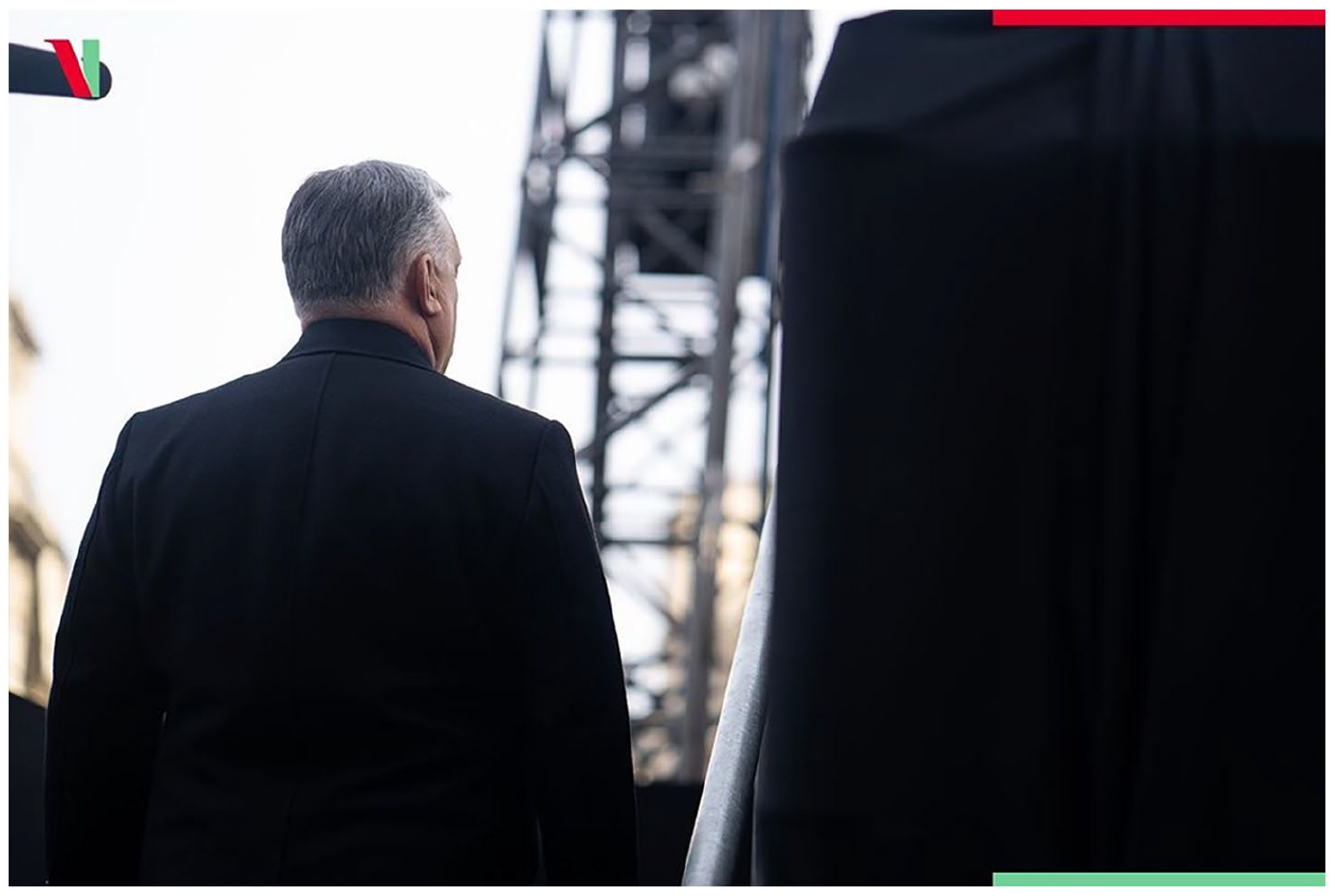
‘In one week only Fidesz! Go for Victory!’, Viktor Orbán, March 2022.
This article is not about the whys and the hows of his political success, however. It is about the unease and defiance that took hold of me when I encountered Viktor Orbán’s official photos on his Instagram account in the run up to the General Election that was held on 3 April 2022. Far from a personal confrontation with my diasporic existence, what I am interested in this article is exploring how the discomfort that engulfed me looking at these photos can be generative of a necessarily contested response to the ways in which nation and belonging are imagined by the current PM of Hungary, to the complex racial ideologies and their exclusionary effects that are not only displayed but produced in his Instagram posts. Arriving to the space of masculine white Hungarianness created by the PM, I am interested in the ‘constitutive boundaries’ of the nation in-the-making by the leader of the country I emigrated from (Puwar, 2004: 5). I use the aversion I felt looking at the photos to direct my reading and sense-making of the politics of belonging that is being offered to me, an ethnic white Hungarian mother with reproductive capabilities – one of the prime targets of the election campaign. From my ambivalent positionality of being both ‘in and out of place’ (Puwar, 2004), my analysis centres around two bodies and their proximity to the somatic norm of whiteness: that of the PM flattened out and represented in the staged photos, and my own, sitting across the screen and pouring my affective embodied intensities on to it. The ambition of this article is to stay with the ambivalence of my position of being outside of Hungary but always within it, aspiring to be outside of the normative inscriptions of white hegemonic femininity but always framed by it; and of the resistant discomfort that the photos and the meanings I deciphered evoked in me.
This ambivalent battle unfolds in the article as I move into the public space of the PM’s Instagram account to understand and resist the imagination of nation and community constructed by him (Anderson, 1983). His imagination co-exists with mine – in opposition and constant resistant negotiation. Hungarianness is fought over between the one that is handed down to me and enforced by the powers of an increasingly centralized state and an autocratic leader, and my sense of national belonging shaped by resistant micro-powers and the tools of sociological scholarship that help me to make meaning of my upheaved affective state and provide me with the necessary scientific vigour and tools to create a safe distance from which this analysis could be produced.
My primary conceptual tools are Nirmal Puwar’s (2004) space invaders and Anamik Saha’s (2021) media make race. As this special issue attests, since its publication 20 years ago, Puwar’s work has been fundamental in understanding the potentials of racialized and gendered bodies to disrupt – invade – spaces of whiteness. For Puwar (2004), spaces take shape ‘through what has been constructed out’ (p. 1). Like a hall of mirrors that only reflects the status quo, only the entrance of racialized minorities and women can reveal the sharp edges of the historical and conceptual scaffolding of white masculine ‘monuments’ (Puwar, 2004: 35). The moments or arrival of those previously excluded are where disruption can happen, when the frame of whiteness can collapse: ‘Even the most historically protected spaces can’t be contained. They remain dynamic and open to other possibilities’ (Puwar, 2004: 1). Puwar’s assertion that exclusions based on race are more acute than gender is crucial for my purposes here: while I am inscribed by the somatic norm of white hegemonic femininities as manifested by the PM in his Instagram as the ‘inside proper’ for Hungarian women in his vision of nation, I refuse this position from an ideologically informed affective response. I work with this visceral, affective refusal to develop the argument that while I could entrench my insider position by accepting the terms of passive reproduction of Orbán’s Hungary – what makes those who are ideologically counter to ethnonationalism while being invited to participate in this version of white femininity an unexpected body is exactly this affective struggle: being perceived as somatically inside, but affectively a body out of place.
Resistance is where I pick up Anamik Saha’s thinking on how media makes race. In Saha’s (2021) work, understanding diaspora ‘with its inherently anti-essentialist qualities’ can be seen as a ‘threat to nationalism’ (p. 69). Saha links diaspora to multicultural societies with indigenous, migrant and refugee populations. While I am a migrant in the country I live in, I am a diasporic ethnic Hungarian in my country of origin. My interest lies in how this outside–inside position can be ‘generative and productive’ to rupture the racial politics of the PM, that, and I argue with Saha (2021), is at the ‘heart of discourses around nation and belonging’ (p. 69). For Saha (2021), the question of representation of race in media needs to be reframed to ‘how is race being made in a particular moment’ (p. 25). Resisting the easier option to ‘occupy the position given’ and taking ‘the effort to step out of it’, I am exploring the generative power of interpreting how race is made in an ‘alternative way’ (Saha, 2021: 24): through the affective responses of a diasporic body.
I am working with affect understood as ‘relational dynamics between evolving bodies in a setting’ (Slaby and Mülhoff, 2019: 27, emphasis in original). Affect in this Spinozian approach is intrinsically imbued with power, the micro-power that each individual holds is their potentia, their affective capacity to enter into relations of affecting and being affected. Moving away from inner feeling states and emotions, this conceptualization emphasizes changing bodily capacities or micro-powers in an affective relational encounter – which in this article happens when I arrive to the space of the social media of Instagram. Foregrounding the bodily, affective experience of whiteness, I am primarily interested in exploring how felt intensities of power relations release or constrain our capacities to act, in the potentia of disturbing the somatic norm of whiteness.
Thinking about the Instagram posts of the PM in this context, the article has a twofold aim. First, to understand what kind of Hungarianness is being produced and what is the political project of belonging the PM is making on his social media platform (Yuval-Davis, 2011). Second, through a response to this racialized imaginary, to explore how a different, oppositional, fractured belonging can be produced from the ‘tenuous location’ of a Hungarian mother, who refuses the inside position offered to her while acknowledging that she won’t ever be able to be fully outside of it.
Through a thematic analysis of 477 photos, I argue that Hungarianness is being produced via ‘the wreckage of white supremacy’ (Meer, 2019) and white hegemonic patriarchal ideas framed by ethnonationalism but that its boundaries are not only being drawn by those in the inside – and at the top of the inside – but also by those who are potentially and simultaneously both in and out. Through analysing the somatic norm of whiteness that is being displayed and made in four key themes – power, war, borders, the sacred family – that emerged in the Instagram posts, I show that ideology of whiteness as a system of power and tropes of whiteness (aggressive white masculinities in service of protecting the nation, Christianity, heteronormative family, subordinated white womanhood in the service of reproducing the nation) are driving principles in the ways in which Viktor Orbán is governing the country. Yet, these exist alongside potentially alternative and resistant framings. I ask with Puwar (2004): What are the ‘terms of coexistence’ of hegemonic and non-hegemonic imaginaries of nation and belonging (p. 1)? Who sets them? Could a body out of place set the terms of coexistence – in my case from my ‘tenuous position’ (p. 10) of being somatically in- but affectively out of place? Can the terms of coexistence be disruption, fracturing, pushing back, resistance?
I conclude by offering some preliminary thoughts on a form of belonging that is produced in the shifting space of being simultaneously in and out. In the nation that is ‘heavily demarcated as [a] white place’ by the PM’s racialized imaginings (Puwar, 2004: 50), I am asking the photos the question of who has the undisputed right to belong. Through examining the aversion and distancing that has viscerally manifested in a bodily response of discomfort, I am opening the closed boundaries of the idea of the nation, which is being reframed and delineated by mainstreamed far-right ideologies and exclusionary ethnonationalisms across Europe and globally.
My argument is that the terms of coexistence are not harmonious and complementary but always in opposition, contradiction, never at rest: an actively affective coexistence of oppositional belonging that never can stand still. This is a relation of resistant and ambivalent belonging to a place imagined and physical, geographical and abstract, that is continuously being made in contradiction.
Ethnonationalism and Hungarianness
There is a world in which European peoples are mixed together with those arriving from outside Europe. Now that is a mixed-race world. And there is our world, where people from within Europe mix with one another, move around, work, and relocate. So, for example, in the Carpathian Basin we are not mixed-race: we are simply a mixture of peoples living in our own European homeland. And, given a favourable alignment of stars and a following wind, these peoples merge together in a kind of Hungaro-Pannonian sauce, creating their own new European culture. This is why we have always fought: we are willing to mix with one another, but we do not want to become peoples of mixed-race. (Viktor Orbán, 23 July 2022, Tusnádfürdő/Băile Tușnad, Romania)
In July 2022, three months after his landslide win in the General Election in April 2022, Viktor Orbán proclaimed his views on race mixing at the 31st Bálványos Summer Free University and Student Camp (better known as Tusványos) organized in Băile Tușnad (‘Tusnádfürdő’ in Hungarian), in Transylvania, Romania, where predominantly ethnic Hungarians live (Monostori et al., 2015). The week-long camp has been organized for three decades and has steadily grown into a music/cultural festival and the annual gathering of the Hungarian right-wing, conservative intelligentsia. Viktor Orbán has visited (except for one occasion) all camps since 1990. Since he came into power in 2010, Tusványos became an important vehicle for him to appeal to his supporters and deliver his domestic and global political visions for Hungary. In addition to the PM, other high-ranking party politicians and conservative intellectuals give talks on the importance and fate of Hungary’s past, present and future. 3 It was there, at Tusványos, in 2014 when he announced his doctrine of ‘illiberal democracy’, a system based on authoritarian hierarchy with elections on a 4 years rota surpassing the liberal system that developed in 1990 to arguably overcome its shortcomings in terms of protecting national interests against liberal individualism (see also Bozóki, 2015; Krasztev and Van Til, 2015). The primary value of the nation is captured by the word ‘illiberal’, and national interest is to be defined and represented by ‘a big governing party . . . through its own natural existence’ (Orbán, 2014).
Transylvania, the part of Romania where Tusványos takes place and where the PM chooses to make his yearly declarations, is more than just a neighbouring region with Hungarian minorities: it is a symbol of the nation. A nation that is Nagy-Magyarország (‘Great Hungary’), including the territories (Transylvania among them) that were taken with the so-called Treaty of Trianon in 1920, when allied forces who defeated Germany and Austria-Hungary in WWI forced Hungary to cede land to Romania, Yugoslavia, Czechoslovakia and Austria, much of which is still inhabited by ethnic Hungarians. In his annual ritual of declaring his vision at Tusványos, Orbán addresses all Hungarians within and outside the borders of the country, in what he refers to as the ‘Carpathian Basin’. In his long decade of rule, Orbán increasingly has presented himself as a protector of not only national interests but that of all of Europe ‘steering [it] away from the rocky shores of racial, cultural and moral suicide’ (Fekete, 2016: 40).
Boundaries and borders of both the geographical place and the social relations of European and Hungarian communities in his ethnonationalist project of belonging are set evidently clear by the PM in the 2022 quote above (Orbán, 2022). A ‘mixture’ of people from the same race – defined by him as ‘within Europe’ and ‘outside of Europe’ – is acceptable, whereas ‘peoples of mixed-race’ are dangerous for European civilization. This idea caused national and international uproar because of his use of the word ‘race’, triggering him to a crisis communication response during his subsequent visit to Austria, when he explained that he sometimes expresses himself in an ambiguous way, but stated nonetheless that he was taking a cultural rather than a biological approach, and that Hungary will always protect its borders (Fazekas, 2022). The racist rhetoric of Orbán might have been shocking for its openly blatant way in 2022, but since 2015 his narrative exploiting the refugee ‘crisis’ for political gains has been based on a security threat of migration and a clash of ethnicities, religions, cultures and civilizations, and increasingly of gender ideology, soaring up fear, hostility and resentment in its supporters – a shift of the far-right discourse into the mainstream that emphasizes ‘a closed and homogeneous national-ethnic community and utilizing historical legitimacy’ (Feischmidt and Majtényi, 2019: 2).
The explanation of referring to the dangers of mixing cultures instead of race or ethnicity was already used in 2017, in the run up to the 2018 election, when the PM received some backlash after he declared at a Hungarian Chamber of Commerce and Industry event that
First of all, I find it very important that we should preserve our ethnic homogeneity. Nowadays, one can say such a thing, though a few years ago, one would have been executed for such a turn of phrase. But now, one can say things like that because life has confirmed that too much mixing causes trouble. (Orbán, 2017a)
If he believed in February 2017 that he ‘can say such a thing’, he repeated them again in his Tusványos 2017 speech in July, this time clearly stating that he equates cultural identity with ethnic composition and conforming his ethnic absolutist project:
There is no cultural identity without a stable ethnic composition. To change the ethnic composition of a country is to change its cultural identity. A strong country can never afford such a thing, especially if it is not forced to do so by a world disaster. (Orbán, 2017b)
The racially exclusionary nation was the political and media message his governing party Fidesz conveyed in the 2018 election campaign, claiming that only a wall across the country’s southern border would stop Muslim migrants from entering and bringing terror to Hungary (Renton, 2019). The mobilization of ‘collective resentment’ towards racial, ethnic and religious minorities and migrants proved to be an effective political campaigning strategy to activate latent attitudes of their supporters who were promised a ‘return’ to power and status, with which Fidesz preserved its two-thirds majority (Bonikowski, 2017).
The General Election in 2018 were the second since the adoption of the new constitution, which came into force on 1 January 2012. The 2011 Fundamental Law of Hungary replaced the 1989 Constitution of the Republic of Hungary and moved from the ‘egalitarian concept of people and political nation’ to ‘the ethnic nation concept’, an effective re-ethnicization of the Hungarian political community (Feischmidt and Majtényi, 2019: 4). The new Fundamental Law cemented ethnic nationalism by creating an exclusionary identity of the ethnic Hungarian nation. In ‘we the people’, minorities are not part of but mentioned as: ‘the nationalities living with us form part of the Hungarian political community and are constituent parts of the State’ (Preamble).
4
The re-ethnicization of the nation is built upon historical myths of the ancient territory of the Hungarian Kingdom as opposed to the current geographical borders, and the protection of Christian culture by all state bodies without offering the same protection to other religions (Kovács, 2019). The 2011 constitution also established the unity of powers with the new rule by law regime. A ‘necessary’ move towards authoritarianism, explained by Orbán as the only way to treat Hungarians: ‘Joining forces is not a matter of intentions, but of sheer force. With a half-Asian lot such as ours, there is no other way [than compulsion or force]’ (2012, quoted in Halmai, 2018). Examining the new Fundamental Law from a comparative constitutional law perspective, Margit Feischmidt and Balázs Majtényi (2019), editors of a collection on the rise of populist nationalism in Hungary (published by the independent Central European University, which was forced out of Hungary in 2018
5
), conclude that
our position is that the fact that the constitution follows the ethnic nation concept threatens the egalitarian nature of the state . . . grounding social solidarity on ethnic origins leads to social exclusion, the stigmatization of peripheral groups, and the destruction of the principles that make resistance to such processes possible. (p. 4)
The constitutional boundaries of who belongs to the community of Hungarians that the ethnic nation concept instituted are further narrowed in the Fundamental Law by the commitment to the protection of the Hungarian Roman Catholic tradition (Halmai, 2018). This branch of European Christianity, of which Orbán declared himself as the defender for the sake of the whole of European civilization, 6 sits alongside not just the sole tolerance but lack of protection of various religious traditions, 7 and with constant references to the ancient pre-Christian paganism in the party’s rhetoric. Christianity and references to Hungary’s pre-Christian Eastern pagan history, being kept alive by its symbol of the Turul bird (‘the symbol of national identity of living’ in Orbán’s words 8 , see Szabó, 2012), are not only being used opportunistically in the framework of the ethnonationalist political strategy, but also emphasize the idea of ‘two Hungarys’: the tribal, pagan Eastern one and the Western Christian (Ádám and Bozóki, 2016), compounding to what Ivan Kalmar (2022) defined as ‘white but not quite’: the condition experienced by peripheral East European countries of not being fully granted the privileges of whiteness that countries in the Global West enjoy.
In the European and global hierarchy of power, ‘white but not quite’ does not afford the Hungarian PM the position he seems to be aspiring for. Speaking the ‘tired old language’ of ethnonationalism, authoritarianism, the Christian European civilization, resurrecting anti-migrant white racism and a backlash against gender and sexual orientation as dominant state ideology to provoke fear and resentments towards external and internal enemies exposes his attempts to establish white supremacy at the centre of his politics (Fekete, 2019: 99). In his prime ministerial oath after his election win in 2022, he publicly waged war:
Part of the picture of the decade of war facing us will be recurring waves of suicidal policy in the Western world. One such suicide attempt that I see is the great European population replacement programme, which seeks to replace the missing European Christian children with migrants, with adults arriving from other civilisations. This is also how I see gender madness, which sees the individual as the creator of their identity, including their sexual identity. And this is how I see the programme of liberal Europe, which leaves behind Christianity and the nation states that up until now have held the West together, while putting nothing in their place. (Viktor Orbán, 16 May 2022, Budapest, Hungary)
White supremacy as an inspirational system of power – with the white ‘nation-in-danger’ (Hervik, 2019) at its centre as made in the PM’s digital media platform – is the framework in which I move on to analyse the Instagram photos in Orbán’s successful election campaign in 2022. The approach I am following draws on Shona Hunter’s (2024) assertion that instead of ‘centralising race and racism as epistemological errors in policy’, the analysis must focus on ‘the ontological politics of the [il]lberal state’: ‘I am suggesting that it is only from within an analysis which surfaces whiteness as a policy ideal that the range of social dynamics of power and vulnerability at work within the state can be fully understood’. In my analysis, whiteness as an ideal (and its contestation as the basis of nation and belonging) is being examined via the relation between two bodies and their proximity to the somatic norm of whiteness.
Methodology
The article is based on a thematic analysis of 477 photos retrieved from the PM’s official Instagram account, 9 from 20 February 2022, the date when the first election-themed post appeared with Orbán’s candidates, up until the date of the General Election on 3 April 2022. In this timeframe, Viktor Orbán posted 477 photos and 58 videos. I collected the photos using the screenshot function (the analysis does not include the videos). If a post had multiple photos, I collected all photos in the post. This sample size proved to be large enough to reach saturation. Following the main inquiry of how the PM is racializing national identity and belonging on his social media platform, I did not include likes and comments for the posts. The four main themes were organized from those that featured most in the subthemes that I identified.
Taking Puwar’s (2004) conceptualization of space and studies by Sarah Pink and John Postill on social media place making (Pink et al., 2016; Postill and Pink, 2012), I approached the official Instagram site of the PM as a public space. Through the analysis, I developed the argument that he is not only ‘positioning himself in the public sphere’ (Puwar, 2004: 18) but actively creates his Instagram account as one. The co-constitution of spaces and bodies in Space Invaders is crucial for my methodological approach and arguments in this article: drawing on Lefebvre (2002), Puwar (2004) asserts that ‘bodies do not simply move through spaces but constitute and are constituted by them’ (p. 32). The space of the PM’s Instagram account and the space of the geographical and abstracted nation are ‘perceived, lived and produced’ by the white male body that is designated as the somatic norm (Puwar, 2004: 32), and by the body of an émigré white Hungarian mother, who is trespassing the racial imaginary of the Instagram posts. Through my arrival, the limits of the Instagram space that serves to produce the PM’s national belonging politics have been drawn with my encounter of it, with my affective responses and reading of the relation of the two bodies as it evolves in this space. My argument here is that I have not just moved through the public space of his Instagram but constituted it as a fractured belonging project.
I am reading the photos through the affects they conjure up. Rebeca Coleman’s (2013) concept of the ‘affective pull’ of the images in the ways in which they ‘arrange and encourage’ interaction and experience through a mode of looking that involves more than making sense of their ideological content is the method I am employing in this article: the photos are felt in and through a body refusing the terms of coexistence offered by the PM (p. 2). Through a close attention to their ‘affective pull’, I am asking the photos ‘what they do’ in terms of transforming hegemonic forms of nation and belonging (Coleman, 2013: 2; Sharma, 2006, 2010). Following Sanjay Sharma (2006), in my critical reading of the PM’s reductive racialized representations of national identity and belonging, I am exploring the relational and performative nature of identity formation in the posts. In the unfinished process of identity making, I am interested in drawing out ‘the possibility of difference’ by mobilizing ‘affective investments to an alternative set of places that may not be framed by existing cultural hegemonies’ (Sharma, 2006: xv). In this move of asking the photos ‘what they do’, I am considering the Instagram posts in terms of their affective capacities to operate outside of the assimilative power of whiteness. The performative inquiry draws attention to what bodies are capable of doing (rather than to their ‘being’) via a focus on ‘becoming’ as ‘the action by which something or someone continues to become other (while continuing to be what is)’ (Deleuze and Guattari, quoted in Patton, 2000: 78). The challenge, as Sharma (2010) explained, is to engage with affective experiences and investments while challenging everyday racialized regimes which saturate contemporary cultures.
This ‘difficult exercise’ of dismantling the PM’s racialized regimes of representation of nation and belonging through their affective capabilities necessarily involves a letting go of conclusive interpretations and ‘absolute guarantees’ (Hall, 1997; 276, quoted in Sharma, 2006: 67) and accepting the ambivalent and open state of ‘dwelling in doubt’ (Kapoor, cited in Tazzi et al., 1998: 38). Using the affective state of ‘dwelling in doubt’ as a method of doing social research is where I take Puwar’s methodological work forward (see also Coleman et al., 2024) and expand on the discussions on how media representation works at visceral bodily levels, which are in ‘relative infancy’ as Saha (2021: 22) put it. Writing about Anish Kapoor’s art, Puwar (2004) states that ‘the connectivity of our psychological states of mind with our bodies can’t be avoided in the practice of viewing/experiencing’ his work (p. 18). Disorientation and dislocation and ‘the consequent reorientation’ the sculptures of Kapoor evoke can be generative of change when the viewer reassesses their position (Puwar, 2004: 18). Viewing and responding to the PM’s photos from my embodied location necessarily incited a re-evaluation of my own position and provided me with a transformative way of knowing as to the potential of carving out a non-hegemonic sense of belonging in its fraught dynamics. While I argue with Clare Hemmings (2012) that ‘in order to know differently, we have to feel differently’ (p. 150), Puwar’s work, along with feminist theory on knowing through affect, has taught me to always be careful not to conceive of affective knowledge as a path leading outside of histories and structures of power and its representation (Pedwell and Whitehead, 2012). In this article, I want to understand how by responding to the affective flow of social media images through my own ‘soft structures of feeling’ (Papacharissi, 2015: 116) I – alongside others ideologically positioned against racially exclusionary ethnonationalist projects – can work against the narrative, and uphold an alternative, oppositional, inclusive national sense of belonging.
The PM’s assuredness and my discomfort and ‘dwelling in doubt’ as to my place in the Hungary he represents and produces are the main affects I am focusing on, and the potential of this relation in ‘critically rethinking the work of representation and its role in mobilizing sentiments and circulating feelings of attachments, belonging, and identification’ (Gray, 2013: 253, cited in Saha, 2021: 22). Drawing on Chadwick (2021), I have argued elsewhere (Halász, 2024) that discomfort can be conceived not only as an affective intensity, but an epistemic resource in a ‘methodology of the privileged’ (Sholock, 2012) in that it can engender white researchers to develop ethical research by directing our attention to the ways in which power relations materialize in whiteness (Yancy, 2008). The images I have chosen for this article represent most graphically the four themes of power, war, borders and the sacred family.
Bodies of whiteness: ‘uncomfortable encounters’ with Viktor Orbán’s Instagram posts
Power
The first and overarching of the four major themes of Viktor Orbán’s images is power. He emits power and strength but also calm and cool headedness. Calmness and keeping a steady and relaxed steering wheel in the face of imminent danger – not only due to the actual war in the neighbouring Ukraine but on all ideological fronts, first and foremost emanating from the liberal West – are what the images invite me to see and feel. Viktor Orbán is sitting most probably in a helicopter, he is blurred but I can decipher him calmly reading a magazine, while the danger is signalled by another helicopter sharply in focus (Figure 2).
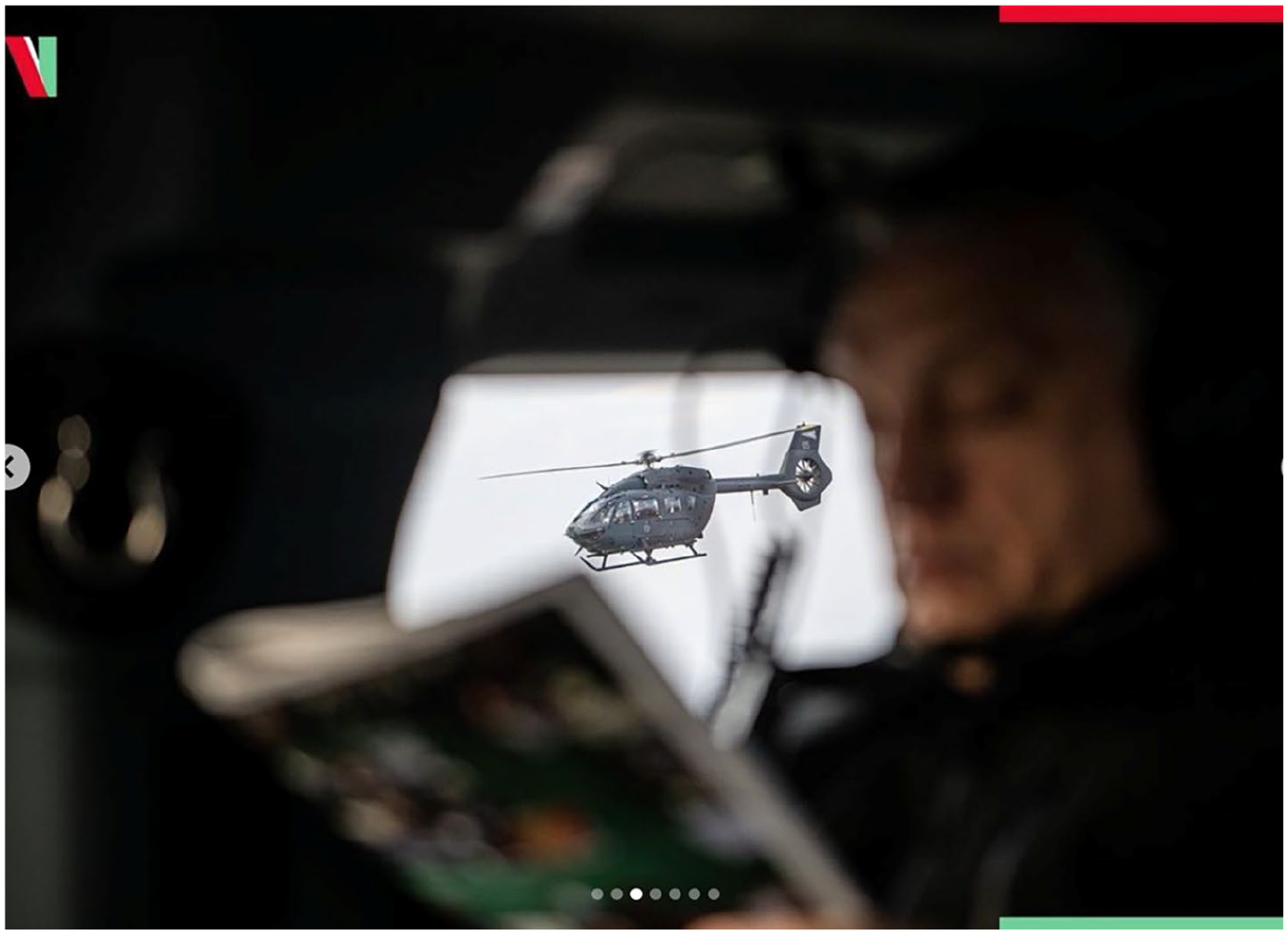
‘Hungary helps – everyone can count on us in troubled times.’ Viktor Orbán, 6 March 2022.
Whiteness as the ‘ideal political somatic norm’ (Puwar, 2004: 10) by a leader of an East European country that is ‘white but not quite’ (Kalmar, 2022) is constructed anew and with fervour. Puwar wrote when the field of critical studies of whiteness (which has steadily attracted scholarly interest since whiteness was first critically addressed by Black thinkers in the 20th century) was concerned with whiteness as invisible and racially unmarked. Since the publication of Space Invaders in 2004, critical whiteness scholarship affirmed whiteness as a system of power and as a hypervisible political norm (Hunter and van der Westhuizen, 2021). Indeed, hypervisibility is stark in the photos: Viktor Orbán does mark himself as a white leader. He asserts his power through an imagery of militant whiteness and his own body, which he actively locks into the well-worn tropes of singular white masculinity using racial and gendered props of performative ‘aggressive, territorial, and fraternal political theatre’ (Puwar, 2004: 12). Examining race and whiteness in Central European media, Anikó Imre (2023) argues that due to the lack of colonial history, escaping racial guilt and responsibility makes the region the phantasy place of undisturbed ‘white innocence’. Expanding on this argument, Kalmar (2022) underlines that the overwhelmingly white population of the region underlines ‘this condition of untroubled whiteness’ (p. 147). This is the condition on the basis of which the West must be saved as expressed above by Orbán in his 2022 prime ministerial oath: he produces himself and his nation as the pure white European hinterland the West needs to prevent its own suicide. This task needs force, strength and a calm leader, which Orbán manifests in his photos.
The somatic contours of ‘the ideal political individual’ (Puwar, 2004: 13) relying on racialized and gendered boundaries produce the cisheteropatriarchal white man at the heart of national and global politics, and of the nation. As Eugenia Siapera (2010) put it in relation to how nationalism is enacted in the media: ‘the ethnic basis of the nation should always be the same as that of the political elite that governs the nation’ (p. 18, quoted in Saha, 2021: 70). My encounter is embedded in my socio-historical context of sharing the ethnic basis of the nation and that of the man who governs this nation. If he is locking his body into clearly delineated ideas of hegemonic, unvaried white masculinity, in the next sections I am examining the figure of white womanhood he fixes for Hungarian women and the cracks of this figure along which the ‘risk of eruption’ (Puwar, 2004: 13) can be conceived of as a potentiality of becoming otherwise in this process of engaging with the powers of his body as I am perceiving it in its staged forms on his Instagram (Sharma, 2006).
War
Viktor Orbán is at war. He is leading an ideological war that has moved from imaginary battles to a real hunt for migrants at the geographical borders of Hungary (see below section on Borders). He is at a ‘pan-European cultural war’ against the West, protecting it from itself: fighting for the ‘real heritage’ of the West’s racially pure white Christian character (Kalmar, 2022: 147). Russia’s invasion of Ukraine on 24 February 2022, coinciding with the last stages of the election campaign, provided him with the opportunity to fully exploit his rhetoric of war and his position of the strong defender between East and West. His campaign communication was fast to shift from focusing on internal enemies (the government’s anti-LGBTQ referendum was linked to the April 3 General Election, see section on The sacred family below) to championing him as the only political leader capable of guaranteeing peace and stability for Hungarians in the face of an actual war just across the border. Key figures of the opposition were quickly portrayed as supporting the war by being willing to send Hungarian troops to Ukraine. The commemoration of Hungary’s 1848 revolution against the Austrian Habsburg Empire was converted by the campaign into a ‘peace march’ where Orbán warned the nation that the choice they must make is of life and death: either ‘a pro-peace right or a pro-war left’ (Gosling, 2022).
The peace that Orbán offers me is frightening. It is not life: it’s the systematic destruction of life by military force. I recoil in horror at this image of a large group of soldiers standing in a half-circle around him (Figure 3). The slogan across the photo reads ‘Peace needs power/strength/force!’ The Hungarian word ‘erő’ means all of these, and I can’t decide between them for the English translation. The longer I look at the image, the more I think he means physical force, mental strength and the power he is receiving by just the sheer phantasy about the capacities and values of his masculine body standing in front of and commanding his troops (Gatens, 1996). The photos confirm Puwar’s (2004) and Saha’s (2021) arguments that the display of war, battle, invasion and danger plays into marking the male public figure as the White Saviour.
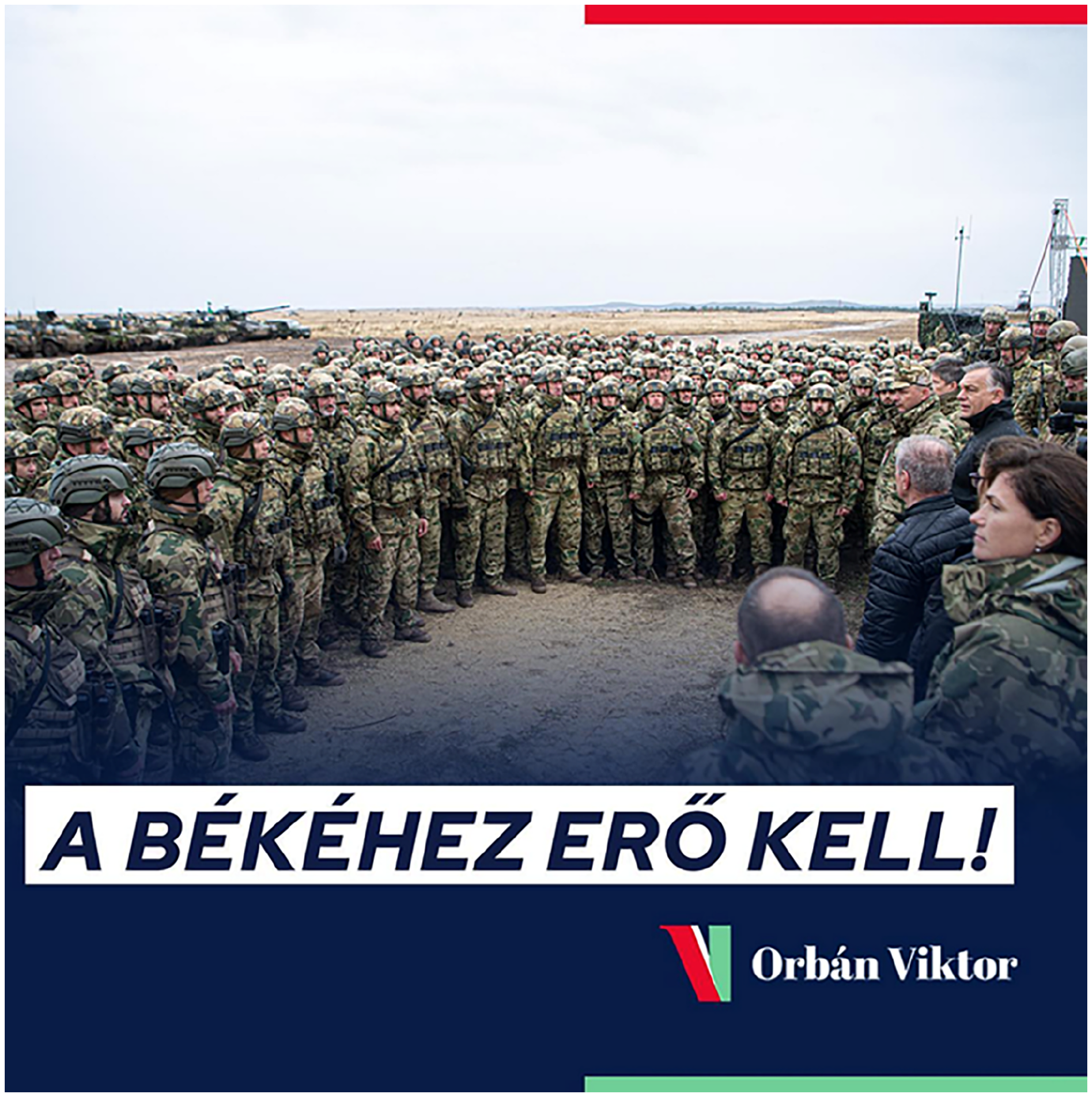
‘Peace needs power/strength/force!’, Viktor Orbán, 27 Feb 2022.
Women’s participation as autonomous agents in public life has been historically constrained (Lister, 1991; Narayan, 1997). As symbols of homeland, justice and beauty, the allegorical female figure appears as statutes and paintings of the nation (Puwar, 2004; Yuval-Davis, 2011). Men defend the nation on the ground with their physical bodies while ethereal women signify virtues of the nation. At a close inspection, I find a woman on the right side of the photo, however. She is there, close to the leader, looking equally stern. I am surprised by her military outfit; it must be the reason why it took me some time to realize the presence of a woman in this overwhelmingly masculine exhibition of power. I know her, as many in Hungary do, she is one of the few female members of the inner circle of Orbán. She is Judit Varga, who served as Minister of Justice from 2019 to 2023 and was an often-presented face of the party in government-led media during her ministership. She is a public figure who has portrayed herself in the media as a woman of will and ambition but always following the instructions of her leader without hesitation or questions. I am perceiving her as a ‘Nice White Lady’ (Daniels, 2021): not a helpless victim in need of protection, but an active warrior in the perpetual violence of white supremacy. She is on Orbán side again, and in the photo offers a place for Hungarian women to take part in his war. An invitation for a position that has been viscerally responded to by distancing and aversion.
Borders
‘We reject immigration’ (Orbán, quoted in Nagy, 2018). This is the ‘we’ I cannot be part of. I don’t reject immigration. I reject the paramilitary ‘border hunters’ who ‘hunt’ for migrants at the borders. For people dehumanized to the extent of being hunted as prey. I am reminded of Puwar’s (2004) words again: ‘In the racial classificatory schema, it is only white Europeans, because they are designated to be fully human, “lords of humankind”, who are seen to have the right personal constitution to reside in political constitutions’ (p. 21). I am aware of the pre-set aversion I bring to the photos depicting borders. My affective responses to these particular images are therefore not a fresh bodily experience: the intensities the photos invoke in me are layering onto an already existing discomfort. I am not only uncomfortable, I do not only ‘fidget’ in the chair that has already taken shape of my ‘fully human’ white body (Ahmed, 2014), I am repulsed once more. I should feel protected and cared for, however. By sympathetic looking young men at their physical prime smiling warmly at each other and at their leader who smiles back at them (Figure 4).
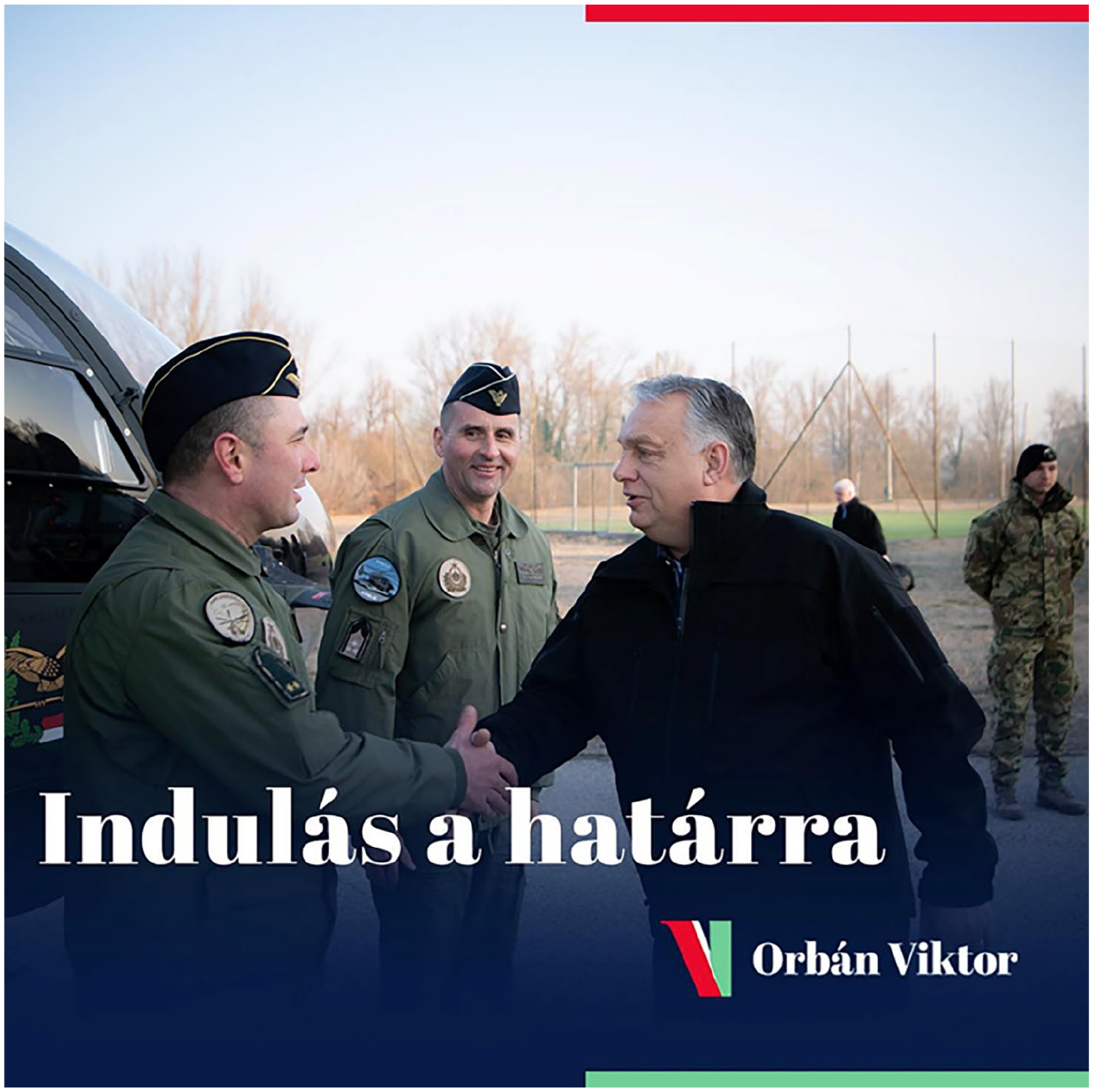
Leave for the border. Viktor Orbán, 5 March 2022.
‘You have the whole country behind you, and it is your task to protect the motherland against migration’, Orbán said at the ceremony of inaugurating the border hunters regiment in September 2022. Reminding his audience that ‘since 2015 millions have arrived illegally in Europe from Africa and the Middle East in complete disregards for borders and laws’ and stressing that ‘security begins at our borders, and Hungary’s security begins with the border hunters’ (Ôry, 2022). The new regiment was set up after the military and the police force ended their service at the southern borders, which since 2015 – when the Hungarian parliament declared a ‘state of migration emergency’ 10 – are protected by a 320-km long wire fence. 11
My aversion strikes me as none of the photos on borders actually depict migrants, the target enemy of the country. And by now, I am saturated by images of the military, soldiers and guards in various combat uniforms ready for battle. I am resistant to the ‘rescue paradigm’ (Rajan, 1993: 6) of the images, to the White Saviour project of the PM, of white men saving white women from Black men and Black women (Frankenberg, 1993).
The sacred family
The PM returned home from the battlefield. He is surrounded by his family, his wife and five grandchildren (Figure 5). But danger lures at home as well: gender ideology must be fought against, and the family protected. The image and its caption ‘The grandfather is a man, the grandmother is a woman, and leave your grandchild alone!’ refer to the so-called ‘Child protection legislation’ passed on 15 June 2022 and the referendum on it held together with the ballots of the General Election on 3 April 2022, as well as the Ninth Amendment to the Fundamental Law, adopted in December 2020. The amendment to the constitution states that
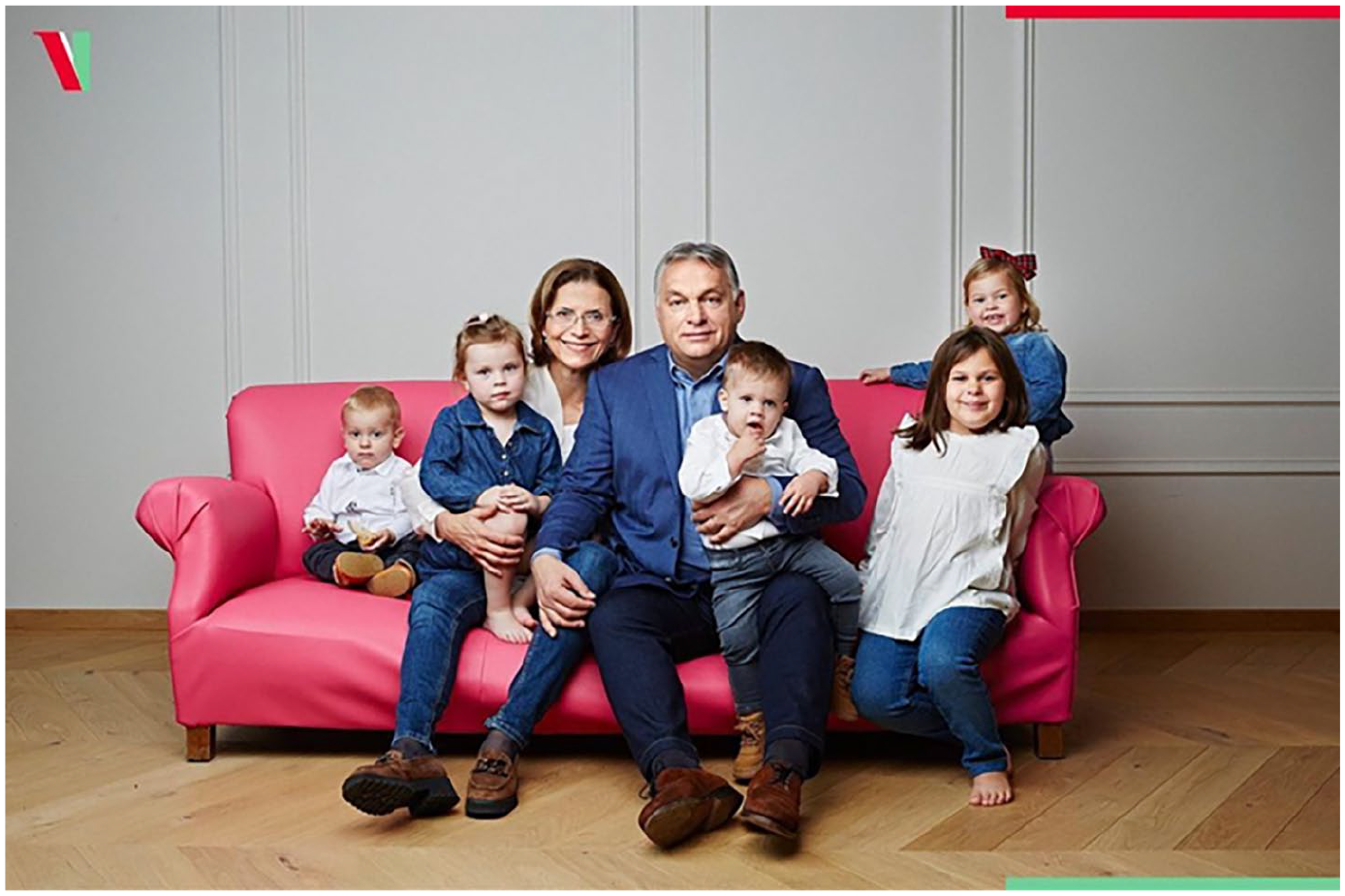
‘The grandfather is a man, the grandmother is a woman and leave our grandchildren alone!’, Viktor Orbán, 2 April 2022.
Hungary shall protect the institution of marriage as the union of one man and one woman established by voluntary decision, and the family as the basis of the survival of the nation. Family ties shall be based on marriage or the relationship between parents and children. The mother shall be a woman, the father shall be a man.
12
The amendments also include a de facto ban of adoption of children by homosexual couples.
The 2022 ‘Child protection legislation’ bans access of minors to content that ‘depicts or propagates divergence from self-identity corresponding to sex at birth, sex change or homosexuality’. 13 Just a month after the adoption of this law, the European Commission (EC) decided to challenge Hungary at the Court of Justice of the European Union (EU) for discriminating against people on the basis of their sexual orientation and gender identity. 14 Germany, France and other 15 EU countries joined the EC in the court case, which ended with a landmark ruling by the European Court of Justice stating that EU funds can be cut to countries experiencing rule-of-law problems. 15 Judit Varga, Minister of Justice at the time of these proceedings, commented that ‘the forces that embraced “woke ideology” had managed to convince 15 EU member states to join an ongoing lawsuit against Hungary’. 16 She also added, in line with official party communication, that the outcome of the referendum clearly shows that Hungarians supported the legislation, which Brussels refuses to accept. 17 In fact, human rights and LGBTQ+ organizations called on voters to invalidate their referendum ballots, which they did: the result had to be considered invalid due to the fact that the valid ballots did not reach the required 50 percent. 18
The man, the grandfather of the heteronormative family, sits in ‘union’ with his wife, whose body is covered by his and by one of the grandchildren. Her body is there but is out of sight apart from a hand, legs and a smiling face. In contrast, his whole body is on view, is at the front, the child he is holding barely covers half of his upper body (Figure 5). I can easily decipher the ideological message of the photo: they have fulfilled their part in the survival of the nation. ‘The scene, so neatly gendered’ (McClintock, 1995: 26-7 quoted in Puwar, 2004: 28), is staged by the scripts of the somatic norms of whiteness. His hegemonic white masculinity proudly displayed on this photo designates the private sphere of the home and the family, the place where the task of the ‘racialised somatic norm of ideal white femininity’ (Puwar, 2004: 26) of procreating the white Christian nation should be accomplished. She is there for me to represent the homeland, motherhood and the home in the service of the man, forever caring and loving and smiling passively and without resistance; the figure of ideal hegemonic white womanhood. I can’t help but position myself in relation to her. Examining my affective responses to her figure, I can’t help but notice that there is a degree of me feeling sorry for her, a minor tune in my orchestra of agitation and distress. If this feeling means there is a level of connection between us, does it stem from the ‘ontological complicity’ (Puwar, 2004: 9) we share as white women in this project of whiteness?
Conclusion: belonging ‘in and out of place’
I have drawn a connection between the representation of power, nation, belonging and embodied meaning making through a close attention to the affective dimensions of the photos in the Hungarian PM’s Instagram account. Drawing on Saha’s (2021) argument of ‘media make race’, I demonstrated that the examined photos on the digital media platform not only serve as a stage to represent and convey the ideological constituents of Viktor Orbán’s ethnonationalist politics embedded in racist rhetoric, but as an important vehicle in his white nation making mission.
This audience member of Orbán’s political stage arrived at the encounter contesting a passive role from the onset (Hall, 1988). The sociological toolkit helped me as a researcher and as a white ethnic Hungarian mother with my own wavering sense of belonging, attachments and dis-identifications to stay with the ambivalence, distress and discomfort that the affective relation of this work has established between the current leader of my country of origin and myself, and to understand that my difficult relation to Hungary persists. His photos hang like mirrors on the towers of power Viktor Orbán erected around himself to reflect an image he wants to see himself as, assured of his ‘ontological importance’ (Puwar, 2004: 19). The surfaces of the mirrors distort this image depending on the angle of the viewer, however. The viewer saw herself in these mirrors as well, equally distorted and fractured in her fear of her own ‘ontological complicity’ in the project of whiteness. The narration of national belonging continues to be a story of contestation as I to tell it to my daughter, who shares my position of always be in and out of place (Figure 6).
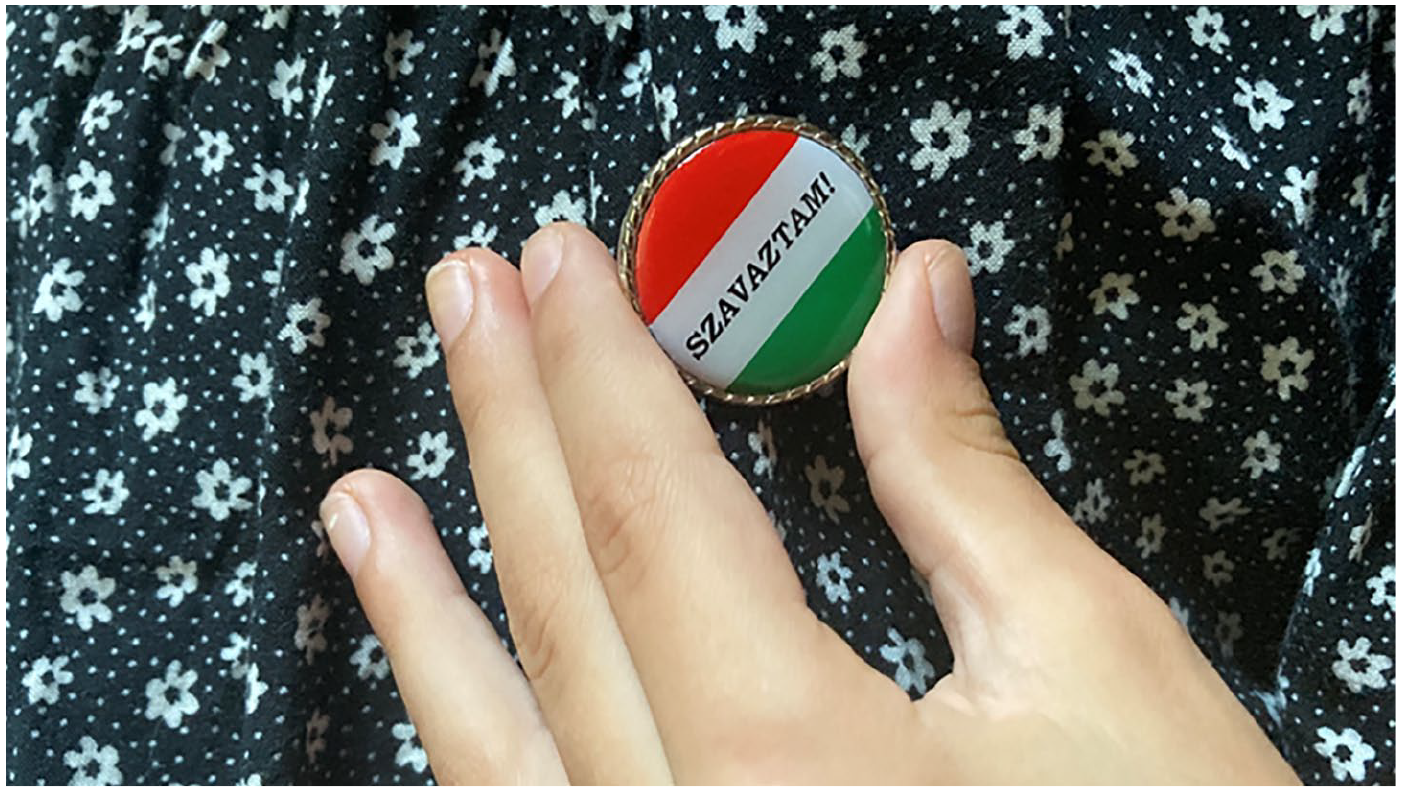
My daughter holding the badge ‘I voted’ which she received after we exited the voting booth, 3 April 2022.
Footnotes
Acknowledgements
Thank you, Nirmal Puwar.
Data Availability Statement
Research data are the publicly available Instagram photos of Viktor Orban.
Funding
The author(s) disclosed receipt of the following financial support for the research, authorship, and/or publication of this article: The author received financial support for the research and authorship of this article from the Leverhulme Trust.
