




Abstract
In this article, I’ll outline the phenomenon of ‘cosmic wellness’ which is now visible across on- and offline spaces that promote health and well-being products and practices to women. Cosmic wellness is a broad constellation of media, discourse, imagery, materials and foods (including crystals, dust and herbs) produced primarily by white, wealthy women. On the one hand, cosmic wellness can be read as a digital food culture that offers healthy and potentially necessary responses to fiercely neoliberal modes of working and living. But conversely, it is framed as the newest example of narcissistic self-absorption and, more seriously, as unhealthy and dangerous. Cosmic wellness is founded on various beliefs, including the moral necessity of pursuing the optimisation of self and the power of markets to provide the ingredients, tools and practices to achieve it. It is connected to histories that chart the incorporation of New Age health and well-being practices into ‘mainstream’ forms of lifestyle production and consumption and the simultaneous derision of these practices, especially when used and promoted by women. But there is also something new about cosmic wellness, especially as it is visible online on platforms such as Instagram. In the article, I outline the key features of cosmic wellness and analyse its contemporary cultural purchase, using theories of digital food cultures, spiritual production and consumption, postfeminism and critical whiteness studies. The article then conducts empirical analysis of a series of Instagram posts from one prominent space in which cosmic wellness currently circulates: Gwyneth Paltrow’s lifestyle and wellness business Goop.
Introduction
On 19 November 2017, a new Instagram post appeared on the official Goop Instagram feed, a 30-second video announcing, ‘The wait is over. GOOP GLOW is here [clapping hands emoji]. A power shot of 6 potent antioxidants in one tiny package. Simply mix the powder with water, stir and #bottomsup (it’s delicious p.s.)’. The video featured a slim blonde woman on a beach in the sun, stirring and then drinking a glass of glowy-orange ‘superpowder’ liquid. At the time, this launch was one of a flurry of new product releases for Goop which included supplement protocols (March 2017), the first live Goop conference #inGoophealth (June 2017), Goop magazine (Fall 2017) and Goop bath soaks (January 2018). Goop self-describes as a ‘modern lifestyle brand’ offering ‘cutting-edge wellness advice from doctors, vetted travel recommendations and a curated shop of clean beauty, fashion and home’ (Goop, 2018a). And the launch of Goop Glow signalled the latest own-branded move into the expanding ‘ingestibles’ market, a business projected to be worth US$220.3 billion by 2022 (Brown, 2017). Ingestibles, broadly defined 1 as products that are ingested such as supplements, vitamins, powders and dusts, represent a curious and potent example of the subject of this article, a phenomenon I’m calling cosmic wellness. In the United States, ingestibles are technically classed by the Food and Drug Administration (FDA) as food, but they are perhaps better understood as food-adjacent, offering much more than simple nutrition but, in addition, many enticing and ephemeral rewards: beauty, glow, health and ‘mighty cosmic flow’ (Living Wholly, 2019). In this article, I make some initial observations about cosmic wellness, using Goop to do so. I also conduct original empirical research on a selection of Goop Glow Instagram posts in order to concretise and interrogate the enticements and ephemera of cosmic wellness. Cosmic wellness is a broad constellation of materials, foods, imagery and discourse which speak primarily to, and are sold to, white, ‘well-thy’ women (see WGSN, 2015). On the one hand, cosmic wellness can be read as a digital food culture that offers healthy and potentially necessary responses to fiercely neoliberal modes of working and living, encouraging spiritual connections to food and environments of eating for example. But conversely, it is framed as the newest example of narcissistic self-absorption and, more seriously, as unhealthy and dangerous.
Cosmic wellness is founded on various beliefs, including the moral necessity of pursuing the optimisation of self and the power of markets to provide the ingredients, tools and practices to achieve it. Cosmic wellness can be connected to histories that chart the incorporation of New Age health and well-being practices into ‘mainstream’ forms of lifestyle production and consumption (Crowley, 2011; Sointu, 2012) and the simultaneous derision of these practices, especially when used and promoted by women. But there is also something new about cosmic wellness, especially as it is visible online on platforms such as Instagram. In the article, I outline key features of cosmic wellness and posit some initial reasons for its contemporary cultural purchase, using theories of digital food cultures (Goodman et al., 2017; Lupton, 2016), spiritual production and consumption (Lofton, 2006; Logan, 2016; Sointu, 2011, 2012), postfeminism (Gill, 2017; Swan, 2017) and critical whiteness studies (Bentley, 2001; Crowley, 2011; Shome, 2014). I argue that, while seemingly vague, unserious, even laughable, cosmic wellness and its various manifestations deserve serious scholarly attention. Not only is this an incredibly lucrative set of growth business practices, what Lofton (2006: 599) calls the ‘spiritual practice of capitalism’, but cosmic wellness also powerfully illuminates the contemporary and sometimes contradictory connections between women, wellness and whiteness.
The article begins by outlining cosmic wellness, and Goop specifically, as a digital food culture but one that transcends food itself and valorises various other materials and substances. I then contextualise cosmic wellness in relation to other analyses of holistic health and well-being movements that link to practices of spiritual production and consumption and highlight some of the gendered, racialised and classed dimensions of cosmic wellness. I then return to the Goop universe, using Goop’s ingestibles to provide an empirical analysis of a series of Goop Glow Instagram posts.
Locating and theorising cosmic wellness
First, cosmic wellness represents an example of what sociologist Deborah Lupton calls a digital food culture. Lupton argues that digital food cultures are defined by a number of features, including a sharing ethos, the cross-platform affordances of digital media and ‘the increasing value that is attributed to the data generated by digital interactions and practices’ (Lupton, 2016: 67). Mobile computing, social media and smartphone apps have, she argues, enabled people to more readily ‘generate, share and comment on digital [food] content’ (Lupton, 2016: 70) which includes everything from food blogs to restaurant reviews to YouTube-hosted amateur and professional chef-ing channels. Lupton also notes that the proliferation of image-based spaces and platforms such as Instagram, Pinterest and Tumblr has fuelled the growth of embodied digital food cultures with a shared set of central themes. Across practices like the taking and posting of food selfies or Instagram promotions of particular products, the focus is on the performance and display of ‘clean eating, slimness, physical fitness and extreme thinness of the flesh’ (Lupton, 2016: 72). These in turn link food, health and embodiment via practices of restriction, control and self-discipline (Lupton, 2016). A key sector of the broader wellness industries is ‘healthy eating, nutrition and weight loss’ now worth US$702 billion (Global Wellness Institute, 2019) and Gwyneth Paltrow and Goop have been directly tied to this growth (Griffin, 2019). GP, as Paltrow is referred to within the Goop universe, is many things but one obvious persona is that of a ‘food celebrity’, as Johnston and Goodman (2015) term it. She has written four clean-eating cookbooks 2 since her early days writing the Goop newsletter at her kitchen table, and Goop now has a prominent section 3 of its website dedicated to food and offering filmed tutorials and recipes, often with links embedded to click through to purchase Goop-branded or other sponsored ingredients.
The value Goop is generating as a wellness-focused digital food culture is staggering. Fast Company reports that wellness-related products and events have seen a tripling in revenue for Goop in the last 2 years (Griffin, 2019), and as I expand on further below, Goop’s expansion of its ‘wellness vertical’ and, particularly, its range of food-adjacent ingestibles has been extremely successful. Ingestibles represent perhaps the next logical stage in a digital food culture focused on clean-ness, restriction and ‘extreme thinness of the flesh’ as Lupton (2016: 72) terms it. Not only do ingestibles make for enticing Instagram posts and Instagram Stories, but they visualise and make accessible immaterial or ephemeral products and materials that offer health, glow and wellness to consumers.
As WGSN (2015) highlights, wellness increasingly enables new displays of stealth wealth, hence the additional moniker ‘wellthness’ to indicate the conflation of wellness and wealth. These industries are often characterised by high or extremely high price points, direct and indirect references to aspiration and luxury and a more general, and often popularly derided, notion of 1 percent living. My use of the word cosmic in conjunction with wellness indicates what I believe are the powerful and powerfully leveraged spiritual dimensions of wellness, in addition to those more tangible and pecuniary dimensions. 4 In order to offset the critiques of the wellness industries as representing just the newest examples of extreme wealth and conspicuous consumption, wellness is routinely premised not only on notions of bodily health but also psychological and spiritual health – a holistic model of well-being that extends beyond biomedicine (see Sointu, 2012).
While I am not relying on the concept of biopolitics extensively in this analysis, the sociologist Nikolas Rose’s concept of optimisation is useful here as it connects to the ubiquity of wellness discourse and practice. 5 Rose (2006) writes that optimisation is now a central imperative for individuals and is in fact, a moral imperative, driven by the market and consumer culture as opposed to medical necessity. Hence, he writes, ‘Contemporary medical technologies do not seek merely to cure diseases once they have manifested themselves, but to control the vital processes of the body and mind’ (Rose, 2006: 8). For Rose (2006: 11), optimisation encompasses two concepts, susceptibility and enhancement, both of which are future-oriented and thus ‘Almost any capacity of the human body or soul – strength, endurance, attention, intelligence and the lifespan itself – seems potentially open to improvement by technological intervention’. For Rose (2006: 6), optimisation illustrates that technologies of life ‘are no longer constrained, if they ever were, by the poles of health and illness’. And perhaps here we can see where the language and markets of wellness now prove so effective. They exist between and beyond the poles of health and illness, providing a very slippery middle ground in which a variety of sites and products have stepped in to offer improvements and enhancements to optimise both body and soul.
As scholars across a range of disciplines have argued, the term wellness is useful in its vagueness. As religious studies scholar Dana Logan (2016: 20) puts it, ‘wellness never stabilises’. The rhetorician Colleen Derkatch (2018: 132) argues something similar, echoing Rose’s analysis of optimisation and enhancement: ‘wellness discourse is predicated on the entanglement of seemingly opposed logics of restoration and enhancement’, the combination of these creating ‘an essentially closed rhetorical system in which wellness is always a moving target’. This ensures that wellness can be taken up in various domains from co-working spaces (Raphael, 2018) to business networking apps (Benjamin, 2017) to financial planning (Hammett, 2020). Sociologist Eeva Sointu (2012: 9) defines the discourse of well-being and wellness itself as ‘individual-specific fulfilment, joy and balance, characterized by an ability to actively navigate challenges in life’ and ‘grounded in both a sense of one’s emotions and embodiment, and a willingness to explore and express oneself’. Peter Conrad illustrates that discourses of wellness are by no means new and that various kinds of health and well-being promotion have often been tied to states of virtue. He writes: ‘The 19th century health movements developed an explicitly religious “hygienic ideology” by which participants could become virtuous through purification by right eating and exercise (Whorton, 1982; Green, 1986)’ (Conrad, 1994:398). As with other kinds of optimisation, as Rose conceptualises it, contemporary wellness practices adopt a moralising tone, often by default, and may offer forms of ‘secular salvation’. As Conrad (1994: 398) argues, ‘wellness-seeking becomes a vehicle for setting oneself amongst the righteous’.
Cosmic wellness is a digital food culture which transcends food itself and it does this by knitting wellness practices such as taking vitamins or drinking superpowders to a multiplicity of forms of spiritual thought and practice: energy flow, vitality, detoxification and purification for example. This is the cosmic in cosmic wellness. Writers from both Religious Studies (Kathryn Lofton, 2006) and Victorian Studies (Wendy Parkins, 2001) have analysed the everyday practices of spiritual or New Age capitalism, both using Oprah Winfrey as an example of a celebrity spiritual guru. Oprah drew her readers’ and viewers’ attention to ‘the spiritual everyday’ and encouraged those same audiences, via a ‘moral injunction towards consumption’ (Lofton, 2006: 610), to engage in particular Oprah-endorsed practices of eating and dieting for example. In the contemporary world(s) of cosmic wellness, products available online or on Instagram continue to offer both embodied and spiritual rewards. For example, a recently released range of malachite skincare products launched by Goop (2019a) in early 2019 talks up the powers of malachite crystal to detoxify both the skin and the spirit, or Brain Dust, popularised by Goop and described as an ‘enlightening edible formula alchemized to align you with the mighty cosmic flow needed for great achievement’ (Living Wholly, 2019).
In one of the few analyses of Goop to-date, Dana Logan (2016: 2) analyses the site as illustrative of a kind of commodified asceticism, ‘a node in a matrix of consumerist self-sacrifice’ and this, a kind of ‘boutique, post-industrial consumerism’. Goop, she argues, sits within the ‘religious category of asceticism: embracing the spiritual dimensions of depletion’ (Logan, 2016: 2). Logan (2016: 2) also notes that Goop is aspirational and that aspiration is then framed as having a ‘spiritual value’. This is a digital food culture that, as Lupton (2016) describes, links food, health and embodiment and, in the selling of ingestibles and other food-adjacent products, imbues these products with spiritual value. They are aspirational products which embody and encourage restriction, control and scarcity and, yet paradoxically, they are readily accessible via everyday digital platforms and practices. Even if the products themselves are beyond one’s means, access to images of the products and evocative information about them – Instagram posts, Instagram Stories featuring GP using the products, reviews, testimonials of the depth of the glow that results – all are available for constant consumption.
Accounts of New Age spirituality and its links to wellness-giving food and food cultures are not new. What is also well-rehearsed is a tendency to view these practices with snide humour and, at times, contempt. In recent journalistic accounts of cosmic wellness, scorn is poured on to products which are framed as the newest examples of snake oil. Practices from crystal therapy to aura-reading are assumed to fuel the newest forms of self-interest and narcissism. A similar tradition is found in academic accounts, a point that the feminist scholar Karlyn Crowley (2011) makes clear in her examination of various alternative health practices, including macrobiotic dieting. New Age spirituality in practice or in discourse has usually been analysed in Religious Studies as emanating from increasingly conspicuous consumer culture rather than from religious tradition and, it is therefore argued, is not worthy of serious attention. Crowley (2011: 7) notes that accounts from Women’s Studies generally view New Age culture with disgust because this culture has often relied on ‘quasi-feminist’ claims that are in fact conservative and regressive. Even cultural studies analyses of gender and New Age spirituality from scholars such as Andrew Ross (1991) and Kimberley Lau (2000) are, as Crowley identifies them, usually ‘cursory and bleak’ (Crowley, 2011: 3).
Sointu and Woodhead (2008) push back against the claims of narcissism routinely levelled at holistic spiritual practices. While acknowledging that these practices are ‘both self-centred and concerned with a self-fulfilment of a directly sensuous kind’ (Sointu and Woodhead, 2008: 272), they highlight that the narcissistic critique (stemming from the work of Charles Taylor and others) is premised on a celebration of a masculine subject and the condemnation of ‘feminized expressions of the subjective turn’ (Sointu and Woodhead, 2008: 272). Why, they ask, have these practices faced such sustained criticism? One reason, they write is
the moral horizons with which holistic practices operate fall under the radar of most moral philosophy and social commentary, not least because they fail to operate with abstract universals such as ‘humanity’, ‘community’, ‘civil society’ or even ‘the family’, but concern themselves instead with embodied and organic forms of care for the concrete individuals with whom one comes into contact in the course of everyday life: in other words, a feminized and thus devalued form of sharing and caring. (Sointu and Woodhead, 2008: 273)
Holistic spiritualities legitimate both relational or emotional care work and they offer particular advantages in terms of both supply and demand. They make use of ‘women’s traditional labours of bodily and emotional care, but within new social settings in which such care is recognised and valued’ and they ‘allow women’s access to traditional women’s care as and when they need it’ (Sointu and Woodhead, 2008: 271) in social locations traditionally accessible to women. Sointu and Woodhead list particular locations – the beauty parlour, the hairdresser, the fitness club, the private home. And of course, the ready access to cosmic wellness via online platforms only extends this reach further. The digital everyday combines here with the spiritual everyday to enable cosmic wellness to spread farther and faster. The sociologist Karen Gregory (2012, 2019) also takes the ‘digital spiritual marketplace’ seriously, arguing that practices such as tarot reading that are increasingly practised and thus accessible online can be read as a form of spiritual entrepreneurialism operating under conditions of precarity. By Gregory’s (2012: 274) reading, tarot is
an entrepreneurial hustle that produces an energized circuit or feedback loop between the self, objects, and the market. It creates a spiritualized assemblage that starts to become its own entity, an entity directly tied into the abundant spirit of the neoliberal market.
Although cosmic wellness may represent both a digital spiritual marketplace and digital food culture that is widely accessible, this does not necessarily mean that it speaks to a large or diverse audience. Cosmic wellness is gendered, racialised and classed. Sointu (2011: 357) argues that the pursuit of complementary and alternative medicine within a discourse of well-being and wellness requires particular attention to gendered identities. Sointu notes that women dominate holistic health as both clients and practitioners and this is also evident in the earlier work of the Religious Studies scholars Heelas and Woodhead (2005). Women’s disproportionate involvement in wellness-seeking ‘can readily be conceptualised as a negotiation of the traditional discourse of caring femininity in a setting that simultaneously reproduces many of the cultural competencies already associated with femininity’ (Sointu, 2011: 257 and see also Sointu and Woodhead, 2008). At the same time, wellness that is sought via alternative or complementary medicine ‘places the unique self of the client at the centre’ and is defined for Sointu through values ‘such as individual fulfilment, freedom, agency and control’ which signifies a ‘feminised setting that also conflicts with traditional discourses of other-directed femininity’ (Sointu, 2011: 257, emphasis added). Thus, women who pursue cosmic wellness can readily be understood as participating in an already-feminised space, and men who do so are conversely viewed as acting ‘contrary to hegemonic ascriptions of manliness’ as Sointu (2011: 257) puts it. At the same time, cosmic wellness encourages women to put themselves first (for long enough to take an ingestible at least), to pamper themselves and to practice self-care. Cosmic wellness both reinforces and disrupts traditional understandings of femininity and masculinity, especially as this relates to the pursuit of bodily and spiritual health and well-being.
Cosmic wellness is also, I would argue, a distinctly postfeminist phenomenon. 6 It is premised on framing its constitutive practices, taking ingestibles, detoxing or buying crystals for example, as empowering for its people who are always/already entrepreneurial, networked, aspirational and digitally literate individuals. Rosalind Gill (2017: 609) has recently assessed the status of postfeminism both as a sensibility and as a critical theory after 10 years of theorising and argues that is has become ‘virtually hegemonic’. She highlights a number of interlinked features of postfeminism that have become even more embedded in cultural life, often via digital technologies: femininity as a bodily property, intensified surveillance by and of women, the requirement to self-monitor and self-optimise via social media and digital culture and the continued dominance of a makeover paradigm. Gill also notes in this assessment that three features of identity have not yet been theorised in relation to postfeminism: religion, transgender and disability. As she puts it, ‘the way that postfeminism connects to debates about the postsecular and to changes in the way that religious identities are represented should be a topic of research, particularly at a moment in which religious visibility is so freighted’ (Gill, 2017: 615). Cosmic wellness provides a new opening here. As a digital food culture, it provides a range of digitally mediated spaces by which the ‘well’ body is displayed, watched and worshipped via a range of spiritual products and experiences. This is a slim feminine body, one already subject to optimisation and control, one already-glowing. It is also a white body. Cosmic wellness and Goop are saturated in white and I mean this at all levels – the landing pages of the Goop website and Instagram feeds, the majority skin colour of the employees and spokesbodies of Goop led by GP, the celebrity guests at the #inGoophealth conferences. The overall palette is one that is bleached out, minimal and ‘pure’.
Cosmic wellness is produced largely by and for white women and the connection between women, whiteness and spirituality is one that has been drawn out by various scholars. For example, Crowley (2011: 3) asks, ‘Why is it that white women are the leading figures and consumers of New Age culture and spirituality?’ And she goes on to argue that ‘white women participate in New Age culture in part to negotiate the long, complex and some would say failed political alliances with women of colour’ (Crowley, 2011: 8). The sociologist Karen Wilkes (2015) is also helpful here in that Wilkes highlights the very close links between postfeminist subjectivity, whiteness and entitlement, looking especially at advertising imagery for luxury brands which are not unlike the advertising for Goop’s ‘aspirational’ products. Raka Shome’s (2014: 178) work on white femininity highlights what she calls its ‘borderlessness’ which, she writes, is ‘organized around a discourse of spirituality, wellbeing and healing, and frequently incorporates the ethos of non-Anglo and Asian-inflected therapeutic practices of inner wellness, planetary connectivity and “finding yourself”’. Goop provides numerous examples of this borderlessness in practice, none more so than one of its most popular products, Goop’s Medicine Bag (retail price £79):
Inspired by the Shaman’s medicine bag from various indigenous traditions this (Goop exclusive) pouch holds (8) magically-charged stones . . . this essential starter-kit is a beautiful introduction to the spiritual practice of harnessing one’s own intuition, protection, healing and inner strength. (Goop, 2017a, emphasis added)
7
This is a Goopified example of what Colin Campbell (2010) terms the ‘easternisation of the west’, a process whereby a multitude of ‘Eastern’ forms of belief and practice (from feng shui to yoga to shamanic ritual) have been popularised in the ‘West’ since the 1960s and have come to form a new kind of ‘cosmic mysticism’ (Campbell, 2010: 751). But as Shome (2014: 186) argues, this is also a process of dehistoricisation, evacuating the histories of social rationality and collective resistance in these practices and replacing them with ‘individualised modes of self-empowerment’.
Whiteness has also been analysed in relation to other food cultures and figures. For example, the Food Studies scholar Amy Bentley (2001: 89) focuses on the food and lifestyle celebrity Martha Stewart, arguing that Stewart’s empire represents ‘whiteness of a certain kind’. Bentley (2001: 89) describes Stewart’s food as the ‘embodiment of whiteness’ and she argues that this is a ‘class-specific whiteness that transcends ethnicity and becomes accessible by cultivation rather than heritage’. It’s crucial to note then that cosmic wellness is also classed and that class is entangled with gender and ethnicity. Class is a prominent feature in other studies of New Age spirituality and therapeutics. Sointu and Woodhead’s (2008) research into holistic spiritualities found that New Age medicine was overwhelmingly consumed by a middle-class clientele. Salmenniemi’s (2017) study of ‘therapeutic engagements’ in post-Soviet Russia also elicited a largely middle-class cohort. But the work of both Salmenniemi and Karen Gregory (2012) also cautions against an assumption that the links between cosmic wellness, class and material wealth are absolute. Salmenniemi (2017: 620) concludes that therapeutic technologies are ‘intimately entangled with class’ but while being a middle-class preoccupation, she found that they are also used by ‘unemployed and socially unprotected people, particularly women, engaged with self-help books in attempts to find a foothold in the new social order’. Gregory’s analysis also foregrounds precarity as integral to her understanding of spiritual entrepreneurialism, noting that while discussions of wealth permeated the Tarot community, she found there to be widespread resistance to the idea that to be a self-employed Tarot reader is to necessarily submit to market logics. 8
As I have said above, cosmic wellness is not a wholly new phenomenon. It has antecedents in New Age spiritual movements, alternative food and eating practices and everyday spiritualisms and it speaks primarily to and through white women who are often wealthy or, at the very least, have resources (time, money and labour) to dedicate to wellness practices and products. But what is new is the affordances which digital platforms have provided for the visibility and accessibility of cosmic wellness products and practices, the accelerating value-generation of these practices and, therefore, the ways in which cosmic wellness more fully imbricates the already-established links between women, whiteness and wellness. To flesh all this out, I now say a little more about Goop and Gwyneth Paltrow as a contemporary example of cosmic wellness, led by an actress-turned-food celebrity-turned-guru, before then presenting empirical findings from an analysis of a selection of Instagram posts promoting the Goop Glow ingestible.
How Goopy are you?
Goop represents a central locus of cosmic wellness in both economic and symbolic terms. Goop began as ‘a homespun weekly newsletter’ (Goop, 2018a), and as Paltrow herself has put it, the site isn’t ‘super luxury’, ‘but we’re aspirational’ (quoted in Miller, 2015). It has a ‘tentacular structure’, a term Eva Illouz (2008: 5) uses to describe the Oprah Winfrey Show and its defiance of the ‘boundaries and definitions of what constitutes a text’. There are now Goop clothing lines, the Goop Clean Beauty book, Goop fragrances, Goop supplement protocols, a Goop magazine and a Goop podcast. The Goop Lab, a six-episode Netflix show hosted by Gwyneth Paltrow and Goop’s chief content officer Elise Loehnen launched in January 2020 (Moore, 2017). There are Goop stores and there have been a number of live #inGoophealth conferences (in Los Angeles, New York, San Francisco and London). All of this is available at Goop.com and the success of Goop has often been tied to its aggressive shop-ability. As Logan (2016: 3) puts it, practices such as detoxing on Goop are forms of consumption ‘that require(s) purchase at every turn’. Seventy percent of its total revenue derives from product sales and Goop’s own-branded products represent its fastest-growing revenue streams with ‘50 percent year-on-year growth’ (Griffin, 2019).
While Goop now very much operates as a bricks-and-mortar wellthness company, it has particular potency online, on platforms such as Instagram. Both the Goop Instagram feed and Gwyneth Paltrow’s personal feed serve as portals for the circulation of Goop’s brand of cosmic wellness and the transactions it affords. Key product launches are teased and then appear on these feeds as posts and Instagram stories and incorporate various forms of multimedia marketing, including saturated colours as teaser posts, countdowns and engaging user-videos.
Gwyneth Paltrow is cosmic wellness’s most valuable representative. She is a #bosslady, a guru lauded for her no-bullshit attitude, a ‘pioneer’ and crucially, someone who is misunderstood. As Paltrow described her work in 2017,
We are growing really quickly, things are great, but there is constant push back from the status quo, from society as it is and we still live in a very patriarchal society that’s very controlled by capitalism. And sometimes my voice is an irritant in that and me encouraging women to take autonomy for themselves is like a problem, but I feel like we are trying to do something important. (Quoted in Handley, 2017)
Like Elizabeth Gilbert within her Eat, Pray, Love movement (Williams, 2014), GP takes up the vocabulary of feminist empowerment, using the language of patriarchy and a critique of capitalism to ‘empower’ her audience, women who are looking for alternative medical and health interventions. Simultaneously she is selling more Goop-branded supplements in the ‘wellness vertical’ (Raphael, 2017). As Gill (2017: 620) notes in relation to Williams’ work, this represents a kind of ‘spiritual materialism’. GP is another example of the ‘new prophets of capital’ as Nicole Aschoff (2015) describes other contemporary charismatic entrepreneurs, many of whom are also tied to healthy eating or dieting movements.
Echoing the critiques of New Age spirituality more broadly (as apolitical, unserious and narcissistic), Goop and Paltrow have been accused of peddling new versions of snake oil or what one critic simply calls ‘Goopshit’ (Belluz, 2017). More seriously, Goop has been investigated for false advertising (Helmore, 2017) and deceptive health claims (Chan, 2017).
In response, Goop has done many things but I’ll focus very briefly on two. First, it now strives for a precise balance between the scientific and spiritual claims it makes via its products. Goop (2019b) now has a ‘Science and Regulatory Wellness Portal’ which vets ingredients and claims for ‘every ingestible product that we sell on Goop’. But more than simply adding quality control mechanisms to its value chain, Goop has also undertaken a lot of finely-tuned rhetorical work. Goop now bills itself as a benign space, a vehicle for exploration and openness whereby consumers will be presented with and offered a variety of options, where questions will be answered without judgement: ‘we take a curious, unbiased, open-minded and service-centric approach to the work we do. We test the waters so that you don’t have to’ (Goop, 2019c). This effectively inoculates Goop, rendering it immune to serious critique. In addition, they lean in to their critics. They laugh at themselves before others do. They ‘call bullshit on their own field’ as one Instagram commenter described it after the first #InGoopHealth conference. They laughingly refer to themselves as ‘Goopy’, hence a series of YouTube and Instagram videos in which celebrity fans are quizzed about cleanses and adaptogenic herbs via the question, ‘How Goopy are you?’ (Goop, 2019d). This is another example of both the slipperiness of cosmic wellness and its potency as a digital food culture. Goop’s digital presence, particularly via Instagram, only shores up and protects it further. The affordances of the platform mean that it can package up, sell and circulate its own version of cosmic wellness easily and effectively. It reaches a large and diverse audience but via a very narrow set of representative techniques. It presents its ingestibles at the intersection of the digital everyday and the spiritual everyday, and in the empirical analysis that follows, I begin to illustrate how it does so.
Cosmic wellness – the case of Goop glow
An emergent field of research is beginning to analyse the Instagram platform and its constitutive media (primarily still and moving images, comments and hashtags) and particular forms of Instagram performance and display. This has included studies that focus on the digital food cultures of Instagram (Baker and Walsh, 2018, focus on ‘clean eating’ hashtags for example). Some scholars have undertaken Instagram-focused research with access to the Instagram API (such as Leaver and Highfield, 2018) and others draw on what is available via the consumer-facing app (Iqani, 2018). This analysis continues in the latter tradition. I analysed all Goop Glow promotional Instagram posts posted to the official Goop Instagram feed between its launch in November 2017 and June 2019 (n = 27). The corpus of material also included posts promoting related products (Goop Genes and Goop Glow chemical peel).
Using my own Instagram account, I identified all posts that featured Goop Glow product lines. I archived these, first, via the Instagram ‘collection’ feature and, second, by recording the key information for each post (visual and textual content, number of likes and comments) and taking screenshots for reference. 9 I also collected supplementary product information available at Goop.com where relevant. Both the Media Studies scholar Mehita Iqani (2018) and the Food and Gender Studies writer Elaine Swan (2017) draw on modes of multimodal visual analysis (Kress and Van Leeuwen, 2001) and I continue in that tradition for the short analysis that is presented below. Iqani and Swan share an interest in a form of feminist analysis that is ‘social semiotically inflected multimodal analysis’ (Swan, 2017: 280) but moves beyond semiotics by interrogating the ‘power relations of meaning making; for example, in reproducing ideologies about postfeminism, neoliberalism, capitalism, gender, race and class’ (Swan, 2017: 280). Webpages and, by extension, Instagram posts or stories are ‘hybrid genres’ with ‘digital, verbal, aural, kinetic and visual meaning-making modes that have particular affordances’ (Swan, 2017: 280). Iqani’s focus on displays of wealth on one particular Instagram feed provides a useful example here. In focusing on the feed of one wealthy individual, she develops an analysis of postfeminist display on Instagram as this intersects with representations of wealth, ethnicity and domesticity. Looking across the relatively small sample of Goop Glow posts, and in the tradition of thematic discourse analysis (Chouliaraki and Fairclough, 1999), I identified key narrative themes deployed in the promotion of Goop Glow on Instagram, the selling of ingestibles and the circulation of cosmic wellness more broadly.
In specifically examining this ingestible product launch on the Goop Instagram feed, I focus on three key themes: (1) the ingestible itself as a food-adjacent material, its ingredients and its purported properties as they deliver both material (bodily) and immaterial (cosmic) benefits and rewards; (2) the bodies on display in service of the ingestible, particularly GP’s, their identifying features and the ways in which they telegraph the ‘ideal’ subject of cosmic wellness; and (3) the performative, digital address of Goop via this particular product. For each theme, I provide screenshots of posts as illustrative examples. 10
First, the general aesthetics of Goop are worth highlighting. The font, photos and content layouts at Goop.com are what Logan (2016: 3) calls ‘crisp and sparse’. Logan (2016: 3) goes on: ‘the photos have a blown-out softness, in muted grey, green and lavender and the font looks like monograms on an Egyptian cotton sheet’. The palette for Goop Glow is limited to what could be called sunrise colours, a dusky spectrum of orange, pink and yellow, flashed out with a silver packet for each ‘dose’ of superpowder. This colour scheme represents something different to the style and palette outlined by Swan (2017: 235) in her work on postfeminist stylistics: ‘a patterning of visual artefacts and verbal text that signify postfeminist tropes’. Swan’s case and subject are different in many ways. She examines a British website offering coaching specifically aimed at women and identifies a number of ways in which postfeminist tropes and depictions of ‘relational and individualised entrepreneurial femininities’ circulate visually and textually. The palette and style of postfeminism in Swan’s case include bright, saturated primary colours (especially hot pink); simple, exaggerated black line drawings (silhouettes of slim, youthful women and associated imagery such as high heels and handbags) and stock imagery of women against decontextualised backgrounds. For Swan (2017: 288), these kinds of stylistics depict ‘neoliberal affects of optimism and energy’ as well as ‘women abstracted from other women and social and economic contexts’. Some of these stylistics could certainly apply to Goop Glow (the lack of context for example), but there are distinct differences as I enumerate below.
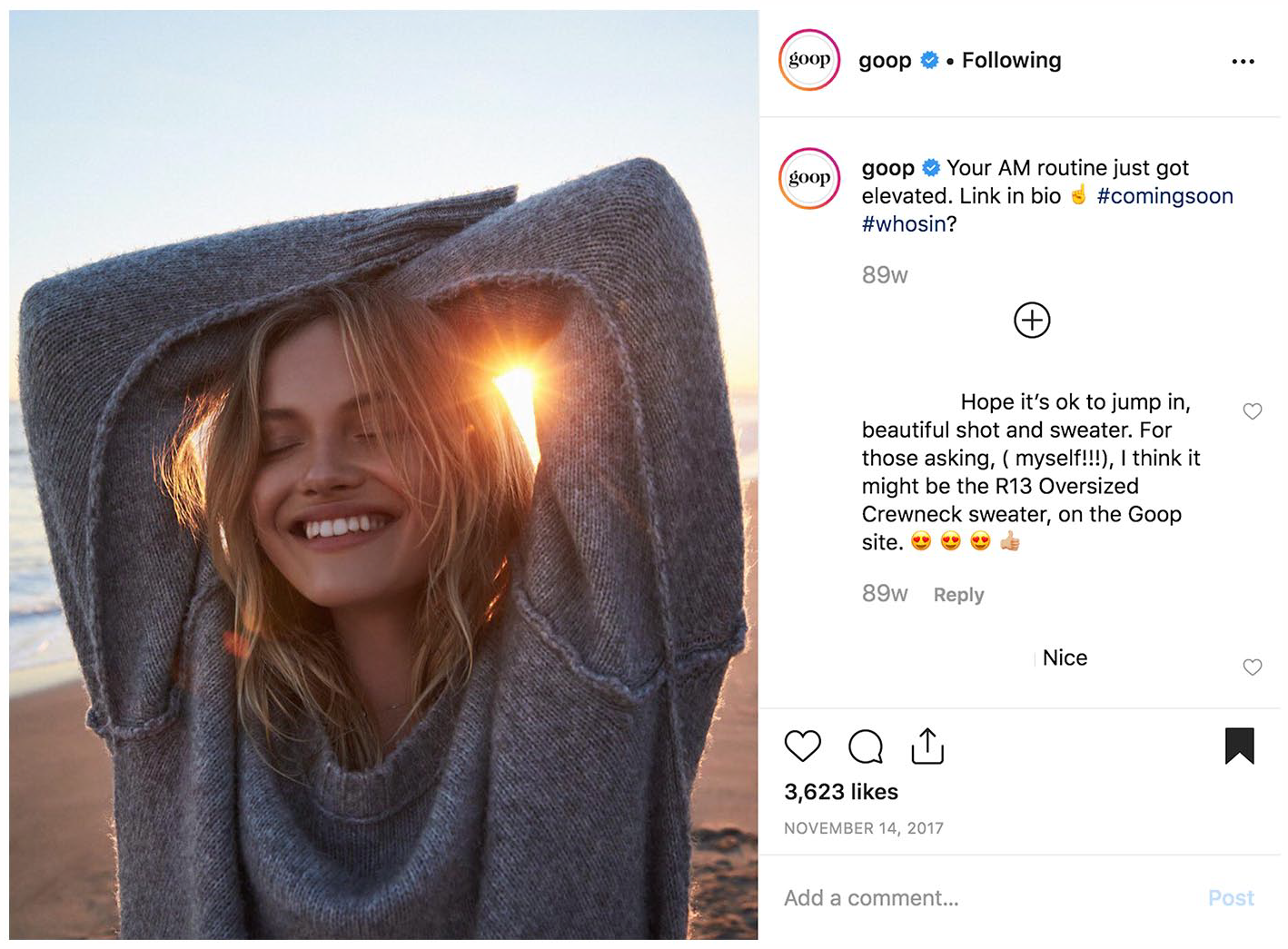
Your AM routine just got elevated (Goop 2017b).
Goop Glow is referred to across the Instagram posts as both a powder and a liquid and technically it is both of these things: a ‘morning skin superpowder’ (Goop, 2019e) which you add to water to create a drink. The term ‘superpowder’ in the official description for the product at Goop.com bakes a cosmic aura into it at point-of-sale and the superpowers of the drink are always highlighted. It is ‘skincare in a glass’ (post 15), a ‘megadose of nutrients’ (post 15), and a ‘Vitamin power shot’ (post 14). This ingestible consists, we are told in the first video for Goop Glow (post 2), of ‘6 antioxidants in one tiny package’, including Vitamin C, Vitamin E and COQ10. Three more are not mentioned in this video but are explained at Goop.com: Lutein, Zeaxanthin and ‘grape-seed proanthocyanidin’ (Goop, 2019e). The materials of Goop Glow thus strike a balance between the familiar, which obviously bring wellness (Vitamin C, antioxidants) and the more mysterious, which adds a dose of both the scientific and the cosmic (Lutein and Zeaxanthin – unknowable yet intriguing). Goop Glow product posts include ‘relatable’ (Kanai, 2019) taste references (to birthday cake and vanilla for example; posts 9 and 12), but this is balanced with enough scientific jargon to ensure it remains enigmatic and beyond total comprehension.
The cosmic properties and results of this ingestible focus on glow: glow itself, ‘glowing skin’, ‘healthy glowing skin’ with one reference to the ‘magic’ of Goop Glow (post 20). But the more magical function of this product is that it requires no work or effort at all, not even chewing. And it provides boundless glow and wellness but without food itself. As Logan (2016: 11) writes in discussing the Goop focus on detox, practices like juicing ‘create(s) physical “glow” through the transformative power of its negative materiality’. In the case of Goop Glow and ingestibles more generally, just pouring, stirring and drinking (the three steps to glow enumerated in post 5) lead to absorbing and then to glowing, and by extension, to wellness itself.
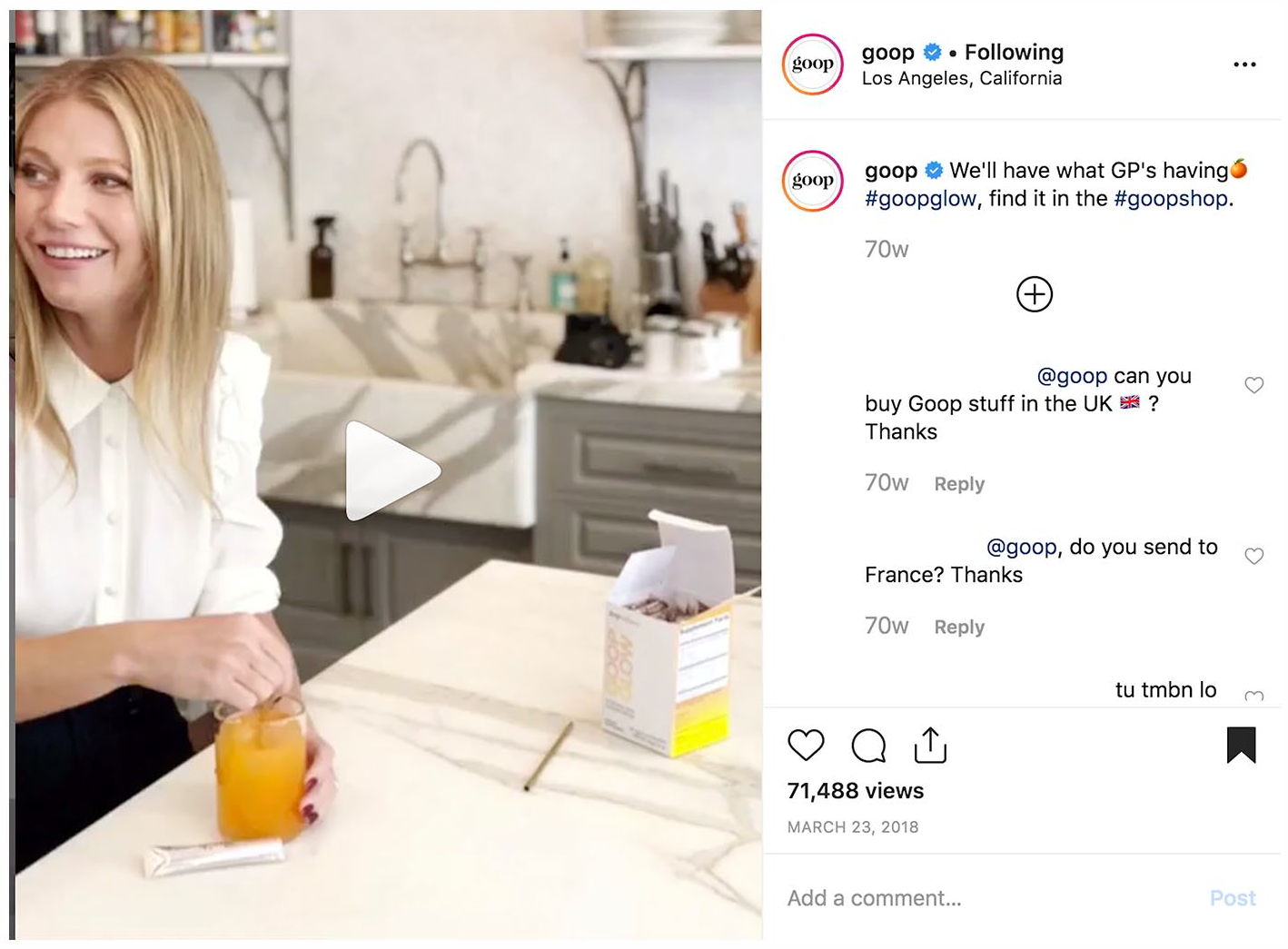
We’ll have what GP’s having Goop (2018b).
Second, the already-glowing bodies on display in service of the ingestible tell us a great deal about the ‘ideal’ subject of cosmic wellness. These are bodies or body parts (hands in particular) that are gendered, raced and sexualised.
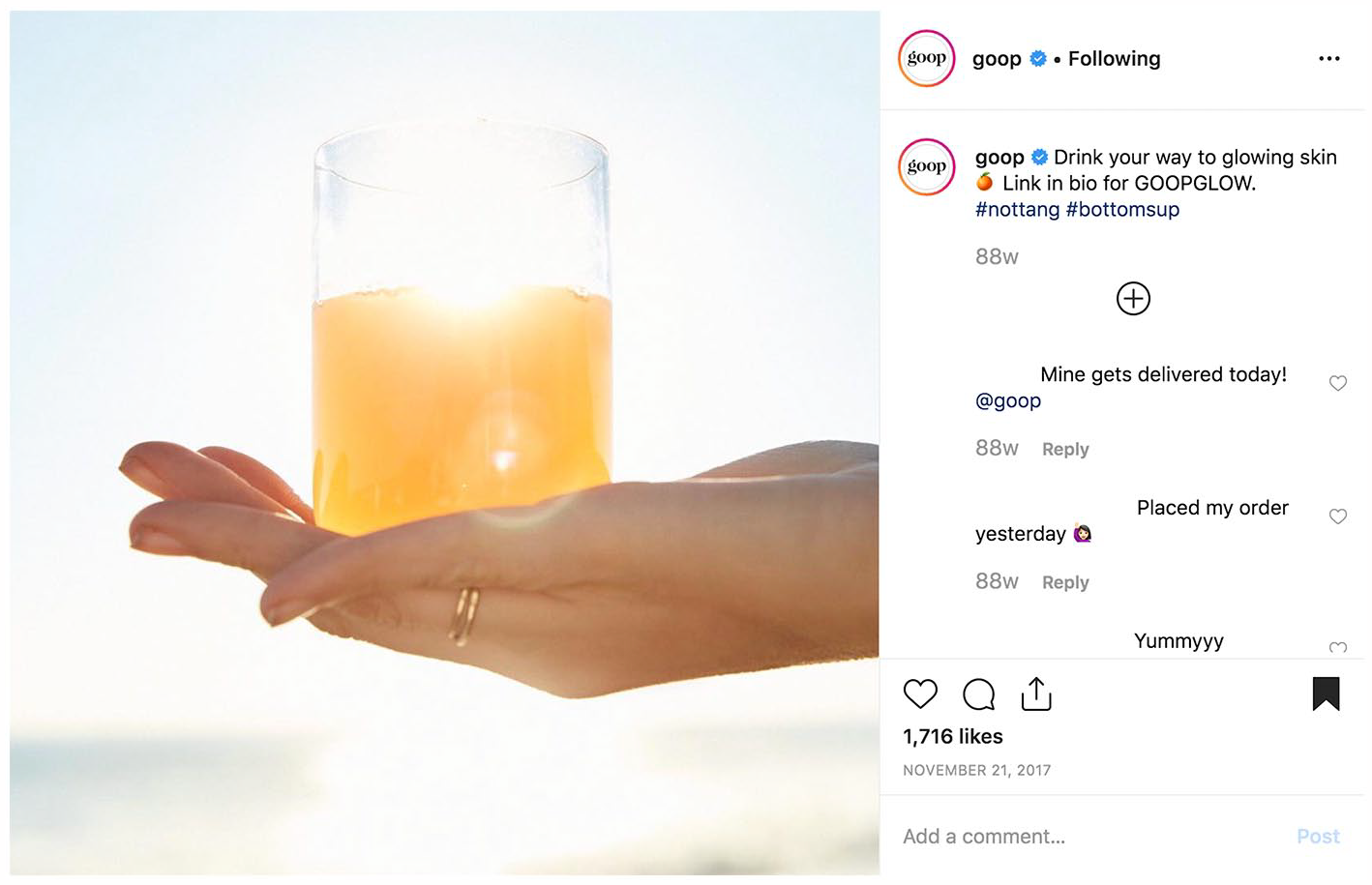
Drink your way to glowing skin (Goop 2017c).
The models and spokespeople across all the posts in this study are almost uniformly white, slim and blonde and the ur-body of Goop Glow is that of GP herself. Paltrow doesn’t appear in a Goop Glow promotional post until post 8, but once she does, the rate of views and likes increases dramatically. An average early Goop Glow post receives between 1500 and 3000 likes, with the first full video receiving 33,000+ views at the time of writing. GP’s first post receives over 71,000 views and subsequent videos receive well in excess of 100,000 Goop’s algorithm learns and responds by then including GP’s body and persona in numerous subsequent posts. In February 2019, two posts over 2 days feature heavily edited videos of GP using Goop Glow. In the first, without sound, GP is shown pouring, stirring and drinking Goop Glow and its key features are then reiterated, with GP’s ownership of the product highlighted: ‘GP’s power drink of 6 antioxidants to support healthy glowing skin’ [star emoji, orange emoji]. In the second video, which does include sound, GP takes us through the same routine but with a more personal commentary. At the top of the video, GP shouts to her daughter off-screen: ‘Apple come back! You need to take a Goop Glow for your cold!’ (‘A mother always knows’ is the tagline). Here and in later posts (Goop Genes post 4, where GP’s mother, the actress Blythe Danner is referenced off-screen), GP casually illuminates her intimate relationships as both mother and daughter as she conducts her promotional work for the product. There is no distinction here between work life and home life. In fact, one Goop Glow filmed post involves GP waking up and speaking to camera, showing off her morning glow from, we are led to assume, her own bed (‘The morning after’ post 20). The bodies of Goop Glow are also and perhaps unsurprisingly sexualised. This is not the only Goop Glow post featuring a bedroom-pose (post 7 includes an orange emoji to cover an exposed nipple) and comments attached to other posts perform a lot of wink-wink-nudge-nudge work. For example, the first Goop Glow post in which GP appears references the now-famous line from the film When Harry Met Sally: ‘We’ll have what GP’s having’ [orange emoji] (Goop Glow post 8) and post 19 is tagged ‘After hours with GP’. We have therefore a number of ‘ideal’ women called up as the subjects of cosmic wellness, including the dedicated mother looking for well-being for herself and her family and the always ‘up for it’ postfeminist subject (Gill, 2007) who is looking for glow of a distinctly post-coital kind.
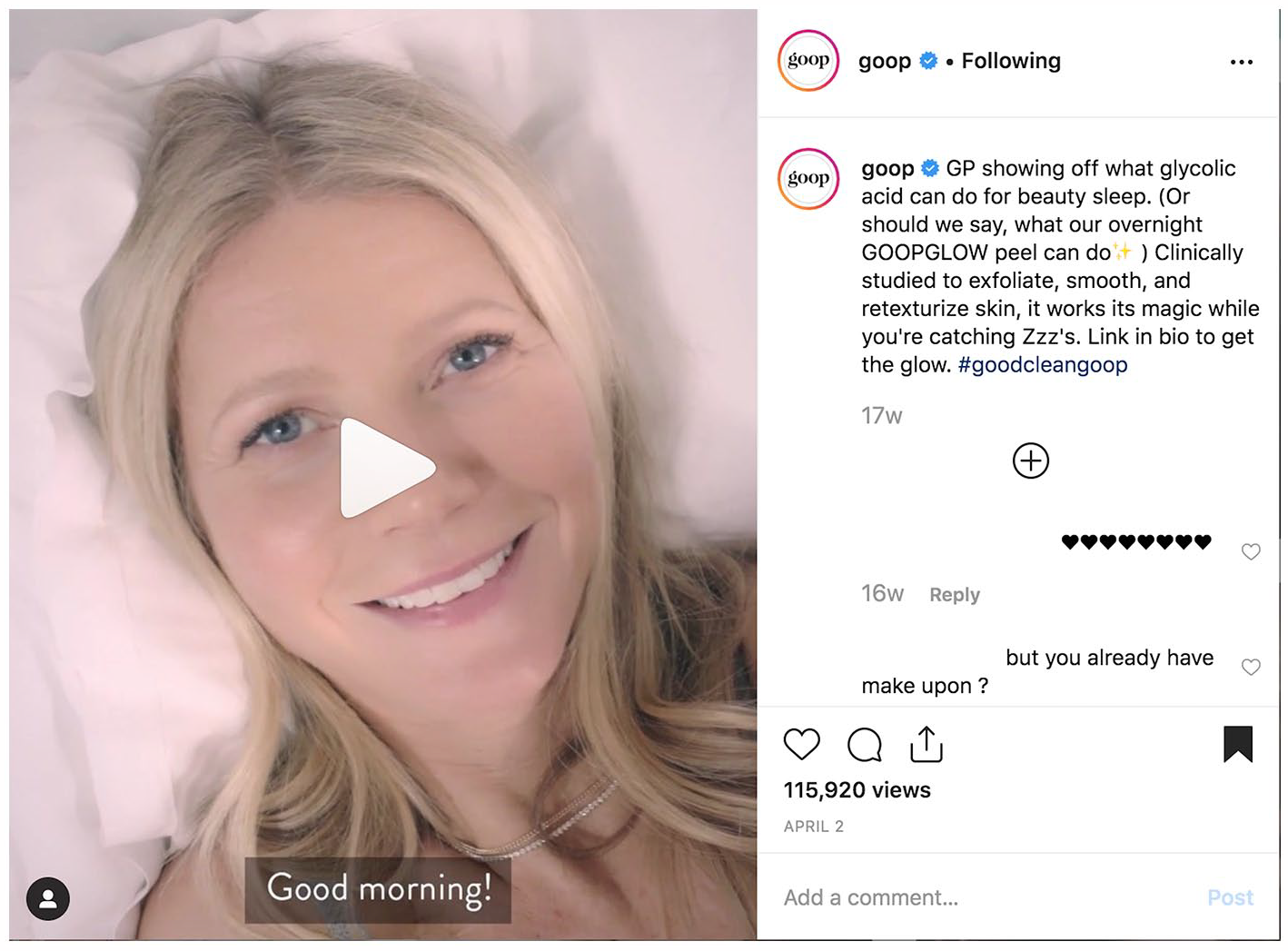
GP showing off what glycolic acid can do for beauty sleep (Goop 2019f).
What I’ve described above hints at the flavour of the voice of Goop via Goop Glow and this is the final theme identified across the sample. As I mentioned in the previous section, Goop has cultivated a particular brand-persona, which GP embodies and emulates as CEO of Goop and its most valuable model and ambassador. This is a persona which marshals all the affordances of Instagram’s textual and visual language and etiquette to present itself as both scientifically serious but more importantly as relatable, cool and always ready to joke or call bullshit. For example, the Goop Glow posts are peppered with digital slang: deets (posts 2 and 4: ‘Link in bio for all the deets + shop’); effing (post 27 ‘a whole effing lot of glycolic acid’), AM (post 1: ‘Your AM routine just got elevated’), ZZZz’s (from post 20: ‘it works its magic while you’re catching Zzz’s’). A small selection of emojis is used repeatedly: the orange, clapping hands, sparkle and stars. This address is relaxed and knowing and is one that Goop has cultivated to give the impression of accessibility, youthfulness and inclusivity and also, as I’ve said, to ward off any and all critique. GP’s appearances for Goop Glow also help to reinforce this. In the second video in which she features, for example, she is shown pouring her silver packet of Goop Glow into a glass of water and then stirring. Her knowing line as she does this is: ‘That’s very complicated chef work right there’. This seems to refer to her alternative persona as a food celebrity and cook book writer and the line as delivered both elevates herself to chef status and simultaneously brings her back down to ‘our level’.
The use of digital slang and emojis provide an Instagrammable version of Swan’s (2017) postfeminist stylistics: the sparkle emoji or the generally promised glow is the Goopified version of the ‘neoliberal affects of optimism and energy’ she identified in her own study. The women who feature in Goop Glow posts are also ‘women abstracted from other women and social and economic contexts’ (Swan, 2017: 288). They ingest Goop Glow in domestic spaces – luxurious kitchens, bathrooms and bedrooms – or in unspecific locations – deserted beach at sunrise. And they do so while filming themselves for their Instagram feed; it is the ‘selfie’ frame (Marwick, 2015) that is routinely used for the Goop Glow posts, even if they are professionally lit and edited as those featuring GP most certainly are. Thus, despite the absolute polish and perfection of all Goop Glow posts, the casual, joke-ready persona of cosmic wellness is always re-established and reinforced.
Conclusion
In this analysis and the article as a whole, I have begun to draw together a number of strands of inquiry in the pursuit of a research agenda I’m calling cosmic wellness. At one level, I am specifically interested in the rise of ingestibles and food-adjacent materials, the circulation and selling of ingestibles on digital platforms such as Instagram and the central role that Goop has played as a market leader in these activities. On another level, I am preoccupied by the particular representative strategies by which Goop has become a central locus of cosmic wellness. It is pursuing and performing serious scientific credibility and, yet at every turn, undercutting this with emojis, text slang and sly, winking Instagram Stories. And much more broadly, I’m interested in what cosmic wellness itself is, and how it represents the newest manifestation of a much longer and complicated history that connects women, whiteness, everyday practices such as eating (or not eating) and spirituality.
As I have argued and illustrated, cosmic wellness can be understood as an emerging digital food culture and one that is diffuse, multifaceted and slippery. More accurately, perhaps, it signals a number of food cultures that are anchored by particular practices and products – ingestibles, supplements and detoxing for example – and circulated via digital technologies. Goop represents one particular space in which cosmic wellness is being alchemised in real time. It presents as aspirational and accessible and yet as always beyond the laywoman’s powers of everyday comprehension. As Logan writes, drawing on Deborah Lofton (2016: 3), Goop ‘is a marker of the “religious now”, an imperative that combines contemporary capitalism and spirituality’. It is steering its followers to ‘purchase at every turn’ (Logan, 2016: 3). Williams writes, drawing on Nancy Fraser, that a key gendered feature of neoliberalism is the linking of emancipation and empowerment to ‘the engine of capitalist accumulation’ (Fraser cited in Williams, 2014: 4). GP and Goop ensure that spiritual enlightenment via Goop Glow signifies empowerment, freedom and fun. It is pioneering a rhetorical and representative position that renders cosmic wellness and its constitutive parts (like ingestibles and their whacky ingredients) as benign, non-threatening, knowing and in on the joke. It is produced by wealthy white women although it also speaks in a universal digital language of emojis, ZZz’s and deets, asking everyone it encounters to get a little Goopy – I mean, what’s the harm?
This kind of slipperiness and evasion requires much more in-depth empirical investigation, as I have demonstrated in this article. We need to understand how cosmic wellness is operating at the level of the individual Instagram post or emoji as much as at the level of platform or industry. This is a digital food culture that is emergent but is sprawling. The account and analysis I have provided here is small-scale and seeks to open up a space for what needs to be a serious and in-depth reckoning with cosmic wellness, and I mean this literally. We need to take Goop Glow, Lutein and Zeaxanthin, dusts, malachite crystals and mighty cosmic flow very seriously. The promise of boundless glow emanating from both body and soul is tantalising and it is especially so when it is disconnected from everything we traditionally associate with food and eating. Cosmic wellness does not require cooking, chewing, digestion or defecation. It comes from a much more intangible set of experiences: ingesting, absorbing, ZZZz’ing and, simply, believing. However, these intangible experiences need to be analysed using very tangible concepts, gender, ethnicity and class to understand which bodies and souls are allowed and enabled to glow and which are not.
Footnotes
Funding
The author(s) received no financial support for the research, authorship and/or publication of this article.
