




Abstract
In 2023, Tate Britain rehung its semi-permanent collections display as a revisionist history of Britain. This major curatorial project makes compelling storytelling. Its critically engaged approach opens British art and history to wider interpretations. At the same time, the display elevates rich, white men. Drawing on a range of theoretical literature from cultural studies, sociology and art history, this article considers how Tate Britain operationalises difference and hierarchy as a British inheritance post-Brexit. I argue that key areas early in the first section of the display, Historic and Early Modern British Art (1550 to 1930), augment a rich, white, male hegemony, against which ‘others’, people of colour, the working classes and (some) white women, are presented as what Nirmal Puwar calls ‘space invaders’. I explore how curatorial revisions and other display strategies – chronology, staging, portraiture and binaries – both disrupt and reinforce the hegemony. The article includes my drawings of key areas of the display, which guide my research.
Tate Britain art gallery in London is the home of British art. In 2023, it reconstructed its semi-permanent collections display as a revisionist history of Britain, set out across its 30 main halls, on the left wing Historic and Early Modern British Art (1550 to 1930) and on the right Modern and Contemporary British Art (1940 to today). The display was a major undertaking that involved 35 curators and more than 100 other staff.
My enquiry concentrates on key areas in Historic and Early Modern British Art, in room 2 Court versus Parliament (1640–1720), room 3 Metropolis (1720–1760) and room 4 The Exhibition Age (1760–1815), which focus, respectively, on the Whig Junto (imperial parliamentarians), newly rich Georgian families, and a semi-naked prostitute Lydia (commissioned by Richard Grosvenor, 1st Earl Grosvenor). My analysis of staging, rituals and revisions in these areas surfaces a mutable paradigm in which rich, white men embody political, economic, domestic and sexual power. In contrast, people of colour, the working classes and (some) white women are represented, in Nirmal Puwar’s (2004) terms, as space invaders, bodies deemed to belong ‘to “other” places’ and therefore ‘out of place’ here (p. 68).
Tate Britain is committed to diversifying its practice (Tate, 2020). However, its remit to show 500 years of British art, primarily through historic British painting, limits its capacity for change. The national press has focused on revisions in the new display, amplifying their effect. 1 What has not been explored, and is attended to here, is how the display’s use of historic British painting to represent British history has reinforced white, male authority, despite a potent counter-narrative. In exploring this effect, the article engages with a major, highly visible yet neglected feature of the display.
The article begins by considering Tate Britain’s engagement with British history, its attempts to diversify and curatorial revisions. It then identifies how specific display features – chronology, staging, portraiture and binaries – have given weighted significance to 18th-century paintings and with them wealthy, white men. Correspondingly, it outlines how other subjects are designated space invaders. I take this information forward in analysis of the three key areas in the display, where I explore how the gallery represents the story of the nation post-Brexit.
Making British history
Tate Britain’s representation of British history responds to the political and cultural environment. In 2000, the Tate Gallery was renamed Tate Britain and repurposed to show the national art collection. From 2000 to 2013, it deployed ‘traditional’ art history methods in its semi-permanent display. These methods centred artists, art movements and aesthetics, along with social, cultural and historic themes. Then, in 2013, Tate Britain instituted a radical transformation, replacing its art history display with a history of Britain arranged in a chronology of ‘actual time’ (Curtis, 2013: 2). Accordingly, the significance of the artworks transferred from the artists to their subjects and from art history to Britishness, transforming the artworks into snapshots of the nation. This change coincided with the then Liberal Conservative government’s investment in patriotic nationalism, which saw Britain’s heritage reconceptualised as ‘assets and advantages’ (Daddow, 2015: 306–308). It is noteworthy that from 2013 to 2016 the founders of the Brexit vote-leave campaign used the gallery as their secret base to plan how to win the 2016 referendum (Pes, 2019). Thus, Tate Britain’s British history display emerged with, and as the backdrop for, Brexit.
The 2023 rehang retains the British history format with critical revisions. Alex Farquharson (2023), who became the Director in 2015, describes the new hang as ‘a more truthful account of history’ that recognises ‘art isn’t made in a vacuum’ (Razzall, 2023).
Differences between the 2013 and 2023 displays reflect increasing tension in the cultural and political arena across the decade. On the one hand, there has been a global decolonial turn in museums, galvanised by Black Lives Matter (BLM) and Rhodes Must Fall, that has led curators to re-inscribe devalued histories and perspectives beyond ‘institutional tokenism’ (Muñiz-Reed, 2017: 100–101). On the other hand, 14 years of Conservative government and the Brexit campaign ramped up the rhetoric of culture wars and ‘war on wokeism’. Reactionary ideas, related to perceived threats to Britain and masculinity, have manifested in a nostalgia for empire and a rise in white supremacy, xenophobia and patriarchal nationalism (Agius et al., 2020; Younge, 2018).
Changes and limitations
In this challenging environment, Tate has engaged in ways that are more inclusive and self-aware. But, its changes have been limited by the continued focus on white subjects in its main display.
In 2020, Tate renewed its commitment to combatting racism in response to BLM protests. It acknowledged its collection was ‘intimately connected to Britain’s colonial past’ and that it needed to diversify its exhibitions and collections (Tate, 2020). Tate Britain commissioned high-profile installations by Black artists, including Chris Ofilli’s monumental mural Requiem (2023) and Alvaro Barrington’s Grace (2024), and introduced wider intersectional representation through group exhibitions, including Life Between Islands: Caribbean-British Art 1950s-Now (2022) and Women in Revolt! Art and Activism in the UK 1970-1990 (2023). Its changes broadened the gallery’s scope. However, most of these exhibitions and events were temporary and situated outside of the semi-permanent display, which remains relatively monoculture (Chambers, 2022).
The 14 rooms in Historic and Early Modern British Art concentrate on historic British paintings of white subjects. 2 By my count, 320 of the pictures on the walls contain human figures, of which 274 exclusively represent white subjects and only seven, less than 3 percent, exclusively represent people of colour. A further 14 paintings represent mixed racial groups, the majority of which foreground white figures (10 November 2023). 3 Although the display refutes the ‘traditional’ (western) invisibility of whiteness as universal norm (Dyer, 1997), this mass of white subjects has effect. As Stuart Hall (2023 [1999]) articulates, shared national identity ‘depends on the cultural meanings which bind each member individually into the larger national story’, therefore ‘those who cannot see themselves reflected cannot properly “belong”’ (p. 14).
Without dismissing the challenges Tate Britain would face in making substantive changes to its main display, there are approaches that would facilitate a more inclusive national script, for example, incorporating the multifarious art histories of the population, different forms of art and a greater emphasis on new artists (see Grant and Price, 2020; Muñiz-Reed, 2017, for discussions). The contemporary display (post-1980) is racially diverse, and half the artists are women, but it contains only 42 artworks and one work by an artist under 30 (my count 10 November 2023). In contrast, Tate Britain has more than 100 works in eight rooms dedicated to JMW Turner.
Curatorial revisionism
The focus on historic British painting in the Historic and Early Modern British Art section means change and diversity are mostly enacted through curatorial revisions. These revisions include 11 contemporary artworks; critically engaged wall texts and additional visual material on the Haitian revolution, Chartists and Suffragettes. Curatorial revisions draw attention to inequal historic processes, ignored histories and marginalised figures in the white, heteronormative, male art canon (Reilly, 2018: 17, 27). However, as additions, they risk reifying established power (Reilly, 2018: 23–27). As Jo Littler (2005) outlines, inclusive gestures in heritage narrations can function as ‘sop or plaster’ (p. 13).
In Historic and Early Modern British Art, the revisions do more than plaster over issues, in particular cutting through the fiction of neutrality that permeates ‘traditional’ displays to surface imperial violence. This approach sits within wider exhibition practice that makes connections between collections and British empire explicit: The Past Is Now: Birmingham and the British Empire (2017–2018); Entangled Pasts, 1768-Now (2024); and Tate’s earlier show Picturing Blackness in British Art. 1700s-1990s (1995–1996). Yet, paradoxically, the relevance that Tate Britain’s revisions bring to historic painting rationalise the focus on British history and cast historic British painting as the main conveyor of its legacy.
Display features
Along with curatorial revisions, Historic and Early Modern British Art contains regular display features – chronology, staging, portraiture and binaries – which confirm historic British painting as the portal to the nation’s past. Exploration of these features shows how they establish the 18th century as the significant period in British history. The focus on this period provides space to discuss British colonial exploitation. At the same time, it centres rich, white men. In Western art history, white men are the ‘universal subject’, who ‘creatively shape their world, ponder its meanings and transcend its mundane constraints’ (Duncan, 1995: 115). Consequently, the new display builds on an established hegemony.
Chronology
The display’s chronological arrangement positions rich, white men as principal subjects in British history. In chronological exhibitions, timelines project forward movement onto art, with visitors moving ‘from the beginning of the story to the end’ (Lubar, 2013: 169). Consequently, the early works in the display serve as evidence of the tradition in the making and a point of origin for its narrative. The first major staging posts in Tate’s display are 18th-century group portraits, which centre rich, white men: The Whig Junto and The Harvey Family, recent acquisitions that I explore in this article. The focus on these paintings near the start of the display creates an ancestral pathway with the white, male and monied positioned as progenitors of the nation. The chronological ordering authenticates their role, as timelines produce the impression that ‘things must have happened as they happened’ and by extension that they include the important moments and people on their path (Lubar, 2013: 170).
Staging
The display’s staging, including room layout and design, confirms the singular importance of historic British painting and rich, white men. The previous 2013 historic display was mainly blue, offering ‘a continuous and unified run’ through British history (Curtis, 2013: 2). Conversely, its new design holds attention in the historic rooms. There are powerful changes in colour, arrangement and mood. The rooms provide immersive encounters with eras and events conveyed primarily through paintings. The singular attention on the 18th-century evokes the lifeworld of its citizenry. Whig politicians and male heads of wealthy Georgian households are staged as crucial figures. There is a salon-style reconstruction with a focus on the male gaze, which I discuss in the final section of the article. This staging presents the 18th-century paintings and their subjects as if they belong in these rooms. In contrast, the few contemporary works in the historic rooms are dislocated out of place and time (and in the contemporary section situated in the impersonal white cube).
Portraits
The increased attention on the 18th-century reflects Farquharson’s investment in reviving this era and its group portraiture, known as conversation pieces (Charlesworth, 2018). Portraiture emerged in the 18th century as the nation’s most significant art form. Its enhanced stature arose from its capacity to convey new ideas of ‘British identity’ tied to wealth, fame and power (Mudge, 2023: 6). The commissioners purchased their place in history, by paying for portraits of themselves and those they were interested in (Mudge, 2023: 5). As most donors were wealthy, white men, Tate’s heightened interest in this era reconnects us with their views. Portraits offer a carefully composed representation of their sitter’s status. They also make British history relatable, as acts of verisimilitude intended to embody their sitter’s character and experience. Thus, the portraits summon intimate connections for those they reflect.
Binaries
The display presents wealthy, white men as the somatic norm. Simultaneously, it creates a binary between them and other subjects – people of colour, the working classes and (some) white women – framed as space invaders (Puwar, 2004). Stuart Hall (2001) (referencing Derrida) explains how binaries are hierarchies in which there is always an unequal power relationship: ‘
In room 8 Art for the Crowd, Tate’s bust is situated at the entrance to the central hall (Figure 1). Here, he performs as the archetypal museum host soliciting admiration for his patronage (Hahn, 2023: 193). His likeness is located next to his bequests, including his famous commission The Doctor (Luke Fildes, 1891). In The Doctor, a physician watches over a poor, sick child who sleeps across two chairs. A light enfolds the pair, illuminating his role in her recovery. Conversely, below it, in Hush a poverty-stricken mother tends her child and in Hushed! the child has died (Frank Holl, 1877). The doctor is posed as the saviour, while the working-class mother cannot save her child. As my drawing intimates, Tate and the doctor mirror each other as benevolent patriarchs.
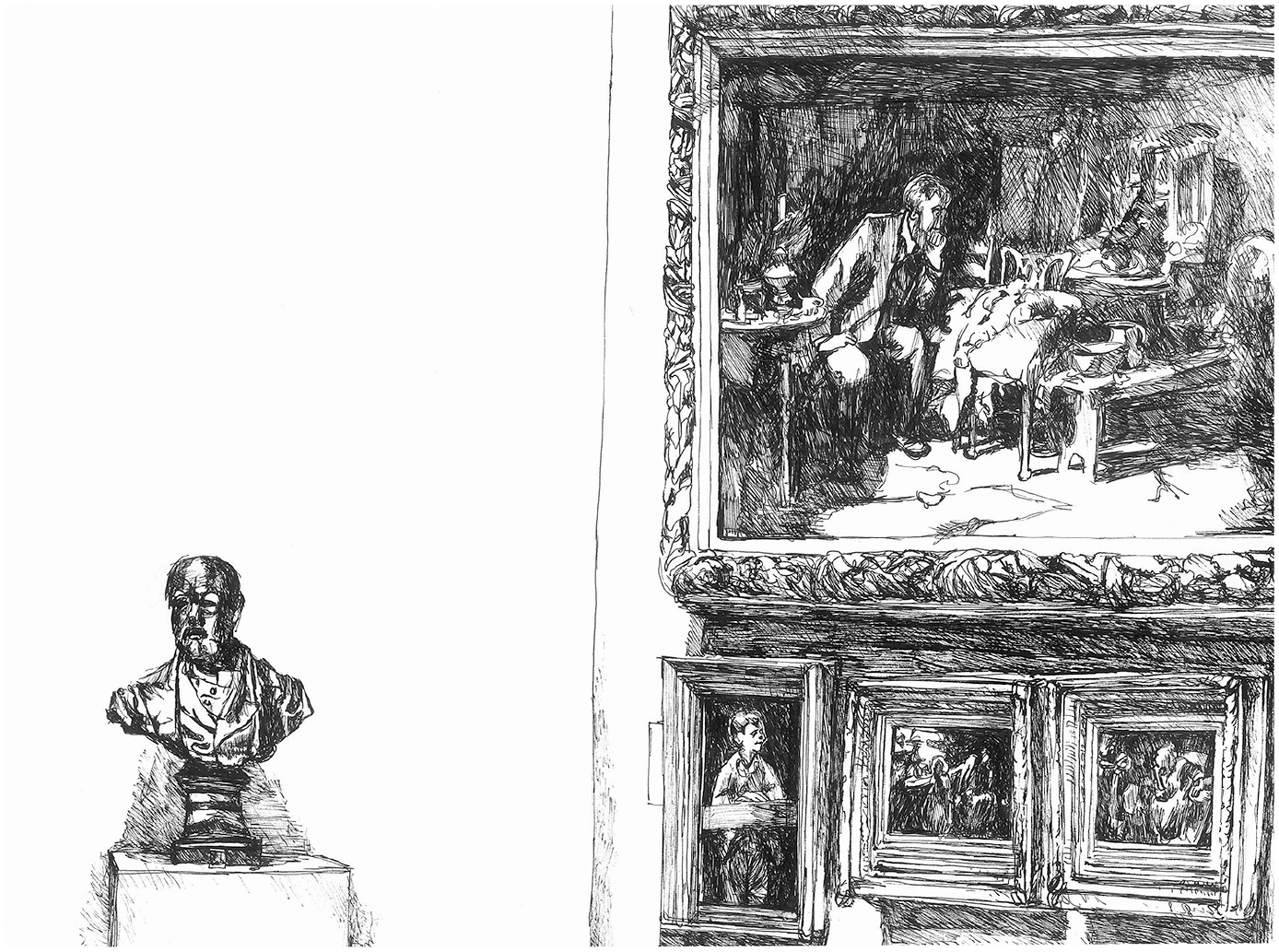
Henry Tate’s bust with paintings. Drawing: Catherine Hahn (2024).
Although the group of works might be read ‘against the grain’ as a critique of Victorian paternalism, the poor cannot challenge the binary ‘zone of indeterminacy’ that would enable them to cross from the position of space invaders to the active, elevated authority (the bearded patriarchy) (Hall, 2001: 235; Puwar, 2004: 144). Rather, the anonymous white, working classes perform as the alterity who are ‘anchored to what they are seen to embody’ – in this case poverty (Puwar, 2004: 72). Conversely, Tate is vaunted. As my study shows, similar binaries are instituted early in the display.
There are also unequal divisions between types of work. The mass of historic painting relegates other art to a supporting role, with a particular impact on contemporary pieces. For instance, in room 1 Mona Hatoum’s Exodus 2 (2002), two old suitcases, joined by human hair, speak to Hatoum’s Palestinian origins and displacement from Lebanon, trauma and loss, in a room of Tudor paintings. Here, the artwork’s pressing concerns are subsumed by 16th-17th century discourse on Britain’s refugees and migrants.
In Historic and Early Modern British Art, curatorial revisions challenge reductive British history. Concurrently, regular display features establish the 18th century as a foundational history with rich, white men at its core. In this context, other subjects are staged as space invaders. Knowledge of hierarchies and dichotomies instituted in the display are taken forward in my analysis.
Method
I concentrate on three areas in rooms 2, 3 and 4 in Historic and Early Modern British Art. Designed as ‘staging-posts’, they establish ways of looking at British history post-Brexit. Following Carol Duncan’s (1995) approach, I treat these areas as ‘dramatic fields’, to ascertain the ‘values and beliefs’ (political, social and sexual) that they advance in the form of ‘vivid and direct experiences’ (p. 2). I explore the ‘ritual structures’ deployed in these ‘staging-posts’, their visual languages, histories and hierarchies. I consider the impact of revisions and other possibilities. Where applicable I make connections to post-Brexit cultural politics.
My focus on visual material parallels the experience of gallery visitors who spend most of their time looking at the artworks. Research suggests that the inclusion of gallery text increases visual engagement, but a third or more visitors will not read beyond the artist’s name and title (Reitstätter et al., 2022: 141–143). I therefore engage with the exhibition texts as secondary source material. To capture and comprehend the display’s visual content and arrangement, I have drawn the areas I discuss. Drawing in situ creates an immersive experience akin to fieldwork, which has enabled me to ‘apprehend the substructure that informs the visitor’s experience’ (Hahn, 2024: 100–101).
I now explore the three key areas in the display in the order most visitors will encounter them. In room 2, the Whig parliamentarians; in room 3, newly wealthy Georgian families and in room 4, Lydia as the object of the male gaze.
The parliamentarians
The first room in the display Exiles and Dynasties (1545–1640) is muted. Tudor paintings of relatively even size merge into a deep blue wall with Exodus 2 off centre on the floor. It is when the audience enters room 2 Court versus Parliament (1640–1720) that they encounter the first dramatic stopping point, The Whig Junto by John James Baker (1710) (Figure 2). Acquired in 2018, the painting’s curation and scale accord it the status of the masterwork, with the white politicians as the nation’s forebears.
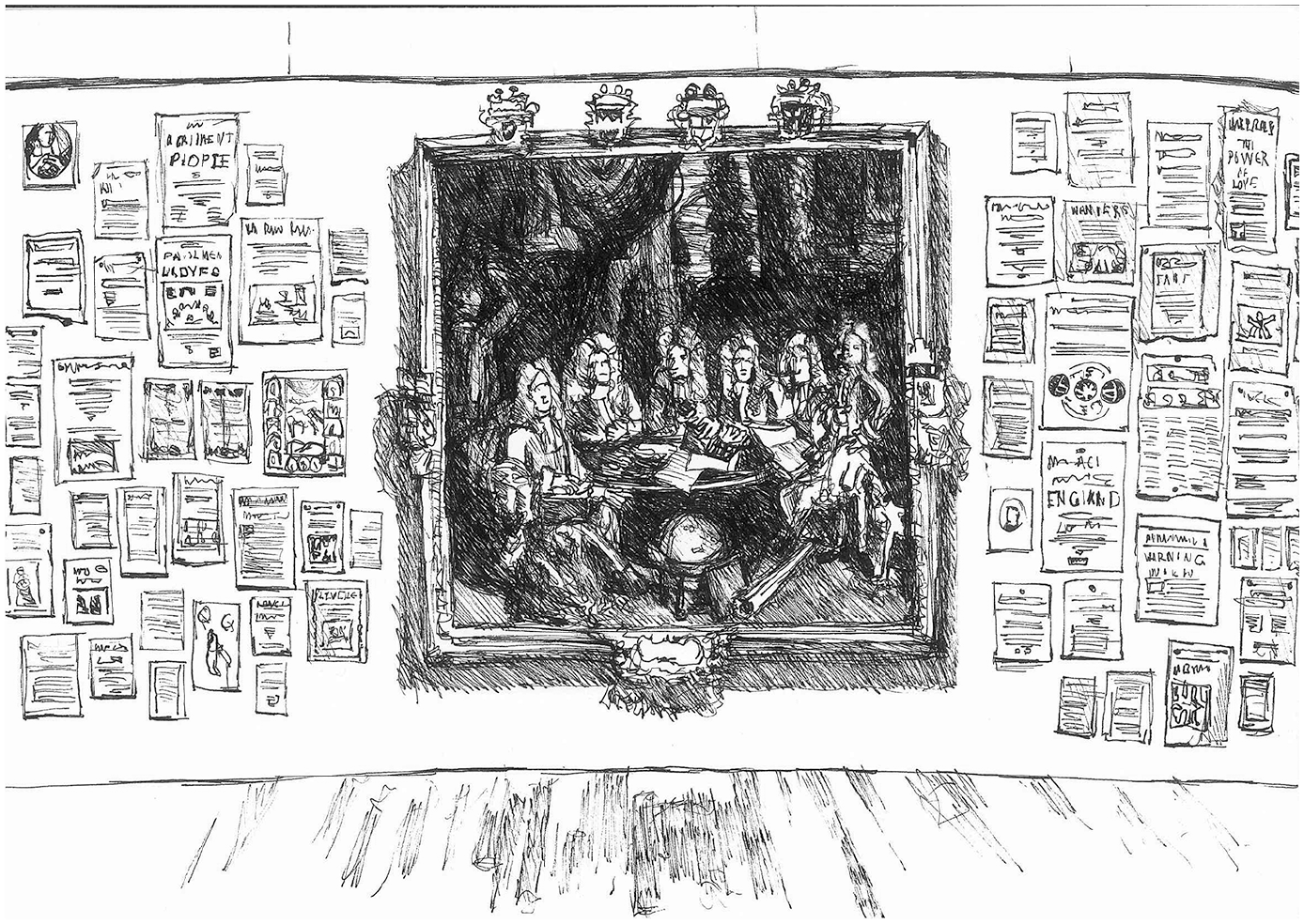
The Whig Junto with protest pamphlets. Drawing: Catherine Hahn (2024).
Court versus Parliament contains 18 paintings made between 1640 and 1720 and three works by contemporary artists. Thirteen of the historic paintings are figurative. Apart from The Whig Junto, they only depict white subjects. The Whig Junto represents six white members of the Whig political party and a young Black man or boy. In the late 17th and early 18th centuries, the Whig Junto ran the Whig party. They were a group of aristocrats who acted like a cabal and used propaganda to control the English government. This section looks at how the display positions the Junto as the progenitors of the British parliamentary system and at how the Black character is portrayed in terms of lack of agency.
Soon after The Whig Junto was gifted to Tate, it was exhibited in British Baroque: Power and Illusion, which opened on 31 January 2020 – the day Brexit became law. The timing was noted by critics who conflated the Junto with the Brexit leaders (Keats, 2020). Three years on, the Junto occupy a dominant position in the display, with Queen Anne relegated to the corner, casting the monarch (and women) in a supporting role. The display’s focus on the shift in power from court to parliament, and from female to male, fits with the resurgence in masculine authority during Brexit, from which men have emerged as principal ‘instigators and actors’ in key political roles (Smith, 2021).
The room is orchestrated around The Whig Junto. The painting is situated on the right-hand wall near the entranceway. Research suggests visitors are most attracted to the right-hand side of the gallery: moving from the left before settling on the right (Kühnapfel et al., 2024: 90). The décor used in the display makes this movement feel imperative. The Whig Junto stands out on a cream wall, in contrast to the other three in puce, a dark brownish purple. The Whig Junto, at the centre of the wall, is surrounded by rough-edged protest pamphlets. The pamphlets form part of Nils Norman’s contemporary installation Sparkles of Glory (2022), which includes audio recordings of the tracts that play as visitors walk around the room. The pamphlets express the views of Levellers and Ranters, protestors and dissenters in the English Civil wars. As well as challenging the Whigs’ politics, the tracts serve as billposters broadcasting important news. As such, they draw people to the painting.
At over 3 m tall and 3½ m wide, The Whig Junto commands its own attention. Historically, in the West, large paintings have had greater status than small ones, and visitors appreciate them more and view them for longer (Bitgood et al., 2013; Seidel and Prinz, 2018). The painting’s size embodies the Junto’s physical authority while its frame performs as their standard bearer. Six painted heraldic symbols, representing the politicians’ aristocratic lineage, stretch out from the mount.
The Whig Junto was originally intended as imperialist, pro-British, anti-European propaganda. Now, its pro-British rhetoric provides an ancestry for Brexit. Tate describes how everything about the painting is ‘designed to demonstrate the [Whig Junto’s] power’ (Barber, 2020). Its Greco-Roman interior and the men’s luxurious clothes: velvet cloaks, wigs and heeled shoes, proffer a room styled and bodies fashioned for universal leadership. The classical décor in the painting asserts Britain’s inheritance from Rome and its ‘desire for empire building’. Papers on the table show friezes celebrating Roman battles, intended as a comparison for Britain’s military success in Europe (Barber, 2020). A globe on the floor and coins piled on the table present British imperial expansion affirmatively in terms of wealth accrual.
In our age of growing racial and gender diversity among politicians, the imperial Junto provide spectral ancestors for the white male leaders in the Brexit debate: Cameron, Clegg, Farage, Gove, Rees-Mogg and Johnson. The Junto’s visible power corresponds with Boris Johnson’s ‘purposeful masculinity’ during Brexit negotiations: ‘playing the man card’ to get ‘the job done’ (Smith, 2021: 450).
The Whig Junto’s role as the progenitors of modern British politics is animated by the dissenters’ pamphlets glued on the wall – the whole conveys the messy and contested birth of new forms of governance. Meanwhile, the reduced focus on monarchy in the display moves attention away from historic female leaders to male parliamentarians. Consequently, the origins of British leadership history are viewed through the contracting prism of wealthy white men.
Pulling back the curtain
In the painting, to the left of the Whig Junto, is a young Black man or teenage boy. Represented in a shadow at the painting’s edge, he stands with his back towards the viewer, his face to the side. He reaches an arm up to pull back the curtain. Though he is in darkness the gesture appears revelatory, as if he is bringing in the light. The gallery text implies the Black figure represents an enslaved person positioned as an outsider, a space invader, whose liminal presence affirms the Junto’s political and economic capital. The text tells us that portraits of wealthy white sitters often included Black subjects in the ‘margins or the background’, as symbols of the sitters’ ‘wealth, power and status’.
By drawing attention to dehumanising portrayals of enslaved Black people commissioned by wealthy whites, the gallery text brings visibility to the racism in The Whig Junto. At the same time, the way that the painting is displayed carries risk. Rachael Minott (2019) has outlined the harm caused by museum displays which begin with portrayals of Black people who are enslaved: ‘To portray the Black experience as starting from a passive and enslaved position is false, and perpetuates the reductive, symbolic use of the Black body as exploited’ (p. 95). As a proxy for racism, the figure conveys an absence or lack – magnified by the absence of other images of Black people in the first four rooms. The added symbolic burden of being the representative for the mass of exploited people comes into play, with the work positioned under what Puwar (2004) describes elsewhere as ‘the spotlight of intense racialised optics’ (p. 63).
In the entrance hall, an introductory film provides a small revision or intervention. It pans in on The Whig Junto and for a second on the Black figure. It asks us ‘Who do you see?’ The close-up shows us the plumpness of the young man’s face and the side glance of his eye. This momentary glimpse brings intimacy to our engagement but does not significantly challenge the racial power structure in the display. Fred Wilson’s Mining the Museum (1992–1993) and Barbara Walker’s Vanishing Point (2021–2022) spring to mind as contrast. Wilson covers up white figures in racist historic paintings, so that only Black figures are visible, animating and reversing the selective act of looking embodied in the work (Houston, 2017). Similarly, by redrawing historic paintings, Walker empowers Black characters in portrayals of wealthy whites. Her Black figures are shown ‘standing strong’, while she depicts whites as blank space between embossed lines (Trigg, 2022). The repetition of this strategy by both artists surfaces Black alliances. In contrast, Court versus Parliament shows a lone Black man or boy in an encasing white world.
While the gallery text is critical of the reductive treatment of the Black subject, the visual display presents the politicians as the authority. In doing so, it anticipates further manifestations of white, male power, as we move through to room 3.
Metropolis: wealthy white families
In room 3 Metropolis (1720–1760), 18th-century family portraits shift the narrative from the court and parliament to a newly wealthy urban elite. Contrived and opulent domestic scenes signal the wealth and prestige of individual British families, with the man at their apex. The pictures return us to the ‘self-fashioning that gripped the Georgian age’, when portraiture flourished as ‘the single most important currency for trading in British identity’ (Mudge, 2023: 6). In this space, we find relatable ancestors for affluent white Britons post-Brexit. The images convey the romantic myth of an imperial age of growth and luxury. Curatorial revisions reference the enslavement and colonisation of people in ways that challenge, but do not reverse, the visual amnesia on the walls.
Metropolis contains 22 historic paintings: 20 show white characters, 15 of them in groups. There are no pictures of people of colour. Thus, the room tenders an imaginary and ‘culturally simple’ heritage that leaves people of colour vulnerable ‘to exclusion from the nation’s sense of itself’ (Gilroy, 1995).
The room is painted light mushroom. The hue matches Westminster Bridge in a picture opposite the entranceway. The bridge, under construction, recalls 18th-century London’s expansion and the lived history around the museum. Five portraits of rich, white families are situated towards the right. The largest, The Harvey Family, by Godfrey Knellar (1721), sits in the middle of the right-hand wall flanked by smaller paintings. Like The Whig Junto, it is the focal point of the display. As a recent acquisition, it expands Tate’s white family portraiture. Painted in the grand aristocratic style, it represents the Harvey Family (business merchants in the Ottoman Empire) in a glamorous neo-classical garden. The painting is accompanied by conversation pieces: pictures of informal family gatherings set in domestic interiors and gardens. Conversation pieces were popular in the 18th century with the new urban business elite (Chen, 2011: 204). With The Harvey Family at their centre, the images stage white, monied families as the growing force in the country. Images of the expanding masculine domain, bridge building, port authority and army barracks, solidify the male heads of households’ territorial claim.
The focus on rich families in Metropolis resonates with the white, heteronormative discourse that resurfaced with Brexit (Saresma, 2018: 178). Anxieties regarding the dissolution of white, Western, male power structures have seen a reactionary impulse to instantiate ‘traditional’ familial and gendered roles (Agius et al., 2020). Pablo Bronstein’s Molly House (2023), included in the space, offers a partial rebuttal of this heteronormative hierarchy through its representation of the queer Georgian clubhouse. However, the iterative patriarchy in the family portraits means their gendered message pervades.
Conversation pieces provide a genealogical inheritance, ‘a visualisation of the last will and testament’ that manifests patriarchal succession (Pointon, 1993: 161). In Metropolis, each family portrait shows the white, male head of household presiding over his family. The husband stands over his wife, holds her hand or rests a hand on her shoulder. The mother sits with an arm around a daughter, or with a daughter at her knee. The sons are relatively independent, miniature versions of their fathers. In The Harvey Family, the father and son stand, hand on hip, side-by-side. Inside the paintings, portraits on parlour walls honour the ancestors. The messaging is clear. Each generation will pass on their inheritance through marriage between like families and progeny, their power fixed in gendered (and raced) roles for perpetuity (Pointon, 1993: 161). The images produce associations with the super-rich today and the increasing concentration of wealth in patriarchal family dynasties (see Knowles, 2023: 97–108).
Metropolis underscores the power of rich families through a binary of affluent white insiders and exteriorised white workers. To the left of the families, the Heads of Six of Hogarth’s Servants (Hogarth, c. 1750–5) are painted on an indistinct brown ground. Unmoored from their social context, the disembodied heads relay the servants’ functionary roles. In Puwar’s (2004) terms, the rich, business families are staged as the ‘natural’ subjects of history and the workforce their adjunct (p. 8). This binary relationship offers a further enclosed, socially ranked, white world.
Problematically, the informal domesticity in the portraits makes the rich families appear relatable. The texts describe the sitters’ European origins, offering a cosmopolitan vision of 18th-century London. However, the symbolism, drinking tea and pet dogs, are ubiquitous with Britain. The intimate style in which the front rooms are painted induces familiarity. Soft hues and even-handed brushstrokes bring attention to details, such as the delicate pattern on a tea set. The care taken with treasured items invites one to admire them, as if a visitor to the house. The material possessions signify prosperity and status (Pointon, 1993: 159), symbolising success in terms of male wealth accrual. There is something of the 21st-century ‘aspirational’ lifestyle in what we are invited to peruse. The family portraits mirror the ‘tradwife’ and rich white businessman glamorised on social media platforms post-Brexit, typified by Megan Boni’s viral ‘I’m looking for a man in finance with a trust fund, 6′5″, blue eyes’ (Clark, 2024).
Commodity consumption
The imperial origins of the luxury lifestyles are brought to attention in the gallery texts. The lavish items, including carpets, chinaware, silverware, tea and sugar, came to Britain through the institutions of slavery and colonisation. Visually discreet connections to these heritages are materialised in the exhibition panels, which describe how sugar was ‘produced in the Caribbean by enslaved Africans’ and name portrait sitters, and businesses, that profited directly from the enslavement of people. 4
This information gives important context for the paintings but is placed in tension with affirmative references to commodity consumption. The main text tells us Queen Catherine made tea fashionable and that by the 1720s ‘black tea’ was ‘favoured with milk, and sugar’. This pleasurable, recognisable, connection contrasts with the enslavement of people as distant suffering. Consequently, the text reproduces the ‘colonialist logic’ of centre and periphery that Dewdney et al. (2013) have identified in previous Tate displays: ‘with tribute flowing from the (colonial) margin to the (imperial) metropolis’ (p. 233).
The texts further this ‘colonialist logic’ by informing us that whites acquired cultural status through colonisation. The label for An English Family at Tea (Joseph van Aken, c.1720) describes how sugar was ‘produced in the British colonies in the Caribbean with the labour of enslaved African people’. It then informs us that tea ‘came to epitomise civilised behaviour for British people’. The painting gives vision to this ‘civilising’ influence through a maid pouring tea for the lady of the house, a tea caddy at her feet, a porcelain sugar bowl on the table. The emphasis, in the image and text, on ‘civilising’ influences animates the patrons’ aspirations. Ching-Jung Chen (2011) describes how the rich, male commissioners of conversation pieces chose luxury devices to frame themselves as a burgeoning aristocracy, as ‘taste displayed through the consumption of fine material possessions, leisure, and art marked the gentleman’ (p. 207).
In Metropolis, the representation of newly rich, white families enjoying opulent lifestyles overwhelms the critique, as the link between the families’ lifestyles, enslavement of people and colonisation is mentioned in the text, but not given vision in the paintings. As with room 2, including images that reflect the violence of imperialism without wider inclusion would be reductive (Minott, 2019: 95, 97). However, by not giving ‘vision to empire, in terms of trauma and loss’, we lose sight of the actualities in its narrative (Hahn, 2016: 30; Vivekanandan, 2021: 202). The images on display also risk double-readings as people may not read the labels (Reitstätter et al., 2022: 143).
Take a seat
One way in which Metropolis has challenged its white vista is through contemporary work, notably Sonia Barrett’s Chair No. 35 (2013). Barrett is the only Black woman artist, and one of only two contemporary artists, with work in Metropolis. Her work is therefore not embedded to the same degree as the 18th-century family portraiture. Nevertheless, it has agentic capacity.
Chair No. 35 lies in front of the portraits, with their 42 members (including white servants), like something at sea (Figure 3). In a room ‘tacitly designated’ as the habitus of elite white families, the chair mobilises its space invader status to disrupt the ‘natural occupants’ (Puwar, 2004: 8). A body wrecked by an awful calamity, it faces down and reaches upwards. In this context, its thin legs balanced on clumped feet seem abject. Its right arm raised, chest up, heroic. Its tautological movement keeps the eye in play. Simultaneously, it expresses destruction and the potential for recovery. Barrett says she ‘makes sculptural works so she can run her hands along the fissures and manifest strategies for multiple compatible existences and mourn’ (Gregoire, 2024). Grief and possibility infuse the chair.
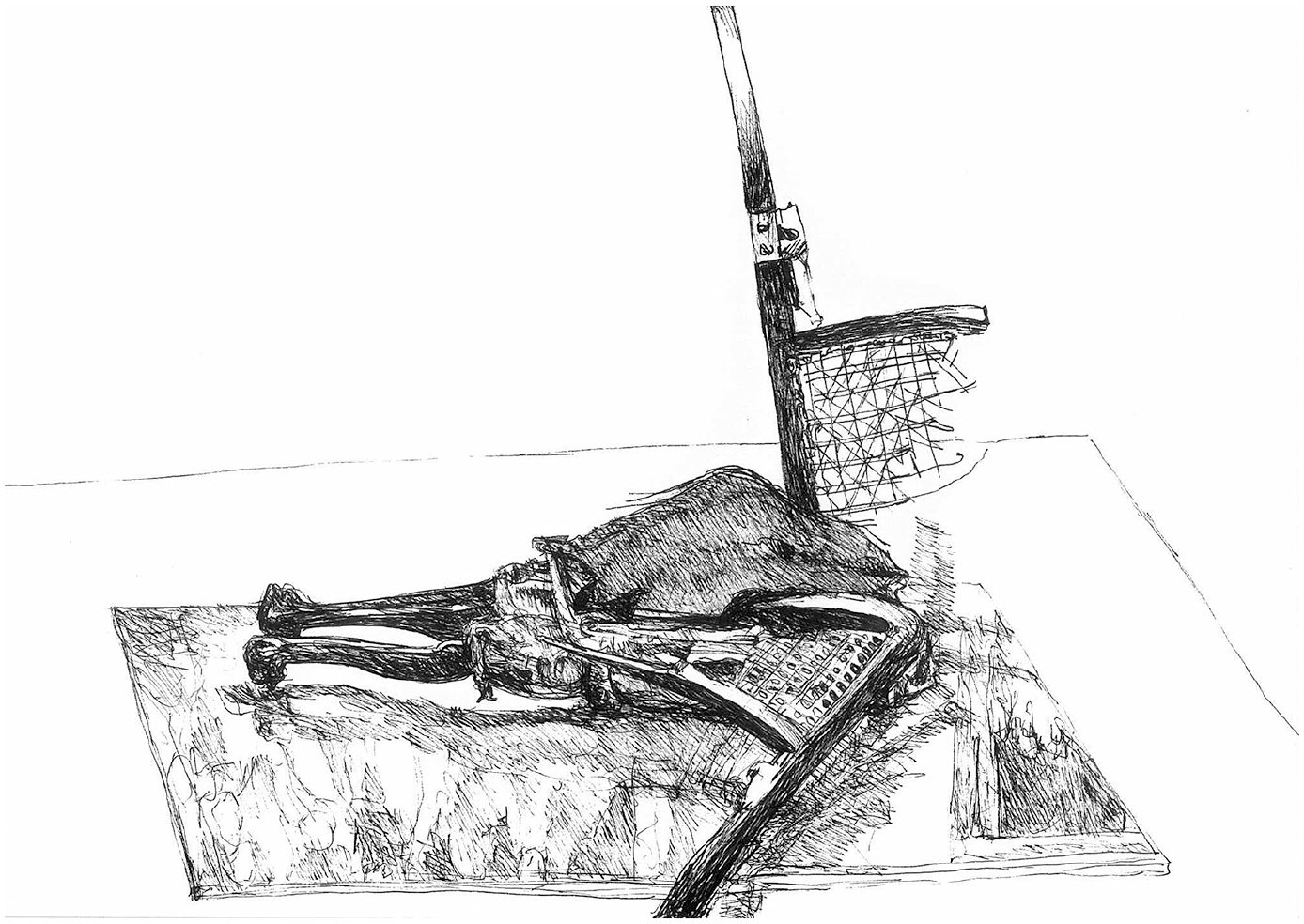
Sonia Barrett’s Chair No. 35 with reflections in the sheet. Drawing: Catherine Hahn (2024).
In Metropolis, Chair No. 35 most readily conjures slavery. However, the display uses Barrett’s heterogeneous interpretation of her work to undermine what Puwar (2004) describes as the ‘straitjacket’ of the marked identity that this environment provokes (p. 70). Through the transparent sheet it lies on, and Barrett’s accompanying explanation, Chair No. 35 encompasses contemporary concerns. The sheet summons light on the sea and wrapping used in forensic laboratories. The wall text quotes Barrett, describing how she was mistaken for a refugee in Italy. Hearing about refugees’ decomposing bodies in the water, she saw links to her own experience, climate change and racial injustice: ‘in a world where all animals, plants and human bodies face rising sea levels’. With Barrett’s help, the broken chair and sheet convey the inequal impact of the climate emergency, the refugee crisis and failed border crossings. By bridging the space between 18th- and 21st-century issues, Chair No. 35 provides an important intervention.
At the same time, the transparent sheet acts like a mirror to reflect the family portraits. Taking us back to their concerns, the controlled lighting in the gallery makes the white families an unwavering presence in the sheet. The fact that Chair No. 35 is bound to these characters reminds us that contemporary works (despite having their own stories) are here to respond to the historic paintings (see Sophie Turner (2024) for a further discussion of this dynamic).
The contemporary pieces provide meaningful disruptions, but their small number limits their capacity for action. There is one other work by Barrett in Metropolis, Lady of the House (2012). A room full of her furniture would have greater effect. Instead, the wealthy, white, patriarchal families remain the dominant thread. The white ancestral pathway in Metropolis leads us through to room 4.
The exhibition age: The male gaze, Lydia and Grosvenor
Room 4, The Exhibition Age (1760–1815), shifts the focus from rich, white men as the subjects of art, to their tastes and interests. The room’s re-enactment of the Georgian exhibition invites a return to the past. In this immersive setting, a painting of a white sex worker. Lydia. by Matthew Peters (1777) stands out. Lydia is one of four versions of a picture made by Peters for 1st Earl Lord Richard Grosvenor (1731–1802), a Tory peer and one of the richest men in Britain. Here, Tate Britain deepens its engagement with wealthy, white men by reanimating the interests of one of their most privileged historic members.
There are 64 paintings in the room, 54 of which depict one or more white people. There are no images of people of colour. Before turning to Lydia, this lack of representation requires mentioning. The Exhibition Age is historically anachronistic as multiple pictures of people of colour were included in public displays in the Georgian era. These images included the anti-imperialist: The Slave Trade, Execrable human traffic, or the affectionate slaves and African Hospitality (George Morland, 1788 and 1790) and portraits, including Chit Qua of the Chinese sculptor Tan Che-Qua (John Hamilton Mortimer, 1770) and Portrait Head of a Man, probably Ira Frederick Aldridge (John Simpson, 1827), now in the next room. The immersive white experience presented by the display, uncoupled from the realities of Georgian life, fits with wider re-imaginings of historic Britain as white that occurred during Brexit (Emejulu, 2016). Without other subject positions, the display returns whites to the invisible role of being ‘just human’, removing the context for their power (Dyer, 1997: 9). There are also no contemporary artworks or critical texts in the exhibition space to provide curatorial revisions.
The hang
Gender is foregrounded in The Exhibition Age. Lydia is not the largest painting in the room but draws attention through its sexual content (Figure 4). Lydia’s disruptive sexual subject matter means the painting registers, on Puwar’s (2004) terms, as a space invader or body out of place. As Grosvenor’s commission, it appears conceived for the male gaze. As there are no equivalent paintings of men in the gallery, or texts to challenge the scopophilia, it also conveys a reactionary assertion of the male right to stare (Mulvey, 2013).
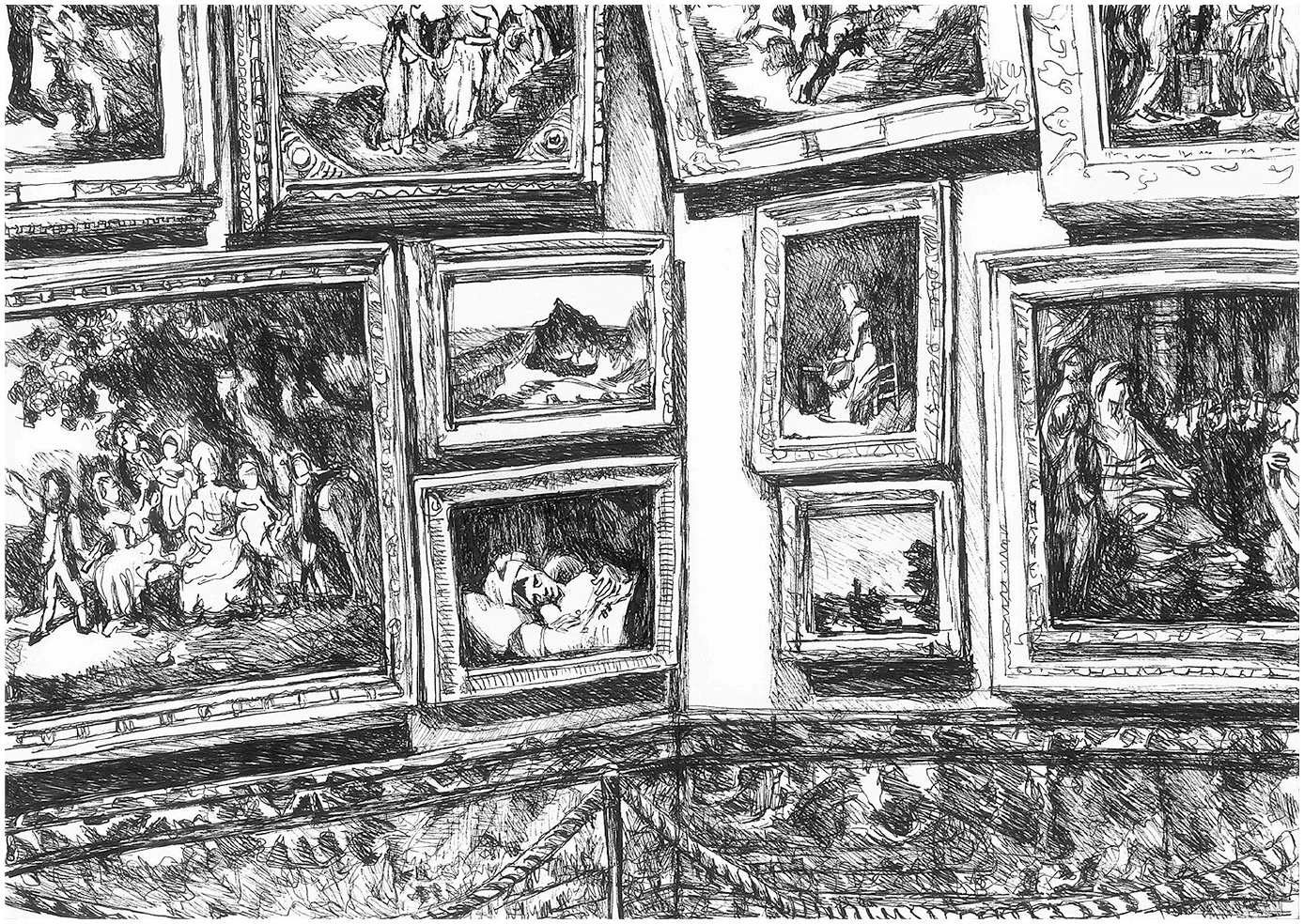
The Exhibition Age with Lydia. Drawing: Catherine Hahn (2024).
In keeping with the 18th-century RA, the room contains catalogues, not wall texts. These sit on a central hexagon of benches and provide basic details on each painting (artist, title and date). The catalogue, as the historic record, abrogates the need to explain the exhibition’s content. Meanwhile, the dense hang and hand-held guides encourage visitors to settle. Gleaming stanchions with green velvet ropes cordon off the work. Not used elsewhere, the ropes recall the throng that pressed to see the RA’s paintings in the 1700s. Thus, the display structure sets up a vantage point and rationale for viewing Lydia as spectacle.
The painting of Lydia is hung in the tight right-hand corner. Her eyes meet the visitors as they enter. In the painting, Lydia is lying part-naked in a bed. The pillow forms hillocks on either side of her head to make a feature of her breasts. The bedding and curtains are slightly blurred, creating a soft-focussed contrast to her eyes. Her right arm under the sheet intimates she may be masturbating (Sammern, 2016: 22). The shadow beneath her left hand indicates the cover will be raised – inviting the viewer-visitor to join her.
In the early years at the RA, artists brightened and lightened their work for maximum attention (Cunningham, 1843: 1, 143–144). Lydia’s body, as the brightest, whitest surface in The Exhibition Age, acts like a beacon. Foreshadowing Manet’s representation of Victorine Meurent in Olympia (1863), the image conveys the transactional value of sex work. In some circumstances, with written support, visitors might construe Lydia’s representation as liberating, as images of sexually active naked women can be understood to represent the ‘lived body’ rather than the passive female nude (Pollock, 2000: 144). However, Grosvenor’s presumed intention for the work refutes this interpretation.
Art historian Romana Sammern suggests Lydia is a portrait created through the interconnection of a (now unknown) prostitute and Grosvenor’s wife, Lady Henrietta. Sammern’s (2016) contention is supported through the squint, or wandering eye, that both are depicted with (pp. 26–27). Grosvenor was separated from his wife and attempted to divorce her for having an affair. She counterclaimed by enlisting prostitutes from the brothels that he visited to testify against him (Sammern, 2016: 21). It is not certain that Grosvenor requested that the artist merge the image of the sex worker with Lady Henrietta. However, the painting’s sexual content and ‘the squint’ do indicate that Grosvenor commissioned it to embarrass his estranged wife. Grosvenor’s attempt to humiliate his wife has echoes in intimate image abuse (revenge porn) and pornographic digital trophy collection today (Haslop et al., 2024). The sex worker is also effaced through Grosvenor’s projections. There is a further question regarding her age, as it is not clear from the painting if the model is a girl or a woman, lending vulnerability to the image.
Displaying Lydia
Importantly, the way Lydia is displayed in The Exhibition Age adds to the model’s estrangement and space invader status. The paintings are arranged around the room in dialogic relationships, a comparative method that reinforces Lydia’s representation as an out-of-place sex object. Lydia is hung next to Johan Zoffany’s The Bradshaw Family (1769). Zoffany’s conversation piece is described in Tate’s online entry as representing ‘that Georgian ideal of family life which was exemplified in the Royal Family’ (Tate, 2024). As its neighbour, Lydia serves as the illegitimate counterfoil, or hidden life, of the wealthy English aristocracy.
The display furthers Lydia’s outsider status by making whiteness pivotal. In doing so, it activates the historic racist trope of whiteness as purity. Lydia’s transgression is operationalised through work in the diagonal corner. Here, paintings of seven white girls and young women line up from the skirting to the ceiling. Together, these images project the fantasy of the demure Georgian female. A schoolgirl bows her head, another plays a harp. In the largest, life-size picture, a woman lifts her veil. They all wear dresses in various shades of white. The visual difference between Lydia and the girls is animated through her heightened whiteness. In historic Western paintings, whiteness was used as a racial trope to evoke ‘spirituality, transcendence, cleanliness’ and virtue (Dyer, 1997: 72). Lydia’s sheet-white skin, like Meurent’s in Olympia, performs a bodily reversal. The girls, as the personification of innocence, highlight Lydia’s role as Magdalene.
Though Lydia might be understood differently, there is nothing in the exhibition to challenge viewing her as a sex object. The absence of people of colour means the display creates a hegemonic fantasy of the white exhibition age and the white female body. Though Grosvenor isn’t present, the display gives power to his vision. The painting evokes his status as the invisible commissioner – the wealthy man behind the gaze. The cost of Lydia’s adornments, the fashionable silk hood and spotless white sheets, announce his economic investment. In the exhibition, the painting’s sexual content also inadvertently affirms the popular Brexit-era trend ‘to change the current (“too modern”, “too equal”) gender order’ by asserting male sexual ‘freedom’ (Löffler et al., 2020; Saresma, 2018: 194).
Sexual object
The fantasy of the sexually available young female, embodied by Lydia, has been challenged in other sites. As part of the Manchester Art Gallery Takeover (2018), Sonia Boyce took down John William Waterhouse’s Hylas and the Nymphs (1896) for one week and invited the audience to put up Post-it notes that commented on its content. As Charlotte Higgins recounts, in the context of the culture wars, ‘all hell broke loose’. Complaints in the media and to the museum fixated on perceived censorship and ‘virtue signalling’ (Higgins, 2018). The art critic Jonathan Jones argued that ‘the great freedoms of modernity’ include the ‘freedom of sexual expression. Even a kinky old Victorian perv has the right to paint soft-porn nymphs’ (Jones, 2018).
Most of the media responses to Hylas and the Nymphs’ removal missed the point of Boyce’s exercise. Namely, to draw attention to work on the gallery wall and invite visitors to take a view on it (Higgins, 2018). The negative response reclaimed a retrogressive British art heritage, and male gaze, in the face of a contemporary art intervention. In doing so, it suggests challenges may lie ahead for those seeking to question the inclusion of works such as Lydia.
Conclusion
In this article, I have analysed key areas early in the first section of Tate Britain’s new semi-permanent display. I have shown how the gallery’s use of historic British painting to relay British history has created an exclusionary foundation for Britishness post-Brexit. Though it contains revisions, the display privileges rich, white men in the story of the nation.
In the context of the decolonial turn and BLM, I have explored how Tate Britain introduced curatorial revisions to the semi-permanent display that challenge ‘neutral’ ideas of art history and romantic ideas of British empire. The gallery questions its own authority through links between its artworks and the enslavement and colonisation of people. The display’s contemporary additions also make lucid connections between past and current day concerns.
However, importantly, my article demonstrates that despite the curatorial revisions, the display does not offer an expansive, foundational British history with equal representation of Britain’s diverse art inheritances. Rather, its content and display features – chronology, staging, portraiture and binaries – provide a narrow British history with roots in an 18th-century world over which rich, white men preside. The white male conjured from this environment, creates relatable associations with ideas of white, patriarchal nationalism forged during Brexit. Artworks staged as space invaders in this arena, including the contemporary additions, disrupt but do not overturn this dominant view. As my article demonstrates, stripping the veneer of moral rectitude from these rich, white men has not relieved their power.
Though Tate Britain engages critically with British history, it cannot claim diversity post-Brexit with its white historic spread. Reclamation of space for contemporary art, and mainstreaming a culturally diverse range of artistic heritages, remains imperative.
Footnotes
Declaration of conflicting interests
The author(s) declared no potential conflicts of interest with respect to the research, authorship and/or publication of this article.
Funding
The author(s) received no financial support for the research, authorship and/or publication of this article.
