




Abstract
This article analyses the shifting media visibilities of femcels: women who self-identify as being involuntary celibate. It first considers the ‘original’ femcel community which emerged on Reddit in 2018, and which was based on often-despairing, even nihilistic, text-based discussion. It then considers the more recent shift to ‘femcelcore’: a social media aesthetic or ‘vibe’, communicated through short, apparently ironic videos on TikTok. We contextualise ‘original’ femceldom within the ‘femosphere’, a complex ecology of female-centric online communities that mirrors the deeply fatalistic, gender-essentialist, ‘red-pilled’ logics of the manosphere, and we situate ‘femcelcore’ within recent histories and aesthetics of ‘sad girl’ culture. Despite their differences, both iterations of mediated femceldom ostensibly reject patriarchal notions of feminine ‘perfection’; they seem to offer a critique of neoliberal feminism, and to comprise a potentially feminist online community, and as such, we consider whether this phenomenon may signal a radical break with the hegemonic postfeminism of recent decades. However, we argue that both iterations of femceldom ultimately provide a weak and highly problematic basis for collective feminism. Drawing on Robyn Marasco’s concept of ‘womanly nihilism’ we argue that, rather than pursuing a feminism of solidarity and collective strength, these mediated femceldoms are rooted in logics of pain and fatalism; they mobilise strategies of self-numbing, dissociation and irony, coupled with the rejection of social hope. They signify not a collective feminist movement, but a fatalistic, dissociative, ‘anti-hope’ retreat from transformative politics, and a turn to the individualising dynamics of TikTok ‘vibes’. Building on Asa Seresin’s notion of ‘heteropessimism’, we introduce the concept of ‘heteronihilism’ to make sense of the widespread mood of ‘giving up’ that is increasingly entwined with, and expressed through, the radicalisation of negative heterosexual experience. We therefore introduce a new theoretical lens for analysing the politics of gender, sexuality and popular media, in a context of a growing and complex backlash against ‘liberal feminism’.
Introduction
Around the year 2021, mainstream Anglo-American media began to pay attention to a phenomenon that had hitherto been almost entirely overlooked and unexamined: that of ‘femcels’, or women who are involuntary celibate. The figure of the male incel had been highly visible since the 2010s, most especially after a self-declared ‘incel’ named Elliot Rodger killed six people in California in 2014; this has since been followed by further atrocities carried out by incels who have been radicalised through participation in manosphere communities. However, the notion that women could also lay claim to the identity of being ‘incel’ had hitherto simply not been a part of public conversation, so strongly linked has it been to notions of ‘toxic masculinity’, male violence against women and misogynistic entitlement to sex (for reasons that are in many ways understandable) (see Srinivasan, 2022). Indeed, because of deeply entrenched assumptions about women’s universal ability to wield power in the domain of sexuality – linked to broader ideas that it is (white) men who are uniquely ‘left behind’ in dating culture but also in society more broadly – one of us has previously argued that the figure of the femcel is not merely invisible within contemporary culture, but is more precisely illegible (Kay, 2021).
However, from 2021, a spate of high-profile media commentaries, magazine articles and documentaries began to turn attention to the femcel, indicating how this identity was gaining at least some legibility and recognition. The Metro newspaper declared 2022 to be ‘the year of the femcel’ (Colombo, 2022), noting that this group had broken ‘into the mainstream’. This article suggested that while the femcel identity was once characterised by inward-looking communities on Reddit, it was now ‘more of a trend and aesthetic that dominates platforms like TikTok’. At the time of writing 1 the femcel hashtag has had 848.2 million views on TikTok. 2 This media attention marked something of a shift, not least because the notion that women, like men, can be sexually or romantically excluded has been very rarely countenanced, and is even aggressively disavowed. Male incels refuse to accept that women can also be legitimately involuntary celibate and claim that femcels are actually ‘volcels’ (voluntarily celibate) as they can easily get sex, simply by virtue of being women (Cuthbert, 2023). Women are assumed to possess higher ‘sexual market value’ (SMV) – not only by incels, but much more widely (Ging, 2019; Kay, 2021). In fact, the person who coined the term ‘incel’ was a woman, named Alana. She had used this term in the context of an inclusive website designed to support lonely people of all genders in 1997, named ‘Alana’s Involuntary Celibacy Project’. 3 However, this history is most often suppressed in the dominant cultural imaginary, within which inceldom is almost exclusively associated with (white, cis-hetero) men.
This article is motivated by a set of questions prompted by the shifting visibilities of femceldom in digital culture: What should we make of this new visibility, and apparent popularity of femcels? Might the widespread disappointment in heterosexuality, which is made visible by mediated femceldom, contain some feminist potential for the transformation of gender politics and heterosexuality? Does mediated femceldom constitute a radical break with the neoliberal feminism that has been hegemonic in recent years?
We argue that to understand the contemporary gender politics of involuntary celibacy, we must consider the interplay between the two articulations of ‘femceldom’ that are circulating in popular digital media. The first is what is sometimes referred to as ‘traditional’, ‘original’, or ‘authentic’ femceldom – broadly speaking, those online groups of women who seek community, identity and recognition based around their experiences of sexual and/or romantic exclusion, and whose primary communicative mode is text-based, often lengthy and painstakingly detailed, on platforms such as Reddit. The second can be understood as a mutation or co-optation of the ‘femcel’ moniker, and is sometimes referred to as ‘femcelcore’ – in which articulations of loneliness, depression, dissociation, numbness and the ‘sad girl’ trope are expressed as an often-playful, ironic social media aesthetic or ‘vibe’, most especially on TikTok.
‘Traditional’ and ‘aesthetic’ femceldoms seem to emblematise two distinctive social tendencies – on one hand, the abjection and humiliation of ‘failing’ within a heteropatriarchal sexual ‘marketplace’ (where women are widely assumed to have all the advantages), and on the other, the ironic performance of femceldom, which is aligned with a ‘sad girl’ aesthetic, disappointment in heterosexuality and a particular kind of feminised dissociation. However, while it is important to distinguish between them and to understand their discontinuities, we also argue that they are both symptoms of the contemporary conjuncture, and that they are – in different ways – characterised by a tendency towards a deepening nihilism (Brown, 2023). We argue that both articulations of women’s involuntary celibacy – ‘traditional’ and ‘aesthetic’ – must be understood as part of a broader structure of feeling that Asa Seresin (2019) calls ‘heteropessimism’, as well as what Robyn Marasco (2020) calls ‘womanly nihilism’. Both iterations designate a sense of fatalistic apathy rooted in disappointment in forms of heterosexuality, but which extends into a broader rejection of social hope, collective politics and futurity; we identify this as part of a broader anti-hope structure of feeling (see also Kay, 2024). We build on these theories to argue that femcels (as well as male incels) are emblematic of what we call heteronihilism: the ways in which nihilistic, reactionary and anti-political moods are increasingly entwined with, expressed through, and radicalised by, negative heterosexual experience. Building on Seresin’s further concept of ‘heterofatalism’, which we go on to discuss, we define heteronihilism as a broad cultural turn to ‘giving up’: giving up on politics, collective action and even hope itself; and, crucially, this giving up is increasingly expressed within popular culture via the prism of disappointment with heterosexuality. We thereby introduce a new theoretical lens for analysing the thorny politics of gender, sexuality and popular media culture, in a context of a growing and complex backlash against ‘liberal feminism’. We suggest that femceldom indexes a potential shift away from the compulsory positivity and confidence of postfeminist media culture (Orgad and Gill, 2022), but while insidiously retaining postfeminism’s disavowal of collective, socialist feminism.
Incels, ‘traditional’ femcels and the femosphere
In keeping with the broader lack of political and sociological interest in women’s sexual and romantic exclusion, there is very little academic research on ‘traditional’ femcels. One exception is Kay (2021) who has written about the subreddit r/Trufemcels, a Reddit forum which began in 2019, whose members felt cruelly excluded from a ‘sexual marketplace’ which was monopolised by ‘high-tier’ women, or ‘Stacys’. She notes that while the manosphere is characterised by its adherence to a ‘red-pill’ philosophy – a bleak and fatalistic view of human nature which incites its adherents to ‘wake up’ to the brutal truths and immutable unfairness of life (see also Bratich, 2022; Johanssen, 2021) – femcels often refer to the ‘pink-pill’, a gender-flipped but similarly desolate version of the red-pill philosophy. The pink-pill philosophy claims that ‘ugly’ women are victims of society’s in-built ‘lookism’ and superficial beauty stereotypes, which are fatalistically understood as ‘hardwired’, innate human prejudices; recognising and accepting this bitter and brutal truth, rather than comforting and deluding oneself with platitudes about inclusivity, is to be ‘pink-pilled’.
The femcel identity is vehemently rejected by male incels, who jealously police the boundaries of who can be legitimately involuntarily celibate along gender lines. While incels express and project their anger outwards towards women, feminists, ‘alpha’ men and ‘Chads’, 4 femcels tend to display an inward sense of melancholia, anguish, pessimism and anger that is focussed on the self (Evans and Lankford, 2024; Kay, 2021).
Femcels constitute one particular cluster of communities in a much broader ecology of women’s online groups that Kay (2024) has termed the ‘femosphere’. These are communities which have arisen ostensibly in defensive reaction against the manosphere, most notably since 2018, and which seek to promote women’s interests against the growing power and networked strategising of misogynistic groups. Other communities in the femosphere include Women Going Their Own Way (WGTOW), female dating strategists and ‘gender critical’ women. However, while femosphere communities frequently deploy a feminist rhetoric, they ultimately mirror and replicate the reactionary, essentialist, fatalistic and ‘pilled’ logics of the manosphere, and can be understood as a ‘gender-flipped version’ of it. Within these communities, a radically simplified interpretation of radical feminism is often coarticulated with conservative ideas from evolutionary psychology, whereby men and women are understood as a ‘sex class’ with ‘hardwired’ sexual, emotional and behavioural characteristics, in ways that are both explicitly and implicitly transphobic (Kay, 2024). This mirrors the ideology of ‘sex realism’ that pervades the manosphere and reactionary digital spaces more broadly (Finlayson 2021).
In their large-scale quantitative study of what they call ‘Online Women’s Ideological Spaces’ on Reddit, Balci et al. (2023) identify femcels as a ‘toxic community’. They categorise femcels as a ‘manosphere analog’, because they correspond to the incel community (as does, for example, ‘Female Dating Strategy’ which has been understood as women’s equivalent of male pick-up artistry). Balci et al. identify the following subreddits as ‘femcel’ groups: r/Trufemcels; r/AskTruFemcels; r/Vindicta; r/PinkpillFeminism, and r/TheGlowUp. These different femcel groups saw significant user activity until most of them were banned in 2020 and 2021 by Reddit – for promoting hate (the precise reasons for the bans have not been made available, but are reported as being due to transphobia, misandry and racism). The largest of these subreddits, r/Trufemcels, then migrated to a new platform called ‘thepinkpill.co’ in February 2021, but never recovered its user-base and at the time of writing is defunct, meaning that ‘traditional’ femcels no longer have an obvious or substantial ‘home’. However, this does not mean that the energies, ideas and self-identifications propelling femceldom have entirely dissipated. A 2024 Channel 4 documentary 5 pointed to the common use of private groups on the platform Discord for femcel communities, suggesting their use of more diffuse and less visible spaces. Interestingly, one finding in the study by Balci et al. (2023) is evidence of user-overlap between femcel communities and gender critical groups (the latter of which are still very much operative). They also found that the ‘identity attacks’ within femcel communities increased after their migration to thepinkpill.co - primarily against Jewish and (especially) Muslim identities.
While logics of white supremacy and racial hierarchy pervade incel communities and the manosphere, such groups are not monolithically white (see Bell 2023; Ghumkhor and Mir, 2022). Similarly, femcel communities and the femosphere do not only interpellate white, Western women, and they have often centred discussion around the role that racism, colourism and misogynoir (Bailey and Trudy, 2018) play in sexual and romantic exclusion (Kay 2021). Indeed, the former moderator of Trufemcels wrote on the ThePinkPill.co – which she created - that, as a Black woman, she felt that the creation of Trufemcels meant that ‘I was given a voice for the first time’. However, while both the manosphere and femosphere are multiracial, this apparent ‘diversity’ is dominantly articulated through biologically determinist, hierarchical and fatalistic understandings of race. Racism is routinely understood as being ‘hardwired’ in humans, rather than socially constructed and therefore to be struggled against. As such, while there is nothing about the state of being an involuntary celibate woman that is intrinsically ‘toxic’ or reactionary (as, too, with men), there is clearly a way in which networked femcel communities have become entangled with, and generative of, the nihilistic, racialised and bio-essentialistic logics of white supremacy, the alt-right and reactionary digital politics more broadly (Finlayson 2021).
The reactionary tendencies within femcel communities must therefore be understood in relation to the historically specific conditions of their formation. While femceldom is often understood as a reaction against the manosphere, and its characteristic misogyny and fatalism, we argue that femcels do not so much oppose manosphere communities as mirror them. We now turn to consider the ways this identity has mutated or split into two: from the ‘traditional’ identity to the new ‘aesthetic’ of femcelcore, which is expressed on TikTok through a ‘post-ironic, self-conscious embrace of aesthetic feminine toxicity’ (Lanigan, 2022).
Contextualising femcelcore, ‘sad girl’ culture and heteropessimism
Writing in Glamour magazine, Fiona Ward (2023) argues that the term ‘femcel’ on contemporary social media platforms is articulated to ‘express an identity into the world – often a romanticized notion of being lonely, pathetic or ‘toxic’ towards relationships in some way’. She defines the characteristic aesthetics of ‘femcelcore’ as ‘an alt-trad “look’’ associated with cultural objects such as The Virgin Suicides and The Bell Jar books, as well as an unapologetic ‘toxic femininity’. This newer version of the femcel could be seen as a (mis)appropriation of the femcel, transforming her into a new aesthetic category which is playfully and creatively expressed in memes, TikTok videos or Instagram posts rather than in more serious, ‘toxic’ and nihilistic terms on Reddit. However, as we have begun to suggest, there are also common characteristics between the two iterations of femceldom.
As Asa Seresin (2019) astutely identifies, contemporary heterosexual culture is increasingly pervaded by a ‘heteropessimistic’ structure of feeling (see also Harrod et al., 2021; Johanssen, 2023), in which feelings of disappointment, disenchantment and negativity abound (see also Kay et al., 2019). Despite the fact that heteropessimism involves ‘performatively detaching’ oneself from heterosexuality, this prevalent mood enables a continued, albeit numbed, attachment to straight culture and sexuality. It is also characterised by an inability to imagine a different world in which heterosexuality might itself be transformed; heteropessimism is fatalistic and anti-utopian: ‘To be permanently, preemptively disappointed in heterosexuality is to refuse the possibility of changing straight culture for the better’ (Seresin, 2019). Seresin has also termed this structure of feeling ‘heterofatalism’ to capture its tendency towards anti-political resignation. Referring to Lee Edelman, Seresin argues that heteropessimism constitutes an ‘anesthetic feeling’ that works to protect against over-intensity and over-stimulation. In this sense, its ‘structure is anticipatory, designed to pre-emptively anesthetise the heart against the pervasive awfulness of heterosexual culture as well as the sharp plunge of quotidian romantic pain’.
Online culture is pervaded with ‘anaesthetic’ affects of nihilism, dissociation, disillusionment, sadness and depression. While there is a much longer history in which women’s mental health has been aestheticised, in the 21st century Fredrika Thelandersson (2022) identifies the ‘turn to sadness’, which contrasts with the compulsory optimism and resilience narratives of postfeminist culture. There has also been an increasing association between ‘Gen Z’ women and girls and an apparent sex negativity and disenchantment with sex and romance. 6 A key moment in this history is the subculture of the ‘sad girl’ on the blogging platform Tumblr between 2014 and 2018. This centred on the self-representation and aestheticisation of mental health conditions such as depression; it also sometimes overlapped with subcultures around pro-bulimia, pro-anorexia nervosa and self-harm content (Thelandersson, 2018, 2022). While such representations can open up the visibility and sense of belonging for those suffering from mental health conditions, and de-stigmatise the pharmaceuticals used to treat them, the flipside is that, as Thelandersson (2018) argues, ‘[a]mong the sad girls on Tumblr, sadness and depression become normal rather than abnormal, to be sad and mad is something to strive for, it even becomes cool’ (p. 6).
The Tumblr ‘era’ was largely proclaimed to be over when the platform banned explicit content in December 2018 (Tiidenberg et al., 2021). However, the aesthetic characteristics and identities constructed on the platform have endured and developed. On TikTok, many videos feature Tumblr-era inspired outfits or makeup tips, or hashtags such as #2013tumblr. At the time of writing, the hashtag #sadgirl has more than 14.7 billion views, and videos with the hashtag #sadtiktok have been watched 3.1 billion times. Tiidenberg et al. (2021) point to the centrality of mental health discourses on Tumblr, and the ways in which many users connected through a shared experience of particular mental health conditions, and so felt part of an accepting community. TikTok has similarly been characterised as a platform that contains a large amount of mental health content (Avella, 2024; Eriksson Krutrök 2021).
Another key moment in recent Internet history was the ‘feral girl summer’ of 2022. This was an explicit reaction against the notion of a ‘hot girl summer’, instead embracing ‘feral’ or perhaps ‘normal’ and banal expressions of feminine identity. Like the ‘sad girl’ moment, as well as the so-called ‘Fleabag era’ (which saw a celebration of the antiheroine character from the British TV show) (Holzberg and Lehtonen, 2021), it was a reaction against neoliberal ideals of the perfect, upbeat feminine self. The figure of the feral girl was also greatly inspired by the protagonist in Otessa Moshfegh’s widely read 2018 novel My Year of Rest and Relaxation, who spends a year in isolation, mostly sleeping in her apartment and dissociating from her pain through the heavy use of pharmaceuticals and other self-numbing practices (see Sykes, 2023). These disparate cultural texts are all marked by a deep disappointment in, or dissatisfaction with, heterosexual culture, alongside the cultivation of self-numbing, dissociation and general refusal of hopefulness or earnestness. Because most of this type of ‘dissociative feminism’ appears to be constructed, desired and embodied by white girls and women – or at least, what becomes algorithmically visible tends to privilege white girls and women (Kennedy, 2020) – commentators have criticised it as another version of white, liberal feminism (Muir, 2022). These aesthetic and affective iterations of heteropessimism, ‘dissociative feminism’ and ‘sad girl’ culture, we suggest, have laid the cultural grounds for the rise of femcelcore.
Femcels 2.0: the rise of femcelcore
In a blog post, Hazel Bergeron-Stokes (2023) has described the transformation of femcels as one whereby:
loneliness and alienation are recalibrated away from earnest lamentations of involuntary celibacy into a satirical celebration of messy emotions, reclaiming negative labels as a kind of self-aware irony.
The ‘femcel memes’ on social media that Bergeron-Stokes analyses are predicated on the aestheticisation of ‘messy’ identity, performing a kind of outward-facing and widely shared sense of alienation and pessimism. Similarly, the iteration of ‘femcelcore’ on TikTok that we analyse, unlike the ‘traditional’ femcel, appears to be sarcastic, ironic and funny, and the use of memes only underscores this affective orientation: ‘Femcels are screaming into the void, but laughing while they do so’ (Bergeron-Stokes, 2023). Bergeron-Stokes argues that the meme-ified femcel constitutes a type of resistance against neoliberal feminism, as well as the extreme misogyny of the incel community. However, we argue that the modes of creative pastiche, dissociation and irony of ‘femcelcore’ do not represent a clean departure from, or opposition to, the nihilistic anger of ‘toxic’ communities, and that these three seemingly disparate communities (incels, femcels 1.0, and femcels 2.0) are all symptomatic and expressive of a shared nihilistic conjuncture. Furthermore, as we go on to argue, neither does ‘femcelcore’ represent a radical or meaningful break from neoliberal feminism.
There are broadly three categories of femcel videos on TikTok: those that critique the aestheticisation or misappropriation of the original term; those which argue that femcels do not exist; and those that seek to depict ‘femcelcore’ through self-representation and/or creative mash-ups of film scenes, music, text and images. Videos in the third category are in the majority, and they conform to the predominant TikTok style, affective tone, mood or ‘vibe’. In our ensuing analysis, we therefore focus on this type of video. From February to April 2023, we searched for videos that use the #femcel hashtag on TikTok and spent time watching and reflecting on several dozen of these. Seven videos which we deemed to be emblematic of this genre were then selected and closely analysed. We watched these seven videos together, and noted down thoughts and responses which were then abstracted into common themes and written up into descriptions and analyses of each video. ‘Femcel cultural objects’ refer to books, film, TV series, artworks, postcards or photos that are shown as part of a video which are heavily associated with the femcel aesthetic (e.g. Sylvia Plath novels, My Year of Rest and Relaxation). A short synthesis of each video is provided in Table 1.
Overview of TikTok ‘femcel’ videos.
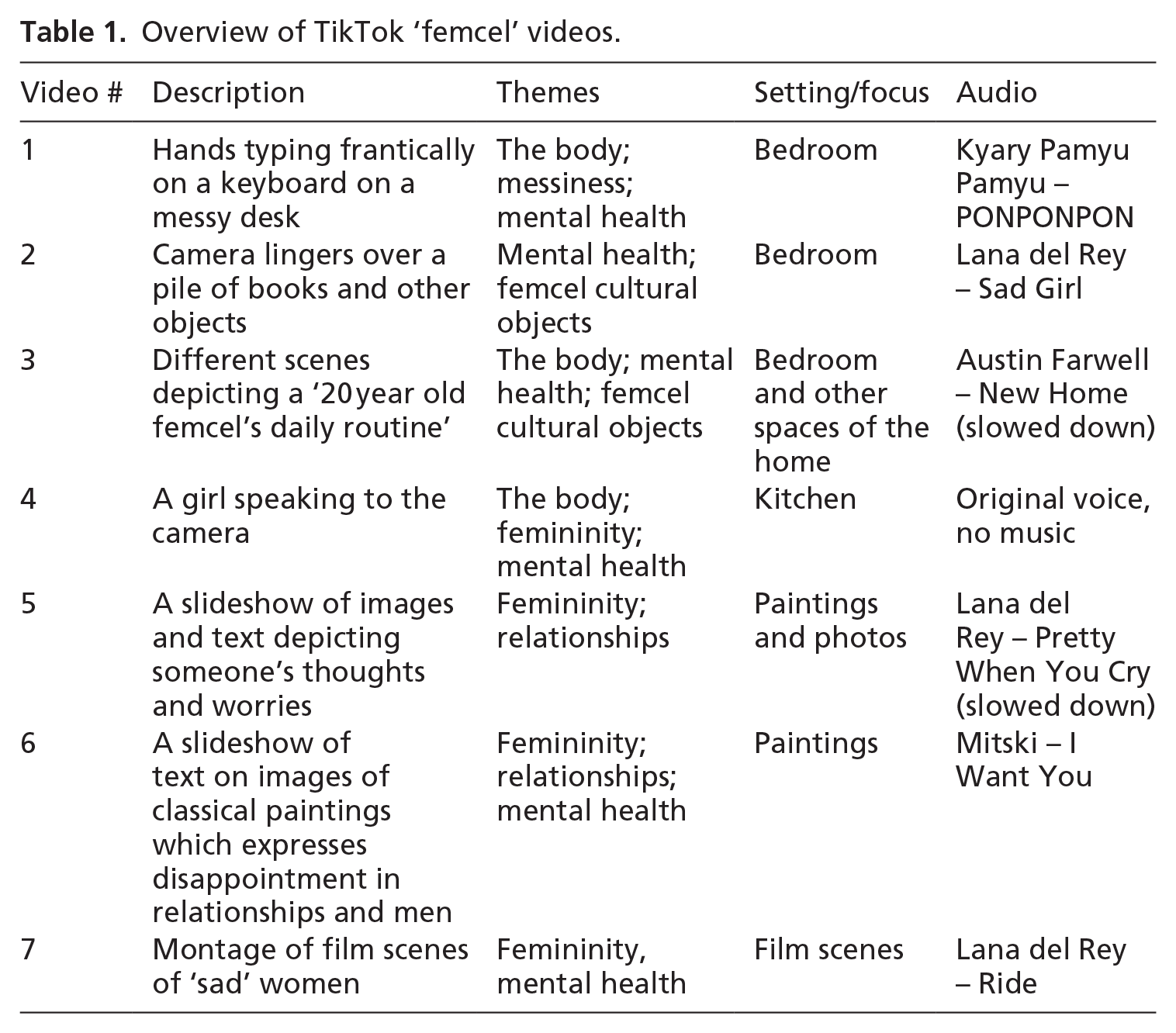
All seven videos use the #femcel hashtag. Four videos depict private spaces in the home, such as the kitchen, or more prevalently, bedrooms (Melanie Kennedy (2020) has noted how TikTok has been central to making girls’ bedroom culture publicly visible). Three videos (#1, 2, 3) show an aestheticised messiness of those spaces, while Video 4 refers to a messiness of the body. Those four videos have some common but also differing elements which lend themselves to a combined analysis. Two of the remaining videos (#5, 6) are similar in that they do not show a TikToker but only a slideshow of images. The seventh consists of a montage of film scenes. As indicated in Table 1, some videos have music (song snippets) or the original voice as an audio track. All videos depict in different ways a predominantly middle-class cultural aesthetic through their settings and material objects on display, like artworks, literature, and fashion, as well as use of music such as the songs of Lana del Rey.
The first short video, which has 317,100 likes and 5273 comments, uses the hashtags #femcel #femcelrights #gamingsetup #messycore #mistki #depression and #femcelcore. It focuses on a messy desk with an illuminated keyboard, computer screen and speakers. Two manicured, feminine-presenting hands with painted nails can be seen frantically typing on the keyboard, while an anime video is shown on the computer screen. The clean, fast-typing, well-groomed hands are in contrast to the overall messiness of the scene; the desk is littered with empty cans and bottles of beer, energy drinks, instant noodle pots, tobacco, discarded tissues, and medicine – a bedroom aesthetic most often associated with male gamers. The curtain is pulled, but it seems like it is daytime outside, as bright sunlight is shining through. The camera slowly moves slightly upward, bringing the computer screen more into focus and showing an anime clip playing.
The second short video shows an artfully cluttered scene from a bedroom, with the overlaid text ‘POV: you’re a femcel’. Central to the set-up is a pile of books, the titles of which are widely used as signifiers of femcelcore, including My Year of Rest and Relaxation, as well as Edith Wharton and Margaret Atwood novels. There are also dead flowers, a kitschy jewellery box with the lid ajar, and a blue bra hanging in the background. A variety of postcards and posters are partly visible in the background, including a pale, thin, feminine body in black lingerie, a hand-drawn, cartoonish image of a face, and what appears to be a postcard with medieval Christian iconography. Reds, blues, beige and cream colours dominate. The video’s aesthetics are almost painterly, similar to a still-life artwork, insofar as only inanimate objects are shown, carefully arranged for the camera. It constructs a somewhat paradoxical sense: a display of feminine decadence as well as individualised, private retreat. The clip has 2602 likes and 23 comments. Lana del Rey’s ‘Sad Girl’ is the audio track – again, this is widely used in femcelcore and related TikTok genres of dissociative feminism. Thelandersson (2022, p. 137) has analysed Lana del Rey in relation to her ‘sad girl’ aesthetic and her well-established association with female weakness and dependence, suggesting that her popularity indicates a widespread ‘dissatisfaction with overtly positive empowerment narratives and a yearning by audiences for representations of negative affects like sadness’.
At 59 seconds long, the third video is significantly longer than the first two. It claims to depict a ‘20 year old virgin day in the life’. It has 1117 likes and 26 comments. It shows the daily routine of a young woman, with overlaid text providing a commentary of an apparently joyless and companionless routine. The first shot shows a messy glass shelf which displays a cluttered variety of toys and ornaments, appearing to signify Japanese popular culture. In the next scenes the woman is seen ‘getting up at 1.30 pm’, and playing a videogame wearing a baggy grey dressing gown while holding her face in her hands. The television screen sits on top of a chest of drawers, whose bottom drawer, the bottom drawer of which is partly open, clothes spilling out; various unidentifiable objects lie on top of the drawer in front of the screen. The text on the TV screen reads ‘DEFEAT’, while the overlaid text on the video says ‘2 pm enrichment’. She is then seen sitting on her bed drawing at ‘3 pm’ for ‘arts and crafts’; we see her in front of a mirror and in the bathroom putting on makeup, sitting on her bed and staring into space. 4.30 pm is simply labelled ‘survive’ as she stares into space with a morose facial expression, first while looking at a desk, and second while sitting on the toilet. She returns at 6 pm as she was ‘sent home from work’. Dinner at 8.30 pm consists of a CapriSun, a Reeves peanut butter cup and a single Babybel cheese, shown in a close-up shot. 9.30 pm is labelled ‘torture’ and the television screen shows the game Overwatch. The video ends with her lying in bed, the main colour being a dark blue, as a filter has been applied to this scene, and the text reads ‘5 am dream’. The girl exhibits sad facial expressions throughout the video while melancholic music plays. The private spaces on display are cluttered and messy. Some scenes are poorly lit and the dominant colours of pink, brown and black seem faded and lifeless. The fact that the video pays attention to detail in the quotidian experience of a femcel, along with its more tragic, bleak and non-ironic quality, means that this feels somewhat more akin to ‘traditional’ femceldom. The hashtags are #femcel #femcelcore #dailyroutine #femcelmoment.
The fourth video shows a teenage girl who is wearing shorts and a long-sleeved top, standing in a kitchen. She is thin and white, and has bags under her eyes. The background is very clean and tidy; parts of a large, shiny cooker are visible as well as cream-coloured kitchen units. She speaks directly to the camera and asks while swinging her arms: ‘Hey guys, genuine question: Can gorgeous, gorgeous girls be at rock bottom? Can gorgeous, gorgeous girls shower not that often, be a little stinky?’ Her voice audibly breaks after she has mentioned the words ‘rock bottom’ and it seems she is suppressing the need to cry. The hashtags are #femcel #rockbottom #adhd. The video has 1,187,000 likes and 1118 comments. It references the popular ‘gorgeous gorgeous girls’ trend on TikTok, where girls and young women use the phrase in a wide variety of videos as a way of declaring their own beauty, sexiness or gorgeousness when engaged in mundane, everyday tasks such as eating - and therefore frequently decoupled from conventional or idealised notions of feminine beauty and perfection. In this case, a twist is added by emphasising a kind of flipside to ‘gorgeousness’, perhaps one that is less ‘relatable’ or upbeat (with the signifiers ‘stinky’ and ADHD). The next three videos show slideshows of images or moving images from films, making use of third-party content.
The fifth video is entitled ‘not things getting bad again 
 #heartbouquets #based #girlblogger #pinterest #femcel #lainpilled’; ‘lainpilled’ is typically used as a hashtag for surreal TikTok content that constructs a sense of dissociation and alienation.
7
The title, with its oblique reference to the impending recurrence of mental health problems, juxtaposed with the litany of laughing emojis, conveys a certain sense of dissociation from the pain that is being disclosed. The video shows a slideshow of photos, film stills and images from anime with text overlaid. The text details mental health issues, poor personal hygiene, disappointment in not being noticed by men, and general insecurity. For instance, one film still shows a woman, with two men lying next to her, one on each side, with ‘my narcissism’ and ‘my self-hatred’ placed on each. One photo shows a girl lying on a folded duvet on the floor with the text added ‘I’m hungry. I have to wash my face and change’. Another image shows the painting of a girl lying in bed with ‘why doesn’t he notice me’ added. It is followed by a photo of a ‘girls night at my place’ that shows a filthy room with dirty clothes and other unidentifiable objects strewn across the floor. The photo is followed by anime stills; one reads ‘Let me get rid of all ur worries give it all to me. I want you to use me’, and the final one shows a girl with a bleeding mouth and no eyes, blood running from the eyesockets: ‘ME WHEN SOMEONE DOESN’T SAY “I LOVE YOU” EVERY TWO MINUTES’. As such, the ‘vibe’ constructed by the video suggests both a rejection of postfeminist upbeat perfection, and a public-facing expression of female neediness and obsession – underscored by the use of a Lana del Rey song.
#heartbouquets #based #girlblogger #pinterest #femcel #lainpilled’; ‘lainpilled’ is typically used as a hashtag for surreal TikTok content that constructs a sense of dissociation and alienation.
7
The title, with its oblique reference to the impending recurrence of mental health problems, juxtaposed with the litany of laughing emojis, conveys a certain sense of dissociation from the pain that is being disclosed. The video shows a slideshow of photos, film stills and images from anime with text overlaid. The text details mental health issues, poor personal hygiene, disappointment in not being noticed by men, and general insecurity. For instance, one film still shows a woman, with two men lying next to her, one on each side, with ‘my narcissism’ and ‘my self-hatred’ placed on each. One photo shows a girl lying on a folded duvet on the floor with the text added ‘I’m hungry. I have to wash my face and change’. Another image shows the painting of a girl lying in bed with ‘why doesn’t he notice me’ added. It is followed by a photo of a ‘girls night at my place’ that shows a filthy room with dirty clothes and other unidentifiable objects strewn across the floor. The photo is followed by anime stills; one reads ‘Let me get rid of all ur worries give it all to me. I want you to use me’, and the final one shows a girl with a bleeding mouth and no eyes, blood running from the eyesockets: ‘ME WHEN SOMEONE DOESN’T SAY “I LOVE YOU” EVERY TWO MINUTES’. As such, the ‘vibe’ constructed by the video suggests both a rejection of postfeminist upbeat perfection, and a public-facing expression of female neediness and obsession – underscored by the use of a Lana del Rey song.
The sixth video entitled ‘very unfortunate but it’s me i’m girls’ has 202,000 likes and 1329 comments and shows a slideshow of classical paintings of women in moments of despair and hopelessness, such as the Ophelia painting by John Everett Millais, with text added that signifies deep disappointment in the reality of heterosexual relationships, such as ‘girls when no guy in real life can measure up to their celebrity crush’ or ‘girls when they can’t be with their favorite fictional man’. It uses the hashtags #fyp, #booktok, #lanadelrey, #femcel, #girlhood, #teachercrush. Again, this seems to signal an aesthetic pleasure taken in the intrinsically unfulfillable nature of heterosexual longing, as well as a valorisation of ‘unhealthy’ or ‘dysfunctional’ heterosexual attachments (#teachercrush). The final video shows in quick succession a variety of film scenes of (mostly white) girls crying, screaming or looking sad. It has 151,200 likes and comments have been turned off. It uses hashtags including #lanadelrey #viral #femcel #viral #foryou. It presents an aestheticisation of female sadness, with Lana del Rey as the soundtrack, but apparently with no clear or coherent intended meaning or underpinning politics.
From femcel discourse to femcel vibe
At first glance, these seven videos may seem incoherent or too disconnected to be analysed in combination, ranging as they do from hyper-short clips of a messy gamer, to the tragic quotidian experience of a profoundly lonely woman, to the creative mashing up of third-party ‘sad girl’ content mingled with longings for relationships with inappropriate or elusive men. However, we argue that these seemingly disparate videos, variously playful and tragic in orientation, are all expressive of the present conjuncture in which a heteropessimistic, fatalistic structure of feeling looms large. The videos depict a predominantly white, middle-class aesthetic that conveys a complex sense of intimacy, disappointment and melancholia. Compared with the original femcel iteration, femcelcore is not text- or discussion-based but image-, sound- and video-based. As Holly Avella (2024) has recently argued, TikTok’s sense of community often rests on a shared structure of feeling (Williams, 1977), which creators refer to as ‘vibe’:
8
Mood and vibe are expressed on TikTok as forms of not simply feeling but relating through the memetic capacities of affect, feelings, and sensibilities. Mood and vibe comments and hashtags can mark where users are working as affective mediators of therapeutic content through the algorithmic platform. (Avella, 2024: 11)
As Avella discusses with a focus on therapy-themed videos, mental health issues have come to constitute an important part of the platform and its mostly young (and female) audience; this was particularly evident during the lockdown periods but has remained the case. The TikTok genres of the ‘Fleabag era’, ‘feral girl summer’ or ‘sad girl’ Tumblr nostalgia all constitute different but overlapping vibes that form a kind of affective tapestry that is so present on TikTok. A vibe rests on diffuse and perhaps fragile feelings of connection and shared sensibilities. It is something that is arguably much harder to articulate, capture or pinpoint in words, but is instead expressed affectively, aesthetically and symbolically through visual and aural modalities. In Raymond Williams’s (1977) terms, a ‘structure of feeling’ can be thought of as ‘a kind of feeling and thinking which is indeed social and material, but [. . .] in an embryonic phase before it can become fully articulate and defined exchange’ (p. 131). The femcel ‘vibe’ on TikTok, in its ineffability, could be said to constitute one such embryonic form of feeling and thinking.
Unlike the traditional femcel identity, the videos we have analysed are not about ‘toxic’, overtly misandrist views of men, bleak ‘pink-pilled’ assessments of human nature, or alt-right-adjacent discourses of racial and sexual genetic determinism. Original femcels (and incels) articulate feelings of depression and rage on text-based discussion forums in baroque, anguished detail, creating a communal sense of ressentiment that has affinities with the micro-fascist moods and logics of broader reactionary movements (see Bratich, 2022). Femcelcore, on the contrary, feels more solitary, individualistic and melancholic, and less resentful and reactionary. However, despite these aesthetic and affective differences, both ‘traditional’ femcels and femcelcore share a pessimistic and fatalistic outlook, and an attachment to hopelessness which, like the ‘wounded attachments’ described by Wendy Brown (1993), appears to be actually somewhat comforting. This is apparent both through the formation of a ‘femcel’ identity based on agonising hurt and humiliation, and through the creative aestheticisation of ‘heteropessimism’ evident in femcelcore.
The algorithmic workings of TikTok as a platform are also significant in this context. TikTok is unique in terms of its demographic and ability to create ‘viral’ trends and fashions that quickly spread, and which are repurposed and reproduced by users. Zulli and Zulli (2022) argue that TikTok is largely characterised by imitation publics whereby ‘networks form through processes of imitation and replication, not interpersonal connections, expressions of sentiment, or lived experiences’ (p. 1873). This is also because, unlike other platforms, TikTok ‘downplays interpersonal connection’ (Zulli and Zulli, 2022) in its embracing of the memetic and viral. This is facilitated and enforced through its affordances, in-built video editing features, video effects and the sound link under each video which brings users to a page that lists all videos that use the sound, and the ‘ForYou’ page which algorithmically curates videos according to users’ past viewing behaviour. Zulli and Zulli argue that TikTok thereby heavily encourages imitation, either by users directly replicating, copying, remixing content or differently modifying an existing video, often resulting in the famous TikTok ‘trends’ and viral videos, or by generating original content in the hope that it may be copied or go ‘viral’. The creation of femcelcore, ‘corecore’ and other similar trends is always partly aimed at manipulating the algorithm by users, in the hope of reaching a wider audience. This tendency towards imitation and uniformity, produced by such attempts at ‘capturing’ a vibe, makes the videos more digestible, algorithm-friendly and ‘catchy’, rather than the Reddit posts of the original femcel communities, which do not lend themselves to virality. Like memes, a TikTok trend always feels somewhat ‘retro’, because every new video tries to capture or quote from something that was previously produced, often repurposing something from the (recent) past (a song, film clip, etc.). Such dynamics are also present in the femcelcore videos we examined, and TikTok’s focus on mimesis explains why they may seem incoherent, random and somewhat disconnected.
The femcel ‘vibe’ holds on to a core feeling of sadness, disappointment, fatalism and pessimism – key aspects of the original femcel. Yet, the ‘vibeiness’ of these videos can also make them feel empty, meaningless or enigmatic. What is it that they are trying to say? Perhaps such vibes defy interpretation and are shared memetically rather than discursively for a reason. They are either felt or not felt. But while the mimetic architecture, imitative logics and ironic moods of TikTok mean that the femcelcore aesthetic appears somewhat ineffable, and does not cohere around a stable or identifiable ideology, we do not suggest that vibes are inherently apolitical. Indeed, we argue that femcelcore can be read as an expression of what we term heteronihilism – not because vibes as such tend towards nihilism, but rather because in this particular case they are predicated on a dissociative disconnection from, and implicit rejection of, collective politics.
Curating the void: pessimism and nihilism since #MeToo
Instead of just ‘screaming into the void’ (Bergeron-Stokes, 2023), we might say that femcelcore is an expression of curating the void, in its attempts to aestheticise disappointment, the absence of hope, and nihilism. In these videos, this aestheticising of the ‘void’ is constructed specifically in relation to the body, gender and heterosexuality, speaking of contemporary anxieties around ideal femininity, romantic relationships and mental health issues. Watching most of the seven videos, we were left with a profound feeling of sadness at the sense of emptiness and meaninglessness produced by the videos, which was nonetheless often situated against a sense of their privilege, irony, knowingness and humour; this makes for a ‘vibe’ which is complex and ambivalent. One may read femcelcore as bordering on celebration of hopelessness and heteropessimism, and a nihilism about the world more broadly, which is nonetheless expressed creatively.
Jack Bratich and Sarah Banet-Weiser (2019) have argued that the extreme misogyny and ‘black-pilled’ nihilism of incels is symptomatic of a wider crisis of neoliberalism’s own logics, whereby the social power promised to men by pick-up-artists is exposed as a ‘con’; as such, neoliberalism ‘cannot cope with its failures, especially its promises of self-confidence’ (p. 5003). We suggest that a similar dynamic and response to neoliberal failure is apparent in both the iterations of femceldom that we have analysed, which view the promises made to women – that they can wield social power over men via their femininity and sexuality – as a ‘con’.
Femcels can, to various degrees, also be understood as reactions against the hegemony of postfeminism (Gill, 2007) and the ‘phallic girl’ (McRobbie, 2009) who embodies ‘confidence culture’ (Orgad and Gill, 2022 [2021]). Femceldom in both its iterations is part of a wider backlash against the #girlboss, who only needs to ‘lean in’, as former Facebook COO Sheryl Sandberg put it in her 2013 book, in order to be both successful and desirable (Rottenberg, 2018). This type of mainstream, structurally white, neoliberal feminism centred around messages of individual empowerment, and was often accompanied by a general sex positivity. It is now increasingly claimed that we are entering a period of ‘sex negativity’, as well as a growing rejection of what is disparagingly called ‘liberal feminism’ – but this widespread critique of liberalism’s failures is thus far tending towards a reactionary anti-political mood rather than a liberationist feminism (Kay, 2024). The moods of nihilism that have arisen in a post-#MeToo context can thus also be understood as a disappointment in the movement’s failure to effect structural change (or, perhaps more accurately, in patriarchy’s role in foreclosing this possibility). Since #MeToo, ‘little has changed about the structural violence of the institution of white, middle-class heterosexuality’ (Holzberg and Lehtonen, 2021: 13). The 1990s and 2000s were marked by widely expressed anti- and non-feminist attitudes among women and girls – as Angela McRobbie noted, feminism in its activist, collectivist guise was ‘fiercely repudiated, almost hated’ (2009). In the 2010s a widespread ‘popular feminism’ became hegemonic – whereby identifying as feminist became ‘cool’ (Banet-Weiser, 2018); and yet the most visible forms of popular feminism were hyper-individualistic, grounded in the logics of consumer capitalism, and ‘decidedly not angry’. They were, therefore, unable to effect structural change – remaining at the level of visibility (Banet-Weiser, 2018). Now, in the figure of the femcel (and beyond), we see a reaction against the ‘cons’, false promises, compulsory positivity and political weaknesses of this popular feminism. And yet the break with neoliberal popular feminism is only partial. There is an important continuity between the ‘upbeat’ postfeminist sensibility and the more pessimistic, even nihilist sensibility of femcelcore. Both eschew any form of collective politics or desire for social and political transformation, and in this way – despite their aesthetic differences – we argue that they ultimately constitute merely different iterations of individualism.
In the 2019 keynote to the Duke Feminist Theory Workshop, Lauren Berlant (2019) argued,
When privilege unravels, it goes out kicking and screaming and people lose confidence in how to be together, uncertain about how to read each other, incompetent even to their own desire, wanting everything to be ‘post’ already, with few skills for bearing this transition – as the incels [. . .] and many new sex negative feminists exemplify.
We suggest that the femcelcore aesthetic is part of a wider feeling of nihilism that is increasingly entangled with and propelled by negative heterosexual experience. While nihilism is dominantly associated with masculinity, misogyny and anti-feminism, we suggest that it is also taking shape within, and is expressed through certain forms of feminine (and even ostensibly ‘feminist’) cultures and identities. Robyn Marasco (2020), inspired by Simone de Beauvoir, writes about a problematic ‘womanly nihilism’ which is manifest in the bourgeois feminine desire to ‘have it all’. As Marasco (2020) argues,
Wanting it all – the desire to be and to have everything – has to be considered in connection with the conditions under which oppressed subjects are permitted too little and only a certain class of women are authorized to set the feminist agenda. (p. 46)
‘Having it all’ is fundamentally about ownership; it is ‘a formula for owning everything’. It is individualist rather than collective; it is therefore at odds with ‘socialist, anticolonial, and antiracist struggles’ and as such is ‘the opposite of a true freedom’. We take from Marasco the crucial insight that nihilism can have ‘womanly’ as well as masculinist forms. We argue that both femcels 1.0 and 2.0, while seeming to depart from the bourgeois feminism of ‘wanting it all’, nevertheless also express a particular kind of ‘womanly nihilism’. In spite of their affects of pessimism and disappointment in heteronormative romance, they remain both resigned and attached to its awfulness. In their fatalism and rejection of social hope, they contribute to a nihilism that forecloses what Wendy Brown (1993) has called ‘instincts for freedom’.
Conclusion
We wish to conclude this article by underlining our key argument: that both articulations of femceldom articulate and index the spreading mood of what we are calling heteronihilism. In that sense, it may be argued that we ourselves have reproduced an equally pessimistic analysis of the present conjuncture, which precisely enacts the kind of nihilistic, gloomy vibes we have identified. Indeed, scholars such as Thelandersson (2022) have located some radical potential in ‘sad girl’ culture, particularly when it takes on more activist and political modalities. We certainly do not wish to argue that sadness is antithetical to feminism or political action; the problem, as we see it, is not feminine sadness but hetero-nihilism; that is to say, when sadness is mobilised in a way that dissipates feminist energies rather than galvanises and strengthens them. In the ‘femcelcore’ content we analysed, there was no sense of a collective feminist project, but rather a dissociation from politics.
We have explored two articulations of mediated femceldom that have circulated in popular media culture since 2018. First, we considered ‘traditional’ femceldom, which came to fleeting public attention in the form of the online discussion-based community Trufemcels in 2018 and 2019, before dissipating into much smaller and seemingly less tenable communities once Trufemcels was banned from Reddit. Second, we considered the rise of ‘femcelcore’, a TikTok aesthetic that deploys the term ‘femcel’ but tends towards a more playful, ironic iteration of this ‘identity’.
As a constituent community of the ‘femosphere’, we argue that Trufemcels mirrored many of the bleak affects and reactionary, fatalistic, ‘pilled’ discourses of the manosphere. Femcelcore emerged within a different social media ecology; while it has been expressed most paradigmatically on TikTok since 2021, its cultural genesis began with Tumblr and the ‘sad girl’ culture that was prevalent from 2014 onwards, as well as the heteropessimistic sensibility that has infused feminised mainstream media culture. Femcelcore, unlike traditional femceldom, is not articulated via lengthy passages of text posted to discussion forums, describing the despair, depression and pain occasioned by rejection and exclusion from heterosexual culture in baroque, anguished detail. Rather, femcelcore is articulated through hyper-short video clips involving performances characterised by irony, self-awareness and aesthetics of ‘dissociation’. That is to say, its communicative mode is that of vibes, and its prevailing affects are those of a kind of numbed disappointment and melancholia. It appears at first blush to bear little resemblance to the femospheric world of evolutionary psychology, genetic determinism and explicit racial categorisation.
Heteronihilism clearly pertains not only to femcels but also to incels (and the manosphere more broadly), and thus has applications that go far beyond the specific topic of this article. But we wish to draw attention here most specifically to heteronihilism’s feminised articulations – the ‘womanly nihilism’ that may appear to be feminist, but which is rooted in bourgeois logics of individualism. While feminised heteronihilism may not have the same power and potential for shaping ‘real-world’ politics and society as the heteronihilistic manosphere – that is, for providing the cultural infrastructure for physical violence and misogynistic populism – we also suggest that it would be wrong to understand feminised heteronihilism as wholly benign or politically inconsequential.
It is not only that we see a broad disappointment and disenchantment with heterosexuality, and a fatalistic resignation to its apparently inevitable awfulness – but that this mood of ‘giving up’ on hope for romantic satisfaction is scaled up into a much broader world-view. Heteronihilism therefore extends the pessimistic, numbed attachment to heterosexuality into a broader anti-political mood. It rejects social hope and derides collective action, while retaining a fatalistic acceptance of the socio-political order. The state of being an involuntarily celibate woman is certainly not intrinsically reactionary, and the widespread disenchantment with heterosexuality has some political potential, in that it illuminates the systemic failings of heteronormative culture under capitalism. However, the ‘femcel’ identity has developed within – rather than against – the technologics of neoliberal capitalism, the resurgence of white supremacy, and the broader derision and despisal of social justice (Brown, 2019). It is because of this historically specific formation that the femcel phenomenon – in both its iterations – must be read as part of the nihilistic conjuncture, rather than part of the feminism of solidarity and collective strength which is required to transcend it.
Footnotes
Data availability statement
Data sharing not applicable to this article as no datasets were generated or analysed during the current study.
Declaration of conflicting interests
The author(s) declared no potential conflicts of interest with respect to the research, authorship and/or publication of this article.
Funding
The author(s) received no financial support for the research, authorship and/or publication of this article.
