




Abstract
In 2021, clean-air activists Choked Up put up hacked road signs in the London neighbourhoods of Catford, Brixton and Whitechapel. The signs stated: ‘People of colour are more likely to live in an area with illegal pollution levels’. They also demanded ‘Clean air for all’. The following year, Breathe: 2022 by artist Dryden Goodwin was installed across the borough of Lewisham. Depicting people struggling to breathe, like the road signs, the delicate pencil-drawn images were a way of ‘making the invisible visible’. These interventions highlight both the elevated levels of air pollution in particular locations and the unevenness of its distribution. They also point to how places and bodies are interconnected in the air that ‘we’ breathe. Foregrounding this activism, this article draws on Nirmal Puwar’s conceptualisation of the ‘somatic norm’ whereby particular spaces are (or, rather, become) ‘reserved’ for particular bodies and, concomitantly, the ‘ontological anxiety’ provoked when bodies enter into spaces not meant for them. I extend Puwar’s work on Space Invaders in two ways. First, reading air quality research data through work which has theorised the spatial–bodily relationship, the article explores how the yoking together of spaces and bodies can serve to locate people in places which are not fit for habitation. Second, I draw attention to the highly corporeal and emotional ways in which these interconnections are manifested, and like the visceral registers of ‘ontological anxiety’, I consider what this might tell us about spatialised and bodied power relations. To render the asymmetries in air pollution exposure not only visible but sense-able, the article draws on a mobile, emplaced and embodied methodology of walking and cycling through London. The processes of moving, breathing and leaving put into relief both the deep fleshiness of spatial–bodily interconnections and the palpability of the power dynamics which permeate them.
Introduction
In 2021, activist group Choked Up put up hacked road signs along red routes in the London neighbourhoods of Catford, Brixton and Whitechapel. In Transport typeface with familiar highway-code graphics, the signs appeared as nothing unusual, providing information for road-users. But a second look showed that these signs were a protest and a demand for the future: ‘People of colour are more likely to live in an area with illegal pollution levels’; ‘Clean air for all’ (see Figure 1).
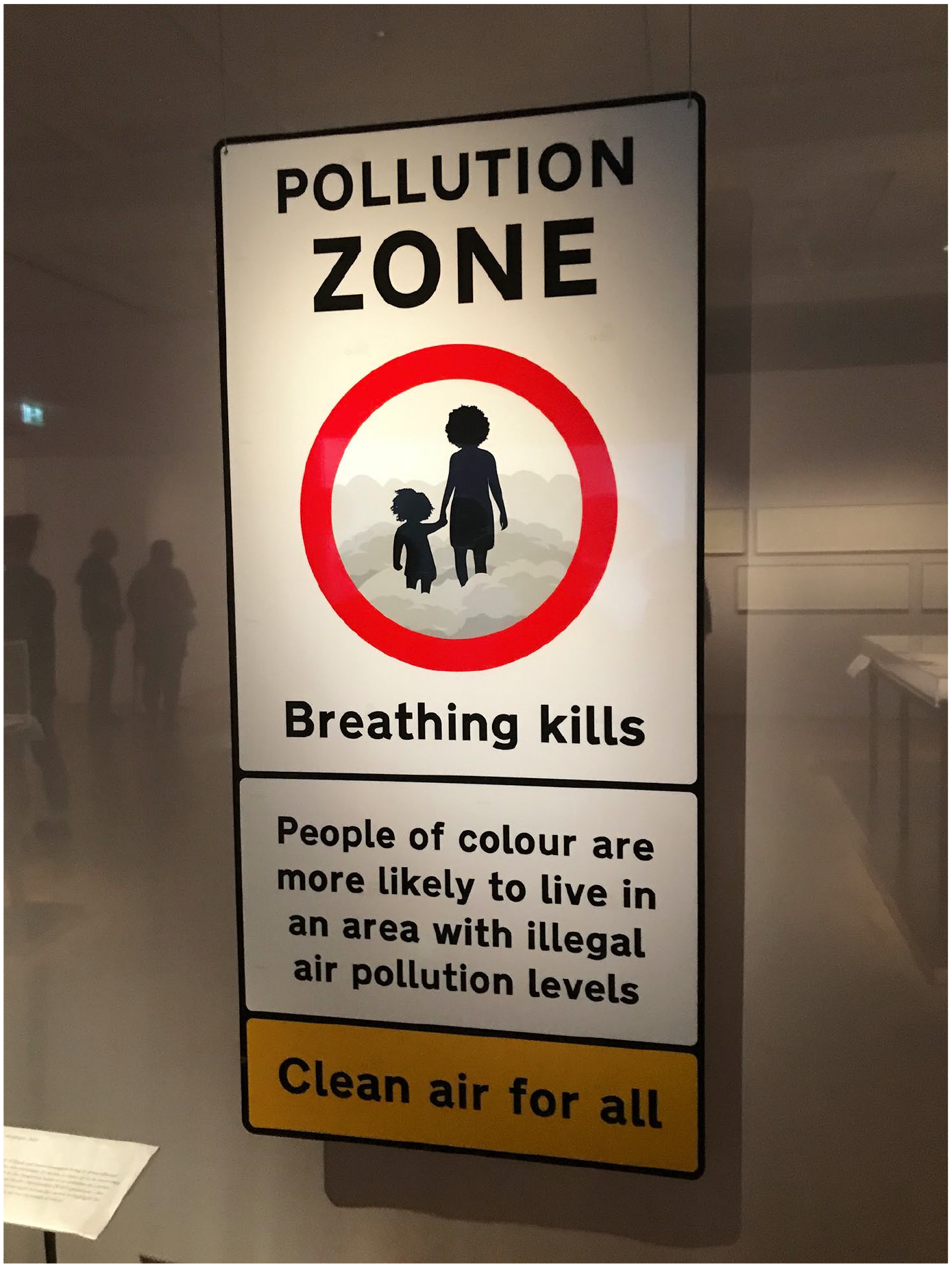
Choked Up’s ‘Pollution Zone’ road sign, part of the Wellcome Collection In the Air exhibition.
Founded by Black and Brown teenage activists Anjali Raman-Middleton, Destiny Boka Batesa and Nyeleti Brauer-Maxaeia, on the installation of their signs, Choked Up’s (2021) Instagram post reads:
Shout out to cars – especially diesel vehicles! Thanks to you, people of colour and deprived communities are more likely to live in areas with more air pollution. So we thought we’d put up some helpful signs. Updating the highway code so pedestrians know what they’re breathing. Safety first! Did you know that London’s network of major roads – the Red Routes – carry around a third of the city’s traffic on an average day? We put up signs around London to address the excessive air pollution coming from these red routes and into the lungs of underprivileged communities. . .
In addition to highlighting the elevated levels of air pollution in particular locations, and the intersecting racial and class inequalities in its distribution, Choked Up’s campaign points to how, in breathing, spaces and bodies are intimately interconnected. Indeed, the inextricability of environments and bodies is epitomised in the air that ‘we’ 1 breathe. Inhaling, we take what is in our environment deep into our bodies, into our organs, cells and flesh. In continuously occurring ‘molecular interaction[s]’ (Tuana, 2008: 202), we use the oxygen in this air to provide the energy required for the essential life processes of movement, respiration, sensitivity, growth, reproduction, excretion and nutrition. Bodies are thus constituted by spaces (Grosz, 1999) in de/generative interchanges. The ‘de/’ here is a reminder that this relationship can be harm-full at the same time as it is productive, and, as Choked Up underlines, the distribution of these harms is uneven across social groups. For some, oxymoronically, ‘breathing kills’.
The power-full relationship between spaces and bodies is taken up in this article as I situate air quality research data within a framework which theorises dynamic spatial–bodily interconnections. Environmental health research into emissions of particulate matter (PM10
2
and PM2.5
3
) and nitrogen dioxide (NO2) has investigated the distribution of these pollutants across places and social groups in the United Kingdom. In their study, Daniela Fecht et al. (2015: 204) found that neighbourhoods in the most deprived quintile experienced significantly higher levels of PM10 and NO2 than those living in the least deprived quintile; likewise, neighbourhoods with more than 20 percent non-white residents had higher levels of these emissions than those areas with less than 20 percent non-white residents (see also Barnes et al., 2019; British Lung Foundation, 2016; Choy, 2016; Dorling, 2010; El-Enany, 2019b; McLeod et al., 2000; Mitchell and Dorling, 2003). A report published in 2023 for the Greater London Authority (GLA, 2023) based on air quality data from 2019 shows that, while there may be some overall improvement, the uneven distribution of pollution in the capital persists:
Overall, whilst the current and projected improvement in air quality across London has and will continue to benefit everyone, clear inequalities in exposure to poor air quality remain. The most deprived communities of London are still more likely to be found in the highest pollutant concentration areas. The areas in London with the lowest NO2 and PM2.5 concentrations have a disproportionately white population, and diaspora communities are more likely to live in an area with higher pollution concentrations than the London average. (p. x)
In breathing, ‘geography matters’ (Massey, 1984). Location (simultaneously spatial and social) makes a difference, and there is an established tradition of mapping intersecting patterns of social and health inequalities across London (see Cheshire, 2012 on life expectancy; Noble et al., 2012 on type 2 diabetes). Walking through a former coal mining area and reflecting on ‘breathing in the shadow of extraction’, Astrida Neimanis and Perdita Phillips (2019) precisely call for ‘attention to a politics of location – to the differences of breathing’ (p. 134, original emphasis). In the rest of this article, I look to Nirmal Puwar’s (2004) theorising of the relationship between spaces and bodies in order to parse these ‘differences of breathing’, emphasising how these are experienced in emplaced and highly corporeal ways.
In Space Invaders, Puwar (2004) forwards the concept of the ‘somatic norm’ whereby particular spaces are (or, rather, become) ‘reserved’ for particular bodies and, concomitantly, the ‘ontological anxiety’ provoked when bodies enter into spaces not ‘meant’ for them. For Puwar (2004), this is encapsulated in Winston Churchill’s response to the entrance of Nancy Astor, the first woman MP, into the UK’s Houses of Parliament: ‘As embarrassing as if she burst into my bathroom when I had nothing with which to defend myself, not even a sponge’ (p. 13). The certainty of a space coded as male (and white) is disrupted by Astor’s ‘invasion’. The ‘fragility of the masculine claim to public space. . . is disturbed by the arrival of the abject’ (Puwar, 2004: 14) and Churchill’s reaction reveals that the ‘natural’ coupling of spaces and bodies is in fact a process, laden with power. Moreover, it is a reaction with an intensely visceral dimension. Likewise the proposal to instal a statue of Nelson Mandela in London’s Trafalgar Square where ‘the pending arrival of a “black” figure of leadership in this privileged public domain’ gives rise to a ‘dispute’ over the size and shape of the figure’s hands (Puwar, 2004: 3–5). Or the arrival of newly elected MP Diane Abbot in the Smoking Room at Westminster, and ‘the “look” that darted across this white, cigar-filled, masculine space to receive this black female body’ (Puwar, 2004: 40). These responses are telling of spatialised and bodied power relations, of who is considered to belong where; and like Churchill’s bathroom scene, there is a physicality to them: Mandela’s hands; ‘the look’; feeling frightened (Fanon, 1986: 112 cited in Puwar 2004: 41) or confused or bemused by the arrival of the racialised and out-of-place ‘other’. Extending Puwar’s work in two ways, the article explores how the yoking together of spaces and bodies can serve to locate people in places which are not fit for habitation, ‘exposing some inhabitants to violent experiences of pollution and denigration of living conditions’ (Davies, 2018: 1542). It also brings to the fore the palpable ways in which this relationship is lived, through a mobile methodological approach of walking and cycling through the city while following consumer goods. Attuning me to the air that ‘we’ breathe and most saliently to the ‘differences in breathing’ (Neimanis and Phillips, 2019: 134, original emphasis), this emplaced and embodied approach emphasises the highly corporeal and emotional ways in which spatial–bodily interactions are manifest: what I am terming their deep fleshiness. And, like the visceral register of ‘invasions’, I further consider what this might tell us about spatialised and bodied power relations.
The article begins in Lewisham, in south-east London. Lewisham was a key site in my study mapping commodity chains, by following goods on foot and by bicycle from port to market to incinerator. In the first section, I introduce the area’s social demographics and set out my methodological approach. This is the borough where Choked Up put up some of their hacked road signs (in Catford) and where the artwork Breathe:2022 by Dryden Goodwin was installed in 2022 along some its busiest roads; ways of ‘making the invisible visible’ (Rosamund Adoo-Kissi-Debrah cited in Invisible Dust, 2022). In the second section, I consider these creative interventions to discuss how Lewisham has become a focus for clean-air campaigners in the ‘fight for breath’, as it exemplifies the inequalities on which environmental health research has reported, in sadly fatal ways. In the third section, through the lens of the air that ‘we’ breathe and conceptual notions of ‘pollution’, I explore how places and bodies are symbolically linked – who is imagined to belong where, who ‘fits’ where – and how this has deeply fleshy impacts for the people living there. Finally, I put into relief the visceral dimensions of this power-full relationship. To do so, I turn to particular moments from my fieldwork where the spatial–bodily interactions associated with air pollution were made not only visible but sense-able.
Following things
In south-east London, Lewisham is a borough of contrasting landscapes: green spaces, rivers, heathland, ‘villages’ and new private housing developments, but also the South Circular, the A2 road which connects London to the port at Dover, a three-lane traffic gyratory, a waste incinerator, light-industrial estates and high-density inner-city housing. It is also a borough of diverse social demographics in terms of socio-economic characteristics and ethnic identity, with notable differences across neighbourhoods. For example, the 2021 Census (Office for National Statistics (ONS), 2023a) shows that 52.6 percent of households in the ward of Blackheath in the north-east of the borough are not deprived in any dimension 4 (for comparison, 48.4% of households in England are not deprived in any dimension; 48.1% in London; and 47.2% in Lewisham) and 62.3 percent of people in Blackheath identified as white (for comparison, 81% of people in England identified as white; 53.8% in London; and 51.5% in Lewisham). Further south, in the ward of Catford South, 46.9 percent of households are not deprived in any dimension and 43.4 percent of people identified as white. In the ward of Deptford in the west of Lewisham borough, only 41.9 percent of households are not deprived in any dimension and 39.4 percent of people identified as white. These three distinct neighbourhoods are within a 20-minute cycle of each other. And as the environmental health research has shown, air pollution in Lewisham follows the same pattern of distribution as the rest of London and the United Kingdom, with Black and brown groups and lower-income neighbourhoods ‘carry[ing] a disproportionate toxic load’ (Alaimo and Hekman, 2008: 9). Air quality data shows that air pollution levels are highest along the major roads going through Catford, Deptford and New Cross (Greater London Authority (GLA), 2016; London Air Quality Network (LAQN), 2018), disproportionately impacting on those who identify as Black, Asian or minority-ethnic-in-the-UK, and households deprived in one or more dimensions (ONS, 2023a, 2023b).
Lewisham – or, rather, some areas of Lewisham – were among the key research sites as I mapped the commodity chains associated with beauty salon consumption. Part of a larger study of consumption infrastructures and their impacts on the urban landscape, the initial research was not focused on air pollution. Yet as my fieldwork progressed, following beauty products across London on foot and by bicycle, it was literally everywhere. The methodological approach for this study took inspiration from Caroline Knowles’ (2014) work in which she followed flip-flops (and the oil from which they are manufactured) from Kuwaiti oil fields through Chinese factories to a rubbish dump in Addis Ababa to consider how these ‘journeys’ shape places and lives (see also Appadurai, 1986; Mansvelt, 2005). In pursuit of beauty goods, I moved from the port to the manufacturing plant to the wholesalers’ warehouses on trading estates through beauty salons and onwards to the municipal waste facility, where the spent products are incinerated, a plume of smoke blowing eastwards on the prevailing winds.
At the outset, tracking beauty consumables on foot or by bicycle was a practical decision rather than a strategic methodological choice. For the past 20 years, walking or cycling has been my main means of transport in London. However, what was initially a pragmatic way to get to field sites increasingly became an important approach for the research. Indeed, to counter the relatively motionless and fairly aspatial (Back, 2012; McRobbie, 2002) tendency among social scientists to sit in libraries or in cafes conducting interviews, Charlotte Bates and Alex Rhys-Taylor (2017) propose that we walk:
Walking is a brilliant form of exercise for our stiff bodies and a way of reinvigorating our engagement with the social world. It induces a mobile, grounded perspective and foregrounds corporeal, sensual, affective matters. Walking collects together visions, smells, tactilities, sounds and tastes with various degrees of association and intimacy . . . Moments of encounter forged between feet and the ground remind us of the emotional and embodied textures of our lives and bring to attention the sensuality of social life. (p. 4)
Both walking and cycling 5 – thoroughly embodied and emplaced modes of getting around – offer a way of drawing attention to the power-full interplay between spaces and bodies, how they de/generatively interact with one another, and in highly palpable ways, most saliently in the air that ‘we’ breathe. Following beauty goods – an interminable stream of goods for beauty work is never done – took me along Lewisham’s A-roads and through its trading estates, to Tilbury Town and other peri-urban light-industrial estates and to municipal waste plants. On my bike, breathing deeply as I pedalled, I would visit the different sites for a few hours before heading home. As a white, middle-class and relatively wealthy academic, I was only ever a visitor, always in the privileged position of being able to cycle away from the most polluted parts of the city. This ability to leave (and to choose to leave) and return to where the air is cleaner 6 is equally telling of spatialised and bodied power dynamics.
Returning to Neimanis and Phillips’ (2019) contention, when thinking about the air that ‘we’ breathe, we must pay attention not only to location but also to ‘the differences of breathing’ as ‘breathing . . . is not experienced evenly’ (p. 134, original emphasis). To examine these power-full differences, I put my emplaced and embodied fieldwork experiences into dialogue with data from air quality maps (GLA, 2016; LAQN, 2018) and 2021 Census data (ONS, 2023a, 2023b). Connecting air pollution, neighbourhood demographics and felt environmental-bodily de/generative interactions, this approach thus serves to both ‘flesh’ (out) these statistics and to situate these experiences in place and in the lives of the residents of Lewisham and the other areas through which consumer goods journey.
‘Fighting for breath’
Following the death of 9-year-old local resident Ella Kissi-Debrah after years of chronic asthma attacks, Lewisham has become a key site in clean-air activism. In 2020, 7 years after her death and after a long campaign by her mother Rosamund Adoo-Kissi-Debrah to hold a second inquest, Ella became the first person in the United Kingdom to have air pollution listed as a cause of death 7 (Laville, 2020), 8 with the coroner Phillip Barlow stating that ‘air pollution “made a material contribution” to her death’ (BBC, 2021). Over the past decade, local clean-air activists – Ella’s family and classmates and other local residents – have taken up a ‘fight for breath’, underlining inequalities in air pollution distribution and the slow government action to address the issue as they campaign for changes in the law.
As a way of ‘making the invisible visible’ (Rosamund Adoo-Kissi-Debrah cited in Invisible Dust, 2022), in 2022, Breathe:2022 by artist Dryden Goodwin and produced by Invisible Dust was installed across Lewisham as part of the borough’s year as the Borough of Culture (Goodwin, 2022; Invisible Dust, 2022; see Figures 2 and 3). The artwork consisted of a series of hand-drawn pencil sketches of a person breathing, blown-up to full size and flypasted along roadsides or placed in JCDecaux digital advertising screens on some of Lewisham’s busiest roads. On a stifling warm day, I cycled over to one of the installations under a railway bridge on the South Circular, not far from where Ella lived and where she walked to her primary school. A non-stop, four-lane road, this is a major road into London from the north and east Kent coasts. It connects to other A-Roads and to the M2, M20 and M25. It is a key commuter route, on several bus routes, often busy with heavy-goods vehicles (HGVs), and lined with homes.
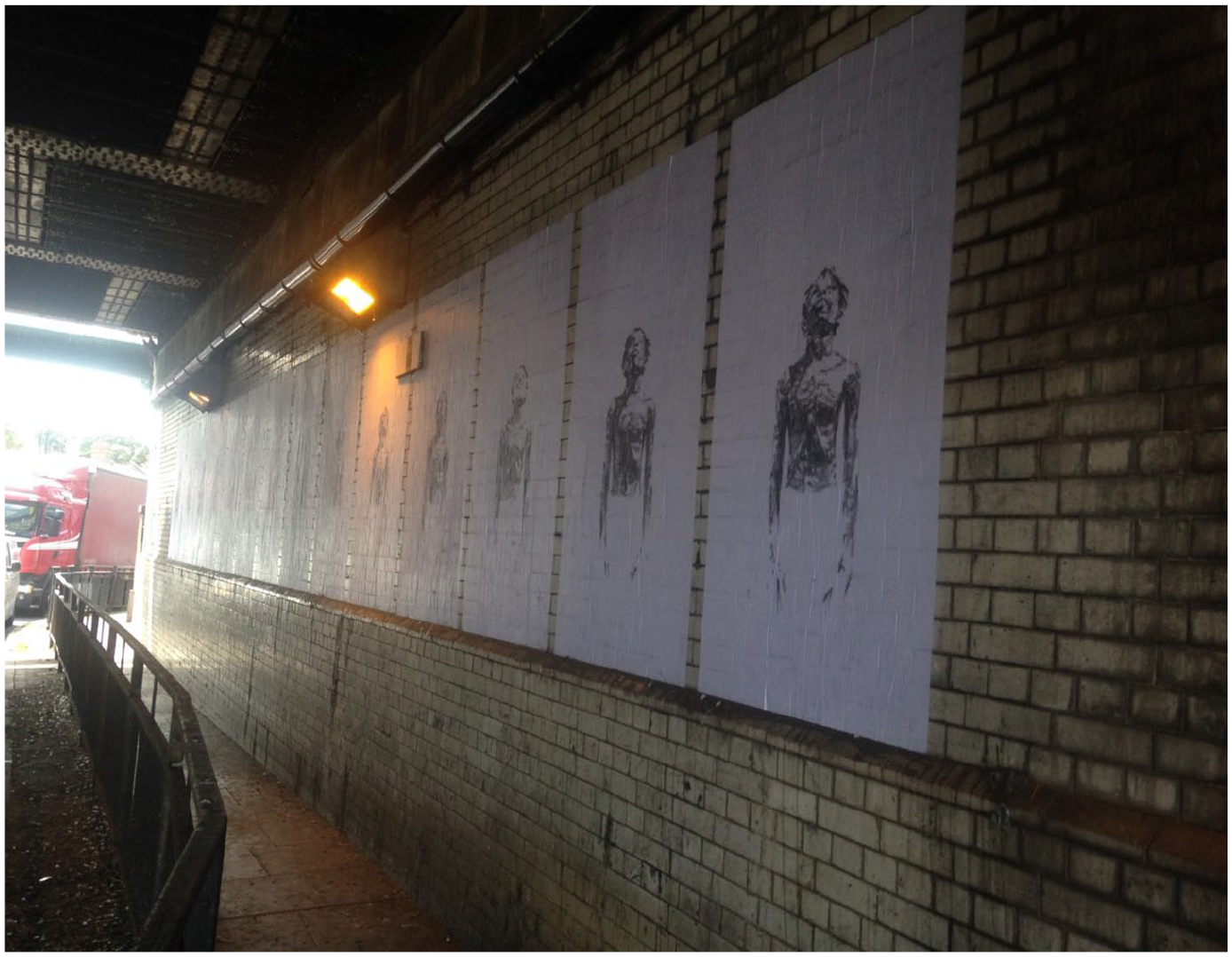
Image of Breathe: 2022 by Dryden Goodwin (produced by Invisible Dust) on the South Circular.
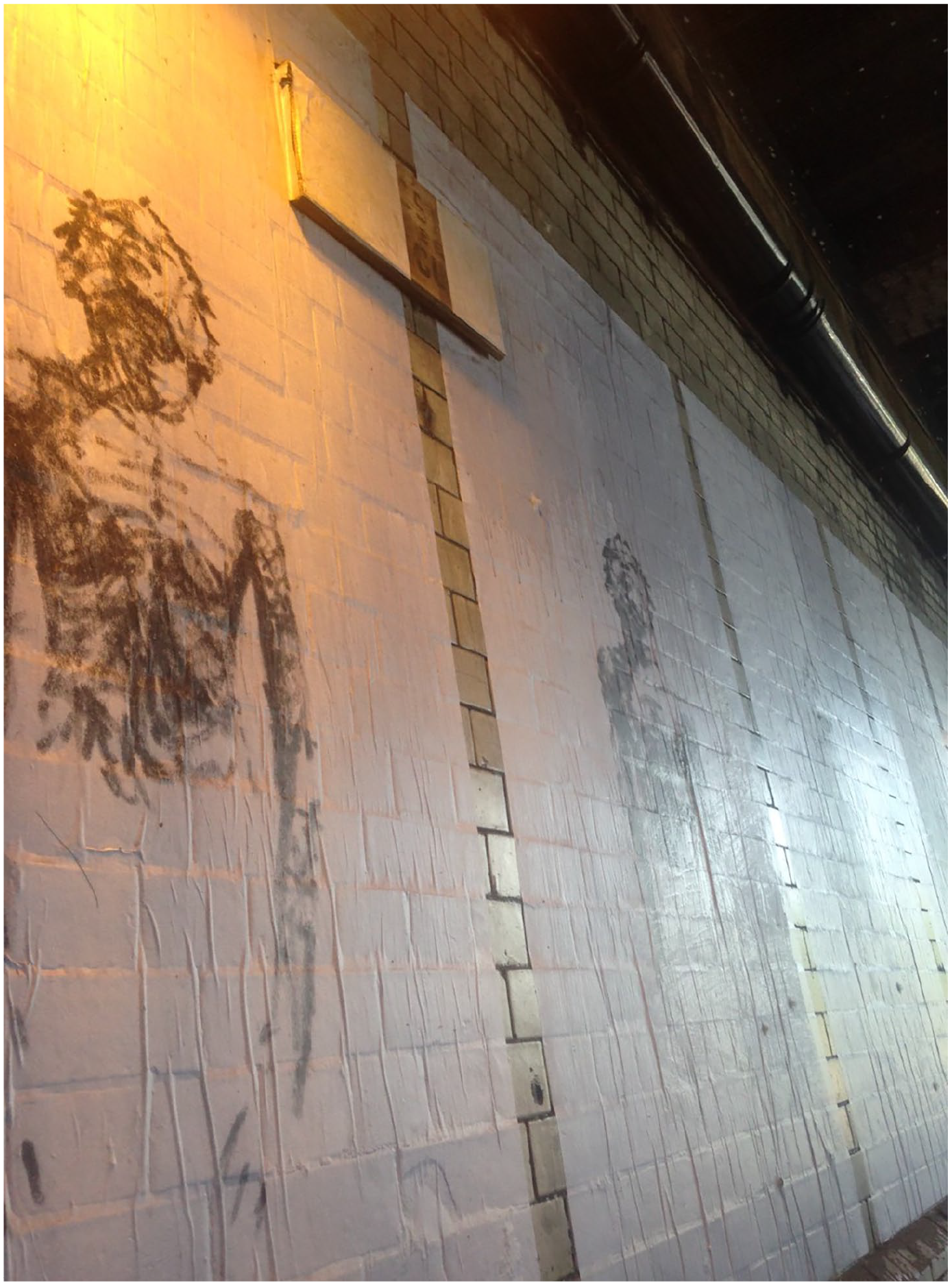
Image of Breathe: 2022 by Dryden Goodwin (produced by Invisible Dust) on the South Circular.
Perhaps unnoticed by drivers and passengers unless they are stuck in traffic, 9 Breathe:2022 features drawings of the artist’s teenage son, 10-year-old local resident Tafari McCalla and ‘representatives from Choked Up, Mums for Lungs, Climate Action Lewisham and the Ella Roberta Family Foundation [who] sat for Goodwin to be drawn and recorded as they “fight for breath”’ (Invisible Dust, 2022). Against the white paper through which one can see the brickwork behind, the charcoal-coloured pencil lines foreground the body. Like a flick-book animation, the figures are inhaling and exhaling, their head is tipped back and their chest contracts and expands. They appear to be struggling. Over time, the paper rips and peels and starts to turn brown, dirtied by exhaust fumes. The installation ‘connect[s the] global health emergency of air pollution to the daily lives of Lewisham locals and those campaigning for clean air worldwide’ (information from Breathe:2022 installation).
Founded by Rosamund Adoo-Kissi-Debrah after her daughter’s death, The Ella Roberta Family Foundation (n.d.) campaigns for ‘the Coroner’s recommendations . . . to be followed by governments, councils, medical professionals and the general public, all over the world’: to reduce air pollution limits in line with the World Health Organization (WHO) guidelines;
10
raise awareness about air pollution and its impacts on children’s health; educate health professionals on the dangers of air pollution; and promote research into the connections between air pollution and asthma. Working towards these objectives, The Ella Roberta Family Foundation (n.d.) underlines how class, ethnicity and place intersect in exposure to air pollution:
We believe in a world where everyone can breathe air that is free from toxic pollution, regardless of where they live, their economic status or their ethnic background.
The Foundation has also done important work in highlighting the issues surrounding the introduction of Low Traffic Neighbourhoods in this part of London, with the effect of intensifying the traffic on the already busy (and residential) main roads, diverted away from the roads with wealthier and whiter demographics. Choked Up’s campaign (2022) with which I opened the article likewise highlights the asymmetries in air pollution exposure: ‘Communities in London do not carry the burden of air pollution equally. . . [e]thnic minority people and deprived communities. . . tend to live along the busiest roads, increasing their exposure to poor air quality’. This activism and its creative interventions puts into relief the forms of environmental racism and social injustice bound up in air pollution. Concomitantly, it brings into play questions about place and, in particular, which places are habitable and who gets to live there; who ‘fits’ where. As Ella’s mother Rosamund asks: ‘Do we all breathe the same air? No. We don’t. It’s a horrible truth isn’t it?’ (black & brown, 2021).
Fit for habitation
On the South Circular, under the claustrophobic bridge on that hot day, the exhaust emissions seem trapped. Goodwin’s delicately drawn images feel incongruous. The person in them looks fragile, maybe panicked as they fight to gulp down air. Leaning my bike up under the railway bridge to take a closer look at the installation and running my hand along the sooty metal railing, I suddenly feel vulnerable, a bit panicked myself. The noisy and vibratory traffic echoing under the bridge underlines that this place, choked with buses, cars and lorries, is not a place to linger and breathe (fieldnotes, July 2022). A visceral reminder that in the air that ‘we’ breathe, places and bodies are de/generatively entangled.
In Space Invaders, Puwar (2004) unpacks the dynamic spatial–bodily relationship to examine how particular bodies become imagined as the rightful occupants of particular spaces arguing that ‘[t]here is a connection between bodies and space, which is built, repeated and contested over time’ (p. 8). In the UK Houses of Parliament and London’s Trafalgar Square, Puwar shows how some bodies – white, male, bourgeois – are the almost unremarked-upon and unquestioned ‘somatic norm’ and the process by which this happens, whereby certain bodies are (or, rather, become) perceived as a ‘natural’ ‘fit’ for particular spaces. This is a ‘fitting’ together which is sedimented and naturalised over time, yet one that is precisely revealed as a construction when bodies who do not belong ‘invade’ the spaces leading to some kind of social and spatial bouleversement. This moment of ‘invasion’, argues Puwar (2004), gives rise to an ‘ontological anxiety’ as what appeared ‘natural’ is put into question (pp. 13–14).
I want to extend Puwar’s (2004) work by first exploring how the perception that ‘certain types of bodies that are tacitly designated as being the “natural” occupants of specific positions’ or places (p. 8) can also serve to locate people in places which are not fit for inhabitation. As part of the same process by which white, male, bourgeois bodies are thought of as the ‘natural’ occupants of the Houses of Parliament or Trafalgar Square, Black and Brown bodies and people from lower-income groups are yoked to highly precarious or even dangerous places in the city (Bulley, 2019). Thus, this spatial–-bodily relationship not only maintains positions of privilege (Puwar, 2004) but also renders particular lives vulnerable to the ‘slow violence’ (Nixon, 2011) and ‘structural violence’ (Galtung, 1969) of toxic emissions, as some people are located in ‘sacrifice zones’ and/or have polluting facilities located in their neighbourhoods. That is to say, neighbourhoods (and people) are environmentally ‘sacrificed’ – and so are imagined to be sacrifice-able – in some way, in the name of capitalist ‘progress’ and profit (Marquardt, 2022: 36) or urban regeneration (Danewid, 2019; El-Enany, 2019a; Kern, 2015). As Jennifer Gabrys (2020) argues, viewed in this way, ‘health’ should not be individualised but instead understood as a ‘political and democratic set of encounters with the lived environments that are generating and exacerbating polluting conditions’ (p. 9). A ‘healthy’ or ‘unhealthy’ body is not an individual experience. Rather, it is made thus in interaction with the environment in which it lives and, moreover, within broader political economic and social structures which mean that the possibilities for ‘health’ are not equally accessible to all.
Important to note is the use of the verb to locate, to emphasise the active process of locating, tied into a suite of knowing decisions about planning, designing and building (Parau and Wittmeier Bains, 2008). This is not only a politics of location (Neimanis and Phillips, 2019: 134) but a politics of locating. There are underlying logics in the interconnections between spaces and bodies which find geographic and material expression through the process of locating. The presumption of a ‘fit’ between bodies and spaces leaves some people located in highly precarious and dangerous places.
The locating of major roads, waste plants, industrial facilities or other such sources of air pollution
11
is not incidental. For example, the interplay between the locating of particular types of industry or networks of distribution, and their associated forms of air pollution and particular communities, follows a long-standing pattern in large industrial cities in western Europe and the United States. In his sensory ethnography of London, Rhys-Taylor (2013) discusses how notions of ‘symbolically polluting’ groups, the capital’s geography and wind direction, have impacted on what and who is located where:
[B]ecause of the prevailing westerly winds, the entire area around [Whitechapel, east London] has historically languished in both west London’s miasmic shadow, and the local odours of an area favoured for the location of slums, cemeteries, plague burial pits, tanneries and sweatshops. In the same way that the seat of power has historically sought to keep genuine toxins down wind, the same area was also allocated home to a remarkable constellation of radical political dissenters, exiles, artists, addicts, nonconformist Christians, Jews, anarchists, Chinese merchants and Bengali sailors. (p. 242)
As the westerly winds blew across the city, the rich and powerful ensured that they were living upwind of anything odourous and polluting, with those who symbolically ‘pollute’ being left to breathe the noxious and potentially harmful emissions of industry, shit and death (see Heblich et al., 2021 on historical pollution and neighbourhood sorting).
These logics continue to configure urban geographies. For example, writing on the Grenfell Tower fire which killed 72 people in west London in 2017, Ida Danewid (2019) looks to colonial spatial ordering to consider how particular spaces and particular bodies are considered to ‘fit’ together with deadly consequences. She argues that the geography of London and other global cities ‘represent[s] . . . an extension and reconfiguration of the domestic space of empire’, where the city’s layout is ‘typically underpinned by a set of racialised assumptions about who belongs in certain spaces, and who does not’ (Danewid, 2019: 293, 299; see also Bulley, 2019). As a result, economically disadvantaged groups and communities of colour are located in those areas where they are ‘disproportionately subject to state violence’ (El-Enany, 2019a: 55) and/or the ‘slow violence’ of environmental–bodily degradation (Nixon, 2011). There are also economic imperatives at work in the process of locating as, for example, the ever-quicker and ever-cheaper distribution of consumer goods is prioritised, or as areas are earmarked for ‘regeneration’ and so are ‘cleaned up’ (both of sources of pollution and people) (Kern, 2015). For example, ‘in “global” cities’, writes Franca Marquardt (2022), also focusing on the South Circular in Lewisham, ‘pollutants are outsourced to these places’ (p. 26). Marquardt (2022) argues that ‘[b]y intentionally building and maintaining cities according to hegemonic visions of economic progress, forms of slow violence are being executed, marking some lives and landscapes as favourable and some as “disposable”’ (p. 27). And, often, the locating of air-toxifying infrastructures and the locating of marginalised communities are perceived as a ‘natural’ ‘fit’. For instance, discussing environmental racism and the locating of toxic waste dumps in the United States, Charles W. Mills (2001) describes how ‘[t]he physical spaces of the surroundings and the personal space of the denizens spill over one another’s boundaries, the wildness of one infecting the other in a reciprocal feedback’ (pp. 84, 77). Mills (2001) continues that, in the intentional siting of toxic rubbish disposal facilities in predominantly African American communities, ‘[i]n effect, then, these spaces can be written off because these people can be written off. The devalued space interacts with its devalued inhabitants’: ‘throwaways on a throwaway population’ (pp. 88, 89, emphasis added). Some communities are more likely to have a polluting facility located in their neighbourhood or to be located in other such ‘sacrifice zones’, to have the pollution of industrial capitalism and the distribution and disposal of its products foisted upon them.
More than symbolic, this ‘reservation’ of certain spaces for certain bodies is experienced on a deeply fleshy level. Bodies are constantly being transformed by their environments, the contents of which ‘[leave] their signature on the flesh’ (Tuana, 2008: 201–203). Inhaling and exhaling; what is in the environment is taken into the lungs, bloodstream, cells and tissue; de/generating bodies and lives. Undeniable in tying together spaces and bodies in material ways and on unequal terms, breathing therefore has a ‘political forcefulness’ where ‘different lives . . . matter differently [or not] with different consequences for their breathability’ and ‘every breath one takes is a process of the intra-metabolizations of power relations’ (Górska, 2016: 23, 107). Then there are those for whom breathing can quickly become an impossibility. In the total climate of antiblackness, Christina Sharpe (2016) describes how Black and Brown bodies are constantly at risk of having the air literally suffocated from them in cases of police and state violence in the United Kingdom and the United States, because one is perceived to be in the ‘wrong’ place. In the United States, Sharpe (2016: 86–87) names Trayvon Martin, Chavis Carter, Monica Jones, Renisha McBride, Miriam Clarey, Glenda Moore, Jordan Dunne, Tamir Rice, Jonathan Holloway, Sandra Bland, Eric Garner, Jonathan Crawford, Rekia Boyd, Yvette Smith, Laquan McDonald ‘and many more’ as those who have been murdered for being a Black person occupying a ‘white’ space, being ‘out-of-place’ in a neighbourhood coded as ‘white’ or in a white-supremacist society. As became the choked-up call for Black Lives Matter, ‘I can’t breathe’.
A focus on the uneven geographies of air pollution shows that breathability is also differentiated because one is in the ‘right’ place, a ‘natural’ ‘fit’ between marginalised and polluted/ing bodies and marginalised and polluted/ing spaces. The symbolic ‘fit’ between spaces and bodies matters in very real terms, for it manifests in how cities are organised, the housing of people in poorly maintained and deadly high-rise buildings or the locating of smelly and noxious industries and facilities; in the air that ‘we’ breathe and eventually in ‘our’ bodies.
Moving, breathing, leaving
Choked Up’s hacked road signs, the installation of Breathe:2022 across Lewisham and the campaigning of local activist groups do important work in ‘making the invisible visible’ (Rosamund Adoo-Kissi-Debrah cited in Invisible Dust, 2022). Returning to the South Circular on that warm July afternoon, standing for a few minutes under the railway bridge, I felt panicked, vulnerable, choked, deafened, shaken, my hands got sooty, I coughed and I decided to leave. As well as Goodwin’s drawings themselves, it is the corporeal and affective dimensions of how the traffic and air pollution are (momentarily) experienced which stand out here, in sharp contrast to the delicate pencil lines of the artwork. In this final section, I consider how walking and cycling through the city in pursuit of consumer goods rendered the symbolic and material relationship between spaces and bodies not only visible but also sense-able; a salient reminder of the deep fleshiness of air pollution, and also its unevenness.
I want to briefly revisit the ‘material scene of Churchill’ (Puwar, 2004: 19) to underscore the bodily and emotional dynamics of his response to Nancy Astor’s ‘invasion’ and the palpability of the ‘ontological anxiety’ to which her entrance into the Houses of Parliament gives rise. Puwar (2004) argues that, in this moment, ‘the movement of a female (foreign) body into his domain sets Churchill running for shelter and lays bare the arbitrary nature of the masculine claim to public space, as a dwelling that is constituted through time requiring continuous repetition, endorsement and protection’ (p. 29). His reaction is revealing of the process by which spaces become ‘reserved’ for particular bodies, and the privileges and disadvantages imbricated in this process. Notably, Puwar (2004) underlines that this ‘invasion’ into a hegemonically white-British and masculine space is experienced as ‘an intrusion of a bodily kind’ (pp. 13, 14). Articulated in Churchill’s sense of nakedness and feeling of being embarrassed, disoriented, ‘exposed and vulnerable’ (Puwar, 2004: 14), the social and spatial bouleversement has a profoundly corporeal dimension. Drawing out the visceral register of this scene and of my fieldwork experiences, I reflect on how attending to our bodily and affective responses in different spaces might enable us to attune to both the deep fleshiness of the spatial–bodily interactions and to how these are imbued with power.
In particular, on a bicycle, you are in and of the traffic. The fieldsites through which I moved as I cycled after beauty goods were largely located along A-Roads or other main roads. To get to these, feeling out of proportion to the landscape, I had to negotiate two- or three-lane carriageways, three-lane junctions, roundabouts; I had to go around HGVs, they had to go around me. As my fieldnotes show, HGVs became a central part of my experience:
Disembarking the small passenger ferry on which I crossed the Thames from Gravesend, I mount my bike to head eastwards towards Tilbury Town and the main port. I am relieved that the pavement running along the single road is a shared-use pedestrian-cycling path as I don’t much fancy cycling on the road with its stream of HGVs. As I approach the main entrance to the docks, the flow of freight traffic – either roll-on-roll-off vehicles, pulling containers or tractor units arriving to collect their cargo – builds significantly. Apart from another woman, equally dwarfed by the scale of our surroundings, I do not see any other pedestrians or cyclists. I stop to take some photos and I am almost blown over by the downdraft of two passing HGVs. As the lorries thunder past, I start to feel frightened (in my notebook I write ‘actually terrifying’) and grip the handlebars of my bike a little harder to buffer myself against their force. (Fieldnotes, October 2019)
As Bates and Rhys-Taylor (2017) describe, these are highly sensorial ‘moments of encounter forged between the feet and the ground’ or between rubber bicycle tyres and asphalt (p. 4); and, although I was not yet attuned to it, between lungs and air. By moving myself, what was put into relief is how other things move, which journeys are prioritised, how the landscape is forged by and for these journeys (Chua et al., 2018; Danyluk, 2018; Knowles, 2014) and how this is viscerally experienced. Being among these HGVs, towering over me, rumbling through my body, my dis-ease and anxiety underline to me that this was not a space in which people are meant to be.
Yet people are present in these landscapes of distribution:
Moving inwards from the port and its immediate hinterlands, I am waiting behind another HGV at a set of lights ready to turn right towards a beauty supplies wholesalers. My body trembles with the reverberation of the lorry’s engine and I try to cover my mouth and nose with the back of my arm. A fruitless exercise as, when the lights turn green, my hand goes back onto the handlebars and I inhale deeply as I start to pedal. I look left across two lanes of traffic and am surprised to notice a line of 1930s terraced houses because the rest of the stretch of road has been dominated by warehouses and big-box stores. With their net curtains, these houses could be on any suburban London street. However their front doors are a mere five metres from the dual carriageway. Their proximity to the A-Road’s incessant traffic means that they look grubby and worn out from the pollution and noise. Just looking at the houses gives me the sensation of sleepless nights listening to the din and feeling the vibrations as the non-stop cars, vans and lorries pass right outside the bedroom windows. I wonder who could live here, if they have adapted to the noise so that they no longer notice it, and if they are ever able to open their windows? What about their lungs? The lights turn green and I follow the HGV towards the wholesalers’ warehouse. (Fieldnotes, April–October 2019)
Fostering a particular mode of attention to the spaces through which I am moving and to my own corporeal and emotional dis/comfort in these places, the power dynamics embedded in the landscape are rendered palpable. Cycling these routes made apparent for whom or for what these spaces are made, who or what is prioritised, who is excluded or more saliently, present but disregarded. On my bicycle, these spaces feel not to be designed on a pedestrian- nor cyclist-scale as they are shaped around the journey of consumer goods, moving ever closer to the market (Chua et al., 2018; Cowen, 2014; Danyluk, 2018). Being on the ground and, moreover, in and of the traffic, I start to tune into what surrounds me, to the traffic and to the air around me. With my attention increasingly focused towards air, back at my desk, I used the LAQN (2018) map of 2016 12 and the London Atmospheric Emissions Inventory map (GLA, 2016) to look at the levels of NO2 and particulate matter registered in the areas through which I had moved and make comparisons to the broader distribution of these emissions across the city.
What then about the houses with the net curtains next to the junction where I am waiting to make a right turn? Whose life directly neighbours these major roadways? What are they inhaling? What is making their bodies? The LAQN’s (2018) map of annual mean pollution shows this stretch of road as experiencing levels between 55 and >58 μg/m3 of NO2 13 (significantly higher than the EU limit of 40 μg/m3 of NO2). According to 2021 Census data, 39.6 percent of people living in the Output Areas alongside this junction identify as white (ONS, 2023a); a disproportionately small percentage considering that 81 percent of people in England and 53.8 percent in London identified as white. In the streets set back from this busy junction, this changes to 48.7 percent of residents identifying as white (ONS, 2023a). There is a similar pattern apparent along the South Circular near to where the Breathe:2022 artwork was installed. The LAQN’s (2018) map again indicates levels between 55 and >58 μg/m3 of NO2. The Census data show that in the Output Areas immediately bordering the A205, 48.3 percent of residents identified as white. In the Output Areas which stretch away from this A-Road, only a few roads away, this quickly changes to 58.4 percent identifying as white (ONS, 2023a). At the same time, NO2 levels drop to between 34 and 37 μg/m3 (LAQN, 2018). Likewise, in both neighbourhoods, the Output Areas whose front doors immediately give on to the major roads have higher levels of deprivation than those just a street or two away (ONS, 2023a, 2023b). Alongside the junction, 49.5 percent of households are not deprived in any dimension, rising to 55.9 percent only a short distance from the A-Road (the average for England is 48.4% and 48.1% for London) (ONS, 2023a). Immediately neighbouring the South Circular, 46 percent of households are not deprived in any dimension; in the Output Areas set back from the A-Road, this rises to 54.2 percent of households (ONS, 2023a). The starkest contrast is between the Output Area entirely bordering the South Circular in which only 29.7 percent of households are not deprived in any dimension, whereas a 5-minute walk away from the major road, this rises sharply to 66.4 percent (ONS, 2023b).
And what about the people who live in Tilbury Town, between one of London’s biggest commercial goods ports and an online retailer’s ‘Fulfillment Centre’ which looms over the town? Or those living next to the other A-Roads along which the hundreds of thousands of quickly consumed and quickly discarded goods journey? Or those living adjacent to the incinerator with the 600+ traffic movements which arrive there and at other nearby waste facilities daily (fieldnotes, January 2020; Gabrys, 2017)? 14 Or who live under the trajectory of the plume from the incinerator’s chimney which contains ‘potentially toxic compounds including heavy metals and organics such as dioxins and polychlorinated aromatic hydrocarbons’ (Van Dijk et al., 2015: 45)? The HGV-heavy, smoggy A-Roads along which I cycle through ports, warehouses and onwards to the incinerator (and the locating of the incinerator itself) replicate these patterns of emissions and social demographics. Along the routes I (and the consumer goods) take, households with higher levels of deprivation and areas where a large proportion of residents identify as Black, Asian or minority ethnic in the UK are more likely to have elevated levels of nitrogen dioxide, particulate matter and other noxious emissions.
This ‘fitting’ together of Black and Brown and deprived communities and polluted spaces and the slow violence these inflict are not incidental. There is a logic of spatial ordering that sees these communities located in places that are uninhabitable; these spaces are ‘reserved’ for them (Puwar, 2004). There is a symbolic dimension where marginalised groups are associated with marginalised places, ‘polluted/ing’ people ‘fitting’ into polluted/ing places, with real material, corporeal consequences; a process of locating where Black and Brown lives are relegated to harm-full places. This is most acute along Lewisham’s South Circular and opposite the junction where adjacent roads have starkly different demographic characteristics and experience starkly different levels of emissions. Underpinned by racist and classist notions of who ‘fits’ into such spaces or sacrifice zones, various logics intersect to make some spaces uninhabitable but, nonetheless, to also make some people inhabit them. Moving through different spaces on foot or by bicycle makes these ‘differences of breathing’ (Neimanis and Phillips, 2019: 134, emphasis omitted) not only visible but sense-able, drawing attention to the deep fleshiness of air pollution (for some). As with the bodily reactions to ‘invasions’, the visceral dimension of these experiences puts into relief the power dynamics and structural violence threaded through the de/generative interactions between spaces and bodies. I am lucky, at the end of the day, I can cycle home to my relatively unpolluted suburban street. My body does not belong on the side of these outer-London A-Roads. Returning to the words of Rosamund Adoo-Kissi-Debrah: ‘do we all breathe the same air? No’.
Conclusion
This article has brought environmental health research into air pollution and its uneven distribution and the activism of those ‘fighting for breath’ into conversation with theoretical framings which examine how spaces and bodies de/generatively interact. To attend to both ‘a politics of location’ and to ‘the differences of breathing’ (Neimanis and Phillips, 2019: 134, original emphasis), I have used Puwar’s (2004) work on the dynamic relationship between spaces and bodies and her concept of the ‘somatic norm’ which highlight how particular bodies are perceived to ‘fit’ in particular places. When certain bodies ‘invade’ into places where they do not belong, this leads to an upsetting of the ‘natural’ spatial order, provoking ‘ontological anxiety’ which, in turn, is telling of the power-laden processes by which particular spaces are shaped around privileged bodies.
This article has sought to extend Puwar’s work in two ways. First, reading air quality research data through work which has theorised the spatial–bodily relationship, the article explores how the yoking together of spaces and bodies can serve to locate people in places which are not fit for habitation. As has long been the case (Heblich et al., 2021; Rhys-Taylor, 2013) and re-constituting colonial spatial logics in London’s geography (Bulley, 2019; Danewid, 2019; El-Enany, 2019a), minority-ethnic-in-the-UK and lower-income groups – symbolically ‘polluted/ing’ people – are perceived to ‘fit’ in marginalised and polluted/ing places. Located in areas given over to the imperatives of profit, urban ‘regeneration’ and ‘progress’, these are ‘sacrifice-able’ people living in ‘sacrifice-able’ areas where air pollution regularly breaches the legal levels, with deeply fleshy consequences.
Second, this article has focused on the visceral dimensions of Churchill’s response to Nancy Astor’s entrance or ‘invasion’ into the UK’s Houses of Parliament. As Puwar (2004) shows, Churchill’s reaction saliently reveals the process by which spaces and bodies come to ‘fit’ and puts into relief the power dynamics imbued in this. To both make sense-able the corporeality of the spatial–bodily relationship and to bring to the fore spatialised and bodied power relations, I drew on a mobile, emplaced and embodied methodology of walking and cycling through the city in pursuit of consumer goods. This approach has shown how the ‘journeys’ (Knowles, 2014) of products shape spaces and bodies as their toxic traces linger materially and corporeally, slowly inhaled into the lungs by those whose homes border the HGV-packed A-Roads. As well as the activism and artwork which makes the uneven distribution of air pollution and its effects visible, this emplaced and embodied moving methodology underlines the deep fleshiness of the interactions between spaces and bodies. Indeed, feeling my body vibrate as trucks overtook me, coughing as I wait behind traffic at a junction or the dirt in my ears after a day of walking or cycling in London, the effects of these commodity chains are visceral. And so too is the slow and structural violence of the de/generative interactions between spaces and bodies. These are equally rendered sense-able by moving through the city as I leave to go home, where I can breathe more securely.
Footnotes
Acknowledgements
With many thanks to Nirmal Puwar for inviting me to contribute to the Special Issue and for your comments on the article. Thanks to Mónica Degen for feedback on earlier versions of the article. Thank you also to Choked Up and Dryden Goodwin for permission to include images of their work. Finally, thanks to the two anonymous reviewers for their generous and helpful comments.
Data availability statement
Data sharing not applicable to this article as no datasets were generated or analysed during the current study.
Declaration of conflicting interests
The author(s) declared no potential conflicts of interest with respect to the research, authorship, and/or publication of this article.
Funding
The author(s) received no financial support for the research, authorship, and/or publication of this article.
