




Abstract
This article examines the self-representations of three female lifestyle influencers from three different empirical settings – the United Kingdom, Sweden and Slovenia – who are each in their own context referred to as a ‘girl boss’. Drawing on multimodal discourse analysis, we examine what ideas and practices constitute a girl boss. Our analysis shows that, despite different geographies and socio-economic backgrounds, influencers’ self-representations are made up of the same themes that together constitute the girl boss as an ideal feminine subject of the current moment. Drawing on the work of Angela McRobbie, we extend sociological and feminist accounts of postfeminism by arguing that, with neoliberalism entering its maturity stage, the girl boss is a new sexual contract offered to women through four modalities of prescriptive feminine agency: girl boss masquerade, boss babe, power couples and woke girl. We also demonstrate the homogenizing tendencies of Internet culture and how the girl boss ideal is easily transposed from the West to the rest.
Introduction
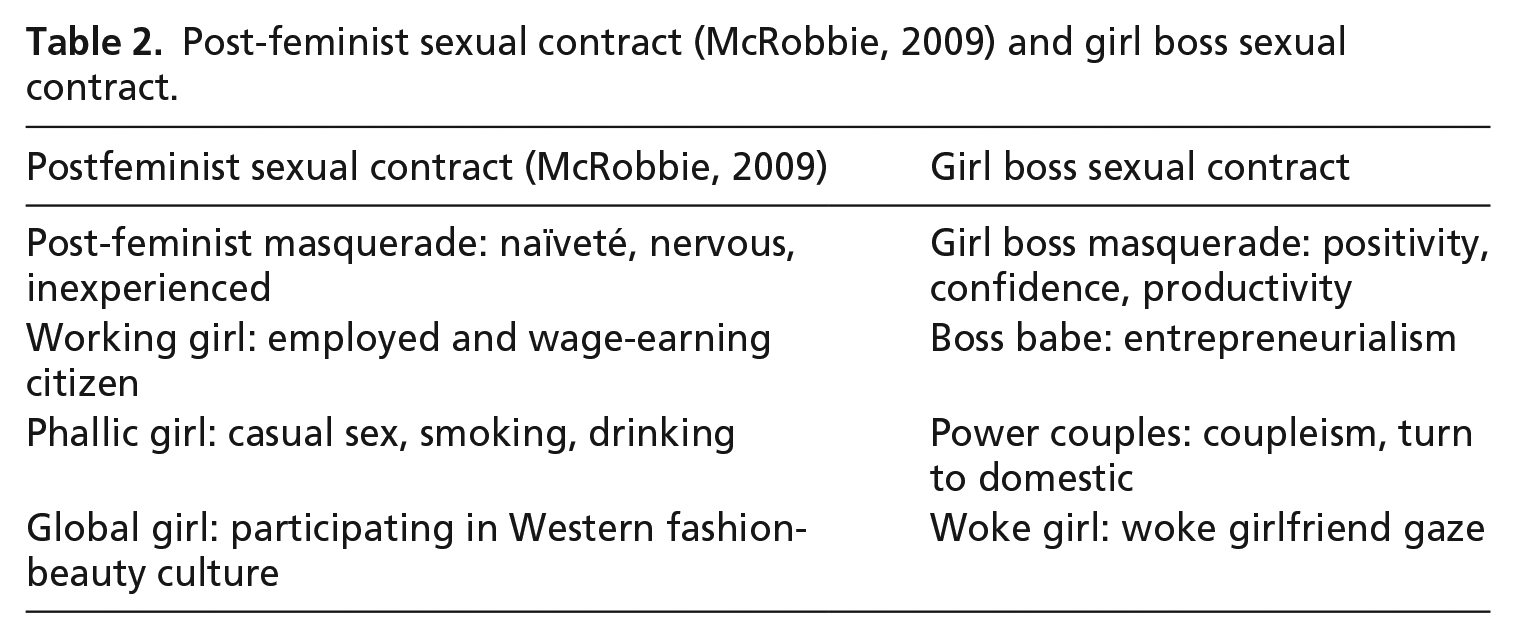
The term ‘girl boss’ was coined by American entrepreneur Sophia Amoruso as the title of her 2014 business memoir, which describes her journey from selling vintage clothing to running the fashion website ‘Nasty Gal’. The girl boss became the corporate feminist of the Millennial generation, and she represents a shift in the cultural codes of postfeminism. While Angela McRobbie (2009) conceptualized post(-)feminism as a sexual contract whereby women were encouraged to participate in the workforce and consumer culture (so long as they performed naivety and discomfort with power in their new roles, to uphold the gender hierarchy), we argue that the girl boss proudly displays her independence and self-reliance through performances of confidence, positivity and capability in the workplace. This new sexual contract, which we term the ‘girl boss sexual contract’, enables women to take on more influential and lucrative roles – to progress from mere participant in the workforce and become the boss. The girl boss is epitomized by business founders such as Emily Weiss, who founded the skincare brand Glossier, and Audrey Gelman, co-founder of the women-only co-working space The Wing, yet the term is also frequently applied to cultural icons, such as Beyoncé and Taylor Swift. The girl boss functions as an aspirational figure and a promise: she tells other women that they can achieve what she has, if only they work hard enough.
The girl boss fell from grace in early 2020. The ironic slogan ‘gaslight, gatekeep, girlboss’ encapsulates the cultural backlash against the girl boss, and the ways in which she has become associated with self-interest. Since then, the end or ‘death’ of the girl boss has been proclaimed many times (Berman, 2021; Littler, 2022). However, a cursory glance at social media shows that the figure of the girl boss has consolidated itself into the Western cultural imagination. The term is used as a verb – ‘girlbossing’ – to describe women who strive for success (Jennings, 2022). Despite widespread usage of the term, there is a lacuna in the scholarly literature that would illuminate the meaning and implications of the term ‘girl boss’ from a feminist perspective. Thus, this article considers a research question: what ideas and practices constitute a ‘girl boss’?
To answer this question, we analyze social media content of three lifestyle influencers who have each been referred to as a girl boss: Molly-Mae Hague from the United Kingdom, Matilda Djerf from Sweden and Kaja Karba from Slovenia. We argue that the patterned articulation of ideas and themes across all three examples constitutes the cultural figure of the girl boss. Building on insights about the entanglement of neoliberalism and postfeminism (Gill, 2007; McRobbie, 2009; Rottenberg, 2018), it is our contention that the girl boss is best understood as a new sexual contract offered to women in a cultural climate in which the features of neoliberalism have become normalized and pervasive – or as Ehrstein et al. (2020) put it, ‘embedded in our everyday living’ (p. 201) – such that neoliberalism is an inherent and inextricable part of the girl boss. Following the work of Angela McRobbie (2009), we argue that the girl boss sexual contract is offered to women through four modalities of prescriptive feminine agency: the girl boss masquerade, boss babe, power couples and woke girl, all of which circulate through social media. By analyzing self-representations of influencers from the United Kingdom, Sweden and Slovenia, we contribute to the existing literature on influencer cultures which, up until now, has predominantly focused on influencers from Anglophone empirical settings.
We proceed as follows. First, we situate the girl boss within research on cultural conceptions of feminism in the contemporary moment. Next, we offer a review of the literature pertaining to social media influencer cultures. Following that, we outline our chosen methodology. The article then moves through four analysis sections, each presenting one prescriptive modality of feminine agency, which together constitute the girl boss sexual contract. In the last section, we propose that the girl boss sexual contract can be understood as a coping strategy as well as a new method of securing women’s willing participation in the same capitalist and patriarchal structures which oppress them.
(Post)feminism in the current (Western) landscape
The central theoretical concept that informs this article is postfeminism, by which we are referring to a set of contradictory and seemingly paradoxical discourses about women’s empowerment and equality which circulate in mainstream political, cultural and media products, and disavow and/or individualize feminist politics. While postfeminist media cultures suggest that women can freely engage in traditionally feminine pursuits in the name of empowerment (Gill, 2007, 2017), femininity is primarily performed through the celebration of feminine stereotypes, while the collective roots of feminism as a social movement fade into the background (McRobbie, 2009). Postfeminism is shaped by neoliberal rationalities, which, as Ehrstein et al. (2020) point out, have come to ‘saturate everyday life’ and call forth subjects who ‘make sense of their lives through discourses of freedom, responsibility and choice – no matter how constrained they may be (e.g., by poverty or racism)’ (p. 201).
Particularly influential on this article is McRobbie’s (2009) notion of the postfeminist sexual contract with four luminous subjects of postfeminism. Through these spaces of luminosity, women were illuminated literally and symbolically as embodiments of idealized femininity. This new sexual contract emerged through ‘spaces of attention’ in four intersecting figurations: the postfeminist masquerade, the working girl, the phallic girl and the global girl. Women’s participation in the workforce challenged patriarchal law, and so women donned a ‘postfeminist masquerade’ to restore it by means of naiveté and hyperfemininity. Similarly, the ‘working girl’ preserved her feminine vulnerability to ensure that she remained desirable to men while she pursued education which would lead to lucrative employment – and in turn, a disposable income to be spent in the fashion-beauty industries. In the realm of sexuality, the ‘phallic girl’ emerged. She was encouraged to enjoy the freedom previously associated with male pleasure – sex, alcohol, cigarettes – so long as she did not become dependent on the welfare state. The privileges of the phallic girl were granted primarily to white women. For citizens of developing countries, the ‘global girl’ was celebrated, so long as she pursued education and employment, and assimilated herself into the Western fashion-beauty complex (McRobbie, 2009: 79–97). Through these four figures, feminism was undone: young women were issued a new sexual contract which promoted education, employment, consumption and heterosexual desire while undoing feminist critiques and the gains of earlier feminist struggles.
Since then, much has been written about entanglements of neoliberalism and (post)feminism. The psychic and affective dimension of postfeminism involves similar ‘feeling rules’ to those of neoliberalism (Kanai, 2019a) such as positivity, resilience (Gill and Orgad, 2018; Kanai, 2019b; McRobbie, 2020) and confidence (Orgad and Gill, 2021). The emphasis on such feelings creates subjectivities well suited to navigating neoliberal structures. The rise of social media influencers has been consistently framed as exemplifying neoliberal postfeminist sensibility through the normalization of self-optimization and self-branding (Chen and Kanai, 2022; Duffy, 2017). Building on the insights of shifts in postfeminism, we seek to understand girl boss as an idealized feminine subject that circulates on social media through our analysis of self-representations of three female lifestyle influencers.
Social media influencer cultures and self-representations
Influencers accumulate large followings on social media by narrating their personal lives and monetizing their activities through advertorials and paid partnerships (Abidin, 2016: 86). Influencers operate as cultural intermediaries who communicate ideas about living well, typically through the consumption of products and their life choices – for example, to have children, to pursue a career or to travel (Arriagada, 2021). With the influencer industry entering its second decade, the field has received significant academic attention. Scholarly investigations focus on their precarious working conditions and underscore the enforcement of the neoliberal subjectivities (Duffy, 2017). Another strand of literature on influencers focuses on their self-representations: for example, studies found that ‘mommy influencers’ reproduce a neoliberal ethos which favors an individual approach to the reconciliation of motherhood and a career (Jorge et al., 2022). Scholars have shown that white, heteronormatively attractive female bodies are the favored subjects of social media (Petersson-McIntyre, 2020) where consumption is essential to the cultivation of normative femininity (Abidin and Gwynne, 2017). By examining Mrs. Hinch, an influencer who supplies household cleaning and organization tips, Casey and Littler (2022) argue that neoliberal culture recasts housework as a therapy for a stressful life, which ensures women’s willingness to participate in unpaid domestic labor and consolidates traditional heteronormative roles in the household.
While current research has centered on the self-representations of ‘mommy influencers’ (Jorge et al., 2022), ‘cleanfluencers’ (Casey and Littler, 2022) and male beauty influencers (Chen and Kanai, 2022), there has been limited scholarly exploration of influencers described as ‘girl bosses’. Although the concept of the girl boss is frequently discussed in the media, it remains an underexplored subject in academic literature. To this end, this article focuses on self-representations of three influencers from three different empirical settings who are each in their own context often referred to as girl bosses: Molly-Mae Hague from the United Kingdom, Matilda Djerf from Sweden and Kaja Karba from Slovenia.
Methodology
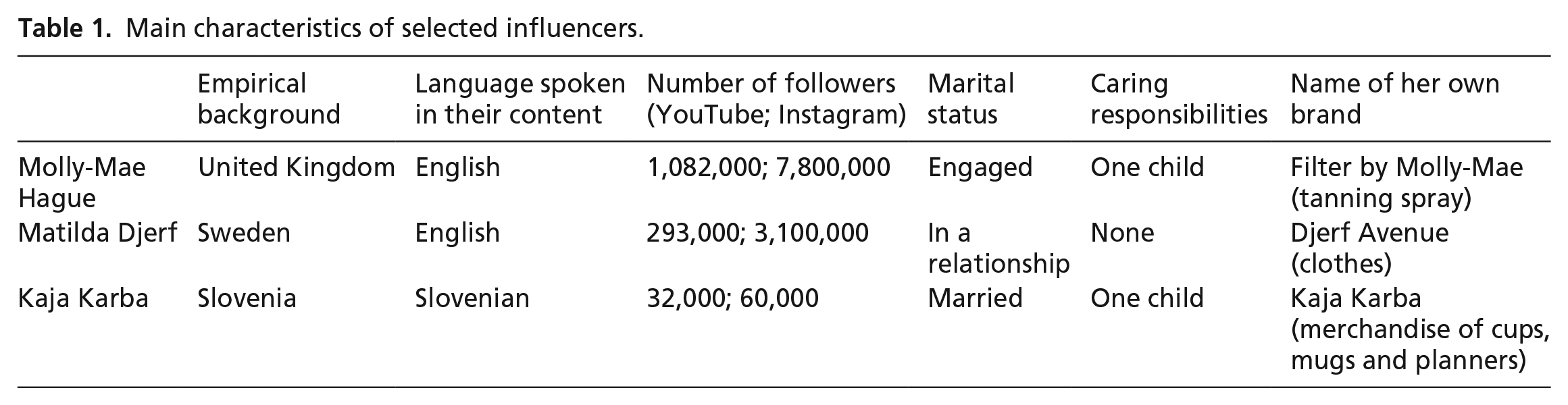
Consistent with the research question of this study – understanding what ideas and practices constitute a girl boss – we chose to analyze the content of the social media posts of three female lifestyle influencers who are often referred to as girl bosses, both in legacy media and in the posts of social media users. Our selected influencers are from diverse empirical settings: Hague is from the United Kingdom, while the other two hail from non-English-speaking settings (Djerf from Sweden and Karba from Slovenia). We selected influencers who posted consistently and with longevity to YouTube and Instagram. Hague and Djerf post in English and have international appeal, while Karba uses the Slovenian language. Hague and Djerf each have over one million followers on Instagram, while Karba has only 60,000. All three influencers operate in the same content genres of lifestyle, beauty and fashion, and are similar in appearance: all are white, able-bodied and have white male partners. There are some nuances in the characteristics of their families and marital status: Djerf does not have a child and she is not married (or engaged), unlike the other two. All built their own business brands on top of their large social media following (see Table 1).
Main characteristics of selected influencers.
We collected data through non-participant observation of their social media profiles on YouTube and Instagram. The corpus includes screenshots of their Instagram pictures and YouTube videos with special attention to posts where a more reflective stance is adopted. We also included texts from news and entertainment media like podcast guest shows. Their videos and posts were collected during the months of June and November 2023, following a ‘flow-oriented’ approach (Markham and Gammelby, 2018) with each influencer’s account being checked daily to immerse the authors in the norms of each influencer’s patterns of representation. Approximately 20 Instagram posts and 10 YouTube videos of each influencer were analyzed. We understood the influencers’ practices of representation as discourse. From this, a close multimodal discourse analysis was conducted (Mayr and Machin, 2012) of posts which related to the dominant observed themes. The content turned out to be rich in themes relating to neoliberal and postfeminist values, including positivity, confidence, productivity, entrepreneurship, ‘wokeness’, product placement and traditional heterosexual relationships. This process then identified central tendencies across content texts, which intersect with previous research into subjectivity and social media.
Findings
We present our argument on the girl boss sexual contract through four interconnected sections. In each section, we discuss a distinctive aspect of prescriptive feminine agency prevalent in influencers’ content (see Table 2 for an overview). In the first section, we explore the concept of the girl boss masquerade within the context of postfeminism’s feeling rules, highlighting positivity, confidence and productivity. Moving to the second section, we investigate influencer labor as a unique practice which aligns with and promotes the ideal of being one’s own boss. Third, we examine the shift toward the domestic sphere and the role of male partners in influencers’ success. In the fourth section, we introduce the concept of the ‘woke girl’ who signals her awareness of global power imbalances. Overall, we underscore the distinctions from McRobbie’s (2009) postfeminist sexual contract and argue that these evolving forms of prescriptive feminine agency contribute to a novel girl boss sexual contract.
Post-feminist sexual contract (McRobbie, 2009) and girl boss sexual contract.
Girl boss masquerade: positivity, confidence and productivity
By analyzing influencers’ content, we observe three crucial ‘feeling rules’ (Hochschild, 1979) that girl bosses adhere to: positivity, confidence and productivity. The feeling rules are all self-mediated: a girl boss controls her own psychic state to ensure optimum productivity and success.
Influencers’ content centers their everyday lives and is frequently accompanied by comments of positivity, such as ‘we literally had the best weekend ever’ or ‘I’m so grateful for this; I feel like I’m in such a good place at the moment, I feel really, really happy’ (Hague, 2023a). Influencers acknowledge stress and difficulties and openly express negative emotions; nevertheless, they systematically formulate solutions to negativity in individual psychological terms, by transforming negative experiences into lessons of resilience. For instance, when Karba reflects on why she moved from London to Cornwall, she discusses structural issues like expensive rent and eviction motivated by her pregnancy. Nonetheless, she frames this double-layered structural issue of caregiving and the housing crisis with resilience and positivity: ‘I believe everything happens for a reason and exactly how it has to happen, and I’m staying positive’ (Karba, 2023a). A similar resilience in the face of the difficulties of motherhood was expressed by Molly-Mae: ‘I was really unwell the first week. I didn’t sleep for 5 days straight and physically couldn’t eat’. She continues with upbeat narrations of motherhood, stating: ‘With this video, I want to draw a line. I can see how in the next few weeks things are going to get better’ (Hague, 2023a). The recurring positive affect in influencers’ content supports Orgad and Gill’s (2021) interpretation that contemporary culture fosters positive and confident subjects. However, enforced displays of happiness and positivity often conceal ongoing inequality (Ahmed, 2010). The cultivation of positive feeling is a regulatory tactic and a feminist issue because it reprivatizes structural inequalities and reconfigures social injustice as personal failure. This approach leads to the depoliticization of critical issues, such as the crises of housing and social reproduction, both experienced by these influencers.
The second feeling rule apparent in influencers’ self-representations is confidence. Confidence is prevalent in influencers’ expressions, particularly in the way they utilize affirmations to navigate challenges. For instance, Hague (2023b) shared: ‘I have so much to do, I don’t know how I’m gonna do it all, but I’m an independent strong lady, and things are going well’. Such displays of confidence and self-reliance starkly oppose the postfeminist masquerade in which women performed naivete, nervousness and inexperience; however, McRobbie acknowledges this shift, from nervousness to self-confidence, in her 2020 book Feminism and the Politics of Resilience. In our analysis, we found multiple examples of such displays of confidence and self-reliance. Djerf, for example, emphasized the pivotal role of confidence in her business achievements: ‘I have always known what I want to do, I’ve always known my values and my self-worth, and that dared me to go my way’ (Sequel, 2023). Orgad and Gill (2021) highlight that in the current moment, confidence is advocated as a feminist tool that women must utilize and nurture. However, like positivity, confidence serves as a disciplinary mechanism which individualizes structural issues and mandates silence about the conditions that instill self-doubt in women in the first place.
The girl boss derives her value through her high productivity levels, which suggests that her affluence and success are exclusively earned through her ability to work harder than everyone else. Hague made comments about work ethic in a podcast interview: ‘I think if you want something enough, you can achieve it. It just depends to what lengths you want to go to get to where you want to be in the future. And I’ll go to any lengths’ (Bartlett, 2021). While she was criticized on social media for paving over her own privilege and suggesting that poverty is a choice, her comments highlight the prevalence and persistence of meritocratic ideals around work ethic and psychic disposition. Karba and Djerf also take pride in their self-discipline and high productivity levels. Both consistently mention in their content that they ‘have so much to do’ (Karba, 2023b). In an interview with the New York Times, Djerf revealed that she dedicates 11 hours a day to work on her clothing line, followed by an additional hour creating content and another hour responding to messages from her followers (Paton, 2022). Girl boss influencers frame productivity as something that elicits a sense of well-being. This conceals the fact that productivity is labor; instead presenting it as something to enhance individual well-being by providing purpose and boosting self-esteem. For a girl boss, productivity is not solely a workplace concern but becomes an everyday concern of the individual. In this manner, productivity becomes intertwined with wellness culture (discussed further below) and is mandated in the same way as other feelings, such as confidence and positivity. In her later writings, McRobbie (2020) reached a similar conclusion: that productivity and self-management define the current moment as the focus of femininity becomes ‘the measurement of goals and meeting the daily objectives’ (p. 2).
While the postfeminist sexual contract upheld patriarchal norms by fostering bodily dissatisfaction and the necessity of bodily upkeep (McRobbie, 2009: 62), feminist criticism of bodily scrutiny and the body positivity movement has made it challenging to shape and discipline women by perpetuating toxic body images. Consequently, the girl boss sexual contract upholds patriarchal values by redirecting attention from the body to the mind. Women are monitored and disciplined through affective means, engaging in the emotional labor of generating and sustaining a disposition that aligns with the requirements of capital (Wood, 2024).
The feeling rules of positivity, confidence and productivity are closely aligned with neoliberal feminism, which celebrates entrepreneurial women like Sheryl Sandberg, former Chief Operating Officer at Facebook, Harvard MBA, and author of the self-help bestseller Lean In. In Sandberg’s book, she posits that women only need greater confidence and self-belief to successfully combine leadership positions in the workplace with motherhood (Rottenberg, 2018). While the feeling rules of neoliberal feminism and the girl boss sexual contract are similar, neoliberal feminism advocates for women to climb the corporate ladder and shatter the glass ceiling as employees in the corporate world, whereas the girl boss sexual contract invites women to establish their own businesses away from organizational structures and become ‘boss babes’.
Boss babe
In McRobbie’s (2009) postfeminist sexual contract, the well-educated girl embodied the success of the meritocratic values of neoliberalism. However, in the girl boss sexual contract, the perception and discursive framing of the education system itself has changed. Influencers emphasize that formal education is not relevant to their success: ‘One day I decided that university education does not fulfill me, and that I want to prove myself in another way, as was taught in school, so I went to London to become an au pair’ (Karba, 2023c). Djerf echoed this perspective: ‘School was not my thing. I just wanted to graduate and go out’ (Sequel, 2023). Women are no longer required to excel in school and make their way to the boardroom, as observed by McRobbie (2020) in her later works. Rather, the girl boss bets on herself, her flexibility, creativity and work ethic. She does not strive for a seat at the (corporate) table; she builds her own table.
In this novel sexual contract, women are encouraged to initiate their own business ventures, with influencing being a viable option to do so. Influencing as a novel form of work hinges on the idea that the entire existence of a person should be built around work, a concept scholars have referred to as ‘digital identity labour’ (Casey and Littler, 2022) or ‘monetization of being’ (Hearn, 2017). Through influencing, the identity of the self is carefully crafted and monetized for profit through advertorials. Advertorials reflect another change in the sexual contract: in contrast to the postfeminist sexual contract, women do not just spend money in the beauty-industrial complex. They are paid by it through product placement – by inserting certain products in their content and aligning with brands.
Hence, while the postfeminist sexual contract encouraged women to pursue a profession and become wage-earning citizens, the girl boss sexual contract insists that women give up their jobs working for someone else and become their own boss – preferably also the boss of others. All three influencers have founded their own brands: Hague founded the tanning spray Filter by Molly-Mae, Djerf runs the 25-million-dollar clothing line Djerf Avenue and Karba sells merchandise on her website. All frequently mention a preference for individual creative freedom and doing what they love for a living. For example, Djerf mentioned: ‘I always loved being creative, and I have never liked having a boss over me. I feel like I manifested it in some way /. . ./ I have always done it out of pure passion because I do love it’ (Sequel, 2023).
The influencers assume their roles as bosses in their content, discussing how they oversee various aspects of their businesses. For instance, Djerf mentions that her employees affectionately call her ‘momager’, stating this is ‘because I literally do everything. I’m part of the social media team, I help with creative stuff’ (Sequel, 2023). Hague (2023d) expressed a similar sentiment: ‘It’s my brand and my vision /. . ./ I just like to be there to oversee things’. Both influencers showcase their employees and assistants, with Hague referring to them as her ‘glam squad’.
It is important to note that while Hague and Djerf enjoy international appeal with millions of followers and collaborations with major global luxury brands, Karba’s audience is primarily Slovenian, and she collaborates with local and fast fashion brands. While Hague, until recently, was associated with the fast fashion brand PrettyLittleThing as a creative director, she positioned these clothes as akin to her designer garments. Another key distinction is that they all have business ventures, but Djerf and Hague have enterprises valued in millions, whereas Karba sells planners and mugs and does not have employees or a ‘glam squad’. However, despite operating at different levels of economic success and being in possession of varying resources, all three influencers are committed to being their own boss. This aspiration holds implications for solidarity and relationships. Hague (2023e) says in a recent vlog, ‘It’s okay if you feel like your friends aren’t at the top of your priority list. I’ll put my hands up and say, like, I wish it wasn’t that way, but I prioritize work’. The role of a boss inherently implies a position ‘above’ someone else, which eliminates the possibility of solidarity among workers and therefore increases a girl boss’s reliance on her heterosexual partner.
Power couples
The postfeminist sexual contract was characterized by the figure of the phallic girl, for whom the freedom associated with masculine sexual pleasure was encouraged and celebrated (McRobbie, 2009). Whereas the phallic girl was always ‘up for it’ (Gill, 2007), girl bosses show no sexual bravado and instead often have long-term monogamous relationships with someone who is equally as career-driven and who will support her goals. Together, they form ‘power couples’ in which women include their partners in their content and business endeavors. Djerf and her boyfriend together founded fashion brand Djerf Avenue with revenues of 22 million dollars in 2022 (Paton, 2022). Hague and her boxer boyfriend Tommy Fury, who both achieved celebrity status after appearing on the reality television show Love Island, have a combined net worth of 9 million pounds. Karba features her husband in her content, displaying his assistance in her business ventures, and admitted that her influencing career would not be possible without her husband’s stable employment.
Each member of a power couple is influential and successful, yet they do not compete but complement each other in the achievement of their goals. Of her boyfriend, Djerf expressed: ‘It’s so cool working toward the same goal, building something together, there’s something so magical and powerful that just gives me goosebumps’ (Sequel, 2023). Hague (2023f) is engaged in real estate investments with her partner and stated: ‘We want to keep making investments, and property is an incredible investment’. In stark contrast, as mentioned earlier, Karba and her husband do not own property and have been affected by the housing crisis. Despite the significant difference in wealth and security, all three influencers promote similar ideals.
‘Power couples’ align with what Aljoša Pužar (2022) terms ‘coupleism’, an ideology mandating couples’ participation in ritual practices like buying matching clothes and celebrating anniversaries extravagantly. These practices not only symbolize a couple’s success but also their economic prosperity, given that they often involve substantial expenditure, which perpetuates exclusivity based on socio-economic class. While the postfeminist contract focused on a woman’s personal independence, the girl boss sexual contract celebrates the girl boss’s reliance on her partner to support her economic advancement, or what Pužar (2022) calls ‘The Two of Us, Inc’. Like the performances of bewilderment and nervousness mandated by the postfeminist masquerade, a girl boss’s supposed reliance on a male partner re-secures patriarchal law under the girl boss masquerade – a way of balancing the scales against women’s increased affluence and influence. Similarly, McRobbie (2020) later recognized that in contexts where family substitutes for welfarism, women are encouraged to be enthusiastic about their careers. At the same time, the home becomes the site of new domestic pleasures, and the family an enterprise that is worked on.
In the influencers’ content, we observe a shift toward a lack of interest in sexual activity, diverging from the agentic hypersexualized femininity (Gill, 2007) characteristic of the postfeminist sexual contract. During a Question-and-Answer session on YouTube with her boyfriend, Djerf (2022a) stated, ‘I’m not gonna take up the dirty questions; I’m like that’s weird, that makes me nervous’. Hague (2023g) also specifically addressed her audience’s comments about her relationship to sexuality: ‘One thing I saw online which was hilarious was ‘if Molly’s pregnant, that means Molly and Tommy have done it’.’ Moreover, she recently discussed her low sexual drive, stating, ‘I look at Tommy with no clothes, and I’m like you’re so hot, and I’m so attracted to you, but /. . ./ I don’t have sexual drive, no’ (Hague, 2023e).
In contrast to the ‘phallic girl’ who enjoys casual sex, drugs and alcohol, the content of the ‘power couple’ girl emphasizes practices like meditation, regular exercise and a healthy diet. Crucially, the aspiration for a healthy body is not mobilized for male validation but for a girl boss herself – to enhance productivity, focus and mood, ultimately aiding her in achieving her career goals. Influencers shape their image around healthy living, with statements like, ‘Every Wednesday we get a box of vegetables and fruits /. . ./ I want better quality organic vegetables, it’s healthier’ (Karba, 2023b). Prioritizing health and productivity, a girl boss avoids late nights out and often remains sober. Her sobriety serves as a symbol of social distinction, reflecting not only self-discipline but also a luxury statement.
The concept of the ‘power couple’ aligns with a broader societal shift back toward the domestic sphere. It connects with what Diane Negra (2009) characterizes as a cultural trend toward ‘domestic retreatism’, encouraging women to remain within traditional domestic roles. Hague (2023b) articulated this perspective, stating: ‘You know guys that I’m a homebird, I like to stay at home. I am not going abroad or leaving the house for anything unless I really want to’. However, the girl boss complicates this turn to domesticity, as influencing allows them to monetize this seemingly conservative move. As Casey and Littler (2022) point out in relation to Mrs. Hinch, this markets a conservative form of conventional femininity but crucially reframes it within the paradigm of the girl boss, thus making normative choices comes to feel progressive. This is bound up with the idealization of monogamous relationships as a prized status, in which value is accrued by the reinscribing of traditionally gendered roles – but only those which are situated within a woman’s own entrepreneurial endeavors.
Woke girl
In the postfeminist sexual contract, the figure of the ‘global girl’ was offered to women from developing countries. While she is not the privileged, primary figure of postfeminism (which, as we have seen, is typically white, Western women), the global girl is still encouraged to take part in the Western fashion-beauty industrial complex as though on equal footing with her privileged counterparts, thus assimilating herself into Western culture (McRobbie, 2009: 88). This ability to participate in postfeminist culture and ‘enjoy its rewards’ comes in exchange for silence on inequality and discrimination (Butler, 2013: 50). However, in recent years, a more intersectional strand of feminism has come to the fore, which emphasizes the role intersecting differences (such as race, gender and class) play in the ways a person is oppressed. Inequalities are highlighted and challenged in mainstream contexts, in the wake of racial and gendered protest movements (Curran-Troop et al., 2022). This created a novel form of ‘progressive neoliberalism’ (Fraser, 2018), which celebrates diversity, meritocracy and emancipation. Subsummation of injustice into corporate institutions has created a ‘woke’ corporate culture which integrates the language of marginalized communities’ struggles for equality evident in diversity initiatives and the strategic use of images of minority groups (Kanai and Gill, 2020).
In this context, we argue the global girl transmogrified into a woke girl. The woke girl is aware of global power imbalances, and the myriad ways in which people are discriminated against, based on race, gender, social class and sexual orientation. Girl boss influencers strive to be inclusive and to avoid triggering any anger from their ‘woke’ audiences. All three adhere to conventional beauty standards associated with white privileged femininity; however, they acknowledge that not everyone shares their privileges. As Djerf stated in a New York Times interview: I’m white, I’m small size, I tan easily, I don’t need to wear makeup. Life can be easier for me because of those things. But that doesn’t mean I don’t feel a strong sense of responsibility to do things the right way. (Paton, 2022)
Djerf often highlights her attention to model representation, sizing and the casting of diverse models. She states that she ‘hope[s] that people feel that [Djerf Avenue is] a safe space to online shop. Because it is scary to shop clothing online with sizing and you see one person modeling the clothes that don’t look like you’ (Sequel, 2023).
Similar awareness of structural issues (but related to gender stereotypes) was voiced by Hague. She regularly acknowledges her understanding of traditional gender roles and stereotypes with statements like, ‘Do you guys remember when Yorkie bars commercials used to say like only for men, how was that allowed, how was that actually allowed please, even a few years ago, that is so messed up’ (Hague, 2023g).
Karba also acknowledges inequality and her own privilege. While she doesn’t address this in terms of race or gender (given that her audience is primarily from Slovenia, a country where woke culture is not particularly prevalent), she makes it clear that she recognizes her privilege. For example, in the context of devastating floods in Slovenia, just before promoting SHEIN clothes, she expressed her remorse and demonstrated her sense of responsibility by mentioning that she had donated promoted clothes to a woman who lost her clothes in the floods: I feel so bad for talking about it because I know that some of you lost everything, and I am here parading with clothes. If I do not show this, I can have a problem, because I am on a contract and have a deadline. I will present you clothes that will be donated to a woman who lost all of her clothes during the floods. (Karba, 2023d)
These comments illustrate that all three influencers are highly attuned to how their audience perceives them and understand that they will be judged for their (lack of) woke credentials, which function as a core tenet of their femininity under the girl boss sexual contract. Adopting the framework of the ‘girlfriend gaze’ introduced by Alison Winch (2012) – which asserts that women regulate each other through ‘affective networks of control’ in which ‘many girlfriends survey the many girlfriends’ (p. 10) – we suggest that these influencers operate with an awareness of a related, yet slightly different gaze on them: the ‘woke girlfriend gaze’, in which influencers signal their awareness of intersectional inequalities to appease the ‘woke’ concerns of their audiences. The woke girlfriend gaze is another aspect where the girl boss sexual contract differs from McRobbie’s later writings. McRobbie (2020: 3) noted that hate, cruelty and aggression target women through poverty-shaming mechanisms in the media and reality television. However, on social media, influencers operate under the woke girlfriend gaze where hate or poverty-shaming is not tolerated – for example, the swift backlash on social media to Hague’s comments about work ethic.
Discussion and conclusion
In addition to examining the ideas and practices that constitute the girl boss within the context of influencer culture, this article makes the case that the dominant articulation of idealized femininity in the current moment is related to, yet notably different from, the postfeminist contract proposed by McRobbie (2009). Hence, we propose that the girl boss is best understood as a novel sexual contract offered to women by four novel modalities of prescriptive feminine agency: girl boss masquerade, boss babe, power couples and the woke girl. Each of these four figurations secures patriarchal law in new ways. The girl boss masquerade encourages women to cultivate specific feelings for which success is promised. The boss babe encourages women to become their own boss and preferably, the boss of others. The power couple reenacts patriarchal law through emphasizing the importance of monogamy and the centrality of a (usually cisgendered heterosexual male) romantic partner to a woman’s ability to achieve her goals. Finally, the girl boss operates under ‘woke girlfriend gaze’ and signals her awareness of intersecting inequalities to appease the intersectional ‘woke’ concerns of her audience. Together, these figures form a subjectivity well suited to the navigation of neoliberal structures. Our analysis indicates that postfeminism is changing in response to new cultural trends, which differentiates the current moment from McRobbie’s postfeminist sexual contract. Furthermore, we explore a key distinction between the way the two contracts are disseminated: while the postfeminist sexual contract was propagated through print media and fashion magazines, the girl boss sexual contract circulates primarily through social media.
We note that, despite disparities among the influencers we analyzed (primarily in terms of resources and socio-economic status), they conveyed the same ideas and similar self-presentations in their content – which suggests that the idealization of the girl boss transcends social class. While all three influencers in our study are white, it is worth noting, by drawing on secondary literature, that the girl boss sexual contract is also offered to women of color with a distinct nuance, as they are invited to use their non-white identities as business pitches and present their cultural niche as an untapped market. In other words, their identities must be mobilized for profit. In this way, they become racial entrepreneurs (Mukherjee, 2016: 51) and mascots of achievement and meritocracy (Littler, 2018).
We suggest that the girl boss is a ‘coping strategy’, related to the persistence of precarity and uncertainty created by the pervasiveness of neoliberalism in its maturity stage (Keisu and Brodin, 2022). Nonetheless, the girl boss merely mitigates the consequences of the system, without addressing the structural causes that shape such precarious lifestyles for women. In many ways, the girl boss is a form of hyper-conformity which reinvigorates patriarchal capitalism and prevents opportunities for solidarity and collective action. However, young women acting as girl bosses are not intentionally anti-feminist; rather, the girl boss sexual contract offers them a way to cope with current social and economic constraints, such as the evisceration of the public sector, rising living costs, constrained social mobility, withdrawal of social care and wage stagnation. The feeling rules of positivity, confidence and productivity, along with the financial advantages promised by business ownership and the monetization of the self, are individualized responses to structural problems.
The aim of this study was to understand what ideas and practices constitute a girl boss. Hence, our focus was on the content of influencers who, in both social media and legacy media, are referred to as girl bosses. Our findings on the girl boss sexual contract do not apply to influencer cultures at large. If we had focused on more diverse groups of influencers, the findings would likely be different because Internet culture itself is diverse. In recent years, we have witnessed the rise of influencers in various content niches such as Marxism (Cotter, 2024), sex-positivity (Are, 2023) and Muslim cooking (Bagdogan, 2023), among many others. In these content niches, the girl boss sexual contract would not be found. Instead, the prevalence of the girl boss is among female influencers in the fashion and beauty content niches. While this contract may not be applicable to all influencers, it is important to note that the lifestyle and beauty niche remains highly lucrative, with the three analyzed influencers being among the most economically successful – Hague and Djerf globally, and Karba locally. Consequently, the girl boss sexual contract reaches and affects many women. However, how non-influencer women who consume this content perceive and implement this contract, as well as its impact on them, remains unexplored and requires further study.
It is crucial to point out that this study primarily focuses on the Western world, specifically scrutinizing the social media content of influencers from Britain, Sweden and Slovenia. Nevertheless, it’s worth noting that Slovenia, while geographically located in Europe, can be seen as a western periphery, forming a boundary between Europe and the Balkans. This context is somewhat unconventional for studies of Internet culture. Through the analysis of these three influencers, we contribute to the broader examination of influencer cultures extending beyond the confines of Anglophone cultures. Importantly, our analysis highlights that the consistency in ideas and representations across all three influencers underscores how Western concepts readily permeate from ‘the West to the rest’ within online influencer cultures. This is also supported by literature from abroad. For example, momfluencers in Portugal (Jorge et al., 2022) communicate a neoliberal reconciliation of work and motherhood similar to their counterparts in the United States (Petersen, 2023). Research from China found that postfeminism operates similarly, as female influencers display ideas and practices that constitute a girl boss sexual contract: they want to do what they love, be their own boss and strive for productivity (Guo, 2022).
Footnotes
Acknowledgements
The authors would like to express their gratitude to the organizers and participants of the conference ‘New Directions in Feminism and Media: Research in Times of Crisis and Change’ for their valuable feedback and encouragement to develop the conference presentation into an article. In addition, the authors extend their thanks to the anonymous reviewers for their constructive feedback and comments.
Data availability statement
No data available as this article draws on social media content analysis publicly available on social media platforms.
Declaration of conflicting interests
The author(s) declared no potential conflicts of interest with respect to the research, authorship, and/or publication of this article.
Funding
The author(s) received no financial support for the research, authorship, and/or publication of this article.

Biographical notes
References
 | hauls, chaos & procrastination
  | Mollymae
 | Homesense AD| Mollymae
 | Cosmetips AD| Mollymae
 + try on haul, makeup rutina / poletni tedenski vlog p.7 l Kaja Karba