




Abstract
The death of the 22-year-old Kurdish-Iranian woman, Jina (Mahsa) Amini, on 16 September 2022 while in the custody of the Islamic Republic of Iran’s notorious morality police, led to nationwide mobilisations in Iran. Women were at the forefront of these protests, leading a movement that emphasised opposition to the production of space and place as gendered by the state apparatuses of the Iranian regime. This article argues that the state systematically and institutionally unmarks the female body in public space in order to make it as invisible as possible. In marking 20 years since the publication of Space Invaders by Nirmal Puwar, the concepts of invisibility, outsiderness, being ‘out of place’ and ‘space invaders’ are revisited in this article, within the political geographies of Iran. Furthering the concept, we also pair together ‘space invaders’ with the acts of invading space as political acts of intervention. Shedding light on the bodies ‘out of place’ within the Woman, Life, Freedom protests in Iran, we discuss how this mobilisation created a new generation of ‘space invaders’ who no longer negotiate with those in power, but exercise their right to choose what to wear when occupying public spaces. Through protest, activism, performances and other mundane acts of everyday resistance, we show how space invaders negate the authority of the state apparatuses, defying conventions and boundaries, and create new codes for a politically and culturally constructed version of ‘woman’ in Iran.
Introduction
At midday on 17 September 2022, thousands of women and men filled a cemetery on the outskirts of the Iranian city of Saqqez, where women collectively removed their headscarves in this public space, for the first time since mandatory hijab became a law in 1983. They chanted Jin, Jîyan, Azadî, a Kurdish slogan of the women’s freedom movement in the early 1990s that promotes a democratic, ecological, gender-equal social system and a bottom-up system of self-government (Käser, 2021: 60). This was the beginning of a nationwide wave of protests, fuelled by the death of the 22-year-old Kurdish-Iranian woman, Jina (Mahsa) Amini, who died on 16 September, after being arrested by the morality police under Iran’s current hijab laws and beaten while in police custody. The collective action of removing the hijab on the day of Jina Amini’s funeral was an invasion of the pre-defined relationships between the theocratic space and female body in Iran. Immediately thereafter, other space invaders/protesters filled the streets of different cities across the country, removing or burning their hijabs to express their autonomy and to claim the right to choose what to wear, cutting their hair in solidarity with other protesters and re-defining the relationship between public spaces and female bodies in Iran. Needless to say, the act of cutting the hair within the Woman, Life, Freedom mobilisations was also inspired by the Kurdish women’s resistance when, during the seventh party congress in late 1999 and early 2000, all women present at the meeting cut their hair to shoulder-length, as a sign of ‘having lost everything’ and to protest against the male-dominated leadership of the Kurdish movement’s parties (Käser, 2021: 57).
Protests, under female leadership, have traversed all social demographics and geographical scales; individuals of different ages, from primary school students and teenagers to senior citizens aged 70 or more; different genders and non-binary people; people of different ethnicities from westernmost cities of Oshnavieh and Piranshahr to the furthest eastern cities such as Zahedan, from the northern city of Rasht to the southern city of Bandar Abbās; from the rich districts to the most deprived working-class neighbourhoods in cities; and from small-scale student protests to larger labour unions and syndicate strikes (Torkameh, 2022). Not only did protesters occupy the streets, but they also utilised the physical and virtual topography of public space. The trending hashtag Mahsa Amini (in Farsi) was retweeted more than 270 million times by early October, setting a new record in the entire history of X (formerly Twitter).
With the slogan ‘Woman, Life, Freedom’ becoming the motto of the protests, with women being at the forefront of the movement and with the emergence of a new whole host of artistic performances, this article aims at applying Nirmal Puwar’s notion of ‘space invaders’, this time within the political geographies of Iran. To contribute to the twentieth anniversary of the publication of Puwar’s seminal work Space Invaders: Race, Gender and Bodies Out of Place, we revisit some of its influential concepts – such as insider/outsider, inclusion/exclusion and ‘out of place’ – in order to discuss how the psyche of the Woman, Life, Freedom movement created a new generation of ‘space invaders’ who courageously changed and challenged the pre-defined rules and norms of occupying public, private and virtual spaces.
The phrase ‘space invaders’ evokes certain conceptions of space in a manner that facilitates the discourse of invasion. It refers to bodies that are conceived to be out of place (Cresswell, 1999), bodies that belong to ‘other’ places (Said, 1999) and bodies that occupy spaces they do not belong because they are undesirable (Puwar, 2004). Doreen Massey (1994) refers to the ‘inherently dynamic’ characteristic of space that considers space in terms of social relations that are never still because social actors attribute different meanings to space at different times. A ‘space invader’, a term Puwar developed out of Massey’s theorisation, counters perspectives of space that understand it as static, flat and immobile, and constantly adds new meanings to the spatial organisations of institutions, societies and cities. A spatial organisation in this view is based on the ever-shifting social geometry of meaning and symbolism (Massey, 1994). The construction of spatial organisation in Iran is no exception.
In this article, the spatial within the geography of Iran is seen in two ways. The first view is as constructed out of the restricted and exclusivist top-down claims by the state imposed onto places and people from a position of absolute power. This is an ideology and a way of thinking that attempts to fix the meaning of spaces, to enclose them, endow them with unchangeable identities and to claim them. The second view sees the spatial as produced by social agency and as a consequence of social processes, conceiving space as ‘directly lived through its associated images and symbols, and hence the space of inhabitants and users’ (Lefebvre, 1991: 39). The latter emphasises that the identities of places are always unfixed, contested and multiple and that any place is constructed through counterposition to the other (Massey, 1994). The first view, related to the ideological conceptualisation of place, can be seen in the production of space by the Islamic state apparatuses since the 1979 Islamic Revolution, whereas the second approach draws on the agency of those who assert the position of ‘out of place’ and as ‘space invaders’ in Iran because they constantly de-stabilise the pre-defined and fixed meanings of particular envelopes of space-time. Attempts at stabilisation, of specific ideologies to particular spaces and places to succeed, certain formulations are embedded in concatenations of interplaying dichotomies related to gender (Massey, 1994). Some of these dichotomies are explored in this article, including visibility/invisibility and insider-ness/outsider-ness. Challenging the ways in which space and place are currently conceptualised from above in Iran implies (indeed, necessitates) challenging the currently dominant form of gender relations, rules and regulations.
By delving into the process through which the Woman, Life, Freedom nationwide protests came into fruition in Iran, we attempt to show the struggle of Iranian women to [re]label space-time, negating the imposed meanings attributed to public spaces, for however long or short a span of time. There are two levels through which contestation is analysed: first, there is the oppressive and discriminatory process of defining what an Islamic public space must look like and how it must be produced so that female bodies remain invisible and unmarked, and, second, in response there is resistance, disobedience and escalation of the presence of marked, visible female bodies within the Islamic public space since 1979, which renders the diversity of the protesters at its most visible and obvious level. Through this article, we build our argument by pulling together threads of existing research on space invaders/bodies out of place (inside and outside Iran) to offer a critical lens through which the recent Woman, Life, Freedom protests can be analysed. We do this by also adding the voice of those protesters whose continuous presence in the streets directly challenged the status quo. It is shown how during the Woman, Life, Freedom protests, women and other marginalised groups occupied and invaded the spaces they have been systematically excluded from or conditionally included in, and called into question the whole political order in order to facilitate their own geographies of visibility and expression.
[Female] bodies out of place
Feeling ‘out of place’ usually refers to how a person (assigned to specific categorical systems of religion, gender, class, race, ethnicity and sexuality) challenges routines, accepted norms and assumptions by opening up the potential to think, feel and act differently, and as a result destabilises the fixed meanings and feelings associated with particular places. Over the past 30 years or so, research in a wide variety of disciplines has demonstrated the close interrelation of gender and space, to discuss how women and gendered bodies need to work harder in order to occupy the spaces from which they have been excluded (Amir-Ebrahimi, 2006, 2008; Butler, 1996; McDowell, 1996; Massey, 1994; Milani, 2011; Moghadam and Haghighatjoo, 2016; Puwar, 2004). Massey (1994) states the sheer maleness of particular public spaces turns women’s experience of occupying space into a conscious act of being ‘out of place’ as ‘space invaders’ because men have a historical, natural, political and even conceptual ‘right to belong’, while women and other gendered bodies are marked out as trespassers and circumscribed as being ‘out of place’.
Furthermore, with the expansion of awareness of gendered identities across multiple axes of race, ethnicity, age, sexuality, religion and nationality, feminist geography and the works of scholars such as Linda McDowell opened up profound discussions on bodies ‘out of place’. Places, McDowell (1996) argues, cannot only be seen as physical or spatial surfaces, but also as boundaries that codify and signify women’s proper place, in such a way that sexuality, race, religion or class can easily disqualify women from certain institutional, political and organisational public spheres, so they are seen as ‘out of place’ and become ‘space invaders’. In 2004, Puwar used Massey’s (1994) term ‘space invaders’ (p. 185), to reflect on the notable shift in the presence of women and sexed racialised minorities (Black women and other women of colour) in (white-dominated) public realms including institutions, galleries, workplaces and so on. She argues that women’s bodies threaten the order and universality of the public sphere in such a way that, when they enter these public realms, the presence of their bodies creates an imaginary collision between normative representations of gendered bodies and the body politic (Puwar, 2004: 94). Being out of place, Puwar argues, gendered bodies have to work how to redo pre-written and pre-defined feminine sexualised scripts, codes and norms – scripts here refers to Butler’s theatrical analogy that explains the construction, reproduction and transformation of genders because gender for her is not ‘a role which either expresses or disguises an interior ‘self’’: rather, gender is an act (Puwar, 2004: 94). Butler (1996) argues, through a constant repetition of performative accomplishments, the historical link between specific sorts of social bodies and their presence in the public realm can be rebalanced and reproduced.
Challenging the liberal Western feminist discourse on the connection between women’s agency and resistance within the Islamic socio-political contexts, Islamic and Iranian feminists and sociologists brought new perspective to postcolonial studies by showing how female bodies repeatedly sink into public spaces through persistent and constant re-ordering of those spaces. Amir-Ebrahimi (2006, 2008) argues that, while Iranian society has been subject to a strict and oppressive set of standards of urf (religious and cultural norms) and sharia laws since 1979, the state still faces serious difficulties in exerting absolute control over women and their sexuality in the private and the public spheres. Since 2001, she continues, the trend of wilfully neglecting the Islamic dress code of veiling has been accompanied by the virtual unveiling of female bloggers (Amir-Ebrahimi, 2008). Deliberately crossing the red lines of sharia law by uncovering their hair and bodies, bad-hijab women (a state terminology used to describe those who do not wear the Islamic hijab appropriately) become ‘space invaders’ who transgress the Islamic codes of the production of public and private space. On the authoritarian nature of the Iranian state, Moghadam and Haghighatjoo (2016) use the idea of being ‘out of place’ to look at women’s struggles to obtain voice and influence within an authoritarian polity and a male-dominated body politic by reflecting on the workings of a women’s caucus within a functioning parliament, albeit one constrained by a particular ideology (political Islam) and a traditional outlook on women. At the same time, Rahbari et al. (2019) also look into how Iranian women’s everyday micro-management of their bodies, their physical interactions and their spatial participation stands against the nation-building programme in Iran and, therefore, is perceived as potentially harmful or inferior, subjected to be excluded and isolated. 1 However, they also show how after the 1979 Islamic Revolution ‘women presented the first and the most effective challenge’ against the new regime by protesting in and outside the country against the body politics that ordered women to veil (Afary and Anderson, 2010, in Rahbari et al. 2019: 1418).
Drawing on the same line of argument, we take the term ‘space invaders’ from Puwar, and the idea of women who do not comply with hijab rules in Iran being counted as bodies ‘out of place’ from the work of Iranian scholars, to reflect on the radical presence of women in the recent Woman, Life, Freedom movement. In what follows, Puwar’s work on ‘space invaders’ will be approached from two perspectives. The first looks at the maleness and the production of exclusionary spaces under the rule of a theocratic regime and women’s conscious experience of being ‘space invaders’ that creates a productive tension when the individual identity (of women and other marginalised genders) playing off against the accepted and dominant social identity of oppressive cultural and political norms. Through this section, we examine the space invaders’ production of spaces of resistance in order to repeat their marked, unexpected and unacceptable presence that makes them hypervisible bodies when spaces appear as Islamic and masculine, which means they ‘stand out’ and ‘stand apart’. The second perspective attends to the connection between women’s revolutionary bodies and the physical space of the city through surface. The surface is where – as Khosravi (2020) discusses – bodily cues and codes, such as clothing, hairstyle, skin colour, voice, accent or any other stereotype, are inscribed through which two different types of reading the surface can happen; an individual becomes either ‘insider’ or ‘outsider’. 2 Here individuals actualise and reproduce their own gendered scripts (styles, acts, rules and performances) through absolute negation of the prescribed and pre-defined rules of bodily surface through revolutionary practices. The ‘space invader’, therefore, uncouples the markers of difference from a referential symbolic system of identity and de-constructs and re-constructs the relationship between public space and the marginalised social identities. In what follows, we discuss the production of Islamic space and absolute power, which prescribed a fixed social identity right at the beginning of the 1979 Islamic Revolution. Without overlooking and concealing the ideological images upon which the female body politics and hypothetical debates of the body politic are based in Iran, our aim is to show how top-down gender policies and rules underpin socio-political subjects in that country.
The 1979 Islamic revolution and the female un/marked body
On 11 February 1979, a revolutionary group led by radical clergy and fundamentalist Islamists seized political power in Iran. In establishing his version of the Islamic government, Khomeini, the leader of the 1979 Islamic Revolution, used the fundamentalist Shia religion as the cornerstone of the new government, rejecting Western imperialism and imposing a set of fixed and immutable obligations and laws that dictated what was permissible and what was not (Rahnema and Nomani, 1996). This is an example of political thought, according to Massey (in Sharp et al., 2000), that is tangled up with a particular notion of power as a coherent totalising structure that, at its root, presupposes a big central block of power – the system. As Khomeini (1970, in Nader et al., 2011: 22) writes in his book ‘Islamic Government’: ‘Islamic government does not correspond to any of the existing forms of government. The fundamental difference between Islamic government, on the one hand, and constitutional monarchies and republics, on the other hand, is this: whereas representatives of the people/the monarch in such systems engage in legislation, in Islam, legislative power and competence to establish laws belongs exclusively to God Almighty. The Sacred Legislator of Islam is the sole legislative power.’
This rhetoric was central to a constitutionalised theocracy. Khomeini extended the general judiciary authority of the jurist (faqih) to allow direct clerical rule and control over society (Arjomand, 1986). In order to simultaneously suppress any form of tension, incongruity and confusion among the people and to stabilise the powerful public position of the new government, he declared that new laws should serve the interest of the governing elite as well – known as ulama (Muslim scholars) and mujtahids (religiously trained scholars who interpret the Islamic law) (Baktiari, 2012). He went further, creating a new doctrine known as ‘The Rule of the Jurisconsult’. The jurisconsult, or supreme leader, is a highly esteemed cleric chosen by his peers in the 86-member Assembly of Experts in recognition of his knowledge of fiqh, or Islamic jurisprudence, and his other religio-political credentials (Baktiari, 2012: 36). The executive power of Khomeini, or any supreme leader after him known as Valy-e Faqih, is demonstrated in Article 4 of the Constitution of the Islamic Republic of Iran in 1979. It declares that: ‘all civil, penal, financial, economic, administrative, cultural, military, political, and other laws and regulations must be based on Islamic criteria. This principle applies absolutely and generally to all articles of the Constitution as well as to all other laws and regulations, and the fuqaha’ (jurisconsults) of the Guardian Council are judges in this matter.’
This philosophy of velayat-e faqih gave Khomeini and his successor, Khamenei, an authoritarian structure of executive power that aimed at the Islamisation of every single sphere of people’s lives.
Reading this through Massey (1994), when power couples with a specific political ideology, it can create a system that sees space and place as entities that can be produced as fixed, dead, immobile and unchangeable. Lefebvre’s negation of the characteristic of space as fixed is also important to note here. The production of Islamic space, for Khomeini, was nothing ‘more than the passive locus of social relations, the milieu in which their combination takes on body, or the aggregate of the procedures employed in their removal’ (Lefebvre, 1991: 11). Using his total power, the production of Islamic space then took two forms for Khomeini: the de-Westernisation of space (the emergence of the Islamic city) and the Islamification of Western culture (through media, wearing the hijab and so on) (Vaghefi, 2017).
Many studies have been conducted by the Iranian scholars on the de-Westernisation of private and public space through the programme of the Islamic city right after the 1979 revolution (Amir-Ebrahimi, 2006; Najmabadi, 2005; Vaghefi, 2017). Here, we concentrate on body, as the construction of a fixed Islamic identity was not limited to the built environment. In order to purify the body of Western ‘sins’ and ideologies, Khomeini imposed a policy of gender segregation to prevent male–female interactions in public spaces and to keep women out of men’s reach in public. In order to strengthen the authority of the newly established revolutionary state, the policy included a mandatory hijab, and gender segregation in schools, public offices, public transport, beaches, sports centres and so forth. As Vaghefi (2017: 79) puts it, the compulsory hijab became a tool to set the foundation for making a common identity among the oppressed: the woman. It became one of the government’s main tools of repression with which to control the bodies of half of the population (Daneshpour and Firooz, 2022). Not only do such restrictions constrict women’s subjecthood; they are also constitutive of the notion of dominant gendered groups’ ‘ownership’ of space and place. Since 1979, the clergy has attempted to impose hijab laws as a means to render the female body invisible and to make their presence in public spaces unmarked. When the space appears Islamic, a female body has to be covered in full hijab. Thus, the female body becomes hypervisible when it is marked with no hijab/inappropriate hijab, which means it ‘stands out’ and is ‘out of place’.
For a theocratic system of government, hiding the bodies of women was to conceal their femininity from men’s gaze in public spaces. Reading this with Puwar’s (2004) notion of visibility/invisibility (p. 58), it means that, like the male body, the female body can also be ‘invisible as a sexed entity’, if it is covered in full hijab. However, the questions of the marked and the invisible female body in Iran are entangled because the political subject (here, the woman) is not passive but constantly and actively reacting against the imposing power, mobilising her own power as an effective tool to resist. This is evident in the production of a totalitarian Islamic space by the state which soon became entangled with the production of spaces of resistance by women, especially during and after the ‘reform era’ (which refers to Mohammad Khatami’s presidency from 1997 to 2005).
‘Exclusionary inclusion’
Less than 1 month after the revolution and only a day before the International Women’s Day, on 7 March 1979, the Kayhan newspaper quoted Khomeini, declaring: ‘In Islamic ministries no one is allowed to commit a sin. In Islamic ministries women must not appear ‘naked’. They can work, but with hijab. There is no constraint on women’s work [in the public sector], but it must be in accord with [the] Islamic hijab.’ (Kayhan, 7 March 1979)
However, Khomeini’s gender apartheid doctrine, as Milani (2011) puts it, was more than a religious ordinance for working places. It became related to other mundane matters of power, domination and exclusion in every aspect of women’s lives. The Islamic Revolution introduced legal and social restrictions, including the lack of right to divorce or obtain child custody, with no right to work, study, obtain a passport or travel freely without a male guardian’s written permission, as well as no right to complain if a woman is raped by her husband. Under the obedience, and the maintenance of tamkin and nafaqa laws, a husband has the absolute right and power over his wife’s body, encompassing her sexual availability at any time he wishes (Mahmoudi, 2019: 16). Despite many years of hard work by a remarkably active group of women and non-governmental organisations (NGOs), the discriminatory laws remain, including the legal obligation of women to wear hijab in public. Those who wear proper hijab and particularly the chador (a full-body garment) are usually granted special privileges by government, so that they can easily take high positions in offices regardless of their qualifications, and can access more opportunities than other women (Daneshpour and Firooz, 2022). Each of these elements is what Puwar (2004) indicates to be specific forms of exclusionary processes.
The so-called bad-hijab female bodies are deemed out-of-place space invaders, who are ‘othered’ and therefore, according to the Islamic law, deserve punishment and discipline. In the early years of the Islamic Revolution, the office for Propagation of Virtues and Prevention of Vice (al-Amr bi al-Maruf wa’l-Nahy an al-Munkar) was formed to survey social behaviour and maintain the control of social life. Over the years, the state introduced different programmes, including the notorious morality police, which in 2007 was reshaped into the Gasht-e Ershad (The Guidance Patrol) – an institutionalised machine of oppression, in order to tackle what is known as bad-hijab. It is worth noting that the morality police are predominantly installed in the more affluent neighbourhoods in cities, while in the more conservative and traditional districts, it is the domestic and cultural rules that impose all the disciplinary and controlling measures against the female body (Amir-Ebrahimi, 2006). This in return takes us to the next point regarding the patriarchal norms and codes of Iranian society. Najmabadi (2005) discusses how the female body is a significant locus for the project of Iranian national identity making. Following Najamabadi’s argument, Rahbari et al. (2019) discuss how patriarchal family models push women to achieve their dignity by indicating that the female body is considered, morally as well as politically, a sacred site, and therefore is subjected to dramatised gender differences that underlie features of the ideal women as the reproductive anchors in the family. To honour the tradition of patriarchy and to create a peculiar image of the Islamic city, the morality police, with its infamously iconic white-and-green mobile statue (the van), became part of the urban moral fabric, dominating cities’ streets and squares. Surveilling and patrolling public spaces, harassing, verbally and sexually abusing, beating, arresting, and even killing (in the case of Jina Mahsa Amini) those who transgress the Islamic moral codes, the morality police became a forcible psycho-physical vehicle of the state-sanctioned violence against the female body in Iran’s urban landscape: part and parcel of everyday life for many urban women.
The dissonance of repressed bodies
As Massey (1994) points out, the social relations of space are experienced differently, and variously interpreted, by those holding different positions as part of it. It is important not to forget the co-existence of a simultaneous multiplicity of spaces when discussing the conceptualisation of the spatial within an oppressive, dictatorial context. The Islamic Republic’s production of (Islamic) space and the Iranian women’s production of spaces of resistance have always existed in relations of paradox and antagonism.
3
The Islamic Republic celebrated its ultimate triumph in 1979 by massive interventions over women’s societal activities throughout cultural, educational and administrative institutions. As Mahdi (2004) writes, ‘Males and females were separated in higher education classes, female students were barred from 69 different fields of study, and from certain disciplines in the universities, such as engineering, law, and agriculture. Women were banned from some professions such as the judiciary and singing groups. A decree dismissed all women judges. Women were forbidden to participate in some sports and not allowed to watch men in sports fields.’
Days after the Revolution, Iran’s revolutionary leader, Ayatollah Khomeini, delivering a speech to a group of clerics in Qom, declared, ‘Muslim women must wear Islamic hijab in public places’ (Khomeini, 2007). Khomeini’s assault on the female body led to sequences of tensions and disputes fuelled a series of protests and demonstrations within different cities. On International Women’s Day, 8 March 1979, ‘space invaders’ filled the streets of the Iranian capital, Tehran, to protest against mandatory hijab and the violation of women’s rights under the new regime. Within a 5-day protest, thousands of women demanded equal wages and work opportunities, asking for the right to choose what to wear. Subsequently, the International Women’s Day was declared invalid and substituted for Prophet Muhammad’s daughter’s birthday which appeared as the official Women’s Day in Iran since then. In July 1980, Khomeini, in a speech, strongly criticised the government for ‘not eliminating the Kingdom symptoms across the state departments’. He gave the government 10 days to Islamicise all its departments and administrations. At last, on 7 July 1980, the Revolutionary Council ratified a new rule at his behest, declaring that women who do not observe the Islamic dress code can be banned from entering the state premises. Women reacted ‘massively and angrily: thousands of women poured into the streets and demonstrated against the forced hijab’, although their protests often faced backlash from the state apparatuses as well as its supporters known as Hezbollahis (Mahdi, 2004).
When eventually the mandatory hijab became law in 1983, the production of the space of resistance, subversion and negation also became part and parcel of everyday life for many Iranian women. It is worth noting that, under the rule of the Islamic Republic, it is not only women or other marginalised gendered bodies that are seen as ‘out of place’ and ‘space invaders’, but also those of ethnic minorities (among them Kurd, Baloch, Azeri, Gilak, Arab and so on). The 1979 revolution intensified what Khosravi (2010: 11) calls the ‘outsiderness’ of these ethnic groups in urban and rural Iran. Nevertheless, this can be described, as Puwar (2004: 8) puts it, as being an insider and outsider at the same time. In this context, the presence of a ‘space invader’ (women, gendered and racialised minorities) continues to locate what are insiders as outsiders. Being both insiders and outsiders, multiple marginalised groups occupy a ‘tenuous location’, since they do not have an undisputed right to occupy the space. Yet, they are still insiders because it is their bodies that, in comparison with the invisible and unmarked bodies, highlight the constitutive boundaries of who can exist as an acceptable somatic norm of humanity and who cannot.
After the mass protests against the mandatory veiling in 1979, Iranian women, either deliberately or spontaneously, collectively or individually, have continued to challenge the patriarchal and tyrannical nature of the established power. Here we mention some examples, not least of all because it is important to recognise the different historical acts of feminist contestation and space invading. In particular, after the emergence of the so-called ‘reformation era’ in 1997, and the Green Movement (mass protests against the disputed presidential election in 2009), a generation of female ‘space invaders’ have constantly interrupted the imposition of power and occupied public spaces in unexpected ways.
Women and youth turned the rather less extreme political climate of the ‘reformation era’ into an opportunity to increase their presence in physical and virtual spaces through a subtle or ‘velvet’ form of resistance and transgression, known as ‘civil disobedience’ (nafarmani-ye madani) (Amir-Ebrahimi, 2008: 94; Khatam, 2009). Since then, major Iranian cities have become full of massive contradictions and ‘in-between’ balances between freedom/control, tradition/modernity, resistance/obedience, public/private and inside/outside. The One Million Signatures campaign – by a network of [female] mobilisers, including artists, writers, actors and filmmakers during the early years of the ‘reformation era’ (2000s) – is one example of how women collectively gathered a million signatures in face-to-face interactions with the general public and challenged, although to a very limited extent, women’s legal inequality. Moreover, the ‘White Wednesdays’ campaign – organised in 2014 by an exiled Iranian women’s right activist, Masih Alinejad, who was a parliamentary correspondent and journalist in Iran before moving to the United States – took the form of mundane and everyday acts of resistance through which millions of women expressed their objections to the mandatory veiling laws by wearing a white headscarf every Wednesdays, as well as by circulating their images and videos on different social media platforms.
It is also worth mentioning the case of Vida Movahed, who, in 2017, stood in complete silence on a utility box in Enghelab Street (Enghelab means revolution) in Tehran, unveiled, waving her white scarf, which was tied to a stick. Her act mobilised ‘The Girls of Revolution Street’ movement through which other women (as well as men) used urban settings as a stage from which to perform acts of defiance against the compulsory hijab. These sorts of production of spaces of resistance can also be related to Lefebvre’s concept of differential space (Lefebvre, 1991). In contrast to the homogenising characteristics of the Islamic space, differences and peculiarities (of women and other marginalised bodies) resist homogenising forces imposed from above. Despite all the exclusions that were central to the construction of the passive, invisible female body subject, as Milani (2011: 244) puts it, women filled all sorts of spaces with their presence, shook the very foundations of Khomeini’s Islamic state, moved far outside the framework preordained by their culture, reached beyond the traditional fields in action and imagination and have been actively present in public and virtual spaces.
In what follows, we discuss one of the most radical encounters between the domination of religious fundamentalism and the resistance of women in Iran and, in particular, the revolutionary ways in which space constitutes the medium through which the relations of domination/resistance can be re-defined and re-constituted by ‘space invaders’.
The revolutionary bodies of the Woman, Life, Freedom protesters
Although the Islamic fundamentalists saw no place outside their hegemonic and dominating whole, they still have not gained full control of the cracks and fissures in the system that enable subjects to stand against it. Rooted in a long history of women’s resistance, the Woman, Life, Freedom uprisings are one of the largest and most radical opposition of women against religious fanaticism since the 1979 Islamic Revolution, with women leading the protests, and girls as young as nine pouring into the streets, occupying the universities’ and schools’ premises, demanding full rights to their bodies, their streets and their cities. This is because, according to Sharp et al. (2000), an immanent whole does not necessarily mean that the political subjects are imprisoned in a no-way-out totalising system. Grassroots movements and protests, such as Woman, Life, Freedom, suggest the necessity of considering the entanglements of power, with totalitarianism always containing the seeds of resistance that contaminates or subverts it (Sharp et al., 2000: 20). An important question is what happens when those ‘out of place’ or bad hijab female bodies come to collectively occupy the public sphere.
‘Making the invisible visible’
When Jina Mahsa Amini died in the custody of the morality police on 16 September 2022, millions of Iranian women were mobilised, as their individual struggle was directly linked to the struggle of all, with the enemy being religious fundamentalism supported by the state terror (Daneshpour and Firooz, 2022). Re-defining the boundaries of protest with women at the forefront of the Woman, Life, Freedom uprising, they revolt for their rights and against the state itself (Oghalai and Shana, 2022). According to one data-driven study, between 16 September and 11 November 2022, at least 1158 of 1265 protests were led by women (Sadeghi-Boroujerdi, 2023). For more than 4 months, the markers of spaces and bodies ‘out of place’ collectively filled the public spaces to actually and fully negate the discriminatory civil rights and hijab laws, by collectively and individually removing their headscarves; cutting their hair; setting fire to their hijabs; burning banners and pictures of symbolic figures of the state, including the supreme leader; writing revolutionary graffiti and anti-establishment slogans on the walls; using art as a form of activism in order to create a whole host of revolutionary music, militant graphic works and performances; knocking turbans off the heads of clerics walking in the streets and ongoing acts of everyday life resistance by filling the public spaces without wearing the mandatory hijab facing the risk of arrest, detention and death (Figure 1).
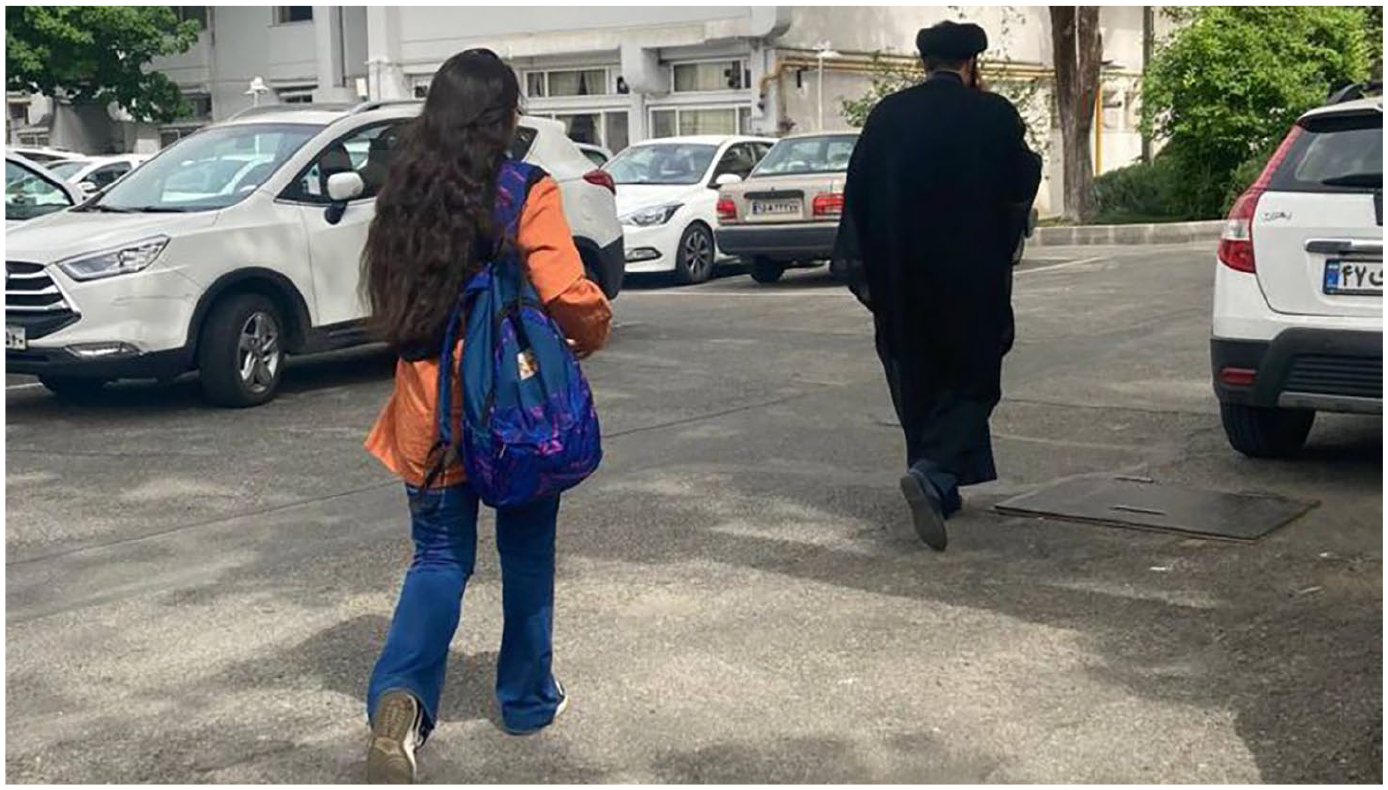
A young woman without hijab walks behind a Shia cleric.
The possibilities of controlling and disciplining these visible bodies are challenging for the state when individuals become collective and when the diversity of marked bodies increases. These diversities and particularities form the contours of our embodied surface, the differences that are mapped on our bodies and the markers of our social differences. A surface is a variable boundary, as Butler (1996) puts it, whose permeability is politically regulated. When Jina Mahsa Amini, as the embodied subject of the theocratic rule, died under the hijab laws, other Kurdish women embodied her subjectivity – in being a visible marked body, an outsider, a body ‘out of place’, a ‘space invader’ – by removing their hijab collectively in the public space of a cemetery on the outskirts of Saqqez and chanting Jin, Jîyan, Azadî. Their embodied act of resistance soon found its way into other surfaces, and women across the country, both religious and secular (Daneshpour and Firooz, 2022), filled public and virtual spaces with their marked bodies that stood tall and loud against the structures and apparatuses of oppression, violence and exploitation of women, gender and ethnic minorities and the working classes. Women’s unexpected and marked occupation of spaces and places represents a spatial and bodily collision of imaginations: female bodies with no hijab versus the theocratic state. They are situated in two diametrically opposed positions, this time, with the women and their visible bodies re-defining the boundaries of exclusion, of the otherness, of the outsiderness.
To adapt a phrase from Edward Said, the encounter of the two, defined in opposition to each other, is tantamount to being in a ‘state of civil war’ (see Puwar, 2004: 144). This was evident in the words of the eyewitnesses who were constantly involved in the protests for at least 4 months after the death of Jina Mahsa Amini. In a series of conversations we have had with a couple of teenage girls and female protesters, they explained in detail about their experiences in facing and standing up to the security forces and plain clothes. Echoing the words of one of these female protesters from Iran, ‘I suddenly found myself standing in front of him [a policeman]. He was tall and I was scared. For a brief moment, I just looked into his eyes, chanted Zan, Zendegi, Azadi [Woman, Life, Freedom] and [then] ran away as fast as I could’. Needless to say, as marked bodies, women’s presence disrupts and disorientates expectations, and therefore they undergo double exposure, which means that their numbers become amplified, such that even a small gathering of protest can represent a territorial threat to the authorities, with associated metaphors of war, battle and invasion (Puwar, 2004). ‘We went to Felestin Street with my two sisters after we heard about a protest that was planned to happen but no one was there when we arrived’, said the same protester quoted earlier, ‘for some reason we decided to stay longer’, she continued, ‘I don’t know how, but we suddenly began to chant “We don’t want the Islamic Republic”, and in a matter of seconds nearly forty boys and girls joined us and we all began marching and shouting other slogans together’. ‘That day’, she added, ‘I became the leader of a protest and for the first time I felt the power of us, the people’. Nevertheless, undeniable open acts of state violence were carried out by plainclothes militias and the security forces against protesters, especially targeting women differently by, according to an eyewitness, firing shotguns at their faces, breasts and genitals (Parent and Habibiazad, 2022) while men commonly had shotgun pellets aimed at their legs, buttocks and backs. ‘My face is marked with violence’, said a protester who had been shot by the police in her face, ‘and it won’t heal until the day our revolution succeeds’ (Figure 2).
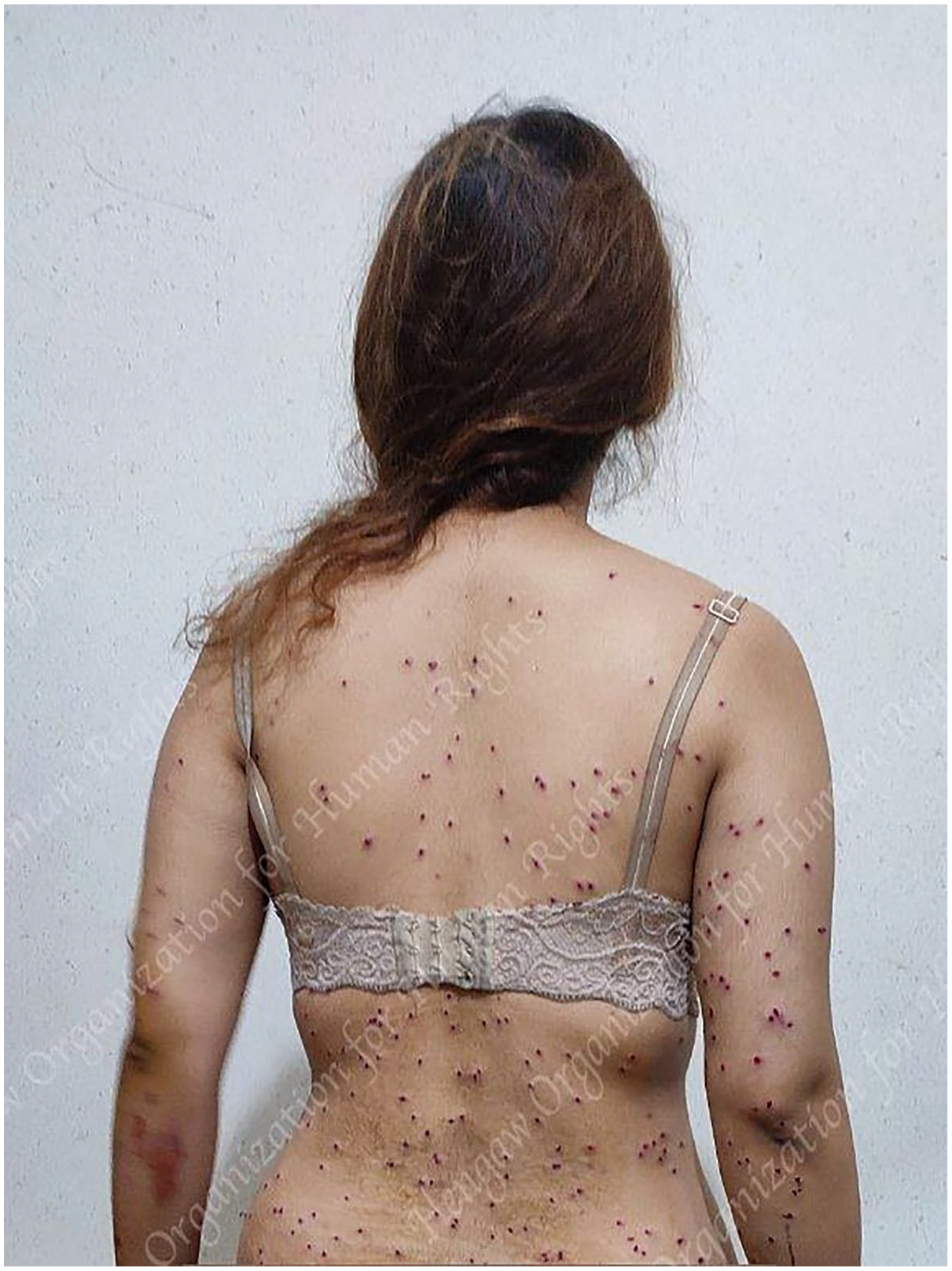
The marks of Birdshot – a type of shotgun pellet – bullets on the body of a female protester in Saqqez, Iran.
This protectionist attitude of the state to space has parallels with wider political discourses on ethnicity and outsiderness in Iran. The systematic ethno-regional discrimination against Kurdish population in western provinces, Baluch Sunni Muslims in southeast, Azeri in the north-west, Gilak in the north and Arab-speaking ethnicities in the southern part of Iran cannot be overlooked. To give a geo-historical context, the multi-faceted process of nation-state building and the forceful process of centralisation by Reza Shah in 1925 created a militant exercise of violence against the tribal-pastoral nomads, including Kurds, Bakhtiaris, Qashqa’is, and Shahsevans, among others. This can be seen, for instance, in Khosravi’s auto-ethnographic work ‘Illegal Traveller’ who, as a member of Bakhtiari tribe himself, declares ‘the “stability” and emergence of the nation-state under the Pahlavi (1925–1979) meant suffering and loss to us’ and that ‘the Islamic Revolution of 1979 changed our lives drastically and intensified our “outsiderness”’. Part of the Pahlavi’s programme of nation-state building was imposing, often with violence, a specific normative Persian identity and cultural practices, including the introduction of Persian/Farsi as a national language.
Reading this against Frantz Fanon’s critical account of the French colonisation and articulation of language and cultural identity for the Black population of Martinique, it can be said that language is a tool the oppressor uses in order to impose (what is seen as) rationality, civility and civilisation onto the diverse ethnic bodies of countries. As Fanon explains, speaking the dominant language becomes a property that endows the colonised with civility and is associated with the idea that the ‘culture of the mother country’ carries the symbolic power of being ‘the language of the civilizing nation’ (Fanon, 1986: 18). These practices, however, reached a new level of structural violence and systemic discrimination after the Islamic Revolution, which has long been characterised in the relationship of these geographies being peripheries. The statist structure of imposing order on the nation as a whole locks these peripheries into a strategically disadvantageous position vis-à-vis the states that dominate them (Matin, 2020). Among these peripheral geographies, for instance, Kurdistan and Sistan-Baluchistan suffer significantly from extreme poverty, lower life expectancy and higher rates of illiteracy, with many individuals turned into stateless bodies who are systematically denied national ID cards. Even obtaining the national card can be conditional, as in the case of Jina Mahsa Amini: the name her parents gave her at birth is Jina, a Kurdish name; however, they had to choose Mahsa, an Iranian name, in order to obtain her official birth certificate (Sadeghi-Boroujerdi, 2023).
The marked bodies of protesters
‘Protestors are space invaders’ (Routledge, 2017: 1). At the same time, protesters [re]make space because it is never static, but rather plural, multiple and subject to transformation. Following Jina’s death in custody, the transformation of space by protesters came into full swing as they expressed new characteristics and connotations of space, place and gender in Iran. In order to disrupt authority, different forms of political art and performative acts mushroomed to challenge the pre-defined meanings and feelings associated with particular places. According to Fatemeh Shams (in Kousheh, 2022), every week a new revolutionary poem and performance would fill the public and virtual space that praise the recapturing of life, giving hope and distancing from political slogans while at the same time staying loyal to the ideals hidden in the three symbolic words that have become the rallying cry of this movement: ‘Woman, Life, Freedom’. As Pamela Karimi also explains, under the state’s regulatory regime, Iranian female artists engaged with space and place differently, removed their identities from their creative acts of protests and amplified the political message of Woman, Life, Freedom through their artwork. She points out how these protests blurred the line between art and activism became a kaleidoscope of aesthetic modalities that transformed the grit of politics and dissent into art (Karimi, 2023a: 86). For instance, in the widely shared images and videos on social media, a masked young woman is perched atop an unsteady metal pole, from which she has suspended a banner that depicts Khamenei wearing a turban fashioned from nooses, accompanied by the caption, ‘Water the tree of the revolution with my blood’ (Karimi, 2023b). Another anonymous artist poured red dye into the fountains in Fatemi Square in Tehran reflecting on the Iranian protesters killed in cold blood. Other individuals (especially college students) used trees or other urban furniture such as lampposts to chain themselves to while bending down in submission, in order to embody the torture of Khodanour Lojei who died in hospital after being fatally shot on 30 September 2022 during the Zahedan Massacre (aka. Bloody Friday), during which state forces brutally killed more than 90 individuals in Zahedan, Sistan and Baluchestan (Torkameh, 2022). Performance, therefore, as a powerful act of resistance became a semiotic way of protest. Re-enacting factual moments of oppression, pain, suffering and even joy, it defied the tyrannical power – which tends to control the public body, and created a novel space of theatrical disobedience (Figure 3).
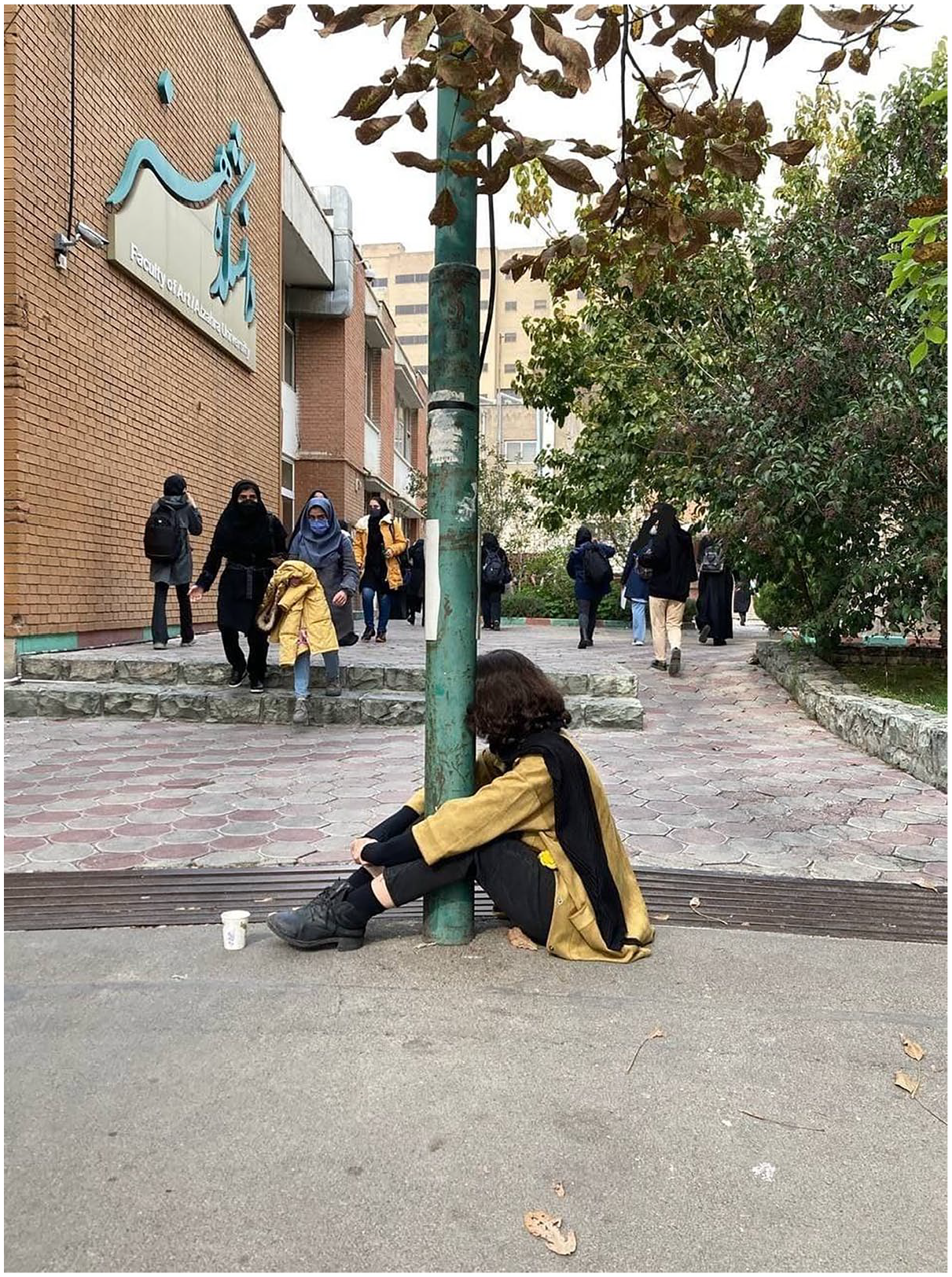
Al-Zahra University, Tehran, Iran, 12 November 2022. A student re-enacting the torture scene of Khodanour Lajaei being tied to a flag post by the state agents. Khodanour was shot during the Zahedan massacre (aka. Bloody Friday) on 30 September 2022 and died in a hospital on 2 October.
The corporeal expression of women and their consistency on the display of resistance in these protests – whether orchestrated by artists or non-artists activism – are thought provoking. When, for instance, in December 2022 a woman in Tehran, disguised in a bonnet to conceal her identity, stood on a pedestrian bridge wearing an outfit from the TV series The Handmaid’s Tale, she embodied a gendered script that imposes oppressive rules of bodily surface on women from above (Karimi, 2023b). However, at the same time, she also actualised the absolute negation of the prescribed and pre-defined rules of bodily surface through her corporeal artistic activism. The emergence of revolutionary bodies and their activism were not only limited to the surface of the streets, squares or bridges in the city. They, in fact, found many other spaces, such as educational spaces, to invade as well. Refusing to be divided by gender-segregated dining areas to start with, many of them abandoned their classes and called for the release of their detained friends (Karimi, 2023a: 88). Music majors at various universities filmed themselves performing protest songs while blurring their faces or showing their tapping feet. This was especially widespread when the students at Tehran University of Art chained their hands and embodied the soldiers’ close-order manoeuvering (drilling or marching) while singing a patriotic song entitled Vatanam (Farsi for ‘my homeland’). Other fine arts majors created a mass choreography of the word blood (khun) on the campus quad and stained their school’s bathroom mirrors with red stenciled words that read, ‘This is the face of someone who can make a change’ (Karimi, 2023b). [Female] students of Al-Zahra University in Tehran joined the protests chanting one of the most radical and progressive slogans of the movement: Marg Bar Setamgar, Che Shah Bashe Che Rahbar [‘Down with the oppressor, whether he is a King or a Supreme Leader’]. Their performative activism is especially important to consider here, as they are the students of a female-only public university and have always been assumed to represent one of the most conservative or politically neutral universities in Iran (Torkameh, 2022). By challenging perceptions and feelings associated with particular places, their activism transformed what was usually seen, heard and felt as a conservative, female-only gender-segregated educational space. Another group of space invaders that radically transformed certainties of how space and place were conceptualised were schoolgirls. Schoolgirls of all ages removed their hijab inside the schools; ran male officials out of their schools; sat in groups in schools courtyards to sing Baraye, a song which became an anthem for the protests; chanted radical slogans such as ‘Death to the Dictator!’, ‘We are all Mahsa, We’ll fight you back!’ and ‘Zan, Zendegi, Azadi!’; and pulled down the images of the two supreme leaders that hung on the walls of the classrooms and replaced them with the hand-written slogan ‘Woman, Life, Freedom’. According to the words of an eyewitness, high school girls had to hide their schoolbooks under the heaters and in secret places inside the wardrobes as the police forces began raiding the schools in order to identify pupils whose books may have a torn-up page where there is usually a portrait of the supreme leader (Figure 4).
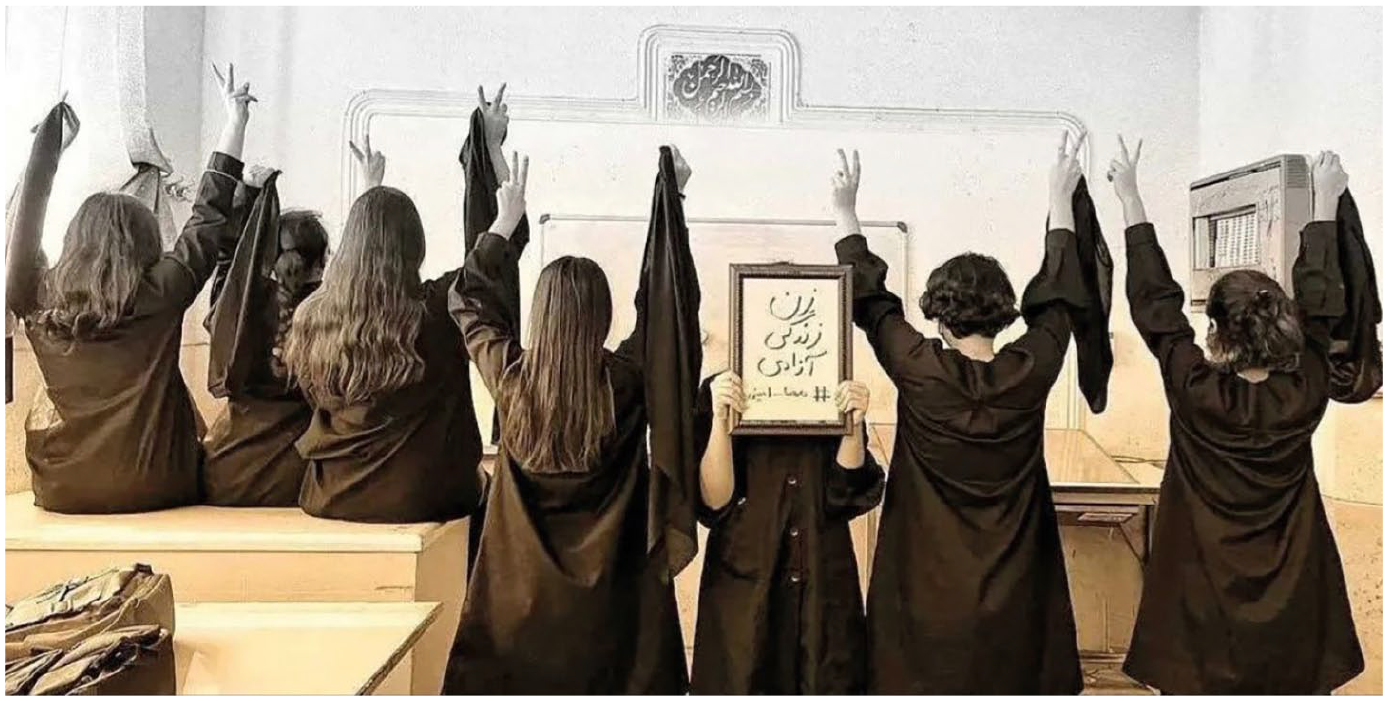
A group of Iranian schoolgirls protest in the classroom while removing their compulsory hijab. Covering her face, one holds a sign which reads: Zan, Zendegi, Azadi [Woman, Life, Freedom].
While pupils and students transcended the boundaries of the educational space into the political space, the mourning mothers and fathers of those killed in the protests began to transform the religious ceremonies and practices of mourning into political performance and activism. They amplified their children’s favourite songs on their graves; sang lullabies that reflected women’s resistance; danced, clapped and ululated collectively; and turned every chehellom (the 40th day of the death vigil) into an act of political protest, as they were joined by a wider community. By engaging with people’s emotions, these parents challenged the hegemonic ideas and framings in society, enabling the construction of group commitment and solidarity, and developing oppositional power from below (Routledge, 2017). By refusing to stay silent, invisible and unmarked, protesters performed visible acts of resistance that cut through the status quo and stood against years of oppression and religious fundamentalism (Figure 5).
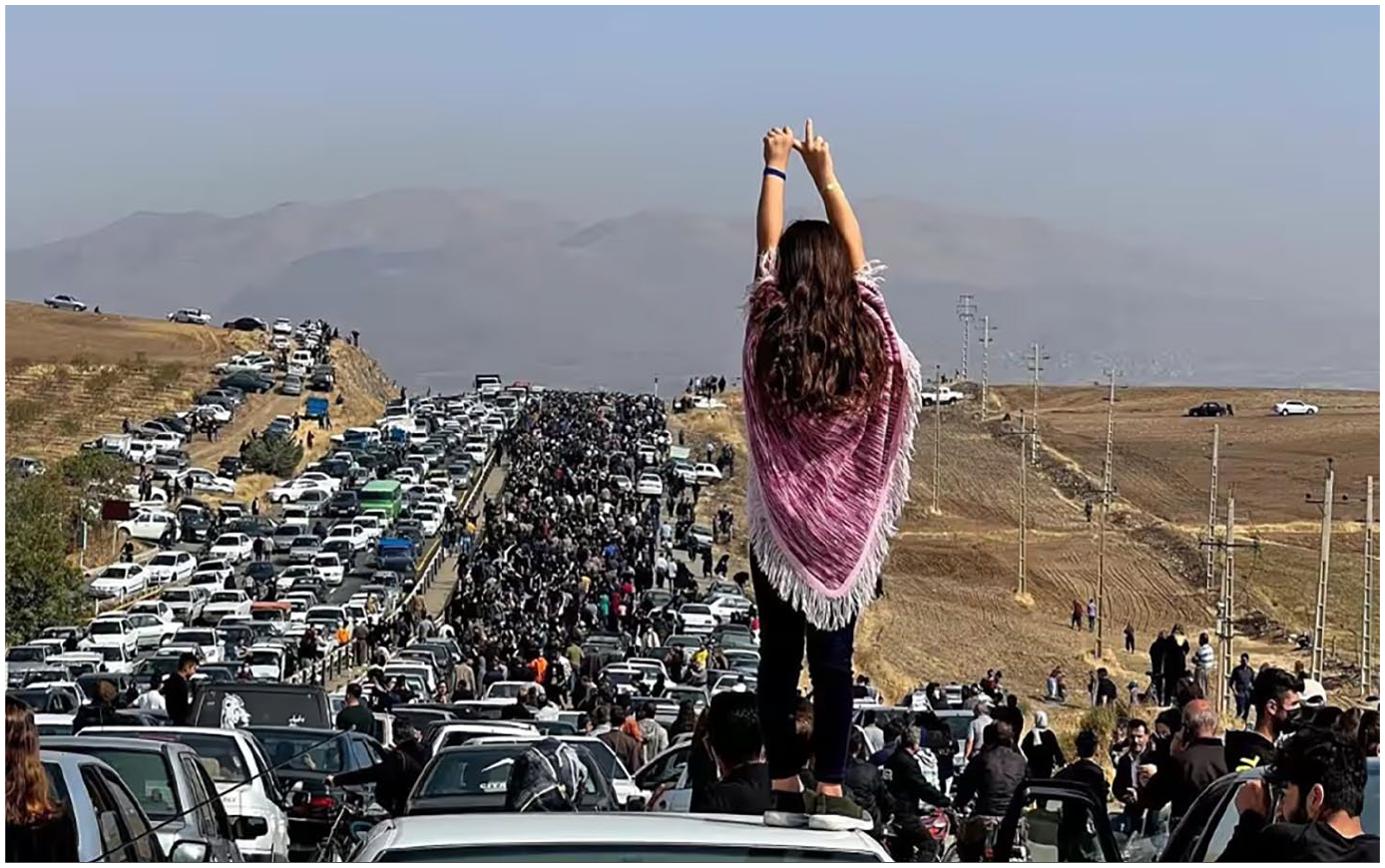
Protesters marching to the gravesite of Jina Mahsa Amini on her chehellom – the 40th day after her death.
Concluding remarks
This article has analysed Iran’s 2022 uprisings, utilising Puwar’s notion of ‘space invaders’ (2004) and also furthered her focus by looking at a spectrum of feminist political activism in Iran, which constitutes a form of space invading. Hence, it has pivoted both space invaders/invading. The other who is ‘out of place’ here is the female body who transgresses oppressive Islamic codes of appearance in public spaces to revolt and to claim autonomy of body and personal/ethnic identity, in a way that the construction of political subject and the identity of place to be transformed into multiple, shifting, possibly unbounded identities (especially in the case of marginalised geographies in Iran). In a theocratic establishment that, according to Moghadam and Haghighatjoo (2016), poses fundamental obstacles to women’s participation, rights and leadership in different spheres, Iranian women turned into a socio-political force for fundamental changes in the system. The demand of the space invaders of recent Woman, Life, Freedom uprisings in Iran is clear: they say ‘No’ to gender oppression and the crude codes that are central signs of discriminatory practices through which social spaces are formed. They demand the recognition of a multiplicity of differences. They consciously become ‘space invaders’/bodies ‘out of place’ and occupy public, private and virtual spaces to mark their existence. Woman, Life, Freedom mobilisations have created a new generation of ‘space invaders’ who do not negotiate, but constantly exercise their right to occupy public spaces through protest, activism, performance as well as the mundane yet risky acts of everyday life such as walking in the streets, strolling in the squares and parks, without wearing the compulsory hijab. Consciously negating the authority of the state apparatuses, these space invaders defy conventions and boundaries, and their arrival continues to create new codes for a politically and culturally constructed version of ‘woman’ in Iran.
Footnotes
Acknowledgements
We would like to thank the reviewers, whose insightful comments and critiques helped us in the process of refining this piece.
Data Availability Statement
Data sharing not applicable to this article as no data sets were generated or analysed during the current study.
Declaration of conflicting interests
The author(s) declared no potential conflicts of interest with respect to the research, authorship and/or publication of this article.
Funding
The author(s) received no financial support for the research, authorship and/or publication of this article.
