




Abstract
Despite recent calls for ‘ordinary’ citizens to become active and responsible as individuals in preventing and countering terrorism and radicalisation in the United Kingdom, little is yet known about how members of the general public make sense of political violence, or about how they think it should be dealt with. Using a bottom-up vernacular security studies approach, this article examines what lay citizens believe about the causes of terrorism and what responses they think are appropriate. Based on qualitative data from one-to-one interviews with members of the public and an analysis based on constructivist grounded theory methodology, the article discusses three key figures that emerged from interviewees’ accounts of terrorism: the vulnerable subject, the radicalised individual and the radicaliser. Overall, the results reveal that a radicalisation framework is dominant in participants’ discourses on terrorism. The article argues that the dominant imaginaries of terrorism identified in this research draw consent towards pre-emptive security practices such as the Prevent duty and de-radicalisation interventions. The discussion problematises the depoliticisation of political violence and the normalisation of illiberal security measures that this conceptualisation of terrorism entails, while stressing the discriminatory character of the social imaginaries of terrorism.
Keywords
Introduction
Over the last two decades or so, counter-terrorism has become frequently present in the United Kingdom as a result of three significant developments. First, anti-terrorism law was established on a permanent basis for the first time in the United Kingdom with the Terrorism Act (2000), which significantly expanded the definition of terrorism and focused on ‘all forms of terrorism’ (Walker, 2003). Second, British counter-terrorism, which had historically centred upon criminal prosecution, was supplemented in 2006 with measures designed to pre-empt terrorist activity (Syrett, 2015): CONTEST (the United Kingdom’s primary counter-terrorism strategy) and specifically its Prevent stream, which aims to stop people becoming terrorists or supporting terrorism. Finally, these developments in British counter-terrorism have been accompanied by an unprecedented turn in the involvement of civil society in countering terrorism (Heath-Kelly, 2017). Since the passing of the 2015 Counter-Terrorism and Security Act, public workers such as teachers, social workers and healthcare professionals have had a statutory duty to participate in the prevention of terrorism, thus becoming an important part of the British counter-terror strategy (HM Government, 2015). Moreover, over the last few years, calls for the general public to participate in counter-terrorism have substantially increased, which represents a dramatic expansion of British counter-terrorism into everyday life (Rodrigo-Jusué, 2022).
Despite the pervasive presence of counter-terrorism in everyday life and increasing demands for civilian participation in national security, there is still a lack of research on how members of the general public imagine terrorism, its causes and its manifestations and how they think political violence can be resolved. 1 Research has overwhelmingly focused on ‘how elites (political, academic, media and cultural elites) understand and construct terrorism’ (Jackson and Hall, 2016: 294), and how the Prevent duty is viewed and enacted and/or resisted by counter-terrorism experts and professional agents such as Prevent practitioners and individuals with the duty to intervene to prevent radicalisation (Dresser, 2019; Elton-Chalcraft et al., 2017; Younis and Jadhav, 2020). In addition to research on authorities and experts, a considerable body of literature has addressed the negative impacts of the substantial transformation in British counter-terrorism strategy within Muslim communities specifically, as these communities have been disproportionately affected and constructed as the new ‘suspect community’ in the United Kingdom (Breen-Smyth, 2013).
This prioritisation of research on security experts, responsible authorities and ‘suspect communities’ means that little attention has been paid to the attitudes of members of the general public. While research has focused on the ways in which particular individuals and groups perceive terrorism and counter-terrorism strategies, the opinions and experiences of lay citizens, regardless of their gender, age, religion or ethnicity and any perceived association with ‘suspect communities’, have attracted less academic attention. Nevertheless, investigating ‘ordinary’ people’s understandings of terrorism and counter-terrorism is becoming ever more crucial as the public’s role in countering terrorism becomes more salient in the United Kingdom. Understanding more about how lay citizens make sense of political violence, the reasons they identify behind terrorist attacks and what kind of responses they deem appropriate is important to comprehend general views and attitudes towards contemporary public policies and security strategies.
This article contributes to filling this important gap by providing rich qualitative data on lay individuals’ views on terrorism, radicalisation and counter-terrorism measures, including de-radicalisation interventions. The article employs the concept of the ‘social imaginary’ (Taylor, 2004) as a valuable analytical tool to explore and theorise lay individuals’ understandings of and attitudes towards (counter )terrorism. While vernacular studies literature occasionally employs the concept of ‘imaginary’ as a vague synonym for ‘understanding’ or ‘view’, this article argues that the concept of the imaginary should be rather understood as the ‘symbolic matrix’ (Valaskivi and Sumiala, 2014) that enables the ‘collective practices’ that produce our social worlds (Taylor, 2004: 24).
Using constructivist grounded theory as a method to analyse interview data, this article identifies the radicalisation framework as central in lay terrorism discourse among research participants and reveals a widespread acceptance of public participation in preventive counter-terrorism among the lay citizens in this study. The article makes an important contribution by introducing three key figures through which lay citizens make sense of terrorism: the vulnerable subject, the radicalised individual and the radicaliser. The final part of the article discusses how the dominance of the radicalisation framework (encapsulated by the three figures) among the lay citizens in this study reflects a gradual depoliticisation of political violence and a pathologisation of political dissent. The discussion stresses how the imaginaries of terrorism identified in the participants’ accounts result in the normalisation and acceptance of problematic illiberal measures including mass surveillance and de-radicalisation interventions. The article ends by emphasising how the discriminatory social imaginaries of terrorism and radicalisation imply damaging effects on particular individuals and groups in the United Kingdom.
Literature review: how do lay citizens imagine terrorism, its causes and its ‘solutions’?
The lack of empirical research to date on how lay individuals talk about and understand terrorism has been partially addressed by vernacular security studies scholars. A vernacular security studies approach puts an emphasis on the everyday and on the importance of researching security from the perspective of the citizens, in contrast to more traditional approaches focusing on the state and the elites (Jarvis, 2019), which typically speak ‘for’ rather than ‘with’ ‘ordinary’ citizens (Jarvis and Lister, 2013). Although they mainly focus on personal experiences of security and on the impacts of counter-terrorism on citizenship, Jarvis and Lister (2016) provide some important insights into how lay members of the public view counter-terrorism strategies. Also from a ‘bottom-up’ approach, a recent study explored Higher Education students’ views on radicalisation (McGlynn and McDaid, 2019).
In their study, based on the analysis of seven group conversations with 14 individuals carried out in Wales at the beginning of the 2010s, Jackson and Hall (2016) made a first attempt to understand what lay people ‘know’ about terrorism, its origins and motivations and the best ways of dealing with it. Their study constituted a pioneering attempt to comprehend ‘ordinary’ people’s understandings of terrorism and their views on the effectiveness of counter-terrorism measures in the United Kingdom. Nevertheless, since this initial effort to explore popular understandings of terrorism in the United Kingdom nearly a decade ago, to my knowledge no other research has explored how lay people in the UK talk about and understand terrorism, and what they think its causes and ‘solutions’ are. However, it is important to note that relevant research on public opinion and attitudes towards terrorism and counter-terrorism policy has been carried out in the US context (see Davis and Silver, 2004; Kam and Kinder, 2007; Manza and Brooks, 2013; Mueller and Stewart, 2018).
Drawing on vernacular security studies literature, a small but growing body of research has recently emerged analysing popular understandings and everyday narratives of terrorism and counter-terrorism online (Bogain, 2020; Da Silva and Crilley, 2017; Evans and da Silva, 2023). Thus, some scholars have pointed to social media not only as a fruitful source to explore public constructions of terrorism (see Downing et al., 2022), but also as an interesting platform to analyse how social media users and activists participate in counter-terrorism online through the employment of memes and humour (McCrow-Young and Mortensen, 2021). However, while acknowledging the significant opportunities presented by social media to examine public opinions, attitudes and beliefs on terrorism, this article stresses the importance of reaching those individuals who are not (necessarily) active online content creators and/or digital natives. Since online comments are most often reactions to a specific piece of content and may be limited to a certain number of characters, off-line methods such as one-to-one interviews offer the opportunity to explore individuals’ ideas in a deeper and less constrained manner.
Finally, research on public opinions on and perceptions of terrorism and counter-terrorism in the United Kingdom has also been carried out through a small number of quantitative research projects. The NatCen’s report British Social Attitudes 34 provides valuable insights into British citizens’ views on national security and terrorism and their general attitudes to civil liberties, social rights, religion and other security measures (Clery et al., 2017). Another quantitative study (Kunst et al., 2023) has also made an important contribution in terms of what Muslims and non-Muslims identify as the main causes of radicalisation, the different ways they perceive the causes behind various types of terrorism, and how their perceptions impact their support for particular counter-terrorism strategies. Although these quantitative studies provide useful statistical data, the research designs and the character of their data does not allow for a deep exploration of the social imaginaries of terrorism. With this in mind, the next section stresses the value of in-depth interviews for exploring the social imaginaries and lay discourse of (counter)terrorism.
Analysing the social imaginaries of terrorism: in-depth interviews and a grounded theory approach
Although focus groups have proved to be a useful method for exploring lay people’s views, attitudes and everyday discourses in relation to (counter) terrorism, this article argues that in-depth interviews are the most effective method ‘to obtain individual attitudes, beliefs and feelings’ (Gibbs, 1997: 2), particularly when dealing with such a highly sensitive and controversial topics as (counter)terrorism. In group debates, participants typically feel obliged to defend a particular view or stand up for a particular position, while ‘battles over morality’ (Meyer, 2008) are not rare. This does not give participants the opportunity to provide a more nuanced view on a topic. In contrast, one-to-one interviews provide research participants with the opportunity to elaborate on the complexity of their opinions and experiences and researchers with the possibility to grasp individuals’ substantially different conceptions, meanings and attitudes, and to appreciate participants’ unique ways of perceiving, seeing and processing the environment they live in, which is key to investigating the social imaginaries of terrorism.
My research adopts one-to-one interviews as the most effective method to investigate how lay citizens comprehend the causes and manifestations of political violence and how they think terrorism should be dealt with. I carried out a total of 12 audio-recorded interviews (n = 12) in Brighton and Hove (East Sussex, UK) between January and April 2019 (see Appendix 1). As other qualitative literature has noted, this research design cannot claim and should not be used to indicate statistical representativeness, but it can nevertheless be used to identify recurring patterns of responses in interview data. While a sample of this size is not representative of any general population, which is rarely the goal of a qualitative research approach, it certainly provides valuable original data on an under-researched topic. Most notably, this study reveals particular speech patterns and attitudes within a very diverse group of participants that matches with previous research findings on lay discourses on terrorism. This might suggest the existence of particular imaginaries of terrorism among lay members of the public more generally.
Research participants were aged between 25 and 75 years, and they were recruited using the snowball technique (i.e. ‘relying initially on friends and colleagues and then on contacts given by other interviewees’; Rapley, 2007: 17) rather than by reaching out to individuals through a call/advert. Recruitment was designed in this way because the research did not seek to represent any specific social group or part of the population: the goal was to reach ‘anyone’ rather than individuals particularly interested in expressing their opinions on (counter)terrorism. Furthermore, this method of recruiting participants also allowed me to ensure that the individuals selected were not employed in the counter-terrorism industry and to gather a diverse group of participants. To enhance the diversity of the snowball sample, I began the sample with seeds that were as diverse as possible (Kirchherr and Charles, 2018), consciously taking into consideration individuals’ age, gender, occupation, ethnicity, sexual orientation, religion and functional diversity, with the aim of obtaining a rich and complex data set reflecting a wide range of personal views and life experiences in relation to security and (counter)terrorism. The snowball recruitment technique proved to be very useful in securing significant levels of trust between interviewee and interviewer (Atkinson and Flint, 2001). This was a crucial element in the research, since participants were asked to talk about their own experiences and to discuss highly sensitive personal and political topics.
To allow for a wealth of information to emerge spontaneously in the interview while also ensuring participants remained focused on the discussion topics, the interviews were semi-structured. This resulted in a rich data set of around 7 hours of audio-recorded interviews and 40,000 transcribed words. Data was analysed from a constructivist grounded theory perspective (Bryant and Charmaz, 2007; Charmaz, 2004), which means that theoretical analysis was inductively and iteratively constructed from qualitative data while acknowledging that, far from being neutral, objective and ‘unproblematic’, data constructions reflect researchers’ ‘social, epistemological, and research locations’ (Charmaz and Belgrave, 2012: 349). In contrast to an objectivist grounded theory perspective, according to which ‘theorists are neutral analysts of a knowable external world’ and data is ‘uncontaminated by preconceived notions and theories’, a constructivist variant of grounded theory concedes that the interpretation and meaning of data cannot be only located within the data itself (Charmaz and Belgrave, 2012: 349). As a result, a constructivist grounded theory approach necessarily adopts ‘a reflexive stance’ towards the researcher’s background, values, situations and relationships with the interview participant, and situates ‘research in the historical, social, and situational conditions of its production’ (Charmaz, 2017). As in previous research on vernacular discourse on (counter )terrorism, this study also approaches its findings as situated in the context of their production and constructed inter-subjectively (see Jackson and Hall, 2016; Jarvis and Lister, 2016).
Taking a grounded theory approach involved collecting and analysing data simultaneously and making constant comparisons to deliver a conceptual understanding from the data (Charmaz, 2006; Charmaz and Belgrave, 2012). During the analysis, interview transcriptions were read and re-read numerous times to build familiarity with research participants’ voices, to identify and categorise relevant information and to consider different meanings. The analysis consisted of a gradual abstraction process, which first involves the creation of codes and sensitising concepts, followed by the establishment of abstract categories, and finally the development of theoretical concepts (Bryant, 2017). This overall process was aided by the use of the qualitative data analysis software NVivo 12, which was very helpful as a tool for breaking down the data and facilitating systematic comparisons.
Data analysis started after the first interview, with initial codes emerging from the analysis of the transcription. A total of sixty codes were created in the analysis of the first six interview transcriptions. In this process of analysis, memo writing constituted an extremely important device that allowed me to identify recurrent themes and to move from coding to generating a preliminary analysis by creating ‘tentative conceptual categories’ (Charmaz and Belgrave, 2012: 357). After close examination of the first six in-depth interviews and rigorous comparison for differences and similarities, the sample was expanded with an additional six interviews and questions. Theoretical sampling resulted in the creation of additional categories and in refinement of the initial categories by comparing new data against the initial ‘tentative categories’ (Charmaz and Belgrave, 2021: 349). Although in-depth interviews rarely produce a clear case of data saturation, it is important to highlight that no new codes were identified after the analysis of the fifth interview, and no additional categories were produced in the analysis of the last four interviews.
A constructivist approach demanded ‘acknowledging the role of language and discourse in the construction of reality’, which involved paying special attention to interviewees’ ‘discursive constructions’ (Scheffels, 2009: 473), including expressions, narratives and common speech patterns. For this reason, participants’ own words were prioritised and used throughout the analysis process, and they have also been reproduced as directly as possible in the findings. The following section explores the four key theoretical categories that were created, grounded in the analysis from the interviews: irrational violence, vulnerability, brainwashing and illiberalism.
Results
The nature of terrorism
During the first 5 minutes of the interviews, research participants were asked to describe their thoughts when hearing the word ‘terrorism’. Perhaps not surprisingly, nearly all the participants mentioned bombs, explosions and violence, and some pointed at 9/11 as the ultimate example of terrorism. While all the participants regarded terrorism as an exceptional use of violence by non-state actors such as the Islamic State of Iraq and Syria (ISIS) and the Irish Republican Army (IRA), three interviewees added a critical perspective, explaining that the concept of terrorism also functions as a ‘label’ which is strategically applied against particular (racialised) actors. In relation to the causes of terrorism, some participants broadly described terrorism as a form of ‘revenge’ or ‘retaliation’ by a ‘marginalised’ group, and understood it as a violent (political) strategy, while most vaguely identified terrorism as an extraordinary act of violence performed by a gang or an individual without a clear motive and/or purpose.
As the interviews progressed, most of the participants who had initially determined a political cause and/or purpose behind terrorism shifted to an ‘orthodox’ perspective, according to which terrorists are criminals and/or ‘madmen’ who lack political goals and motivations, and terrorism must be countered through the use of force, intelligence and policing (see Jackson et al., 2011). For example, one research participant defined terrorism as ‘bombs’, ‘fear’ and ‘hurting innocent people’ (Interview 2), another simply as ‘violence’ (Interview 10), and another stressed the incomprehensibility of terrorism, comparing it to paedophilia: ‘Just as I don’t understand paedophiles or anything like that, I just don’t get why [. . .] somebody [. . .] behave[s] in that way’ (Interview 9).
Nonetheless, when research participants were asked about how and why individuals become involved in terrorism, the narrative of an individual process of radicalisation emerged as the major discursive pattern among most of the interviewees. Only one participant persistently challenged this thesis, which establishes that terrorism occurs when a vulnerable individual goes through a gradual process of radicalisation induced by a negative influence through which they acquire extremist ideas that draw them into terrorism. As the conversations went into more depth, discussing what terrorism is, why terrorist attacks occur, who is responsible and why some people engage in political violence, recurring themes began to emerge, and consistent accounts were given by nearly all the participants. Overall, three key figures were read out of the interviewees’ accounts, which provide valuable insights into some of the existing social imaginaries of terrorism in the United Kingdom: the vulnerable subject, the radicalised individual and the radicaliser.
The vulnerable subject
Most research participants subscribed to the idea that terrorism occurs when ‘vulnerable’ individuals become ‘radicalised’ and/or are ‘brainwashed’ by others to carry out violent acts. For most participants, ‘radicalisation’ and/or being ‘radicalised’ had a negative meaning directly linked to violence, and interviewees frequently used both terms interchangeably with ‘extremism’ and becoming an ‘extremist’. Notably, nearly all the participants believed that some people are more easily radicalised than others, with most citing vulnerable individuals such as victims of abuse and/or ‘weak’ individuals as more prone to ending up involved in terrorism due to negative aspects of their personal circumstances (including drug abuse, loneliness and unhappiness). Although common speech patterns and discourses among research participants are relevant for this analysis from a grounded theory perspective, it is important to highlight that research findings do not aim to be representative of the whole population. Nonetheless, they provide relevant insights into vernacular discourses on terrorism and how some participants ‘make sense’ of political violence.
My interview analysis shows how in the social imaginary of lay individuals the vulnerable individual is pictured as someone with mental health conditions and/or cognitive disabilities. Vulnerable individuals were mainly imagined by participants as male individuals with cognitive disabilities and/or problems of mental health conditions, but also as individuals who are ‘lost’, ‘unhappy’ and/or looking for a purpose and/or ‘meaning’ in life. Some interviewees directly referred to young Muslim men as the most vulnerable to radicalisation, specifically because of their close contact with imams (Interview 5), a general sense of emptiness/lack of purpose (Interview 3) or their experiences of racism and Islamophobia (Interview 1).
Overall, participants established a causal link between mental health and/or cognitive disabilities and terrorism. One participant pointed to mental health, low self-esteem or the desire to belong to a group as possible factors behind radicalisation (Interview 2). Another participant claimed that ‘vulnerable people can become radicalised [in] many different ways, especially with the Internet’ (Interview 4). Interviewee 5 argued that ‘whether is Islamist, whether is far-right [sic]’, anyone who is not ‘in [a] good place [and who] hasn’t got the mental capacity [. . .] could be easily persuaded’. Similarly, another participant argued, ‘if someone is mentally unbalanced it wouldn’t take much to set them off’ (Interview 3). Another participant stated, [at] the top of the terrorist cell, or a terror organisation, there are influential, strong characters who are looking for the vulnerable [. . .] the disaffected. Because if you’re not disaffected, if you are not unhappy, then the rhetoric won’t appeal to you [. . .]. (Interview 12)
Although rare, there was also evidence of resistance to the vulnerability thesis. One participant countered this rationale by pointing at life experiences and the historical and structural causes behind terrorism, and claimed that radicalisation is not necessarily violent and/or negative (Interview 8). Another participant who had previously used the language of vulnerability to explain the causes of terrorism later argued that ‘anyone’, including people who are ‘extremely intellectual’, can become radicalised (Interview 9). Despite the existence of alternative views, it is notable that the figure of the vulnerable individual played a significant role in the terrorism discourse of most of the participants. The vulnerable individual represented a central theme in the imaginary of terrorism of research participants by providing an explanation for who gets involved in terrorism (the vulnerable), how (under negative influences and/or abuse) and why (lack of resilience/weakness due to their personal situation).
The radicalised individual
The ‘radicalised’ individual was identified as the main actor behind acts of terrorism by most of the research participants. Analysis of the interview data shows that terrorism is commonly imagined as the violence produced by a vulnerable individual who has been radicalised but who, nonetheless, could be de-radicalised. Most interviewees pictured radicalisation as an individual step on the path to terrorism, and understood a radicalised person as someone who is in the mindset of being able to (and wanting to) carry out acts of violence.
In the imaginary of the majority of the participants, radicalisation is carried out against someone’s will and is thought of as a type of abuse. Radicalisation was often described as an unconscious and harmful process. Most interviewees agreed that individuals become radicalised through the negative influence of another individual, through manipulation, persuasion, grooming and/or brainwashing; participants frequently employed these terms interchangeably. Radicalised individuals were most often described as ‘brainwashed’, and their ideas and practices as involuntary and somehow unconscious. For instance, one participant referred to radicalised subjects as ‘almost hypnotised people’ (Interview 7) and another compared radicalisation with ‘joining a sect’ (Interview 10).
Radicalisation was mainly comprehended as the opposite of well-being, and it was frequently equated to a sickness. For example, when discussing de-radicalisation, a research participant claimed: ‘I don’t believe there is a treatment or something to cure these people’ (Interview 9). Nonetheless, my data analysis shows that de-radicalisation plays an important role in social imaginaries of terrorism and radicalisation of some lay citizens. Even though research participants did not know what de-radicalisation interventions involved, nearly all believed that it is possible and desirable to de-radicalise an individual. De-radicalisation was commonly associated with care and counselling, and imagined as a psychological therapy by most participants. Only a few interviewees opposed the idea that these interventions are an effective counter-terrorism strategy. Thus, it would be interesting to carry out further research on British citizens’ attitudes towards counter-terrorism.
In research participants’ accounts, the radicalised individual is personified by a young male figure. Nearly all the participants believed that men are more easily radicalised than women, although many could not explain why they held this belief. One participant said that it is most often men who get radicalised because they tend to follow leaders more than women (Interview 6). Another participant explained that men are more often radicalised than women because they are less empathetic (Interview 12), and another argued that men resort to violence because they are not taught to deal with their emotions and ask for help (Interview 11). While many participants said that radicalisation is not necessarily linked to any particular group and/or ideology, some interviewees openly identified radicalisation with Muslims. One interviewee explained that [. . .] it’s always nearly younger guys that they get radicalised [. . .] especially maybe young Muslim guys who they have been involved in drugs or their families are quite wealthy, and they have tried all the different things [. . .] but there is something missing in their lives. (Interview 3)
Another explicitly referred to ‘radicalisation within Islam’ and referred to mosques as the main space where radicalisation occurs (Interview 5). Thus, it can be deduced that for many interviewees the radicalised individual is epitomised by a young Muslim male.
The existence of ‘signs’ of radicalisation plays a conflicting role in social imaginaries of (counter)terrorism and radicalisation of research participants. Half of the interviewees said that radicalised individuals can be identified by certain ‘signs’ (such as changes in behaviour, their speech, being angry, looking anxious, nervous, frightened and/or disturbed), while the other half were unsure and/or thought it was not easy to identify someone who is radicalised because individuals can hide it. Only one participant confidently stated that unless someone clearly shows support for terrorist attacks it is not possible to identify ‘signs’ of radicalisation. Interestingly, most of the research participants thought that teachers and doctors could prevent terrorism and/or play an important role in countering terrorism if they received adequate training. Only two participants expressed a clear opposition to the involvement of public sector workers in countering terrorism and radicalisation.
The radicaliser
The figure of the radicaliser emerged from the accounts of most of the research participants when they were making sense of terrorism. Participants drew on the imaginary of the individual who radicalises vulnerable subjects to explain the causes of terrorism, apart from the one interviewee who clearly stated their opposition to the radicalisation thesis. Radicalisers were pictured as individuals in prison for terrorist offences (Interviews 2, 3, 9), imams (Interview 5) and recruiters who brainwash vulnerable individuals (Interviews 4, 11, 12). The interviewee who identified imams as the main radicalisers explained that apart from ‘planting bombs’ and ‘killing people’, extremism ‘also consists of promoting to others [. . .] that they should go out there and sacrifice for the cause’ (Interview 5). Radicalisers were typically pictured as strong (male) characters and (religious) leaders by many research participants. For example, a participant who stressed the role of the ‘charismatic leader’ and gave Osama Bin Laden and Saddam Hussein as examples explained, I think again it’s leadership, isn’t it? They look up to a leader who they believe is a saint, is God [. . .] I think it’s just brainwashing people, just trying to make people see that if they do something like that this is good in their mind [. . .]. (Interview 6)
The role of leaders was also stressed by another interviewee who talked about the existence of ‘influential strong characters’ in terrorist organisations (Interview 12). In the imaginary of most of the interviewees, the radicaliser is somehow understood as the ‘real’ terrorist who recruits individuals to their cause through manipulation. While some referred to ‘brainwashing’, others suggested that radicalisers use techniques of persuasion on easily influenced people. For example, the participant who likened radicalisation to recruiting people to a sect explained that there are people ‘somewhere in the world’ whose aim is to find people and ‘use their weakness’ to fill them with the ‘information they want’ with the ultimate aim of using these individuals against other people (Interview 10). Similarly, another participant argued that [terrorists] ‘talk to people and make them see that they are right’ (Interview 7).
While some research participants also mentioned the media as a source of radicalisation, most rejected the idea that an individual can become a terrorist in a short period of time through media consumption. Rather, participants in this study comprehended the radicaliser as a human agent rather than as material or media content. Some participants specified prisons and mosques as examples of the sites where radicalisers operate, and some proposed exceptional measures to prevent radicalisation in prison. One participant claimed that prisoners convicted of terrorism should be separated from other inmates, stating that if they are allowed to mix with the general population ‘they are going to find somebody weak there, they are going to find somebody looking for a cause, looking for a purpose in life, and they would be able to radicalise them’ (Interview 3), and a participant who compared terrorists with sex offenders also argued that terrorists should be kept separate from other prisoners to prevent the radicalisation of vulnerable individuals (Interview 9).
Most participants endorsed and took a positive view of de-radicalisation interventions, and many favoured additional measures, such as financial penalties, surveillance and harsher prison sentences to counter-terrorism. Those research participants who expressed the belief that radicalised individuals cannot change also defended the employment of additional (illiberal) measures, including deprivation of citizenship and the death penalty. The following section discusses these findings and their implications.
Discussion and conclusion
Dominant imaginaries of terrorism
One of the key findings of this research is the high level of consistency identified in the accounts of a diverse group of individuals when discussing such highly controversial and sensitive issues as terrorism, political violence and counter-terrorism strategies. Regardless of their gender, age, occupation, religion or other personal and social characteristics, research participants revealed similar understandings of what terrorism is, what causes it and how it should be countered. In other words, the congruity of individuals’ explanations and vocabularies when discussing terrorism and national security strategies indicated a significant level of homogeneity among the members of the public I interviewed. Nonetheless, it is important to highlight that due to the small sample size and qualitative approach, no statistical representativeness should be deducted from this study. However, the congruence of these findings with other research discussed in this section might interestingly suggest the existence of popular imaginaries on terrorism and attitudes towards counter-terrorism among some parts of the population in the United Kingdom. For example, consistency with previous research that also identified the ideas of the terrorist as a ‘brainwashed’ individual (Da Silva and Crilley, 2017) and a ‘vulnerable victim’ (Jackson and Hall, 2016) as central in vernacular accounts of terrorism might indicate the existence of particular imaginaries of terrorism among the British public.
Another useful insight that can be drawn from the findings is the significant degree of convergence between the lay discourses of terrorism analysed in this research and dominant institutional discourses on terrorism. Even though most of the interviewees were not familiar with the British counter-terrorism strategy (CONTEST) and legislation, and only a few were aware of the Prevent duty before the interview, these lay individuals’ accounts showed a substantial level of concurrence with such institutional discourses. This corresponds with the findings of previous research on vernacular discourses on terrorism in the United Kingdom (Jackson and Hall, 2016; Jarvis and Lister, 2016), which also identified significant levels of convergence between lay people’s narratives on (counter)terrorism and those of elites. Since nearly all my research participants identified the BBC and ITV news channels as their main sources of information about politics and (counter)terrorism, the correlation between vernacular and elite discourses suggests that mainstreaming media is likely to be a key medium through which particular narratives and imaginaries of (counter)terrorism are constructed and disseminated among the general public in the United Kingdom. 2 Literature identifies the media as the main lens through which ‘ordinary’ citizens view conflicts and gain information about (counter)terrorism (Dobkin, 1992; Nacos et al., 2011), yet media analysis continues to be a marginal aspect of both terrorism and vernacular security studies. As a result, this article stresses the need to embrace media research as part of the ‘commitment to thinking and engaging critically with the production, circulation, and consumption of representations of terrorism’ (Dodds, 2008: 241), and particularly in research focused on the social imaginaries of terrorism and security.
Despite some significant contradictions and narrative incongruities detected in research participants’ statements – which might reveal the ‘inherent inconsistency and instability of the dominant public terrorism discourse’ (Jackson and Hall, 2016: 299) – the findings indicate the predominance of the radicalisation framework in the accounts of the members of the public interviewed. When research participants spoke about the causes of terrorism, most rapidly shifted from an initial reaction which deemed terrorism as an incomprehensible act (and/or an act of revenge/retaliation), to the notion of terrorism as being the result of an individual process of radicalisation. Paradoxically, this shift in participants’ accounts shows the malleability of vernacular discourses of terrorism, on the one hand, and the dominance of the radicalisation framework among research participants, on the other. It is also significant that a large majority of participants repeatedly referred to the three figures described in the previous section to make sense of the causes of terrorism and to propose and discuss various counter-terrorism strategies. Nonetheless, it is important to stress that due to the sample size, interview findings cannot be generalised to the general population and further research into lay citizens’ views on and attitudes towards (counter)terrorism is needed.
Overall, the accounts of terrorism produced by the members of the public in this study indicate that terrorism is popularly understood as the product of an individual process of radicalisation induced by a negative influence, referred to in this article as ‘the radicaliser’. Interview analysis shows how the radicalisation narrative performs as an adaptable and reassuring tale to explain the complex phenomenon of terrorism. Only one research participant fully opposed the radicalisation framework and exhibited radically different views throughout the interview, which points to the existence of alternative and disruptive vernacular discourses of terrorism and security among some individuals that need to be investigated further. 3 The second part of the discussion focuses on the implications of the social imaginaries of terrorism shared by the majority of participants in this study.
Terrorism, conflict and the radicalisation framework
This section discusses three conclusions which can be drawn from the key figures of terrorism presented in this article. First, political violence is problematically pathologised and depoliticised through the imaginaries of the vulnerable individual and the radicalised subject. Rather than comprehending terrorism as a strategic action which is carried out by rational agents with the aim of obtaining particular (political) goals, the figure of the vulnerable individual removes any political cause or motivation from the act, reinforcing the historical trend of casting terrorism as a non-political (and irrational) act of violence which is not grounded in social struggles and is committed by (evil) non-state actors (Stampnitzky, 2013). Instead of locating an (external) conflict as the source/origin of grievances and violence, the figure of the vulnerable individual puts the spotlight on personal (internal) conflicts, such as mental health, disabilities and (negative) interpersonal relations to explain individuals’ actions (see also Younis, 2021). Thus, the pathologisation of terrorism occurs when terrorism is understood to be the result of an individual’s mental health conditions and/or abusive relationship rather than a calculated political strategy carried out by complex rational actors who live in equally complex environments.
Similarly, the dominant understanding among research participants of radicalisation as a process of manipulation and grooming poses important questions on the notion of agency in the realm of politics and political violence. The idea of the radicalised person as a ‘hypnotised’ and/or ‘brainwashed’ individual actively eliminates both rationality and will from those who carry out acts of political violence. Consequently, the radicalisation narrative functions like a tale that obscures (and eliminates) ongoing conflicts, hiding social struggles and structural conditions as the possible causes of violent actions even if this directly contradicts research (Blakeley et al., 2019). This denial not only results in a ‘damaging failure to understand the nature of political conflicts’ (Kundnani, 2012: 3) but also poses important obstacles to the development of alternative security practices (see CAGE, 2020).
Second, my findings suggest that the imaginaries of terrorism (encapsulated by the three key figures) identified in research participants’ accounts draw consent towards highly contested pre-emptive counter-terrorism policies such as the Prevent duty (Prevent Watch, 2022; Rights Watch, 2016). The members of the public interviewed in this study showed a general (and uncritical) acceptance of security practices which are (problematically) located in a pre-criminal space (Heath-Kelly, 2017). Most participants agreed on questionable ideas such as the involvement of teachers and doctors in counter-terrorism (Revell, 2019), and were accepting of highly controversial de-radicalisation interventions (Elshimi, 2017) even if they were not aware of what these practices involved. Despite the lack of transparency and accountability in pre-emptive counter-terrorism practices, the dominance of the radicalisation framework among research participants seems to draw an acceptance and legitimacy towards widely criticised counter-terrorism practices.
The figure of the vulnerable individual rendered practices of mass surveillance and referrals under the Prevent duty legitimate and acceptable to most of the participants. The popular understanding of terrorism as a pathology and the centrality of vulnerability discourses among participants generalised the idea that counter-terrorism should be understood as a practice of safeguarding and/or a social care intervention (see Heath-Kelly and Strausz, 2018). As a result, the findings suggest that the three key figures identified in participants’ accounts of terrorism legitimise and normalise highly contested counter-terrorism practices, eliminating any discussion of these policies by turning them into ‘common sense’ (see Kaleem, 2021). Thus, this study shows that research on vernacular discourses and social imaginaries of terrorism is crucial to understanding lay individuals’ attitudes towards and conduct within whole-of-society approaches to national security practices. Moreover, the illiberal views and attitudes identified in participants’ accounts – which are consistent with findings on attitudes to civil liberties and social rights in the 2017 British Social Attitudes survey (Clery et al., 2017) – pose important questions about how the British ‘war on terror’ is promoting/feeding into illiberal views and antidemocratic attitudes among the general population.
A final reflection based on my findings is that lay imaginaries of terrorism are likely to stigmatise and even play a role in criminalising particular individuals and groups, such as those with mental health conditions and learning disabilities, as well as Muslims or those perceived to be Muslim. This does not come as a surprise, since research shows that people with mental health conditions, Asians/British Asians, and particularly Muslims are being disproportionally referred to counter-terrorism authorities (Aked, 2020; Younis and Jadhav, 2020). The fact that most research participants established a causal link between mental health and/or cognitive disabilities and terrorism, despite the lack of scientific evidence in this regard (Aked, 2021; Al-Attar, 2020), shows that the pathologisation of terrorism is being normalised through the figure of the vulnerable and radicalised individual. The dominance of these imaginaries among lay individuals in this study reveals that those with learning disabilities and/or mental health conditions might be considered suspicious and/or potentially dangerous by some members of the public. As a result, growing calls for public participation in British counter-terrorism, and the responsibilisation of citizens in national security duties, pose serious concerns regarding the marginalisation and stigmatisation of particular individuals and groups. In this sense, future research examining the implications of lay citizens’ views on right-wing extremism is much needed.
The association of vulnerable and radicalised individuals with Islam in some participants’ accounts reflects the persistence of racism and Islamophobia which constructs Muslims as the suspect community in the United Kingdom (Jackson, 2018). Moreover, the idea of Muslim religious leaders as radicalisers also demonstrates that particular social imaginaries of terrorism are highly infused with Islamophobia (Awan, 2012). This raises important questions regarding the negative influence on the public of discriminatory media portrayals and official discourses (Altikriti and Al-Mahadin, 2015). The 2019 British Social Attitudes Survey on religion and public life shows that Muslims are the least liked religious group in the United Kingdom, as well as the group that concentrates the most negative feelings from society (Curtice et al., 2019), while reports demonstrate that hate crimes against Muslim individuals have substantially increased over the last year (HO, 2022). Moreover, the lay imaginaries of terrorism identified in this study also suggest that current strategies that encourage public participation in counter-terrorism are highly likely to expand/increase the discrimination and marginalisation of Muslims. Research shows how false referrals produce harmful consequences in individuals’ lives and ‘risk worsening existing health inequalities’ (Aked, 2020: 4). Consequently, this article stresses the need for more research on the lay discourses and imaginaries of terrorism in the United Kingdom and their impacts in the context of whole-of-society approaches to counter-terrorism.
Footnotes
Appendix
Participant profile.
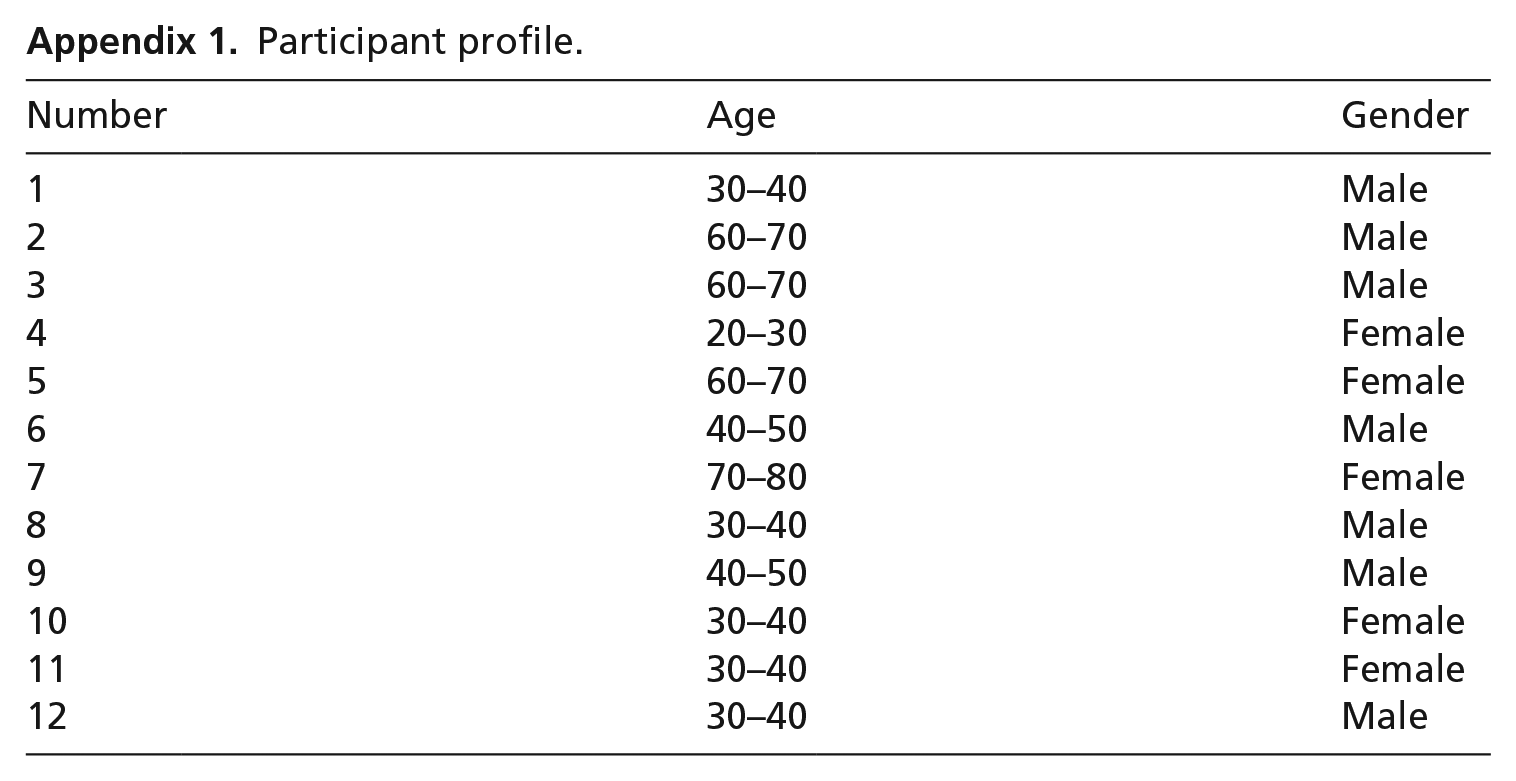
| Number | Age | Gender |
|---|---|---|
| 1 | 30–40 | Male |
| 2 | 60–70 | Male |
| 3 | 60–70 | Male |
| 4 | 20–30 | Female |
| 5 | 60–70 | Female |
| 6 | 40–50 | Male |
| 7 | 70–80 | Female |
| 8 | 30–40 | Male |
| 9 | 40–50 | Male |
| 10 | 30–40 | Female |
| 11 | 30–40 | Female |
| 12 | 30–40 | Male |
Acknowledgements
The author would like to thank John Downey for his valuable guidance and support and the research participants for their time and generosity sharing their views and experiences.
Funding
The author disclosed receipt of the following financial support for the research, authorship,and/or publication of this article: This work was supported by the Constructing the illiberal citizen? Radicalisation prevention, counter-terrorism, and the media in the UK project funded by Economic and Social Research Council (UKRI). Award reference: ES/X006476/1.
