




Abstract
How do cultural critics in the digital age convince audiences that their writings are valuable? What discursive strategies do they employ to construct their authority? And which differences can we see between professional critics working in institutionalized media and amateur critics contributing to online platforms? This article presents an in-depth analysis of book reviews by different critics to answer these questions. The results indicate that long-standing critical strategies are still largely intact: both professional and amateur critics construct authority by analyzing the book, contextualizing the book and discussing its reception, suggesting that amateurs have adopted to a large degree the skill sets of professionals. At the same time, amateur critics distinguish themselves by a pronounced presence of their personal experience in their reviews. This could point to a new way of constructing authority.
Introduction
Traditionally, cultural critics in the media play a crucial role in establishing which cultural expressions are considered worthwhile in societies (Debenedetti, 2006; Janssen, 1999). Particularly, the opinions of critics working for elite newspapers – such as the New York Times in the United States or Le Monde in France – are given considerable weight. Yet, in the past decade, the media landscape has changed considerably. The rise of the Internet has provided cultural participants not only with more options to inform themselves on the cultural output (e.g. specialized webzines, blogs and web stores) but also with platforms where they can voice their opinions (Beaudouin and Pasquier, 2017; Verboord, 2014). Consequently, the power balance between audiences and critics has changed and new forms of criticism have emerged (Frey, 2014; Jaakkola, 2021; Kristensen and From, 2015). According to some, in the digital age, ‘everyone is a critic’ (Jacobs et al., 2015). This raises the question of who, in the current timeframe where cultural valorization is becoming increasingly polyphonic, still has the authority to legitimize cultural value and how critics active in different parts of the cultural field set out to do so.
Authority is not an intrinsic property – something that a person or an organization has – but it needs to be attributed by others to become effective; even if the persons performing the attribution believe that it is an intrinsic property (Weber, 1978 [1947]). Bourdieu (1980) famously coined this the ‘production of belief’ in his analysis of how the ‘charismatic ideology’ dominates in the cultural field: the misperception that artists and cultural experts, such as critics, build their reputation on innate characteristics rather than on strategic position-takings in the space of possible positions and relations. Ever since, many empirical studies have shown how critics rely on various strategies – for instance, gatekeeping, employing side activities and writing essays or manifestoes – to establish their authority and thus engage in self-legitimation (e.g. Chong, 2020; Janssen, 1997; Van Rees, 1987). Discourse is one of the crucial instruments of critics to stake out their territory and signal how their classifications should be compared to those of others (Tominc, 2014; Van Leeuwen, 2007). Not only is ‘cultural value’ a rhetorical construction by definition, but critics also employ discourse to build argumentation (Van Rees, 1987), convince audiences of their judgment’s credibility through intellectual display (Baumann, 2007) or in-group representation (Tominc, 2014) and ‘objectivize their opinions’ (Chong, 2013: 267). Viewing authority thus as something ‘discursively constructed’, this study examines how different critics justify their judgments and legitimize themselves as authorities in the literature field.
Previous studies have signaled distinctions between professional reviews and those of lay users benefiting from the affordances of the digital age (Matthews, 2016; Verboord, 2014), but the notion of ‘authority’ did not receive much attention. To be sure, societal developments other than the rise of this ‘participatory culture’ may also have impacted the authority of critics. In general, cultural taste patterns in Western societies – including the Netherlands – have become more ‘omnivorous’ (Peterson and Kern, 1996), and also the media increasingly cover cultural forms that traditionally rely less on legitimization practices by critics, such as pop music, film and fashion (Janssen et al., 2011; Purhonen et al., 2019). Yet with the rise of algorithmic culture, it seems more important than ever to examine how qualitative evaluations – in contrast to recommendations that are rating-based, network-based, artificial intelligence (AI)-based and so on – are constructed and connected to symbolic value and human experiences (Striphas, 2015). Which evaluations are seen as ‘authoritative’ also influences, via the digitalization of media outlets (e.g. Metacritic), more algorithmic manifestations of cultural evaluation.
The case of the Netherlands provides a relevant perspective, as an internationally oriented, highly digitalized society with relatively high levels of cultural participation. Book reviewing culture focuses more on new books than on the canon compared to other European countries such as Germany (Verboord et al., 2015). All relevant newspapers – both elite and popular – plus various opinion weeklies cover literature. There is also a thriving online scene for books, and readers both consult Dutch- and English-language platforms to gather information (Bax et al., 2022). Since book buying is also increasingly done online, it would be fair to say that reading audiences can turn to a wide variety of critical resources for information and advice.
What constitutes authority in the cultural field?
The problem of what constitutes authority is strongly related to the question of under which conditions particular viewpoints meet social acceptance or, in other words, become legitimized (Furedi, 2013). Most social systems contain some authoritative roles – persons or institutions – that hold particular forms of power, grounded on internalized values rather than on persuasion or force, which makes individuals in the system choose to defer to them. As described by Weber (1978 [1947]): ‘the basis of every authority, and correspondingly of every kind of willingness to obey, is a belief, a belief by virtue of which persons exercising authority are lent prestige’ (pp. 263–264). Weber distinguished between three different types of legitimate authority: rational-legal authority (based on a system of rules that are accepted), traditional authority (based on historic constellations or inheritance) and charismatic authority (based on the unique qualities of a specific individual). Yet which type prevails depends on the specific social contexts in which they appear (Furedi, 2013). Legitimation is a process that depends on people attributing or granting legitimacy, as well as actors actively trying to justify their existence and activities in order to become recognized as an authority.
Within the cultural field, the charismatic authority figure has never completely disappeared despite the efforts of cultural experts to present the process of aesthetic value judgment as an objective practice following universal standards (Bourdieu, 1980; Van Rees, 1989 see also Kristensen and From, 2015). Traditional critics mainly relied on their institutional position to provide them with authority; their employment by established media signals expertise (Kristensen and From, 2015; Verboord, 2010). An important ingredient of the authoritative power of this affiliation concerns the combination of the medium’s readership (large, sometimes high-status audiences), professionalism (making the critic appear knowledgeable and credible) and being in an oligopolistic field (making the critic ‘special’). The media logics (journalistic norms, routines and discourses) that follow from this combination of factors generate a taken-for-granted perception of expertise and authority, which fosters the persistence of the charismatic ideology (Debenedetti and Ghariani, 2018; Verboord, 2010). In sum, their institutional embeddedness grants traditional critics legitimacy and thus provides them with authority (Janssen, 1997; Verboord, 2010). Their authority is thus ‘closely connected to tradition, knowledge and professionalism’ (Kristensen and From, 2015: 11).
The emergence of user-generated content on the Internet (e.g. web magazines, discussion forums, fan sites, blogs and vlogs) has generated a different model of information distribution and expertise claiming, in which credibility has become the main concern (Mackiewicz, 2010; Metzger et al., 2010). Individuals lacking institutional credentials need to find different ways to convince audiences about the trustworthiness of their evaluations. Consequently, in a field that is highly diversified, more heterogeneous cultural critics will step forward who draw on different strategies to convince their audiences (Kristensen and From, 2015). According to Tominc (2014), authority construction has shifted from an impersonal system where authority was assigned to positions, to a sphere/ society of fragmentation, where different authorities can exist and compete with each other, with seemingly few hierarchical distinctions.
Three points are important. First, credibility is multifaceted. In the online sphere credibility is often interpreted as being able to connect to peers: consumer critics approaching the reviewed object the way that the reader would do. Yet, the notion of professional credibility is strongly linked to the cultural field: this is much more dependent on the ‘right’ personal dispositions and cultural capital (Smith Maguire and Matthews, 2012). Second, whereas authority also relies on (perceived) expertise, many types of expertise are hardly unique to professional critics. With a growing cultural offer and the emergence of all kinds of cultural niches, it is becoming more and more difficult for mainstream professional critics to oversee everything. Online, fans and aficionados can express more specialized expertise (Kammer, 2015). Third, the rising status of popular culture has made the notion of authenticity seemingly more important in the online context (see a critical discussion of authenticity and rock music in Thackray, 2016). Partly accommodating consumer needs and partly voicing anti-elitism, amateur critics can wear their lack of institutional credentials as a badge of honor. Schwarz (2019) signals how many online critics challenge the ‘establishment’ of the cultural field by accusing professional critics of vain pretense and instrumentalism. In sum, where professional critics may derive their authority from ‘professional journalistic norms and routines’, the knowledge of the amateur might take on the form of a ‘layman’s fascination and authentic devotion’ (Kristensen and From, 2015: 15).
The practice of reviewing: how discourse aids authority construction
Language plays an essential role in the legitimation (activity) of institutions and practices, as has been argued in general accounts of communication (Van Leeuwen, 2007) but also for the specific valorization processes in arts and culture (Baumann, 2007; Price, 2020; Van Rees, 1987). Critics use a certain discourse to achieve a maximum effect in reinforcing their legitimizing competence – depending on the type of critic they represent (see the previous section) and the audience they address. Discourse can establish, maintain and transform relations of power between various social actors (Fairclough, 1995: 132–133), for instance, by using vocabulary associated with certain social groups or emphasizing specific evaluation criteria. In line with the preferences of the dominant social classes, legitimate taste has long been characterized by an ‘aesthetic disposition’ in which disinterested, intellectual and form-centered perceptions prevailed (Bourdieu, 1984). Traditionally, this ‘high-art’ aesthetics has been the dominant form of evaluating culture, especially in countries that are characterized by more hierarchical cultural systems (Janssen et al., 2011; Van Venrooij and Schmutz, 2010). Examples of such discourse concern evaluative techniques such as contextualization, identifying the author as a creative source, making comparisons to high-art products, and the assessment of originality, but also the usage of high-art terminology (e.g. ‘artistic’ and ‘genius’) and critical terms in the analysis (e.g. irony, genre and metaphor) (Baumann, 2007; Koreman, 2014; Van Venrooij and Schmutz, 2010).
These high-art criteria can be contrasted to a popular aesthetic ‘that emphasizes functional, emotional and experiential ways’ of evaluation (Van Venrooij and Schmutz, 2010: 397). Verboord (2014), studying movie reviews, found for example that viewers tend to refer to their own watching experience, which can be seen as part of a popular aesthetic. Indeed, the personal point of view (articulated, e.g. by the usage of first-person pronouns) is a common finding in studies of amateur reviews (De Jong and Burgers, 2013; Skalicky, 2013). Popular art criteria are overall mostly used by amateur critics, while professionals rely on high-art criteria. However, digitalization and an increasingly precarious labor market for (cultural) journalists might lead to professionals also using a more subjective and personal style in order to distinguish themselves (Kristensen, 2021: 1595).
Cultural critics differ from news journalists in the sense that cultural journalism is concerned with ‘an evaluating or opinionated rather than a neutral approach’, which differs from the focus on the value of objectivity practiced by news journalists (Kristensen and From, 2015: 861). In that sense, subjectivity and emotionality are central to cultural journalism (Kristensen, 2021). However, the translation of these emotions into discourse might take on different forms for different critics. To come to terms with this inherent subjectivity, professional critics employ various strategies. First, in their aesthetic analysis, they invoke conceptions of art (literature) that resonate with the wider field of cultural production (Janssen, 1997; Van Rees, 1989). Second, critics translate their personal, emotional reaction into a reasoned review ‘moving from knowledge that is embodied or instinctive to knowledge built on rational arguments’ (Chong, 2013: 273), engaging in ‘evidence-based reviewing’ (p. 272). In doing so, they attempt to show that the emotion experienced is an effect of textual features, rather than a purely personal reaction. Furthermore, critics try to separate their personal preferences from the quality of the book through ‘reflexive reading’ (Chong, 2013: 274–275), investigating and critically assessing their emotional response. This ‘ritual of objectification of emotionality’ can function as boundary work – distinguishing professional critics from amateurs (Kotisova, 2022: 800).
Claiming authority is also about how the self is presented in evaluative discourse (Van Leeuwen, 2007). In their verbalization of aesthetic norms, critics can draw more or less attention to their own persona by, for instance, the reference points they use in their argumentation (cultural history vs. personal life). The discursive tools at their disposal are virtually endless: showing their very presence (use of ‘I’); how advice is given; the degree of certainty with which claims are being made; how strong opinions are formulated; to what extent explicit disagreement with other critics is voiced and the degree to which critics mention personal experiences as a sign of authenticity.
In sum, in the current media landscape, the authority of critics has become less self-evident. It is crucial for critics, in competing for the audience’s attention, to ensure that their reviews are perceived as authoritative. This research therefore studies how authority is constructed in reviews, explaining its research design in the following section.
Methodology
The method employed is content analysis, comparing reviews by different critics to see what strategies they employ to establish their authority and to identify possible differences between them. We sampled reviews from critics with various levels of institutional embeddedness, online and offline (see Table 1), using the platform as the main criterion. We distinguish between ‘professional critics’ and ‘amateur critics’. The former work for established, institutionalized media with editorial control (either online or offline) or for online platforms with some kind of editorial control. The latter concerns individuals who contribute reviews on an individual basis to either a social network site or a web store. We selected goodreads.com, arguably the largest reading social network in the world (Driscoll and Sedo, 2018), and bol.com, the largest online store in the Netherlands. We define amateurs as people with a passion and love for literature, who are more invested and knowledgeable than lay audiences, but are without the ‘institutional legitimacy and authority’ of professionals, as these amateurs are not affiliated with or employed by legacy media (Kammer, 2015: 874; Teil and Hennion, 2004). Within this category, we denote consumers as a specific sub-group, as we expect that reviewing a bought product on a web shop is different in terms of engagement and investment than contributing to a special-interest social network site.
Overview data collection.
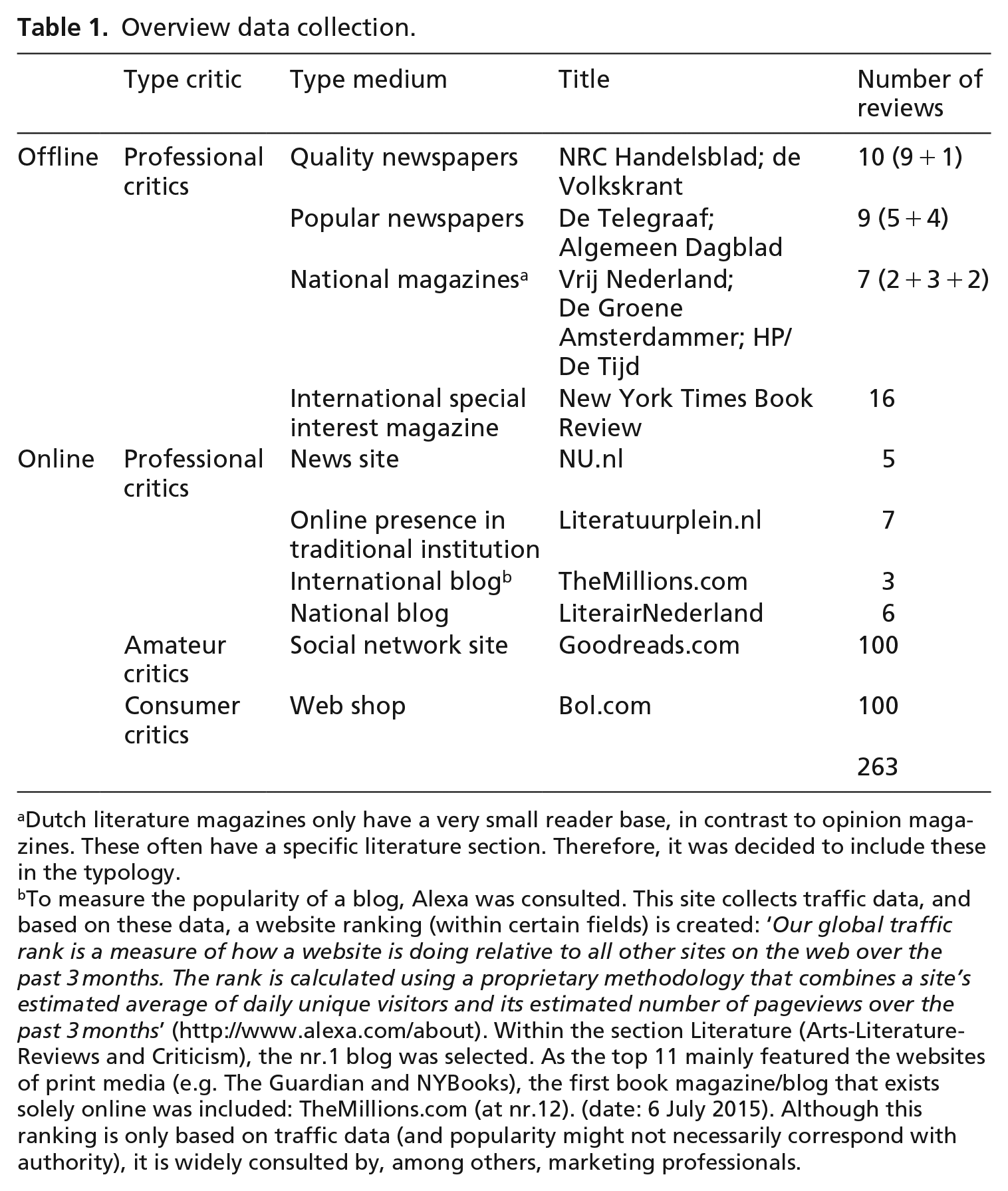
Dutch literature magazines only have a very small reader base, in contrast to opinion magazines. These often have a specific literature section. Therefore, it was decided to include these in the typology.
To measure the popularity of a blog, Alexa was consulted. This site collects traffic data, and based on these data, a website ranking (within certain fields) is created: ‘Our global traffic rank is a measure of how a website is doing relative to all other sites on the web over the past 3 months. The rank is calculated using a proprietary methodology that combines a site’s estimated average of daily unique visitors and its estimated number of pageviews over the past 3 months’ (http://www.alexa.com/about). Within the section Literature (Arts-Literature-Reviews and Criticism), the nr.1 blog was selected. As the top 11 mainly featured the websites of print media (e.g. The Guardian and NYBooks), the first book magazine/blog that exists solely online was included: TheMillions.com (at nr.12). (date: 6 July 2015). Although this ranking is only based on traffic data (and popularity might not necessarily correspond with authority), it is widely consulted by, among others, marketing professionals.
We acknowledge that this distinction between professionals and amateurs might not be clear-cut, as, in recent times, the boundaries between different types of critics (and reviewers) have blurred, especially in the online realm (Feldman, 2021). Many of the ‘amateurs’ contributing online have educational credentials and specialized knowledge comparable to ‘professionals’ (Kammer, 2015) and are increasingly professionalized in areas like food or fashion (e.g. Feldman, 2021). Nonetheless, taking the platform as a starting point is partly a necessity due to missing information on individual backgrounds and partly still relevant as platforms increasingly developed their own institutional logics (e.g. Verboord, 2014). Comparing critics who work in different habitats – and with different degrees of traditional legitimacy – informs our understanding of discursive strategies to construct authority.
Our analysis focused on reviews. To distinguish these from other journalistic genres, we established a set of criteria: Reviews were included when they (1) were categorized as reviews, (2) when books were attributed a rating (stars, balls or a grade), which is a typical characteristic of a review, or (3) if the review was published in a specific rubric or section (e.g. ‘Book of the week’), which was quite common in magazines. In unclear cases, the evaluative character of the article was the most important: if there was a substantial evaluative element, and the article was written by a named critic (e.g. instead of ‘written by one of our reporters’) the article was included.
The selected media outlets represent the major spaces for book reviews in the Netherlands; this also includes some English-language outlets. For these outlets, we collected all fiction book reviews for 2 weeks in 2015 (the week of 30 March to 5 April and the week of 29 June to 5 July). When a medium did not cover a sufficient number of reviews (e.g. TheMillions.com only covered non-fiction books in that timeframe), additional reviews were sampled. For goodreads.com and bol.com, it was not possible to reliably recover the reviews that were published during a certain week. Therefore, the reviews were sampled in a different manner (see Appendix 1). Although our sampling yielded four genres (and 503 reviews in total), this article focuses on book reviews from two genres (Literary Novel/Stories and Crime/Thriller), to improve the coherency of the sample.
The dataset for this article therefore consisted of 263 book reviews (see Table 1). These reviews were qualitatively analyzed with the software program ATLAS.ti. The data were approached openly, but the theoretical framework did provide elements that guided the analysis, as it indicated that critics have various discursive tools at their disposal to appear authoritative. We focused on elements in authority construction that might differ between critics, platforms and contexts (online–offline). Specific attention was paid to expertise, trust, credibility, authenticity, high-art/ popular art aesthetics and objectivity/ subjectivity. The professional and amateur reviews were coded separately first and later compared. The results are presented in the following section.
Results
Our analysis shows that the construction of authority can be described along two axes: first, we find three strategic dimensions that structure the argumentation of critics. These dimensions concern (a) analysis of the book, (b) contextualization of the book and (c) reception of the book. All critics engage with these strategies, but to various degrees and with different emphases. And here is where the second axis comes in: critics differ in their discursive repertoires to the extent that experiential discourse becomes more proficient when professional ties are declining. Amateur critics construct authority not by discussing different elements or providing different interpretations, but by building emotional resonance that is anchored in personal experiences.
Analysis of the book
All critics engage – to varying degrees – in an analysis of the book. They discuss and evaluate the (content of) the book itself either in a holistic way or by discussing and evaluating specific elements such as the characters, pace of the book, storylines, narrative perspective, writing style and/or language use. While many criteria seem to stretch all genres and are present in every review, some criteria appear to be genre-specific: the plot for example appears to be particularly important when it concerns thrillers, while ‘theme’ often features in reviews of literary novels. The usage of the established criteria and elements in a book review is one strategy to construct authority. It signals that one knows how to read and evaluate a book to others who are familiar with the conventions of ‘the review’. This strategy draws on expertise and is highly dependent on the social context in which the review appears. Using established criteria is only effective if the audiences can be expected to know and appreciate these criteria. Still, our analysis shows that all types of critics tend to engage in some form of evaluation and that there is great consensus about which elements of a book should be discussed in a review. Amateurs and consumers seem to adopt the rules of the field and follow the lead of professional critics in this respect. Although the rules are often implicit (Chong, 2020), all reviewers are clearly aware of them.
Critics also discuss elements that relate more to the effects that reading the book has, such as the pull of the book. This resonates with Chong’s (2013) findings that critics look for being ‘engaged’ or ‘absorbed’ (p. 273) by a story, indicating that the ‘affective experience of reading’ (p. 273) is important in assessing a book’s quality. Although the same terminology can sometimes be observed in the reviews – for example words like ‘compelling’ or ‘gripping’ – critics show differences in their discussion. Amateurs and consumers often discuss the (im)possibility of putting the book aside and discuss whether the novel captures you instantly or whether it takes a bit longer:
I seriously couldn’t put it down. The premise drew you in- everyone that works hard wants an offer like the one Mitch McDeere is offered by the Firm. It’s intoxicating! I wanted to get that offer! There’s no way you could say no. Grisham was a master at pulling you into Mitch’s shoes, which is impressive since its written in 3rd person omniscient. . . .The storyline is gripping. Its like you take a huge breath at the beginning and then hold on. . . because you won’t stop til you’re at the end. (amateur critic, goodreads.com)
In professional reviews, such direct phrases are far less common. Instead, this element is discussed through other criteria. Reviewers use phrases like: ‘what keeps us turning the pages is the cunning plot’, ‘time and again you come across sentences that you don’t want to let go’ or discuss it in a more elaborate matter:
‘We lived in a city that daddy Lion called the nameless hole’. It is the first sentence of the second paragraph of Alleen met de Goden, the latest novel of Alex Boogers. He instantly invokes the desolation of the surroundings where Aaron Bachman, whose life we get sucked into, grows up in. (professional critic, LiterairNederland).
1
Critics refer here to the writer as the creator and instigator of this experience. This focus on the writer is part of a high-art aesthetic (Van Venrooij and Schmutz, 2010) and can also be observed in the discussion of other elements. By highlighting the author as the subject causing this experience, they suggest that anyone who reads the book will experience it this way. In addition, by framing their experience in this manner, they provide an explanation of why this feeling is evoked. In contrast, for consumer critics, this element almost seems to function as a criterion that stands on its own, requiring little explanation (‘Thrilling book, captures you instantly! highly recommended’). For the reader of the review, this also makes it distinctively personal, almost elusive; something to (maybe) only experience once you read the book yourself.
A similar pattern can be observed when critics discuss the emotions experienced while reading the book. In amateur and consumer reviews, the variety of emotions felt is often discussed by focusing on the subject experiencing these emotions: ‘Sometimes I was reading the book with teary eyes’ (consumer critic, bol.com) and ‘I felt an immediate connection to the story and was deeply moved by the restrained, yet palpable power of the narrative’ (amateur critic, goodreads.com), in line with expectations from the literature indicating a personal point of view (De Jong and Burgers, 2013; Skalicky, 2013; Verboord, 2014). Consumers subsequently rarely translate these discursive propositions into an argumentation which explains in a more detailed way why this specific emotion is evoked. Even when the emotions are presented as (an element of) the novel, rather than a subjective reaction, they are most often not further explained. This is a pattern that is present in consumer reviews, which tend to be quite short and are often more collections of statements than coherent stories. Even though these critics discuss the same elements as other critics, they rarely explain in more detail how they came to a certain conclusion or judgment. In this case, it leads to the emotional reaction remaining a distinctively personal one.
This is very different from professionals. They mostly refrain from using such personal statements; rather than attributing the emotion to themselves, they attribute it to the book: ‘Reading “Muidhond” is a claustrophobic experience and chillingly electrifying’ (professional critic, de Volkskrant), ‘. . . Joshua Cohen and his brilliantly exhausting fourth novel, “Book of Numbers”’ (professional critic, New York Times Book Review). In addition, they also engage in elaborate analysis and argumentation, sometimes employing specialized terminology. Earlier studies already showed that many professional critics emphasize the need to translate emotion into ‘knowledge built on rational arguments’ (Chong, 2013: 273) or as Weiss Hanrahan (2013) observed in the case of music critics: ‘It’s the job of the critic to discuss not just the affective experience of music, but how the music comes to have the effects that it does’ (p. 75). This is also visible in the book reviews in this sample. Below the critic tries to unravel how the ‘claustrophobic experience’ mentioned in the quote above comes into being, using citations from the book to support his argumentation:
But the details that Schilperoord mentions, with an eye for little imperfections (there is a little shard of his plate, there is a little shard of Elke’s tooth, there is a little spot in her eye) seem omens of an abomination that slowly bloats and finally is about to burst, just as inevitable as that imperturbable sunlight. How does the debutante achieve this? Maybe it is because of the sympathy that Jonathan evokes, while he should be a dangerous sex offender. . . . Maybe it is above all Schilperoords technical highly giftedness. Just by using timestamps she can electrify banal acts, which results in passages like in a police record: ‘He cooked at two minutes past six. He baked eggs with bacon, heated the soup.’ (professional critic, de Volkskrant)
Although amateur critics refer to the direct personal emotional experience (similar to consumers), they often do provide a more elaborate argumentation of how this emotion was provoked by the novel (in contrast to consumer critics). The main difference with professionals is that the assessment of the book predominantly takes place from a personal point of view. Since goodreads.com reviews do not need to adhere to the format of traditional media, freedom and room are provided to also give meaning to books in different ways than just through text. Reviewers use memes, hyperlinks and pictures to discuss the novel and present their opinion, therefore constructing a distinctively personal review, not just in content but also in style and presentation. In general, reviews by amateurs and consumers are written in an informal style, indicated by the use of smileys (but also typos, grammar and spelling mistakes) and an abundance (or lack thereof) of capital letters and punctuation marks. This might stem from the lesser presence of editorial control on these platforms, and it challenges the traditional format of the review. Nevertheless, amateur reviewers on goodreads.com still adhere to strategies put in place by professional critics and their approach echoes the findings by Chong (2013) and Kotisova (2022) about critics investigating what textual features evoked their emotions.
Contextualization of the book
While the first strategy refers to an evaluation of the book itself, the second one is related to contextualizing the book. The book is positioned not only in the literary and/or cultural field but also in a broader societal and/or historical context, discussing the interplay between the two. Critics can display their knowledge of the author’s oeuvre, the (national and historical) circumstances in which the book was written, the recognition of the book (e.g. economic and symbolic capital), the genre, the literary field or even arts and culture in general (for example when references to movies are made). Not only the book as a whole is contextualized, but the discussion also focuses on certain elements:
This way, Hurwitz creates a character that always works well in the crime genre. The selfmade man who does not let his privileges be taken away, and in the past has gained skills that come in handy now he sees himself being confronted with bad guys. (professional critic, NU.nl)
Here, the reviewer demonstrates knowledge of the genre when discussing the character of the book. By positioning the book in the field, criteria such as originality and authenticity can be distinguished (Van Rees, 1987) and the ‘aesthetic significance’ (Weiss Hanrahan, 2013: 75) is assessed. Gauging both the originality and the authenticity of a book or author requires extensive knowledge. This strategy thus leans heavily on expertise. When critics contextualize the book, they display their knowledge, often by drawing comparisons and assessing the originality and authenticity of a book. All critics make use of this high-art aesthetic, a discourse that in previous research has mainly been tied to professional critics with institutional ties (Verboord, 2014). However, for consumer critics, this often remains constricted to a small context or reference. It is confined to the author’s works and sometimes the genre (‘Like I’ve come to expect from Nicci French another good book’), indicating a fan-based relationship, which can also be deducted from the fact that many consumers mention that they had to wait long for the book and/or look forward to the next part of a series.
Reception of the book
Above, the book is positioned in its cultural and societal context, assessing the book’s role in the literary/cultural field and society. However, the other side of the spectrum is also discussed in reviews: the relationship between the book and the reader or the reception of the book. Critics here not only discuss their personal reading experience, either directly or indirectly, but also provide advice, which again gives them the opportunity to display expertise. Reviewers discuss for example which type of reader or audience the book would interest, and for which situation(s) a book would be suitable: ‘For anyone who has been looking for themselves an absolute recommendation’ (consumer critic, bol.com). Finally, critics might also guide the reader: they inform them about the correct order or best way to read or understand the book for example: ‘You have to ignore very pulpy, cheesy writing to enjoy this romantic thriller’ (amateur critic, goodreads.com).
How various critics conceptualize this element is, again, quite different. In contrast to professionals, amateurs do not seem to be very concerned with the ‘avoidance of outside influences’ (Chong, 2013: 271). When they discuss their reasons for reading and reviewing the book, they often do so explicitly: clearly stating how they have been influenced (e.g. positively: the book was recommended by friends, or rather negatively: it was mandatory at school). They do not attempt to come across as unbiased or objective or, by explicitly mentioning their reasons to write a review, they actually seek to make clear where they stand and improve their transparency. This might point to reviewers’ media-savviness: they demonstrate awareness of the fact that media content is at times sponsored, obliging them to clarify their reasons for writing the review in order to appear authentic and to establish trust. Professional reviewers often very briefly and indirectly discuss the reason for reviewing a certain book (e.g. it is a debut, it follows upon a well-reviewed book), relying mostly on the institutional context of the book and identifying with their position as professional gatekeeper, rather than their personal preference.
Next to selection, amateurs and consumers also take a personal viewpoint in describing their reading experience. In addition to writing from a first-person perspective, they also situate the book in their own life and often discuss their connection with the book. This accords with the findings of previous studies (De Jong and Burgers, 2013; Driscoll and Sedo, 2018; Skalicky, 2013; Verboord, 2014) indicating that consumers/amateurs often refer to their own experience, in line with a more popular art aesthetic. Especially amateur reviewers on goodreads.com create a narrative or life story. They tell something about themselves and provide elaborate descriptions of (and reflections on) when the book was read, where it was read and so on. The book is, or passages from the book are, also often related to one’s own life, for example with specific stories or anecdotes:
I read this back when it was first released in 1991! At the time I was a teenager who was getting on a plane to visit relatives and I needed something to read to pass the time. THE FIRM distracted me for the long plane trip. Just recently I was at the used bookstore looking for a book for my teenage son to read while he is gone for the next 10 weeks working at a Boy Scout camp as a lifeguard. (amateur critic, goodreads.com)
Here the experience becomes so detailed, that it is very unlikely that it will be similar to the reader’s experience. Rather, it almost takes on the format of a diary, and as such challenges the traditional purpose of a review. The evaluation is so specifically embedded in the personal experience of the reviewer, that barely any general advice can be deduced from it. However, this quite personal approach might serve an important purpose, as it provides an insight into the person behind the review. In the long run, this strategy could function as a way to make a connection between reviewer and reader, giving readers a chance to relate or compare themselves and their taste to the reviewer, which might lead them to believe the critic and follow their judgments. Credibility may thus be established based on the positioning of the reviewer as a peer, rather than a professional. Especially online, where the identity and motives of a reviewer are not always clear, this might be a successful strategy to establish trust (Verboord et al., 2021).
Professionals also devote attention to the experience of reading the book and its reception. Although, of course, their review is also based on their own personal reading experience, they most often do not refer to this experience in a direct way. They rarely use ‘I’ and the personal context hardly receives direct attention, signaling the personal connection to the book and how it is situated in their own life of unimportance. Instead, they use the impersonal ‘the reader’ (a category that captures themselves as well as the reader of the review, the potential reader of the book) or ‘you’. Sometimes critics opt for the more personal ‘we’ instead, putting themselves on an equal level with the reader, establishing or assuming a personal bond. This might be strengthened as, in a few cases, critics indeed use the ‘I’ in their review, which gives the reader a glimpse of the person behind the review. This development might indicate that some professional critics see the need to adapt to new ways of writing or even grant readers an insight into their personality, embracing a more personal reviewing style, in addition to professional conventions (see Kristensen, 2021). However, these are rare cases in our data; overall professional critics adhere to the implicit rule that they remain in the background, put the novel in the foreground, and render themselves as a subject unimportant.
Conclusion
The analysis shows that all critics discuss the same themes and employ similar strategies in reviewing a book: they provide an analysis, contextualize the book and discuss its reception. All three elements can serve to construct authority as they give critics the chance to display expertise and/or establish trust. This finding suggests that existing reviewing strategies are still holding steady; engaging in aesthetic analysis and contextualizing the cultural product under review are well-established, discursive strategies of professional cultural critics that are also adopted by ‘new’ critics (cf. Weiss Hanrahan, 2013). This long-standing high-art aesthetic approach is complemented by elements of a popular aesthetic such as discussing the reception of a cultural product. This is not new (see, for example Van Venrooij and Schmutz, 2010 for a discussion of popular music reviewing), but elements of a popular aesthetic used to be less common in reviews of traditionally high-art products such as literary books. Our results point to the increased openness of literary critics to diverse aesthetic criteria.
Although all critics use the three strategies, they do so in different ways. On the one hand, we found a discourse that strongly resembles the ‘traditional’ way of reviewing. High-art criteria prevail here (Van Venrooij and Schmutz, 2010; Verboord, 2014). The reviewer as a subject is unimportant, as the content of the book itself is the focus of attention. At times, this evokes a quite impersonal approach to the book, as the audience is addressed as ‘the reader’ and emotions are framed as properties of the book (often instigated by the writer), instead of feelings of the reader (Kotisova, 2022). Although this partly obscures the personal role of the reviewer, it does result in a judgment that seems to supersede personal contexts, as the evaluation appears to depend on the characteristics (and quality) of the book, not on the person reading it (Chong, 2020). Critics position themselves as audiences’ gatekeepers, guides and evaluators, deciding what is worthy of their attention and what is considered legitimate culture, in line with the traditional conception of cultural authority (Janssen and Verboord, 2015).
On the other hand, a more personal way of constructing authority seems to be on the rise. Where traditionally critics employ different tactics to reconcile themselves with their subjectivity and provide an ‘objective’ judgment (Chong, 2020; Kotisova, 2022; Weiss Hanrahan, 2013), the reviewer’s subjectivity takes center stage in this discourse. A more experiential way of reviewing is employed and the reviewers place themselves on an equal level with their audience. Critics write from a first-person perspective and the book is embedded in their personal life, in line with a more popular aesthetic (De Jong and Burgers, 2013; Skalicky, 2013; Verboord, 2014). This discourse is therefore more personal and individualized, in content and often also in style and presentation. Through this approach, readers get to know the critic and might be able to form a bond with them, trusting the critic and deeming the judgment credible (Verboord et al., 2021). Because the evaluation of the book is embedded in a personal context, the value that is attached to the reviewer’s judgment seems very dependent on whether a reader can identify with the critic. As a result, the reviewer will likely appeal to (and possibly be granted authority by) a smaller audience. However, the online environment offers room for a large diversity of critics with different personal narratives and styles, who might cater to an equally diverse audience (Kammer, 2015).
Generally speaking, the degree of personal involvement increases as professional ties decrease. The position of critics is, however, not static; amateurs and consumers might engage in a discussion of the book that transcends the personal context, and professionals might occasionally provide an insight into the person writing the review. Both ways might be successful in convincing audiences to grant the critics authority, as they both give reviewers the opportunity to display expertise and establish a relationship of trust – although in very different ways and from a different position in relation to the audience (Kristensen and From, 2015).
The study complements existing studies about practices of new critics in the digital realm: it highlights the use of a more experiential discourse among amateurs (De Jong and Burgers, 2013; Verboord, 2014) while also pointing to an increasing professionalization of online critics working outside institutionalized settings (Feldman, 2021; Kammer, 2015). Moreover, the findings show the key role of emotions in the discourses of critics: even though subjectivity has traditionally played an important role in critical practice (Kristensen, 2021), the way critics discursively deal with emotions clearly differs. Whereas they share many other strategies, this feature sets them apart (Kotisova, 2022).
This study aimed to contribute to the debate about critical authority in the digital age. While the findings suggest that professional practices are still intact, it should be kept in mind that online a great diversity of amateur and consumer critics is active, whose backgrounds are often unknown. To assess whether the behavior of these critics can (partly) be explained by having similar characteristics as professional critics (Kammer, 2015), more research is needed. It is also worth replicating this study in other national contexts, especially countries with more hierarchical cultural classification systems and countries with lower levels of digitalization. Also, this research has literature – a traditional highbrow art form – as a focal point, which might partly explain why high-art aesthetics are still holding steady. It is recommended to study other art forms, as well as journalistic genres, as cultural criticism encompasses more than just reviews. Finally, legitimatization lies not only with the critics themselves; it is a process that involves other people as well. Critics can actively try to legitimize their viewpoints, in order to be perceived as authoritative, but the attribution of authority is ultimately not up to them, but to other actors in the field, such as fellow critics and audiences. Future studies should therefore focus on the viewpoints of these agents.
Footnotes
Appendix 1
Funding
The author(s) disclosed receipt of the following financial support for the research, authorship, and/or publication of this article: This study is supported by the Dutch Research Council as part of the PhD in the Humanities Project ‘Constructing Cultural Authority. The online and offline evaluation of pop music and fiction books.’ (PGW 14-10, projectnumber 322-45-005).
