




Abstract
By relying on diverse scholarly works within several fields – such as communication, cultural, feminist media, film and tweenhood studies – on the one hand, and conducting audience research with Hungarian informants on the other, this interdisciplinary study, as part of a bigger project, examines Hungarian tweenagers’ negotiation of gender. It does so by investigating the concept of ‘the’ princess, including but not limited to Disney Princesses, while offering unique contributions on both theoretical and methodological levels. Theoretically, it shines a light on the limitations of applying Western, post-feminist, liberal theories in a non-Western, post-socialist and ‘illiberal’ environment, and it discusses complexities of the Princess Phenomenon which have been overlooked in academia. From a methodological perspective, it presents innovative short-term ethnographic approaches, specifically in terms of conducting a gender-centred audience study with young people in an anti-gender milieu. To achieve these objectives, this work first introduces the historical, social and political contexts in contemporary Hungary. This is followed by a discussion of the theoretical and methodological approaches which it was necessary to consider before undertaking the fieldwork in Hungary. The article then analyses Hungarian children’s notions of gender by discussing their ideas about ‘the’ princess as a concept. Finally, as a summary, this study outlines its contributions to diverse academic disciplines.
Introduction
This work, as the segment of a greater project, aims to examine the understanding of gender 1 among Hungarian tweens, 2 that is, children between ages 7 and 10, by investigating their perception of Disney Princesses – a multicultural, highly successful, yet often critiqued phenomenon. Due to the objectives of my research, this article provides a discussion of the interdisciplinary literature on fairy tales, multiculturalism, post-feminism and neoliberalism, while offering an overview of the challenges faced during the fieldwork which was carried out in 2018 in Hungary – a country now famous for its anti-gender environment – as well as of the methods applied to analysing the data from this audience research. These sections are followed by an analysis of Hungarian children’s accounts of gender from the conversations with them about diverse princesses. Finally, the concluding remarks assert this research’s originality, and outline ways in which this article can be useful with regard to existing and diverse scholarly works. Nevertheless, for this article’s analysis to be clearly understood, first a contextual overview of contemporary Hungary is required.
Although geographically speaking Hungary is located in Central Europe, due to the former ideological divide between the ‘East’ and the ‘West’ along the line of the Iron Curtain, the region – which includes the countries of the Visegrád group, that is, the Czech Republic, Hungary, Poland and Slovakia – is often referred to as Eastern Europe. Indeed, considering the way in which this area is regularly portrayed in Western media, Eastern Europe is believed to have a ‘second-class status in the eyes of the West’ (Imre, 2014: 132). Following the argument outlined by Ivan Kalmar (2022), it can be observed that ‘[c]onflating Central and Eastern Europe raises unjustified suspicions that Central Europe, and especially its illiberals, are a Russian fifth column’ (p. 10, emphasis in original) and that ‘the prototypical country of “Eastern Europe” is Russia, meaning that the term “Eastern Europe”, when applied to Central Europe, gives it a Russian tint’ (p. 10). Based on the above, Hungary is considered as a non-Western entity and a Central European country throughout this article, while acknowledging that some scholars consider Hungary as a part of Eastern Europe. In any case, discussing the concept of gender and gender roles with children in present-day Hungary is not without its challenges. Back in the 1960s, John Hajnal (1965), an economist of Hungarian origin, characterised Hungary as ‘non-European’ based on its marriage patterns (i.e. citizens getting married relatively young). According to the Hungarian sociologist Olga Tóth (2004), the number of new marriages among young people reached its peak in the 1970s, during the time of state Socialism, and by doing so displayed ‘non-European’ features. This is important to keep in mind while considering women’s roles in present-day Hungarian society, as even in the 21st century the country remains largely conservative, and Hungarian women still seem to favour becoming homemakers over building a career (Tóth, 2004: 128–129). Indeed, as a professor of gender studies, Andrea Pető (2015) observes that in some European countries, Hungary included, ‘[w]oman as a mother defined by the state has never left the political rhetoric’ (p. 143) and, according to Pető (2015), there is currently an increasing number of women ‘who consider family as the most lucrative and safe site for employment’ (p. 144).
With that being said, the currently hegemonic discourse when it comes to family values in Hungary is best described as ‘familism’ (Dupcsik and Tóth, 2014), which is complemented by the far-right, populist Fidesz-KDNP government’s views of gender roles. One of the most illustrative examples of this is the speech that László Kövér, a founding member of the Fidesz party and speaker of the National Assembly, gave on 13 December 2015. 3 Kövér’s speech not only shows how Fidesz-KDNP defines women and their roles within society, that is, reducing their functions to giving birth and raising children, but was also the site of one of several attacks that the regime has made on gender studies in higher education (Pető, 2018). Indeed, anti-gender movements have been on the rise in Hungary (Kováts, 2017; Pető, 2018) since 2010, when Fidesz-KDNP came to power with a supermajority. Anti-genderism, however, is not unique to Hungary. As social researchers Elżbieta Korolczuk (2015) and Lidia Salvatori (2018) rightly observe, it is a transnational trend influenced by deeply rooted Catholic traditions. In fact, ‘gender ideology’ is a political buzzword created and propagated by the Vatican (Garbagnoli, 2016), and anti-gender movements exist in both post-socialist and Western countries.
Fairy tales and -isms: positioning Disney Princesses and Hungarian tweens
Due to the complexity of the topic and the aims of this research, the literature review is inevitably obliged to be interdisciplinary. To investigate Hungarian children’s conceptualisation of gender within an anti-gender milieu through such a multicultural phenomenon as Disney Princesses, which I argue are post-feminist and neoliberal media texts, 4 a brief study of how fairy tales and Disney Princess animations have influenced each other is required. This discussion will necessarily be followed by examinations of several -isms – multiculturalism, post-feminism and neoliberalism – as they are strongly linked to the Princess Phenomenon. Before doing all this, however, first I will outline the definitions of both the ‘Princess Phenomenon’ and the ‘tweens’.
It is rightly claimed that Disney’s portrayals of women should be understood in their historical contexts, with Disney Princesses taken as symbolic of the times in which their respective movies were released (Davis, 2006; Mollet, 2020). The Princess brand was created in 2000 (Orenstein, 2006), following the period of the ‘Disney Renaissance’ (1989–1999), in order to satisfy the market demand through selling the existing Disney Princess characters as commodities under a single product category banner, encompassing the idealistic, nostalgic and romantic visions of a princess. Disney Princesses have become complex, internationally prominent commodities, and are thus conceptualised as a ‘phenomenon’ within this project, in a similar manner to the approach adopted by the feminist media scholar Robyn Muir (2023). These characters are also understood as definers of the concept of ‘the’ princess – at least to American audiences (Mollet, 2020) – and a subject of many debates, on the one hand, within diverse scholarly critiques, and on the other as inspiration for audiences’ cultural productions. Indeed, while the Princess Phenomenon has been termed a ‘Princess syndrome’ (Hartstein, 2011) or ‘Princess problem’ (Hains, 2014), there are also academics (Bruce, 2005; Hine et al., 2018) who, after undertaking diverse empirical studies, claim that the portrayals of Disney Princesses do not negatively influence girls’ images of themselves (Bruce, 2005), or even that the representations of the newer Disney Princesses could have a positive impact on how children interpret gender roles (Hine et al., 2018). Due to their significance, the depictions of Disney Princesses, specifically, are popular subject matter for academics from numerous fields, often expressing contradictory opinions, underlining that discourse around the topic can be seen as polarised, and that the Princess Phenomenon is highly complex. On the one hand, there are, for example, media historians stating that the portrayals of female figures in Disney movies are unobjectionable, as ‘Disney films are ripe with respect for women’ (Brode, 2005: 10). Furthermore, according to the enthusiastic claim of one academic from the field of women’s studies, some Disney movies can be seen to represent their respective female protagonists each as a ‘feminist hero who lives out ideals of women’s equality by being completely assertive and autonomous – a full moral agent’ (Cuomo, 1995: 214). Mark I. Pinsky (2004), a journalist and author, suggests that this tendency among Disney employees to portray heroines with more assertive traits is linked to ‘the growing number of women writers, producers, and executives at the studio’ (p. 264). Moreover, some have perceived a feminist transformation of Disney Princesses over time, reflective of the diverse waves of feminism, and that these characters ‘shift our focus from reinforcing patriarchy, to challenging it, and finally turning it on its head, redefining our very understanding of what it means to be feminine and masculine’ (Pérez, 2020: 79).
On the other hand, however, there are also academics, from disciplines such as literature, media and child development, who argue more or less the opposite. Frequently employing a perceptibly condemnatory tone, they assert that Disney women appear as ‘helpless ornaments in need of protection’ (Zipes, 1995: 37), or, conversely, that if a woman in the Mouse House happens to have power, she is portrayed as ‘a castrating bitch’ (Sells, 1995: 181). It is also asserted that Disney Princess animations represent their protagonists as conforming to stereotypical beauty standards, which consequently has a negative effect on young girls’ self-image (Coyne et al., 2016). The fact that there are so many, often antithetical and/or prejudiced, academic opinions about these mainstream media texts shows that princess characters are a popular target of criticism for scholars.
For present purposes, the year 2000 was significant not only becuase of the creation of the Disney Princess brand, but also because the decade which followed, between 2001 and 2011, was considered to be the ‘tween moment’ (Bickford, 2020), a significant point in the history of the second concept I promised to define here. During this time, ‘a broad swatch of the child audience was redefined as between childhood and adolescence’ (Bickford, 2020: 2, emphasis in original) in the common understanding of the American public. To be more precise, the term ‘tweens’ refers to young people aged from 7 to 14, that is, ‘that in-between age-group between childhood and adolescence’ (Valdivia, 2008: 270, my emphasis).
Tweenhood is not, however, only an age group (Gerding and Signorielli, 2014), in that its conception is marked by gender and race (Bickford, 2020; Kennedy, 2019), and created by culture and marketing, as well as by Disney itself, which plays an important role in approaching tweens as consumers (Kennedy, 2019). Tweens are seen to hold firm opinions when it comes to consuming beauty, fashion and media products (Pilcher, 2013) and to possess ‘designer-label tastes and the buying power to match’ (Donnally, 1999), while also consuming the most media within the child demographic, meaning that they form ‘a lucrative market’ (Gerding and Signorielli, 2014: 43).
Although in Hungarian the expressions ‘tween’ and ‘tweenhood’ are not employed in either everyday or academic discourses, there are local expressions such as kisiskoláskor (‘middle childhood’) or simply gyerekek (‘children’), used when describing this age group. In my work, I apply the terms ‘tweens’ and ‘tweenhood’, and I do so not only to underline the in-betweener features of this cohort, but also in order to position my research both within and as contributing to related Western scholarship, while also considering Disney’s influence on the conception of these terms.
Proceeding then with considering Disney and fairy tales, while they were themselves inspired by fairy tales, many Disney animated features also had an impact on the genre of fairy tales itself, as Jack Zipes (1995) notes: ‘[i]f children or adults think of the great classical fairy tales today, be it Snow White, Sleeping Beauty, or Cinderella, they will think Walt Disney’ (p. 21). Such effects of the studio’s adaptations of fairy tales are heavily debated. Zipes (1995), for instance, asserts that ‘Disney “violated” the literary genre of the fairy tale’ (p. 40), while Marina Warner (1995) considers Disney himself to be the Grimm Brothers’ ‘brilliantly successful spiritual heir’ (p. 205). In any case, one feature that seems to be shared by both fairy tales and their Disney versions is multiculturalism. Similarly to tales that are claimed to be ‘border-crossers’ (Warner, 2014: 59) between countries, Disney animations are also multicultural. Indeed, as Kutsuzawa Kiyomi (2000) indicates, in the last few years of the 20th century ‘multiculturalism has become Disney’s buzzword’ (p. 47), while Douglas Brode (2005) goes so far as to suggest that Walt Disney himself could be seen as ‘the single member of Old Hollywood who set what would come to be called multiculturalism into motion’ (p. 19). That being said, animations ultimately possess a specific characteristic that plays a major role in their international popularity, as Gerald Scarfe (2015) rightly observes – the cartoons’ ‘strength is in their simplicity, their ability to reach people visually without the need for language’ (emphasis in original).
As previously mentioned, in this work certain Disney Princesses are viewed as post-feminist and neoliberal commodities. From a feminist cultural studies perspective, post-feminism is understood to be a discourse that is both ‘undoing’ (Gill, 2016: 613, emphasis in original) feminism and embracing it ‘as the new cool’ (Gill, 2016: 622). In other words, post-feminism is a concept that encompasses the ‘double entanglement’ (McRobbie, 2004) of both anti-feminist and feminist ideas. Through highlighting that her commodified body has been and still is one of the key signifiers of a Disney Princess’ identity construction – both in her depiction and in audiences’ perceptions of her – this article argues for the consideration of the gendered economy of visibility (Banet-Weiser, 2015) when it comes to the interpretation of Disney Princesses. This work also extends the claims of diverse textual analyses, that certain female Disney characters (Benhamou, 2014; Bickford, 2015; Blue, 2013a, 2013b; Kennedy, 2018, 2019; Tasker, 2011; Valdivia, 2008) and even Disney Princesses (Leader, 2018; Seybold, 2020; Stover, 2013; Wilde, 2014) are post-feminist media texts. In light of this, it can be asserted that the majority of the animations considered within this article 5 portray Disney Princesses as representatives of both the post-feminist ‘double entanglement’ (McRobbie, 2004) and of neoliberal commodification (Dosekun, 2015) in an economy of visibility (Banet-Weiser, 2015).
Having said that, it can be argued that through ‘celebration of girlhood’ (Lazar, 2009: 390) as well as (ostensible) empowerment through consumption, Disney produces a strong connection between audiences and consumer culture, within the concept of its post-feminist and neoliberal Princess Phenomenon. Indeed, one has to keep in mind that post-feminism goes hand in hand with neoliberalism. In fact, the latter has been claimed to be ‘a contributing factor to the spread’ (Kennedy, 2018: 426) of the former. Furthermore, both neoliberalism – which is viewed as ‘a mode of political and economic rationality characterized by privatization, deregulation and a rolling back and withdrawal of the state from many areas of social provision’ (Gill and Scharff, 2011: 5) – and post-feminism are ‘structured by a current of individualism’ (Gill and Scharff, 2011: 7), and both of them require women – more so than men – ‘to work on and transform the self’ (Gill and Scharff, 2011: 7).
Nevertheless, in positioning neoliberalism and post-feminism within the Hungarian milieu, it has to be noted that since 2014, Hungary’s current political system has famously been explicitly categorised by the current prime minister, Viktor Orbán, as ‘non-liberal’ or ‘illiberal’ (Tóth, 2014). Moreover, scholars have argued that it is an authoritarian neoliberal (Fabry, 2019) or non-neoliberal (Gertz and Kharas, 2019) regime. This is not, however, to suggest that neoliberalism does not exist in Hungary, but rather quite the opposite. Neoliberalism already appeared ‘organically in Hungarian society in the 1980s, as a response by domestic economic and political elites to the deepening crisis’ (Fabry, 2018: 77) of the former regime, during the era of state Socialism (Antal et al., 2014). While analysing the understanding of such neoliberal, post-feminist media texts as Disney Princesses among Hungarian tweens, however, the present-day political character of Hungary as an ‘illiberal’ regime has to be acknowledged.
At the same time, it also needs to be noted that how the concept of post-feminism is understood in Hungary is different from how it is understood in the Western context. This is the case not only because second-wave feminism (as it is known in the West) did not develop in Hungary (Antoni, 2014; Horvath, 2022; Owczarzak, 2009; Pető, 1998) – and post-feminism is claimed to be a direct response to second-wave feminism (Dosekun, 2015) – but also due to the parallel presence of traditional views of gender roles (Scharle, 2015), familism (Dupcsik and Tóth, 2008), anti-feminist movements (Juhász, 2015) and assaults on gender studies (Pető, 2018). Because of this, one of the original contributions of this work is specifically the examination of tweens’ perceptions of gender, through the portrayal of the post-feminist, neoliberal Princess Phenomenon, within a post-socialist, ‘illiberal’ context.
Methods and challenges: The power of gender
Analysing children’s accounts of their own perspectives on any topic was an overlooked and untapped area for most early sociologists, while those who did conduct such research viewed children as one homogeneous demographic comprised of incompetent objects (Kirk, 2007), instead of involving them as subjects in the research process. It is argued (Morrow and Richards, 1996) that the heterogenic approaches towards children can be traced back to different scientific approaches. In the field of psychology, for example, children are often not only considered to be vulnerable objects, but also to be ‘less competent than adults’ (Morrow and Richards, 1996: 98), which can be reductive and presumptuous, from a research perspective.
Nevertheless, at this point the diverse scholarly attitudes towards young people have changed, so much so that the focus has moved ‘from seeking information about children to seeking information directly from them’ (Docherty and Sandelowski, 1999: 177, my emphasis). The same can be said about audience studies more generally, as the ways in which audiences have been examined have also altered over time (Jenkins, 2005; Jensen and Rosengren, 1995; Livingstone, 2003, 2008; Newbold, 1995; Ross and Nightingale, 2003), and in the present day, child audiences are frequently viewed as ‘very “skilled” readers’ (Buckingham, 1993: 48) of diverse media texts. Ellen Seiter (1993) goes so far as to suggest that ‘it is a mistake, however, to see marketers as evil brainwashers and children as naive innocents’, especially considering that young people are the ones who ‘vote with their remote controls’ (p. 9). With that being said, the fact that there are media scholars who approach children as active cultural agents (Jenkins, 1998) does not mean that children are no longer considered as couch potatoes by certain academics. The debates over children and media are far from resolved, and instead, diverse positions coexist (Buckingham and Strandgaard Jensen, 2012). Indeed, without conducting their own empirical research, there are academics who arguably portray young people passively absorbing media messages, and this especially seems to be the case when it comes to Disney animations (Jule, 2011; Silverman, 2002).
Within the framework of this ethnographic study, I approached my participants 6 as active, ‘competent social actors’ (Punch, 2002: 338) who are ‘strong, capable, and knowledgeable experts on their own lives’ (Einarsdóttir, 2007: 199). To engage fully with the children in my informant group, during my fieldwork I employed focused (Knoblauch, 2005)/micro (Wolcott, 1990)/short-term (Pink and Morgan, 2013) ethnography, which included conducting conversational interviews (Coll and Chapman, 2000; McKee and Bell, 1985; Turner, 2010) with the informants, as well as making observations and taking field notes. Following this, I applied thematic analysis (Boyatzis, 1998; Braun and Clarke, 2006; Opler, 1945) in order to make sense of the collected data.
During the pilot study and the fieldwork (between January and May 2018), altogether there were 19 paired conversations with 38 Hungarian working and middle-class tweens, aged 7–10 (Figure 1). 7 The sessions were held in both the urban and rural parts of the country, in schools, children’s homes and open spaces such as playgrounds. They were conducted in Hungarian, each one lasting between 30 and 45 minutes, and were later transcribed in Hungarian, and then translated into English.
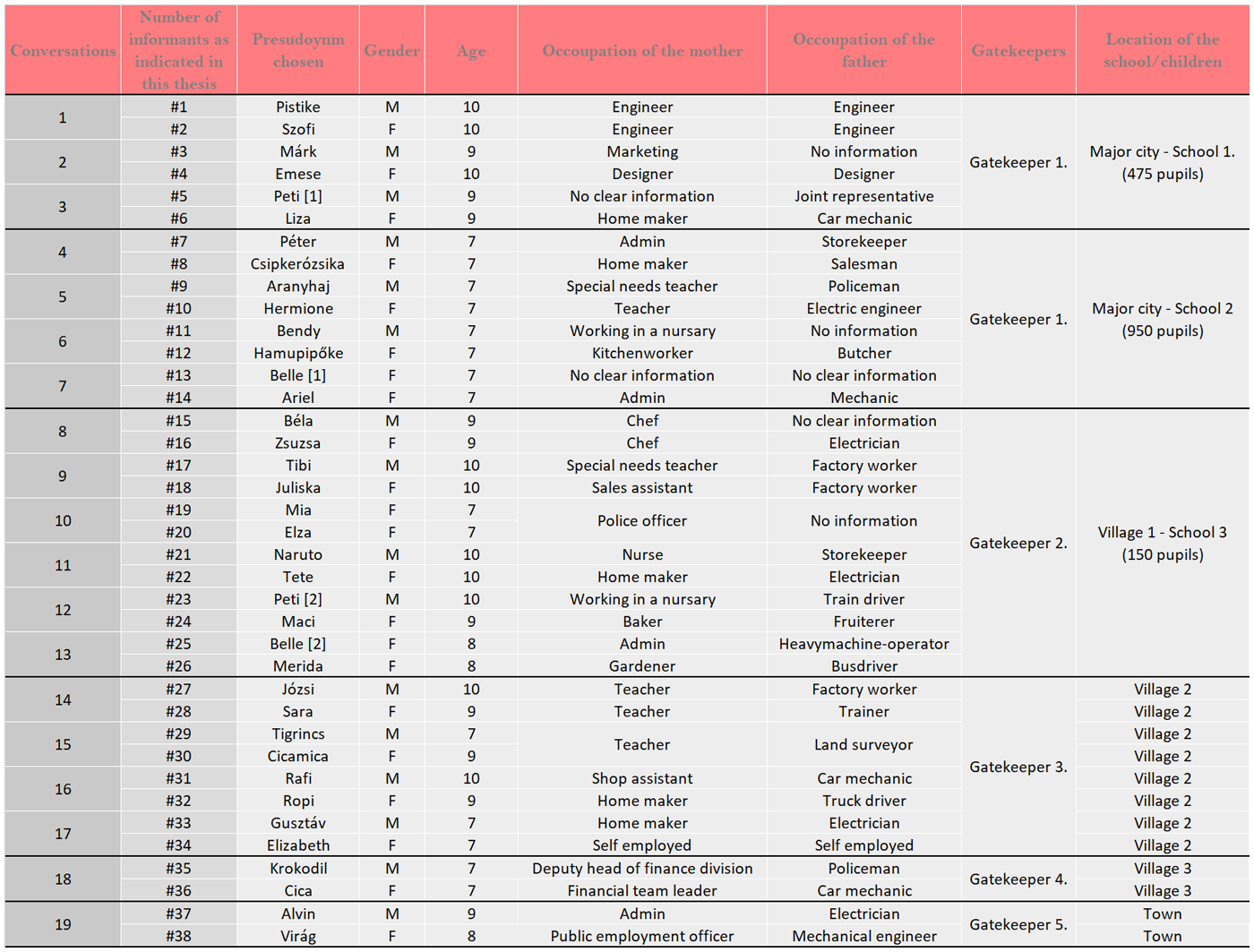
Table of informants.
There were various challenges which presented themselves during the fieldwork. Innocent as it may seem, the topic, and more specifically using the word ‘gender’ on the diverse ethical forms required, appeared to be controversial. Specifically, while the school’s headteacher in Village 2 originally agreed to my conducting research in their institution, once they saw the word ‘gender’ on these papers, they changed their mind, claiming that it is a ‘sensitive topic’. This incident was an illustration of the fear caused by the discourse around gender that is being pushed by the government in contemporary Hungary. Thanks to the gatekeeper who organised sessions to be held outside of the school, however, I was still able to have conversations with several children.
During the interviews, the children were first invited to choose pseudonyms for themselves, and were then shown short videos from Disney and Disney-Pixar Princess animated features, as well as being presented with a picture of Disney Princesses in order to refresh their memories with regard to these characters. I used several criteria in selecting the short videos. First, all these animations were released between the start of the ‘Disney Renaissance’ (1989–1999) and 2018, 8 a time period that has crucial importance with regard to Disney Princesses, post-feminism and tweenhood. Second, these videos all dealt with the representation of the heroine’s character. To be more specific, in all these videos the female figure was the focus, for example, through the depiction of her paid work (The Princess and the Frog), or of her connection to nature (Brave, Pocahontas), or of the challenges she has to face (Mulan) or of her romantic interest (Aladdin). In addition, these were all musical clips from the films, including lyrics providing more information about the female protagonist and her environment, sung by the narrator, other characters or the heroine herself. Third, the videos were chosen deliberately to include princesses of distinctive cultural and ethnic backgrounds, with the aim of offering illustrations for discussing race with the children. Finally, using such video clips was also an important aspect of creating a comfortable, ‘child-friendly’ atmosphere (Heath et al., 2007; Kirk, 2007; Punch, 2002) for the informants.
The activities were followed by discussing the ‘Ideal’, the ‘Generic’ and the diverse Disney Princesses. The reasoning behind dividing up ‘the’ princess as a concept in this way was that I aimed to explore Hungarian tweens’ conceptualisation of gender through their negotiation of the diverse princess figures and their various gender characteristics, which included first examining the children’s understanding of the princess as a concept in a generic sense. Then, by asking them to imagine an ‘ideal’ princess, the children were encouraged to express their own ideas regarding the perfect princess. Finally, by discussing Disney Princesses specifically, I was able to gain knowledge about how the informants see these figures, and to get a sense of the type of values the children attached to them. Moreover, the children were also asked to name their favourite Disney Princesses, if they had any, and to provide explanations for their choices, such as why they liked or disliked certain characters. Eventually, the sessions yielded significant data, as despite some similarities, the Generic, the Ideal and specific Disney Princesses were clearly distinguished by informants, based on the values and gendered features with which the characters were associated. Discussing ‘the’ princess as a concept in this way proved to be revealing about the Hungarian tweens’ conceptualisation of gender, as will be presented in the following section.
Gender and the princess: The Good, the Bad and the Disney
Generally speaking, the children imagined a princess as being beautiful and smart, but also bossy, lazy, ‘too girly’ and whiny. Moreover, they envisioned her as lonely and needing protection, despite being enormously rich. In a nutshell, their Generic princess is rather a negative figure, that is, she is ‘bad’. In comparison, the Ideal princess was perceived as the ‘good’ girl by the informants, and qualities such as being curious, hard-working, a little bit ‘boyish’, brave and talented were attached to her. The children furthermore described her as relatively wealthy, and one who uses her fortune for charitable purposes. In short, she was seen as altruistic, as well as capable of protecting herself, and as someone who has many friends, that is, a broad social network. As for the Disney Princesses, they were perceived predominantly positively and were popular with the informants, though primarily among the girls. There were some specific characters who were especially well-liked by these Hungarian tweens, both girls and boys, such as Merida, Mulan, Pocahontas and Rapunzel. The children attached such values to them as being curious, brave and talented, and these figures were imagined as being capable of protecting themselves and as having multiple friends. In other words, Disney Princesses were understood to possess attributes that are the hallmarks of the ‘good’ princess, described above.
With that being said, while trying to define ‘the’ princess as an overarching concept, based on the ways in which these Hungarian tweens understood it, it became clear that its figure is rather an ambivalent one, displaying contradictory features. To be precise, the Generic princess appeared to possess several characteristics that support conservative and patriarchal views, such as her being beautiful, girly and in need of being saved. Yet the qualities the children attached both to the Ideal princess and to many of the Disney Princesses exhibited progressive features. In other words, the ways in which Hungarian tweens negotiated their understanding of gender through the idea of ‘the’ princess can be seen to illustrate the existence of both traditional and liberal values in contemporary post-socialist, ‘illiberal’ Hungary. The coexistence of the aforementioned gender features prompted the formulation of the three categories of ‘The Amazon’, ‘The Damsel in Distress’ and ‘The Disney’.
The Amazon
The specific gender characteristics of being ‘brave’ and ‘strong’ having been associated with the Ideal princess by these tweens (including the boys) corroborates Susan Hopkins’ (2002) work on present-day girl heroes in popular culture, in which she includes, among others, Disney Princesses from the last part of the 20th century and the beginning of the 21st. In Hopkins’ (2002) view, audiences crave an empowered, active warrioress, and the media responds with portrayals of the contemporary ‘girl hero’, which emerges as a ‘sign of the times’ (p. 5). Similarly, more than a decade later, Graf (2015) has argued that Katniss Everdeen, Lady Arya Stark and Princess Merida represent the Amazonian archetype within contemporary audiovisual culture. She sees these characters as warrioresses: a concept that was commonly identified in the sessions with Hungarian informants in connection with both the Ideal princess, and also specific Disney Princesses. Graf (2015) points to these examples as media texts that challenge conventional gender roles, which are indicative in her view of wider societal changes. Through tying together the insights from the informants, and Hopkins’ (2002) and Graf’s (2015) work on the empowered and warrior-like female characters, this section discusses the Ideal, ‘amazon’ princess.
While talking about what a princess is supposed to be like, Ariel (informant #14) argued that although a princess is ‘beautiful’, she ‘also has to be brave’. When she was asked to provide a more detailed response, she said that
Ariel: I don’t mean that a . . . that she has to be a boy, but they [the princesses] should be a little bit like boys, so that like very brave, very strong . . .
Ariel’s vision of the Ideal princess is revealing, as it appears to embody values that are traditionally attached to men, that is, being brave and strong. In other words, this image of the Ideal princess is similar to that of an Amazonian heroine. That being said, Ariel’s assertion that the Ideal princess is expected to be beautiful, while also being ‘very brave’ and ‘very strong’, as well as her later remark that the Ideal princess ‘should also sing nicely’ in order to draw a boy’s attention, suggest that this Ideal princess can be viewed as a post-feminist figure. 9
The Ideal princess was described in a similar way by Peti [2] (#23), another informant, who said,
Peti: I always say that she [a princess] does not have to walk around [. . .] in these huge dresses [. . .], and [. . .] that a princess can be just as brave [. . .], and beautiful and kind at the same time as well [. . .] and every princess can be good at something.
Like Ariel (#14), Peti also appears to be aware of the gender features conventionally associated with a princess. Nevertheless, and similarly to Ariel, Peti also was not afraid to speak his mind. Furthermore, the way Peti described the Ideal princess as a ‘beautiful’, ‘brave’, ‘kind’ person who can be ‘good at something’, that is, is talented, evokes the ultimate post-feminist tweenager princess, often portrayed in Western popular culture (Kennedy, 2018, 2019). Based on Ariel’s (#14) and Peti’s [2] (#23) conceptions of the Ideal princess, she is a beautiful, brave, strong and talented feminist figure – a post-feminist ‘amazon’.
The Damsel in Distress
Hungarian tweens’ ideas of the Generic princess suggest that it is a pre-feminist concept, and the informants’ opinions when discussing this character demonstrated rather negative views. To be specific, the gender features of the Generic princess that were listed by the children were practically identical to those of the archetypal passive princesses of fairy tales, as explained by Zipes (2011). The Generic princess, especially when compared with the prince, is a helpless damsel in distress, as will be discussed in this section.
Hungarian tweens’ notions of princesses and princes in general are illuminating with regard to these children’s broader conceptualisations of gender roles. For example, while talking about whether or not it is good to be a princess/prince, at one point Tigrincs (#29) said,
Tigrincs: I think it is better to be a prince than a princess. Researcher: Well, why? Tigrincs: Because a prince does not have as many servants as a princess. Because like a, a girl. . . she is different compared to a boy, because a boy serves himself, a girl is like [Tigrincs uses a high-pitched voice], ‘Ah, well, well, well, well. . . this should not be like this, take that one out’.
The most striking feature of Tigrincs’ following statements in connection with gender roles is how he proceeded from his initial subject. At first he spoke about princesses and princes in general, but then he continued by expanding his opinion, making a more generic claim concerning girls and boys, and concluding that girls order people around and can therefore be bossy. It should be noted, however, that Tigrincs made this wider claim after talking about the Generic princess, and his comment can be seen to underline that the Generic princess was approached negatively by the children. Having said that, according to Emese (#4) it is not good to be a princess because princesses are ‘fastidious’, and
Emese: [. . .] if they make their dresses dirty, they start whining right away.
In other words, in addition to being wealthy, the upper-class Generic princess is understood to be spoiled.
Moreover, she was also viewed by the children as a lonely figure, lacking free will. As, for example, Peti [2] (#23), Krokodil (#35) and Cica (#36) all pointed out, princesses do not even have the right to choose their husbands, as that is up to their fathers to decide, which is to say that the Generic princess, in the understanding of these Hungarian tweens, has to obey her father. She not only has no free will but no freedom either. When describing the Generic princess, Márk (#3) went so far as to suggest that
Márk: [. . .] she can never do what she wants and then [. . . ] she is like as if she was living in captivity.
Márk imagined the Generic princess as a person deprived of agency, which, according to his account, is equivalent to being imprisoned. Such a conceptualisation of the Generic princess appears to convey patriarchal ideals about women, such as the expectation that they be submissive. Márk’s views of the Generic princess also recall Jennifer Waelti-Walters’ (1979) discussion of the princess who, she claims, is a ‘totally powerless prisoner’ (p. 180).
Further to this, the Generic princess possesses traditional features, as was demonstrated during the session with Juliska (#18). The way in which this informant described princesses and princes in general can be taken as a textbook summary of the gender features of these figures, as they have often been portrayed in classic fairy tales:
Juliska: [. . .] in general princesses have long hair [. . .]. They always wear long skirts [. . .], and most of them have crowns too. And all of them want to get married, I mean most of them [. . .] and at the end they get married to someone [. . .]. I would describe a prince as brave [. . .], he always travels on a horse [. . .], and he has a sword.
As is readily apparent, while describing the Generic princess, Juliska painted a flawless portrait of a damsel in distress. Indeed, the princess’ most significant features are linked to her appearance, for example, having long hair and a skirt. She also wears a crown, which signifies her wealthy background, along with underlining her elite social position. That being said, the only purpose of a princess is to be married to a prince, which implies that she is indeed a passive character. In contrast, the prince is active, and defined by his actions, such as fighting and travelling, while the only important feature of his appearance is his having a sword, which is connected to his activity. In this sense, Juliska’s commentary not only recalls patriarchal expectations about women, that they be ‘passive sexual objects’ and ‘dutiful wives’ (Rosaldo and Lamphere, 1974: 1), but also the typically patriarchal fairy tale plot, in which the hero takes the active role while the heroine remains passive (Zipes, 2011). During the 19th century, illustrations of fairy tales created by men already painted a stereotypical picture of the stories’ protagonists, and these images had a profound influence on how audiences imagined these characters. As Zipes (2011) remarks, ‘[t]he heroines were largely blonde and beautiful with perfectly proportioned features; the heroes were gallant, handsome, and courageous, often with sword in hand and on a white horse’ (p. 20). While Juliska described the princess and the prince in almost exactly the same way as Zipes (2011), it should be noted that when Juliska listed her examples, she referred to generic ideas about these figures, which serves once again to underscore the influence that these centuries-old concepts still have today.
The Disney
In contrast to the spoiled and girly archetypal and pre-feminist princess, Hungarian tweens appeared to favour those Disney Princesses who, according to the children, are ‘not princessy’ and are instead portrayed with ‘adventurous’ lifestyles and ‘boyish’ characteristics. While strongly linked to gender, these features also speak to the idea of maintaining authenticity, prominent in post-feminist tweenager popular culture (Kennedy, 2014, 2018, 2019), as well as of Disney and Pixar’s novel conceptualisation of a princess (Kapurch, 2015). The ways in which the children described these Disney and Disney-Pixar princesses is also revealing with regard to Disney’s intention to make the portrayals of its latest princesses more relatable to their audiences. This section will discuss these ‘not princessy’ Disney and Disney-Pixar princesses – characters that can be viewed as post-feminist figures, based on Hungarian tweens’ understandings of them.
When Emese (#4) was asked about her favourite princess, her answer was Mulan, and her reasons were that this Disney Princess is a ‘fighter’, ‘brave’ and ‘kind’. Similarly, according to Tigrincs (#29), Mulan is ‘not really princessy’, since she became a ‘warrior’. He also described Merida in much the same way, that is, as a ‘less princessy’ figure, and Cicamica (#30), interrupting, offered the following supporting argument:
Cicamica: Because the princesses usually don’t fire arrows, climb mountains, stuff like that. [. . .] And kill a bear.
Here, Cicamica not only grasped the essence of Merida, as her character is presented in the animated feature Brave, but also encapsulated Merida’s ‘less princessy’ activities, contrasted with the typical characteristics of a Generic princess, that is, an archetypal princess. It should also be noted that Merida’s ‘tomboy adventures’ (Kapurch, 2015: 444) as described by Cicamica, that is, stuff like climbing mountains or killing a bear, are activities that are considered to be traditionally masculine.
Further to this, Cicamica also mentioned Rapunzel, and said that this Disney Princess is ‘not princessing’. When she was encouraged to express her opinion in more detail, Cicamica said of a Generic princess:
Cicamica: For example [. . .] she stands up and then [Cicamica is using a high-pitched voice while imitating a princess by calling on the servants]: ‘Red carpet!’ Tigrincs: She commands. [. . .] to be brought her breakfast to bed, the lunch. . .
Here, Cicamica provided an illuminating observation in terms of understanding the Generic princess, first coining the verb ‘princessing’ in talking about a celebrity/diva character, and then providing an explanation, with which Tigrincs subsequently agreed. Once again, this exchange clearly hints at the negative connotations of this type of princess, as she is perceived not only as an ‘abject’ diva (Doty, 2008: 3), but is also associated with being extremely rich and bossy.
Jasmine, Merida, Mulan, Pocahontas, Rapunzel and Tiana were each often referred to by the children as ‘not princessy’ princesses. For example, while talking about Merida, Elza (#20) asserted that
Elza: I think it is better to be in the free world than to spend the whole day being locked in a room.
Discussing Tiana, Mia (#19) and Elza (#20) said,
Mia: [. . .] she has never been a princess. Elza: She seems to be very cool. [. . .] Well because she does not seem to be a princessy type. [. . .] because she seems to be a free girl. . .
It is interesting to note that Elza used the term ‘free’ in order to describe how Tiana is not a ‘princessy type’. Elza’s remarks about Merida and Tiana not only underscore previously discussed features of the Generic princess – that she is without free will, or even a ‘prisoner’ – but also, in much the same way as Cicamica’s (#30) comment about Rapunzel, provide another example of the children contrasting Disney Princesses with the archetypal princess.
Conclusion: Gender and the future
In order to gain a clear understanding of the tweens’ ideas of ‘the’ princess as a concept, the diverse attributes attached to this figure by the children, including her ideological and social purposes, need to be examined. Christopher Vogler (2007), a screenwriter and former story consultant at Disney, asserts that the various characters in media texts should be approached as ‘flexible character functions rather than as rigid character types’ (p. 24, my emphasis), and that archetypes, of which a Princess is certainly an example, ‘can be thought of as masks, worn by the characters temporarily as they are needed to advance the story’ (p. 24, my emphasis). As Rebecca-Anne C. Do Rozario (2004) also argues in connection with Disney Princesses, they ‘at times wear the princess mask’ (p. 46, my emphasis). This is to say that a princess is a performance, a function and a mask that is worn only temporarily by a character. Furthermore, the features of this mask, as has been shown in the analytical section, also appear to be both ever-changing, and strongly influenced by the contexts (e.g. time and place) in which the princess figure appears in the cultural zeitgeist.
From their statements during the conversations, it was clear that the informants’ understandings of gender roles significantly shaped the ways in which they viewed the Ideal, the Generic and the Disney Princesses. The princess, in general, was deemed a hyper-feminine diva, a damsel in distress. The Ideal princess and the newer Disney Princesses, however, were seen instead as having traditionally masculine characteristics in certain respects, and these features were viewed positively by the children. This indicates Hungarian tweens’ refusal of the conventional female gender roles that can often be found not only in centuries-old fairy and folk tales, but also in the current rhetoric of the far-right, populist Hungarian government.
As was made evident by my short-term, gender-centred, ethnographic study with Hungarian children, undertaken in an anti-gender milieu, how tweens perceive a princess is based in part on their media culture, which is also region-specific. The Generic princess is rooted in centuries-old media texts, mainly folk and fairy tales, though the informants were not keen to associate themselves with this specific figure. The Ideal princess and the newest generation of Disney Princesses were viewed both as more progressive and as positive role models, as proven by their popularity among the informants. The close parallels between the Ideal princess and recent Disney Princesses should not be overlooked, but the influence exerted by Disney Princesses over the course of the past century ought not to be discarded either.
In light of all this, sweeping statements like ‘[n]obody in her right mind could possibly want to be a fairy tale princess’ (Waelti-Walters, 1979: 180) 10 and ‘[e]very little girl wants to be a princess’ (Ayob, 2010: 54) appear to be generalisations built on oversimplified assumptions. Moreover, while (Western) theoretical concepts such as post-feminism (Gill, 2016; McRobbie, 2004) and neoliberalism (Gill and Scharff, 2011) are relevant to discussing the ‘Princess Phenomenon’, the texts which comprise it can be understood in diverse ways among diverse audiences, including non-Western ones, which suggests that the de-westernisation of such theories is required. Indeed, as I have shown, the princess is a heterogeneous concept, and its negotiation is deeply impacted by the multifarious cultural and societal contexts of its audiences. These audiences, moreover, are also heterogeneous, in their conceptions of various ideas, figures, archetypes, and so on, understood through media texts that time and again include dynamic and contrasting discourses, such as tweens’ conceptualisations of gender via the portrayal of post-feminist, neoliberal Disney Princesses within a post-socialist, ‘illiberal’ Hungary.
Footnotes
Acknowledgements
Many thanks to the reviewers for their constructive and very kind comments. A special thank you goes to Dr Györgyi Horváth for significant emotional and professional support.
Funding
The author(s) disclosed receipt of the following financial support for the research, authorship, and/or publication of this article: The author would like to thank the University of Leicester for supporting their research by funding their PhD studies.
