




Abstract
This article examines the role of national screen agencies in the realisation of an equitable screen sector. Publicly funded screen agencies like Ffilm Cymru Wales, Screen Ireland, Det Danske Filminstitut (Danish Film Institute) and Hrvatski Audiovizualni Centar (Croatian Audiovisual Centre) directly shape the sector, both on screen and behind the camera. Using interviews with senior decision-makers within several European screen agencies, we critically analyse the logics and practices of these cultural intermediaries in relation to gender equality. We chart how the issue is mediated by screen agencies, including their (in)actions. Alongside formal measures, we observe some staff working in quotidian ways to deliver change through positively leveraging their relationships with the sector. Our research highlights that while most of sampled agencies advocate for gender equality, few recognise ethnicity, socioeconomics, disability or age in their larger policy frameworks, and therefore, questions of intersectionality are rarely addressed formally in institutional approaches. We conclude that for screen agencies to become effective intermediaries for equality, a paradigmatic shift in their logics and working practices would be required. However, this would only represent a first step as wider policy and industrial reform is necessary to redress the exclusionary frames of the screen sector.
Keywords
Publicly funded screen agencies are a critical component of the film and television industry. Few independent films or high-end television dramas would get made without the direct and indirect support offered by bodies such as Ffilm Cymru Wales (FCW), Screen Ireland (SI), Det Danske Filminstitut (Danish Film Institute) and Hrvatski Audiovizualni Centar (Croatian Audiovisual Centre). These agencies intervene across screen development, production, distribution, exhibition and education. They occupy a critical mediating position in the dense institutional networks which weave together the screen sector and they routinely traverse cultural and economic agendas as they seek to cultivate and sustain the sector. In this article, we focus on their role in the realisation of an equitable and inclusive screen sector for female workers.
This article occupies a particular historical moment. In the past few years, several accounts have surfaced relating to the misuse of power and to the sustained forms of injustice within creative workplaces. These include the prosecution of Harvey Weinstein (Boyle, 2019), the controversy surrounding the 2020 César Awards, and in Denmark the public disclosure by the television presenter Sofie Linde of sexual harassment. Reignited Black Lives Matter protests in 2020 urged a focused re-examination of racism in its habitual as well as its more structural forms. There have been voluble calls for change (e.g. Time’s Up) and corresponding forms of collective activism (e.g. Women in Film and TV International, European Women’s Audiovisual Network, Le Deuxième Regard) to redress a sector wrought with systematic and structural issues relating to work.
However, despite decades of activism the full realisation of equality in the screen sector has been stubbornly slow. Women, individuals from black and minority ethnic backgrounds, disabled workers and those with less privileged socio-economic circumstances remain under-represented in the workforce overall, and specifically in positions of power and influence. Similarly, the experiences of older workers, those from lesbian, gay, bisexual, transgender/transsexual and queer or questioning (LGBTQ)+ and religious communities are largely invisible in policy debate about screen production. A combination of industry norms and production routines contribute to the reproduction of multi-layered forms of discrimination, including: the long standing inequalities in policy and funding (Liddy, 2020; Nwonka, 2020; O’Brien, 2019); risk-averse investors and informal recruitment both of which rely on the cultivation of reputational capital creating a spiral of inequality for those who are systematically excluded (Wreyford, 2015); non-traditional patterns of work which demand flexibility and availability irrespective of personal circumstances (McRobbie, 2015) and gender-based harassment and bullying (Boyle, 2019). Finally, the COVID-19 pandemic has revealed further the precariousness of the freelance economy in which the long-term consequences for equality, diversity and inclusion are potentially even more devastating (Eikhof, 2020).
This article examines the intervention made by screen agencies to realise a gender-equitable sector – this being the issue which has garnered the most attention and action among agencies. This article does not attempt to measure or quantify the impact of screen agencies on gender equality. Instead, its underlying empirical research offers insight into the kinds of change they choose to enact (or not), and how, in their own words, these institutions and industry figures characterise and navigate the tensions that emerge as a result. Its value lies in its comparative dimension, which illustrates the ways in which taken for granted notions of equality cross national borders, the shared patterns of intervention which emerge and the prevailing logics which characterise them. It examines the specific scenario of a public agency trying to intervene in a sector beyond its own institutional boundaries, and whose mandate might comprise transformational sectoral change to the benefit of their nation.
In the realisation of an equitable sector, screen agencies have a potentially transformative role as both cultural actors in a nation’s screen sector and economic gatekeepers at a time when other sources of funding have been squeezed (such as funding from public broadcasters). They occupy an authoritative voice within policy advocacy, something vividly illustrated in the response to COVID (Noonan, 2020). However, as we outline later, they are also subject to precarity as public bodies in changing political contexts. Therefore, we recognise both the power and powerlessness of screen agencies – a prime issue underlying all forms of inequality.
In this study we frame interviewees as leaders within screen agencies, whose own accounts are complimented – and at times juxtaposed – with institutional measures put in place to remedy inequalities. We acknowledge that the presence of equality rhetoric, and of some interventions, is not in itself a catalyst for profound change. We share the scepticism of other scholars (Cobb, 2020; Nwonka, 2020; Newsinger and Eikhof, 2019) about the rhetoric and tools of diversity proffered by some public bodies and recognise that mobilising diversity can be a way of avoiding change or potentially reinforcing power relations, rather than flattening them. Therefore, in our conclusion, we reflect on avenues for meaningful engagement with the structural challenges of diversity.
Cultural intermediaries as purveyors of public value
Our research frames screen agencies as cultural intermediaries, drawing on the work of Bourdieu (1984). In this frame the expertise and material practices of intermediaries contribute to the formation of new cultural norms and tastes. By ascribing value in these ways, the work of cultural intermediaries ultimately functions in the circulation of power institutionally, socially and culturally. In the context of publicly funded screen agencies, this intermediation work is located under the auspices of public value. Facilitating industrial mobility, attracting inward investment, and meeting cultural demand for heterogeneous stories can all be regarded as aspects of the public good. However, we contend that screen agencies also attempt to deliver forms of value beyond the traditional dichotomy of cultural and economic; these we term social value.
Some of this social value is captured in this quote: [I]t is my point again of a public value: so cultural, social and economic. And I think what we’ve got to do is find a way of expressing that so that is doesn’t all get – important as it is – it doesn’t all get sucked into that economic space. So that is really important within the overall business plan for Screen Scotland, that it has got skills and talent development, it has got film education, it has got audience development, as much as it does have TV or film production funds available. It is a very rounded approach that enables us to work across a whole range of fronts, that is able to capture and ultimately express that cultural, social and economic value’. (Chief Executive, Creative Scotland)
As illustrated here, the social value delivered by these intermediaries is not divorced from other forms of value. Indeed, they are often fused in the strategic discourse of screen agencies, and at times these values may be at odds. Therefore, our analysis is careful not to idealise or overstate the social intervention of screen agencies. As above, value is underpinned by various sensibilities, so as social actors there will be occasions in which they must navigate various relationships, ideals and obligations. Simply put, negotiating potentially rival economic, cultural and social values will be contextual and malleable, as we see later in relation to mediating gender equality.
Here, our research contributes to a ‘third’ wave of studies on cultural intermediaries, building on calls by Perry et al. (2015) and Cronin and Edwards (2021). These authors argue for greater emphasis on the socially engaged practices performed by cultural intermediaries which ‘operate between diverse cultural, creative and social worlds’ (Perry et al., 2015: 14–15) and which mediate between multiple manifestations of the political (Cronin and Edwards, 2021). For screen agencies, the ‘political’ is manifest in their ambitions for sustainability and equality of opportunity, a social justice framework which could also be integral to what Mark Banks (2017) calls ‘Creative Justice’. Banks highlights the value of investing in equality of opportunity with the end goal of equality of outcome. However, he argues further that policies and interventions will yield only superficial or short-term improvements unless there is a more profound commitment to an evaluation of cultural objects on their own terms, to ensuring equal access to cultural work and, importantly in light of what we discussed earlier on, to reducing the harms inflicted by and through cultural work. Banks is keen to point out that these goals are more actionable and less abstract than they might seem, with the ultimate challenge and ‘provocation’ being ways to harness the three principles of Objective Respect, Parity of Participation and Reduction of Harms for policy intervention. For screen agencies to deliver social justice, these actions mean creating a more diverse labour market, supporting growth in all geographic locales, encouraging responsible filmmaking and creative businesses, contributing to more resilient and vibrant communities especially around minority languages, and more recently addressing the environmental impact of filmmaking. This would also entail incorporating, into the agencies’ policies and funding goals, normative prescriptions for change along with more numerical targets. Therefore, through the lens of screen agencies, this article offers an expanded account of cultural intermediation within policymaking framing intermediation as a negotiated activity with both individual and institutional forms, and which has particular purchase in the realisation of creative justice.
The study
This article emerges from the funded project ‘Screen Agencies as Cultural Intermediaries: Negotiating and Shaping Cultural Policy for the Film and TV Industries within Selected Small Nations’ which interrogates the evolving role of screen institutions operating in Belgium, Croatia, Denmark, Northern Ireland, the Republic of Ireland, Scotland and Wales. This research is comparative in nature, following the approach refined for media research by Livingstone (2003). National screen agencies are framed as ‘units of analysis’, with attention paid to contextualisation, the application of a common framework and the potential for theorisation across borders. All these sampled nations have established screen industries with shared histories of collaboration and co-production, though they differ in their socio-political context and the scale of their screen sector. While recognising the important contribution of regional and supranational agencies to the culture of screen production (Chow and Sand, 2020), this research focuses on the main screen agency responsible for the screen output of each nation, given its prominence, likely influence and access to resources.
Interviews formed one element of our methodology. We interviewed CEOs and Chairs as institutional leaders, as well as various other executive-level staff (with roles usually titled ‘Head of Department’ or ‘Senior Advisor’) where on the ground activity could be explored. We conducted 46 semi-structured interviews from September 2018 to February 2020, most of which were conducted face to face in-country. The objective of the interviews was to understand screen agencies in terms of change and continuity in the sector – the broader theme of the research project. Included in the discussion was the structural evolution of the agencies in response to digital transformations, the logics underpinning their day-to-day work, and reflection on the professional identities of staff. Therefore, while equality was not the primary theme of the research, it emerged as an important sub-theme discussed within the context above and on occasion interviewees raised issues, especially in relation to gender, without prompt. 1
We also undertook reviews of the institutional policies of the selected screen agencies focusing on interventions which explicitly addressed inequality as an issue. This acknowledges the benefits of other interventions (such as promoting media literacy) but which are rarely framed specifically as measures to remedy inequalities. We also examined the national policy frameworks that screen agencies inhabit, to understand the specific contexts in which they operate. In each of the countries there is a thick milieu of legal protections and policy formations in place related to discrimination and equal opportunities. However, at a sectoral level, we observe that national film policy has tended to foreground capacity-building and cultural sustainability, rather than explicit matters of justice and fairness. Despite clear empirical evidence of inequality, responsibility for reform of the creative labour market is frequently delegated to public (or quasi-public) bodies such as public service broadcasters and screen agencies.
As outlined in Table 1, most of our screen agencies operate at ‘arm’s length’ from government and are overseen by cultural departments within government. While their remit is often framed as cultural, in reality they mediate across multiple policy domains including education, infrastructure and, increasingly, the economy. In general, agencies enjoy relatively high levels of professional and day-to-day autonomy. For example, they have relative freedom to make decisions related to the distribution of funding and internal appointments. However, they are subject to external budgetary control. Appointments at CEO and Chair levels are usually political appointments and resignations can be very public (for instance, the resignation of Hrvoje Hribar from Hrvatski Audiovizualni Centar/Croatian Audiovisual Centre (HAVC) in 2017 and Frédérique Bredin from the French Centre National du Cinéma et de l’Image Animée in 2019, both of which followed claims of undue political pressure). On occasion agencies have been closed due to political change (see Doyle et al., 2015 in relation to the UK Film Council’s closure in 2011). Therefore, screen agencies simultaneously inhabit a position of power and precarity, which can fluctuate abruptly with shifting political winds.
Overview of screen agencies in the project’s research sample.
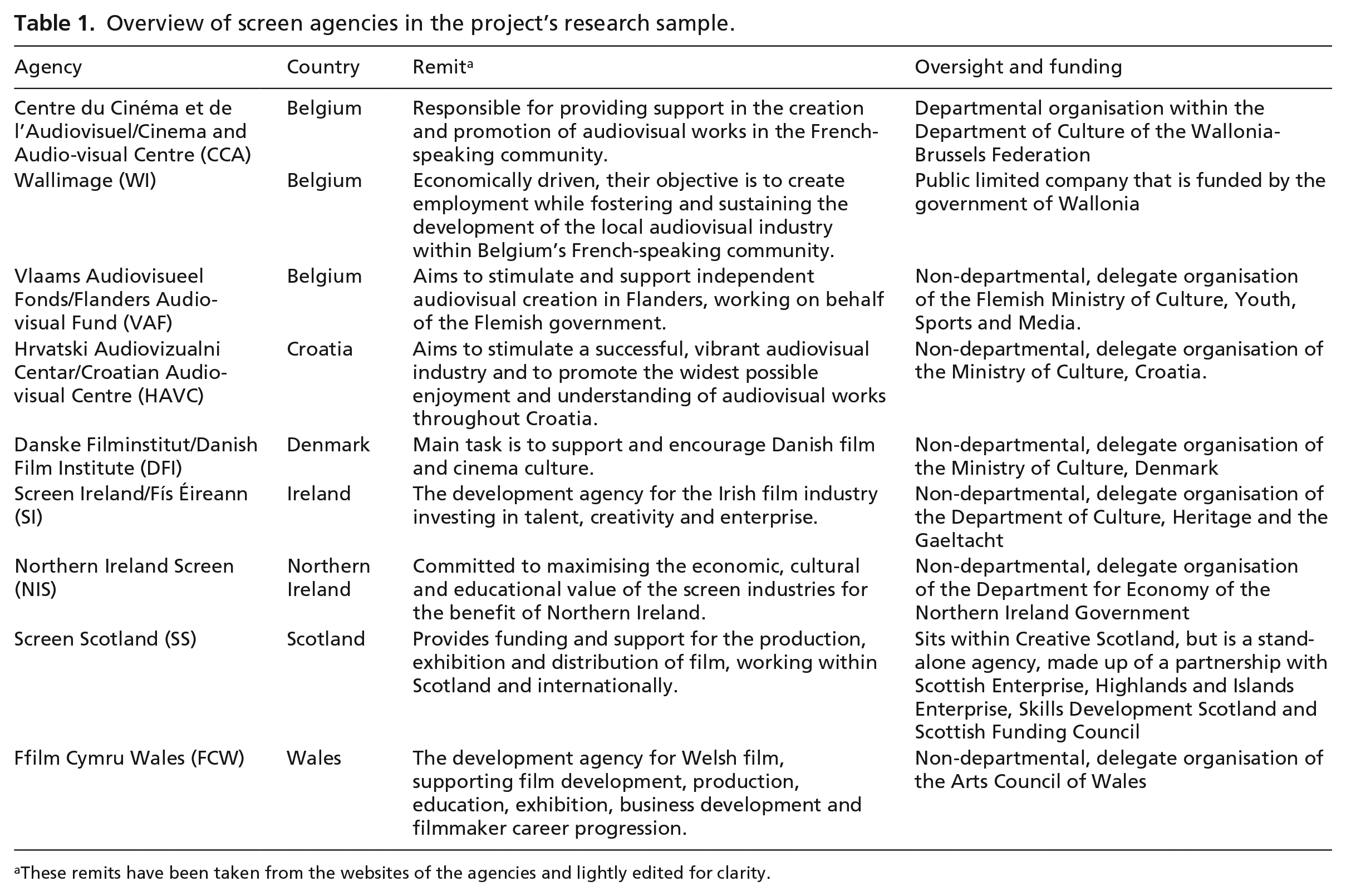
These remits have been taken from the websites of the agencies and lightly edited for clarity.
Our wider research reveals two prevailing logics which characterise these agencies. First, staff, assessors and board members are generally drawn from the sector (as opposed to civil servants or other occupational groups). This establishes a credible knowledge base, which then underpins their claims to authority and legitimacy with both the sector and policymakers. Building a positive relationship with the sector is a normative concern for screen agencies, but as we discuss later, it can become a substantial obstacle to more radical reforms. Second, the distribution of funding has been firmly established with recourse to ideas of ‘quality’ in relation to cultural and artistic value and/or (more recently) ‘market growth’. Both these evaluations are contentious in their own terms, but even more so in the context of an equality agenda (Liddy, 2020; Verhoeven, 2019), as we discuss later.
A final context worth outlining is the gender profile of the agencies themselves. In October 2020 the research team reviewed the profile of key leadership and strategic roles within our sample of nine agencies. We found several screen agencies had individuals self-identifying as female:
Four of the nine agencies had a female CEO (SI, Screen Scotland (SS), Centre du Cinéma et de l’Audiovisuel/Cinema and Audio-visual Centre (CCA) and FCW)
A third had a female Chair (FCW, Northern Ireland Screen (NIS) and SI)
A third had a majority female governing board (SI, NIS, WI).
To contextualise this finding further, in July 2021 we conducted a review of leadership structures within 37 screen agencies in Europe thereby extending the quantitative analysis above beyond the original agencies. We used public data and coded using self-identified pronouns. In this wider sample, 41 percent of the CEOs identified as female and 35 percent of the Chairs. Overall, the balance in European screen agencies skews male in roles of very senior leadership and governance.
Returning to our core study of nine agencies, several themes emerged organically from our analysis of interviews with individuals in leadership positions as well as existing and/or proposed initiatives and policies targeting inequalities in the screen sector. These represent specific ways in which existing problems of inequality in the cultural sector have been acknowledged, represented or defined by our interviewees and the agencies studied, and what (if any) counter-measures have been proposed or implemented. This list is not exhaustive. The noticeable absence of conceptualising inequality as a business issue is thus not necessarily a sign of it not being conceptualised per se. However, it is worth pointing out that in our interviews with industry figures, increasing diversity in the sector has been conceptualised as a supply issue rather than an audience issue. That is, there was no mention of audiences demanding greater diversity, but rather engagement with the problems of bringing diversity about in the face of institutional, cultural and staffing pressures. It is also worth pointing out that the themes are not mutually exclusive, and we can observe overlap between them. However, while – as previously mentioned – this article does not primarily aim to discuss the relative success of existing initiatives, it does highlight the lack of more intersectional approaches to equality, and to ‘creative justice’ more generally. Crucially, its very framing shows which issues have more legibility than others, and how or where the screen agencies see their remit. As becomes apparent in the next section, most of the agencies in our sample listed in Table 1 publicly acknowledge and make visible the problem of gender inequality, while tentatively leveraging their prominence in the sector to draw attention to the issue.
Inequality as a knowledge issue
Equality as an agenda is visible within most of the agencies in our sample. None of the agencies reject publicly the responsibilities of the sector with regard to gender equality though, as we discuss later, equality is often narrowly conceived. Overall, in the screen sector there has been increased awareness of gender (in)equality and the disadvantages many women face, though ‘gender fatigue’ is also becoming a risk due to the perceived hypervisibility of this issue (Liddy, 2020). At the same time, there has been a widened frame of interventions for screen agencies. In relation to equality agendas, they have become an expected centre of gravity for a range of civil society movements, economic actors (including trade unions) and substate actors (including local governments, cities and municipalities). One of the foremost ways in which the problem of inequality has been made visible through screen agencies is data collection – in essence as cultural intermediaries they intervene to broker knowledge of the issue. However, some agencies regard such data gathering as sufficient to address the issue.
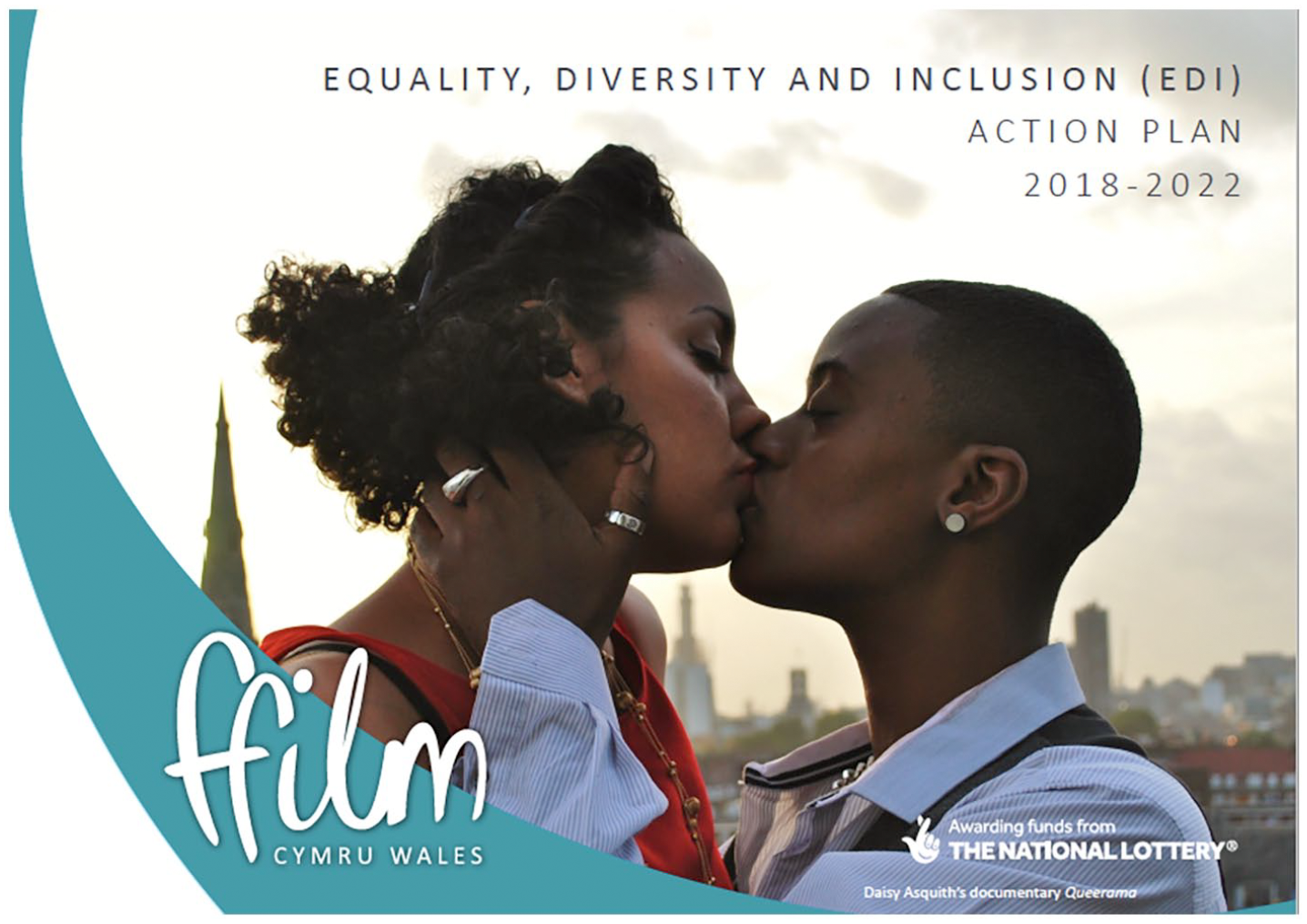
Ffilm Cymru Wales Equality, diversity and inclusion action plan 2018–2022.
Several agencies in our sample have publicly committed to collecting and publishing data on labour dynamics and its demographics (e.g. reports such as Equality Matters published by Screen Scotland (2017) and gender data collected by Screen Ireland and Danish Film Institute). While their research strategy usually focuses on quantitative constructions of the issue drawing on sectoral surveys and census data (thereby rarely uncovering the material impacts on the working lives of women or the repercussions of structural inequalities), the studies repeatedly highlight the issue of inequality, and the predominance of white, middle-class men in the screen sector, a finding corroborated in many academic studies, including Cobb (2020). A prominent review by the European Women’s Audiovisual Network (2016) pointed to the ongoing failure by the sector, including screen agencies, to collect and monitor statistics, regarding it as symptomatic of ‘a lack of a coherent, evidence-based strategy within leading institutions’ (pp. 10–11). Some agencies seem to have responded to this criticism: [W]e now publish the stats every quarter, and then annually, around diversity. [. . .] How many applications did we get from projects that had a woman director attached? What percentage of those were funded? What amount were they funded? So, we are collecting all of that, and we publish that. (Chair, Screen Ireland) I think we were quite slow in starting to actually be serious about gender but I think just making statistics, just making producers and everyone aware of this actually is starting to change something. We measure everything now. (CEO Danish Film Institute)
For many of the agencies, ‘knowing’ the problem is the first step in their interventions. Here we are mindful of Eikhof et al.’s (2017) conclusion that within the creative industries gender inequality is ‘overwhelmingly articulated as something that needed to be evidenced and explained, rather than challenged and changed’ (p. 848) – something inherent in the second quote above. There is a risk that research becomes a performative act rather than a means of change.
In some cases, research – along with heightened expectations among stakeholders for change – has facilitated further efforts to address the issue. This includes the creation of action plans (see Figure 1 above), the development of resources curating and celebrating women’s contribution to screen (e.g. Women in Croatian Film (Croatian Audiovisual Centre 2016)) and the allocation of new institutional structures and resources dedicated to the theme of diversity. The latter has taken the form of dedicated working groups and committees, such as the Gender Equality and Diversity Subcommittee appointed by the board of Screen Ireland in 2020. However, within this context, perceptions differed among our interviewees around defining the ‘problem’ of gender equality, and subsequently the need to address it. Our interviews also contain an admission that, in general, screen agencies have been reactive rather than proactive about issues relating to equality. This was recognised in our interview with the Chair of Croatia’s HAVC who acknowledged ‘It’s been on the agenda as a theoretical one, [. . .] but not regarding film production’ and again with the CEO of the Danish Film Institute: [T]he agenda of either ethnic representation or gender has come from another. . . it wasn’t initially our agenda. It was an agenda coming from somewhere else.
Overall, we found that one reason for this hesitancy is the centrality of meritocracy to the organisations’ ethos, based on the assumption that the notions of ‘talent’ or ‘creativity’ are neutral, ahistorical and apolitical values. Elsewhere, diversity is treated as part and parcel of the more general, creative mission of the agencies where it is applied to the stories funded and the worlds they build and showcase, rather than the demographics of the screen workers. When diversity is addressed and it openly challenges existing ways of operating, on occasion it can be met with sectoral, political and sometimes media pushback. This points to the risks (real or perceived) of Equality, Diversity and Inclusion (EDI) as potentially alienating stakeholders and industry partnerships and ultimately jeopardising relations between the agency and some parts of the sector, a point we return to in more depth later.
Inequality as a capacity issue
Frequently, how an issue is addressed or not is tied to the ways in which it is defined. Therefore, a gap in knowledge and the subsequent need for research is one way in which inequality is framed. The study also found three other ways that the issue of inequality was framed: in terms of being an issue of capacity linked to the size and shape of the labour market; an issue of creative outcomes where there is a need for women themselves to adapt to the dynamics and demands of the industry; and finally, an issue in which relational networks and structures are deemed more critical than formal targets or mechanisms which might curb creative autonomy.
As argued in McElroy et al. (2018) the issue of labour can be a particular challenge within small nations (a shared characteristic in our sample) and/or those with a nascent market for screen production. 2 In both contexts there are specific labour dynamics, including: less depth to the labour market, fewer organisations with scale, and the perennial risk of successful individuals migrating to other places which are seen as offering more opportunities (McElroy et al., 2018). Therefore, for some in our sample (as in the research by Redvall and Sørensen, parity through levers like quotas on labour or regulatory intervention is routinely rejected: ‘No, we have no quotas. [. . .] first and foremost, we cannot put it in a regulation because we do not have enough crew’ (Executive, HAVC).
In some cases, this might be true. Specialist roles such as cinematographer and editor take years to train and at that moment there may only be a limited number of workers in smaller nations able to perform specific tasks in the industry. However, we would also contend that this can be an overly simplified rationale which points to questions of occupational hierarchies. For instance, our analysis notes that many of the interventions and discourses related to equal opportunities focus on roles referred to as ‘the talent’, thereby marginalising the experiences and capacity building of others involved in production: [I]t’s difficult, because at the moment, we’re focusing on writers, producers, directors, to a certain extent DOPs [Director of Photography]. If you dig further down into technical stuff, it’s very gender imbalanced. So, there’s still a lot of work to do there. (Chair, Screen Ireland)
Some agencies have adopted targets as a route to creating greater capacity in terms of above the line talent. The most visible of these is the commitment by a number of screen agencies to 50:50:2020, as originally advocated by the Swedish Film Institute.
3
However, other agencies have publicly resisted quotas, expressing a desire to rely on what they perceive to be the ‘natural’ dynamics of the market: At Wallimage there is no quota based on the gender of those who present and shoot the films. This would be silly and insulting. On the other hand, we can but notice that some of the most enjoyable feature films that we have co-financed in recent times, from Grave to Nico, 1988 are films by strong, original and captivating women. (Wallimage, 2018, authors’ translation from French)
Even where quotas and targets have been adopted, however, they have at times proved problematic or have been criticised for their lack of transparency. Most screen agencies do not publicly detail the processes for achieving targets and so counting can be opaque and reliant on self-measurement (a criticism publicly levied at Screen Australia in 2019 (Evans, 2019)). Few agencies have public targets in place related to diversity. Here Ffilm Cymru is a notable exception, as they include a specific equality plan with targets for gender, disability, BAME, LGBTQ+, Welsh Language Speakers and those who come from or are in socio-economic disadvantage. Their interventions relate to development and production funding, training and support initiatives (Ffilm Cymru Wales, 2018). In general, across our sample we note, however, that where targets exist there appear to be few formal sanctions when they are not delivered upon.
It is not only the capacity of the labour market but also women’s own capacity as creative professionals that is seen as an issue. Often the problem of inequality is framed in terms of women within the labour market who need to be fixed – that if they developed appropriate traits and skills, they would be better equipped to compete. Indeed, one of the most ubiquitous responses by screen agencies to the issue of gender inequality has been to offer additional skills training aimed directly at women. Several agencies feature networking opportunities or talent programmes to get women to participate more fully in the workforce (e.g. X-Pollinator from Screen Ireland, a programme dedicated to upskilling women, features workshops such as ‘Write a Killer Funding Application’). Women become the sole targets of such efforts, suggesting that women are the cause of their own failure, overlooking the fact that individual women are not the architects or operators of their own industry-wide inequality. As observed elsewhere (Liddy, 2020; Newsinger and Eikhof, 2019; Verhoeven, 2019), this logic posits that women don’t apply for funding, nor do they emerge as senior creatives or occupy technical roles because they lack the skills or confidence, rather than it being a symptom of their reticence about a system which has perpetually marginalised them. A narrative of labour market fixes and self-improvement displaces narratives of reform.
Inequality as a creative output issue
A further frame underpinning the responses of screen agencies to inequality is made with reference to the subjective qualities of the content. The discourse of quality and meritocracy still pervades many screen agencies and their actions (see Wahl, 2017). Thus, content is treated as a separate entity from content producers, with the former often prioritised. Some of these tendencies can be observed in this quote from the DFI: I think diversity for us is films. I think having a high diversity when it comes to directors in terms of gender or ethnic background creates better films but it’s the films that are our focus [. . .] our notion of diversity is the films we need, films that have different voices, more representations that are more like what the society is. That’s the way we understand it. (CEO, DFI)
Such a commitment to diversity of content demonstrates at most a partial attempt to further the project of creative justice (Banks, 2017). While Banks calls for an evaluation of cultural objects based on their own objective qualities, this is never divorced from calls for greater parity of participation in all aspects of cultural work.
As research testifies, women are systematically disadvantaged in this system because they can be perceived as less experienced and often have fewer credits or lower reputational capital (Banks, 2017; Liddy, 2020; Wreyford, 2015). Reference to more subjective criteria such as one creator’s greater experience frequently fails to consider the reasons for having been afforded those opportunities in the first place. In the interviews, there was careful disavowal of bias in the systems of selection and support, while striving to reconcile this with concern for equality. The tensions within this were visible to those working within the system, who are told: [. . .] this is the commercial scheme so there needs to be a certain expectation on audiences and so we have to go just with the strongest directors. (Artistic director, New Danish Screen, DFI)
While flawed, the logic of quality is deeply rooted in the organisational culture and history of many agencies. Indeed, it is part of the modus operandi of many parts of the creative sectors with funding selection a product of history and a critical expression of power (Banks, 2017). Abandoning this logic is perceived as highly risky for the agency. Our interviewees warned that by moving away from this accepted system of rewarding ‘good’ ideas to one that seeks to intervene for other purposes (e.g. equality), they feared an erosion of the ‘good faith’ they have established and would ‘need to shift the whole relationship with the sector’ (Senior Executive, 2019).
To bring change about, many recognise the need to adjust the funding system and several strategies have been employed in response to inequality: first, creating dedicated funding for projects which offer opportunity to women to build reputation, experience and skills (e.g. Enhanced Production Funding for Female Talent, Screen Ireland). Second, attempts to diminish bias within the process of allocating funding through unconscious bias training for funding assessors, though such initiatives can sometimes be read as mere box ticking exercises, or a way of evading approaches that demand more profound changes, such as that of affirmative action.
To maintain existing relationships, a reputation of being ‘too radical’ is seen as detrimental to the smooth functioning of the agencies. The Chair of Screen Ireland points to such tensions in the aftermath of trying to instigate change: We are now seen as being too gender biased. I have people approach me to say ‘there’s no point applying for funding to Screen Ireland if you are male’, which I say ‘there is absolutely, if you have a good project’. I also want to say to him: ‘I didn’t hear you saying a dicky-bird when it was all males being funded and now you’re suddenly jumping up and down’.
Despite the friction and discomfort this inevitably causes, we argue that an attempt to improve ‘equality of outcome’ via targets and quotas is justified from a social justice approach as it moves away from the flawed, individualised, ‘bad luck’ approach to inequality and makes alleviating inequalities a matter of choice and circumstances. Many of the interventions currently being developed and delivered work within the system of inequality rather than dismantling that system. Echoes of this are in Eikhof and Warhurst’s (2013) conclusion that: ‘A meritocratic world of work cannot be delivered within the creative industries’ current model of production’ (p. 504). The need to provide a sense of continuity in what is a rapidly changing sector, and a risk-averse attitude mandated by the fact that public funds are being spent, however, is not the only reason many argue for more gradual and tentative change to take place.
Inequality as a relational issue
Despite many agencies having sufficient professional authority and a public commitment to equality, there was reluctance among agencies to radically disrupt the sector, perhaps mindful of the institutional and professional risks associated with this approach. As outlined earlier in relation to the normative logics at play, many screen agencies attempt to cultivate relationships built on trust with the sector, or at least with those who traditionally have been regarded as powerful and visible stakeholders.
However, we also note how some of the senior industry figures in our sample rely on less formal, more ‘ordinary’ ways of working towards gender equality. We have termed these behaviours ‘nudging’, as they rely less on a premeditated or avowed tactic to enact change, and more on quasi-instinctive responses by some individuals in the agencies, who identify problematic behaviours or views as they occur and try to correct them. The following interview excerpt evidences what we have termed ‘nudging’: I had one project coming in with a female main character with two older men and it’s a female character of 46, post-war and basically what she did was she was walking around. Her husband was out doing all the interesting stuff, she was walking around being extremely sexually frustrated, having two lovers and she finally found the great lover who basically raped her. They were like writing it as a seduction, but it was a very violent seduction and finally she was fulfilled because somebody just took her. And I had to write to them and say are you completely. . . it was like how do you think the reaction would be in two years when that film came into the cinema? That female character from two middle aged men, it’s ridiculous and I think two years ago I would never have replied like that, but I got so angry and there’s a whole movement now. (Artistic director, New Danish Screen, DFI)
The Chair of Screen Ireland refers to similar practices within her agency: The project managers work very closely with the projects. They might say to a project: this is great, but if there are no women, what if you swap that role there for a woman? What if that lead character becomes a woman? What if you do that? Have you thought about getting a female editor, a female DOP?
What we see in these anecdotes are individual challenges to prevailing work routines. These micro-interventions and everyday practices seek to disrupt the cultural and structural meta-text of the sector and those who work within it. While we do not wish to overstate this intervention or its ubiquity, we do wish to acknowledge the quotidian ways in which equality is being negotiated beyond formal policies and by leveraging existing relationships with the sector. Like the arts professionals in Durrer and Miles’ (2009) study of cultural intermediaries, many individuals are operationalising an equality ambition which is more fundamental than the organisations for which they work. There is a mix of empowerment and authority which allows these executives to intervene in the creative process. However, such ‘spontaneous’ interventions have serious drawbacks. Indeed, commitment to institutional change which relies on the work of individuals can add to their workload, both emotional and practical, as they have to negotiate between different subject positions and stakeholders to instigate and bring about the practicalities of change.
The absence of intersectionality
Largely invisible in the approach to equality taken by the sampled screen agencies was any account of intersectionality. To discuss gender as it is situated in specific work environments without paying attention to, for example, class and race is an inherently flawed endeavour, an issue that recurs across the creative industries (McRobbie, 2015; Nwonka, 2020). For instance, an intersectional understanding of identity is usually absent in the data collection strategies employed by screen agencies. Few of the screen agencies in our sample published statistics on the ethnicity or class background of their screen workers in front or behind the camera. While some like the Danish Film Institute include reports on social and geographical diversity, categories are often bracketed off from each other rather than integrated, which means that multiple axes of oppression or privilege are not fully captured in such disaggregated categories (Skadegård Thorsen, 2020). At the same time, attention to intersectionality is largely missing in wider institutional policies, with identity categories at most agencies again bracketed off into separate initiatives. This is problematic, as the chances for individuals who are subject to multiple axes of oppression to overcome these without institutional intervention are negligible. Screen agencies may counter that intersectionality is hard to capture. However, possibilities exist. For example, Ffilm Cymru’s targets mentioned above aim to mirror the demographics of the Welsh census, offering a fuller representation across multiple vectors.
Indeed, without full commitment to an intersectional agenda and policies in place, changes will be dependent on individuals, with all the drawbacks this entails. As Nwonka’s (2020) report on the BFI’s diversity standards shows – corroborated by our observations and self-reflexive remarks by some industry figures – when gender becomes a privileged category and others are disregarded, it is white middle-class women that benefit most. This was explicitly acknowledged in the interviews with the Artistic Director of New Danish Screen and again with the Chair of Screen Ireland where they discussed the internal profile of their agencies: We sat with the project managers recently, [. . .] and we were talking about the fact that we are all white, middle-class women. We are not representing social class. We’re not representing ethnicity. [. . .] So, we put in diversity statements now to all our ads saying we welcome applications from. . ., we’re not diverse. We’re not seeing the impact yet of that. So, there’s a lot of work. (Chair, Screen Ireland)
As noted earlier, in our sample there is a notable absence of Black and ethnic minority individuals at senior level, including at the levels of Chair and CEOs, and in the composition of governing boards. 4 Without such representation, what Banks (2017) might term ‘representational justice’, the embeddedness of equality in the agency apparatus and systems is likely to remain partial and obstructed.
Conclusion: screen agencies as mediating change?
Our research positions the agencies as intermediaries between the screen industry and small nations. Screen agencies have long been complex intermediaries, with diverse and often contradictory objectives. Much discussion of these organisations focuses on the uneasy relationship between their cultural and economic values. However, our research highlights the tentative emergence of a new political project for screen agencies related to social justice. Many will argue that screen agencies have for a considerable time played an active part in promoting social inclusion, for instance through their talent and audience access programmes. However, a concern with removing the barriers to access for women in a professional capacity is now accompanied by a heightened sense of expectation and visibility. Here and elsewhere (McElroy and Noonan, 2022), we begin to unpack the challenges of understanding how organisations, that are not ostensibly set up to be social organisations with an explicitly political remit, enact and leverage these forms of value through their provision of film and television.
The existence of multiple initiatives in the agencies of our sample, summarised in Table 2, suggests that gender equality measures do have more traction, a development mirrored beyond our sample (Association of Film Commissioners International (AFCI) 2020). We noted earlier that screen agencies are increasingly drawing attention and therefore legitimising the issue of equality as a concern. What should be clear from our study is that most European agencies are paying various degrees of attention to the issue of EDI. However, while a commitment to gender equity is acknowledged and made visible in the majority of cases we examined for this study, this commitment falters in the face of other agendas and concerns and it is yet to embed responsibilities fully into their structures and decision-making. For example, while special funding initiatives are put in place to support female talent, quota systems are routinely shunned due to their perceived riskiness (Redvall and Sørensen 2018). Diversity is often segregated from other talent development and funding initiatives, so therefore in many institutional contexts it risks becoming segregated into its own area of policy rather than being a fundamental part of the culture of the organisation.
Summary of emergent frames.
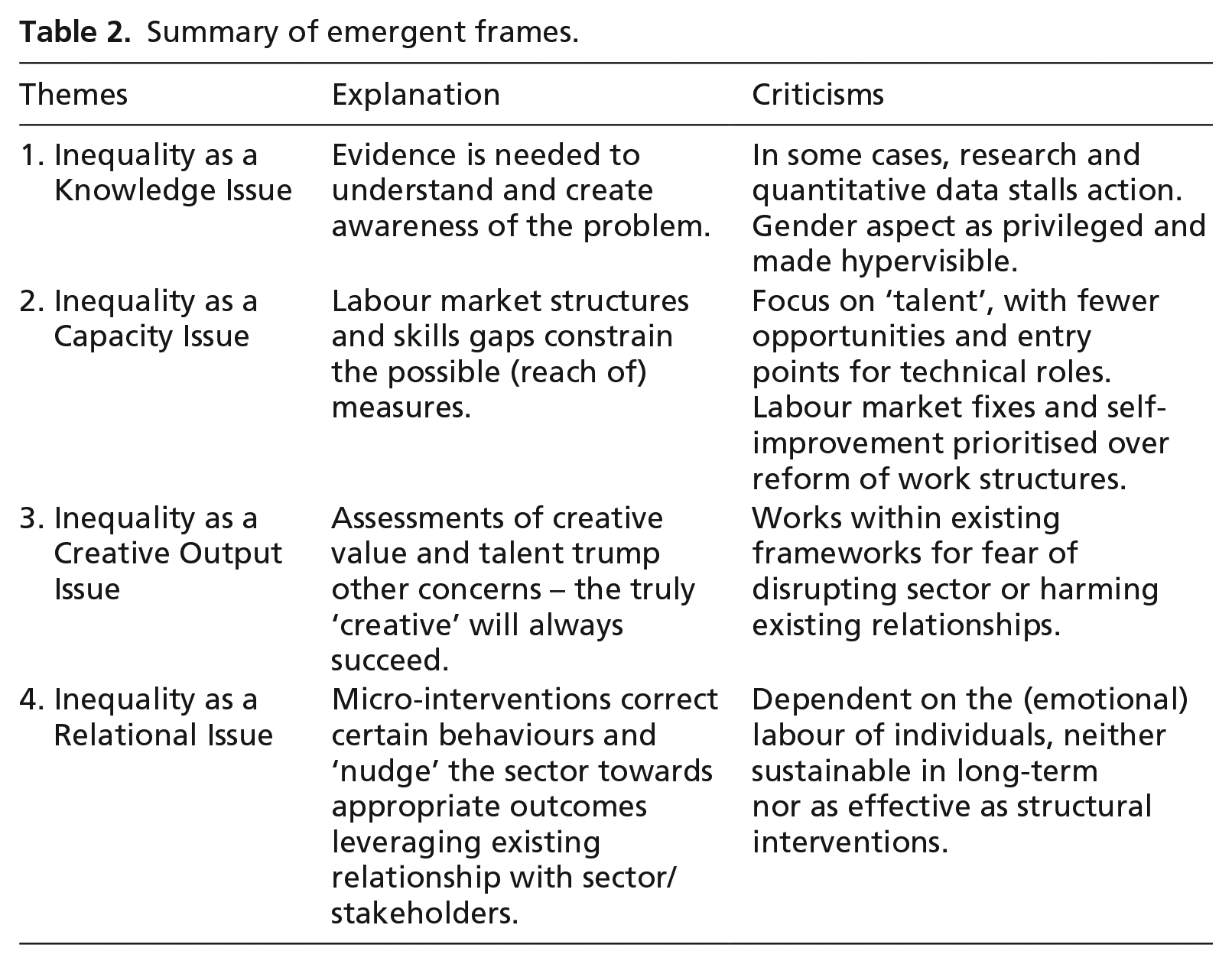
What emerges from our research is that the implications of an inclusion agenda are far more fundamental and far-reaching than currently envisioned. Meaningful change will necessitate a renegotiating of the purpose of screen agencies and their relationship with both the sector and policy makers, and also a reimaging of their role as cultural intermediaries within film and television. Screen agencies feel bound by their relationship to the sector and the need to ‘preserve’ working relationships, especially with those in influential roles within the sector. However, these relationships can be the very mechanisms through which inequality is reproduced. An expanded remit to include positive social change will require screen agencies and their funders to consider new ways of aligning performance, values, and accountability.
In short, if screen agencies are to become effective intermediaries for equality and to deliver new forms of social value, a paradigmatic shift in their logics, norms and working practices will be required. For example, the notion of ‘diversity’ needs to be continuously examined so it becomes more than a mere buzzword or means of heightening the image of specific agencies, and instead becomes a path towards more intersectional form of representation and justice. These new agendas will require internal changes. It will require new and specific expertise among staff. This will include not only staff who know the screen sector, but who know the communities which are marginalised within the current system. It will also require new organisational partnerships beyond the screen sector. A good example of this is Ffilm Cymru Wales’ Foot in the Door, an employability programme designed purposefully ‘for social inclusion’ (Managing Director, Ffilm Cymru Wales). This grew as a partnership with a housing association in the local area who are active partners in the recruitment, support, and training of participants from low-income households into the programme.
However, interventions of this kind are resource intensive, and rarely yield ‘quick-fixes’ in an industry which is constantly moving forward to the next project and to the next funding cycle. Radical reform may elicit additional criticism as existing power structures are dismantled, representing considerable institutional risk for screen agencies. The slow pace of change at institutional level is circumvented by some gender-aware executives challenging the norms of the sector so as to ‘nudge’ the sector towards more inclusive practices. But it also represents often unrecognised professional risk for the agency workers who engage in this political agenda, especially in smaller scale markets.
We see a critical role for screen agencies in amplifying equality as a normative concern and in instigating new values within the screen sector. They have a vital role in the redistribution of financial, symbolic and cultural resources of the sector for the good of all. However, while screen agencies will be critical to change, they will not be able to instigate radical change without wider normative and operational change occurring across the sector including within large production companies, film festivals, broadcasters, educators, and distributors. They will also require policy makers and funders to actively create and support mandates for equality, to defend agencies who work against taken for granted sectoral norms like quality and meritocracy, and to create evaluative frameworks which are transparent, robust and bring about meaningful change. It is those bodies who are ‘funding the funders’ (which we listed in Table 1) who must take additional responsibility for the structural change needed in the sector.
Timing here will be critical, and we recognise the additional challenges associated with the COVID-19 pandemic. Much of the equality-related actions, rhetoric and interventions assumes a growth trajectory – the assumption that a growing sector will inevitably increase participation. However, there is a dual threat to this logic: women and minorities are highly likely to be further economically disadvantaged in the short-medium term (Eikhof, 2020) and there may be redistribution of public funding to other areas such as health and social welfare. We fear that the external pressures arising from an austerity agenda will start to displace socio-cultural values in pursuit of a return to ‘normal’. Therefore, screen agencies have a critical role in ensuring any gains of the last decade are not lost, and the industry which emerges is an inclusive, diverse and equitable one.
Footnotes
Funding
The author(s) disclosed receipt of the following financial support for the research, authorship, and/or publication of this article: This work was funded by the UK’s Arts and Humanities Research Council (AHRC) as part of their support for the project ‘Screen Agencies as Cultural Intermediaries: Negotiating and Shaping Cultural Policy for the Film and TV Industries within Selected Small Nations’ (AH/R005591/1).
Notes
Biographical notes
