




Abstract
The polarised Leave/Remain positions offered by Brexit hampered opportunities for Britons to articulate the complexity of their affective political allegiances. Turning our focus on Grayson Perry: Divided Britain (2017, C4, Swan Films), we argue that Perry’s role as artist-ethnographer enabled an exploration ‘from below’ of the tensions occluded by deliberative democratic debate in febrile post-Brexit Britain. Intervening in a conjuncture of which Brexit was symptomatic, Perry’s arts documentary with Channel 4 provided the space to articulate newly configured affective and political affiliations in terms both of Britain as place and Britishness as identity. Drawing on Chantal Mouffe’s conception of agonistic politics, we argue the programme provided a space of confrontation for groups defined as polarised ‘camps’ to contest and debate through their emotional and symbolic differences which exposed the limitations of the ‘post-political’ formation. However, while the programme visualises Perry’s ‘left populist’ strategy of crafting two similar pots through ethnographic listening and interactions with Leave and Remain communities, we argue the focus on predominantly white communities ultimately offers a limited notion of what ‘a people’ with the potential to revitalise democracy in contemporary Britain could be.
Introduction
Recent influential commentary has interpreted Brexit as the expression of underlying social, cultural and ideological divisions within British culture. According to such accounts, Brexit disclosed a hidden truth: British people belonged to two ‘tribes’ which had existed somehow concealed beneath the surface of political culture which fractured the country into ‘leave’ or ‘remain’ stances. In this article, we contest this simplistic account and argue, from a perspective informed by the work of Chantal Mouffe (2013, 2018), that far from giving real political expression to the tensions in British society, Brexit narrowed complex issues of identity, class, race, locality and power into a reductive binary logic. Conceptualising Brexit as one dimension of what Mouffe has called the ‘populist moment’, a conjuncture in which the crisis of neoliberal hegemony and the post-political order that legitimates it has given rise to a reconfiguration of the social and political order, we consider the central role that cultural practice can play in both recording the affective and political re-alignments of British identities after Brexit and providing a site for their re-articulation. We argue that Perry’s (2017) arts television documentary Grayson Perry: Divided Britain (C4, Swan Films) provides a site for ostensibly polarised communities to confront, articulate and work through lived and felt differences in ways that disclose the absence of genuine contestation within the current political landscape. The film offers a space where the need for an agonistic politics finds articulation, a site of virtual and actual popular assembly where dissensus is explored as part of what can be understood as a project to ‘revive and radicalise democracy’ (Prentoulis, 2016: 44).
Responses to Brexit
Brexit, understood through the perspective of the conjunctural analysis outlined in the recent work of Jeremy Gilbert (2019) and Lawrence Grossberg (2019), can be understood as the symptom of a configuration of conflicting forces which can be mapped in the divergent responses to the vote. The EU Referendum was heralded as a ‘democratic landmark’, a lifetime opportunity when Britons could at long last have their voices heard (Prentoulis, 2016: 42). Yet, post-referendum reflection in the arts, current affairs and academia remains starkly divided about the implications of the vote for places and communities and its wider repercussions for politics in the United Kingdom.
For those sympathetic to ‘Remain’, the Referendum gave vent to a Pandora’s box of ugly feelings – uncovering the fault-lines of division across Britain. In British artists’ work on Brexit, the referendum is conceived as a ‘train wreck’. Anish Kapoor used an aerial satellite photograph of the British Isles bearing a deep vertical wound as though the referendum had exposed all that was sick in the nation (‘A Brexit, a Broxit, We All Fall Down’ 2020). Arts writer Somak Ghoshal, writing about this work, describes it as ‘ascerbic, violent, sinister’. Kapoor ‘depicts Brexit as a bloody schism within Britain, dividing races, ethnicities and communities more sharply than ever’ (Ghoshal, 2020: 3).
Responses from scholars with a focus on questions of race have been equally troubled by the apparently retrograde retreat into narrow forms of nationalism the Brexit result seems to suggest. Virdee and McGeever (2018) argue that discussions about Brexit tend to occlude Black and Brown citizens; the maxim ‘left behind’ elides the ‘internal others’ that the United Kingdom rests its identity against (see also Bhambra, 2017). The Brexit campaign was predicated on ‘the contradictory but inter-locking visions’ (Virdee and McGeever, 2018: 1803) of an aching nostalgia for empire and a ‘Powellite’ inward retreat from globalisation. Bound up in the fantasy, and therefore central to the Vote Leave campaign to make Britain ‘great again’, were anxieties about immigration, especially in relation to the figure of the ‘Muslim’. Of particular interest to our article is their contention that the underlying motor for the ‘Leave vote’ was the politicisation of Englishness. Since 2008, a pernicious racialised nationalism has taken hold amid the felt loss of Britain’s prestige in a globalising world which has led to ‘a defensive exclusionary imaginary: we are under siege, it is time to pull up the drawbridge’ (Virdee and McGeever, 2018: 1811). Central to political Englishness is immigration: 10 percent of the populace saw it as an issue in the 1980s and 1990s – which had risen to 30–40 percent by 2006 making ‘race and immigration’ the most pressing issue in the United Kingdom (Duffy and Frere-Smith, 2014: 8). By mobilising racial nationalism, figures at the helm of the Vote Leave campaign, such as Nigel Farage, made political capital from the idea that the white working class are the biggest victims of globalisation, a categorisation which draws attention away from the issues and problems experienced by Black and Brown Britons (Virdee and McGeever, 2018: 1806). The occlusion of questions of race, as Bhambra (2017) argues, occurs when boundaries are drawn around those deemed legitimate citizens within the polity. She critiques Goodhart’s (2017) reading of Britain as ‘nation’ because it misidentifies Britain’s history as Empire, an Empire which includes ethnic minorities as insider-citizens.
Other scholars have sought to move beyond the equally problematic and simplistic categorisation of ‘Leave’ voters as the uneducated dupes of a wave of right-wing populism. McKenzie’s (2017) ethnography of white working-class political re-invigoration represented by the ‘Leave’ vote charts their investments in hope for change in their localities. Challenging the mantra ‘left behind’ which casts working-class people as atavistic and xenophobic, McKenzie listened to her respondents and heard that the howl of ‘leave’ was about the pain and the despair of everyday existence: zero-hour contracts, unaffordable housing and redundancy in the wake of de-industrialisation. Her fieldnotes feature East Londoners ‘left out’ of the new shiny corporate buildings that are not meant for them. Blaming ‘abject and white’ working-class people for voting against their interests, she argues, mis-recognises the 30 years of ‘unfairness, injustice and exclusion’ of their lived experience. Similarly, Walkerdine (2019) contests the way working-class communities were pathologised for voting Leave. Critiquing approaches which attack the affective life of working-class people and listening to the specific issues, fears and concerns of two South Wales communities, she is able to map how and why adjacent factions judge each other and act to other, defend, reject and project within ‘affective entanglement’ (Walkerdine, 2019: 9).
Building on this scholarship, this article turns to the work of Mouffe in order to offer, via Perry and his work at C4, two new perspectives on Brexit: first, a reconceptualisation of the Brexit process in terms of an understanding of the concept of agonistic politics, and, second, an approach to Perry’s practice, as presented in Divided Britain, as work which reflects and responds to the crisis of neoliberal hegemony, contesting the crude binarism of the referendum and, more crucially, the impoverished political landscape of a ‘post political’ order. In the section which follows, we examine Perry’s role within C4’s arts programming agenda and his suitability as artist-presenter and interlocutor on the political positions offered by Brexit.
Arts programming, Grayson Perry and C4
Television scholars have expressed worries that the traditional genre of arts television is so ‘at risk’ that its status as a vital component in our televisual landscape is virtually moribund (Noonan, 2018). A stand-out arts success in the terrestrial schedule is Channel 4’s series of collaborations with Perry whose oeuvre blends specialist factual with lifestyle programming conventions. Noonan and Genders (2018) argue that Perry’s programming success, acclaimed as a ‘mould-breaking combination’, with its talent-driven formula playing to market logics, offered an unsustainable solution to ‘at risk’ arts programming. Yet, Perry’s success in establishing ‘a cornerstone of C4’s arts strategy’ (Noonan and Genders, 2018: 84) has gathered pace since 2014 resulting in a portfolio of series, the latest of which is Grayson’s Art Club (C4, 2020) which shows Perry and Phillipa Perry interacting with the creative practices of a virtual community managing the emotional rollercoaster of lockdown. Divided Britain, generically categorised as ‘documentary’, could be seen as an affective precursor, given Perry’s position as both ‘artist-presenter’ (Noonan and Genders, 2018: 84) and interlocutor between Leave and Remain. Perry meets Channel 4’s public service and commercial remit. As artist, writer and intellectual, he carries the gravitas to debate and evaluate the political questions which constitute public service, while his cultural cachet marks his status outside the elite – his lower middle-class background, troubled familial history and occasional identity as ‘Clare’ – render him distinctive, relatable and marketable. He also draws distance from white, male and at times patrician arts presenters such as Kenneth Clark (Conlin, 2009) or Simon Schama. Lauded as innovative by commissioning editors, as Noonan and Genders found in their industry research, Perry’s role as artist-ethnographer enables him to fashion his art out of the concerns of the people and communities considered by the programme (Noonan and Genders, 2018: 87). We argue that particular significance must be attached to Perry’s emotional intelligence and empathy (Butler, 2020), attributes which make him adept at contextualising the ‘affective histories’ (Walkerdine, 2019) of the ‘two tribes’. His propensity for listening, an essential action where populist political atmospheres accrete (Flinders, 2020: 21), enables him to tease out, record and respond to ugly feelings. We argue that the shift in arts programming identified by Noonan and Genders (2018) to celebrity, reality and spectacle offers a useful form for engaging publics in political debate. In this way, Divided Britain creates space for ‘critical art’ which ‘foments dissensus . . . makes visible what the dominant consensus tends to obscure and obliterate’ (Mouffe, 2008: 12). The affective responses to Brexit are distinct from those ‘non-cathartic’ emotions which are the focus of Sianne Ngai’s work. Yet, the ‘ugly feelings’ Perry discloses can certainly be understood similarly as ‘negative affects’ generated in response to ‘a general state of obstructed agency’ (Ngai, 2007: 3). We argue that the formal shift represented by Perry’s intervention stretches out to new forms of public service using narratives and symbols of identity which urge communities to reflect and engage with the wider implications of Brexit within the polity.
Before examining Divided Britain’s complex relation to Brexit and its aftermaths, we consider how aspects of Mouffe’s work help us to situate the programme within the post-Brexit conjuncture. Mouffe’s account of agonistic struggle is crucial for an understanding of the current conjuncture.
Agonistic politics
Whereas Liberal political theory understands political differences in relation to an ideal of consensus, Mouffe argues that conflict in democratic societies is ineradicable and should be recognised as the defining constituent of democratic pluralism. The concept of ‘agonistic struggle’ provides a way of conceptualising the inescapable role of contention within democratic societies. In this account, conflict cannot be overcome through the establishment of an over-arching consensus; rather, ‘it is always present since what is at stake is the struggle between opposing hegemonic projects which can never be reconciled rationally’ (Mouffe, 2013: 9). In liberal democracy, this confrontation is ‘played out under conditions regulated by a set of democratic procedures accepted by the adversaries’ (Mouffe, 2013: 9). This consensus around both the institutions of liberal democratic organisation and the ethico-political principles underpinning it prevents a relation of ‘agonism’ from being one of ‘antagonism’. In the latter case, the ‘us/them relations’ that constitute political identifications can be experienced as violent ‘friend/enemy’ ones. In this scenario, those who had hitherto been regarded as ‘different’ come to be seen as posing an ontological threat to their opponents.
How should we understand the divisions articulated in the Brexit process in relation to Mouffe’s work? The contentions around issues of democratic representation and the relation of national to supranational political structures within the Brexit ‘debate’ could be understood as agonistic struggles. However, we argue that the role of ‘Leave’ and ‘Remain’ positions as sites for the articulation of complex and often previously unvoiced tensions linked to fundamental economic, political and geographical inequalities are dysfunctional. They are symptomatic of the failure of the existing democratic structures to provide a means for the expression of agonistic dispute. As Mouffe (2018) points out, a hegemonic formation in which neoliberalism constitutes a supposedly incontestable economic and ideological horizon has given rise to a ‘post-democratic’ order in which genuine political contestation has been replaced by political managerialism and the impoverishment of liberal democracy: With the demise of the democratic values of equality and popular sovereignty, the agonistic spaces where different projects of society could confront each other have disappeared and citizens have been deprived of the possibility of exercising their democratic rights. (p. 16)
The emergence, within the Brexit process, of what Goodhart and others describe as ‘tribes’, defined through their mutual incomprehension and stigmatisation, can be understood as the effect of the loss of the plane of agonistic contention and its displacement by sites of antagonism formed around identities expressed in terms of polarised positions grounded in more complex and deeply seated tensions.
In what follows, we consider how a reconceptualisation of the divisions expressed in relation to Brexit in the light of Mouffe’s work enables us to assess Perry’s role as artist-presenter; his craft practice and what we will describe as his ‘populist’ creative process can be seen as mechanisms through which antagonistic conflicts might be re-articulated in agonistic forms. We suggest, crucially, that Divided Britain makes explicit the simplifying superficiality of Brexit divisions and works through a strategy of what Prentoulis (2021: 30) describes as ‘transversality’, ‘a type of cutting across left and right . . . in order to redefine the political field rather than occupy the middle ground’. Through its deployment of forms of ethnographic engagement with ‘Leave’ and ‘Remain’ communities and identities and its inscription of these in the production of art objects, Divided Britain provides a site of transversal encounter which ‘can signify the need to change the rules of the political game and leave behind the old political categories’ (Prentoulis, 2021: 31). An arts documentary film and the art-making within it obviously cannot provide – in themselves – the means to restore democratic sites of engagement and contention. But they do offer an agonistic surface on which to stage a critique of the impoverishment of political culture and suggest ways in which a counter-hegemonic formation might emerge through the renewal of agonistic dispute outside existing sites and modes of political praxis. Understood in this way, Perry is a cultural practitioner operating, to use Althusser’s phrase, ‘in the conjuncture’ rather than ‘on the conjuncture’ (Althusser, 1999: 18; Mouffe, 2018: 9). For Althusser (1999: 19), the critical role of the intellectual (following the example of Machiavelli) is not simply to provide an ‘enumeration’ of the elements constituting the conjuncture they inhabit but to enable a conceptualisation of it ‘as their contradictory system’. Perry’s intervention at the intersection of the affective and the political reveals the ‘populist moment’ as, in Gilbert’s (2019: 13) phrase, a ‘specific configuration of emotion, attachment and trauma . . . registered on corporeal and psychic planes as well as those of public institutions’.
Brexit and the ‘populist moment’
Brexit can be understood in relation to a wider transformation of the political landscape which Mouffe (2018: 12) has identified as the ‘populist moment . . . the expression of a variety of resistances to the political and economic transformation seen during the years of neoliberal hegemony’. These have been provoked by the erosion of the central tenets of liberal democracy in what has been called ‘post-politics’ or sometimes ‘post-democracy’: ‘The only thing that post-politics allows is a bipartisan alternation of power between centre-right and centre-left parties’, Mouffe (2018: 17) argues, giving rise to a situation in which politics has become ‘a mere issue of managing the established order’. The effect of this has been the elimination of ‘the possibility for agonistic struggle between different projects of society which is the very condition for the existence of popular sovereignty’ (Mouffe, 2018: 17). Only through the (re-)emergence of agonistic struggle, Mouffe argues, can ‘a people’ emerge whose will can be expressed through democratic processes.
The populist moment is characterised by a situation in which ‘the dominant hegemony is being destabilized by the multiplication of unsatisfied demands’ which cannot find expression through established institutions and processes. The result is a disarticulation of the hegemonic formation and the emergence of ‘a new subject of collective action – the people – capable of reconfiguring a social order experienced as unjust’ (Mouffe, 2018: 11).
The success of right-wing populist movements constituted around the demand to leave the EU, which have involved a critique of a political ‘establishment’ that fails to address the concerns of ‘ordinary’ people, can be understood as one response to this populist moment. Mouffe’s recent work has argued that the left should not concede the sphere of new political intervention to movements welding dissatisfaction with inequality and lack of popular representation to xenophobic and racist nationalisms. A left populism – she claims – can be constituted ‘combining the variety of democratic resistances against post-democracy in order to establish a more democratic hegemonic formation’ (Mouffe, 2018: 36). This, she suggests, can only take place as an effect of ‘an adversarial agonistic politics oriented towards the establishment of a different hegemonic order within the liberal-democratic framework’ (Mouffe, 2018: 38). We argue that Divided Britain offers televisual engagement with ostensibly divided communities and in the process acts as an agonistic space through which popular sovereignty might find its expression.
Grayson Perry: Divided Britain and the populist moment
A superficial reading of Divided Britain might align it with a broader liberal response to Brexit as a troubling disclosure of fundamental divisions within British society characterised by the distinction between a cosmopolitan, socially and geographically mobile and ‘left-leaning’ stratum and a provincial, white, working-class and ‘traditionalist’ faction ‘left behind’ by globalisation. Ostensibly sharing a perspective with commentary like Goodhart’s (2017) The Road to Somewhere, it examines the views of people in the most polarised of communities in the country: Boston and Hackney. Goodhart’s simplified conception of ‘the nation’ and his equally problematic rendering of complex dynamics of class, geography and ethnicity have been widely criticised (Emery, 2019; Goodfellow, 2020) and Perry’s role in ‘getting behind’ the antagonisms of Brexit to explore the more complex and contradictory perspectives within these locales provides a route towards re-articulating supposedly allergic opposition as agonistic disputation and a path towards new forms of dialogic interaction.
Described in 2012 as ‘C4’s Louis Theroux’ Perry builds on his ability to ‘explore the texture of everyday life’ using what commissioner Tabitha Jackson described as his role as ‘an artist-anthropologist’ (Anonymous, 2012). ‘Artists’, writes Perry (2017), ‘are now cultural operatives reflecting the values and feelings of the majority of the population’. Part-ethnographer and sharing Theroux’s televisual investigations of life-worlds but using art practice, he embeds himself within spaces and practices which also tend (almost stereotypically) to reinforce the sense of cultural difference between these localities and communities. There is an emphasis on the differences between metropolitan and provincial cultures and identities which stresses the apparent inequality of resources, the different experience of and perspective on migration and contrasting perceptions of both local and national identities within the ‘Remain’ and ‘Leave’ communities. The film’s title and – to an extent – its representational schema seem to reinscribe familiar conceptualisations of Brexit as metonymic for a fracturing of British society along lines which demarcate opposing positions relating to class, race, geographical and social mobility understood as existing prior to and finding expression in the Brexit vote. To that extent, the film contributes to a discourse about Brexit as revealing a ‘truth’ about social division which finds effective articulation in the ostensible polarities of Leave and Remain positionalities. Swan’s script-writing team almost explicitly utilises what Jay Emery describes as the ‘facile categorisations’ in the work of Goodhart (2017: 3): Remainers are ‘people of anywhere’ who see ‘the future as an adventure on which they are well-equipped to embark’. Leave voters are ‘linked to their community and their geography . . . people of somewhere. They feel their identity is under threat because their locale is under threat, their way of life is under threat’. The Referendum question, Perry suggests, was ‘well-pitched to highlight this divide’.
Yet, the film also invites its audience to interrogate the reductive form of political practice represented by Brexit and by extension the impoverishment of democratic praxis within ‘post-political’ Britain. Its novel contribution is to present art as a practice which can engage citizens in ways that give articulation to their different and sometimes conflicting cultural identities in forms that work away from the antagonistic relation constituted by Brexit and towards what can productively be understood as agonistic modalities of interaction (Mouffe, 2005: 1–16, 2013: 1–18). Within these, the scope for transversal lines of interaction and encounter is mapped out both in the form of the work Perry produces and in the interactions within public space it prompts. The film suggests that art, at least in the ‘populist’ form Perry’s practice takes here, provides a site for the contestation of meanings, values and identities which is more inclusive and progressive than either conventional political mechanisms or the constricting binarism of referenda. Populist art also has the potential to extend outwards to include the issues and problems of Black and Brown citizens, argued to have been occluded in Brexit discussions (Virdee and McGeever, 2018). However, one of the problems of Divided Britain, as we explore later, is that it falls short of this opportunity to be racially inclusive.
Setting out with the concept of two ‘tribes’, Perry’s engagement with the communities he considers (ostensibly positioned in terms of a radical polarity) suggests complexities and contradictions within them which prevent simplistic conceptualisations of the subjectivities of those who constitute them. In Boston, Perry records conversations with speakers who express disorientation and disempowerment in the face of what they perceive as global forces: economic crisis, migration and the apparent transformation of the locality. These positions are linked to a sense of alienation or disengagement from the political process and a perception that involvement in existing democratic practices is futile (‘my one vote’s not going to make a difference’), or irrelevant (‘we don’t vote. . . what we don’t know don’t hurt us’). Some of Perry’s interlocutors appear to endorse the notion that ‘Leave’ was the expression of a cluster of values and anxieties associated with ‘left behind’ identities: white, working-class, provincial. Yet, the film also suggests that this perspective obscures complexities and contradictions. It sets, for instance, speakers who describe the influx of Eastern European migrants as sudden, alarming and disorientating against those who accept that the labour undertaken by migrants is ‘too hard’ for most people and assert the wide availability of employment within the locality to counter the notion that migrants take work from ‘locals’. ‘It’s easy to get a job’, says a young female interviewee, ‘I’ve had three in a year’. Most strikingly, one interviewee, who identifies himself as Latvian and recounts experiences of discrimination and hostility within the town, claims, to an astonished Perry, that he would have voted ‘Leave’ if he’d been able to participate in the referendum. This moment is clearly disconcerting for Perry and perhaps for viewers because it appears to disrupt the assumption that Brexit is the expression of already constituted identities that align with readily comprehensible concepts of class, locality and ethnicity.
Subsequently, Perry notes the contradictions between the concern articulated by some older Leave voters for Britain to ‘stand on our own feet’ and the fact that the labour practices typical of the large-scale agribusinesses which surround Boston rely on the low-wage costs secured with labour provided by migrants of Eastern European origin. Perry’s narrative acknowledges the sense of disenfranchisement, disorientation and displacement experienced by ‘British-born’ people within Boston; he identifies it with a ‘nostalgic, intensely local sense of identity and a desire to protect the life they felt they used to have’. Yet, the film reveals that, in an apparently homogeneous ‘Leave’ community, identities and perceptions can be recorded that unsettle the binary conception of subjectivities allegedly manifested in the referendum. This enables Perry to problematize the notion of entrenched, ‘tribal’ affiliation Divided Britain seems, initially, to accept: ‘For all the tribal markers on display . . . how deep did this division really go?’ Perry asks at one point, inviting the audience to interrogate the Anywhere/Somewhere polarity.
Perry’s exploration of ‘Remain’ identity in Hackney is more explicitly satirical and more alert to the contradictions of this position. He remarks that an anti-Brexit demonstration constitutes a form of ‘leisure activity’ for the ‘left-leaning middle classes’ in which demonstrators who had participated in anti-globalisation protests now line up with ‘global finance’ in defence of a neoliberal status quo.
This sharper critical edge perhaps suggests a perspective informed by the caricature of ‘Anywheres’ offered in Goodhart’s (2017: 23–24) work: ‘liberally-inclined graduate[s]’ who ‘belong to the mobile minority’ and ‘fully embrace egalitarian and meritocratic attitudes on race, sexuality and gender’. That identity is one which Perry is willing to include himself in at points in the film. Again, though, the film disrupts the caricature of the ‘Remainer’ position as contemptuous and uncomprehending of ‘Leave/’Somewhere’ communities. Remain voters from ‘leafy Stoke-Newington’ express a (belated) recognition of their motivation in a desire to sustain a social order which granted them significant social and economic power. A woman in the ‘pregnancy yoga’ group interviewed by Perry expresses a changed perception, in the light of the referendum outcome, in which a ‘wall’ becomes visible between those, like her, who have ‘done very well out of the system’ and those who ‘weren’t doing well’. This speaker expresses a sense of ‘shame’ at not being able to ‘see’ the inequalities she suggests are now brought into focus. There is a recognition, in this moment, of economic, social, cultural and political divisions that have been obscured by a ‘system’ that perpetuates them and an acceptance of complicity with this. The affective dimension to this recognition, an emotional response to a transformed conception of the polity is, we argue, a crucial dimension of the emergent realignment the film projects.
These moments work to suggest the failures of the post-political formation and pose a challenge to the impoverished political landscape of centrist consensus politics. At this level, Divided Britain can be understood as an instance of media practice that operates as a ‘site where the hegemonic struggle’ is ‘fought’ (Mouffe, 2013: 143). It both points up and contributes to the fragmentation of neoliberal hegemony and the centrist political managerialism that sustains it.
Articulating difference through ‘A Matching Pair’
Perry’s account of his own relation to the ‘debate’ and the role he ascribes to his artistic practice seems, at first glance, to reinstate a conception of culture as the agent for consensus retrieved from the ‘noise’ of Brexit. Perry insists that the ‘crowd-sourced’ images sent to him by Leavers and Remainers have a ‘similar tone’ revealing ‘something deeper than all the cultural differences I’d seen’. This is expressed by his decision to make the pots literally almost ‘matching’ in form and size. Yet, while Perry suggests the selection of images through which the ‘two tribes’ sought to express their relation with ‘Britain’ reveal an investment in ‘everyday things we all love’, the identification of ‘shared values’ beneath division is part of a thread of critique which, far from diminishing difference, provides a mechanism for its articulation. Perry’s narrative and his art repeatedly problematise the simplifying binarism of the Brexit process, suggesting that those issues it gave vent to and the affective, ethical and political investments these are related to are ‘complicated’, giving rise to questions about British culture ‘that can’t be answered by some simple bloody ‘yes’ and ‘no’ question’. However, the interrogation of the orchestration of political differences into a binary antagonism does not prompt the erasure of contention in the symbolic or social domains. The pots ‘A Matching Pair’ (see Figures 1 and 2) carry the traces of conflicting ideological positions marked out in the polarised iconography in the different sets of transfers decorating them.
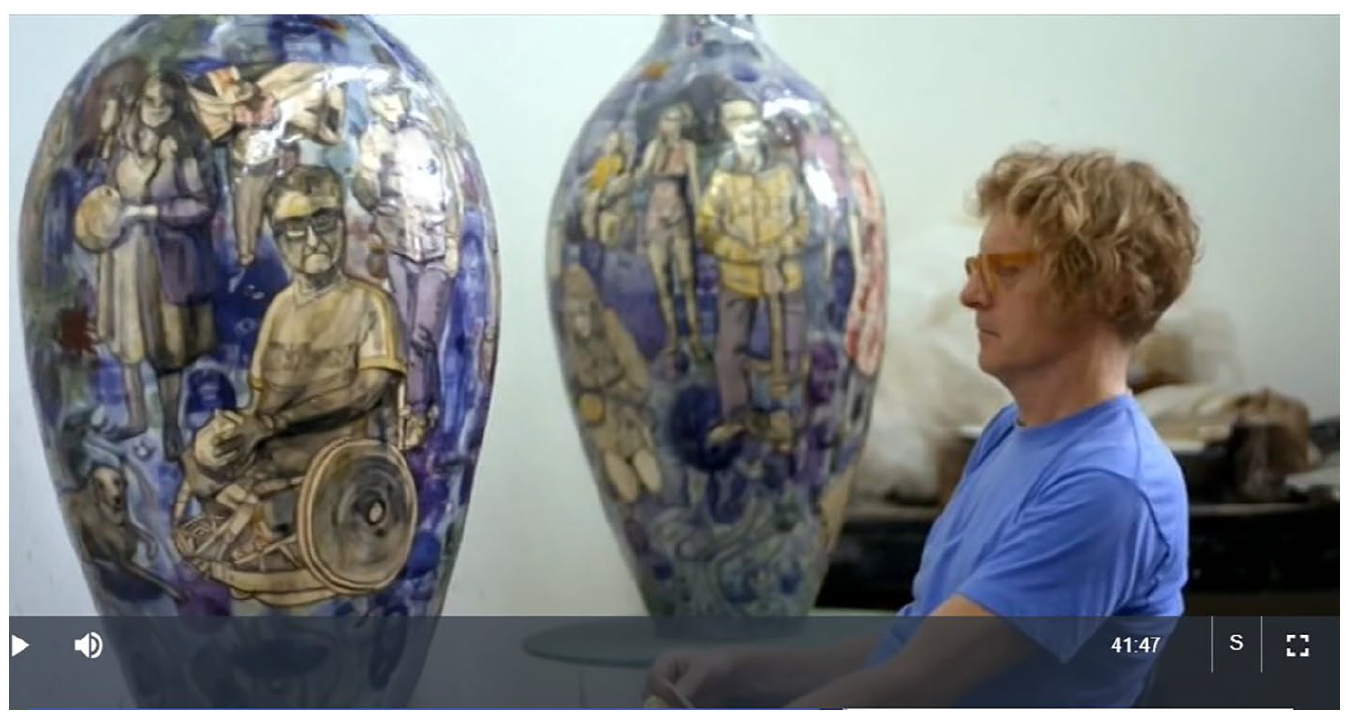
Perry with ‘Matching Pair’.
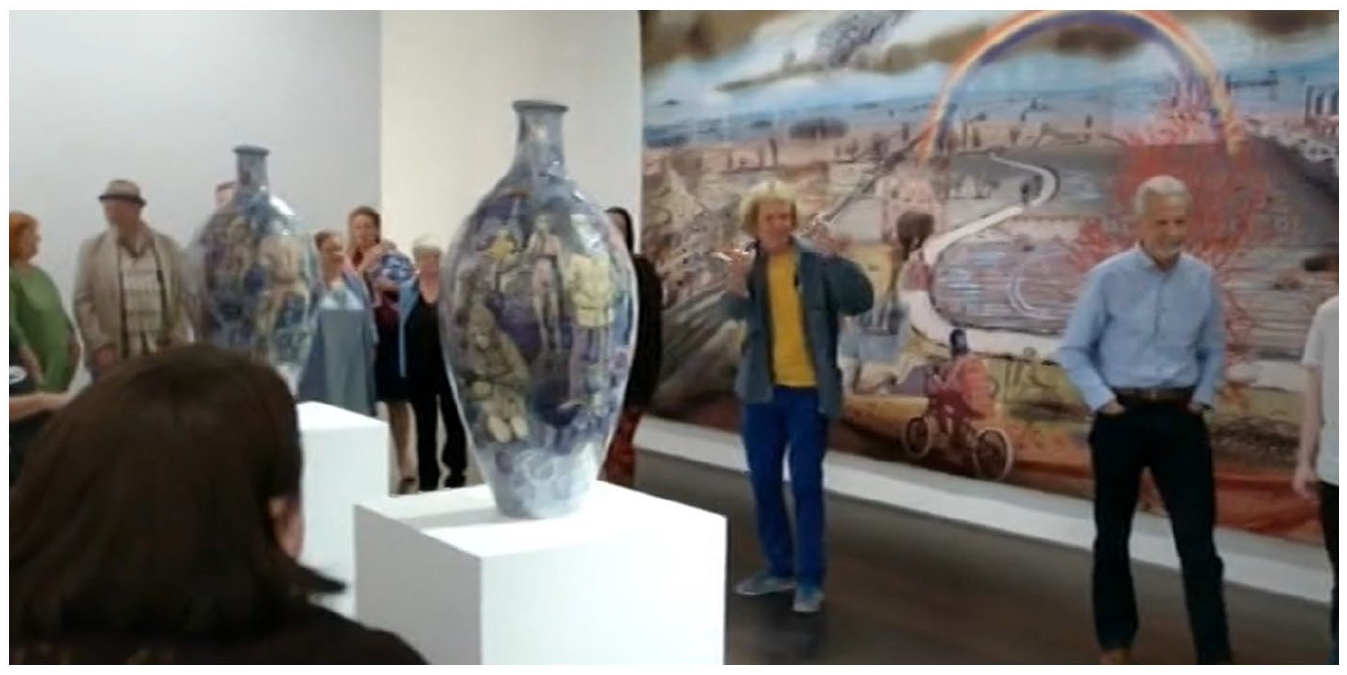
‘Matching Pair’ at the Serpentine Gallery with ‘Leave’ and ‘Remain’ supporter groups.
The two pots ironically mimic the two ‘sides’ or ‘tribes’ which are apparently accepted as the premise of the film (and suggested by its title) but whose internal homogeneity and coherence it works to unsettle and disrupt. Perry’s ironic suggestion that the ‘Remain’ pot is slightly smaller than its actually identical counterpart gestures at this partially parodic relation to the ‘debate’ on Brexit. In fact, rather than manifestations of allergic division, the pots establish a plane of similarity on which difference is nonetheless inscribed. Here we might see a conception of art emerging as a site where the meaning of Britishness is contested but within a new space in which the process of disputation doesn’t resolve into antagonistic othering. Perry’s use of social media (widely identified as part of a transformation of the political process seen in the 2017 election) reveals a concern to engage a broader range of people with and in art, incorporating images selected and sent by ‘ordinary’ correspondents on both ‘sides’ of the Brexit debate (see also Prentoulis (2021)). This process positions his work as a site where politics might be understood outside and beyond the domains normally defined as ‘the political’ (Mouffe, 2005: 17–35). The bricolage of identities and values depicted in images on the surface of the pots gives articulation to meanings and desires which Perry insists have not found expression ‘for decades’. These may be ostensibly similar but are nonetheless derived from and are expressive of conflicting affective investments in local, national and global identities, meanings and relationships.
Affect and nationalism
Perry’s invitation to ‘Leave’ and ‘Remain’ communities to identify what ‘matters’ to them about Britain might be seen as a retrograde framing of identity within nationalist ideology. As we suggest below, there are certainly aspects of Divided Britain which reinforce a narrowly defined concept of whose perspective on Britishness ‘counts’. However, Mouffe (2018) stresses that it is at the national level . . . where a collective will to resist the post-democratic effects of neoliberal globalization should be constructed . . . a left populist strategy cannot ignore the libidinal investment at work in national – or regional – forms of identification and it would be risky to abandon this terrain to right-wing populism. (p. 71)
Prentoulis (2021: 139) argues that what the ‘Leave’ campaign and Boris Johnson were able ‘to do successfully was to make the EU the target of all grievances associated with neoliberalism’. Central to this was the mobilisation of a concept of the nation constituted through xenophobic and anti-migrant sentiment, a perception that ‘people who have come to live in the UK are undercutting wages, driving down conditions and diluting ‘British culture’ (Goodfellow, 2020: 21).
Part of Perry’s work in ‘sourcing’ images for the pots is concerned with the representation and re-shaping of concepts of national identity. While the gathering of images which express emotional engagement with a concept of Britishness might be understood as ‘reflecting’ already constituted subjectivities, Perry’s work, in positioning the images in ways that orchestrate them into a signifying structure, also works to generate new ways of perceiving those subject positions. ‘Leave’ and ‘Remain’ pots work to establish forms of ‘togetherness’ within ostensibly opposed positionalities but also to forge relations through the crafted resemblances between those groups in the final work. ‘Matching Pair’ effectively establishes a new and shared sense of post-Brexit identity through its strategy of mirroring and resemblance, an identity which is constituted around a shared sense of emotional investment in the things ‘that make us who we are’. We consider the problematically narrow versions of identity which seem to be included in this community elsewhere, but it is worth, at this point, indicating the ways in which, in line with Mouffe’s suggestion that ‘the cultural and artistic fields constitute a very important terrain for the constitution of different forms of subjectivity’ (2018: 77), Perry’s work effectively re-shapes identity as it reflects it.
For Grossberg (2019), attention to how ‘affective landscapes’ are layered in any formation – people’s emotions, motivations and energies – is part of conjunctural analysis. Structures of feeling align with political positions to form what he calls ‘mattering maps’ (Grossberg, 2019: 61). Enabling the visualisation of emotional energies, such maps illuminate political alliances and differences, thereby disclosing the things that matter to people. Echoing Grossberg, Mouffe stresses the importance of affect in the formation of new forms of citizenship. For her, rationalist accounts of politics fail to recognise the importance of what she describes as ‘passions’ to democratic processes. She argues for a populist strategy aimed at constituting a ‘collective will sustained by common affects aspiring for a more democratic order’ (Mouffe, 2018: 76). This would work by forming a Gramscian ‘common sense’ that would be ‘congruent with the values and identities of those that it seeks to interpellate’ and would ‘address people in a manner able to reach their affects’ and ‘connect with . . . aspects of popular experience’ (Mouffe, 2018: 76). In comments on the Brexit vote in an interview with Verso, Mouffe explained, ‘I expected this result, because during the campaign you only sensed real passion among the “Brexiteers”. And I think emotions play a decisive role in politics’ (Mouffe and Streeck, 2016). Similarly, in a telling aside in Divided Britain, Perry comments that the emotional responses to Brexit indicate how ill-judged the Remain campaign’s appeal to rationality and ‘facts’ was and suggests that the significant identifications for both sides were affective, rather than the product of economic calculation or deliberations about the ‘national interest’. What interests Perry, and what he sees as a shared component of the reactions of both ‘tribes, are the passions . . . inflamed by’ Brexit, the ‘ugly feelings’ that Ngai (2007: 11) suggests ‘are organized by trajectories of repulsion rather than attraction, by phobic strivings “away from” rather than philic strivings “toward”’.
This affective dimension of the Brexit process is central to Divided Britain’s analysis. In his examination of ‘Leave’ sentiment, Perry points up, as indicated in our discussion above, the logical contradictions between a rhetoric focused around ‘taking control’, ‘standing alone’ in a community – like Boston – which is reliant on the labour of large numbers of migrants to sustain it. ‘This’, Perry points out is what drew him to conclude that Brexit ‘is not a rational conflict’. Meanwhile in ‘Remain’-dominated Hackney, Perry encounters correlative experiences of sadness and disappointment which he reads as the emotional impact of the vote on a community which, at least in Perry’s account, viewed the outcome as a denial of the cosmopolitan, inclusive and progressive values characteristic of its community.
Perry’s commentary on the crowd-sourced images also foregrounds emotional investment. He suggests that the desires aligned with ‘Leave’ or ‘Remain’ positions are relatively insignificant: ‘The feelings that made us vote either way are actually a small part of what makes us who we are’. Of more interest to him are what he identifies as shared identifications with a Britishness (more properly – as we discuss – Englishness) which runs counter to the divisions linked to Brexit and help to constitute an ‘us’ that the final passages of the film imply might generate surprising horizontal alignments between the supposedly opposed groups.
Art and populist politics
In this respect, we might consider Perry’s work as contiguous with the populist politics envisaged by Mouffe. For Mouffe, the formation of ‘the people’ as the political agents of a populist moment ‘is not an empirical referent but a discursive political construction. It does not exist previously to its performative articulation. . . [it is] not a homogeneous subject in which all the differences are somehow reduced to unity’. She suggests what a left populist strategy will involve is ‘a process of articulation in which an equivalence is established between a multiplicity of heterogeneous demands’ (2018: 62–63). Perry’s work enables an encounter between ostensibly incompatible positions at the level of representation, bringing the ‘tribes’ into relation by establishing an equivalence between ostensibly different objects (the pots are similar although they remain distinct). In the final scene, the film then uses that representational encounter as the basis for one between those groups who have been defined through their identification with opposed positions within the Brexit process. The pots, in this moment, become the mechanism for an assembly of those ‘ordinary’ people whose self-presentation provides the material for the surface decoration of the pots (see Figure 3). Members of both groups express pleasure in encountering representations of themselves and at their incorporation into a work which gives articulation to the sense of belonging to a community defined around a Brexit stance. They are simultaneously taken aback by the equivalence the pots establish between their positions. This is partly contrived by Perry’s concern to suggest a correspondence between seemingly incompatible ideological perspectives but there is a double mirroring in the process of encounter in which the ‘tribes’ recognise themselves in their own representation and then the resemblance between those selves and the ‘others’ depicted in the paired pot. The discursive engagement between the groups, ranged around their respective pots, is initially uncomfortable, a confrontation in which those emotions invested in the Brexit process and experienced in its outcome find expression. There are angry exchanges and tears, one speaker identifies ‘a lot of hostility over there’. The moment is carefully edited for presentation to the viewer but the unease of both groups (and of Perry) is palpable. Nonetheless, the gallery space and the art-works provide a site for encounter, one which does prompt an exploration of the basis for the differences which are never elided either in the pots or in the confrontation they bring about. The significance of this moment of assembly is that it initiates a form of political dialogue which the Brexit process, in its narrowing of democratic praxis to a single and simple binary ‘choice’, appeared to enable but actually closed off. Perry’s work provides a site for modes of interaction and the articulation of contending notions of what a concept of ‘Britain’ or ‘Britishness’ might mean. This both foregrounds the absence of such sites of engagement in the formal democratic processes provided in the post-political formation and begins, in an admittedly limited way, to suggest mechanisms through which they might be constituted. One participant in the dialogue, whose remark is positioned as a coda to the encounter, comments that ‘we need to think about what it is that we are encouraged to disagree about’. This moment suggests that the antagonisms of Brexit mask the potentiality for alignments across difference which might emerge through the constitution of an ‘us’ (a people) assembled around the body of shared images which Perry suggests constitutes a field of ‘ordinary’ identity.
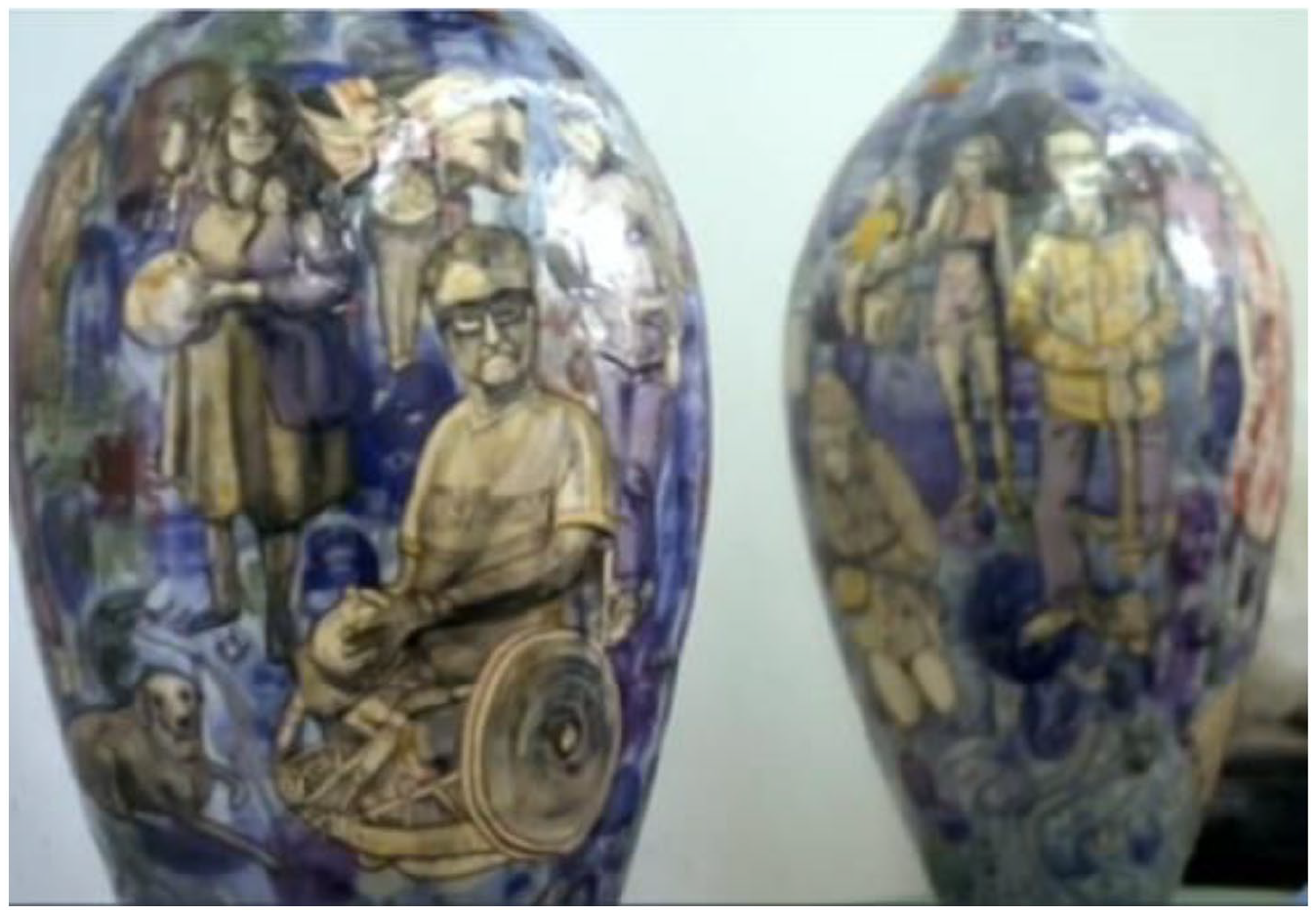
Detail of ‘Matching Pair’ showing ‘crowd-sourced’ images of ‘Leave’ and ‘Remain’ supporters.
Exclusions from ‘Divided Britain’ and Matching Pair
Despite what we are presenting as the progressive or even ‘left populist’ dimensions of Perry’s project here, it must be acknowledged that both the ethnographic strategy pursued in the interactions with ‘Remain’ and ‘Leave’ communities and the ‘crowd-sourced’ imagery out of which the pots emerge offer a limited and limiting notion of what ‘a people’ could be. While the programme’s title indicates that Perry is concerned to analyse ‘British’ identity, what Divided Britain actually provides should more accurately be described an exploration of Englishness. In Boston, a region where 75 percent voted Leave, Perry engages with its inhabitants on late night taxi rides, where passengers’ inhibitions are loosened by alcohol consumption. Almost invariably, the conversation turns to immigration. ‘There’s a high percentage of them isn’t there’, remarks one interlocutor. A young woman adds that, given the high percentage of ‘foreign nationalities . . . there are certain places I wouldn’t walk in town’. Another adds, ‘you struggle with your identity in Boston’. And, at a meal Perry enjoys with older locals, complaints are made about ‘an influx of varying nationalities’ who descended on the town, such that the white indigenous population felt it had been ‘taken off them’. These conversations work to close the gap on the ‘emotional disconnection’ with politics through the act of listening (Flinders, 2020), not least because trying to barometer the mood of communities enables an affective understanding of ‘Leave’.
Perry’s exchange with the one migrant worker willing to speak on-camera provides an uncomfortably superficial insight into the sense of confusion and anxiety at the outcome and implications of the referendum felt by a Rumanian-born man who had lived and worked in Boston for 10 years. Although the tone of the exchange is kept ‘light’, in keeping with Perry’s conversational style in the programme, there is here an attempt to incorporate into the discursive space of ‘Leave’ sentiment a voice which articulates the sudden rupture and displacement experienced by a man forced by the vote to re-evaluate his lived experience of Britain. However, the use of an Eastern European voice removes the opportunity to address anxiety about skin colour through inclusion of, for example, ‘muslim’ experience (Virdee and McGeever, 2018) and to extend the issues affecting insider-citizens from outside Europe in Brexit debates. By providing space only for white voices (and only a marginal space for migrant perspectives), an understanding of the undergirding racial and nationalist politics of Leave melts away. Driving the motivation for Leave, Virdee and McGeever (2018) argue, was an English nationalism tinged with racism which certainly finds expression Perry’s taxi-ride encounters. If the practice of listening were more fairly meted out, Black voices could foreground the socio-economic disadvantage that being part of the ‘left behind’ means or cite the ramped up racist violence which amounted to 6000 incidents in the month after the EU Referendum vote (Komaromi, 2016).
It is also important to look at those identities which appear to be regarded as worth crafting through inclusion to become enshrined in the pots. The programme shows Perry scrolling through digital images about what Britain means to ostensibly opposed groups. They offer a ‘mundane’ version of Britishness: the pub, fry-ups, pets, red letter boxes, ‘the gentle English countryside’. In this way, Perry is able to render difference invisible in the hope of brokering sameness in the transfers he conveys on the matching pots. As we indicate, this can be understood as a move to forge transversal links between nominally divided groups. But no wonder he produces similarity from two groups who share an almost entirely white racial identity. As a result, the pots incorporate little sense of English cultural diversity. There are some people of colour on the ‘Remain’ pot in the form of inspirational figures like Mahatma Gandhi and Gina Miller, but where are the images of carnival in UK cities of the North, goat curry, Bangra DJs or mosques on the English skyline?
Conclusion: art, agonism and assembly
In Mouffe’s (2013: 92) ‘agonistic approach’ to the conceptualisation of artistic practice art is understood as a site ‘where conflicting points of view are confronted without any possibility of final reconciliation’. We suggest Perry’s pots move towards a realisation of this concept. As instances of what Mouffe (2013: 93) calls ‘critical art’ they have the function of ‘making visible what the dominant consensus tends to obscure and obliterate, in giving a voice to all those who are silenced within the framework of the existing hegemony’. Artistic practice has a significant role in the ‘transformation of political identities’ that accompanies the disruption of existing hegemonic formations, inscribing ‘the social agent in a set of practices that will mobilise its affects in a way that disarticulates the framework in which the dominant processes of identification take place (Mouffe, 2013: 93). Through a process of representation, reinscription and realignment Perry’s work (and importantly its display as the focus of a site of assembly and encounter) might be understood as contributing to a process of ‘de-identification’ with existing hegemonic formations of identity: an unsettling of the ‘tribal’ positionalities posited in essentialist accounts of identity and the beginning of a new process of identification around an emergent sense of a ‘people’ defined in agonistic relation to a neoliberal project of governance which is obscured by the ultimately spurious antagonisms articulated through Brexit.
Footnotes
Funding
The author(s) received no financial support for the research, authorship and/or publication of this article.
