




Abstract
We provide an analysis of dance as a practice and an ‘Other’ space; a counter-hegemonic ‘space’, which is affected by the existing social ordering, while simultaneously resisting it. We employ Foucault’s concept of ‘heterotopia’ to analyse dance’s potential to disrupt and deconstruct hegemonic discourses of the past in a conflict-ridden environment such as Cyprus. We analyse three dance works by choreographers who are living and working in Cyprus, and while we focus on the interrelated dimensions of time, space and the (choreographic) subject, we demonstrate how dance may (1) provide a space to problematize the past and recraft the present, (2) enable the re-signification of places of conflict into places of communication and peace and (3) invite artists to reflect on their subjectivities and transform into agents of peace.
Introduction
Forty eight years since the Turkish invasion, Cyprus remains ‘an island of enduring political, military, and more recently, economic conflict’ (Doudaki and Carpentier, 2017: 1). The island is currently divided into the Republic of Cyprus (RoC) at the south, where Greek-Cypriots reside, and the northern part, which is inhabited by Turkish-Cypriots and settlers from mainland Turkey. The two communities continue to mainly ‘consider themselves separate from the other’ (Avraamidou, 2018: 3; Loizides, 2007), and the (hegemonic) discourse of the Cyprus conflict is grounded on divided collective memories of victimization. It is disseminated through rituals, national symbols, institutional establishments and the media (Avraamidou, 2018; Bounia and Stylianou-Lambert, 2012; Psaltis, 2016; Psaltis and Cakal, 2016; Ross and Alankus, 2010; Şahin, 2011; Way, 2011) and relies on hegemonic readings of the past, which tend to offer one-sided representations of the historical events that occurred in 1974, and the discursive erasure of the violence of the 1960s, which disproportionally victimized Turkish-Cypriots.
Highlighting the ‘Greekness’ of the island, it constructs Turkish-Cypriots as the ‘Other’, an enemy that threatens traditional values, Hellenism and its two main pillars: antiquity and Christianity (Bounia and Stylianou-Lambert, 2012). Emphasizing certain elements of the historical past, while undermining others, it alienates the two communities, their shared cultural ground and common elements (Psaltis & Cakal, 2016: 229). Dominant representations in the public sphere and mainstream media tend to contribute to the construction of national identities (Doudaki and Carpentier, 2017), the silencing of (minority) voices opposing the prevalent nationalistic narrative (Bounia and Stylianou-Lambert, 2012) and the perseverance of the past as a narrative of national struggle (Papadakis, 1994).
This article focuses on how Cyprus’ conflict discourses are articulated in the cultural sphere, and more specifically though dance. Part of a broader research project that investigates conflict discourses at various discursive topoi, it analyses dance as a heterotopia; a ‘space’ in which hegemonic discourses and foundations of power are (re)negotiated. Discourses, one of Foucault’s most powerful concepts, designate, among other things, what we can think and know, thus comprising expressions of significant power. In what follows, we show how dance, which is found everywhere, albeit in different forms, can sometimes function as a space and a practice that counters hegemonic discourses, thus contesting the very systems of power within which it is born. While we focus on some specific cases of choreographers and performances dealing with the Cyprus conflict, we offer a novel conceptualization of dance as a heterotopia: a counter-hegemonic artistic practice and space. In doing so, we bring Foucault’s (1984) concept of ‘heterotopia’ to performance studies, and contribute to research engaging with the (1) arts as means of resistance and intervention, and alternative spaces of struggle (Conquergood, 2002; Taylor, 2016) and (2) role of the arts in divided societies (Gold, 2006; Zelizer, 2003, 2007).
Cyprus: a brief history of the conflict
Under Ottoman rule since 1571, Cyprus was ceded to the British in 1878. During the British colonial period, two nationalisms – the Greek and the Turkish – arose as Greek-Cypriots strove for enosis (the union of Cyprus with the ‘mother state’ of Greece), while Turkish-Cypriots came to demand taksim, the partition of the island. In the 1950s, bids for enosis culminated in the EOKA (National Organization of Cypriot Fighters) guerrilla struggle, which was violently suppressed by the British, whereas Turkish-Cypriots formed their own armed organization to counter EOKA, TMT (Turkish Resistance Organization). As a result of this struggle and in the context of broader decolonization, the independent RoC was established in 1960. Yet, the divergent objectives of the two ethnic groups and the British policies of exacerbation of divisions (Papadakis et al., 2006) led to inter-communal violence (1963–1967), mostly at the expense of Turkish-Cypriots, as ‘one-fifth of their people were gradually displaced in refugee camps’ (Papadakis et al., 2006: 2).
The incipient stabilization of the situation after 1967 was interrupted by the military junta in Greece and the coup attempted in 1974 by Greek-Cypriot pro-union nationalists (EOKA B) against the president of the RoC. The subsequent Turkish invasion in July and August 1974 divided the island and led to human costs at the expense of both sides but mostly the Greek-Cypriots, as the displaced people amounted to almost one-third of all Greek-Cypriots (Loizos, 1981; Papadakis et al., 2006: 3). Since 1974, all negotiations aimed at resolving the Cyprus Conflict have failed. The most well-known reunification attempt to establish a federal, bicommunal, bizonal solution, the UN-sponsored Annan Plan, was rejected by the Greek-Cypriot side in a referendum in 2004.
Cypriot nationalisms and hegemonic discourses
As elsewhere, in Cyprus too, nationalism is not a single-dimensional phenomenon. Two expressions of nationalism can be found: ethnic nationalism, which is based on common origin and pre-existing ethnic ties, and explicitly ties citizenship to ethnicity, and civic or territorial nationalism, in which a political community of citizens share a territory and a common culture (meaning, values, myths and symbols; Peristianis, 2006: 101–102). Ethnic nationalism among Greek-Cypriots was based on the idea that Greek-Cypriots are part of motherland Greece and should be eventually united under one nation. This developed in contrast to the Cypriot nationalism, which was advocated in the 1920s by the communist parties of both the Greek- and Turkish-Cypriot community but failed in gaining widespread support. Carpentier (2018) argues that Greek-Cypriot nationalism ‘evolved from a mostly agonistic nationalism to an antagonistic nationalism’ (p. 37) first during the EOKA struggle from 1955, and second during the inter-communal violence in 1963–1964 and 1967. Although the Greek-Cypriot leadership officially abandoned the goal of uniting with Greece after independence from colonialism in 1960, most of its supporters still clung to Hellenic ethnic symbols (Peristianis, 2006: 103–104).
After 1974, ethnic nationalism lost its prominence as a result of the ‘great betrayal’ of Greece and its failure to prevent the Turkish invasion, and the policy of rapprochement was established, marking the beginning of the ‘cyprocentric turn’ (Peristianis, 2006: 104). However, by the late 1980s, ethnic nationalism ‘was staging a comeback’, ‘no longer as a political goal of union with Greece but as a desire for cultural resistance and rejuvenation’ (Peristianis, 2006: 105). Carpentier (2018: 36) argues that the naturalization of nationalism was the outcome of a discursive struggle for hegemony, which was eventually lost for Cypriotism, that highlights similarities between the two communities and promotes their peaceful coexistence (Avraamidou, 2018).
Turkish-Cypriot ethnic nationalism consolidated its hegemonic status in the 1950s – partly in response to the danger of the Greek-Cypriot nationalistic project and partly fed by ideological changes in mainland Turkey (Carpentier, 2018) – and stressed ‘the insistence on the political equality of the two communities and the avoidance of domination by Greek-Cypriots’ (Vural & Peristianis, 2008: 45), as well as the separateness of the two communities. The official ideological discourse considered Turkish-Cypriots ‘an extension of the people of Turkey’ (Navaro-Yashin, 2006: 85), left outside the Turkish state accidentally. Yet, Turkish-Cypriots tend to adopt identities that distance them from Turkish settlers and ‘contradict the logic of nationalism and ethnonationalism’ (Navaro-Yashin, 2006: 96).
The opening of the crossings in 2003, the quasi-absence of material violence in the past two decades, and the strengthening of pacifist and pro-unification activism produced a counter-hegemonic discourse, which weakened antagonistic nationalism, evolving into ‘post-antagonistic nationalism’ (Carpentier, 2018: 39). In the Greek-Cypriot community, (post)nationalist discourses have been ‘supported by the signifying practices of key institutions, with their capacity to coordinate, synchronize and harmonize different voices, even though their hegemonic strength has decreased significantly over the past decades’ (Carpentier, 2018: 38).
Hegemonic and official discourses largely coincide (although exceptions do exist). Part of the hegemonic construct (and its contestation) is the dividing line in Cyprus (the Green Line or the Buffer Zone). The opening of the crossings was significant as it allowed Cypriots to contact the ‘other side’ ‘without being exposed to material violence’ (Carpentier, 2018: 39). The Cypriot borders, which function as sites of both division and contact, conflict and cooperation, security and anxiety, oppression and creativity, act as important expressions of nationalism and its contestation (Papadakis, 2018). The crossings and the symbolic meaning of the borders, which are constructed differently in specific ideological settings (Papadakis, 2018), appear prominently in the works of the artists discussed below.
Art and disorder: dancing the political
Artistic (dance) practices and the political
Over the past century, arts and artistic practices have been used to raise awareness over political and social issues (Kolb, 2006), with scholars acknowledging art’s contribution to peace-building efforts and reconciliation purposes (Shank and Schirch, 2008; Shaughnessy, 2012; Zelizer, 2003, 2007). Artists have used art in protests against wars and violence, in interventions, therapy and reconciliation purposes (Aladro-Vico et al., 2018; Taylor, 2016; Zelizer, 2007). Parts of the cultural sphere have facilitated resistance to dominant discourses, while art studios and galleries, dance studios and performance settings have transformed into spaces within which the order of things is recreated, disrupted and challenged. This has been the case in Cyprus as well.
In a setting such as Cyprus, where conflict is rooted in memories of a troubled past, artistic performances, which ‘transmit knowledge’ (Taylor, 2016), can develop ‘counter-histories’ (Foucault, 1984): histories told from a different perspective. Such performances and artistic works can unsettle hegemonic discourses, aspects of the ‘official’ spoken and written history, and the artefacts it produces. Perhaps indirectly, such performances can offer opportunities to question the established knowledge system that is preserved in state institutions and official collective memory agents. It is no coincidence that anti-institutional artistic interventions are often perceived as provocations or political acts, rather in the sense of ‘rupture and challenge, than as an ideological or dogmatic position’ (Taylor, 2016: 49; Tselika, 2018, 2019).
Artists, who have served as conflict mediators (Gold, 2006: 2), managed to bring people together and create bridges between the island’s divided communities, thus resisting the hegemonic discourses and institutions that set them apart (Tselika, 2018, 2019). They encouraged peace-building and the formation of honest and long-lasting relationships between the two communities. Artistic endeavours, films and mockumentaries, photographic exhibitions, bicommunal (artistic) activities and (artistic) interventions in public spaces and social media reframed the existence and ideology of Cypriot borders, thus contributing to reunification, peace and cooperation efforts (Constandinides, 2017; Constandinides and Papadakis, 2014; Gold, 2006; Kleanthous, 2005). They offered reinterpretations of history and historical events and approached issues such as trauma and death to (1) prevent future conflicts from re-occurring, (2) develop trust and empathy, and (3) build bridges between the two communities (Gold, 2006; Hulton, 2008; Tselika, 2018, 2019). They challenged practices that lead to hostility and separation, and tried to create ‘zones of contact and encounter’ (Tselika, 2018: 282).
Artistic practices may act as an effective medium to ‘construct an alternative reality through the deformation and reformation of the standing situation’ (Demetriou, 2016: 68), and generate collective narratives that problematize the official and institutional ones. Nonetheless, artists working towards this end in Cyprus often need to develop their practice outside the mechanisms of the state, since bicommunal cultural actions and artistic developments ‘happen largely without state-related formal bridges of official collaboration’ (Tselika, 2019: 15). The lack of formal cultural policy and state-funded spaces for bicommunal interaction on either side of the island limits these artistic practices’ impact and counter-hegemonic potential. At the same time though, it encourages non-institutional collaborations between artists and grassroots movements across the divide, thus transforming bicommunal art initiatives into important hubs of resistance. These initiatives, which find support mainly by community movements and associations, non-governmental organizations (NGOs), private institutions and international bodies, provide spaces for interactions, relationships and dialogical exchanges that have the potential to diffuse alternate readings of the past and lead to long-lasting unifying actions.
Artistic acts of resistance can problematize and question the established order of things, thus serving as counter-acts, which challenge and subvert dominant discourses, situations, values, people and power relations (Faith, 1993; Hollander and Einwohner, 2004; Trethewey, 1997). Taken that resistance – a condition of power – always exists as a possibility within relations of power (Foucault, 1980), we discuss dance as a practice through which, and a space within which, artists invite audiences to re-reinterpret the past and break the established line of division, thus resisting the hegemonic discourse that relies on, and reproduces, nationalist ideologies. We analyse dance as ‘heterotopia’ – an ‘Other space’ (Foucault, 1984) – that facilitates reflections, reconsiderations and reconstructions of hegemonic discourses of the past and the island’s official history.
Dance as heterotopia
Foucault’s (1984) notion of ‘heterotopia’ has been used to analyse mainly real places that disrupt the order of things, such as theatres (Ioannidou, 2010), museums (Hetherington, 2011) and libraries (Lees, 1997), as well as non-conventional sites of aesthetic production (Maxwell, 2016) and festivals (Stanciu, 2014; Wilks and Quinn, 2016). Rarely has it been used to analyse practices or non-spaces, with the most notable exceptions being Zaimakis’ (2015) research on the potential of graffiti practices as cultural heterotopias, and art ephemeras as art practices that are rarely documented, but still question the space of art (Cooke, 2006). After all, the concept was coined to refer to places that function like counter-sites, where the ‘real sites [. . .] are simultaneously represented, contested, and inverted’ (Foucault, 1984: 3). The ‘cultural, institutional and discursive spaces that are somehow “different”: disturbing, intense, incompatible, contradictory and transforming’ (Johnson, 2013: 790–791).
Heterotopias have been interpreted as interrupting ‘the stream of everyday experiences, opening spaces of rest, refuge and play’ (Johnson, 2013: 797). For instance, for Dehaene and De Cauter (2008), the theatrical event, ‘the heterotopia par excellence’ (p. 8), comprises a dialectical play between the private/public dimension, an event of transformation and of suspension. Johnson (2013) stresses heterotopias’ imaginative quality, seeing them as ‘spaces of, and for, the imagination’ (p. 798). Nonetheless, the analysis of art, and more specifically dance, as a practice that can disrupt and deconstruct hegemonic discourses, while seemingly obvious, remains limited and calls for further exploration. We therefore draw on the concept of heterotopia to analyse dance as a counter-hegemonic practice and space that can disrupt the order of things.
Dance may not be, strictly speaking, a spatial concept, but it can be understood as a discursive and material practice that creates a space to (re)negotiate and (re)construct meaning. In its discursive-ness, it is a multidimensional cultural text (Giurchescu, 2001) that produces meaning each time it is performed. The ‘dance-text’ is not only a choreographic structure but a ‘frame-function’ that serves several social purposes and contains political–ideological, educational, religious and other messages (Giurchescu, 2001). At the same time, dance is strongly material: it is anchored in body work and always materialized in a particular place (a stage) and time. Dance may be further understood as a heterotopic space in the metaphorical sense, as it is affected and limited by the existing social ordering, while simultaneously resisting it. Genocchio’s (1995) understanding of heterotopia as ‘more of an idea about space than any actual place’ (p. 43), resonates with our interpretation and encourages us to expand current understandings and uses of the concept.
Methodology
Applying a case-study approach, the analysis below focuses on three dance performances, which engage directly with the Cyprus conflict. Data were collected through in-depth, semi-structured interviews with three performance artists in Cyprus, relevant documents (articles and reviews about the artists/performances, artists’ media interviews and artists’ websites), as well as video recordings of the performances (when available) or other printed material from the performances (e.g. brochures, photos). Interviews were transcribed and analysed through thematic qualitative analysis (Braun and Clarke, 2006), relying on the conceptual notion of heterotopia and especially looking into the three interrelated dimensions of time, space and the (choreographic) subject.
We analyse the performances of Arianna Economou, Andromachi Dimitriadou-Lindalh and Lia Haraki. 1 They are well-known in Cyprus about their contribution to the arts field, the reconciliation movement and other peace initiatives. We selected three specific works dealing with the Cyprus conflict, the borders and division, the constructed and yet well-established, differences that continue to divide the island:
Arianna Economou’s Shared Echoes I & II, 2004 which was developed just after the partial opening of the borders in Cyprus. Comprised of two parts, it was concerned with the divide, the ‘artificial line’ separating the two communities and the construction of Turkish-Cypriots as the Other.
Andromache Dimitriadou-Lindahl’s Voices Unheard, 2006 which was comprised of five parts dealing with, among other issues, missing people, the conflict, and shared loss.
Lia Haraki’s Record, Replay, React Show – Re-sculpting Freedom (The RRR Show), 2017 (2014), which was a provocative and radical performance that challenged popular understandings of freedom and boundaries. This was the artist’s first engagement with the Cyprus conflict. Choreographed and performed by the artist, The RRR Show was first performed in 2014 in the Nicosia Municipal Arts Centre’s (NiMAC) for the ‘Treasure Island’ exhibition. Since then, it has been performed in other spaces in different versions. The version we discuss here was performed in 2017 in the framework of the ‘Terra Mediterranea’ exhibition in NiMAC following Yiannis Toumazis’ invitation.
Another (hi)story
All three artists, each in their own way, re-tell the island’s history by engaging with aspects of the conflict that are often undermined, thus disrupting the order of things and challenging the hegemonic discourse that prevail in state mechanisms and mainstream spheres. Dimitriadou-Lindahl problematizes the dominant narration of the state by highlighting loss, absence, and death as affecting both communities. Similarly, Economou emphasizes all shared traditions, values, customs and cultural practices that the two communities enjoy, thus portraying the two communities as mainly similar rather than different. Finally, Haraki challenges dominant narrations by playing with, and desacralizing important figures of, Cyprus’ history. Through their performances, they disrupt the order of things.
Shared loss; common tradition
Missing You, the last part of Voices Unheard by Dimitriadou-Lindahl, challenges the hegemonic discourse, which revolves around ‘the heroes who died on each side’ (Dimitriadou-Lindahl, interview) and continues to narrate a story that divides people. Instead, the artist’s work engages with the divide, the lived experience of the conflict and the common traumatic consequences it had for both communities. According to the artist, these counter-hegemonic representations could ‘sensitise the audience’ since this performance would ‘help both sides understand that the loss is shared, the human factor is the same, pain is shared’. Based on these, she ‘would develop empathy’. The emphasis on death, human, material and symbolic loss as something that concerns both communities offers another narration of some aspects of the conflict. Unlike hegemonic, one-sided projections of the effects of the conflict (Bounia and Stylianou-Lambert, 2012; Psaltis, 2016), such narrations invite audiences to reflect on what they know and take for granted; they invite them to deconstruct history and develop empathy towards, and connections with, the Other.
Likewise, Economou’s work brings to the fore the overlooked matters of bicommunal cooperation, friendship and shared pain. She crafts counter-histories that invite audiences to question and reconsider the two communities as distanced and different, thus challenging feelings of hostility. She invites them to actively reflect on the hegemonic discourse and resist one-sided representations of formal written history. Economou aspires to achieve this in two main ways. First, she brings together artists (choreographers, musicians, painters) and lay people from both communities, and makes them work in close contact, metaphorically and literally. In this performance, people danced in close physical contact, painting artists drew as people moved in space and musicians played music around themes from both parts of the island: I worked with contact improvisation, which brings the two communities in absolute contact with each other, working head to head. I brought people together [. . .]. We had artists around drawing [and musicians all working together]. (Economou, interview)
As Economou characteristically said, the musicians ‘brought all these musics [sic] together, from stone, from glass, from different parts of Cyprus’ to accompany the contact improvisation jam. She perceived it to be particularly important to include elements that can be found and used in both sides of the island, to highlight the shared heritage of Turkish-Cypriots and Greek-Cypriots rather than the elements that separate them. The materials used to make music, and the overall practice, have a symbolic meaning: they highlight that there are common, shared elements in both sides of the line. Materially and performatively, this work communicates an imagery of Cyprus as unified; as whole: [Shared Echoes I] was the first [work bringing people together] and it was such a euphoria because we all believed that it was just the beginning of something new; of us coming together. [. . .] contact improvisation uses pedestrian movement, so it brought [lay] people from both communities together. We had dancers and non-dancers working together. We had people from theatre, from dance, young people mostly to do contact [improvisation] together.
Following this performance, Economou set to further deconstruct ‘the Cyprus myth’: So, we [say that] there is this myth, there is this other myth and then there is the Cyprus myth. And then we talk about the issues and all the drama. And it was beautiful work [. . .]. And we travelled with this piece in Famagusta, in Bellapais, in Limassol and Nicosia; on both sides. [. . .] We looked at the myth-making of a country, of ourselves, of who we are. All about identity really. Full of humour. (Economou, interview)
Engaging humour and creativity, Economou’s work explored the constructedness of ethnic identities to show that assumed differences between the two communities are part of a myth, thus questioning and reinventing ethnic identities. Against the hegemonic discourse, which presents the Turkish-Cypriots as an enemy of the island’s traditional values (Bounia and Stylianou-Lambert, 2012), Economou’s performance problematized difference: it stressed aspects that the two communities share and encouraged audiences to reflect on those parts of their identity that they experience as natural and fixed.
Other narrations
In a slightly different way, although intending to reach a similar outcome, Haraki dealt with performative elements of spaces of history, memory and trauma. As the creator noted, ‘the project [The RRR Show] attempts to energize healing processes as well as mechanisms of forgiveness through a critical reflection of the recent history [of Cyprus]’ (Toumazis and Haraki, 2017). While re-telling the story in a more critical way, the RRR Show intends to transform ‘socially and politically haunted spaces’ into ‘tools of reconciliation and rapprochement rather than apparatuses of nationalism and intolerance’ (Toumazis and Haraki, 2017). In this work, Haraki plays with live loop recording to create many layers of sound that give away diverse literal and metaphorical interpretations of Cyprus’ history: The methodology I used [loop recording] has many layers. [. . .] I created a huge soundscape with the words I felt that each of the statue was saying. So, by the end there was a noise comprising of many references: from our national anthem, to screams, to songs, more commercial songs, kids’ voices etc. So, it was like I had created a soundscape with many references, which is everything that is in our minds [regarding the invasion]. At the end I ran around the room to exhaustion as a cathartic attempt. (Haraki, interview)
In Haraki’s work, we encounter a heterochrony, namely a ‘break with [. . .] traditional time’ (Foucault, 1984: 6). Haraki breaks the linearity of time by bringing together in a single space acoustic fragments, echoes of various past events, which are re-played and to which she re-acts and at times counters. The artist challenges dominant symbolic readings of the past by reacting to the statues of the Liberty Monument in Nicosia, copies of which were exhibited in NiMAC’s space. The statues – including figures such as the priest, the soldier, the mourning woman, peasants – represent archetypal emblematic figures in the Cypriot society and history, which enjoy respect and high moral value. Haraki tries to deconstruct the story behind, and prevalent meaning of, each statue (see Picture 1).
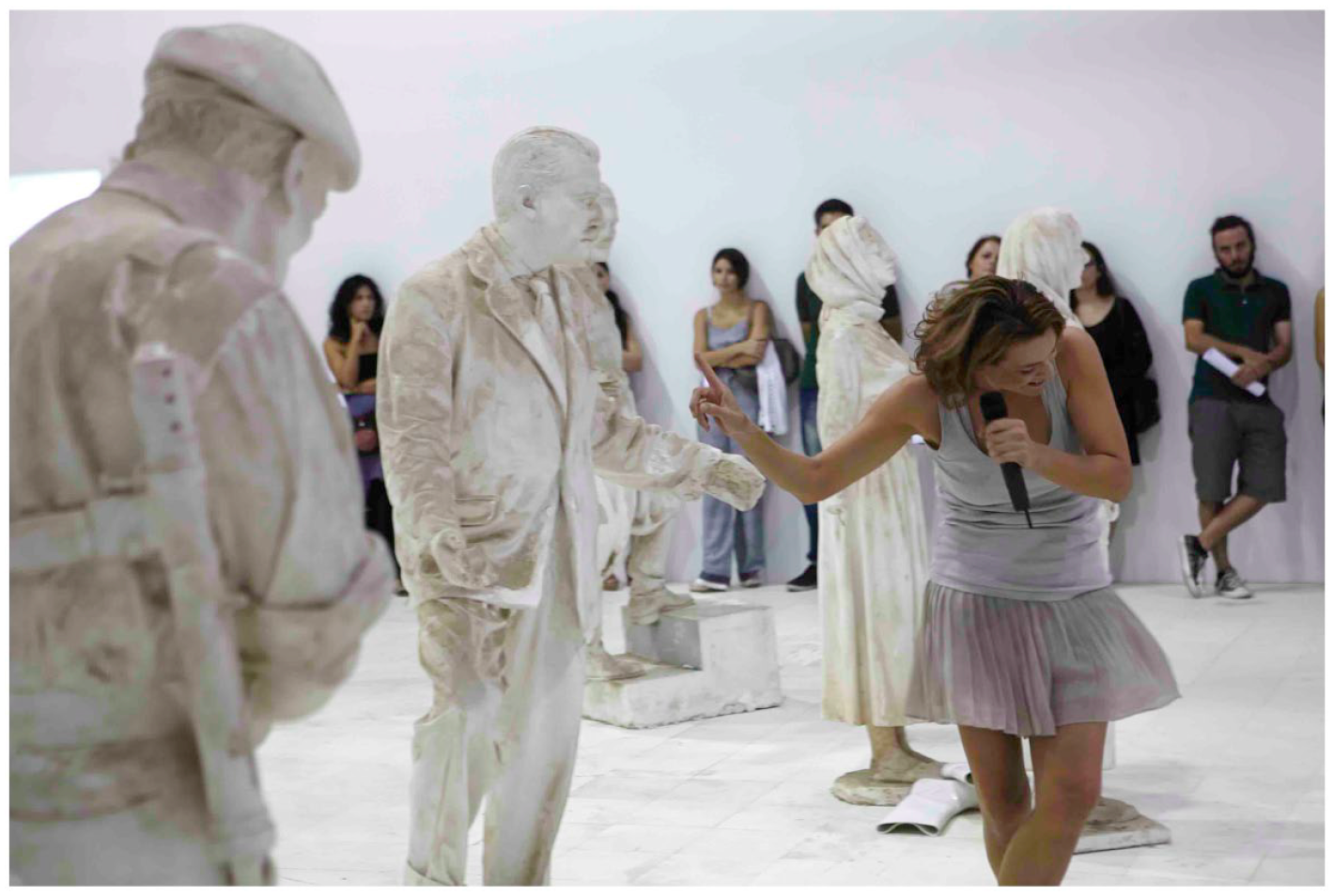
Lia Haraki, Record, Replay, React Show – Re-sculpting Freedom. Reproduced after permission by the artist.
Haraki approaches the statues with a playful and provocative attitude. One of the most, if not the most, provocative interaction is between the artist and the statue of the soldier, representing an EOKA fighter in the struggle against the island’s colonization by the British. Haraki first poses as dead under his gun – an action that aligns with dominant narrations of soldiers as protagonists of the conflict. In a later occurrence though, Haraki uses the soldier’s gun to masturbate. As an act, it challenges the intended symbolic meaning of the statue: So, all these figures, the soldier with the gun, the woman in black, the crying woman, I have full respect for this. And then I tried to re-write, to write over this, as a more conscious being [. . .] to reinvent those identities, to reprogram them. [. . .] So, I removed the signified from each statue and saw it as just a figure. By wiping out all these references I was able to joke [with them], to project another identity, to connect them with me as I am today, which I believe is quite open. (Haraki, interview)
Haraki’s playful interactions may be perceived as provoking sacred and valued figures, and protagonists of Cyprus’ history. In the context of the dance performance though, this exploration, which was positively received, encouraged audience members to reinterpret the symbolic meanings of these figures.
Produced within existing relations of power, heterotopic dance challenges institutional forces. Situated within a larger ‘wave’ of resistances – comprising artistic and political practices, and collective endeavours materialized in the margins – it opposes the current situation. Found in an agonistic struggle with institutional forces reproducing discourses of nationalism, the artists represent resisting voices and bodies, and heterotopic dance communicates a discourse of unification, peace and cooperation.
Crafting different presents
Heterotopic dance spaces provided the three artists’ safe (performing) spaces to meet, interact, exchange ideas and collaborate with members of the Turkish-Cypriot artistic community. Functioning as temporary zones with traces of prefigurative politics, they facilitate attempts to fulfil a different present, by denaturalizing and delegitimizing nationalistic narratives and identities, in the hope of effecting future change: In all our works we talk about the past, the present and a wish for the future. So, we put seeds for the future. We don’t deal with it just for the present and how it is [now]. We work a lot on the buffer zone, the divide, but it’s not because we want to glorify it. It’s because we want to put a future, a wish about what we want it to be. [. . .] So, art is the way towards transformation. Art is a way of transformation. Only if you become conscious of something you can try to change it, or it begins to change by itself just because you noticed it. (Economou, interview)
Dance heterotopias prefigure a vision of a future world and invite participants and viewers to bracket hegemonic discourses and take part, albeit temporarily, in this ‘other place’. Martin (1998), while discussing the ‘politicality of dance’, argued that performance is utopian precisely in its intimation of an entirely different world that flashes through this one. This is not a utopia that one could move into but a passing state that takes the fleeting movement toward emergent possibilities as its own. While the archetypal utopian community had to retire someplace where no others could see it, the politicality of dance (which is surely not all of it) places utopia on display with all its possibilities and limitations. (p. 106)
Political dance cultivates various opportunities for reflection, troubling and resistance (Taylor, 2016). It encourages dancers to self-reflect and start trying to change all these which they disagree with. Yet, and as discussed below, dance in Cyprus can have only a limited impact, mainly due to the lack of infrastructures and people’s limited engagement with this art form.
From artists into political subjects
Dance facilitates the self-transformation of choreographers/dancers from artists to conscious political subjects. Economou, for instance, was concerned with the ways she ‘as an artist [can] offer back to this place [Cyprus] and how can [her] work have a meaning/impact in the long run’. Since early on, she had been asking herself: ‘Why do I do this? What do I have to say in this social context, in this human context, in the context of the arts?’ These questions guided her artistic path. While reflecting on Cyprus, the context in which she was raised, and her experience of growing up there, she felt that she had to engage with the conflict, division, loss, (the lack of) relationships between the two communities and the Green line. Dance gave her a space to do this.
Haraki expresses something similar when she describes the impact, of choreographing the RRR show, on herself: This work was key to understand a lot about my own preconceptions, my background and way of thinking about the Cyprus issue as a Cypriot woman. When the statues were brought to me, it was like going back to elementary school and seeing all the figures we had on our notebooks with the motto ‘I do not forget’; and once again I became aware of the brainwashing [. . .]. The standpoint of the educational system in Cyprus was very specific. There were the good ones and the bad ones.
The artists voiced a necessity to rework the memories and embedded perceptions of the difficult past, but to do so, they first needed to reinvent their own identities and develop a political consciousness. Haraki describes the internal process she experienced while ‘undoing’ the deeply embedded indoctrination into hegemonic perceptions and identities about the past and the Cypriot conflict, which she (and her entire generation) underwent within the official educational system. In this respect, the space of dance is reminiscent of the mirror in Foucault’s (1984) account, which is described both as a utopia and a heterotopia: I begin again to direct my eyes toward myself and to reconstitute myself there where I am. The mirror functions as a heterotopia in this respect: it makes this place that I occupy at the moment when I look at myself in the glass at once absolutely real, connected with all the space that surrounds it, and absolutely unreal, since in order to be perceived it has to pass through this virtual point which is over there. (p. 4)
The artists describe their self-reformation and self-transformation through choreography. Dance, then, as a material (bodily) and discursive practice, acts as a re-constitutive gaze that enacts critical artistic subjectivities. Political dance functions as a heterotopia: a space where artists reconstruct their own selves, strip themselves from embedded perceptions and interpretations of the past to create new subjectivities, critical dancing perspectives and political positions. This process of ‘undoing’ is akin to Foucault’s (1984) counter-sites, where ‘real sites’ (in this case, selves) are ‘represented, contested, and inverted’ (p. 3).
Troubling troubled sites
Finally, dance acts as a heterotopia because of its ability to reinvent real sites. The three artists engage quite intensely with the buffer zone, which in Cyprus’ recent history constitutes one of those emotionally charged spaces that are ridden with symbolic meaning: for Turkish-Cypriots, it signifies protection and a rigid state border, whereas for Greek-Cypriots it denotes aggression, animosity and an obstacle to reunification (Papadakis, 2018: 288). Dimitriadou-Lindahl engages with people’s fear of passing over to ‘the other side’, while Economou challenges the very essence of it. After talking to people from both sides for Crossing Over (part of Voices Unheard), Dimitriadou-Lindahl realized their anxiety in crossing over, as they thought that by showing their passport at the border, which was a precondition for passing over, they would recognize the unlawful occupation of Cyprus. Crossing over could performatively give substance to the line and ‘legitimise’ the division of the island and ‘the enemy’, as she told us.
Economou, however, approached crossing over as an act of resistance; an act that contests the very aim of the line to divide the island. She reinvented it as a meeting point for the two communities. Economou saw the partial opening of the borders in 2003 as (1) an opportunity to explore the ‘other side of the line’ and (2) a communication gateway, which at the time was absent from mainstream cultural practices. In Shared Echoes I, she attempted to contest the border by reinventing this real site as an ‘artificial thing’ that conceals the common roots of Cypriot people, their shared history and tradition. She talked about it as an unnatural division – a constructed division – thus opening the way to deconstruct its essence: after the borders opened, I thought it was time to look at what is in the other side. In my piece I was saying ‘speak to me, do you hear me?’; and I look at my ancestry as well. What is my ancestry? Why is it divided? My ancestors are everywhere, how can you say they are on this or that side? My roots are everywhere. And how can you tell me that this artificial thing is telling me where my ancestry is? It’s not. It’s everywhere, it’s ancient [. . .] (Economou, interview)
The artists suggested that the arts more widely, and dance more specifically, have the potential to disrupt the order of things and hegemonic narrations that continue to separate the two communities. Nonetheless, they all acknowledged some material and institutional conditions that hinder dance’s potential contribution.
A space of unlimited opportunities?
Art is the way of connecting all our stories and sharing our humanity. [. . .] I don’t know of other means that do that. (Arianna Economou)
Even though the wider role of art as a means of resistance has been problematized (Anani and Toukan, 2014; Salih and Richter-Devroe, 2014), it has been argued that art, and dance, in particular, can intervene and challenge political situations (Gold, 2006; Shank and Schirch, 2008; Shaughnessy, 2012). Martin establishes dance as politicized culture and perceives performing and viewing as means for mobilization (1995 cited in Prickett, 2016: 47). Situated within existing power relations, the arts and other visual culture genres such as graffiti (Zaimakis, 2015), may be approached as a counterspace, which undermines power relations and the hegemonic discourses that they produce and are reproduced by.
Interviewed artists talked about dance, and the arts more widely, as a meeting point and a point where one can test one’s boundaries, either as a spectator or performer. Furthermore, they talked about art as a form of communication, which does not require people to speak the same language: Art is one of the most important pieces that can connect people. Songs that have a shared/common melody, poetry, personal experiences which transform into art, which become dance, poems, images, paintings. [. . .] The only way to move forward and find solutions is through dialogues and meetings with the Others. Art helps in this. It helps you realize that you are not alone, that you are sharing things with others [. . .] I believe that it helps [in reconciliation] and perhaps the most honest movements towards reconciliation are the ones which were made in the field of the arts. (Dimitriadou-Lindahl, interview)
Artists discussed dance as encouraging reflexivity and inviting audiences to ‘shift’ their perspective, position and mind-set (Haraki, interview). Indeed, performance does this (Christofidou, 2021; Taylor, 2016). When asked about the impact of The RRR Show on audiences, Haraki said, I believe this shifting occurred because even the audience’s concentration means experiencing, reflecting, which take us to the next stage where people try to realize and understand their emotions and then take a position: either bury those emotions or do something with them. Because of the concentration I observed I am certain something happened in this respect.
However, the artists recognize that the potential of dance as an agent of change is rather limited in Cyprus as the arts more widely, and dance in particular, are not widely embraced or attended. Political dance performances tend to attract a particular crowd such as artists, academics and public figures with an interest in the arts and activism; people who already favour reconciliation efforts, activist events and bicommunal festivals. In this sense, such dance practices tend to preach to the converted.
In addition to this, artists spoke about the need to cultivate an authentic relationship between people and the arts so that the latter becomes an integral part of the local culture and people come closer to the field. Yet, the lack of state-funding and institutional support poses an important obstacle to achieving this (Tselika, 2019). The three artists highlighted the shortage of public art spaces where artists from both communities can meet, exchange ideas and develop collaborations. Dimitriadou-Lindahl highlighted that the state needs to create artistic bridges between the two communities since most political art comes from individual artists and small groups of people that are affiliated to NGOs, or are supported by international bodies (Tselika, 2019). Hence, while there is a strong arts community working from the margins, there are no strong official initiatives undertaken by the state or public bodies, which hinders the proliferation of the arts as a peace-building tool.
In fact, one of the artists told us that the RoC has used her art to represent Cyprus in Europe. However, the play that was selected indirectly highlighted the Greekness of the island, thus instrumentally reproducing the hegemonic discourse. Indeed, there are documented examples where political art has been commodified, emptied of its political message (Anani and Toukan, 2014; Salih and Richter- Devroe, 2014), and used by states as a tool for social control and conformity (Horkheimer and Theodor, 1972). Likewise, the (selective) allocation of resources, the development of infrastructure that facilitates art, and the hierarchizing of art and artists, further affect the perceived value of produced art works and their reception (Bourdieu, 1983).
It is perhaps unsurprising that these artists worked from the margins, producing work often without institutional support. Hence, and despite their intentions to produce political art to transform the current situation and challenge the hegemonic discourse around the Cyprus conflict, they did realize and acknowledge dance’s limited potential to bring about change. Nonetheless, they still perceived this work as their duty, and part of their service to Cypriot society.
Concluding remarks
As per Foucault (1984), heterotopia refers to spaces that disrupt the order of things; ‘cultural, institutional and discursive spaces that are somehow “different”: disturbing, intense, incompatible, contradictory and transforming’ (Johnson, 2013: 790–791). Dance, we argue, acts as a heterotopia as it disrupts the order of things through three interrelated dimensions: time, space and the choreographic subject.
In terms of space, dance acts as a heterotopia in two regards. First, all artists worked in spaces very close to the Green line, thus deconstructing its dominant symbolic meaning and re-approaching it as a point of contact rather than division. Second, dance heterotopias act as a safe space where they narrate the (hi)story differently. Through their dance practices they turned the spotlight onto the commonalities, shared cultural practices and pain that characterize the two communities but are nonetheless buried under hegemonic narrations of the past, which proliferate in museums, mainstream media, formal education and state institutions, and preserve the rhetoric of division. Dance performances facilitated the crafting of alternate parallel histories. This takes us to the second dimension: time.
Dance heterotopias foster bicommunal encounters. Although temporary, they may encourage reconsiderations of the Cyprus conflict. Audiences are invited to rethink all those aspects that they were taught as dividing the people of Cyprus; all assumed differences of the two communities. The process of dance semiosis/signification or the ‘messages’ communicated through the works, challenge hegemonic readings of the past. Dance heterotopias, therefore, create an Other reality: a counter-reality of unification, friendship, similarity and peace, thus sowing the seeds for another future. And even though dance heterotopias may not dramatically change prevalent interpretations of the conflict, Other readings of the past are important as they start cultivating alternative relations in the present, and by consequence, the future.
In terms of the third dimension, choreographic subjects transform in this space and through their practice. They experience an intense process of reflection, through which they recondition their minds to overcome the restrictive knowledge they acquired regarding, among other issues, the Cyprus conflict. Political contemporary dance, as well as other somatic practices, cultivates reflexivity (Christofidou, 2021; Taylor, 2016), and develops dancers’ self-awareness. It substantiates them as political subjects.
Furthermore, and because dance is one of the few artistic practices where there is no detached product to be consumed (since the dancer/dancer’s body is the product), choreographic subjects have the power to initiate a shift in people’s perceptions (Taylor, 2016). As Martin (2004: 48 cited in Prickett, 2016: 49) argued, dance has the ‘capacity to move an idea in a particular direction through the acquired prowess of bodies in action’. When instigated by political queries, dance can ‘evoke institutional issues alongside the personal, juxtaposing constraint of the body and spirit with expressions of hope and resistance’ (Prickett, 2016: 46). In conflict-ridden settings, it can challenge conventional ways of thinking about specific issues and structures of power (Salih and Richter-Devroe, 2014; Taylor, 2016). The immediate contact between the artist and audience creates moments of meaningful interactions (Salih and Richter-Devroe, 2014; Zelizer, 2004: 5), where meaning can be recrafted and reassigned at any particular moment, space or interaction, something which is less feasible with other more rigid or stable cultural means.
In closing, this analysis resonates with much work in the field of cultural studies – a complex and contradictory terrain, according to Grossberg (1996) – through its concern with counter-hegemony and resistance, while stressing aspects of cultural creation that are less salient in the field and thus introducing new emphases and fields of exploration. First, it moves away from the critical analysis of ‘mass’ or commercial (visual) culture – the classic area of interest of (British) cultural studies – to the analysis of performative arts, which stand between ‘mass’ and ‘high’ arts, in that they develop independently from the market but are still accessible to the public (through practices such as street performances and the involvement of non-dancers).
Second, it focuses not on interpretative practices of audiences but on the ‘text’ produced by choreographers, showing the transformational force of this process for the artists themselves as subjects. The self-transformation of dance artists, as documented in this article, follows Stuart Hall’s anti-essentialist approach to identity. Here, cultural/ethnic identities ‘come from somewhere, have histories. But, like everything else which is historical, they undergo constant transformation. Far from being eternally fixed in some essentialized past, they are subject to the continuous “play” of history, culture and power’ (Hall, 1990: 225). In our analysis, dance is identified as a site where such identity transformation takes place (of artists as well as ethnic identities related to the Cyprus conflict), challenging the naturalness and fixed-ness of hegemonic identities but leaving open the outcome of such transformation, sidelining any essentialist positions about what is or what should be.
Third, dance is a different kind of text, one that is ‘written by the human body’ (Shapiro, 2016: 12) and represents an embodied knowing and a critical subjectivity that is not based on a rationality that often works at the expense of lived experience and emotions (e.g. trauma, loss, pain, hostility but also healing and forgiveness). This concerns also the ‘reception’ process by spectators. Andrée Grau (2011) puts forth the assumption that ‘the very experience of the live engagement with the [dance] artists strengthens and sharpens people’s awareness, often giving them a longer lasting impression than, for example, reading a newspaper article on the same topic’ (p. 155). Dance, as it mediates the material and the transcendent, is thus a site worth exploring further within cultural studies to address questions about how power can be challenged in less rationalistic ways as well as how ‘stories, ideas, and aesthetic ideals proposed by different performance genres are transmitted in memorable ways to their audiences’ (Grau, 2011: 157).
In a conflict-ridden context such as Cyprus, dance heterotopias may act as catalysts of change, contributing to unification and peace efforts. They problematize aspects of written history that have been established as historical facts. This is a main principle of heterotopias. Nonetheless, and precisely because of these spaces’ existence outside Cyprus’ mainstream cultural sphere, their effect remains limited. And yet, this is precisely what makes these dance spaces heterotopic. After all, ‘an important characteristic of Foucault’s heterotopia seems to be that it requires some significant travel – some expulsion from “mainstream” society and its habits’ (Saldanha, 2008: 2083). The re-articulation of the island’s history that dance heterotopias facilitate creates moments and spaces of rupture, and critical subjects.
Footnotes
Funding
The author(s) disclosed receipt of the following financial support for the research, authorship, and/or publication of this article: This article is part of a project that has received funding from the European Union’s Horizon 2020 research and innovation programme under grant agreement No 769252.
