




Abstract
This article offers an analysis of women’s representation in the 2021 Channel 4 series It’s A Sin. Focusing on the show’s narrative and ideological use of the telephone network as a system of transactional care, the article critiques depictions of motherhood and questions the erasure of narratives about experiences of gender, race, sexuality, class and disability in queer communities. By way of textual analysis and histories of communication technologies in the 1980s and 1990s, the article argues that It’s A Sin perpetuates conservative and moralising perspectives on a range of issues, particularly with regard to gender and sexual activity.
Keywords
‘Tell him I send my love’, says Ritchie’s agent Carol, to his friend Jill in the final episode of It’s A Sin. As Carol leaves the Pink Palace, the London flat shared by Ritchie, Jill and the rest of their queer chosen family (Roscoe, Ash and the late Colin), a telephone beep becomes audible on the soundtrack. As part of a musical score, the beep repeats throughout a montage sequence following Jill and Roscoe as they travel to the Isle of Wight to say goodbye to Ritchie, who is dying of acquired immunodeficiency syndrome (AIDS)-related illnesses. Once there, they book a room at a local hotel and Jill repeatedly calls Valerie, Ritchie’s mother. Agreeing to pass on Jill’s daily messages, Valerie nevertheless denies Ritchie’s friends any telephonic or in-person access to him. Consequently, the rhythmic cadence of the telephone beep on the soundtrack – promising the possibility of connection – is at odds with the visual reiteration of Jill putting money into the pay phone and hanging up the receiver resignedly, over and over again. Thus, the sequence is a moment of rupture that positions Valerie as a villain who breaks a gendered network of care established by Jill, Carol and other women to support patients with human immunodeficiency virus (HIV)/AIDS via telephone calls in the series.
For viewers old enough to remember telecom company one2one’s televised advertisements between 1996 and 2002, the soundtrack adds an additional layer of irony. For the telephone beeps appear courtesy of the Penguin Café Orchestra track ‘Telephone and Rubber Band’, which was synonymous with one2one because the company used it in a series of ad campaigns that encouraged people to buy mobile phone contracts. For example, the 1997–1999 ads (tagline ‘Who would you one2one with?’) featured celebrities including Kate Moss and Ian Wright discussing what they would ask notable dead individuals via phone calls with them. Interspersing archival footage of (in the former instance) Elvis Presley and (in the latter) Martin Luther King, and focusing on cis-presenting male icons, the ads privileged a patriarchal canon and indulged in nostalgia. 1 In doing so, the campaign highlighted a longing for reconnections with dead men whose passing was untimely and whose lives were subject to unanswered questions. While the ads used cisheteronormative casting, the cultural significance of the sentiment in the late 1990s reads to me as loaded with latent HIV/AIDS subtext; it is a glib nod to national mourning for a lost generation that is packaged in palatable terms for the public and appropriated for commercial gain by erasing queerness.
Unlike the one2one ads, It’s A Sin is anything but subtle about its HIV/AIDS narrative. However, like the one2one ads it references in Episode 5, the show’s representation of the epidemic is complicated by the burgeoning neoliberal capitalism that the series relies on in terms of its characters, themes and off-screen broadcast contexts-yet deplores via its onscreen narrative. This article, then, draws on a range of historical sources to interrogate the hypocrisies manifest in the show’s depiction of responses to the AIDS crisis via characters who engage in telephone calls. In doing so, it is attentive to the roles that gender, race and class play in determining the moral worth of characters, noting that It’s A Sin’s attitude towards people – mostly women – for whom communication and care are transactional tend to be misogynist and anti-sex work. By depicting women as carers connected by a matrilineal telephone network that exists to support mostly white cis gay men, and by equating transactional phone calls with immorality, I contend that the show perpetuates conservative stereotypes about queerness that erase intersectional experiences. 2
Call me!: the gendered telephone network
In all five episodes, viewers bear witness to phone calls that take place in a variety of locations, including a payphone at a university, a red phone box on the street outside the Pink Palace and a phone at a nurse’s station in a hospital ward (Figure 1). In almost every onscreen phone call, women participate as callers or receivers whose purpose is to support white cis gay men, inquire about their welfare or otherwise share useful information that informs the viewer about the show’s historical context. Eileen calls her son Colin when he arrives in London to ensure that he has settled into his lodgings and is making friends. Valerie takes calls from Ritchie in which she offers him money and expresses how much she misses him. And the nurse in the hospital not only offers to make phone calls on behalf of patients to establish support networks, but also calls Ritchie’s consultant to pass on information to his parents. While it is vital to recognise that emotional care in queer communities is not equivalent to the burden of production expected of workers under capitalism, the show nevertheless maintains a historically gendered notion of telecoms labour that positions women in service to men through omnidirectional emotional support. For example, investigating telephone networks in the 19th century, Michèle Martin (1991) describes how they initially served white patriarchal capitalism and relied on women’s labour as telephonists, even as the nascent telecoms industry limited marginalised people’s access to the technology. Furthermore, as Ellis Hanson (1995) discusses, the phone and its wire functions symbolically as breast and umbilical cord (pp. 38, 42). It is coded maternally by design, and so It’s A Sin not only perpetuates stereotypes about women’s labour, but also maternal care, which constitutes women’s main function within the show’s narrative arc.
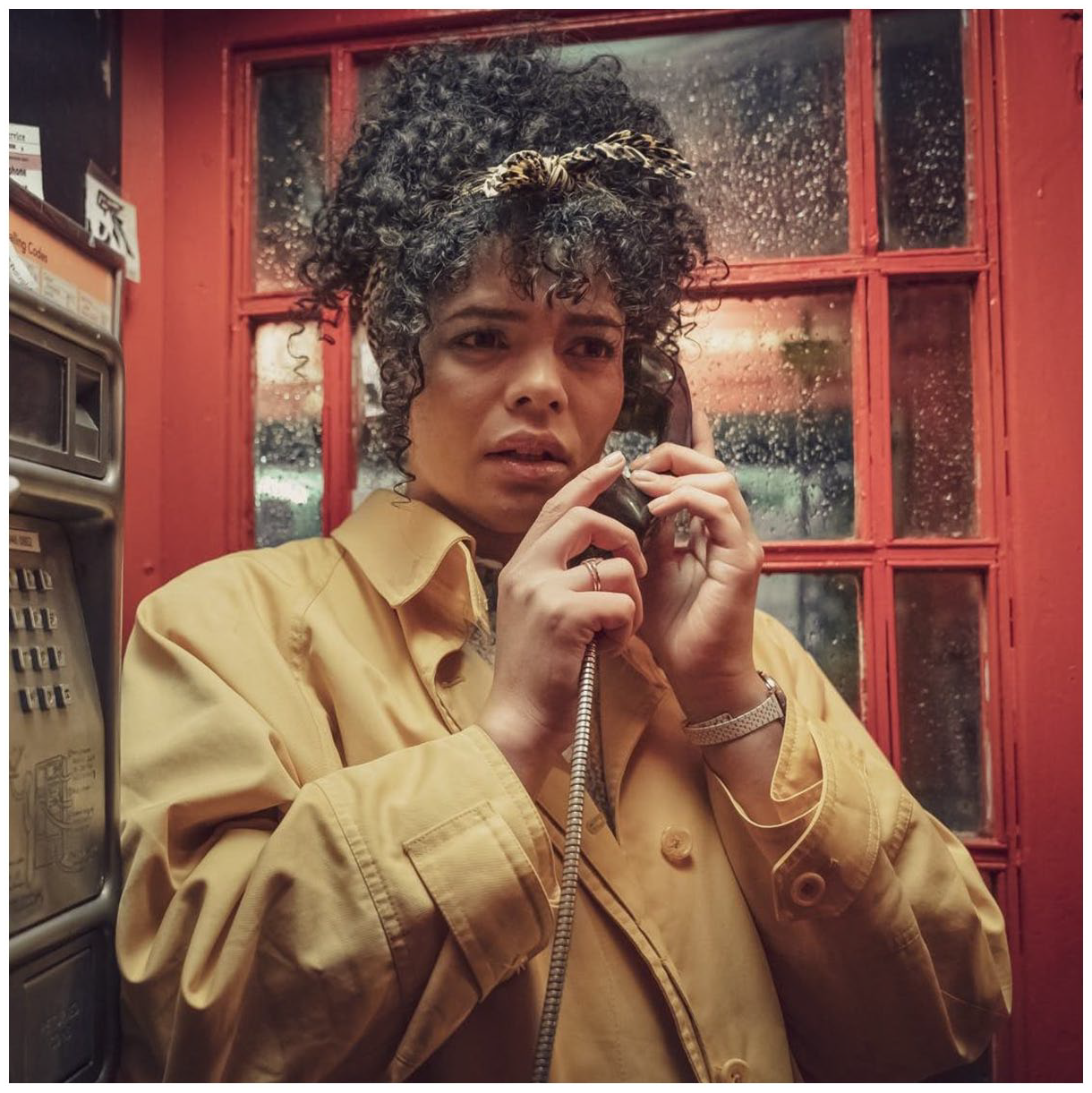
A promotional still used by Channel 4 to advertise the show. Jill (Lydia West) holds a handset in a phone box in a scene from Episode 3. Her willingness to selflessly provide care for her male friends via the phone positions her as a maternal figure.
Jill’s telephone use in particular bears closer scrutiny, for the bulk of telephonic labour, as well as emotional and physical care, falls to her as the Black surrogate mother for the queer, male-oriented community that she inhabits. Throughout the show, she is selfless in supporting sick friends and is willing to interrupt both her studies and her sleep to do her best for them. In Episode 2, for instance, Gregory (who has just been diagnosed with HIV) calls her during her Drama class at university and insists that she is the only person who can help him because men in their friendship group are untrustworthy. Jill responds by cleaning, shopping and cooking for him in secret and risks the wrath of his family in her attempts to contact him by phone after his father moves him to Glasgow. In Episode 3, Jill gives up her time between performances of her stage show to volunteer at a telephone support centre (likely the Terrence Higgins Trust). 3 ‘Am I dying?’ an anonymous man asks her. ‘I can’t answer that darling’, she says, ‘but have you been to a doctor?’ It is also Jill who wakes in the night to answer the phone to Eileen announcing Colin’s death, and Jill who shares the news with her housemates. In Episode 5 it is Jill, never Ash or Roscoe, who speaks to Valerie on the phone, either to cover up or enquire about Ritchie’s condition.
Jill, then, is the receiver of trauma and the broadcaster of bad news. Yet Jill herself has no backstory besides having parents, who appear briefly in three sequences but do not reveal anything about her upbringing or character. Nor does she receive much care from others. At no point in the show is her Blackness acknowledged and (from my perspective as a white woman) her race does not seem to affect how she moves through the world, either. As Beverley Bryan, Stella Dadzie and Suzanne Scafe (2018 [1985]) argue in their account of 1980s Britain, life for Black women was beset by specific oppressions in all areas of life, from education to employment and from healthcare to criminal justice (p. 194). 4 Yet Jill’s experiences at university and as a successful musical performer, and in hospitals and with lawyers, do not bear out that fact. In Episode 4, for instance, at a die-in attended by police who violently assault protestors including Jill, the show fails to recognise the increased danger she faces as a Black woman compared to the white, middle-class Ritchie.
Given that actress Lydia West was cast in a part inspired by Jill Nalder, a white woman friend of writer Russell T Davies, I am reminded of Kristen J Warner’s (2017) notion of ‘plastic representation’ (p. 32). The concept refers to the discomfort caused when shows recast originally white parts with performers of colour, swapping between racial groups ‘with little adjustment to the parts themselves [. . . which] as a result marks the changes as superficial’. Moreover, writing about It’s A Sin, Kemi Alemoru (2021) positions Jill in a long history of film and television narratives that rely on ‘two-dimensional Black characters whose only use is to save white protagonists’ known as ‘magical negroes and mammies’. Hence Jill, whose Blackness is downplayed and, significantly in a show about sex, whose sexuality is indiscernible, functions narratively as receptionist and carer for mostly white men. There is no explicit racial solidarity between her and Roscoe, and no opportunity for self-recognition and community in her care work because no people of colour or people marginalised by gender get HIV/AIDS in the show. Consequently, her narrative erases a long history of misogynoir and racial discrimination in Britain, and, in overlooking it, the series perpetuates the problems it fails to articulate. While her sexlessness avoids stereotypes that fetishise Black women’s bodies as sexual objects, It’s A Sin’s refusal to address her sexuality renders Jill as a virginal other, for viewers do not know whether she is straight, lesbian, bisexual, asexual, abstaining or otherwise. In a series that frequently equates sex with dirt, contamination, filth and immortality (see Ritchie equating ‘filth’ with his porn magazines in Episode 1), Jill is the clean and perfect virgin mother, a kind of Black Madonna from whom life and care is given amid chaos. She is, after all, a literal cleaner who scrubs kitchens on behalf of men, and, through her labours on the phone, listens to and guides them in their quest for salvation.
‘I watched him get up, and go to work, and phone his mum, and behave’
Mother–son relationships abound in It’s A Sin, many of which are conducted remotely by phone. However, not all mothers are created equal, and the show represents them according to a virgin/whore dichotomy that is predicated on women’s visible proximity to capital. The notion that care can be transactional, and that labour deserves reward, is undermined by positioning mothers as immoral if they do not make themselves freely subservient to white men. For Jill, Eileen and Valerie, who between them represent both ends of the moral spectrum with regard to motherhood, their telephone conversations with biological and surrogate sons and with one another determine how they are judged within the show’s moral framework.
Like Jill, Eileen, for example, is a good mother. From the outset, she is depicted as an understanding single parent who is interested primarily in her son’s advancement in life; calling him from her home in Wales in Episode 1, she checks on his health and ensures that he is having fun. When Colin becomes ill, Eileen gives her time and attention to him without placing any demand on him in return. She is self-effacing and never discusses the impact that caring for her sick son has on her own mental or physical wellbeing as a disabled, working-class woman. She gives her energy to the broader community as an activist by participating as a protestor at the die-in. She also acts as a conduit of information by calling the Pink Palace immediately when Colin dies – she does, after all, phone the flat and speak to Jill in the middle of the night. In her work about lesbian telephone exchanges in the United States, Cait McKinney (2020) discusses the historic erasure of women’s work from the public record, arguing that it ‘is perhaps most acute when this work takes the form of service, care, or emotional labour, categories that include activist projects understood as labours of love’ (p. 12). In both Jill and Eileen’s cases, their work does not warrant payment because it is fundamental to their roles as good mothers, and neither of them asks for any payment from their biological or surrogate sons. Colin treats his mother in kind by selflessly trying to protect her from the stigma associated with his sexuality and calling her regularly. As Roscoe says to Jill in Episode 4, Colin always phoned his mum and behaved; theirs is an example of how mother–son relationships should work according to It’s A Sin.
Valerie, meanwhile, asks Ritchie for a return on her financial and emotional investment in his wellbeing and he in turn weaponises her demonstrations of care using emotional blackmail. When he calls her from a local payphone, for instance, to request that she pays to install a private phone line at the Pink Palace, she agrees on the basis that he will contact her more and thus be a more loving son. They are financially and emotionally co-dependent, each relying on the other’s need (for money in Ritchie’s case and affection in Valerie’s) to extract something from the relationship. It is telling that both mother and son are Conservative voters in the neoliberal economy of 1980s Britain and that their economic and social values are at odds with the feminist, queer and more progressive ideologies of Ritchie’s peers. Valerie wants to dismantle the unions and knows the cost of everything from education to steak. Ritchie, a pampered middle-class graduate, knows the price of nothing beyond his immediate needs and doesn’t think children should see gay men in books.
In the final episode, the telephone at the Pink Palace exacerbates tensions between Ritchie’s two politically opposed mother figures. Jill uses the phone to visibly conceal his illness from his parents and play acts that he is merely busy when he is too ill to reach the phone. In one scene she answers as if the caller has reached a laundry service, only to be reprimanded for making a silly joke. ‘Sorry Mrs T, I’ll just get him for you’, Jill responds as she is forced from acting, the profession that earns her money, back into her primary role as receptionist. Throughout the episode, Valerie becomes increasingly irate as she learns the extent of her son’s attempt to cover up his debilitating condition. ‘You didn’t think to phone? His parents are clearly not here, and you think that’s wise?’ she yells in the hospital, before demanding that the nurse call Ritchie’s doctor to provide her with information. In a showdown with Jill, she blames her son’s friend for the ‘charade’, and in doing so undermines Jill and Ritchie’s acting profession while expressing anger that his illness has been kept from her. She had expected an emotional return on her monetary investment when providing the phone line by way of news about and from Ritchie, and she is angry that she has not been recompensed according to plan. Consequently, when she terminates his care in London and takes Ritchie home, she makes Jill pay: during the Isle of Wight montage sequence, viewers see Jill dropping coin after coin into the payphone at her lodgings in a transaction that always ends with Valerie refusing to share information.
For all that she demonstrates care for her son – forgiving him for using expensive steak in a casserole, supporting him financially, telling him that she loves him, curbing his father’s obsession with Ritchie’s career – Valerie is a transactional mother who gives because she needs to take. She is also homophobic, which manifests in her declaring that gay desire is a phase and in her refusing to acknowledge Ritchie’s femme presentation (hypocritically, the show perpetuates stereotypes about gender and sexuality by insisting that cis male actors who like musicals and do not have girlfriends must be gay). Unlike Ross’s mother, who demands that lodger Colin pay for his phone calls to Eileen and declares that Ross isn’t ‘one of those filthy dirty queers’, Valerie tolerates her son’s sexuality. Nevertheless, she embodies what Julia Kristeva (1982) describes as ‘abject’. She is ‘immoral, sinister, scheming, and shady: a terror that dissembles, a hatred that smiles, a passion that uses the body for barter instead of inflaming it, a debtor who sells you up, a friend who stabs you’ (p. 4). Moreover, her child serves her ‘as token of her own authentication’ (p. 13). Whereas Colin’s lawyer Lisbeth and Ritchie’s agent Carol are both paid as professionals to support members of the queer community with HIV/AIDS and are thus exonerated for the transactional nature of their care, the labour that Valerie provides as a mother should be, and yet is not, free. As a result, the show makes her a scapegoat not only for the deaths of men that Ritchie claims to have infected knowingly via unprotected sex, but also for the AIDS crisis more broadly. ‘They died because of you’, says Jill. ‘They all died because of you’. It is possible to legitimise blaming a white, middle-class woman for multiple men’s deaths by reading Margaret-Thatcher-sympathising Valerie as a proxy for the Prime Minister herself, whose policies harmed numerous queer people. 5 However, Jill’s monologue ultimately emphasises the show’s own conservatism and misogyny. Rather than interrogate how the crisis was caused by white supremacist and patriarchal capitalism that all of the characters in the show either perpetuate or participate in, it instead blames bad mothers who refuse to do their duty to young men and provide free labour on the telephone. 6
The misogyny implicit in the show’s representation of women as both good and bad mothers according to their proximity to capitalism is just one facet of its conservative ideology. For in depicting phone communications, the series is curiously strait-laced; telephone networks are divorced from sex and queerness and are for the most part used to demonstrate familial bonds between parents and their biological or surrogate children. Writing in 1995, Ellis Hanson (p. 34–35) described the possibilities for safe sex that phones provided gay men at the height of the AIDS crisis. By way of Kristeva’s musings on eroticism and Donna Haraway’s writing about cyborgs, he positions phone sex as transactional and delightful in its perversity. ‘Through technology’, he suggests, ‘desire makes brazen its age-old love-affair with capital’. Yet the closest that It’s A Sin comes to acknowledging connections between phones, sex and financial reward for labour are the calling cards just visible behind Jill and Ritchie when they call parent figures from the local phone box. In the phone box scenes, the (as far as I can tell, cisheteronormative) advertisements for sex are positioned as antithetical to the pure wholesomeness that people expect from familial relationships. The show is so invested in the patriarchal notion that telephones are symbolically maternal objects facilitated by women’s labour that it erases histories of queerness that are subversive because they are transactional – and in doing so, It’s A Sin expresses anti-sex work sentiment. Significantly, Roscoe’s brief foray into transactional sex is made acceptable by the show because first, he is taking financial advantage of a wealthy Conservative Member of Parliament (MP) who is both racist and homophobic, and second, because Roscoe is hurt when he learns that the MP does not care for him emotionally (Episode 4). Thus, the series refuses to acknowledge sex as a legitimate form of labour via telephone or otherwise. The only acceptable iteration of sex is one that involves strength of feeling, with the final episode suggesting that Ritchie, who has been positioned as immoral owing to his promiscuity, is finally absolved of his sexual sins when he tells Valerie that all of his many one-night stands were meaningful.
Conclusion
Writing about alternatives to patriarchal and anti-capitalist models of familial care, Sophie Lewis (2019) describes how people ‘cultivat[e] non-oedipal kinship and shar[e] reciprocal mothering labours [. . .] In particular, trans, Black, sex-working, migrant, and queer communities have historically survived thanks to their skills in this sphere (sometimes called ‘kinning’)’ (p. 147). To an extent, It’s A Sin strives to portray the queer chosen family living in the Pink Palace as participating in ‘kinning’, and reveals how a network of marginalised people – queer, disabled, of colour, sex workers – labour to support gay men who contract HIV/AIDS. But the show fails to represent anyone beyond the white cis gay community being affected by the virus and erases the intersectional experiences of mostly women characters who exist only to serve white men. Consequently, through ‘plastic’ character Jill and a moralising narrative about blame aimed at Valerie, the series upholds the conservative ideology it narratively claims to reject. Furthermore, it does not account for its own proximity to capital as a televised broadcast that relies on advertising and corporate sponsorship for its transmission. 7 For, like the one2one phone ads that it references in Episode 5, It’s A Sin trades in nostalgia and privileges white men to produce a marketable historical narrative. In doing so, it bears a striking resemblance to marketing strategies that specifically target gay men owing to the so-called power of the ‘pink pound’, which assume that gay men have a higher-than-national-average disposable income and so treat other demographics in the queer community as marginal (see, for example, Goldfingle, 2014, or Bengry, 2018). The result is a show that narratively demonises women’s proximity to capital as well as transactional modes of care – including sex – even as it benefits from and perpetuates consumerism. In its onscreen gendered telephone networks and moralising about motherhood, It’s A Sin tells a conservative story about the AIDS crisis in which progressive politics are ultimately phoned in.
Footnotes
Acknowledgements
The author would like to thank Jonah Coman and Joanna Helfer for their insights and discussions when preparing this article. In addition, the author would like to thank students who took the 2021 ‘Screens and Machines’ class at the University of Glasgow for their conversations about queer histories of communication technologies.
Funding
The author(s) received no financial support for the research, authorship, and/or publication of this article.
