




Abstract
The UK television series It’s a Sin (2021) emerged alongside ongoing cultural projects that re-script acquired immunodeficiency syndrome crisis narratives and contribute to a broader ‘post-acquired immunodeficiency syndrome’ media culture. In this Cultural Commons piece, we consider how community health promoters have adapted the imagery from It’s a Sin to create new human immunodeficiency virus educational materials. We situate these media practices in relation to an ongoing practice to think about the ‘end of acquired immunodeficiency syndrome’ through strategic health communication practices and question the cultural significance of adapting It’s a Sin for health advocacy initiatives. We argue that more attention needs to be paid to the exchanges between popular culture and health promotion imagery. Critical health and media scholars should develop more complex cultural health criticism to capture the exchanges between health promotion and melodrama, to create accountability and avoid re-scripting normative perspectives of health and illness within post-acquired immunodeficiency syndrome media.
In a cultural moment when images of acquired immunodeficiency syndrome (AIDS) pasts have flourished, where stigma is thwarted through normative portraits of lifted fingers and embracing couples, It’s a Sin has emerged as a jewel in the crown of post-AIDS media production. Post-AIDS media has been described as ‘the cultural re-scripting of HIV/AIDS from a state of crisis to one of chronicity that has acted as a backdrop to new representations of HIV and AIDS and male homosexuality’ (Kagan, 2018: 15). Building from the possibility of life with fewer deaths from AIDS-related illness and greater access to medical treatment, post-AIDS media serves as an aesthetic domain where artists may speculate futures beyond AIDS and to revisit the AIDS past using a utopian lens. Viewed in this light, It’s a Sin straddles a speculative future and a utopian past, creating a disco-driven fantasy of queer kinship disrupted by AIDS – an example of post-AIDS media that appeals to, as the Channel 4 ratings proclaim, an emphatically more ‘gay accepting’ British audience in the early-21st century.
The series’ success has encouraged a plethora of related cultural projects – including plans for an AIDS memorial in Birmingham 1 and the trialing of a new public health campaign that draws from its imagery. The ‘Together We Can’ campaign was released through an online health promotion survey in April 2021 by the Terrence Higgins Trust, a third-sector human immunodeficiency virus (HIV) organisation dedicated to eradicating HIV stigma and improving the physical and social conditions of people living with HIV in the United Kingdom. Using stills from It’s a Sin, the campaign rallies its audience to ‘Do it for Ritchie!’ ‘Make Ash Proud!’ and to ‘Be more Jill!’ (see Figures 1 and 2). The A4 digital posters further state the need to ‘educate ourselves’, to ‘challenge lies, myths and fake information’, to ‘talk openly and honestly about HIV’ and to ‘use language that doesn’t stigmatise anyone’ in order to stop HIV stigma. This campaign positions It’s a Sin as a pedagogical tool, highlighting what ‘It’s a Sin taught us’ and mobilising its intended audience to behave and respond according to the series’ fictional characters.
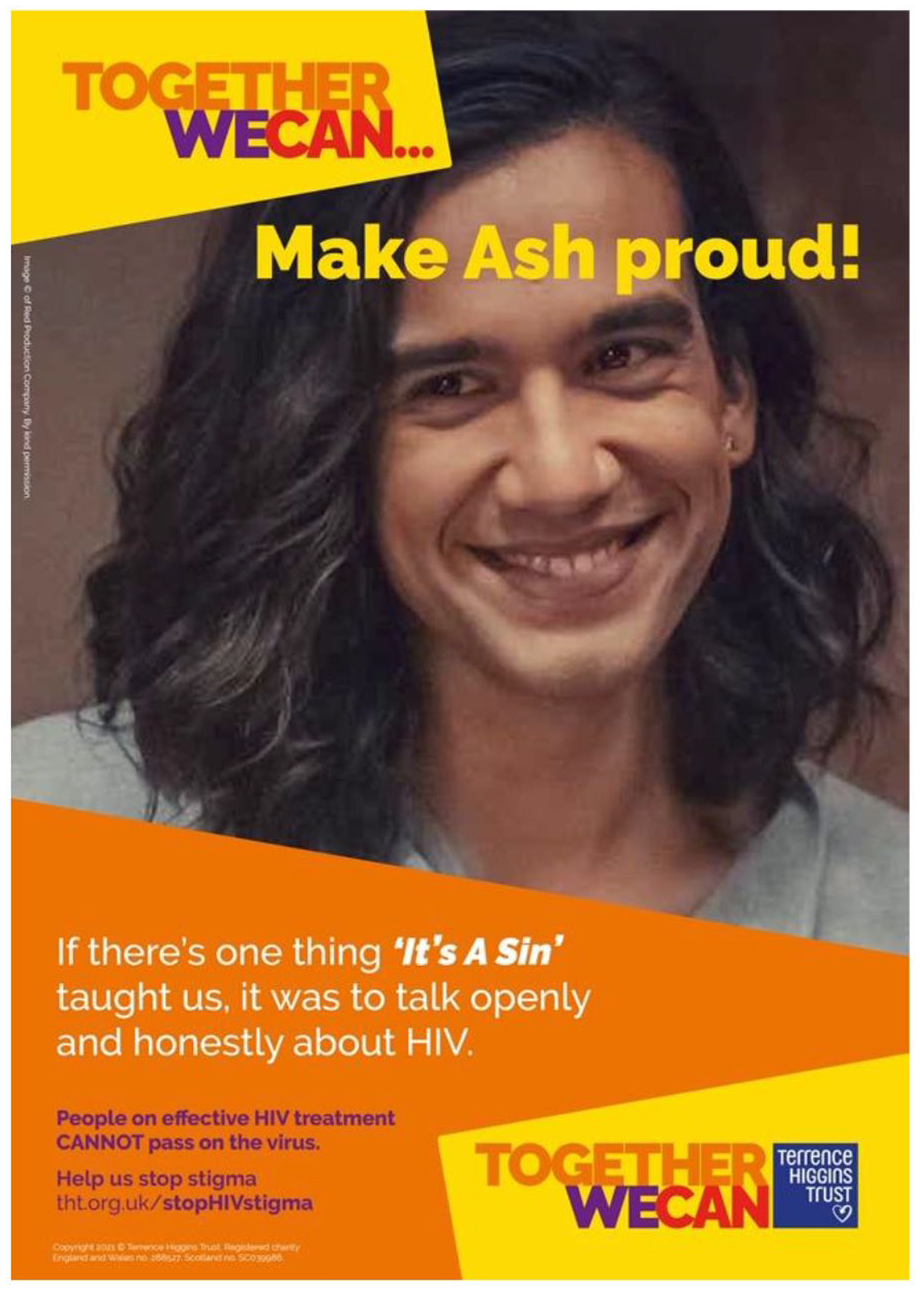
‘Make Ash Proud’ poster.
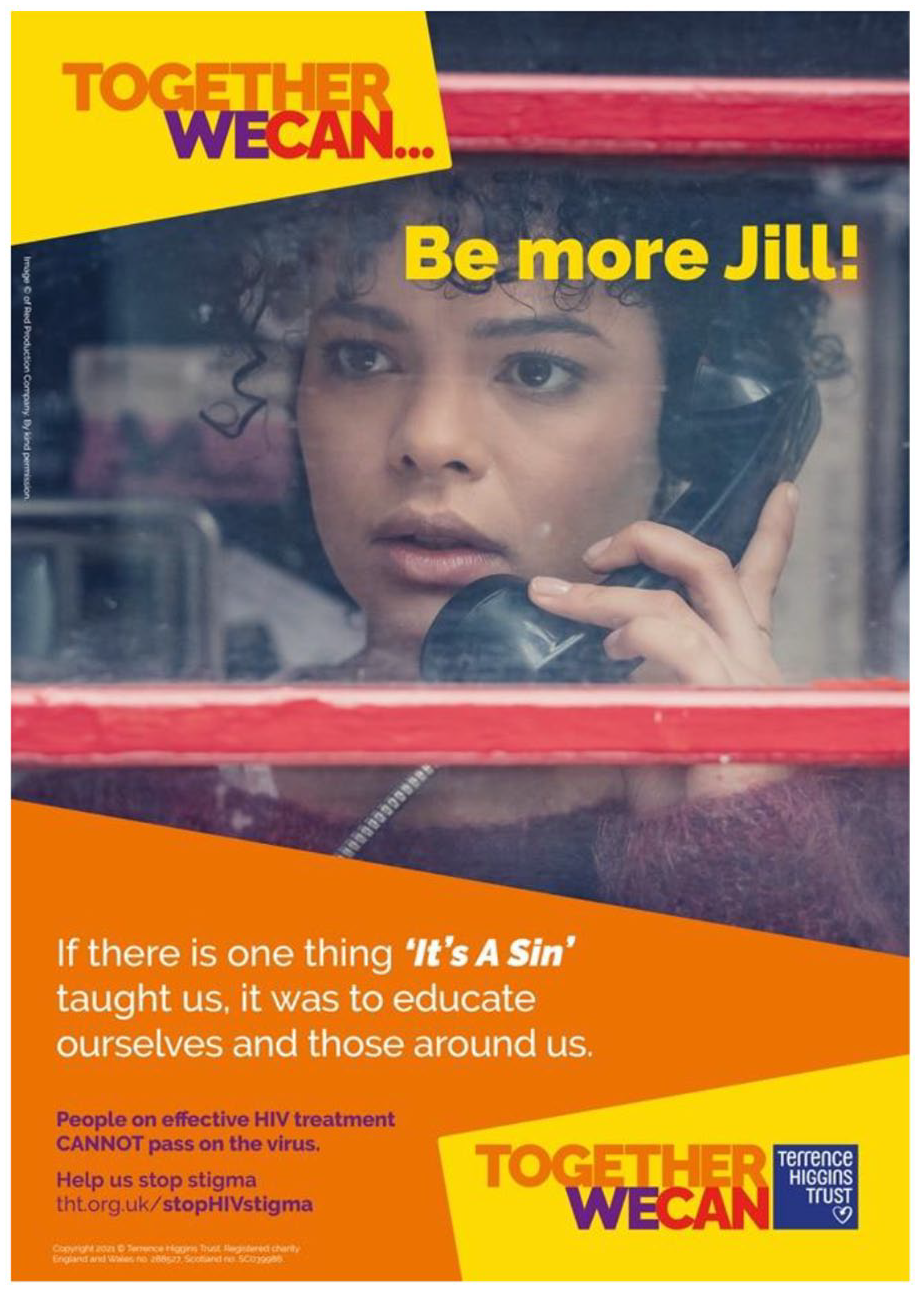
‘Be More Jill’ poster.
More than a rousing play on AIDS history, which links familiar faces with national HIV prevention targets and literacy strategies, this instance of the ‘Together We Can’ campaign raises interesting questions about how cultural media has come to serve as both a pedagogical and indexical tool to drive home the treatment-as-prevention (TasP) messages of the ongoing and global ‘Ending AIDS’ project (Sandset, 2020). We suggest that the pedagogical positioning of It’s a Sin and its reformulation and extension through the production of health promotion messages in the ‘Together We Can’ campaign creates a mingling of bio/techno/cultural publics with ambiguous political stakes. That is, the dual campaign-series bridges a broader television and largely heterosexual audience with the majority queer audiences targeted by the Terrence Higgins Trust campaign. This mingling creates a perceived ‘healthy public’ that, we argue, smooths out the queer multiplicity of AIDS histories in favour of a linear and problem-orientated image culture to engage a broader audience in the ongoing campaign to ‘end HIV’. In what follows, we consider the potential strengths and limitations of this representational strategy, attending to health promotion as a broader cultural problem that is presently being reconfigured through the entanglement of third-sector marketing and mainstream media production.
- - - -
The ‘Together We Can’ campaign imagines a public both open to the historical lives of queer people and welcoming of new HIV prevention messages. The tagline ‘If there’s one thing It’s A Sin taught us’ signals a shared sameness for an audience composed of both queer and non-queer viewers. Together, the ‘us’ and ‘we’ of the images interpolates a wide-ranging audience into a shared position to do their part to stop HIV transmission while engaging the early visual histories of AIDS. The record-breaking audience of the five-part mini-series (Chilton, 2021) is, thus, reconfigured as a public of an intended public health campaign, moving the boundaries of the histories of HIV prevention beyond the queer people presented in the series’ profilmic world towards a more inclusive participation in HIV health promotion. If, as Michael Warner (2002: 67) suggests, the ‘chicken-and-egg circularity’ of publicity means that there is no public that exists prior to an act of speech or a text, then the ‘Together We Can’ campaign must be understood as working not just to address the original audience of the series – that is, those willing to engage a queer AIDS visual history – but also to fashion them into a health-conscious public – that is, a national viewer invested in social change and stigma eradication. The formulation of a public doubly invested in viewing the histories of AIDS and the situating of TasP messages as the imperative takeaway from those visual histories thus presents an ambiguous political framework for understanding the pedagogical purpose of the series and the health campaign.
Why does this campaign craft such as public, as opposed to remaining with its queer legacies in the present, and with what ethics are the members of this public asked to engage? We suggest that the act of yoking together the series and health campaign affects a normative politics of engagement that sidesteps the need for sustained feminist and queer critiques. This sidestepping of a critical and queer health politic has been the subject of extensive critique (e.g. Broqua, 2020; Gould, 2009; Hallas, 2009; Juhasz, 1995; Kagan, 2018; Race, 2009), but remains largely situated as an intellectual problem and is rarely engaged by health professionals who curate public health campaigns. We seek here to bridge this gap by connecting, however briefly, this lack of queer political engagement within new AIDS cultural media with historical health promotion practices that have tended to reduce queer health activism to a health politics that normatively incites behaviours and practices to secure the ‘end of HIV’. In doing so, we suggest that the normative drive to signify and obtain the ‘end of AIDS’ obfuscates queer lives and creates an exclusionary vision of ‘healthy futures’.
- - - -
The visual and material outputs of HIV awareness campaigns, we suggest, ought to be considered cultural products in their own right within a larger economy of AIDS cultural media (Hallas, 2009; Kagan, 2018). The significance of this claim is perhaps best exemplified by the recent web series The Grass is Always Grindr, which was produced by the London-based sexual health clinic 56 Dean Street using the UK HIV Innovation Grant scheme for developing cultural interventions in at-risk communities. The series dramatises gay male encounters with chemsex, HIV transmission and relationships in London, and presents lengthy sequences of biomedical knowledge dissemination and overdose treatment procedures for its targeted audience. As Patrick Cash, the writer of the series, said, ‘There is a serious HIV-reduction message intertwined into the scenes. But it was essential to our production team . . . that it worked first and foremost as a drama’ (quoted in Cross, 2019). Framing the series as a drama before a health promotion video, Cash affirms the troubling relationship between health promotion messages and the need to dramatise (indeed, as Kagan might suggest, ‘curate’) the histories of HIV prevention. This entanglement signals a need for a more complex cultural health criticism to capture the exchanges between health promotion and melodrama.
The point we want to make here is that the pairing of ‘Together We Can’ and It’s A Sin takes from previous health promotion practices a troubling desire to normatively situate certain forms of biomedical consumption (Race, 2009) as a key takeaway from AIDS histories. This practice sidesteps or dampens the modes of political struggle that are otherwise on display within queer AIDS histories – modes of struggle that are still necessary in a contemporary moment marked by austerity, the increasing privatisation of the UK’s National Health Service (NHS) and decreasing funds for local sexual health services. Taking a broadcast that was initially condemned for its failure to disseminate up-to-date information about HIV treatment and testing – criticism to which Channel 4 would eventually capitulate (Kelly, 2021) – the ‘Together We Can’ campaign neglects a queer critique of the sustained violence of staging queer AIDS deaths (which remain visible in the present 2 ). Instead, the campaign extracts pedagogic value from a programme that is reluctant to engage with the sustained problems of HIV transmission in the present and the devaluation of queer politics as a mode of coalition-building against a health system ill-equipped to support queer communities for the future.
As well as occluding the value of queer resistance in AIDS history in the present, the campaign’s central message – ‘If there’s one thing It’s A Sin taught us’ – also constrains the need for new types of AIDS narratives within mainstream media (e.g. narratives centred on women, trans people and Black African, Asian and ethnic minorities, etc). In doing so, it shuts down critical conversations about the insufficiency of current AIDS media to capture the complexities of the ‘health’ of AIDS histories. Instead, through a tacit appeal to technological determinism, 3 it reminds its audiences of the successes of biomedical activism without visualising the key players – like ACT UP – who brought about and continue to agitate for policy reform, revised health promotion practices and divided coalitional strategies that refused to foreground the neoliberal politics of individualism as equal access initiative.
- - - -
What we view as a blurring of the forms of public health promotion and mainstream media might be understood as an integrated approach to advancing contemporary TasP messages. What we see in the 56DS web series The Grass is Always Grindr interlinked with the later Generation Zero health campaign, 4 we also see in the exchanges that occur between It’s a Sin and the ‘Together We Can’ campaign. In other words, this visual pairing naturalises the desire to look past the affective work needed to bring critical change and instead re-centres an individualist narrative of responsibility, blame and shame. This connection between public health promotion and mainstream media, we suggest, creates a looping effect that signals a desired form of audience participation across media platforms: a way of telling AIDS histories that ‘cleans up’ the narrative (Kagan, 2018; Kerr, 2017) for a technologically sophisticated world in which AIDS might be eradicated once and for all. In this sense, health promotion practices have focused too narrowly on state-sanctioned marketing strategies that encourage engagement with the biomedical accoutrements of testing, treatment and prevention. But as health promotion becomes disseminated within broader cultural media, it becomes subject to cultural and media criticism. We see, as these messages become integral to the stories gay men tell about their histories in the contemporary moment, the need to hold these images and their creators accountable for the lack of radical queer politics and the sustained violence to queer communities still impacted by AIDS through the disengagement with a specifically queer health media criticism.
However, we do not want to write off It’s a Sin and the associated health promotion campaign as simply a normative health media project that conditions audiences to act according to TasP regimes. Indeed, we are not seeking to contest the biomedical realities of TasP or the clear and helpful intentions of imagining a world without AIDS through the national integration of testing programmes and anti-stigma campaigns. Our argument concerns a curious cultural practice that positions HIV prevention messages as singular and oriented towards a technological promise which, as we have argued elsewhere (Weil and Ledin, 2019; Ledin and Weil, 2021), has failed to play out as the imagined ‘magic bullet’ it has been historically constructed as – for instance, because of persistent and unaddressed health inequalities. As such, these homogeneous image cultures collapse the need for a queer politics that resists institutional messages that neglect social and cultural perspectives of healthy futures. These include the need for systemic changes to healthcare practices; the need to foreground anti-racist and anti-xenophobic conversations through the ‘end of AIDS’ platform (Cheng et al., 2020); and the need to speak from community need rather than institutional idealisation of the technologically determined future which features as a ‘body without organs’ (Deleuze and Guattari, 1983) for queer communities who continue to struggle with HIV transmission. No doubt, these communities will remain in precarious positions long after the ‘end of AIDS’ has expired in the cultural images of the ‘Ending HIV’ bioscientific imaginary.
The promise of both It’s a Sin and the ‘Together We Can’ campaign provides viewers with an opportunity to take issue with sustained visual, ideological and cultural absences within queer AIDS media. But a critical entanglement of these visual products must provide viewers with opportunities to consider to what extent a critical queer politics remains relevant for people living with and impacted by HIV transmissions in the 2020s. Hence, we suggest, as part of a broader post-AIDS visual culture, that these images need to expand normative thinking about healthy futures to centralise queer political strategies that recognise the hierarchal realities of oppression, which continue to make the ‘end of AIDS’ feasible only for a select few. To move past this tired cultural practice, we must reflect on whether current health promotion practices are sufficiently aligned with the futures that queer communities struggle to bring about, faced with a conservative politics that continues to devalue their lives. Accounting for other possibilities enabled through community-driven initiatives, we can construct a health criticism that attends to the hegemonic order of a post-AIDS media culture, raising technological determinism as an issue rather than a solution (Sandset, 2020) for creating more equitable and fairer futures for queer people.
Footnotes
Funding
The author(s) received no financial support for the research, authorship, and/or publication of this article.
