




Abstract
Jazz is remarkable among genres in emerging from marginalised communities to a position of status, and is also evidently male-dominated in terms of both audiences and musicians. Using the Taking Part surveys of cultural participation in England, we investigate the gender gap in jazz and how it compares with classical and rock. We find women are less likely to attend jazz concerts than men. We also report on a unique dataset of 983 musicians, and identify how the position of women in the jazz network differs from men. Women also feature lower recording productivity, an effect appearing to work directly rather than mediated by instrumental choice or period of birth. We argue that equality of access to cultural advantage requires that we attend to how gender inequalities operate within genres, both to inform measures for debiasing and also to uncover mechanisms of gender inequalities which may hold in other contexts.
Introduction
During its first years in the early 20th century, jazz was perceived by much of American and British society as marginal, and certainly subcultural. Stebbins (1966) summarised the genre’s perception as ‘associated with narcotics, murky slum-area bars, prostitutes, the criminal element, loose morals, and the renegades of society’ with musicians forming ‘one of society’s deviant groups and part of its social problem’ (p.197). Nevertheless, even at that point, it was becoming ‘respectable’ with musicians training in conservatoires and shifting towards a middle-class existence and jazz as an ‘art world’ was emerging (Stebbins, 1966: 211; Lopes, 2002). By 2007, Chan and Goldthorpe (2007) were able to point to ‘opera and jazz’ as both comprising elite music cultures that, while of niche appeal and often rejected by the culturally omnivorous, were nevertheless considered higher status (p.14). As a genre, jazz is perceived as sophisticated: ‘complex, intelligent, and inspiring’ (Rentfrow et al., 2011: 1153), although also ‘alien and aloof’ (Nicholson, 2014: 18). Further, the community producing it is internally elitist and high-status among commercial musicians (Nylander and Melldahl, 2015).
Jazz is notably also associated with maleness, somewhat counterintuitively since the genre has a democratic ethos, valuing musicianship over ascribed status. But Stebbins’ study was of ‘jazzmen’, as was Becker’s (1951) canonic study, which described remorselessly how jazz musicians tended to perceive themselves as free spirits ‘[with] a mysterious artistic gift setting him apart from all other people. Possessing this gift, he should be free from control by outsiders’ (Becker, 1951: 137, italics added). Jazz musicians and fans are stereotyped as masculine, evidenced by a satirical ‘Bloke Newington Annual Festival of Male Improvisation’ poster cited by McKay (2005) in a deeply considered discussion of gender in jazz (p.250). While challenging hegemonic masculine ideals, the genre enshrines an alternative ideal distinct from femininity. McKay also notes the heteronormativity of jazz, with musicians and fans positioning themselves against show music, disco, and opera (McKay, 2005: 267).
Various explanations have been offered for female underrepresentation. It is ‘inherently social’ (McAndrew et al., 2014: 217): musicians depend on personal networks to assemble flexibly in different combinations (Dowd and Pinheiro, 2013; Faulkner and Becker, 2009). The genre also requires extensive training. Becker (2015), accounting for how musicians learn how to accompany unfamiliar tunes or musicians they have not met before, explained that experienced musicians do so unthinkingly, ‘understanding the conventional musical language – of time signatures and keys and chords and circles of fifths’ (online). Women may experience barriers to acquiring formal and tacit jazz knowledge. Instrument choices made in childhood are gendered, and jazz foregrounds instruments perceived as ‘male’. Traditionally, training in brass instruments was often provided in brass and military bands to which women had limited access. The best-known female musicians have accordingly been vocalists. Voice artist Maggie Nicols described it thus: ‘I was socialised – we all were: women sing, men played instruments’ (McKay, 2005: 276). The genre also remains closely associated with improvisation and taking a solo (‘a necessary part of jazz’ – Ratliff, 2000), identified by Alexander (2011) as particularly difficult for adolescent girls. McKay however argues that it is improvisational practice that is gendered rather than the inherent nature of improvisation, which can instead be dialogic and intuitive (McKay, 2005: 248). Professional survival also depends on touring, particularly difficult for caregivers.
Even so, jazz is hardly divergent in being gendered. Genres have distinctive audiences and are hosted in distinctive venues (Lena and Peterson, 2008). Some may attract audiences primarily comprising women who prefer cultural products created by men; others, men who prefer to observe women; and still others, audiences preferring artists of the same gender. Such examples of gender homophily and heterophily (such as boy bands and young women, or opera divas and male audiences) are evident at the level of the individual act; equally, women and men exhibit different preferences at the genre level (Mauri and Wolf, 2016), motivating a sociological analysis of gender differences in jazz consumption.
A further motivation relates to effects arising from gender biases in production and consumption, of interest as deviations from rationality and/or efficiency. Gender specificity in either artist representation or tastes may discourage creative labour market participation of or consumption by one particular gender, compared with what their ‘true’ preferences would imply. Among producers, members of minority groups may withdraw from contexts where they are perceived as ‘other’. Among audiences, it is well established that preferences are interdependent, with the implication that those consuming music align with chosen reference groups (Merton and Kitt [Rossi], 1950). Accordingly, prior gender specificity begets more specificity, which may limit opportunities for both producers and audiences alike.
Gender differences in the consumption of jazz
The literature on genre and consumption has tended to prioritise the question of whether omnivorism is associated with higher social status, or whether homology between social status and elite cultural consumption persists (Bourdieu, 1984; Peterson and Kern, 1996). The Bourdieusian approach assumes that the socially advantaged adhere to forms of culture revered in their societies, while rejecting more popular forms. From the 1990s, this conception of elite cultural consumption has been challenged, with several authors (Chan and Goldthorpe, 2007; Peterson and Kern, 1996) positioning against ‘symbolic violence’ as a salient social mechanism. Evidence has pointed to the socially advantaged in the United States and United Kingdom consuming both elite and popular cultural forms, distinguished from the less-advantaged in their range and volume of consumption.
Gender has been less prominent in this discussion, used almost exclusively as a control variable with little explication. Lizardo (2006b) provides an important exception, stressing the interplay between occupation, gender and status via three different mechanisms driving gender differences in highbrow culture consumption: occupational segregation, differential values and preferences and differential workplace networks. Lizardo (2006a) notes that at least in the United States, ‘there is no such thing as “the” gender gap in highbrow culture consumption’ (p.2); instead, it applies only to those who participate in the labour market.
As discussed, jazz is nowadays perceived as higher status, even if it was not historically. Tampubolon (2008) estimated latent musical classes and the socio-structural drivers of their membership, identifying as higher status a ‘dominant’ musical class associated with opera, musical, rock, jazz and classical concert attendance, and listening to classical, music and jazz recordings. A second ‘popular’ class comprised those who tended not to attend live performances and preferred to listen to rock and pop. Higher occupational status was positively associated with membership of the dominant class; gender, however, was non-significant. Using Canadian survey data, Veenstra (2015) identifies jazz as ‘relatively highbrow’: alongside classical, opera, world music and choral music, it tends to be appreciated by the more educated. There is little, though, on the interaction of gender and status, or the association between gender and jazz consumption in particular. Anecdotally, jazz is thought to be of minority, primarily male taste: critic Jane Cornwell wrote in Jazzwise in 2002 that ‘[j]azz is often seen as a “serious” music, a genre that demands total involvement and knowledge of past and present details to be enjoyed. Dare I say it, but that’s rather anal, rather male’ (McKay, 2005: 252).
Gender, creative networks and jazz
The community of jazz musicians is known to be heavily networked; personal networks also tend to vary by gender, with consequence for occupational success (Burt, 1999). Such variation may explain part of the difference between men and women in their representation in music scenes. Women tend to have relatively smaller, denser networks, and may have relatively fewer of the weak ties important for success (Granovetter, 1973). Gender differences in friendship are apparent from early childhood (Bott, 1928), while girls’ friendship groups are smaller and more homogeneous through school (McPherson et al., 2001: 422–423). Gender differences identified in survey data have been corroborated by behavioural data from online games (Szell and Thurner, 2013): owners of female avatars demonstrate lower preference for risk and greater competence at trading. Gender differences in strategic networking are identifiable in the workplace: men tend to choose men for both expressive and instrumental ties, while women tend to prefer men for instrumental ties, but women for workplace friendship. Status and education attract connections for both, but men are better able to convert status into network centrality (Burt, 1999).
Burt’s findings from the study of a hierarchical firm are likely to have significance for the creative sector, more often organised in network terms with bureaucratic policies formalising recruitment and regulating relationships relatively lacking. He finds that organisational leaders have little time to evaluate outsiders’ credibility, accordingly relying on reliable cues (Burt, 1999: 18). It is plausible that decision-makers in the creative sector operate similarly. Accordingly, those who lack legitimacy benefit from sponsorship: Legitimate members of a population succeed by building their own social capital. Illegitimate members of the population have to borrow. In my analysis [of a computer equipment manufacturer], the illegitimate members of the population turn out to be women and young men. The young men eventually compete as legitimate members of the population when they enter the more senior ranks (like an assistant professor promoted to a position with tenure). Women remain illegitimate across the senior ranks. (Burt, 1999: 2)
In other words, ‘illegitimate’ members are not equally valued. Relatedly, a significant literature has emerged on female musicians’ experience of male-dominated scenes, and how genres are actively `produced’ as male (Bull, 2019; Cohen, 1997; Scharff, 2019). For jazz, McKay estimated that some 85 percent of jazz musicians were men, a heavier bias than in other genres, and noted the genre’s reputation of comprising ‘[m]en supporting men . . . men compensating for their societal inadequacy or familial indolence with a solo’ (McKay, 2005: 246). Faulkner and Becker (2009) describe ‘[t]he music business [a]s overwhelmingly a male business, almost all the women involved being singers’ (p.13). Of 50 musicians interviewed, 3 were female. Stein begins her study of women in jazz with ‘[j]azz remains stubbornly misogynistic, stuck in some self-imposed time-warp’ (Stein, 2018: iii). Interview respondent Camille Thurman (b.1986, composer, vocalist and saxophonist) referred to earlier generations ‘having harsher experiences (out-front encounters making it clear that women were not wanted)’ (Stein, 2018: 144). Stein refers to brutal ‘cutting’ sessions . . . One musician (male) who organizes free improvisation sessions recently told me he felt women were more suited to free improvisation . . . because of the sharing and collective nature of the experience. However, cutting sessions were definitely more of a male thing . . . a question of last musician standing or, as it has been put, who has the biggest dick. (Stein, 2018: 105–6)
Regarding more implicit biases, trombonist Sarah Gail Brand (b.1971) discussed how [t]he men I work with never consider my gender to be anything to do with my ability . . . [but] there is the notion (as with a lot of art forms that require intellectual understanding of the process we go through) that women aren’t perhaps bright enough to understand the technical requirements in terms of harmony, form, composition and that sort of thing. Also, in jazz, you need to be confident and people don’t expect women to be confident. (Stein, 2018: 123)
Similar themes were identified by Davies (2001) in her analysis of homosociality in rock. Credentialization, accessing the support of a central male artist, and separation are strategies adopted in response. Opera-trained vocalist Debbie Gifford formed a band after experiencing lack of respect: ‘I was looked down on as if I was not a musician, just the “girl singer” who didn’t know anything about music’ (Stein, 2018: 131). Saxophonist Ivy Benson led all-female bands for some 40 years, often employing women trained in brass bands (McKay, 2005: 282), fostering Gracie Cole, Crissy Lee, Deirdre Cartwright, Annie Whitehead and Gail Thompson among others. Another notable group following a separation strategy was the Feminist Improvising Group of the 1970s, evolving into Lydia D’Ustebyn’s Swing Orchestra in the 1980s (McKay, 2005: 253–283).
Before the expansion of conservatoires, female-only spaces provided an alternative route to acquiring tacit knowledge. Cartwright suggested that [i]n classical music there may be prejudice and discrimination . . . but at the same time you know where you can go – there are grades, exams, orchestras, structures or lines that you can follow to get some sort of career or recognition. For young women wanting to start out in jazz that simply was not the case – except for Ivy . . . She offered a professional band, with high standards. (McKay, 2005: 284)
As student finance has expanded and with jazz moving into conservatoires, those born from the 1970s have largely acquired formal credentials.
In sum, the extant literature suggests that jazz audiences and musicians alike have homosocial preferences. Marginalisation within the scene appears to correlate with that within jazz audiences, reducing opportunities for female musicians, who are perceived as riskier. This informs the following research questions:
RQ1. Do jazz audiences exhibit a gender gap?
RQ2. Are women segregated within the community of jazz musicians?
RQ3. Is female status associated with lower musical productivity in the jazz world?
Data and methods
To answering these questions, we follow a mixed strategy. We first examine gender differences in reported frequency of attendance at jazz performances using survey data, then analyse differences between male and female performers in their connections and recording productivity. We thus follow Lizardo’s (2008) prescription that ‘we must attend to the historical origin and trajectory of the system of production of symbolic goods in the West, and how this has interacted with the system of scholastic “production” of consumers’ (p.3). This enables us to understand the evolution of systems of cultural stratification which separate status groups and valorise genres. While not allowing us to identify the causal effect of musician community composition on audience tastes, or audience tastes on musician career success, assessment of gender inequalities on both the production and consumption sides will provide a more complete understanding of how gender matters in jazz.
Gender and jazz consumption
In beginning with analysis of attendance, we draw on the high-quality Taking Part surveys, commissioned by the UK government’s Department for Digital, Culture, Media and Sport to generate participation indicators relevant to subsidised cultural institutions. Surveying adults aged 16+ years in England, it has run annually since 2005–2006, with 13 waves available for secondary analysis (see descriptive statistics in Table A1). Recurrent items include the following:
Those reporting attending another live music event were then asked,
We accordingly generated a measure of reporting attending any jazz performance in the last 12 months, and a measure of frequency of attendance, where non-attendance scored 0, those attending once or twice in the last 12 months scored 1, those attending at least 3 or 4 times a year 2, at least monthly 3 and at least weekly 4. 1 We did likewise for attendance at classical concerts, and rock events, chosen as comparators for jazz, given data availability and sufficient sample sizes. 2
We then examined variation in reported attendance by gender via exploratory and multiple regression analysis. First, we graphed the percentage of men and women reporting any attendance over the previous 12 months by 5-year birth cohort (Figure 1). Second, we graphed the gender gap by birth cohort, relativising the gap to take account of the different propensities to attend the three genres. This draws on Voas et al.’s (2013) suggestion to use the geometric mean of the relative risk that one gender (here, men) participates and another does not, to measure the gender gap across contexts (here, cohorts and genres). The N for each cohort and genre is given in Table A2 (Supplemental Online Appendix).
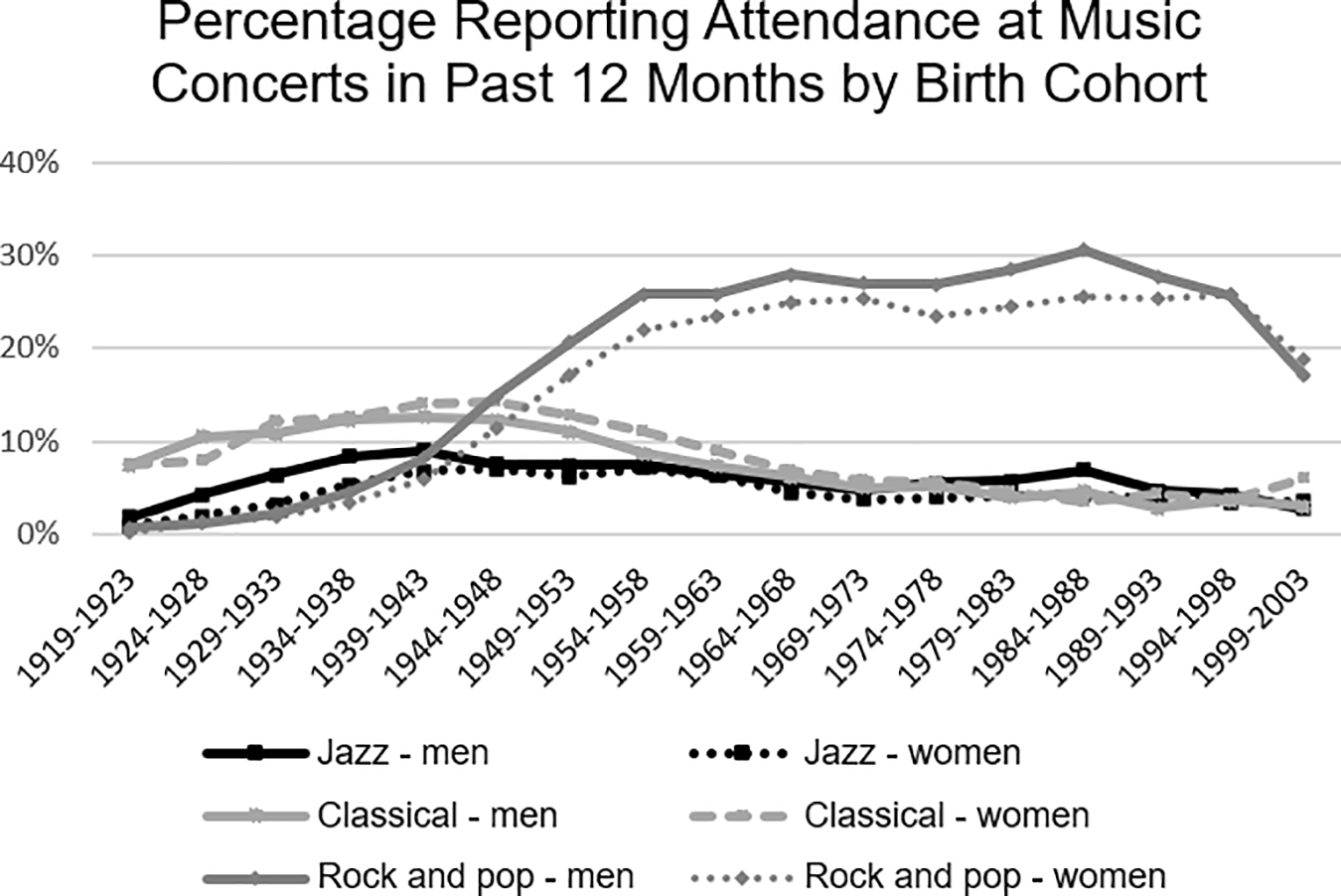
Percentage reporting attendance at music concerts in the past 12 months.
Findings are given in Figures 1 and 2 above, with the gender gaps relativised in Figure 2. Classical music attendance generally exhibits a gender gap in favour of women (women are more likely to attend than men), while jazz and rock have gender gaps in favour of men for almost all cohorts. The gap appears significantly larger for jazz than rock for older and younger birth cohorts, while that for rock is larger for middle-aged cohorts. For jazz, the gender gap is largest in favour of men for those born before the 1950s, narrowing for those born in the 1950s and early 1960s. It increases again for those born in the later 1960s and 1970s, though this may be a result of women in early middle age having less leisure time due to caring responsibilities. For the very youngest cohort, the gap appears to be in favour of women: whether this is an age or cohort effect remains to be seen in future survey waves.
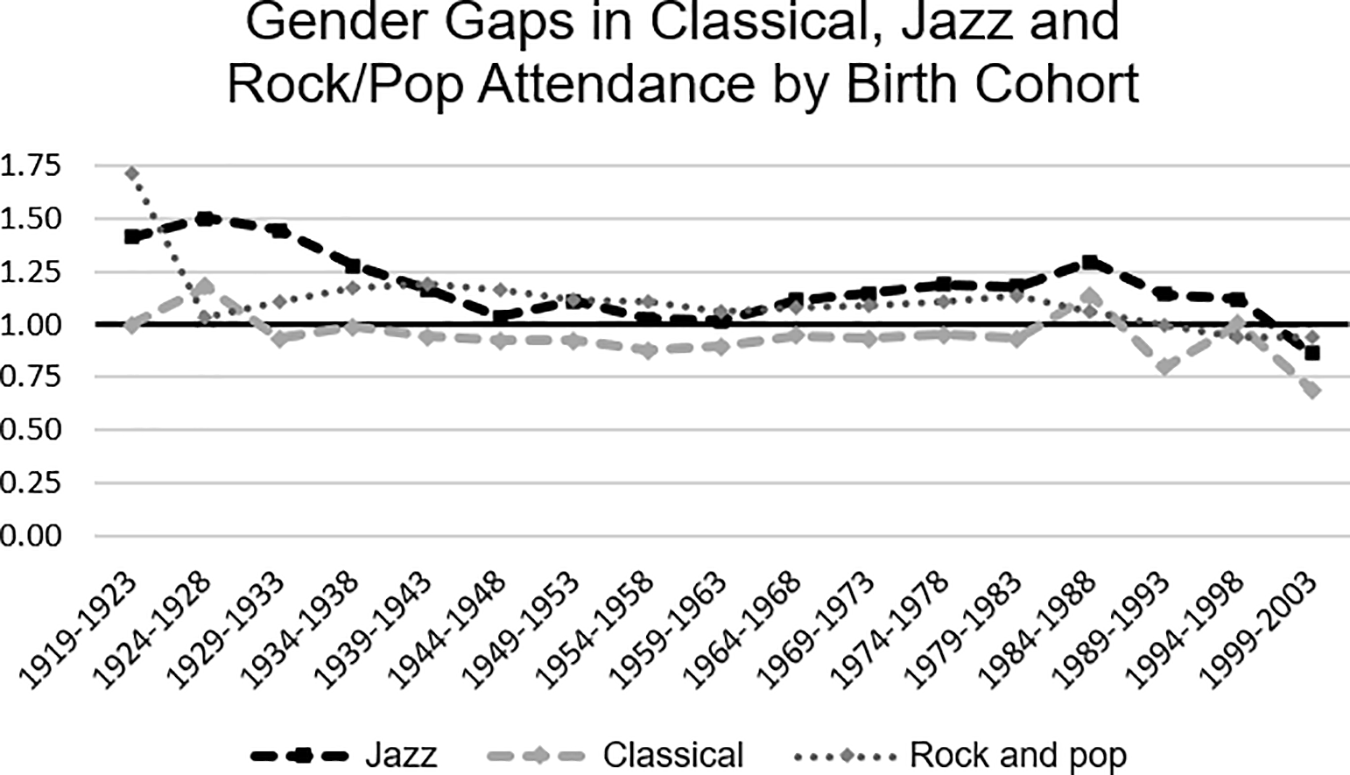
Gender gap in attendance at music concerts in the past 12 months, by genre.
For a more concrete test of the effect of gender on attendance, we ran a set of zero-inflated ordered probit (ZIOP) models, with frequency of attendance at jazz, classical and rock performances as dependent variables, gender the key explanatory variable of interest and a range of socio-demographic variables as controls. This specification was chosen because it is plausible that disengagement is generated by a different process than non-attendance is among those generally inclined to attend. In other words, the decision whether to attend or not is modelled as a binary choice via a probit model, and the decision regarding frequency of attendance via an ordered probit model. The ZIOP estimator accordingly ‘un-mixes’ zeroes generated both by non-fans as well as fans who happen not to have attended a concert within the relevant period. This approach has been widely applied since Harris and Zhao’s (2007) analysis of tobacco consumption, including in cultural economics (e.g. Borowiecki and Bakshi, 2018; also Ateca-Amestoy 2008 for zero-inflated negative binomial models of theatre attendance).
Controls were included to account for time availability (student status, retirement status, number of children), and socioeconomic resources relating to education, housing tenure (a proxy for security and wealth) and occupational status. Predictors of generalised engagement (participation in sport, religious attendance) were included to reflect tendency to be active in general. We also include Chan-Goldthorpe (2004) status scale scores created from multidimensional scaling analysis of the dissimilarity of the occupational distributions of randomly sampled respondents’ friends.
Further, we include the year of birth (linear and squared terms), whether the respondent identifies as ethnically White, religious affiliation as a proxy for cultural values (secular, Christian and other religion), whether they live in an urban area and survey wave. Status scale scores can only be calculated for the first eight waves, and rock attendance was not available on Wave 5; accordingly, we restrict analysis to Waves 1–4 and 6–8, with scaled cross-sectional weights applied, and to the same set of respondents in each model. Detailed results are tabulated in Table A3 (Supplemental Online Data Appendix). For each genre, the inflation equation is reported first, followed by the model of attendance frequency.
To aid interpretation, estimated model coefficients for gender are translated into probability values or ‘predictive margins’, holding other covariates at their means (Table 1). These demonstrate that, taking control variables into account, being female rather than male predicted a significantly lower probability of attendance at jazz and rock, and a slightly higher probability of attendance at classical concerts. In the standard ordered probit equation predicting frequency of attendance (Table A3), being female rather than male had no significant effect on jazz attendance among those judged potential participants, a large and significant positive effect on classical attendance frequency and a significant negative effect on rock attendance. However, from testing differences between the predicted probabilities for men and women at every level of attendance, statistically significant (α = 0.05) gender gaps were identified in each case other than non-attendance for rock ‘participants’.
Predicted probability of attending jazz, classical and rock concerts for female and male respondents averaging over remaining covariates. a
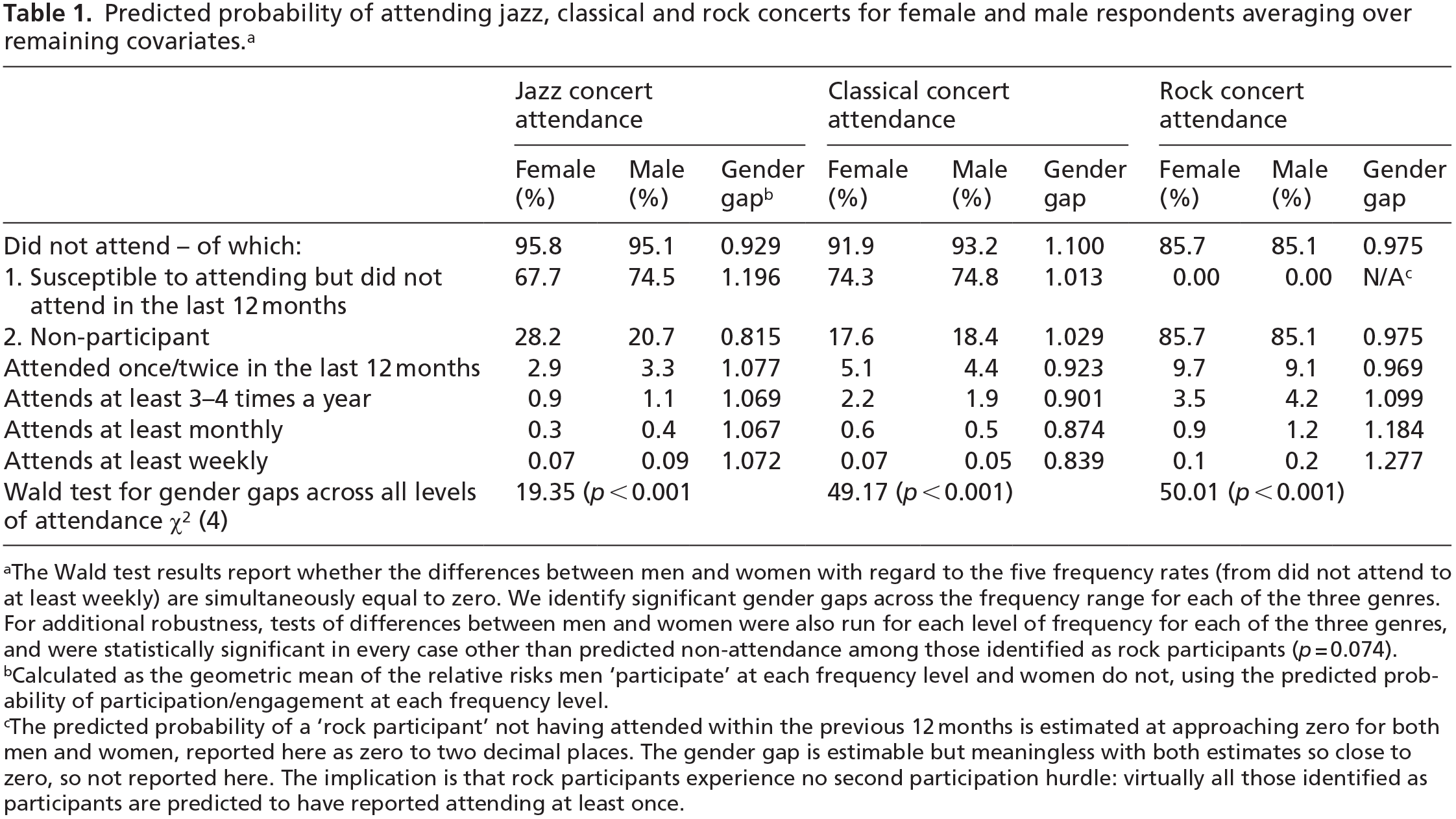
The Wald test results report whether the differences between men and women with regard to the five frequency rates (from did not attend to at least weekly) are simultaneously equal to zero. We identify significant gender gaps across the frequency range for each of the three genres. For additional robustness, tests of differences between men and women were also run for each level of frequency for each of the three genres, and were statistically significant in every case other than predicted non-attendance among those identified as rock participants (p = 0.074).
Calculated as the geometric mean of the relative risks men ‘participate’ at each frequency level and women do not, using the predicted probability of participation/engagement at each frequency level.
The predicted probability of a ‘rock participant’ not having attended within the previous 12 months is estimated at approaching zero for both men and women, reported here as zero to two decimal places. The gender gap is estimable but meaningless with both estimates so close to zero, so not reported here. The implication is that rock participants experience no second participation hurdle: virtually all those identified as participants are predicted to have reported attending at least once.
Calculation of average marginal effects for social status (see Table A4, Supplemental Online Data Appendix) also reveals it is positive and significant for every non-zero level of attendance frequency for each genre, confirming Tampubolon’s findings. Status also appears to have a larger effect for men than women for jazz (Figure 3), while it has a significantly larger effect for women than men for classical, as revealed by the composite Wald test of whether the gender gaps are jointly zero across all levels of attendance; by comparison, status has a similar effect on women and men with regard to rock attendance (Table A4, final row). It is plausible that jazz attendance generates less status for women than men, or at least that status is a less powerful motivator of attendance. These findings complement Mauri and Wolf’s (2016) analysis of intra-household bargaining among couples attending the arts in the US Current Population Survey. They found that males earning a larger share of household income, and those with relatively younger female partners, were predicted to attend opera and dance (‘female-dominated’ genres) relatively less often. More research is required to identify how status affects attendance differently by gender for the single and the partnered.
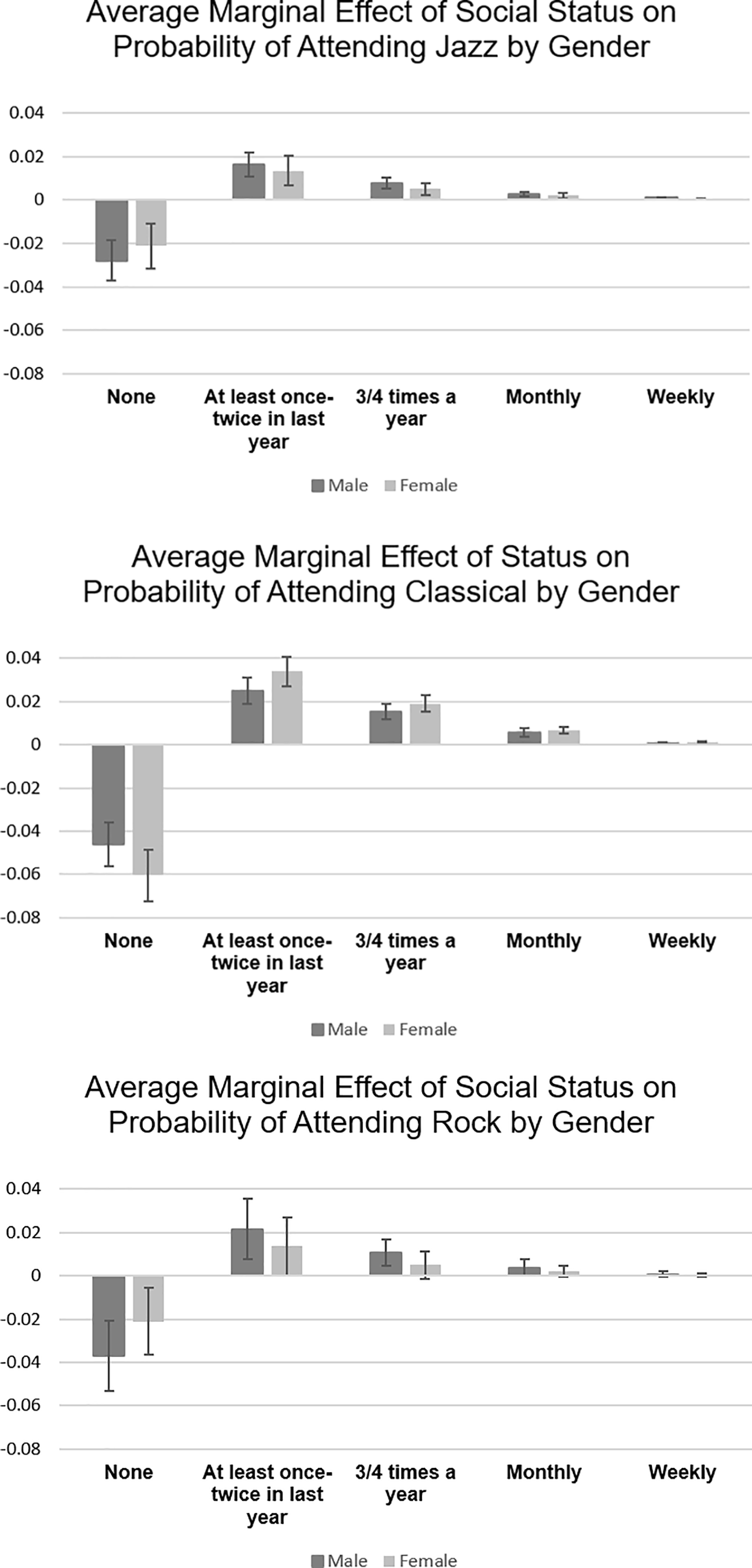
Average marginal effect of social status on probability of attending concerts by the level of frequency, gender and genre.
Gender and jazz musicians: segregation within the network?
To account for gender and production, we next build on an established body of work analysing jazz using social network analysis. Phillips (2011) modelled the number of re-recordings achieved by a set of 1752 Midwestern recordings listed in the Lord Discography: the presence of a female bandmember was significantly and positively associated with the number of ‘covers’. A total of 31 percent of the recordings in his sample featured at least one female member. Pinheiro and Dowd’s (2009) analysis of a respondent-driven survey identified that male performers (81% of their sample) tend to report higher incomes, with the difference apparently mediated by age, instrument choice and stylistic flexibility. They also found that connections matter: union members and those more strongly connected to musical friends earn relatively more (Pinheiro and Dowd, 2009: 504). Elsewhere they model social capital, operationalised as the number of local musicians known to the respondent and whether they are a union member; again, they find that female musicians do not differ significantly from men (Dowd and Pinheiro, 2013). A further body of work uses computational and automatic data extraction methods (e.g. Venturini et al., 2019), although generally lacking musician-level data providing the detail sociologist value. Vedres (2017) reports an innovative study relating the productivity of individual recordings in achieving re-releases to the prevalence of ‘forbidden triads’, namely connected triplets with two strong triads and an open dyad (p.2), theorised to form the foundations of ‘fold networks’ incubating originality. While an extremely important study, it nevertheless does not take gender into account.
To turn attention to gender, we use a unique dataset on the social networks and musical profiles of jazz musicians, using musician and jazz writer John Chilton’s (2004) acclaimed Who’s Who of British Jazz. Cultural economists and sociologists alike have increasingly turned to directories of notable figures to generate valuable datasets (O’Hagan and Hellmanzik, 2008; Reeves et al., 2017). We add a measure of recording output using data from the Lord Discography. Both sources are recognised by academic researchers (McKay, 2005; Phillips, 2011; Vedres, 2017). 3 Data were extracted manually to ensure that individual musicians sharing names could be disambiguated, and qualitative information on career and sociodemographics encoded. This yielded data on 983 musicians raised in Britain or with careers primarily based there, of whom 40 (4%) are female. Figure 3 illustrates change in the representation of female musicians by decade of birth. A similar pattern of low female representation, rising slightly for those born after 1960, was noted by McAndrew and Everett (2014) in a study of British classical composers, while almost no women featured in O’Hagan and Borowiecki’s (2010) study of 522 international composers.
Descriptive statistics are provided in Table A5 (Supplemental Online Data Appendix). More than half have led their own live bands. A majority have performed overseas. The measure of recording productivity also exhibits the skew common to artistic rewards (Rosen, 1981). Male musicians feature 54.7 (SD = 65.2) recordings on average, female musicians 29.5 (SD = 37.0). A test of the null hypothesis of equality of means was rejected at the 1 percent level of significance – t(981) = 2.430, p < 0.001. About 60 percent of the female musicians offer voice as an instrument compared with 17 percent of male musicians. Setting voice aside, female musicians offer an additional 1.3 instruments on average, male musicians 2.0 – t(981) = 4.009, p < 0.001.
Chilton’s Who’s Who also includes a wealth of data on musicians’ musical relationships: familial, educational, through friendship and professional collaborations. We find that 971 musicians form a single major component; 12 are isolates. Figure 5 illustrates the full network recorded in Chilton’s Who’s Who, including the pop, rock, folk and other artists to which the 983 were connected via freelance and other work, sized by betweenness centrality. The community in the upper right was associated with dance band music of the first half of the century, with band leader Bert Ambrose the most central. Over time, the community became stylistically differentiated, illustrated by the partial separateness of the cluster on the left. Figure 6 illustrates the distribution of female musicians within the network of 983 musicians achieving their own entry in Chilton’s Who’s Who, sized by their number of recordings. We see very few women in the ‘dance band’ cluster, with the women who achieve an entry primarily distributed in the other two clusters.
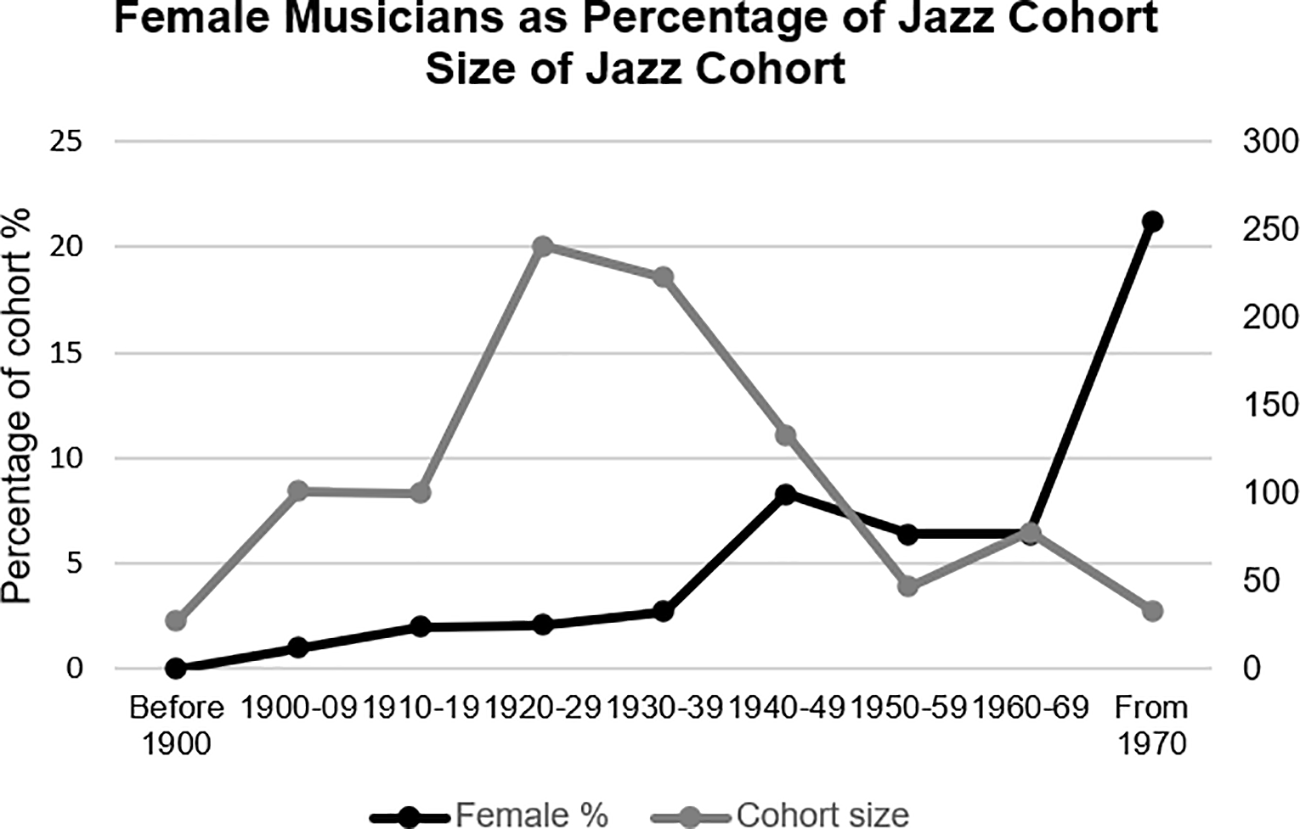
Female musicians as percentage of birth cohort.
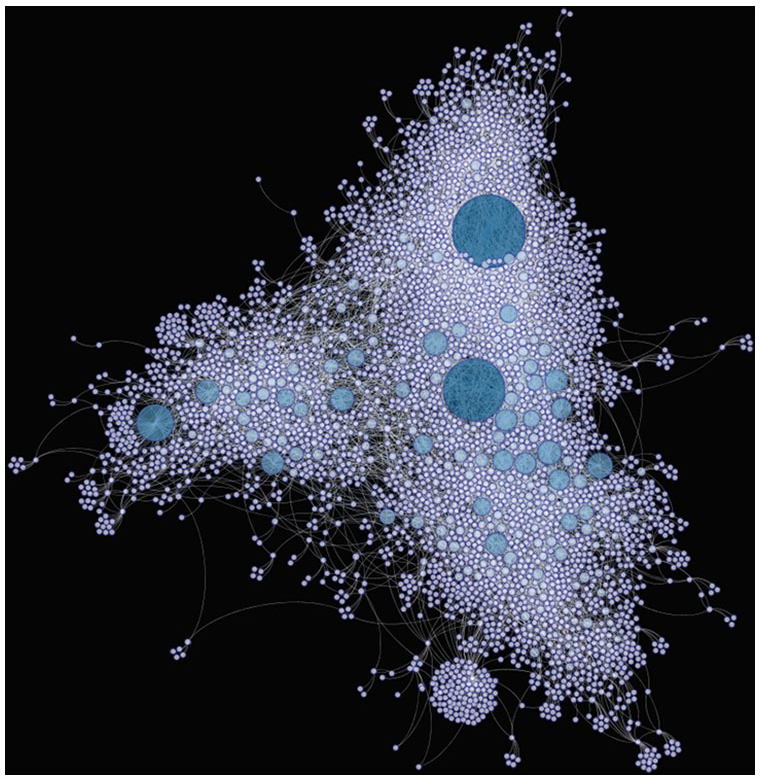
Main component of Chilton sample in network context (N = 3558). Nodes sized by betweenness centrality, positioned using ForceAtlas2 (continuous graph layout algorithm in Gephi).
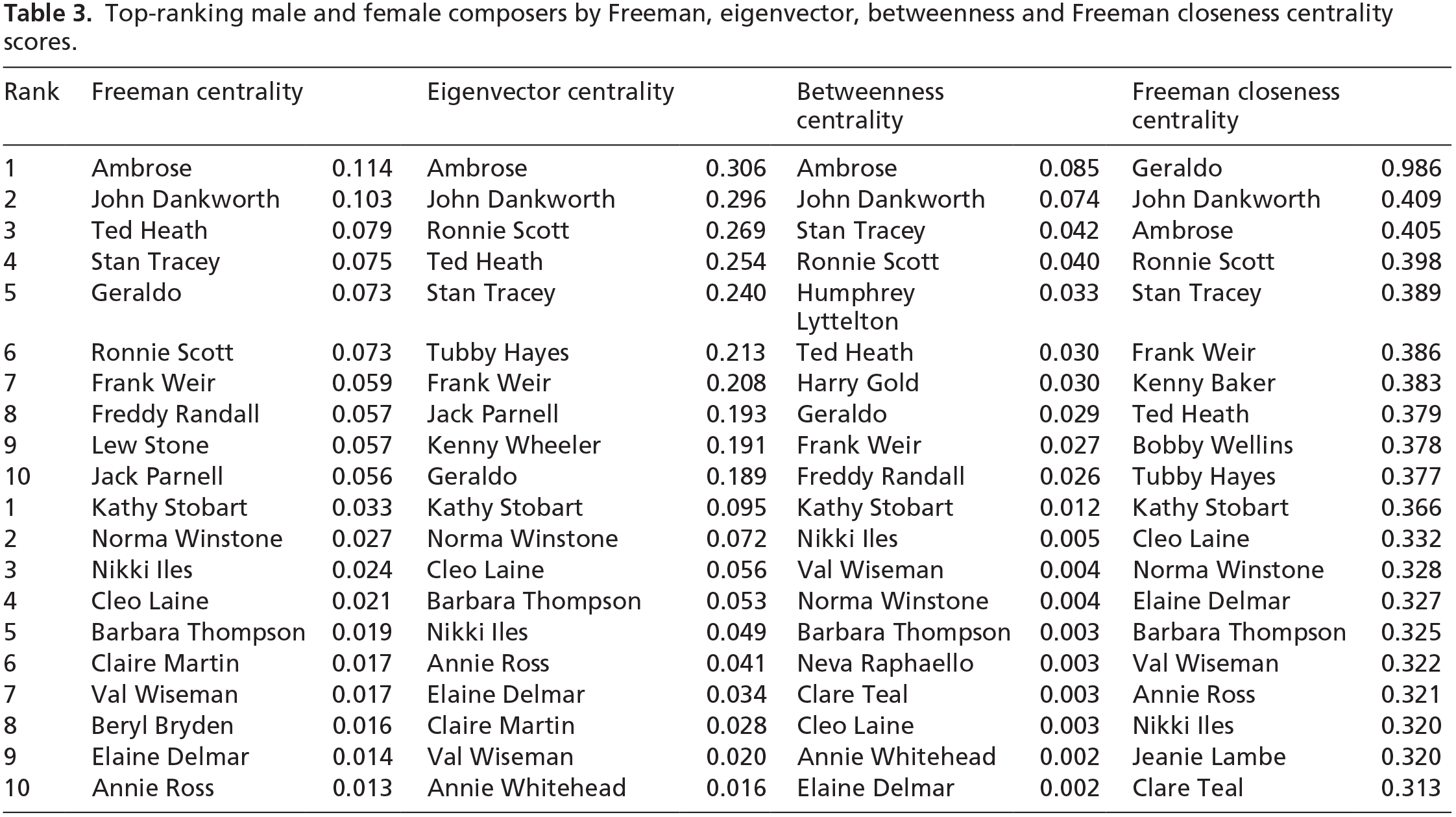
We next examine how centrality varies between male and female musicians, via t tests with significance based upon a permutation test to take account of network structure (Table 2). Female musicians do not differ from male musicians in their degree centrality, or betweenness centrality. They do feature significantly lower centrality in terms of eigenvector centrality (connectedness to highly connected alters) and closeness centrality (thought to capture the ability to mobilise a network; see Prell, 2011: 107). Table 3 provides illustrative examples with the top 10 most central female and male musicians ranked by centrality score. For each of the four measures, the top-ranked woman (saxophonist Kathy Stobart, 1925–2014) features considerably lower centrality than the 10th-ranked man. Stobart’s scores would equate her with the 48th-ranked man in terms of Freeman centrality, just above the 43rd-ranked man for eigenvector centrality, the 41st-ranked man for betweenness centrality and the 21st-ranked man for Freeman closeness centrality.
Centrality scores for male and female jazz musicians in the Chilton sample.
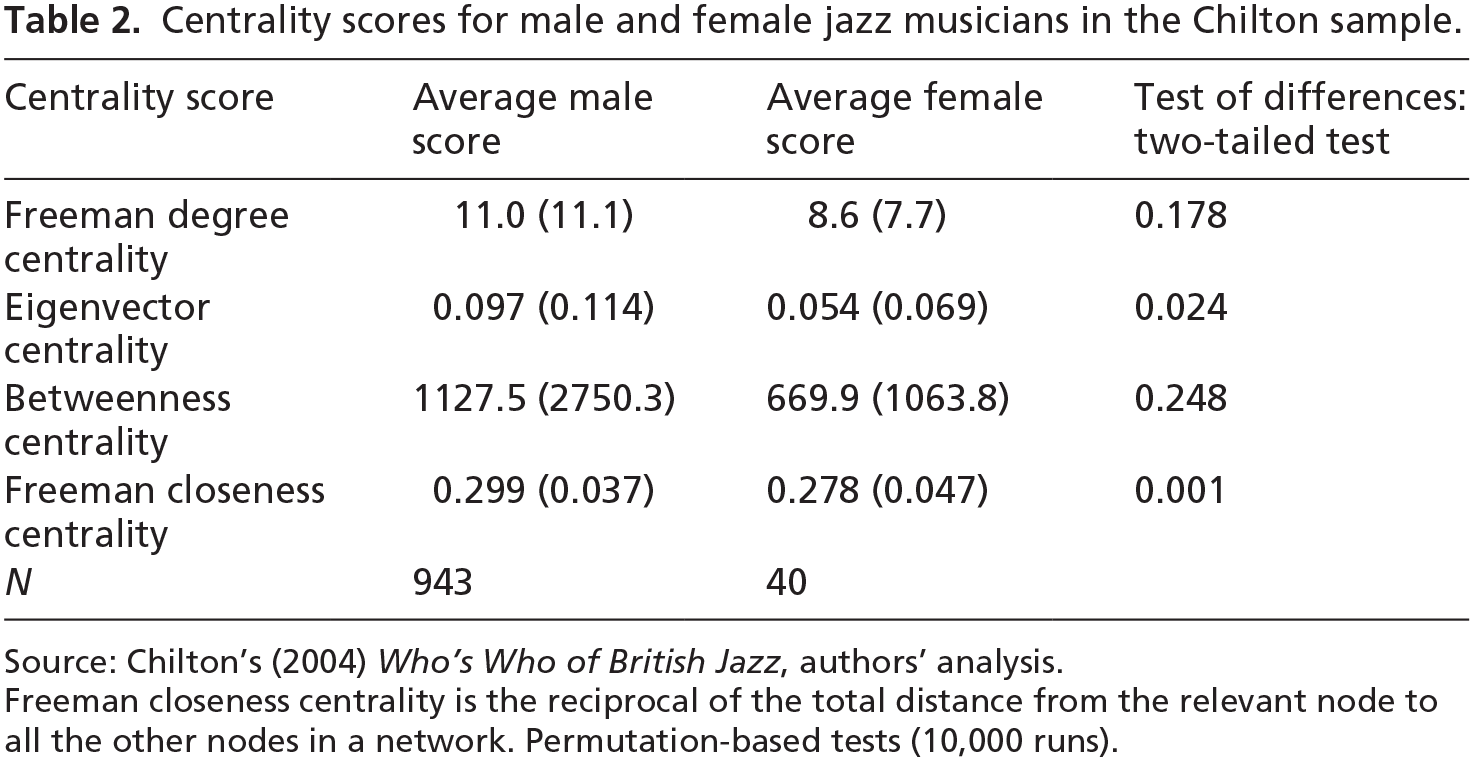
Source: Chilton’s (2004) Who’s Who of British Jazz, authors’ analysis.
Freeman closeness centrality is the reciprocal of the total distance from the relevant node to all the other nodes in a network. Permutation-based tests (10,000 runs).
Top-ranking male and female composers by Freeman, eigenvector, betweenness and Freeman closeness centrality scores.
We also tested whether tendency to homophily varied between male and female musicians (Table 4). The first column indicates that female musicians have significantly lower homophily in terms of percentage of same-gender ties. The second column reports the E-I index, namely the number of ties external to the group (in this case, gender) minus the number of ties internal to the group divided by the total number of ties. This can range from −1 (perfect homophily) to 1 (perfect heterophily) and here indicates that on average a high level of homophily holds among male musicians, while heterophily holds among female musicians. This, however, could be accounted for by female musicians having a much smaller pool from which to make connections with others of the same gender. Yule’s Q adjusts for group size; results reported here in the third column nevertheless reiterate that male musicians exhibit homophily, and female musicians heterophily. It is plausible that male musicians tend to have higher status, and status (rather than gender) attracts connections, although other mechanisms are possible. A further perspective is given by the network of female–female connections in Figure 7: while there is an identifiable set of connections between musicians such as Ivy Benson, Annie Whitehead and high-profile vocalists including Cleo Laine, and another around Nikki Iles and Tina May, it is sparse by comparison with the male–male network (not shown).
Homophily among male and female jazz musicians in the Chilton sample.
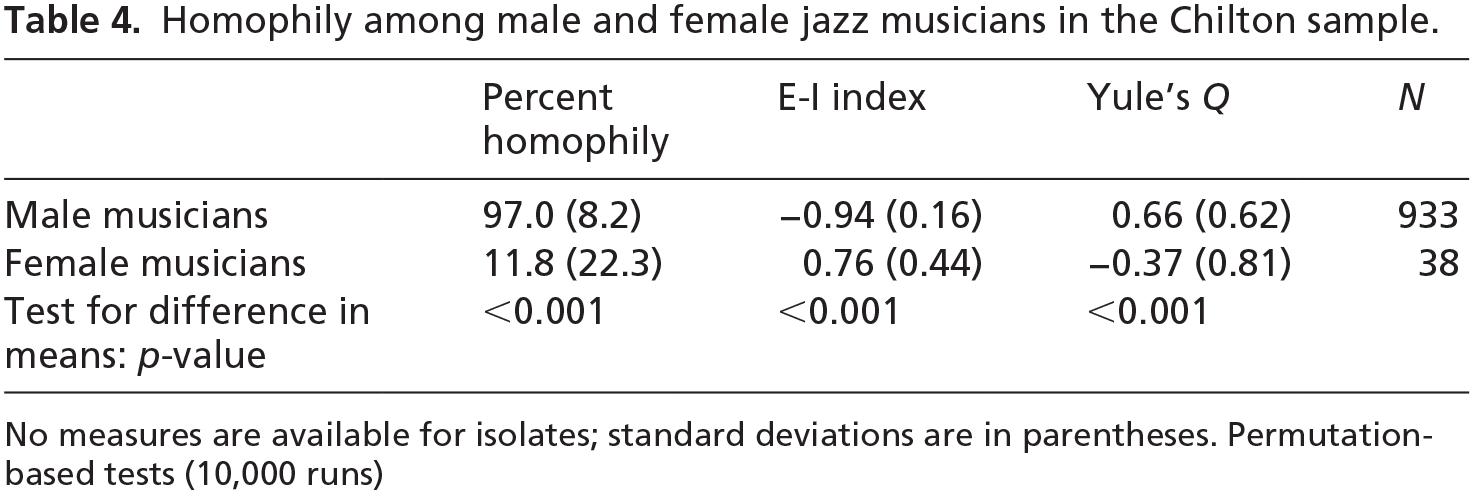
No measures are available for isolates; standard deviations are in parentheses. Permutation-based tests (10,000 runs)
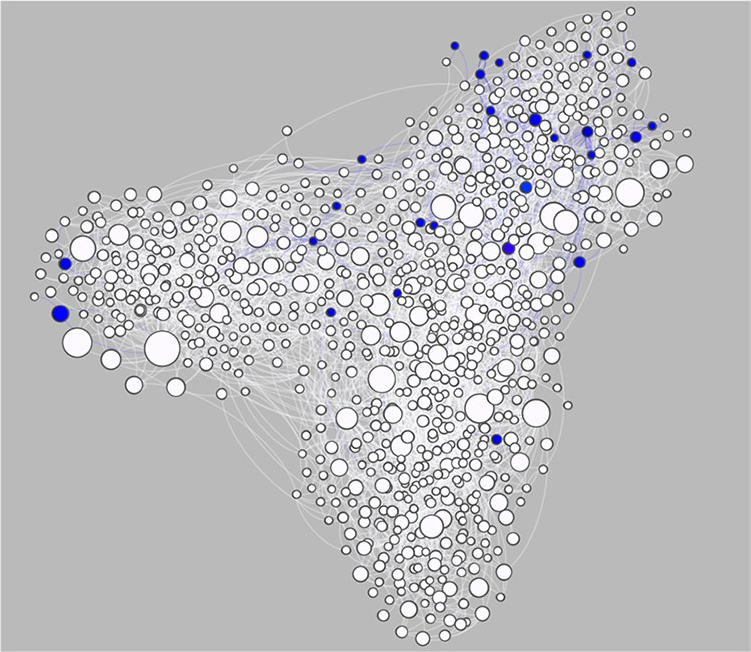
Main component of Chilton sample. Nodes sized by the number of recordings, coloured by gender.
For a more robust test, we ran a series of logistic regression quadratic assignment procedures to model tie formation. The quadratic assignment procedure provides a permutation-based non-parametric test of dependence between square matrix variables of the same size (Dekker et al., 2007). Our key explanatory variables of interest are gender homophily, a measure of whether the career spans of our musicians overlapped or not, by assuming that their professional lives began at 15 (at which point the vast majority are learning jazz or already gigging), and ended at 80 unless we identified an earlier death date. Since individual biographies provide evidence of performing well past normal retirement ages, this generous span seemed reasonable. It also remains possible for musicians to have a personal relationship through family or other ties even if their career spans did not overlap, and so we included career non-overlap as a predictor rather than removing structural zeroes from the analysis. We also took account of absolute difference in birth year, and instrument choice via matrices indicating whether dyad members differed in being vocalists, and the sum of instruments played. This latter was chosen over similarity or difference in number played because while it is plausible that multi-instrumentalists prefer to work together, what matters for a duo or ensemble is complementarity rather than similarity. Results are reported in Table 5. Since the dependent variable is binary, we bear in mind that coefficients should not be compared across models.
LRQAP model of tie formation within the Chilton sample.
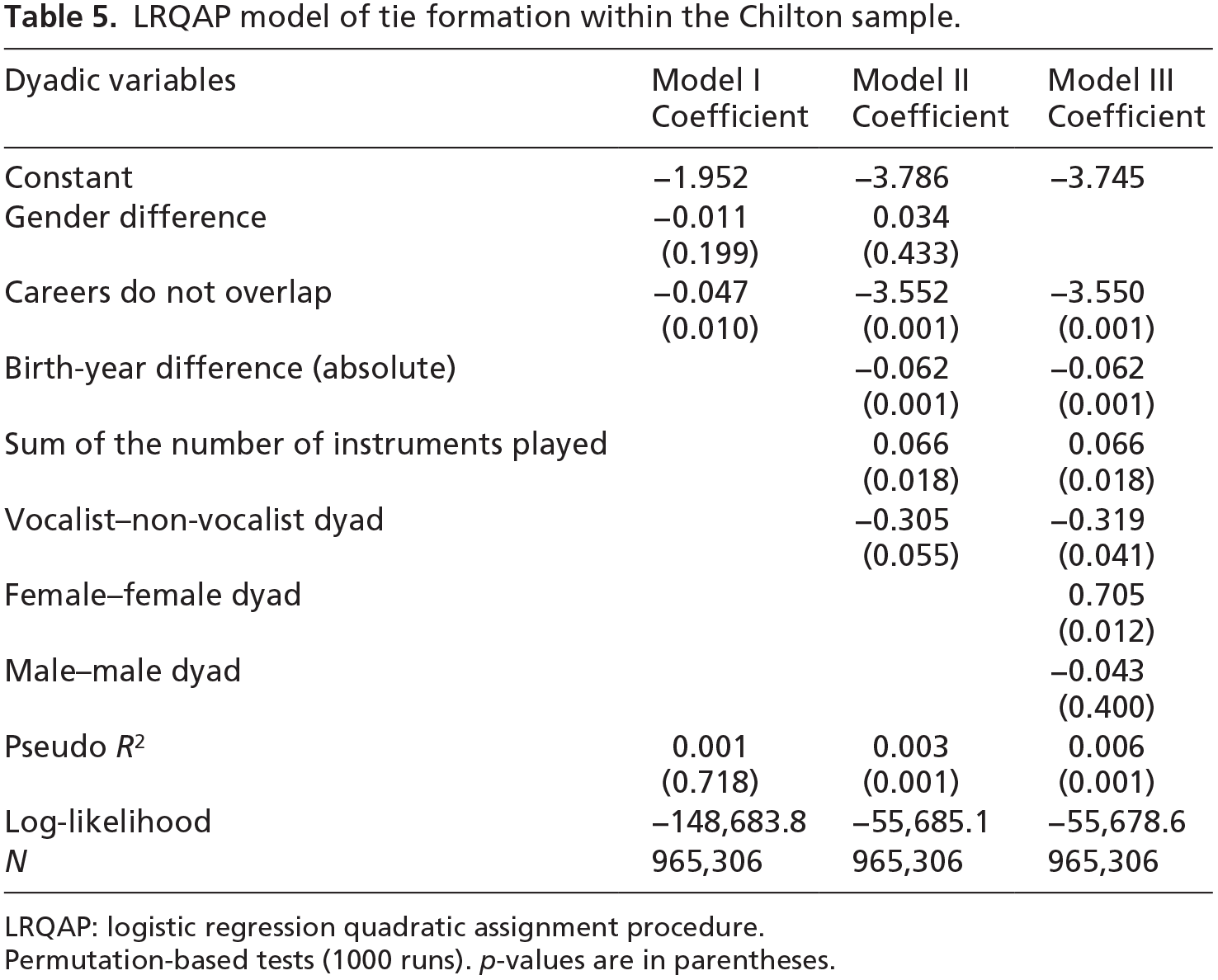
LRQAP: logistic regression quadratic assignment procedure.
Permutation-based tests (1000 runs). p-values are in parentheses.
In each model, the term for non-overlapping careers naturally has significant negative effects. In the second and third models, so does the difference in birth years: those from more distant musical generations are less likely to feature a tie. Where two members jointly play more instruments, a tie is more likely. Controlling for other variables, dyads featuring just one vocalist are less likely to feature a tie than those which feature none (or, less often, two vocalists). The first two models suggest that gender-heterophilous ties are not significantly more or less likely than homophilous ties. The final model distinguishes between male homophily and female homophily: here, female–female dyads are significantly more likely to feature a tie, while male–male dyads are no more likely to feature a tie than heterophilous dyads.
These findings add nuance to Tables 3 and 4. Once we take account of instrument choice, difference in birth year and career non-overlap, female–female dyads as presented in Figure 7 are more likely to exhibit a tie than female–male dyads, suggesting that the female heterophily we observe in Table 3 is induced rather than chosen. They also suggest lower instrumental versatility may limit ties.
The case of Kathy Stobart is illustrative. She began her career as a saxophonist in 1939 in an all-female band, forced by the Blitz to stop touring a year later. At that point, she joined a ballroom orchestra in Newcastle. Her obituarist describes how she had no awareness of jazz at all until she met the noted saxophonists Keith Bird and Derek Neville, who were then stationed at a local RAF camp. They bought her ‘10 jazz records for my 17th birthday’, and Bird painstakingly took her through various harmonic exercises and saw to it that she succeeded him when he vacated a quartet job in Ealing in London in late 1942. (Vacher, 2014: online)
Although she withdrew from a serious gigging schedule after her three sons were born, her musician husband was to die prematurely due to the stresses of the lifestyle, when she was only 44 years. To keep earning, she joined Humphrey Lyttelton permanently, working with him until she retired in 2004, and was also a gifted teacher and role model to female musicians. By contrast, a large proportion of the female sample began their careers after the heyday of jazz as a source of employment. They either could not or were very unlikely to have been able to meet highly central figures such as bandleaders Ambrose (d.1971) and Geraldo (d.1974). Indeed, a significantly higher proportion of women than men in the dataset do not overlap with other musicians (p = 0.001). They entered as jazz was becoming a smaller community, less purely commercial and its training more formalised.
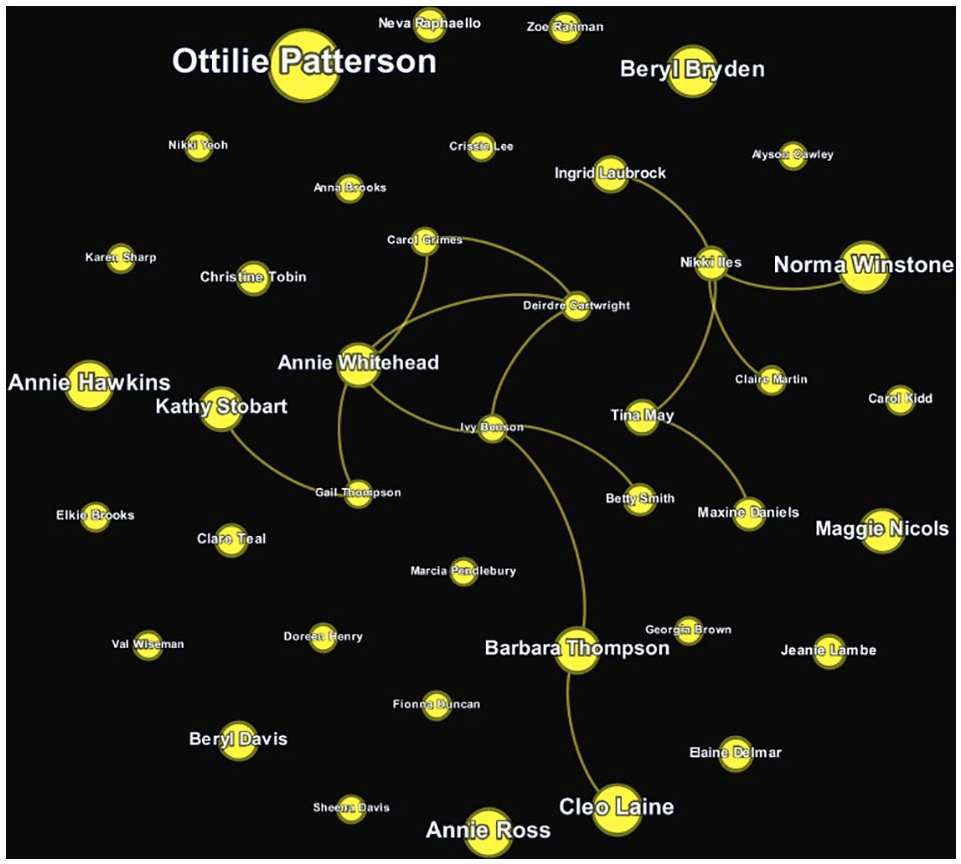
Ties between female musicians achieving entries in Chilton (2004). Nodes sized by the number of recordings.
Gender and jazz production: recording productivity
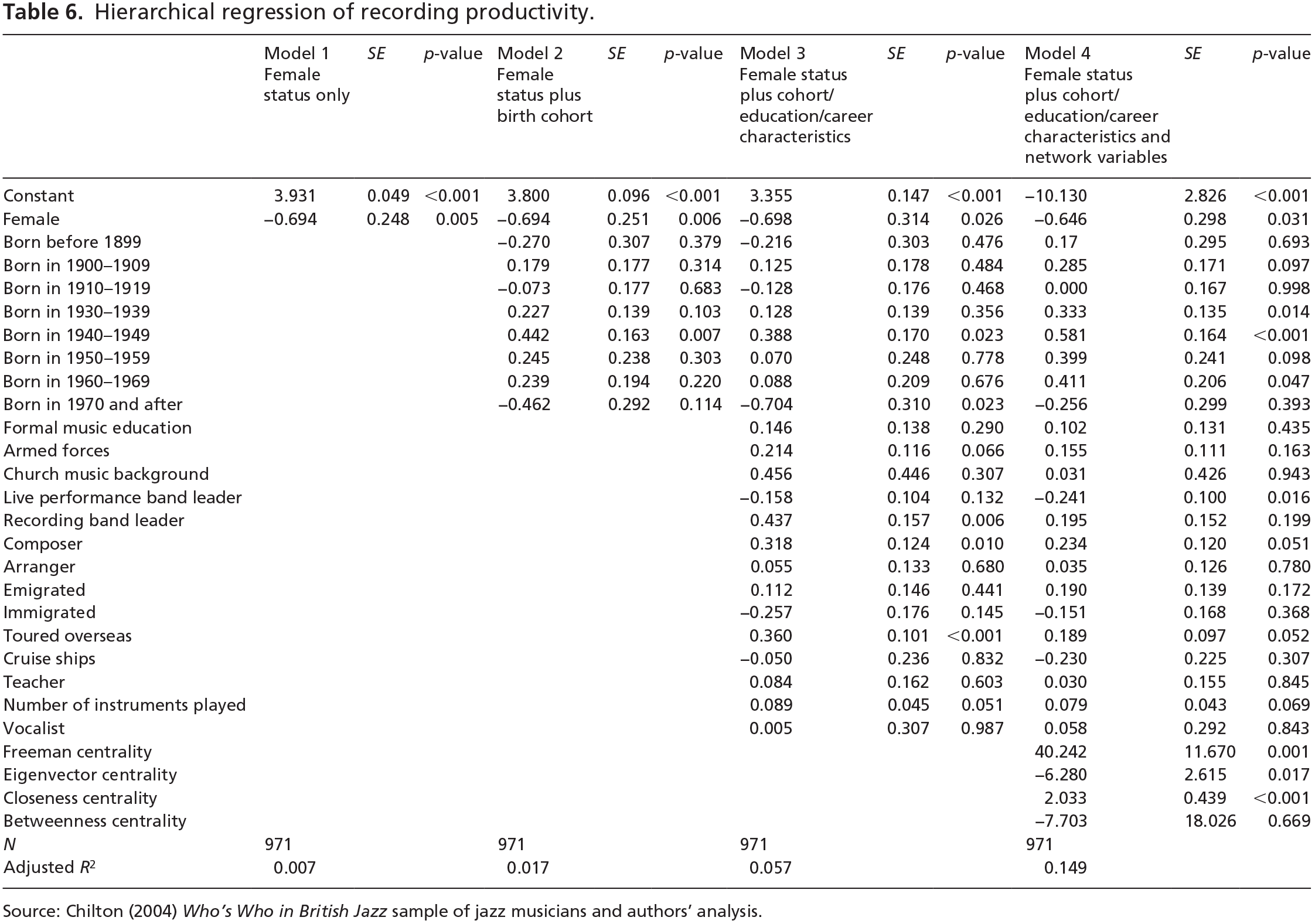
We then assessed gender gaps in recording as a measure of career impact. Using biographical data in Chilton’s Who’s Who, we modelled recording output in terms of birth cohort, education and musical and career characteristics. We also examined the association between network position and recording output using Freeman, eigenvector, closeness and betweenness centrality measures. They are the four most commonly used, with each ‘represent[ing] a different process by which key players might influence the flow of information through a social network’ (Valente et al., 2008: 19). While there are moderate-to-strong correlations between the measures (ranging from r = 0.477 to 0.855), we nevertheless include them separately due to their capturing distinct, although conceptually related, phenomena (Valente et al., 2008: 22).
We ran a series of hierarchical linear regressions on the same set of musicians (N = 971) to examine whether the gender gap appears to be mediated by the social and musical environments in which musicians develop and enter the profession (proxied by birth cohort); career characteristics; and network centrality. To take account of skew in the number of recordings, as well as the non-trivial number who did not record, we use the inverse hyperbolic sine (IHS) transformation.
We found as summarised in Table 6. In the base model, featuring only a constant and term for female status, the coefficient for ‘female’ is −0.694. This remains of similar magnitude even after terms for birth cohort are entered in the second model, suggesting they do not mediate the gap. It also remains essentially stable when terms for musical background and career type are entered in the third model. It does decrease slightly in the fourth once centrality terms are added, suggesting that some of the difference lies in women’s different network position. However, the decrease is comparatively small, even taking into account the variable transformation. We conclude that the gender gap lies as much in disadvantage due to being female, rather than characteristics into which women are more likely to select, such as instrument choice. Admittedly, the women who are represented in the Chilton directory have already cleared a hurdle to be recognised as notable musicians, increasing the risk of endogenous selection bias. Nevertheless, these findings should motivate further studies with this and other datasets into gender and other inequalities in creative work.
Hierarchical regression of recording productivity.
Source: Chilton (2004) Who’s Who in British Jazz sample of jazz musicians and authors’ analysis.
The following additional caveats apply. First, it is possible the Chilton and Lord sources are incomplete or biased in coverage. However, these sources are the best-available data on notable professional jazz musicians in Britain. It is plausible that our explanatory variables were captured more unevenly, depending on Chilton’s acquaintance with the musicians, their representation in Melody Maker, and availability of other sources. Where we are not given information on educational background, service in the forces and so on, musicians are coded as zero rather than missing, with coefficients accordingly likely biased towards zero.
We also acknowledge that the number of recordings is an imperfect measure of career output: it does not take into account record sales, or other forms of success, such as income or non-pecuniary recognition including peer esteem. ‘Success’ is multidimensional and subjective. Nevertheless, the number of recordings does capture an observable form of musical output relating to how far they were in demand by recording companies and/or bandleaders.
The network could also be criticised as partial by definition, excluding important non-musicians: agents, publishers, promoters, record company executives and so on. Even so, our questions of interest can be at least partly answered with the data at hand. A feasible extension could involve additional focus on venues and bands, modelling networks as bipartite or tripartite, to provide further perspectives on gender differences. Explicit focus on the growing importance of formal music education and declining importance of military bands in accessing and sustaining professional careers would also provide further insight into the changing opportunity structure for female musicians, following Borowiecki’s (2019) notable work using US census data.
Conclusion
In its earliest years, jazz was dominated by male musicians, admitting a small minority of women (primarily vocalists) and largely performed in male spaces. Over recent decades, as the genre gathered prestige, female musicians continued to be disadvantaged. We examined gender differences in jazz as manifested in both consumption and production. We found a large gap between men and women in reporting any level of attendance, larger with regard to non-engagement than that for rock. Among the notable musicians recorded by Chilton, women form a clear minority. The vast majority of ties pertaining to male musicians are gender-homophilous, while female musicians overwhelmingly feature heterophilous ties. Multiple regression analysis suggests that this is largely a function of later female entry to the network, but that merely pushes the explanandum back one step. The evidence for women having lower recording productivity regardless of their birth cohort, educational background and instrumental choice is also strong.
The qualitative literature suggests that women are perceived as lacking legitimacy and credibility as musicians within a historically male genre, identified strongly with a male canon and ‘male’ instrument choices and performance practices. Results from our models of recording output suggest that the negative association between female status and recording output is overwhelmingly direct rather than mediated by differential characteristics.
Our analysis is also informed by cultural studies’ prioritisation of diverse methodological and conceptual tools. Cultural studies are characterised by concern with substantive questions within a carefully conceptualised problematic, rather than methodologically driven. Our empirical approach shares cultural studies’ concern with cultural logics and with the particular, and data for what they tell us about the genres themselves as well as their social bases. Our model specifications also speak to cultural studies’ concern with the complexity of cultural inequalities. While gender gaps are found for each of the three genres examined here, the direction, size and location of the gaps vary across each. Equally, in its attention to concert attendance rather than reported tastes, and performance and professional work, the article makes a case for reprioritising attention to active behaviour and practice alongside attention to meaning-making and the experiential.
Implications are twofold, relating to symbolic recognition, and more wholesale change. Extension to this work should prioritise understanding of legitimacy, and the institutional and structural changes required to debias jazz in the interests of musicians, audiences and the music itself. We could point to parallel issues in rock and hip-hop, dominant at present in the commercial music world. Our analysis of Taking Part also suggests that programming biases may originate within audiences as much as communities of musicians and the industry more broadly: audiences have power as consumers, and tend to know what they want. The challenge for a more progressive jazz world is for those with more agency, whether consumers or producers, to change what they want.
Supplemental Material
sj-docx-1-ecs-10.1177_13675494211006091 – Supplemental material for ‘The man that got away’: Gender inequalities in the consumption and production of jazz
Supplemental material, sj-docx-1-ecs-10.1177_13675494211006091 for ‘The man that got away’: Gender inequalities in the consumption and production of jazz by Ana Alacovska, Dave O’Brien, Siobhan McAndrew and Paul Widdop in European Journal of Cultural Studies
Footnotes
Acknowledgements
The authors gratefully acknowledge the comments and insights of Orian Brook, Nick Crossley, Bonnie Erickson, Jan Fuhse, Monika Herzig, Pete Jones, Adrian Leguina, Dave O’Brien, Susan O’Shea, Michael Rushton, Mark Taylor, participants at the International Network for Social Network Analysis annual conference, Hamburg; the Social Spaces of Music conference, University of Manchester; the Workshop in Cultural Affairs, Center for Cultural Affairs, O’Neill School of Public and Environmental Affairs, Indiana University; and unnamed reviewers. They also pay tribute to the late John Chilton (1932-2016) for his remarkable work in compiling the career histories analysed here.
Funding
The author(s) disclosed receipt of the following financial support for the research, authorship, and/or publication of this article: Data collection for this article was funded by ‘Music Communities’, AH/J006807/1, an Arts and Humanities Research Council project funded under the Research Councils UK cross-council ‘Connected Communities’ programme. The article was completed while the corresponding author was in receipt of a University of Bristol Institute for Advanced Studies University Research Fellowship. Datasets for this article are available on request from the corresponding author.
Supplemental material
Supplemental material for this article is available online.

Notes
Biographical notes
References
Supplementary Material
Please find the following supplemental material available below.
For Open Access articles published under a Creative Commons License, all supplemental material carries the same license as the article it is associated with.
For non-Open Access articles published, all supplemental material carries a non-exclusive license, and permission requests for re-use of supplemental material or any part of supplemental material shall be sent directly to the copyright owner as specified in the copyright notice associated with the article.
