




Abstract
Are higher status cultural tastes in the modern United States better described as being inclusive and broad or exclusive and narrow? We construct an original dataset in response to conflicting answers to this question. We fill a major gap in the literature on cultural tastes by simultaneously considering taste for both musical genres and artists within genres. By examining the compositional balance of respondents’ taste portfolios, we reconcile seemingly incommensurate theoretical frameworks of class homology and omnivorousness. The results indicate that an omnivorous disposition to music is a relatively middle-status position in the social structure. In contrast, positions characterized by higher levels of cultural capital map onto exclusive and narrower tastes for consecrated culture.
Introduction
Cultural tastes are frequently of interest given their relationship to inequality (Bourdieu, 1984; Lamont and Fournier, 1992), and genres – and musical genres in particular – are perhaps the most commonly studied topic of cultural tastes (e.g. Bryson, 1996; Vlegels and Lievens, 2017).
Genres are central to the study of cultural tastes because they serve as primary sorting mechanisms both for producers (e.g. Alacovska, 2017; Negus, 1998) and consumers (e.g. Harrington and Bielby, 1995; Radway, 1984); genres are promissory notes from the former to the latter as objects travel across the cultural circuit (Du Gay et al., 1996).
For the past half-century, two of the leading theories in the study of cultural taste have been Bourdieu’s (1984) ‘homology’ between elite tastes and statuses and Peterson’s (1992) ‘omnivore’ hypothesis of a flattening in taste hierarchies. Both of these theories have leaned quite heavily on the analyses of tastes for genres, with the latter doing so in particular. Although not necessarily oppositional, these theories of taste portfolios have not been tested on equal footing within a common framework. In this article we do so, while also synthesizing them. Doing so, we believe, is important, not only because it may bring two theories which have at times been pitted against each other into conversation, but also because it may provide a better window into current configurations through which class-based cultural practices operate within a field to support, reproduce and justify broader power relations.
To examine theories of class homology and omnivorousness we rely on original survey data of US respondents. In what follows, we first summarize two distinct but sometimes overlapping literatures on social class and cultural tastes. We then discuss several limitations in these literatures and align these limitations with motivating hypotheses for our research. Most centrally, while music is largely defined through genres and it is those genres which may set any potential listeners’ ‘horizons of expectations’ (Jauss, 1982) for what is to be consumed, in our survey we lean on the fact that power relations are embedded in social relations not only across genres but also within genres. After description of our survey and methods, we present our results. In brief, in considering both genres and artists within genres, we find evidence of omnivorous taste profiles, albeit not in the social location argued by Peterson and others. Instead, in the modern United States, those of high cultural status exhibit snobbish preferences for cultural forms that are highly consecrated, whereas omnivorousness is a relatively middle-status position. In addition to the substantive findings of this work, in the ‘Discussion and conclusion’ section we outline the additional contributions, while also discussing limitations and ideas for future research.
Cultural taste: distinction and omnivorousness
Bourdieu’s (1984) now classical understanding of class and taste centers around a ‘homology’. In concrete terms, an individual’s structural position in the social hierarchy is mirrored by their taste preferences in the hierarchy of symbolic goods (Bourdieu, 1984: 232). For Bourdieu, tastes (and distastes) are formed through early childhood socialization, interaction with cultural and educational institutions, and class identity in adulthood. Tastes, in this theory, effectively act like ‘elective affinities’ (Bourdieu, 1984: 241), where the suitability of people with their tastes seem natural (Lizardo and Skiles, 2015). Fundamentally, in Bourdieu’s framework classed tastes have a strong tendency to diverge and therefore to be exclusionary.
Methodologically, Bourdieu primarily relied on correspondence analysis to both test and illustrate homology. Bourdieu’s analysis mapped the social space – which described the distribution of respondents’ economic capital (primarily income) and cultural capital (primarily educational attainment and class origin) – and then, separately, the space of lifestyles – which described how certain tastes clustered and were also distant from other tastes. Bourdieu demonstrated that the social space and the space of lifestyles mapped onto one another fairly closely, suggesting that tastes and class positions mutually structure one another. He found that the volume of economic and cultural capital, and the relative amounts of economic versus cultural capital, are associated with specific taste profiles. Generally, people with high volume of capitals have tastes for the most critically respected, or consecrated, cultural forms, and this is especially so for those with high cultural capital relative to economic capital.
Bourdieu’s homology argument has been subjected to various critiques and elaborations. For example, Bennett et al. (2009) analyze UK data within a Bourdieusian framework and find that ethnicity, age and gender also structure taste profiles. Perhaps the most salient critique of Bourdieu’s model has been that the argument relies on conceptualizations of class and taste that are specific to the 1960s and 1970s French cultural milieu that emphasized legitimacy and hierarchy (Lamont, 1992). Others suggest that, post-1970s, the values that underlie exclusionary and hierarchical tastes have been superseded by values that support inclusivity, diversity and cosmopolitanism (Ollivier et al., 2009; Peterson, 2005). In other words, the nature of the connection between class and taste reflects broader societal values and historically rooted – but also changing – cultural classification regimes (DiMaggio, 1987).
Peterson’s studies of US survey data from the 1980s and 1990s on musical tastes garnered a great deal of attention when they produced results that appeared to contradict the homology perspective. Specifically, Peterson found that people of high status did not have tastes that sharply diverged from the tastes of people of low status (Peterson and Simkus, 1992). Instead, people of high status had tastes that spanned what he termed both traditionally ‘highbrow’ and ‘lowbrow’ musical genres, and had preferences for more genres of music than low-status individuals who liked a narrower range of them. Peterson labeled these high-status individuals of wide-ranging tastes ‘omnivores’, which formed the foundation of a new literature that has since elaborated on Peterson’s original finding.
Over the past two decades, the omnivorous pattern of cultural preferences and consumption has been found in various data, spanning different countries (e.g. Chan and Goldthorpe, 2007; Katz-Gerro, 2002; Rankin and Ergin, 2017) and cultural domains (e.g. Berghman and van Eijck, 2009; Smith Maguire, 2018; Warde and Gayo-Cal, 2009). Allowing for some important variations, the core of the concept of omnivorousness has enjoyed empirical replication many times over, where education, income and/or occupational prestige associates with breadth and composition of cultural tastes. In sum, data from the 1980s onward tend to find that high-status individuals consume omnivorously, rather than holding a preference only for more consecrated culture. Ostensibly, these findings lend credence to the idea that Peterson’s observations were correct for the contemporary era and that Bourdieu’s homology argument may have been a product of its time and place.
Moreover, omnivorousness – as a more democratic and less snobbish mode of high-status cultural consumption – implies that our understanding of the relationship between tastes and status needed modification. Specifically, the overlap in cultural tastes across levels of income, occupation and/or (especially) education suggest that tastes and cultural practices are not straightforwardly exclusionary, but rather they are much more subtly implicated in social stratification (Erickson, 2008). In Peterson’s (2005) interpretation of omnivorousness, high-status people have broad tastes that cross traditional genre boundaries as a signal of high status and cultural capital.
Limitations to the study of omnivorous tastes
While there are a range of critiques of the omnivore finding (see Brisson, 2019 for a recent example) we focus on three: (1) problematic measurement of the status, prestige or legitimacy of cultural objects, (2) inconsistency in the conceptualization of omnivorousness and (3) questionable assumptions about the generalizability of genre preferences in music for cultural tastes, even within the domain of music.
With respect to the first obstacle, inherent to the question of studying classed tastes is differentiating legitimate (in Bourdieu’s terms) or more prestigious or high-status (in Peterson’s terms) cultural objects from illegitimate or lowbrow cultural objects. By cultural objects we mean anything that individuals can interpret as conveying meaning and can therefore prefer, consume, receive or otherwise act on (Griswold, 1987). As Karademir-Hazir and Warde (2015) note, some past research has relied on taken-for-granted understandings of the highbrow/lowbrow divide in order to differentiate cultural objects (e.g. Chan and Goldthorpe, 2007; Lizardo and Skiles, 2009; Ollivier et al., 2009). The risks of using a cultural hierarchy based on common knowledge is that knowledge can be outdated without the researcher being aware of it, and it necessarily imposes a univocal, provisional assessment (van Rees et al., 1999). Moreover, Katz-Gerro (2002) shows that definitions of ‘highbrow’ culture and its relationship to social stratification differ by national case. In recognition of this risk, the majority of past research has leveraged information about the distribution of socioeconomic status of individuals in order to construct a status hierarchy of cultural objects (Robette and Roueff, 2014).
These methods have the virtue of being objective and rooted in relevant data. Their shortcoming is that they rely on an endogenous measure of cultural hierarchy. They identify high-status cultural objects as those primarily preferred or consumed by high-status people, and low-status cultural objects as those that are primarily preferred or consumed by low-status people. This approach makes sense if as an a priori assumption one believes that taste-based positional and dispositional homologies exist between individuals and objects, but this assumption is not falsifiable. As Robette and Roueff (2014) note, to date no study has employed an exogenous scale of cultural legitimacy that is not also vulnerable to the critique of being the researchers’ subjective assessment. Such a measure is required to move the literature forward.
The second major obstacle in the study of omnivorous tastes has been the lack of consensus on how to conceptualize and operationalize definitions. Peterson’s initial finding was that individuals with high occupational prestige consume more musical genres than those with low occupational prestige, and they consume genres that cross the traditional highbrow/lowbrow divide. There are multiple ways to measure the crossing of this divide. For example, in Peterson and Kern (1996), highbrow respondents are defined as highbrow by liking both classical music and opera and by choosing one of them as their favorite genre of music, and omnivorousness is measured as the number of lowbrow and middlebrow genres liked. They showed in this study that highbrow individuals – who have higher levels of income and education – were becoming increasingly omnivorous. Peterson’s early studies also found that high-status individuals liked a greater number of genres than did low-status individuals. These can be considered a volume measure of omnivorousness which uses raw count data for liking across genres (Purhonen et al., 2010; Warde et al., 2007, 2008). The problem with a reliance on measurement of volume alone, however, is that it risks losing the conceptual link to omnivorousness as an inclusionary cultural consumption pattern that embraces tastes across status divides.
In contrast to volume measures, alternative approaches to defining omnivorousness use a composition framework, in which genres are binned into ‘brows’ and omnivorousness is defined as the liking of genres across those brows (Purhonen et al., 2010; Warde and Gayo-Cal, 2009; Warde et al., 2008). Yet in a composition framework there is no consensus on how much cross-brow appreciation is necessary for omnivorousness. Much like volume, however, the measure of composition in omnivorousness should not be abandoned, as the identification of transcending status boundaries is the core distinguishing feature of omnivorousness, and what allows the homology hypothesis to be measured on equal footing with the omnivore hypothesis. Unlike volume, however, operationalizing a reliable composition measure requires overcoming the first hurdle of defining the brow status or level of artistic consecration of genres objectively and exogenously.
The third obstacle to the advancement of the study of omnivorous tastes has been an assumption that the liking and disliking of music genres generalizes out to cultural tastes more broadly, and even within the domain of taste in music. The vast majority of research has relied on surveys which include measures of genre preferences (e.g. classical, pop, country) but do not have finer grained measurements of artists and artworks within genres. Some scholars of taste have raised questions about the inferences we can draw from the measurement of genre preferences (Bennett et al., 2009: 77–78; Hanquinet, 2018; Holt, 1998; Johnston and Baumann, 2007). While there is no doubt validity to the assertion that some genres are more high status or legitimate than others, it is also apparent that there is wide variation in the degree to which cultural objects within genres are consecrated. Because there is both between-genre and within-genre variation in consecration levels, measures of genres consumed or preferred may be imprecise, or masking status distinctions in musical tastes that occur within genres rather than only across genres.
Regarding this third limitation, by way of example, when a respondent says she likes rap music (an ostensibly less-consecrated genre), the researcher does not know if by ‘rap music’ she means she enjoys listening to Insane Clown Posse (a distinctly unconsecrated rap group) or enjoys listening to Kendrick Lamar (a Pulitzer Prize and Grammy winning rap artist), nor which artists are in the respondent’s head when cued on ‘rap music’ (see also Vlegels and Lievens (2017) on this point). As a result, a high-status individual might have a taste profile where she prefers only consecrated cultural objects across a variety of traditionally consecrated and unconsecrated cultural genres. When only looking at genre preferences, such an individual would appear to be omnivorous, but might not in fact have tastes that overlap with individuals of lower social status, who might consume from some of the same genres but only the unconsecrated artists within those genres. The degree to which this is the case is simply unknown.
Bourdieu’s (1984) work and a few other studies (Bennett et al., 2009; Flemmen et al., 2018; Le Roux et al., 2008; Prieur et al., 2008; Savage and Gayo, 2011; Warde and Gayo-Cal, 2009) have employed survey data at the level of the cultural object (artists, artworks and individual practices). These follow-up studies to Bourdieu all confirm the homology thesis. However, none of these studies set out to test whether omnivorousness among high-status individuals extends across both genres of different levels of consecration and artists within those genres, also at different levels of consecration. To do so would require data expressly designed for this purpose.
Hypotheses
Our hypotheses are designed to separately test for omnivorousness as volume and composition (Peterson, 2005). The volume measure counts the total number of genres liked. For composition measures, the question is if respondents with higher levels of cultural capital prefer consecrated over unconsecrated culture – as would be predicted by Bourdieu – or if they have a ‘balanced portfolio’ of omnivorous liking across levels of artistic consecration (Warde and Gayo-Cal, 2009: 124). Our first two hypotheses are concerned with both of these measurements of omnivorousness at the level of musical genres. Based on the bulk of work following in the Petersonian and Bourdieusian traditions, we focus on education level and early childhood arts exposure as the most likely predictors of boundaries in cultural tastes:
H1A – Genre volume: The number of genres liked increases as education and childhood arts exposure increase.
H1B – Genre composition: Education and childhood arts exposure associate with having a more balanced portfolio of liking across consecrated and less consecrated genres.
Our second set of hypotheses mirrors our first, with the dependent variables now concerning artists rather than genres. We do so because while genres are consecrated at different levels, artists within those genres are also consecrated at different levels. Quantitative work on omnivorousness in musical tastes has focused almost exclusively on the level of genres rather than artists not because the former is a better or more valid measure, but because those data have been publicly available from Peterson’s (1992) intervention onward.
As findings on omnivorousness in the liking of music genres are interpreted to be evidence of a more general disposition and not just something special about music genres, we would predict that sociodemographic associations on our measures of genres should be mirrored in our measures of artists in our second set of hypotheses:
H2A – Artist volume: The number of artists liked increases as education and childhood arts exposure increase.
H2B – Artist composition: Education and childhood arts exposure associate with having a more balanced portfolio of liking across highly consecrated and less consecrated artists.
We use Figure 1 to illustrate the distinctions in our first two sets of hypotheses. In Figure 1 there are four genres, labeled Genre A through Genre D. These genres are arrayed on the y-axis by their level of consecration. Yet in this example within each genre there are also three artists – in Genre A, artists A1 through A3, and so on – which are differentially consecrated within their genres. To the left of Figure 1 we also include the proposals of our first four hypotheses.
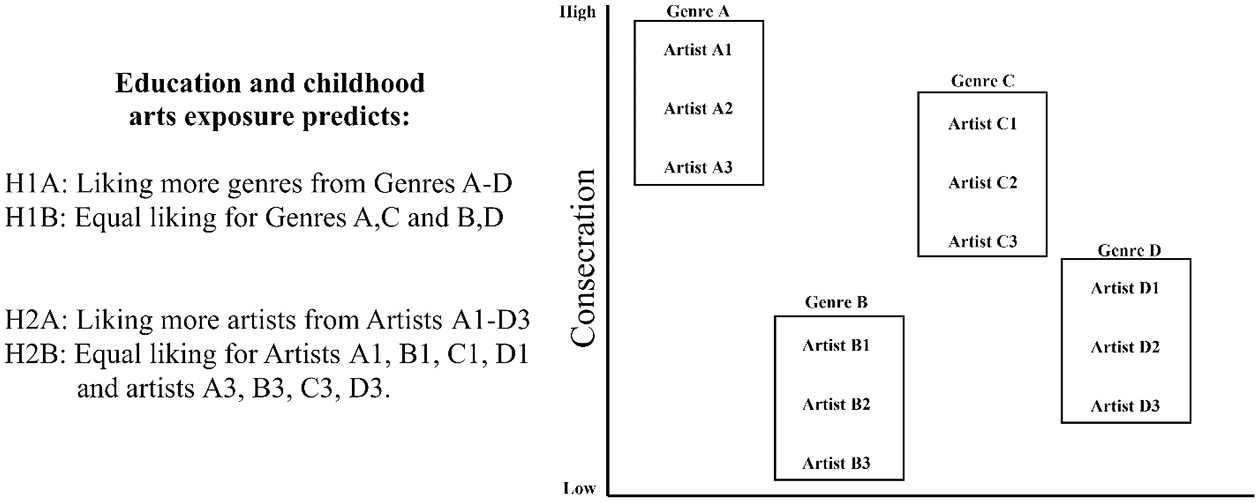
A graphical illustration of hypotheses.
So far, our hypotheses predict that for both volume and composition measures of omnivorousness, the liking patterns for artists should mirror the liking patterns for genres. Using Figure 1, however, we can illustrate alternative scenarios. For instance, a music listener may only like consecrated artists within consecrated genres, such that she likes Genre A and Genre C and Artists A1 and C1 within those genres, but dislikes Artist A3 and Artist C3 within those genres, in addition to all other artists and genres. In this scenario our music listener would be considered a ‘true snob’. In contrast, a ‘true omnivore’ would have a ‘balanced portfolio’ of liking in which they do not discriminate in their appreciations between genres like Genre A or B, or artists like A1 or B3. This ‘true omnivore’ is culturally open and expresses her status through not making consecration distinctions in her liking patterns. Yet alternatively, a respondent could be omnivorous with regard to genres, but elitist with regard to artists within those genres, such that she has equal appreciation for Genres A through D, but only likes Artists A1 through D1 within those genres, or vice versa in which she is a snob about genres but not about artists in those genres. This type of person, whose tastes express ‘democracy’ with regard to one level of culture but ‘distinction’ with regard to another (Johnston and Baumann, 2007), would be both a snob and an omnivore. She would, in effect, be expressing her status in both a Petersonian and a Bourdieusian way. She would be a ‘snobivore’.
By bringing together Petersonian and Bourdieusian conceptions of high status tastes and synthesizing them into a common framework that allows for variation in compositional balance at both the levels of genres and artists, it is possible to imagine how different taste portfolios may occupy distinct locations within the social space. As such, we advance a third and final hypothesis addressing the relative location of individuals with omnivorous, balanced portfolios within a space characterized by variation in accumulated cultural capital:
H3 – Location of omnivores within the social space: Omnivores (as defined as those with a balanced portfolio of liking across more and less consecrated genres and artists) will have completed less education and have lower childhood arts exposure than snobs (as defined as those with a preference for consecrated artists and genres).
Although not formally part of H3, as a validation check we also test if, for our key predictors, ‘snobivores’ fall between omnivores and snobs.
Data and methods
Case selection
As noted above, most studies of classed tastes rely on either researchers’ ‘common sense’ definition of hierarchies in cultural objects or impute the statuses of objects from the statuses of those who like them, a definition that presupposes class homologies. To overcome this problem, before running our survey we sought multiple exogenous consecration measures of both musical genres and artists. 1 As explicated by Bourdieu (1993; see also Dowd et al., 2021), artistic recognition may be bestowed by three different external groups: critics, creative peers and the general audience. In selecting cases of more or less consecrated culture, we made pains to triangulate cases across all three of these exogenous sources. For general audience perception, we pretested survey items on Amazon Mechanical Turk (M-Turk), with our final case selection again also validated through additional exogenous measures.
M-Turk is an online platform in which workers sign up to complete small-scale tasks for pay. Although the workers on M-Turk are not a randomly selected group, there is research to show that M-Turk data is comparable in quality to other commonly used social science data sources (see Gaddis, 2017a, 2017b). While our M-Turk respondents were somewhat younger (particularly in the 30–39 years category), more educated (higher proportion of college graduates) and had lower household incomes than the overall US population (albeit not out of line with their ages and education levels), our pretest samples nonetheless provided us with a good distribution across categories of gender, age, education and income. Furthermore, for several reasons our questions about perceptions of cultural consecration are not vulnerable to systematic bias that can be related to the ways in which M-Turk workers might not be representative of the general population.
First, while the Survey of Public Participation in the Arts (SPPA) asks how much individuals like to listen to a range of genres, in our pretest surveys, for 20 musical genres we asked 500 respondents on M-Turk, regardless of their personal tastes, on a seven-point scale, how generally ‘artistically respected’ they thought these musical genres are, while also allowing for being unfamiliar with the genre or declining to state an answer. This question, rather than a question of personal preferences, relies on third-order inference for artistic consecration and is therefore a better measure of status distinctions between items (Ridgeway and Correll, 2006; Correll et al., 2017). Second, while there is debate about the degree to which everyday individuals can identify status distinctions in more rarefied elite culture (see Friedman and Reeves, 2020), by staying within the range of commonly recognized and more broadly popular culture we can sidestep these concerns. Third, regarding popular music, recent research confirms our approach and finds that despite differences in tastes, individuals can differentiate between their own likes and dislikes for music and what is generally artistically consecrated music, and that there is generally high agreement on where musicians fall within a perceived cultural hierarchy (van den Haak, 2020). Included genres were selected based on their frequent inclusion in surveys such as the SPPA and the General Social Survey which are typically used to create measures of omnivorousness (e.g. Bryson, 1996; Rossman and Peterson, 2015). These results are reported in Table 1.
Genre consecration.

N = 500.
Genres for which artists were selected are in boldface.
Boldfaced in Table 1 are the five genres from which we selected artists for testing: Rap/Hip-Hop; Contemporary Pop; Country/Western; Contemporary Rock; and Classic Rock. We selected these five genres both because they proved to contain a range of widely known artists across a range of artistic consecration within the genre, and because the genres themselves more or less spanned a range of artistic consecration (see also van den Haak, 2020).
To select artists, we began by relying on Metacritic.com to identify musicians and bands at least one standard deviation above (i.e. artistically consecrated by critics) or below (artistically unconsecrated) the mean for their artist career scores. We then marked the appearance of these artists across a range of best/worst artists and albums lists both by genre and by decade in music publications. From these procedures we selected 116 musicians and bands for testing against general perceptions of artistic consecration. Rather than asking about liking for artists we again asked a third-order inference question about perceptions of how ‘artistically respected’ the artists were, again with the option to mark unfamiliarity or to decline to give an answer. From these 116 artists, we then winnowed down to clear cases of three high, one medium and three low consecrated artists for each of the five genres, resulting in 35 artists in total as listed in Table 2.
Artist consecration across genres.

We validate our selection of artists in three ways. As seen in Table 3, first, for selected artists (from the full population of pretested artists) we calculate within genre Z-scores on audience perceptions. Second and third, for each artist we calculated the total number of Grammy nominations and wins (peer recognition), as well as the number of albums which appear on Rolling Stone’s 2009 updated 500 Greatest Albums of All Time list (Schmutz, 2005), as well as the 500 best reviewed albums in Rolling Stone as listed on the website Albumoftheyear.org (critical recognition).
External artist consecration measures by level of consecration.

Survey
Through a Qualtrics Data Panel, we ran our survey with 1821 adult US respondents that mirrored population parameters along lines of age, education, gender and race. Our volume and composition-dependent variables are constructed from data on respondents’ liking/disliking of 20 genres and 35 artists within five of those genres. Our volume measures (H1A; H2A) are count variables of how many genres/artists a respondent liked ‘somewhat’, ‘mostly’ or ‘very much’. 2 Our composition measures (H1B; H2B) are three-category variables distinguishing between (1) a preference for less consecrated genres or artists, (2) an omnivorous ‘balanced portfolio’ of liking across levels of artistic consecration (Warde and Gayo-Cal, 2009: 124) and (3) a preference for more consecrated genres or artists. For genres, these variables are the number of consecrated genres liked (out of five) subtracted by the number of unconsecrated genres liked (again out of five), whereas for artists the number of unconsecrated artists liked (out of 15) was subtracted from the number of consecrated artists liked (again out of 15). This resulted in genre-liking scores ranging from −5 to 5 and artist-liking scores ranging from −15 to 15, where negative values represent an overall preference for less consecrated genres or artists and positive values reveal an overall preference for more consecrated genres or artists. 3 To construct the final composition measures, genre values from −5 to −2 were coded as unconsecrated, values from –1 to 1 were coded as omnivorous (or balanced), and values from 2 to 5 were coded as consecrated. The artist composition measure was constructed identically, but with values from −15 to −3 representing unconsecrated, −2 to 2 representing omnivorous (or balanced) and values 3 to 15 representing consecrated. 4
As based on the literature, as independent variables we focus on respondents’ education level and degree of self-reported childhood arts exposure, both measured on seven-point scales. To better isolate the potential effects of childhood arts exposure, we control for parental education levels. So that genre-level preferences are measured independently from artist-level preferences, in our genre models we control for the number of artists liked, and in our artist models we control for the number of genres liked. In all models we control for age, gender, income, race and urban/suburban/rural residency. While we do not discuss statistically significant controls in our results section as they are beyond the scope of this article, we highlight them as areas for future research in the discussion. Descriptive statistics are given in the appendix.
Models
H1A and H2A concern the volume of genres and artists liked, respectively. Because both dependent variables and the model residuals are normally distributed, we estimate ordinary least square (OLS) models, regressing the numbers of genres and artists liked on our key predictors and controls. In contrast, H1B and H2B rely on categorical outcomes of the composition of genres and artists and are modeled using multinomial logistic regression. We use individuals with a ‘balanced portfolio’ of omnivorous tastes as the reference category; thus, the coefficients for ‘consecrated’ and ‘unconsecrated’ preferences are in comparison to compositional omnivores.
As a final step, we extend our analysis to get a sense of where an omnivorous taste portfolio may be situated in a space defined by differences in accumulated cultural capital. We do so by comparing the average level of education and childhood arts exposure of respondents with different compositional balance in their tastes for more or less consecrated genres and artists.
Results
Volume measures of omnivorousness for genres and artists
Table 4 reports findings from the OLS models on genre volume (H1A) and artist volume (H2A). Model 1, which employs the traditional volume measure of number of genres liked as a measure of omnivorousness, supports the general association found in prior research between education and omnivorousness. As shown by the significant and positive relationship between education and the number of musical genres liked, with each unit increase in respondents’ degree attainment their number of genres liked increases by 0.268. Similarly, childhood exposure to the arts significantly and positively associates with the total number of genres liked. Between respondents with the lowest and highest scores on this seven-point scale, we can expect to find an average difference of 3.108 genres liked. H1A is therefore supported.
OLS regression results for H1A (genre volume) and H2A (artist volume).

OLS: ordinary least squares.
Reference category = urban.
reference category = White.
Standard errors in parentheses; two-tailed tests.
p ⩽ .05.
p ⩽ .01.
p ⩽ .001.
While Model 1 offers support for the relationship between cultural capital and breadth of cultural consumption at the base of the omnivore argument, we would expect this association to extend beyond musical genres and also hold for the liking of musical artists. To examine this, Model 2 replicates Model 1, but with the volume of artists liked by respondents as the outcome. Unlike for genres, for artists education is negatively associated with liking more artists; with each unit increase in educational attainment the volume of artists liked decreases by 0.329. In turn, childhood arts exposure drops out and is insignificant for the volume of artists liked. Whereas H1A is supported, H2A is clearly not supported. In the case of artists, the findings suggest the opposite of what the omnivore hypothesis predicts.
To further examine this relationship, in our next set of models we focus on composition measures of omnivorousness, which begin to unravel which artists are the ones causing those with higher levels of cultural capital to be less omnivorous when using a volume measure.
Composition measures of omnivorousness for genres and artists
To investigate the composition of genres (H1B) and artists (H2B) liked, in Table 5 we rely on multinomial logistic models. For each independent variable in the genre composition (Model 1) and artist composition (Model 2) models, Table 5 reports respondents’ relative log odds of falling in the ‘unconsecrated’ or ‘consecrated’ category as compared to the ‘omnivore’ reference group.
Multinomial logistic regression results for H1B (genre composition) and H2B (artist composition) – omnivores as reference group.

Reference group for multinomial logistic model = omnivores.
Reference category = urban.
Reference category = White.
Standard errors in parentheses; reported in log odds; two-tailed tests.
p ⩽ .05.
p ⩽ .01.
p ⩽ .001.
As highlighted by Model 1, when measured as composition, education does not significantly impact the relative log odds of falling in the unconsecrated group relative to the omnivore group, but significantly associates with a preference for consecrated genres over an omnivorous ‘balanced portfolio’. Each level of educational attainment increases the relative log odds of preferring more consecrated genres as compared to being omnivorous (b = 0.133). Childhood arts exposure operates similarly to education, associating with an unbalanced portfolio of liking toward consecrated musical genres (b = 0.157). As such, H1B is not supported. These findings depart from much of the prior literature on omnivorousness. We return to this unexpected discrepancy below.
Turning to the artist composition model presented in Model 2 of Table 5, we see some similar relationships to those found in the genre composition model regarding a preference for consecrated artists over a more omnivorous disposition. Higher levels of education significantly increase the relative log odds of preferring more consecrated artists (b = 0.136), as does childhood arts exposure (b = 0.147). H2B is not supported – high education and childhood arts exposure associate with narrowly consecrated tastes in the composition of artists, rather than with a balanced portfolio.
Figure 2 translates relative log odds into probabilities in order to better understand the magnitude of the effects of our focal variables for genres and artists. Someone with low levels of cultural capital (a high-school graduate with no childhood arts exposure) has only a 0.1 probability of having a preference for consecrated genres; while someone with high levels of cultural capital (a graduate degree and frequent childhood arts exposure) has a 0.34 probability. The same pattern is visible in terms of cultural capital and artist composition. Indeed, a person with high levels of cultural capital is more likely than not to prefer more consecrated artists (p = 0.6).
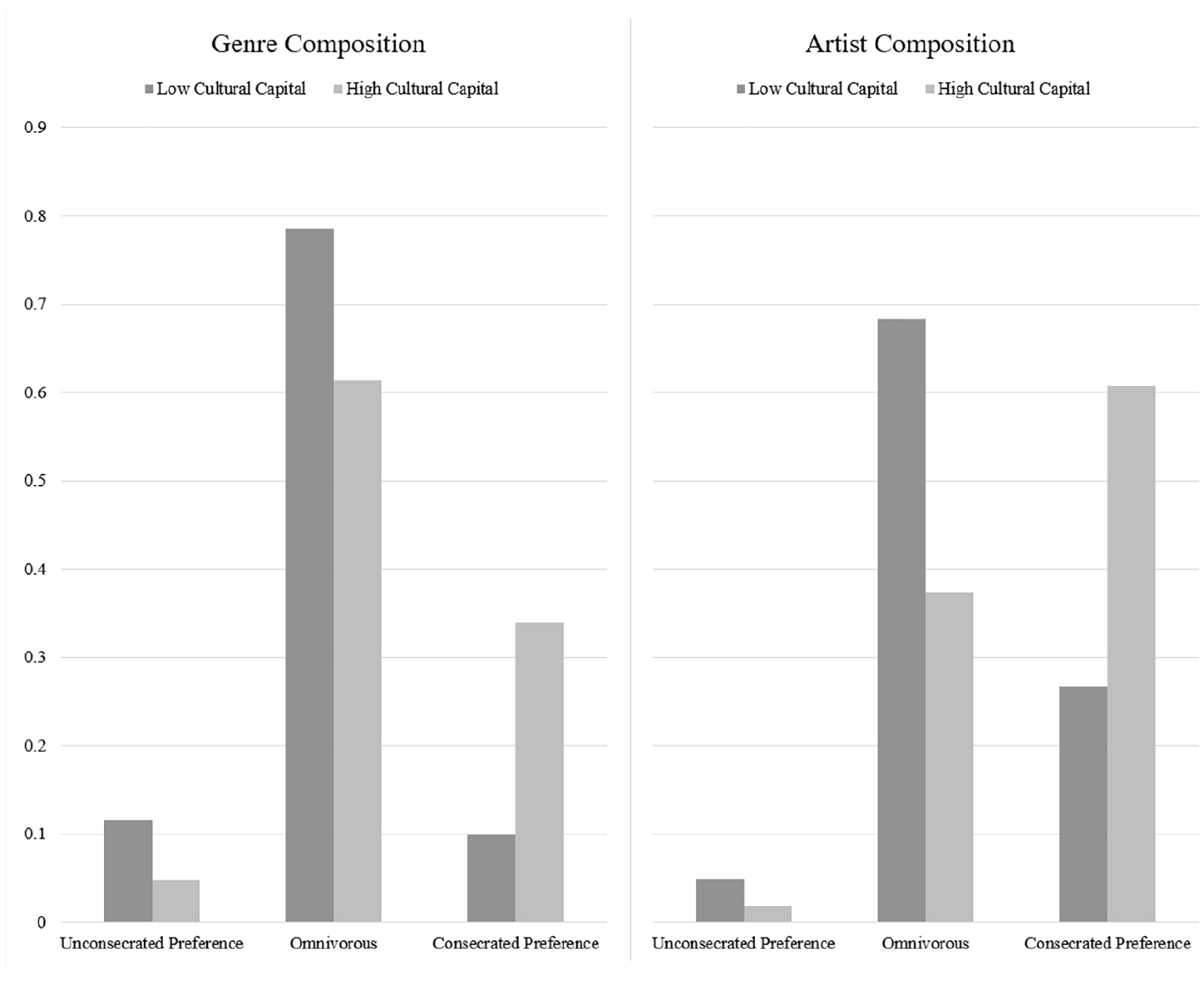
Predicted probabilities of compositional balance.
Our results indicate that snobbery indeed appears to have persisted, and this should lead to a renewed interest in the composition of tastes with respect to cultural consecration at the level of both genres and artists. By examining the composition of our respondents’ taste portfolios at the artist and genre levels simultaneously, it is possible to identify different configurations that reflect both Peterson and Bourdieu’s conceptions of higher cultural capital tastes. For instance, an individual with a balanced portfolio of liking across both consecrated and unconsecrated genres and artists could be considered a ‘true omnivore’, while an individual who prefers both consecrated genres and artists could be viewed, following Peterson’s (1992: 244, 252) designation of a ‘snob-to-slob conception’, as a ‘true snob’. In turn, an individual with a balanced portfolio at one level – either genres or artists – but a preference for the consecrated at the other could usefully be thought of as a ‘snobivore’. An examination of compositional balance among our respondents reveals that ‘true omnivores’ constitute 40.1% of our sample, ‘true snobs’ are 10.3%, and 31.5% are somewhere in between (i.e. ‘snobivores’). Clearly, these ‘snobivores’ could easily be mistaken for omnivores without taking into account compositional measures at both the genre and artist level.
Although omnivorousness has not superseded distinction as a taste profile among respondents with higher levels of cultural capital, it nonetheless captures the taste portfolio of an important share of our sample. This suggests that omnivores do in fact exist within a space of possible positions in cultural consumption, although perhaps not in the location that the omnivore framework would lead us to expect. Supporting our third hypothesis regarding the location of respondents with an omnivorous taste profile within the social space, comparisons of true omnivores’ mean scores on cultural capital measures to those of snobivores and true snobs suggest that omnivores occupy a relatively middle-status position. Respondents from our sample with a balanced portfolio of liking across more and less consecrated genres and artists had statistically significantly lower mean education (Mean = 4.1, SD = 1.3) and childhood arts exposure (Mean = 3.0, SD= 1.6) scores than their snobivore (education Mean = 4.6, SD = 1.4; childhood arts Mean = 3.3, SD = 1.6) and true snob (education Mean = 4.9, SD = 1.5; childhood arts Mean = 3.5, SD = 1.8) counterparts. 5
While omnivorousness might operate to demonstrate that one is not lower status, it does little with respect to showing a taste profile that is indicative of higher cultural status. To do so requires an exclusionary dimension of either the artist or genre levels (snobivores), or both (snobs). Ultimately, for omnivores, snobivores, and snobs, even within the realms of generally recognized popular music, we find a fairly consistent homology between the social space and the space of culture tastes.
Discussion and conclusion
In this article, using original data on US respondents’ likes and dislikes for musical genres and artists, we investigate the stratified nature of musical tastes. Using a volume measure of omnivorousness, we find that as education and childhood arts exposure increase, Americans express liking more genres of music, yet increased education associates with liking fewer musical artists across various consecration levels. Using a composition measure of omnivorousness, we find that higher levels of education and childhood arts exposure associate with not being omnivorous for genres or artists; rather, these things associate with liking more artistically consecrated culture. In examining these compositional configurations in the liking of genres and artists, we find that although about 40% of our sample can be typified as musical omnivores, they exist closer to the middle of the social structure. In turn, as predicted from a homology perspective, individuals with the highest levels of cultural capital still express tastes for more highly consecrated culture. Likewise, as would be predicted, snobivores – who are either omnivorous regarding genres and snobs regarding artists, or vice versa – fall between omnivores and snobs on our key predictors.
We see several key contributions of this work. First, while prior work has certainly incorporated tasting at different levels of culture to productive ends (e.g. Bennett et al., 2009; Bourdieu, 1993), we do so much more systematically, and within a framework in which case selection could be replicated across either different cultural domains or different national contexts. In turn, while prior studies have, for the most part, relied on researcher inference or tautological definitions to define high status culture, we selected cases by triangulating across the third-order inference of respondents, and the evaluations of both critics and peers (Bourdieu, 1993; Dowd et al., 2021). Finally, by simultaneously considering different levels of culture in the same domain we introduce the existence of what we term ‘snobivores’; that is, people best described through a Petersonian framework at one level of culture and a Bourdieusian framework at a different level of culture.
A limitation of this work is that, like many studies before it, we cannot speak of the degree to which musical tastes may or may not ‘stand in’ for cultural tastes and lifestyles more broadly. In an effort to maintain at least some level of common reference with literature on musical genres and omnivorousness (Peterson, 2005), we also more or less reproduce the standard list of genres used in most survey research, which obscures both greater heterogeneity in genres (Lena, 2012) and in what may be respondents’ own definitions (Sonnett, 2016). Also, like many survey studies before us, we cannot comment on whether or not our respondents are ‘performing’ taste portfolios, or if their expressed tastes also extend to practices (i.e. does ‘liking’ salsa music mean one seeks out salsa music or is knowledgeable about it, or does it only mean one is not opposed to it?). Qualitative studies, or other forms of observational work, may be best equipped to tease out the relationships between tastes and practices, as well as other questions (e.g. Benzecry, 2011; Hennion, 2001; Ollivier, 2008).
More generally, and as is generally true of survey research on the cultural consumption of creative goods in sociology, we see our work as rooted in that of Bourdieu, and the classic (and continued) audience studies from cultural studies (e.g. Brunsdon and Morley, 2005). While our work here does not incorporate multiple methods, we hope our findings might serve as what Spillman (2014) calls the ‘thin description’ that helps situate thicker description studies in a wider context. While (albeit with some exceptions) sociologists have shied away from case studies about singular artists or objects, we believe that cultural studies particularly excels in these rich and focused analyses, and we hope that our findings might serve as the ‘thin description’ for that style of work. Our work also points to the more subtle ways that higher status consumers reinscribe their status across and within genres, which we hope should also serve as a warning of the ways in which research practices may inadvertently obscure power dynamics. As recent expert discourse has centered around a flattening of taste hierarchies; this presumption may in part be an artifact of what was being measured and the questions being asked. If we see omnivorousness as being democratic in one’s tastes and use only volume measures of genres to show evidence for omnivorousness, we wrongly come to the conclusion that there has been an overall flattening in power relations centered around class tastes.
In turn, while in this work we focus on social position as defined through education and early childhood arts exposure (the more cultural side of social class), we believe that important associations beyond these focal variables also appear in our controls. This is true for both gender and for race. As found by Bennett et al. (2009), despite Bourdieu’s emphasis on social class, gender and race also structure cultural consumption. More work in this direction is also needed. Also along these lines, in our results age seems to be significantly associated with cultural tastes in potentially fascinating ways. One way to read our findings is that through the life course those of higher capital backgrounds ‘graduate’ from more omnivorous dispositions into snobbery. Alternatively, their tastes may remain constant, and it is through their higher status positions that the genres and artists they like ‘graduate’ into becoming consecrated culture. This would be suggested by consistent jazz fans who have ridden the wave of jazz transforming from lowbrow, disparaged culture to highbrow consecrated culture (Lopes, 2019), or Bob Dylan fans who were young in the 1960s when Dylan was a participant in a not-yet legitimated genre, and who now remain Dylan fans as he is named the winner of the Nobel Prize for Literature in 2016. Answers to this question are just starting to emerge (Lena, 2019), but more research is needed. Be it because high-status individuals’ tastes become more restrictive through the life course or because over time their more or less fixed tastes become consecrated culture, our findings suggest that as they age those of higher status may also shift from occupying a more omnivorous social position in their youth to a snobbish one in their older ages.
Finally, we note that because the expression of status through tastes evolves (Peterson, 2005) and the culture that is considered high status also evolves (Lopes, 2019), a robust understanding of the role that culture plays in generating and reproducing inequalities may require more dedication to both reanalysis and redefinition. We consider this as a call not only for clearer procedures and definitions, but also greater tolerances for ‘strange’ methods and ‘strange’ findings that do not reproduce canonical definitions or results. As culture is a moving target, scholars of culture must also stay on the move.
Footnotes
Appendix 1
Survey demographics.

| N | % | Mean (SD) | Range | |
|---|---|---|---|---|
| Genre volume | 1821 | 9.009 (4.477) | 0–20 | |
| Genre composition | 1821 | 0.198 (1.542) | −5 to 5 | |
| Artist volume | 1821 | 16.023 (8.255) | 0–35 | |
| Artist composition | 1821 | 1.769 (3.011) | −8 to 14 | |
| Gender a | 1819 | 0.504 (.500) | 0–1 | |
| 0. Male | 902 | 49.59 | ||
| 1. Female | 917 | 50.41 | ||
| Education | 1821 | 4.254 (1.412) | 1–7 | |
| 1. <9th grade | 6 | 0.33 | ||
| 2. Some HS | 81 | 4.45 | ||
| 3. HS | 622 | 34.16 | ||
| 4. Some college | 452 | 24.28 | ||
| 5. AA degree | 195 | 10.71 | ||
| 6. BA/BS | 326 | 17.90 | ||
| 7. Grad degree | 139 | 7.63 | ||
| Income | 1738 | 5.303 (3.132) | 1–12 | |
| 1. <10K | 150 | 8.63 | ||
| 2. 10–19.9 | 208 | 11.97 | ||
| 3. 20–29.9 | 255 | 14.67 | ||
| 4. 30–39.9 | 236 | 13.58 | ||
| 5. 40–49.9 | 173 | 9.95 | ||
| 6. 50–59.9 | 170 | 9.78 | ||
| 7. 60–69.9 | 109 | 6.27 | ||
| 8. 70–79.9 | 126 | 7.25 | ||
| 9. 80–89.9 | 61 | 3.51 | ||
| 10. 90–99.9 | 63 | 3.62 | ||
| 11. 100–149.9 | 137 | 7.88 | ||
| 12. >150 | 50 | 2.88 | ||
| Race | 1705 | 1.706 (1.126) | 1–5 | |
| 1. White | 1110 | 65.10 | ||
| 2. Black | 210 | 12.32 | ||
| 3. Hispanic | 231 | 13.55 | ||
| 4. Asian | 84 | 4.93 | ||
| 5. Other b | 70 | 4.11 | ||
| Urban–rural | 1820 | 1.962 (0.732) | 1–3 | |
| 1. Urban | 523 | 28.74 | ||
| 2. Suburban | 843 | 46.32 | ||
| 3. Rural | 454 | 24.95 | ||
| Child arts | 1821 | 3.171 (1.673) | 1–7 | |
| Mother education | 1758 | 3.588 (1.534) | 1–7 | |
| 1. <9th grade | 124 | 7.05 | ||
| 2. Some HS | 211 | 12.00 | ||
| 3. HS | 730 | 41.52 | ||
| 4. Some college | 266 | 15.13 | ||
| 5. AA degree | 155 | 8.82 | ||
| 6. BA/BS | 172 | 9.78 | ||
| 7. Grad degree | 100 | 5.69 | ||
| Father education | 1689 | 3.599 (1.723) | 1–7 | |
| 1. <9th grade | 180 | 10.66 | ||
| 2. Some HS | 216 | 12.79 | ||
| 3. HS | 629 | 37.24 | ||
| 4. Some college | 225 | 13.32 | ||
| 5. AA degree | 95 | 5.62 | ||
| 6. BA/BS | 204 | 12.08 | ||
| 7. Grad degree | 140 | 8.29 | ||
| Age | 1780 | 45.957 (16.588) | 18–90 |
SD: standard deviation.
The survey question for gender included a third ‘non-binary’ option. Because of limited responses (N = 2), this category was omitted from the analysis.
Includes American Indian or Alaska Native, Native Hawaiian or Pacific Islander, Middle Eastern/North African non-White and Other.
Funding
The author(s) received no financial support for the research, authorship, and/or publication of this article.
