




Abstract
The article explores how affect is circulated and managed in comment discussions on networked online platforms, such as Facebook. A mixed-methods analysis is conducted of comments on news about the triple disaster of an earthquake, a tsunami and a meltdown of three reactors at Japan’s Fukushima Daiichi nuclear power plant in March 2011 on public Facebook pages of seven Finnish mainstream news media. The article examines how affect sticks and circulates in these discussions, and how the commenters direct and sustain the mode and mood of Facebook discussions. The main findings of the article concern how online discussions are structured by what the author calls affective discipline, in which participants the discussion manage the mood of the discussion through various means. The results open up an important way to study the internal, affective dynamics of contemporary online discussions. In particular, the study helps us understand how flows of affect are shaped and steered in online discussions, and how the same discussions may simultaneously sustain multiple affective dynamics. These dynamics may, in turn contribute to how publics respond to news and official information in crises.
Introduction
In a contemporary hybrid media environment (cf. Chadwick, 2013), a disruptive and unexpected event, such as a natural disaster or a major act of terror tends to spark a mediated response in which mainstream news media and the countless variations of social media refer to one another in an interdependent relationship across the globe (Sumiala et al., 2016; Valaskivi et al., 2019). Because they break the routines of the everyday (Katz and Liebes, 2007), disruptive events stir our emotions and often generate a need to express these emotions publicly (Sumiala and Tikka, 2010). In fact, stories about collective emotions, as numbers of headlines about ‘a nation in mourning’ attest, can be argued to be a staple in the arc of crisis reporting (Pantti et al., 2012). Moreover, while most expressions of emotion related to a disruptive event used to remain in a relatively small group, the current networked forms of communication have made them increasingly visible. For instance, social media platforms, such as Facebook and Twitter, have made visible and shareable many reactions, discussions and emotions about a disruptive event that previously would have remained in a more limited group of people. In other words, the interconnectedness of the hybrid media environment blurs the boundaries between public and private, mainstream media and Internet vernacular in times of disruptive events.
In the study presented in this article, I examine this intersection of mainstream journalism, public discussions, and emotions and affect. I am interested in the internal dynamics of online discussions about mainstream news, and how affect figures as a part of these dynamics. I argue that disruptive events can provide particularly effective examples of how emotions of individuals become meshed into the larger mediated narrative about the event. I also suggest that disruptive events may serve as an outlet for individuals to express their emotions in a more general way. However, while one can draw some general conclusions about networked online discussions during a disruptive event, one must be aware of the cultural and temporal contexts in which they take place.
To study dynamics of online discussions about a disruptive event, I chose to analyse Facebook discussions on seven Finnish mainstream news media’s public Facebook pages about the triple disaster of an earthquake, a tsunami and a nuclear powerplant accident that happened in March 2011 in Japan. The sample consists of 732 comments by 463 unique commenters to 51 posts. As an event of overlapping disasters and simultaneous layers of response, coverage and commentary, the March 2011 triple disaster forms a crossroads in which social media, disaster news coverage, and affect and emotion intersect in interesting ways. In particular, I am interested in how affect appears in these discussions, and how it structures them.
Studying the comments to news about the March 2011 triple disaster from a geographically and culturally distant context allows for a broader consideration of how people react to disasters and crises that happen beyond their cultural frame of reference (Joye, 2015; Matthews, 2018; Sakai, 2015). This context also provides an opportunity to study how affect may simultaneously resonate on various cultural, social, historical and geographical levels in networked online discussions (Sreberny, 2016; Valaskivi et al., 2019). The research questions driving the inquiry of this article are as follows:
How is affect present in the Facebook comment discussions about the news of March 2011 triple disaster and in what ways does it structure the discussions?
What kind of relationship do the comments have with the posted news items?
Through these questions, I explore the affective dynamics of online discussions around a global news event in a local cultural, political and historical context. While the empirical context of the study is specific, the findings can contribute more generally to understanding dynamics of online discussion that are relevant in more contemporary settings. In particular, I believe that the notion of affect is crucial in understanding these dynamics, and the findings may promote further understanding on how to address questions about public discussion online in ways that account also for non-deliberative expression. Furthermore, I suggest that studying what could be called historic online data has its unique merits, because it provides an opportunity to analyse the development of the hybrid media environment and to document the change of online infrastructures and ways of communicating online.
Affect in online discussions
During the last decade, social media platforms, such as Facebook, have become significant online spaces not only for individuals and groups, but also for journalism and news (Larsson, 2018b; Tong, 2017: 401). While Facebook’s role as a platform in which journalistic content is circulated alongside disinformation disguising itself as journalism been debated particularly after the US presidential elections in 2016 and 2020 (Johnson and Kelling, 2018; Wahl-Jorgensen 2019), mainstream news organizations have been present on the platform since early 2000s, looking to engage their existing audiences and to find new ones (Langlois et al., 2009; Larsson, 2018b; Tong, 2017). As recent literature on disaster news coverage and social media suggests, Facebook and other social media have also become places where people look for information during disruptive events, either when the situation involves them directly or when they are interested in a distant event (Belair-Gagnon, 2015; Joye, 2015; Li et al., 2014; Matthews, 2018; Shineha and Tanaka, 2014; Thomson and Ito, 2012; Tong, 2017). The technological affordances of Facebook allow the news organizations to share their stories more widely, enabling the users to comment on the news and thereby engage the news organization more directly than with, for instance, letters-to-editors (Larsson, 2018a, 2018b). The comments render visible the reactions of the readership, thus producing another layer of information and impressions on top of the one produced by professional journalistic accounts. This layering of interpretations, information and impressions is one aspect of the hybridity of the contemporary media environment, in which professional journalism, politics, activism and commentary from ordinary citizens become blended in a mix of various, interdependent media (Chadwick, 2013; Sreberny, 2016; Sumiala et al., 2016; Wahl-Jorgensen 2019).
Since Facebook began to transform itself from an online directory of college students to its current form, its mission statement has been to ‘give people the power to build community and bring the world closer together’ (Facebook, 2019). This resonates with the hopes of the early days of Internet that the networked medium would give rise to a more democratic and deliberative public sphere (Dean, 2003; Langlois et al., 2009; Paasonen, 2015; Papacharissi, 2002; Rheingold, 1995). However, as critical research and more popular inquiries have been pointing out since the early 2010s, the contemporary publics gathering on Facebook and other platforms seldom correspond solely to the idealized notions of a deliberative public (Dahlberg, 2005; Dean, 2003; Larsson, 2018b; Nikunen, 2015; Paasonen, 2015; Papacharissi, 2002, 2015). Moreover, as Larsson (2018b: 3) suggests, while newspapers and other established media were initially excited to provide a way for their readership to engage more directly with the news and the journalists, there has been a reversal of opinion in recent years due to the high amount and the low quality of the messages received. Larsson (2018b: 4) also points out that news outlets expected that the same low-quality comments would produce revenue for them on Facebook as they generate and sustain engagement with content, while on their own website, such comments would be unacceptable.
Caustic discussions are of course not contained to Facebook, but have been present in online discussions since the early Internet. Text-based online communication has sometimes been described as less emotionally expressive than face-to-face communication, but as previous studies on online discussions indicate, this may not be the case (e.g. Binns, 2012; Cole, 2015; Dean, 2003; Loevlie et al., 2018; Nikunen, 2015; Paasonen, 2015; Rheingold, 1995; White and Crandall, 2017). Therefore, the concept of affect provides a fruitful analytical tool to examine online discussions not only on the level of deliberation, but essentially as a phenomenon which mobilizes and is structured by emotion, feeling and sensation (Nikunen, 2015; Oikkonen, 2017; Paasonen, 2015; Papacharissi, 2015). Moreover, following Paasonen (2015), I suggest that the online discussions are driven, directed and sustained by distinct affective dynamics.
Affect is often used to refer to non-discursive intensities and sensations, and emotion is understood as a more conscious, culturally and socially produced and circulated form of the same phenomenon (Ahmed, 2004; Nikunen, 2015; Oikkonen, 2017; Paasonen, 2015; Wahl-Jorgensen 2019; Wetherell, 2012). However, I use affect to refer to both discursive and non-discursive, because while they may be separable at the level of theory, in practice, affect is entangled with the human meaning-making processes and can be culturally, socially and historically mediated while simultaneously experienced as deeply personal and subjective (Ahmed, 2004; Nikunen, 2015; Oikkonen, 2017; Paasonen, 2015; Wetherell, 2012). Affect also accumulates, or sticks, to signs, figures, bodies and objects as they circulate in interactions between other signs, bodies and texts (Ahmed, 2004; Nikunen, 2015; Oikkonen, 2017; Paasonen, 2015). In online discussions affect sustains people’s interest to participate in them (Paasonen, 2015: 28), playing a crucial part in why some discussions attract more participation and reactions than others do. Moreover, affective dynamics shift and direct the intensity and tune of the discussion (cf. Oikkonen, 2017), and there may simultaneously be multiple affective dynamics at play in one discussion. Based on the analysis elaborated below, I suggest that one of these dynamics can be affective discipline, where participants of a discussion take action against other participants’ behaviour in ways that intervene in the mood of the discussion and direct its attunement (cf. Langlois et al., 2009; Løvlie et al., 2018; Tong, 2017: 412, 414).
Material and historical contexts
The Facebook comments about the Finnish mainstream media’s news coverage of Japan’s triple disaster of March 2011 provide an intriguing context in which to study dynamics of online discussions that come into being in the interactions between mainstream news media and social media, for several reasons. A global news event that concerns an already contested topic (nuclear energy) can invite discussion that can be both globally connected and tied to local political and historical contexts (Papacharissi, 2015). For instance, in Finland, the disaster in Japan coincided with a parliamentary election campaign period, and nuclear energy had been on the national news agenda because of issues in ongoing power plant projects (Fennovoima, 2018; Teollisuuden voima, 2018). While the news coverage rarely made the connection between the Fukushima Daiichi disaster and nuclear policy, the connection was made by the commenters. In addition, like most North European countries, the 1986 Chernobyl disaster and its aftermath, particularly in relation to how and when local officials shared information on the fallout from the Soviet reactor, has left its imprint on the public discussions about nuclear energy (Laihonen, 2016; Timonen et al., 1987; see also Weart, 2012).
As Ziegele et al. (2017) and Løvlie et al. (2018) note, news containing news values, such as controversy and damage appear to encourage active online commenting, even though the covered events are not in an area of cultural or geographical proximity to the commenters (see also Larsson, 2018b). In other words, controversial or disruptive topics appear to have more affective stickiness (Ahmed, 2004) that can carry on over time, and they therefore invite and sustain more attention and engagement (Paasonen, 2015) than other topics.
In addition, the comments about the triple disaster of March 2011 can provide a retrospective point of reference to how online discussions have since evolved. The empirical study of this article can be seen as a snapshot of a certain kinds of online discussions in a specific temporal, social and cultural context, which may influence their internal dynamics. As the visual interface and functions available for both users and administrators of Facebook have changed drastically during the last decade, 1 and as the company has made the use of the platform increasingly difficult by closing its application programming interface (API) from scholars in recent years (Bruns 2019; Franzke et al., 2020), the empirical data of this study provide a valuable glimpse to how the platform looked and functioned in its earlier days. Therefore, findings from this study provide points of comparison for studies done with more contemporary data about how dynamics of online public discussions have evolved during the 2010s and the early 2020s. Furthermore, when examining the Facebook discussions about Japan’s triple disaster of 2011 through historical data, it provides an opportunity to assess the discussions as a part of their broader historical context, which may have not been visible when the most acute phase of the disaster was ongoing.
From networked publics to affective discipline
The increasing shift of public discussion and other forms of political participation to networked digital platforms have raised numerous discussions about what this means to democracy and the notion of the public sphere. One approach to address the question of public sphere and public participation online is opened by the concept of networked publics (boyd, 2010; Ito, 2008; Langlois et al., 2009). Boyd (2010: 45–47) and Langlois et al. (2009: 418, 430) define networked publics through the media of participation, such as Facebook and other social media platforms, which follow certain material characteristics. This approach importantly renders visible the technological affordances of networked publics, such as sharing and linking, and it also implies that online discussions take place in and constitute a public sphere where the discussion is assumed to be deliberative and focused on finding a consensus solution (Dahlberg, 2005).
Langlois’ and her coauthors’ account is particularly interesting, as they shift the assumption of online publics and deliberative in the Habermasian sense by focusing on one hand on the non-human agency driving and sustaining networked publics on Facebook (2009: 425, 429), and on the other hand on the seeming fragility of the implied focus on rational deliberation. For instance, they highlight how the networked publics are influenced and shaped by what they call informational dynamics and communicational dynamics, that is the technological solutions mostly invisible to the general user that direct how, for example, comments or posts are displayed and to whom (Langlois et al., 2009: 425).
Regarding the fragility of the deliberative focus of networked publics, Langlois and company (2009: 428) focus on Marres’ notion of issue publics (see also Price 1992). Drawing from the work of John Dewey and Walter Lippmann, Marres (2007) suggests that people’s involvement in politics and public discussion (online or offline) is mediated by problems that affect, in other words, move or touch, them. Moreover, Langlois et al. (2009: 424) also point out that discussions on social media platforms are susceptible to hijacks and disruptions despite the best intentions of the page owners, administrators or the original poster (cf. Paasonen, 2015; see also Mouffe, 1999). In addition, Langlois et al. (2009: 430–431) note that in cases where such disruption occurs, the discussants may engage in what they call communicative discipline to resist disruptions or to reorganize the discussion. While Langlois and her coauthors do not explicate on what communicative discipline means concretely, it resonates with more current scholarship on the dynamics of online discussions, where attempts at managing the discussions may include work done by page administrators and enabled by the platform’s technology, such as removing unwanted comments (Larsson, 2018b). The participants of the discussion may themselves also engage in similar actions, such as asking a discussant to remove offensive content, or by asking the administrators to step in (Das, 2017; Løvlie et al., 2018; Nikunen, 2015; Paasonen, 2015).
This approach to networked publics as volatile and driven and sustained by something more than a need for rational deliberation, and as sites of contestation resonates with Papacharissi’s (2015: 125) concept of affective publics, which refers to ‘networked public formations that are mobilized and connected or disconnected through expressions of sentiment’. Therefore, as affect is an essential element of both human meaning-making and online discussions, I suggest that certain elements of what Langlois and her coauthors understand as communicative discipline can be also understood as affective discipline, as managing an online discussion often includes managing the mood of the discussion (cf. Das, 2017; Løvlie et al., 2018; Paasonen, 2015). Affective discipline can also be understood as a part of the multiple dynamics that drive and sustain online discussions (Løvlie et al., 2018; Oikkonen, 2017; Paasonen, 2015; Stoehler and Lindgren, 2014; Tong, 2017), in concert with the communicational and informational, technologically enabled dynamics Langlois and company emphasize. Furthermore, I suggest that while affective dynamics drive and sustain the discussions on networked publics, the affective dynamics are in turn sustained by the communicational and informational dynamics driven by the non-human agents such as algorithms that operate behind the interface accessible to the general user.
I propose that when engaging in affective discipline, participants of a discussion manage the emotional attunement or mood of the discussion by taking actions against participants who express emotion that differs from the (presumed) attunement of the other discussants, or from what is socially conceived as an acceptable response (cf. Ahmed, 2004: 170–171; Paasonen, 2015). A simple example of this would be a person bursting into laughter in a situation where others are in a sombre mood. Moreover, I suggest that online discussions as affective publics may simultaneously contain competing affective attunements, as an online discussion rarely is unanimous, and it is in constant flux.
Next, I proceed to employ the concepts of affect and affective discipline in analysing the empirical material of the study. First, I will provide a description on the analysis method and the empirical material, before proceeding to discuss how affect appears in the comments about news of Fukushima Daiichi, and how the notion of affective discipline allows for a closer examination of certain dynamics that structure these discussions.
Methodology for analysing affective discipline
The empirical data of the study consist of 732 comments written to 51 Facebook posts of seven major Finnish news outlets’ public pages that included a link to a news story about the earthquake, the tsunami and the triple meltdowns at Fukushima Daiichi between 11 March, when the earthquake and the tsunami took place, and 30 April 2011. The news outlets whose Facebook posts I analysed are two national television channels (Finnish public broadcasting company YLE’s news division, hereafter YLE, and the news division of a commercial broadcaster MTV3), two tabloid papers with national circulation (Ilta-sanomat, IS and Iltalehti, IL), Finland’s largest newspaper (Helsingin Sanomat, HS), a business daily (Kauppalehti, KL) and a regional paper from northern Finland (Kaleva). Table 1 summarizes the breakdown of the numbers of Facebook posts, comments, individual commenters and likes for each news outlet for the observed period.
A summary of the total sample.
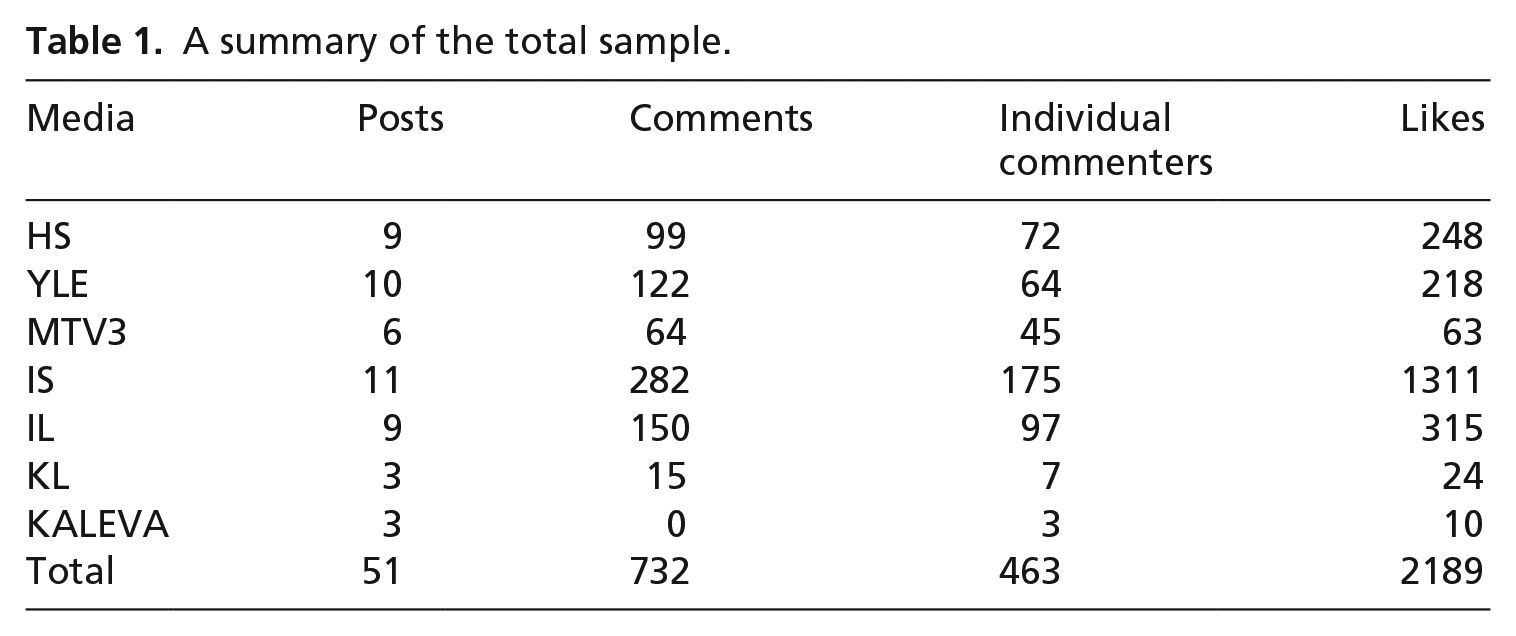
I chose the sample above because I wanted to include media of various sizes and from several points on the spectrum between the so-called quality media and tabloids. Moreover, I used mainstream news media’s Facebook profiles as my sample because they are publicly accessible, and because they act as interesting intersections to global news events, local politics and culture, and to the personal experiences and opinions of the individual commenters (Larsson, 2018a, 2018b). I chose the timeframe of the sample based on a hypothesis that the news coverage of and social media posts about Japan’s triple disaster would continue for at least 30 days. Moreover, I chose to extend the timeframe of the selection beyond 11 April 2011 because I wanted to see if the sampled media would post stories about the triple disaster after the most acute phase of the disaster had passed. This hypothesis was based on the results of a previous study on the news coverage of the triple disaster in Finland (Valaskivi et al., 2019).
I collected the sample manually in autumn 2014 using Facebook’s search functions on the selected media’s timelines. An API tool, which was still available for research use at the time, was not used because the material I was searching for was in Finnish, and most available API research tools only supported English searches. After the initial search, the comments were anonymized and transferred to text documents for analysis, together with the original post. I gave all comments three numbers: the number of comments in a thread following an individual story, the number of the individual commenter in the thread and the number of likes the comment received, as exemplified below. All times are in Finnish time (GMT + 2) unless stated otherwise, and dates are in dd.mm.yyyy format:
1/1/0, HS 11.3.2011 17:11: it really is a very bad situation :(
Paasonen (2015) and Larsson (2018a) suggest that one way to account for public’s affective engagement with a Facebook post or a comment is the number of likes and comments each post generates – in other words, how many people were affected by a post enough to click the button. In addition, the frequency of posting and commenting can serve as an indicator of activity of the overall discussion (Larsson, 2018a), but it can also indicate the affective intensity of the discussion (Paasonen, 2015). Therefore, I noted how many comments and likes each post got, and how many likes individual comments received.
The posts and comments were analysed qualitatively with a mixed-methods approach that draws inspiration from metaphor analysis (Lakoff and Johnson, 1980) and existing scholarship on affect in online discussions (Nikunen, 2015; Paasonen, 2015), to tease out elements that influence the affective attunement of each post and comment. I examined the overall composition and style of the comments, paying attention to the word choices, usage of emotional expressions, metaphors and argumentation styles of commenters, as these elements often influence how the comments are interpreted both in terms of meanings and in terms of affect (cf. Oikkonen, 2017). The word choices would include what kind of verbs and adjectives commenters use and what kind of connotations they carry, for instance if the events at Fukushima Daiichi were referred to as ‘an accident’ or ‘a catastrophe’. With emotional expressions, I mean statements such as ‘that’s terrible’, ‘this makes me laugh’ or even ‘omg lol wtf’. In classifying metaphors, I followed Lakoff’s and Johnson’s (1980: 5) definition of a metaphors as expressions in which a thing is understood and experienced in terms of another. Understood in this sense, metaphors are not just figures of speech reserved for poetry, but pervasive in everyday language (Lakoff and Johnson, 1980). To revisit a previous example, when ‘the nation mourns’, the nation is understood in terms of a person’s emotional expression. With argumentation styles, I refer to the overall style of writing of a comment, which is made up of the elements described above.
Each Facebook post and the anonymized comments attached to it were coded manually following the guidelines above for more thorough analysis. In my analysis, I followed a hermeneutic approach, going through the material several times, each time revisiting the analysis and deepening and contesting my previous results.
Feeling Japan’s disaster on Facebook
The news posts and their comments constituted a shifting, complex and sometimes contradictory stream of affect and argument around the triple disaster in Japan on Finnish Facebook in March 2011. As Papacharissi (2015: 130) argues, affective publics and the events around which they focus can be understood as separate events that occur in parallel and are imbricated with each other in global and local contexts. In the empirical material of this study, the individual events of the earthquake, the tsunami and the meltdown at Fukushima Daiichi nuclear power plant became entangled with past, present and anticipated future events and interpretations about them in the comment threads, creating a layer of affectively informed meanings that bind together the actual events and the mediated discourse around them.
As Table 2 above illustrates, posting, commenting and liking on the seven news media’s Facebook pages was most intense between 11 and 14 March. During those 4 days, the humanitarian crisis brought on by the earthquake and the tsunami, and the nuclear emergency at Fukushima Daiichi were in their most acute phases. On 12 March 2011, for instance, the seven media generated approximately 22 percent of the total 51 posts. These 11 posts got 264 individual comments, roughly 36% of the total number of comments. However, from 17 March, the news coverage as well as posting and commenting on Facebook began to decline, as the situation at the area affected by the triple disaster became more stable (Valaskivi et al., 2019).
Numbers of Facebook posts by date, along with a timeline of the disaster.
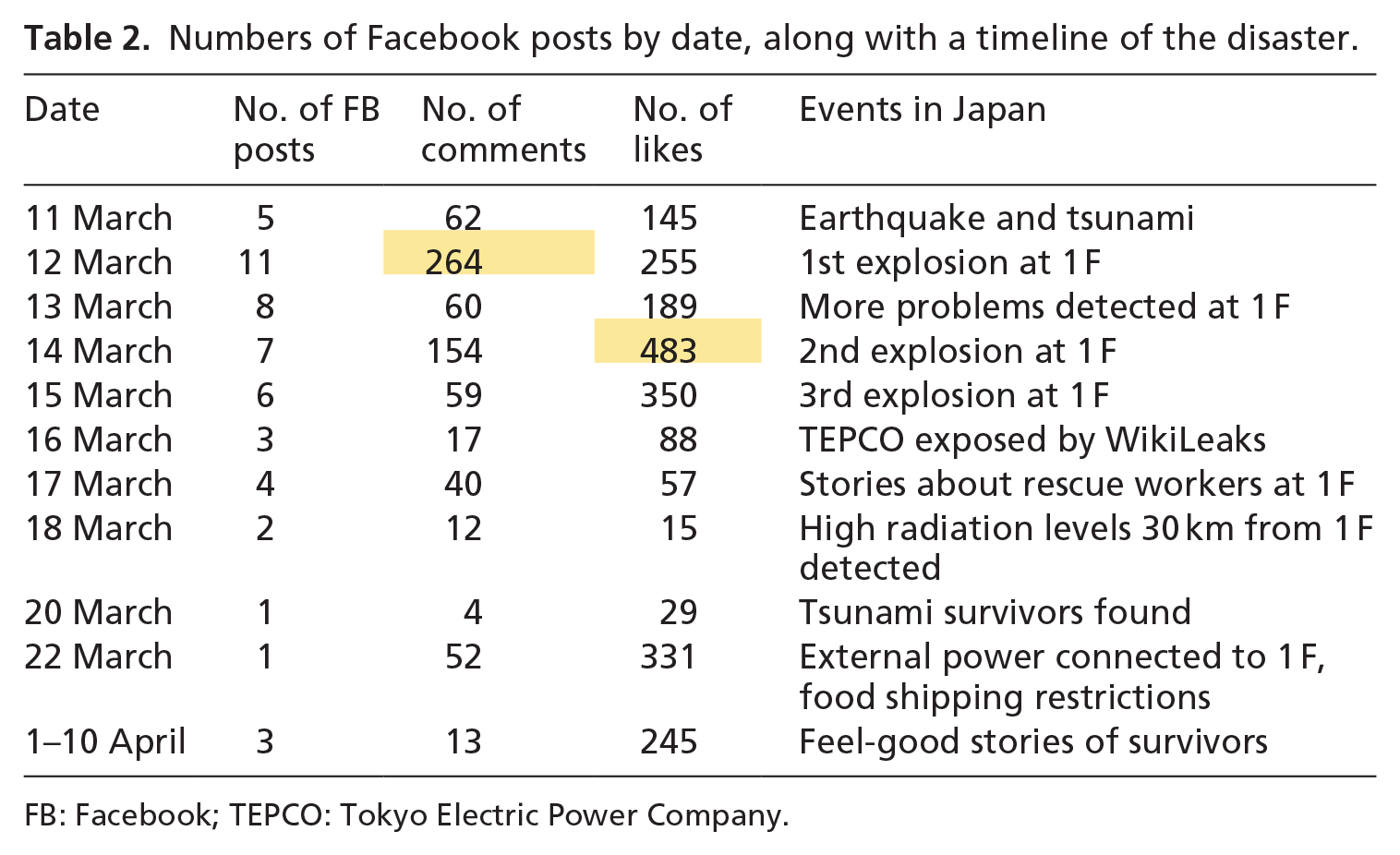
FB: Facebook; TEPCO: Tokyo Electric Power Company.
In general, the media that posted more often also attracted more comments and received more likes for their posts. The tabloid IS was the most active and attractive in this sense, as its posts received both most comments (282, 38.5% of total comments) and likes (1311, 59.9% of total likes). However, the number of comments on a post did not correlate with the number of likes the post received, as has been reported in previous studies (De Vries et al., 2012; Larsson, 2018a). Predominantly, positive posts, such as stories of tsunami survivors, attracted more likes but fewer comments, while negative or neutral stories, such as reports about the Fukushima Daiichi nuclear power plant, got fewer likes, but more comments.
The styles and modes of commenting also varied noticeably between the media, perhaps reflecting the image of each outlet, as the conversations on the so-called quality medias, such as HS’ and YLE’s, Facebook posts can be described as issue-focused and polite despite opposing views of the commenters. The commenting on both tabloid papers’ (IS and IL) posts was generally rowdier and filled with crass humour, insults and occasional disruptive behaviour, such as trolling and flooding. This could be interpreted as a hint of the socioeconomic status of the readership of the tabloids. However, both tabloids and the so-called quality media, such as the national broadcaster YLE and the main daily HS generally enjoy a readership that cuts across a wide social spectrum in Finland (Media Audit Finland, 2018). Therefore, I am reluctant to make such generalizations. It is also worth noting, that moderators of the Facebook pages were visibly active only on MTV3’s and YLE’s pages.
On all seven media’s pages the discussion in the comments was rarely about the content of the shared news item, but rather about the general topic of the tsunami, the earthquake or the nuclear disaster. Moreover, the tone of commenting appears to be dependent on either the topic of the original post or the tone of the first comment made to the post. Principally, posts that were directly related to events at the Fukushima Daiichi nuclear power plant tended to raise debate about nuclear energy, attracting fierce disagreement and expressions of disappointment and frustration. Posts about the earthquake and the tsunami, however, attracted more comments that expressed sadness or dismay at the destruction. The commenting was therefore very much reactive to the journalistically produced accounts about the events in Japan, which served primarily as prompts for the discussion.
Disciplining and directing affective dynamics
The Finnish Facebook discussions about news of events in Japan in March 2011 featured several affective dynamics that were in play simultaneously. For instance, several discussions included expressions of worry, political debate and jocular remarks about the situation all at the same time. One way in which the commenters upheld positive affect was humour, and in several discussions the mood was kept light by the commenters with wordplays and witty remarks despite the seriousness of the topics, echoing a sentiment common to online vernacular sites such as 4chan where nothing is taken seriously (Auerbach, 2012; Nikunen, 2015; Stoehler and Lindgren, 2014). For example, the first comment to IL’s post about the tsunami (28 likes and 11 comments) was not exactly a serious one:
1/73/0, IL 11.3.2011, 10:51: well there sure have been some nice waves out there in Japan . . .
Other aspects that made the public come together were sense of solidarity towards disaster victims, as expressed in several comments to news about tsunami that sent their condolences to the people of Japan – and a shared sense of being offended. These two aspects were often intertwined, as a discussion from YLE’s Facebook page on 14 March, following a post about a special website dedicated to the triple disaster, demonstrates. The text of the original post accompanying a link to the site reads as follows:
Go check out YLE’s cool new web special about the events in Japan! – [Employee’s first name]
The post, made late at night on 14 March, got 12 likes and 15 comments, and was not well received by the commenters. Nine out of the 15 commenters expressed their distaste towards the post and the poster, engaging in acts that could be described as affective discipline. For example:
4/451/3 YLE, 14.3.2011, 23:32: YLE has some gross language about a serious event! Maybe you should’ve thought before [posting] – S H O U L D N’ T Y O U !!! 5/452/3 YLE, 14.3.32011 23:34: In the context of a tragic event and deaths, calling this a ‘cool web special’ is more than a bit tasteless, you know. Works for disaster films and lowbrow papers’ front pages, not for reality.
The nine unsatisfied commenters criticize the original poster, a representative of the broadcaster, for the use of such light and enthusiastic terms to describe the YLE special website. In the comments, the original poster’s language is deemed frivolous because of the human cost of the disaster. However, the acts of affective discipline are relatively moderate in this instance: the commenters question the original poster’s choice of words and scold them for lack of tact.
In some cases, the implied solidarity and empathy towards disaster victims was blended with tints of (banal) nationalism, when the commenters discussed reports of the situation of Finnish citizens in the Japanese disaster area. For instance, comments on a post by the tabloid IS about four Finns unaccounted for in Japan on 14 March illustrate how a failure to join in with the implied solidarity towards one’s compatriots was met with acts of affective discipline that go beyond reminders about ‘tact’. The original post includes no other content than a link to the article, which displays the headline and an abstract of the story, and it received 157 likes. The first comment is a simple exclamation of ‘yes!’, but the second commenter sets a different tune. They voice their disinterest and compare the four missing Finns to thousands of suffering others in Japan and Finland, creating a rupture to the positive mood about the news item:
2/250/2, IS 14.3.2011 (1) 01:08: Who fucking cares about a couple of Finns when thousands of people are dying there. Then you cry after those four when at the same time a hellish number of people die because of alcoholism and domestic violence in Finland.
The comments posted to the story after the remark above are not about the original news story. Instead, other commenters respond to commenter 250’s frustration broadening to apparent provocation, reprimanding commenter 250 for lack of empathy or ridiculing and belittling their argumentation or their traits, mostly focusing on their assumed gender, age and mental state (cf. Paasonen, 2015). The discussion about and disciplining of commenter 250 went on for 14 hours and 18 comments, and amounted to direct insults and one vaguely framed death threat, until it withered in the afternoon of 14 March 2011.
Commenter 250 was clearly perceived as a disruptor by the rest of the commenters because commenter 250 deviated from the implied interest and empathy towards one’s compatriots during a crisis which probably had motivated the journalist to write the story and to the Facebook page administrator to post it on IS’s page (cf. Galtung and Ruge, 1965; Ziegele et al., 2017). Commenter 250’s comment also makes visible how the news appears to value lives of specific nationalities differently. The vitriolic responses to commenter 250’s post can therefore be understood as reactions to rupturing of implied proper affective attunement to one’s compatriots, as well as to the uncomfortable assumptions the comments make visible.
The two examples discussed above illustrate instances where a participant of an online discussion goes against the assumed affective attunements to a crisis. The following example, however, illustrates a case where the affective attunement of the discussion and the attempts at directing it are more diverse.
On afternoon of 12 March, MTV3 shared a link to a news story about how potassium iodide tablets had sold out in several pharmacies across Finland. The text of the original post read as follows:
According to Finnish Radiation and Nuclear Safety Authority, the possible emissions from Japan will not have any significant health effects. However, according to YLE News, many have already prepared for what may be to come. Do you have potassium iodide tablets?
The post received 5 likes and 23 comments. Most of the comments are composed as answers to the question posed in the post and reflect a variety of reactions from concerns about personal health to distrust towards authorities, anti-nuclear statements and sardonic humour. While most nuclear energy-related topics tend to generate politicized discussion, a factor that may influence the comments in this sample is, as I have mentioned in the ‘Introduction’ section, that Finland was having parliamentary elections in April 2011, and the Fukushima Daiichi disaster coincided with the campaigning period.
In addition to rousing political passions, for some commenters news about iodide tablets evoked memories of the 1986 Chernobyl disaster, and made them wonder whether they too should buy tablets just to be sure, such as in the comment below:
2/202/0, MTV3 12.3.2011 15:42: no iodide tablets here . . . but should I go buy some just in case they always say there’s no risk, but then it always is the opposite.
A more common response, however, was to attempt to downplay or ridicule the presumed panic. For example:
18/368/2, MTV3 12.3.2011 18:17: BOOOO. Let’s everybody panic and put tin foil hats on!!!!!
On all sampled Facebook pages, references to the Chernobyl disaster and spoofs like the one above were common in discussions about iodide tablets or events at Fukushima Daiichi in general. They can be understood as two affective reactions to the same issue. On one hand, the Chernobyl comments remind others that something similar has happened before, and there may be legitimate reasons for concern, considering the misgivings of the aftermath of the disaster in the Soviet Union and in Finland (Timonen et al., 1987). Many Finns who were born before 1986 have memories of the accident, of the official response to it in Finland, and of the mediation of the two latter, as the weather conditions in Europe made the fallout from the exploded reactor to travel north, raining down over parts of Finland and Sweden (Laihonen, 2016; Timonen et al., 1987). Moreover, journalists and various experts compared the two accidents as they were trying to make sense of what was happening with the reactors in Japan (Friedman, 2011; Rantasila, 2018).On the other hand, the ridiculing comments can be understood as an attempt at managing the affective attunement of the discussion by countering concern with humour (cf. Auerbach, 2012; Nikunen, 2015; Stoehler and Lindgren, 2014).
Moreover, this particular comment thread features an attempt at influence the affective attunement of the discussion that is not present in any other discussions in the sample. In this discussion, MTV3’s own page profile participated twice: first to repeat an advisory from the Finnish Radiation and Nuclear Safety Authority about iodide tablets, and later to inform the readers that the story has been updated with the same advisory. This intervention can be interpreted as a rather standard crisis communication approach: mitigating anxiety with officially confirmed information (cf. Valaskivi et al., 2019; Weart, 2012; Rantasila, 2018).
Discussion and conclusion
The above examples demonstrate how even short comment threads may contain multiple affective dynamics, and that discussants employ different means to direct or disrupt these dynamics, such as providing new information, lightening the mood with humour or in some cases engaging in affective discipline against others. In most cases, the first comment set the tune for the rest of the discussion, as illustrated by the remark on IL’s first report of the tsunami. Moreover, as the YLE’s and IS’s examples above illustrate, discussions that are driven by negative affect and contain acts of affective discipline can also simultaneously contain comments that have positive or neutral affect: in both cases, the original post was positive, but most of the discussion was not.
The affective dynamics of the networked publics shaping Facebook comments in March 2011 were often entwined with multiple elements that reflect local cultural, social, political and historical contexts, even though the event discussed in the comments was global. For example, the discussion of MTV3’s news about iodide tablets on 12 March 2011 reflects this layering of contexts well, as an event in Japan simultaneously sparks memories of another event more than 30 years ago, evoking debate on local energy policy and preparedness, and inviting discussion about the trustworthiness of local officials.
Furthermore, the posts and comments provide an interesting insight into how news are commented on in third-party platforms like Facebook. In most cases, the majority of the comments to the posts did not consider the news story posted, but instead were about the topic (the tsunami, the earthquake, the nuclear energy, etc.) in a more general sense, or as in the case of YLE’s web special post and IS’s post about four missing Finns, most of the commenting focused on one of the participants of the discussion. In other words, while the journalistic content acted as a prompt for the discussion in terms of what the commenters were talking about, the comments were in most cases not about the journalistic content.
Analysis of overall structure and tones of the discussions revealed three recurring elements that appear to play a role in directing and driving flows of affect in the comments. The elements, all residing on analytically distinct levels, are the topic of the original post, the tone and argumentation of the first comment, and attempts at directing affective attunement of the public. The affective dynamics that are at play in the discussions are multiple and not mutually exclusive, and they become challenged or interrupted by posters and commenters either unwittingly or consciously through provocation. The commenters can attempt to direct the affective dynamics of the discussions deliberately either by changing the tone of the commenting with their own message or through acts of affective discipline against commenters who are perceived to have disrupted the affective attunement of the discussion.
Tools for affective discipline do not limit themselves to calling out unwanted behaviour and opinions, or attempts at lightening the mood with humour, but include the technologies of the platforms on which the discussions take place (Langlois et al., 2009). These include the Facebook page administrators’ ability to delete or modify disruptive messages, and also the more complex ways in which the algorithms display the discussions and comments to other users (e.g. Knuuttila & Laaksonen, 2020). Other commenters may also persuade a participant to remove their comments, or even to completely leave the platform (Paasonen, 2015), but in the sample analysed in this study, it remained ambiguous if that had taken place.
Moreover, the study sheds light on how news is received on social media platforms during a disruptive event, such as the March 2011 triple disaster in Japan. While the data do not tell how many people actually read the news shared on Facebook, the comments suggest that the journalistically produced content provided the commenters with a way to express their opinions and emotions, in particular in discussions about nuclear energy in the context of Fukushima Daiichi, even when the commenting appeared to be erratic and random. This observation would suggest that in addition to providing opportunity for debate, the media outlets’ Facebook pages serve as spaces that allow for articulating various kinds of opinion and affect. Therefore, I suggest further study of non-deliberative expression and affect should be of interest to communication and media studies. In the spirit of Marres (2007) and Mouffe (1999), it is worth considering whether, instead of viewing non-deliberation and affect as something to be removed from public discussion, they should be understood as crucial elements that keep the discussion alive and ongoing (see also Wahl-Jorgensen, 2019).
The affective dynamics of the discussions create a vibrant snapshot of Facebook commenting on mainstream news in 2011, providing a point of comparison for contemporary online discussions. The posts and comments that constitute the data of this study testify for the persistence, replicability, searchability and shareability of affective and networked publics, even in its incompleteness (boyd, 2010: 46–49; Papacharissi, 2015: 126). They also provide a glimpse of how affective intensities circulate in a hybrid media system, and how they become ‘archives of feelings’ (Pybus, 2015) that allow these intensities to be traced, analysed and circulated further by other means of digital, networked communication.
I recognize that there are limitations to the conclusions that can be made from an analysis of historical social media data that consider the current hybrid media environment. While the discussions studied in this article are infused with affect, they appear almost tame compared to the current social media vitriol (cf. Cole, 2015; White and Crandall, 2017; Yeo et al., 2017). The notion of affective discipline opens up an important way to study the internal, affective dynamics of contemporary online discussions. In particular, it helps us understand how flows of affect are shaped and steered in online discussions, and how the same discussions may simultaneously sustain multiple affective dynamics. These dynamics may in turn contribute to how publics respond to news and official information in crises. It also raises a host of profound questions about the nature of public discussions online, and the directions to which we, as their participants, want and are able to take them.
Footnotes
Funding
The author(s) declared no potential conflicts of interest with respect to the research, authorship, and/or publication of this article.
