




Abstract
Centering upon the first Europe-wide public opinion survey of racism, carried out by the Eurobarometer in 1988, this article explores how studying European public opinion research can shed light on what we call the raced constitution of Europe. Based on an analysis of this Eurobarometer survey, we scrutinize how Eurobarometer opinion polling involves a constant scale-switching through which ‘Europe’ and ‘racism’ are co-produced. As we argue, techniques of European opinion polling contributed to the imagination of a ‘European’ ideological whole, from which stabilized categories of ‘non-European others’ were excluded. By creating an opposition between ‘democratic Europe’ and ‘individualized xenophobia’, racism was enacted as a lower class attitude ‘not of Europe’ and as a permanent rem(a)inder of the past that serves to legitimate the project of European integration.
Introduction: the raced constitution of ‘Europe’
The governmental project of the European Union (EU) has been associated with a specific foundational myth of ‘Europe’: its unity exists to prevent war between European nations, and to prevent the reoccurrence of racial violence most traumatically remembered with the Holocaust. As in many myths, there is some truth to this, but at the same time, it enables a forgetfulness of previous histories of racism, colonial and imperial (Wekker, 2016). What is more, this constitutional idea of postwar Europe has consistently glossed the raced constitution of Europe itself. For many Europeans, it seems as if race plays no part in current history, and as if racism is non-existent in Europe, even that it is not a ‘European’ thing (Goldberg, 2006; Lentin, 2008). Yet, race figures prominently in conceptions of the culture of immigrants, in the supposed failures of multiculturalism, and in the persistent denegation of Muslims in Europe (Schinkel, 2017).
In this article, we seek to shed light on this paradox by focusing on a particular moment in European postwar history at which the EU was forced to face racism. In 1984, a group of European Parliament members – alarmed by the electoral success of the Front National and other radical right-wing parties in the European elections – requested an inquiry into the rise of racism in Europe. The committee of inquiry then wrote a report on right-wing extremist groups and racist violence in countries in and around the European Community (EC). Among other recommendations, it postulated that a Eurobarometer survey be conducted ‘on the present state of relations between the different communities living in Europe’ (European Parliament, 1985: 97). A ‘Special Eurobarometer Survey’ on racism and xenophobia followed in the fall of 1988, as part of the 30th ‘Standard Eurobarometer Survey’. Its findings were presented at the end of 1989, in a Eurobarometer Special Report on ‘Racism and Xenophobia’ (Commission of the European Communities, 1989).
Since 1974, the Standard Eurobarometer Survey has conducted biannual surveys to monitor European public opinion on behalf of the European Commission. In addition to Standard Surveys, Special Eurobarometer Surveys have been conducted with a focus on particular themes. The 1988 Eurobarometer survey at stake in this article was the first to measure racism in public opinion Europe-wide. More Eurobarometer surveys on ‘racism’ or ‘discrimination’ followed in 1997, 2000, 2002, 2006, 2008, 2009 and 2012 – although each was quite different from the previous one.
As we will show, the 1988 survey did not simply give rise to representations of European racism. Rather, it helped to fortify the idealized image of ‘Europe’ as a tolerant, democratic region whose very existence was evidenced by the suppression of the racism of individuals who had been unable, for various reasons, to keep pace with the ‘modernization’ of Europe. Thus, as we seek to argue, the very practice of rendering racism measurable was raced from the outset in the sense that particular conceptions of ‘Europe’ and its ‘others’ were operative in the Eurobarometer survey.
The 1988 Eurobarometer survey, then, constitutes a singular moment in the European postwar imagination of race and racism. However, it took place in a time, and amid a context, at which the ‘Europe’ of the EU was itself far from a settled entity. Economic and political consolidation processes were still in a germinal phase and ‘the European Community’ was still largely an issue of technocratic projection. Crucially, it was also a time when various national governments began restricting their national migration policies with regard to ‘undesirable’ populations while also laying the foundations for the current European border regime (De Haas et al., 2016). The Schengen Agreement – establishing freedom of movement for some while immobilizing others – was passed in June 1985; the Single European Act – enabling ‘a free market’ for some while burdening others – in February 1986 (Vigneswaran, 2013).
Precisely because these developments have since escalated, we argue that social scientific measurements of ‘racism-in-Europe’ must be critically assessed in view of their performative effects and political affordances for rendering racism a public issue. Today, amid ‘Brexit’, heated conflicts over migration across the Mediterranean and the normalization of racist discourses concerning ‘Islam’ and ‘integration’ (Schinkel, 2017), it is particularly important to consider the early formation of bureaucratic racial categories in the EU. Paying close attention to how such categories are crafted and what they perform, we argue, provides important context to current concerns in, and about, ‘Europe’ as a racial category.
The question of European racism cannot be considered apart from the question what the stability of the object of ‘Europe’ is, which is entangled in highly particular ways with what ‘race’ is for Europe and what ‘European racism’ is. As we argue in this article, the raced constitution of Europe, as mediated by public opinion research on racism and xenophobia, centres on the issue of scale. As various geographers have argued, scale is not given but a constructed or emergent property of geographies (Bier, 2017; Marston, 2000; Massey, 1994). In the case we discuss, scale is both fixed and flexible. It is fixed because it ranges from the level of individuals (people with certain opinions), the level of groups (racialized others) and the level of European nation-states to the scale of Europe itself. But scale is flexible because the methods and concepts deployed in the Eurobarometer allow for constant scale-switching – not between fixed scales, but as what enables scale to become fixed in the first place. For example, measuring ‘European public opinion’ occurs by conducting surveys among individuals mediated by disaggregation at the national level. Subsequently, re-aggregation takes place at the level of ‘Europe’. In other words, in order to become publicly available as an object of discourse and imagination, ‘Europe’ needs to pass through several forms of scale-switching.
As we seek to show, scale also operates as a way of facilitating and of simultaneously invisibilizing what we here call the raced constitution of ‘Europe’. Ours is thus a relational perspective: neither scale nor public opinion can be considered as given but must be considered as co-constituted in performative practices that seek to demonstrate both ‘racism’ and ‘Europe’. In this sense, we seek to contribute to a relational understanding of the ways in which race may emerge at different scales (cf. M’charek et al., 2014a, 2014b). David Theo Goldberg (2009) comments on the importance of a relational, rather than a (often methodologically nationalist) comparative approach to racism: ‘racist arrangements anywhere – in any place – depend to a smaller or larger degree on racist practice almost everywhere else’ (p. 1275).
In a similar vein, this analysis of a Eurobarometer survey of racist and xenophobic opinions among Europeans of ‘non-European others’ seeks to show how such individual opinions can be considered as particular inflections of raced conceptions operative at the scale of ‘Europe’ itself. Yet, paradoxically, precisely by switching scale and attributing racist opinions to individuals, Europe can uphold an aggregate self-image of democratic tolerance. This image is even further strengthened, we argue, by the self-legitimating notion that indeed, there are Europeans with racist attitudes, but it is precisely this fact that calls for ‘Europe’. Studying EU-commissioned public opinion research is then, we argue, a way of scrutinizing the raced constitution of ‘Europe’ (cf. Goldberg, 2006).
The ‘Public opinion, racism and the scale of Europe’ section outlines our perspective on the performativity of public opinion surveys. ‘Statistical cleansing’ through ‘Calibrating the other of Europe’ sections form the core of our analysis of the way in which ‘Europe’ and ‘racism’ become constituted in the process of scale-switching in the specific case of the first public opinion survey of racism in Europe. The final section presents our concluding remarks on the analysis.
Public opinion, racism and the scale of Europe
Statistical methods and the use of survey questionnaires are crucial technologies of the modernist social imagination (Law, 2009; Law and Urry, 2004; Osborne and Rose, 1999; Ruppert, 2012). Linked to a broader array of biopolitical knowledge practices, they act as a research infrastructure to the mediation, visual capture and governmental grasp of bounded ‘societies’. This infrastructure has been laid out in view of identifying and rendering visible kinds of people (Desrosières, 2002; Foucault, 2003; Hacking, 2007) while also enabling the articulation and diagnoses of social pathologies (Canguilhem, 1991; Rose, 1996). Public opinion has, from the early 20th century onward, been increasingly constituted through infrastructures of survey research and statistical analysis, conceptually redirecting it from a ‘popular suspicion’ toward the state into a ‘popular mood’ demanding attention of the state (Rosanvallon, 2008).
As such, public opinion research is performative of central objects of liberal democratic state-making (Osborne and Rose, 1999). First, survey questionnaires enact a psychic depth-structure of the liberal citizen-respondent: her outer discourse is coded into responses emanating from a deeper attitude held within the desiring underground of the person. Politics is rendered visible through a set of acquisitive statements: I like, I want, I prefer and I demand. Public opinion ultimately consists of these more or less stubborn attitudes. Second, commensuration of encoded responses through statistical description and analysis is performative of the publicity of opinion. What is desired deep within the citizen is at once shared across any number of demographic dimensions and thus draws out a (latent) frontier of collective expression and demand: ‘I’ desire, because ‘we’ desire. This public desire is not the irredeemably particular rumbling of organisms, but a desire of and for collective gratification, a desire of a specific kind of people. Thus, what matters for public opinion research is the relative frequency of an attitude as it makes public the social origin of political desires. Finally, the very practice and presentation of public opinion research stabilizes the very objects that it presumes to measure, as respondents learn what it is to have an attitude and publics are offered visual and discursive materials that reflexively demonstrate public opinion to them and others.
Performativity implies that a specific ensemble of methods, techniques and interventions constitute public opinion in the first place (Law et al., 2011; Mair et al., 2015). Importantly, this also means that public opinion is thereby made within and out of specific historical circumstances, neither raw material to be composed nor fully formed facts to be revealed. Survey questionnaires enter into a world that already operates through practices of confession and self-narration (Lorenzini and Tazzioli, 2016) and statistical analyses of demographics do so in relation to already-instituted visions of kinds of people, such as lineages, races, peoples, nations and crowds.
When unpacking the measurement of racism through public opinion research, we must therefore take into account how the enactment of racist-opinion-among-the-public proceeds from already raced circumstances. Race is already crafted into and out of the very conditions through which such research activities take place and become possible (Fields and Fields, 2012; M’charek, 2013). This means that the enactment of racism, implied in the performativity of its measurement, cannot solely be understood as the racialization of a particular social setting through methods of opinion research but must include, as part of what is at stake, the racial particularization of that setting (Goldberg, 2006). Race is both a method and the setting to which it can be applied. The setting of felicitous racialization must already have been prepared through race to some extent. Thus, racial performance is never original or merely situational.
The relevant setting in this case is ‘Europe’ and as such presents quite particular ways in which race generates and maintains it. At stake is what Goldberg (2006) calls racial Europeanization; that race tends to concern Europe in ways relevant to the very carving out of that particular region of sovereign, governmental and demographic space. For Europe, Goldberg (2006) stresses the erasure of race: For Europeans, race is not, or really is no longer. European racial denial concerns wanting race in the wake of World War II categorically to implode, to erase itself. This is a wishful evaporation never quite enacted, never satisfied. A desire at once frustrated and displaced, racist implications always lingering and diffuse, silenced but assumed, always already returned and haunting, buried but alive. (p.334)
One important consequence of racial Europeanization is how racism becomes conceptually relocated, from the heart of imperial government and biopolitical statecraft to the often cloaked and developmentally regressive attitudes of individuals. If race is no longer, it is merely race-ism that lingers in the psychologies of citizens (Barker, 1981; Gilroy, 2000; Lentin, 2008). Racism is a tense conviction, a feeling of resentment, an idiocy, a personal flaw and an incapacity to live in an ‘altered’ or ‘diversified’ Europe.
Within racial Europeanization, racism and public opinion intersect in such a way that racism becomes, first and foremost, a particular instance of public opinion. This means that racism is discovered by eliciting a response. Racism when performed through public opinion research is rendered measurable through a response to the presence of ‘others in Europe’. Racism is a reaction to the alteration of whiteness that constitutes the European setting.
At stake in the measurement of racism through public opinion research is not merely the enactment of liberal political subjectivity, but more specifically the racial (re)constitution of the very public whose racism is to be measured. Measurement makes possible but is also made possible by the specific strictures of racial Europeanization. As shall be developed in detail, the issue of scaling is most pertinent here. The constitution of a European scale is not merely a problem of opinion monitoring as a method, but at once entangled in the substance of opinions-as-monitored. The 1988 Eurobarometer survey of racism in Europe aims to gain a vantage onto the European public as a whole, thereby enacting European opinion. Yet, the study at once depends on a racial scaling of Europe whereby it can be determined whose response to whose presence actually counts in the measurement of racist attitudes. As we demonstrate, the problem-at-hand – What do Europeans think about ‘others’? – cannot be resolved without at once resolving an auxiliary one – Who counts as part of Europe?
Statistical cleansing
The reliability of the public opinion poll is based on the promise of ‘the representative sample’. Through standardized techniques of representative sampling, every ‘European’ is made commensurable, enacting Europe ‘as an isomorphic population of individuals in a homogeneous and bounded conceptual and geographical space’ (Law, 2009: 248). As we show in the following, distributed techniques of surveying, analyzing and representing used in the 1988 Eurobarometer study are operative in forging a racial imagination of ‘Europe’ based on the exclusion of its ‘migrantized’ Others.
First of all, as practices of representation inevitably involve invisibilization and exclusion (Butler, 1990), Eurobarometer sampling resulted in the exclusion of various possible respondents. While the 1988 Eurobarometer survey was centrally designed and coordinated by the French institute Faits et Opinions, sampling and interviewing was carried out by national public opinion institutes. All of the methods used depended on national population registers, such as the census or electoral registers (Reif and Melich, 1991: vi–viii). This meant that being ‘registered’ and ‘addressable’ was a precondition for inclusion in the survey sample. The survey targeted people who were firmly enrolled in the administrative infrastructures of government. As a result, specific populations who generally suffer from ‘differential undercount’ (Hannah, 2001) in such registers, such as ‘the undocumented’, ‘illegal renters’, ‘the homeless’ or those living in ‘irregular housing’, were actively ‘sampled out’ of the population.
Exclusion was further enforced through the first question of the 1988 Eurobarometer survey, which asks the respondent whether she is of the nationality of the country in which the survey is conducted. For example, ‘Are you … (British)? IF YES, […]’. As the survey questionnaire shows, the interviewer was instructed to abort the interview if the answer to this first question were negative: ‘Is not … (British) (CLOSE THE INTERVIEW)’ (Reif and Melich, 1991: 455). The Eurobarometer survey thereby filtered out those – 640 respondents, roughly 5 percent of the original sample 1 – who failed to attest to belonging to the ‘nationality’ of the country they reside in. 2 Through the very first question, the survey thus rendered participation dependent on respondents’ response to a national-statist identification, therewith relying on as well as reproducing state-nation-territory homologies. It rendered invisible specific complexities of national ascription – such as when citizens of Northern Ireland identifying as Irish were asked whether they are ‘British’ or when Catalonians were asked whether they are ‘Spanish’ – as a means to cut a bounded sample from a plurality of possible respondents.
Another barrier for participation was language. As the survey was presented to respondents in the dominant national language, language barriers deselected those identifying as a national citizen who do not speak the dominant language fluently. This might relevantly include those speaking minority, regional or other non-dominant languages. 3
After national samples were selected and the interviews were held by national public opinion institutes, Faits et Opinions collected, weighted and adjusted the national datasets in order to construct one European dataset. For some countries, a ‘national weight’ or ‘post-stratification weight’ was used to check and correct the representativeness of the sample with regard to sex, age or region, as compared to the registered population, according to census data for instance (Reif and Melich, 1991: vi–ix). A ‘European weight’ was used to adjust national sample sizes to their relative demographic share in the total population of the 12 member states – with Germany, Italy, Great Britain and France together making up over 70 percent of the aggregated sample (calculated based on Reif and Melich, 1991: 9). Thereby, individual attributes and opinions – sampled from different nationalized populations – were aggregated into a new all-encompassing whole of 11.795 ‘European’ respondents, all made comparable and commensurable and thus ultimately producing public opinion on a ‘European’ scale.
Taken together, these initial steps toward a representative sample not only depended on but also actively shaped a Europe-of-Nations. Sampling practices aimed to ensure representation in view of a nested set of scales: ‘Europe’ is composed of ‘Nations’ which themselves are composed of ‘registered and self-identifying nationals who share in linguistic sameness’. This projected the population that ought to be represented in the first place, and presented a scaffold of scales to be endowed with opinionated substance. From an infrastructure of registration, national identification and linguistic hegemony, a structured sample of respondents was generated that would be made to utter the opinions of a specific projection of Europe.
Not only the infrastructure of European sampling, but also the structure and content of the survey, as well as the data analysis and reporting contributed to the constitution of ‘Europe’ and its ‘others’ through a constant switching between different scales of (self-)observation. Ironically, the Eurobarometer questionnaire opens with a set of explicitly nationally oriented questions regarding the economic and political situation in the country, in which Europe is not mentioned at all. A radical switch, both in topic and scale, is then made as the survey proceeds to focus extensively on major, clearly ‘supra-national’ issues and values, starting with questions about ‘the European program for the fight against cancer’, followed by an inquiry into the ‘great causes which nowadays are worth the trouble of taking risks and making sacrifices for’ (such as ‘world peace’, ‘human rights’ and ‘protection of wildlife’), thus performing Europe as a caring community of universal values.
At this point, the survey switches to the set of questions regarding the respondent’s attitudes toward ‘others’, living in ‘our country’, thus articulated explicitly as an issue of national scale. After an intermezzo containing questions on the rather positively postulated effects of the EC’s plans regarding the ‘single European market’, such as ‘the elimination of custom controls’ and ‘growth in the world economy’, the survey switches back to attitudes toward ‘others’. In this latter part, immigration is discursively problematized as an issue of common European concern, asking for instance whether the respondent thinks ‘we’ should extend, restrict or leave unchanged the rights of ‘these people’.
At the same time, more fine-grained discursive techniques are operative in forging and stabilizing an opposition between a ‘cleansed’ European population and its excluded ‘others’. Consider the first question posed to measure racism (see Figure 1): ‘Generally speaking, how do you feel about the number of people of another nationality, living in our country: are they too many, a lot but not too many or not many?’ 4 The question is repeated four times, inquiring subsequently how people feel about the number of ‘people of another race’, ‘people of another religion’, ‘people with another culture’ and ‘people belonging to another social class’ living in their country. 5
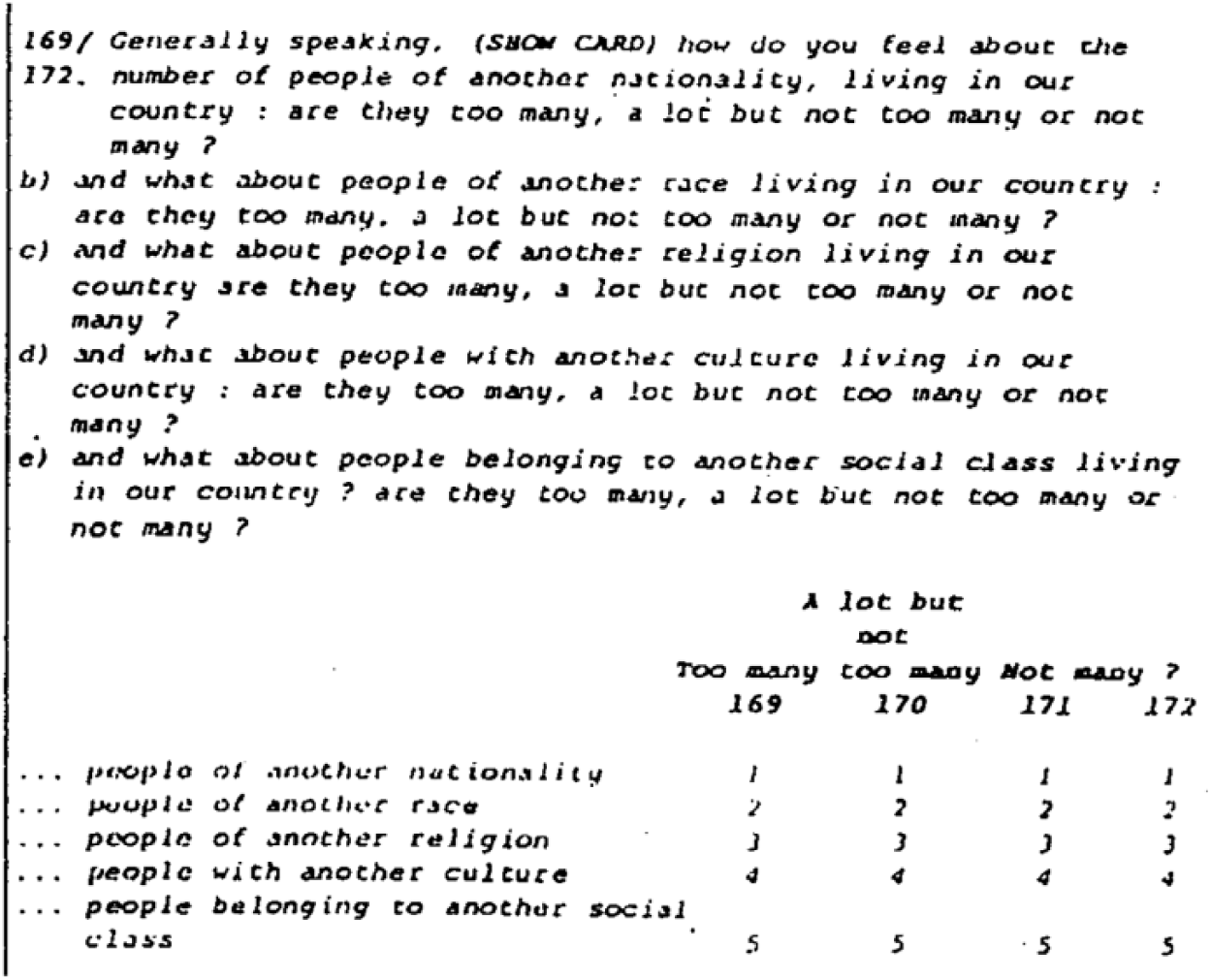
Question 167/172 from EB 30.
The question thus performs racism as a matter of attitudes (‘feel’) of individuals (‘you’), who, together with the interviewer, are part of a homogenized national entity (‘our country’), presumably associated with a single, normalized ‘nationality’, ‘race’, ‘religion’, ‘culture’ and ‘social class’. The object of racist attitudes is the presence of categories of people thus carved out as ‘other’. Racism is rendered countable by asking for the native’s feelings about numbers of people, from another country, another ‘race’, another ‘culture’. ‘Nationalities’, ‘cultures’, ‘social classes’, ‘religions’ and even ‘races’ make present fixed and hierarchically positioned social groupings. Furthermore, with answer categories ranging from ‘too many’ and ‘a lot but not too many’ to ‘not many’ – excluding the possibility of ‘too few’ – the a priori assumption is that a large presence of ‘others’ could be met with either resistance or indifference but in no way with approval. Rather, due to the repetition of the word ‘many’ in the various question and answer options, the presence of these ‘others’ is problematized in particular in terms of their numerousness – forging nascent postcolonial anxieties of ‘human excess’, ‘waves of migrants’ and ‘invasion’.
This first question is followed by a series of questions polling the respondent’s ‘attitudes towards others’ in which these categories of ‘others’ are frequently repeated. Interestingly, as these questions demonstrate, the survey projects racism within a national scale, thus simultaneously enacting ‘the national’ as a relevant collective and constituting ‘racism’ as a national issue. In the Eurobarometer report, however, the results of the 12 nationally conducted surveys are aggregated to produce findings on a European scale, thus leading to the articulation of the key finding that ‘One European in three believes there are too many people of another nationality or race in his country’ (Commission of the European Communities, 1989: 5).
Hence, as a result of the switching between individual, national and European ‘scales of observation’ (Chapura, 2009), Europe’s concern with racism is translated into a concern about the problematic presence of ‘numerous others’ who are de-Europeanized. Although the question shown in Figure 1 refers to the identity of ‘others’ only as the unspecified negative of an assumed national standard, the Eurobarometer report translates the findings to the European aggregate, enabling the imagination of a collective non-European ‘other’. This allows the Eurobarometer report to discuss ‘Opinions held by Europeans on “Others”’ (Commission of the European Communities, 1989: 57) and the ‘Identity and future of immigrant-populations in Europe’ (ibid.: 66), or to state that ‘The “other religion” at Community level is clearly Islam’ (ibid.: 36) and renders the non-European migrant-other legible as a common issue for Europe.
Locating racism
Racism sits uneasily between national and European vantage points. Scaling up means both lumping national outcomes together and shifting the border between ‘us’ and ‘them’ outward. As we will show in the following, it is also primarily through such scaling up that racism becomes all the more specifically locatable. The European scale that is constituted in the Eurobarometer report allows racism to be more easily attributed to specifically commensurated respondents: marginal, lower class people who apparently are unable to keep pace with European modernization and who are rendered visible as the negative exception to a morally superior European majority.
The Eurobarometer report opens rhetorically with a series of quotes from European declarations expressing Europe’s commitment to democracy, human rights and the condemnation of racism. Subsequently, it presents a summarizing note by the European Commission, stating, Respect for human rights and democratic principles are part of a common European ideological and political legacy. The following figures are sufficient evidence: for 78% of all Europeans, democracy is the best of regimes and respect for human rights is, for 60%, one of those great causes that are worthwhile.
Nevertheless, as the note proceeds, ‘a certain intolerance’ is evident and therefore requires that Europe ‘observes great democratic vigilance and assumes the political responsibilities that come with it’ (ibid.: 1).
As various studies have shown, the institutional language of tolerance and anti-racism exhibited in policy documents and debates can have the paradoxical effect of concealing and thereby participating in the further institutionalization of racism (Ahmed, 2012; Blommaert and Verschueren, 1998; Van Dijk, 1993; Wodak and Van Dijk, 2000). Various discursive techniques of racism denial may be at work, such as celebratory self-regard, the use of euphemisms and promoting an understanding of racism as ‘accidental’ (Ahmed, 2012: 48) and always ‘elsewhere’ – in the past, politically at the far right or socially at the bottom (Van Dijk, 1993). In a similar vein, as we will show in this section, the Eurobarometer enacts ‘the European’ as part of an ideologically anti-racist whole while reminding her of the threatening persistence of racism-at-the-margins, thus legitimizing the project of European integration.
In the Eurobarometer survey, these discursive effects are produced not only though evocative rhetorical language but also through rather mundane practices of selection, quantification and visual representation. For instance, the writing of a summary to a report requires a selection of the report’s ‘key findings’ – thus necessarily bringing into focus certain findings at the expense of others; it also requires decisions about how to present these findings and whether or not to bolster their factuality and transportability by referring to specific numbers (cf. Alonso and Starr, 1987). In the summarizing note, the previously mentioned finding that ‘one European in three believes there are too many people of another nationality or race in this country’ (Commission of the European Communities, 1989: 5) is the most specifically quantified finding regarding the existence of racism in Europe. Other findings mentioned in the summary are formulated more ambiguously or without quantification. 6 Crucially, the one-in-three figure signifies a minority. Arguably, it could be considered a ‘sizable minority’, one that indeed ‘requires democratic vigilance’ on the part of Europe; yet on the basis of the other two-thirds, it can still safely be claimed that on the whole Europe is ‘committed to democracy and human rights’ and ‘condemns racism’.
Critical examination of the number ‘one in three’ shows that the data constituting this apparently clear figure are not as unambiguous. The data provided in the report suggest that it must be derived from a table (see Figure 2), from which one can read that 37 percent of respondents indicated they feel there are too many ‘people of another nationality’ living in the country, and 33 percent indicated they feel there are too many ‘people of another race’.
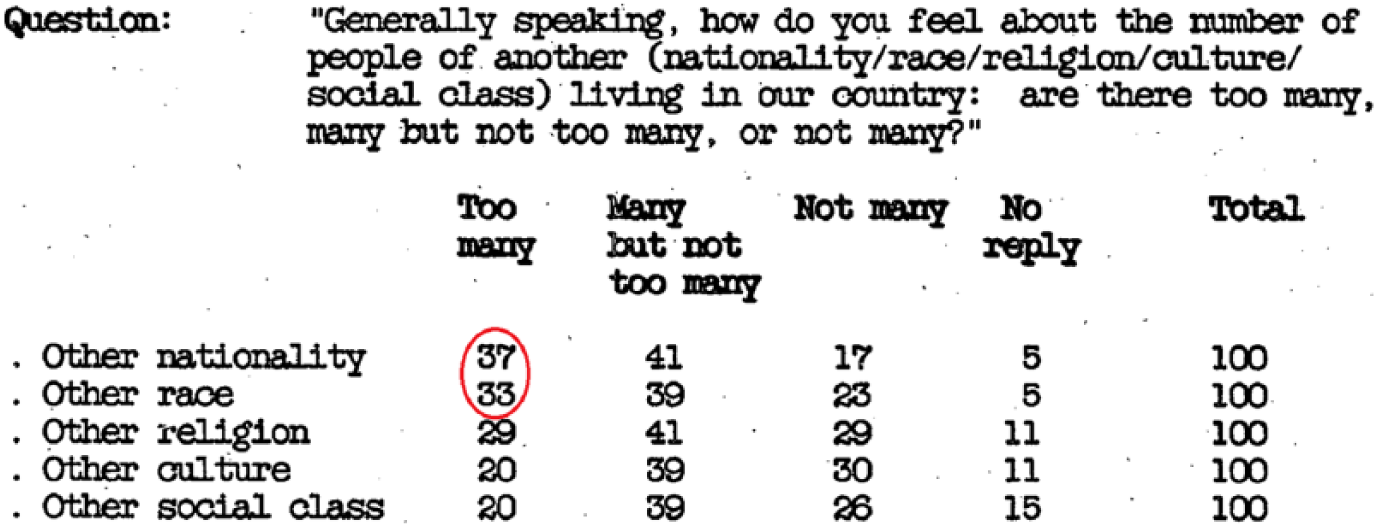
Table from EB report (circle added).
At first sight, one-third may be considered an acceptable translation of the 33 percent and the 37 percent. But as the respondents who answered they feel there are too many ‘people of another race’ may not (all) be the same as those who answered there are too many ‘of another nationality’; the total number of people who answered there are too many ‘people of another nationality or race’ must be at least 37 percent. Moreover, as we know, the full survey question not only inquired about ‘people of another nationality’ and ‘another race’, but also ‘people of another religion’, ‘culture’ or ‘social class’. In the report, a bar diagram is presented (see Figure 3), from which we can derive the percentage of respondents who indicated they feel there are too many ‘others’ of any of these five categories. As the figure shows, the result of this alternative representation of the data would be that not a minority, but in fact a slight majority of 51 percent of the respondents indicated that they feel there are too many of one or several groups of ‘others’ in ‘their’ country.
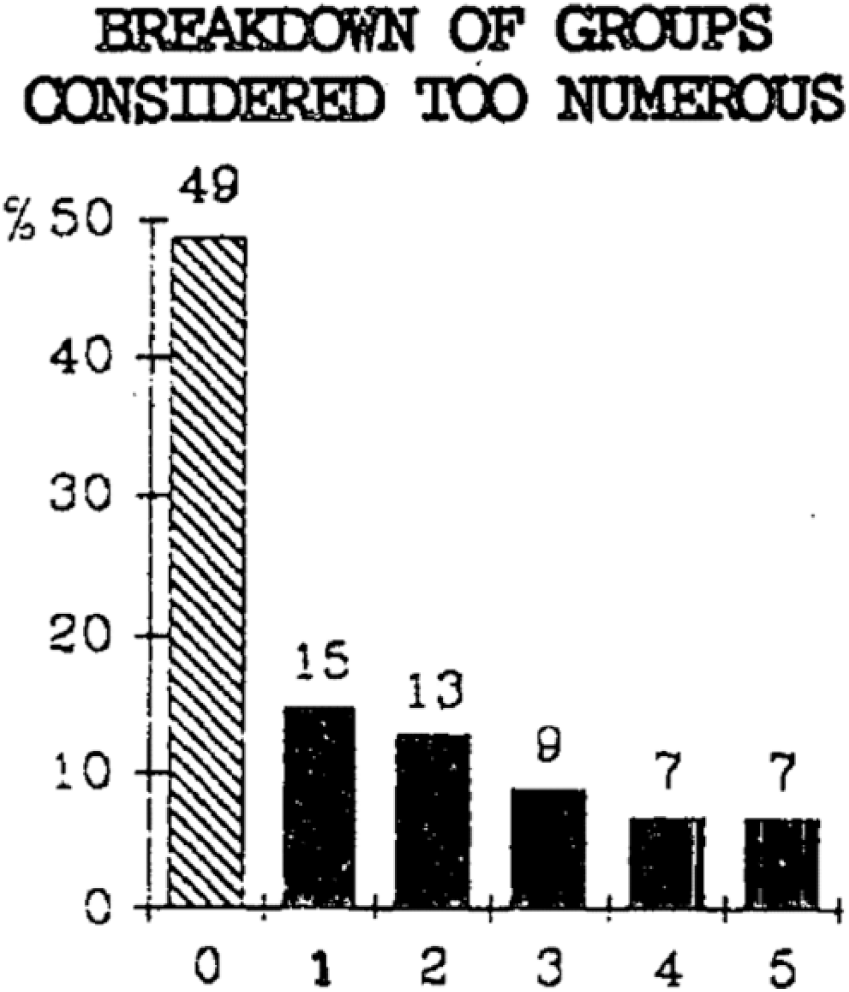
Bar diagram from EB report.
Also, although the report as well as the summary do acknowledge that there is a great variation between the different countries, the overall focus in the general analysis is on the figures produced at the European aggregate. However, when we scrutinize the rather imprecise bar-charts visualizing the responses by country, it turns out that the differences in responses between the various national samples are vast: less than 20 percent in Greece, Spain, Portugal and Ireland, and between 40 percent and 50 percent in Belgium, Germany, France and the United Kingdom. European scaling thus glosses out these differences and overlays them with a lowest possible average of ‘one out of three Europeans’.
The visual representation of these results is also significant. As the two examples in Figures 3 and 4 show, this tends to be done in a form that visually displays ‘the non-racist category’ to be the largest one, although it is proportionally not at all that dominant, or even a minority.
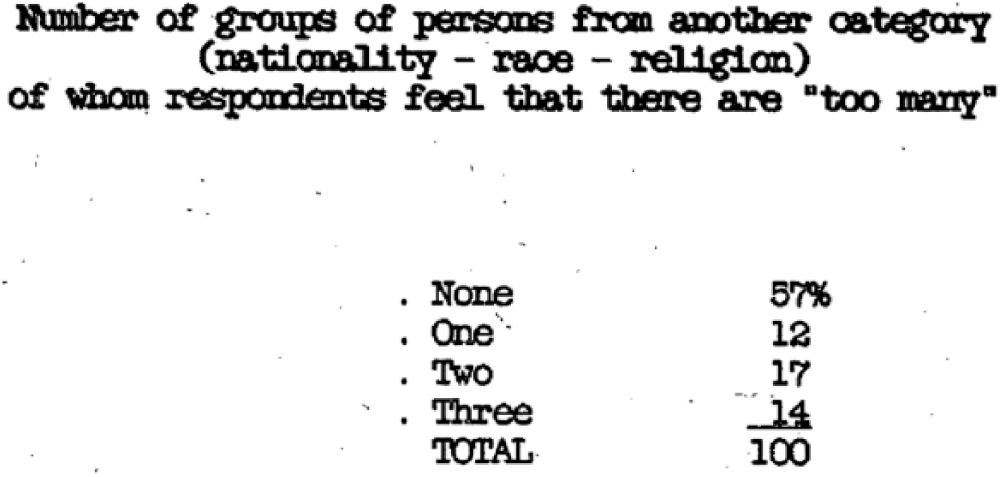
Table from EB report.
Hence, through techniques of visual presentation, a European democratic ‘moderate middle’ is constituted as a dominant majority and as a counterweight to a ‘racist minority’. Simultaneously, as we will now show, this minority is cast specifically as a minority of materialist, right-wing-oriented lower educated respondents (cf. Lipset, 1959). Hence, the summary states that ‘[a]dvancing age, a lower education level, a tendency towards “materialism” and right-wing leanings go hand in hand with the feeling that there are too many “others”’ (Commission of the European Communities, 1989: 5). Throughout the report, socio-political variables, and ‘educational level’ in particular, figure prominently in the analysis of attitudes toward ‘others’ but also for instance in the analysis of ‘attitudes towards human rights and democracy’. These variables are repeatedly named as ‘significant factors’, which is manifested in tables showing their relative weight.
As the socio-political variables and their attendant categorizations of people are reiterated over and over in the text and tables, these categories become increasingly stabilized as (fixed attributes of) groups of people, thus contributing to the ‘making up’ of a new ‘kind’ of people (cf. Hacking, 2007). And as the overall results of the survey tend to simultaneously emphasize the dominance of enlightened, democratic, non-racist values, it follows that those groups of respondents who tend to have ‘intolerant’ views – associated with ‘a low education’ – are the negative exception.
However, a closer look at the data in and behind one of these tables offers quite a different view. If we look at the table (see Figure 5), depicting the ‘level of education’ as an explanatory factor for the feeling that ‘there are too many “others” in the country’, it turns out that the results for ‘the low-educated’ (42% said there are ‘too many people of another nationality in the country’) are often quite comparable to those of the ‘medium-educated’ (41% chose the same answer option). In fact, the percentages of the ‘low’ and ‘medium-educated’ come quite close to the result for the total European aggregate (37%), but this is easily overlooked as the European aggregate is left out of this table.
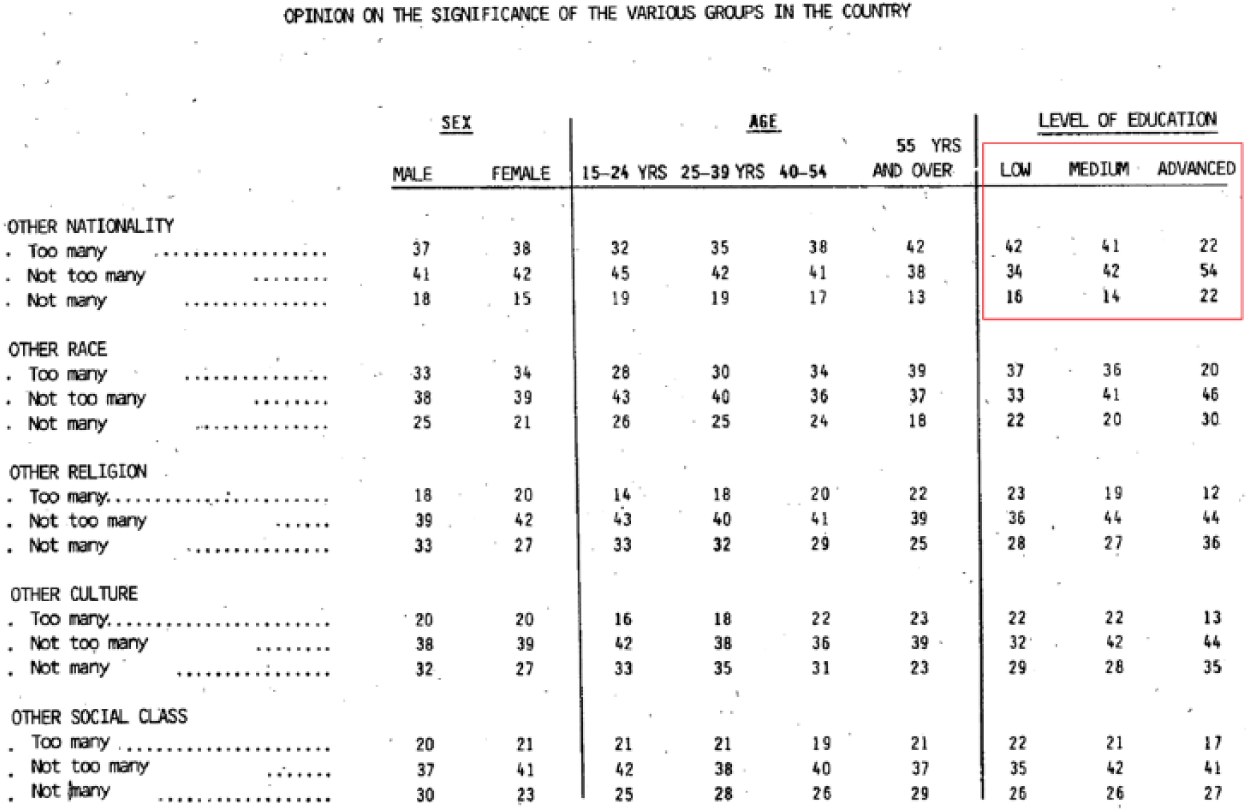
Table from EB report (rectangle added).
In addition, as we further unravel how the different educational groups were construed, we find in the Variable Report (Commission of the European Community, 2012) that on a European scale, the category of ‘low-educated’ – defined as those who left full-time education at the age of 15 or younger – turns out to constitute the biggest group (39%), followed by those having a ‘medium level education’ (33%), while those having an ‘advanced level’ of education constitute a slim minority of 15 percent (pp. 927–929). Looking at the data in this way creates the alternative possibility that it is rather the category of the ‘advanced-educated’ (22% of ‘them’ said there are too many ‘others’ in the country) that forms the exception, thus rendering the imagination of a ‘lower educated intolerant’ minority versus a dominant European moderate middle a very particular summation of the findings.
Moreover, as the report translates individuals’ responses regarding the number of years people say they spent in full-time education and responses regarding attitudes toward ‘others’ into significant effects on a European scale, the focus on these socio-political effects tends to have a harmonizing effect. It helps to enact a European statistical population, as well as European ‘levels of education’, ‘levels of income’ and ‘right-wing leanings’. What is not mentioned in the report, but can be derived from the Variable Report, is that the differences between national datasets are vast, with ‘the low-educated’ comprising up to around 50 percent to 67 percent of respondents in Portugal, Italy, Spain and Greece, and 13 percent and 22 percent in Denmark and the Netherlands. Thus, by relating various measures of ‘attitudes towards others’ and ‘attitudes towards democracy’ with ‘education level’ on a European scale, another strand of people – an imagined European class of the low-educated – is constituted as a ‘minority’ in, but not of Europe (cf. Lentin, 2008).
Calibrating the other of Europe
One of the key issues the Eurobarometer survey set out to explore turns out to be deeply ambiguous. The question of ‘who these others are, in European eyes’ (Commission of the European Communities, 1989: 35) appears to produce responses that are difficult to commensurate. After the survey question inquiring into the respondent’s feelings about the number of ‘others’ living in the country, the next question invites the respondent to specify who these others are: ‘When you hear about people of another nationality, whom do you think of? (What nationality?)’. It is an ‘open question’ – the questionnaire even instructs the interviewer specifically with the words: ‘DO NOT SUGGEST. DO NOT PROMPT’. The survey repeats this question with regard to the other dimensions of difference (‘race’, ‘religion’ etc.).
To be able to report the data, the ‘spontaneous answers’ to these questions were then encoded. With regard to ‘people of another race’ for instance, this resulted in a list of racial codes including ‘Whites’, ‘Blacks’, ‘Orientals (yellow race)’, ‘Gypsies’, ‘Arabs’, ‘Turks’, ‘Indians’ and ‘Indonesians, Malaysians’ (ibid., 1989: 38), which are then presented as fully normalized categories. The report presents the survey findings in a set of tables accompanied by a brief explanation: With regard to the
Thus, through its practices of inquiring and reporting about racism, the 1988 Eurobarometer contributed to the stabilization of bounded, reified racial and religious categories and constituted ‘Europe’ as a non-Muslim and ‘white’ domain.
Apparently and somewhat unsurprisingly, when it came to defining ‘the other nationality’ of Europe, the data proved more problematic to commensurate. The report therefore states, European countries can be divided into a number of groups: countries […] where a number of nationalities are mentioned at comparable levels of importance; countries […] where associations made by the respondents clearly point to non-European populations; finally, in countries with low levels of immigration […] people find it less easy to identify a non-national and tend more to mention European nationals as foreigners […].
This account is accompanied by a table (see Figure 6).
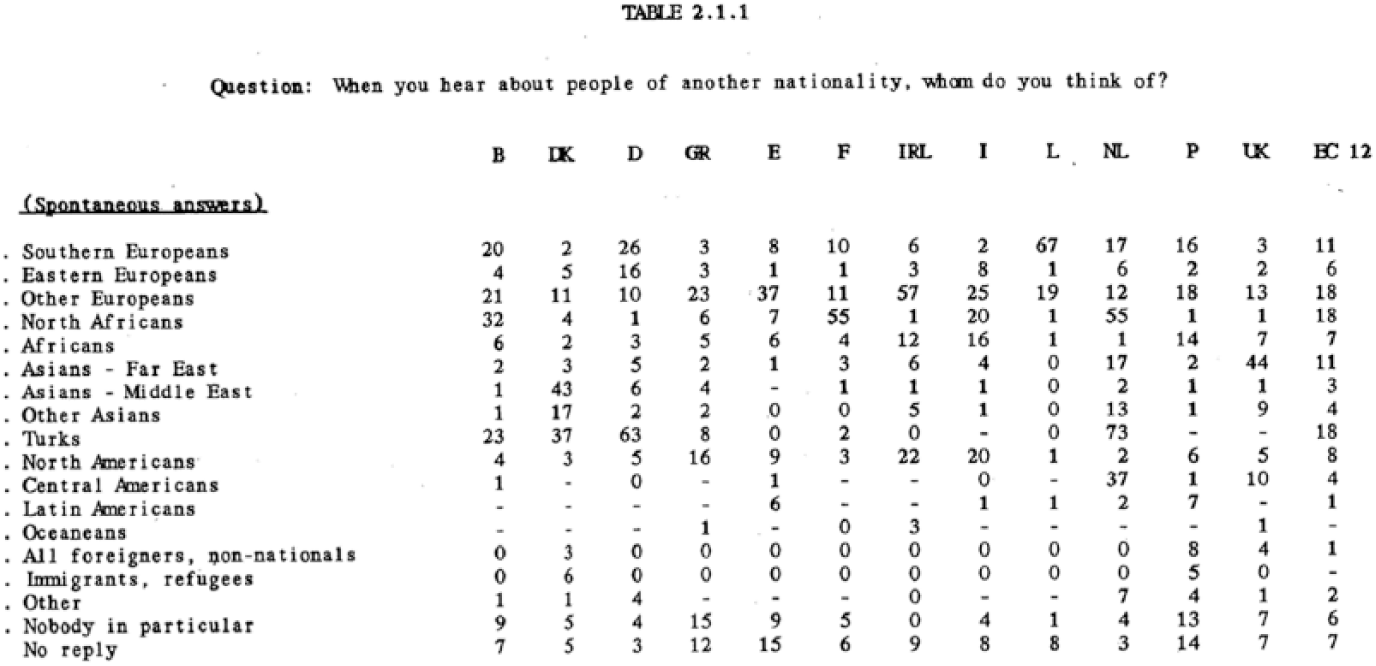
Table from EB report.
If we take a look at ‘the European aggregate’ as shown in the table, in the column at the far right, we see that three encoded groups of ‘others’ are mentioned most often: ‘Turks’, ‘North Africans’ and – ironically – ‘Other Europeans’ (18% each). As a result of the way responses have been encoded, ‘Turks’ are made visible as a recognizable, national category of ‘others’, whereas national EC member state populations are made invisible here. Whereas ‘Turks’ are only mentioned to a significant proportion (23%–73%) in four countries (the Netherlands, Germany, Denmark and Belgium), ‘Other Europeans’ is the only category to which significant percentages of respondents from all 12 EC Member States refer: between 10 percent and 57 percent. In addition, quite substantial percentages of respondents from various countries identify ‘Southern Europeans’ as the ‘others’ they think about (e.g. 67% in Luxembourg, 26% in Germany and 20% in Belgium).
As European nationals are dissolved into broad categories of ‘Southern’, ‘Eastern’ and ‘Other’ Europeans, which include but do not consist exclusively of EC member state countries, what is rendered invisible, and technically impossible to calculate, is this: What percentage of the EC population pointed at one of their ‘fellow’ EC member-state-populations as the group they think of when asked about ‘others’?
Thus, by bringing into view a specifically European aggregate, the Eurobarometer report averaged out the differences between national situations and allowed for racism to become a problem of extra-European immigration. Through the phrasing and ordering of questions, the use of categorizations, encoding practices, the use of rhetoric and repertoire, the selective reporting of findings and the switching between national and European scales, the survey contributed to the constitution of a homogeneous European whole, in which internal differences and frictions were silenced. It performed an immigration/racism nexus as a common European challenge, from which the object of that racism – the non-European immigrant other – was excluded. ‘Europe’ was inscribed as a much-needed political institution to care for the European population and to defend democracy and human rights, which should therefore be permitted ‘to assume the political responsibilities that come with it’.
Conclusion
As we have argued, the Eurobarometer survey on the rise of racism in Europe contributed to the coming-into-being of the very phenomenon it set out to explore. It formulated ‘European racism’ as an issue, but simultaneously enacted it as a pathological attitude, associated with an underclass of the lower educated. Although the Eurobarometer report acknowledges several times that a significant difference emerges between member states, the overall focus of the report is on ‘Europe’ as a whole. This is understandable, as it has always been in the interest of the European Commission to create support for the continuous expansion of European legislation and responsibility, which requires the making of European issues fit-for-policy. Clearly, policy makers realized early on that the implementation of the ‘Common European Market’ would have far-reaching implications for the governance of migration, as well as for the governance of labor, security, social and environmental protection, and thus for ‘the governance of life and death’ in general (cf. Urwin, 1991).
In this process, and as intricate part of it, the contours of what we have called the raced constitution of Europe become visible. The governance of labor and immigration deemed a key aspect of the ‘European project’ was accompanied by forms of racism and xenophobia that came to be construed as a ‘backlash’ of, or a ‘reaction’ to, the progressive project of European integration (cf. Van Reekum, 2012). The public opinion research commissioned to investigate this has offered a site at which the raced constitution of Europe becomes visible at the interstices of the scales of the individual citizen, the nation and Europe.
Our study can then be considered as part of a line of work encompassing studies by Porter, Desrosières and Rose, that illustrates how societies get to be constituted as placeholders for the ontological realms behind statistical regularities (cf. Schinkel, 2017). In other words, borrowing from Deleuze’s interpretation of Foucault, ‘Europe’ becomes an object in the visibilities and the statements that express it (Deleuze, 1986). ‘Europe’ is an object of articulation, both for policy makers and politicians, and for citizens’ imagination.
But that articulation, while explicitly situated in opposition to racisms past and present, is itself raced in significant ways. In the very act of locating racism, ‘Europe’ gets to be articulated in raced terms as a corollary of various ‘others’. Through practices of measuring racism on a European scale, a double dichotomy emerges: one between a European, native ‘whole’, which speaks to Europe through the survey, and groups of migrantized ‘others’ who are performed as a political problem for this nativized Europe, and another one between a European ‘moderate middle ground’, that is enlightened, democratic and racism-free, and a marginalized European minority of lower educated with racist attitudes. Through these two dichotomies, Europe itself then becomes reconfigured as an ideological and political ‘whole’ responsible for protecting the European people from the lingering threat of racism, thus feeding into Europe’s foundational myth that has existed from Rousseau to the postwar birth of the EU. The performative effects of the Eurobarometer study can thus be understood as part of what Vigneswaran (2013) calls an integrating spatial strategy related to the EU’s market-driven policies (p. 85).
Precisely by sorting out whose opinion gets to be part of ‘public opinion’, and who gets to be the object of public opinion, the attempt to localize racism is thus at once a situating of ‘Europe’ in registers that are raced from the outset. In order to see this, one needs to consider how ‘Europe’ is performed in public opinion research as an object that arises out of a process of scale-switching. Out of individually collected ‘opinions’ in nationally bounded and specific ways, a European scale is crafted in conclusions concerning commensurated forms of a ‘European public opinion’. Paying due attention to exactly how such entities and scales come into being, we argue, is key in understanding contemporary anxieties over Europe in relation to Brexit and current racist discourses and policies concerning immigration. It also helps as a warning against all-too easy categories such as a ‘white working class’, currently much discussed as a supposed driver of both the election of Donald Trump in the United States, and of the Brexit vote in the United Kingdom. Such conceptions are part of an ongoing reconstruction of racial categories in which white and non-white, European and non-European, self and other are continually under negotiation. It is important to highlight the bureaucratic and statistical work of categorizing and measuring that renders such notions plausible in the first place. The linking of racism and a ‘white working class’, too, is possible through a number of omissions. For instance, is there really a separate class consciousness?; are rural and former industrial areas currently considered the home of a ‘white working class’ exclusively white? (they are not); and what occupations are and are not included in the ‘white working class’? Such questions are indicative of the work of selection one has to do to craft racial categories. For the EU, a pivotal moment at which that work became systematized is the 1988 Eurobarometer survey.
Racism is, of course, always enmeshed in practices of bordering. And so it should be no surprise that the constitution of ‘Europe’ is raced. What we hope to have contributed to the understanding of the raced constitution of Europe is, then, the specific way in which racist bordering can be both facilitated and invisibilized in a play of scale-switching. The shifting back and forth between different scales contributes to an imagination of Europe as a community of shared values incompatible with racism, a welfare polity fighting against cancer, a set of regulations enabling a prosperous and free market economy and the scale at which problems of immigration are best dealt with. It enacts a nested national-European public that, confronted with a problematic presence of migrant others, is in need of European governance to address this presence, precisely as a way of preventing racism. Along the way, ‘Europe’ is imagined as an anti-racist project, while the raced nature of this imagination, visible only in the scrutiny of its statistical articulation, is invisibilized. Practices of statistical monitoring of racism can thus be seen as instances of the articulation of an entanglement of scale and public opinion that, together, make up the raced constitution of ‘Europe’.
Footnotes
Funding
The author(s) disclosed receipt of the following financial support for the research, authorship, and/ or publication of this article: This research was part of the European Research Council funded project “Monitoring Modernity: A comparative analysis of practices of social imagination in the monitoring of global flows of goods, capital and persons” (ERC Starting Researcher Grant, project number 283679).