




Abstract
Aims and objectives/purpose/research questions:
Research in bilingual phonetics and phonology often aims to identify factors that influence specific features of “accented” speech production and perception, with the goal of explaining patterns of cross-language influence. In recent years, language dominance has emerged as a key predictive factor in bilingual phonetics research, with tools like the Bilingual Language Profile (BLP) being used to assess it.
Design/methodology/approach:
This paper explores the concept of language dominance and reviews studies that highlight the versatility of the BLP as an assessment tool, particularly in relation to the phonetic properties of minoritized languages in contact with Spanish, as well as Spanish in contact with English.
Data and analysis:
The BLP is a widely used, open-source instrument that assesses language dominance through self-reports. It generates a continuous dominance score and provides a comprehensive bilingual profile, considering multiple factors such as age of acquisition, frequency and context of language use, proficiency in different language skills, and attitudes toward each language.
Findings/conclusions:
This overview demonstrates that: (1) BLP indices can quantify the degree of language dominance at the individual level, useful for participant screening, grouping, or as a predictor variable in statistical analyses. (2) Language dominance is best understood as a gradient, continuous construct. (3) Bilingual groups are inherently heterogeneous, with significant variation in language dominance, and the BLP can capture this heterogeneity in fine detail. (4) BLP indices can reveal asymmetrical language dominance effects resulting from language co-activation. (5) BLP indices may not always capture differences in bilingual speech production and perception.
Originality:
These findings highlight the explanatory power of the BLP indices in accounting for subtle cross-linguistic phonetic influences in bilingual speech production and perception.
Significance/implications:
This paper introduces key methodological and theoretical considerations for future bilingual phonetics and phonology research while also offering insights into the broader applications of the BLP for understanding bilingual speech.
Introduction
Language dominance is a multifaceted construct that encompasses various aspects of linguistic experience, including proficiency, fluency, processing efficiency, frequency of use, and cultural affiliation. It has been defined as “observed asymmetries of skill in, or use of, one language over the other” (Birdsong, 2014, p. 374). Within an individual, such asymmetries may manifest in multiple ways—for instance, through more frequent daily use of one language or the ability to speak or read aloud more words per minute in that language compared to the other. This underscores the inherently relative nature of language dominance: it is not a fixed, categorical state but rather a measurable continuum, where one can be more or less dominant in a given language relative to other bilinguals. Furthermore, the balance between a bilingual’s languages can fluctuate over the course of a lifetime, reflecting the dynamic and context-dependent nature of language dominance (de Leeuw, 2019; Kelly, 2022; Kornder & Mennen, 2021).
Since Lambert’s (1955) introduction of language dominance as a measurable construct in bilingualism research, and its subsequent rise to prominence (Hamman et al., 2019; Silva-Corvalán & Treffers-Daller, 2016), it has emerged as a central predictive variable in the study of bilingual behavior. Empirical work has demonstrated that language dominance shapes a wide range of linguistic phenomena, including code-switching tendencies (Basnight-Brown & Altarriba, 2007), the organization of bilingual lexical memory (Heredia, 1997), language choice in self-directed and silent speech (Dewaele, 2004), preferred language for mental arithmetic (Tamamaki, 1993), and the extent of cross-linguistic influence in syntactic processing (Rah, 2010), as well as in bilingual phonetics and phonology (see Birdsong & Amengual, 2024, for a review).
Although numerous ad hoc methods have been employed to assess language dominance, the past two decades have seen the development of several reliable, valid, and widely accessible standardized instruments for this purpose. Prominent examples include the Bilingual Language Profile (BLP; Birdsong et al., 2012), the Bilingual Dominance Scale (BDS; Dunn & Fox Tree, 2009), the Self-Report Classification Tool (SRCT; Lim et al., 2008), and the Language Experience and Proficiency Questionnaire (LEAP-Q; Marian et al., 2007). Comparative analyses of these tools, including their content and outcomes, are provided in Gertken, Amengual, and Birdsong (2014) and Peña et al. (2021).
This paper critically examines the construct of language dominance and reviews research demonstrating its effects on bilingual speech, with particular focus on the phonetic characteristics of minoritized languages in contact with Spanish (such as Catalan, Galician, and K’ichee’) as well as Spanish in contact with English in the United States. The review emphasizes the predictive value of the BLP, a widely used instrument in bilingual phonetics research. It illustrates how BLP metrics provide a reliable and replicable means of quantifying language dominance at the individual level, enabling both the classification and grouping of participants and the use of dominance as a categorical or continuous predictor variable in statistical modeling. Overall, the paper underscores the BLP’s versatility as a tool for operationalizing language dominance and its central role in advancing understanding of cross-linguistic influence in bilingual speech production and perception.
Expanding on this discussion, the paper is structured to develop a systematic exploration of the conceptual and empirical dimensions of language dominance, as assessed by the BLP. “The Bilingual Language Profile” introduces the BLP as a valid, reliable, and widely accessible self-assessment instrument for evaluating language dominance. “Instructive studies and use of the BLP in bilingual speech perception and production” highlights the tool’s flexibility and relevance in research on bilingual speech perception and production. This section demonstrates that BLP-derived measures can predict cross-linguistic influence in bilinguals’ production and perception, support the conceptualization of language dominance as a gradient and continuous construct, and capture the inherent heterogeneity of bilingual populations. It also examines how language co-activation interacts with dominance as operationalized by the BLP and discusses instances where BLP indices appear insufficient to detect group-level differences or to fully account for interlingual effects in specific phonological processes. Finally, “Discussion and conclusion” offers reflections on future research, recommending expansion of the BLP to additional language pairs, communities, and phonetic variables. Such developments promise a more comprehensive understanding of bilingual phonetic behavior and cross-linguistic influence.
The Bilingual Language Profile
The BLP is a user-friendly, open-source, and freely accessible instrument designed to assess language dominance. Since its inception in 2012, the BLP has been supported, hosted, and distributed by the Center for Open Educational Resources and Language Learning (COERLL) at the University of Texas at Austin. The BLP generates comprehensive indices of language dominance based on self-reported data, producing a continuous dominance score as well as an overall bilingual profile that incorporates multiple dimensions, including age of acquisition, frequency and context of language use, proficiency across various skills, and language attitudes. Bilingual individuals complete 19 questions across four modules (Language History, Language Use, Language Proficiency, and Language Attitudes), evaluating each language separately. The Language History module collects information on the age of acquisition for each language, the age at which the individual felt comfortable using each language, years of formal education in each language, duration of residence in regions where the languages are predominantly spoken, and time spent working in environments requiring each language. The Language Use section assesses the proportion of language use during an average week across different social contexts, such as interactions with friends, family, and at school or work, as well as self-directed speech patterns like talking to oneself or counting in each language. In the Language Proficiency module, participants rate their speaking, listening, reading, and writing abilities on a scale from 0 (“not well at all”) to 6 (“very well”) for each language. Finally, the Language Attitudes module explores the degree to which individuals feel authentic when speaking each language, their cultural identification with speakers of each language, and the importance they place on using the language like a native speaker or being perceived as one.
Participant classification as dominant in one language or the other is based on their responses to the BLP questionnaire, which produces a global score for each language (Language A and Language B), individual scores for each module, and an overall dominance score. Each module comprises a series of questions answered numerically for both languages. Separate scores are calculated for each language, which are then converted into a scale score by subtracting the Language A score from the Language B score. The resulting dominance scores range from -218 to 218, with these numerical indices quantifying the degree of language dominance at the individual level. These dominance indices, which researchers can employ either to group participants or as predictor variables in statistical analyses, may be applied flexibly depending on the specific goals of the research project.
The BLP was developed to assess bilinguals across diverse linguistic and cultural backgrounds and contexts, including second language (L2) acquisition, heritage language learning, language attrition, immigrant experiences, and both sequential and simultaneous bilingualism. It is currently available in over 32 language versions, covering 40 language pairings. One advantage of the BLP, and similar dominance assessment tools, is its reliance on self-evaluation. Self-reports are efficient, requiring less time than linguistically based tasks, easier to interpret, and free from complex scoring or statistical analysis. Research consistently shows that bilinguals can accurately evaluate their language experience and proficiency in ways that align with behavioral measures of performance (Flege et al., 2002; Gollan et al., 2012; Langdon et al., 2005; Lim et al., 2008; Marian et al., 2007). However, self-assessments may be affected by factors such as linguistic insecurity or prestige asymmetries within a bilingual community, much as language anxiety can influence second-language learners’ self-ratings (MacIntyre et al., 1997). Recent work by Li and Zhang (2021) also reports moderate correlations between self-assessed proficiency and actual language performance.
The BLP scores are composite measures derived from the sum of responses across multiple items that capture diverse aspects of bilingual experience (see Luk & Bialystok, 2013). As a result, identical BLP scores are unlikely to correspond to identical response patterns across all items. Therefore, two bilingual individuals with the same dominance score should not be assumed to have equivalent profiles with regard to the underlying components of language dominance. The BLP’s validity has been established through comparisons with objective proficiency assessments and other language dominance measures (Gertken et al., 2014; Solís-Barroso & Stefanich, 2019), confirming that it is a reliable and valid self-report instrument for assessing language dominance (Olson, 2023).
Instructive studies and use of the BLP in bilingual speech perception and production
The BLP has been extensively employed in recent research on bilingual speech production and perception to classify participants according to their language dominance across a diverse range of language pairs. These include Spanish-Catalan (Amengual, 2016c, 2016d; Nadeu & Renwick, 2016; Ramírez & Simonet, 2018; Simonet, 2014), Portuguese-English (Osborne, 2021), Spanish-K’ichee’ (Baird, 2015), Spanish-Hñäñho (Mulík et al., 2021, 2023), Spanish-Yucatec Maya (Uth, 2016), Spanish-Afrikaans (Henriksen et al., 2021), Spanish-Galician (Amengual & Chamorro, 2015), Spanish-English (Amengual, 2016a, 2018, 2019; Casillas, 2015; Casillas & Simonet, 2016), Spanish-Welsh (Bell, 2017), and Korean-English (Jung & Dmitrieva, 2024). Collectively, these studies demonstrate that language dominance, as measured by the BLP, serves as a robust predictor of cross-linguistic influence in bilingual speech production and perception.
BLP indices predict cross-linguistic influence in the production and perception of bilinguals
A compelling demonstration of the predictive potential of BLP indices is Amengual (2016c), which examines the perception and production of the Catalan mid vowel contrasts by 60 early Spanish-Catalan bilinguals in Majorca (Spain). Because Catalan has four vowels (/e/, /ɛ/, /o/, and /ɔ/) and Spanish has two (/e/ and /o/) in the same phonetic space, the Catalan mid vowels are vulnerable to the influence of Spanish in both production and perception (Mora & Nadeu, 2012; Pallier et al., 1997; Ramón-Casas et al., 2009; Simonet, 2011). In Amengual (2016c, 2016d), the Spanish BLP score was subtracted from the Catalan BLP score. A positive final score indicates dominance in Catalan while a negative score indicates dominance in Spanish. The score limits of the questionnaire are -218 and 218; that is, -218 would be indicative of Spanish monolingualism, and 218 would be indicative of Catalan monolingualism. A score of zero represents balanced bilingualism. These BLP indices that are used to quantify the degree of dominance enable a binary grouping classification of Spanish-Catalan bilinguals for the comparison of Spanish-dominant and Catalan-dominant bilinguals’ perceptual performance. Figure 1 displays the BLP score distribution of the Spanish- and Catalan-dominant groups in Amengual (2016c).
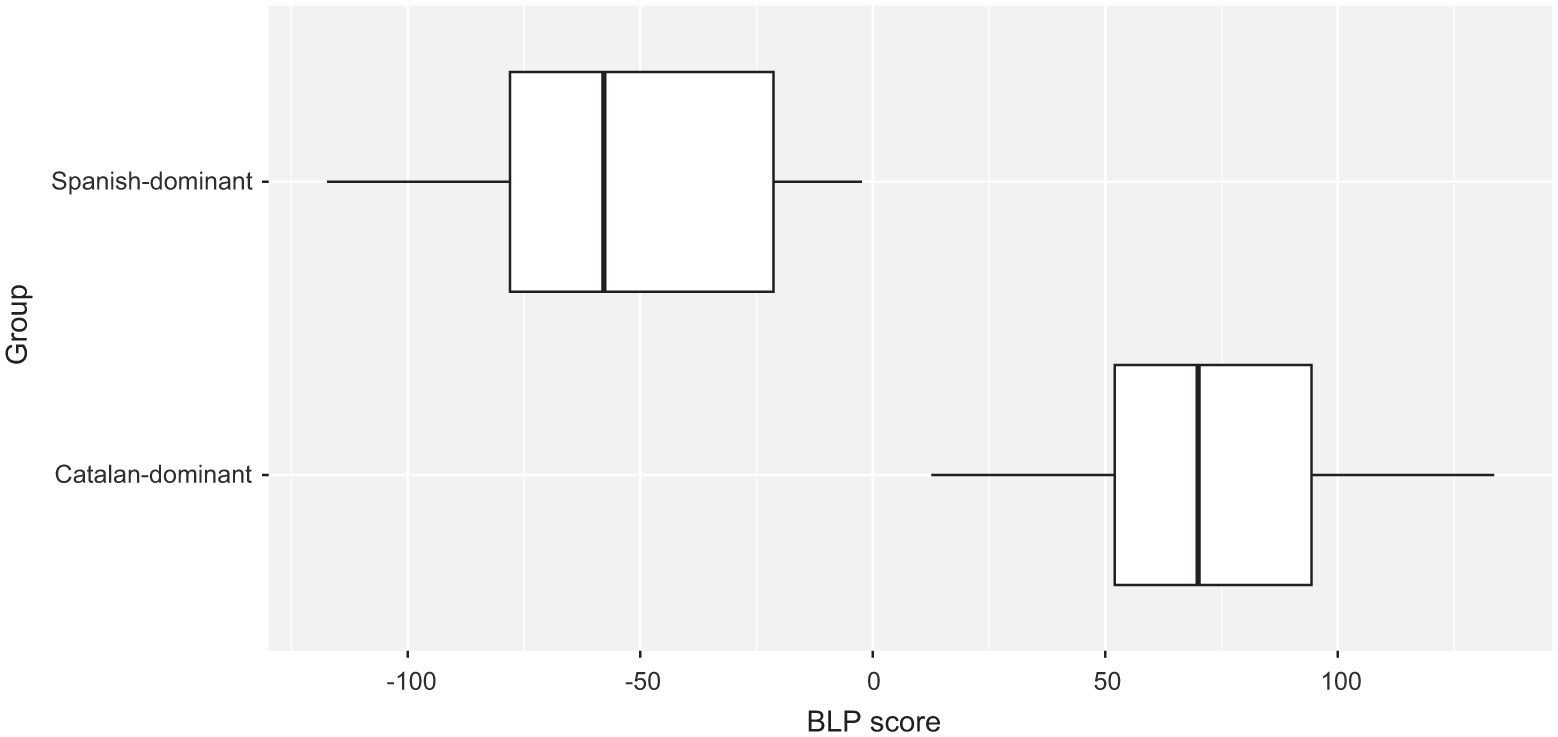
Language dominance as a function of group according to the BLP in Amengual (2016c).
Findings from a categorical AXB discrimination task reported by Amengual (2016c) reveal that the Catalan-specific mid vowels (/e/-/ɛ/ and /o/-/ɔ/) pose greater perceptual challenges than other vowel contrasts in Majorcan Catalan. Moreover, Spanish-dominant bilinguals exhibited higher error rates compared to their Catalan-dominant counterparts. These results corroborate earlier research suggesting that Catalan mid vowels, which acoustically and perceptually overlap with Spanish /e/ and /o/, present difficulties for Spanish-dominant speakers. In addition, the study identified perceptual challenges and differences between the groups in distinguishing the /ɛ/-/a/ contrast, potentially attributable to the relatively lower mid-vowel realization of /ɛ/ in Majorcan Catalan, which reduces the acoustic distance between /ɛ/ and /a/ compared to other Catalan dialects.
Language dominance is better understood as a gradient, continuous construct
Bilinguals can be discretely classified as dominant in one or the other language based on BLP indices, as shown in the previous section. However, language dominance is better understood as a continuous, not dichotomous variable (e.g., Grosjean, 2001), and discrete classifications of language dominance in groups or bins may obscure distinct patterns of between-speaker variation. To investigate individual variation in the production and perception patterns of bilinguals, several studies have incorporated gradience into the variable of language dominance by examining individual speakers’ BLP score (Amengual, 2016b; Amengual & Chamorro, 2015; Baird, 2015; de la Fuente Iglesias & Pérez Castillejo, 2020). The continuous nature of language dominance can be correlated with other continuous measures. An example of this can be found in vowel-production studies, in which Euclidean distances or Pillai scores are used to quantify the acoustic distance between two vowel targets and are correlated with individual BLP data points as a continuous measure of language dominance. An example of this analysis is a recent study on the perception and production of the Galician mid vowel contrasts in Amengual and Chamorro (2015). As is the case for Catalan, the Galician vowel system provides the opportunity to test sounds that are susceptible to contact-induced change: in contrast to Spanish, Galician has a seven-vowel system, with an additional contrast in height, distinguishing higher-mid vowels /e/ and /o/ from lower mid vowels /ɛ/ and /ɔ/ in stressed syllables.
Amengual and Chamorro (2015) demonstrate that BLP indices are useful predictors of cross-linguistic influence in the production and perception of Galician mid vowels by Spanish-Galician bilinguals. In this production and perception study, 54 early Spanish-Galician bilinguals from Vigo and Santiago in Galicia (Spain) participated in binary forced-choice identification tasks, AX discrimination tasks, and a reading-aloud task. As shown in Figure 2, the participants in this study displayed a wide range across their BLP values, and keeping a binary grouping (Spanish-dominant, Galician-dominant) may obscure relevant data to explain relevant patterns of between-speaker variation.
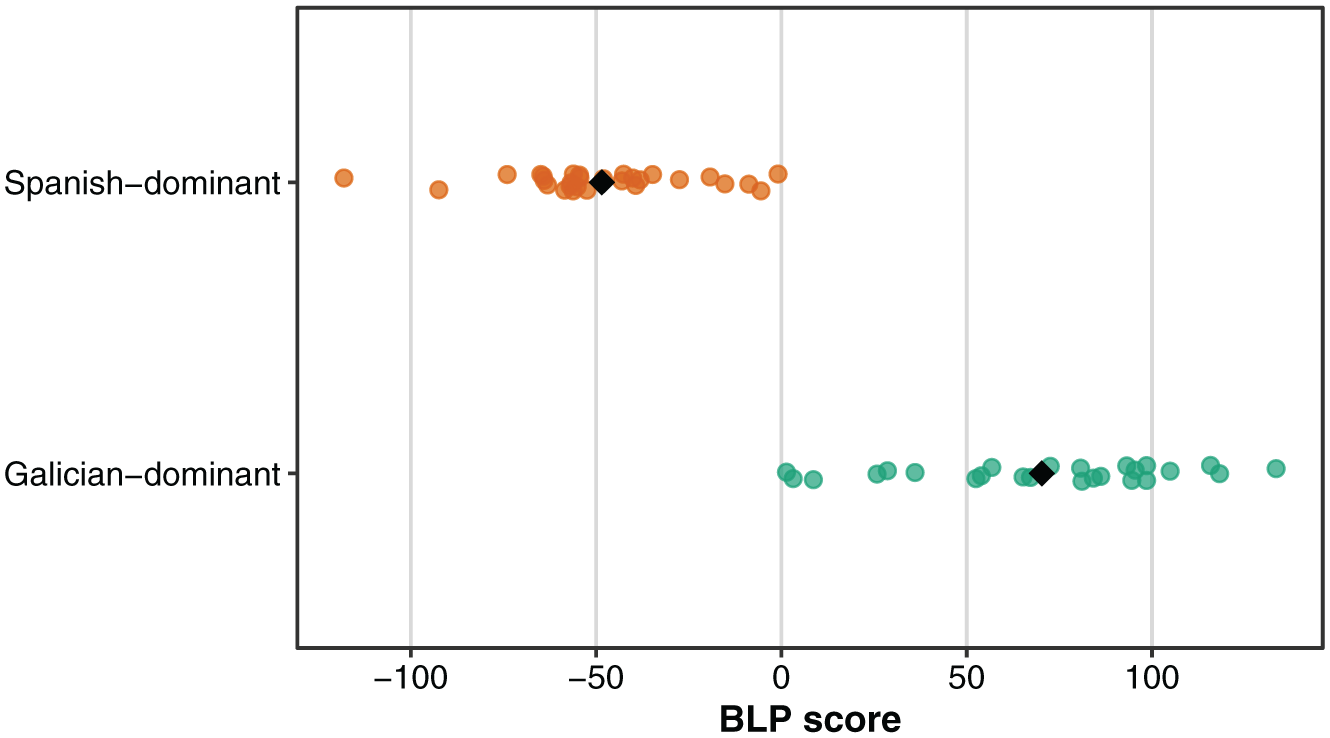
Individual Language dominance scores as a function of group according to the BLP in Amengual and Chamorro (2015).
With regards to their production of the Galician mid vowels, Pillai scores representing the vowel cluster difference between Galician /e/–/ɛ/ and /o/–/ɔ/ were calculated for each individual speaker by which the higher the Pillai score, the lower the degree of overlap, and larger distinction, between the two vowel clusters. This production data was correlated with the BLP values of each individual Galician-Spanish participant. The results revealed that the Pillai score was smaller for Spanish-dominant bilinguals than for Galician-dominant bilinguals, and correlations between the individual language dominance values (based on the BLP indices) and Pillai scores yielded a significant positive correlation only for the Galician-dominant group. In other words, the Galician-dominant bilinguals who were more dominant in Galician were found to maintain less overlap, and thus a larger distinction between the Galician /e/–/ɛ/ contrast.
Another study that provides a convincing case for utilizing individual BLP indices as a continuous value for language dominance is Baird (2015). In his study on peak alignment in Spanish, Baird shows that BLP values can predict subtle features of accent among Spanish-K’ichee’ bilinguals in Guatemala. While the intonation in broad focus in most varieties of Spanish has been shown to display a “late peak” (a pitch contour that rises in the tonic syllable but does not reach its peak until a post-tonic syllable), several studies have shown that “early peaks” (pitch contours that peak within the tonic syllable) are prevalent in contact and bilingual Spanish intonation, and it is the structure of the language with which Spanish is in contact that is a key variable of early peak alignment.
In Baird (2015), 10 residents from two Guatemalan communities, Cantel and Nahualá, were assessed for their relative dominance in Spanish and K’ichee’ using the BLP. The Cantel residents showed varying degrees of Spanish dominance, while those from Nahualá were more K’ichee’-dominant. In a task where participants read aloud a set of Spanish declarative sentences, the speech samples from the bilinguals were compared to those of 10 Spanish monolinguals from Quetzaltenango. Acoustic analysis focused on the placement of peak fundamental frequency (F0) in paroxytone target words with CV tonic syllables. In Spanish, F0 typically occurs after the tonic syllable, but in language contact situations, its placement can be more variable, often appearing before the tonic syllable. Like all Spanish monolinguals, the Cantel bilinguals consistently produced post-tonic F0 peaks, as did 7 of the 10 bilinguals from Nahualá. However, the initial analysis, which examined the association between bilinguals’ place of residence, a categorical variable, and F0 peak placement (pre- or post-tonic), may have offered an overly simplified account of the relationship between F0 alignment and the tonic syllable. The complex nature of F0 peak realization in the Spanish of Spanish–K’ichee’ bilinguals could not have been adequately captured through a categorical analysis limited to factors such as place of residence, degree of Spanish versus K’ichee’ dominance, or pre- versus post-stress F0 peak alignment. Baird found that bilinguals’ relative language dominance was a better predictor of both the direction and the precise location of F0 peaks. By treating Spanish–K’ichee’ dominance as a continuous variable and F0 placement as a continuous dependent variable, Baird was able to capture individual variation in the bilingual speakers’ patterns. Specifically, the degree and direction of language dominance predicted the location and alignment of peak F0 relative to the tonic syllable. This finer-grained approach revealed details of F0 behavior that would not have been apparent if the analysis had relied on categorical factors like place of residence, language dominance, or pre- versus post-tonic F0 alignment. As noted by Baird (2021, P. 512), “categorical declarations of the role of language dominance in linguistic outcomes fall shorter of the true nature of bilingualism than cases in which language dominance is viewed as continuous.”
BLP indices can capture the heterogeneity of bilingual groups
Bilingual individuals exhibit considerable diversity in their linguistic experiences and sociolinguistic backgrounds. This diversity encompasses speakers living in socially bilingual communities, sequential bilinguals who acquire a second language primarily through formal education, indigenous language speakers in contact with dominant languages, and heritage speakers of diasporic languages, typically descendants of immigrants. The following section reviews three studies that employ language dominance categorizations, derived from BLP indices, to investigate bilingual speech production, with a focus on heritage language speakers. These studies consider variables such as age of acquisition, type of early bilingualism, and sociolinguistic generation of immigration.
In a study examining the acoustic correlates of the Spanish tap–trill phonological contrast in Spanish heritage speakers and L2 Spanish learners in the U.S., Amengual (2016a) shows that categorizing participants solely by their age of acquisition (Spanish heritage speakers [early bilinguals] vs. L2 Spanish learners [late bilinguals]) fails to capture the full complexity of their language dominance profiles. This is evident from the trimodal distribution of the BLP indices, as illustrated in Figure 3.
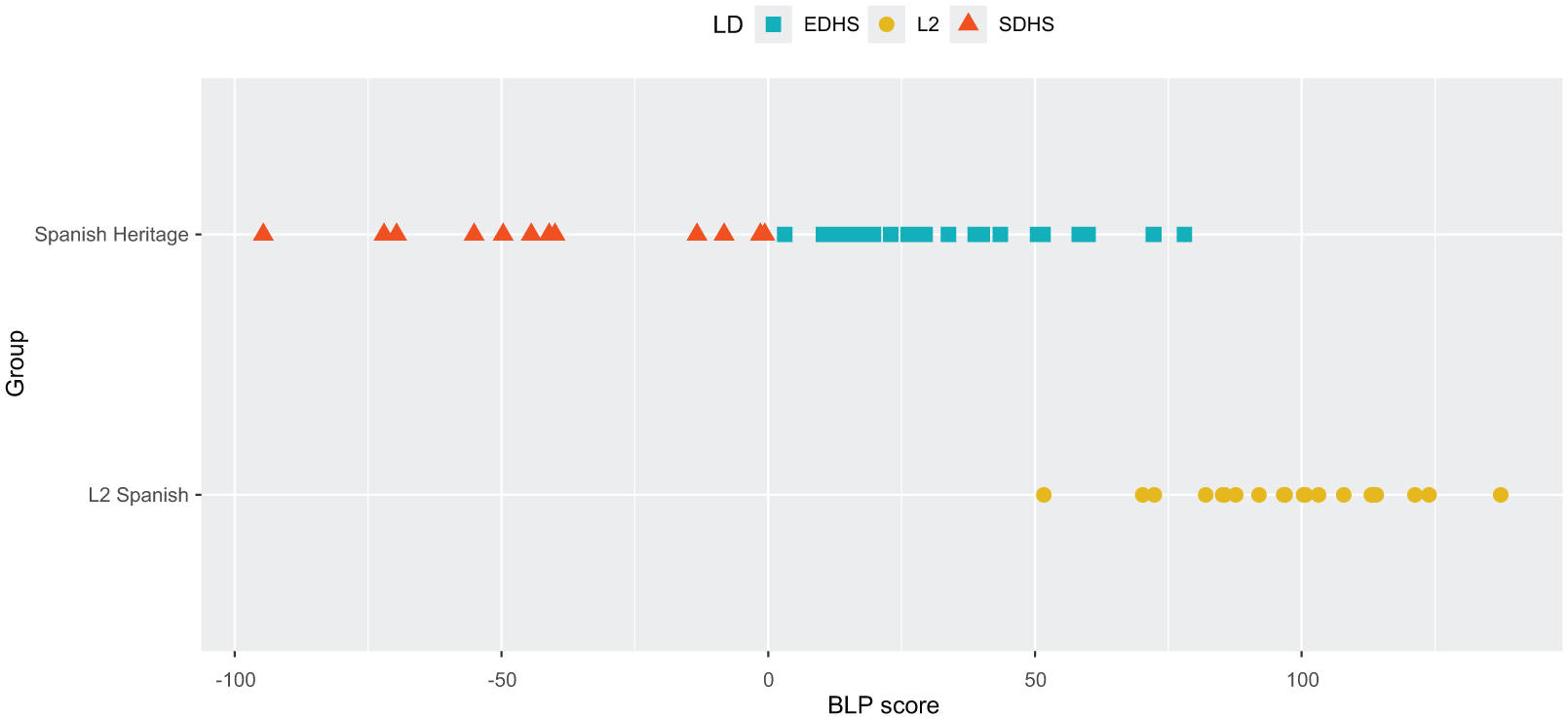
Individual language dominance scores of the three participant groups (Spanish-dominant heritage speakers, SDHS; English-dominant heritage speakers, EDHS; L2 Spanish learners, L2) as a function of the BLP indices in Amengual (2016a).
The BLP indices suggest that more explanatory power can be obtained by further dividing the Spanish heritage group into a Spanish-dominant and English-dominant heritage speaker group. The results of this study indicate that, on the one hand, only the Spanish-dominant heritage speaker group produced mostly canonical phonological trills with two or three brief occlusions between the tongue apex and the alveolar ridge, whereas the English-dominant heritage speaker group and the L2 Spanish learners produced most trills with one or zero occlusions and maintained the Spanish tap–trill contrast largely by means of segmental duration. In other words, with respect to trill production the English-dominant heritage group and the L2 group patterned similarly. The acoustic analysis of the phonemic tap, on the other hand, revealed that the Spanish-dominant and the English-dominant heritage speaker groups showed a similar pattern in their acoustic realization of Spanish taps whereas a different distribution emerged in the production of the L2 learner group. With respect to tap production, variance was clearly a result of language dominance; that is, English-dominant heritage speakers and L2 learners were most likely to exhibit a modified system to maintain the intervocalic rhotic phonological contrast.
Early bilinguals are individuals who acquire both of their languages early in life. This group includes simultaneous bilinguals, who are exposed to both languages from birth, as well as early sequential (or successive/consecutive) bilinguals, who first learn one language (L1) and later acquire a second language (L2) during childhood. It is important not to assume that early sequential and simultaneous bilinguals receive the same amount or type of exposure to their languages in their early years. In Amengual (2019), two groups of Spanish heritage speakers were compared: one group had been exposed to both languages from birth (e.g., through a one-parent-one-language approach), while the other group had been raised speaking only Spanish at home with Spanish-speaking parents, later learning English in preschool or kindergarten. These groups were compared to a group of late English-Spanish bilinguals. The study aimed to determine if simultaneous and sequential bilinguals differed in their production of allophonic variants (i.e., Spanish spirantization) in their heritage language due to differences in the type of early bilingualism. The results of a production task revealed that sequential bilinguals produced a more lenited intervocalic bilabial, dental, and velar approximant than simultaneous bilinguals. These findings suggest that early exposure to both a minority (heritage) language and a majority language has long-lasting effects on the acoustic features of allophonic variants, with these effects persisting into adulthood.
Incorporating BLP indices allows researchers to control for language dominance when analyzing group-level differences. This approach also enables direct comparison between simultaneous and early sequential bilinguals while holding dominance effects constant, thereby ensuring that observed differences reflect experiential or developmental factors rather than dominance-related variability. Figure 4 provides the distribution of the sequential bilinguals, simultaneous bilinguals, and L2 Spanish speaker participants in Amengual (2019) as a function of their BLP dominance scores. Note that all bilingual groups are dominant in English, but that higher values indicate a more unbalanced English dominance.
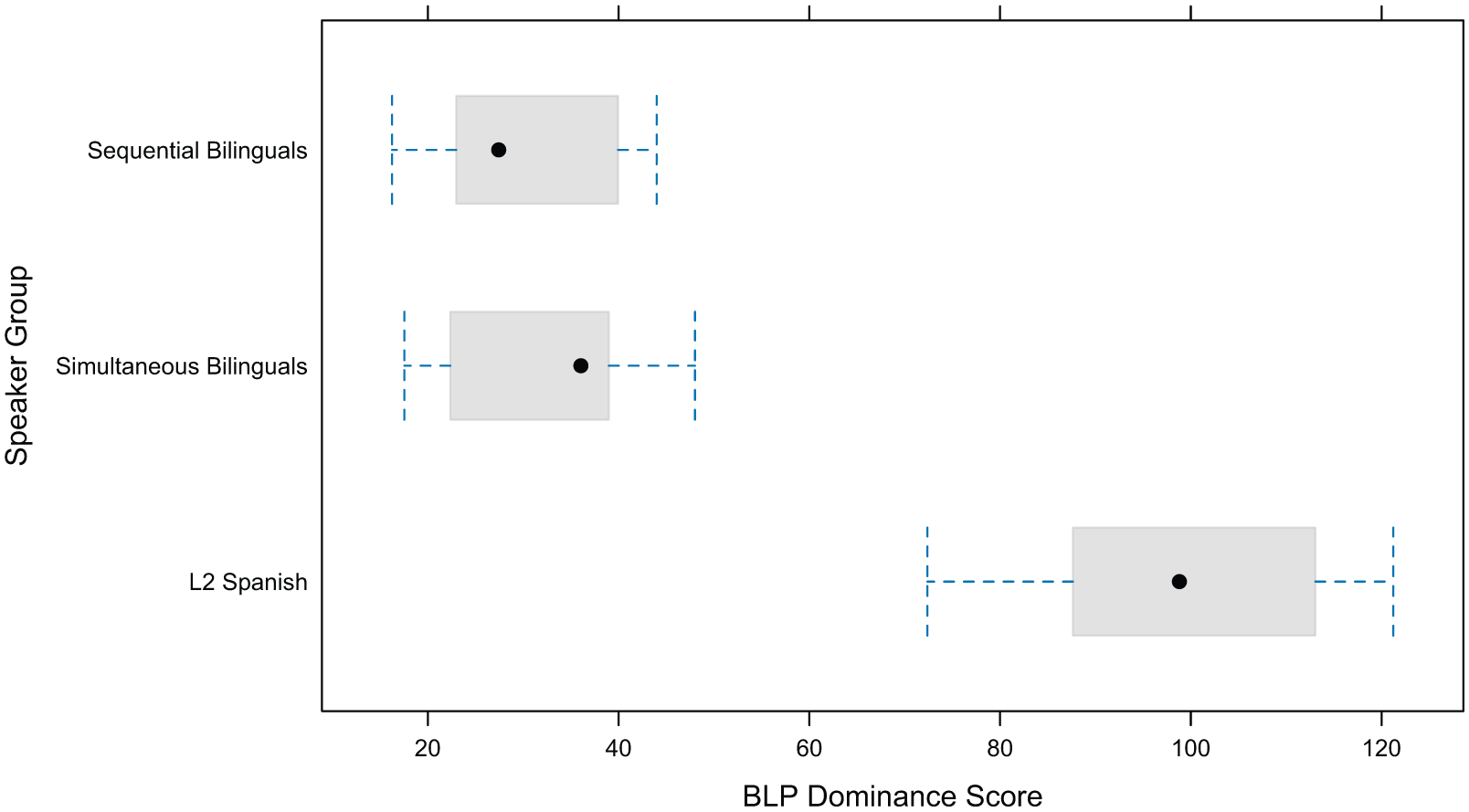
Language dominance as a function of group (early sequential bilinguals, simultaneous bilinguals, and L2 Spanish learners) according to the BLP in Amengual (2019).
It is important to acknowledge that these simultaneous bilinguals may have had less exposure to Spanish during childhood, adolescence, and early adulthood than their sequential bilingual peers, depending on the social environment in which they were raised. This experiment does not directly test this possibility; however, the two groups did not differ in terms of frequency and context of language use, self-reported proficiency in speaking, listening, reading, and writing, or their attitudes toward each language. Participants’ language dominance scores, as measured by the BLP, were similar: sequential bilinguals (M = 29.6, SD = 9.6) vs. simultaneous bilinguals (M = 32.8, SD = 10.1). With this caveat in mind, the findings further support the notion that heritage speakers are a heterogeneous group, with considerable variation even among those who acquire both languages early in life. In addition, they suggest that simultaneous bilinguals and L2 learners differ from sequential bilinguals in their production of the /b, d, g/-[β, ð, ɣ] allophonic alternation in Spanish.
Shifts in language dominance at the individual level often reflect a well-documented process involving the gradual transition from the immigrant (minority) language to the majority societal language across successive generations within immigrant families. Demographic research has identified a typical three-generation shift from the immigrant language to English in the United States, a phenomenon commonly referred to as Language Shift (Fishman, 1965). An illustrative example is provided by Amengual (2018), which examines intergenerational variation in pronunciation among Spanish-English bilinguals in California, incorporating immigrant generation as a key variable. This production study focused on the acoustic realization of voiced lateral approximants in both Spanish and English among Spanish heritage speakers from three immigrant generations (G1.5, G2, and G3), as well as L2 Spanish learners. Following the classification system proposed by Silva-Corvalán (1994) and Potowski and Torres (2023), participants were grouped according to their immigrant generation: Generation 1.5 included individuals born in Mexico who immigrated to the U.S. between ages 6 and 11; Generation 2 comprised U.S.-born individuals with one or both parents born in Mexico; and Generation 3 consisted of bilinguals born in the U.S. whose parents were also U.S.-born, with grandparents born in Mexico. All bilingual participants were raised speaking Spanish to varying extents within their families and were pursuing undergraduate studies in California. Figure 5 displays the distribution of BLP scores for the G1.5, G2, G3, and L2 Spanish speaker groups. The ridgeline plot reveals that each group exhibits a distinct language dominance profile with generally normal distributions, except for the G2 group, which shows a bimodal pattern: some members align with the Spanish-dominant G1.5 group, while others resemble the G3 group in their BLP scores.
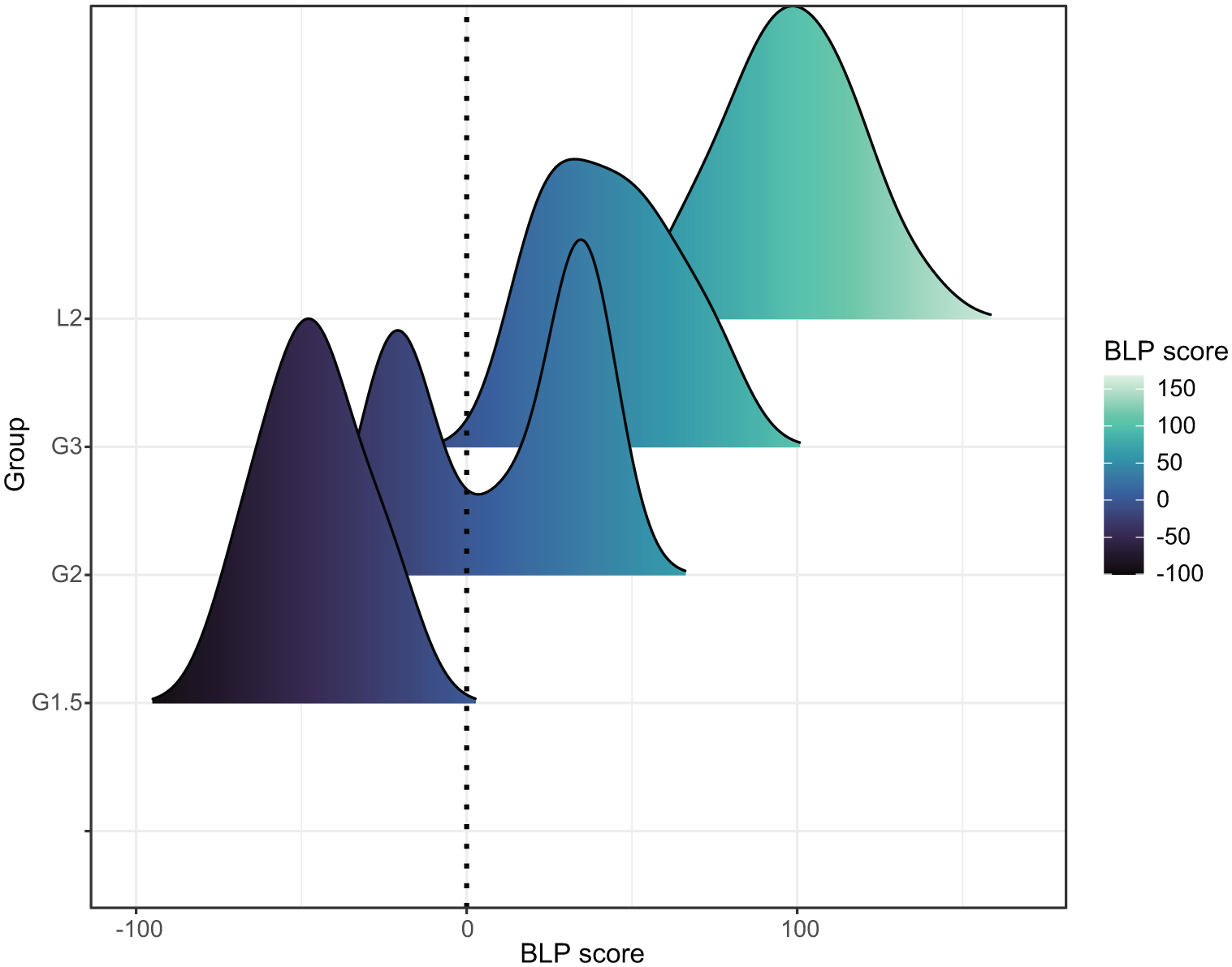
Ridgeline plot displaying BLP scores as a function of group in Amengual (2018). The dotted vertical line indicates the divide between Spanish-dominant and English-dominant bilinguals.
The production experiment revealed language-specific phonetic patterns in the acoustic realization of laterals across the different speaker groups. Specifically, Spanish and English laterals differed in their degree of velarization: all groups produced darker, more velarized laterals in English and clearer, less velarized laterals in Spanish. In addition, intergenerational differences emerged within the Spanish heritage speaker groups, with Generation 1.5 speakers (the most Spanish-dominant group) producing lighter (more Spanish-like) laterals and Generation 3 speakers (the most English-dominant group) producing darker (more English-like) laterals. This trend, in which laterals in both languages become progressively darker with increased English dominance, aligns with expectations stemming from the language shift process observed in U.S. immigrant families, where Spanish occupies a socially and linguistically subordinate position relative to English. As illustrated in Figure 6, each group maintains distinct, language-specific phonetic distributions in their production of lateral approximants but also exhibit language dominance effects.
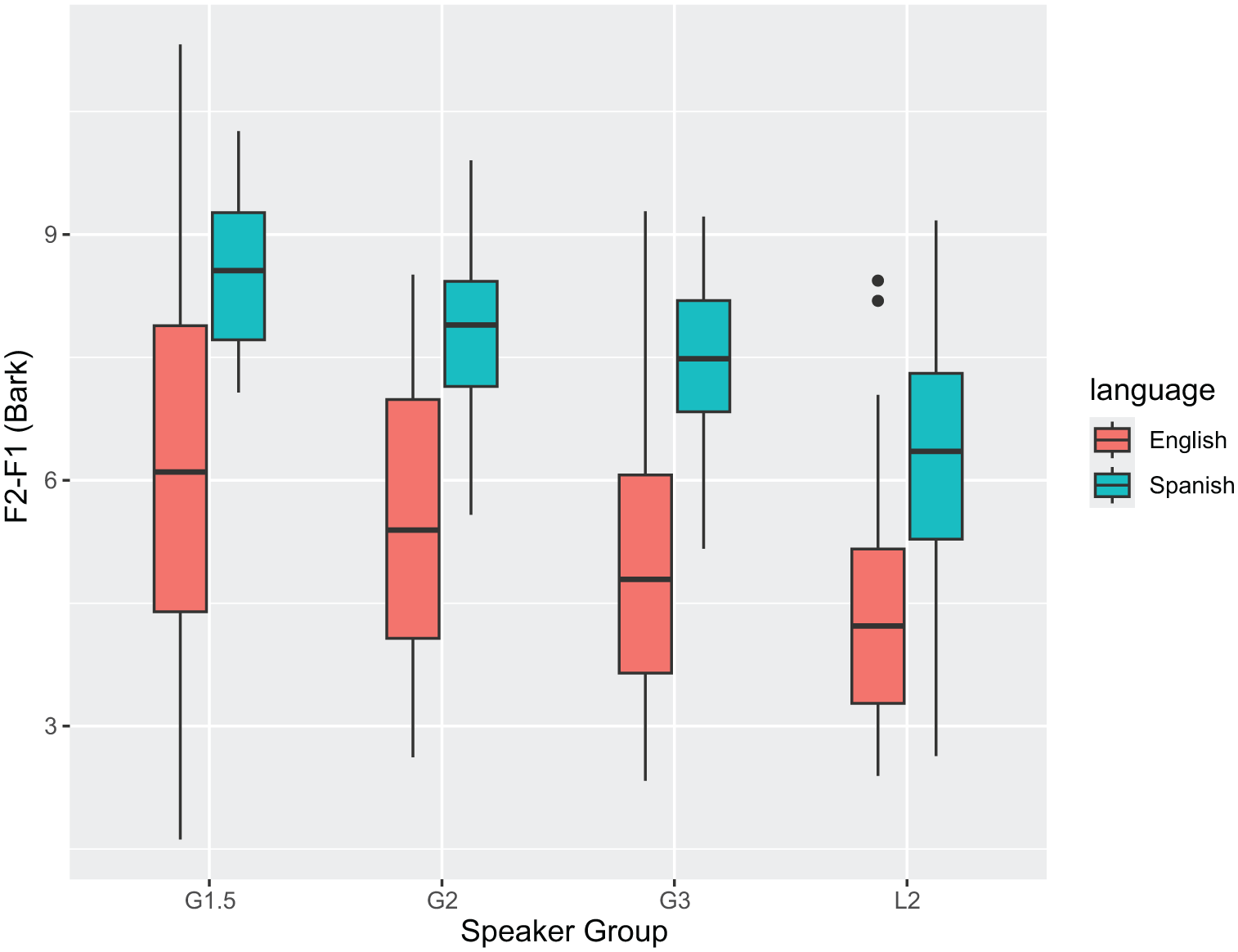
F2-F1 (Bark) values as a function of group and language in Amengual (2018).
Language mode interacts with language dominance as operationalized by the BLP
When defining and operationalizing language dominance, it is crucial to consider multiple dimensions and domains. To fully understand the relationship between language dominance and the phonetic abilities of bilingual individuals, one must consider the interaction of several factors. These include the degree of dominance, frequency of language use, the phonetic similarity between the first (L1) and second (L2) languages, the specific phonetic features under investigation, and the language modes (monolingual, bilingual, or multilingual) in play during testing and over time. Language mode, which refers to the state of activation of a bilingual’s languages and language processing mechanisms at any given moment (Grosjean, 2001), is likely to interact with and influence the effects of language dominance on bilingual speech.
Grosjean’s language mode framework suggests that, depending on the communicative context, either one of a bilingual’s languages (monolingual mode) or both languages (bilingual mode) will be activated. Monolingual mode occurs when the context or interlocutor requires the exclusive use of one language, while bilingual mode arises when two bilinguals, comfortable mixing languages, interact, or when a bilingual listens to a conversation that incorporates elements of both languages. Existing research indicates that experimental designs manipulating language mode can reveal subtle differences in the acoustic realization of language-specific phonetic categories as well as language-specific perceptual routines (Antoniou et al., 2011; Casillas & Simonet, 2018; Simonet, 2014; Simonet & Amengual, 2020). This body of work provides compelling evidence that the co-activation of both languages can immediately affect the phonetics of both the dominant and non-dominant languages, with each being influenced in different ways.
An example of this asymmetry is Amengual (forthcoming), a study that investigates the effects of language mode and intergenerational language shift on the acoustic realization of Spanish and English voiceless stops by early Mexican American Spanish-English bilinguals who read target words embedded in carrier sentences in a monolingual English session, a monolingual Spanish session, and a bilingual English/Spanish session. The 30 Spanish-English bilingual participants had been raised and educated in a bilingual environment in California, having extensive and continuous exposure to both Spanish and English from an early age. They were further divided into three groups as a function of their generation of immigration: Generation 1.5, Generation 2, and Generation 3. Figure 7 provides the distribution of the Spanish-English bilinguals of each immigrant generation as a function of their language dominance scores according to the BLP.
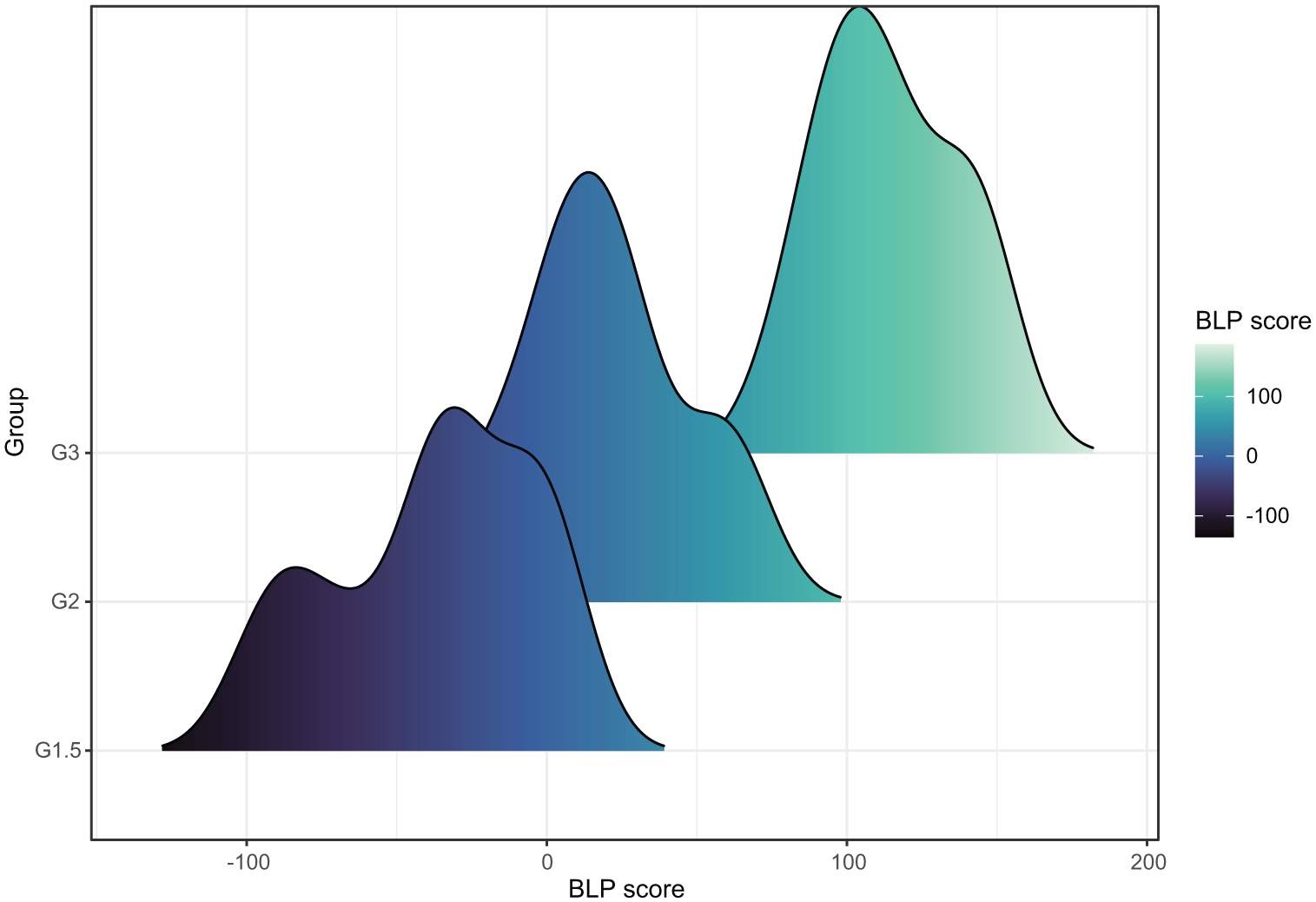
Ridgeline plot displaying BLP scores as a function of group in Amengual (forthcoming).
The results from a reading-aloud task show that while these bilinguals maintain language-specific Voice Onset Times (VOTs) regardless of group status, there is evidence of cross-linguistic influence, reflected in “compromise” values that vary with language dominance, as quantified by the BLP. These findings suggest that although English-dominant G2 and G3 speakers are most likely to produce VOTs in their Spanish voiceless stops that resemble English patterns, they simultaneously shift both their dominant and non-dominant languages to preserve cross-linguistic contrasts. As shown in Figure 8, the Spanish-dominant G1.5 group produced longer English VOTs in monolingual mode than in bilingual mode, while their Spanish VOTs remained virtually unchanged between monolingual and bilingual modes. In contrast, language mode effects in the English-dominant G3 group were opposite to those seen in the Spanish-dominant G1 group. Specifically, the G3 group produced shorter Spanish VOTs in monolingual mode than in bilingual mode, while their English VOTs showed no significant difference between the two modes.
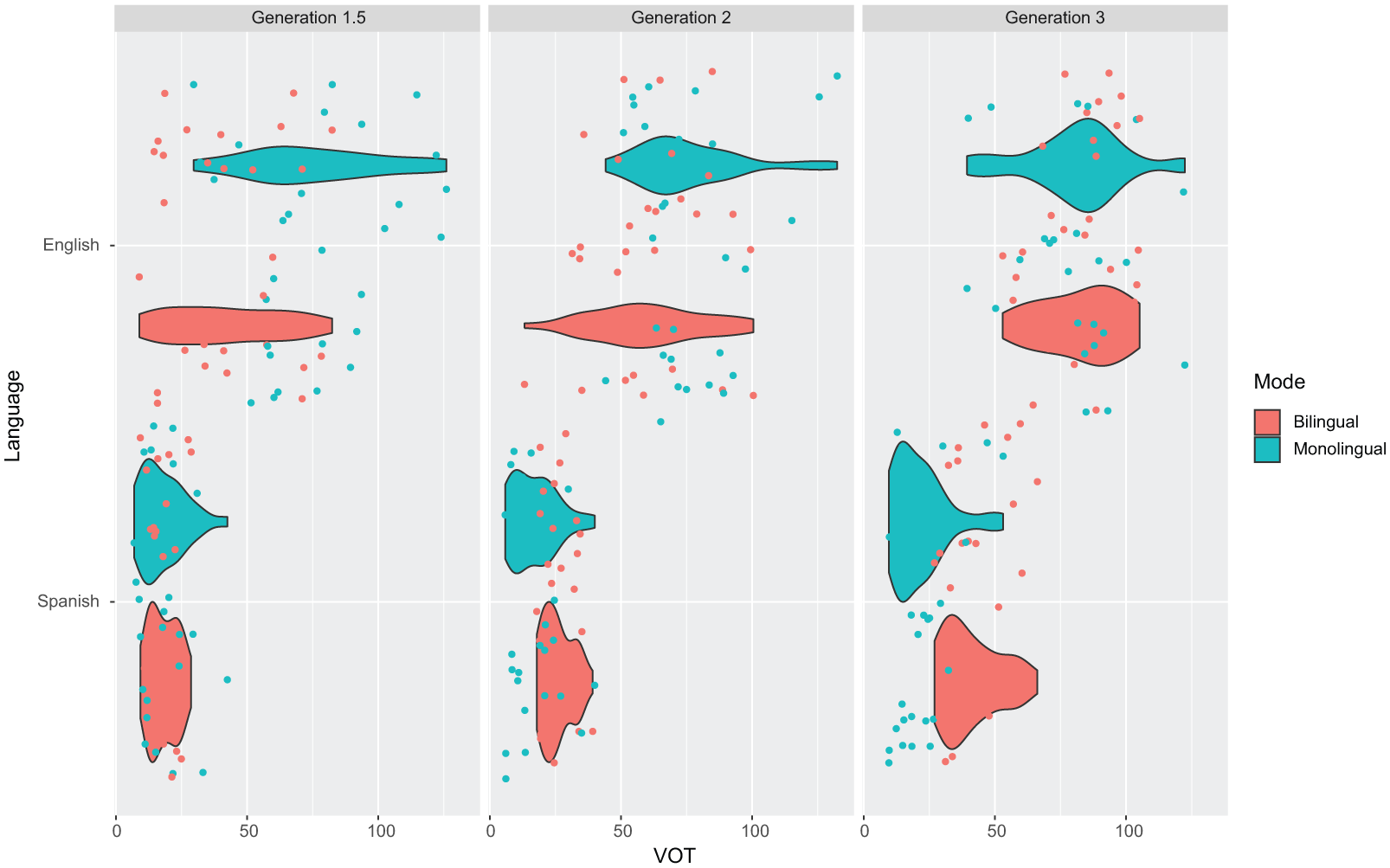
VOT values of productions of voiceless stops by G1.5, G2, and G3 speakers in monolingual and bilingual mode as a function of group and language in Amengual (forthcoming).
In other words, these data show asymmetrical effects based on the BLP indices: when in bilingual mode, Spanish-English bilinguals produce less target-like voiceless stops in their non-dominant language. Acoustic analyses of the G1.5 and G3 data revealed that co-activation effects in the bilingual experimental session only impacted the acoustic realization of voiceless stops in the weaker (non-dominant) language, not in the dominant language. In short, the VOTs of voiceless stops in the non-dominant language, as quantified by the BLP, shift toward the VOT range of the dominant language. These asymmetries, arising from the interaction between language co-activation and language dominance (i.e., BLP indices), highlight the importance of considering a bilingual’s situational language context and language dominance in models of bilingual speech production.
BLP indices may not always capture differences in bilingual speech production and perception
As demonstrated in the studies reviewed in this section, there is substantial evidence that language dominance significantly influences bilingual speech production and can explain the extent of cross-linguistic effects in bilingual speakers. However, in some instances, language dominance, as measured by BLP indices, may fail to detect group-level differences or account for individual variability with respect to certain phonological features. For example, Amengual and Simonet (2020) investigated how language dominance affects the acoustic realization of the Catalan [a]-[ə] alternation, a phonological process linked to lexical stress, and the Catalan mid-vowel contrasts /e/-/ɛ/ and /o/-/ɔ/, which are phonemic distinctions. Their production experiments revealed that while Spanish-dominant and Catalan-dominant bilinguals exhibited significant differences in producing Catalan mid vowels, these dominance-related effects did not extend to vowel reduction patterns.
Building on this work, Simonet and Amengual (2020) examined the acoustic characteristics of unstressed /a/ in Spanish and Catalan. In Spanish, unstressed /a/ remains [a], whereas in Catalan it is typically reduced to schwa [ə]. Their findings revealed that the unstressed Catalan /a/ was consistently realized as schwa across all participants; however, in bilingual contexts containing Spanish words, the reduced vowel shifted slightly toward the Spanish variant, as indicated by a higher first formant (F1). Importantly, BLP indices did not consistently influence these patterns, nor did language mode interact with participants’ linguistic experience.
This raises an important question: what makes the unstressed /a/ in Catalan different from other phonological features that have shown language dominance effects in prior research? Amengual and Simonet (2020) propose that the absence of dominance effects in the acoustic realization of Catalan [a] and [ə] among their bilingual participants may stem from the relative ease of acquiring this phonological alternation. For Spanish-dominant bilinguals, the acquisition of unstressed /a/ may be facilitated by its high frequency and predictability, which attract perceptual attention and promote phonetic learning. From this perspective, the absence of dominance effects likely reflects a ceiling effect in bilingual performance rather than a limitation of the BLP in capturing interspeaker variability. Consequently, it is worth continuing to explore whether the influence of language dominance on cross-linguistic phonetic interactions, whether operationalized through BLP indices or other measures, varies according to the phonological feature under investigation, such as phonemic contrasts, allophonic variations, or primary versus secondary acoustic cues.
This cautionary stance similarly applies to bilingual speech perception. At least two studies have shown that BLP indices do not always reliably predict bilinguals’ ability to identify ambiguously pronounced words in lexical decision tasks (Chan et al., 2020) nor does it consistently affect how orthographic and phonological similarity influence bilingual word recognition (Carrasco-Ortiz et al., 2021). Further research is necessary to determine whether, according to some measures, language dominance, as quantified by the BLP, plays only a limited role in shaping perceptual flexibility in bilinguals. Taken together, these findings suggest caution in making broad generalizations about the role of language dominance (and BLP indices) in bilingual speech production and perception.
Discussion and conclusion
The BLP is a widely utilized, open-source instrument designed to assess language dominance in healthy adult and adolescent bilinguals possessing at least school-level literacy. It is available for an expanding range of language pairs and has been effectively employed across diverse bilingual populations, including simultaneous and early sequential bilinguals, late second-language learners, and heritage speakers. As demonstrated in this paper, a principal strength of the BLP lies in its versatility in operationalizing the impact of language dominance on both the acoustic realization of bilingual speech and perceptual sensitivity to language-specific phonetic contrasts. BLP indices have consistently proven to be valuable predictors of the interaction between bilingual sound systems, offering a refined framework for understanding cross-linguistic influence in bilingual speech.
In bilingual phonetics research, the BLP can be used to quantify language dominance for participant screening or grouping, or as a predictor variable in statistical analyses, either as a categorical or continuous measure. The BLP effectively captures the inherent heterogeneity of bilingual groups, which can vary significantly in terms of language dominance, and can also predict asymmetrical dominance effects resulting from language co-activation. However, it is important to note that while there is strong evidence supporting the usefulness of BLP indices as independent variables in bilingual speech production and perception research, as well as their ability to explain the degree of cross-linguistic influence, no single instrument can account for all the variation in the acoustic realization and perceptual attunement of phonological categories across every bilingual context.
The bilingual experience is far from uniform, encompassing a broad continuum that ranges from balanced, daily use of two languages to more restricted, diglossic contexts in which a minority language is primarily maintained within familial or community domains. When analyzing language dominance profiles with the BLP, it is therefore essential to account for sociolinguistic and experiential factors specific to the population under study, as these may directly shape the patterns of dominance observed. For instance, de Rocafiguera et al. (2025) found that, among Catalan-Spanish bilinguals in Catalonia, the proficiency module of the BLP did not distinguish Catalan-dominant from Spanish-dominant speakers as effectively as other dimensions. In such contexts, giving equal weight to all modules may mask stronger dominance effects driven by differences in language history or use.
These findings highlight the need for a more flexible analytical approach to the BLP, one that allows researchers to adjust the relative contribution of each module according to the sociolinguistic characteristics of the community and the goals of the study. Examining the proportion of variance explained by each module across different bilingual populations represents a promising first step toward this goal, offering insights into how dominance is structured and operationalized in diverse bilingual settings.
At the same time, applying a uniform instrument such as the BLP across diverse bilingual and multilingual populations presents both methodological challenges and clear advantages. While a standardized measure facilitates cross-study comparability and contributes to a cumulative understanding of bilingualism, it may also overlook population-specific features of language experience that shape dominance in meaningful ways. Future work might aim to balance these competing needs by developing adaptable versions of the BLP that preserve its core structure while incorporating flexible, context-sensitive modules. Such adaptations would enhance the instrument’s ecological validity and ensure that it remains responsive to the diversity of bilingual experiences across linguistic and sociocultural contexts.
In light of these considerations, researchers should exercise caution in employing the BLP, or any instrument designed to assess language dominance, merely because it is readily available and grounded in a comprehensive, multifactorial framework that quantifies dominance across four dimensions: language history, use, proficiency, and attitudes. Rather than adopting such tools uncritically, investigators should evaluate whether their specific research objectives warrant alternative or complementary participant classification methods, such as additional (psycho)linguistic measures (Favreau & Segalowitz, 1982; Golato, 2002), speaker accent ratings (Flege et al., 2002), or other experimental criteria (Grosjean, 1982; Hazan & Boulakia, 1993). Moreover, it remains unclear whether composite BLP scores are more predictive of phonetic and phonological behavior than the individual indices derived from current language use, accumulated language experience, or early language exposure.
Building on this methodological reflection, it is also important to consider how the predictive role of BLP-measured dominance may vary across linguistic domains and bilingual populations. While the present paper focuses on the phonetic domain, research suggests that language dominance, as captured by the BLP, may have differing levels of explanatory power depending on the linguistic level of analysis. For instance, BLP scores may more robustly account for variability in lexical or morphosyntactic processing than in phonetic or phonological production, where factors such as language mode or input frequency might exert stronger effects. Furthermore, the application of the BLP across diverse populations raises critical methodological and conceptual questions. Originally developed for bilingual contexts, the BLP’s extension to multilingual speakers, particularly trilinguals, remains both a challenge and a promising direction for future research. Accurately capturing language dominance in multilingual settings requires not only evaluating relative proficiency and use across multiple languages but also modeling the complex, dynamic interactions that occur among them.
To illustrate how these challenges can be addresses empirically, Helms (2023) provides a compelling example of how the BLP can be adapted for trilingual research. In a study examining the production and perception of stress among L1 English-L2 Spanish-L3 Catalan speakers, Helms adapted the BLP to derive relative dominance scores specifically suited to trilingual populations. Employing a Principal Component Analysis (PCA) framework, she demonstrated that a continuous measure of relative language dominance, rather than predetermined categorical distinctions such as “L1 English” or “L3 English,” more effectively disentangles the effects of relative language experience and order of acquisition. Notably, within her trilingual sample, a substantial proportion of variance in the BLP data was captured by two principal components: the first reflecting the strength of participants’ English dominance relative to their Spanish and Catalan dominance (PC1), and the second reflecting their Catalan dominance relative to Spanish dominance (PC2). A comparable method was employed by Repiso Puigdelliura (2025) in an analysis of word-external vocalic sequences produced by L3 English speakers who are Catalan–Spanish bilinguals. Her PCA yielded four principal components, collectively accounting for 57.9% of the variance in the adapted BLP responses from this trilingual sample.
Together, these studies demonstrate that adapting the BLP for multilingual contexts can yield more nuanced insights into the relative influence of multiple languages. They also underscore the potential for further refinement of the BLP and the development of complementary instruments capable of assessing language dominance with greater precision across diverse linguistic backgrounds. Future research should thus prioritize methodological innovations that can capture three-way dominance distinctions through independent, uncorrelated predictors, thereby advancing our understanding of how relative dominance relationships shape linguistic behavior in multilingual speakers.
This line of inquiry connects directly to ongoing research in bilingual phonetics, which continues to deepen our understanding of how bilingual sound systems interact and influence both speech production and perception. Expanding this work to encompass a broader range of language pairs, bilingual communities, and phonetic variables will be essential for fully assessing the BLP’s capacity to account for patterns in bilingual phonetic behavior. The strategic and theoretically grounded use of the BLP offers a powerful means of uncovering fine-grained dominance effects, allowing researchers to link these patterns to phonetic outcomes with greater precision. Such advances not only promise significant empirical insights but also provide critical evidence to refine models of speech learning and strengthen theoretical frameworks of language development and acquisition.
Footnotes

Funding
The author received no financial support for the research, authorship, and/or publication of this article.
Declaration of conflicting interests
The author declared no potential conflicts of interest with respect to the research, authorship, and/or publication of this article.