




Abstract
Aims and Objectives/Research Questions:
The current research investigated the reliability of the Latvian Clinical Personality Inventory (LCPI) between Latvian and Russian language versions within a bilingual sample. The main research question was whether the LCPI demonstrates consistent psychometric properties across both languages, thereby supporting its use in bilingual psychological assessments.
Design/Methodology/Approach:
The reliability of the LCPI scales was assessed using parallel-form and test–retest methods with bilingual participants (N = 94) fluent in and using both Latvian and Russian. Participants ranged in age from 18 to 81 (M = 37.77; SD = 14.78).
Data and Analysis:
Reliability was assessed using Pearson’s correlation coefficient analysis between the different language versions and across time intervals. The study also analyzed Cronbach’s alpha for LCPI scales.
Findings/Conclusions:
The findings indicate a statistically significant correlation between the measures across both language versions, demonstrating a strong mean correlation coefficient (r = 0.85). In addition, consistency was observed across different test–retest intervals, with a strong mean correlation coefficient for the respective language versions (LV retest r = 0.82; RU retest r = 0.85). These results provide evidence supporting the reliability of the LCPI scales. Furthermore, internal consistency was found to be high, as evidenced by Cronbach’s alpha coefficients, which averaged α = .82 for the Latvian language version and α = .83 for the Russian language version.
Originality:
The originality of this paper lies in the fact that it empirically assesses the cross-linguistic reliability of the LCPI, an area where previous research has been limited.
Significance/Implications:
The observed inter-language consistency, as evidenced by significant correlations between the Latvian and Russian versions of the LCPI in the bilingual sample, suggests a degree of measurement invariance, which is crucial for ensuring valid score comparisons across languages, thereby establishing the LCPI as a valuable tool for psychological assessment in bilingual settings.
Keywords
Introduction
Language considerations in psychological assessment
Language significantly influences the accurate assessment of psychological constructs, including mental health, personality traits, and cognitive functioning. Ideally, assessments should be administered in an examinee’s native language or the language of highest proficiency to ensure valid results. Language is deeply intertwined with cognition, emotion, and cultural understanding, influencing how individuals perceive, process, and express their experiences. This intricate relationship between language, cognition, emotion, and culture can introduce measurement error, threatening the validity and reliability of assessment scores.
Limited language proficiency can impair comprehension of test instructions, item wording, and the nuanced meanings embedded within psychological constructs. Consequently, examinees with limited proficiency may misinterpret instructions or test items, resulting in invalid responses. This is particularly relevant for complex psychological constructs, such as personality traits or subtle mood variations that require a nuanced understanding of language. Furthermore, language barriers can significantly impede accurate reporting of emotional experiences during assessment, potentially leading to underreporting or misrepresentation of symptoms, with serious consequences for accurate diagnosis and effective treatment planning (Cormier et al., 2022). Moreover, cultural factors embedded in language, including norms of emotional expression and attitudes toward seeking psychological help, may substantially influence both response styles and test-taking behavior. Consistent with the conclusions of Sorokowski and Kowal (2024), such cultural and linguistic variations systematically shape patterns of response-scale use, which in turn may introduce interpretive differences in bilingual personality assessments. Norms and expectations regarding self-disclosure and emotional expression can vary across cultures, impacting how individuals respond to assessment items (Wright, 2024).
These language-related challenges are particularly salient in multilingual contexts such as Latvia. Latvia has a substantial Russian-speaking minority, comprising approximately 37.7% of the population (Central Statistical Bureau of Latvia [CSB], 2023). The recent influx of Ukrainian refugees, representing diverse linguistic backgrounds, further highlights the need for accessible mental health services, including Ukrainian and Russian language support. Providing psychological support to these populations requires validated and reliable versions of commonly used psychological assessment tools, including measures of mental health, cognitive functioning, and personality, in Russian. Currently, the availability of such validated and reliable assessment tools in Russian remains limited, posing a challenge to effective service provision.
Measurement invariance and bilingualism
The accurate assessment of bilingual individuals hinges upon the crucial consideration of test score comparability. Measurement invariance across languages is indispensable, ensuring that a test reliably measures the same construct irrespective of the language of administration, thereby facilitating valid score comparisons and clinically meaningful interpretations, as demonstrated by Leclerc et al. (2025). This issue is particularly critical, as cultural factors may systematically influence test performance, with Cruchinho et al. (2024) emphasizing that careful translation, cross‑cultural adaptation, and validation are necessary to address potential variations in response patterns.
While the definition of bilingualism remains multifaceted, encompassing a spectrum from rudimentary language skills to near-native fluency (Brown & Miller, 2013; Wagner et al., 2022), this study adopts a nuanced approach, focusing on self-identified Latvian-Russian bilinguals within the framework articulated by Wei (2007). Acknowledging the inherent complexity in categorizing bilingualism, we recognize that individuals may acquire and utilize languages through diverse pathways and for varied purposes. Specifically, this study operationalized bilingualism, as a construct of notable heterogeneity, utilizing Wei’s (2007) framework. Participants were classified based on self-reported bilingual proficiency and developmental trajectory, aligning with Wei’s typology, which encompasses: balanced bilingualism (near-equal proficiency in both languages), late bilingualism (acquisition of the second language after early childhood), maximum bilingualism (high proficiency in both languages across diverse domains), secondary bilingualism (use of the second language in specific contexts), and early bilingualism (simultaneous acquisition of both languages from infancy). While acknowledging the limitations inherent in self-report measures, this approach effectively captures participant-perceived bilingualism, enabling a robust investigation of its impact on assessment outcomes.
Furthermore, test reliability, particularly temporal stability, is of paramount importance when evaluating bilingual populations. This is critical to mitigate the confounding influence of language-related variations across test versions, ensuring that observed changes reflect genuine individual differences rather than linguistic artifacts (International Test Commission [ITC], 2017). Therefore, robust measurement invariance and test reliability are essential for valid and reliable assessments of bilingual individuals.
Cross-language comparability of the Latvian Clinical Personality Inventory in a bilingual population
The Latvian Clinical Personality Inventory (LCPI) (Perepjolkina et al., 2020), recently adapted into Russian (Perepjolkina et al., 2022), offers a culturally relevant assessment tool for Russian-speaking individuals in Latvia. This adaptation necessitates rigorous investigation of cross-language score comparability to ensure that the Russian version measures the same constructs as the original Latvian version and that observed score differences reflect genuine individual differences rather than language or cultural factors.
The LCPI was developed to address the need for a culturally sensitive assessment tool within the Latvian context. This self-report instrument assesses psychiatric disorder intensity, personality traits, functioning difficulties, and social adaptation in adults aged 18 and older. While the Latvian and Russian versions share core content, some items were modified or replaced in the Russian version to optimize psychometric properties (Perepjolkina et al., 2022). This highlights the importance of demonstrating conceptual and linguistic equivalence across versions, a crucial aspect of cross-cultural assessment (ITC, 2017).
This study examines the consistency of the LCPI scores in a Latvian-Russian bilingual population. Specifically, it assesses the stability of LCPI scores across repeated administrations (test–retest reliability), the equivalence of scores between Latvian and Russian versions (parallel-form reliability), and the internal consistency of the scales within both language versions. The aim is to determine if LCPI scores demonstrate sufficient consistency, equivalence, and internal homogeneity to support their use in multilingual settings of Latvia.
The research questions were:
Does the LCPI demonstrate adequate parallel-form reliability between the Latvian and Russian language versions in a bilingual Latvian-Russian population?
Does the LCPI demonstrate adequate test–retest reliability in a bilingual Latvian-Russian population across both the Latvian and Russian language versions?
Do the scales of both the Latvian and Russian language versions of the LCPI demonstrate adequate internal consistency (as measured by Cronbach’s alpha)?
Methods
Participants
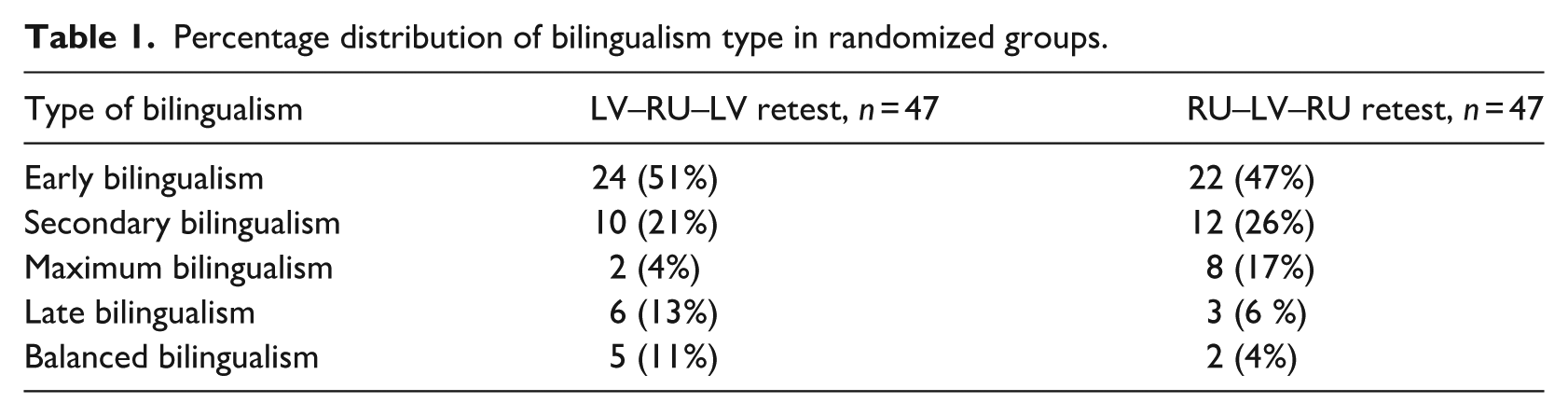
This study employed a convenience sample of 94 bilingual individuals (76 women and 18 men) residing in Latvia, recruited through social media platforms. The age of the participants ranged from 18 to 81 years (M = 37.77, SD = 14.78). All participants self-reported fluency in both Latvian and Russian, actively using these languages in their daily lives. Educational attainment included at least basic education, with 55% possessing higher education and 45% secondary education. Participants were requested to self-identify their bilingual typology, thereby facilitating a nuanced understanding of their language experiences. Specifically, participants were classified into one of five categories (Wei, 2007) in a model where all respondents clustered into the following percentages: balanced bilingualism (7%), late bilingualism (10%), maximal bilingualism (11%), secondary bilingualism (23%), and early bilingualism (45%). The percentage distribution between the two randomly selected groups, which differed in order of language use and consisted of 47 participants each, is shown in Table 1.
Percentage distribution of bilingualism type in randomized groups.
Exclusion criteria included participants who were younger than 18 years of age, had not completed basic education, did not possess comparable proficiency in Latvian and Russian, or did not use both languages in daily life, as well as individuals who did not complete all scheduled test administrations and participated only once or twice.
Instruments
Participants completed a demographic survey designed to gather information regarding their gender, age, education, and bilingualism profile, specifically classifying bilingualism as early, secondary, maximum, late, or balanced.
The Latvian and Russian version of the LCPI, containing 322 statements, was used (Perepjolkina et al., 2020, 2022). Participants responded to items using a 4-point Likert-type scale, ranging from 0 (totally disagree) to 3 (totally agree). According to the LCPI Technical Manual for the Latvian version (Perepjolkina et al., 2020) and the Russian version’s (Perepjolkina et al., 2022) User Manual, the LCPI scales in both language versions demonstrate acceptable to excellent internal consistency, with Cronbach’s alpha coefficients ranging from α = .67–.97 for the Latvian version (Lv) and α = .70–.96 for the Russian version (Rv). The nine clinical scales exhibit Cronbach’s alpha coefficients ranging from α = .76 to .97 (Lv) and α = .81 to .96 (Rv), and the five functioning scales range from α = .78 to .92 (Lv) and α = .81 to .90 (Rv). Five additional scales show coefficients between α = .74 and .95 (Lv) and α = .76 and .94 (Rv). Thirty-three personality scales show Cronbach’s alpha coefficients ranging from α = .67 to .95 (Lv) and α = .70 to .89 (Rv). Prior to this study, test–retest reliability data for the Latvian and Russian versions of the LCPI were not available. However, detailed information regarding the factor structure of the personality scales, other psychometric properties, as well as the detailed information about the Russian version adaptation process and results, can be found in the respective user manuals (Koļesņikova et al., 2022; Perepjolkina et al., 2022).
Procedure
Participation was voluntary, and informed consent was obtained from all participants prior to their involvement. Participants first completed a demographic questionnaire. The LCPI was administered electronically via the psychological testing platform www.exploro.lv. Participants (N = 94) were recruited through social media platforms. Upon agreeing to participate, they were randomly assigned to one of two groups (n = 47 per group) using a Simple Random Sampling method implemented via a random number generator function provided by the online resource www.randomizer.org. To control the potential order effects of the test forms, the groups differed in the sequence of test administration languages. Group 1 completed the Latvian version of the LCPI on the first day, the Russian version on the second day, and the Latvian version again 2 weeks later for a test–retest reliability assessment. Group 2 completed the Russian version on the first day, the Latvian version on the second day, and the Russian version again 2 weeks later for test–retest reliability assessment. Each test session, including instructions, required approximately 25–45 minutes to complete. Upon completion of each assessment, respondent data were automatically processed, and an electronic report was generated in both PDF and Excel formats, containing each respondent’s raw scores and standardized T-scores for each scale.
Data analysis
Raw scores, T-scores, and demographic data from the electronic questionnaires were extracted from the online platform and aggregated in Microsoft Office Excel 365. Responses were coded according to the test manual and entered into IBM SPSS Statistics 29 software for data analysis. Descriptive statistics (means and standard deviations based on T-scores) were calculated for all scales. To determine the stability of the results, test–retest and parallel form reliability were assessed. Parallel form reliability between the Latvian and Russian versions was assessed using Pearson’s correlation coefficients. Test–retest reliability within each language version over a 2-week interval was also assessed using Pearson’s correlation coefficients. All statistical tests were conducted with an alpha level of .05. Missing data were excluded from the analysis. To assess the internal consistency of the LCPI scales, Cronbach’s alpha (α) was calculated for both the Latvian and Russian language versions. The interpretation of the obtained alpha coefficients was guided by commonly cited rules of thumb provided by George and Mallery (2003), who suggest the fallowing benchmarks: α > .9 (Excellent), >.8 (Good), >.7 (Acceptable), >.6 (Questionable), >.5 (Poor), and <.5 (Unacceptable) (George and Mallery, 2003).
A power analysis was conducted to determine the required sample size for detecting effect sizes in correlational analyses. Using G*Power 3.1 (Faul et al., 2007), with parameters set at power = 0.80, α = .05, and a two-tailed test, the analysis revealed that detecting a moderate effect size (r = 0.30) requires approximately 88 participants. Conversely, detecting a large effect size (r = 0.50) requires only 29 participants. This analysis highlights that with a larger effect size, a smaller sample is sufficient to achieve adequate statistical power. Based on the initial parameter of detecting a medium effect size (r = 0.30), a minimum sample size of 88 participants was deemed necessary.
Ethics statement
Prior to the study, permission No. 2-PĒK-4/182/2024, 12.02.2024, was obtained from the Ethics Committee of Riga Stradiņš University. Before testing, respondents were informed about the anonymity and confidentiality of the testing. Each respondent was assigned a unique code. The information provided by the respondents was processed and stored in accordance with the “Personal Data Protection Law.”
Results
Parallel form reliability and internal consistency
Tables 1 and 2 (see Supplementary Materials No. 1) display the descriptive statistics (means [M] and standard deviations [SD] of T-scores), and Tables 3–10 (see Supplementary Materials No. 2) display the extended descriptive statistics for the data collected from the bilingual Latvian-Russian sample. The results are organized by the language of the test (Latvian [LV] and Russian [RU]) and the time of administration (initial test and retest).
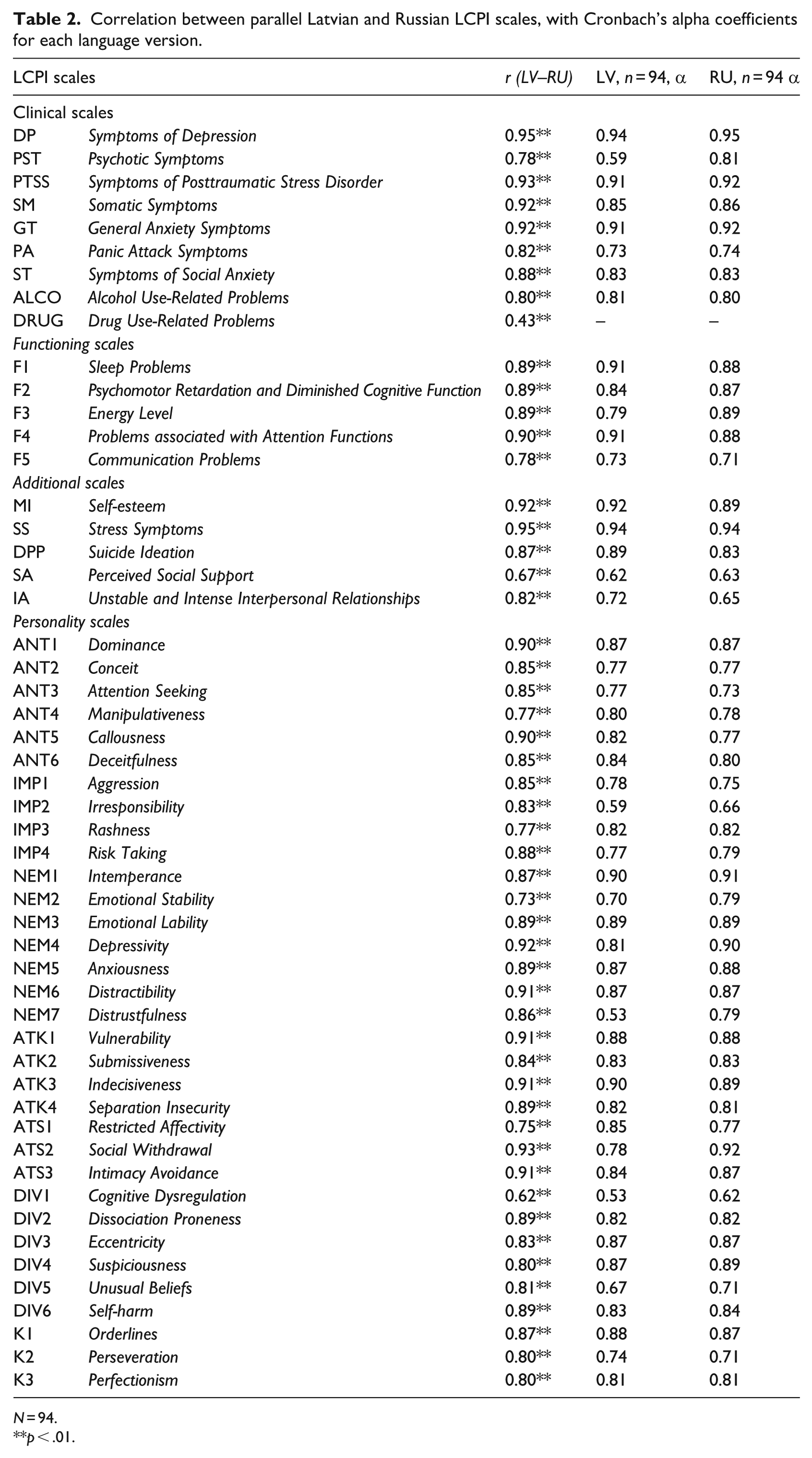
Correlation between parallel Latvian and Russian LCPI scales, with Cronbach’s alpha coefficients for each language version.
N = 94.
p < .01.
To evaluate the parallel-form reliability between the Latvian and Russian versions of the LCPI scales, Pearson product–moment correlations were calculated. The results show that for all scales (clinical, functioning, additional scales, and personality scales), there are statistically significant positive correlations between the Latvian and Russian versions of the measures. While the majority of the obtained correlation coefficients across all LCPI scales ranged from 0.75 to 0.95, indicating strong parallel-form reliability, a few exceptions were observed. Specifically, the correlation coefficient from the Perceived Social Support scale was r = 0.67; for the Cognitive Dysregulation scale, it was r = 0.62; and for the Drug Use-Related Problems scale, the correlation was r = 0.43 (see Table 2).
To evaluate the internal consistency of the LCPI scales within both the Latvian and Russian language versions, Cronbach’s alpha coefficients were examined for each scale. As indicated in Table 2, in all scales in Latvian and Russian versions the observed value for Cronbach’s alpha varied from .53 to .95 – Clinical scales (α = .59–.95), Functioning scales (α = .71–.91), Additional scales (α = .62–.94), and Personality scales (α = .53–.92). Notably, most alpha coefficients were above the acceptable threshold of 0.70. However, lower alpha values were observed in both the Latvian and Russian versions for the Perceived Social Support, Cognitive Dysregulation, and Irresponsibility scales. In addition, the Psychotic Symptoms, Unusual Beliefs, and Distrustfulness scales showed lower alpha values specifically in the Latvian version, while the Unstable and Intense Interpersonal Relationships scale exhibited a lower alpha value only in the Russian version (see Table 2). It was not possible to evaluate Cronbach’s alpha for the Drug Use-Related Problems scale due to insufficient variance in the data. This was because almost all respondents selected “strongly disagree” for all items on this scale.
Test–retest reliability for the Latvian and Russian versions
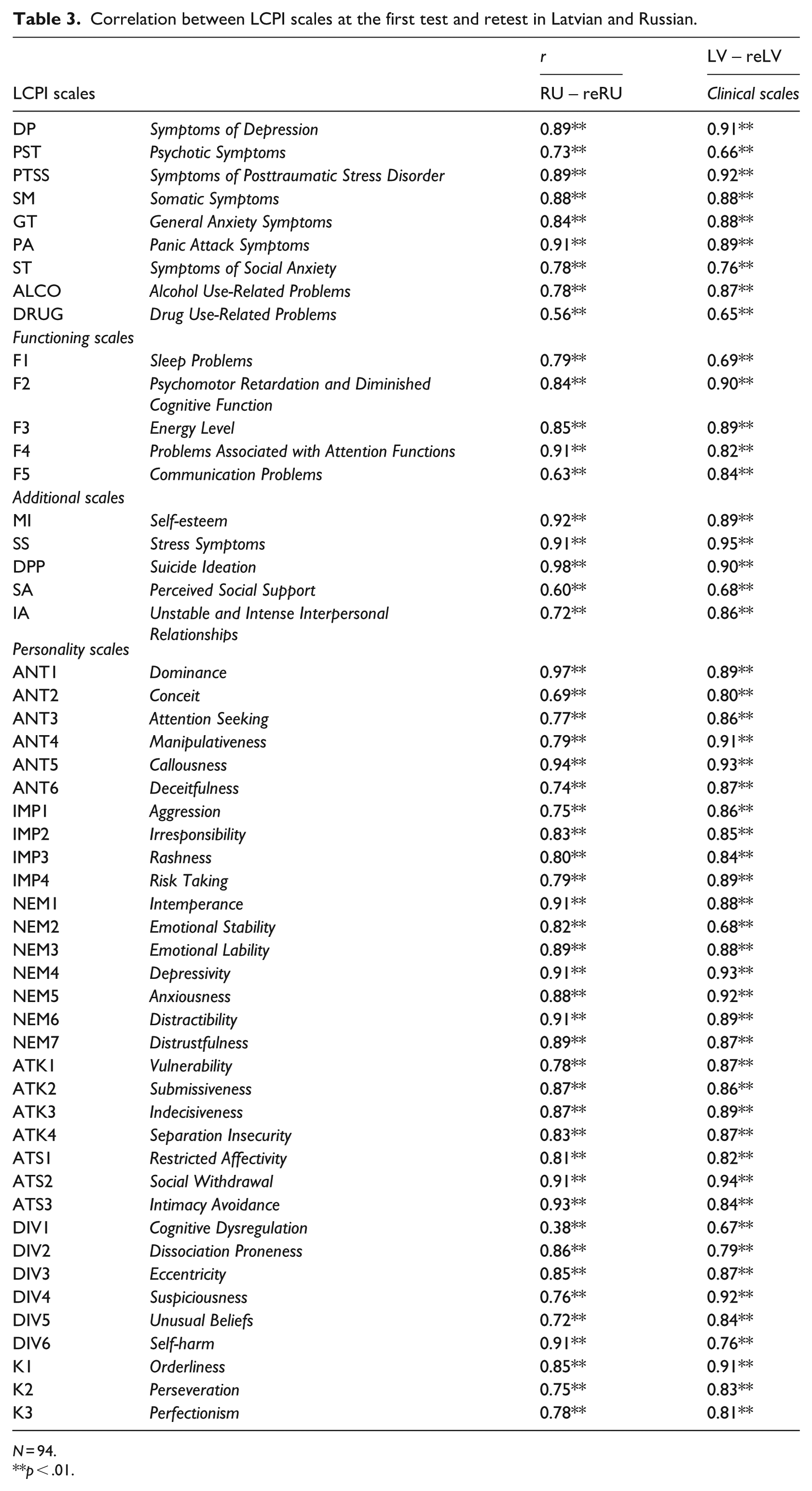
To determine the stability of the Latvian LCPI scores over time, a test–retest reliability analysis was conducted with a 2-week interval between administrations. Pearson product-moment correlations were calculated between the initial and retest scores. The results demonstrate statistically significant correlations for all scales both for Latvian and Russian versions of the test (clinical, functioning, additional scales, and personality scales). The observed moderate to strong correlations (mostly r = 0.70 and higher, p < .01) suggest good temporal stability of the Latvian and Russian versions (see Table 3).
Correlation between LCPI scales at the first test and retest in Latvian and Russian.
N = 94.
p < .01.
Overall, most scales in both the Latvian and Russian test versions demonstrated good test–retest reliability. However, the Latvian version had four scales with moderately lower coefficients (r = 0.60–0.69), with the Cognitive Dysregulation (r = 0.38) and Drug Use-Related Problems (r = 0.56) scales showing the least stability over time. For the Russian version, five scales also displayed moderately lower coefficients (r = 0.65–0.69). Nevertheless, it must be emphasized that even those scales exhibiting lower internal consistency demonstrate a high effect size according to the guidelines established by Cohen (1988) (see Table 3).
Discussion
The present study investigated the cross-language equivalence of the LCPI by examining the correlation of scores obtained in Latvian and Russian versions among a bilingual population. The results revealed moderate to strong correlations between the two language versions across the measured constructs. These findings suggest a reasonable degree of cross-language consistency, indicating that the LCPI, when administered in either Latvian or Russian, taps into similar underlying personality dimensions within bilingual individuals.
The observed, moderate to strong, correlations lend support to the validity of the Russian adaptation of the LCPI. While initial validation studies focused on establishing the reliability and validity of the Russian version within monolingual Russian speakers, the present study adds a crucial layer of evidence by directly comparing scores within a bilingual sample. This approach is particularly important in multilingual contexts like Latvia, where a significant portion of the population is proficient in multiple languages. Language proficiency of Latvian residents aged 25 to 64, if it is not a native language, 91.3% is Russian, 89.3% is Latvian, 64% is English, and 15.3% is German (CSB, 2023).
By reporting effect sizes (such as Cohen’s r for correlational analyses), we move beyond mere statistical significance to provide a clear indication of the strength and relevance of the relationships observed between the LCPI scales and other variables. Furthermore, the interpretation of these effect sizes – categorized using Cohen’s (1988) widely accepted guidelines (Small: r – approx. 0.10; Medium: r – approx. 0.30; Large: r – approx. 0.50) – allows for a direct comparison of our findings with those of other studies in the field, thereby contributing to the meta-analytic synthesis of research results. This practice ensures that our conclusions are based on both the statistical reliability and the practical meaningfulness of the observed data. As demonstrated, for instance, by the study evaluating the cross-cultural equivalence of the Korean Minnesota Multiphasic Personality Inventory-2 (MMPI) (Chung et al., 2006).
Using a bilingual sample to assess cross-language equivalence offers several advantages over traditional back-translation or methods of parallel forms. First, it directly addresses the question of whether bilingual individuals experience and report personality characteristics similarly across languages. This approach acknowledges the dynamic interplay between language, culture, and cognition in bilingual individuals. Second, it helps to identify potential cultural or linguistic nuances that may influence test performance (Chen et al., 2013). By comparing scores within the same individuals across languages, we can minimize the confounding effects of inter-individual differences and focus on the impact of language itself.
Notably, the clinical scales for depression (DP) and posttraumatic stress symptoms (PTSS) had the strongest correlation between measures, indicating their reliability in reflecting underlying psychological constructs. In contrast, the narcotic abuse-related problems (DRUG) scale had lower correlations, which may be partly explained by possible language nuances in the Latvian version. The qualitative feedback from participants also highlighted slight differences in interpretation between the Latvian and Russian versions. For example, some items in the Russian version were perceived as more intense or emotionally charged compared to the Latvian version. Such differences, particularly in scales such as alcohol problems (ALCO) and risky behavior (IMP4), underline the importance of cultural and linguistic sensitivity in adapting the test (Puente et al., 2013).
While most of the LCPI scales demonstrated satisfactory internal consistency, some scales revealed Cronbach’s alpha values below the commonly accepted threshold of 0.70. This result, although indicating the necessity for further instrument refinement, suggests caution in scale interpretation. According to academic standards (e.g., Blascovich & Tomaka, 1991; Nunnally & Bernstein, 1994), measures whose internal consistency does not meet higher requirements are suitable for research purposes and initial screening, where the goal is to investigate relationships between variables or obtain preliminary data. However, these scales should not be used for individual clinical decision-making or diagnosis, and therefore, the interpretation of LCPI scales with lower alpha values must be conducted with this methodological limitation in mind.
The correlations between the Latvian and Russian versions of the LCPI were found to be moderate (≈ 10%) to strong (≈ 85%) but not perfect (r < 1.0), which indicates good convergent validity but confirms the presence of minor, yet distinct, differences influenced by translation nuances and the context of bilingual performance. While substantial overlap exists between the two language versions, the less than perfect correlations suggest that some language-specific or culturally influenced variance may be present. This is not unexpected, as language is not merely a neutral vehicle for conveying information; it is also embedded within cultural contexts that shape meaning and interpretation. Further qualitative research, such as cognitive interviews with bilingual participants, could help to explore these nuanced differences and identify specific items or constructs that may be interpreted differently across languages.
The findings of this study are consistent with several previous studies that were conducted using the Spanish adaptation of the Personality Assessment Inventory (PAI, Morey, 1991). They collectively highlight the importance of rigorous validation processes when adapting clinical personality inventories for different languages. Ensuring that translated assessments accurately capture the intended constructs is crucial for their effective application in diverse cultural settings. The evidence from bilingual assessment research supports the cross-language reliability of instruments like the PAI, facilitating their use in multilingual contexts and contributing to more inclusive psychological evaluation practices (Kois et al., 2019; Rogers et al., 1995).
The implications of these findings are significant for clinical practice and research in Latvia. The evidence supporting the cross-language equivalence of the LCPI provides clinicians with greater confidence in using either the Latvian or Russian version with bilingual clients. This is especially important considering the large Russian-speaking population in Latvia. The native language of 37.7% of the population of Latvia is Russian (CSB, 2023), as well as the recent influx of Ukrainian refugees, many of whom are also Russian speakers. Providing access to psychological assessment in their native language can significantly improve the accuracy of diagnosis, the effectiveness of treatment planning, and the overall quality of mental health services (Puente et al., 2013). However, the absence of dominant language identification (Pavlenko, 2002) is a limitation.
However, even taking into account the obtained invariance indicators, it must be acknowledged that cultural and linguistic differences may continue to influence response processes and test results, thus limiting the assumption of complete cross-linguistic and cross-cultural equivalence.
Limitations and future directions
While the present study provides valuable insights into the reliability of the LCPI in a bilingual sample, several limitations must be acknowledged.
One primary limitation concerns the sample composition. Although the study included 94 bilingual participants, the sample size is relatively small for generalizing findings to the broader Latvian population. In addition, the sample was not fully balanced in terms of gender distribution, with 81% of participants identifying as female. Future studies should aim for a more diverse and representative sample to ensure broader applicability of the results.
Furthermore, the study did not control for participants dominant language or potential code-switching tendencies, which may have influenced response patterns. Future research should consider assessing the role of dominant language and cultural nuances in bilingual test administration to refine measurement accuracy.
The study also focused exclusively on non-clinical participants, limiting the generalization of the results to clinical populations. Given that the LCPI is designed for personality assessment in both clinical and non-clinical settings, future research should examine test–retest reliability and equivalence in individuals with diagnosed psychological disorders.
In conclusion, while the present study provides initial evidence for the reliability of LCPI in a bilingual setting, further research addressing these limitations will strengthen its psychometric foundation and applicability in diverse psychological assessment contexts.
Conclusion
The LCPI has demonstrated itself to be a valid and reliable instrument for assessing psychological states and personality traits among both Latvian and Russian speakers. Its established bilingual applicability ensures accurate and culturally appropriate assessment, making it a valuable tool for psychological practice and research within multilingual societies. Building upon this foundation, the findings of this study further support its utility by providing evidence for several key psychometric properties.
First, the parallel-form reliability analysis revealed close to moderate positive correlations between the Latvian and Russian language versions across all scales. These results strongly suggest a good level of coherence and comparability between the two language versions, indicating that the LCPI effectively measures similar constructs regardless of the language of administration in a bilingual Latvian-Russian population.
Second, the test–retest reliability analyses for both the Latvian and Russian language versions demonstrated generally good temporal stability of the LCPI scores over a 2-week period. While some individual scales exhibited slightly lower stability coefficients, the overall pattern of close to moderate positive correlations supports the reliability of the LCPI results over time for both language versions.
Finally, the examination of internal consistency using Cronbach’s alpha coefficients indicated acceptable to excellent levels of homogeneity for most scales within both the Latvian and Russian language versions. Although a few specific scales showed lower internal consistency, the majority of the scales demonstrated adequate internal coherence, suggesting that the items within each scale are measuring a similar underlying construct.
In summary, the results of this study provide further empirical support for the psychometric soundness of the LCPI in a bilingual Latvian-Russian context. The demonstrated parallel-form reliability, temporal stability, and internal consistency across the Latvian and Russian language versions underscore the LCPI’s value as a reliable and coherent instrument for psychological assessment in multilingual settings.
Supplemental Material
sj-docx-1-ijb-10.1177_13670069251406858 – Supplemental material for Bilingual assessment of the Latvian Clinical Personality Inventory: A comparative study
Supplemental material, sj-docx-1-ijb-10.1177_13670069251406858 for Bilingual assessment of the Latvian Clinical Personality Inventory: A comparative study by Laura Petersone, Jelena Kolesnikova and Viktorija Perepjolkina in International Journal of Bilingualism
Supplemental Material
sj-docx-2-ijb-10.1177_13670069251406858 – Supplemental material for Bilingual assessment of the Latvian Clinical Personality Inventory: A comparative study
Supplemental material, sj-docx-2-ijb-10.1177_13670069251406858 for Bilingual assessment of the Latvian Clinical Personality Inventory: A comparative study by Laura Petersone, Jelena Kolesnikova and Viktorija Perepjolkina in International Journal of Bilingualism
Footnotes
Acknowledgements
The authors thank the respondents for their contributions to the study.

Ethical considerations
Prior to the study, permission No. 2-PĒK-4/182/2024, 12.02.2024, was obtained from the Ethics Committee of Riga Stradiņš University.
Consent to participate
Participation in the study was voluntary and anonymous; each participant was assigned a code. Written informed consent was obtained from the participants.
Consent for publication
Not applicable.
Funding
The authors disclosed receipt of the following financial support for the research, authorship, and/or publication of this article: The research was supported by Riga Stradiņš University. The authors received no financial support for the publication of this article.
Declaration of conflicting interests
The authors declared no potential conflicts of interest with respect to the research, authorship, and/or publication of this article.
Data availability statement
Data available on request due to privacy/ethical restrictions.
Supplemental material
Supplemental material for this article is available online.
Author biographies
References
Supplementary Material
Please find the following supplemental material available below.
For Open Access articles published under a Creative Commons License, all supplemental material carries the same license as the article it is associated with.
For non-Open Access articles published, all supplemental material carries a non-exclusive license, and permission requests for re-use of supplemental material or any part of supplemental material shall be sent directly to the copyright owner as specified in the copyright notice associated with the article.
