




Abstract
Aims:
This study aims to provide new insights into the creativity of nominal compounds in multilinguals. We ask whether mixed and unmixed compounds in Malay-English language contact follow Malay or English rules for the headedness of compounds and how pluralisation rules are applied to compounds across both languages. We also ask whether any innovative forms qualify as examples of rule-governed or rule-changing creativity.
Design/Methodology/Approach:
We analyse data from the existing literature on compounding in Malay and English, as well as data from a corpus of over a thousand utterances with intrasentential code-switching, collected by Majid (2019) among teachers of English in Malaysia.
Data and Analysis:
A qualitative analysis is made of the headedness of different nominal compounds and of the way in which these are pluralised.
Findings/Conclusions:
We found that Malay compounds in the data were generally left-headed and English compounds right-headed, but the directionality of mixed compounds depended largely on the language of the clause in which they appear: in Malaysian English short stories and newspapers, mixed compounds were right-headed, while they were left-headed in Malay clauses in the speech of teachers.
Originality:
The study brings together insights from the literature on creativity and insights from studies on nominal compounding. As in most studies of compounds, the constructions are studied in isolation, the current study is novel in that the language of the clause in which the compounds appear is also analysed. Finally, we bring together insights from the study of compounding in children as well as young adults, showing that the data from young adults are more likely to lead to rule-changing creativity.
Significance/Implications:
The study makes a contribution to our understanding of the ways in which language contact affects variability in compounding and can provide new insights into the separability of grammars in language contact.
Introduction
Code-switching has often been claimed to be a particularly creative form of language use (Kharkhurin & Wei, 2015). Indeed, the very fact of using two languages daily and being familiar with more than one culture is often claimed to enhance creativity, possibly because multilinguals ‘perceive the world through the amalgam of two different conceptual prisms and view events from a wider and enriched range of experiences’ (Dewaele, 2015, p. 6). While we do not wish to deny that code-switching can be creative, not all forms of bilingual language use are equally creative in our view. If we compare a bilingual utterance against monolingual norms, even switches such as those in (1), where the Dutch noun oogarts ‘ophthalmologist’ appears in a French utterance, would count as creative, because monolinguals of Dutch or French do not produce such utterances.
(1) Oh Micheline, je viens pas au club parce qu’il Oh Micheline I come not to the club because it faut que j’ aille au oogarts must that I go-SUBJUNCT to the ophthalmologist’. ‘Oh, Micheline, I can’t go to the club because I have to go to the ophthalmologist’. (Muysken, 2000 p. 70)
However, switches of single nouns are the most frequent type of code-switching in many communities across the world (e.g., Deuchar et al., 2018). Thus, if one considers originality or novelty to be a defining criterium of creativity, switching of single nouns as in (1) is unlikely to qualify as a creative form of language behaviour. Moreover, comparing monolinguals against bilinguals is no longer appropriate, because there is such a wide range of abilities among both speaker types, and bilinguals are specific speaker-hearers in their own right, and because such comparisons often lead to deficit views of bilinguals (Dewaele et al., 2021). Instead, we need information about the switching conventions in the specific community under study, and the patterns that are common cross-linguistically, to decide how original a specific utterance is.
In the literature, creativity is generally taken to refer to the act of generating new ideas or new connections between existing ideas or concepts (Sternberg & Lubart, 2009). A specific act or product is creative if it is original or novel as well as functional or appropriate (i.e., adaptive concerning task constraints) (Sternberg & Lubart, 2009). In our definition of linguistic creativity, we follow Bauer (2001), who proposes that creativity and productivity are both hyponyms of innovation, but what distinguishes these is that productivity is rule-governed, whereas creativity is not, although a clear distinction between the two is difficult to make: As Bauer points out, both types of creativity are related, because
A good place to look for linguistic creativity is data from children acquiring their first language(s), because they often creatively expand patterns to form novel utterances, such as (2).
(2) I want a crying tissue (Annie, 2;1.11, Lieven et al., 2003, p. 341)
Annie had used both crying and tissue in separate utterances, but not in combination, nor was this combination available in the input at the time of recording. In usage-based approaches to language learning, the creation of the novel expression crying tissue can be explained by assuming that the child has access to entrenched slot-and-frame patterns, such as I want Word1 Word2, exemplified in (3) and (4), also from Lieven et al. (2003).
(3) I want an Annie drink (4) I want this one
As pointed out in the paper, to this entrenched slot-and-frame pattern, Annie applies a small number of simple operations that allow her to modify the existing pattern. In a very careful analysis of the available data that were collected over a period of six weeks, Lieven et al. show that between one-third and one-half of Annie’s multi-word utterances at this age are novel in that they have never been said in the same way before. However, as the large majority of these utterances were modifications of available patterns, they would not qualify as being creative in Bauer’s definition.
Here, we focus on compounds, as these have hardly been studied from the perspective of creativity. We adopt the definition from Lieber (2010) that compounds are ‘words that are composed of two (or more) bases, roots, or stems’ (p. 43). Like Bauer (1998), we assume there is no principled, generally agreed way to distinguish compounds from other multiword units or from syntactic phrases. None of the criteria generally taken to distinguish syntactic phrases from compounds (e.g., differing stress patterns, listedness, spelling, syntactic isolation of the first element of the compound, etc.) makes it possible to unambiguously distinguish compounds from phrases, nor do the different criteria correlate with each other.
The main objective of studies into compounding in multilingual children is to uncover to what extent they are able to keep the compounding rules of both languages separate and whether crosslinguistic influence (CLI) can be detected in the structure of children’s compounds (e.g., Foroodi-Nejad & Paradis, 2009; Nicoladis, 1999). CLI is a term used to describe the interaction of two linguistic systems in multilinguals (Gawlitzek-Maiwald & Tracy, 1996). As shown in Nicoladis (1999), CLI can manifest itself, for example, in that word order inside compounds is transferred from one language to another.
In studies of multilingual adults, by contrast, the focus has been mainly on explaining switching within mixed compounds, that is, compounds in which the head and the modifier come from two different languages. Here, we try to bring together these two lines of research under the perspective of creativity. While the main focus of the current paper is on explaining strategies used by adult multilinguals in forming compounds, examples from children are particularly useful in illustrating different types of creativity. In addition, studying creative language use in children and (young) adults is also of interest for theories of language change. Interestingly, Raviv et al. (2025) argue that it is not children but adolescents who drive innovations in language change because the latter have far more opportunities than children to ensure a change is adopted more widely. Children often use what they call
(5) Raketenfrau (Alex, four-year-old German-Dutch bilingual) rocket woman ‘female astronaut’
In putting together two nouns that he knew (Rakete ‘rocket’ and Frau ‘woman’) in a novel compound, he solved his communication problem creatively and effectively. Thus, the creation in (5) is not only original but also appropriate, in that his communicative intentions were fully clear to his interlocutor. In (6), we see that Alex’s creative skills went even further, because he also invented a novel concept, namely a specific type of ice cream which only exists in his imagination and used two novel compounds to refer to it.
(6) Pizzaeis mit Salamistreusel Pizza ice cream with salami sprinkles ‘Pizza ice cream with salami sprinkles’ (Alex, four-year-old German-Dutch bilingual)
Both inventing a new compound for an existing concept, as in (5) and creating a novel concept, as in (6), are examples of real creativity. This is especially true of (6) because it ‘integrates ideas in our conceptual system that have not previously been connected’ (Lamb, 1999, p. 205). Interestingly, in forming these compounds, the 4-year-old strictly follows the German rules for compound formation, in that all compounds are right-headed and there is a grammatical relationship between the modifier and the head of the compounds. In all three cases, this is an attributive relationship whereby the non-head modifies the head. The fact that Alex can use German compounding rules is to be expected, because in Germanic languages, where compounding is a productive process, children can construe root compounds (consisting of combinations of bare nouns) from before the age of two; between the ages of two and two and a half, they can identify the head and the modifier in compounds (Clark, 2017). 2
The compounds in (5) and (6) differ from the one in (7), where Theo, a monolingual German 2-year-old, puts together two nouns (Auto ‘car’ and Nachtisch ‘desert/pudding’), and thus produces a form which sounds similar to the intended adjective automatisch ‘automatic’, which he has heard from his parents.
(7) Autonachtisch (Theo, 2;10) car + desert/pudding (intended form automatisch, pronounced on seeing a piece of toast jump out of a toaster) ‘automatic’
The complex target form automatisch is out of reach for Theo, because he does not yet master the derivational suffix -isch ‘-ic’ which changes nouns to adjectives, but he does know how to build nominal compounds, such as Kopfkissen (lit. head pillow, ‘pillow’) or Hosentasche ‘trouser pocket’. This leads him to produce the creative solution in (7). This compound differs from the previous two examples because there is no grammatical relationship between the non-head and the head. Indeed, Theo has chosen the lexemes Auto and Nachtisch because of their phonetic resemblance to the target automatisch. Thus, this compound does not completely follow the rules for German compounds. In other words, Theo ‘invents a new way of saying something that doesn’t fit the standard syntax’, which qualifies as true creativity according to Lamb (1999, p. 295).
The fact that Alex follows existing German compounding rules means his creations are best classified as
In this paper, we focus on switches of mixed compounds, because these can throw new light on the difference between rule-governed and rule-changing creativity, as well as on the issue of shared grammatical structures in multilingual productions. The possibility that (parts of) grammars could be mixed is supported by psycholinguistic evidence that syntactic representation is integrated between languages during language processing (Hartsuiker et al., 2004; Sanoudaki & Thierry, 2015) and evidence from studies of language contact (see López, 2020, for extensive discussion). Mixed compounds can provide new evidence regarding the existence of shared grammars, because syntactic, morphological, phonological, as well as sociolinguistic variables impact their formation and/or acceptability in a speech community.
There is considerable crosslinguistic variability in the internal structure of mixed compounds. Alexiadou (2020) notes that in mixed compounds where Greek is one of the contact languages, the head is invariably Greek. Similarly, in French-Dutch (Treffers-Daller, 2005), Dutch generally provides the head, and for Turkish-Dutch (Backus, 2003), it is generally Turkish that provides the head. By contrast, in French-English (Nicoladis, 1999), English-Dutch (Clyne, 1967), Norwegian-English (Eik & Riksem, 2022), Turkish-German (Treffers-Daller, 2023), and Persian-English language contact (Foroodi-Nejad & Paradis, 2009), the parts of a mixed compound can come from either language. This then leads to the question of what explains this variability. While congruence between the rules of both languages might explain the availability of bidirectional mixed compounds (Muysken, 2000), bidirectionality can also sometimes be found in the absence of congruence between these rules, as the French-English data illustrate.
One possibility is that language dominance affects this choice, as Alexiadou (2020) suggests in a footnote. Thus, a French-dominant French-English bilingual might produce left-headed compounds, while an English-dominant one would produce right-headed compounds. However, the child in Nicoladis (1999) was English-dominant but still produced some left-headed compounds. An alternative solution might be that the language of the clause in which the compound is embedded affects the headedness of mixed compounds. If so, a mixed compound embedded in a French clause might be more likely to be left-headed than when it appears in an English clause. Some support for this comes from Cocchi and Pierantozzi (2022), who studied mixed Italian-German compounds in an experimental setting, whereby the language of the clause in which the compound was presented was systematically manipulated. They did not consider acceptability to be an all-or-nothing issue, but measured it on a 6-point scale, and revealed there was a great deal of variability among their four judges. Cocchi and Pierantozzi conclude that (8) and (9) were acceptable to some judges because the language of the head matched the language of the clause.
(8) mangio una apfeltorta (Cocchi & Pierantozzi, 2022, p. 12) eat-1SG ART-FEM-SG apple-tart ‘I eat an apple cake’. (9) Ich esse eine Melatorte (Cocchi & Pierantozzi, 2022, p. 12) 1SG eat ART-FEM-SG apple-tart ‘I eat an apple cake’.
However, only a small number of judges took part, and the effect of the language of the clause differed per structure. The results are therefore not as clear-cut as one might have hoped. Clearly, more research using experimental data would be needed to clarify the effect of the language of the clause on the acceptability of mixed compounds.
We have chosen to study compounding among Malay-English multilinguals because the compounding rules for both languages differ clearly. Thus, the question arises whether mixed compounds follow the compounding rules of English or Malay, or whether there is variability in the internal structure of such compounds, as in Nicoladis (1999). If mixed compounds ‘break the rules’ of one of these languages, the resulting structure would qualify as rule-changing creativity. Finally, it is of interest to investigate what variables affect the choice of the headedness of an (un)mixed compound in those cases where there is variability in headedness. In particular, we are interested in whether or not the language of the clause impacts the headedness of compounds found among Malay-English bilinguals.
Compounding in English and Malay
For the current paper, it is relevant to point to a number of key differences between the compounding rules for nominal compounds in Malay and English, as such comparisons will allow us to understand to what extent any mixed compounds follow or ‘break’ the rules of the contributing languages or constitute creative innovations by comparison to those rules.
To begin with, a key difference is that adjectives normally precede the noun in English but follow the noun in Malay. This is also true for adjective + noun (A + N) compounds in English and noun + adjective (N + A) compounds in Malay. This means that it is difficult to distinguish between the Malay compound papan hitam (lit. board + black) ‘blackboard’ and the syntactic phrase papan hitam ‘a board which is black (in colour)’. In this context, it may be relevant to note that there is some variability in word order in Malay, in particular in mixed noun phrases (McLellan, 2009), as can be seen in (10), where the modifier issue follows the head terrorists, and in (11), where the modifier global follows the head business, both of which would be unexpected according to English grammar rules. It is possible, perhaps even likely, that this word order was triggered by the fact that the entire clause was in Malay.
(10) Inda jua baik kalau kitani karang pepacah balah pasal NEG also good if we later broken quarrel because issue terrorists atu issue terrorists DEM ‘It’s not good if we’re going to be in conflict over the terrorists issue’. (McLellan, 2009, p. 8) (11) . . .dalam pemajuan ekonomi (particularly bisnes global). in development economic particularly business global ‘. . . in economic development (particularly global business)’ (McLellan, 2009, p. 8)
There are, however, also examples where English word order is found within nominal compounds inserted into Malay, as can be seen in (12) and (13) from McLellan (2009), who analysed data from an online discussion forum from Brunei (see Treffers-Daller et al., 2022, for further discussion).
(12) Public transport balum lagi effective not yet again public transport not yet again effective not yet again ‘Public transport is not yet effective’. (McLellan, 2009, p. 8) (13) Economic talk mu ani isi nya manis manis economic talk 2sPOSS DEM content 3s-POSS RDP-sweet ‘The content of your economic talk is very sweet.’ (McLellan, 2009, p. 8)
Importantly, McLellan (2009) points out that differences in collocational strength may explain some of the variability in word order. That word order in compounds (and free phrases) is variable in Malay-English language contact can also be seen in (14) and (15) from Rasdi (2016), who shows that English modifiers can follow English heads. This is perhaps not too surprising, given the examples such as beef Wellington and chicken Kiev (Bauer, 2005, p. 48), where the modifier follows the head, too.
(14) Apa salah kalau senior nak datang bertandang, dengan satu bouquet chocolate What wrong if senior want come AV-visit with one bouquet chocolate ‘There is nothing wrong if the senior student wants to come with a chocolate bouquet.’ (Rasdi, 2016, p. 38) (15) Sis nok kelik buat kek lapis doh-ni bose ado roommate psyco sis want return make cake layer already-DEM bored have roommate psycho ‘I want to go back home and make Kek Lapis (Layered Cake). I’m bored of having a psycho roommate.’ (Rasdi, 2016, p. 38)
Finally, some compounds are borrowed from English. Some of these, for example, poskod ‘postcode’, keep the English word order, and others have been adapted to Malay word order, e.g., kad credit ‘credit card’. Which variables (collocational strength, the language of the clause, or their status as borrowings that are listed in dictionaries) are the strongest predictors of word order in compounds would need to be investigated with experimental methods.
An additional problem is that compounding in Malay has not been widely studied (Azam, 2016), and Malay is not included in international handbooks on compounding, such as Lieber and Štekauer (2009). We therefore rely on Azam (2016), who summarises the available literature on compounding in Malay (e.g., Hassan, 1974, 1986; Karim, 1995). To the best of our knowledge, there are no studies of the acquisition of compounding by Malaysian children, nor do we have information about the productivity of compounding in Malay by comparison with other languages. Interestingly, according to Percillier (2016), the internal structure of nominal compounds can vary in Malaysian English, in that sometimes the order head-modifier is found, as in shelter bus for bus shelter or certificate graduate instead of graduate certificate. 3 However, in other studies on Malaysian English (e.g., Hashim, 2020), no mention is made of differences between Malaysian English and other varieties of English with respect to the structure of compounds.
In our analysis, we will use the classification of compounding as proposed by Bisetto and Scalise (2005), according to which there are three categories of compounds, namely
In subordinate compounds, as in taxi driver, there is a complement relationship between the two constituents, because taxi is the complement of driver. In attributive compounds, by contrast, there is a relationship of attribution or modification between the non-head (key) and the head (word), as in keyword, and in coordinate compounds, the grammatical relation is one of coordination, as in actor-author. Within these categories, there is the familiar distinction between
We will focus on nominal compounding, which is very productive in many languages. In particular, noun + noun (from now on N + N) compounds, such as kayu api (lit. wood + fire, ‘firewood’), can frequently be found (see Table 1). This example shows that compounds are normally left-headed in Malay, although there are some exceptions, particularly among attributive compounds, such as e.g., perdana menteri ‘prime minister’, although menteri is a borrowing from Sanskrit (Jones, 2008). The English examples are generally right headed, except for attorney general.
Different categories of nominal compounds in English and Malay.
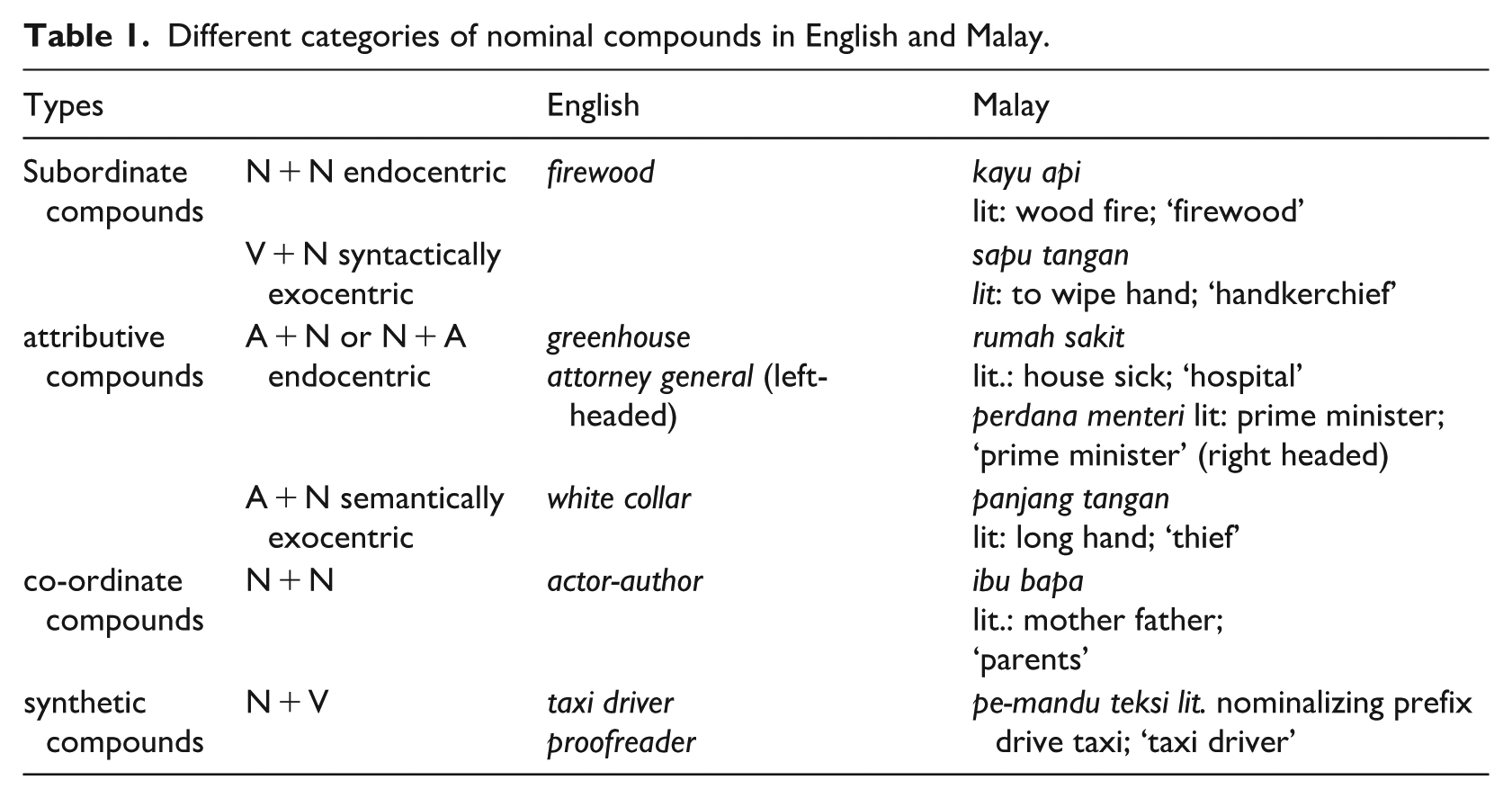
The second layer in Bisetto and Scalise’s model distinguishes between endocentric and exocentric compounds. For Malay, a distinction is sometimes made between syntactically exocentric and semantically exocentric compounds (Hassan, 1986). The former consist of a transitive verb (head) + object/complement, e.g., sapu tangan (wipe hand) ‘handkerchief’ types. Semantically exocentric nominal compounds, by contrast, are exocentric in terms of meaning, e.g., panjang tangan (long hand) ‘thief’ types. It is interesting that among the exocentric attributive ones, some appear to be right-headed too (e.g., panjang tangan, lit. long hand, ‘thief’) and besar kepala (large head) ‘stubborn’, although adjectives generally follow nouns in syntactic phrases.
A few words also need to be said about
For the current paper, it is important to note that synthetic compounds differ clearly between Malay and (Malaysian) English. Deverbal nouns are quite productive in Malay according to Azam (2016), but constructions with deverbal nouns are commonly considered as syntactic phrases, not compounds (Karim et al., 2008). Thus, according to Azam, technically speaking, Malay has no synthetic compounds. As explained above, we take the view that there are no principled distinctions between syntactic phrases and compounds. The fact that word order in compounds and free phrases is the same in Malay makes it even more difficult to make this distinction than in English.
There is one more type of compound that has not received attention in the literature on Malay-English language contact, namely
A final point needs to be made about the differences between the languages with respect to the pluralisation of compounds. Here, there are again clear differences between English and Malay. As is well known, English makes use of inflections which are added to the head of a compound (e.g., taxi drivers, car parks, greenhouses, etc.). Normally, this is the right-hand element, except for compounds borrowed from, for example, French, where attorney general becomes attorneys general in plural: here, attorney on the left is the head. Regular plurals and other inflections do not normally appear within compounds, but see Bauer (2019) for exceptions. In Malay, by contrast, the plural is formed through reduplication (Karim, 1995). For compounds, the rules differ in that, in some cases, only the head is reduplicated (partial reduplication), as in rumah sakit (house sick/ill ‘hospital’), where only rumah ‘house’ is reduplicated, so that it becomes rumah-rumah sakit ‘hospitals’ in plural. In other cases, both constituents are reduplicated (full reduplication). Thus, e.g., uji kaji ‘experiment’ becomes ujikaji-ujikaji ‘experiments’ (see Azam, 2016, for further discussion). While we cannot explore this issue in detail, for the current paper, it is important to know that with respect to pluralisation, the rules are clearly different in both languages.
We hope the brief overview in this section has shown that there are important differences in how compounds are formed in English and Malay, although, as shown in Percillier (2016) and Vollmann and Soon (2020), there is extensive evidence for CLI and convergence between the different languages spoken in Malaysia, too. The differences in headedness and pluralisation make this language pair an interesting testing ground for the analysis of rule-governed and rule-changing creativity, also because CLI could lead to innovations in compounding structures. To the best of our knowledge, this is the first study that focuses on creativity in Malay-English compounds.
Mixed compounds in Malay-English language contact
From the literature on language contact in Malaysia, it emerges that mixed compounds are fairly common in Malaysian English. Many of the items listed in Ramakrishna (2009) and Tan (2009) relate to cultural items (in particular food) that the authors consider to be borrowings in Malaysian English. Ramakrishna’s study discusses lexical borrowing from Malay in a sample of 184 English short stories written by Malaysians from three time periods between 1957 and 2006. According to the author, the mixing of Malay, Tamil, and Chinese elements is a distinctive linguistic characteristic of these English stories. Among the 95 Malay items (mainly from works written between 1985 and 2002) found in these Malaysian English stories, there are a number of Malay-English mixed compounds, as shown in Table 2. 4 Tan (2009) presents mixed compounds from a Malaysian English newspaper corpus, which contains around 4 to 5 million words from newspaper articles published in the two most authoritative English language dailies in Malaysia – The STAR and the New Straits Times. The data were collected between August 2001 and January 2002.
Mixed Malay-English compounds in English short stories and newspapers.
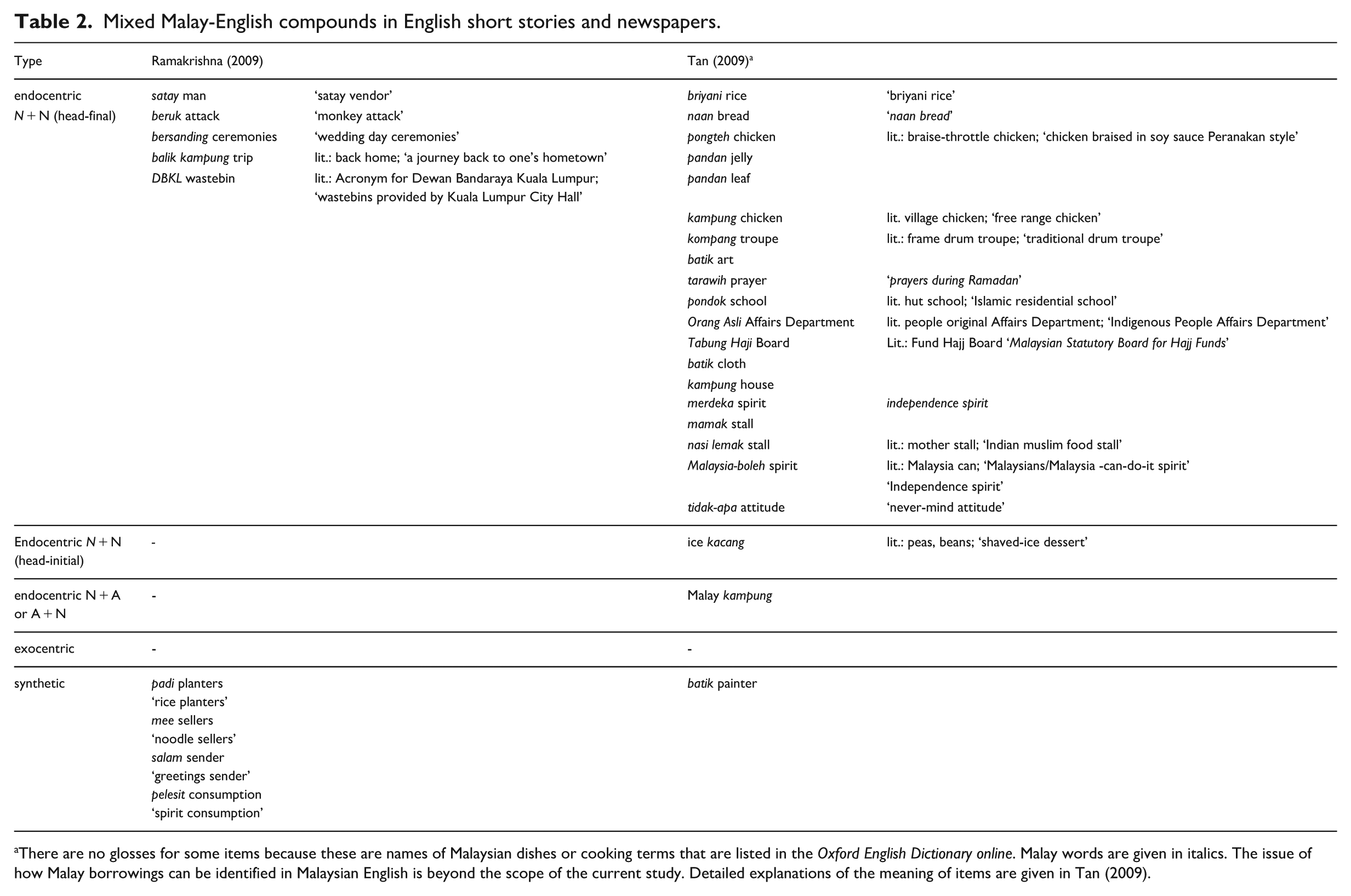
There are no glosses for some items because these are names of Malaysian dishes or cooking terms that are listed in the Oxford English Dictionary online. Malay words are given in italics. The issue of how Malay borrowings can be identified in Malaysian English is beyond the scope of the current study. Detailed explanations of the meaning of items are given in Tan (2009).
As can be seen in Table 2, most of the nominal compounds in the data are right-headed endocentric N + N compounds, with an English noun as the head, and a Malay non-head. Only a handful of left-headed compounds were found in the newspaper collection, and both authors found a few synthetic compounds that also had an English head. Tan notes that most of the mixed compounds are literal translations from Malay. Thus, ayam kampung (lit. chicken village, ‘village chicken’) is borrowed in Malaysian English as kampung chicken. Often, such borrowings are structurally adapted to English grammar in that the compounds become head-final. It is clear that chicken can also appear in the non-head position, as in chicken rendang ‘chicken curry’.
In the data from the stories, there are two phrasal compounds, namely Malaysia boleh (lit. Malaysia can) spirit ‘Malaysia-can-do-it spirit’ and tidak apa attitude ‘never mind attitude’. In both cases, these compounds are right-headed and the head is an English noun. How productive these are in Malaysian English cannot be said based on the current evidence.
The mixed compounds from Ramakrishna (2009) and Tan (2009) illustrate clearly that Malay words that are borrowed into Malaysian English and are used in compounds follow English rules for building compounds. The same was found in Treffers-Daller (2005), where French lexemes that were listed as borrowings in Dutch dictionaries could function as the head in a right-headed compound (e.g., gazettenmarchand ‘newspaper seller’). Thus, whether or not a lexeme has obtained the status of a borrowing in the receiving language (in this case Dutch) may also affect its ability to appear in the position of the head. It is an open question whether this is also possible for donor language items that are not (yet) listed in the receiving language. As long as there is no agreement on how to unambiguously distinguish borrowings from code-switches, this issue is difficult to resolve.
The current study
In this study, we focus on the following questions:
1. Do (un)mixed compounds found among Malay-English bilinguals follow Malay or English rules for headedness?
Hypothesis: We expect the default to be that word order in monolingual English compounds will follow English word order and be right-headed, while monolingual Malay compounds will follow Malay word order (i.e., be left-headed). For mixed compounds, we expect word order to be English if the head is English and Malay if the head is Malay. However, because of the widely acknowledged crosslinguistic influence between both languages, there could also be variability in headedness.
2. If there is variability, does the language of the clause affect the headedness of compounds in the data?
Hypothesis: With Cocchi and Pierantozzi (2022), we assume that the language of the clause will affect the headedness of compounds in that monolingual and mixed compounds may be more likely to follow English word order if the language of the clause is English and more likely to follow Malay word order if the language of the clause is Malay.
3. Are all types of compounds distinguished by Bisetto and Scalise (2005) found in the data?
Hypothesis: Following Dressler (2006), we expect endocentric compounds to be more common than exocentric ones, as this is the type of compound that is crosslinguistically most common.
4. To what extent do Malay-English (un)mixed compounds qualify as examples of rule-governed or rule-changing creativity?
Hypothesis: We expect there to be more examples of rule-governed creativity than of rule-changing creativity, as the data come from formal settings (English or literature classes). In more informal settings or on social media, we would expect more examples of rule-changing creativity (Treffers-Daller et al., 2022). Examples of English number inflection on compounds may be seen as rule-changing creativity, because number is not marked on Malay nouns with an inflection but through reduplication.
Methods
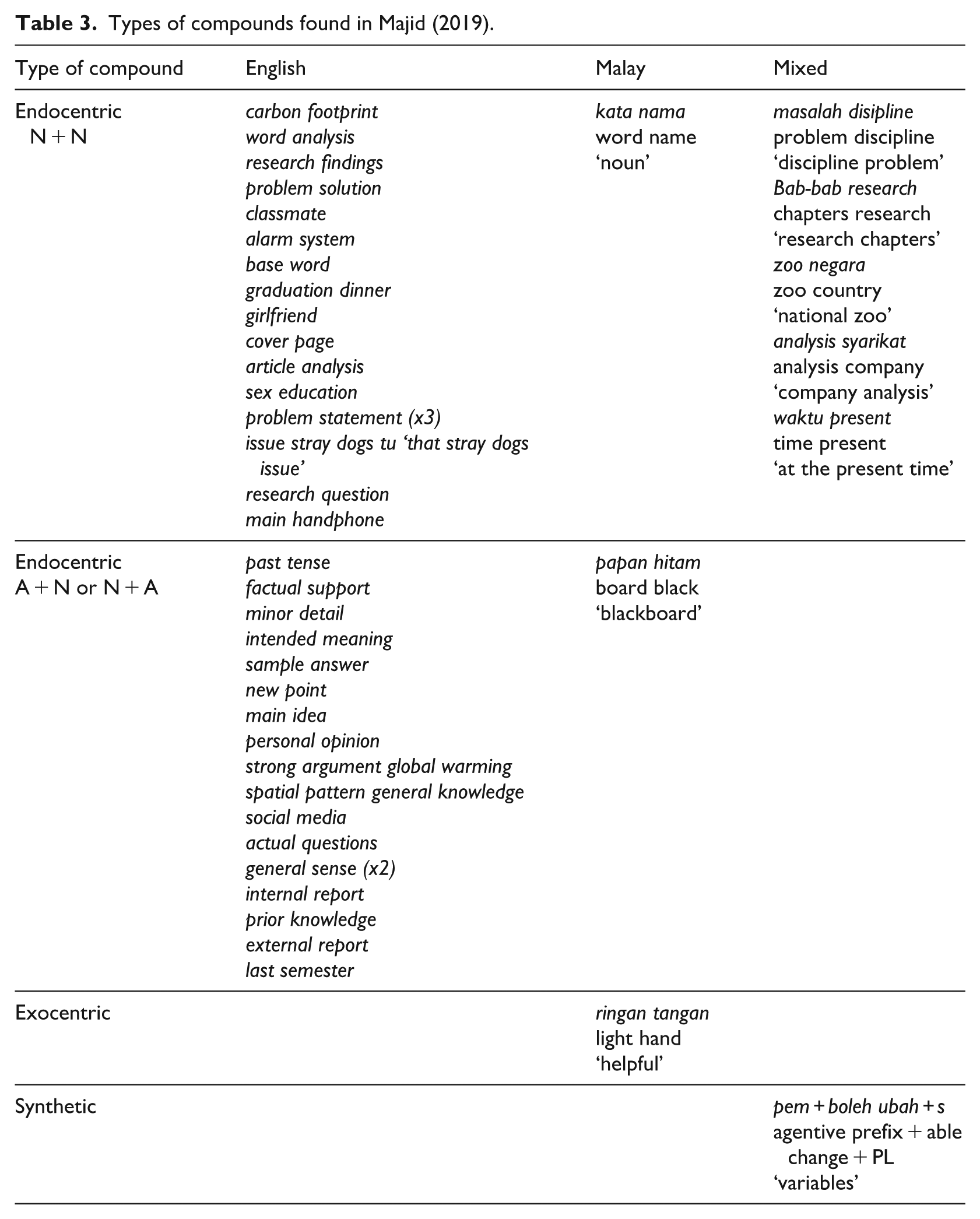
The data on which this study is based come from Majid (2019) whose corpus contains 1044 utterances with intrasentential code-switching between Malay and English. These data stem from two English language lecturers (Azma and Ali) who worked at a university in Malaysia at the time of data collection (see Treffers-Daller et al., 2022 for details). They both had an MA degree in TESOL from a Malaysian university and worked as English Language tutors at a university in Malaysia. They were both fluent in English, although their English language levels were not measured. An overview of the compounds from conversations recorded in classrooms where Ali and Azma were teaching can be found in Table 3.
Types of compounds found in Majid (2019).
In analysing the data, we have chosen a qualitative approach because the data set contains relatively few examples of the target constructions. A quantitative approach whereby individual differences in compounding strategies between speakers are studied is therefore not feasible on the basis of the available data.
Results
RQ1: Headedness of (un)mixed compounds
Table 3 shows that the majority of compounds in the data are English right-headed endocentric N + N and A + N compounds. For the latter, it may be the case that some of these are syntactic phrases rather than compounds. 5 However, we do not make a fundamental distinction between these two categories. Because they provide important information about the headedness of phrases and compounds, we have decided to include all A + N compounds/phrases in the data. The number of monolingual Malay compounds is very limited, but there are a few interesting mixed compounds in the data. The endocentric N + N compounds form the largest group among the mixed compounds, but they are a very diverse group. There was only one exocentric compound (ringan tangan, lit. light hand, ‘helpful’), and one synthetic compound in the data pemboleh ubahs ‘variables’. The latter received an English plural, which is quite rare in the data set. Four of the five compounds in this group are left-headed, but only two of these have an unambiguous Malay head (masalah ‘problem’ or bab-bab ‘chapters’). The mixed compounds are clearly left-headed and therefore formed according to Malay rules.
While it is clear from the many monolingual English compounds in Table 3 that the two participants master the rules for compound formation in English, the mixed compounds show some variability in that they allow English non-heads to appear in left-headed N + N compounds, as in masalah disipline ‘discipline problem’ and bab-bab research ‘research chapters’, and an English adjective to appear on the right hand side of a Malay head, as in waktu present ‘at the current time’.
Interestingly, there are no examples where Malay nouns appear as the head in a right-headed compound, nor do Malay adjectives appear on the left in right-headed structures (e.g., *hitam papan ‘blackboard’). The very few Malay compounds in the data are left-headed, and this is also true for the mixed compounds. However, there appears to be a little variability in the position of English nouns: zoo negara ‘national zoo’, the English noun zoo is the head of a left-headed compound. However, in these cases, the English part (e.g., analisis, disipline, or zoo) is a borrowing from English, which we know because these items are listed in dictionaries of Malay, e.g., Kamus bahasa melayu (https://kamusbm.com/) or pusat rujukan persuratan melayu (https://prpm.dbp.gov.my/). In the dictionaries, the spelling of some of these (e.g., analisis, disiplin) has been adjusted to Malay spelling rules, which is a further indication of the fact that they have been borrowed. The fact that these items are established borrowings in Malay may have facilitated their appearance in left-headed compounds. Only in some cases, bab-bab research ‘research chapters’, and issue stray dogs tu ‘that stray dogs issue’ does an English noun or an English A+N combination that is not a borrowing in Malay appear on the right in a left-headed compound. Interestingly, bab-bab research and issue stray dogs tu are embedded in a Malay clause, which may have increased the likelihood of Malay-like structures. Overall, the data show that the two teachers clearly separate the compounding rules for both languages in that English compounds are right-headed and Malay compounds are left-headed.
RQ2: The language of the clause
Examples (11) – (13) show in which linguistic contexts the mixed compounds occurred. The mixed compounds in (11) and (12), which display Malay word order, appear in a clause that is entirely in Malay, while the Malay compound papan hitam ‘blackboard’ appears in a completely English clause, as can be seen in (13).
(11) Walaupun John-ni ada masalah disipline tapi he was a great sportsman Although John-DEM has problem discipline but he was a great sportsman ‘Although John has this discipline problem, he was a great sportsman’. (12) Saya dalam bab-bab research-ni sayas edikit flexible. 1SG in chapters research-DEM 1SG a little flexible ‘I am a little flexible with research chapters. ’ (13) I would really appreciate it if, before we start, you guys could padam the papan hitam I would really appreciate it if, before we start, you guys could erase the board black ‘I would really appreciate it if, before we start, you guys could erase the blackboard.’
Finally, in (14), we see that, as expected, English compounds found in completely English utterances conform to English compounding rules.
(14) So, the keywords that you must look at the research findings are ‘study’.
RQ3: Types of compounds
In total, among the monolingual English compounds, there were 16 endocentric N + N compounds and 19 A + N or N + A endocentric compounds (multiple tokens of the same type not included). There were no exocentric or synthetic English compounds. For Malay, the results show there was one N + N, one N + A compound, and one exocentric compound. Among the mixed compounds, we found five endocentric compounds and one synthetic compound. Full details are given in Table 3.
RQ4: Rule-governed or rule-changing creativity?
Finally, we asked whether there is any evidence for creativity in the mixed compounds in the data from Majid (2019). Evidence for rule-changing creativity in how compounds were pluralised: in some cases, English words (e.g., students-students) were reduplicated, and plural is marked in English through the addition of -s, which means that this is actually an example of doubling (Muysken, 2000). Another example of rule-changing creativity might be the addition of an English plural -s to pemboleh ubahs ‘variables’, which is highly constrained in many data sets, but actually fairly common in the Malaysian English newspaper data from Tan (2009), who mentions, for example, datuks ‘grandfathers’ and kerongsangs ‘brooches’. Finally, the fact that word order inside compounds does not always match the language of the head, as discussed under RQ1, can be interpreted as rule-changing creativity. This issue is taken up again in the discussion.
Discussion
In this paper, we analysed the occurrence of compounds in studies on Malay and Malaysian English, and in the data set from Majid (2019). We asked, first of all, whether (un)mixed nominal compounds follow English or Malay word order. Overall, the evidence from Majid (2019) suggests that English compounds are right-headed, and Malay compounds are left-headed. Thus, the compounding rules for each language are clearly separated by the two teachers. While there were more English compounds than Malay compounds, this does not necessarily mean that compounding is less productive in Malay: the data were collected at an English-medium university, which means that less Malay was spoken than in other settings. Interestingly, with respect to mixed compounds, the data from Majid (2019) are clearly different from those in the newspapers studied in Tan (2009) and the Malaysian English stories in Ramakrishna (2009): in these two sources there were many right-headed mixed nominal compounds, where Malay lexemes function as the non-head and appear on the left-hand side of the English head noun. In the data from Majid (2019), this type of mixed compound is completely absent.
The difference between the corpora studied here shows that the variability in the headedness of mixed compounds is not only decided by the language of the head: in clauses that are entirely English, as in the data from Tan (2009) and Ramakrishna (2009), English compounding rules are followed, while in clauses that are entirely or mainly in Malay, as in the data from Majid (2019), it is Malay rules that are followed. The fact that the language of the clause impacts the headedness of compounds lends support to the analyses of Cocchi and Pierantozzi (2022), who concluded that if the language of the clause matches the language of the head, this increases the acceptability of mixed compounds. The impact of the language of the clause on the headedness of compounds could even be seen in Malay utterances that contain a monolingual English compound: for some of these, the compound was head-initial rather than head-final. This is important because it shows that the headedness of a compound is not merely a word-internal issue, in that the language of the head determines the headedness of a compound (e.g. if the head is Malay, then the compound is head-initial): the matrix language of the clause also impacts the internal structure of mixed and unmixed compounds. Which variables are most important cannot be decided based on the current evidence. Empirical data such as those provided by Cocchi and Pierantozzi (2022) would be needed to investigate this further.
The variability in word order in Malay-English language contact, which was already noticed by McLellan (2009), has important implications for our understanding of the separability of lexicons in multilinguals. We agree with Alexiadou (2020) that the evidence from the literature supports the idea of a unified, integrated lexicon from which multilinguals pick heads and non-heads in creating compounds. However, multilinguals are still able to produce monolingual compounds where the internal structure matches that of the language of the head: in fact, most of the monolingual compounds in Majid (2019) were right-headed English ones. This means that, even if the lexicons of multilinguals are at least partly shared, they remain also separable. Whether or not creating shared grammatical structures also counts as rule-changing creativity is an interesting issue we have not been able to address in this paper.
In our study, we did not find as much crosslinguistic influence in compounding structures as in the study of Nicoladis (1999), but we did find some evidence for variability in headedness (un)mixed compounds. We also found some evidence for Malay reduplication applied to English nouns, as well as English plural attached to Malay nouns and a case of double marking. Both the issue of variability in headedness and the issue of pluralisation could be interpreted as examples of rule-changing creativity. English plural marking on Malay nouns was not attested about twenty years ago (McLellan, 2009), but there is some evidence that this kind of mixing is on the rise, particularly on social media, and mainly in the speech of young adults (Rasdi, 2016). Therefore, the phenomena observed here may well illustrate how rule-changing innovations change to a rule-governed innovation when they are adopted by a wider group of speakers (Bauer, 2001).
Here, we have focused on creativity that resulted from crosslinguistic influence between the languages of multilinguals. Of course, innovations can also emerge as internal developments in a language, as in the data from the children cited in this paper (examples 2, 5, 6 and 7), which were not modelled on compounds from other languages. However, children’s input-divergent innovations are typically short-lived: As Raviv et al. (2025) point out, children ‘outgrow transient acquisition errors’ (p. 4), because they do not have the same opportunities to promote innovations as adolescents. Thus, the current data provide some support for the thesis of Raviv et al. (2025) that it is not children but adolescents who are the drivers of language change. Whether innovations in compounding, such as those studied here, are likely to spread among multilinguals and lead to language change will need to be studied in more detail based on experimental data, or data from large online corpora (see Treffers-Daller et al., 2022, for further discussion). For analyses of corpus data, the usage-based approach taken by Lieven et al. (2003) is a very good example of how innovations in the speech of individuals can be detected, provided the data constitute a representative sample of the speech of the interlocutors, as Lieven et al. point out.
Conclusion
In this paper, we asked whether (un)mixed compounds in Malay-English language contact follow the English or Malay rules for compound formation. We found that English compounds are generally right-headed and Malay compounds are generally left-headed, but the headedness of mixed compounds depended partly on the language of the clause: in Malaysian English short stories and newspapers, mixed compounds were right-headed, while they were left-headed in the speech of teachers. In the latter context, the language of the clause in which the mixed compounds were embedded was entirely or mainly Malay. As the language of the clause turned out to be very relevant for the headedness in compounds in our data set, it would be interesting to see to what extent this is also the case for mixed compounds in other language combinations.
In future, the effect of collocational strength of the structures should also be considered, because it is likely that constructions with a high mutual information (MI) score display less variability than those with low MI scores. Finally, it is important to establish whether or not the modifier or the head of a compound (or the entire construction) is listed as a borrowing from a donor language in a recipient language. Particularly relevant from the perspective of creativity would be studies of compounding among bilingual children and young adults who speak two languages with different compounding rules, as is the case for Malay and English. Such studies could throw important new light on the separation of grammars in bilingual development, as well as the ability of adolescents to drive language change. In addition, it would be important to include analyses of individual differences in language backgrounds, frequency of use and language proficiency in future studies of compounding among multilinguals. We very much hope the current study will inspire other researchers to take these issues up in future work.
Footnotes
Acknowledgements
We would like to thank the two Malaysian teachers who took part in the experiment.

Informed Consent Statement
Informed consent was obtained from all subjects involved in the study.
Funding
The authors received no financial support for the research, authorship, and/or publication of this article.
Declaration of conflicting interests
The authors declared no potential conflicts of interest with respect to the research, authorship, and/or publication of this article.
Institutional Review Board statement
The study was conducted in accordance with the Declaration of Helsinki and approved by the Ethics Committee of the Institute of Education, University of Reading (22 October 2016).