




Abstract
Purpose:
Dichotic listening (DL) involves processing auditory information with both ears, divided into binaural integration and separation. There are very limited studies that have explored the auditory processing differences in different forms of bilingualism. Hence, the study aimed to explore the effects of language acquisition patterns (Simultaneous vs. Sequential bilingualism) on dichotic processing skills.
Methodology:
Fifty clinically normal-hearing children (10–15 years) participated in the study. The recruited children were segregated into simultaneous and sequential bilinguals based on language assessment using LEAP–Q. The DL test developed in Kannada and English languages was administered on simultaneous and sequential bilinguals in three different conditions (Free Recall, Forced Recall Right, and Forced Recall Left).
Data & analysis:
All the data were first tested for normality using Shapiro–Wilk’s test, and the results showed that the data were normally distributed. Hence, parametric statistics were applied to check for the significance test with a 5% significance level. Mixed methods analysis of variance (ANOVA) was conducted to explore the main effect of group and language and the interaction between group and language in free and forced recall conditions.
Findings:
The results showed a significant main effect of language and condition on dichotic scores, but not group. The findings revealed significant differences between simultaneous and sequential groups only in the Kannada language and not in English. The dichotic test, administered in two distinct languages, demonstrated distinct linguistic patterns consistent with the bilingual model, underscoring its therapeutic significance in evaluating bilingual language proficiency.
Originality:
The dichotic test, administered in two distinct languages, demonstrated distinct linguistic patterns consistent with the bilingual model, underscoring its therapeutic significance in evaluating bilingual language proficiency.
Implications:
Before assessing bilingual children’s speech or language abilities, examining the order in which they acquire their languages is critical.
Introduction
Central auditory processing disorder (CAPD) is a perceptual deficit specific to the auditory modality, which occurs despite normal peripheral hearing function. APD is defined as “deficits or poor performance in one or more of the following listening skills: auditory pattern recognition; auditory performance with competing acoustic signals and degraded acoustic signals; auditory localization and lateralization; auditory discrimination; temporal aspects of auditory pattern recognition” (American Speech-Language-Hearing Association, 2005). Sound localization and lateralization, auditory discrimination, auditory pattern recognition, and temporal features of audition are all behavioral phenomena that are caused by central auditory processes, which are the mechanisms and processes of the auditory system (Boets et al., 2011). Numerous studies have used various questionnaires and behavioral tests to assess auditory processing abilities in children. To correctly interpret the central auditory processing tests, people must comprehend how the auditory centers, respectively, carry out the mechanisms of the three central auditory functions: binaural interaction, temporal processing, and dichotic listening (DL) (Dlouha et al., 2007).
DL is the auditory process that involves listening with both ears. Binaural integration and separation are the two distinct processes that make up DL. The ability to simultaneously receive distinct auditory messages given to the left and right ears is known as binaural integration. Perceiving one auditory information while disregarding another in the other ear is known as binaural separation (Volkmar, 2021).
The left hemisphere significantly influences the function of language. Asymmetric projections are frequently seen from each ear to the bilateral auditory cortex (Hakvoort et al., 2016; Mei et al., 2020). The cerebral pathway from the right ear to the left hemisphere is thought to be superior to the pathway from the left ear to the left hemisphere in the majority of people (contralateral projection dominance) (Hiscock & Kinsbourne, 2011). Listeners reported speech stimuli from the right ear more accurately than the left when engaging in DL. This preference for the right ear is known as a right-ear advantage (REA). The structural model originally suggested by Kimura (1961) is the most widely accepted explanation for REA. This model associates the REA related to the combined effects of contralateral auditory pathway dominance and left hemisphere specialization for language processing (Kimura, 1967). The application of DL is not limited to studying lateralized temporal lobe function but also involves studying cognitive processes like attention and executive function.
Bilingualism refers to the ability to speak two or more languages, whether by an individual or a community of speakers. In the vast majority of nations worldwide, bilingualism is the norm. Depending on the language, cognitive, developmental, and social aspects, bilinguals are divided into many groups. Bilinguals were categorized based on the difference between the level of competence and fluency in the languages spoken, age, context, and language acquisition method, as well as the proposed language representation or processing system, which include: (a) the early/late, (b) simultaneous/ successive, (c) formal/informal, (d) acquired/learnt, (e) additive/subtractive, and (f) compound/coordinate/sub-coordinate bilinguals.
Based on the age at which they were exposed to two or more languages, bilinguals are categorized as either early or late. Early bilingualism refers to learning multiple languages during childhood, before adolescence, while late bilingualism involves acquiring one language first and learning the second after the age of 8. There are two types of early bilingualism: simultaneous early bilingualism, which occurs when a child learns two languages at the same time from birth, and sequential early bilingualism, which occurs when a child learns a second language (L2) early in life after first partially mastering their first language (L1). The brain’s plasticity is demonstrated by its ability to understand and generate two languages with different phonological, syntactic, and semantic characteristics. People who are born bilingual frequently exhibit overlapping patterns of brain activity when processing their two languages. This implies that neither major anatomical nor functional modifications are necessary for the brain’s language network to easily accommodate and comprehend both languages (Kousaie et al., 2017). Sequential bilinguals, who acquire their second language (L2) after mastering their first language (L1), frequently have enhanced activity in brain regions linked to phonological processing and speech production, especially while speaking their L2 (Berken et al., 2016).
Kannada is a Dravidian language primarily spoken in southern India, with around 60 million speakers, predominantly in Karnataka. Kannada is characterized by an alphasyllabary writing system, written horizontally from left to right, and comprises about 20 dialects (Ahmed et al., 2022). The English language holds a significant place in Karnataka, functioning alongside Kannada, the official state language (Brown & Ogilvie, 2010). Since bilinguals must continually navigate between two lexical options to derive meaning, studying bilingualism provides valuable insights into the modularity or interactivity of language processing. CAPD is a language-based assessment; the nonavailability of test materials and testers’ and clients’ varied competencies in these languages create more challenges for audiologists. Performance on behavioral CAPD tests, many of which are linguistically loaded (e.g., dichotic listening tasks, speech-in-noise tests, gap detection using speech stimuli), is heavily influenced by language proficiency. It is possible for children or persons who are not native speakers or who have limited proficiency in the test language to perform poorly due to linguistic difficulties rather than auditory processing deficiencies (Chermak et al., 2017). There is a lot of evidence that language experience affects the performance of individuals on speech-based tests like those found in APD batteries (Shi, 2009; Tabri et al., 2011). By examining performance in sequential bilingual individuals, our study provides insights into how bilingual individuals’ language experience may interact with central auditory processing, thus offering important implications for both clinical assessment and the field of bilingualism research.
Numerous studies on dichotic listening have explored the differences in DL among bilinguals and monolinguals. However, there is insufficient data exploring the differences in auditory processing skills among different types of bilinguals. Numerous studies on dichotic listening have explored the differences in dichotic listening among bilinguals and monolinguals. However, there is insufficient data exploring the differences in auditory processing skills among different types of bilinguals. Hence, this study aims to explore the effects of language acquisition pattern (bilingualism) on dichotic processing skills and compile the differences in auditory processing skills for different language acquisition.
Methodology
The study was conducted in the Department of Audiology and Speech-Language Pathology, Kasturba Medical College, Mangalore, and the Department of Speech and Hearing, SDM College of Medical Sciences and Hospital, SDM University, Dharwad, India. This study has been conducted prospectively with an analytical design. This research project is reviewed and approved by the Ethics Committee of Kasturba Medical College, Mangalore [IEC KMC MLR 03/2024/99].
Test procedure
Fifty clinically normal-hearing children (age range of 10–15 years) were recruited for the study based on inclusion and exclusion criteria. Right-handed subjects with Pure Tone Average (PTA) <20 and no speech understanding difficulties were recruited for the study. Sample size was estimated based on the standard deviation taken from previous literature (Persinger et al., 2002).
Written informed consent was taken from the participant’s parents or guardians. The Edinburgh Handedness Inventory was used to assess the handedness of the participants. Pure tone audiometry was done to assess the hearing acuity of the patient. Thresholds were obtained using the modified Hughson and Westlake method (Ascending and descending Method). Subjects with audiometric thresholds below 25 dBHL for both air conduction and bone conduction testing were recruited for the study. A detailed case history related to hearing, communication, systemic disease, occupation, and family history was taken before PTA. Participants were also examined for middle ear dysfunction using tympanometry on the GSI Tympstar middle ear analyzer, using a 226 Hz probe tone (A type: Normal tympanogram with admittance value of 0.3–1.66 cc and middle ear pressure −100 to +60 daPa). Participants with any history or present middle ear pathology were excluded from the study. The recruited children were segregated into simultaneous and sequential bilinguals based on language assessment using LEAP–Q. All sequential bilinguals in the study acquired Kannada as their first language (L1) and English as their second language (L2). This pattern of language acquisition is common in the Karnataka region, where individuals are predominantly exposed to Kannada from early childhood, both at home and in the community. The DL test developed in Kannada and English languages (Bhat et al., 2021; Dsouza et al., 2024) was administered on both simultaneous and sequential bilinguals to assess the effect of language learning patterns on dichotic performance in different forms of bilinguals. The recruited children were seated comfortably in a sound-treated room, and the stimuli were presented through the calibrated AKG K72 headphones. The participants were instructed to listen carefully, recall the stimuli presented in both ears, and respond orally. Upon hearing a beep tone before a stimulus in any ear, they were required to repeat the stimulus presented in that specific ear.
Conditions
Free recall: The subject will be asked to concentrate on the stimulus coming from both ears.
Forced recall right: The subjects will be instructed to recall whatever was heard only from the right ear.
Forced recall left: The subjects will be instructed to recall whatever they heard only from the left ear.
Scoring
In the free recall condition, every correct recall of stimuli presented in the right ear was given a score of 2, similar to the left ear. Correct recall of all four stimuli presented to both ears was scored as a double correct score of 1. Similarly, if the participant recalled both the stimuli presented in the left ear correctly and one stimulus in the right ear, then a score of 2 was given to the left ear and a score of 1 was given to the right ear, and vice versa. In the forced attention condition, correct recall of both the stimuli presented to the attended ear was given a score of 2.
Statistical analysis
Dichotic scores obtained from the test were documented in Excel files and then exported to SPSS version 22 for analysis. All the data were first tested for normality using the Shapiro–Wilk’s test, and the results showed that the data were normally distributed. Hence, parametric statistics were applied to check for test of significance at 5% level of significance.
Results
A total of 50 participants were recruited for the study (25 simultaneous and 25 sequential), comprising 20 males and 18 females with ages ranging from 10 to 15 years and a mean age of 13.2 years. All the data were first tested for normality using Shapiro–Wilk’s test, and the results showed that the data were normally distributed. Hence, parametric statistics were applied to check for the significance test with a 5% significance level. A mixed-methods analysis of variance (ANOVA) model was carried out to explore the effect of the pattern of language acquisition on dichotic performance with bilingual pattern (Simultaneous vs. Sequential) as a between-subject variable and dichotic conditions (Free recall right vs. Free recall left vs. forced recall right vs. forced recall left) and language (Kannada vs. English) as within-subject variables. Upon violation of sphericity, Greenhouse-Geisser’s corrections were applied. Post-hoc analysis corrected for multiple comparisons using Bonferroni correction was carried out to determine pairwise significance if there was a significant main effect. The descriptive statistics are provided in Table 1.
Dichotic scores across language and groups.
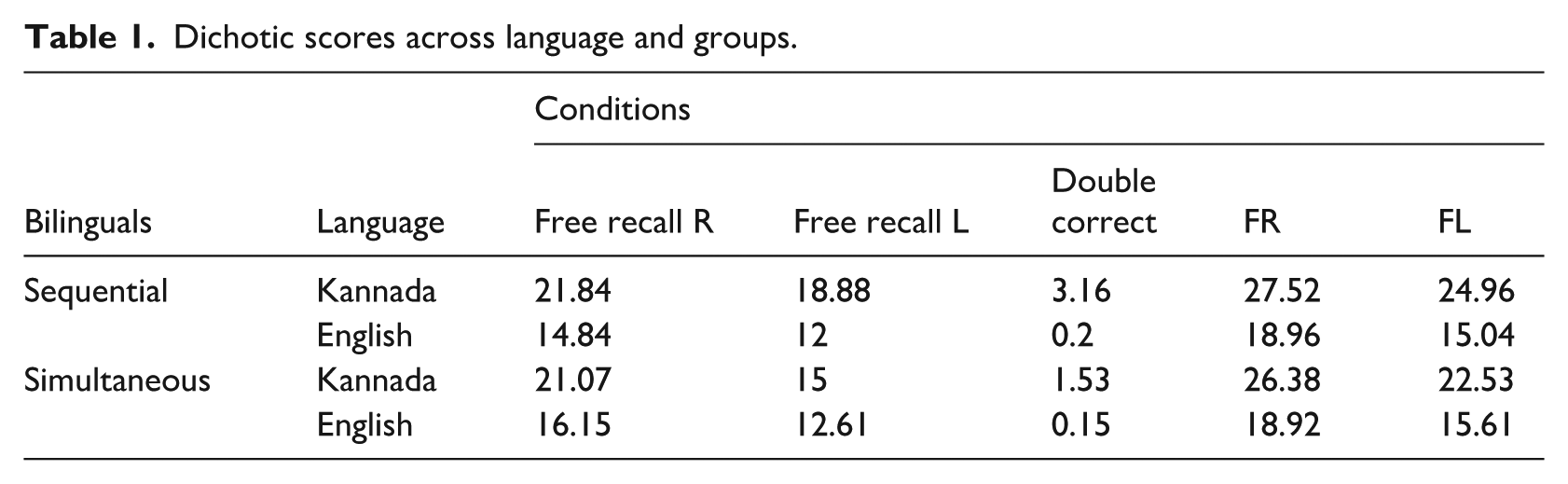
Mixed-methods ANOVA was conducted to explore the main effect of group (Simultaneous vs. Sequential) and language (Kannada vs. English), and the interaction between group and language in free and forced recall conditions. The overall results showed a significant main effect of language, f (1,36) = 265.525, p < .001, and condition, f (2.5, 91.2) = 488.122, p < .001, on dichotic scores, but not group, f (1, 36) = 0.869, p = .358. Concerning the language, irrespective of the type of bilingualism, the dichotic scores were superior for the Kannada language compared to English (p < .001). Post-hoc analysis was done to explore the main effect of the condition, and the results showed a significant difference between the right and left ear (irrespective of language), where right ear scores were larger when compared to the left in both free (p < .001) and forced recall conditions (p < .001).
Further analysis was carried out to explore the interaction effect between language and bilingual patterns. This was done by comparing the difference scores of Kannada and English (L1—L2) between simultaneous and sequential bilinguals across the condition using an independent sample t-test. The results revealed significant differences between simultaneous and sequential groups in free recall conditions (Free right—t[48] = −2.1, p = .02; Free left—t[48] = −3.1, p = .03), where the score difference was larger in the sequential group when compared to simultaneous. This indicates that dichotic performance in L1 was superior for sequential when compared to simultaneous, whereas the L2 performance was comparable between the groups.
Discussion
DL involves processing auditory information with both ears, divided into binaural integration and binaural separation. In the realm of cognitive psychology, the DL test has long been a valuable tool for researchers to explore the intricate workings of the human brain and its ability to process auditory information (Hugdahl & Westerhausen, 2016). Various conditions of DL assess different cognitive pathways. While dichotic performance in the free recall condition primarily engages a lateralized perceptual language component, the forced recall assesses cognitive functions like attention and executive function (Trejo-Martínez et al., 2018).
Bilingualism is the ability to make use of two or more languages, whether by an individual or for communicating within a community, which is a common phenomenon in most countries worldwide. Bilinguals are classified as early or late, based on when they are exposed to more than two languages (Moncrieff, 2011). Preadolescent or early bilingualism, occurring before adolescence, includes simultaneous (learning two languages from birth) and successive (learning a second language after partially acquiring the first) (Sebastian-Galles & Santolin, 2020). Most electrophysiological studies show that stronger cognitive abilities like attention control and auditory processing result from enhanced attention demand during bilingual conversation (Barulli & Stern, 2013; Schroeder & Marian, 2012).
India is estimated to have 452 official languages (Lewis et al., 2009). With over a thousand native languages spread over four major language groups, bilingualism (the capacity to speak two languages) and multilingualism (the ability to speak more than two languages) are common in India. Numerous studies on DL have explored the differences in DL among bilinguals and monolinguals, but none have explored the differences in auditory processing skills among different types of bilinguals. If there is a significant effect of the pattern of language acquisition, then there is a need to develop language-specific CAPD tests, especially in a multicultural country like India, for accurate assessment of underlying auditory processing deficits. Hence, this study also aims to explore the effects of language acquisition pattern (bilingualism) on dichotic processing skills and compile the differences in auditory processing skills for different language acquisition.
The overall results revealed a notable main effect of language and condition on DL scores, but not the group. There was a marked difference in the dichotic scores among the right and left ears in both groups, where greater scores were obtained in the right ear compared to the left, suggesting an advantage in the right ear in the free recall condition. This ear difference was seen in both Kannada and English languages. The REA is considered a reliable marker of cerebral language asymmetry, as language and linguistic abilities are predominantly lateralized in the left hemisphere (Damasio & Damasio, 1979). Not only behavioral but several neurophysiological studies have shown larger activation in the left hemisphere of the brain as opposed to the right during dichotic presentation (Hugdahl & Westerhausen, 2016). Such an ear difference was seen even in forced recall conditions, where right scores were superior to left. Our previous studies have shown a lack of ear differences in forced recall conditions in adults because of the strong influence of top-down cognitive processes on perceptual asymmetry (Bhat et al., 2021). Such a phenomenon may not be seen in children because of maturational influence on cognitive function. Studies have suggested that maturation of cognitive functions like executive function is not fully developed till adulthood (Best et al., 2015; Thillay et al., 2015).
Irrespective of the type of bilingualism, the dichotic scores were superior for the Kannada language compared to English. Research has demonstrated that bilingual individuals, even those with high proficiency in their second language, tend to face greater challenges when subjected to tests in that language (Rosenhouse et al., 2006; Tabri et al., 2011). This could also be because of the strong influence of the regional Kannada language over English, especially in northern parts (Sharma & Purdy, 2009; Tabri et al., 2011). This could also be because of the strong influence of the regional Kannada language over English, especially in the northern parts.
This study also revealed significant differences between simultaneous and sequential groups only in the Kannada language and not in English. Regarding sequential bilinguals, language competency was higher for L1, but for simultaneous bilinguals, it was the same for both L1 and L2. Simultaneous bilinguals acquire a second language by 3 years of age, whereas sequential bilinguals acquire a second language after 3 years of age (Paradis et al., 2021). While a sequential bilingual kid may show, at least initially, strength in their original language, a simultaneous bilingual child may show more equal growth in both languages (Goldstein & Bunta, 2012). Thus, the dichotic processing variations between simultaneous and sequential bilinguals were effectively identified in the current study, and these differences were in line with theories of language learning.
Summary and conclusion
Before assessing bilingual children’s speech or language abilities, looking at the order in which they acquire their languages is critical. The dichotic test, administered in two distinct languages, demonstrated distinct linguistic patterns consistent with the bilingual model, underscoring its therapeutic significance in evaluating bilingual language proficiency.
Footnotes

Ethical considerations
All participants provided written informed consent, and the Institutional Review Board approved all research procedures.
Author contributions
Yashu, Krithi, Nishika, Thalika, Viola, and Mayur: Conceptualization, Data curation, Formal analysis, Investigation, Methodology, Writing—original draft
Harsha and Wasim: Supervision, Visualization, Writing—review, and editing
Funding
The authors received no financial support for the research, authorship, and/or publication of this article.
Declaration of conflicting interests
The authors declared no potential conflicts of interest with respect to the research, authorship, and/or publication of this article.
Data availability statement
The data that support the findings of this study are not publicly available due to their containing information that could compromise the privacy of research participants, but are available from the corresponding author upon reasonable request.