




Abstract
Aims and objectives:
The primary goal of this study was to examine whether degree of bilingualism related to dichotic listening accuracy, a measure of bilateral processing, after controlling for age and income.
Methodology:
Participants included 59 children ages 6–11 years (M = 7.86, SD = 1.81) and 61 adults (18–83 years) (M = 34.02, SD = 15.70). Participants completed demographic surveys, vocabulary assessments in English and Spanish, and a dichotic listening test.
Data and analysis:
Multiple linear regressions examined whether the degree of bilingualism predicted bilateral processing.
Findings:
Degree of bilingualism predicted bilateral processing in the whole sample of children and adults.
Originality:
This study is one of the first to examine bilingualism and bilateral processing while including both children and adults. It also importantly controlled for a possible cognate facilitatory effect and participant income differences and measured bilingualism on a continuum.
Significance:
Results highlight the importance of including bilingual groups of different ages when researching bilingualism and laterality.
Dual language experiences have profound developmental influences on brain structure, function, and neural plasticity (Pliatsikas et al., 2020; Vaughn et al., 2021). Researchers have found that bilingual adults demonstrate less brain laterality (i.e., the hemispheric specialization of certain neural functions to one side of the brain) than monolingual adults (Gresele et al., 2013; Jafari et al., 2014). While some research has documented differences in bilateral processing between bilingual and monolinguals adults, few, if any, have focused on relations between degree of bilingualism, laterality, and bilateral processing in children. Bilingual experiences (e.g., early vs. late acquisition; Hull & Vaid, 2007) and variations in language proficiency across bilinguals’ two languages or language balance (i.e., the degree of similarity between a person’s proficiency in two languages) could affect bilateral processing. This study examines how degree of bilingualism relates to measures of bilateral processing in children and adults.
One way to measure bilateral processing is through the established paradigm of dichotic listening (Westerhausen, 2019). Dichotic listening tests involve simultaneously presenting auditory stimuli (e.g., syllables, words, digits, or sentences) to both ears. These tests have been used to measure the degree to which attention can be directed to one ear versus to both ears simultaneously (Musiek & Chermak, 2015; Shinn et al., 2005). Using these and similar methodologies, researchers have established that the brain processes auditory information in a contralateral manner (Kimura, 1967). It is primarily contralateral brain connections that drive the reception of stimuli transferred from the auditory nerves to the auditory cortex and secondary auditory regions (Hugdahl, 2011; Hugdahl & Brobeck, 1986). The stimulus-receiving ear opposite a given brain hemisphere (e.g., the right ear to left hemisphere) is most sensitive to information presented to it. It also has been established that the left hemisphere processes verbal stimuli (Kimura, 1967; Strouse Carter et al., 2001), while the right hemisphere processes melodic patterns in most individuals.
Several studies have demonstrated that laterality increases with age from childhood through old age, and that these age-related changes are associated with specific structural brain changes such as corpus callosum atrophy in older adults (Hirnstein et al., 2013; Olulade et al., 2020; Qi et al., 2019; Salat et al., 1997; Westerhausen et al., 2011, 2015). One study specifically compared child and adult samples. Westerhausen et al. (2011) conducted a functional magnetic resonance imaging (fMRI) study with children and adults and found that increased callosal isthmus thickness in 6-year old children was associated with less interhemispheric communication (i.e., less exchange of information and activity coordination between the two cerebral hemispheres), while a decrease in callosal isthmus thickness was associated with more interhemispheric communication. In 8-year old children, there was no correlation between callosal isthmus thickness and interhemispheric communication. In the adult sample, callosal isthmus thickness was positively associated with interhemispheric communication. Westerhausen et al. (2011) speculated that perhaps these parallel structural and functional developments reflect a callosal refinement process which involves a reorganization of the speech processing system and how it communicates across hemispheres, a refinement which occurs during ages of 6 and 8 years. In contrast to the research cited above (see Olulade et al., 2020), other research has indicated less laterality as age increases (Moncrieff, 2011; Musiek & Chermak, 2015). Given these inconsistencies in the research, there is a clear need to consider the effect of age when investigating relations between bilingualism and bilateral processing.
Bilingualism and bilateral processing
Bilingualism refers broadly to having language competencies in two different languages (Davison, 2009). There are many types of bilingualism, for example, additive and subtractive, balanced and dominant, and sequential and simultaneous bilingualism (see Davison, 2009 for a review). Furthermore, some researchers have described differences between “early bilinguals,” those who have acquired both languages before age 6, and “late bilinguals” who have acquired their second language after the age of 6 (Hull & Vaid, 2007). Degree of proficiency in both languages varies from person to person, but all bilinguals can be described as ranging from balanced to one-language dominant. A balanced bilingual is equally proficient in both languages, whereas a language dominant bilingual is more proficient in one language over the other (Portocarrero et al., 2007). Given the cognitive differences in bilinguals compared to monolinguals (Bialystok, 2017; Bialystok & Senman, 2004; Grundy, 2020; Kovács & Mehler, 2009), they are an important sample of study that can inform theories of brain processing.
Takahesu Tabori et al. (2018) suggest that research examining bilingual cognitive advantages needs a theoretical account of how bilingual experience impacts the development of cognition. For example, two prominent theories describe possible mechanisms that could lead to enhanced performance on cognitive tasks by bilinguals as compared to monolinguals. The adaptive control hypothesis (Abutalebi & Green, 2016) states that language control processes are adaptive to the recurrent demands of the environment in which they are employed; thus, bilinguals, when cued to switch between languages, have more ease in language-switching compared to monolinguals as the latter do not language-switch due to them only knowing one language (Abutalebi & Green, 2008; Green & Abutalebi, 2013). Correspondingly, Lai and O’Brien (2020) have found that higher engagement in a dual language context confers advantages in cognitive engagement and disengagement when performing verbal tasks. Another theory, the attention processing account (Bialystok, 2015), states that monolinguals and bilinguals differ in the deployment efficiency of attentional control (Bialystok & Craik, 2022). According to this theory, since both languages in bilinguals are activated during linguistic tasks, bilinguals attend to information in each language and select a mechanism to avoid interference from the irrelevant information, resulting in enhanced inhibitory control. Though there is ongoing debate about the nature and extent of bilingual cognitive processing advantages (see Lehtonen et al., 2018; van den Noort et al., 2019, for reviews), bilinguals remain of interest in studies of bilateral processing given findings of underlying neurological differences between bilinguals and monolinguals (Vaughn et al., 2021). That is, there have been consistent findings that language experiences shape brain structure, function, and neural plasticity (e.g., Golestani & Zatorre, 2004; Mechelli et al., 2004). For example, Liu et al. (2023) demonstrated that Chinese-English bilinguals had different brain circuits involved in language production and comprehension using fMRIs. Furthermore, Blanco-Elorrieta and Pylkkanen (2016) have demonstrated that Arabic-English bilinguals showed a dissociation in language control mechanisms between production and comprehension. In these bilinguals, language-switching during production involved bilateral activity in dorsolateral prefrontal regions, whereas language-switching during comprehension involved activity in the anterior cingulate cortex (Blanco-Elorrieta & Pylkkanen, 2016). Given these structural and functional characteristics in the bilingual brain, it is paramount to study bilateral processing among bilinguals.
Researchers have demonstrated bilateral processing differences as measured by dichotic listening tests between monolinguals and bilinguals using non-word syllables, with monolinguals being more lateralized than bilinguals (Hull & Vaid, 2007; Jafari et al., 2014; Sovieri et al., 2011). Gresele et al. (2013) demonstrated more bilateral processing for bilingual adults on dichotic listening using digits and words. They assessed early and late bilingual adults as well as monolingual adults. Measures included the Dichotic Digits Test (DDT) and the Staggered Spondaic Words, which determine binaural integration. Late bilinguals performed better than monolinguals on the DDT, showing significantly higher total scores as well as significantly higher scores on the left and right ears separately when compared to monolinguals. No hemisphere showed dominance in the late bilingual group, indicating higher bilateral processing. Furthermore, there was only a right ear advantage and higher total scores for early bilinguals when compared to monolinguals. Similar results by Onoda et al. (2006) confirmed that bilinguals outperformed monolinguals in right and left ears as well as in binaural total scores.
Previous research
While previous research has demonstrated differences among bilinguals in bilateral processing as measured by dichotic listening using non-word syllables or digits, differences among bilinguals in dichotic word listening have not been examined. Using words as stimuli would add valuable information to the literature of bilingual differences in dichotic listening because words are more complex than syllables or simple digits and thus involve different and later processing stages (Westerhausen, 2019). For this reason, it is unknown whether the findings for non-word stimuli processing in bilinguals apply when the dichotic stimuli are words. Furthermore, when using words as dichotic stimuli, there must be a control for the cognate facilitatory effect (Costa et al., 2005; Gresele et al., 2013). Cognate words in a language are similar to words in the other language. Typically, cognate words can have orthographic, phonological, or both orthographic and phonological overlap, but some share no orthographic or phonological overlap with their equivalents in the other language (Kelley & Kohnert, 2012; Schwartz et al., 2007). The cognate facilitatory effect refers to general findings of increased processing efficiency for cognate than for non-cognate words in bilinguals (Bravo et al., 2006; Méndez-Pérez et al., 2010). This is because bilinguals know two languages which sometimes can share orthographic and/or phonological characteristics (see Schwartz et al., 2007, for examples of English words which share orthographic and/or phonological characteristics with Spanish words). This is a confound which would possibly involve people who are more bilingual demonstrating a higher performance in the cognitive measure of interest not because of their bilingualism specifically, but because of the facilitation effect that knowing cognates across languages can bring to auditory word processing (see Westerhausen et al., 2017, for a review about stimulus characteristics determining variables to control for in designing dichotic listening paradigms). Thus, it is important to control for the cognate facilitatory effect when using dichotic word listening tests to measure laterality and bilateral processing to dissect whether a genuine cognitive difference exists among different degrees of bilingualism.
Furthermore, previous research on bilingual differences in bilateral processing has failed to compare children with adults. Including both adults and children is necessary as research demonstrates age-related changes in laterality (Moncrieff, 2011; Westerhausen et al., 2011). In addition, there are problems with considering monolinguals versus bilinguals as binary categories (Laine & Lehtonen, 2018). For example, researchers typically have measured bilingualism as a categorical variable (Luk & Bialystok, 2013) and focused on comparing bilinguals to monolinguals (de Bruin, 2019; De Luca et al., 2019). There is a need to consider bilingualism as a continuum, beyond mere binary terms (De Luca et al., 2019) as bilingualism has inherent individual variability. For example, there are differences among bilinguals, such as in level of language proficiency (Kaushanskaya & Prior, 2015). Thus, bilingualism is a complex variable which goes beyond a binary of whether someone is a bilingual or a monolingual (Kremin & Byers-Heinlein, 2021; Luk & Pliatsikas, 2016; Takakuwa, 2005). Relatedly, dichotomizing a continuous variable not only results in loss of power when there is only one predictor (i.e., increasing chance of Type II errors) but also increases the probability of Type I errors when multiple continuous predictors are dichotomized (Maxwell & Delaney, 1993).
Finally, there has been a lack of matched bi/monolingual groups in terms of socioeconomic status and other demographic variables in previous studies (Paap et al., 2015). To ensure that no socioeconomic status differences act as a confound variable when comparing different levels of language proficiency, a proxy measure of socioeconomic status, such as income, was included as a control variable as well when examining cognitive differences across language proficiency levels.
Purpose
This study examines relations between degree of bilingualism and dichotic word listening. Preliminary analyses examined these relations by age group, as dichotic word listening has a developmental component (Moncrieff, 2011). In addition, bilingualism was measured as a continuous variable, and the cognate facilitatory effect was controlled for, as half of the word pairs in the dichotic listening task were cognate, and the other half non-cognate. Age and income level were also controlled for in analyses. Specifically, it is hypothesized that degree of bilingualism will be a significant predictor of dichotic word listening for both ears combined and laterality in children and adults, even after controlling for age and income. Across the continuum of bilingualism, more balanced bilinguals (vocabulary levels in Spanish and English being similar) are expected to demonstrate higher levels of bilateral processing and less laterality than less balanced bilinguals (i.e., greater difference between Spanish and English vocabulary). This result would be consistent with the attention processing account (Bialystok, 2015) as explained by the adaptive control hypothesis (Abutalebi & Green, 2016), as bilateral processing in the dichotic word listening task involves higher divided attention.
Method
Participants
Participants included 59 children aged 6–11 years (M = 7.86, SD = 1.81, males: 25, females: 34) and 61 adults aged 18–83 years (M = 34.02, SD = 15.70, males: 25, females: 36). Of the 37 children with available information on ethnicity, 35 (94.6%) were of Hispanic or Latino origin and 2 (5.4%) were classified as Other or of Mixed Ethnic Origin. Of the 61 adults who provided their ethnicity, 57 (93.4%) were of Hispanic or Latino origin, 2 (3.3%) were White, and 2 (3.3%) were Other or of Mixed Ethnic Origin. For children, of the 56 who had data on language(s) predominantly spoken at home, 37 (66.1%) predominantly spoke Spanish at home, 9 (16.1%) predominantly English, and 10 (17.9%) spoke Spanish and English. Of the adults with data on predominant language(s) spoken at home, 39 (63.9%) predominantly spoke Spanish, 11 (18%) predominantly English, and 11 (18%) Spanish and English. Child participants were recruited from a public elementary school, located in a bilingual region of South Texas along the United States–Mexico border. Adult participants were recruited by directly speaking to them and giving a brief description of the study and asking if they would like to participate. The age ranges for child participants were selected due to availability and willingness for schools to participate. Adult age ranges were selected to be comprehensive when accounting for adult age-related changes in laterality and dichotic word listening, especially since this comprehensiveness in sampling was not achieved with children. Furthermore, Spanish–English bilinguals were selected for this study as this is the available bilingual sample in South Texas.
Materials and procedures
Demographics survey
The demographics survey asked questions about age, gender, total household income, language use, and ethnicity. Total household income ranged from $0 to $200,000. Income was used as a raw variable, with the exact dollar amount used as a continuous variable in analyses. Table 4 in Appendix 1 presents more information on demographics variables. Information about home language use consisted of a single open-ended question asking participants to list the language(s) predominantly spoken at home. In addition, the Language Experience and Proficiency Questionnaire (LEAP-Q; Marian et al., 2007) was appended to the demographics survey. The LEAP-Q asks participants about cultural background, language learning context, and age of second language acquisition. However, only adult participants were able to complete the LEAP-Q.
Degree of bilingualism
The picture vocabulary subtest of the Woodcock-Muñoz Language Survey III (WMLS-III; Woodcock et al., 2017) was administered in Spanish and English to each participant. The use of these subtests allowed the calculation of standardized vocabulary scores in both languages, with age-corrected norms (M = 100, SD = 15) established by Woodcock et al. (2005). The variable “degree of bilingualism” was created by subtracting English from Spanish standardized scores following procedures by Gasquoine et al. (2017), creating a discrepancy score. Furthermore, the following formula was applied to create the final “degree of bilingualism” variable: 1/(discrepancy score + 1). Values ranged from .01 to .33 for children and .02 to 1.00 for adults. The higher the value, the higher the degree of bilingualism. For example, when one’s discrepancy score is 0 (indexing a perfect balanced bilingual), this score is equal to 1.00. This was also used as a measure of participants’ dominant language: higher Spanish scores meant a participant was dominant in Spanish and higher English scores meant a participant was dominant in English.
Dichotic word listening
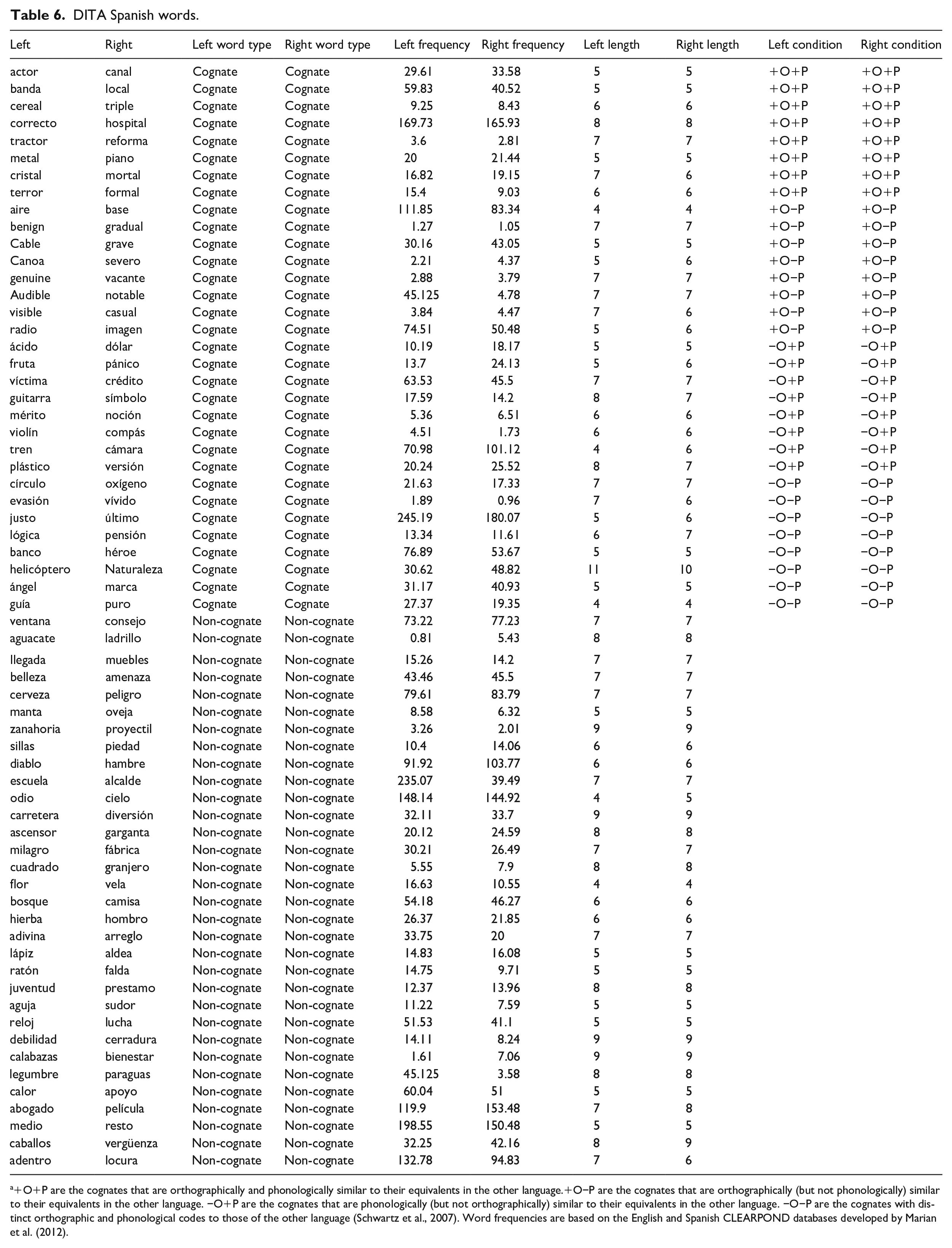
The Dichotic Test of Attention (DITA) was used to measure bilateral language processing. It was administered using the E-Prime 2.0 software (Schneider et al., 2012), a software commonly used in psychological research. The DITA consisted of 64 word pairs, for a total of 128 words (see Tables 5 and 6 in Appendix 1 for the list of words, as well as their characteristics). Half of the word pairs were cognate and the other half non-cognate to control for the cognate facilitatory effect (Costa et al., 2005). Furthermore, word length and frequency were matched as closely as possible between the words in a pair following procedures outlined by Techentin and Voyer (2011). The volume and sound onset of each word on a pair was matched according to guidelines by Musiek and Chermak (2015), and the two words in each pair were put together avoiding any relationship between their meanings. For example, “fox” and “vulpine” as a word pair would be unacceptable, as those words are related by the meaning they share (foxes are vulpines). All DITA stimuli consisted of common English and Spanish words selected from a list of cognate and non-cognate words compiled by Schwartz et al. (2007). Each of the words forming the word pairs were presented simultaneously (i.e., if “actor” and “metal” formed a word pair, both of these words were presented simultaneously within the word pair). The word pairs were all presented in a different random order for each participant. Six measures were taken: left ear accuracy, right ear accuracy, accuracy for both ears combined, cognate and non-cognate accuracy, and laterality. For the left, right, and the both ears accuracy, a score of zero was the lowest possible score, and a 64 the highest. For cognate and non-cognate accuracy, a zero was the lowest possible score, and a 32 the highest. The laterality measure was obtained by following the formula provided by Westerhausen (2019): (Right Ear Accuracy − Left Ear Accuracy)/(Right Ear Accuracy + Left Ear Accuracy). Positive values indicated a right ear advantage and negative values a left ear advantage (Marshall et al., 1975). The DITA assesses bilateral hemispheric processing by having the participant report the two words that were simultaneously presented to both ears (binaural integration). Finally, the DITA was administered in the participants’ dominant language as measured by the picture vocabulary subtest of the WMLS-III to ensure participants’ optimal performance, as the DITA is a language processing task. If a participant had exactly equal scores on the picture vocabulary subtest of the WMLS-III, then participants were given the DITA in their preferred language.
Procedures
Upon receipt of parent consent and child assent, all testing was completed by research assistants with demonstrated proficiency in Spanish and English in a quiet location of the child’s school. Picture vocabulary was assessed in both Spanish and English beginning with the child’s preferred language. The picture vocabulary was assessed by showing the child a series of pictures and asking the child to name each of them. A score of 1 was given if the child correctly identified a picture, and a 0 if it was not correctly identified. After determining the dominant language for the child using the picture vocabulary scores, the DITA was administered in the participant’s dominant language. Child participants were told that they were going to hear a series of two words presented simultaneously to each ear and to verbally report each word in the order that they were remembered. The researcher would type the responses the child participant gave. After the completion of the DITA, the child participants were provided a book as a reward and were thanked for their participation.
For adult participants, after providing informed consent, they were given a demographics questionnaire. They were then assessed by a bilingual research assistant on picture vocabulary in English and Spanish in the participant’s preferred language first. Assessing adults’ picture vocabulary scores involved the same procedure as that described for children. Adults then were given the DITA in the dominant language. The participants were instructed that they would hear a series of two words presented simultaneously: one to the left ear and the other to the right ear, and that they were to type the words in the order in which they were heard. After adult participants finished, they received no compensation and were thanked for their participation.
Data analyses
Analyses were conducted using IBM SPSS Statistics 27, with an a priori alpha value of .05. As a preliminary analysis, a one-way analysis of variance (ANOVA) was conducted, with age group as the independent variable and laterality as the dependent variable. The rationale for this was to examine differences in laterality between children and adults.
To examine the hypothesis that degree of bilingualism would predict bilateral processing and laterality, a series of multiple linear regressions were conducted for the whole sample of children and adults combined, with age, income, degree of bilingualism, and an interaction term between age and degree of bilingualism as predictors of dichotic word listening accuracy for both ears combined, and for laterality. Multiple linear regressions permit analysis of continuous data as independent and dependent variables, which prevents Type I errors and maintains power (Maxwell & Delaney, 1993). The reason for the choice of the both ears combined accuracy as a dependent variable is that this variable measures bilateral processing. Two words were presented simultaneously to participants in each trial: one to the left ear and another to the right ear. Higher scores in this measure thus mean that participants were able to process and remember both the word presented to the left ear, and the word presented to the right ear, which means both hemispheres were activated during this processing as each hemisphere processes the stimuli coming from the contralateral ear (Kimura, 1967). If participants did not score high on the both ears accuracy measure, it means there is low bilateral processing and perhaps one ear is dominant. The laterality measure looks at the degree to which one ear or the other is dominant in processing verbal stimuli: positive values indicate right ear dominance, whereas negative values reflect left ear dominance. The rationale for choosing these two variables instead of just one is because each of these measures takes into account things the other does not: the both ears accuracy measures bilateral processing but cannot provide information regarding dominance of any ear in case of low performance, whereas the laterality measure simply looks at whether one or the other ear is dominant but does not provide a measure of how much bilateral processing there is, if any. None of these analyses included gender as a variable, as there were no significant differences between the genders on dichotic listening (see Supplemental Materials for the analyses of gender differences). To control for differences in income, income was included as a predictor variable in the analyses (Paap et al., 2015). Age and the interaction between age and degree of bilingualism were chosen as predictors because age has been associated with changes in brain laterality in past research (Moncrieff, 2011; Olulade et al., 2020). Age was used as a continuous variable instead of a categorical variable consisting of age groups. In addition, it is important to ensure that degree of bilingualism is not interacting with age as bilingualism has been shown to have different effects on cognition depending on participants’ current cognitive stage of development (Demie, 2013). If there were a significant interaction, then the analyses with age, income, and degree of bilingualism as predictors of both ears accuracy and laterality would be conducted for children and adults separately.
Results
Preliminary analysis: age group differences in laterality
Figures 1 and 2 (see Supplemental Materials) demonstrate the differences in laterality between children and adults. A one-way ANOVA was conducted with age groups (children vs. adults) as the independent measure, and laterality as the dependent measure. The result was significant, F(1, 118) = 10.97, p < .01,
Intercorrelations among age, income, degree of bilingualism, dichotic word listening, and laterality for children.
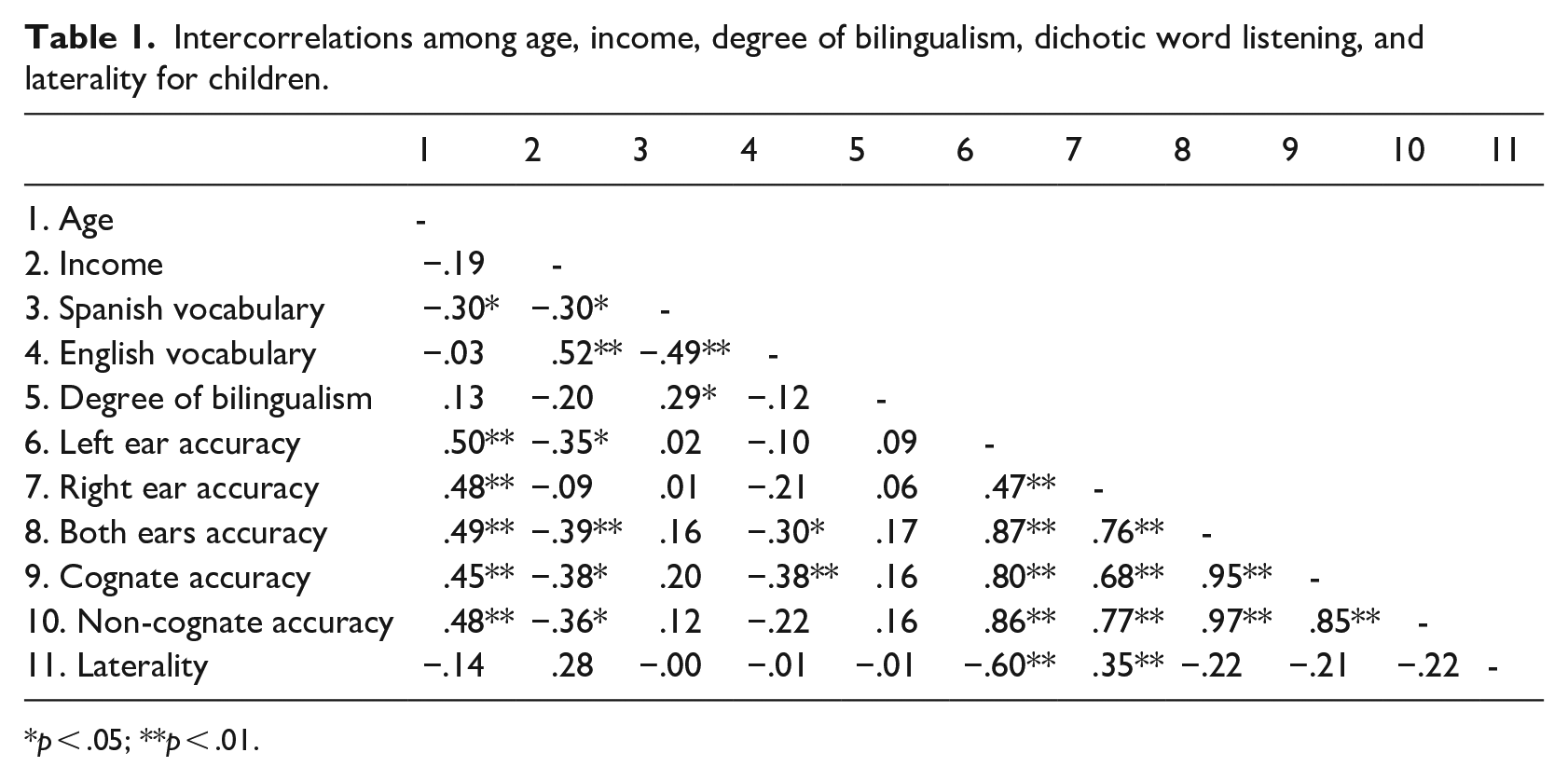
p < .05; **p < .01.
Intercorrelations among age, income, vocabulary, degree of bilingualism, dichotic word listening, and laterality for adults.
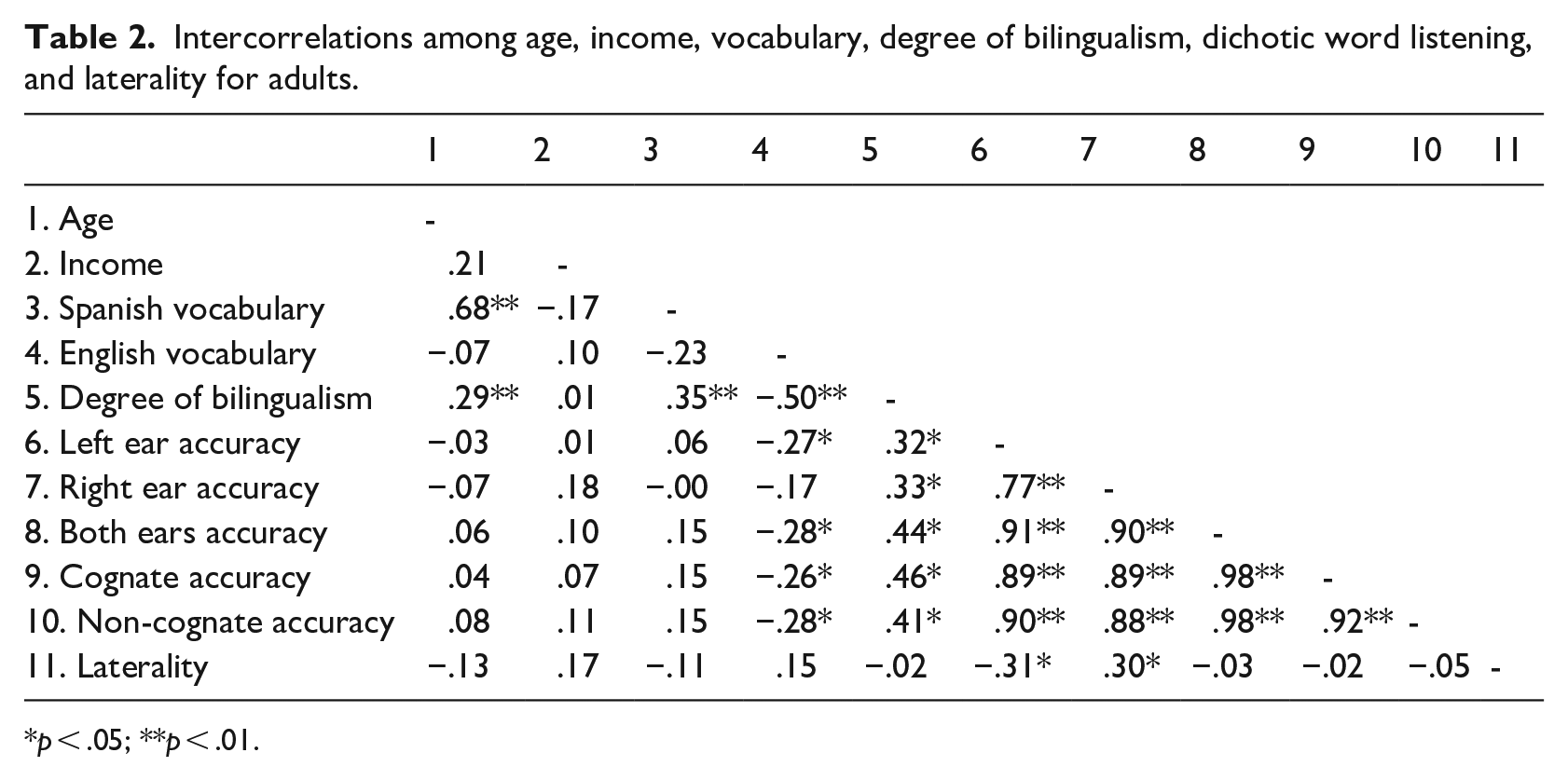
p < .05; **p < .01.
Intercorrelations among age, income, vocabulary, degree of bilingualism, dichotic word listening, and laterality for children and adults.
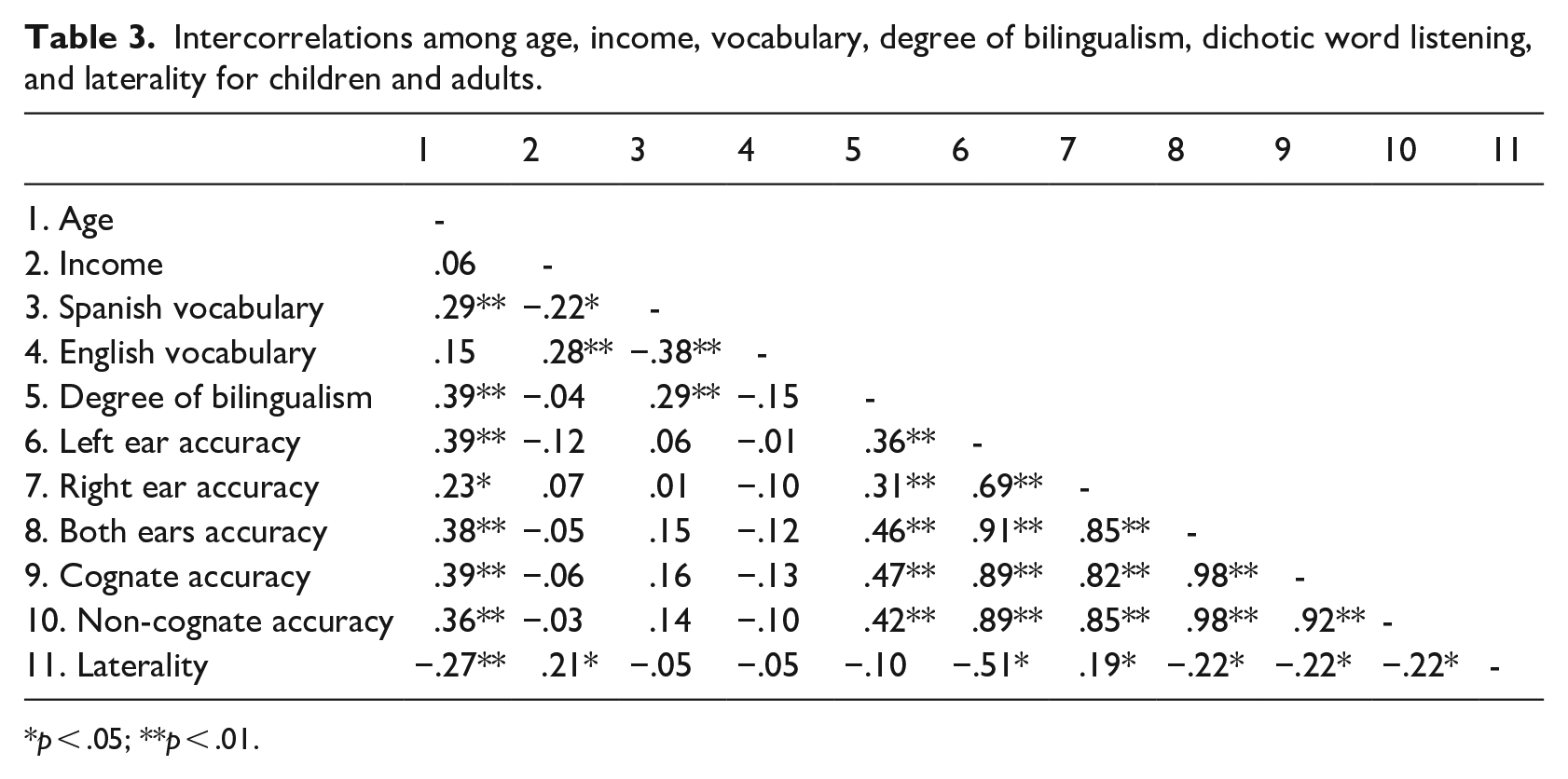
p < .05; **p < .01.
Bilateral processing in the combined sample
A multiple linear regression was conducted with age, income, degree of bilingualism, and an interaction term between age and degree of bilingualism as predictors of accuracy for both ears combined. This multiple regression was conducted to examine whether bilingualism predicts bilateral processing as measured by the recall accuracy for both ears combined with age, income, and any interaction between age and degree of bilingualism controlled. The overall result was significant, F(4, 88) = 8.05, p < .01, with an R2 of .27. Only degree of bilingualism was a significant predictor of accuracy for both ears, β = .47, p < .01, 95% confidence interval (CI) = [21.32, 71.55]. Neither age (β = .18, p = .08, 95% CI = [−.02, .36]), nor income (β = −.04, p = .68, 95% CI = [−.0001, .00007]), nor the interaction between age and degree of bilingualism (β = −.08, p = .53, 95% CI = [−1.37, .71]) was significant. These results suggest that degree of bilingualism predicts performance on the both ears accuracy measure, and is associated with higher bilateral processing. Furthermore, there was no interaction between age and degree of bilingualism, meaning that the relation of bilingualism on bilateral processing is not affected by age.
The next regression used age, income, degree of bilingualism, and an interaction term between age and degree of bilingualism as predictors of laterality. The purpose of this regression was to examine whether laterality, or ear dominance, was predicted by degree of bilingualism independent of age, income, and any interaction between bilingualism and age. The overall result was significant, F(4, 88) = 3.51, p < .05, with an R2 of .14. Age (β = −.33, p < .01, 95% CI = [−.008, −.002]) and income (β = .23, p < .05, 95% CI = [−0.000, 0.000003]) were significant predictors of laterality. Neither degree of bilingualism (β = .06, p = .66, 95% CI = [−.34, .53]) nor the interaction term between degree of bilingualism and age (β = .004, p = .98, 95% CI = [−.02, .02]) were significant predictors of laterality. These results suggest that age predicts laterality, such that for every year increase in age, laterality decreases by .33 points. Furthermore, the results suggest that higher incomes are associated with more laterality. Because neither regression model demonstrated a significant interaction between age and degree of bilingualism, no analyses were conducted for children and adults separately.
Discussion
Results of this study identify relations among demographic characteristics, degree of bilingualism, and bilateral processing. These findings contribute to the sparse literature on bilingualism and dichotic word listening comparing children and adults. The major strengths of the study are the inclusion of a child sample along with an adult sample, which enables comparisons across age groups, and the measurement of bilingualism as a continuum, which avoids Type I errors (Maxwell & Delaney, 1993). The design also controlled for the cognate facilitatory effect (Costa et al., 2005) by having half of the DITA word pairs as cognates and the other half as non-cognates. Results indicate a relation between degree of bilingualism and bilateral processing as measured by dichotic word listening.
The results using the accuracy for both ears combined is consistent with the previous literature which examined dichotic word listening using adults only (Gresele et al., 2013; Hull & Vaid, 2007; Jafari et al., 2014). Hull and Vaid (2007) and Jafari et al. (2014) have found evidence of higher bi-hemispheric involvement among participants who were bilingual compared to monolinguals. In this study, participants who had higher degree of bilingualism obtained higher scores for both ears accuracy, indicating that they could better divide their attention across the two presented verbal stimuli, indicating less laterality. More interestingly, even with cognate/non-cognate words controlled for, degree of bilingualism was still predictive of bilateral processing as measured by the DITA. This addresses the concern that the cognate word facilitatory effect could explain the performance of bilinguals on language processing tests (Costa et al., 2005), as there was an equal number of cognate and non-cognate trials in this study.
The result using laterality as an outcome variable showed a developmental trend: as people develop, they become less lateralized. This might be due to age-related changes in the corpus callosum which increased in thickness as children develop (Westerhausen et al., 2011). Interestingly, Westerhausen et al. (2011) also have shown that callosal isthmus thickness is associated with the level of bilateral hemispheric processing. Perhaps in adults, the callosal isthmus thickness is fully developed, such that there are no further age-related changes, leaving room for other factors such as bilingualism to begin influencing performance in dichotic listening.
In line with the adaptive control hypothesis (Abutalebi & Green, 2016) and the attentional processing account (Bialystok, 2015), our results showing higher bilateral processing in bilinguals also support the notion that bilinguals have higher attention capacities, namely, better ability to divide attention. To successfully listen and recall each of the two simultaneously presented words in the DITA, participants must listen to the two channels as the DITA is a binaural integration task (Musiek & Chermak, 2015; Shinn et al., 2005). Thus, the higher performance of people who are more bilingual in this study is in line with the idea of bilinguals having higher attentional capacity. This is explained by the adaptive control hypothesis, according to which environmental demands unique to bilingual environments cue bilinguals to control their language processing in a specific way, leading to better attentional deployment processes in bilinguals (Lai & O’Brien, 2020). Thus, bilinguals growing up are exposed to cognitive demands that differ from those of monolinguals, which lead to the development of better attention capacities. This in turn leads to bilinguals being more successful in dividing their attention and processing information bilaterally in the dichotic word listening test.
It is possible, however, that participants might demonstrate bilateral processing in one language, while not in the other. Further research should include more complete measures, including a dichotic word listening test that is not in the participants’ dominant language, as this study only tested participants in their dominant language, and it is unclear whether bilateral processing occurs in each language spoken by bilinguals. In addition, future studies should add a reaction time measure in the dichotic word listening test and an adolescent sample so that comparisons can be made between more diverse age groups. Further research is needed that examines degree of bilingualism, language practices, language context, and dichotic listening performance to confirm these suppositions.
Conclusion
These results suggest that higher degrees of bilingualism lead to higher degrees of bilateral processing, which involves divided attention. These results are in line with the attentional processing account (Bialystok, 2015) and the adaptive control hypothesis (Abutalebi & Green, 2016), such that the early language context leads to the development of stronger attentional abilities in bilinguals.
Supplemental Material
sj-docx-1-ijb-10.1177_13670069241277499 – Supplemental material for Relations among degree of bilingualism and bilateral information processing in children and adults
Supplemental material, sj-docx-1-ijb-10.1177_13670069241277499 for Relations among degree of bilingualism and bilateral information processing in children and adults by Francisco J. Sierra, Amy A. Weimer, Yu-Cheng Lin, Jerwen Jou, Nayda Castillo, Cedar Garcia, Michelle Suarez, Flor I. Garcia, Gabriela Aleman, Edson Ortiz and Francheli Romero in International Journal of Bilingualism
Footnotes
Appendix 1
DITA Spanish words.
| Left | Right | Left word type | Right word type | Left frequency | Right frequency | Left length | Right length | Left condition | Right condition |
|---|---|---|---|---|---|---|---|---|---|
| actor | canal | Cognate | Cognate | 29.61 | 33.58 | 5 | 5 | +O+P | +O+P |
| banda | local | Cognate | Cognate | 59.83 | 40.52 | 5 | 5 | +O+P | +O+P |
| cereal | triple | Cognate | Cognate | 9.25 | 8.43 | 6 | 6 | +O+P | +O+P |
| correcto | hospital | Cognate | Cognate | 169.73 | 165.93 | 8 | 8 | +O+P | +O+P |
| tractor | reforma | Cognate | Cognate | 3.6 | 2.81 | 7 | 7 | +O+P | +O+P |
| metal | piano | Cognate | Cognate | 20 | 21.44 | 5 | 5 | +O+P | +O+P |
| cristal | mortal | Cognate | Cognate | 16.82 | 19.15 | 7 | 6 | +O+P | +O+P |
| terror | formal | Cognate | Cognate | 15.4 | 9.03 | 6 | 6 | +O+P | +O+P |
| aire | base | Cognate | Cognate | 111.85 | 83.34 | 4 | 4 | +O−P | +O−P |
| benign | gradual | Cognate | Cognate | 1.27 | 1.05 | 7 | 7 | +O−P | +O−P |
| Cable | grave | Cognate | Cognate | 30.16 | 43.05 | 5 | 5 | +O−P | +O−P |
| Canoa | severo | Cognate | Cognate | 2.21 | 4.37 | 5 | 6 | +O−P | +O−P |
| genuine | vacante | Cognate | Cognate | 2.88 | 3.79 | 7 | 7 | +O−P | +O−P |
| Audible | notable | Cognate | Cognate | 45.125 | 4.78 | 7 | 7 | +O−P | +O−P |
| visible | casual | Cognate | Cognate | 3.84 | 4.47 | 7 | 6 | +O−P | +O−P |
| radio | imagen | Cognate | Cognate | 74.51 | 50.48 | 5 | 6 | +O−P | +O−P |
| ácido | dólar | Cognate | Cognate | 10.19 | 18.17 | 5 | 5 | −O+P | −O+P |
| fruta | pánico | Cognate | Cognate | 13.7 | 24.13 | 5 | 6 | −O+P | −O+P |
| víctima | crédito | Cognate | Cognate | 63.53 | 45.5 | 7 | 7 | −O+P | −O+P |
| guitarra | símbolo | Cognate | Cognate | 17.59 | 14.2 | 8 | 7 | −O+P | −O+P |
| mérito | noción | Cognate | Cognate | 5.36 | 6.51 | 6 | 6 | −O+P | −O+P |
| violín | compás | Cognate | Cognate | 4.51 | 1.73 | 6 | 6 | −O+P | −O+P |
| tren | cámara | Cognate | Cognate | 70.98 | 101.12 | 4 | 6 | −O+P | −O+P |
| plástico | versión | Cognate | Cognate | 20.24 | 25.52 | 8 | 7 | −O+P | −O+P |
| círculo | oxígeno | Cognate | Cognate | 21.63 | 17.33 | 7 | 7 | −O−P | −O−P |
| evasión | vívido | Cognate | Cognate | 1.89 | 0.96 | 7 | 6 | −O−P | −O−P |
| justo | último | Cognate | Cognate | 245.19 | 180.07 | 5 | 6 | −O−P | −O−P |
| lógica | pensión | Cognate | Cognate | 13.34 | 11.61 | 6 | 7 | −O−P | −O−P |
| banco | héroe | Cognate | Cognate | 76.89 | 53.67 | 5 | 5 | −O−P | −O−P |
| helicóptero | Naturaleza | Cognate | Cognate | 30.62 | 48.82 | 11 | 10 | −O−P | −O−P |
| ángel | marca | Cognate | Cognate | 31.17 | 40.93 | 5 | 5 | −O−P | −O−P |
| guía | puro | Cognate | Cognate | 27.37 | 19.35 | 4 | 4 | −O−P | −O−P |
| ventana | consejo | Non-cognate | Non-cognate | 73.22 | 77.23 | 7 | 7 | ||
| aguacate | ladrillo | Non-cognate | Non-cognate | 0.81 | 5.43 | 8 | 8 | ||
| llegada | muebles | Non-cognate | Non-cognate | 15.26 | 14.2 | 7 | 7 | ||
| belleza | amenaza | Non-cognate | Non-cognate | 43.46 | 45.5 | 7 | 7 | ||
| cerveza | peligro | Non-cognate | Non-cognate | 79.61 | 83.79 | 7 | 7 | ||
| manta | oveja | Non-cognate | Non-cognate | 8.58 | 6.32 | 5 | 5 | ||
| zanahoria | proyectil | Non-cognate | Non-cognate | 3.26 | 2.01 | 9 | 9 | ||
| sillas | piedad | Non-cognate | Non-cognate | 10.4 | 14.06 | 6 | 6 | ||
| diablo | hambre | Non-cognate | Non-cognate | 91.92 | 103.77 | 6 | 6 | ||
| escuela | alcalde | Non-cognate | Non-cognate | 235.07 | 39.49 | 7 | 7 | ||
| odio | cielo | Non-cognate | Non-cognate | 148.14 | 144.92 | 4 | 5 | ||
| carretera | diversión | Non-cognate | Non-cognate | 32.11 | 33.7 | 9 | 9 | ||
| ascensor | garganta | Non-cognate | Non-cognate | 20.12 | 24.59 | 8 | 8 | ||
| milagro | fábrica | Non-cognate | Non-cognate | 30.21 | 26.49 | 7 | 7 | ||
| cuadrado | granjero | Non-cognate | Non-cognate | 5.55 | 7.9 | 8 | 8 | ||
| flor | vela | Non-cognate | Non-cognate | 16.63 | 10.55 | 4 | 4 | ||
| bosque | camisa | Non-cognate | Non-cognate | 54.18 | 46.27 | 6 | 6 | ||
| hierba | hombro | Non-cognate | Non-cognate | 26.37 | 21.85 | 6 | 6 | ||
| adivina | arreglo | Non-cognate | Non-cognate | 33.75 | 20 | 7 | 7 | ||
| lápiz | aldea | Non-cognate | Non-cognate | 14.83 | 16.08 | 5 | 5 | ||
| ratón | falda | Non-cognate | Non-cognate | 14.75 | 9.71 | 5 | 5 | ||
| juventud | prestamo | Non-cognate | Non-cognate | 12.37 | 13.96 | 8 | 8 | ||
| aguja | sudor | Non-cognate | Non-cognate | 11.22 | 7.59 | 5 | 5 | ||
| reloj | lucha | Non-cognate | Non-cognate | 51.53 | 41.1 | 5 | 5 | ||
| debilidad | cerradura | Non-cognate | Non-cognate | 14.11 | 8.24 | 9 | 9 | ||
| calabazas | bienestar | Non-cognate | Non-cognate | 1.61 | 7.06 | 9 | 9 | ||
| legumbre | paraguas | Non-cognate | Non-cognate | 45.125 | 3.58 | 8 | 8 | ||
| calor | apoyo | Non-cognate | Non-cognate | 60.04 | 51 | 5 | 5 | ||
| abogado | película | Non-cognate | Non-cognate | 119.9 | 153.48 | 7 | 8 | ||
| medio | resto | Non-cognate | Non-cognate | 198.55 | 150.48 | 5 | 5 | ||
| caballos | vergüenza | Non-cognate | Non-cognate | 32.25 | 42.16 | 8 | 9 | ||
| adentro | locura | Non-cognate | Non-cognate | 132.78 | 94.83 | 7 | 6 |
+O+P are the cognates that are orthographically and phonologically similar to their equivalents in the other language.+O−P are the cognates that are orthographically (but not phonologically) similar to their equivalents in the other language. −O+P are the cognates that are phonologically (but not orthographically) similar to their equivalents in the other language. −O−P are the cognates with distinct orthographic and phonological codes to those of the other language (Schwartz et al., 2007). Word frequencies are based on the English and Spanish CLEARPOND databases developed by Marian et al. (2012).
Acknowledgements
The authors thank Fabian Daniel Gonzalez and all the research assistants who collected the data for this study, and those individuals who provided suggestions to make the drafting process easier. This study was conducted in partial fulfillment of the first author’s master’s thesis.
Data availability statement
Due to the nature of the research, participants did not agree to have their data publicly shared, so supporting data is not available.
Declaration of conflicting interests
The author(s) declared no potential conflicts of interest with respect to the research, authorship, and/or publication of this article.
Funding
The author(s) received no financial support for the research, authorship, and/or publication of this article.

Supplemental material
Supplemental material for this article is available online.
Author biographies
References
Supplementary Material
Please find the following supplemental material available below.
For Open Access articles published under a Creative Commons License, all supplemental material carries the same license as the article it is associated with.
For non-Open Access articles published, all supplemental material carries a non-exclusive license, and permission requests for re-use of supplemental material or any part of supplemental material shall be sent directly to the copyright owner as specified in the copyright notice associated with the article.
