




Abstract
Aims and objectives:
Although bilingualism and its effects on cognition and language processing are widely studied, when it comes to bilingualism across modalities, the current understanding is limited. Here, we report a letter fluency task that compared word-retrieval outcomes and strategies in early bimodal bilinguals (Czech and Czech sign language) and monolinguals (Czech).
Methodology:
Bimodal bilinguals (n = 15) and monolinguals (n = 15) matched for age, gender, and education completed a letter fluency task. Bimodal bilinguals’ language dominance was assessed by the gradient Bilingual Dominance Scale. The number of correctly retrieved words was analyzed, along with phonetic and semantic clustering, word corpus frequencies, errors, and retrieval failure durations.
Data and analysis:
Data were analyzed using mixed-effects models. In addition to the most common analysis of the number of retrieved words, we ran a series of subsequent models to compare various aspects of the bimodal bilinguals’ and monolinguals’ word-retrieval strategies and mechanisms.
Findings:
The results showed that bimodal bilinguals retrieved fewer words than monolinguals, and the number of correctly retrieved words was positively correlated with their self-reported bilingual dominance score in spoken Czech. As for the retrieval strategies in the two groups, our exploratory analyses of phonetic and semantic clustering and word corpus frequencies did not reveal significant effects of language background, although bimodal bilinguals tended to have longer stretches of silence between the retrieved words.
Originality:
The experiment investigates lexical retrieval in an under-researched language landscape, namely in Czech and Czech sign-language bilinguals. It is the first study exploring clustering strategies and effects of language dominance in bimodal bilinguals’ verbal fluency.
Implications:
The present results suggest that retrieval difficulties in bimodal bilinguals are not solely due to phonological competition but may be influenced by cognitive trade-offs. Future research should consider not only linguistic factors but also personal traits and communicative styles shaped by the unique cultural experiences of bimodal bilinguals.
Keywords
Introduction
In the past decades, many studies have concluded that bilingual experience brings certain positive effects on cognitive processing, especially with respect to conflict resolution tasks. This phenomenon has been termed “cognitive advantage” of bilingualism. The supposed bilingual cognitive advantage has been argued to stem from increased executive control abilities—mechanisms and strategies enabling humans to control their cognitive processes in order to effectively reach defined cognitive goals using their mental capacities (e.g., Bialystok, 2007). Executive control involves processes such as updating, shifting, and inhibition (Miyake et al., 2000). Especially inhibition, in other words, the ability to suppress unwanted responses in certain situations, represents a skill in which many bilingual speakers have more experience than monolinguals due to the ever-present mental competition of their multiple languages and a frequent need to switch between them (Bialystok et al., 2009).
There are many nonverbal tasks commonly used to compare executive functions, and inhibition in particular, between monolingual and bilingual populations: these are, for instance, conflict-solving tasks such as the Stroop task, Simon task, or Eriksen flanker task. These tasks present stimuli varying along multiple dimensions and probe participants’ ability to inhibit interferences from one dimension while performing a task targeting another stimulus dimension, and/or test participants’ ability to suppress responses in particular contexts. Bilinguals seem to be slightly overperforming monolinguals in tasks like these, but the reported effect size tends to be small (Bialystok & Craik, 2022), and the overall variability in findings across studies does not allow for strong conclusions, as shown by Van den Noort et al. (2019) who reported a systematic review on bilingualism and various measures of cognitive control. They showed that bilinguals outperformed monolinguals in just over a half of the reviewed studies (namely, in 54.3% of studies when all ages were taken into account); moreover, most of those studies had earlier publication dates (which suggests an early publication bias against null or conflicting results). The rest of the reviewed studies reported either mixed results (28.3%) or even evidence against a bilingual advantage in terms of cognitive control skills (17.4%).
In addition to tasks assessing nonverbal inhibition or selective attention, prior studies have also aimed to examine the interaction between the two languages in the bilingual mind. This has often been done using verbal tasks requiring lexical access. While the findings from this literature are also mixed, specific tasks, such as picture naming or word retrieval, yield more consistent findings across studies pointing toward certain “bilingual costs.” This is reflected in slower picture naming or a larger number of errors across various tasks as well as in the bilinguals experiencing more tip-of-the-tongue states than monolinguals (e.g., Bialystok et al., 2008; Bylund et al., 2019; Faroqi-Shah et al., 2021; Gollan & Acenas, 2004; Gollan et al., 2005).
Letter fluency is a verbal task commonly used to assess both verbal abilities and cognitive control skills. This task requires participants to produce as many words as possible matching given criteria within a certain time limit, usually 1 minute. The most common criteria are semantic category (the task being to name as many words from, e.g., the category of fruit) or initial letter/sound (the task being to name as many words that begin with, e.g., a “p”). Verbal fluency tasks are considered a valid indicator of verbal abilities, especially the access to the mental lexicon (Shao et al., 2014) and executive control, especially inhibition. The simplicity of the task, ease of its administration, and straightforward analysis make it very convenient for use, not only in the field of cognitive linguistics but also in clinical practice. It often serves as a quick tool for assessing changes in cognitive function in patients with various diagnoses (or people at risk of a diagnosis), including particularly those associated with damages in frontal parts of the brain (Schwartz & Baldo, 2001). In this clinical context, it is appropriate to emphasize the importance of psycholinguistic research, which suggests that normative data of bilingual populations may differ from norms reported for monolinguals—the results of the task are thus prone to misinterpretation if used without proper precautions (Giovannoli et al., 2023).
The literature suggests that a letter fluency task places more demands in terms of cognitive control than a semantic fluency task (Patra et al., 2020). This is because unlike with semantic category access and retrieval, the production of words beginning with a particular speech sound or letter is not a task that people perform on a regular basis in everyday life, which makes it more demanding and also more dependent on executive control strategies. Moreover, letter fluency often imposes a set of restrictions, such as the avoidance of identical word stems, and exclusion of proper names and numbers, which challenge working memory and attention (Bialystok et al., 2009). The differential aspects of language behavior that are reflected in letter fluency and semantic category fluency have a neural basis, as the two tasks seem to activate different parts of the brain (Biesbroek et al., 2021).
To what extent do monolinguals and bilinguals differ on verbal fluency and is there a reliable “disadvantage” for bilinguals? Although some literature considers the bilingual cost in verbal fluency performance to be reliably documented, recent review studies suggest the effect might be more nuanced, if present at all. For instance, only 14 out of 30 studies reviewed by Giovannoli et al. (2023) actually found significant differences in letter fluency between monolinguals and bilinguals; moreover, some of those studies found better performance in monolinguals while others found better performance in bilinguals. For semantic fluency, 23 out of 33 studies failed to find significant differences between the groups. These numbers do not allow for making conclusions about whether or not bilingual (dis)advantage in letter fluency is real. Note that Giovannoli et al.’s review only included bilingual first language learners and bilinguals of spoken languages.
Bilingual cost seems to be more robustly reported for category fluency than for letter fluency, possibly because the former is more prone to language interference (activation of words in the nontarget language, Giezen & Emmorey, 2017; Giovannoli et al., 2023). Besides the need to inhibit exemplars from the nontarget language, category fluency in particular might also be hindered by the bilinguals’ potentially smaller, or context-specific, vocabulary per language (Bialystok et al., 2009). When trying to tap into the factors that may disadvantage bilinguals in word retrieval, it is nearly impossible to isolate the effects of language interference and frequency of language use, as those are typically interrelated.
To sum up, unequivocal evidence is still lacking that would allow us to resolve the debate on whether and how exactly bilingualism influences cognition and lexical access. Many new and rigorous studies are emerging with respect to spoken languages, and their growing number is promising with respect to more thorough future interpretations through meta-analytic approaches. The field is witnessing a shift from the black-and-white view in terms of a bilingual cost versus a bilingual advantage toward a novel understanding of mixed results as evidence of a dynamic and complex cognitive trade-off of bilingualism, where the bilinguals’ enhanced cognitive control in some areas is weighed out by attenuated performance in other areas (Dentella et al., 2024). Despite the advance of research in the area of spoken bilingualism, there is still a limited understanding of how languages realized in different modalities interact in one’s mind and how this situation influences an individual’s use and performance in each of their languages.
Bimodal bilingualism, which involves the combination of a spoken and a sign language, offers a new perspective on the study of bilingualism. Studies with bimodal bilinguals with different hearing and language learning backgrounds suggest that languages can still co-activate in the mind during language processing as well as production, despite operating in nonshared linguistic modalities (Giezen & Emmorey, 2016; Giezen et al., 2015; Gimeno-Martínez et al., 2021; Morford et al., 2014; Villameriel et al., 2016, 2022). However, given the lack of overlap between the spoken- and the sign-language phonology, studying bimodal bilinguals allows to rule out phonological (and orthographic) cross-language effects that are of particular relevance in verbal fluency tasks. In this study, we focus on bimodal bilinguals who could be described as heritage signers—adult hearing children of deaf signing parents, also known as CODAs (children of deaf adults; note that deaf or hard of hearing parents have hearing children in about 90% of cases Moroe & de Andrade, 2018). For many CODAs, sign language represents a major mode of communication in infancy and preschool years, but spoken language becomes dominant as the individual integrates in the hearing community (through school, friends, etc.). In this respect, the language background of CODAs resembles the situation of children of immigrants (Heffernan & Nixon, 2023).
To date, findings on bimodal bilinguals’ verbal and executive performance compared to that of monolinguals are sparse. Emmorey et al. (2008) assessed executive control in bimodal bilinguals, unimodal bilinguals, and monolinguals using a flanker task. Their study showed that accuracy was comparable across all groups, but reaction times were faster in unimodal bilinguals than in the other two groups. That would suggest that the enhanced executive control of unimodal bilinguals stemming from their need to select and inhibit across language within the same modality may not be needed when an individual’s two languages involve different modalities. The results of Giezen et al. (2015) support these conclusions—these authors found comparable overall accuracy as well as reaction times between spoken English monolinguals and American Sign Language (ASL)-English bimodal bilinguals in a spatial Stroop task, suggesting a similar level of inhibitory control between the groups. Pyers et al. (2009) found more difficulties during word recalling (tip-of-the-tongue state) in a picture-naming task in bimodal and unimodal bilinguals in comparison to monolinguals. However, the bimodal bilingual group was more successful in lexical retrieval than the unimodally bilingual group. The authors suggest this might be caused by increased frequency of use of the language of the task by bimodal bilinguals in comparison to unimodal bilinguals. This explanation is supported also by the results of Emmorey et al. (2013) who did not find evidence for frequency-lag hypothesis in hearing bimodal bilinguals in spoken language (the dominant language of the group) as opposed to sign language in a picture-naming task, possibly due to increased spoken language use through code-blending and mouthing.
Concerning verbal fluency, Giezen and Emmorey (2017) found a lower number of words produced in a letter fluency task by CODAs (heritage users of ASL immersed in spoken English dominant environment) in comparison to monolingual English speakers. The bimodal bilinguals self-rated their English proficiency as native, and their vocabulary scores did not differ from those of monolingual control group, which indicated that their lower scores were unlikely due to reduced vocabulary or limited use of the spoken language. The authors interpreted the results as evidence for interference between the sign and spoken language even in the absence of cognates and in the absence of phonological and articulatory overlap (Giezen & Emmorey 2017). Similar results were reported by Banaszkiewicz et al. (2024). They included verbal fluency as part of a neuroimaging study on language performance in CODAs and late hearing learners of Polish Sign Language. Consistent with previous findings, CODAs had significantly lower scores than late sign-language learners in the letter fluency task.
Similarly to unimodal bilinguals, bimodal bilinguals vary greatly as to their language dominance, language use, and language attitudes, across the two modalities. Language dominance seems to be one of the major factors affecting verbal fluency in unimodal bilinguals (Bennett & Verney, 2019; Wauters & Marquardt, 2018), but little is known about how language dominance affects bimodal bilinguals. The aim of this study is to test whether performance on letter fluency differs between monolinguals and bimodal bilinguals and whether letter fluency in bimodal bilinguals is modulated by language dominance. Similarly to Giezen and Emmorey (2017), the present study focuses on hearing adults who were raised by deaf parents predominantly in sign language. As a follow-up on Giezen and Emmorey (2017), who tested users of ASL and American English, we investigate users of different languages, namely Czech sign language (CSL) and spoken Czech. Besides the primary aim to test the effects of language background and language dominance on the number of retrieved words, we explore several word-retrieval strategies that might differ between monolinguals and bimodal bilinguals. To this end, we assess the proportion of errors, the frequency (uniqueness) of the retrieved words, the number and size of phonological clusters, the number and size of semantic clusters, and the duration of silent periods when the participants were not able to retrieve a new word.
Previous studies examining unimodal bilingual speakers have revealed differences in clustering strategies; unimodal bilinguals exhibited larger phonetic cluster sizes than monolinguals (see, for example, Marsh et al., 2019; Patra et al., 2020). Based on these findings, it was therefore expected that differences would also be evident when comparing bimodal bilinguals and monolingual speakers. The analysis of clustering strategies was approached here in an exploratory manner rather than with a strong hypothesis, as the strategies in unimodal bilinguals and bimodal bilinguals likely differ from monolinguals in various respects.
Although participants are expected to inhibit semantic associations in a letter fluency task, task-discrepant clustering has been argued to reflect more sophisticated organizational processes (Abwender et al., 2001). While this may not necessarily lead to higher productivity, it can reveal differences in cognitive flexibility or metalinguistic awareness between groups. By including an exploratory analysis of semantic clusters, we aimed to extend prior research and provide additional data to better understand clustering processes in bilinguals during verbal fluency.
As to our main hypotheses on the effects of language background and language dominance, we predict that the bimodal bilinguals will produce fewer words than monolinguals (in line with previous findings with bimodal bilinguals in different languages, Giezen & Emmorey, 2017). In line with prior research on unimodal bilinguals (Bennett & Verney, 2019; Wauters & Marquardt, 2018), we expect that the bimodal bilinguals’ dominance in the spoken language will modulate the number of produced words with greater spoken dominance predicting larger number or retrieved words.
As to the exploratory analyses, with respect to word frequencies, research on unimodal bilinguals suggests two competing predictions, as outlined in Gollan et al. (2008): bilinguals might produce fewer low-frequency words than monolinguals, because low-frequency words are more difficult for them to access (the weaker links hypothesis). Alternatively, bilinguals might produce more low-frequency words than monolinguals, because high-frequency words are more affected by competition between the languages due to their more probable accessibility in both languages (the interference hypothesis). For the population tested in the present study, who were bimodal bilinguals immersed in a spoken language environment from an early age and were dominant in spoken language (see Table 1), language competition at the level of high-frequency spoken words is unlikely. Instead, we predict that if there are any differences in word frequencies produced by the two groups (see Giezen & Emmorey, 2017 who did not find any), bimodal bilinguals will produce fewer low-frequency words than monolinguals (as was the case for unimodal bilinguals in Gollan et al., 2008). We anticipate that word-retrieval difficulties will be associated with higher error rate, longer and pauses between the retrieved words, and/or with a lower number and a lower average size of phonetic and semantic clusters.
Background characteristics of the monolingual and bimodal bilingual groups tested in the present experiment.
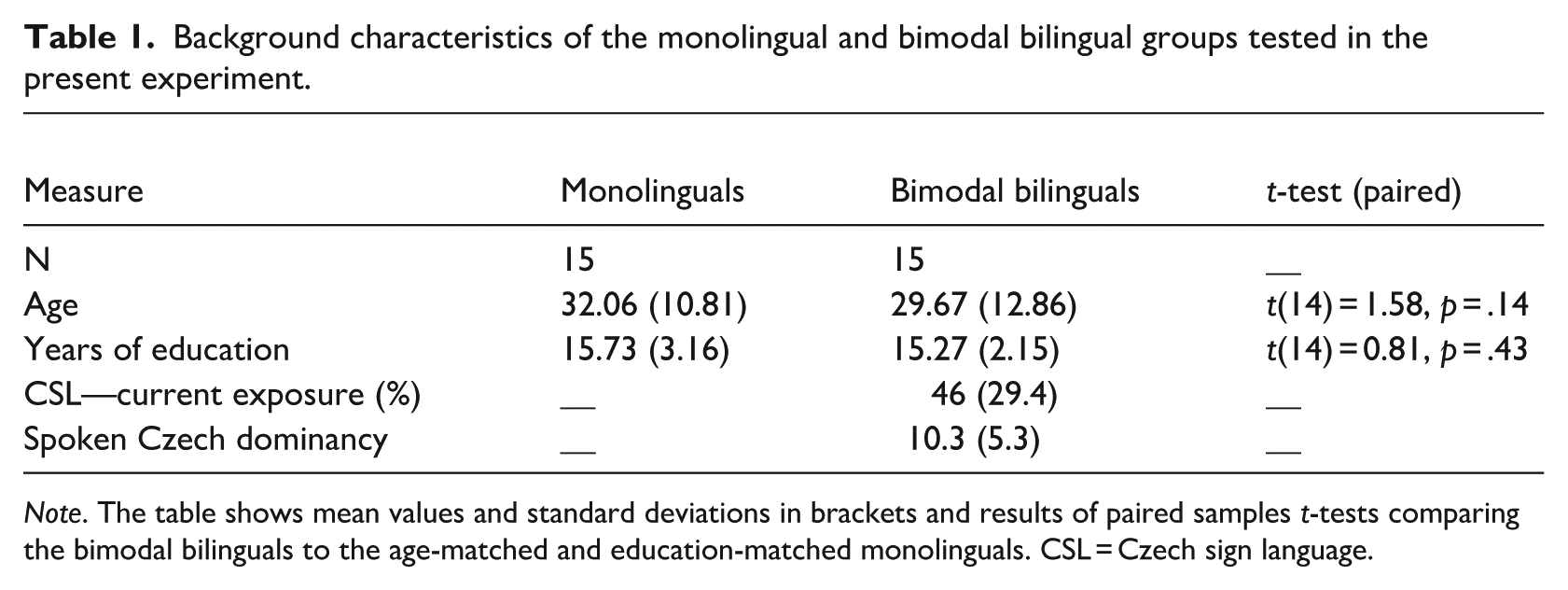
Note. The table shows mean values and standard deviations in brackets and results of paired samples t-tests comparing the bimodal bilinguals to the age-matched and education-matched monolinguals. CSL = Czech sign language.
Method
Participants
A total of 30 adults participated. Half of them were bimodal bilinguals, specifically, hearing CODAs. They were users of spoken Czech and CSL, were between 18 and 62 years old, 13 of them were women and 2 were men. A group of 15 speakers of Czech were recruited and pairwise matched to the CODA participants in sex, age, and education. This matched group was native speakers of Czech who were not raised bilingually and did not speak any other language than Czech at a native-like level; we refer to this group as monolingual. Note that all the bimodal bilinguals and the monolinguals reported that they have experience with learning at least one spoken language other than Czech, but none knew any other spoken language than Czech at a native-like or near-native-like proficiency. Table 1 shows the participant characteristics in the two groups.
All participants from the bimodal bilingual group filled in a questionnaire to describe their experience with CSL. At the time of the experiment, five participants had been actively using CSL in their work as interpreters, CSL teachers, social workers, or special educators or were enrolled to university programs to become CSL interpreters. The bimodal bilingual participants were asked to subjectively rate their CSL and Czech exposure separately for four periods of their life: for infancy (0–3 years), preschool age (3–6), younger school age (6–15), and older school age (15–19). They rated their CSL and Czech exposure in each of these periods on a 1 to 10 scale, where 1 corresponds to minimal exposure and 10 to maximal exposure. Figure 1, plot (a), shows the mean values over time, and plot (b) shows individual data for each participant. Mean current CSL exposure (covering a period of 1 year prior to the experiment) was evaluated to be around 46% (SD = 29.4). To quantify the bimodal bilinguals’ language dominance, we administered the gradient Bilingual Dominance Scale by Dunn and Tree (2009), a 12-item questionnaire that assesses participants’ language background through self-reported introspection. The items cover areas such as language acquisition and comfort, language use, and language restructuring, due to, for example, losing fluency in one of the languages. The resulting value can range from −31 to +31 points, with 0 indicating a perfectly balanced competence in both assessed languages. Only one of the respondents obtained a score indicating a subtle inclination to CSL dominance (score −1), others showed more or less stronger dominance in spoken Czech, normally distributed around the mean value of 10.33 (SD = 5.3), as shown in Figure 1, plot (c).
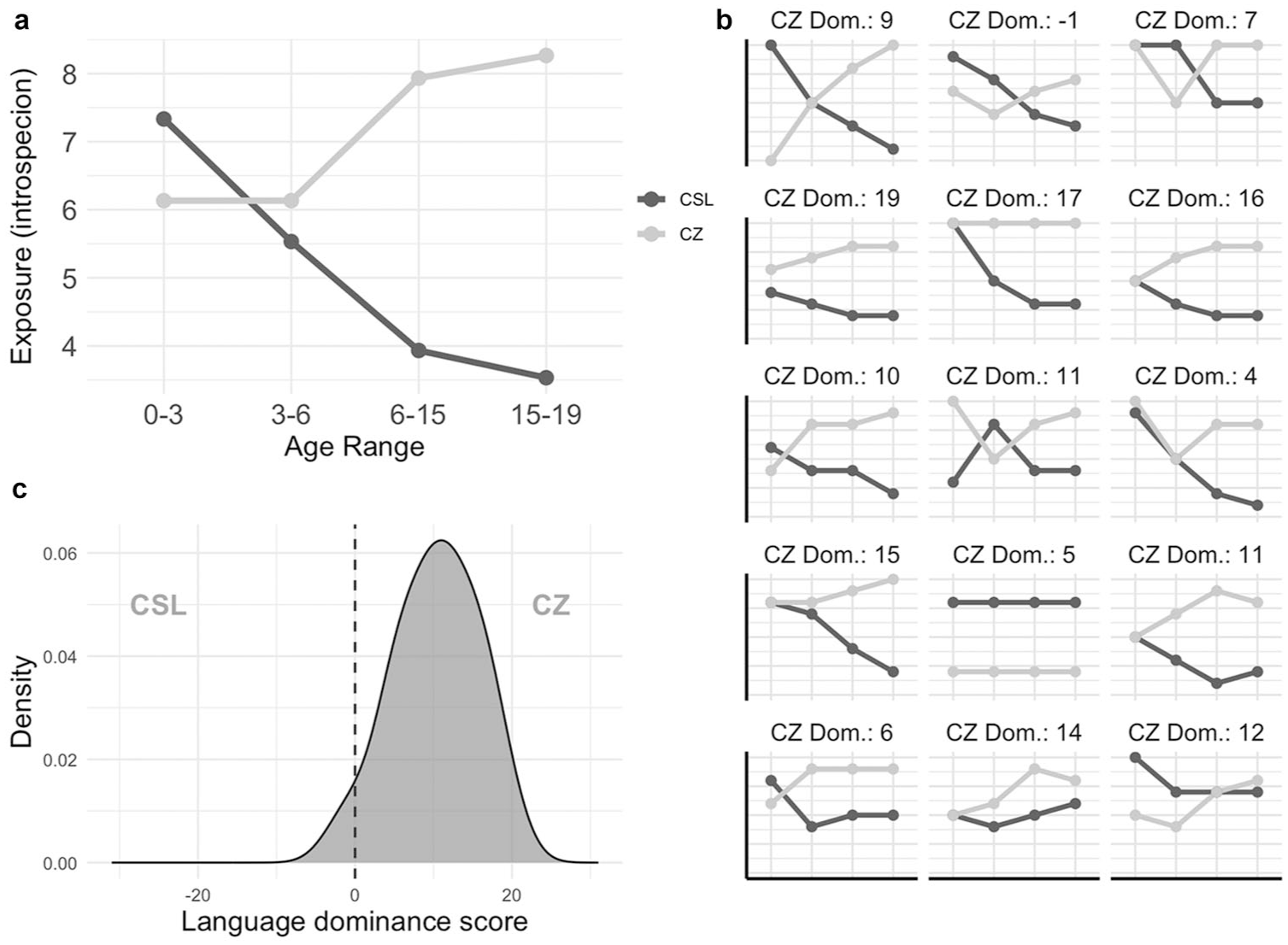
Panel (a) Self-reported exposure to spoken Czech (CZ) and Czech sign language (CSL) during childhood and adolescence, averaged across the 15 bimodal bilinguals. Panel (b) Individual graphs for each bimodal bilingual participant showing their self-reported exposure curves for CZ and CSL as well as their CZ language dominance score. Panel (c) Density plot of language dominance score in bimodal bilinguals obtained on the basis of Dunn & Tree’s Bilingual Dominance Scale. Possible values range from −31 to +31, with 0 indicating a balanced bilingual.
Procedure
After the language background questionnaires, a Czech version of the letter fluency task was administered (the Czech version was first introduced by Preiss, 1997, adapted from Spreen & Benton, 1969). The complete task consists of 6 letters B, P, L, N, T, and K, where N and B, K and P, and T and L represent pairs with significant correlation and nonsignificant differences in performance (Kopeček & Kuncová, 2006). The participants were audio and video recorded using a mobile phone camera and an external microphone.
Annotations
The audio recordings of each participant were manually annotated in Praat (Boersma & Weenink, 2024). Each recording was inspected by two annotators. The videos were examined for signs of code-blending—simultaneous production in both languages but none were found. The Praat annotations were transformed into R data frames using the rPraat package (Bořil & Skarnitzl, 2016).
Retrieved words starting with wrong phonemes were labeled as errors, and so were proper names, word-stem repetitions, and nonexisting words. To assess the effects of word frequency, for each correctly retrieved word, its frequency was obtained from the Czech written corpus SYN 12 (Křen et al., 2023) in the interface of online application KonText (Machálek, 2020). To explore possible differences in retrieval strategies between the two groups, we analyzed the number and size of phonetic clusters, applying the scoring rules for phonetic clusters from Troyer et al. (1997). We also conducted an analysis of semantic clusters (following Ledoux et al., 2014; Sauzéon et al., 2004; Schwartz et al., 2003), as the use of task-discrepant clustering has been associated with more advanced and intentional retrieval processes than task-congruent clustering (Abwender et al., 2001). We applied the rules outlined in Tallberg et al. (2011). Finally, we analyzed the duration of silences between the retrieved words with a duration longer than 1 second. The detailed protocol for cluster annotation that we applied to the present data, along with examples, is provided on the project’s OSF page: https://osf.io/pb2gw/.
Interestingly, during data collection, we observed that participants did indeed produce semantic clusters even in the letter fluency task. For instance, in response to the letter “K,” one participant produced a striking cluster of seven correct animal names: koala (koala), kuna (marten), kodiak (kodiak bear), kráva (cow), kůň (horse), koza (goat), and křeček (hamster). Other commonly observed clusters related to categories like clothes, plants, or automatized sequences. These patterns raise the question of whether bimodal bilinguals might differ from monolinguals in the use of such advanced strategies due to their unique language backgrounds.
Statistical analysis
Two generalized linear mixed-effects models (Poisson family, using the lmer4 package in R, Bates et al., 2015; R Core Team, 2024) were built to test our main hypotheses on the effects of language background and language dominance, respectively. The first model, M1, analyzed the number of retrieved words, fitting the fixed effect of language background (bimodal bilinguals vs monolinguals, coded as −1 vs +1) and random intercepts for participant and for letter category. The second model, M2, analyzed the number of retrieved words in the bilingual group, modeling the fixed effect of language dominance (numeric, values could range from −31 to +31), again with random intercepts per participant and letter category.
A series of subsequent mixed-effects models explored several aspects of various word-retrieval strategies and mechanisms. Model M1t (glmer) analyzed the number of correctly retrieved words (across twelve 5-second time bins) with language background, time bin (numeric, 12 values, centered on the first time bin), and their interaction as fixed effects, and per-participant and per-category random intercepts, modeling the trajectory of word retrieval throughout the trial. All subsequent models predicted the fixed effect of language background and per-participant and per-category random intercepts. Model M3 analyzed the corpus frequency of the retrieved words. Model M4, glmer, analyzed the percentage of errors. A fifth model, M5, glmer, analyzed the number of phonetic clusters, and a sixth model, M6, lmer, analyzed the size of phonetic clusters. Model M7, glmer, analyzed the number of semantic clusters, and model M8, lmer, analyzed the size of semantic clusters. A last model, M9, lmer, analyzed the duration of silent intervals.
Results
The raw data are visualized in Figures 2 and 3, panel (a). Figure 2 shows the average number of correctly retrieved words per category. Figure 3(a) plots the number of correctly retrieved words in 5-second bins across the 1-minute trial, pooled across the six categories and across participants, for both monolingual and bimodal bilingual groups.
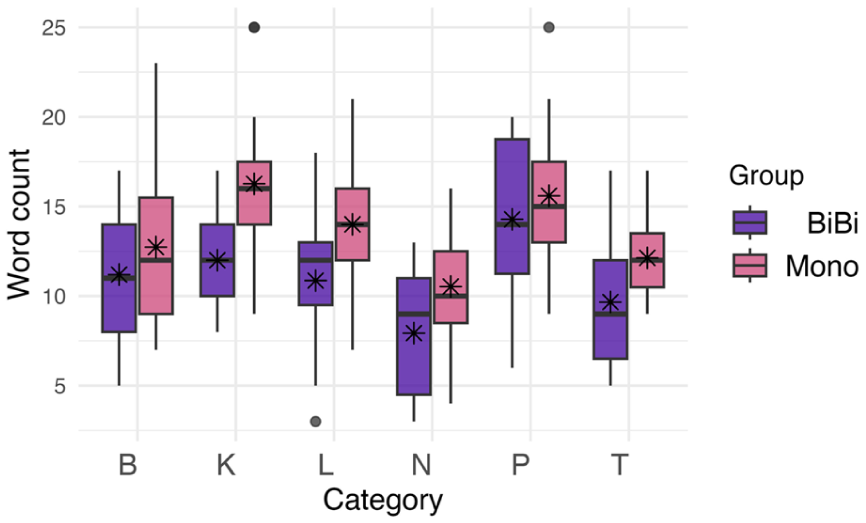
The data. Number of correctly retrieved words for each letter category and group. The figure shows means (stars), medians (thick horizontal lines), interquartile ranges (boxes), and minima and maxima (whiskers).
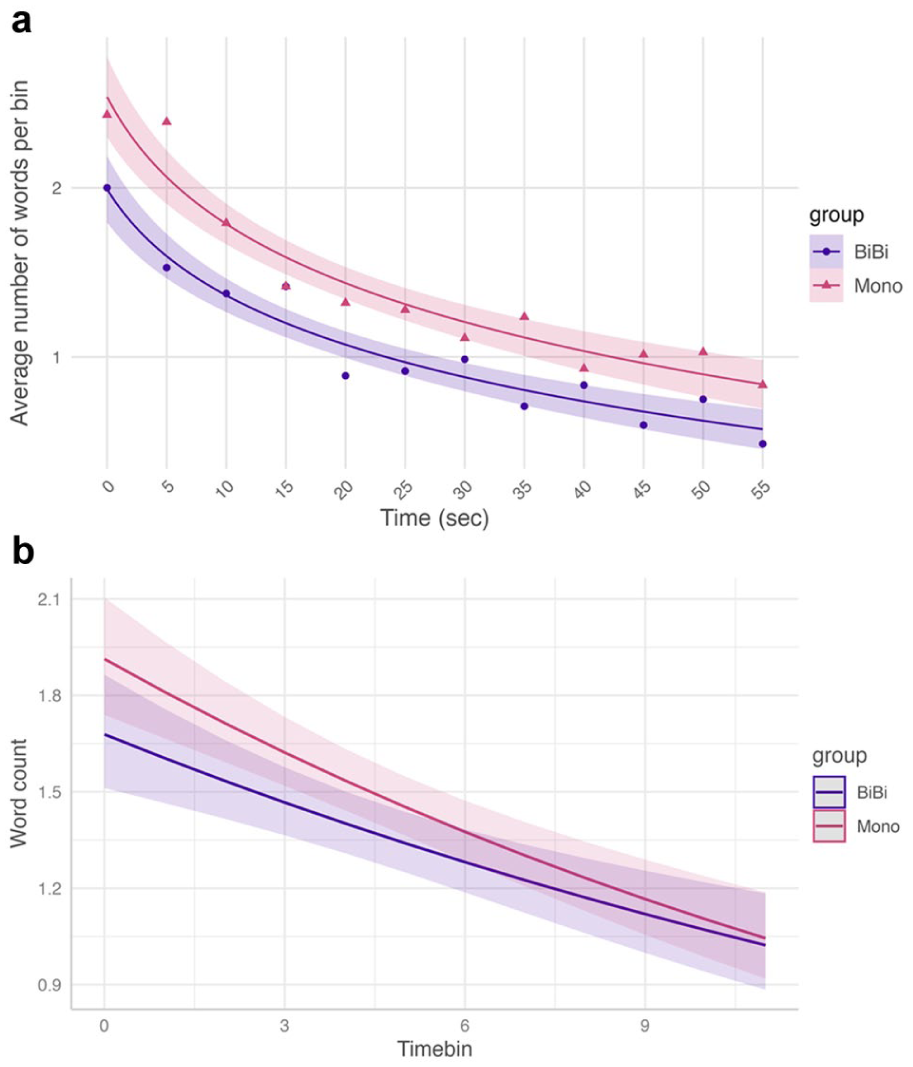
Panel (a) The number of correctly retrieved words as a function of time and group, pooled across letter categories. Lines represent the best-fitting logarithmic functions with shading representing 95% confidence intervals. (b) Modeling outcomes. The predicted number of retrieved words as a function of time. The plot shows curves and 95% confidence intervals for each group by language background.
The number of correctly retrieved words is the most common indicator of success in the letter fluency task. M1 analysis yielded a significant intercept (estimate = 2.460, SE = 0.078, z = 31.72, p < .001) and a significant effect of language background (mean slope = 0.108, SE = 0.045, z = 2.40, p = .016). Pairwise comparisons of the means, listed in Table 2, showed that the bimodal bilinguals retrieved significantly fewer words than monolinguals by on average 2.5 words per letter.
Results of M1.
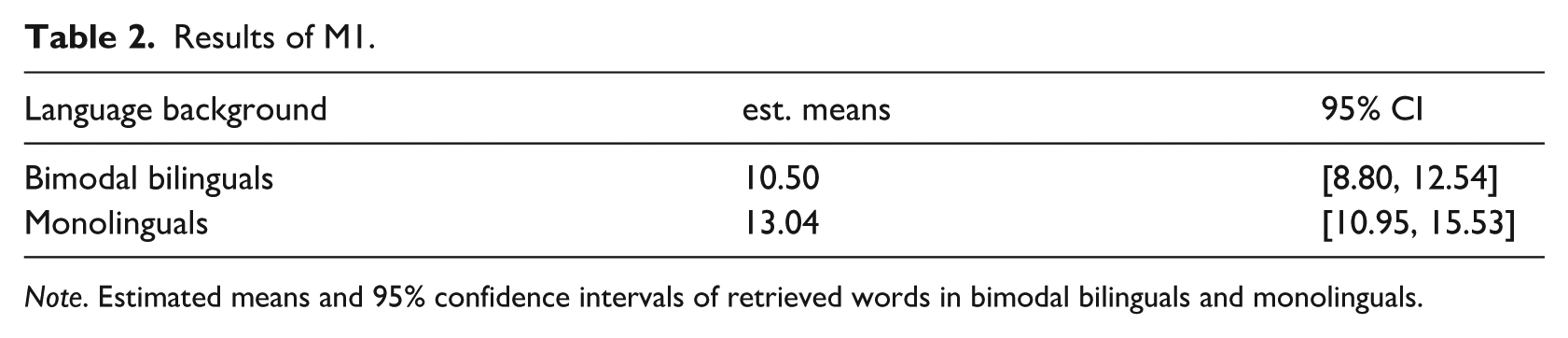
Note. Estimated means and 95% confidence intervals of retrieved words in bimodal bilinguals and monolinguals.
The results of an exploratory model M1t, which was more complex than M1 in that it also included the fixed factor of time bin and its interaction with language background, revealed a trending effect of language background (mean slope = 0.064, SE = 0.0358, z = 1.794, p = .073) and a significant main effect of time bin (mean slope = −0.050, SE = 0.006, z = −7.697, p < .001). Figure 3(b) plots the model-predicted means and 95% confidence intervals per group across the 12 time bins. It can be seen that while the number of retrieved words in the monolingual group is numerically above the bimodal bilingual group across the entire trial, both groups show a similar decrease in the number of words they retrieved over the time course of the fluency trial.
The results of M2, which modeled the fixed effect of language dominance on the number of correctly retrieved words in bimodal bilinguals, yielded a significant intercept (estimate = 2.032, SE = 0.146, z = 13.897, p < .001) and a significant effect of language dominance (mean slope = 0.030, SE = 0.010, z = 2.801, p < .001). Figure 4 plots the modeled mean values and their confidence intervals across the language dominance scale and shows that the stronger the dominance in Czech (as opposed to CSL), the larger the number of retrieved words.
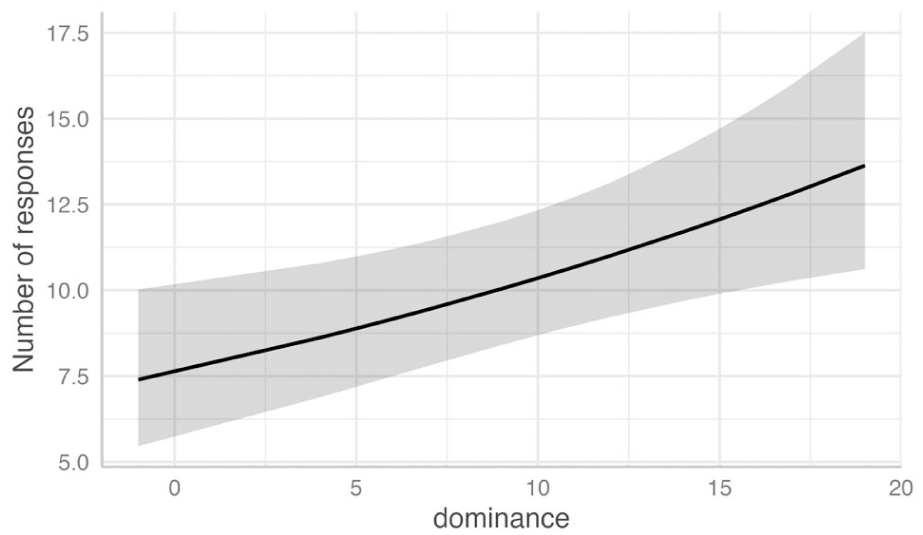
The modeled number of retrieved words as a function of language dominance in the bimodal bilinguals; the plot shows means (thick black curve) and 95% confidence intervals (shading).
M3, modeling the effect of language background on the corpus frequency of the retrieved words, yielded a significant intercept (estimate = 3.613, SE = 0.161, df = 6.027, t = 22.382, p < .001); the effect of language background did not come out as significant (mean slope = 0.119, SE = 0.092, df = 28.127, t = 1.289, p = .208).
M4, analyzing the effect of language background on error rate, revealed a significant intercept (estimate = 0.142, SE = 0.044, df = 3.316, t = 3.261, p = .040); the effect of language background was not significant (mean slope = −0.006, SE = 0.012, df = 28.302, t = −0.492, p = .627).
M5 and M6 analyzed the effect of language background on the number and size of phonetic clusters, respectively. Both models yielded a significant intercept, and both failed to detect an effect of language background (M5 intercept = 0.462, SE = 0.089, z = 5.134, p < .001; M6 intercept = 1.013, SE = 0.086, t = 11.748, p < .001; M5 Language background slope = 0.018, SE = 0.084, z = 0.219, p = .827; M6 Language background slope = 0.05139, SE = 0.066, t = 0.784, p = .44).
M7 and M8 were analogous to M5 and M6 but analyzed the number and average size of semantic clusters. Only M8, analyzing the average size of semantic clusters, yielded a significant intercept (estimate = 0.648, SE = 0.111, t = 6.340, z = 5.826, p < .001). The intercept of M7, analyzing the number of semantic clusters, was not significant (estimate = −0.306, SE = 0.180, z = −1.700, p = .090). The effect of language background was not significant for either model (M7: mean slope = 0.09076, SE = 0.107, z = 0.849, p = .396; M8: mean slope = −0.006, SE = 0.059, t = −0.100, p = .921).
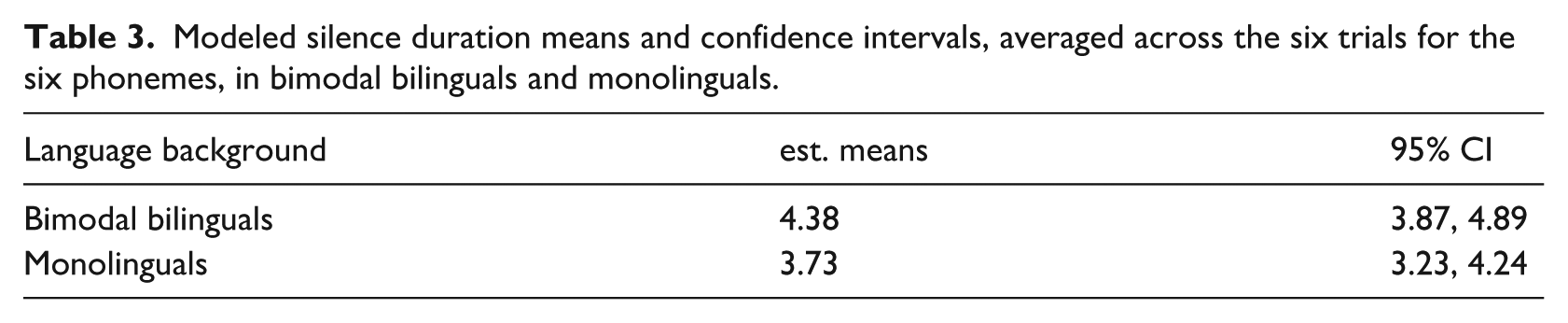
M9, modeling silence duration, yielded a significant intercept (estimate = 4.056, SE = 0.183, t = 22.170, p = < 0.001). We observed a nonsignificant trend toward a difference in the duration of silences between the groups, with bimodal bilinguals tending to produce longer pauses (mean slope = −0.323, SE = 0.183, t = −1.995, p = .089). Table 3 lists the model-predicted silence duration means and confidence intervals in each of the two groups.
Modeled silence duration means and confidence intervals, averaged across the six trials for the six phonemes, in bimodal bilinguals and monolinguals.
Discussion and conclusion
Bilingualism research has long tried to understand the effects of bilingualism on cognition and verbal abilities. The abundance of studies on bilinguals’ executive functioning and word retrieval suggest mixed results, and if any, the effects in either direction seem rather small. Bimodal bilingualism provides an excellent ground for studying verbal competences in bilinguals whose languages operate in distinct modalities, and where phenomena like phonetic or articulatory transfer are by definition impossible.
In this study, we asked whether bimodal bilinguals differ from monolinguals in their verbal fluency, specifically, in the number of words they correctly retrieve in a letter fluency task. Besides the general language background effect, we tested whether the bimodal bilinguals’ performance is affected by their language dominance score. Our results revealed that CODA participants, bimodal bilinguals in Czech and CSL, retrieved significantly fewer words, replicating prior findings on English and ASL bilinguals in Giezen and Emmorey (2017). This suggests that lower performance on verbal fluency tasks by bilinguals may not be necessarily tied to competing phonological systems, as it is not specific to unimodal (spoken language) bilingualism. The lower verbal fluency (in laboratory tasks) might have different causes related to the mechanisms of bilingual trade-off of cognitive capacities, which is a new point of view suggested by Dentella et al. (2024).
Our results showed that in both groups the number of retrieved words was highest at the beginning of the trial and decreased toward the end of the trial; this trajectory was comparable across monolinguals and bimodal bilinguals. Note that in the analysis that included the factor time bin, the main effect of language background was only trending (compared to the significant effect in the main model that did not consider the time trajectory). In light of the significant monolingual versus bimodal bilingual difference in verbal fluency in the main model, as well as the non-negligible trending effect of language background in the second more complex model, our interpretation remains that overall, bimodal bilinguals retrieve fewer words than monolinguals.
The present results further indicated that verbal fluency in bimodal bilinguals is modulated by language dominance: the more dominant one is in Czech compared to CSL, the more words they retrieve. Regarding the investigated concept of language dominance, it should be noted that our design provides a rather simplified view of this factor, as language dominance was assessed subjectively via a questionnaire. Based on the present data, any conclusions drawn about the effects of language dominance should be done with caution due to potential confounding factors such as language exposure across developmental stages, current frequency of use, as well as vocabulary knowledge and language proficiency, which we did not assess in the present sample because of the lack of standardized tools for CSL. While our statistical model indicated that language dominance significantly affected the outcome in the letter fluency task, the relationship between language dominance and verbal fluency is not necessarily causal and should be investigated in future work. To assess the effects of language dominance separately from other factors such as vocabulary size, language exposure, and frequency of use, a more comprehensive approach will be needed that incorporates objective measures of language proficiency in the bimodal bilinguals’ languages as well as detailed developmental exposure records.
Keeping in mind the existence of potential confounding factors, the present study represents one of the first attempts to investigate the effect of language dominance on verbal fluency in bimodal bilinguals. The results replicate previous findings with unimodal bilinguals (e.g., Bennett & Verney, 2019; Wauters & Marquardt, 2018), bringing novel insights into the field. Most importantly, they emphasize the need for controlling language dominance profiles in the bilingual individuals, along with other, more or less related measures such as language exposure and frequency of use, particularly when letter fluency and similar tests are used in clinical settings.
In our investigation of potential differential strategies of word retrieval, we analyzed corpus frequency of the retrieved words, error rate, clustering strategies, and duration of silences, that is, periods of retrieval failure. Exploring these factors that are rarely analyzed in the literature could shed some light onto the processes underlying verbal fluency differences between monolinguals and bimodal bilinguals.
The lower number of correctly retrieved words in the bimodal bilingual group was not accompanied by a between-group difference in error rate, suggesting that inhibition of unwanted responses was comparable across monolinguals and bimodal bilinguals. This is in line with prior studies that compared unimodal bilinguals and monolinguals (Gollan et al., 2002; Portocarrero et al., 2007; Rosselli et al., 2000; Sandoval et al., 2010).
Regarding the corpus frequency of the retrieved words, our analyses did not detect a difference between bilingual and monolingual speakers. As a result, no evidence was found in favor or against any of the hypotheses reviewed in the section “Introduction,” namely the weaker links or the interference hypothesis. The null effect for corpus frequency corresponds with the observation of Giezen and Emmorey (2017). The lack of a word-frequency effect might be attributed to the fact that our bimodal bilinguals were early-immersed speakers, dominant in Czech: strong dominance in the target language has been shown previously to reduce word-frequency effects in unimodal bilinguals (Gollan et al., 2008). Future studies could assess corpus frequency of retrieved words in bimodal bilinguals who do not use spoken language on a daily basis (e.g., hearing adults living/working with deaf signing partners) or who acquired spoken language much later than in early childhood (i.e., deaf individuals whose hearing was compensated later in life).
As for clustering strategies, previous studies reported greater phonetic cluster size in unimodal bilinguals in comparison to monolinguals (Marsh et al., 2019; Patra et al., 2020). Regarding semantic clusters, the results are more diverse; some studies indicate increased semantic clustering in bilingual speakers (Roberts & Le Dorze, 1997), while others observe no significant differences between bilingual and monolingual speakers in semantic clusters (Patra et al., 2020), or even report larger semantic clusters in monolingual speakers (Brandeker & Thordardottir, 2023). In the present study, bimodal bilinguals were not found to differ from monolinguals in terms of the number and size of phonetic and semantic clusters. This suggests that the lower number of produced words in the bimodal bilingual group was not significantly associated with a reduced or enhanced use of clustering. The last potential strategy difference that was assessed here were periods of silence, that is, retrieval failures. Although the effect of language background did not reach significance, there was a trend of longer silent intervals between retrieved words in bimodal bilinguals compared to monolinguals. This indicates that the reduced number of words produced by bimodal bilingual speakers may be linked to prolonged pauses. This observation requires further investigation.
The results of our exploratory analyses suggest that the lower overall score of the bimodal bilingual group was not strongly tied to any of the selected retrieval strategies. Although our list of potential strategies that may facilitate the retrieval is not exhaustive, our findings raise the question of whether the lower number of retrieved words in CODAs, as shown here and in Giezen and Emmorey (2017), is necessarily caused exclusively by linguistic factors. It is important to keep in mind that on top of their unique linguistic experience, CODAs also have a unique cultural experience. They usually grow up in specific settings that make them not just bilingual, but also bicultural and participation in the Deaf community brings along certain challenges for hearing children. It is commonly understood that many CODAs frequently help with interpreting for their parents (Frank, 2019; Preston, 1995) in various, not always age-appropriate, contexts, which can lead to increased feelings of stress and frustration (Heffernan & Nixon, 2023). This can affect one’s identity development and personal traits (Frank, 2019). Sutin et al. (2019) in their meta-analysis have shown that while openness and extraversion are strongly positively tied with letter fluency performance, personal characteristics related to increased neuroticism are associated with lower scores in this task. While the evidence of co-activation in bimodal bilinguals’ minds (Giezen & Emmorey, 2016; Giezen et al., 2015; Gimeno-Martínez et al., 2021; Morford et al., 2014; Villameriel et al., 2016, 2022) and its consequences on language processing cannot be ignored, we suggest that future research should take personal characteristics and socio-cultural environment of the participants into account. As we suggested in the introduction, the experiences of CODAs are in some ways comparable to those of children of immigrants, and it remains an open question whether and how parental language history specifically shapes children’s experiences. Therefore, we propose that the influence of personality characteristics should also be explored in research on unimodal bilingualism.
Note that while interpreting the present results, one should keep in mind that the sample size was at the low end, and therefore, our analyses had limited statistical power. A small sample is, however, a feature common to studies with “atypical” populations that are rather small in themselves. In total, there are about 7,300 individuals who are CSL users, and only a small fraction of them would be CODAs (Novák, 2017), in light of which, a sample of n = 15 is no longer small relative to the population size. The small population-sample problem can be overcome in future research that would test bimodal bilinguals (and language-matched monolinguals) across cultures and languages.
Footnotes
Acknowledgements
The authors would like to thank all the participants who took part in this study, as well as Hana Dufková and the CODA Czech Association for their assistance in recruiting participants. We are grateful to Marcel Giezen for his thoughtful feedback and valuable suggestions, which greatly contributed to improving the quality of this paper.
Author contributions
M.S. and K.C. designed the study. M.S. and E.P. administered the experiment and annotated the material. M.K. processed the experimental data. M.S. and K.C. analyzed the data and drafted the manuscript. All authors contributed to the final version of the manuscript after discussing the results.
Declaration of conflicting interests
The authors declared no potential conflicts of interest with respect to the research, authorship, and/or publication of this article.
Funding
The authors disclosed receipt of the following financial support for the research, authorship, and/or publication of this article: This research was supported by Charles University, project GA UK no. 178223 (Speech production in bimodal bilinguals: Lexical retrieval experiment) and by the European Regional Development Fund, project “Beyond Security: Role of Conflict in Resilience-Building,” reg. no.: CZ.02.01.01/00/22_008/0004595.

Ethical considerations
The authors assert that all procedures contributing to this work comply with the ethical standards of the relevant national and institutional committees on human experimentation and with the Helsinki Declaration of 1975, as revised in 2008. The project was approved by the Research Ethics Committee of the Faculty of Arts, Charles University (approval number FFUK/411709/2023).
Consent to participate
All participants provided informed consent to participate in the study. Consent was obtained in written form in accordance with the guidelines approved by the Research Ethics Committee of the Faculty of Arts, Charles University.
Consent for publication
Not applicable.