



Abstract
Aims and objectives:
This study explores the variations in dialect proficiency among bidialectal children in the Dutch province of Limburg, situated in the southeast of the Netherlands. The primary objective is to uncover the sources of individual differences in dialect proficiency within a dialect-standard continuum.
Methodology:
The study employs a cross-sectional design to assess dialect proficiency through a picture naming task conducted in the local dialect. Key individual difference factors considered include age, gender, socioeconomic status (SES), dialect use at home, dialect use with peers, and vocabulary size in the standard language (Dutch). Dutch vocabulary was measured using a standardized test, while other individual difference factors were gathered via a parental questionnaire.
Data and analysis:
A total of 128 children, aged 4 to 9 years (M = 81 months; SD = 12 months), participated in the study. Responses on the picture naming task were converted into a score representing the difference between a child’s response and the dialect form. A smaller difference indicated closer proximity and thus higher dialect proficiency. Mixed-effects linear regression modelling was used to analyse the data.
Findings:
Older children, those who frequently used dialect in peer interactions, and children with larger vocabularies in standard Dutch tended to use forms closer to the dialect. Gender, SES, and dialect use at home were not significant predictors of dialect proficiency, possibly due to the specific context of Limburg and the age range of the participants.
Originality:
While picture naming is commonly used to measure children’s expressive vocabulary and word retrieval – indices of language proficiency – its use in a context characterized by a dialect-standard continuum without an official norm is novel.
Implications:
Picture naming tasks can be valuable in developmental sociolinguistics and dialect acquisition research. However, they should not be used as a stand-alone measure.
Keywords
Introduction
In the absence of official norms, local dialects are often under significant influence of the standard language, resulting in extensive variation and a dialect–standard continuum (Auer, 2005). While such variation has been extensively investigated in sociolinguistic research, few studies have approached it from a bidialectal acquisition perspective. This study focuses on children exposed to dialects classified as Central Limburgish (Hermans, 2013) and the standard language along a continuum in the province of Limburg in the southeast of the Netherlands which falls within the South Low Frankish dialect group (Südniederfränkisch). The aim is to identify individual difference factors explaining why some children are more proficient in the traditional dialect, measured with a picture naming task, compared to others. Understanding these sources of individual differences offers insights into the mechanisms potentially contributing to the decline in dialect proficiency among younger speakers and newer generations. Our study builds upon previous research on bidialectal acquisition conducted in various countries including Austria (Kaiser & Ender, 2021; Kaiser & Kasberger, 2018), Norway (Strand, 2022), Scotland (Smith et al., 2007, 2013), and the United States (Fischer, 1958; Labov, 1964), among others. Our overarching goal is to advance the emerging field of developmental sociolinguistics and contribute to the development of realistic and ecologically valid models of language acquisition (De Vogelaer et al., 2017; Johnson & White, 2020, p. 1).
Standard-dialect continuum in Limburg
In Limburg, distinct local linguistic varieties, clearly separate from standard Dutch, are widely spoken, both in rural and urban areas (Cornips, 2013). The Netherlands, a signatory of the 1992 European Charter for Regional or Minority Languages (ECRML), formally recognized the dialects spoken in Limburg, collectively labelled as Limburgish, as a regional language in 1997 (Camps, 2018). Limburgish comprises a range of dialects and primarily exists as a spoken linguistic variety, lacking an official written standard. Despite its recognition under the ECRML, there is no formal language policy supporting Limburgish as a medium of instruction or as a subject in schools (Council of Europe, 2016, p. 8).
The degree of use of and proficiency in Limburgish vary as illustrated by the results of two recent surveys. In 2019, Statistics Netherlands conducted a large-scale national language survey among 7,652 individuals aged 15 years and older, revealing that 48% of Limburg’s inhabitants reported speaking mostly Limburgish at home (Schmeets & Cornips, 2021). Results showed moreover that respondents aged 55 years and above used Limburgish more frequently compared to younger groups, especially compared to those between 15 and 25 years, pointing to less use among younger generations (Cornips, 2020). In 2020, an internet survey was carried out commissioned by the dialect association Veldeke on speaking, writing, and the use of Limburgish on social media, receiving responses from over 1,100 adults who had registered with the national research panel Panelclix (R&M and Matrix, 2021). The study found that 78% of respondents speak Limburgish, with 67% claiming high proficiency. Note that whereas the Statistics Netherlands survey asked about actual use of language or dialect at home, that is, which language or dialect was spoken most often at home, the Veldeke survey asked whether the respondent is able to speak dialect, explaining the difference between 48% and 67%, respectively. The latter study also indicated that (self-reported) proficiency is less among younger generations, in line with the aforementioned drop in use: 74% of respondents aged 65 and older reported high proficiency, while this percentage drops to 52% for those aged 18–34 years. There was little variation by educational level, which confirms the notion that formal education is less of a determining factor in regional language use in Limburg compared to other regions in the Netherlands (Schmeets & Cornips, 2021), and worldwide (Bromham et al., 2022).
Sources of individual differences
If the above-described decline of dialect proficiency continues in younger generations, children are even less likely to obtain high proficiency in Limburgish than the adolescents who participated in the previous surveys (Schmeets & Cornips, 2021; R&M|Matrix, 2021). In a previous study, we examined proficiency among children living in Limburg using a picture naming task and found substantial individual variation (Francot et al., 2017). As the sources of this variation are largely unknown, our aim in this study was to identify factors that explain why some children are more proficient in their local dialect compared to others thereby focusing on the role of demographic factors (age, gender, socioeconomic status [SES]), experiential factors (interactions at home and with peers), and proficiency in the standard variety.
Below, we turn to these factors one by one by reviewing relevant research, which targets use of dialect, rather than proficiency. While little is known about relations between language use in interactions and children’s dialect proficiency, it is widely acknowledged that use of and experiences with a certain language in interactive settings are positively related to children’s proficiency in that language (Anderson et al., 2021; Blom & Soderstrom, 2020; Hoff, 2006; Rowe & Snow, 2020; Wang et al., 2020), in line with socio-cultural, socio-interactionist, and usage-based perspectives on language acquisition (Bruner, 1983; Bybee, 2010; Vygotsky, 1978). Use and proficiency are typically measured differently, that is, spontaneous speech and interactions to investigate use versus more controlled tasks like the picture naming task in this study to investigate proficiency; in child bilingualism research, both use and proficiency are studied using parental report (e.g., Kašćelan et al., 2022).
Age
Dialect use tends to peak during preschool years, with school-aged children gradually favouring the standard variety (Foulkes et al., 2005; Nardy et al., 2013; Smith et al., 2007). Conversely, other studies suggest that the transition to increased use of the standard or sociolinguistically prestigious variety may commence prior to formal education (Kaiser & Ender, 2021; Strand, 2020). Developmental shifts during the preschool phase may mirror alterations in caregiver behaviour (De Houwer, 2003; Foulkes et al., 2005; Smith et al., 2013), while later changes could signify sociolinguistic maturation (Kerswill, 1996, p. 293; Hejná & Jespersen, 2021; Kaiser & Ender, 2021). Sociolinguistic maturity entails an understanding of different linguistic varieties and their appropriate use in various contexts, akin to adult-like structured behaviour. Children may become increasingly attuned to these varieties (Kaiser & Kasberger, 2018) and the complexities involved in adapting their speech to match (groups of) adults and other children in different settings. The transition towards greater use of standard Dutch may reflect this increasing sociolinguistic maturity, as well as changes in children’s social networks (Blum-Kulka & Gorbatt, 2014).
Gender
Use of dialect features has been found to be more prevalent among boys than girls (Fischer, 1958). Investigating children ranging between 3 and 6 years growing up in German-speaking Austria in a dialect (Bavarian) – standard continuum, Kaiser and Ender (2021) report a nuanced pattern showing an interaction between gender and geographical location. In their study, boys tended to use dialect-only repertoire, especially in rural areas, girls tended to use standard-only repertoire, especially in urban areas, whereas boys in urban areas and girls in rural areas relatively often used a bi-varietal repertoire. Regarding the underlying mechanisms of differences between boys and girls, some studies suggest that caregivers manipulate the use of salient linguistic features in child-directed speech according to the child’s gender (Foulkes et al., 2005; Nardy et al., 2013; Smith et al., 2013). Others point to children as active agents in constructing gender through meaningful interactions with other children (Blum-Kulka & Gorbatt, 2014).
SES
Nardy and colleagues (2013) conclude that ‘the higher the position of the family background on the social scale, the more standard variables the children produce’ (p. 8). Such effects of SES have been found as early as age 3 years (Díaz-Campos, 2005), and they may become stronger as children grow older (Chevrot et al., 2011). Children from higher SES backgrounds also seem to show an earlier preference for standard forms compared to children from lower SES backgrounds (Barbu et al., 2013; Kaiser & Kasberger, 2021). SES is conceptualized and measured in different ways, that is, by looking at education, income, and/or occupation. Recent research pointed out that in particular educational level predicts greater language endangerment and loss of minority or regional languages (Bromham et al., 2022) suggesting a negative impact of formal schooling on language vitality. However, as discussed above, previous surveys indicated that Limburgish shows little variation by educational level. Whether this is also reflected in children’s Limburgish proficiency is unknown.
Interactions at home and with peers
For this study, we investigated the use of Limburgish dialect in two interactive settings, that is, at home and with peers. Interactions at home, including those with parents and siblings, may be particularly important for young children, although research has also noted a significant impact of the preschool context. For example, after entering preschool where learning activities take place in Dutch, toddlers in Limburg were found to stop speaking Limburgish as a home language even when both parents speak Limburgish at home (Cornips, 2020), demonstrating effects of the wider context and of societal dominance of the standard variety on young children’s language use. Similarly, in a study conducted in Austria with somewhat older 3- to 6-year-old children, Kaiser (2021) found that the amount of dialect use in the home was not a significant factor in children’s dialect and/or standard repertoire use. In contrast, the frequency of being read to (which is a measure of standard language input in this context) increased the probability developing standard speech, but only in rural areas. Taken together this may suggest that (especially in somewhat older children) dialect use at home may have limited impact, whereas the input in other contexts, notably standard language input and interactions with other interlocutors, such as peers, is more important.
Proficiency in the standard variety
It has been suggested that learning one language may come at the expense of another implying a competitive relationship (Scheele et al., 2010) which, in turn, may result in a trade-off or negative correlation between proficiency in the two languages of bilingual children. However, empirical findings show limited evidence for a competitive relation (Hoff, 2021), while other research suggests positive relations between proficiency in both languages through positive transfer, which may be especially relevant in the case of children who learn two closely related varieties that provide ample opportunities to share knowledge and resources (Blom et al., 2020; Bosma et al., 2019; Floccia et al., 2018; Goriot et al., 2021; Tribushinina et al., 2024). Furthermore, a third variable, such as language aptitude, is expected to impact on development in each language in the same way, resulting in a positive relation.
The present study
The following research question guided our study:
Do age, gender, SES, interactions at home and with peers, and proficiency in Dutch predict the proximity of child responses to dialect forms?
Our predictions were as follows:
Older children have accumulated more experiences with adult dialect speakers, and consequently have more experience with adult norms of dialect forms, and on how and when to use different varieties and forms. They also have greater sociolinguistic maturity, a larger repertoire, and they may be more aware of the dialect features. We therefore expected that the responses of older children would be closer to the dialect forms than those of younger children.
Boys may use forms closer to the dialect end at the continuum than girls if boys use dialect more frequently, hence have more accumulated experiences, than girls.
Higher SES is often associated with less use of dialect at home, but this may be different in Limburg where dialect is spoken in homes of lower as well as higher educated families. Consequently, SES may or may not impact on children’s responses.
Children who more frequently use their dialect in interactions at home (i.e., with their family) and with peers produce forms closer to Central Limburg dialects than those who interact less in dialect. Because the children in our study went to school full-time, interactions with peers may be more influential than interactions at home.
We expected that children who know more words in Dutch would know more words in dialect because of positive transfer and/or a high language aptitude.
Method
Participants
The data were collected at seven primary schools in the south-central region (municipalities: Beek-Elsloo, Sittard-Geleen, and Schinnen varying between 3,000 until 30,000 inhabitants, see Figure 1).
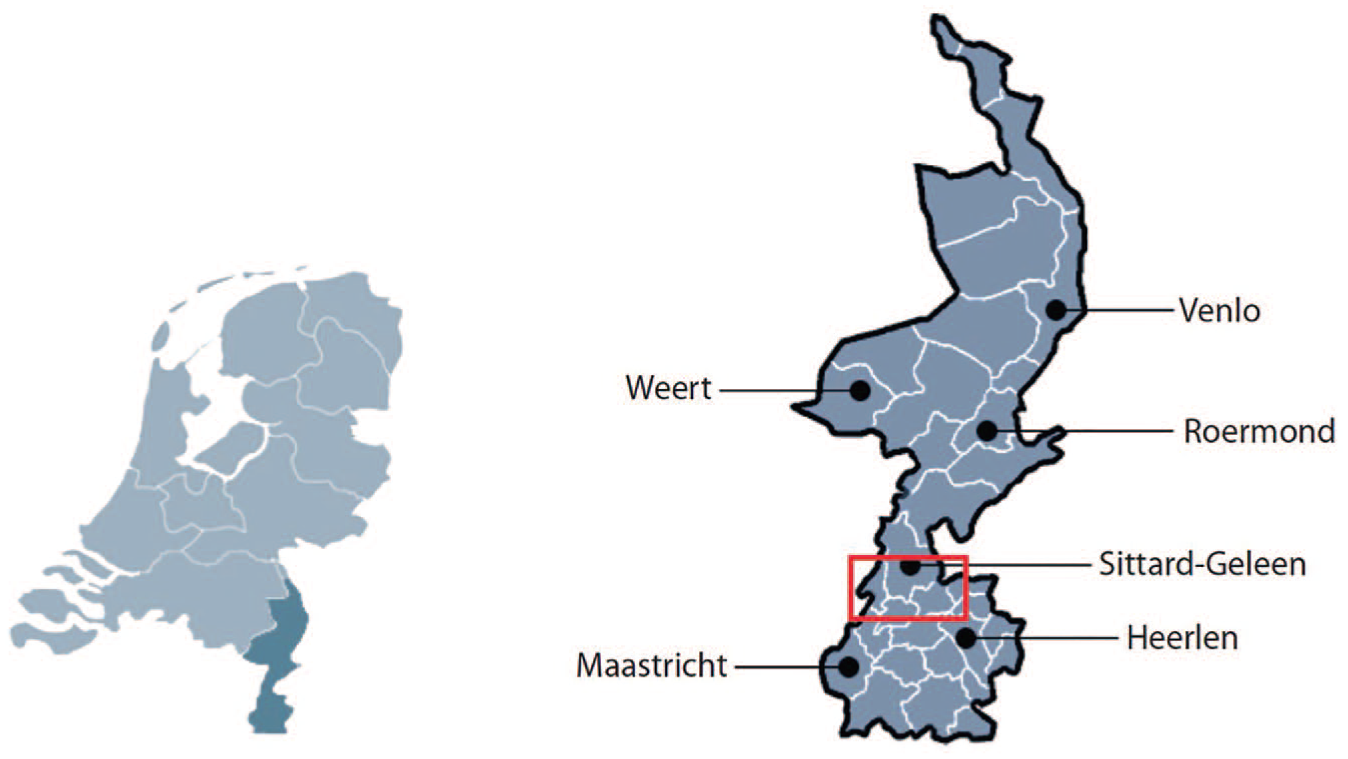
Region and municipalities where the study took place.
Data on the picture naming task were obtained from 128 children. In this sample, there were slightly more boys (56%) than girls and SES was mid to high. The sample characteristics are shown in Table 1. As indicated in the table, not all parents filled in (specific items on) the questionnaire, resulting in missing data points for some variables, in SES. Explanations of the different measures are provided in the next section.
Sample characteristics (demographic variables).
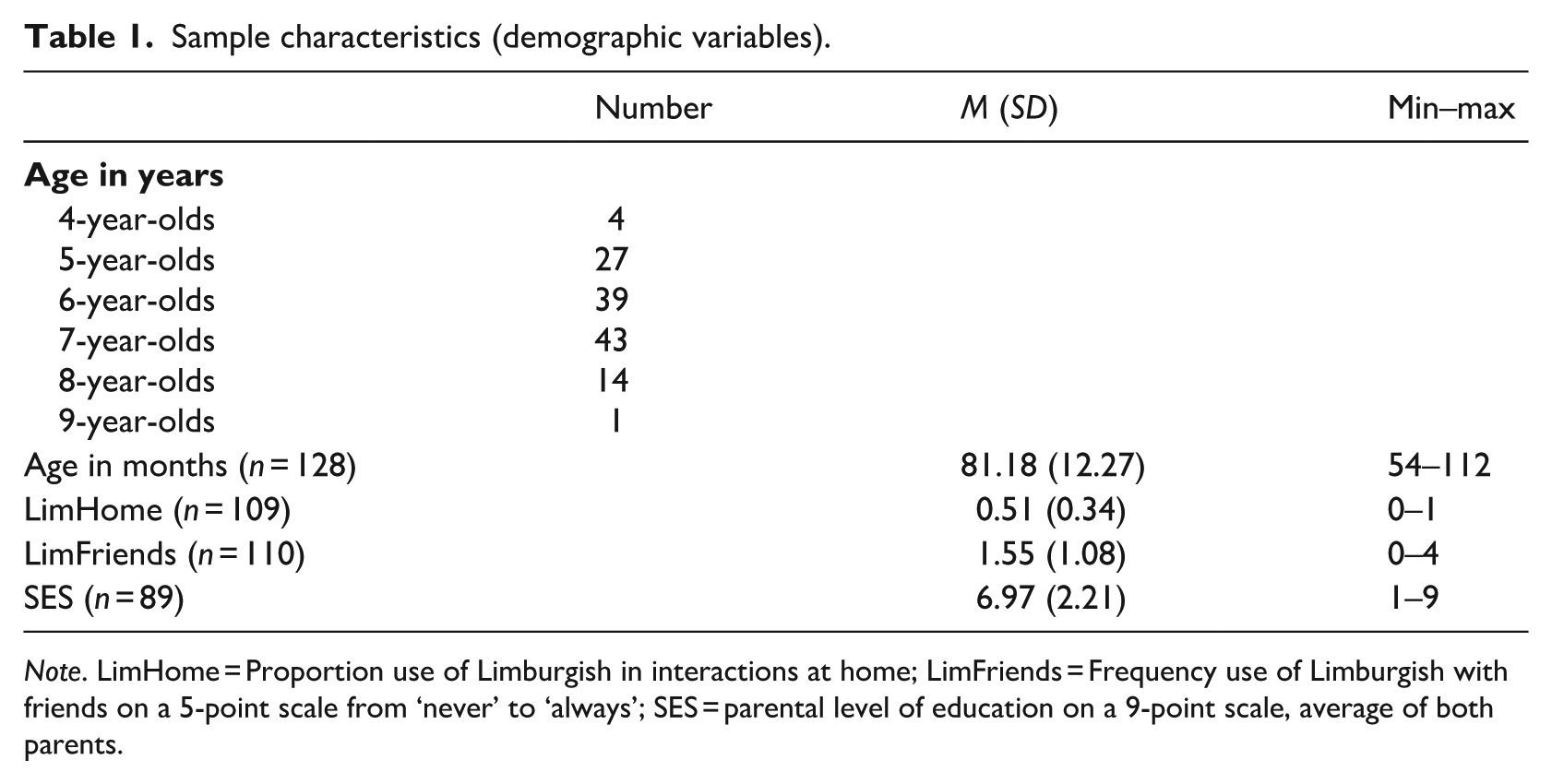
Note. LimHome = Proportion use of Limburgish in interactions at home; LimFriends = Frequency use of Limburgish with friends on a 5-point scale from ‘never’ to ‘always’; SES = parental level of education on a 9-point scale, average of both parents.
Measures
Lexical knowledge of Limburgish
Children were tested with the Limburgish expressive vocabulary task (Limburgse Woordenschat Taak ‘LWT’). In the LWT, each image is presented to the child asking in dialect to name the object in dialect. Children may differentiate functionally between two very close linguistic systems by at least 2 years of age when they are in the one- and early two-word stages of development (Chevrot & Ghimenton, 2018; De Houwer & Ortega, 2018). The LWT consists of 30 target words (see Appendix), which were selected from the Basiswoordenlijst Amsterdamse Kleuters (Mulder et al., 2009), which is a list of 3,000 words that all children in the Netherlands are expected to know by the time they finish preschool. The 30 words selected for the LWT refer to everyday objects and well-known animals. The words/concepts we selected were well depictable and pilots showed that they prompted the target response. To the extent possible, we avoided selecting words that had cognates in Dutch. In the case of cognates, words were phonologically different in dialect and Dutch, and in most words the difference pertained to two or more phonemes. The target forms were determined based on dialect dictionaries (Roebroek, 1982) and young adults (±20 years old) who were experienced dialect users from the region. The forms were confirmed by older, retired dialect speakers from the same region who were asked to name the pictures in dialect.
Language use in interactions
A Dutch version of the LITMUS Parental Bilingual Questionnaire (PaBiQ; Tuller, 2015) was used, which provides information on language use in interactions at home and interactions with peers, as well as family SES. Use of dialect in interactions at home indicates the percentage of time a child was, around the time of testing, addressed in dialect in the home environment. This information was collected for the mother, father, other caretakers and siblings on a five-point scale ranging from 0 = never to 4 = always, corresponding to 0%, 25%, 50%, 75% and 100%. These scores were added up and divided by the maximum score that was possible. For example, a score of 0 (mother), 1 (father), 2 (sibling), would result in a score of (0 + 1 + 2)/(3*4) = 0.25, which would correspond to 25%. Language use with peers was also measured on a five-point scale ranging from 0 = never to 4 = always. A single overall measure was used without differentiating between different peers. SES was estimated through parental educational level (i.e., average of both parents), measured as the highest degree obtained on a nine-point scale ranging from 1 indicating no formal education to 9 indicating a university degree. Parental education is highly predictive of other SES indicators (income, occupation) and a better predictor of cognitive performance than other SES indicators (Calvo & Bialystok, 2014).
Lexical knowledge of Dutch
Dutch receptive vocabulary was measured with the Peabody Picture Vocabulary Task (PPVT-III-NL; Schlichting, 2005). The PPVT is a standardized receptive vocabulary test in which a child hears a stimulus word and has to choose the correct referent out of four pictures. The PPVT contains 204 items divided over 17 sets. Each set consists of 12 items and sets are ordered according to difficulty. The PPVT-III-NL was administered and scored according to the official guidelines. Raw scores were converted to standardized scores based on age-corrected normative scores.
Procedures
At the time this research took place (2014–2015), the University of Maastricht Ethical Review Committee Inner City Faculties (ERCIC) was not yet established, but in hindsight, the ERCIC concluded that the research adheres to all institutional requirements. Schools in the targeted dialect area were approached for participation. Subsequently, parents of children in the right age range who attended the participating schools received information letters. Only children for whom informed consent was obtained took part and were tested individually by trained research assistants fluent in Dutch and Limburgish. Prior to administering the task, the research assistant made sure that the child understood the instruction to use dialect through a brief informal conversation in which the research assistant talked with the child about their use of Dutch and dialect in daily life thereby using the more informal term ‘plat’ to refer to the local dialect. While administering the task, research assistants used Limburgish, even though children responded in Dutch. The questionnaire data were collected during a telephone interview with the child’s caregiver.
Data-analytic strategy
We used Levenshtein distance as a measure of proximity to the dialect form. Levenshtein distances reflect the minimum number of single-character adaptations (insertions, deletions, substitutions) to change one word into another, that is, the least costly operations to transform one transcript in another (Heeringa, 2004). For example, to transform the English word ‘interest’ into the Dutch word ‘interesse’, two adaptations are required: substitution of ‘t’ by ‘s’ and insertion of ‘e’. Based on phonetic (SAMPA) transcriptions of the children’s responses, a Levenshtein distance variable was created that reflected the pronunciation distance. This was done for 122 children, as for six children no audio-recordings were available. In the analysis, we excluded irrelevant responses (i.e., a word that referred to a concept that did not correspond with the picture). Irrelevant and nonresponses comprised 6.49% of the data.
To answer the research question, mixed-effects linear regression models were run with R (R version 4.2.2), using Levenshtein distance from dialect as the outcome variable. After drop of multivariate missing data, 86 children remained. Predictor variables were scaled and centred. Participant and item were added as random-effect variables. Fixed-effect variables were age (Age), gender (Gender), SES, use of Limburgish in interactions with the child at home (LimHome), use of Limburgish in interactions with peers (LimFriends), and vocabulary size in Dutch (DutchVoc).
Results
Descriptives
Table 2 shows the counts for the different responses indicating that most responses were relevant, but given in Dutch rather than in Limburgish. There was also a considerable number of responses that we labelled as unclear and that were neither Dutch nor the targeted dialect response. Often these appeared to be hybridizations. Children used, for example, blended forms consisting of a Dutch stem and a dialect suffix (e.g., to refer to a small fish children used the form visj + keDIM ‘vɪʃkə’ consisting of a stem associated with Dutch and the diminutive suffix associated with the dialect), as well as the other way around (e.g., to refer to a small bird children used the form veugel + tjeDIM ‘vø:ɣɔɫcə’ with the stem associated with the dialect and the diminutive suffix associated with Dutch), and they appeared to transform Dutch words to Limburgish by applying phonological regularities between Dutch and Limburgish (e.g., children applied the regular [ɛi] – [i:] correspondence between Dutch and Limburgish to the Dutch form ‘konɛin’ using the resulting hybrid form ‘koni:n’ rather than the target ‘kni:n’ to refer to a rabbit). See for some further explanation and examples Blom (2023) and Open Science Framework (OSF): https://osf.io/b6kqw/.
Responses on LWT and average Levenshtein distance (standard deviation).
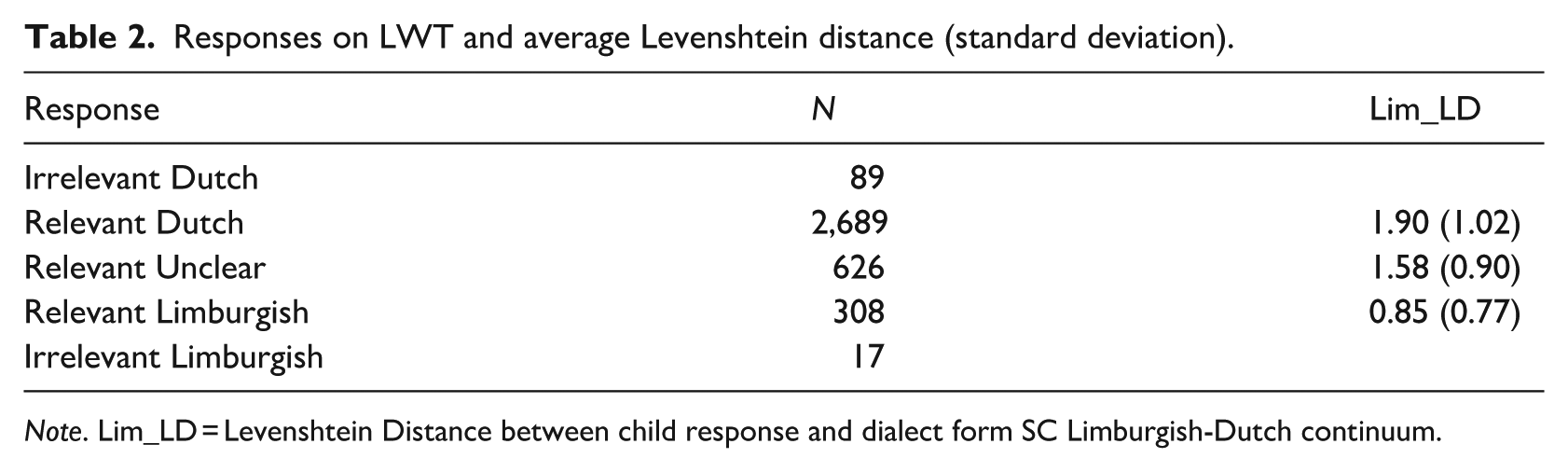
Note. Lim_LD = Levenshtein Distance between child response and dialect form SC Limburgish-Dutch continuum.
Modelling individual difference factors
Models were run with Child and Item as random effects. Models in which random slopes were added failed to converge. The full model with Age, Gender, LimHome, LimFriends, SES, and DutchVoc as fixed-effects yielded non-significant results for Gender and LimHome. The effects Age and LimFriends reached statistical significance. The effect of DutchVoc approached significance. Inspecting the direction of the effects, we conclude that a higher age, more use of Limburgish with friends, and a higher Dutch vocabulary score predicted a smaller distance score, hence greater proximity to the dialect form. The predictions of the full model are summarized in Table 3.
Model estimates full model predicting Levenshtein distance between child response and dialect form.
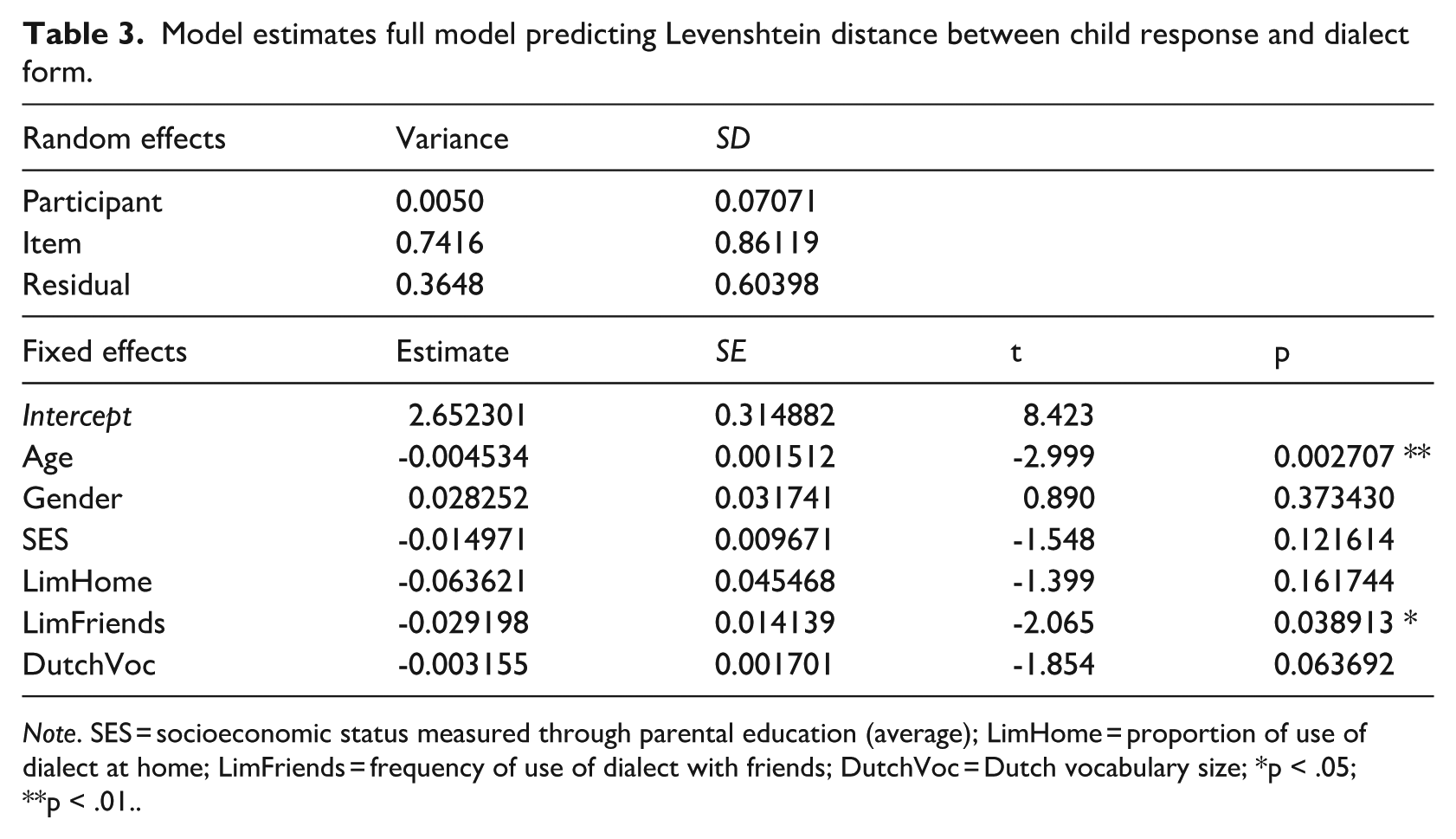
Note. SES = socioeconomic status measured through parental education (average); LimHome = proportion of use of dialect at home; LimFriends = frequency of use of dialect with friends; DutchVoc = Dutch vocabulary size; *p < .05; **p < .01..
Because of the many missing values for SES, the model was rerun without SES. Dropping SES as a predictor resulted in a significant effect of DutchVoc (Estimate = −0.003647, SE = 0.001679, t = −2.172, p = .029882*). However, the full model had a better fit than the reduced model without SES as indicated by a lower Akaike information criterion (AIC) index (4457.626 for the full model versus 4,496.444 for the model without SES). In addition, we inspected the more parsimonious model with only significant predictors or predictors approaching significance (Age, LimFriends, DutchVoc). The results were similar to those of the full model, indicating that the presence of Gender, SES, and LimHome did not impact on the effects of Age, LimFriends, and DutchVoc. The full model had a better fit than the reduced model without Gender, SES, and LimHome (AIC of the reduced model was 5,415.997).
Discussion
While many studies have researched variation in children’s proficiency in standard varieties, little is known about variation in children’s dialect proficiency. In this study, we used the LWT (Limburgish Vocabulary Task), which is a picture naming task, to investigate the topic. The goal of our study was to better understand variation between children by investigating sources of individual differences.
We found that older children and children who used dialect more frequently in interactions with peers more often produced forms closer to the target dialect words. In addition, a trend was found for proficiency at using Dutch. Although recent surveys showed an overall decline in use of and proficiency at Limburgish in younger generations (Cornips, 2020; R&M|Matrix, 2021), the effect of age in our study suggests that children continue to develop dialect proficiency. The effect of age may have different, not mutually exclusive, explanations. First, it may stem from accumulated use and experiences that support implicit learning of dialect vocabulary, in line with many studies that have pointed to the role of experience in early child language development (Anderson et al., 2021; Wang et al., 2020), and socio-cultural, socio-interactionist, and usage-based perspectives on language acquisition (Bruner, 1983; Bybee, 2010; Vygotsky, 1978). Second, chronological age could index sociolinguistic maturity reflecting the fact that older children know better than younger ones which linguistic variety to use when explicitly asked to respond in dialect. Our results regarding age support those of Kaiser and Kasberger (2018) who found that around age 8–9 years, which was the oldest group in our study, discrimination ability has become stable and consistent. Another factor could be a growing familiarity with specific terminology used in the instructions (Kasberger & Kaiser, 2019).
While dialect use at home did not emerge as a significant predictor, confirming Kaiser (2021), dialect use with friends did, suggesting that dialect use with friends could be a protective factor against dialect decline. The contrast between effects of dialect use at home versus dialect use with friends should probably be viewed against the backdrop that all children in our sample attended primary school and many of them had already done so for several years. While growing older, children’s social networks change (Blum-Kulka & Gorbatt, 2014), and they extend the range of communicative partners they engage with in dialect on a regular basis (Ochs & Schieffelin, 2012, p. 1). Specifically, interactions with peers may become increasingly important once children have entered school, which may be reflected in the significant effect of dialect use in interactions with peers versus the non-significant effect of dialect use in interactions at home. In this respect, our results support the conclusion by Kaiser and Ender (2021) that ‘children’s communicative radius expands as they grow older: They go to school, meet peers, teachers and gradually experience a wider range of different social encounters, which entail different patterns of language use with new communicative partners’. Moreover, the significant effect of dialect use with friends reveals that these children are able to socialize in and through dialect outside the home domain as well, that is, with friends and in the wider local community beyond peers and familiar adults (e.g., speaking it in the public space, in stores, and during local events).
Similar to dialect use at home, the effects of SES (measured through education) and gender did not reach significance. Although the absence of an effect of SES deviates from the pattern that children from higher SES backgrounds use the standard variety more (Nardy et al., 2013), we had expected this beforehand. The reason is that Limburgish appears strongly rooted in all educational layers (Schmeets & Cornips, 2021). Use of Limburgish is furthermore considered crucial for membership in the Limburgish elite in public cultural practices. As such, the inhabitants that identify strongly with Limburg attach great importance to speaking the Limburgish dialect since it is considered a vital aspect in place-making processes at local and regional levels in Limburg (Cornips, 2018). Regarding gender, closer inspection of the data revealed that Limburgish was more often used in interactions at home in the case of girls than boys. However, because boys and girls did not differ in the use of Limburgish with friends, the absence of an effect of gender is consistent with findings on the relative impact of interactions at home versus interactions with peers.
Finally, we found a trend indicating that Dutch vocabulary size positively predicted closeness to dialect forms confirming that there is no trade-off between learning Dutch and dialect, in line with earlier findings on English–Spanish bilinguals (Hoff, 2021). The findings may also suggest that if children acquire two closely related varieties, the two varieties may strengthen each other (Blom et al., 2020; Bosma et al., 2019; Floccia et al., 2018; Goriot et al., 2021; Tribushinina et al., 2024), although sufficient exposure to and experience with the local dialect will be required for attaining high proficiency and to prevent a decline in dialect use because of significant and ongoing pressure from the standard variety.
Picture naming in developmental sociolinguistics
Typical methodologies used in sociolinguistics research such as in-depth interviews or recordings of children’s interactions in their situated context are extremely insightful, but they are often also too labour-intensive for collecting data from larger samples of children and not suited for investigating the full breadth of interindividual variation. Picture naming is commonly used to measure children’s expressive vocabulary and word retrieval, which are indices of language proficiency. Using a picture naming task in a context characterized by a dialect – standard continuum that lacks an official norm is uncommon and raises methodological and conceptual challenges. Using this method for developmental sociolinguistic research, like we did, requires reflection on its strengths and weaknesses.
In addition to being efficient in terms of time and resources, elicited production (in contrast to a comprehension or discrimination task, e.g., Kaiser & Kasberger, 2018) can result in rich data including unforeseen responses that provide insight into children’s knowledge. Qualitative analyses described in previous research (Blom, 2023) point to use of hybrid forms resulting from cross-linguistic phonological rules that transformed Dutch words into words that are ‘Limburgish-like’, and from within-word code-mixing in morphologically more complex forms. According to Trudgill (1986, p. 62), phonetically intermediate or hybrid forms are examples of ‘interdialect’ referring to ‘situations where contact between two dialects leads to the development of forms that actually originally occurred in neither dialect’ or to ‘imperfect accommodation’. In this study, the use of hybrid forms typically involves cases where the Levenshtein distances to target dialect forms are smaller than they would have been if a child had used Dutch forms. For example, several children appeared to apply the regular [ɛi] – [i:] correspondence between Dutch and Limburgish to the Dutch form konɛin using the resulting hybrid form koni:n rather than the target kni:n. Transforming the Dutch form konɛin (‘rabbit’) into the target requires two adaptions (deletion, substitution) whereas only one adaption is required for the hybrid form koni:n (substitution). Importantly, such forms would not have surfaced in spontaneous interactions. For example, based on spontaneous interaction we may conclude that some children display only passive knowledge of the local dialect, or no knowledge at all. Yet, when the same children are instructed to say a word in dialect, they produce responses that reflect knowledge of the dialect as well as sociolinguistic maturity.
The method also has its drawbacks. Notes added to the parental questionnaire indicated that one child who produced almost exclusively Dutch responses in the picture naming task was linguistically strong in both Limburgish and Dutch. Her consistent use of Dutch when faced with a task administered at school may reveal sociolinguistic awareness in the sense that in Limburg a child is expected to use standard Dutch in an educational context (Cornips, 2020), especially in interaction with teachers and adults in other roles such as the research assistants. The assistants’ use of Limburgish instead of standard Dutch in an instruction context may have been evaluated as highly atypical according to her sociolinguistic maturity and against the (informal) language policy of the school.
Limitations of the study and future research
It is reassuring that the analyses yield interpretable patterns suggesting that the LWT measured what it was developed for. Yet, we do not know how well the task reflected the children’s dialect proficiency. Validation of the task as a measure of dialect acquisition and proficiency is recommended. Furthermore, the children were tested at school, and their task behaviour may have been impacted by the language norms at school in Limburg, as suggested by the child we discussed above and the overall low number of dialect responses. It is also conceivable that testing at school amplified the effect of interactions with peers and diminished the effect of interactions at home.
Conclusion
In this study, we assessed children’s dialect proficiency in the southern Dutch province Limburg using a picture naming task and set out to pinpoint sources of individual variation in children’s dialect proficiency. In general, the number of dialect responses was low and relatively many responses were given in standard Dutch. This could point to overall low dialect proficiency, and may signify pressure from Dutch. Children’s ability to name pictures in dialect was impacted by the individual difference factors age, use of dialect with peers, and proficiency in the standard variety. Accumulated experience with the local dialect and sociolinguistic maturity through which the child has more opportunities to intentionally select which linguistic variety to use depending on their orientation to the wider community may explain why one child has higher dialect proficiency compared to another child. In addition, the results suggest that in bidialectal acquisition, the two varieties strengthen one another, which is presumably related to the large degree of overlap caused by the long duration of contact between Dutch and dialect in Limburg. Finally, our results indicate that picture naming can be a useful method in developmental sociolinguistics in general and dialect acquisition specifically. Such a task should, however, not be used as a stand-alone measure.
Footnotes
Appendix
Items of the Limburgse Woordenschat Taak (Limburgish Vocabulary Task).
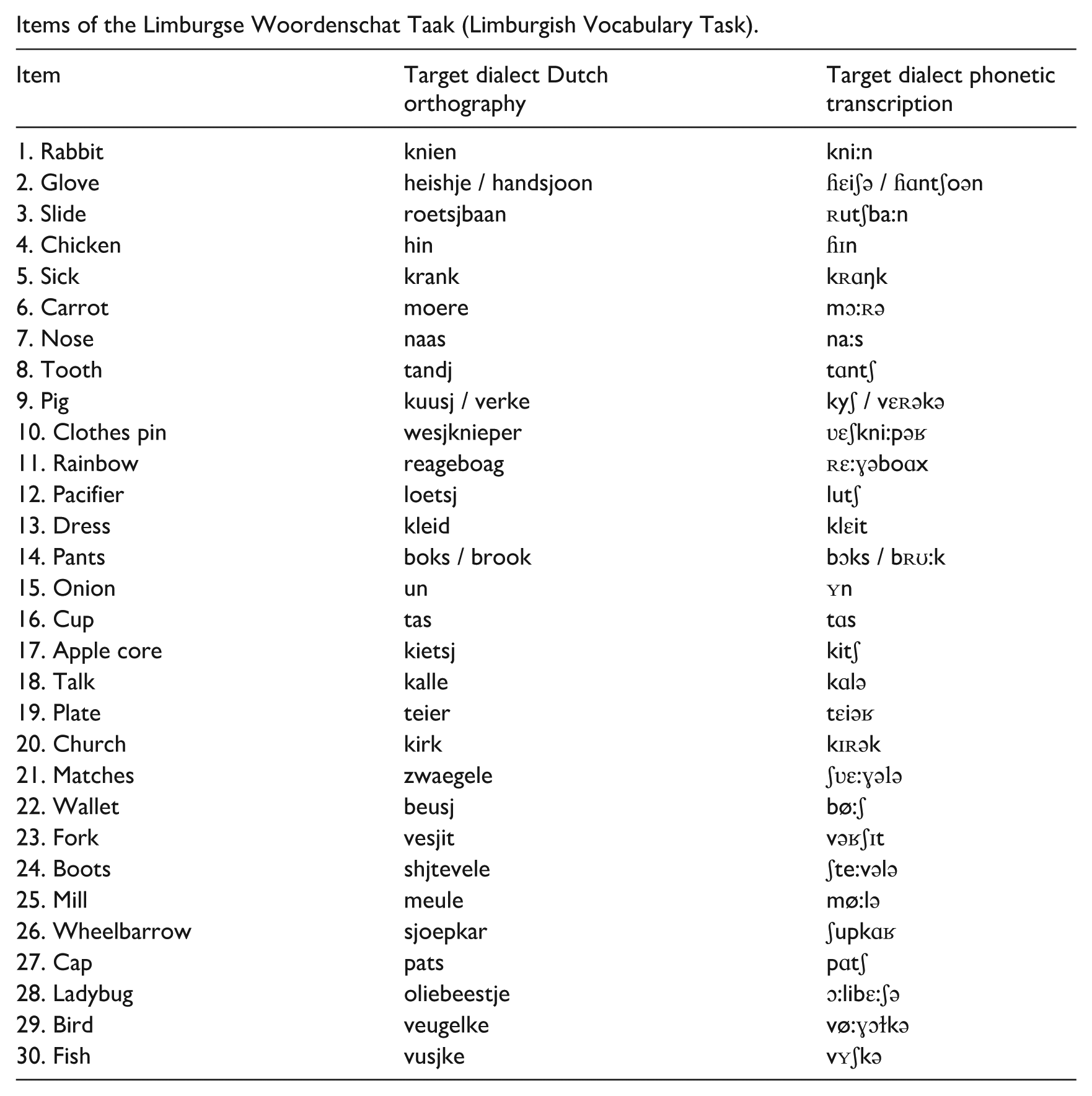
| Item | Target dialect Dutch orthography | Target dialect phonetic transcription |
|---|---|---|
| 1. Rabbit | knien | kni:n |
| 2. Glove | heishje / handsjoon | ɦɛiʃə / ɦɑntʃoən |
| 3. Slide | roetsjbaan | ʀutʃba:n |
| 4. Chicken | hin | ɦɪn |
| 5. Sick | krank | kʀɑŋk |
| 6. Carrot | moere | mɔ:ʀə |
| 7. Nose | naas | na:s |
| 8. Tooth | tandj | tɑntʃ |
| 9. Pig | kuusj / verke | kyʃ / vɛʀəkə |
| 10. Clothes pin | wesjknieper | ʋɛʃkni:pəʁ |
| 11. Rainbow | reageboag | ʀɛ:ɣəboɑx |
| 12. Pacifier | loetsj | lutʃ |
| 13. Dress | kleid | klɛit |
| 14. Pants | boks / brook | bɔks / bʀʊ:k |
| 15. Onion | un | ʏn |
| 16. Cup | tas | tɑs |
| 17. Apple core | kietsj | kitʃ |
| 18. Talk | kalle | kɑlə |
| 19. Plate | teier | tɛiəʁ |
| 20. Church | kirk | kɪʀək |
| 21. Matches | zwaegele | ʃʋɛ:ɣələ |
| 22. Wallet | beusj | bø:ʃ |
| 23. Fork | vesjit | vəʁʃɪt |
| 24. Boots | shjtevele | ʃte:vələ |
| 25. Mill | meule | mø:lə |
| 26. Wheelbarrow | sjoepkar | ʃupkɑʁ |
| 27. Cap | pats | pɑtʃ |
| 28. Ladybug | oliebeestje | ɔ:libɛ:ʃə |
| 29. Bird | veugelke | vø:ɣɔɫkə |
| 30. Fish | vusjke | vʏʃkə |
Acknowledgements
We are grateful to Kirsten van den Heuij for her contribution to the study, and designing the location maps used in this publication (Figure 1).
Author contributions statement
Conceptualization: EB, LC; Data curation: LC; Writing–Original draft: EB; Formal analysis: EB; Writing–Reviewing & Editing: EB, LC, ØAV; Funding acquisition: EB, LC.

Declaration of conflicting interests
The author(s) declared no potential conflicts of interest with respect to the research, authorship, and/or publication of this article.
Funding
The authors disclosed receipt of the following financial support for the research, authorship, and/or publication of this article: This study is funded with grants from the Dutch Organization for Scientific Research (NWO Vidi, NWO Aspasia) awarded to Elma Blom, Raod veur ‘t Limburgs, SWOL (Maastricht University/Chair Languageculture in Limburg of Leonie Cornips), and Meertens Institute Amsterdam.