




Abstract
Aims and objectives:
Previous research has reported that varied language experiences and language use can play a role in the development of empathy and emotional intelligence (EI). The present study aimed to investigate the association between language experience, bilingualism and personality.
Methodology:
One hundred and forty-two participants completed a language background questionnaire along with a series of measures to assess empathy and both trait and ability EI.
Data and analysis:
Measures included the Trait Emotional Intelligence Questionnaire short form (TEIQue), the Toronto Empathy Questionnaire (TEQ), and the Situational Test of Emotional Understanding Brief (STEU-B). Hierarchical regression models, analyses of variance (ANOVAs), and Structural Equation Modelling were used to examine the relationships between language experience, bilingualism, and measures of empathy and EI.
Findings:
Findings reveal that bilingualism and language experiences did not contribute to empathy and EI. These results question the role that linguistic experience has in shaping empathy and EI. However, a significant difference in empathy and EI scores emerged when comparing participants who processed information in their first (or native) language to those who did not, suggesting that empathy and EI are stronger when processed in the first language.
Originality:
This study provides a new understanding of the influence of language background on empathy and EI as well as the impact of processing information in a first language.
Significance:
This study highlights the importance of considering the role that language has in future cross-cultural and cross-linguistic studies. Implications for the use of culturally appropriate measures and future research are discussed.
Empathy and emotional intelligence (EI) are two closely related concepts which are essential for understanding and managing human emotions and building healthy relationships. Both of these contribute to real-life outcomes as they shape our behaviours and are predictive of prosocial and antisocial behaviours (Davis, 2015; Marshall & Marshall, 2011). Studies also suggest that both empathy and EI can be developed and increased over time with evidence suggesting that self-awareness, practice, and active engagement with others can facilitate this (Berenguer, 2007; Kotsou et al., 2019). Although these concepts have their similarities and have some overlap in the way that individuals understand emotions, they are distinctive in that they focus on different aspects of emotional understanding.
Empathy is a multidimensional construct that comprises both affective and cognitive dimensions (Decety et al., 2014). Definitions of empathy usually refer to the ability to understand the emotions of another person and share these emotions to some degree. Cognitive empathy relates to the ability to recognise and understand another person’s emotions or mental state, whereas affective empathy (or emotional empathy) is the ability to share another person’s mental or emotional state. Although both dimensions are related to each other, they are independent in that an individual could display high cognitive empathy but low emotional empathy, both behaviourally but also neutrally (Kanske et al., 2016).
EI, on the contrary, refers to a broader concept mapping onto wider abilities in recognising, understanding, and using emotions effectively. EI has been described as a concept that includes empathy but also self-awareness and the capacity to recognise or understand one’s own emotions. Within EI are additional abilities such as self-regulation (controlling and managing emotional responses and reactions), social awareness (identifying and understanding the emotional needs of others), and adeptness in managing interpersonal relationships (Goleman, 2001). Importantly, it has been demonstrated that EI predicts academic achievement across the lifespan, even when statistically accounting for personality and academic intelligence factors (Mestre et al., 2006; Qualter et al., 2012).
Two distinct constructs of EI exist, differentiated by how EI is conceptualised and measured. Trait EI is defined as a set of emotion-related self-perceptions, which are typically measured through self-report questionnaires. It reflects an individual’s subjective assessment of their emotional abilities, such as how well they believe they can recognise, understand, and manage their own and others’ emotions. These self-perceptions are considered to be stable across the lifespan and are thought to have identifiable biological underpinnings, as indicated by research suggesting a genetic basis for individual differences in trait EI (Petrides et al., 2016). In contrast, ability EI is understood as a set of cognitive abilities related to processing emotional information, and it is assessed using performance-based tasks. This construct involves skills like accurately identifying emotions in facial expressions, using emotional knowledge to navigate social contexts, and understanding emotional dynamics in complex situations. Ability EI reflects cognitive processing and is therefore viewed as more malleable, with evidence indicating that it can be enhanced through training and targeted interventions (Kotsou et al., 2019).
Importantly, research has highlighted that there is a substantial degree of variability in an individual’s empathy and EI. Although these traits may have some inherent neurological underpinnings (Christov-Moore et al., 2014), it is likely that they are also subject to the influence of societal norms and upbringing (Eisenberg, 2002). Several well-established factors are believed to influence the development and expression of empathy and EI, including age and gender (Christov-Moore et al., 2014). For example, some studies report that females tend to score higher on measures of empathy and EI compared to males, possibly due to neurological differences (Bosson et al., 2021; Christov-Moore et al., 2014) or social and societal norms and expectations (Eisenberg, 2002). Alternatively, it is also possible that these differences may be due to the ways in which these constructs are measured with males more likely to suppress these emotions while females are more overt in their expression (Bosson et al., 2021). These variables will be accounted for in the present study. In addition to these factors, language experience and bilingualism have emerged as further domains that shape how individuals perceive, process, and respond to emotional cues and social situations (Alqarni & Dewaele, 2020; Romero-Rivas et al., 2022).
Language experience, empathy, and EI
Studies suggest that language experiences may influence a range of personality dimensions (Dewaele & Botes, 2020). For example, in an international study of 651 multilinguals, an association was found between multilingualism and flexibility, social initiative, and open-mindedness (Dewaele & Botes, 2020). An extension to this is the finding that bi/multilingual individuals may also possess enhanced cognitive and socio-emotional abilities compared to monolinguals (Alqarni & Dewaele, 2020; Romero-Rivas et al., 2022).
Bi/multilingualism is linked to increased emotional granularity, which refers to the ability to identify, distinguish, and label emotions with precision. This heightened emotional granularity is associated with better emotional regulation and psychological well-being (Kalokerinos et al., 2019). Bilinguals typically possess a richer emotional vocabulary, allowing for more nuanced emotional expression and awareness (Alqarni & Dewaele, 2020). Conversely, speakers of languages lacking specific emotion words may struggle to perceive or articulate those emotions (Pavlenko, 2008, 2014). Speakers of languages with a higher degree of emotional granularity will have an increased variety of ways to express and to describe not only their own but also other peoples’ emotions. Thus, bilinguals’ knowledge of multiple languages may provide them with an advantage in communicating emotions, contributing to higher EI (Alqarni & Dewaele, 2020).
Perspective taking and empathy
Research indicates that bilingualism influences cognitive control and executive functioning due to the need to continuously monitor language environments (Adesope et al., 2010; Bialystok, 2017; Bialystok & Martin, 2004; Costa et al., 2008; Ware et al., 2020). However, this advantage might also extend to other areas through the perspective-taking process inherent in bilingual settings. Perspective taking, which involves understanding situations from others’ viewpoints, is crucial for developing empathy and EI (Alqarni & Dewaele, 2020). The frequent mental set-switching required in bilingual contexts enhances this skill, as individuals navigate different cultural norms and values tied to each language. For example, Green and Wei (2014) suggest that the code-switching bilinguals engage in across diverse social contexts enhances their ability to process and understand emotional expressions, promoting flexibility and adaptability. Similarly, the cognitive flexibility involved in language switching can foster adaptive thinking and openness to new experiences, further boosting empathetic abilities (Ikizer & Ramírez-Esparza, 2018).
In relation to empathy specifically, Dewaele and Wei (2012) reported that when multiple languages are known and used frequently, elevated levels of cognitive empathy are observed. This international study with a sample of 2,158 participants found that when comparing those who used multiple languages frequently versus those who did not, higher cognitive empathy scores were observed. This suggests that the frequency of use specifically resulted in an enhanced ability to see things from the viewpoint of others (though note the small effect size). Global multilingual proficiency, however, did not seem to be associated with cognitive empathy scores in this study.
These findings are not without inconsistency. For example, another large study by Dewaele (2021), involving 1,278 participants from three databases, found that those who were proficient in more languages, even at higher levels, did not generally exhibit significantly higher scores in Trait EI. Prior to this, Dewaele and Stavans (2014) investigated whether bi/multilingualism impacted a range of personality dimensions with 193 participants from an Israeli context. Although a marginal effect was found for emotional stability, overall multilingualism did not seem to have an effect on any other personality dimensions, including cultural empathy. Interestingly, however, total language proficiency was related to the variation seen in cultural empathy scores, explaining a small amount of variability (2.3%, with a small effect size). As a result, there is a lack of consensus on if, or how, language experience impacts empathy and EI.
The foreign language effect
Decision-making processes and emotional responses are influenced by the language in which information is processed, particularly whether it is a first or second language (Del Maschio et al., 2022; Romero-Rivas et al., 2022; Stankovic et al., 2022). The Foreign Language Effect is a phenomenon wherein individuals process information differently when using a non-native language. This effect often results in more analytical and less emotionally charged decision-making (Del Maschio et al., 2022; Stankovic et al., 2022; Zhou et al., 2023). This effect is believed to be related to language competence and reading proficiency in the ‘foreign’ language (Romero-Rivas et al., 2022; Stankovic et al., 2022; Zhou et al., 2023). Studies suggest that when bilinguals operate in their second language, they experience a detachment that enables more objective reasoning and less emotional bias. This detachment might enhance emotional regulation, a key component of EI, by allowing bilinguals to assess emotional situations with greater clarity and less impulsiveness.
As an example of The Foreign Language Effect, Alqarni and Dewaele (2020) compared the performance of Arabic-English bilinguals and Arabic and English monolinguals in an emotion perception task. The study found that bilinguals outperformed English monolinguals in recognising emotions in English but did not perform better than Arabic monolinguals in Arabic. In addition, bilinguals scored higher on trait emotional intelligence (Trait EI) than monolinguals, and Trait EI scores were positively correlated with emotion perception scores. In another study, Romero-Rivas et al. (2022) found that participants were more willing to sacrifice themselves to save others when responding in a foreign language.
Language and emotional expression
Similarly, speakers of multiple languages often have language preferences for the expression of emotion, whereby the first language (or native language) is typically preferred or evokes a stronger emotional response (Dewaele, 2013; Pavlenko, 2005, 2012; Romero-Rivas et al., 2022). In a recent study of 294 participants, Romero-Rivas et al. (2022) found that processing stimuli evoking empathy and assessing EI varied depending on whether their first or second language was being used, with a small effect size (V = .15). The authors suggest that this is due to reduced ‘emotional reactivity due to psychological and emotional self-distance’ if being assessed in a ‘non-native’ language or increased emotional distance (Caldwell-Harris, 2014).
Researchers have described how this influences personality and self-perception, although Ożańska-Ponikwia (2011) suggested that differences in the reporting of this ‘feeling different’ may be due to personality characteristics. Specifically, in their sample of 102 Polish-English bilinguals, it was suggested that some individuals reported changes in their personality, while others did not due to individual differences whereby some individuals were better able to notice any subtle changes than others, suggesting a more complex picture between these relationships.
Cultural accommodation
Linking bilingualism and language use is culture, with research suggesting that bilinguals and multilinguals adapt their personality, behaviour, or communication style based on the context and the language they use (Chen & Bond, 2010). This is referred to as the Cultural Accommodation phenomenon which suggests that language use in different cultural contexts results in a shift in empathy and EI expression. More specifically, research suggests that individuals who speak more than one language are likely to respond in a way that conforms to the cultural expectations associated with the language being used (Chen & Bond, 2010; Çiftci & Üstunel, 2022). For example, Chen and Bond (2010) studied 213 Chinese-English bilinguals and assessed their self-perceived personality traits. Their findings suggest that in using a later-learnt language, this activates the perceived cultural norms most often associated with that language with personality expression following these social norms, with small-to-medium effect sizes. Although these studies typically focus on how aspects of personality (such as openness to experience) may shift to align with perceived cultural norms, it is possible that this may also occur with empathy.
Bilingualism as a continuum
While significant strides have been made in understanding the connections between bilingualism, empathy, and EI, the research is not without limitations. The diversity of bilingual experiences, such as differences in language proficiency, learning contexts, and cultural backgrounds, is often underexplored. This diversity can influence the degree to which bilingualism impacts emotional and empathetic capabilities; however, traditionally, bilingualism has been conceptualised as a distinctive categorical variable, whereby an individual either is or is not, bilingual. More recently, however, an increasing number of studies have opted to view bilingualism as being more on a continuum depending on exposure to multiple languages or proficiency in more than one language (Kremin & Byers-Heinlein, 2021; Marian & Hayakawa, 2021; Ward & Sanoudaki, 2023). By doing so, it is possible to explain individual variation and better capture the dynamic and changeable language experiences that individuals have. This approach then enables us to identify subtle differences that bilingualism may have on an individual’s behaviour or personality. To date, only one study has been conducted which was aimed to be a preliminary investigation of whether global language proficiency predicted cultural empathy (Dewaele & Stavans, 2014). Findings suggest that language proficiency explained 2.3% of the variation in cultural empathy, with a small effect size. Further research is needed using more refined measures of bilingualism as a continuum, which is the approach taken in the present study.
Aims and research questions
The present study aimed to investigate what individual factors influence empathy and EI, namely language experience and bilingualism. While the relationship between bilingualism and cognitive advantages, such as enhanced executive functioning, is well documented and has been researched widely, its influence on empathy and EI remains a subject of ongoing exploration. Moreover, existing research in this area has a tendency to use group comparison methods to explore any between-group differences for bilinguals compared to monolinguals. The present study aims to explore empathy and EI by considering language experiences as a continuous measure of bilingualism.
The research questions that will be addressed in the present study are:
Does the degree of exposure to additional languages predict empathy and EI?
Does processing information relating to empathy and EI differ depending on whether it is processed in a first or second language?
To address these questions, we will employ both trait and ability measures of empathy and EI and investigate individuals across a bilingualism continuum. By delving into the complexities of these interactions, this research aims to provide a more in-depth understanding of how language experience, language of processing, and bilingualism shape empathy and EI.
Methods
Participants
An initial sample of 199 participants was recruited for inclusion in the present study. Of these, 52 did not complete the study or failed the attention cheques. A further five were removed as they were identified as outliers (defined as ±3 standard deviations above or below the measures; Osborne & Overbay, 2019). This left a final sample of 142 participants (118 females, 83.1%; 21 males, 14.79%). Our sample was primarily comprised of young adults studying at a higher education institution in the United Kingdom. The majority of participants were born in the United Kingdom (77.47%) and had English as their first language (80.28%). In terms of language background, 35.91% reported being multilingual (defined as being able to speak more than two languages), 24.65% were bilingual, and the remaining 39.44% were monolingual (for further demographic information, see Table 1).
Demographic information about the participants, split by language status.
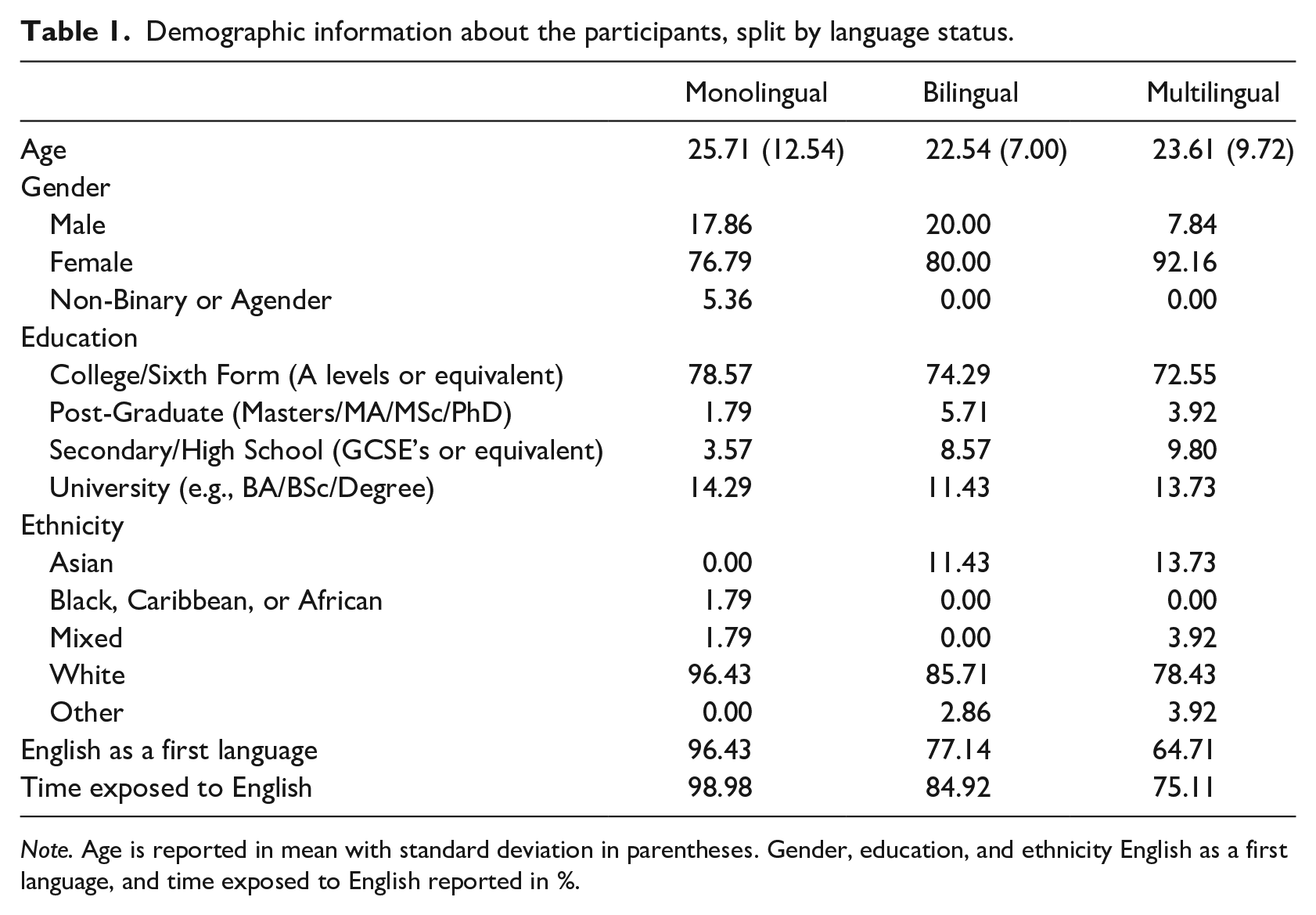
Note. Age is reported in mean with standard deviation in parentheses. Gender, education, and ethnicity English as a first language, and time exposed to English reported in %.
Materials and procedure
Participants were invited to participate in the study which was administered online. All participants were required to provide informed consent prior to participation, and full ethical approval was received from Swansea University’s Department of Psychology Ethics Committee. Participants completed a series of measures as outlined below which were administered in the order presented.
Background questionnaire
To gather demographic information about the participants, a background questionnaire was administered. This questionnaire asked for their age, gender, and ethnicity along with detailed questions regarding their language background. These questions were adapted from the Language Experience and Proficiency Questionnaire (LEAP-Q; Marian et al., 2007) to capture the participants’ self-reported exposure and proficiency in their language(s). The questionnaire also asked about participants’ dominant language, the order in which they acquired their languages and how often they used their languages in various contexts.
Empathy
Participant’s empathy was assessed using the Toronto Empathy Questionnaire (TEQ) developed by Spreng et al. (2009), which primarily assesses emotional empathy. The TEQ is a validated assessment of empathy with high internal consistency (ranging from α = .72 to .86, Kourmousi et al., 2017; Yeo & Kim, 2021) and good test–retest reliability (r = .81, p < .001, Spreng et al., 2009). Our internal reliability analysis was consistent with this at α = .83.
EI
As aforementioned, EI was assessed using both Trait and Ability measures. First, the Trait Emotional Intelligence Questionnaire short form (TEIQue) was administered, which is a 30-item self-report questionnaire to assess global trait EI (Petrides, 2009). The reliability for the various subscales ranges from α = .70 to .84 (Laborde et al., 2016). The internal reliability of the TEIQue in the present study was α = .88. Following this, the Situational Test of Emotional Understanding Brief (STEU-B) was used to measure emotional understanding (Allen et al., 2014). The scale’s internal reliability is reported to be adequate at α = .63, although our internal reliability assessment was slightly lower at α = .5.
Data analysis
Prior to analysis, the data were checked, and outliers were removed (as noted above). The analysis procedure comprised correlations, hierarchical regression models, and analyses of variance (ANOVAs) where appropriate. The Bonferroni corrections were applied to adjust for multiple comparisons. To measure language experience as a continuous measure, the percentage of time that participants were exposed to an additional language was used, along with a composite measure of multilingual proficiency. This measure was calculated based on the participant’s reported proficiency of speaking, understanding, and reading in all of their languages, leading to higher scores for those proficient in two or more languages. To assess whether the language of processing (first vs second or third language) had an impact on empathy and EI scores, simple between-group t-tests were used, in addition to Structural Equation Modelling (SEM), using the path analysis approach. We specified a path model where the language of processing (first vs. later-learnt language) was hypothesised to directly influence both empathy and EI. This model allowed us to estimate the direct effects of language processing on both empathy and EI. The model was estimated using maximum likelihood (ML) with NLMINB optimisation method. To estimate how well the model fitted the data, chi-square (χ2) and the chi-square/degrees of freedom ratio (χ2/df), comparative fit index (CFI), Tucker–Lewis index (TLI), and the root mean square error of approximation (RMSEA) were calculated. The thresholds used to estimate a good model fit were based on Schreiber et al. (2006). These specified a criterion of the χ2 being non-significant with an α level of .05 and when the χ2/df ratio was less than two, with values closer to 1 indicating a better fit. The model was also deemed to have a good fit if the RMSEA was below .05. Finally, both the CFI and TLI were required to have values of .95 or higher.
Results
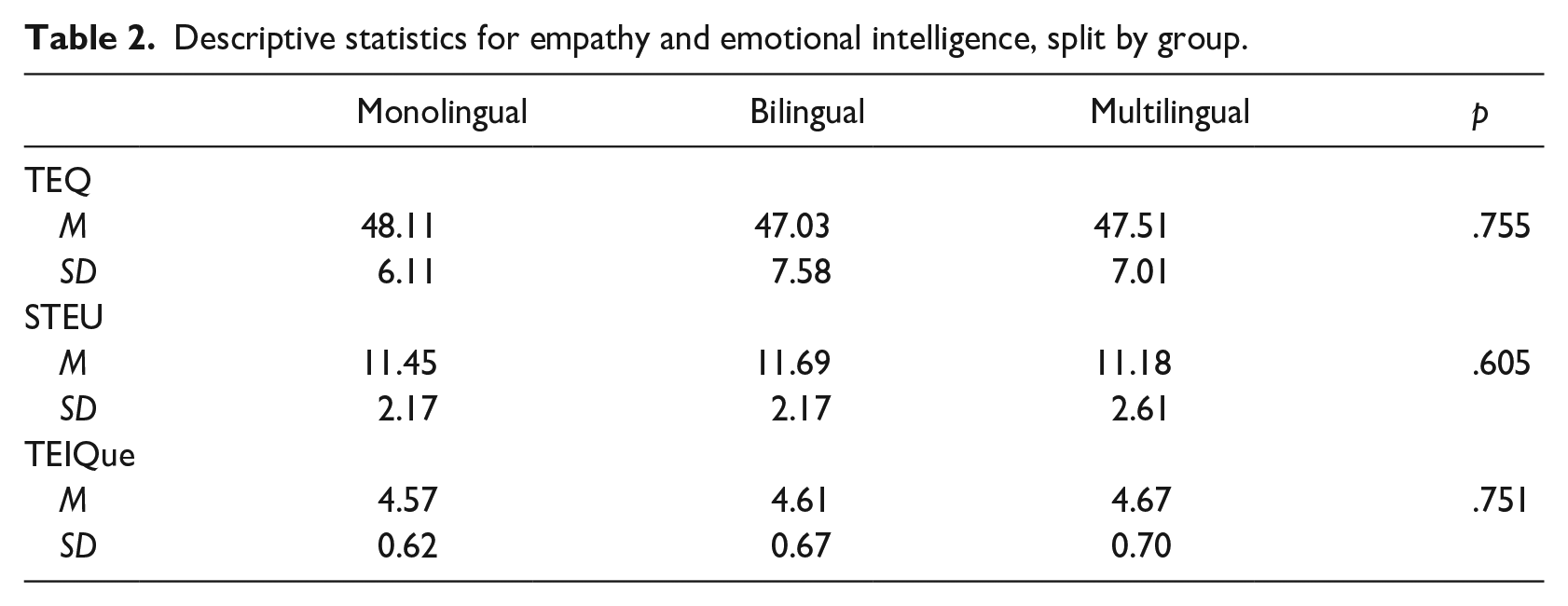
Descriptive statistics for each measure, split by language background, are presented in Table 2. This provides a summary of scores on the empathy and EI scales, split by group. Although measures of empathy and EI were highly correlated, these were investigated through different analyses, so there were no issues with multicollinearity. Log transformations were applied for the TEU, TEIQue, and the STEU-B as the data were not normally distributed. Residuals were normally distributed, and inspection of the residuals indicated that the residuals were homoscedastic.
Descriptive statistics for empathy and emotional intelligence, split by group.
Multilingual composite proficiency
To investigate whether language experiences had any impact on empathy, a hierarchical regression was conducted. This analysis enabled us to examine whether language experiences were predictive of empathy while accounting for additional predictor variables (age and gender). For empathy measured using the TEQ, the first step of this model included the control variables of age and gender and was not significant F (2, 136) = 2.12, p = .124, R2 = .03, R2 adjusted = .02. The addition of the multilingual proficiency score as a predictor in Block 2 did not significantly improve the model, F change (3, 135) = .12, p = .725, R2 change = .01, R2 adjusted = 0.01. The results from this model are presented in Table 3. This suggests that bilingual language experience was not predictive of empathy (as measured by the TEQ).
Regression result for empathy and multilingual proficiency, as measured using the TEQ.
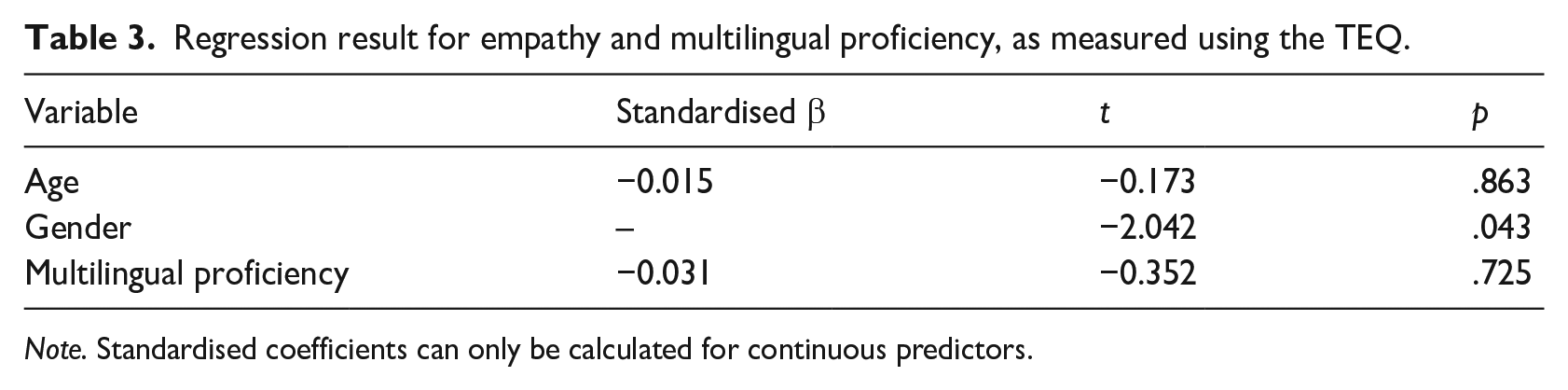
Note. Standardised coefficients can only be calculated for continuous predictors.
A further hierarchical regression was conducted using scores from the TEIQue. This first step of this model, which included the control variables of age and gender were significant F (2, 136) = 4.88, p < .009, R2 = .07, R2 adjusted = .05. The addition of the multilingual proficiency score as a predictor in Block 2 did not significantly improve the model, F change (3, 135) = .21, p = .648, R2 change = .05, R2 adjusted = .63. The results from this model are presented in Table 4. This suggests that, again, bilingual language experience was not predictive of empathy, whereas age was.
Regression result for empathy and multilingual proficiency, as measured using the TEIQue.
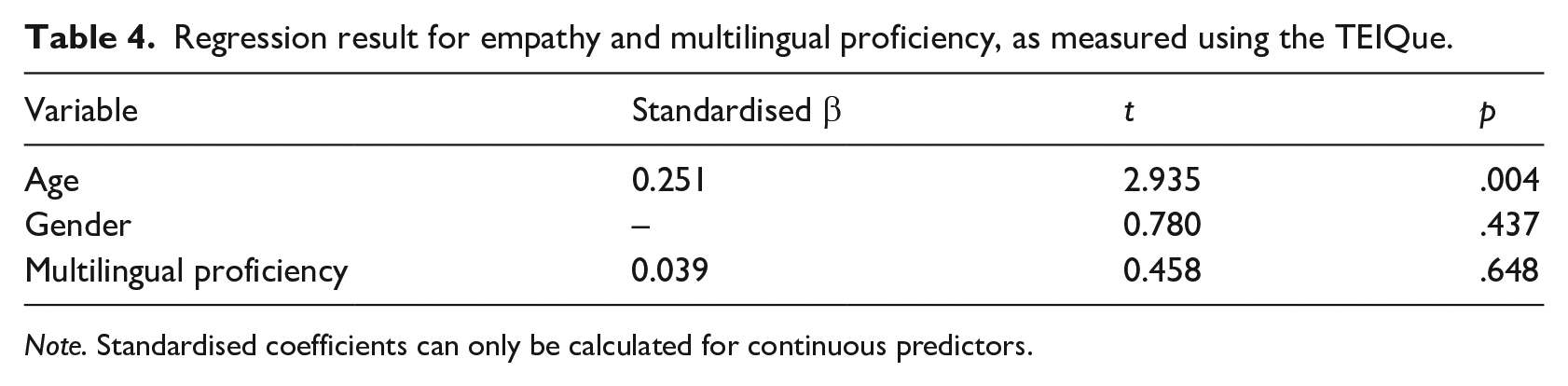
Note. Standardised coefficients can only be calculated for continuous predictors.
A final hierarchical regression was conducted to identify whether EI (scores from the STEU-B) was predicted by multilingual proficiency. This first step of this model, again including the control variables, was not significant F (2, 136) = 1.05, p = .353, R2 = .02, R2 adjusted = .01. The prediction did not improve with the addition of multilingual proficiency, F change (3, 135) = .47, p = .495, R2 change = .02, R2 adjusted = .01. Table 5 shows the results of this analysis.
Regression result for emotional intelligence and multilingual proficiency, as measured using the STEU.
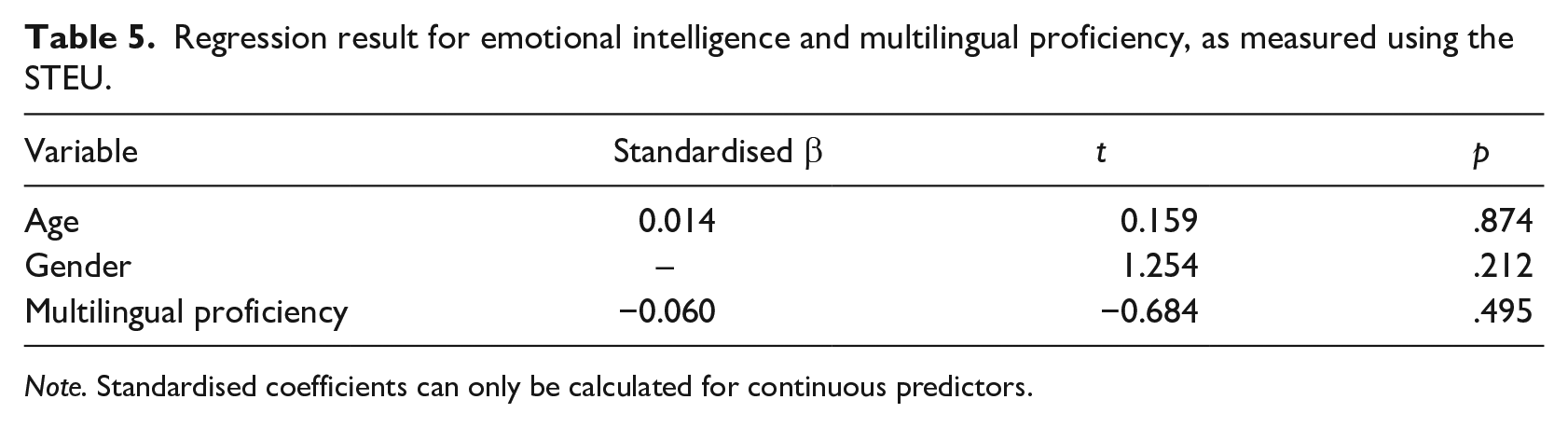
Note. Standardised coefficients can only be calculated for continuous predictors.
To provide a full exploration of whether bilingualism impacted empathy or EI, an ANOVA was conducted to explore whether there was a significant difference between the groups (monolingual, bilingual, and multilingual) on each of the variables (TEQ, TEIQue, and STEU-B). For the TEQ, no significant effect was found for language status F (2, 139) = .281, p = .755, nor was there an effect of language status on the TEIQue F (2, 139) = .287, p = .751 or the STEU-B F (2, 139) = .504, p = .605. Taken together, these findings suggest that language background did not relate to participants empathy or EI.
Language of processing
Our second research question sought to identify whether the language that the participants were asked to respond in impacted their scores on empathy and EI. The primary aim of this analysis was to examine whether empathy and EI are influenced by having to process these emotion-related questions in a first versus a second language. A between-group t-test was conducted to compare empathy scores between those who were processing the tasks in their first language (English) compared to those who had English as an additional language. For empathy, scores on the TEQ were analysed which demonstrated that there was no significant difference in the scores for those who spoke English as their first language (M = 48.06, SD = 6.46) and those who did not (M = 45.86, SD = 7.85); t(140) 1.55, p = .124 (see Table 6). For the TEIQue, there was a significant difference for those who spoke English as their first language (M = 4.72, SD = 0.62) and those who did not (M = 4.21, SD = 0.69); t(140) 3.83, p < .001. Those who were processing the information in a second or third language scored significantly lower on this measure.
Descriptive statistics for empathy and emotional intelligence, split by those with English first language.
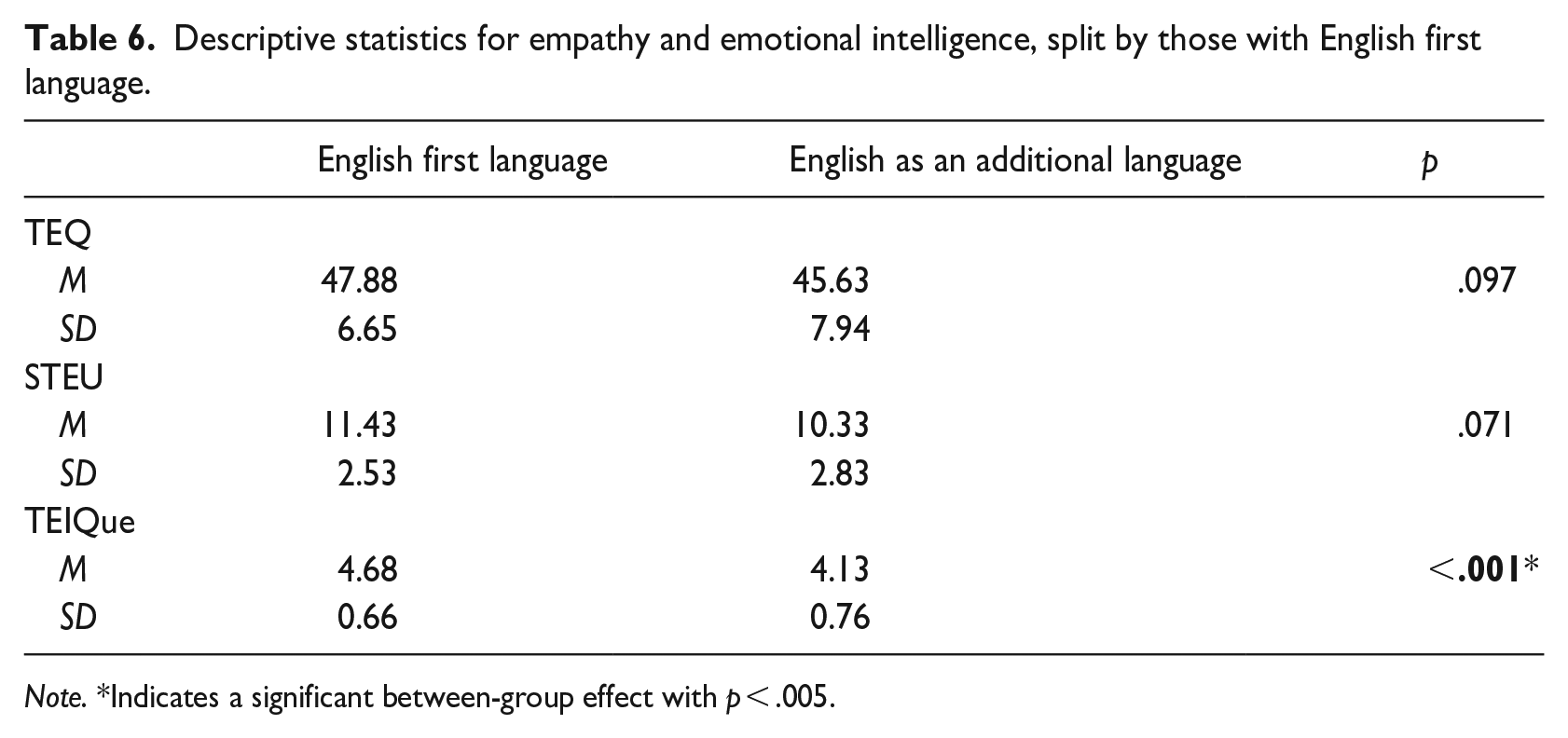
Note. *Indicates a significant between-group effect with p < .005.
For EI, scores on the STEU-B were compared between those who spoke English as their first language (M = 11.61, SD = 2.24) and those who did not (M = 10.57, SD = 2.56), again revealing a significant between-group difference t(140) 2.15, p < .05. This suggests that participants who had English as an additional language scored lower on their EI.
To assess the relations among the target variables of empathy, EI, and language of processing, an SEM model was developed using path analysis (as described above). Using the criteria outlined earlier, the SEM model demonstrated an excellent fit to the data. The model yielded a chi-square value of .000, indicating a perfect model fit with no discrepancy between the observed data and the model’s predicted data. Furthermore, the CFI = 1.000 and TLI = 1.000 both suggested a perfect fit. The RMSEA was .000, with a 90% confidence interval of [0.000, 0.000], again indicating a perfect model fit. Path coefficients were examined to determine the impact of language processing on empathy and EI. The results indicated that the effect of language of processing on empathy as measured using the TEQ was positive but not statistically significant, β = 2.25, p = .110. In contrast, the language of processing had a significant positive effect on a second measure of empathy (TEIQue), β = 0.55, p < .001. Language of processing also had a positive effect on EI, β = 1.09, p = .038. The standardised coefficients indicated that language processing had the strongest impact on the TEIQue (βstd = .31, indicating a moderate effect size) compared to its impact on EI (βstd = .17, a small effect size; see Figure 1).
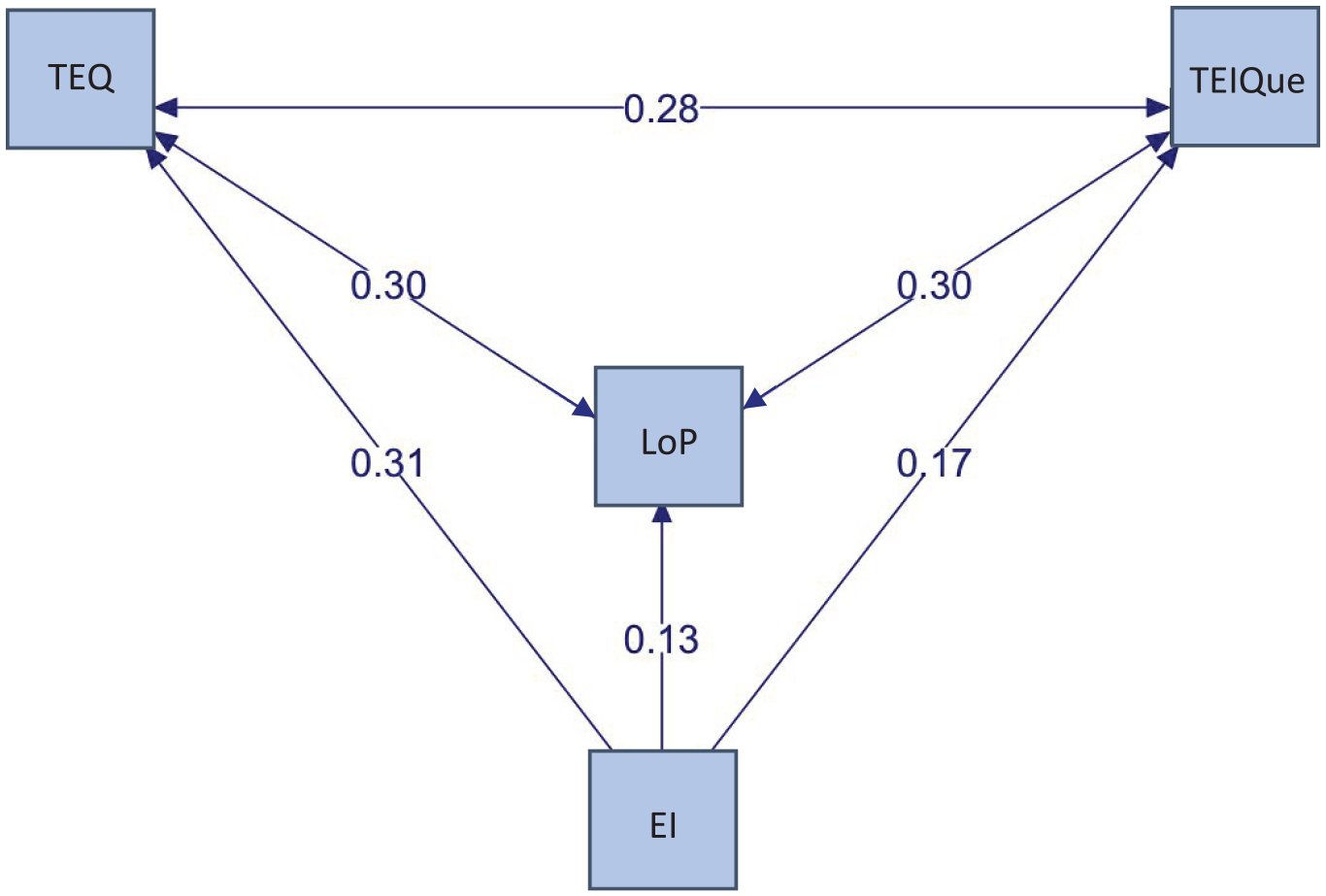
SEM model showing the effects of language processing on empathy and emotional intelligence.
In summary, the findings suggest that completing and processing emotion-related questions in a second or third language significantly impacts certain aspects of empathy and EI. Specifically, the language of processing significantly predicted empathy scores on the TEIQue (trait empathy) and EI, but not the state empathy measure (TEQ). The model demonstrated an excellent fit, supporting the robustness of this model.
Discussion
The present study aimed to examine whether individual factors (specifically language experiences and language of processing) influence empathy and EI. Findings demonstrate that, contrary to what was expected, the extent of the participant’s diversity in language experiences and language background did not predict EI or empathy, even while conceptualising empathy as both a trait and ability. This suggests that, in conflict with some initial findings in the field, those who are bilingual or multilingual do not display any differences in the way in which they process, recognise, and understand their own and other peoples’ emotions. This contradicts the claims made by Alqarni and Dewaele (2020) who found that bilinguals score significantly higher than monolinguals on trait EI and emotion perception. Dewaele and Wei (2012) also found that cognitive empathy scores were higher for participants who know and use multiple languages frequently, a finding that was not replicated here.
At the same time, Dewaele and Wei reported that those who were either bilingual or multilingual did not differ from monolinguals on their cognitive empathy scores, and engaging in a study abroad programme also did not have an effect. One important difference between these studies by Dewaele and colleagues and the present study was the empathy scales used. Dewaele and Wei (2012) created an empathy quotient using an adapted version of the questionnaire designed by Baron-Cohen and Wheelwright (2004). The authors themselves noted there were issues with the low degree of internal consistency, meaning only one subscale was able to be analysed. In contrast, the present study used three well-validated measures to capture empathy and EI, which were generally found to have high internal consistency in the present study. It is also interesting to note that the current sample was generally younger than those of Dewaele and Wei and Alqarni and Dewaele (2020).
Furthermore, we employed one of the same measures used by Alqarni and Dewaele (2020; TEIQue), and interestingly, our English monolingual sample had the exact same mean performance as their English monolingual sample (4.57). However, their bilingual sample performed marginally higher (4.8 vs. 4.67 in our sample) which resulted in a small but significant effect. A larger and more recent study by Dewaele (2021), on the contrary, also did not find that those who were proficient in more languages had higher scores in Trait EI. A further possible explanation for this discrepancy is that the measures which are commonly used to assess empathy and EI are not capable of detecting nuanced differences in the emotional processing of bilingual and multilingual speakers. As Dewaele (2021) suggests, it is also possible that trait EI is less responsive to social environmental factors like multilingualism compared to other personality dimensions.
It is also possible that the previous studies which detected a difference between those who were monolingual and bilingual actually found differences based on the language in which the task was being presented in and whether this was the first language or not. As the present study employed a continuous measure of bilingualism, this more precise measure of language experience may have been capable of differentiating between language experience and the language of processing. As demonstrated in the present study, those who were processing the information in a second or third language scored significantly lower for both trait empathy and EI.
This raises important questions about the suitability of measures when assessing bilingual and multilingual individuals. An important consideration is whether it may be more appropriate to ensure that assessments are delivered in the first language, where typically there is a stronger emotional response, as reported in the previous studies (Dewaele, 2013; Pavlenko, 2005, 2012; Romero-Rivas et al., 2022). As suggested by Romero-Rivas et al. (2022), the finding that participants who were completing the assessment in their first language scored higher on empathy and EI supports the proposal that there is an increased psychological and emotional distance when processing information in a second or third language. More research is needed in order to investigate the mechanisms responsible for this emotional distance and how language background influences emotional processing and emotional perspective taking.
Recognising how language influences emotional experiences and empathy is vital for effective communication and building strong interpersonal relationships. This understanding is particularly significant in fields such as health care, mental health, counselling, and education. Professionals in these areas might achieve varying degrees of success when discussing empathy or EI with multilingual individuals. By acknowledging language’s impact on emotional expression and perception across different cultural and linguistic contexts, we can better support individuals in meaningful and appropriate ways.
Strengths and limitations
Our study used a comprehensive approach to measuring empathy and EI by employing both trait and ability measure of empathy. This is an important strength given the lack on consensus on whether empathy is best conceptualised as an ability which is amenable to change over the lifespan or whether it is a trait with biological underpinnings. Including both measures has provided a nuanced understanding of participants’ emotional tendencies and abilities, contributing to a more holistic interpretation of these concepts. A further strength of the approach taken in the present study was the fairly novel means of conceptualising bilingualism as a continuum. This approach has been taken by recent studies in bilingualism (Kremin & Byers-Heinlein, 2021; Marian & Hayakawa, 2021; Ward & Sanoudaki, 2023) and has added depth to our exploration of the intricate relationship between language proficiency, empathy and EI, strengthening the evidence base in this field.
However, it is important to also acknowledge some limitations in the present study. First, the self-report nature of the measures employed, as noted above, raises some questions about the ecological validity of the findings, as self-reported behaviours and feelings may not always align with real-life behaviours. Second, as the assessment of empathy and EI was undertaken in English alone, it is not possible to compare bilingual and multilingual individuals’ empathy and EI in their second or third language. This is an important consideration for future studies, especially given the finding that those completing the measures in a non-native language scored significantly lower than those completing it in their first language. Finally, we acknowledge that the sample contained a substantially higher proportion of females compared to males. This unequal distribution may have limited the analysis; however, as this unequal distribution was apparent across language background, this is limitation is unlikely to have impacted the results. Future research should consider refining the areas suggested above to overcome these limitations.
Conclusion
The aim of the present study was to investigate which individual factors were related to empathy and EI. Findings show that bilingualism and language experiences did not contribute to measures of empathy and EI, while the language used did. Those who were undertaking the study in their first language scored significantly higher than those using a second or third language, suggesting that this has a key role to play in the processing of emotional information. The present study has also identified a pressing need for improved and culturally appropriate measures in relation to empathy and EI. It is essential to acknowledge the complexity of the relationship between bilingualism, language experiences, and culture with empathy and EI, and the present study provides an initial first step in doing so. This complex interplay may also be impacted by other cross-cultural and cross-linguistic factors, and future research should aim to uncover the mechanisms underpinning these relationships.
Footnotes
Acknowledgements
The authors are very grateful to the participants who took part in the present study. The authors would also like to express their gratitude to Abigail Moorhouse, Gwen Roberts, and Jack Boocock for their assistance during the study’s development stage and data collection stage.
Availability of materials
The study materials which include information about the study, the consent form, and the language background questionnaire are available on the OSF (https://osf.io/zpf25/). The data have also been made available on the OSF ( ).
).
Declaration of conflicting interests
The authors declared no potential conflicts of interest with respect to the research, authorship, and/or publication of this article.
Funding
The author(s) received no financial support for the research, authorship, and/or publication of this article.