




Abstract
Aims and objectives:
This paper explores children’s experiences and perceptions of their own bilingualism in two contexts in Scotland, UK: a primary school with a high proportion of children using a language other than English at home; and a primary school where the language of instruction is an indigenous, minority language, Gaelic.
Methodology:
The paper draws upon data gathered from multiple qualitative methods, including interviews, group activities and discussion, with both children and their parents. The data in this paper draw upon a broader interdisciplinary project exploring children’s experiences of bilingualism. Ethics were duly considered.
Data and analysis:
Data were gathered from 27 children and 11 parents. Data were coded and analysed using thematic analysis. Comparison between contexts was of particular interest for this article.
Findings:
This paper highlights the importance of research with children in order to gain an insight into their experiences and perceptions of their own bilingualism. In particular, our findings illustrate how children’s language learning is encouraged and supported by children’s connections with others and the fundamental role of family (particularly parents/carers) and diverse community-based support systems (which encompass a wide range of individuals and community groups) in order to develop active bilingualism.
Originality:
This paper addresses a research gap in a largely quantitative field, by adopting a qualitative approach to explore children’s experiences and perceptions of their own bilingualism. A qualitative approach facilitates attention to complexity and the participants’ own meanings and understandings.
Significance:
The paper highlights the value of research with children in order to explore their views and perspectives. In particular, qualitative research methodologies, where children’s experiences are central to understanding the research phenomenon, and to facilitating the exploration of the range of complex issues that interact with a child’s bilingualism.
Keywords
Introduction
Traditional research on children’s bilingualism 1 within psychology and language sciences is often on rather than with the involvement of the child. This frequently means that children complete tests and their parents or carers are invited to take part in a survey of language comprehension and understanding (Woodhead & Faulkner, 2008). As a result, children’s perspectives of their bilingualism are not systematically included, if at all. Children do not have the opportunity to share their experiences of their own bilingualism, with methodologies utilising observations of children or asking parents about their children remaining the status quo.
In this paper, we set the scene within the Scottish context in order to shed light on the policies supporting minority languages in Scotland. Then, we offer a brief overview of the involvement of children in studies of language use and highlight the need to greater explore the complex, intricate experiences of bilingual children. In particular, we seek to explore the wider, intertwined dynamic relationships which shape children’s experiences and perceptions of their own bilingualism. In doing so, we draw upon the notion of children as competent social actors who are constructing not only their everyday lives, but also the world around them (Uprichard, 2008). This draws from the field of childhood studies which has rapidly developed over the past 30 years, with academics exploring and critiquing the traditional view of childhood with new conceptual, empirical and methodological understandings in order to shed light on the social construction of childhood (James & Prout, 1997; Spyrou, 2017).
Then, we draw upon data from two different contexts: a primary school located in a large city where the school has a high proportion of children who speak a language other than English at home, with around 30 languages spoken by the school population; and a primary school located in an Island community where the language of instruction is an indigenous, minority language, Gaelic, and where the language is spoken within the community and supported through various publicly funded community-based activities. These data was gathered utilising multiple qualitative methods with children and their parents, and we present our findings detailing children’s perceptions and experiences of minority language use and their own bilingualism in two different educational and community contexts.
The Scottish context
Scotland is becoming increasingly bilingual, resulting in an increasing number of children growing up with a language other than English spoken at home. In 2017, almost one in 10 Scottish school pupils (8.8%) were identified as using a language other than English as their main home language. Of the 158 different languages identified, the most spoken were Polish, Urdu, Scots, Punjabi and Arabic (Scottish Government, 2017a). Further, Scotland has two indigenous languages, Gaelic and Scots, which are both protected under the European Charter for Regional or Minority Languages, with Gaelic receiving further protection as a national language under the Gaelic Language Act (Scottish Parliament, 2005).
The Scottish Government has promoted Gaelic, and its use in Scotland, due to the protected and official status of the language. However, there are particular concerns surrounding the endangered nature of the language due to declining rates of Gaelic speakers. As a result of the Scottish Government’s policy focus, and resulting policy implementation, extra resources, support and investment have been provided for the Gaelic language, culture and community. These include the provision of Gaelic Medium Education (GME), a form of education whereby children are primarily taught through the medium of Gaelic (Scottish Government, 2019a). Further, the Scottish Government Gaelic Language Plan 2016–2021 outlined the steps the government intends to take in order to revitalise Gaelic language, culture and heritage (Scottish Government, 2017b). By contrast, for those children whose first language is not English, the national policy is focused on developing English language skills though Scotland’s English for Speakers of Other Languages (ESOL) Strategy and makes less provision for maintaining the language of their families. As Hancock (2014) argues, the maintenance of heritage languages of migrants in Scotland has been an area of little policy attention.
Children’s experiences of bilingualism: across disciplines
Although childhood is seen as a temporal phase, with children both ‘being and becoming’ (Uprichard, 2008), there is an absence of research whereby children’s experiences of bilingualism are at the forefront. In recent years, there has been a shift within research in the area of family language policy (Gyogi, 2015; Revis, 2019; Smith-Christmas, 2016; Wilson, 2020) and creative methodologies (Prasad, 2020; Wilson, 2020). However, the studies within family language policy often focus on one aspect of a child’s life – family interactions and the effects these have on the child. There is little or no attention paid to the effect of schooling, peers, wider community and national socio-political contexts on children’s experiences and perceptions of bilingualism. Research on the experiences of bilingual children in the classroom, associated with best practices for educators, is a prominent field (Coyle, 2018; Foley et al., 2013). However, this area often does not consider the experiences and perceptions of children.
Discussion surrounding language use and language and cultural identity can be found in sociological-based research and literature, due to the intersectional nature of the discipline (Valentine & Skelton, 2007; Valentine et al., 2008). In the Scottish context, research has highlighted the multifaceted and complex nature of migrant children’s sense of identity and belonging (Moskal & Sime, 2016). However, language and the child’s understandings and perspectives of their linguistic diversity and bilingualism are often not the focus of such work. Children are positioned as part of transnational families situated in migration scholarship (Little, 2020; Moskal & Sime, 2016).
By contrast, there has been a wealth of research on GME and the revitalisation of the Gaelic language in recent years, including in the areas of family language policy (Smith-Christmas, 2016); educational attainment of Gaelic-medium-educated young people (O’Hanlon et al., 2013); the links between Gaelic and school, and the negative implications for this in terms of language policy (Smith-Christmas, 2017; Smith-Christmas & Armstrong, 2014); public perceptions of Gaelic (O’Hanlon & Paterson, 2019; Paterson & O’Hanlon, 2015); Gaelic language practices and identities of Gaelic-medium-educated adults (Dunmore, 2017); and perceptions and use of Gaelic in vernacular communities (Ó Giollagáin et al., 2020). With regard to GME, Smith-Christmas (2017) and Dunmore (2017) raise concerns regarding the focused efforts on indigenous language revitalisation through immersion education. In particular, Dunmore (2017) acknowledges that GME, whereby the school is the focal point of Gaelic revitalisation efforts, may not result in adult speakers due to a disconnection between language, identity and belonging amongst new Gaelic speakers. Thus, research needs to explore the places where language and bilingualism are (not) encouraged and how children experience and view their languages and bilingualism.
Another research area where children’s perception of their own bilingualism and their languages is not normally considered is that of the linguistic and cognitive effects of bilingualism. While much research in these fields has revealed early benefits of bilingualism (Bialystok et al., 2010; Costa & Sebastian-Galles, 2014; van den Noort et al., 2019), recent studies have questioned the replicability of these findings (Paap & Greenberg, 2013; see recent response by Leivada et al., 2021). However, the possible influence of the many contextual factors affecting bilingualism has not yet been systematically explored (Kheirkhah & Cekaite, 2015; Place & Hoff, 2011). The bilingual child’s attitudes are one of the variables that may interact with cognitive effects and influence their behavioural and neural visibility.
Therefore, this article draws upon methods from the social sciences and foregrounds the experiences of children growing up in bilingual environments in Scotland. In particular, the case study research highlights two contexts: one where the language spoken is an indigenous minority language, Gaelic, and another where a range of other minority languages are used by the children. Therefore, throughout this paper the concept of heritage and community language (HCL) is adopted, with this term referring to indigenous, immigrant, refugee and ancestral languages in which an individual has some proficiency (Valdés, 2001) or a personal connection (Fishman, 2001).
This study was part of a broader interdisciplinary project exploring the connections between social and cognitive factors in child bilingualism. While the research on these connections is still ongoing – and therefore not reported here – preliminary data suggest a positive correlation between performance in cognitive tests and a supportive linguistic environment at the community and family levels. However, in this particular article, we illustrate the importance of research with children in order to understand their experiences and perspectives of their own bilingualism. In particular, in this paper we highlight that drawing upon methodological and conceptual tools from the social sciences paves the way for a better understanding of the multiple factors interacting in bilingual development and, as a result, develops the notion of bilingualism as a continuum of experience (Hornberger, 1989; Valdés & Figueroa, 1994).
The study and methods
This paper draws upon a mixed method study consisting of two case studies, in order to explore children’s experiences of and perspectives on bilingualism, across the domains of family, community and school. Data for the study were collected over a three-month period (April–June 2018), and this paper will explore data gathered from qualitative methods, including observations; group work with children; and individual interviews with children and parents. In the following sections, the context of each case study is outlined, as well as further details on the methods for gathering data.
Contextual information: case study research
A case study approach was adopted in order to obtain a holistic understanding of the experiences of bilingual children in two different contexts (Yin, 2009). The case study sites were primary schools, which cover schooling for ages five to 12 in Scotland. The children who took part in the study were in the upper levels of primary school and were aged between nine and 12 years old. All names (primary school, children and parents) are pseudonyms. These schools were selected due to the high proportion of children attending both these schools using a minority language.
The first case study site is Lochview Primary School (Lochview), located in the Western Isles of Scotland. Lochview has a pupil roll of under 500 pupils and is a dual-stream primary school, with children and their families opting to be taught in the medium of English or Gaelic. All of the children from Lochview who took part in this research were in GME. The Western Isles have a population of 27,684 – equating to nine people per square kilometre. Due to the remote and rural nature of these island communities, the Western Isles face issues arising from depopulation, an ageing population and poor access to services (Scottish Government, 2019b). The use of Gaelic is most extensive in this local authority area, with 61% of the population reporting some Gaelic language ability and 52% reporting speaking Gaelic (National Records of Scotland, 2015a). In comparison, the Scottish national figures, based on 2011 census data, are 1.7% and 1.1% respectively (National Records of Scotland, 2015b).
The second case study site is Forest Primary School (Forest) where the language of instruction is English. Forest is located in a large Scottish city which is part of the densely populated central belt of Scotland. Forest has a diverse population with almost 30 languages spoken by its 600 pupils. The school community is affluent and the children who took part in the research all spoke a migrant, minority language and for most of the children this language was their primary home language.
Methods
Observations were used to enable the researcher to become familiar with the children and provided insights into their activities and day-to-day school life. This method also aided the development of activities and interview guides (DeWalt & DeWalt, 2002). Many of the formal interactions with children, such as the interviews and group discussions, involved some element of task-based activity based on the idea of ‘activity-oriented questions’ (Colucci, 2007). This mode of research offered a variety of tasks for children to complete, alternative ways for children to contribute to discussions, and encouragement of participation among those less confident in talking, and allowed discussions to be stimulated in ways that may not have been captured through the researcher posing questions (O’Kane, 2008). Activities included craft representations of self (Nomakhwezi Mayaba & Wood, 2015); postcard to future self (van Gelder et al., 2013); vignette discussion (Crivello et al., 2013); and life history timelines (Bagnoli, 2009). Further, the task-based activities provided the researcher with valuable artefacts which could be explored in greater detail with children in the follow-up interviews (Prasad, 2020).
Children who self-identified as bilingual were invited to take part in the study, with 41 children, and their parents, providing consent. However, from the 41 who consented, 27 children chose to participate in the study to varying degrees. Languages spoken by the 27 children taking part in the study included Catalan, Czech, French, Gaelic, German, Greek, Hungarian, Italian, Malaysian, Polish, Russian and Spanish. All of the 27 children took part in the group activities and 11 of the 27 children participated in an interview. Additionally, interviews were conducted with four parents of children who took part in the research. These interviews were arranged for a date, time and location mutually agreeable for both researcher and parent – with all interviews taking place either at the researcher’s institution or at the parent’s place of work.
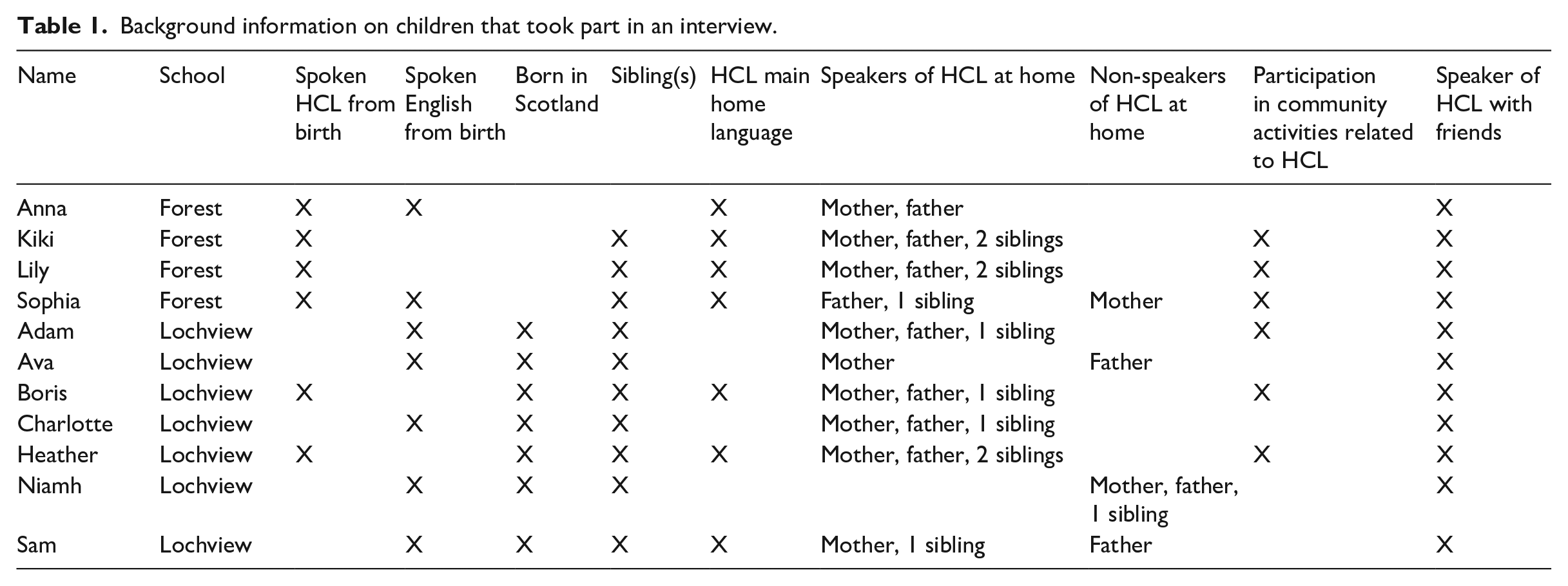
In this paper, we primarily draw upon the data from children who took part in all aspects of the study. Table 1 provides a brief contextual background for each of these children. All children who were interviewed and were attending Forest spoke a European language while all those attending Lochview spoke Gaelic. The languages and nationalities of the children attending Forest have not been specified or, if deemed necessary, have been fictionalised, in order to protect the children’s identities.
Background information on children that took part in an interview.
The research took due account of ethical requirements, gaining the necessary institutional approvals. In order to access schools, approval was sought from gatekeepers, including regional-level directors of education and the headteacher of each school. Further, of particular note for this study was the need to negotiate both children’s and parents’ consents to participate, to respect children’s privacy and confidentiality alongside protection of their rights, and to give due sensitivity to their identities, languages and cultural contexts. Regarding consent, parents/carers of children opted in to the research study via an information letter (and consent slip) which was sent out by the two schools. The researcher developed an information leaflet specifically designed for children. The researcher took time to go through this leaflet, at her first meeting with the children, in order to ensure that the children were providing informed consent. However, consent was ongoing across the lifespan of the project with children given the option to opt in and opt out of activities/tasks. For example, one child participated in the group activities, but chose not to take part in an individual interview.
All interviews and group discussions were audio-recorded and transcribed. These transcripts, alongside artefacts from the group activities and the researcher field notes, were subsequently coded and analysed, using NVivo. Thematic analysis was utilised in order to identify, analyse and report themes within the data (Braun & Clarke, 2006). This consisted of the generation of initial codes which were then discussed in project meetings. Collaboration allowed for reflection and the subsequent reviewing and refinement of codes. Analysis was conducted across three levels – the individual child, the school community and all children’s data in order to explore common themes across the data.
In the findings below, we explore the themes which arose in relation to the advantages of bilingualism as perceived by the children in the study. For each case study location there were different perceived advantages. For the children speaking a minority language at Forest, the advantages often focused on their uniqueness due to their bilingualism. For the children attending GME at Lochview, their perceived advantages often focused on familial and community connections. However, for both case study schools, we highlight concerns about these perceived advantages, by situating the findings within the national socio-political context.
Research findings
Our research findings highlight the children’s experiences of bilingualism and how these intersect with other aspects of children’s lives. However, children who took part in the research were at different points on the bilingualism continuum, in that there was variation in the proficiency of children in each language (Valdés & Figueroa, 1994). For example, some children only spoke their HCL at school and others only spoke their HCL at home, while others spoke their HCL across multiple sites including home and school. Thus, the children’s experiences reflect many different paths to bilingualism. Therefore, while the research suggests common themes and areas that may be of interest for future research and inquiry, the diversity in experiences is also emphasised in order to not diminish the unique life experiences of the children in the study.
Forest
Bilingual identities: celebratory and exclusive
The children at Forest were proud of their multifaceted and bilingual identities. When asked the hypothetical question of ‘which language (English or HCL) would you pick if you had to choose one to speak forevermore?’, most of the children could not choose or wished to blend their two languages together in order to create a new language. For example, Lily commented, ‘I could say one word in English and one word in my other language and I would carry on like that. So, everyone would understand me a bit’. This finding is in contrast to Wilson’s (2020) research with French heritage speaking children and young people living in the UK. Wilson (2020) found children were happy with being able to speak two languages, but were unable to articulate the reasoning behind their positive attitudes to their heritage language and bilingualism. Further, unlike the children in our study who would choose to blend two languages, and enjoyed teaching their friends words from their respective language, Wilson found the French-speaking children and young people preferred to speak English. This is noteworthy in the context of Forest, a school where over 30 languages are spoken, which may be influential in supporting a positive bilingual and heritage language ethos which filters down to the children’s own perceptions of their selves.
The school community at Forest has taken steps to celebrate the linguistic and cultural diversity of its students (through assemblies celebrating languages or the organisation of a multilingual families group); however, the children’s HCL practices were primarily centred around the family and home. At school, and with most of their friends, children tended to speak English. This was most likely due to a practical reason, given that English is the language of schooling and the common language between peers. All four of the children that were interviewed from Forest commented that they spoke their HCL at home – with parents often holding ‘strict’ views regarding the language being spoken. This was sometimes met with resistance, as explored in the next section. However, on the whole, the majority of children at this school were very aware, and proud, of their bilingualism and were keen to share with the researcher what languages they spoke and their experiences of these languages. However, at times, this extended to excluding or dismissing other children in their class as they did not speak more than one language, which is reflected in Excerpt 1 below:
Excerpt 1 Another girl at the table asks if she is bilingual – she [this other girl] explains she speaks Australian and Australian dialect words. She is mocked by Isabella for not speaking another language. Isabella and her friend moved on to talk about the benefits of bilingualism – and how they are more intelligent than those who are not bilingual. Isabella then told the other girl (Australian) that she can’t speak to me [the researcher] because she isn’t a true bilingual. Researcher’s field notes
The dismissal of one child who was deemed not to be bilingual by another child taking part in the research study shows how bilingualism could be used to exclude as well as include some children. Further, children often emphasised their ‘natural gift’ of bilingualism and commented on how they had heard they are more intelligent than monolinguals due to their bilingualism. Through engaging in competitive behaviours, by trying to gain an advantage over their peers, these children could be said to be making sense of the world around them through social comparisons with identities being shaped through ‘scales of preference, of ambivalence, of hostility, of competition, of partnership and co-operation, and so on’ (Jenkins, 2008, p. 6). However, this behaviour also showed the contradictory and complex nature of belonging whereby a positive aspect in one setting may be a negative aspect in another. In particular, as seen in Excerpt 2, children spoke about the ‘gifting’ and value of languages and how some are held in higher esteem or have higher status, compared to others.
Excerpt 2
There are languages more gifted and valued than others though, like French and Spanish.
[Stating agreement]
Like French and Spanish, like if everyone thinks they need to learn French and Spanish. . .
No, it’s French and German more.
German isn’t that valued.
No, it’s French and Spanish. They’re most widely spoken or like that. . ..I don’t really know.
English, French and Spanish are the ones everyone wants to speak.
Why are these more valued?
Just want to speak them because they’re spoken most.
Or like official languages of like EU [European Union] stuff.
Group discussion, Forest
Favell (2018) suggests traditional policy thinking around migration and responses to migrants stagnate progressivism and relegate citizens from particular countries, speaking particular languages, to a subordinate status. Through this hierarchical ordering of citizens, at multiple layers of the social system, including the political and societal level, a particular language can be relegated into one that is stigmatised. Meštrić and Šimičić (2017) argue that dialects, minority and immigrant languages often languish in a ‘vacuum’, lacking the historical, social and political contexts that lead to national state languages being favoured. In the above excerpt, the Forest children identify a hierarchy that prioritises particular state languages. However, even within this hierarchy, where it could be said their HCLs would be positioned in the upper echelons, there are still disagreements over which languages are granted higher status. In this context, children have to negotiate the power imbalances implied by background discourses about international orders, nation states, citizenship and language that shape and influence their identities.
Language-learning practices
While the children’s bilingual and cultural identities were often emphasised in the research, formal language learning, such as grammar, was often viewed as a necessary evil. Lily provides an elaborated example of what was found generally in the data. She attends a school which finishes earlier on a Friday and she often receives private HCL tutoring lessons at home on a Friday afternoon. Below, in Excerpt 3, she outlines her thoughts on this arrangement.
Excerpt 3
. . .it’s [private HCL tutoring lessons] on Friday so up to the normal time that school should finish, so it’s like, extended school.
Okay, and how do you find that?
I feel that sometimes, I can move the thing because I quite like having play dates and some people can only have Fridays. . .
One-to-one interview, Forest
When language-learning opportunities became more prescriptive (e.g. through attendance at organised community activities, private tutoring, language school), children tended to do these at parental request, rather than of their own desire – often commenting that, if given a choice, they would not participate in such opportunities. The example above from Lily suggests she sees her HCL tutoring as something which is flexible and easily cancelled – and is a second choice to spending time with her friends.
Lily speaks as if she had room for manoeuvre and provided some insight into how experiences and identities were negotiated and may be contested, within the difference spaces of school, home, community and wider society. Anna and her mother, Solveig, provided a stronger example of contestation, perhaps even conflict, in family language policy. Anna struggled with the idea of speaking two languages when she had only ever had formal education in one of them. She was born in an English-speaking country before moving to Scotland prior to starting her formal education. Anna spoke of knowing how to read and speak in her HCL but not being able ‘to do much else’. When asked what ‘much else’ consisted of she said that she had to take time when people spoke to her in her HCL as she had to translate into English before she could fully grasp what the person was trying to say.
Solveig, Anna’s mum, raised concerns regarding Anna’s knowledge and use of their HCL which matched what Anna had said to the researcher during her interview. Anna’s reasoning for not reading books in German was because it was hard work and it was easier and faster to read in English. However, Solveig commented, as noted in Excerpt 4, that Anna tended to read in German when in Germany, which occurred around three times a year, each visit for approximately two weeks.
Excerpt 4 For her [Anna], German is more work so it’s easier to do in Germany and she does it there, but most of her reading is in English and her writing is – her German spelling is not good because she doesn’t practise it. So it is something we’ve thought about it but it’s hard to encourage that, there’s so much else to do and taking German classes, you would have to hire a tutor because there isn’t really anything. Solveig
However, as we can see in Excerpt 5, Anna appeared to see her parents as failing to recognise her skills in English, and felt they focused on her, as suggested by her mother, weaknesses in using the German language.
Excerpt 5
They [Anna’s parents] correct my English which is very rude seeing as I can pronounce English much better than them. So I just get them back by correcting them even more. They need correcting.
Who’s that?
My mum. Dad, sometimes, too. But forget that. They’re parents, adults and allowed to do that.
Anna
There was further confusion for Anna as she felt her parents were flexible in their use of the HCL when at home, with no clear guidelines or boundaries as and when the HCL was to be used. There is a sense of frustration in Anna’s situation with her parents failing to recognise her English language skills while imposing the HCL on her with little support for her learning. Further, her parents were not providing an example of full commitment to the HCL, by criticising her HCL skills without accepting criticism of their own. From the data, we can see Anna was contending with the inter-generational dynamics of the child–parent relationship whereby power is exercised over children as a result of the former’s role as caregiver alongside their adult status (Punch, 2005). Further, as Kheirkhah and Cekaite (2015) have identified, with regards to informal heritage language lessons in the home, the exchanges between Anna and her mother could be seen to be jeopardizing family interactions, with Solveig positioned as an expert and Anna viewed as less competent. This suggests a complex household arrangement with hints towards not only the difficulties of navigating household language policy, but also the complexity of family dynamics and adult–child power relations.
On the whole, the Forest school children’s experiences suggest that the wider national context of language policy lacks initiatives, institutional arrangements, resources and support for users of migrant languages that sustain their HCL beyond the family and household. This is in contrast to the experience of the Gaelic-speaking children at Lochview who are situated in a supportive school and local community environment, but also a wider national policy context, which promotes the use of the children’s HCL.
Lochview
An immersive Gaelic identity
The children attending Lochview were clearly attached to their Gaelic. When asked the hypothetical question of ‘which language (English or Gaelic) would you pick if you had to choose one to speak forevermore?’, all of the children commented that they would speak Gaelic – even in cases where all their family members did not currently speak Gaelic. One child, Sam, spoke Gaelic with his mother, brother and grandmother. His father ‘doesn’t speak it, but he can understand some words. Like, what’s the time and stuff’. When talking through his ‘craft representation of self’ to the researcher that he created as part of one of the arts-based activities (see Figure 1), Sam commented that ‘[His dad] has a star on his hat because he means a lot to me’. However, when asked what language he would choose to speak forevermore, if he had to pick one, Sam instantly and assertively chose Gaelic, commenting ‘he [his father] will learn so he can speak to me’.
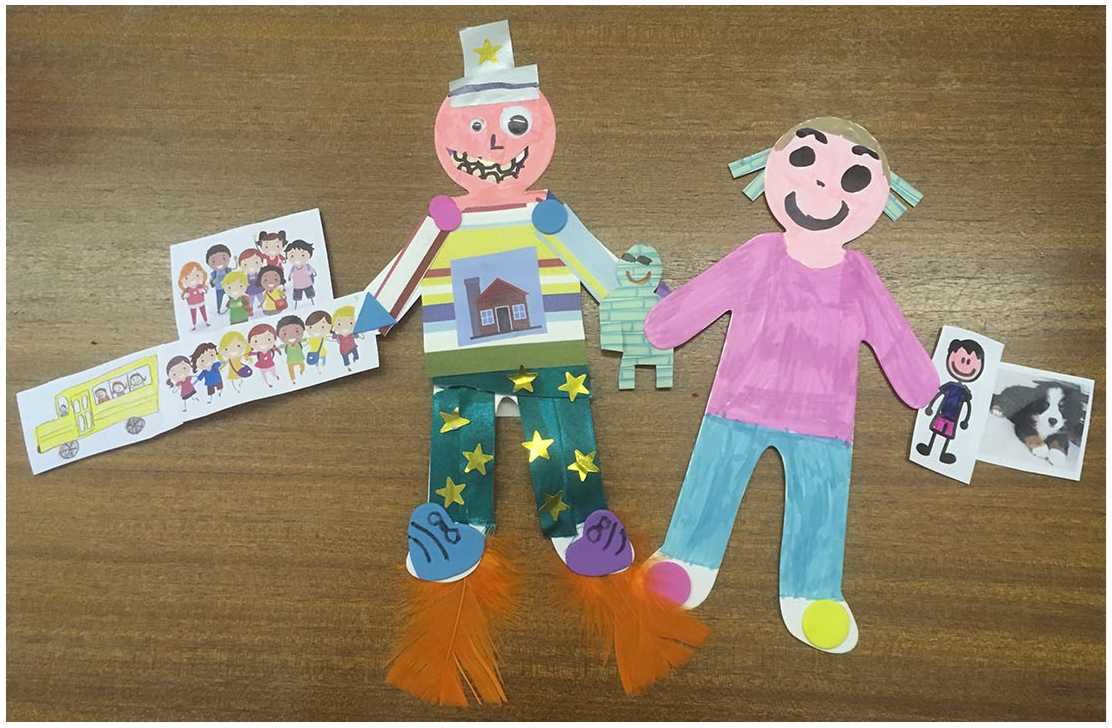
Sam’s craft representation of him and his family.
Despite strong familial and intergenerational ties, Sam opted to use Gaelic forevermore, even when his father did not currently speak the language. Sam had both a strong familial and language attachment, and these cannot be disentangled simply. However, Sam’s positive view towards Gaelic, which was viewed by him as a significant part of his current positioning, hints to the potential for language revitalisation if this attachment were to remain beyond schooling and into adulthood.
Another example of a child who opted to speak Gaelic forevermore was Niamh, who opted to do so despite none of her immediate family speaking Gaelic. She commented on her appreciation of the intricacies of the Gaelic language and structure.
Excerpt 6 I like that some of the words are the same words in English, but they’re mixed up. . .uaine is green in Gaelic and gorm is blue in Gaelic, but if someone was speaking about the beautiful green grass, they’d say the beautiful gorm grass, because whenever you’d be speaking about green grass, you’d put blue in. Niamh
Niamh also commented on her love for drama and art. Niamh spoke of practising her drama skills, and acting out scenes, with her Gaelic allowing her to be different characters, while her love for art connected her to her grandfather and cousin – both of whom use Gaelic.
In a recent study of Gaelic language use in the vernacular community, Ó Giollagáin et al. (2020) identified a diminishing connection and bond between young people and the Gaelic language. Further, identity with the Gaelic language was viewed as the language of schooling and older people. While we have identified a positive bond between children and the Gaelic language, we recognise the sample differences, with Ó Giollagáin and colleagues’ sample drawing upon teenagers. This highlights a need for further research to explore transitions in youth in order to better understand changes in language ideology and practices and how these may be framed by the socio-cultural and political context. Further, we also found, as identified in the above section, that the Gaelic language can be simply connected with schooling and older relatives, and we develop our concerns about these associations below.
Heritage language revitalisation and maintenance
For many of the Lochview children, school tended to be a focal point for their Gaelic identity and learning. However, children were often immersed in the language outside of school and noted engagement in the Gaelic community. For example, while those at Forest used their HCL within specific local community settings (e.g. family, Saturday school, religious services) that are part of the patchwork of the larger community, for the children at Lochview Gaelic was more embedded in the fabric of the wider community.
Despite this, while children often had extended family with whom they spoke Gaelic, few spoke Gaelic as their main language outside of school. Further, as the school was a dual-stream primary school, the children tended to have friends across both streams and, as a result, English tended to be the most common form of communication with friends. For example, Heather and Ava were part of a friendship group of young females who all attended the same dance classes and Charlotte had a close group of friends from the church and choir she attended. Even when children were socialising with their Gaelic-speaking peers they tended to resort to English as the primary language outside of the classroom. However, there were certain exemptions, including for creative purposes, as we can see in Excerpt 7.
Excerpt 7
Do you know when it might be that you speak Gaelic with them [Adam’s friends]?
Well, if there’s something – say, we’re playing a football match and we don’t want other people who don’t know Gaelic, then there’s kind of – we speak Gaelic and then they don’t know what we’re saying, and also, sometimes, just randomly, we just start speaking Gaelic.
Adam
Adam and his teammates used language creatively when it was tactically advantageous. This furthers the argument of bilingualism’s potential to provide opportunities for expression and creativity, as noted earlier in relation to Niamh’s comments about using Gaelic to help develop her acting skills. In particular, children valued greater opportunities for expression and connection with others. However, these uses of a language primarily as a hidden and private-sphere language may be a form of accepting and hence reproducing the subordinate status of a language (Walsh, 1991). Using language in secretive and private ways can have an undermining effect on the sustainability and maintenance of a language. By excluding the HCL from the spotlight of centre stage the child may see the language as something which is only of value in private, not public, spaces.
Conclusions, limitations and areas for further research
This study foregrounds children’s experiences of bilingualism, including the factors that support their bilingualism, their accounts of the benefits it brings them and how these experiences intersect with the multiple factors influencing, constructing and shaping their identities. We found that children were quick to tell us that they were proud of their languages and cultural identities. Their accounts provided insights into complex tensions and negotiations at the micro levels of familial and peer relations, through their experiences of family language policy, and of home and school negotiations around child agency and child behaviours. Further, children’s accounts reflect how they try to make sense of the world around them through absorbing prevailing macro-level tensions, such as societal and global attitudes and perceptions which reveal an internalisation of hierarchical views towards different languages and cultures.
For the children speaking a minority language, primarily in the home with family, we observed a school community which embraced the bilingual diversity of the children and provided an environment where children could celebrate their language and cultural identities. However, the children’s experiences also highlight the status of minority languages in Scotland, the lack of public resources to sustain the languages of minority children, and the power imbalances they face in negotiating the social world, including both peer and parent–child relationships.
Further, while our findings suggest a positive attitude among GME children towards their Gaelic identity and language use, and children spoke of using Gaelic outside of schooling, there are wider concerns in the literature regarding how children will maintain Gaelic in the future beyond Gaelic schooling (Dunmore, 2017; Smith-Christmas, 2017). Fishman (2001) warns that initiatives that focus on schooling as part of minority language revitalisation may fail due to a lack of support from home and community, and Baker (2011) comments that ‘potential does not necessarily lead to production’ (p. 265). In order to maintain a language, Cunningham Anderson and Anderson (2004) argue that parents’ commitment is crucial to the language-learning process in order to provide children with support in their learning, while Brock and Conteh (2011) suggest that, as a child’s context is wide and diverse, children subsequently encounter a range of influences that will in turn influence their life trajectories. Therefore, joined-up collaborative working between family and the wider community is essential in order to ensure language learning is nurtured, especially in contexts where the family do not speak Gaelic.
The comparison between contexts is indicative, meriting further study. One community of children speak Gaelic, a revitalised, heritage language of Scotland. These children attend school where the language of instruction is Gaelic, and often use the language in the wider community. The other community is one where children attend a school where English is the language of instruction, but many of the children speak a minority language as their main home language. As a result, there are many socio-political tensions experienced within each of these linguistic communities including issues of inclusivity regarding histories of language status (Hancock, 2014). Further, the affluence of Forest suggests a need for further research to explore how minority languages can be sustained across all households (regardless of socio-economic status) when the onus is often on families to invest money and time in their child’s home language learning – with little to no government support, therefore raising issues of equity and social justice. Additionally, there is an opportunity for policymakers to learn from both revitalised and minority-language communities. The sharing of practices, experiences and knowledge across communities may shed light on strategies to revitalise a language, and embed and support minority languages in local communities and the wider society.
Just as Wilson (2020) has recently advocated for greater incorporation of children’s perspectives into family language policy research, we call for the incorporation of children’s experiences and perspectives, and an inclusion of the community and wider socio-political contexts alongside further use of qualitative methods, and conceptual ideas from the social sciences, in order to explore children’s experiences of bilingualism. The social sciences provide the conceptual tools (to study complex and contested ideas) and methodological approaches (including research with children and family, and mixed method dialogue) to study the lived experiences of children in order to better understand the bilingualism puzzle.
Footnotes
Acknowledgements
The authors would like to thank the schools, families and children that took part in the research for their contributions. We also wish to thank the Carnegie Trust for the Universities of Scotland for funding this project.
Declaration of conflicting interests
The author(s) declared no potential conflicts of interest with respect to the research, authorship, and/or publication of this article.
Funding
The author(s) disclosed receipt of the following financial support for the research, authorship, and/or publication of this article: This work was supported by the Carnegie Trust for the Universities of Scotland through a Collaborative Research Grant.
