




Abstract
Aims and Objectives:
The study explores the challenges foreign language learners face in gender assignment and agreement within nominal, verbal, or adjective phrases, specifically in comparison to native speakers and bilingual children. It aims to identify where learners struggle with gender assignment and to what extent these difficulties can be explained by their multilingual background. Additionally, it investigates whether integrating models of Universal Grammar and Construction Grammar can provide a more comprehensive understanding of the gender assignment process.
Research Questions:
The article adresses the following research questions: What are the specific challenges foreign language learners face in gender assignment within nominal, verbal, and adjective phrases, and to what extent can these challenges be explained by their multilingual background? Furthermore, how can insights from Universal Grammar and Construction Grammar be combined to develop a comprehensive explanatory model for these difficulties?
Methodology/Approach:
The research is based on a corpus of authentic learner productions written by learners of French as a foreign language (L3) with German as the learners’ first language (L1). Data analysis is focusing on processing and production errors related to gender assignment and agreement.
Data and Analysis:
Learner errors in gender assignment are analysed with regard to their frequency and patterns, considering the learners’ multilingual backgrounds, especially possible transfer effects of their L1.
Findings/Conclusions:
The findings suggest that learners face significant challenges in extracting and applying morphosyntactic rules for gender assignment. Errors are often linked to difficulties in processing gender noun-constructions as multiword units. Combining insights from Universal Grammar and Construction Grammar indicates that these constructions should be treated as holistic units, which may facilitate their acquisition and processing.
Originality:
The study bridges two prominent linguistic models—Universal Grammar and Construction Grammar—to offer a novel explanatory framework for understanding gender assignment in foreign language learners. This dual-model approach highlights the potential of treating gender noun-constructions as multiword units in language acquisition.
Significance/Implications:
The results have important implications for foreign language teaching, particularly in designing input manipulation strategies. Emphasizing the role of multiword units in language processing could enhance learners’ ability to filter morphosyntactic rules from input and improve their gender assignment accuracy.
Keywords
Introduction: gender assignment as a persistent problem in foreign language learning
Gender assignment is considered a long-standing and persistent problem in foreign language acquisition, where even advanced learners will continue to make mistakes (Binanzer, 2017, 2020; Doleschal, 2004, p. IX; Menzel, 2004, p. 55; Kiyko & Kiyko, 2020, p. 169; Wegera, 1996, p. 19). To date, there have been few satisfactory studies of strategies for better presenting the assignment of gender in the input so that learners can find more effective ways of processing and automatically storing the gender relationship. As early as 1880, Mark Twain pointed out that the only strategy for assigning the correct gender was probably memorisation and learning every gender by heart: Every noun has a gender, and there is no sense or system in the distribution; so the gender of each must be learned separately and by heart. There is no other way. To do this, one has to have a memory like a memorandum-book. (Mark Twain, [1880] 2018, p. 24)
The lack of an inventory of strategies is not least due to the fact that in many languages, the grammatical gender is considered a category for which it is impossible to establish rules of derivation (Kiyko & Kiyko, 2020, p. 170). In this context, Weinrich even speaks of a so-called ‘blind category’, the assignment is arbitrary, and must be learned as a grammatical fact together with the noun (Weinrich, 2005, pp. 325–326). Weinrich (2005) thus refers to a discussion about the mental representation of adnominal gender information: the literature discusses whether gender is stored directly with the associated noun as a chunk or whether the assignment happens in each case by rule during production. The assignment would then take place via the semantic, morphological, and phonological properties of the noun (Corbett, 1991). Psycholinguistic modelling usually argues for representation as stored information ‘as an inherent property of nouns in the knowledge of native speakers in his/her language’ (Schriefers & Jescheniak, 1999, p. 577).
In order to understand the challenge that this ‘blind category’ poses to learners in processing, a brief overview of the French gender system and its function will first be given. Some initial corpus data will then be presented to explain the challenge of this system for learners and also to show that it is a persistent problem. This problem will then be examined against the background of different theories of acquisition and an attempt will be made to find a reason for the problems that foreign language learners have with gender assignment. This will be followed by some considerations as to why an acquisition theory that works with multiword units or takes into account the processing of these units as a special form of language processing can also help in practice, that is, in foreign language learning and acquisition. The aim of the paper is to propose an integrative modelling of acquisition processes for foreign language acquisition that can help to improve foreign language acquisition, and which includes different forms of language processing.
Definition, function, and the learner’s problem
Gender represents a classification of the substantive lexicon reflected by the behaviour of congruent words such as pronouns, adjectives and articles, thus having an impact on morphology and syntax. (Irslinger, 2009, p. 1, translation JW)
1
In this definition of gender, Irslinger (2009) focuses on its function as a classifier. She analyses this role against the backdrop of the discussion of whether gender must be considered as historical ballast and whether languages such as German, Spanish or French – which still have a fully functioning gender system – allow themselves something of an indulgence in this regard. For example, since the gender system in Dutch already seems to be unstable, the question arises as to whether or not the syntactic functionality is now obsolete and whether gender is still used within the syntactic referentiality. English, as a further example, lost its three genders over time, just as it lost its case system: as phonetic changes eliminated final syllables and nominal inflectional endings, English gradually relied more on word order rather than on agreement to indicate the syntactic functions of words, and gender eventually lost its grammatical role (Irslinger, 2009). In French, by contrast, this is done via assignment and agreement. As a result, gender in French also has the function of making properties of the noun predictable during processing. Nevertheless, as early as 1975, voices were raised asking why French has retained such a poorly comprehensible system for so long: Some have been surprised that French, as the language of a culture characterised above all by reason, has retained such an irrational element as grammatical gender; M.A.Meillet calls it one of the most illogical grammatical categories, and one that is, moreover, completely unexpected. (Parris, 1975, p. 24, translation JW)
2
Although it is an exciting and vibrant discussion within linguistics whether gender is purely an ‘indulgence’ and one which is likely to disappear due to language change, we will not delve into these questions any further, but rather examine why gender systems are so difficult to learn, especially in foreign language acquisition, using French as an example.
French is a language that has gender marking and in which the gender assignment has consequences for the congruence of other syntactic elements. These consequences are far-reaching: they extend into the verbal phrase, a very complex system of assignment and agreement.
1. L
The little black cat has come.
2. L’image triste est accrochée au mur.
The sad picture is hanging on the wall.
3. L
The little black goat has come.
If one looks at the three examples, the complexity of the French gender system becomes immediately clear. The problem of the deep orthography that we have in French is also evident: gender is barely marked on the phonic level; in the second example, it is actually only visible on the graphic level (highlighted in italics), on the phonetic level it is not overtly realised (Ågren, 2016). In the first sentence, however, we find three overt gender markings on the phonetic level (highlighted by underlining the audible elements). In Example (2), conversely, there is no overt gender marking on the phonetic level and only one overt gender marking on the graphic level. Compared to Spanish, in Example (3) – where one finds all possible gender assignments overtly marked – French offers a great challenge for learners.
In addition, French is a language system that has both lexical and grammatical gender (Ayoun, 2007, 2018). Although the French gender system is considered opaque to speakers – Corbett calls it ‘the most puzzling of the grammatical categories’ (Corbett, 1991, p. 1) – it has been shown on various occasions via corpus linguistic approaches that the assignment is indeed based on formal, mostly phonotactic and morphological rules (Ayoun, 2007; Blaikner-Hohenwart, 2006; Schwarze, 2000; Tucker et al., 1977). It seems that the final sound in particular plays a decisive role in the attribution, as Blaikner-Hohenwart (2006) demonstrates: It [gender differentiation; J.W.] is working in French: First of all, the formation of gender is not ‘irrational’, there is a phonological system for determining gender, starting from the final phone, so that predictions are possible. (Blaikner-Hohenwart, 2006, p. 69, translation JW)
3
Nevertheless, the controversy as to whether the gender is also learned by native speakers (NS) with the respective noun or can be assigned ad hoc remains vibrant (Ayoun, 2018). For example, Ayoun (2018) was able to prove that even NS did not achieve a 100% certainty in assignment when using isolated nouns as stimuli, which seems to be due to several factors such as masculine versus feminine, frequent versus non-frequent, and so on. Ayoun also interprets her results as evidence that gender is acquired lexically for each noun separately: The results of a gender assignment task revealed strong lexical and gender effects with an overall accuracy of 72.5% and a significantly better performance on masculine nouns (82.4%) than feminine nouns (73.8%) or nouns which are both masculine and feminine (61.5%). The NS speakers’ performance also varied depending on whether the stimuli were compounds or not, common or uncommon, or had a vocalic or consonantal initial. A strong lexical effect was also found, confirming our hypothesis that gender must be acquired for each individual lexical item. (Ayoun, 2018, p. 137)
Dewaele and Véronique (2001) argue similarly, citing in particular the different ways in which children versus adults process linguistic input (p. 277). They point out that learners may not be able to pay attention to phonological features and therefore gender is no longer accessible to them. Carroll (1999), in her study of the acquisition of gender in French by learners with L1 English, also finds strong evidence that L2 learners do not process phonological cues. However, most studies do not explain why L2 learners have so much difficulty in acquiring gender – these investigations usually work with offline data, which has very limited explanatory power in terms of processing. A study that specifically addresses the processing problem of adult L2 learners in acquiring morphological features such as gender is offered by Arnon and Ramscar (2012). They were able to show that, due to the previously learned language system of the L1, so-called inhibitory effects can arise in the acquisition of the L2 when learners are confronted with noun labels only, and not with an article + noun sequence (Arnon & Ramscar, 2012). In the case of pure noun label input, learners focus only on the nouns and not on the relation between article and noun, which would be important for processing and establishing a semantic pattern: adult learners are likely to fail here with their strategy of dominant lexical-semantic processing, since their language learning experience tends to block them in processing the grammatical cues and the article is virtually ‘overlooked’: Blocking occurs when a new cue is introduced into a situation where a set of previously learned cues fully predict a response. In the absence of any discrepancy between what was encountered and what was anticipated, the new cue will not be associated with the event. (Arnon & Ramscar, 2012, p. 2115)
These findings strongly suggest that, on one hand, gender is not salient enough during input processing and therefore does not become an intake in the first place. On the other hand, they suggest that article + noun sequence should be presented as a unit, which at least brings them close to multiword units, following the broad definition in Nation (2013, p. 479–480). In order to solve the learner’s problem, it is first necessary to discover whether gender assignment is a persistent problem for French learners with L1 German and what might cause incorrect gender assignment.
Gender assignment in French as a foreign language – a case study with L1-German learners
Material and participants
In order to check for possible fossilisation or persistence of erroneous gender assignment, a corpus of learner productions was created. This analysis is, therefore, based on a corpus of 35 texts written by German-speaking learners. The learners participating in this research project – 23 girls and 12 boys between the ages of 14 and 19 – are Austrian students attending either secondary school or vocational school in Upper Austria. While 18 participants (51.43%) attend a so-called AHS (Allgemeinbildende Höhere Schule 4 ), 17 participants (48.57%) attend a so-called BHS (Berufsbildende Höhere Schule 5 ). Although these schools differ slightly in terms of their curriculum, French is a major subject for all students participating in this research project. Each participant has an average of 2–4 hours of French per week, which depends mainly on their school level as well as on their individual school programme. Since the types of school of the learners participating in this project differ greatly, and thus also the progression in the individual subjects, their knowledge of the French language also varies. When assessing their level of French according to the Common European Framework of Reference for Languages (2018), a work published by the Council of Europe (2018) with the aim of providing a definition of proficiency levels through detailed descriptors, the participants’ knowledge of French corresponds to levels A1 (2 subjects), A2 (13 subjects), and B1 (20 subjects; Council of Europe, 2018, p. 78).
This variety of proficiency levels makes it possible to examine the presence of different types of errors, such as gender errors at several levels. With regard to knowledge of other languages, it should be noted that all the participants used German as their first language. In addition to German, they speak English as their first foreign language. French is, therefore, the second foreign language for most of the participants or, in other words, the L3.
The corpus includes various texts of between 60 and 250 words. Themes covered include family, friendship, the world of work, new technologies, health, nutrition, sport, leisure activities, holidays, fairy tales, and Austria, among others. This wide range of topics, from the familiar to the everyday, corresponds de facto to the learners’ areas of interest.
Results
As there were only two participants corresponding to the A1 level; they were not included in the analysis.
Looking at the overall results, one can easily detect an outlier in the B1 group (see Figure 1). In Figure 2, the outlier has been removed and it becomes evident that both groups are working in a very similar and comparable way, and the parallelism between the A2 and the B1 group arises very clearly: both groups behaved relatively homogeneously with regard to errors in gender assignment and agreement.
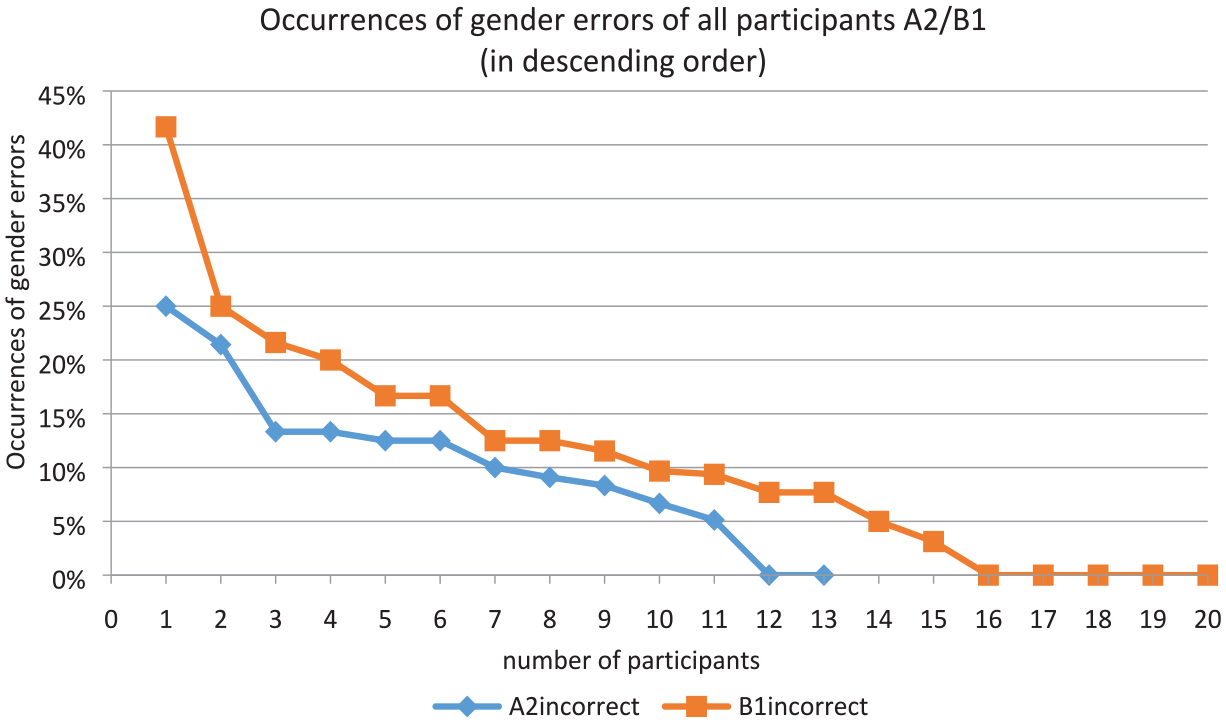
Occurrences of gender errors of all participants A2/B1.
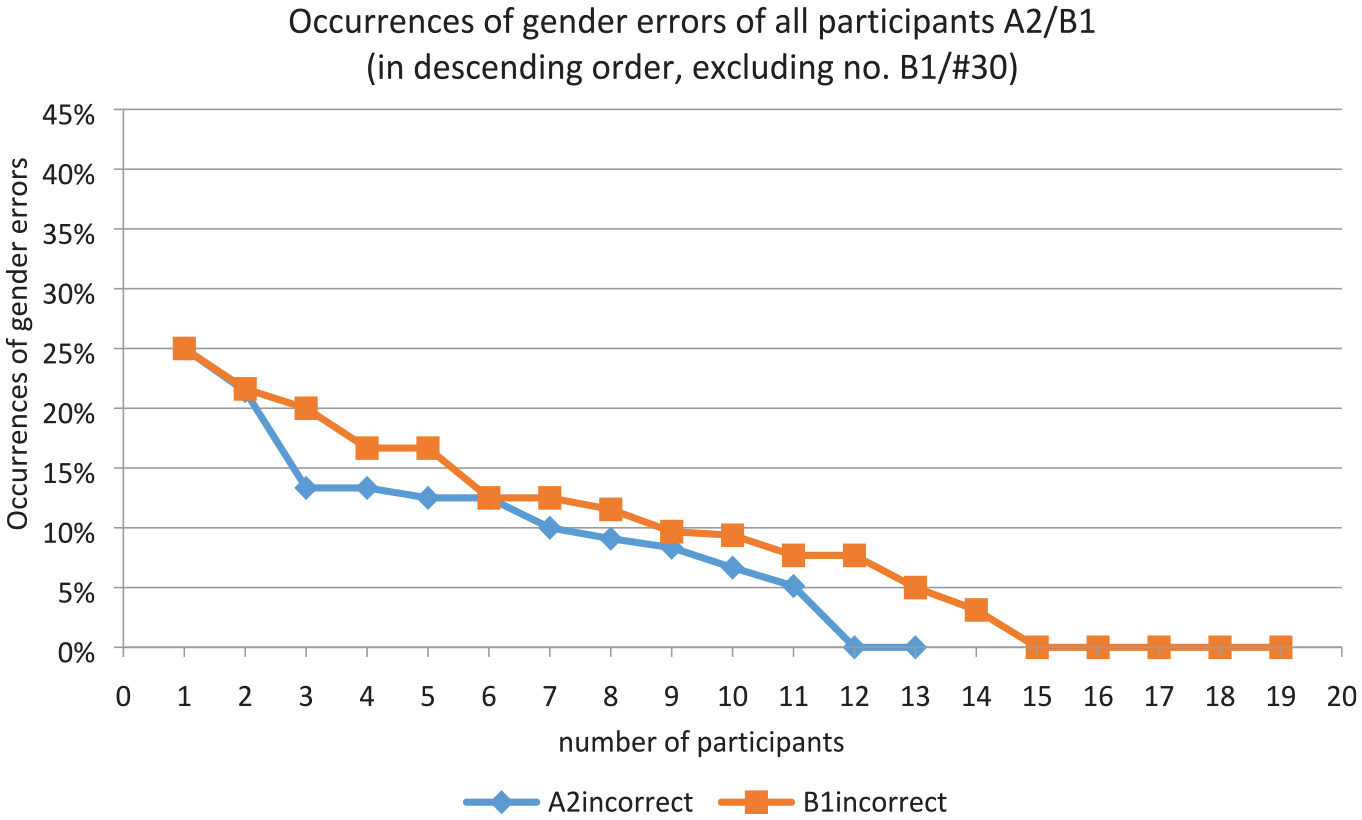
Occurrences of gender errors of all participants A2/B1 in percentage to the totality of all errors.
The analysis of the given data in a boxplot 6 also shows that both groups are relatively stable concerning their distribution around the median (see Figure 3), even if the interquartile range of the B1 group is slightly larger and the dispersion within the group is greater. Despite the small number of participants in each group, it is visible that both groups behave relatively homogeneously among themselves and their behaviour with regard to gender violations suggests a certain parallelism that might indicate fossilisation.
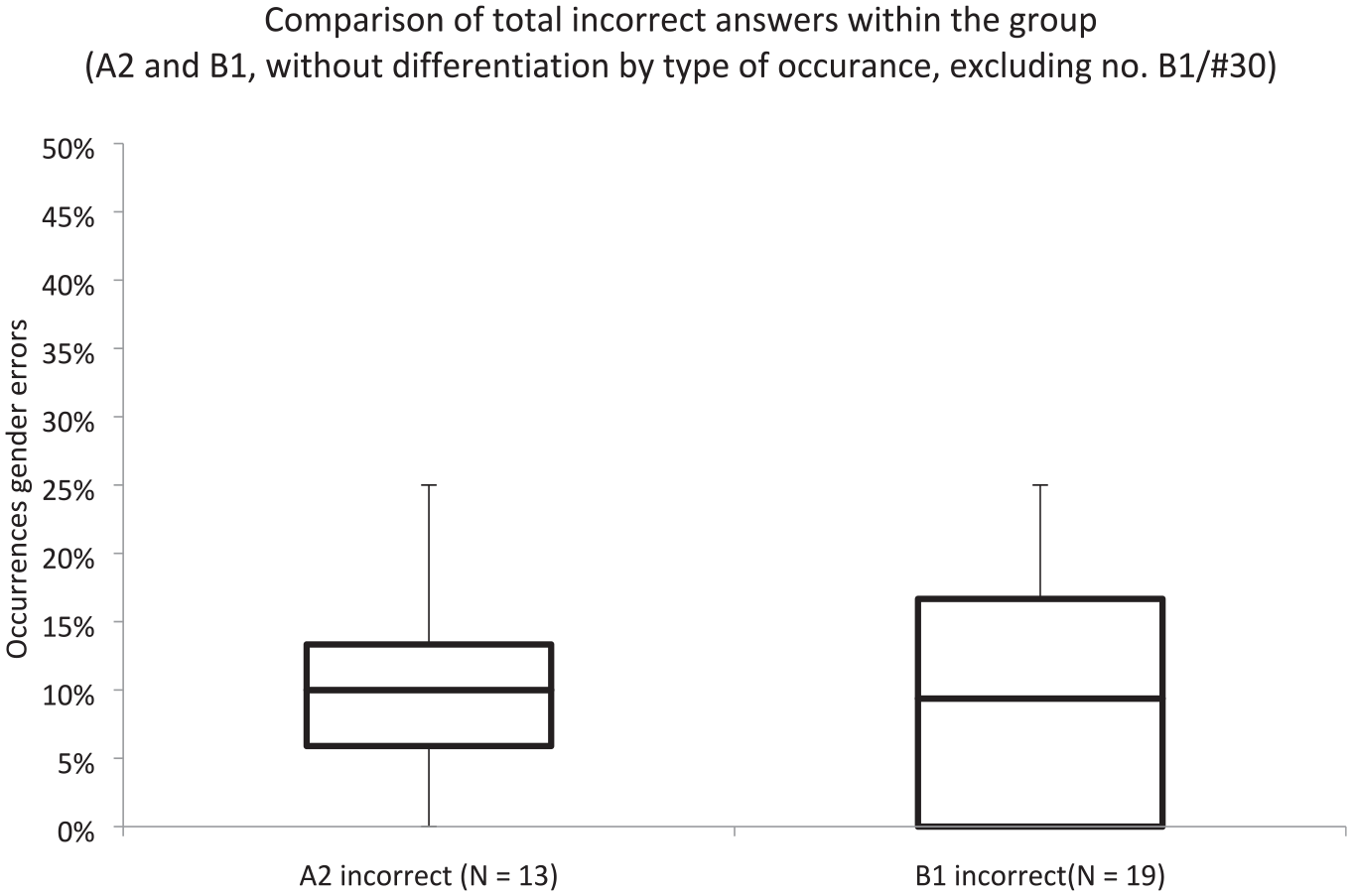
Comparison of total incorrect answers within the group.
The groups fluctuate quite stably around a median of about 10%. These findings are consistent with studies by Carroll (1999) or Franceschina (2001), for example, who also confirmed gender assignment and agreement as a persistent learner problem, even in advanced learners. In their studies on gender assignment in foreign language learners of Spanish (L2), they also found fossilisation to be around 10%. Note that a 10% error rate equals an entire grade level, which is quite significant for learners during their school career.
In a further step, the errors concerning gender assignment and agreement were categorised according to the type of part of speech involved or the syntactic construction in which they occurred (see Figure 4).
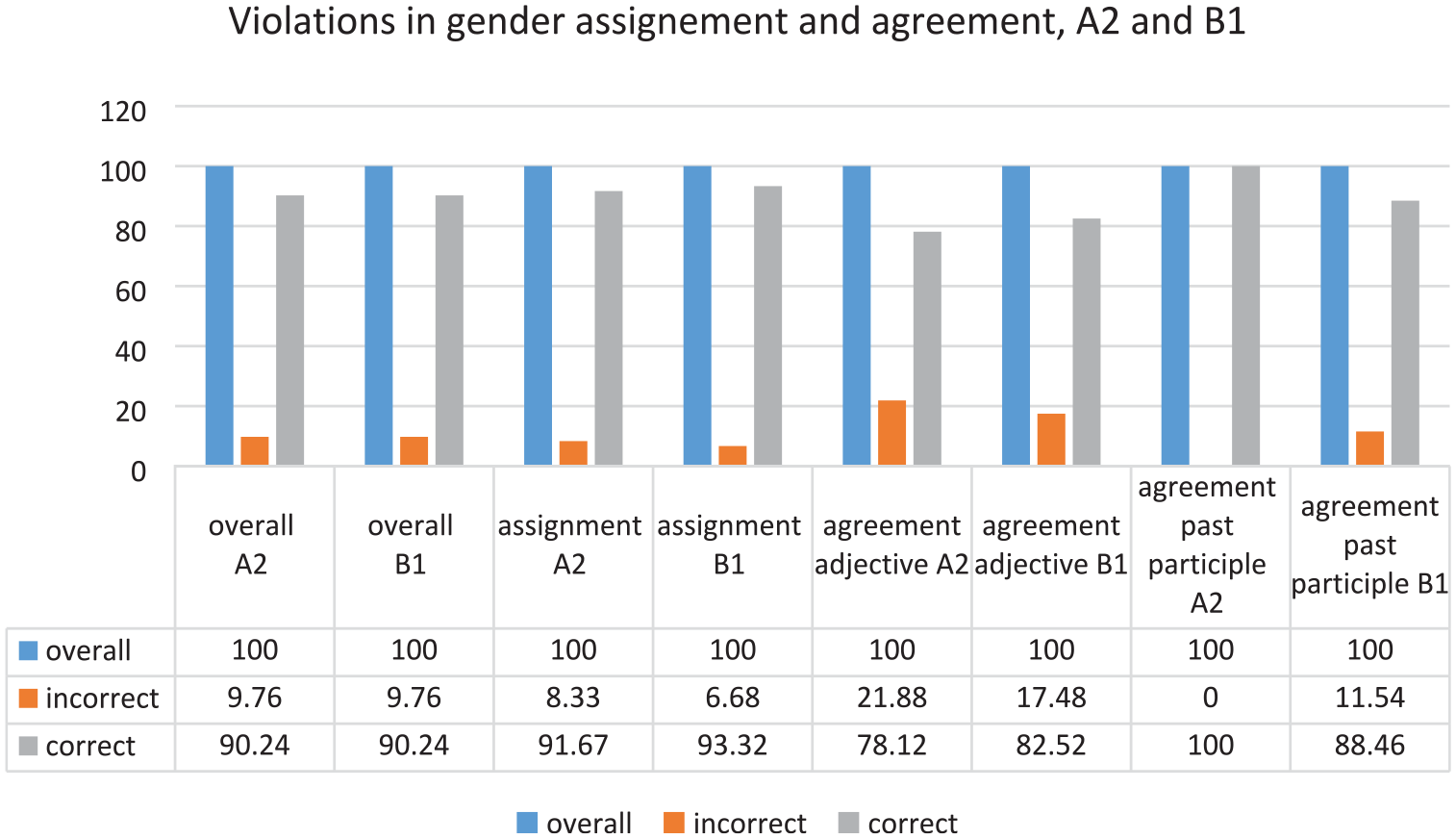
Violations in gender assignment and agreement, A2 and B1.
The analysis shows the differences between the groups: as the syntax becomes more complex and as the level increases, errors concerning the congruence between past participle and gender occurred more often in the B1 group. In the A2 group, there were only two occurrences of a past participle form, and both were correct in their agreement. Instead, the A2 group makes more errors in the article + noun sequence – the ‘pure’ gender assignment – that is to say, assignment without agreement or syntactic alignment. We, therefore, observe a persistent problem in the learners’ behaviour and there is only little progression. The question remains as to why gender assignment is so hard to acquire – even in groups that have another Romance language as an L1 as, for example, Kupisch et al. (2013) have shown for learners of French with Italian as their L1.
These results, even though they were analysed for a very small sample and therefore have only very limited significance, lead us back to our initial questions: why is gender so difficult to acquire and what could be done in the input to help facilitate the processing of precisely this cue? In order to approach these questions, previous attempts at an explanation from different perspectives of acquisition will be used to examine how valid these approaches are.
Different linguistic approaches to explain the gender problem
Modular approaches
Most modular approaches argue from a Universal Grammar (UG)-based perspective (Carroll, 1999; Franceschina, 2001, 2003, 2005; Granfeldt, 2003; Kupisch et al., 2013). These UG-based approaches usually attempt to explain errors via the lack of, or decreasing access to the UG or via the transferability of language knowledge, that is the possibility of positive or negative transfer (Meisel, 2011; Schwartz & Sprouse, 1996). For example, Carroll (1999) or Franceschina (2003, 2005) conclude that gender assignment is accessible to adult learners, but some seem almost to be blocked from acquiring it due to existing language knowledge. As a consequence, they lack the possibility of relying on bootstrapping effects for positive transfer. Most explanations of persisting problems with gender assignment ultimately end up in fossilisation, arguing with the Failed Functional Features Hypothesis (FFH, Hawkins & Chan, 1997), ‘which predicts that the acquisition of L2 functional features not instantiated in the learner’s L1 feature inventory will result in persistent divergence in adult learners’ (Franceschina, 2003, p. 97) and which is based on the distinction between universal and parameterised features. Franceschina’s works (2001, 2003), however, suggest that the acquisition of gender takes place in a different way than, for example, the acquisition of number and cannot fully be explained by the FFH. She concludes that there is no critical period for the acquisition of syntax but dismisses the possibility that the gender (here = article) + noun sequence might be learned as a multiword unit in the form of a construction with given slots (Franceschina, 2001, p. 244). The possibility of acquisition by storing chunks as a first step in this process is not discussed at all. She also seems to exclude a probable influence of different processing strategies between NS and non-native speakers (NNS): However, gender has been shown to be a persistent problem for some adult L2 learners. Failure to acquire a property of the L2 for which there is unambiguous positive evidence in the input intriguing. Given that some L2 learners [. . .] are indistinguishable from NSs in their production, comprehension and metalinguistic judgements of grammatical gender, we can rule out the possibility that the mere fact that these speakers already have knowledge of a previous language prevents them from fully acquiring the relevant properties of the L2. This suggests that the concerns expressed by Cook (1992) and Ellis (1991) about L2 speakers being intrinsically different from NSs, and therefore not directly comparable to them, may not be justified. (Franceschina, 2005), p. 191)
To sum up the main findings, UG-based approaches do suggest that adult learners are able to acquire native-like knowledge of grammatical gender (Franceschina, 2005). They also argue that the learner’s L1 plays a crucial role concerning possible attainment of grammatical gender and that extralinguistic factors such as age, length of exposure, task modality and language skill have to be taken into consideration as possible influencing factors for some of the variability. Nevertheless, the strongest influence is exerted by the L1, from which it can be concluded that transfer effects should be expected to be high, especially for learners who already have a gender system in the L1. 7 Positive transfer should therefore be a possible strategy for learners.
Despite this, a qualitative look into our data seems rather to confirm that positive transfer 8 does not play an important role in gender assignment:
4. Je bois *
‘I drink a cup of tea or a cup of water’.
5. Merci, *
‘Thank you, the check-out is on the second floor’.
6. C’est *
This is a gothic cathedral.
7. [. . .] pour améliorer *
[. . .] in order to improve the students’ concentration.
8. [. . .] l’usine ou *
[. . .] the factory where [you can] work in summer [in] the production.
9. Par ailleurs, le projet est *
By the way, the project is a good idea for visiting and discovering the town and its different culture.
10.
Another quality of a good friend [. . .].
In Example (4), it would have been possible for this learner with L1 German to rely on the German word eine Tasse ( ‘a cup’), which is female in both German and in French. Obviously, the learner knew that an article must be put in front of the noun (possible explanations: concept of the sequence/construction stored as a whole or transfer of the +gender parameter of the L1) but could not bootstrap on the L1 system. The same case occurs in every example (4–10). It should be noted that learners do not forget to put the article, which may underline the already cited hypothesis that gender has to be learned lexically as part of every item and that these sequences are stored, at least in the first phases of L2 acquisition, as a whole, comparable to multiword units.
However, Examples (7–9) also show that the learners do not rely on morphological cues such as typically feminine endings like -tion or -ée, and there are also errors in gender assignment that might be caused by negative transfer from the L1 into the target language:
11. *
Another reason for [. . .].
12. Pour *
As far as I am concerned, I can wear a dress [. . .].
Interestingly, in both cases, these are constructions that could be grouped under so-called formulaic speech. It is possible that the entire chunk was transferred by the learners here – however, the data set is too small to be able to make valid statements. If the thesis that chunks are preferably transferred as a whole were to be confirmed in a larger data set, this would speak strongly in favour of usage-based modelling within the framework of CxG.
A very striking example from the corpus shows that there are violations in gender assignment even if the semantic gender is not arbitrarily assigned, but is transparent due to the properties of the noun:
13. [. . .] je travaillais comme *
[. . .] I have been working as a chambermaid [. . .].
These are certainly isolated examples, but they are repeated within the corpus and at least call into question the role of transfer in relation to grammatical gender. With regard to foreign language learning explanations that only argue by the possibility of access to UG, these explanations seem to be insufficient and unsatisfactory as they cannot explain either cases such as in Example (4) or the very similar results of the –gender group and the +gender group in the study by Franceschina (2003), as she herself highlights.
Usage-based approaches
It has been already mentioned that there are some phenomena in the dataset that might indicate that the framework of CxG and a usage-based perspective on foreign language acquisition could help to shed light on the difficulties learners have in acquiring gender. Unfortunately, there are only a few studies that examine gender assignment from a usage-based perspective and the arguments mostly refer to frequency effects (Wegener, 1995, 2005, 2016). Both studies show that acquisition takes place. Both are working with children who are acquiring German as a foreign language and who possess different heritage languages, and both attribute this to frequency in input, but they give no explanation for the fact that children continue to make errors in gender assignment in their studies. In the end, processing is hardly taken into account.
However, the works of Binanzer (2017, 2020; Binanzer & Wecker, 2020) can possibly be located in the area of a usage-based, and above all, strongly input-focused framework. Although she primarily investigates the acquisition sequences for gender in younger learners (target language German), she clearly presents in her studies that learners must first acquire patterns so as to be able to acquire agreement patterns, the so-called ‘consistent agreement pattern’ (Corbett, 1991), in order to find out which linguistic units are gender-sensitive targets (Binanzer & Wecker, 2020; Corbett, 1991) and how the genre information has to be mapped there (Binanzer & Wecker, 2020). Her findings certainly indicate that L2 learners may also be able to process probabilistically and filter the input for statistically probable patterns, even if they no longer seem to be as sensitive to this as children in first language acquisition. Nevertheless, implicit statistical learning seems to still be possible (Binanzer, 2020; Binanzer & Wecker, 2020). In consequence, she concludes that the most important step is to access the semantic congruent patterns: Once the semantic congruent patterns and plural schemata are securely available, meta-linguistic knowledge and language-practical skills about the formal congruent patterns and gender classification regularities or paradigmatic relations between singular and plural forms can be built up in the same way, i.e. through awareness and subsequent proceduralisation and automation. (Binanzer, 2020, p. 24, translation JW)
9
The study does not address how these patterns can be made more accessible to learners via possible input optimisation and manipulation, however.
If we follow general assumptions of CxG and usage-based approaches regarding the entrenchment and establishment of schematisation during language acquisition, 10 it is important to examine why gender so stubbornly resists these processes. After all, it is an almost overrepresented category in the input, but frequency effects do not seem to occur, as learners obviously do not manage to process it sufficiently. The idea that patterns may play a role in gender assignment and, therefore, also the ability of probabilistic pattern prediction during processing can probably be seen in the previously cited study by Ayoun (2020): she investigated the gender assignment of L1 French speakers and found that they were uncertain about the correct gender in about 25% of the cases. She then investigated the strategies speakers used to assign the correct gender and found that speakers used both combinatoric pattern and rule knowledge, which suggests that explanatory potential from both construction grammar and UG is at work while acquiring morphological categories like gender. In her study, NS first looked for prototypical multiword units by adding adjectives or building a whole phrase, and then checked these units on the phonological level (Ayoun, 2020). 11 However, Ayoun (2020) argues from a purely UG-based perspective and concludes that NS only process via phonotactic rules, which they try to (re)find via these strategies. She seems to overlook the possibility that these strategies may aim to process first via pattern-driven and combinatorial probability to re-access the rule-based processing that adult L1 speakers seem to have ‘lost’.
This leads us back to the question of how the processing in NS of morphological categories with little salience may be imitated in learners and what might be useful for optimising learners’ input.
Discussion
It seems important to pay more attention to the fact that the acquisition of morphological categories in processing depends strongly on salience and attention. This is where the comparison between first language acquisition and foreign language acquisition becomes significant. Studies have already shown that children tend to process morphologically and prosodically, while adults process semantically (Lew-Williams & Fernald, 2007; Havron & Arnon, 2021). This leads to a different behaviour in the perception of salient features during language processing. With this, however, gender also loses the function of predictability about properties of the noun, since learners process primarily lexically-semantically (Grüter et al., 2012; Lew-Williams & Fernald, 2007). It was also demonstrated that children process and acquire faster when they process multiword units (Arnon & Christiansen, 2017).
In addition, Eisenbeiß (2003) was able to illustrate in her work that the gender system in first language acquisition (L1 German) was only reliably acquired when the case system was also stably acquired. Consequently, case and gender seem to support each other during the automatisation process and by this way facilitate the storage of the mental representations of morphological categories (Eisenbeiß, 2003).
With this, Eisenbeiß (2003) also demonstrated that children benefit not only from multiword units, but also from the fact that several mutually supporting features were present in the input. This is in line with the previously mentioned different cognitive processing routes that can be observed in children and adult learners (Clahsen & Felser, 2018; Frenck-Mestre et al., 2009; Havron & Arnon, 2021; Jost & Christiansen, 2016; Pulvermüller et al., 2013; Schimke & Hopp, 2018; Zwitserlood, 2018).
Given all these findings, the assumption for the gender problem is, therefore, that morphological features are no longer sufficiently salient in the processing by adult learners to attract enough attention for them to be stored. The learners pay too much attention to the semantic features of the input; they process the noun label and oversee the article + noun sequence, perhaps due to economic constraints and their processing experience in the already acquired language systems. To optimise processing, it is therefore necessary to find a method in the input that triggers both combinatorically and rule-based processing routines. The aim in doing so is to control the perception and processing of the input as well as possible. This seems to work best through the presentation of formulaic sequences and multiword units (Arnon & Ramscar, 2012). However, is this already being implemented in textbooks?
Problems with the didactic input?
It has been a long time since input enhancement was discussed and tested in Foreign Language Learning, but a look in current manuals for French as a foreign language shows that input enhancement is much more difficult than one might think, if one considers the cognitive processing and the problem of salience of the cue that should be learned. Figure 5 shows examples of input enhancement that is meant to draw the learner’s attention to gender assignment in difficult cases – the gender is not marked on the phonetic level in the following cases. 12
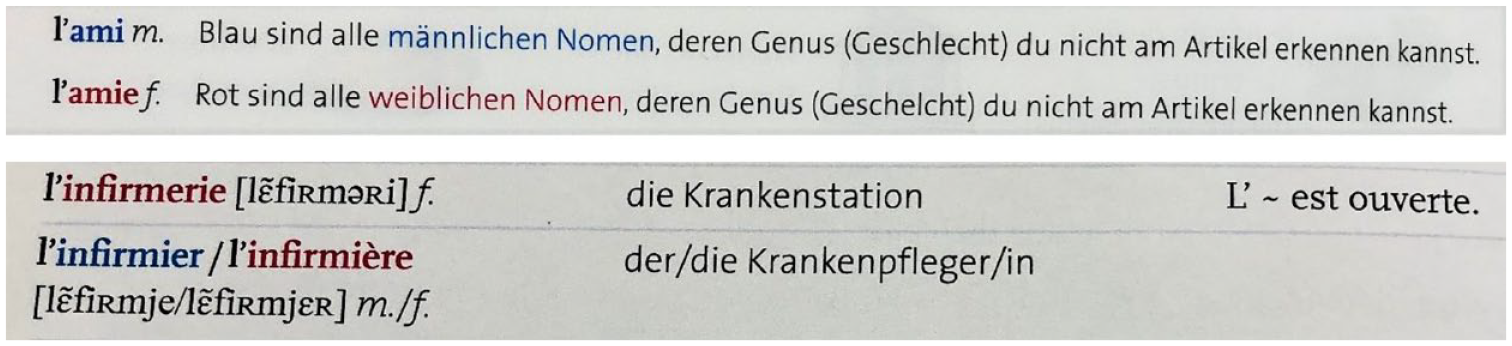
Examples of input enhancement that should draw attention to difficult gender assignment; À plus! Nouvelle édition 1. Gymnasium Bayern. 2017. Cornelsen.
Using the examples of the French words for ‘the friend’ (l’ami, masculine versus l’amie, feminine) in which gender is not audible if the direct article is used, the manual tries to explain that in every such case, the male word is written in blue and the female word in red to facilitate the gender differentiation. It is easy to detect that this solution triggers the noun label processing that might block the processing of the morphological cue as has been showed by Arnon & Ramscar (2012).
Figure 6 shows an additional confusing factor of the method proposed by the manual À plus: besides the problem that, once again, the noun label processing is triggered by colouring the whole lexeme, the colour red is also used here to mark the irregularly formed plural in French. These are several false runs for the learners to process correctly.
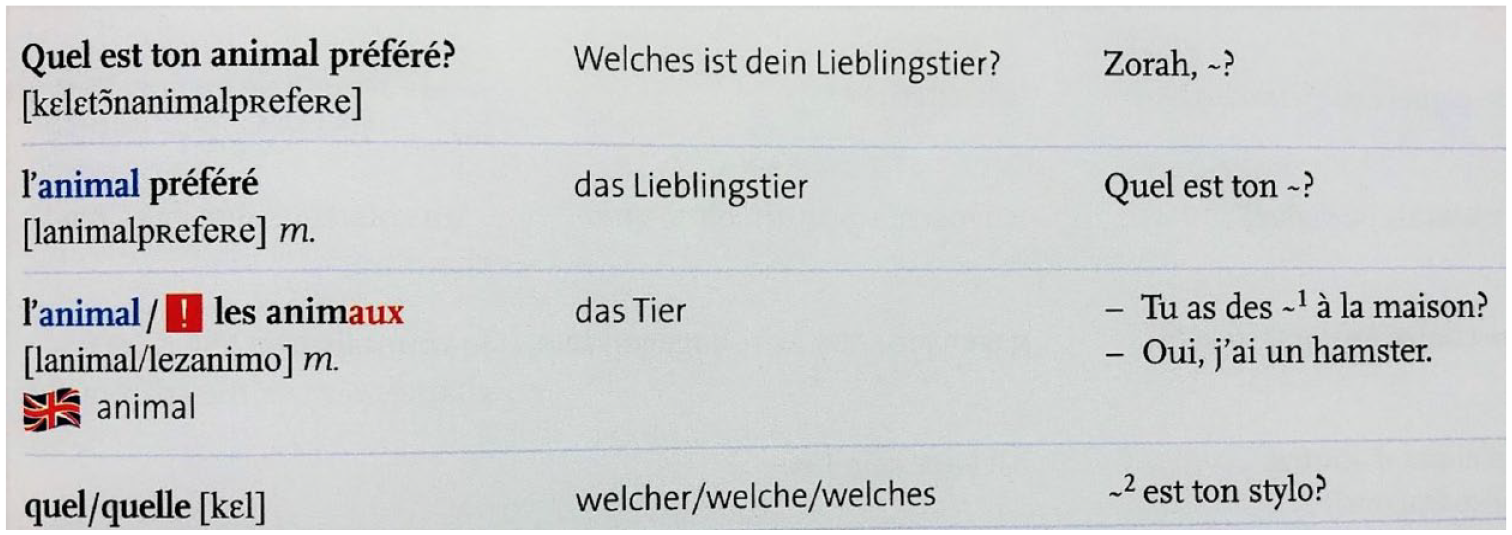
Examples of input enhancement that should draw attention to difficult gender and number assignment; À plus! Nouvelle édition 1. Gymnasium Bayern. 2017. Cornelsen.
Interestingly, the interrogative and the possessive pronoun are not marked at all, whereas in the case of the interrogative pronoun there is even an overt realisation on the graphic level.
The aim in designing learning materials is to take into account the different processing routines – statistical ones and rule-based ones – and, above all, to try to integrate the benefits of multiword units for the learners in order to support them to develop the right processing strategies. A first approach would be to create more salience through the provision of multiword units in which attention is drawn to the feature to be acquired in order to achieve improved processing and thus more learning success. In the following, some examples of possible prototypical chunks are suggested to illustrate the idea of input manipulation that follows linguistic findings:
14. l’eau gazeuse
sparkling water
15. l
a big cup of tea
16. l’infirmierø compétentø versus l’infirmière compétente
the competent nurse
17. l
the good hand
18. l
the interesting domain versus the interesting exercise
19. le grandø groupe versus la grande masse
the big group versus the big mass
Following the suggestions of contextual optimisation (Motsch & Berg, 2017), vocabulary learning should concentrate more on article + noun sequences and additionally on giving as many opportunities as possible to process morphological cues by increasing the amount of target cues – gender should be overtly marked whenever possible and in several items and features. In doing so, learners can begin by acquiring chunks that can eventually be transformed into rules or smaller units; in this case, morphological language knowledge would be stored in the course of their acquisition.
Conclusion
To conclude, it seems necessary to try to imitate the different mechanisms of processing between children, adult L1 speakers and adult L2 learners as far as possible through adequate input optimisation that is in line with linguistic findings as has been shown. The hypothesis that learning strategies implement this knowledge in a better way and that context and input optimisation must be more integrative can not only be confirmed by corpus linguistic data, but also requires a psycholinguistic study, which is still pending but will hopefully take place after this study.
Footnotes
Declaration of conflicting interests
The author(s) declared no potential conflicts of interest with respect to the research, authorship, and/or publication of this article.
Funding
The author(s) received no financial support for the research, authorship, and/or publication of this article.
