




Abstract
Aim and Objectives:
There is ample evidence available in correlational studies for cross-linguistic transfer from the first language (L1) to a second or a foreign language (L2/FL). Less extensive are the interventional studies in this area. The current study sought to determine which linguistic skills transfer from Arabic (L1) to English (EFL) after employing an intervention program in Arabic.
Design/ methodology:
Participants were sixty-nine Arabic-speaking ninth graders randomly assigned to an experimental group receiving an intervention program in Arabic and a control group not receiving an intervention. Pre-tests and post-tests tapping phonological, orthographic, morphological, and syntactic awareness in English and Arabic were administered to all participants.
Data Analysis:
A two-way analysis of variance (ANOVA) for repeated measures compared the pre-test and post-test results in English and Arabic within each group and between the groups. In addition, a linear regression model was used to examine the predictive effect of pre-test scores and the intervention program in Arabic on post-test performance in English.
Findings/Conclusion:
Findings revealed a within-language improvement in all Arabic skills after the intervention. As for the cross-linguistic transfer, significant differences favoring the intervention group were only demonstrated in phonological and morphological skills. No transfer was evident in orthographic or syntactic transfer.
Originality:
By employing an intervention program addressing four linguistic skills in Arabic concurrently, the present study revealed a robust transfer of phonological and morphological awareness from Arabic to English, whereas it showed no transfer of orthographic or syntactic awareness.
Significance:
Findings, on the one hand, lend support to the linguistic Interdependent Hypothesis by suggesting that some linguistic skills can interdependently transfer across distant languages. On the contrary, findings endorse the Script Dependent Hypothesis, by showing that some other linguistic skills are language-specific, thereby, impeding cross-linguistic transfer.
Keywords
Introduction
Evidence on the transfer of linguistic skills from L1 to L2/FL is accumulating. This lends support to Cummins’s (1979, 1981) Linguistic Interdependence Hypothesis which holds that there is a significant correlation between first language (L1) and second language (L2) proficiencies. It also suggests that some linguistic skills can positively transfer from L1 to L2, respectively. Cummins argues that the linguistic mechanisms through which learners develop their mother tongue are common to all other languages acquired later throughout the learners’ lifetime. As such, better language competence is achieved when L1 knowledge acquired at home overlaps with L1 and L2 linguistic skills learned at school. That is, sufficient L1 linguistic skill development is crucial to the development of the corresponding skill in L2. Cummins (1981), thus, puts forward the Common Underlying Proficiency (CUP) model. CUP suggests that adequate teaching and sufficient exposure to either language promote the development of the linguistic proficiency underlying both languages being acquired. Hence, a learner who masters linguistic skills in L1 is capable of transferring these skills smoothly to L2, thereby demonstrating an advanced level of L2.
In contrast, the Script-Dependent Hypothesis points out that the differences between L1 and L2 orthographic features hinder cross-linguistic transfer among L2 learners (Geva, 1995). It suggests that reading in one language develops independent of another language as each language has its own orthographic features. Orthographies can differ in the transparency of letter-sound correspondence. Transparency is the underlying principle of the “Orthographic Depth Hypothesis” which revolves around the degree of orthographic consistency in a language (Katz & Frost, 1992). In languages with deep orthographies, such as English, graphemes may partially represent their sounds (phonemes) and can have multiple pronunciations. According to Liberman et al. (1974), difficulties in L2 reading can be a direct function of the different orthographies between L1 and L2. To date, the literature on cross-linguistic transfer has reached no consensus on whether orthography is transferable across languages or not.
In keeping with the above suggestions, the present study sets out to determine which changes occur to the linguistic skills in Arabic (L1) and more importantly, which skills transfer from L1 to English as a foreign language (EFL) when an intervention program in L1 is provided to ninth-grade Arabic-speaking English learners. It examines four linguistic skills concurrently, namely, phonological, orthographic, morphological, and syntactic awareness. It is worth mentioning that most studies in the field of cross-linguistic transfer have looked into correlational relationships between the linguistic skills in pairing languages. The present study, however, followed an experimental design that employs an intervention program in L1 to examine its effect on L2/FL linguistic skill awareness.
Arabic as a diglossic language
While the theories above focus on L1 L2 correlation, the present study referred to EFL and not as L2. The reason lies in the sequence of the languages acquired by native Arabic speakers residing in Israel. Arabs, as a minority, belong to the largest ethnic group in Israel of which the official language is Hebrew. Hebrew has a distant typology and different linguistic characteristics from those of Arabic.
Arabic is a diglossic language that is made up of two varieties, colloquial and classical (Ferguson, 1959). The colloquial variety is the locally spoken Arabic acquired naturally by the native speakers and differs in dialect from one region to another (Saiegh-Haddad & Henkin-Roitfarb, 2014). The classical variety, on the contrary, is literary Arabic known as Modern Standard Arabic. This variety represents the primary language of literacy, namely the language of reading and writing taught at school regardless of the colloquial variety and the spoken dialect differences (Saiegh-Haddad & Henkin-Roitfarb, 2014). The complexity in the order of languages acquired by Arabic speakers has to do also with the fact that the first language Arabic-speaking children learn is the vernacular language they use at home whereas, the second language they are schooled in is the Modern Standard Arabic (MSA). They learn how to read and write MSA already in the first grade. Hebrew, as the official state language, is taught in the second grade. A year later, in the third grade, English is taught. In light of this complex, English in the current context is referred to as a foreign language (FL) rather than L2.
It is important to note that the current study examined the cross-linguistic transfer in adolescent Arabic speakers who master reading and writing in all three languages, Arabic, Hebrew, and English. While linguistic skills such as phonology and orthography are usually acquired at an early age, in the current study, we considered them an integral part of the linguistic skills needed for language learning regardless of the learners’ age.
English and Arabic: phonology, orthography, morphology, and syntax
Arabic and English are the languages investigated in the present study. Arabic is a Semitic abjad language read and written from right to left. It is based on a consonantal writing system. The stem or the root of most Arabic words are built of consonants. The vowels contribute to the non-concatenative word-building procedure of composing interwoven roots and patterns (Saiegh-Haddad & Henkin-Roitfarb, 2014). English, on the contrary, is a Roman alphabetic language, read and written from left to right, and follows inconsistent orthography due to the lack of grapheme-phoneme correspondence in many cases.
Phonological awareness in Arabic and English
Phonemes are the smallest units in a word that alter its meaning. The ability to access the phonemic level of the spoken language and manipulate representations at the cognitive level indicates phonological awareness. Given a particular sound in a word is replaced by another sound, the meaning of the word changes. For example, in English, when the phoneme [b] replaces the phoneme [k] in “cat,” it alters the word’s meaning and turns it into “bat.” Similarly, in Arabic when the phoneme [d] in the word ‘dar’دار which means “house” is replaced by the phoneme [n], a new word “nar” نار which means “fire” is produced. In addition to sound recognition, phonological awareness refers to the learner’s ability to manipulate phonemes in spoken words such as segmenting and blending phonemes (National Reading Panel, 2000; Torgesen et al., 1994). The ability to segment letter strings into units that correspond to specific phonemes is critical for phonological awareness. For example, segmenting the phonemes of the word “school” in English results in /s/ /k/ u/ /l/, and segmenting the word “madrasa” (school) in Arabic results in /m/a/d/r/a/s/a/. Phonological awareness entails also blending phonemes to articulate a word such as, blending the phonemes: /s/ /k/ /u/ /l/, in English, to produce the word “school” or blending the phonemes /m/a/d/r/a/s/a/, in Arabic, to produce the word “madrasa.”
In English, there are 44 phonemes including: (1) consonants e.g., /b/, /t/; (2) long vowels e.g., /a/ in /made/, (3) short vowels e.g., /a/ in /mad/; (4) digraphs e.g., /th/, /ch/; (5) “r-controlled” sounds, i.e., the vowel sound changes according to the sound /r/ as in /car/; (6) diphthongs when two vowels make a new sound such as /ou/ in /cloud/. Arabic shares 17 phonemes with English such as /b/, /s/, /ʃ/, and /t/ (Smart & Altorfer, 2005), whereas, it includes phonemes that do not exist in English. Examples of phonemes that have no English equivalents can be / ʕ/(voiced pharyngeal approximant or fricative), /dˤ/ (denti-alveolar, emphatic, voiced consonant), or /x/ (voiceless, velar fricative, similar to Scottish ch).
Following Kogan and Saiegh-Haddad’s (2023) literature review, the phonological syllable in English is made up of two major constituents: the onset and the rime. The onset is the first syllable which includes the prevocalic consonant(s), whereas, the rime is the second syllable and it includes the vowel together with all postvocalic consonant(s) (VC).
As for Arabic, Standard Arabic comprises 28 consonantal phonemes and 6 vowel phonemes. The six vowels that build up the vocalic inventory in Arabic comprise three short vowels, namely, low /a/, high front /i/, and high back /u/, and three long equivalents: /a:/, /i:/, and /u:/ ا, ي, و respectively. The graphemes that represent the long vowels represent in other cases consonants or semi-vowels referred to as glides /w/و and /y/ ي (Holes, 2004). Within the consonantal system of Arabic phonology, four phonemes are coronals, /s t d ð/ س ت د ذ, whose four counterparts are velarized or “emphatic,” /ṣ ṭ ḍ ð / ص ط ض ظ, respectively, in which the tongue body raises toward the back of the soft palate (Saiegh-Haddad & Henkin-Roitfarb, 2014). Two more thickening velarized emphatics with back consonants are the velar غ/
Concerning the syllabic structure, unlike English, Arabic follows the body-coda hypothesis which states that the body unit of the syllable is composed of the onset consonant(s) together with the vowel (CV), whereas the coda which is the final part of the syllable constitutes the final consonant(s) (Kogan & Saiegh-Haddad, 2023).
Orthographic knowledge in Arabic and English
Orthography has been defined as the system of symbols that represents the print of a language (Badian, 2001; Nassaji & Geva, 1999). Orthographic awareness refers to the ability to form, store, and access the written representation of a spoken language (Stanovich and West, 1989). Barker et al. (1992), associate orthography with the memory of specific visual patterns that identify the words they illustrate. Another underpinning principle of orthographic general knowledge is the understanding of letter combinations and how they occur in a language (Conrad et al., 2013). In English, for example, recognizing the graphemes that represent the letters which are made up of 26 alphabets (21 consonants and 5 vowels), reflects orthographic awareness. Orthographic awareness in English also requires recognizing graphemes of different syllable types such as “CVC” as in “met” or “CVVC” as in “meet,” recognizing digraphs such as “th” or “sh,” and recognizing silent letters such as “l” in “walk.” Another underpinning principle of orthographic general knowledge is the understanding of letter combinations and how they occur in a language. For example, knowing that the letter combination “st” occurs often at the beginning of a word in English while “sb” does not, imply orthographic awareness (Conrad et al., 2013).
In Arabic, on the contrary, the orthographic abjad system works differently. Arabic is written from right to left. Its orthographic system comprises 28 letters among which 25 are consonants and 3 are long vowels. Short vowels in Arabic are represented by diacritics. Vowelized Arabic, which presents diacritical marks, implies consistent orthography as the print of the word with the marks around provides a complete reflection of its phonology (Taha & Saiegh-Haddad, 2016). However, when Arabic words are unvowelized orthography turns to be opaque (Abu-Rabia, 2001; Abu-Rabia & Awwad, 2004; Taha & Saiegh-Haddad, 2016). As for the rest of the letters, consonants in Arabic are most likely categorized according to basic shapes that differ in the number and location of dots around such as in ج, ح, خ (/
In addition, Arabic orthography is known for its allography or ligaturing (Abu-Rabia et al., 2003; Tibi & Kirby, 2019). Allography refers to cursive writing in which the graphemes are connected in a certain way that changes their shape according to their location in the word (Abu-Rabia et al., 2003). Therefore, allography increases the orthographic complexity of the script in Arabic as one phoneme in such a case may correspond with three or four graphemes (Asaad & Eviattar, 2014). Another salient factor that makes Arabic orthography complex is diglossia. Diglossia enables Arabic speakers to switch simultaneously between the high and low varieties of the language when shifting from standard Arabic to spoken Arabic (Ferguson, 1959). The latter varies according to the different dialects practiced within the country or the region they reside (Saiegh-Haddad, 2003). For example, the grapheme “q” in standard Arabic might be articulated as /ʔ/, or /g/, or /k/ in spoken Arabic depending on the specific dialect the speaker uses (Tibi & Kirby, 2019).
Morphological awareness in Arabic and English
Morphology accounts for the grammatical properties of words and the way words are related to each other in a language (Fábregas & Scalise, 2012). The ability to manage the inflectional and derivational structures of a language demonstrates morphological awareness (Carlisle, 1995). Inflection of the word means that the units combined to the base form do not change its grammatical category or its core meaning. Derivational morphology, on the contrary, entails altering the meaning and the grammatical category of the core word once morphemes are added to it. Derivations usually change the syntactic class of the base word and make substantial changes in meaning (Deacon et al., 2014).
English morphology is considered impoverished. It mainly revolves around inflectional and derivational aspects. An inflection in English can be exemplified by the plural “s” or the past simple “ed.” For instance, the plural “s” in “cats” maintains the core meaning of the word and its grammatical category, or the suffix “ed” is added to the base form of the verb to imply the regular past form as in “start- started.” Derivational morphology, however, which changes the syntactic class of the base word can be seen, for example, in the suffix “er” that is added to the base verb “play” and changes the core meaning of the base form. In addition, it alters its grammatical category from a verb to a noun.
While English inflectional morphology denotes number and tense, Arabic inflectional morphology denotes the grammatical function of a word such as gender, number, person, tense, etc. (see: Saiegh-Haddad & Henkin-Roitfarb, 2014). The inflectional morphology in Arabic is linear in which prefixes and suffixes are added to the base word. Similarly, in English, suffixes are added to inflect the word. The technique of adding or removing affixes to produce or recognize a new word can be shared between Arabic and English.
Unlike English, Arabic morphology is considered rich and complex as it is both linear and non-linear. It is linear in terms of locating affixes around the base word and non-linear as it requires interweaving a pattern with the root to form nominal and verbal derivations (Abu-Rabia, 2001; Saiegh-Haddad & Henkin-Roitfarb, 2014). The root is mainly consonantal and it constitutes the core meaning of the word (lexeme), whereas the pattern is built up of vowels and provides grammatical information (Abu-Rabia, 2001; Abu-Rabia & Awwad, 2004). For example, a consonantal root can be “K-T-B,” which roughly means “write,” and a word pattern such as “Ca: CeC” turns the verb into a noun as in Ka: TeB (writer) (Saiegh-Haddad & Geva, 2008). The different word patterns represent different grammatical categories such as agentive, passive adjective, passive verb, and active participle (Saiegh-Haddad & Henkin-Roitfarb, 2014; Tibi & Kirby, 2017). The pattern is usually composed of vowels (e.g., “a” and “e” in KaTeB) and affixal consonants (e.g., “m” in maCCu: C “maKTu:b” which means “written”). The vowels and affixal consonants are inserted between the consonant slots (the root) and express grammatical information. Since the pattern is incorporated in the root, Arabic derivational morphology is considered non-linear (Mahfoudhi et al., 2010). In contrast, the inflectional morphological system in Arabic adds affixes linearly such as prefixes and suffixes that indicate person, number, gender, and tense (Abu-Rabia & Awwad, 2004). For example, the prefix consonant [n] is added to the base form ‘DaRaSa’دَرَسَ“ to study” to yield ‘naDRoS’: نَدرُس (we study), a first-person, plural, masculine or feminine, present tense form. Inflectional morphology involves also nouns to which gender and number morphemes are added. For example, in the word “KiTaBahom” (their book), the morpheme “hom,” which represents the plural masculine possessive pronoun (their), is attached to the core noun KiTaB (book).
Arabic morphological awareness addresses morphological relatedness and morphological decomposition. Morphological relatedness has to do with productive word patterns that are derived from the same consonantal root as the following: (1) the agentive word pattern Ca: CeC e.g., / ʕa: Mel/ [worker]; (2) the passive adjective word pattern maCCu: C e.g., /maʕMu: L/ [worked on]; (3) the place adverbial word pattern maCCaC e.g., /maʕMaL/ [factory]. (4) the reciprocal verbal pattern Ca: CaCa (as in /ʕa: MaLa/ [dealt with]. All these four patterns are derivations of the consonantal root / ʕML/. Morphological decomposition has to do with breaking down the word into morphemes. For example, a word such as “ka:tib” [writer] stems from the three-letter root “KTB.”
Syntactic awareness in Arabic and English
Syntactic awareness refers to the learner’s ability to attend to the internal grammar of the sentence, to reflect on the rules of grammar, and to manipulate the grammatical structure of sentences in a given language (Durgunoglu, 2002; Gombert, 1992). Syntax sets forth the rules by which words are combined into sentences and linguistic units convey distinct meanings (Siu & Ho, 2020). Syntactic awareness is a metalinguistic ability that is operated on the mechanism responsible for assigning intra-sentential structures to groups of words (Tunmer et al., 1988). As for the sentential structure, the explicit structure of English sentences is restricted to SVO (subject- verb- object) word order. While the English subject-verb variant is restricted, the Arabic pattern is free as it provides a choice between SVO and VSO (verb-subject-object) depending on various factors in a particular context (Al-Jarf, 2007).
A learner may practice syntactic awareness by breaking the sentence into chunks to figure out its meaning rather than trying to simultaneously process all the words as one larger chunk. Not only does syntax refer to discerning the grammatical structure of the sentence, but also to combining words into larger syntactical units to compose text-level representations such as sentences or paragraphs (Willows & Ryan, 1986). To assess individual differences in the learner’s ability to manipulate and reflect on word order in a sentence, two major tasks have been implemented so far. One task is a judgmental task in which learners are required to judge whether the sentence is correct or not (Geva & Farnia, 2012). Another task requires learners to rearrange a set of words into a sentence (Tunmer et al., 1988).
Transfer of linguistic skills from L1 to L2/FL
The transfer of linguistic skills from L1 to L2/FL in bilingual learners has been widely researched. Phonological Awareness (PA) transfer has been documented in a range of languages such as from Korean as L1 to English as L2 (Wang et al., 2006), from Russian (L1) to Hebrew (L2) (Ibrahim et al., 2007), from Turkish (L1) to Dutch (L2) (Verhoeven, 2007), and from English (L1) to Arabic (L2) (Saiegh-Haddad & Geva, 2008). Moreover, previous studies reported cross-linguistic transfer of PA from Arabic as L1 to English as L2 which was translated into reading performance (Abu-Rabia & Siegle, 2002; Alshaboul et al., 2014). The authors attributed this finding to potential positive transfer from Arabic to English.
There is a paucity of interventional studies on the effect of the instruction of PA in one language on the other. Within this dearth, studies have shown that once explicit instruction of phonological skills is provided, phonological awareness improves across languages. Cirino et al. (2009), for example, investigated the development of Spanish as L1 and English as L2 following an intervention program that targets core reading. Participants who were assigned to the intervention groups exhibited significant differences in phonological measures, among others, in the language they practiced. Chen et al. (2010) looked into the effect of intensive EFL instruction on the development of PA in L1 (Chinese). Results showed that English phonology instruction maximized Chinese PA.
The studies mentioned earlier investigated PA transfer among elementary school learners. A survey conducted by Proctor and Zhang-Wu (2019) on studies assessing cross-linguistic transfer between EFL and a range of L1s (e.g., Spanish–English, French–English, Chinese—English) shows that all studies on PA transfer were conducted among primary school grades, up to grade 6. The reason might be that PA is associated with literacy skills which are usually acquired at early ages. In the present study; however, we refer to PA as an integral and indispensable part of a linguistic cluster that builds up language acquisition. As such, we investigated PA alongside orthographic knowledge, morphological awareness, and syntactic awareness. It is the first research, to our best knowledge, that examines PA transfer among Arabic-speaking adolescents.
While phonological transfer from L1 to L2/FL has been empirically evident, studies on orthographic skill transfer from L1 to L2 have not reached a consensus on whether orthographic knowledge is transferable or is script-dependent (i.e., language-specific). Da Fontoura and Siegel (1995) found that English-Portuguese bilingual children with reading disabilities had significantly higher scores than the monolingual English-speaking children with reading disabilities on the English pseudo-word reading and English spelling. The authors attributed this result to positive transfer from the more regular grapheme-phoneme conversion rules of Portuguese to the more complex grapheme-phoneme correspondence of English. In a similar vein, Kahn-Horwitz et al. (2005) examined whether factors that affect L1 reading acquisition also affect L2 reading acquisition. They found that L1 (Hebrew) independent variable, such as orthography, predicted L2 (English) knowledge of letter sounds and names. Moreover, Nassaji and Geva (1999) looked into the cross-language transfer of phonological and orthographic skills among Persian-English bilinguals. They found that efficient orthographic processing in L1 contributed significantly to individual differences in L2 reading measures. In addition, Abu-Rabia and Sanitsky (2010) established that orthographic knowledge in more than one language enhanced both L1 and FL proficiency. Likewise, Abu-Rabia and Siegle (2002) reported a significant relationship between word recognition and pseudo-word reading in both Arabic and English among bilingual children. According to the authors, this might point to evidence of cross-language transfer from the regular orthography of Arabic to the irregular orthography of English.
Some other research, on the contrary, has shown that orthographic knowledge does not transfer across languages as orthography is language-specific. For example, Schwartz et al. (2007) found that the bilingual group (Russian L1- Hebrew L2) outperformed the monolingual (Hebrew) group on phonological awareness and processing in Hebrew but not on fluency and spelling which depended heavily on orthography. Wang et al. (2006) reported that no transfer occurred in the orthographic skills between the Korean (L1) and English (L2) orthographic systems. Likewise, Sun-Alperin and Wang (2011) in a study on the effect of L1 orthographic processing skill on L2 reading and spelling among Spanish-English bilingual children found no evidence of orthographic transfer. Gunderson (2007) in his book about English-only instruction and immigration presented several studies and included documentation of immigrant students’ L1 writing skills and their background L2/FL (English) proficiency to evaluate the relationship between L1 and L2/FL: proficiencies among others. He addressed the role of orthographic differences in students’ English reading skills and their schooling experiences given their transition between home and school as immigrants. 148 first languages of approximately 16,000 immigrant students to Canada were categorized. Findings revealed that socio-economic background, L1 proficiency, and English school instructions predicted English (L2/FL) performance, whereas orthographic differences between students’ first languages and English did not predict academic achievement in English. Based on the investigations above, to date, orthographic transfer has been inconclusive as to whether orthography is language-specific or interdependent. As for intervention programs and their role in enhancing orthographic awareness in L2/FL, no unequivocal answer can be given yet as rarely did any study investigate intervention programs in the context of orthographic awareness transfer. This scantiness is one motive behind the present study.
As for morphological awareness (MA) transfer, the vast majority of cross-linguistic studies conducted on morphological awareness have demonstrated morphological transfer from one language to another Ramirez et al. (2010) documented a morphological awareness transfer from Spanish as L1 to English as L2 in school-aged children. Wu and Juffs (2022) revealed a significant effect of L1 (Turkish) morphological type on L2 (English) MA. Along the same lines, Jiang et al. (2011) found that inflectional morphology transferred from Russian as L1 to English as L2. They attributed this finding to the morphological congruency between Russian and English. A recent study by Russak and Zaretsky (2023) examined the use of English inflectional morphology and the representation of morphosyntactic in EFL written production among L1 (Hebrew) and L1 Arabic-speaking sixth graders. Results showed that Arabic speakers demonstrated strong associations between Hebrew MA and English MA which might be attributed to cross-linguistic influence. It seems that the Arabic speakers drew on English MA for correct sentence production, whereas the Hebrew speakers relied on reading comprehension.
While the investigations mentioned earlier looked into correlational relationships between L1 and L2/FL MA, there is a paucity of experimental research on the interventional effect of morphological training in one language on the improvement of a pairing language. Among this sparse, Badawi (2019) attempted to investigate the effect of explicit EFL inflectional and derivational morphology instruction on EFL MA development among secondary school Arabic speakers. Results revealed that the experimental group significantly outperformed the control group in morphological awareness after the treatment which substantiated that explicit morphological instruction leads to EFL MA development. As Badawi (2019) found an improvement in EFL after providing EFL intervention, Abu-Rabia et al. (2013) reported a significant improvement in L1 (Arabic) MA after implementing an intervention program in EFL. Transfer of morphological awareness from EFL to L1 after an intervention program was also evident in Malay- English bilinguals. Significant differences between the intervention group and the control group were found in English and, more importantly, in Malay morphological awareness after providing English explicit instruction (Zhang et al., 2016).
Research about cross-linguistic transfer of syntactic awareness reported that syntactic skills transfer from L1 to L2 and, in turn, contribute to L2 syntactic development (Abu-Rabia, 1997; Abu-Rabia & Siegel, 2002; Durgunoglu, 2002; Geva & Siegel, 2000; Siu & Ho, 2015, 2020; Sohail, 2015). Abu-Rabia and Siegel (2002) examined the relationship between some linguistic skills and the development of reading skills in English-Arabic bilingual children. They found that the correlation between syntactic awareness and reading acquisition was significant within the same language and, more importantly, across languages. By the same token, Abu-Rabia and Sanitsky (2010) reported positive syntactic transfer between Russian (L1) –Hebrew (L2) and English (FL)- Hebrew(L2) in Russian multilinguals. That is, English syntactic awareness was predicted by the learner’s first- and second-language syntactic awareness. Moreover, L1 (Chinese) syntactic skills predicted L2 (English) reading comprehension and the correspondence between L1 and L2 syntax supported L2 acquisition (Siu & Ho, 2015). Cross-language transfer of syntactic awareness and its effect on L1 and L2 reading comprehension was also demonstrated in English-French bilingual children (Sohail, 2015). A more recent study has also shown that syntactic awareness in L1 (Chinese) had facilitated reading comprehension in L2 (English) in bilingual children from Hong Kong over the course of 1 year (Siu & Ho, 2020). We are aware only of a handful of interventional cross-linguistic studies investigating syntactic awareness transfer. Abu-Rabia et al. (2013) and Feder and Abu-Rabia (2020) pointed out that syntactic transfer occurs from L2 to L1 once an L2 intervention program is provided.
The current study
The purpose of the current study is twofold. First, it aims to investigate the within language development in L1 among Arabic-speaking ninth graders after employing an intervention program. The rationale behind choosing ninth graders lies in the fact that they acquired the linguistic skills in both languages at an earlier age which makes them master reading and writing in both languages. Second, it looked into the cross-linguistic transfer from L1 (Arabic) to EFL when an intervention program in Arabic is provided. To address these goals, the central questions of this study were: (1) Which changes occur in phonological, orthographic, morphological, and syntactic awareness within the experimental group when an intervention program is provided? (2) Which linguistic skills transfer from Arabic to English when an intervention program in Arabic is provided? We assumed that all linguistic skills in Arabic would improve following an intervention program and that all linguistic skills except for orthography would transfer from Arabic to English.
Method
The study design was approved by the Chief Scientist of the Ministry of Education after it had been approved by the Ethics Committee at the University of Haifa. In addition, permission to carry out the study was obtained from the Arabic teachers who ran the intervention program, school principals, and the parents of all participants. A consent letter explaining the process of the study in detail was sent to the parents and signed by them prior to the commencement of the treatment. Students whose parents did not sign the consent letter were not included in the study. Participants were recruited from two schools in the Haifa District. The schools belong to the third socio-economic index (out of 5) according to the Ministry of Education which denotes an intermediate socio-economic status and an average academic level. Both schools follow the same curricula and use the same English and Arabic course books. Following the Ministry of Education recommendation, both schools administered placement exams at the beginning of the school year in English and Arabic to determine the proficiency level of their ninth graders. The participants in the study meet A2 level in English according to the Common European Framework of Reference (CEFR). In Arabic, they meet the average level according to a national evaluation exam called ASIF which is designed by the National Authority for Measurement and Evaluation in Israel to assess reading comprehension and writing production in Arabic as L1.
Participants
A total of 69 ninth-grade school students with an average age of 14.4 [SD = 0.35] participated in the study. All participants are Arabic native speakers who were born in Israel. They have received Standard Arabic instruction as a core subject since the first grade. They all started formal instruction of English, as a school subject, in the third grade. All participants received 5 hours a week of English instruction and 5 hours of Standard Arabic instruction. All the participants have learned Hebrew as a second language at school since the second grade as Hebrew is the official language of the country they reside. They receive 4 hours a week of Hebrew instruction. Participants were assigned to two groups experimental and control. The experimental group received an intervention program in L1 (Arabic), whereas the control group received some enrichment activities that had nothing to do with any of the languages.
Materials
English and Arabic measures
Tests in Arabic and English were given to all participants before and after the treatment. The tests assessed the four linguistic constructs (phonology, orthography, morphology, and syntax) in each language separately via multiple measures. Each measure constituted a task that included 15 items (see Supplementary Appendix A and B). Below is a detailed description of the tasks.
Phonological awareness in English and Arabic
The English tests were adapted from Bradley and Bryant (1983) and Kahn-Horwitz et al. (2005) (Cronbach’s α.= 0.77). The Arabic tests were adapted from Taha and Saiegh-Haddad (2016), Tibi (2016), and Tibi et al. (2021) (Cronbach’s α = 0.82). The test comprised three tasks, (a) phonological awareness in which the participants were required to identify the common phoneme in a series of spoken words provided by the examiner; (b) phoneme segmentation which required participants to listen to spoken words and were asked to break them down into phonemes; (c) blending phonemes, in which participants listened to separated (spoken) phonemes and were required to blend them to produce a word.
Orthographic knowledge in English and Arabic
The English tests were based on Kahn-Horwitz (2015) (Cronbach’s α = 0.74) and the Arabic tests were based on Asaad & Eviatar (2014), Tibi (2016), and Tibi et al. (2021) (Cronbach’s α = 0.79). The tests comprised (a) an Orthographic Identification task which required the participants to figure out the misspelled (foil) word in pairs of words pronounced alike. (b) Letter order task in which the participants had to rearrange the order of the letters to produce correct words; (c) Spelling task as fifteen words (from the curriculum lists) were dictated to the participants in each language.
Morphological awareness in English and Arabic
The morphological tests in English are based on Bowers and Kirby’s (2010) measures. The Arabic tests are adapted from Taha and Saiegh-Haddad (2016), Tibi (2016), and Tibi and Kirby (2017). This test comprises three tasks as follows: (a) Morphological Identification for which the participants were required to identify the root of the word in Arabic and the stem (base form) of the word in English. (b) Derivatives which entailed deriving four words from a single word. (c) Inflection in which the participants were required to give the past form of a given regular verb in English. In Arabic they were provided with the base verb form and the relevant pronoun was attached. (Cronbach’s α. Arabic 0.76; English 0.72)
Syntactic knowledge in English and Arabic
This test comprises three tasks as follows: (a) Syntactic judgment (Abu Rabia & Siegle, 2002; Kahn-Horwitz et al., 2005) in which participants were provided with sentences and they had to decide whether the sentence was syntactically correct or incorrect; (b) Correcting Sentences as the participants were provided with scrambled sentences and were asked to rearrange the word order to produce legal sentences; (c) Sentence Completion which entailed filling in gaps by using connectors or prepositions. (Cronbach’s α. Arabic 0.74; English 0.82)
Procedure
All participants were given a battery of tests to assess their linguistic skills in Arabic as L1 and EFL before the treatment. The tests were administered in each language separately on two consecutive days for 2 hours each in the participants’ classroom. Subsequently, an intervention program in Arabic tapping the linguistic skills tested earlier was provided to the experimental group. The intervention program in Arabic was designed to address all the skills tested earlier. It was held three times a week during school hours (45 minutes each). The school days are usually from 8:00 a.m. to 15:30. This includes extra hours for empowerment and bridging gaps. Two hours a week that were allocated for empowerment and one more free hour in the schedule were utilized for the intervention program. The entire program lasted for approximately four months. Altogether, 40 hours were provided for the intervention program as 10 hours went to each language construct. The program was cascaded by the school Arabic teachers after receiving guidance from the researchers and language counselors. The teachers received materials, lesson plans, worksheets, handouts, tasks, and activities approved by the Ministry of Education for each construct. They were also required to take attendance, to follow a calendar, and fill out a checklist to track the activities they completed and the handouts they gave to the participants. Prior to the instruction of each construct, the researchers met with the teachers to provide the guidelines and the materials. Follow-up meetings were arranged at which the teachers reported to the researchers on the progress of the program. In addition, observations were conducted regularly by the researchers.
At the end of the intervention program, another battery of tests, identical to the pre-tests, were given to the two groups. All post-tests were scored dichotomously by giving one point for each correct answer. Each subtest (measure) included 15 items, thus, the maximum score possible for each subtest was 15. The results were compared to the pre-test results. The goal was to examine whether any changes occurred in the learners’ L1 (Arabic) and FL (English) skills as a result of the intervention program in Arabic.
The intervention program in Arabic
The program was designed according to the pre-tested linguistic skills. Explicit instruction and intensive practice were provided to attend to each of the linguistic skills in the following manner:
Phonological awareness
Explicit instruction of phoneme manipulation was provided to establish and strengthen phonological awareness. The program included sound recognition, phoneme blending, and phoneme segmentation instruction and practice as follows.
(1) Sound recognition requires recognizing sounds in different words and recognizing words with the odd sound in a series of three words. For example, the learners identified the common sounds such as the /r/ in “rabe:ʕ” (spring), “bahar” (sea), “madrasa” (school).
(2) Blending phonemes entailed listening to a sequence of separate spoken sounds and combining them to form a word. Participants practiced blending phonemes such as /k/ /i/ /t/ /a:/ /b/ to produce the word “kita:b” (book).
(3) Phoneme segmentation refers to breaking the word into its sounds by tapping out the sounds or by pronouncing each sound separately. Participants practiced segmenting words to their internal phonemes. For example, the phonemes of the word “ka:teb” (writer) was segmented into /k/ /a:/ /t/ /e/ /b/.
Orthographic knowledge
Grapheme- phoneme correspondence
Since Arabic is a diglossic language and Arabic learners practice both vernacular (spoken) and standard languages, the following aspects were enhanced:
(a) Words with diglossic phonemes: these are words that include Standard Arabic phonemes that are not articulated similarly in the spoken vernacular of the learners such as ‘ق’ /q/ in ‘قلب’ /qalb/ (heart) which is most likely pronounced as /
(b) Emphatic phonemes: these are velarized consonants such as (ص[sˤ] .ط [tˁ], ض [dˤ], ظ[ðˁ]). Each of these emphatic phonemes has a non-emphatic counterpart (coronals) (س[ṣ], ت [ṭ], د [d], ذ [ð]). Each phoneme in each pair has a different representation in the written language;
(c) Letters with dots: these are groups of letters with identical structure but with different location or number of dots around the letter skeleton. For example, the graphemes ت, ث, ب represent different phonemes, namely, [b], [θ] and [t], respectively.
(d) Vowelized and unvowelized words: Arabic orthography is considered shallow when diacritics, which represent short vowels, are involved (Abu-Rabia, 1997). Short-vowel diacritics which have different phonemes are located either above or below the letter (Abu-Rabia et al., 2013). When words are unvowelized, they can represent homographs which look the same but differ in meaning. For example, the words, حَمَلَ, حمَّلَ, حَمْل, حِمْل, حَمَل which mean (lamb, load, pregnancy, overloaded, carry), have the same shape without diacritics.
Spelling
The spelling reflects the ability to convert phonemes into written letters. In the intervention program group, participants had to write down the words dictated to them. The lists of words were taken from the curricula, i.e., from course books approved by the Ministry of Education which meet the level of the participants. It is worth mentioning that the words chosen for the program were not practiced in the regular language classes.
Morphological awareness
The morphological program followed the study of Saiegh-Haddad and Geva (2008). It addressed morphological relatedness and morphological decomposition. In the morphological relatedness instruction, the participants practiced four productive word patterns that are derived from the same consonantal root as the following: (1) the agentive word pattern Ca: CeC e.g., / ʕa: Mel/ (worker); (2) the passive adjective word pattern maCCu: C e.g., /maʕMu: L/ (worked on); (3) the place adverbial word pattern maCCaC e.g., /maʕMaL/ (factory). (4) the reciprocal verbal pattern Ca: CaCa (as in /ʕa: MaLa/ (dealt with). All these four patterns are derivations of the consonantal root / ʕML/.
In the morphological decomposition instruction, participants practiced breaking down the word into morphemes. For example, they received a word such as “ka:tib” (writer) and were asked to identify its root which is “KTB.” Arabic inflections were also included in this type of instruction.
Composing morphemes in Arabic was also taught via conjugation lessons. Participants reviewed and practiced how to compose one word out of a verb, tense, and pronoun which denotes gender and number. They had to convert the tense of the verb and attach the suitable pronoun to it to compose one word.
Participants received explicit instruction and performed tasks in Arabic to practice the morphological structures. By doing this, they related morphemes to their root words and decomposed morphemes into root and derivational morphemes.
Syntactic awareness
The development of syntactic awareness entails the gradual acquisition of grammatical rules. The following subjects were taught: word order, nominal sentences (noun and predicate), verbal sentences (verb- subject), possessive pronouns, and tenses (past and present) in their affirmative, negative, and interrogative structure. Participants received explicit instruction on syntactic awareness. They also practiced and drilled the grammatical rules mentioned above via worksheets and tasks.
Results
Linguistic skill improvement within the language
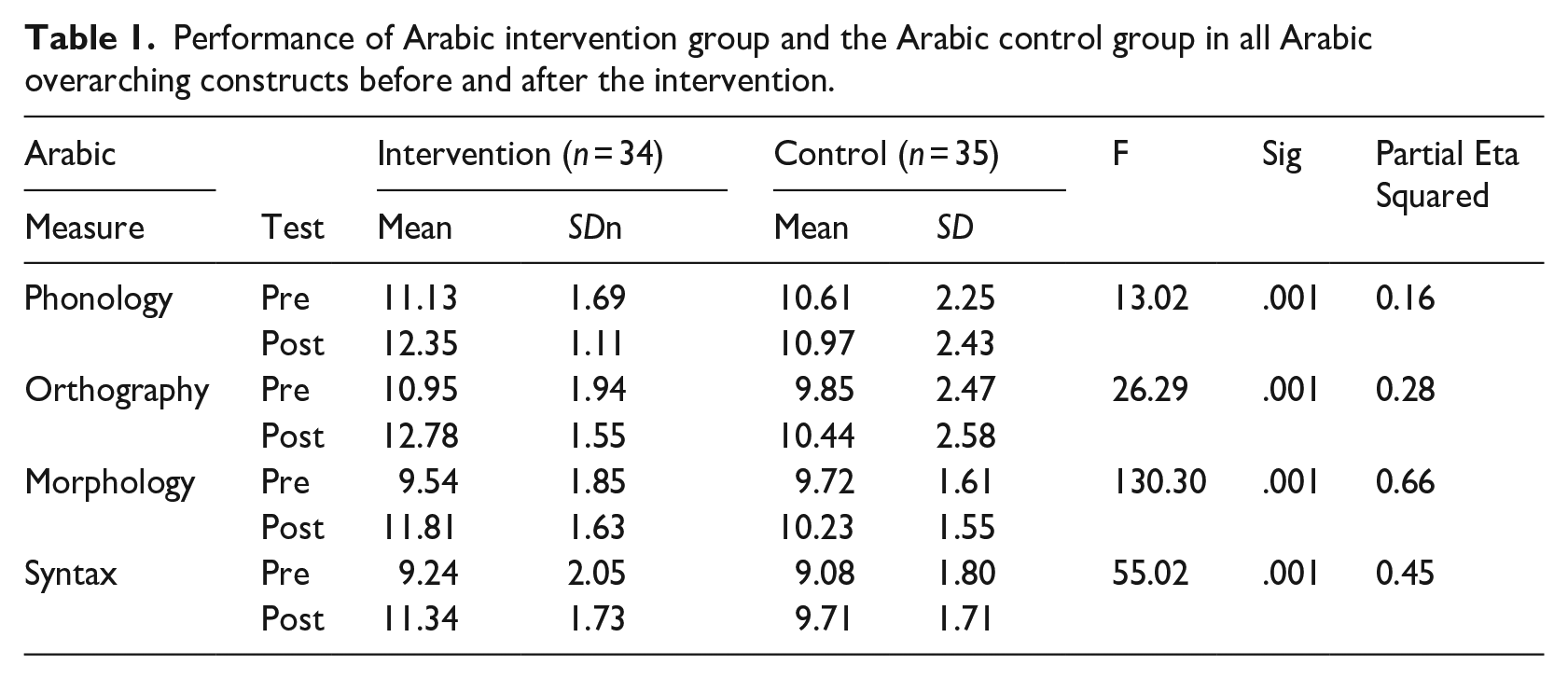
Concerning the first research question as to the change that occurred in Arabic linguistic skills after the intervention, results show that all Arabic linguistic skills significantly increased in the group that had received Arabic intervention. Significant differences were found in all phonological skills after the intervention, namely, Phonological Identification F (1,68) = 5.40, p < .023, η2 = 0.74; Sound Segmentation F (1,68) = 11.90, p < .001, η2 = .15, and Sound Blending F (1, 68) = 4288, p < 042, η2 = .59. Likewise, the orthographic skills had significantly improved Orthographic Identification F = (1, 68) = 21.38, p < .0001, η2 = .24, Letter Order F (1, 68) = 23.55, p < .0001, η2 = .26 Spelling, F (1,68) = 4.41, p < .039, η2 = .61. The performance of the intervention group on the morphological subtests have prominently improved compared to the control group. This has been demonstrated in Morphological Identification, F (1,68) = 20.79, p < .000, η2 = .36 Derivational Morphology, F (1,68) = 38.12, p < .000, η2 = .36 and Inflectional Morphology, F (1, 68) = 86.26, p < .000, η2 = .60. Not only did these subtests present highly significant differences between the groups, but also large effect sizes. Syntactic Knowledge scores have also demonstrated significant improvement with large effect sizes. That is, intervention group significantly outperformed the control group in Syntactic Judgment, F (1, 68) = 47.90, p < .000, η2 = .41, Sentence Order, F (1, 68) = 13.94, p < .000, η2 = .17, and Syntactic Production, F (1, 68) = 14.76, p < .000, η2 = .18.
Table 1 below presents the degrees of freedom, the p-value and the size effect of the interaction of time (pre-tests and post-tests) and group (intervention and control) in the Arabic performance. It shows the within- subject development that occurred in the Arabic intervention group after the intervention in all four overarching Arabic language constructs.
Performance of Arabic intervention group and the Arabic control group in all Arabic overarching constructs before and after the intervention.
Transfer from Arabic to English
The second research question aimed at exploring the transfer of Arabic to English via an intervention program in Arabic. To address this question, the differences between the pre-test and post-test scores on all measures were computed using two-way ANOVA for repeated measures within and between variables. The effect size was indexed using Partial Eta Squared when η2 = 0.01 indicates a small effect, η2 = 0.06 indicates a medium effect, and η2 = 0.14 indicates a large effect.
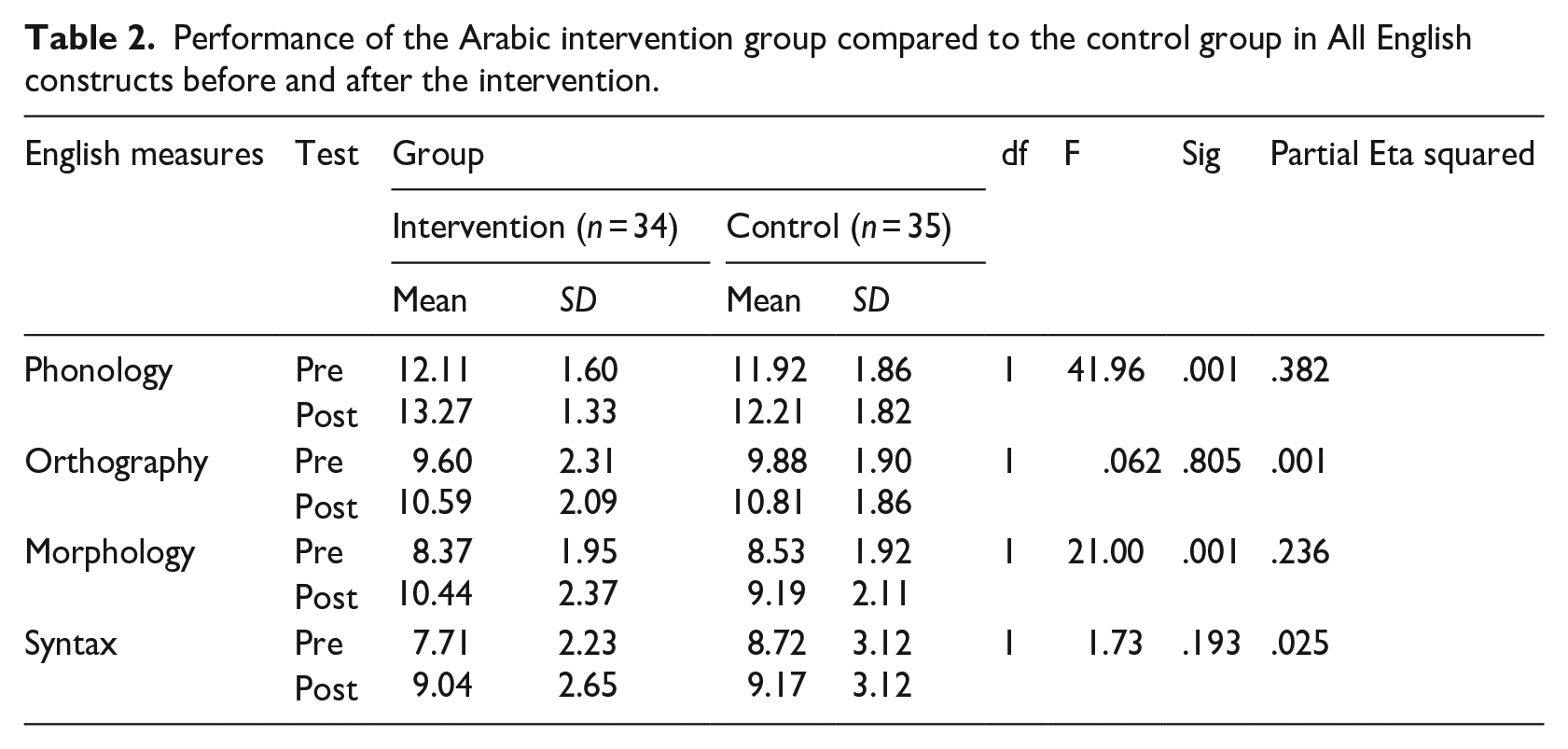
The assumption underlying this question was that all linguistic skills tested in English would significantly improve after providing the Arabic intervention program except for orthographic skills. Results, however, partially consolidate the assumption. Only phonological and morphological skills have significantly improved in Arabic after employing the English intervention program whereas, the syntactic skills have not. As for orthography, the results confirmed our speculation that no change has occurred in the English orthographic performance after receiving an intervention program in English.
The two-way ANOVA revealed a statistically significant interaction between time (pre and post-tests) and group (intervention and control) on all English phonological measures. The performance of the Arabic intervention group improved significantly more than that of the control group in English Phonological Identification, F (1,68) = 15.94, p < .0001, η 2 = .19, English Sound Segmentation, F (1,68) = 22.42, p < .0001, η2 = .25 and English Sound Blending, F (1,68) = 13.03, p < .001, η2 = .02. Results also showed significant interaction effect of time and group on English morphological awareness. That is, the intervention group scored higher than the control group in the Morphological Identification F (1,68) = 8.85, p < .004, η2 = .12, Derivational Morphology, F (1,68) = 4.109, p < .047, η2 = .06 and Inflectional Morphology F (1,68) = 8.57, p < . 009, η2 = .09.
While significant differences with large effect sizes were found in morphological and phonological performances, no significant differences were found in English orthographic and syntactic performances when Arabic intervention was provided. None of the syntactic knowledge subtests, namely, Syntactic Judgment, F (1, 68) = .067, p < .796, η2 = .001, Sentence Order, F (1, 68) = 524, p < .471, η2 = .008, and Sentence Completion scores, F (1,68) = 2.86, p < .095, η2 = .04, reported any significant differences between the groups. Nor did any significant difference appear in the Orthographic Identification F (1, 68) = .643, p < .425, η2 = .009, Letter Order, F (1, 68) = .368, p < .546, η2 = .005, and Spelling, F (1, 68) = .153, p < .697, η2 = .002.
To determine if there was a statistically significant difference between the Arabic intervention group and its parallel control group in the means of the English linguistic skills before and after the treatment, tests of Within-Subject Contrasts were conducted. The Descriptive Statistics in Table 2 compresses all the linguistic skills presented in the subtests to the four main overarching constructs so that each mean score comprises the relevant subtests of the linguistic skills mentioned above. For example, the phonology mean constitutes the average of sound identification, sound segmentation, and sound blending. The table presents the within-subjects contrasts of the Arabic intervention group compared to the control group. It reveals a statistically significant interaction between time and group effects on English phonology and morphology, whereas no significant interaction was found in English orthography and syntax. In other words, the Arabic intervention group significantly outperformed the control group only in phonology and morphology. For example, the phonology mean constitutes the average of sound identification, sound segmentation, and sound blending.
Performance of the Arabic intervention group compared to the control group in All English constructs before and after the intervention.
In addition to ANOVA for repeated measures presented above, a linear regression model was used to test the effect of the Arabic intervention on the change in English skills alongside the pre-test score of the English linguistic skills. Table 3 below presents the Coefficient values of the change that occurred to each of the English skills as a result of the intervention in Arabic, the F-Statistic which tests the overall significance of the regression model, the degrees of freedom, the significance (P value), and the R- squared which denotes the proportion of the variance in the English linguistic skills that is predictable from the Arabic intervention.
Regression model on the changes that occurred in the English linguistic skills before and after the Arabic intervention.
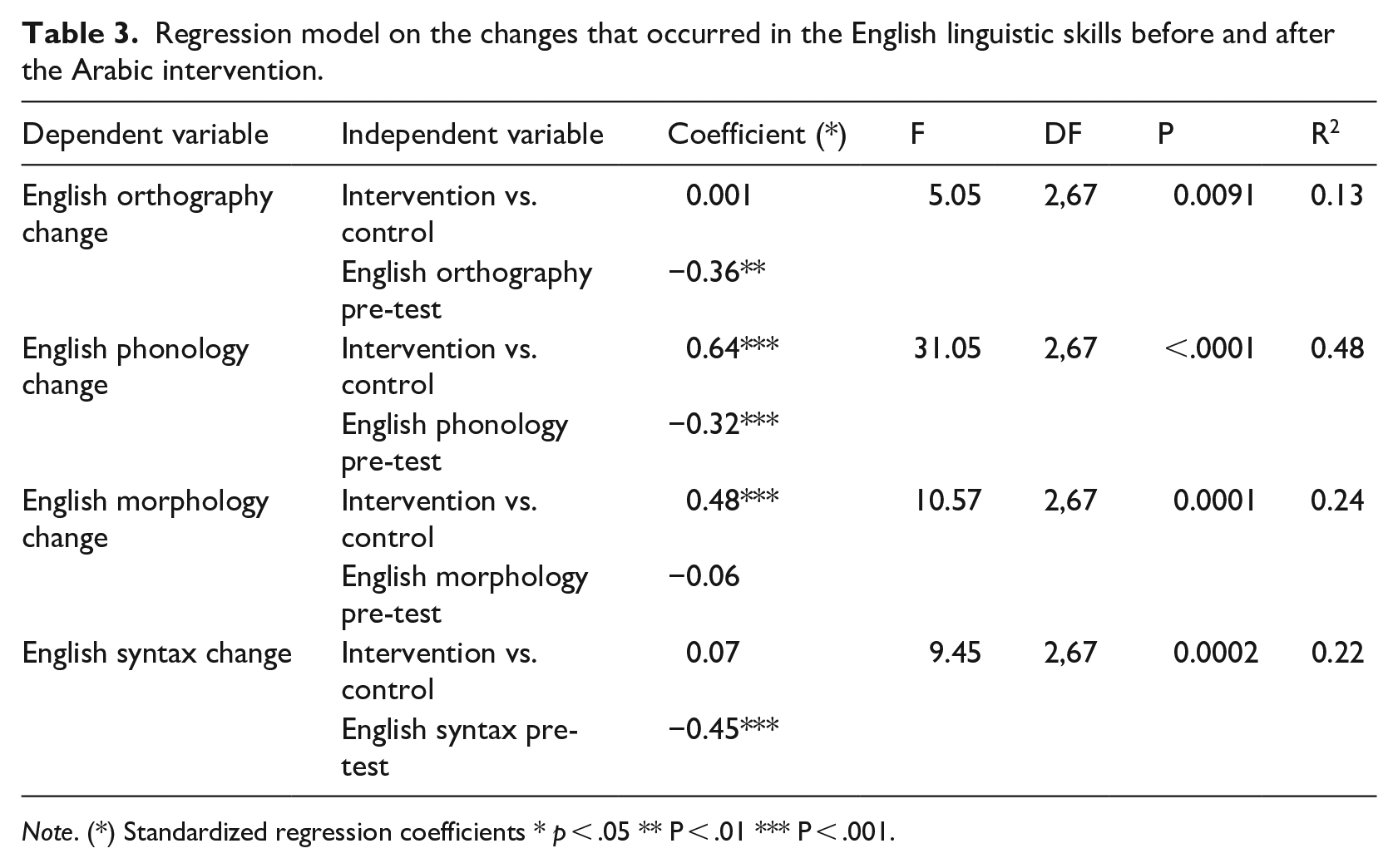
Note. (*) Standardized regression coefficients * p < .05 ** P < .01 *** P < .001.
Discussion
The present study was designed to determine the effect of an intervention program in Arabic on the development of linguistic skills within Arabic and mainly on linguistic skill transfer to English as a foreign language. It also looked into the transfer of orthographic awareness in these two typologically distant languages. To this aim, one group was assigned to the Arabic Intervention program, and the other was not assigned to any intervention. Both groups were assessed on phonological, morphological, syntactic, and orthographic awareness before and after the intervention. Results showed that the intervention group significantly outperformed the control group in all language skills in Arabic. However, it exhibited significant differences in English only in phonological and morphological skills.
Within-language effect
Differences favoring the experimental group were exhibited in all Arabic linguistic skills after the intervention. All linguistic skill measures significantly progressed in the experimental group. This finding consolidates our hypothesis regarding the positive effect of the intervention program on linguistic skills within the same language. These results support convincing evidence from numerous studies with monolingual speakers who benefited considerably when provided with intervention programs on phonological awareness (Abu-Rabia et al., 2013; Cirino et al., 2009; Durgunolu & Oney, 2002; Feder & Abu-Rabia, 2020; Taha & Saiegh-Haddad, 2016; Vaughn et al., 2006; Wimmer et al., 1991), morphological awareness (Abu-Rabia et al., 2013; Badawi, 2019; Feder & Abu-Rabia, 2020; Good et al., 2015; Kraut, 2015; Vaknin-Nusbaum & Raveh, 2019), and syntactic awareness (Abu-Rabia et al., 2013; Feder & Abu-Rabia), Similarly, some prior research shows the importance of explicit instruction and practice in orthographic-skill development (Cirino et al., 2009; Ehri, 1998; Ehri, & Robbins, 1992; Vaughn et al., 2006).
Cross-linguistic transfer of phonological and morphological awareness
The results about transfer from Arabic to English after providing an intervention program in Arabic were partially different from those of within-language development. Findings on phonological transfer consolidated our speculations and demonstrated a positive transfer in all phonological measures. This finding extends the mounting evidence in the literature pertaining to phonological transfer from L1 to L2 in different languages such as, from Russian to Hebrew (Ibrahim et al., 2007), Russian to English (Abu-Rabia & Sanitsky, 2010; Schwartz et al., 2007); English to Hebrew (Wade-Woolley & Geva, 2000), Hebrew to English (Russak & Saiegh-Haddad, 2011), English to French (Wise et al., 2016), Spanish to English (Cirino et al., 2009). The present finding endorses also a few previous studies that looked into the transfer of phonological awareness from Arabic to English (Abu-Rabia & Siegle, 2002; Alshaboul et al., 2014). The phonological transfer from Arabic to English might be explained in light of the diglossic nature of Arabic which implies two forms of the language i.e., spoken and standard (Ferguson, 1959). Diglossia, thus, can be a function of phonological distance between colloquial and standard Arabic as there is lack of phonemic congruency between the two modes (Saiegh-Haddad et al., 2020). According to Asadi and Ibrahim (2014), the phonemic range of spoken and standard Arabic usually overlap. Most phonological structures of the syllables exist either in the standard language or in the spoken language. The authors remark that this difference widens the distance between spoken and standard Arabic phonology. Hence, Arabic speakers are expected to master both structures simultaneously to warrant word decoding. The ongoing ability to shift from one mode to another while perceiving and manipulating phonemes might entail the development of more sensitive phonological awareness, thereby transferring to a foreign language. Yang et al. (2017) in a meta-analysis study on cross-linguistic transfer between Chinese and English argue that the sensitivity, perceptual attention, and the cognitive skills required from the learner in order to manipulate sounds in one language overlap with other languages regardless of language typology. It seems that the intervention program in the current study activated the phonological sensitivity among the interventional group participants which in turn led to phonological awareness transfer to English. As such, conceptualizing and reflecting on L1 sounds can be directly related to the ability to do so with L2/FL sounds (Wade-Woolley & Geva, 2000). Moreover, intensive exposure and practice of sound knowledge and manipulation improve the learner’s phonological abilities in another language (Abu-Rabia et al., 2013; Chen et al., 2010).
In essence, our findings confirm the notion that phonological awareness is mainly a cognitive-linguistic construct independent of the typological differences across languages (Saiegh-Haddad & Geva, 2008). Besides, the positive phonological transfer that occurred from Arabic as L1 to EFL endorses the underlying premise of Cummins’s (1979, 1981) Interdependence Hypothesis which postulates that linguistic skills of all languages acquired by the learner develop within shared mechanisms. It is worth noting that the participants in the present study have acquired L1 phonological skills in their early school years. This might have facilitated a cross-linguistic transfer of phonological items especially after providing explicit instruction of L1 phonology via the intervention program. According to Cummins (1979, 1981, 2012), proficiency developed in one’s L1 can transfer to L2 given that the learner received adequate instruction in L1 and sufficient proficiency in L2.
Another important finding emerging from the current study and supporting Cummins (1979, 1981) view is the morphological transfer that occurred from L1 to L2. Findings corroborate our hypothesis that morphological awareness transfers from Arabic to English. Results showed that transfer of all morphological skills significantly transferred from Arabic to English. This finding is consistent with the increasing amount of studies substantiating transfer from L1 to L2 in a broad array of languages such as Chinese (L1) to English (L2) (Zhang et al., 2014); Hebrew to English (Kahn-Horwitz et al., 2005); Spanish to English (Ramirez et al., 2009, 2010); English to French (Deacon et al., 2007; Lam & Chen., 2018); Turkish to English (Wu & Juffs, 2022); English to Arabic (Saiegh Haddad & Geva, 2008). Apparently, there are several possible explanations for this finding. Kieffer and Lesaux (2012) in their study about L1 morphological role on English reading among Spanish, Filipino, and Vietnamese speakers found that morphological awareness in L1 transfers to derivational morphology in English and thus contributes to English reading comprehension. Ramirez et al. (2010) pointed to the complexity of L1 (Spanish) morphology as a significant factor in transferring morphological awareness to L2 (English) word reading. They contended that since Spanish derivational and inflectional morphemes are intertwined, the learner is required to activate both systems when it comes to morphological analysis in their L1. Activating two morphological systems simultaneously may demand more cognitive effort, thereby developing better morphological skills. This view may generalize to Arabic native speakers who implicitly deal with a rich and complex morphological system. Thus, when it comes to English whose morphology is less complex, transfer from Arabic to English most likely occurs smoothly.
Wu and Juffs (2022) attributed the transfer of Turkish (L1) morphology to that of English (L2), in their study, to the implicit processing routines in Turkish word structure. They contend that these routines led to more attentiveness to the morphemic structure of L2 English words. They argued that L1 computations in inflection and derivation could transfer to L2 derivation. This can explain the significant transfer that occurred in the present study from Arabic morphology to English derivational morphology. Arabic morphology is linear in terms of locating affixes around the base word and non-linear as it requires interweaving a pattern with the root to form nominal and verbal derivations (Abu-Rabia, 2001; Saiegh-Haddad & Henkin-Roitfarb, 2014). Hence, the morphological transfer from Arabic to English in the current study may lie in the complexity of Arabic morphology being linear and non-linear which demands higher cognitive abilities of composition and decomposition of words in order to comprehend them (Boudelaa, 2014; Boudelaa et al., 2010). It seems that these cognitive processes transfer from Arabic to English derivational morphology awareness and processing. This finding about transfer from a more complex morphological system to a less complex system aligns with previous studies on cross-linguistic transfer (Deng et al., 2016; Ramirez et al., 2010; Saiegh-Haddad & Geva, 2008; Wu and Juffs, 2022). To put it differently, when learners’ L1 morphology is complex, they might develop higher sensitivity to morphological skills which in turn transfers across languages. The intervention program, thus, could have stimulated the morphological sensitivity among the participants in the intervention group which contributed to the morphological transfer that occurred from Arabic to English.
Absence of orthographic and syntactic transfer
In line with our assumption, the significant intervention effect on phonological and morphological awareness failed to be significant on orthographic transfer from Arabic to English. This finding is pursuant to prior research on cross-linguistic transfer of diverse orthographies as no orthographic transfer occurred from a Roman-alphabetic script such as English to a Semitic script as Arabic and Hebrew, or a Hangul script such as Korean, or Cyrillic alphabet such as Russian (Abu-Rabia, 2001; Abu-Rabia et al., 2013; Feder & Abu Rabia 2020; Gottardo et al., 2001; Keung & Ho, 2009; Schwartz et al., 2007; Wang et al., 2006). The findings of these studies were suggestive of the Script-Dependent Hypothesis approach which establishes that orthography is language-specific, thereby preventing transfer. This view, thus, seems to apply to the absence of orthographic transfer from Arabic to English in the present study.
Wang et al. (2006), attempted to attribute the absence of transfer from Korean as L1 to English as L2 to Hangul’s orthography shallowness. While in Hangul each grapheme maps onto a single phoneme, in English the relation between graphemes and phonemes is opaque due to its deep orthography. Thus, no support from Korean orthography to English orthography was expected. This argument may partially explain the present finding regarding Arabic-English transfer in terms of shallowness. Although Arabic orthography is shallower than that of English, it is built up of various and complex conventions of which none resembles any of the English orthographic conventions. Therefore, it seems that there were no shared intersections to allow transfer from Arabic to English in the area of orthography.
No syntactic transfer was evident from L1 to FL in the present study. This finding ties in with those of Verhoeven (1994) who reported no empirical evidence for linguistic interdependence at the syntactic level in Turkish (L1) and Dutch (L2) and with those of Gottardo (2002) who found no evidence of transfer at the syntactic level from Spanish (L1) to English (L2). Koda (2007) differentiates syntactic awareness from other linguistic skills such as phonological and morphological awareness. According to her, syntactic awareness entails an incremental lexical integration process that contributes to constructing meaning while comprehending a sentence. The integration process or the so-called “syntactic parsing” has to do with innate structure development which enables little children to comprehend and reconstruct complex structures in their L1 prior to literacy instruction. Koda (2007) explains that little does syntactic awareness in L1 account for that of L2 since syntactic parsing is language-dependent. Thus, L2 learners have to learn sentence construction in the new language separately. This can elucidate the reason for the absence of syntactic transfer from Arabic to English in the current study. Apparently, the syntactic instruction of the Arabic free pattern provided for English FL learners, in the present study, did not transfer to English syntax due to specific differences in syntax parsing of each language.
In summary, while the absence of syntactic transfer from Arabic to English in the present study corroborates Koda’s (2007) view, the transfer of phonological and morphological awareness provides evidence to CUP (Common Underlying Proficiency) which underpins his Interdependence Hypothesis (Cummins, 1979, 1981) by establishing that linguistic skills transfer from one language to another, especially when adequate instruction is provided. These results support the possibility of cross-linguistic transfer between two typologically distant languages. The finding regarding orthographic transfer, however, supported the Script-Dependent Hypothesis which contends that each language is characterized by its specific orthographic system, thereby preventing transfer across languages.
Supplemental Material
sj-docx-1-ijb-10.1177_13670069241300286 – Supplemental material for Exploring cross-linguistic transfer of phonology, morphology, syntax, and orthography from Arabic (L1) to English (FL): An intervention study
Supplemental material, sj-docx-1-ijb-10.1177_13670069241300286 for Exploring cross-linguistic transfer of phonology, morphology, syntax, and orthography from Arabic (L1) to English (FL): An intervention study by Laila Haddad-Najjar and Salim Abu-Rabia in International Journal of Bilingualism
Footnotes
Acknowledgements
The authors are grateful to the anonymous reviewer for their constructive feedback and their insightful and valuable comments. They are also grateful to Professor Ad Backus for his editorial help and support.
Data availability statement
Supplemental material for this article is available online in the OSF repository: DOI 10.17605/OSF.IO/N49WV.
Declaration of conflicting interests
The author(s) declared no potential conflicts of interest with respect to the research, authorship, and/or publication of this article.
Funding
The author(s) received no financial support for the research, authorship, and/or publication of this article.
Ethical approval statement
This study was approved by the University of Haifa, Faculty of Education Research Ethics Committee (approval no. 078/22) on 1 March 2022.

Supplemental material
Supplemental material for this article is available online.
Author biographies
References
Supplementary Material
Please find the following supplemental material available below.
For Open Access articles published under a Creative Commons License, all supplemental material carries the same license as the article it is associated with.
For non-Open Access articles published, all supplemental material carries a non-exclusive license, and permission requests for re-use of supplemental material or any part of supplemental material shall be sent directly to the copyright owner as specified in the copyright notice associated with the article.
