




Abstract
Purpose:
The study offers insights into the interplay between mood and the language of operation in the context of stereotype judgements in female bilinguals.
Methodology:
Participants were presented with gender stereotypically congruent and incongruent sentences in their L1 (Polish) and L2 (English). They performed a stereotype congruency judgement task while their behavioural responses were being recorded.
Data and analysis:
The speed and accuracy of participants’ responses were measured and analysed using linear and generalised mixed-effect modelling, respectively.
Findings:
Our results indicated that bilinguals’ positive and negative mood states may interact with the language of operation, irrespective of stereotype congruency. We observed a facilitatory effect on response times of a positive relative to negative mood in L2 as opposed to L1. Such findings point to strong internalisation of gender stereotype in L1, with the behavioural responses remaining unaffected by mood changes, as well as decreased internalisation of gender stereotypes and their weaker accessibility in L2 compared to L1.
Originality:
The study is the first to illuminate the complex interplay among mood, language of operation, and stereotype activation, enhancing our understanding of the cognitive processes underpinning social judgements in bilingual speakers.
Significance:
The reduced accessibility of gender stereotypes in L2 might carry important consequences for various domains such as social interactions, politics, and employment situations, where L2 may serve as a tool for encouraging gender equality and diminishing gender-based stereotypes and biases.
Introduction
Gender stereotypes encompass generalised beliefs, attributes, and expectations associated with men and women (Eagly & Wood, 2016). While previous studies have indicated the automatic activation of gender stereotypes during native language (L1) processing (Molinaro et al., 2016; Osterhout et al., 1997), recent findings have pointed to decreased automaticity of gender stereotype processing in the context of a non-native language (L2), potentially indicating a reduced internalisation of gender stereotype knowledge in L2 (Jankowiak, Naranowicz, et al., 2024). However, little is known about the potential modulation of gender stereotype activation in bilinguals by their mood, defined as a low-intensity, slowly changing affective background state that fluctuates between pleasant (positive) and unpleasant (negative) internal conditions (Forgas, 2017). Recent research has indicated that mood influences semantic processing differently in L1 and L2 (Kissler & Bromberek-Dyzman, 2021; Jankowiak et al., 2022; Naranowicz et al., 2022, Naranowicz, Jankowiak, et al., 2022; Naranowicz et al., 2023; Naranowicz & Jankowiak, 2024). Yet, it remains unexplored whether mood can have an impact on access to not only semantic, but also stereotype knowledge systems in both L1 and L2. Therefore, this study aims to investigate how positive and negative moods modulate the automatic activation of gender stereotypes in L1 (Polish) and L2 (English).
Gender stereotype processing in L1 and L2
Understanding how individuals acquire, store, and process stereotypes is a fundamental aspect of social cognition. Stereotypes represent social knowledge that encompasses pre-existing semantic knowledge about the world and profoundly influences human perception, actions, and attitudes (Greenwald & Farnham, 2000; Siyanova-Chanturia et al., 2012). Previous psycholinguistic research has consistently suggested that gender stereotypes are activated automatically and are difficult to inhibit (Contreras et al., 2012; Proverbio et al., 2018). For instance, sentences violating gender stereotypes (e.g., Males carefully watch their waistline before the wedding.) have been observed to elicit more cognitively taxing lexico-semantic access and meaning integration mechanisms, as evidenced by event-related potential (ERP) patterns (Molinaro et al., 2016; Osterhout et al., 1997; Pesciarelli et al., 2019). This points to the deeply ingrained nature of gender stereotypes within semantic memory networks and indicates that their violation is perceived as a linguistic error (Proverbio et al., 2018; Jankowiak, Naranowicz, et al., 2024).
Recent research has expanded the investigation of gender stereotype processing to the domain of bilingualism (Jankowiak, Naranowicz, et al., 2024), and pointed to a reduced internalisation of gender stereotype knowledge in L2, potentially indicating decreased sensitivity to stereotype-laden information when operating in L2. This reduced reliance on stereotypes in L2 processing has been proposed to stem from weaker connections between general stereotype knowledge and L2 lexico-semantic representations (Jankowiak, Naranowicz, et al., 2024). Such findings align with previous research indicating that bilinguals’ psychosocial processes are influenced by the language of operation. Notably, bilinguals have been observed to exhibit higher levels of empathy when operating in their L2 (Wu et al., 2020). Bilinguals relative to monolinguals have also been found to show reduced social biases, possibly due to their higher cognitive flexibility (Castro et al., 2022).
Mood and stereotype activation
Sociological research exploring how mood regulates social judgements has pointed to facilitatory effect of a positive mood on stereotype activation (Curtis, 2013; Park & Banaji, 2000; M. Wang et al., 2015; but see Huntsinger et al., 2010; Krauth-Gruber, & Ric, 2000). Such an effect could be accounted for by the Mood-and-general-knowledge (MAGK) framework (Bless, 2001; Bless et al., 1996), proposing that mood differently shapes our cognitive architecture through reliance on retrievable knowledge. As it signals being in a benign situation, a positive mood is argued to promote assimilative thinking and reliance on heuristics (i.e., mental shortcuts), including stereotypes, expectations, cognitive biases, scripts, and schemas. Conversely, being associated with the presence of imminent threat, a negative mood is argued to reduce heuristics-based processing, thereby motivating accommodative and analytical (i.e., detail-oriented) thinking when processing social information (see also Clore & Huntsinger, 2009 for further discussion).
Correspondingly, the interaction between mood and stereotype activation has also been accounted for by the Affect-as-information (AAI) framework (Clore & Storbeck, 2006; Schwarz & Clore, 1983), holding that mood serves as an embodied source of information that regulates our memory, thinking, and (social) judgements. Being associated with cognitive ease, a positive mood is thought to activate effortless top-down and referential processing (i.e., connecting new information with accessible knowledge in search of associations). In contrast, requiring more extended cognitive effort, a negative mood is argued to promote effortful bottom-up and referential processing (i.e., categorising new information based on its individual attributes, without connecting it to accessible knowledge).
Altogether, the theoretical approaches along with empirical evidence suggest that being in a positive mood leads to inferential errors (i.e., misattribution) in social judgements. Specifically, due to reliance on accessible knowledge and assimilative thinking, a positive mood might trigger a more automatic activation of stereotypical knowledge, thus giving priority to stereotype-congruent attributes in social judgements. On the contrary, as a result of suppressed heuristics-based and promoted accommodative thinking, a negative mood leads to more systematic and unbiased social judgements. Yet, while recent evidence suggests that mood effects on semantic processing may be modulated by the language of operation (e.g., Jankowiak et al., 2022; Naranowicz et al., 2022, Naranowicz, Jankowiak, et al., 2022), little is known about the interactions between mood and stereotype activation in a bilingual context, as measured through the lens of language.
Mood and bilingualism
Growing evidence has indicated that mood modulates semantic processing in both L1 and L2 (see Naranowicz, 2022 for a review). Specifically, a prevalent trend suggests that a positive mood, in contrast to a negative one, fosters more effective meaning comprehension, as observed in the monolingual (Chwilla et al., 2011; Van Berkum et al., 2013; P. Wang et al., 2017) and bilingual contexts (Kissler & Bromberek-Dyzman, 2021; Jankowiak et al., 2022; Naranowicz et al., 2022, Naranowicz, Jankowiak, et al., 2022, 2023; Naranowicz & Jankowiak, 2024). These studies collectively shed light on both the differences and parallels in how mood shapes semantic processes in both L1 and L2 of bilingual individuals. For instance, Jankowiak et al. (2022) observed increased semantic integration and re-evaluation of the sentences violating general knowledge in a positive as opposed to negative mood in both L1 and L2. A complementary pattern was then observed in a follow-up study at a behavioural level, with semantic judgements being overall faster in a negative than positive mood, the effect being more robust in L2 (Naranowicz & Jankowiak, 2024).
This study
In this behavioural study, highly proficient Polish (L1)–English (L2) female bilinguals were induced into a positive and negative mood and made stereotype congruency judgements about L1 and L2 sentences conforming to (i.e., stereotypically congruent sentences) and violating (i.e., stereotypically incongruent sentences) gender stereotypes. To the best of our knowledge, this is the first study systematically testing how mood interacts with the language of operation in the context of stereotypical thinking about gender roles. Building upon previous research, we predicted to observe a mood-driven effect on stereotypical thinking, dependent upon the language of operation. Specifically, we expected to observe more automatic gender stereotype activation in a positive than negative mood in L1 (Bodenhausen et al., 2001; Huntsinger et al., 2009; Isbell, 2004), the effect being larger for stereotypically congruent than incongruent sentences (Hypothesis 1; Huntsinger et al., 2010; P. Wang et al., 2017). This would be reflected in facilitated behavioural responses (i.e., faster response times [RTs] and higher accuracy) to L1 stereotypically congruent relative to incongruent sentences in a positive but not negative mood. In L2, we predicted to observe reduced gender stereotype activation, irrespective of the mood type (Hypothesis 2; Jankowiak, Naranowicz, et al., 2024). This would be reflected in a smaller stereotype congruency effect in L2 than L1 in both mood conditions. These predictions align with the MAGK (Bless, 2001; Bless et al., 1996) and AAI (Clore & Storbeck, 2006; Schwarz & Clore, 1983) frameworks, which suggest increased reliance on pre-existing knowledge in a positive mood compared to a negative mood, a tendency that may be attenuated in L2 relative to L1 (Jankowiak, Naranowicz, et al., 2024). Note that early evidence has suggested that positive and negative moods may differently alter bilingual language processing, pointing to strong context-dependence of such mood effects (e.g., Jankowiak et al., 2022; Naranowicz et al., 2022a, Naranowicz, Jankowiak, et al., 2022, 2023; Naranowicz & Jankowiak, 2024). Yet, mood effects on language-driven stereotypical thinking have not yet been tested in a bilingual context, and therefore no other detailed hypotheses were formulated about the relationship between mood, stereotype congruency, and the language of operation. Importantly, we also exploratorily analysed if and how gender reference (i.e., stereotypes being associated with men or women) further modulates the relationship between mood and stereotype activation in L1 and L2, therefore employing half of the stimuli referring to men and the other half to women.
Methods
Participants
Forty Polish (L1)–English (L2) bilinguals participated in the study, two of whom were excluded from the analyses due to technical problems during data collection. The final sample, therefore, consisted of 38 participants aged 19–25 (MAge = 21.72 years 95% confidence interval [CI]: [21.24, 22.20]), who were students of English Studies at [intentionally removed to ensure anonymity]. Consistent with de Groot (2011), participants were classified as highly proficient L1-dominant late bilinguals who had not lived in the L2 environment and had acquired their L2 in an instructional yet immersive learning context (see Table 1). All participants were women, given the previous studies pointing to sex-dependent mood effects on language processing (Federmeier et al., 2001; Naranowicz et al., 2023). They were all right-handed, had normal/corrected-to-normal vision and no neurological, mood, psychiatric, and language disorders. The questionnaires measuring their perception of and attitudes towards gender identity (see Table 1) indicated a high alignment with traits traditionally associated with femininity. Participants exhibited a low degree of sexist attitudes along with a high degree of feminist and egalitarian attitudes towards women, and strongly identified with their gender. For their participation, participants received extra credit points. Note that the power analysis dedicated to linear mixed-effect modelling (Westfall et al., 2014) for the design employed in this study showed that participation of 38 individuals exposed to a total of 240 stimuli would yield a power of 0.97 to detect medium-to-large effects (Cohen’s d > 0.50).
Participants’ characteristics (means with 95% confidence intervals [CIs]).
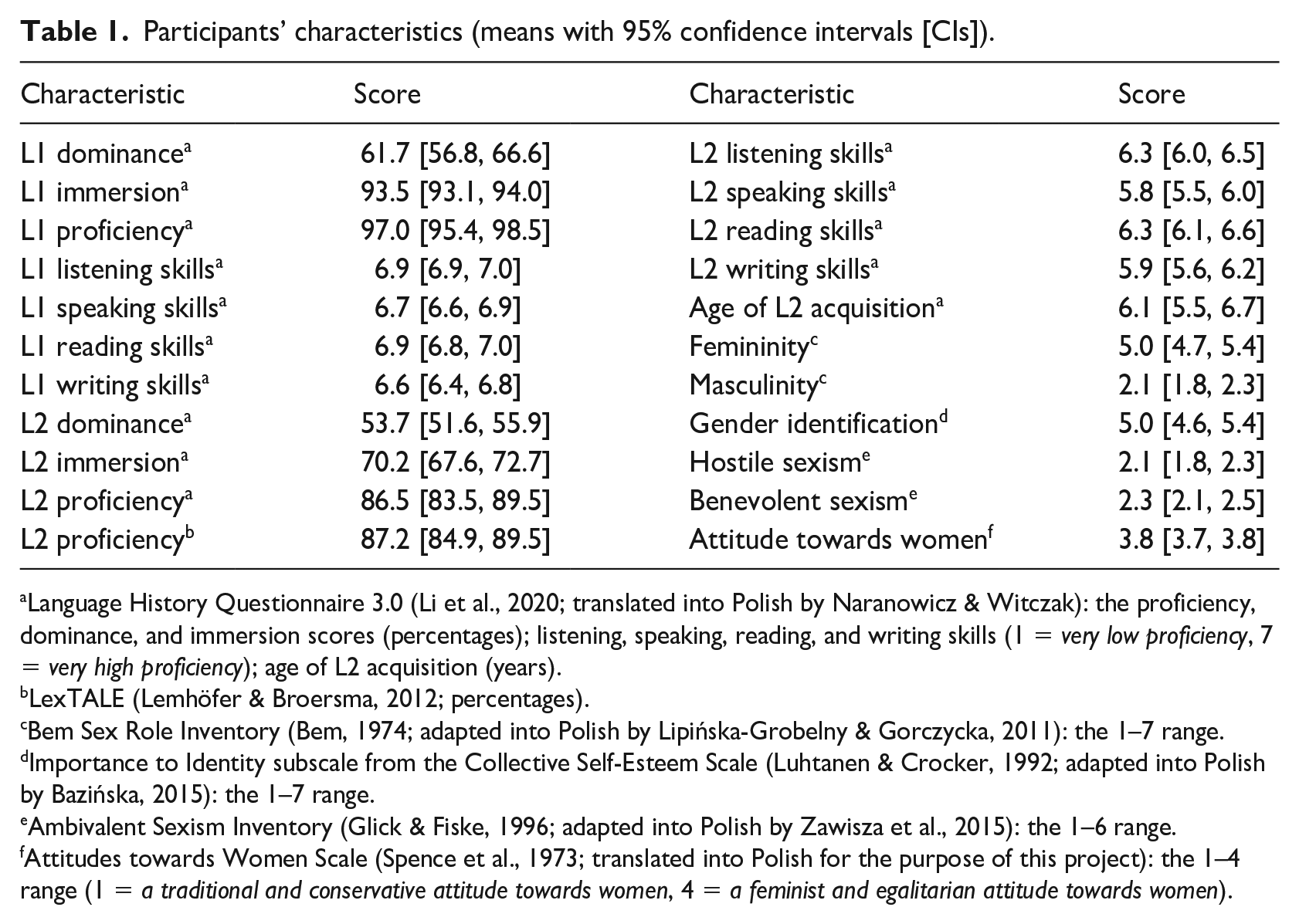
Language History Questionnaire 3.0 (Li et al., 2020; translated into Polish by Naranowicz & Witczak): the proficiency, dominance, and immersion scores (percentages); listening, speaking, reading, and writing skills (1 = very low proficiency, 7 = very high proficiency); age of L2 acquisition (years).
LexTALE (Lemhöfer & Broersma, 2012; percentages).
Bem Sex Role Inventory (Bem, 1974; adapted into Polish by Lipińska-Grobelny & Gorczycka, 2011): the 1–7 range.
Importance to Identity subscale from the Collective Self-Esteem Scale (Luhtanen & Crocker, 1992; adapted into Polish by Bazińska, 2015): the 1–7 range.
Ambivalent Sexism Inventory (Glick & Fiske, 1996; adapted into Polish by Zawisza et al., 2015): the 1–6 range.
Attitudes towards Women Scale (Spence et al., 1973; translated into Polish for the purpose of this project): the 1–4 range (1 = a traditional and conservative attitude towards women, 4 = a feminist and egalitarian attitude towards women).
Materials
Mood-inducing stimuli
To experimentally induce the targeted positive and negative moods, participants were exposed to five positive and five negative mood-inducing films. These were 90-second, physiologically arousing, non-narrative, and affectively evocative animated films. They were adapted from the study by Naranowicz et al. (2023), and were rated on 7-point valence (1 = inducing a very negative mood, 7 = inducing a very positive mood) and arousal (1 = very physiologically unarousing, 7 = very physiologically arousing) scales. The positive compared to negative mood-inducing films were rated significantly higher on the valence scale (MPositiveFilms = 5.07, 95% CI: [4.26, 5.89]; MNegativeFilms = 2.09, 95% CI: [1.28, 2.89]), b = –2.99, SE = 0.49, t(8.21) = –6.10, p < .001, and there was no difference between the two film types in arousal ratings (MPositiveFilms = 2.60, 95% CI: [1.37, 3.83]; MNegativeFilms = 3.59, 95% CI: [2.43, 4.75]), b = 0.99, SE = 0.60, t(6) = 1.64, p = .154. To sustain the evoked targeted mood, each selected film was additionally divided into two 45-second fragments, which resulted in the presentation of 20 film fragments in both mood conditions (i.e., 15 minutes).
Linguistic stimuli
The linguistic stimuli included 120 Polish and 120 English declarative and emotionally neutral sentences, divided into two categories: 60 stereotypically congruent (e.g., Their niece became a hairdresser.) and 60 stereotypically incongruent (e.g., Their nephew became a hairdresser.) sentences in each language. Within each condition, half of the sentences were related to women (n = 30) and another half to men (n = 30). Polish sentences comprised four to six words, and English sentences comprised five to seven words. The larger number of words per sentence in English than Polish was due to articles in English, which do not exist in Polish. The sentences were adopted from a database by Jankowiak et al. (2024b), and were controlled for their meaningfulness, probability of use, and stereotypicality level. The critical words were presented in a sentence-final position. They were adopted from a database by Jankowiak et al. (2024a), and were controlled for their frequency, valence, arousal, concreteness, age of acquisition, as well as the number of letters and syllables.
Procedure
The procedure applied in the experiments was approved by a local ethics committee [intentionally removed to ensure anonymity]. Participants gave their written informed consent before participation. Prior to data collection, participants were screened online with questionnaires measuring their medical history, language history, L2 proficiency, and attitudes towards and identification with different gender roles (see Table 1). The questionnaires were administered 3 weeks before the experiment proper to minimise the risk of potential impact of the gender-related questionnaires on experimental performance. Participants were seated 75 cm away from an LED monitor with a screen resolution of 1280×1024 pixels in dimly lit and quiet booths. E-Prime 3.0 was employed to present the stimuli and collect the behavioural data.
Participants were presented with 10 positive and 10 negative mood-inducing film fragments of 45 second each in two separate mood blocks. The film fragments were presented in a random order in each mood block. To strengthen the induced mood states, participants were additionally instructed to put themselves in the targeted mood (Rottenberg et al., 2018) and imagine themselves as one of the protagonists (Werner-Seidler & Moulds, 2012). Between the two mood blocks, participants watched a 5 minute fragment of a low-arousing non-narrative screensaver depicting abstract shapes to neutralise the mood state evoked first. Participants were asked to rate their current emotional state before and after each mood block. In both experiments, participants first watched three film fragments to elicit the targeted mood and then they alternately read 15 sentences and were presented with another film fragment to sustain the evoked mood state.
Participants’ task was to decide if the presented Polish (L1) and English (L2) sentences were congruent with gender stereotypes. They read 120 Polish and 120 English sentences presented in a random order and separate language blocks, each including 60 stereotypically congruent and 60 stereotypically incongruent. In total, participants made stereotype congruency judgements of 240 sentences. The order of the mood and language blocks as well as key designation were counterbalanced across participants. All instructions were provided in the language corresponding to the first experimental block. The time sequence of stimuli presentation is provided in Figure 1.
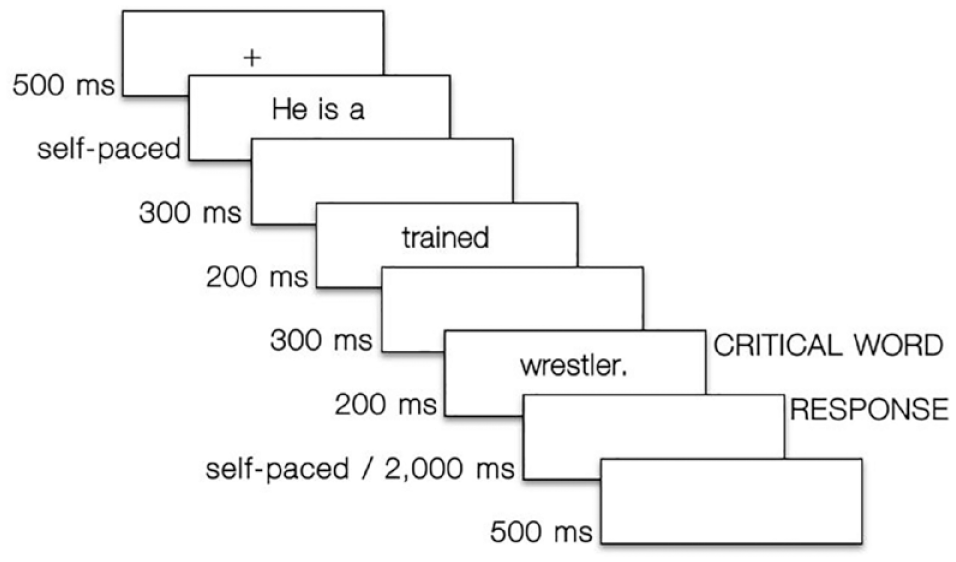
Time sequence of stimuli presentation.
Study design
The mood rating data analysis conformed to a 2 (Time of measure: Before vs After mood induction) × 2 (Mood: Positive vs Negative) within-subject design. The RT and response accuracy data analyses conformed to a 2 (Mood: Positive vs Negative) × 2 (Language: Polish [L1] vs English [L2]) × 2 (Stereotype congruency: Stereotypically congruent vs Stereotypically incongruent) × 2 (Gender reference: Female-related vs Male-related) within-subject design. Note that all the variables, including the exploratory variable of Gender reference, were analysed in one model, which allowed us to better understand their complex relationship and account for a potentially mediating role of Gender reference.
Data analysis
All statistical analyses were performed in R Core Team (2020). Participants rated their current affective state using 7-point valence, arousal, and motivation scales (i.e., bipolar dimensions). To ensure the effectiveness of our mood manipulation, we compared all mood ratings after relative to before mood induction separately in each mood condition as planned comparisons, predicting increased/comparable mood ratings in the positive mood condition along with decreased mood ratings in the negative mood condition (see Naranowicz, 2022 for a review).
The analysis of RTs was based on correct responses only. The RTs below 200 ms and above 1,500 ms as well as those falling outside the value of 1.5 interquartile range were discarded from further analyses, altogether resulting in the final rejection of 0.87% of behavioural data.
The mood ratings and RT data were analysed with linear mixed-effects models (Baayen et al., 2008; Barr, 2013; Barr et al., 2013) and response accuracy with generalised linear mixed-effects model (Baayen et al., 2008; Barr, 2013; Barr et al., 2013; Jaeger, 2008), using the lme4 package (Bates et al., 2015). A maximal model was first computed with a full random-effect structure, including subject- and item-related variance components for intercepts and by-subject and by-item random slopes for fixed effects (Barr et al., 2013). We reduced the model complexity to arrive at a parsimonious model using principal component analysis (Bates et al., 2015). The b estimates and significance of fixed effects and interactions (p-values) were based on the Satterthwaite approximation for mixed-effects models (the lmerTest package; Kuznetsova et al., 2017). All R scripts, full model specifications, the linguistic and mood-inducing materials, as well as the raw data files used in the analyses are publicly available at https://osf.io/ukpj5/.
The final structure of each model is presented below:
lmer(RT ~ Mood*Language*StereotypeCongruency*GenderReference + (1 + Language + StereotypeCongruency| Participant) + (1 + StereotypeCongruency| Stimulus)
glmer(Accuracy ~ Mood*Language*StereotypeCongruency*GenderReference + (1 + StereotypeCongruency| Participant) + (1 + Mood*StereotypeCongruency| Stimulus)
Results
Mood ratings
The analysis of the valence ratings showed fixed effects of Mood, b = –0.66, SE = 0.13, t(111) = –5.10, p < .001, and Time of measure, b = 0.50, SE = 0.13, t(111) = 3.88, p < .001, as well as a Mood × Time of measure interaction, b = 2.21, SE = 0.26, t(111) = 8.57, p < .001. Planned comparisons showed a decrease in the valence ratings after compared to before mood induction in the negative mood, b = 1.61, SE = 0.18, t(111) = 8.80, p < .001, with an increase in a positive mood, b = –0.61, SE = 0.18, t(111) = –3.32, p = .001 (see Figure 2).
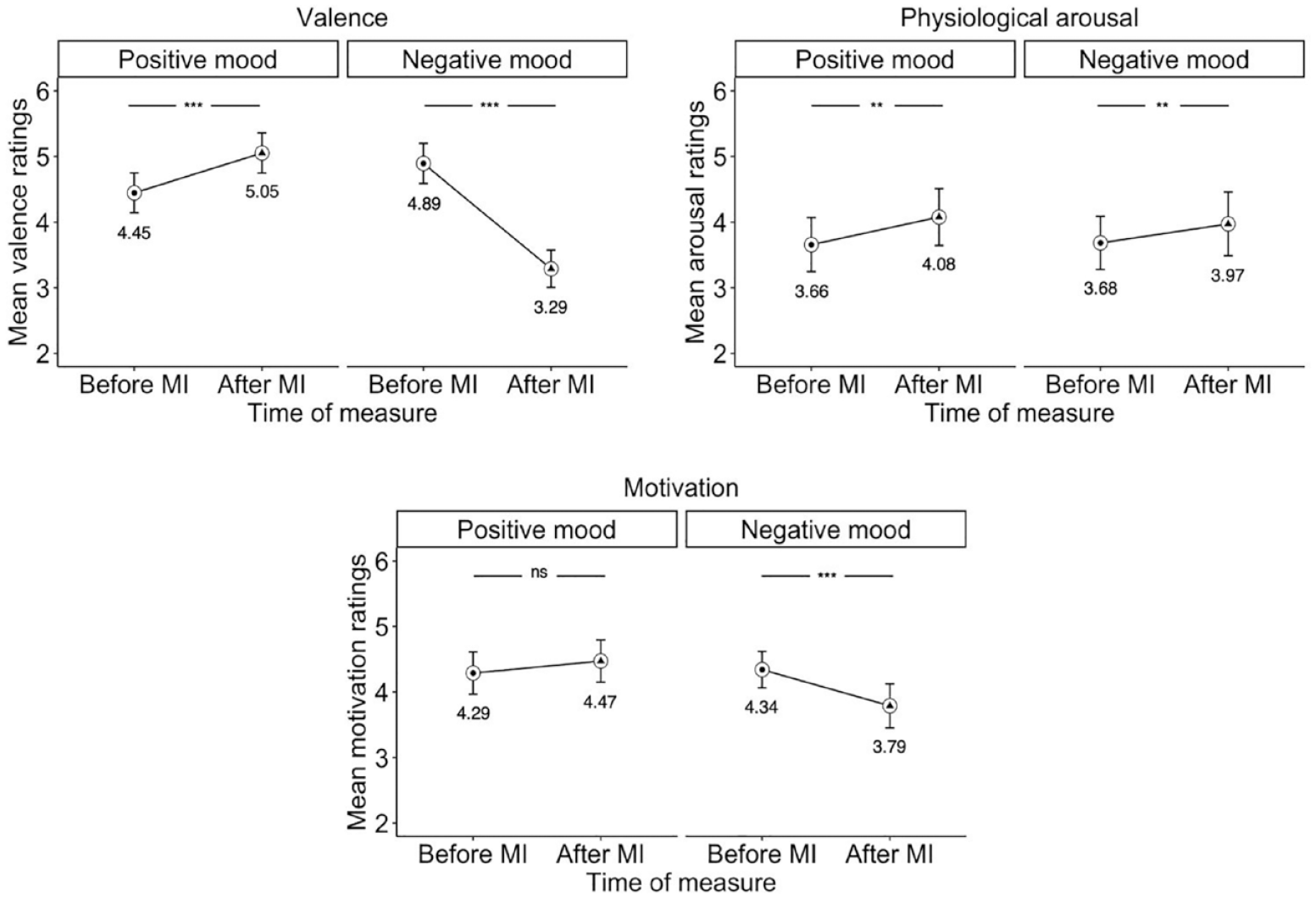
Participants’ affective state before and after mood induction (MI) in the positive and negative mood conditions.
The analysis of the arousal ratings showed only a fixed effect of Time of measure, whereby participants reported feeling more physiologically aroused after relative to before mood induction, b = –0.36, SE = 0.15, t(111) = –2.39, p = .019 (see Figure 2).
The analysis of the motivation ratings showed a fixed effect of Mood, b = –0.32, SE = 0.11, t(111) = –2.86, p = .005, as well as a Mood × Time of measure interaction, b = 0.74, SE = 0.22, t(111) = 3.34, p = .001. Post hoc comparisons showed a decrease in the motivation ratings after compared to before mood induction in a negative mood, b = 0.55, SE = 0.16, t(111) = 3.54, p < . 001, with no difference in the motivation ratings in a positive mood, b = –0.18, SE = 0.16, t(111) = –1.18, p = .240 (see Figure 2).
Response accuracy
The analysis of response accuracy showed a fixed effect of Gender reference, whereby participants responded to female-related sentences with greater accuracy than to male-related sentences, p = .001 (see Table 2).
Response accuracy data: Mean response accuracies with 95% CIs along with the results of the generalised linear mixed-effects models.
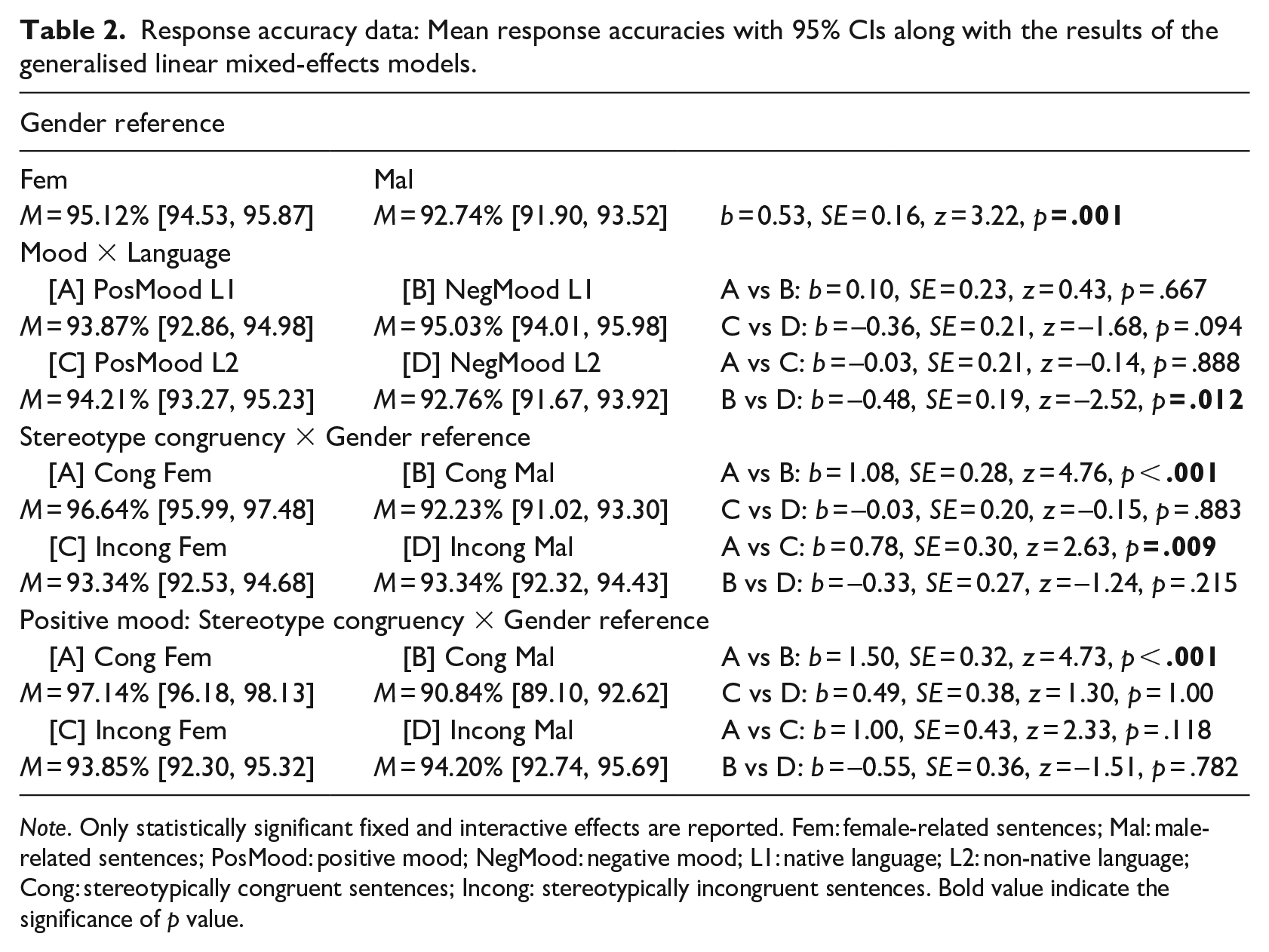
Note. Only statistically significant fixed and interactive effects are reported. Fem: female-related sentences; Mal: male-related sentences; PosMood: positive mood; NegMood: negative mood; L1: native language; L2: non-native language; Cong: stereotypically congruent sentences; Incong: stereotypically incongruent sentences. Bold value indicate the significance of p value.
The analysis also yielded a two-way Mood × Language interaction. Post hoc comparisons revealed that Polish (L1) sentences were responded to with higher accuracy than English (L2) sentences in a negative mood, p = .012, with no between-language differences in a positive mood, p = .888 (see Figure 3 and Table 2). Yet, there were no between-mood differences for Polish (L1), p = .667, and English (L2) sentences, p = .094 (see Table 2).
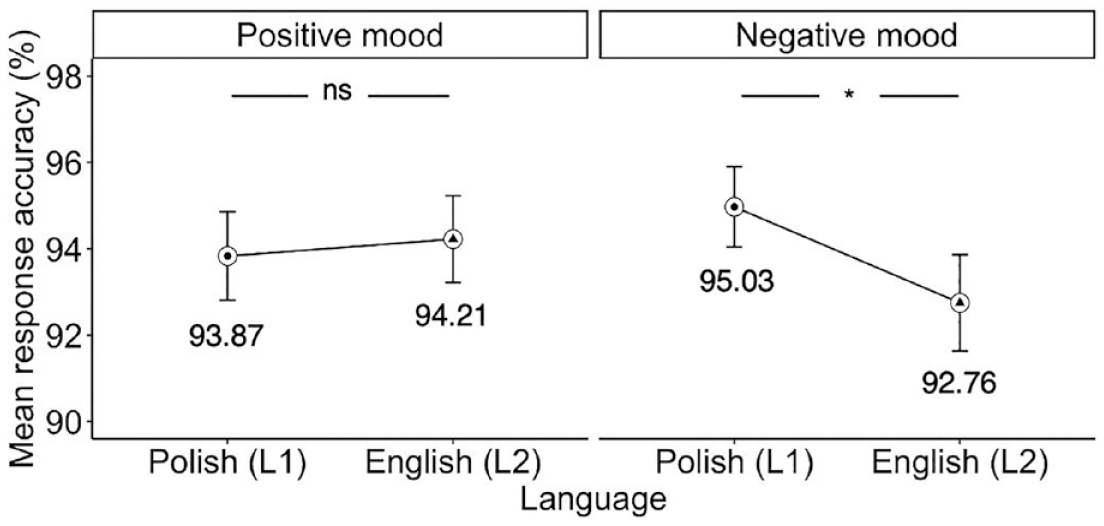
The interactive effect of response accuracies between mood and the language of operation.
There was also a Stereotype congruency × Gender reference interaction. Post hoc comparisons showed higher accuracy for stereotypically congruent female- than male-related sentences, p < .001, with no differences for stereotypically incongruent sentences, p = .883. Moreover, there was higher accuracy for stereotypically congruent than incongruent female-related sentences, p = .009, with no difference between the two sentence types for male-related sentences, p = .215 (see Table 2).
The analysis further revealed a Mood × Stereotype congruency × Gender reference interaction. Further analyses were performed separately for a positive and negative mood, revealing a two-way Stereotype congruency × Gender reference interaction in a positive mood only. Post hoc comparisons revealed that stereotypically congruent female-related sentences achieved higher accuracy than stereotypically congruent male-related sentences in a positive mood, p < .001, with no difference in response accuracy between stereotypically incongruent female- and male-related sentences in a positive mood, p = 1.00 (see Figure 4 and Table 2) as well as between female-related stereotypically congruent and incongruent sentences, p = .118, and male-related stereotypically congruent and incongruent sentences, p = .782 (see Table 2). All remaining differences in response accuracy were statistically non-significant, all p > .05.
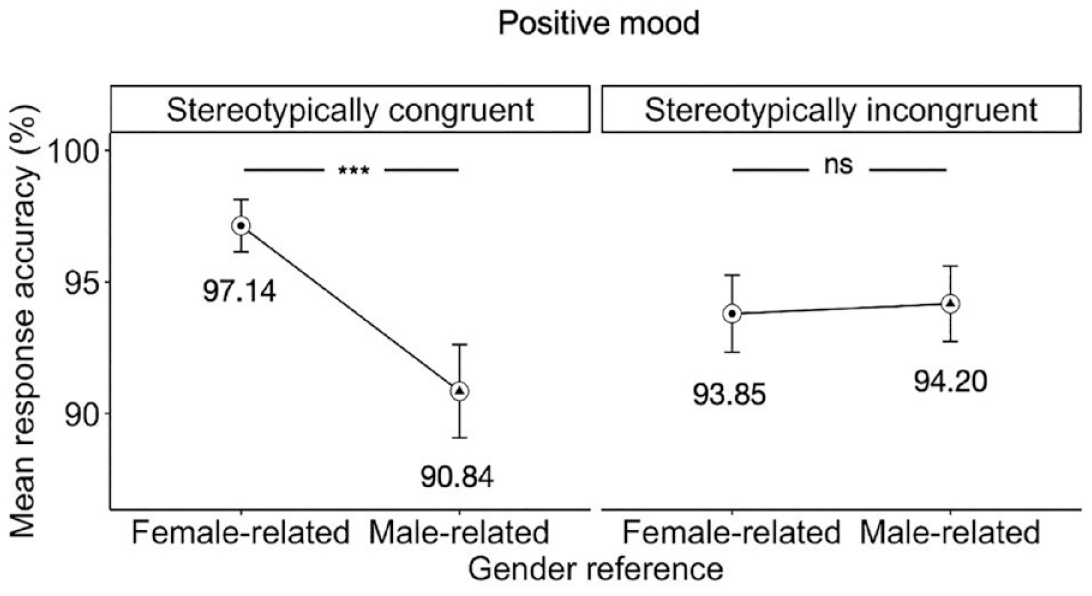
The interactive effect of response accuracies between sentence congruency and gender reference in the positive mood condition.
Response times
The analysis of RT data yielded a fixed effect of Stereotype congruency, with faster RTs for stereotypically congruent than incongruent sentences, p < .001. The analysis also revealed a fixed effect of Language, with faster RTs for Polish (L1) than English (L2) sentences, p < .001. There was also a fixed effect of Gender reference, with faster RTs for female- than male-related sentences, p < .001 (see Table 3).
Response accuracy data: Mean response accuracies with 95% CIs along with the results of the generalised linear mixed-effects models.
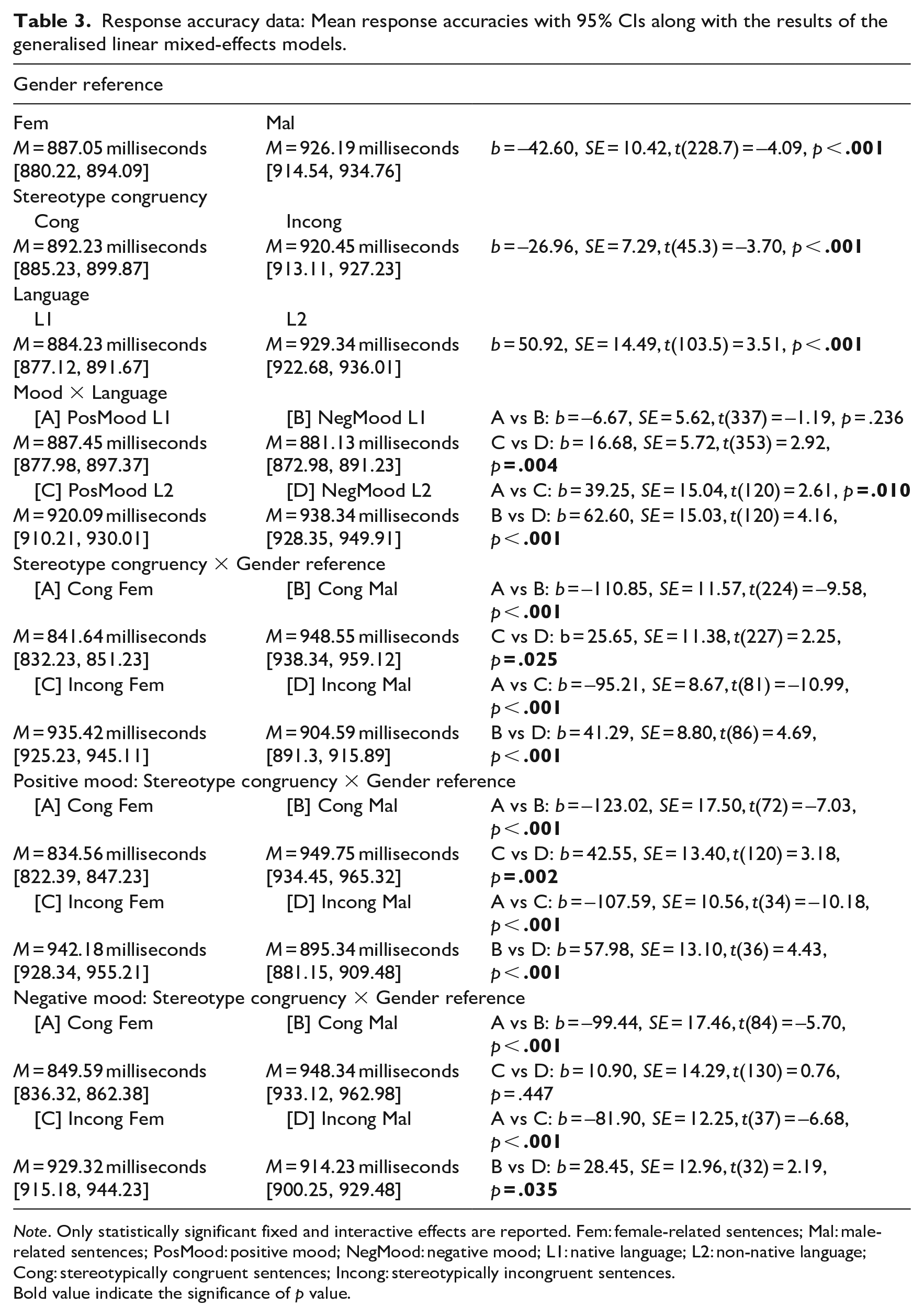
Note. Only statistically significant fixed and interactive effects are reported. Fem: female-related sentences; Mal: male-related sentences; PosMood: positive mood; NegMood: negative mood; L1: native language; L2: non-native language; Cong: stereotypically congruent sentences; Incong: stereotypically incongruent sentences. Bold value indicate the significance of p value.
Moreover, the analysis revealed a Mood × Language interaction. Post hoc comparisons showed faster RTs for English (L2) sentences in a positive than negative mood, p = .004, with no between-mood difference in RTs for Polish (L1) sentences, p = .236 (see Figures 5 and 6 and Table 3). There was also a between-language difference in both the positive mood condition, p = .010, and the negative mood condition, p < 001, mirroring a fixed effect of Language (see Table 3).
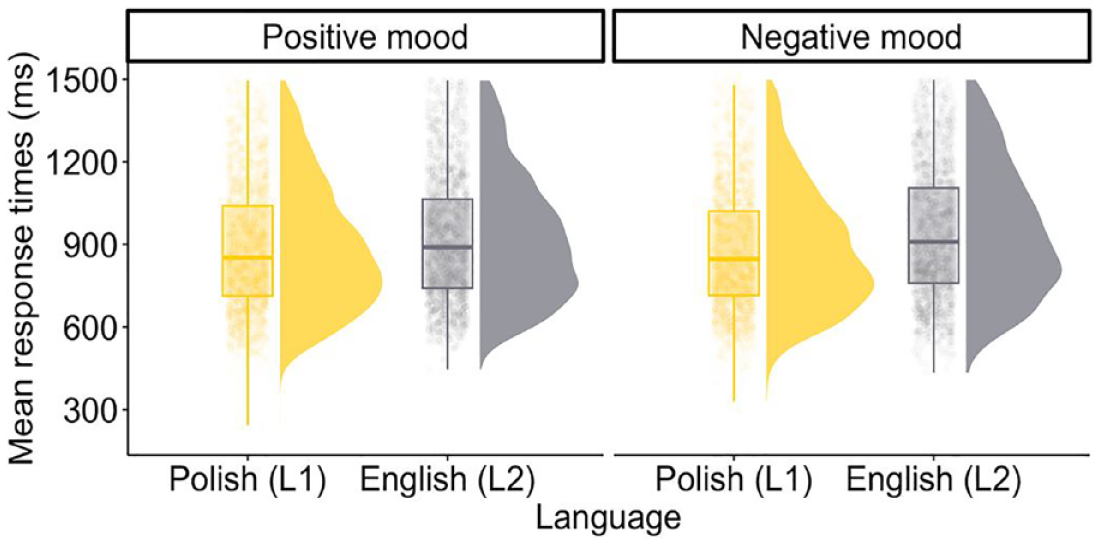
Distribution of the RT data.
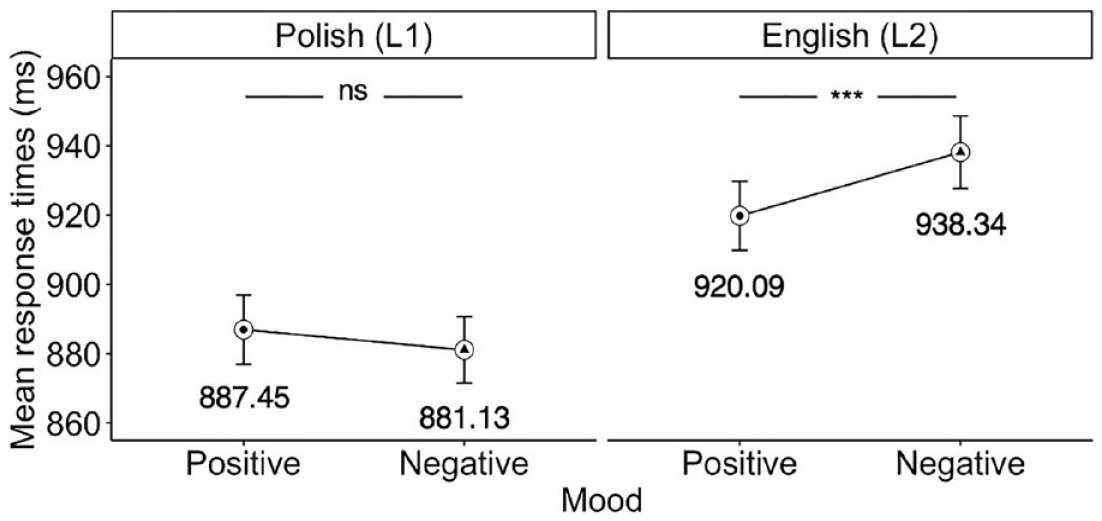
The interactive effects of RTs between mood and the language of operation.
The analysis also yielded a two-way Stereotype congruency × Gender reference interaction. Post hoc comparisons revealed faster RTs for female-related stereotypically congruent than incongruent sentences, p < .001, along with faster RTs for male-related stereotypically incongruent than congruent sentences, p < .001. Moreover, there were faster RTs for female- than male-related stereotypically congruent sentences, p < .001, as well as for male- than female-related stereotypically incongruent sentences, p = .025 (see Table 3).
Finally, the analysis also showed a three-way Mood × Stereotype congruency × Gender reference interaction. Further analyses were performed separately for each mood, revealing a two-way Stereotype congruency × Gender reference interaction in each of them. As for stereotypically congruent sentences, post hoc analysis showed faster RTs for female-related than male-related sentences in both a positive mood, p < .001, and in a negative mood, p < .001. However, a different pattern was found for stereotypically incongruent sentences, with faster RTs for male- than female-related sentences in a positive mood, p = .002, along with no difference in RTs between female- and male-related sentences in a negative mood, p = .447 (see Figure 7 and Table 3). All remaining differences in RTs were statistically non-significant, all p > .05.
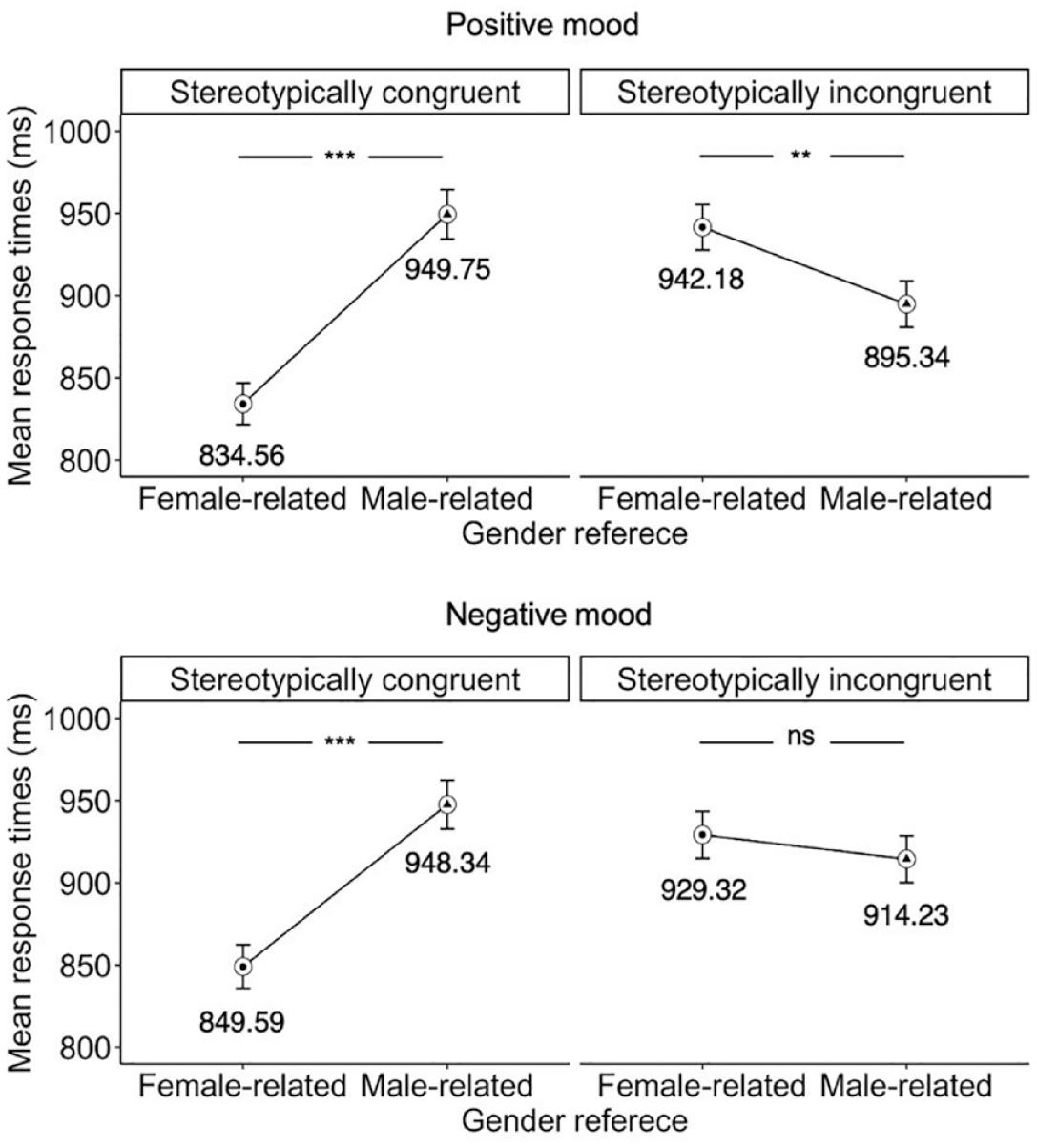
The interactive effects of RTs between sentence congruency and gender reference in the positive and negative mood conditions.
Altogether, the observed behavioural patterns partially align with our predictions, as they point to the existence of mood-driven effects on stereotype thinking being dependent upon the language of operation.
Discussion
This study explored if and how stereotype congruency judgements are modulated by a positive and negative mood in proficient female bilinguals, as reflected in the speed and accuracy of responses to stereotypically congruent and incongruent sentences in L1 and L2, half of which related to men and another half to women. We expected to observe gender stereotype activation being more robust in a positive than negative mood in L1 for gender stereotypically congruent as opposed to incongruent sentences (Huntsinger et al., 2010; P. Wang et al., 2017; Hypothesis 1). In L2, we predicted decreased gender stereotype activation, regardless of the mood type and stereotype congruency (Jankowiak, Naranowicz, et al., 2024; Hypothesis 2).
Partially aligning with our hypotheses, this study offers new evidence for bilinguals’ mood and the language of operation interactively affecting their stereotype congruency judgements at a behavioural level. However, the exact observed behavioural patterns diverged from our predictions, with positive and negative moods differently affecting reaction times in L2, and not in L1, irrespective of stereotype congruency. Specifically, participants made overall faster stereotype congruency judgements in a positive than negative mood in L2, with no between-mood differences in L1, the effect being independent of stereotype congruency.
Language- and mood-independent stereotype congruency effect
First, contrary to what we hypothesised, we found a general effect of stereotype congruency, whereby stereotypically congruent sentences were responded to faster than stereotypically incongruent sentences in both languages and mood types. This aligns with prior monolingual research indicating that processing linguistic information that violates gender stereotypes requires more cognitive effort than the information that reinforces stereotypical expectations regarding women and men (Molinaro et al., 2016; Osterhout et al., 1997; Pesciarelli et al., 2019). Our results thus suggest that sentences challenging gender stereotypes required more cognitive resources, resulting in longer response latencies. This underscores the highly automatic activation of gender stereotypes during language processing (Boroditsky, 2009; Boroditsky et al., 2003; Canal et al., 2015), highlighting their deeply ingrained nature (Jankowiak, Naranowicz, et al., 2024). Crucially, the presence of this stereotype congruency effect is critical for this study, as it indicates that, as intended, participants successfully activated their stereotype knowledge, as triggered by stereotype congruency judgements.
Mood-independent internalisation of gender stereotypes in L1
Contrary to our predictions, automatic stereotype knowledge activation, which would have been reflected in faster responses to stereotype congruent than incongruent sentences, was not facilitated by a positive compared to negative mood in L1 (Curtis, 2013; Park & Banaji, 2000; M. Wang et al., 2015). In line with the MAGK framework (Bless, 2001; Bless et al., 1996), increased reliance on stereotypes in social judgements in a positive relative to negative mood can be attributed to a positive mood promoting, along with a negative mood inhibiting, heuristics-based thinking and reliance on readily accessible knowledge. Yet, in this study, we observed no mood effects on the speed and accuracy of stereotype congruency judgements in L1.
This contradiction with the previous findings may be accounted for by the linguistic nature of this study. Specifically, prior investigations into the interplay between mood and stereotype processing have predominantly adopted a sociological perspective, utilising non-linguistic categorisation tasks (Curtis, 2013; Park & Banaji, 2000). Therefore, it is crucial to acknowledge the potentially distinctive influence of linguistic stimuli and tasks on these processes. In our study, participants made stereotype congruency judgements regarding stereotype-laden sentences, necessitating the automatic activation and retrieval of pre-existing gender stereotypes as integrated with lexico-semantic representations conveyed through linguistic contexts. These linguistic requirements and task demands might have led to continuous and prolonged activation of gender stereotypes at both conceptual and lexical levels, potentially fostering assimilative thinking irrespective of the mood type. To further explore how mood influences stereotype activation at consecutive stages of language processing, future research could employ electroencephalography, which may serve as a direct and precise measure of cognitive processes being activated at lexical and semantic levels. Essentially, the absence of a discernible mood-related impact on stereotype congruency in L1 may also be indicative of a deep internalisation of gender stereotypes at a linguistic level in L1. Considering our participants’ L1 dominance and lifelong residency in an L1-speaking country, their socialisation and exposure to cultural and gender norms primarily occurred in the L1 context, reinforcing gender stereotypes through constant exposure to them in this language. Put simply, in our female bilingual participants, gender stereotypes seem to have been internalised to a point where mood had no discernible impact on their behavioural responses in L1, as gender stereotypes might be overall easily accessible and relied upon in the linguistic context they primarily occurred.
Mood-dependent decreased internalisation of gender stereotypes in L2
Recent electrophysiological evidence has pointed to attenuated automaticity of stereotype knowledge activation in L2 relative to L1, reflecting a weaker internalisation of gender stereotypes within an L2 environment (Jankowiak, Naranowicz, et al., 2024). Here, we observed quicker yet equally accurate stereotype congruency judgements in L2 in a positive relative to negative mood. Although contradicting our original predictions, this finding may in fact signal decreased internalisation of stereotype knowledge in L2. Interpreting the lack of a noticeable mood effect on stereotype congruency judgements in L1 as indicative of deep internalisation of gender stereotypes within the L1 context, one might expect that the presence of an anticipated mood effect in L2 would in fact indicate diminished sensitivity to stereotype-laden information in L2 compared to L1. Specifically, just as the automatic activation of stereotype knowledge masked any behavioural mood effects on stereotype congruency judgements in L1, mood-induced stereotype activation might have manifested in L2, as participants operating in L2 were less influenced by the heightened accessibility of stereotype knowledge triggered by the linguistic stimuli and task requirements. In essence, we believe that the expected mood effect surfaced in L2 rather than L1, suggesting that gender stereotypes might be less deeply internalised in L2 – a language learnt in formal settings with limited social interactions.
This effect aligns with studies on the Foreign Language Effect (FLE; Degner et al., 2012; Opitz & Degner, 2012), previously tested mostly in the context of affecting language and marking a larger psychological distance when operating in L2 compared to L1 (Caldwell-Harris, 2014; Dewaele & Wei, 2013; Jankowiak et al., 2018). This study, therefore, extends the FLE to the context of stereotype activation, indicating that gender stereotypes, as cognitive constructs ingrained in the conceptual store (Stanciu et al., 2019), may be less interconnected with L2 relative to L1 lexico-semantic representations (Jankowiak, Naranowicz, et al., 2024). However, to further explore the role of task requirements in mood effects on stereotype activation in a bilingual context, future research could also apply tasks implicitly (and not only explicitly) activating stereotype knowledge, for instance, by focusing on semantic rather than social aspects of the presented linguistic content in L1 and L2 (see Jankowiak, Naranowicz, et al., 2024).
Alternatively, the presence of a mood effect on stereotype congruency judgements in L2 as opposed to L1 may also be indicative of the L2 linguistic content itself being perceived negatively in a negative compared to positive mood. In an electrophysiological study targeting mood–language interactions, Naranowicz et al. (2022) observed greater cognitive efforts invested in semantic integration and re-evaluation of L2 than L1 sentences in a negative compared to positive mood – the pattern previously observed for negative compared to positive sentences (Jończyk et al., 2016). This implies that linguistic material may in fact be perceived more or less favourably depending on whether an individual is in a positive or negative mood state, respectively. Therefore, the reported slower responses to L2 sentences in a negative compared to positive mood also accord with prior behavioural and electrophysiological research pointing to suppressed semantic integration of negative linguistic content (Jończyk et al., 2016; Jończyk et al., 2024; Zhang et al., 2023), resulting from decreased emotional sensitivity in L2 than in L1 in L1-dominant bilinguals who learnt their L2 in formal rather than immersive contexts.
Self-relevant bias promoted by a positive mood
We also exploratorily examined the role of gender reference (i.e., whether a particular gender stereotype pertains to men or women) in the mood–stereotype activation interactions. Overall, judgements of sentences associated with women were faster and more accurate than those associated with men. A corresponding temporal tendency was also found in response to sentences consistent with stereotypes about women as well as those inconsistent with stereotypes about men. Note that the sentences consistent with female-related stereotypes (e.g., Their
Furthermore, the relationship between stereotype congruency and gender reference was observed to be altered by mood. Stereotype congruency judgements were faster for sentences consistent with female-related relative to male-related stereotypes in both a positive and negative mood, pointing to a bias towards female-related stereotypes occurring irrespectively of the mood type. However, a significant difference between the two mood states emerged for the accuracy of these judgements: in the positive mood, participants demonstrated facilitated accuracy when responding to sentences congruent with female-related compared to male-related stereotypes. Complementarily, in a positive mood, sentences violating male-related stereotypes were responded to faster than sentences violating female-related stereotypes. Together, these findings point to facilitated behavioural responses to female-centric content (i.e., sentences with subjects pertaining to women) in a positive compared to negative mood, indicating that the self-relevant tendencies in social judgements observed in female participants might have additionally been facilitated by a positive mood. These findings corroborate previous research testing the relationship between mood and self-related judgements (see Forgas, 2017 for a review). For instance, Detweiler-Bedell et al. (2006) found that, unlike those in a negative mood, students in a positive mood were more likely to anticipate their own rather than others’ success in academic achievements, pointing to a tendency for more favourable self-centred judgements in a positive compared to negative mood. The observed self-relevant bias is also consistent with theoretical accounts, predicting that a positive mood promotes reliance on cognitive biases (Bless, 2001; Clore & Storbeck, 2006). Notably, the AAI framework predicts that, unlike a negative mood, a positive mood activates heuristics-based thinking, typically leading to more favourable evaluations of an object of judgement (Clore & Storbeck, 2006). Therefore, prior empirical evidence and theoretical accounts together seem to indicate that our participants could have been more sensitive and responsive to self-relevant linguistic content pertaining to their own gender in a positive as opposed to negative mood due to enhanced appraisals of the self. Future research could systematically test interactions between mood and self-evaluations, with a particular focus on how a positive and negative mood alters tendencies for more or less favourable self-judgements.
Limitations and future research directions
While our study provides valuable insights into the interplay between mood and stereotype congruency judgements in bilingualism, it focused on female bilinguals, limiting the generalisability of the findings to other gender groups and more heterogeneous participants. This deliberate choice of a homogeneous sample aimed to enhance internal validity and exert greater control over potential confounding variables, given previous research indicating a more profound reliance on stereotype knowledge among male than female participants (Jankowiak, Naranowicz, et al., 2024; Proverbio et al., 2018). By narrowing down the demographic characteristics of participants, we could effectively reduce variability and isolate specific factors of interest. However, it is crucial to acknowledge the real-world diversity among individuals, encompassing variations in cultural background, language proficiency, socioeconomic status, and other factors. In addition, our study did not account for participants’ multilingual (extending beyond purely bilingual) experiences, which could have an impact on stereotype congruency judgements. Specifically, multilingual participants may exhibit different cognitive and emotional responses due to their broader linguistic repertoire and cultural experiences (Dewaele & Wei, 2013). Consequently, the study’s findings may not seamlessly extend to a broader population that encompasses individuals with different characteristics. Moving forward, we believe that expanding our investigation to a more diverse participant pool will provide a richer understanding of how cultural and social factors intersect with mood and language, shaping stereotype judgements. This broader approach will contribute to a more representative comprehension of the complex dynamics at play in bilingualism and stereotype processing.
Conclusion
In conclusion, our study offers valuable insights into the dynamics of mood and the language of operation in the context of stereotype congruency judgements among bilingual female participants. Our results indicated that bilinguals’ positive and negative mood states interact with the language of operation, irrespective of stereotype congruency. Overall, the observed facilitatory effect of a positive relative to negative mood in L2 as opposed to L1 points to decreased internalisation of gender stereotypes and their weaker accessibility in L2 compared to L1. Moreover, exploratory analyses also revealed strong language-independent self-reference tendencies, with faster and more accurate responses to sentences related to participants’ own gender. Such a self-referent bias was additionally strengthened in a positive compared to negative mood, suggesting that a positive mood may prioritise self-related judgements. Together, our study illuminates the complex interplay among mood, the language of operation, and stereotype activation, enhancing our understanding of the cognitive processes underpinning social judgements in bilingual individuals.
Footnotes
Author contribution statement
MN: conceptualisation; methodology; software; validation; formal analysis; visualisation; investigation; data curation; writing – original draft; writing – review & editing; KJ: conceptualisation; methodology; validation; writing – original draft; writing – review & editing
Declaration of conflicting interests
The author(s) declared no potential conflicts of interest with respect to the research, authorship, and/or publication of this article.
Funding
The author(s) received no financial support for the research, authorship, and/or publication of this article.
